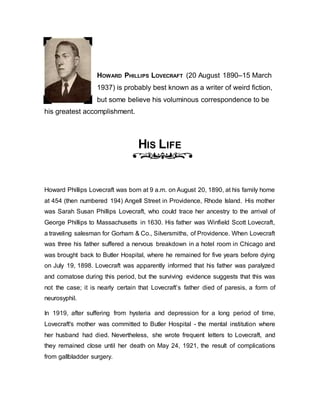
HOWARD PHILLIPS LOVECRAFT (20 August 1890–15 March
1937) is probably best known as a writer of weird fiction,
but some believe his voluminous correspondence to be
his greatest accomplishment.
HIS LIFE
Howard Phillips Lovecraft was born at 9 a.m. on August 20, 1890, at his family home
at 454 (then numbered 194) Angell Street in Providence, Rhode Island. His mother
was Sarah Susan Phillips Lovecraft, who could trace her ancestry to the arrival of
George Phillips to Massachusetts in 1630. His father was Winfield Scott Lovecraft,
a traveling salesman for Gorham & Co., Silversmiths, of Providence. When Lovecraft
was three his father suffered a nervous breakdown in a hotel room in Chicago and
was brought back to Butler Hospital, where he remained for five years before dying
on July 19, 1898. Lovecraft was apparently informed that his father was paralyzed
and comatose during this period, but the surviving evidence suggests that this was
not the case; it is nearly certain that Lovecraft’s father died of paresis, a form of
neurosyphil.
In 1919, after suffering from hysteria and depression for a long period of time,
Lovecraft's mother was committed to Butler Hospital - the mental institution where
her husband had died. Nevertheless, she wrote frequent letters to Lovecraft, and
they remained close until her death on May 24, 1921, the result of complications
from gallbladder surgery.
Throughout his life, selling stories and paid literary work for others did not provide
enough to cover Lovecraft's basic expenses. Living frugally, he subsisted on an
inheritance that was nearly depleted by the time of his last years. He sometimes
went without food to afford the cost of mailing letters. Eventually, he was forced to
move to smaller and meager lodgings with his surviving aunt. He was also deeply
affected by the suicide of his correspondent Robert E. Howard. In early 1937,
Lovecraft was diagnosed with cancer of the small intestine, and suffered from
malnutrition as a result. He lived in constant pain until his death on March 15, 1937,
in Providence.
HIS WRITINGS
The UAPA reinvigorated Lovecraft and incited him to contribute many poems and
essays; in 1916, his first published story, The Alchemist, appeared in the United
Amateur Press Association. The earliest commercially published work came in 1922,
when he was thirty-one. By this time he had begun to build what became a huge
network of correspondents. His lengthy and frequent missives would make him one
of the great letter writers of the century. Among his correspondents were Robert
Bloch (Psycho), Clark Ashton Smith, and Robert E. Howard (Conan the Barbarian
series). Many former aspiring authors later paid tribute to his mentoring and
encouragement through the correspondence.
His oeuvre is sometimes seen as consisting of three periods: an early Edgar Allan
Poe influence; followed by a Lord Dunsany–inspired Dream Cycle; and finally the
Cthulhu Mythos stories. However, many distinctive ideas and entities present in the
third period were introduced in the earlier works, such as the 1917 story "Dagon",
and the threefold classification is partly overlapping.
Despite being known primarily as a horror writer, Lovecraft wrote on a remarkably
wide variety of subjects.
 Fiction – A list of all of Lovecraft’s fiction, including revisions and
collaborations.
 Poetry – Lovecraft, like Poe, at one time considered himself primarily a poet.
 Letters – Lovecraft was a voluminous letter-writer, and it is estimated that he
wrote over 100,000 letters in his lifetime.
 Amateur Journalism – Lovecraft’s talents blossomed under the influence of
amateur journalism.
 Literary Criticism – Lovecraft not only reviewed the works of others, he wrote
numerous pieces on his philosophy of literature.
 Science – Science fascinated Lovecraft from an early age, and he had
especially strong interests in astronomy and chemistry.
 Travel – Although some think of Lovecraft as a reclusive stay-at-home, he
actually traveled quite extensively along the Atlantic seaboard.
 Philosophy – Besides his literary philosophy, Lovecraft held strong views on
the nature of the universe, which is clear throughout many of his tales.
 Autobiographical – Lovecraft wrote several brief autobiographical sketches
for his correspondents.
HIS CREATIONS
A Lovecraftian Bestiary
A compendium of Lovecraft’s fictional creatures that have, unfortunately, become
the focus of too much attention.
The Necronomicon and other Grimoires
Quotes from Lovecraft’s letters and tales regarding the fictional tomes that he
frequently mentioned in his works.
A Lovecraftian Bestiary
I really agree that Yog-Sothoth is a basically immature conception, & unfitted for
really serious literature.
H.P. Lovecraft to Frank Belknap Long, February 27, 1931
| Azathoth | Chaugnar Faugn | Cthulhu | Dagon | Deep Ones |
| Elder Things | Ghouls | Great Race | Hastur | Mi-Go | Night-gaunts |
| Nyarlathotep | Shoggoths | Shub-Niggurath | Tsathoggua | Yog-Sothoth |
The Necronomicon and Other Grimoires
Frequently, Lovecraft made reference to ancient, moldering tomes that contained secrets
man was not meant to know. Most of these were fictional, but a few of them were “legitimate”
occult works. By mentioning factual and fictional documents in the samecontext, this helped
to make the false books seem real. Lovecraft made only brief mentions of these books,
primarily to add atmosphere, and rarely described them in any detail. The best-known of
these fictional manuscripts is his Necronomicon, about which he said the most. So well-
constructed was his information on this fabled text (helped along by modern-day hoaxers
bent on making a profit from the ignorance of others) that people to this day believe this
book to be real.
| The Book of Eibon/Livre d’Eibon/Liber Ivonis |
| Cultes des Goules | De Vermis Mysteriis | The Eltdown Shards |
| The Necronomicon/Al Azif | The People of the Monolith |
| The Pnakotic Manuscripts | Seven Cryptical Books of Hsan |
| Unaussprechlichen Kulten/Black Book/Nameless Cults |
| Non-Fictional Books |

H.p lovecraft

  • 1.
    HOWARD PHILLIPS LOVECRAFT(20 August 1890–15 March 1937) is probably best known as a writer of weird fiction, but some believe his voluminous correspondence to be his greatest accomplishment. HIS LIFE Howard Phillips Lovecraft was born at 9 a.m. on August 20, 1890, at his family home at 454 (then numbered 194) Angell Street in Providence, Rhode Island. His mother was Sarah Susan Phillips Lovecraft, who could trace her ancestry to the arrival of George Phillips to Massachusetts in 1630. His father was Winfield Scott Lovecraft, a traveling salesman for Gorham & Co., Silversmiths, of Providence. When Lovecraft was three his father suffered a nervous breakdown in a hotel room in Chicago and was brought back to Butler Hospital, where he remained for five years before dying on July 19, 1898. Lovecraft was apparently informed that his father was paralyzed and comatose during this period, but the surviving evidence suggests that this was not the case; it is nearly certain that Lovecraft’s father died of paresis, a form of neurosyphil. In 1919, after suffering from hysteria and depression for a long period of time, Lovecraft's mother was committed to Butler Hospital - the mental institution where her husband had died. Nevertheless, she wrote frequent letters to Lovecraft, and they remained close until her death on May 24, 1921, the result of complications from gallbladder surgery.
  • 2.
    Throughout his life,selling stories and paid literary work for others did not provide enough to cover Lovecraft's basic expenses. Living frugally, he subsisted on an inheritance that was nearly depleted by the time of his last years. He sometimes went without food to afford the cost of mailing letters. Eventually, he was forced to move to smaller and meager lodgings with his surviving aunt. He was also deeply affected by the suicide of his correspondent Robert E. Howard. In early 1937, Lovecraft was diagnosed with cancer of the small intestine, and suffered from malnutrition as a result. He lived in constant pain until his death on March 15, 1937, in Providence. HIS WRITINGS The UAPA reinvigorated Lovecraft and incited him to contribute many poems and essays; in 1916, his first published story, The Alchemist, appeared in the United Amateur Press Association. The earliest commercially published work came in 1922, when he was thirty-one. By this time he had begun to build what became a huge network of correspondents. His lengthy and frequent missives would make him one of the great letter writers of the century. Among his correspondents were Robert Bloch (Psycho), Clark Ashton Smith, and Robert E. Howard (Conan the Barbarian series). Many former aspiring authors later paid tribute to his mentoring and encouragement through the correspondence. His oeuvre is sometimes seen as consisting of three periods: an early Edgar Allan Poe influence; followed by a Lord Dunsany–inspired Dream Cycle; and finally the Cthulhu Mythos stories. However, many distinctive ideas and entities present in the
  • 3.
    third period wereintroduced in the earlier works, such as the 1917 story "Dagon", and the threefold classification is partly overlapping. Despite being known primarily as a horror writer, Lovecraft wrote on a remarkably wide variety of subjects.  Fiction – A list of all of Lovecraft’s fiction, including revisions and collaborations.  Poetry – Lovecraft, like Poe, at one time considered himself primarily a poet.  Letters – Lovecraft was a voluminous letter-writer, and it is estimated that he wrote over 100,000 letters in his lifetime.  Amateur Journalism – Lovecraft’s talents blossomed under the influence of amateur journalism.  Literary Criticism – Lovecraft not only reviewed the works of others, he wrote numerous pieces on his philosophy of literature.  Science – Science fascinated Lovecraft from an early age, and he had especially strong interests in astronomy and chemistry.  Travel – Although some think of Lovecraft as a reclusive stay-at-home, he actually traveled quite extensively along the Atlantic seaboard.  Philosophy – Besides his literary philosophy, Lovecraft held strong views on the nature of the universe, which is clear throughout many of his tales.  Autobiographical – Lovecraft wrote several brief autobiographical sketches for his correspondents. HIS CREATIONS
  • 4.
    A Lovecraftian Bestiary Acompendium of Lovecraft’s fictional creatures that have, unfortunately, become the focus of too much attention. The Necronomicon and other Grimoires Quotes from Lovecraft’s letters and tales regarding the fictional tomes that he frequently mentioned in his works. A Lovecraftian Bestiary I really agree that Yog-Sothoth is a basically immature conception, & unfitted for really serious literature. H.P. Lovecraft to Frank Belknap Long, February 27, 1931 | Azathoth | Chaugnar Faugn | Cthulhu | Dagon | Deep Ones | | Elder Things | Ghouls | Great Race | Hastur | Mi-Go | Night-gaunts | | Nyarlathotep | Shoggoths | Shub-Niggurath | Tsathoggua | Yog-Sothoth |
  • 5.
    The Necronomicon andOther Grimoires Frequently, Lovecraft made reference to ancient, moldering tomes that contained secrets man was not meant to know. Most of these were fictional, but a few of them were “legitimate” occult works. By mentioning factual and fictional documents in the samecontext, this helped to make the false books seem real. Lovecraft made only brief mentions of these books, primarily to add atmosphere, and rarely described them in any detail. The best-known of these fictional manuscripts is his Necronomicon, about which he said the most. So well- constructed was his information on this fabled text (helped along by modern-day hoaxers bent on making a profit from the ignorance of others) that people to this day believe this book to be real. | The Book of Eibon/Livre d’Eibon/Liber Ivonis | | Cultes des Goules | De Vermis Mysteriis | The Eltdown Shards | | The Necronomicon/Al Azif | The People of the Monolith | | The Pnakotic Manuscripts | Seven Cryptical Books of Hsan | | Unaussprechlichen Kulten/Black Book/Nameless Cults | | Non-Fictional Books |