

HOW WE TOOK OUR SERVER-
SIDE APPLICATION TO THE
CLOUD…
…and liked what we got
Agenda
 Where we started
 What we did
 Paradigm shift


                     2
BACKGROUND
Who‟s talking?
   Fred Simon
   @freddy33
   Chief Architect of JFrog
   Also Head of DevOps
   Co-author of Artifactory

                               4
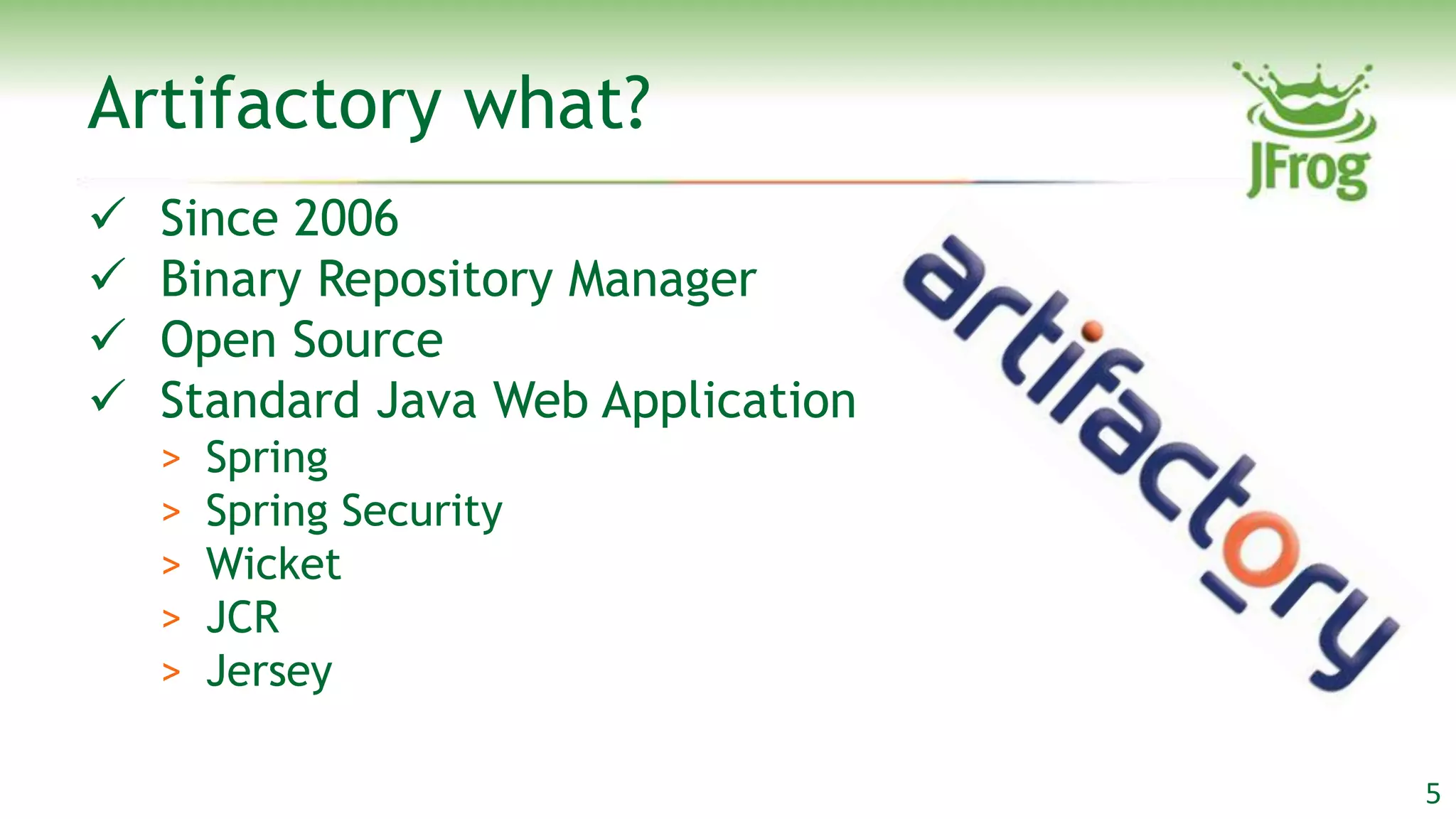
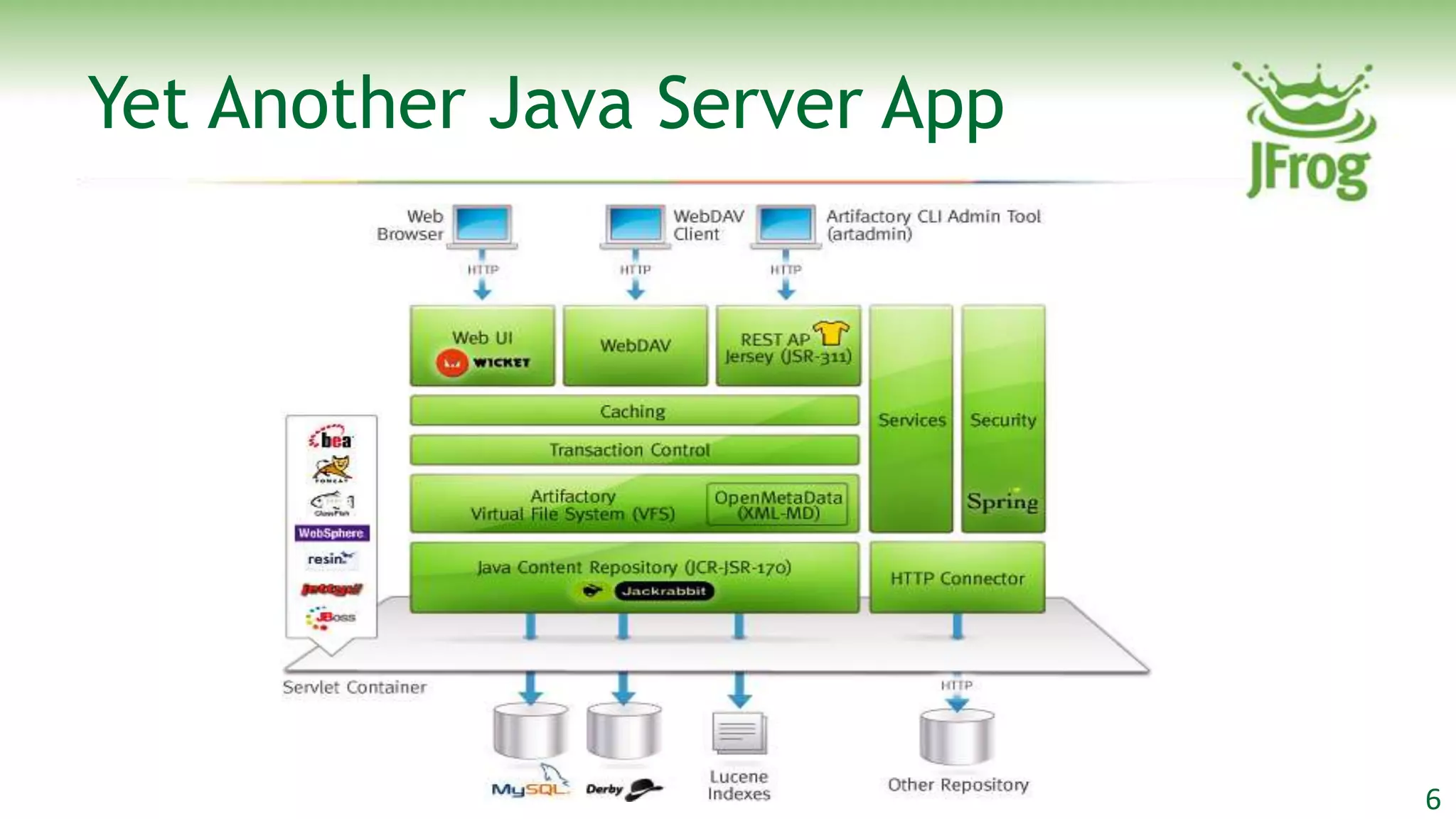
Artifactory what?
   Since 2006
   Binary Repository Manager
   Open Source
   Standard Java Web Application
    >   Spring
    >   Spring Security
    >   Wicket
    >   JCR
    >   Jersey

                                    5
Yet Another Java Server App


                              6
Moving Forward
 Community success
 JFrog established in 2008
 JavaOne 2009
  > Pro version
  > Software as a Service (SaaS version)
    › Heavly used by OSS community

                                           7
Artifactory SaaS
 Benefits for the user:
  > Zero maintenance
     › Backups
     › Updates
     › Infrastructure
  > Support
 Drawbacks for the user:
  > Can‟t install user plugins

                                 8
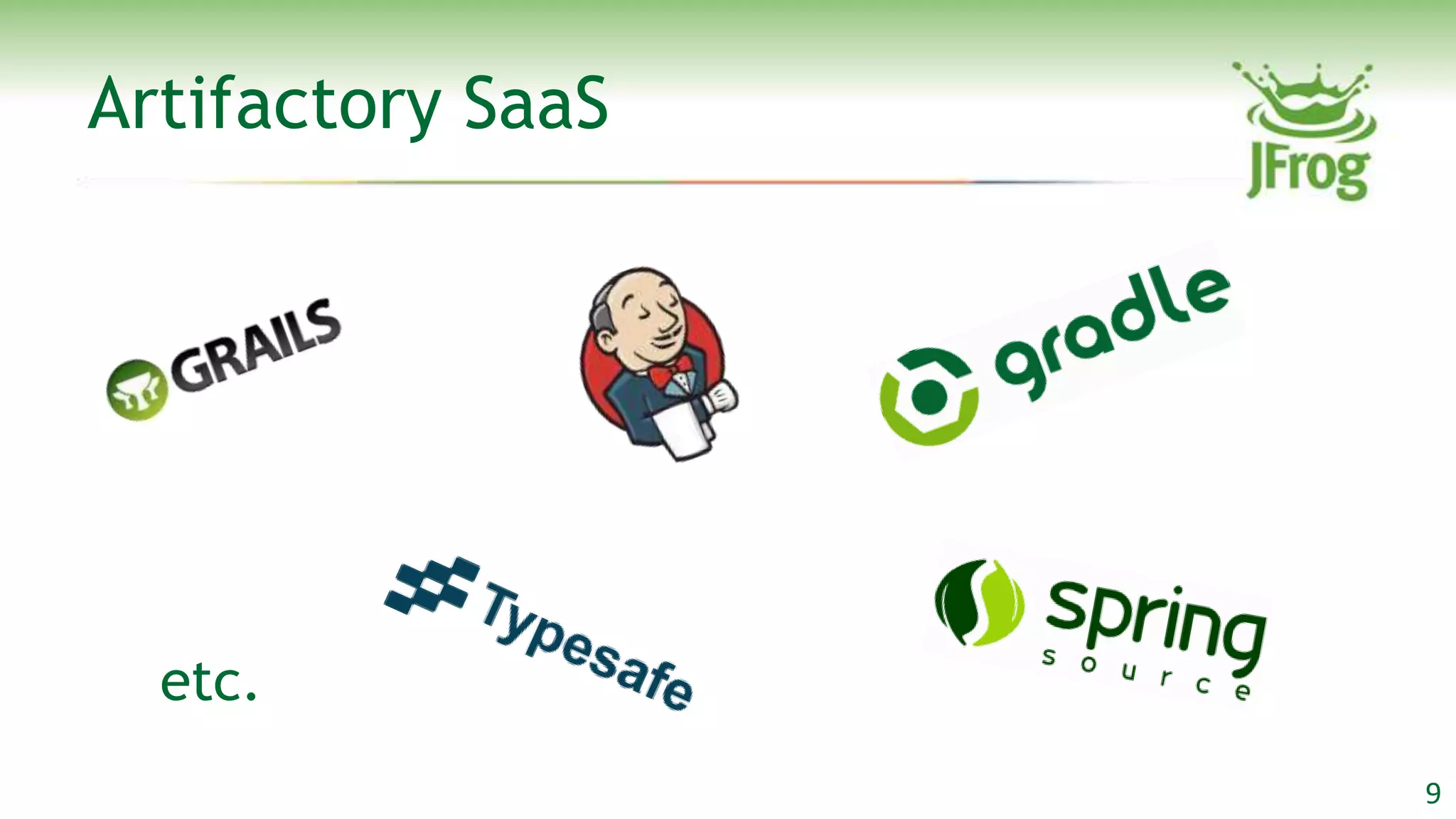
Artifactory SaaS


  etc.
                   9
Moving Forward
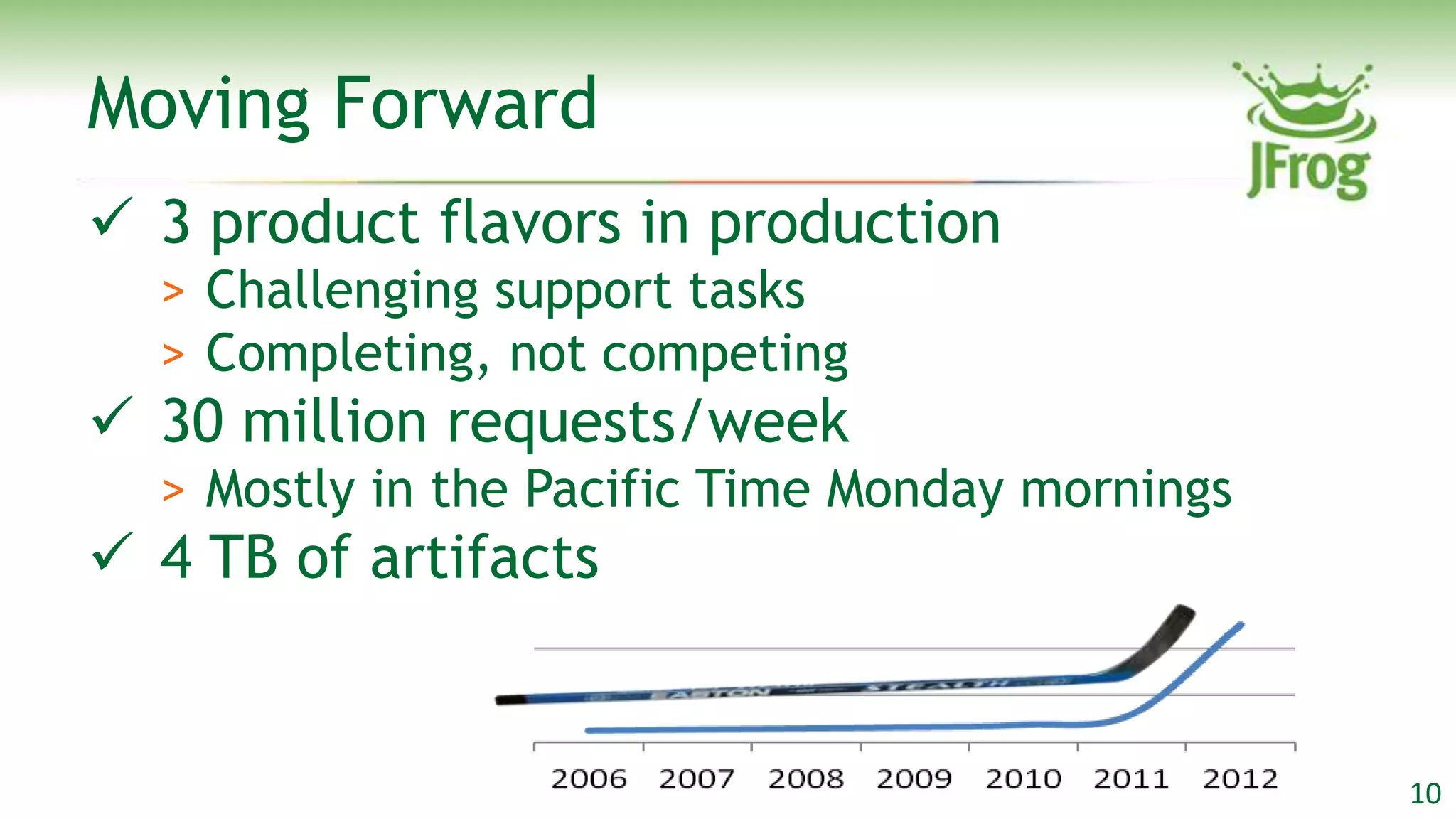
 3 product flavors in production
  > Challenging support tasks
  > Completing, not competing
 30 million requests/week
  > Mostly in the Pacific Time Monday mornings
 4 TB of artifacts


                                                 10
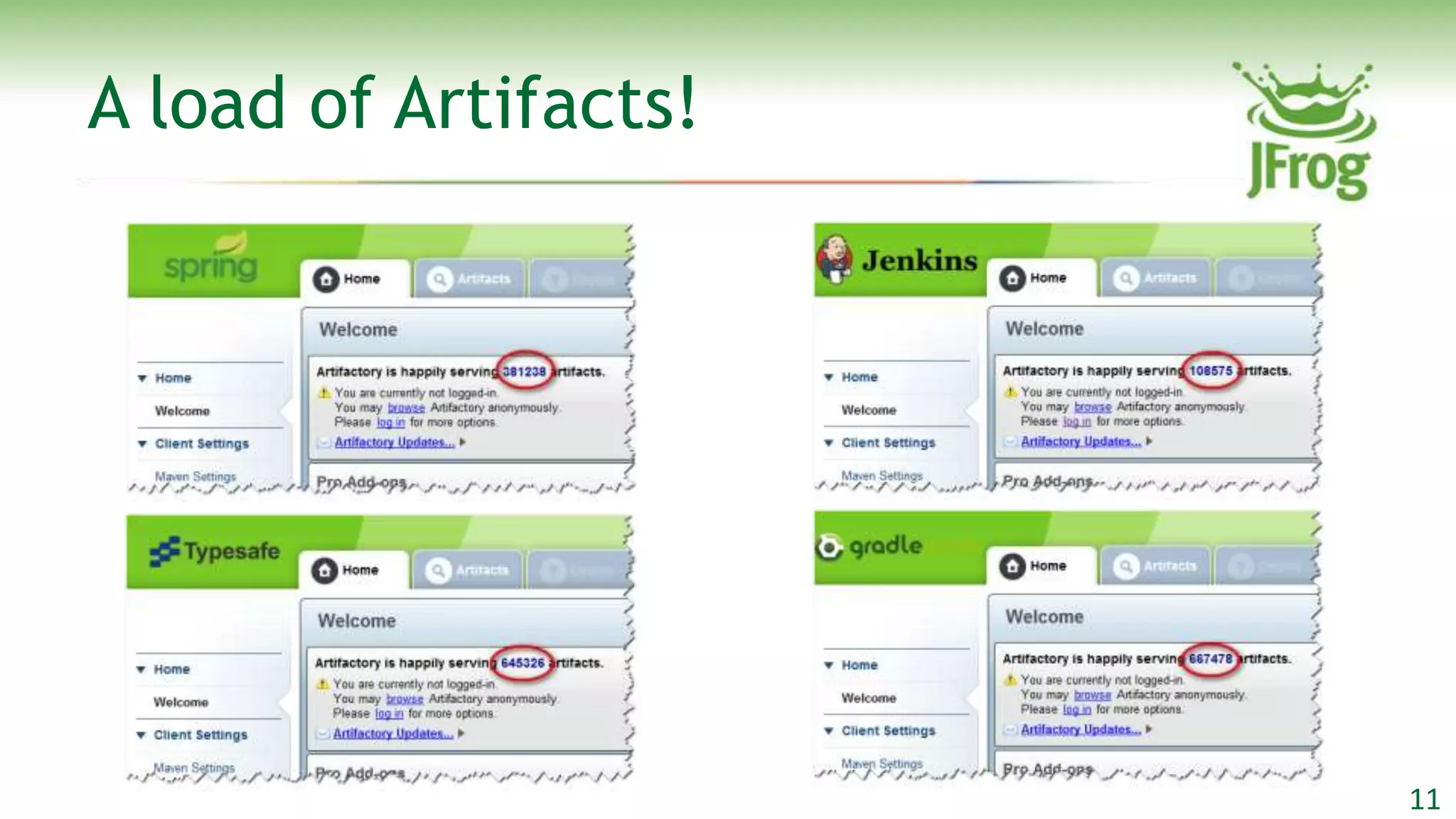
A load of Artifacts!


                       11
JOURNEY TO
 THE CLOUD
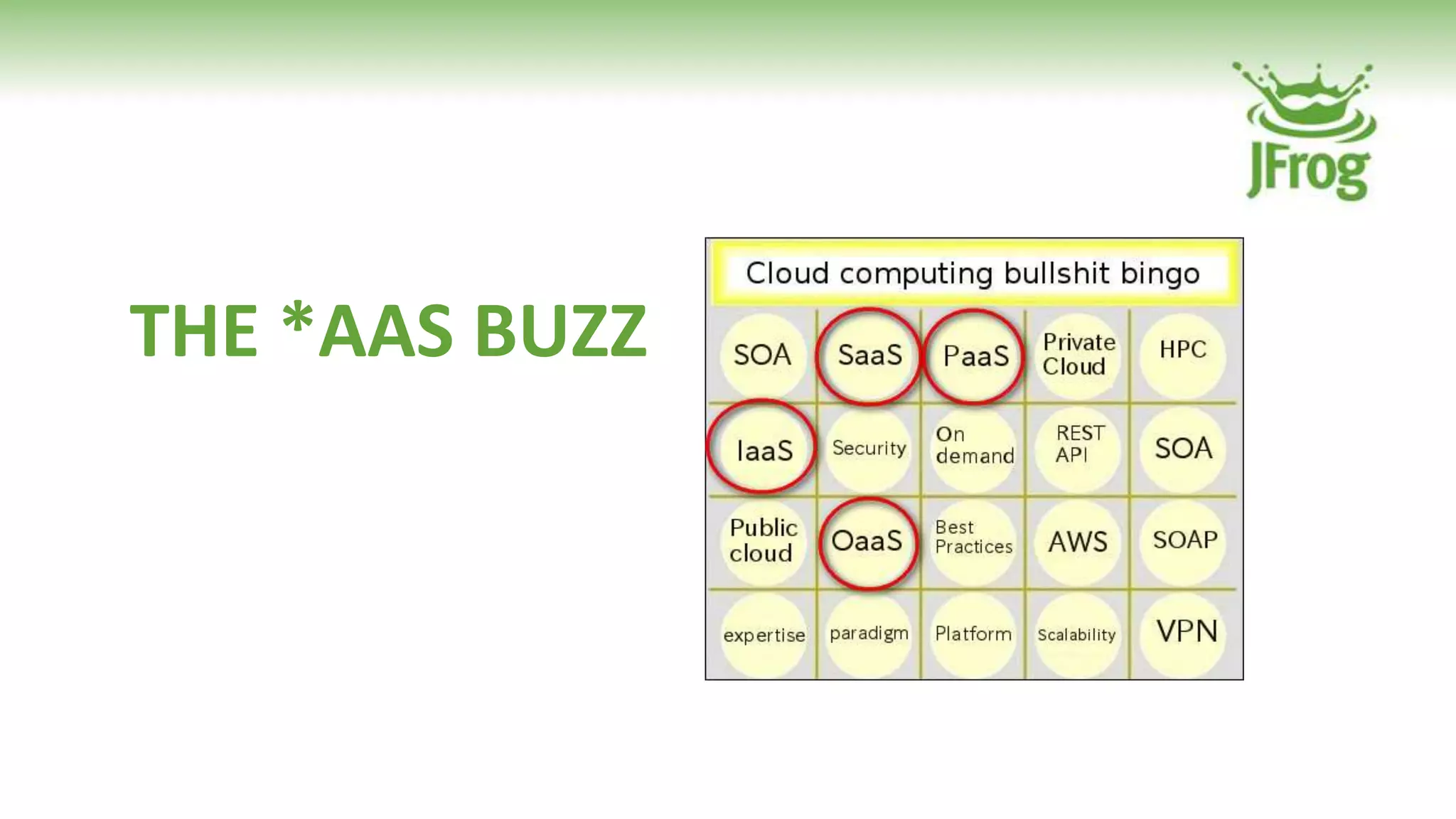
THE *AAS BUZZ
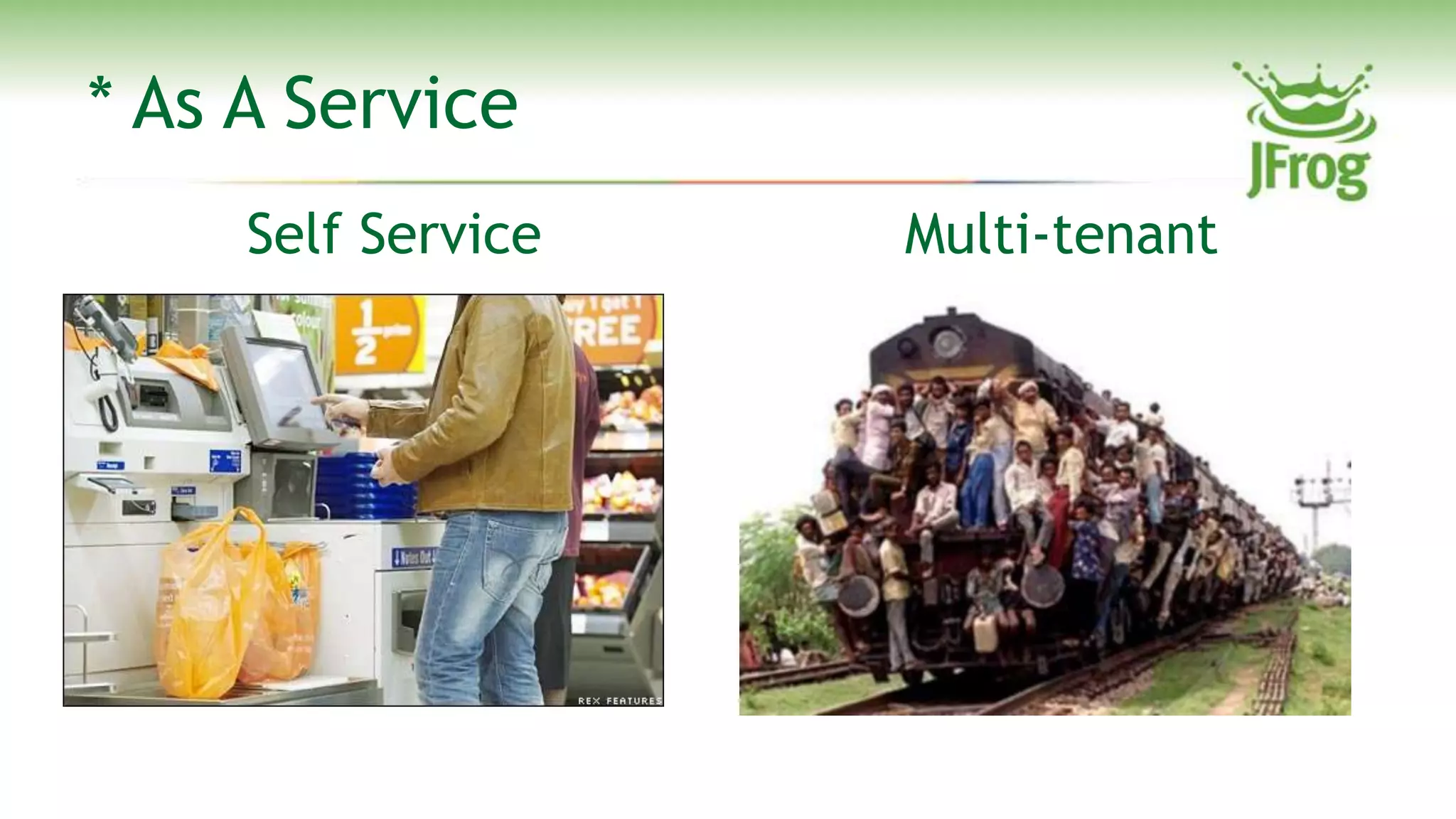
* As A Service
     Self Service   Multi-tenant
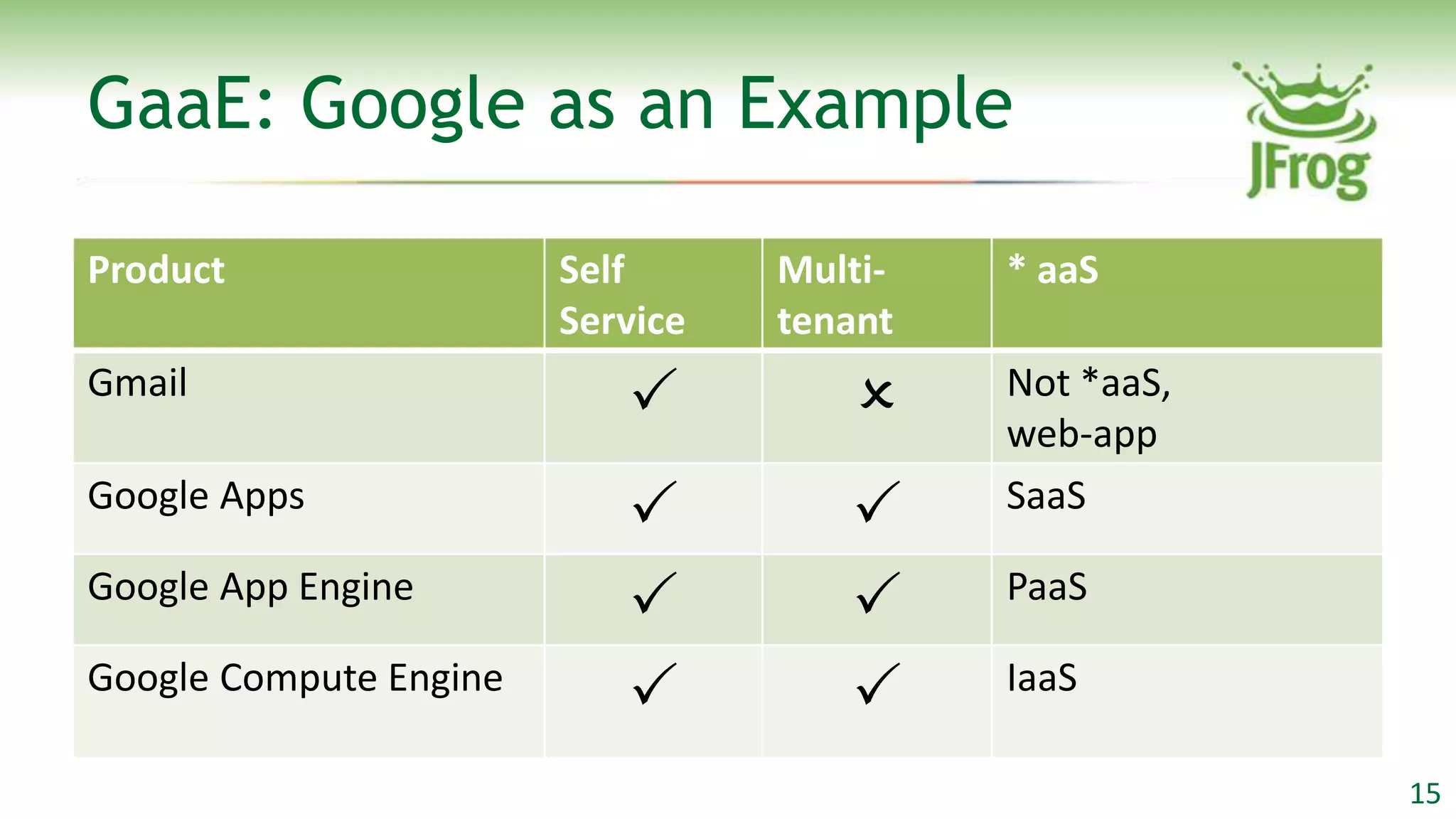
GaaE: Google as an Example

Product                 Self      Multi-   * aaS
                        Service   tenant
Gmail
                                         Not *aaS,
                                           web-app
Google Apps
                                         SaaS

Google App Engine
                                         PaaS

Google Compute Engine
                                         IaaS

                                                       15
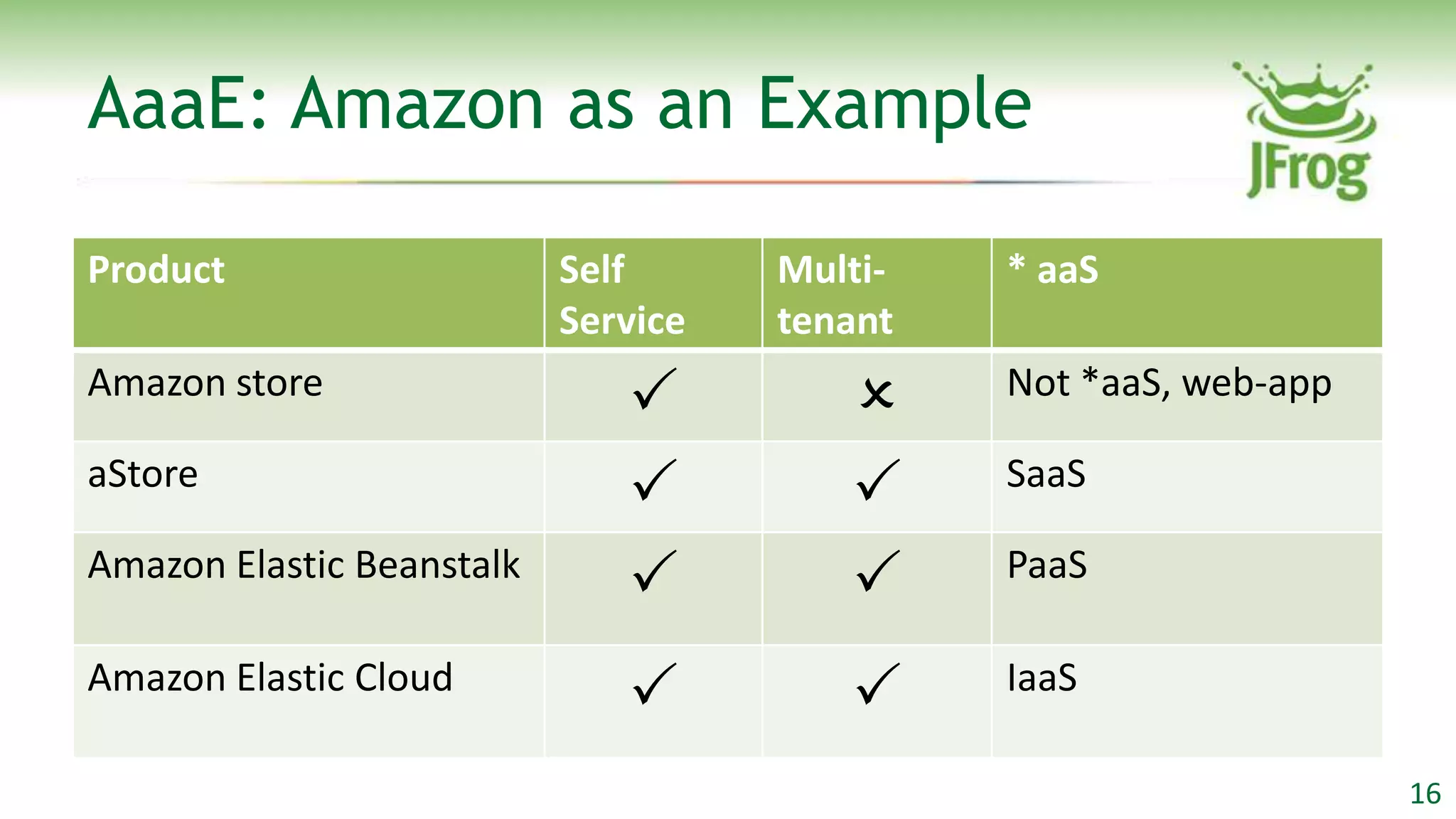
AaaE: Amazon as an Example

Product                    Self      Multi-   * aaS
                           Service   tenant
Amazon store
                                            Not *aaS, web-app

aStore
                                            SaaS

Amazon Elastic Beanstalk
                                            PaaS

Amazon Elastic Cloud
                                            IaaS

                                                                  16
The SaaS Pains - Overview
 Multi-tenancy
 Platform selection
  > PaaS or IaaS
 DB schema updates


                            17
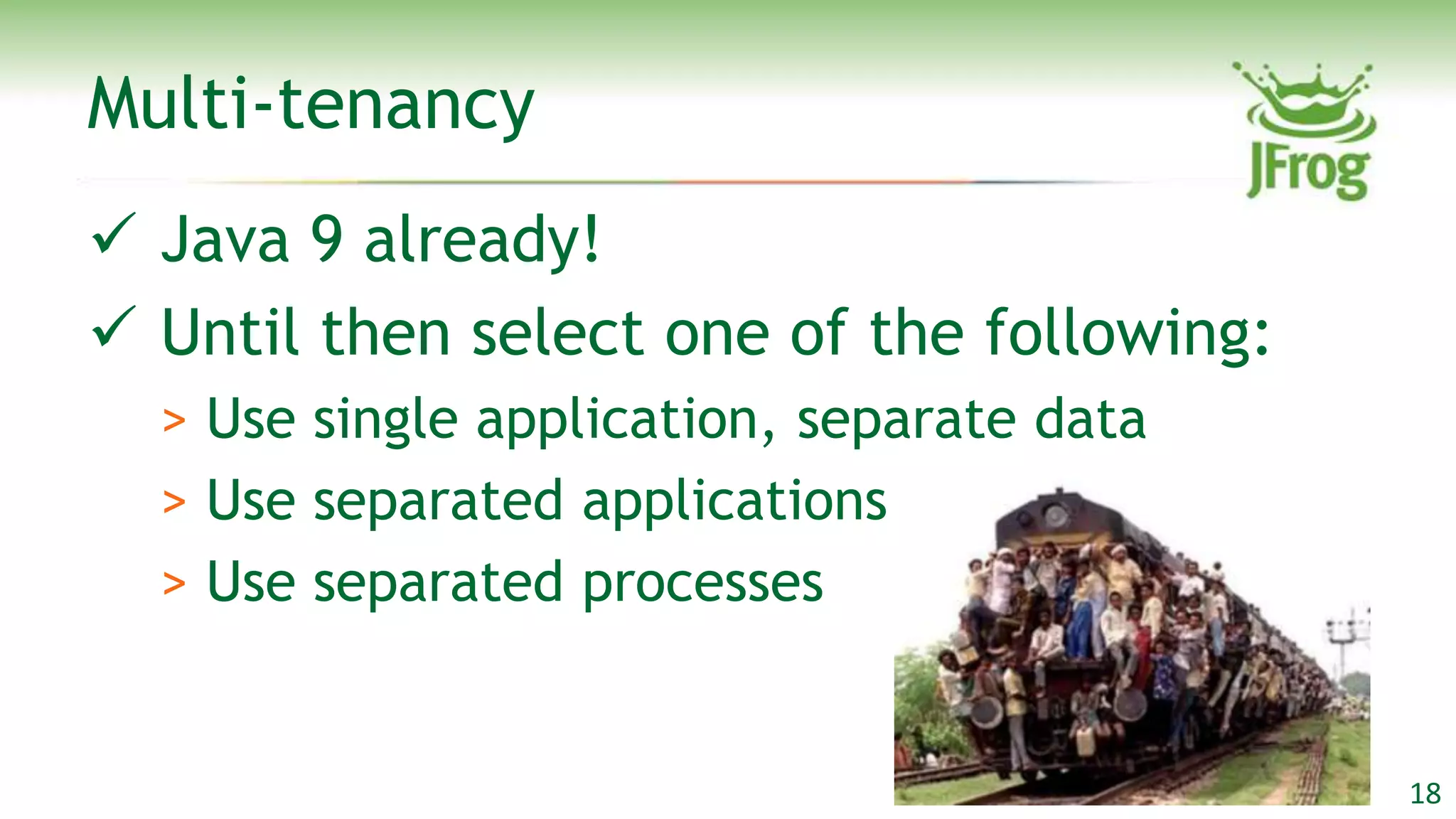
Multi-tenancy
 Java 9 already!
 Until then select one of the following:
  > Use single application, separate data
  > Use separated applications
  > Use separated processes


                                            18
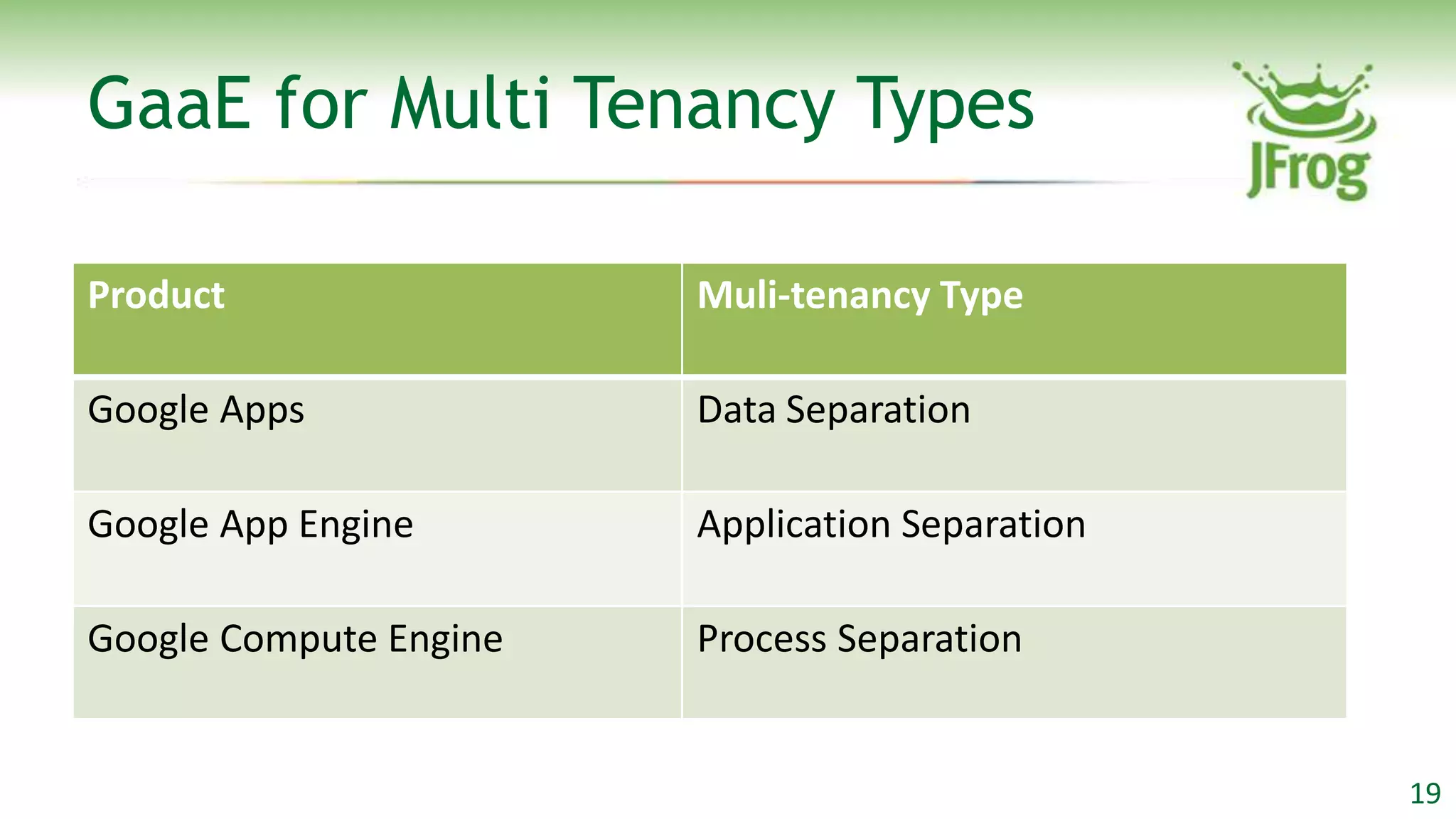
GaaE for Multi Tenancy Types

Product                 Muli-tenancy Type

Google Apps             Data Separation

Google App Engine       Application Separation

Google Compute Engine   Process Separation


                                                 19
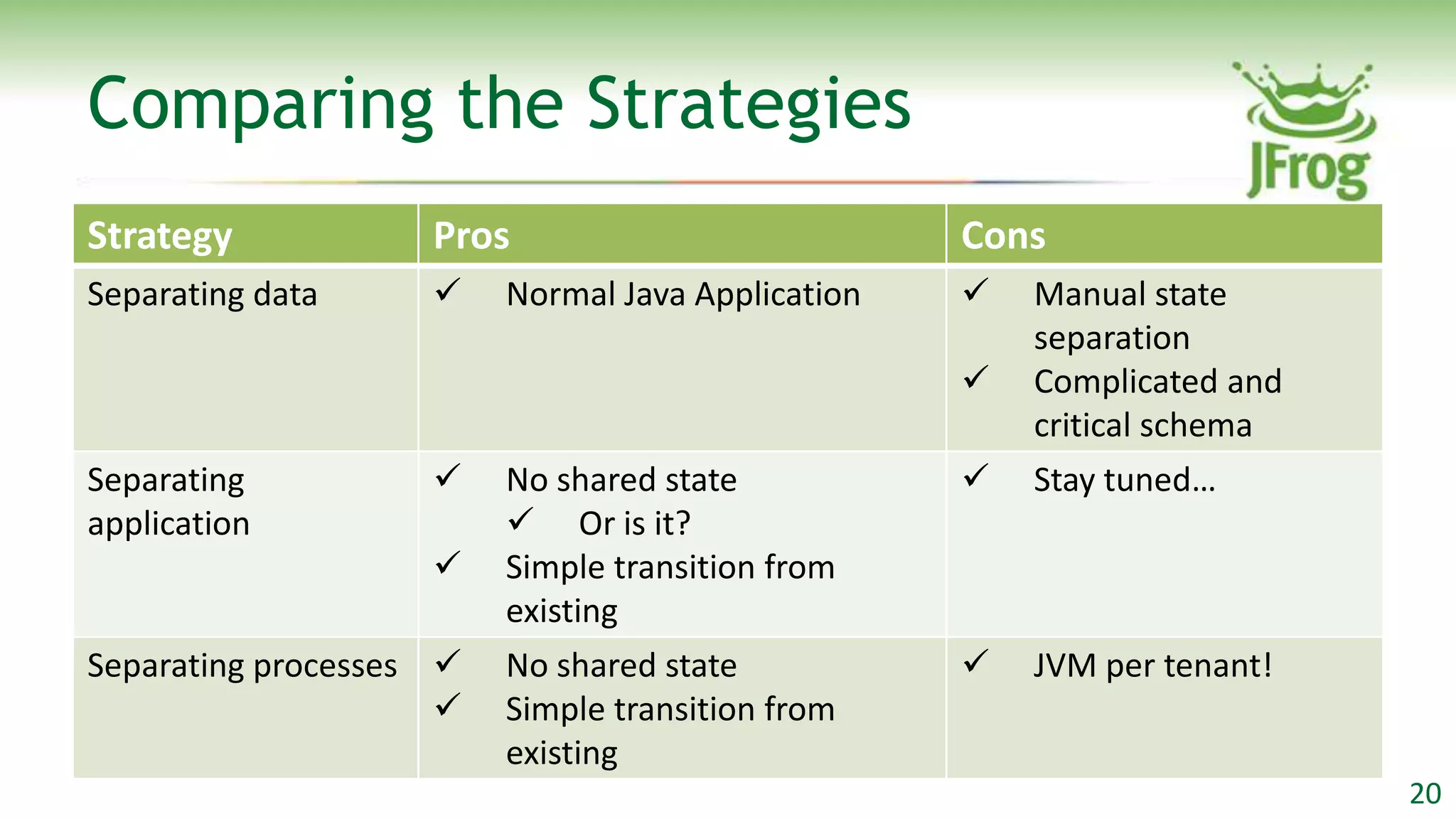
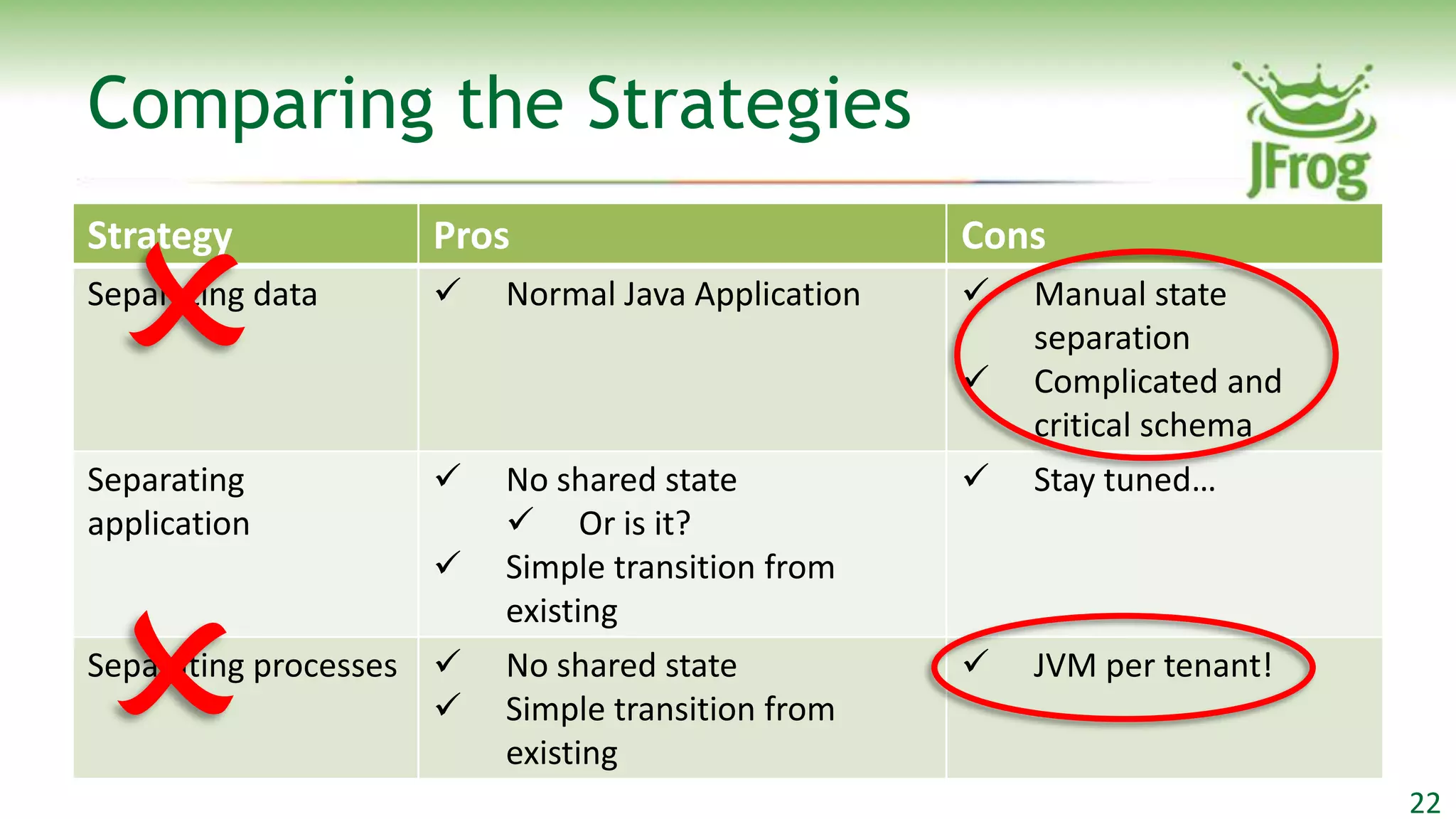
Comparing the Strategies
Strategy            Pros                           Cons
Separating data         Normal Java Application      Manual state
                                                       separation
                                                      Complicated and
                                                       critical schema
Separating              No shared state              Stay tuned…
application               Or is it?
                        Simple transition from
                         existing
Separating processes    No shared state              JVM per tenant!
                        Simple transition from
                         existing
                                                                         20
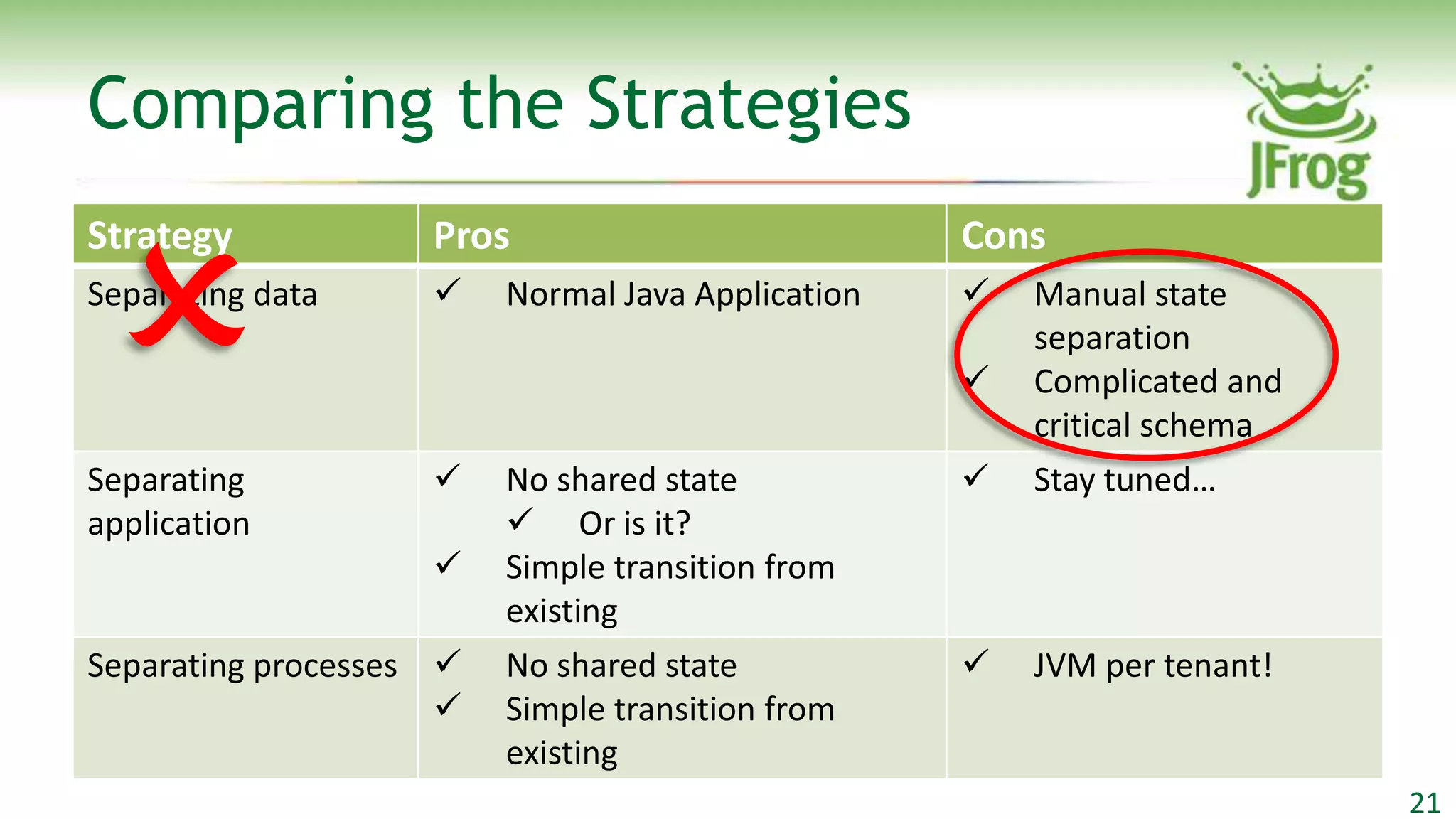
Comparing the Strategies


 
Strategy            Pros                           Cons
Separating data         Normal Java Application      Manual state
                                                       separation
                                                      Complicated and
                                                       critical schema
Separating              No shared state              Stay tuned…
application               Or is it?
                        Simple transition from
                         existing
Separating processes    No shared state              JVM per tenant!
                        Simple transition from
                         existing
                                                                         21
Comparing the Strategies


 
Strategy            Pros                           Cons
Separating data         Normal Java Application      Manual state
                                                       separation
                                                      Complicated and
                                                       critical schema
Separating              No shared state              Stay tuned…
application               Or is it?
                        Simple transition from



                         existing
Separating processes    No shared state              JVM per tenant!
                        Simple transition from
                         existing
                                                                         22
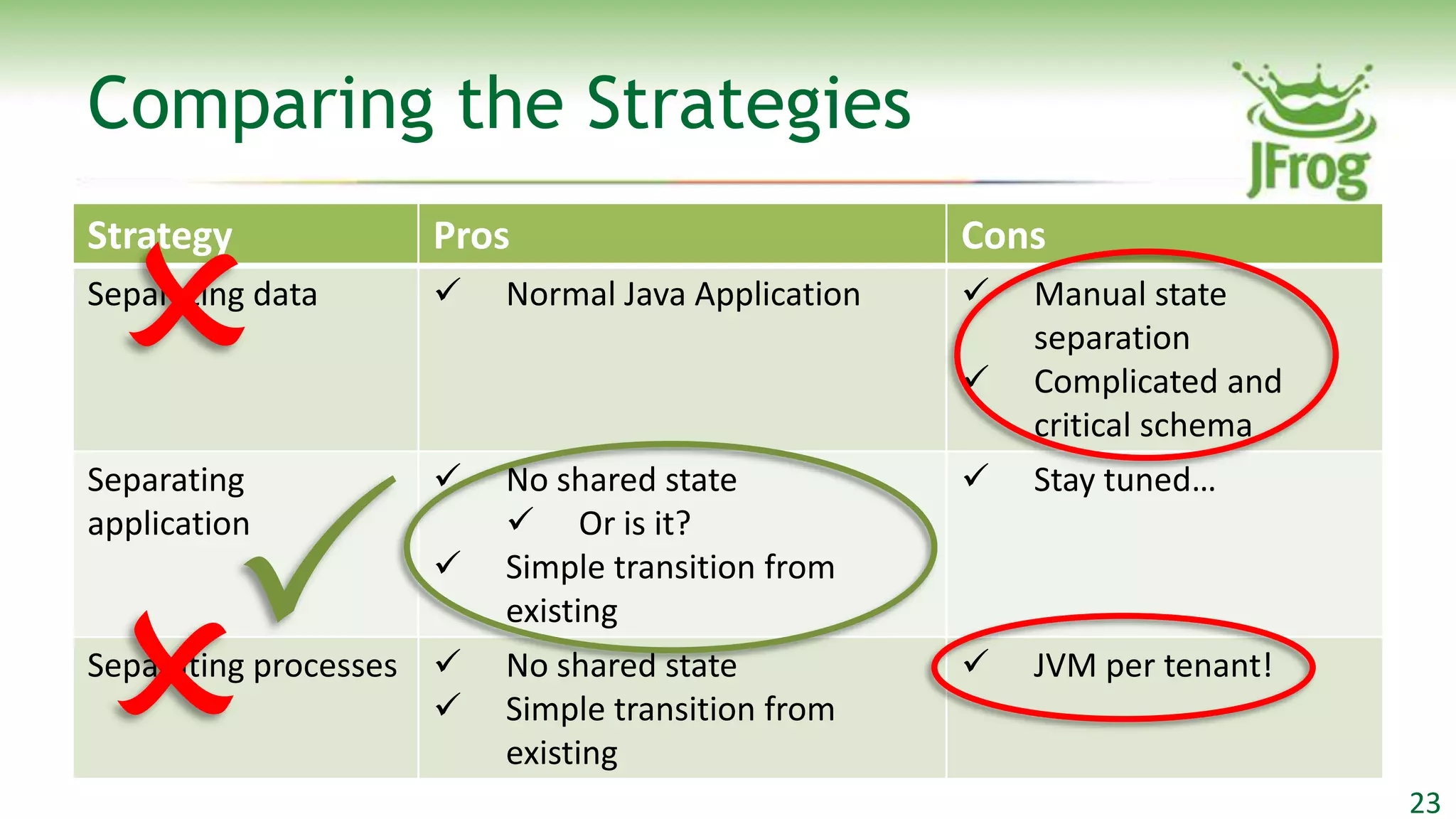
Comparing the Strategies



Strategy            Pros                           Cons
Separating data         Normal Java Application      Manual state
                                                       separation
                                                      Complicated and
                                                       critical schema


 
Separating              No shared state              Stay tuned…
application               Or is it?
                        Simple transition from



                         existing
Separating processes    No shared state              JVM per tenant!
                        Simple transition from
                         existing
                                                                         23
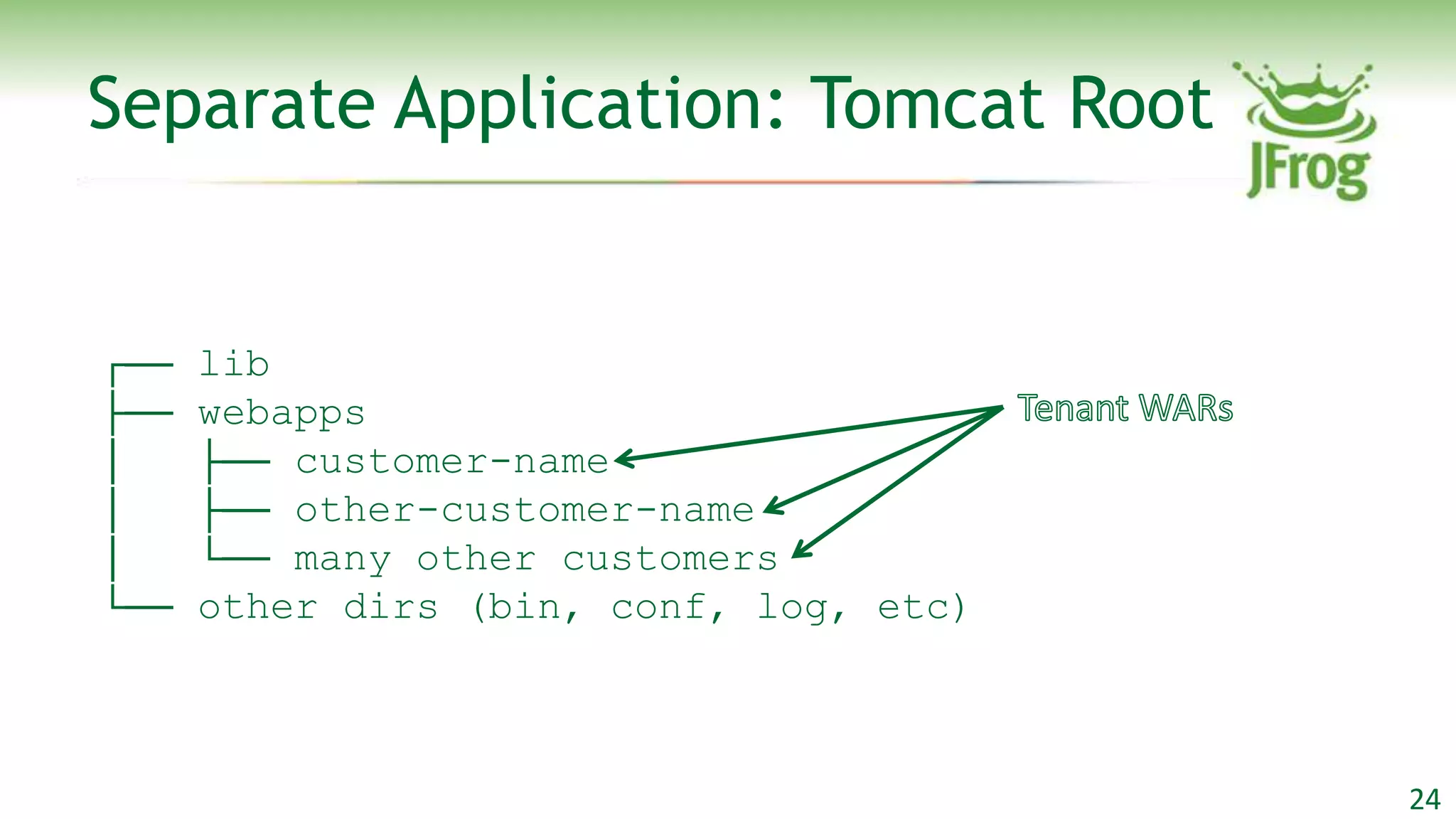
Separate Application: Tomcat Root


┌──   lib
├──   webapps
│     ├── customer-name
│     ├── other-customer-name
│     └── many other customers
└──   other dirs (bin, conf, log, etc)


                                         24
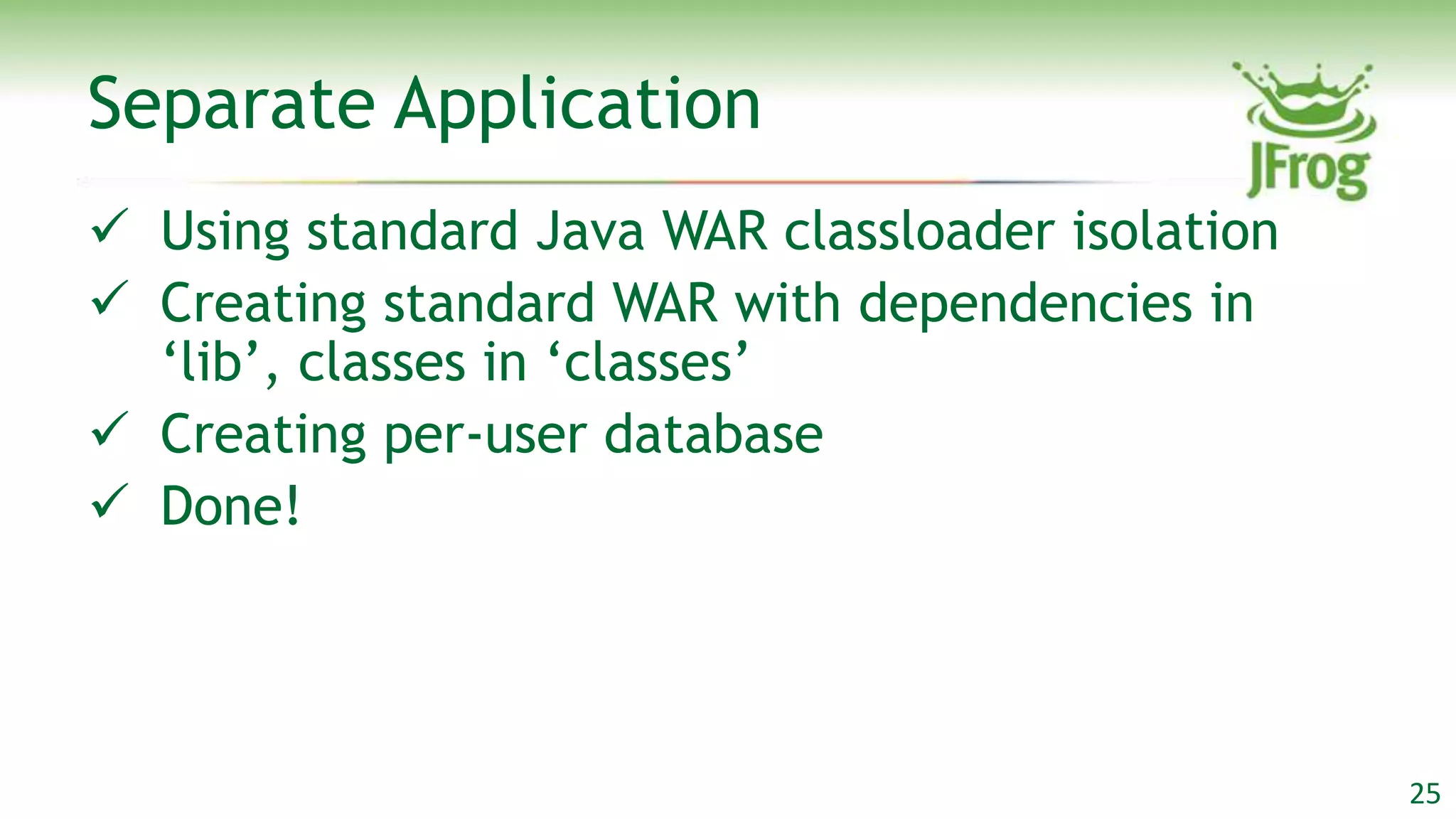
Separate Application
 Using standard Java WAR classloader isolation
 Creating standard WAR with dependencies in
  „lib‟, classes in „classes‟
 Creating per-user database
 Done!


                                                  25
Separate Application
 Using standard Java WAR classloader isolation
 Creating standard WAR with dependencies in
  „lib‟, classes in „classes‟
 Creating per-user database
 Done!
 Perm Gen explodes after deploying 4 WARs
  > Even when set to 1Gb!

                                                  26
The Quest for Shared Libraries
 The solution – move libraries to shared
  classloader
  > Both 3rd party and application
  > 25 Mbs of JAR files
 Not as easy as it sounds
 Review the source code of 3rd party libraries
  one by one
  > Open Source FTW

                                                  27
THE QUEST FOR
SHARED
LIBRARIES
Spring Framework
 Perfect
 Make sure the context is bounded to
  thread/war


                                        29
Spring Framework
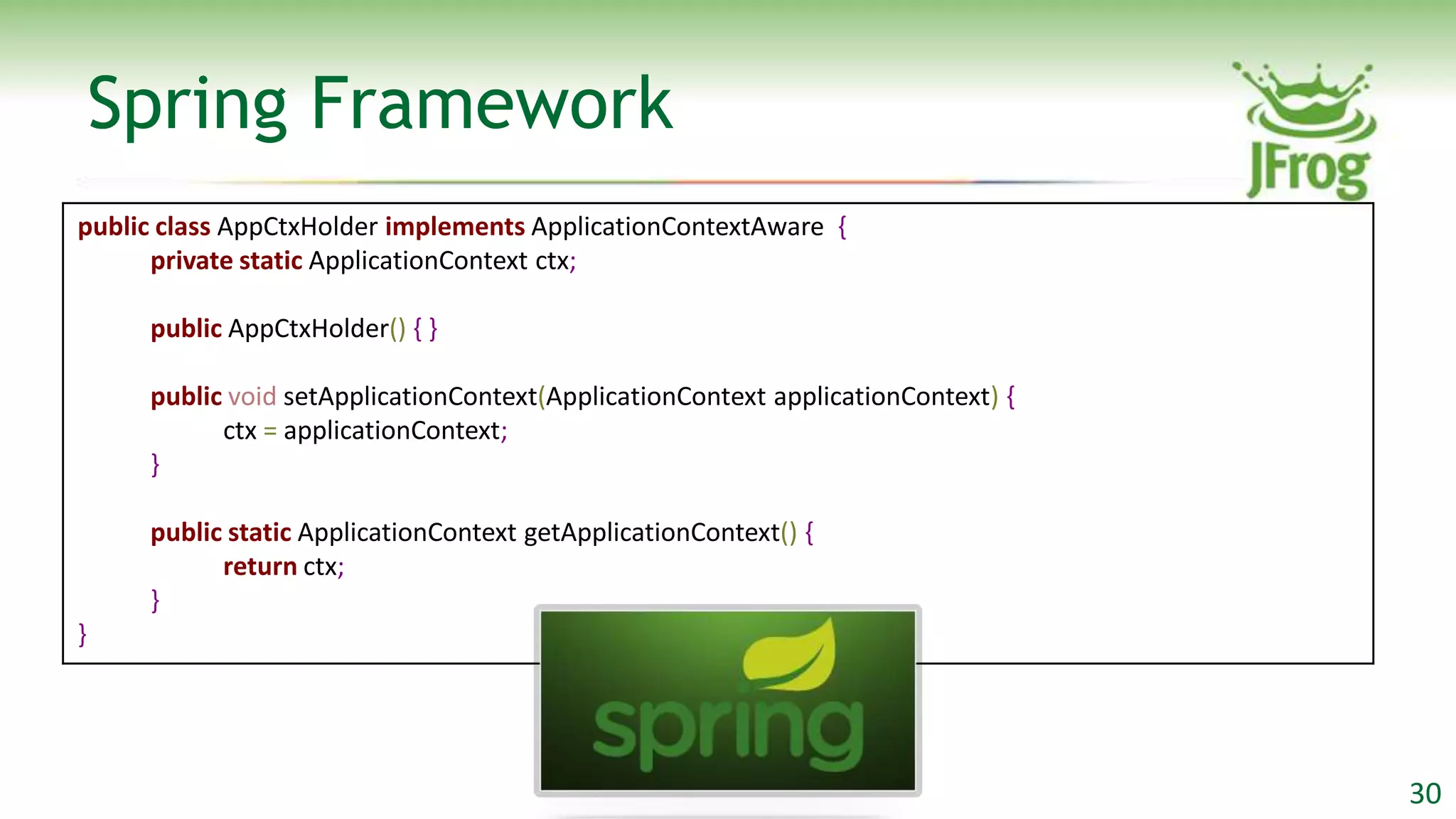
public class AppCtxHolder implements ApplicationContextAware {
      private static ApplicationContext ctx;

     public AppCtxHolder() { }

     public void setApplicationContext(ApplicationContext applicationContext) {
           ctx = applicationContext;
     }

     public static ApplicationContext getApplicationContext() {
           return ctx;
     }
}


                                                                                  30
Spring Framework
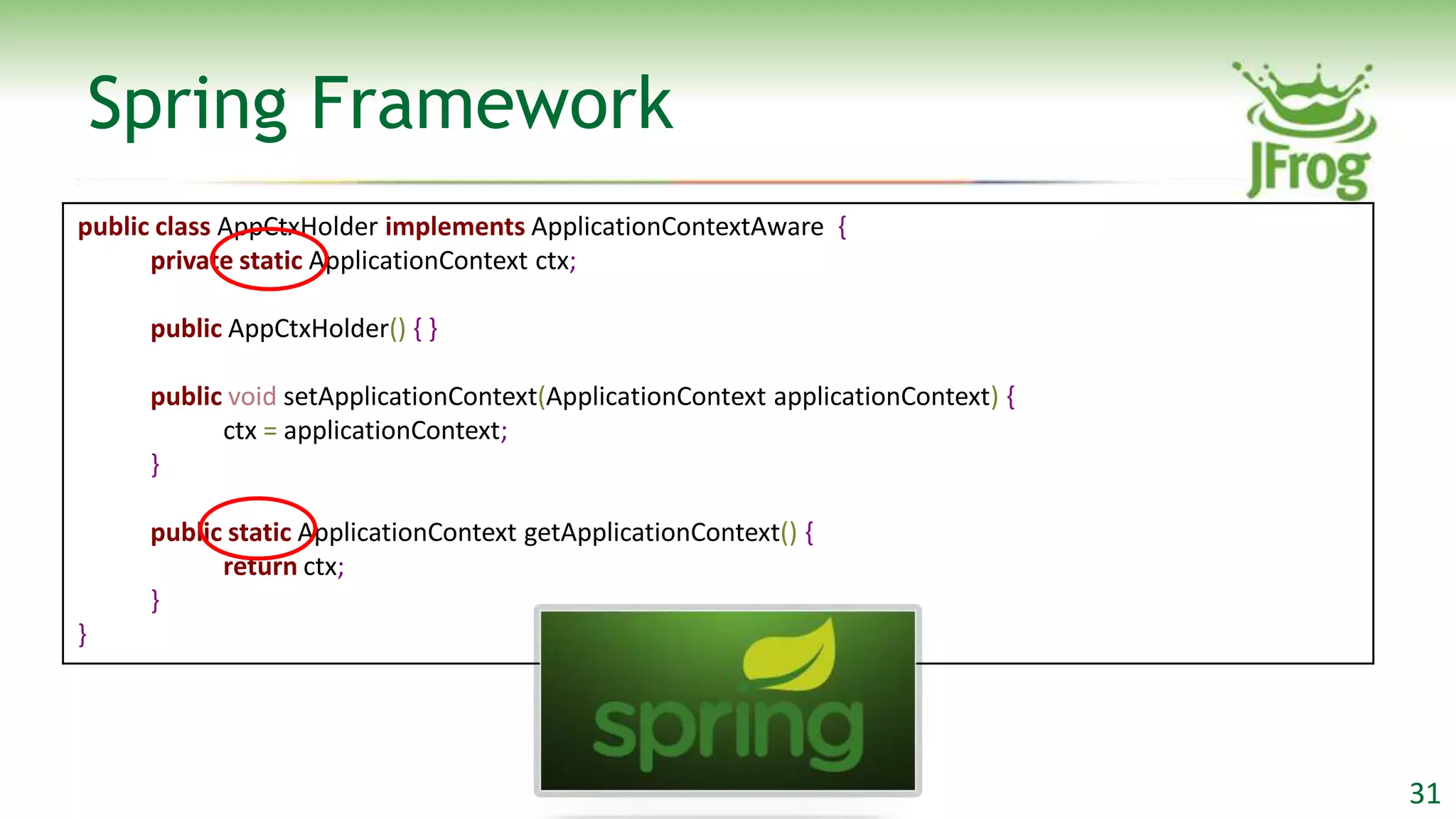
public class AppCtxHolder implements ApplicationContextAware {
      private static ApplicationContext ctx;

     public AppCtxHolder() { }

     public void setApplicationContext(ApplicationContext applicationContext) {
           ctx = applicationContext;
     }

     public static ApplicationContext getApplicationContext() {
           return ctx;
     }
}


                                                                                  31
Spring Framework
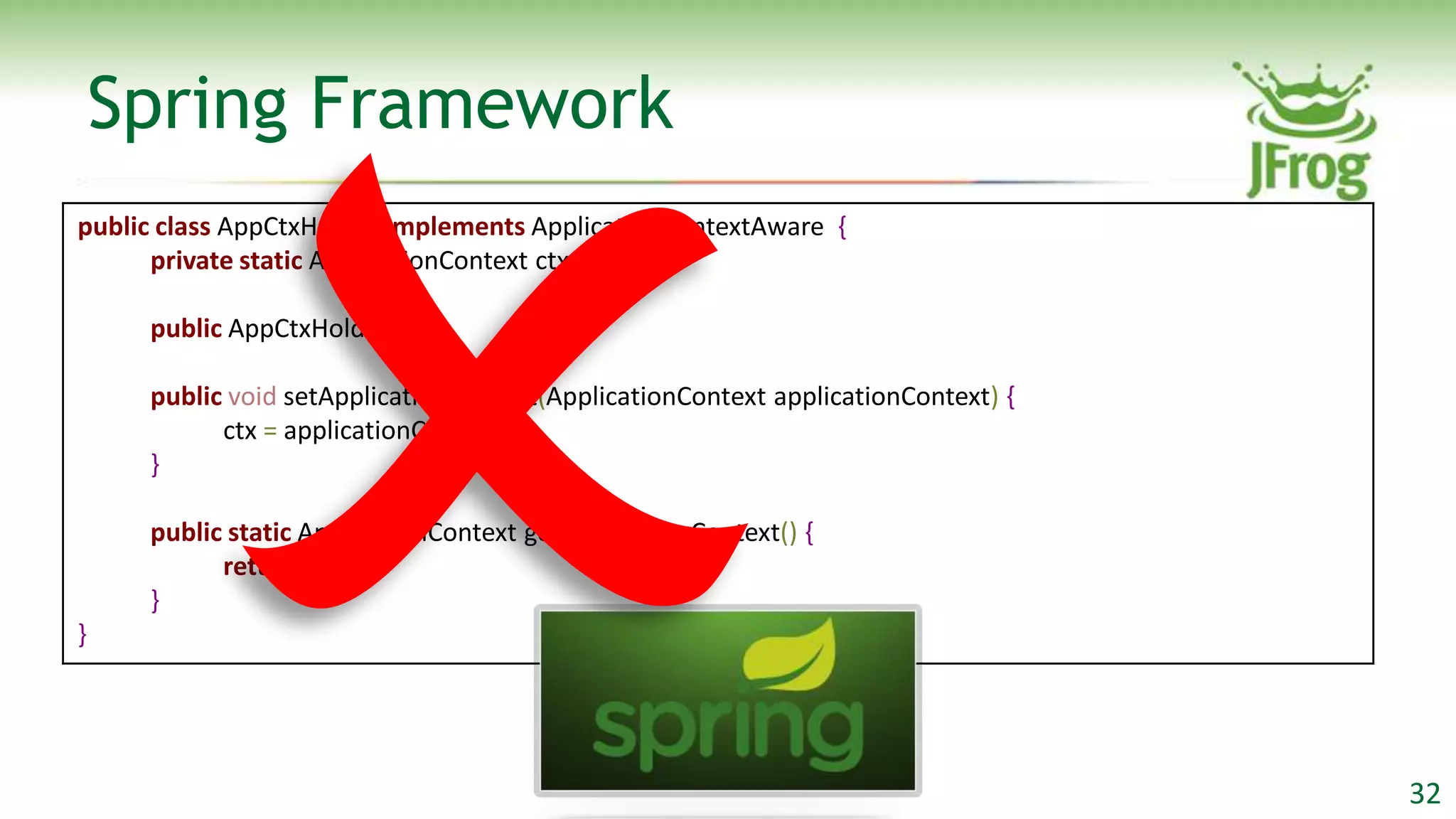
public class AppCtxHolder implements ApplicationContextAware {
      private static ApplicationContext ctx;

     public AppCtxHolder() { }

     public void setApplicationContext(ApplicationContext applicationContext) {
           ctx = applicationContext;
     }

     public static ApplicationContext getApplicationContext() {
           return ctx;
     }
}


                                                                                  32
Apache Wicket
 Was good
 New versions added static map of
  applications
  > Lesson learned: Recheck on each version
    upgrade


                                              33
Thread Pools
 They are not shared – good!
 Need global management to adjust the
  size to match all the tenants
  > Without global thread pool


                                         34
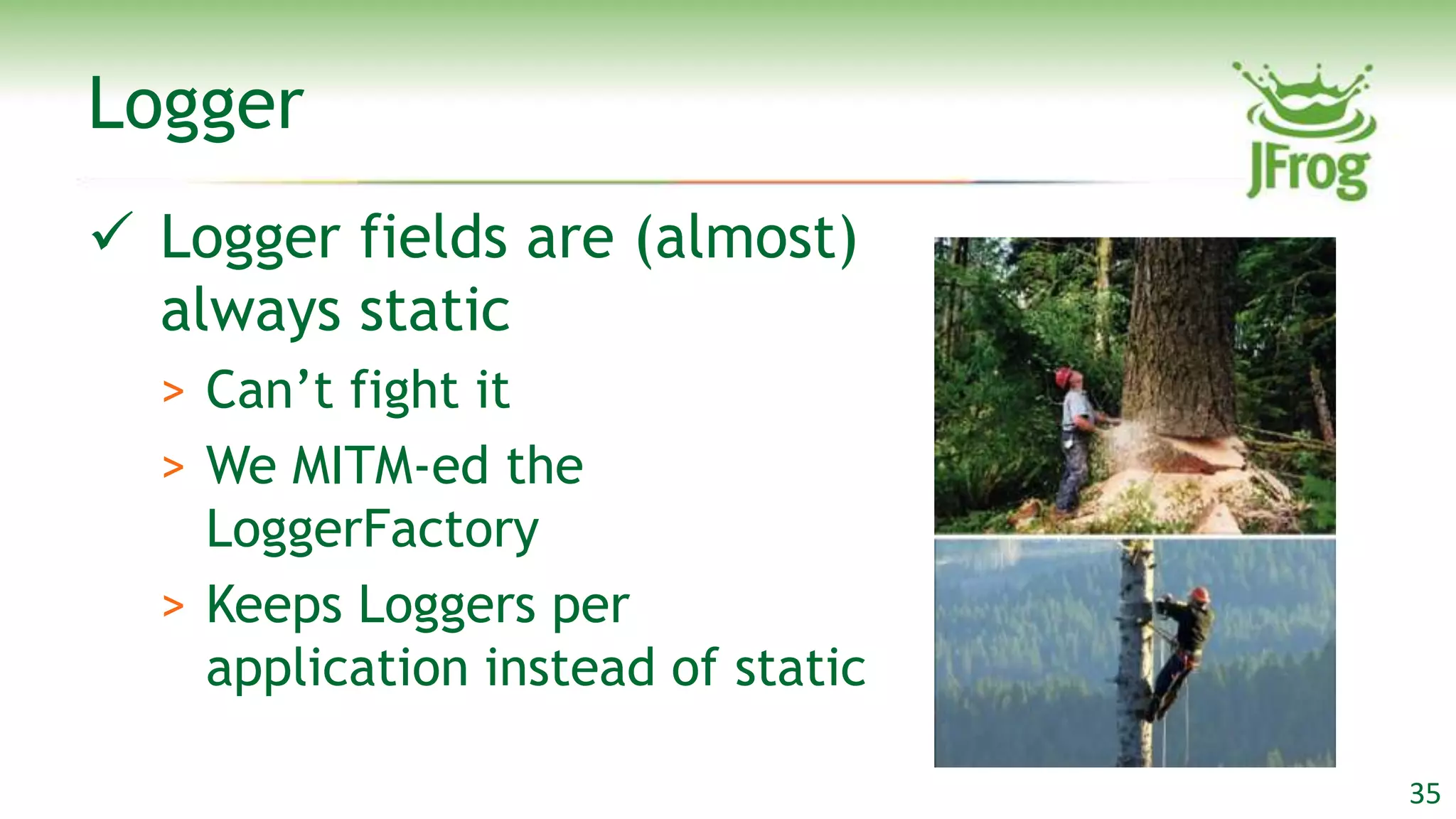
Logger
 Logger fields are (almost)
  always static
  > Can‟t fight it
  > We MITM-ed the
    LoggerFactory
  > Keeps Loggers per
    application instead of static

                                    35
Race conditions on central locks
 Examples
  > Transaction ID
  > Tomcat ClassLoader
 Solving race condition
  generates synchronous
  initialization

                                   36
CATS Software


                37
Jackrabbit
 Heap-wide temp file cleaner thread
  > A static thread destroying the temp files of
    the other tenants
  > Not as funny as it sounds


                                                   38
Heap-wide Caches
 Lucene and other cache solutions are
  adjusted for the whole heap size
 Use SoftReference based caches


                                         39
THE QUEST FOR SHARED LIBRARIES:
RESULTS
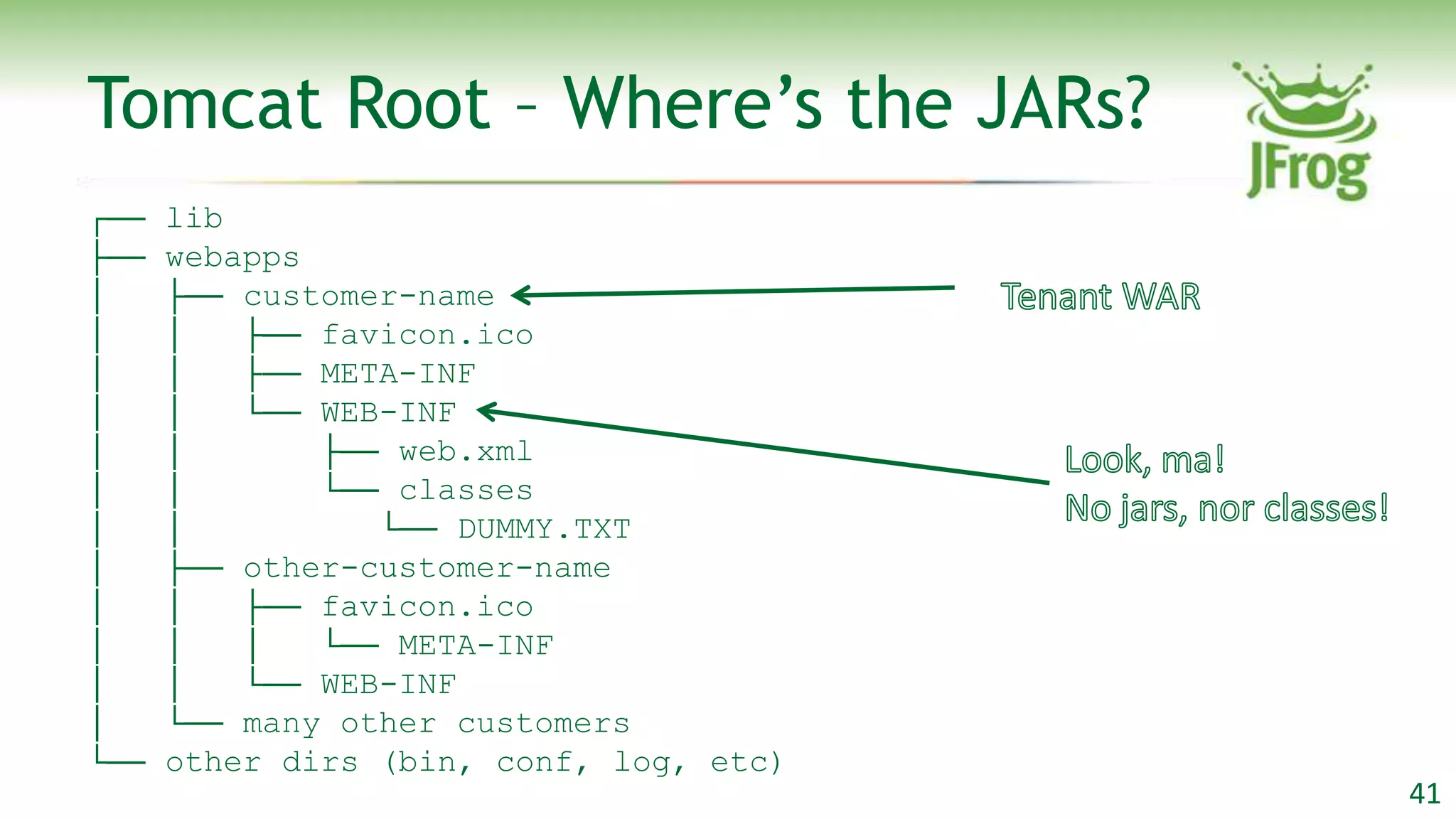
Tomcat Root – Where‟s the JARs?
┌──   lib
├──   webapps
│     ├── customer-name
│     │   ├── favicon.ico
│     │   ├── META-INF
│     │   └── WEB-INF
│     │       ├── web.xml
│     │       └── classes
│     │          └── DUMMY.TXT
│     ├── other-customer-name
│     │   ├── favicon.ico
│     │   │   └── META-INF
│     │   └── WEB-INF
│     └── many other customers
└──   other dirs (bin, conf, log, etc)
                                         41
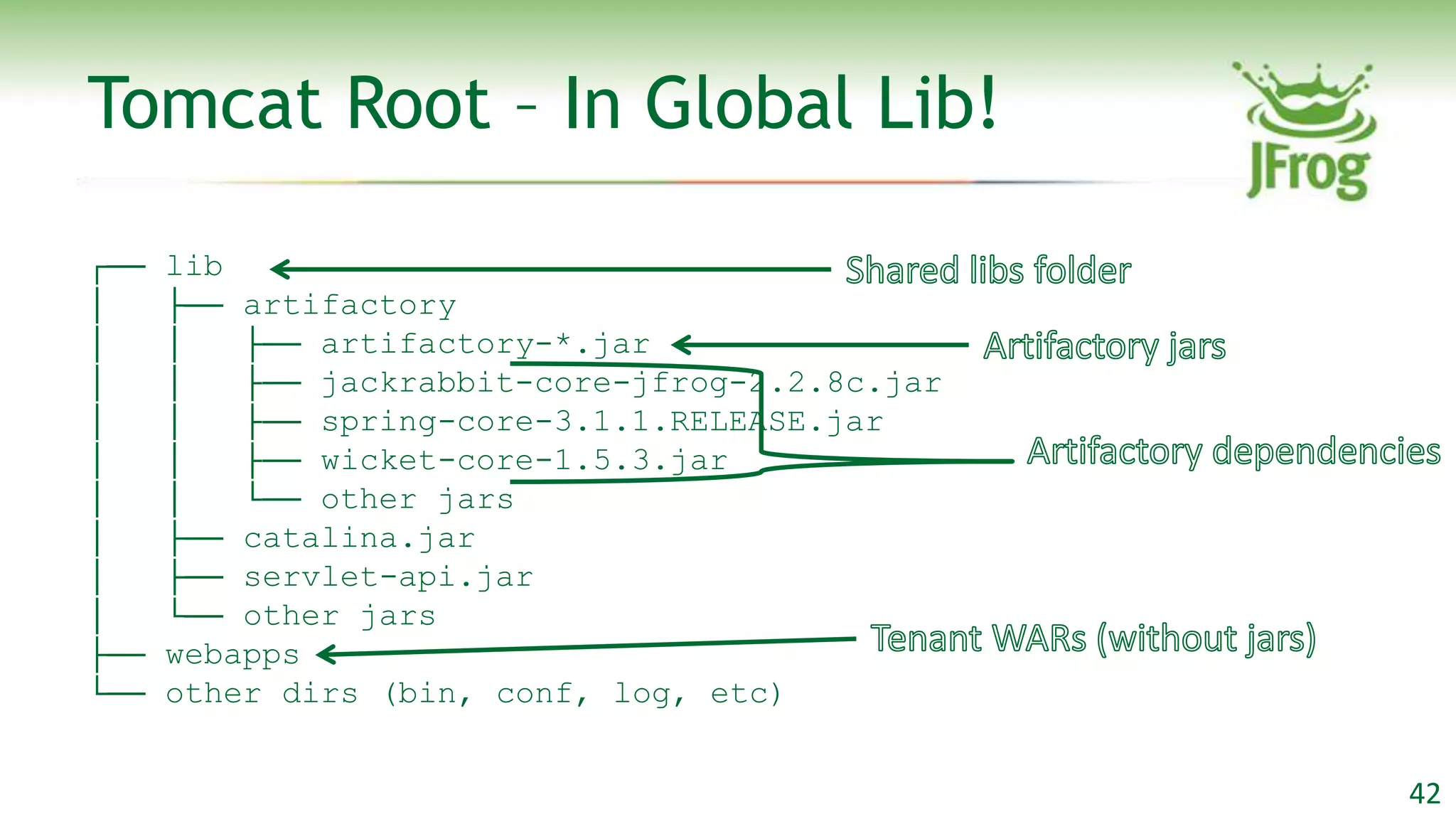
Tomcat Root – In Global Lib!

┌──   lib
│     ├── artifactory
│     │   ├── artifactory-*.jar
│     │   ├── jackrabbit-core-jfrog-2.2.8c.jar
│     │   ├── spring-core-3.1.1.RELEASE.jar
│     │   ├── wicket-core-1.5.3.jar
│     │   └── other jars
│     ├── catalina.jar
│     ├── servlet-api.jar
│     └── other jars
├──   webapps
└──   other dirs (bin, conf, log, etc)


                                                 42
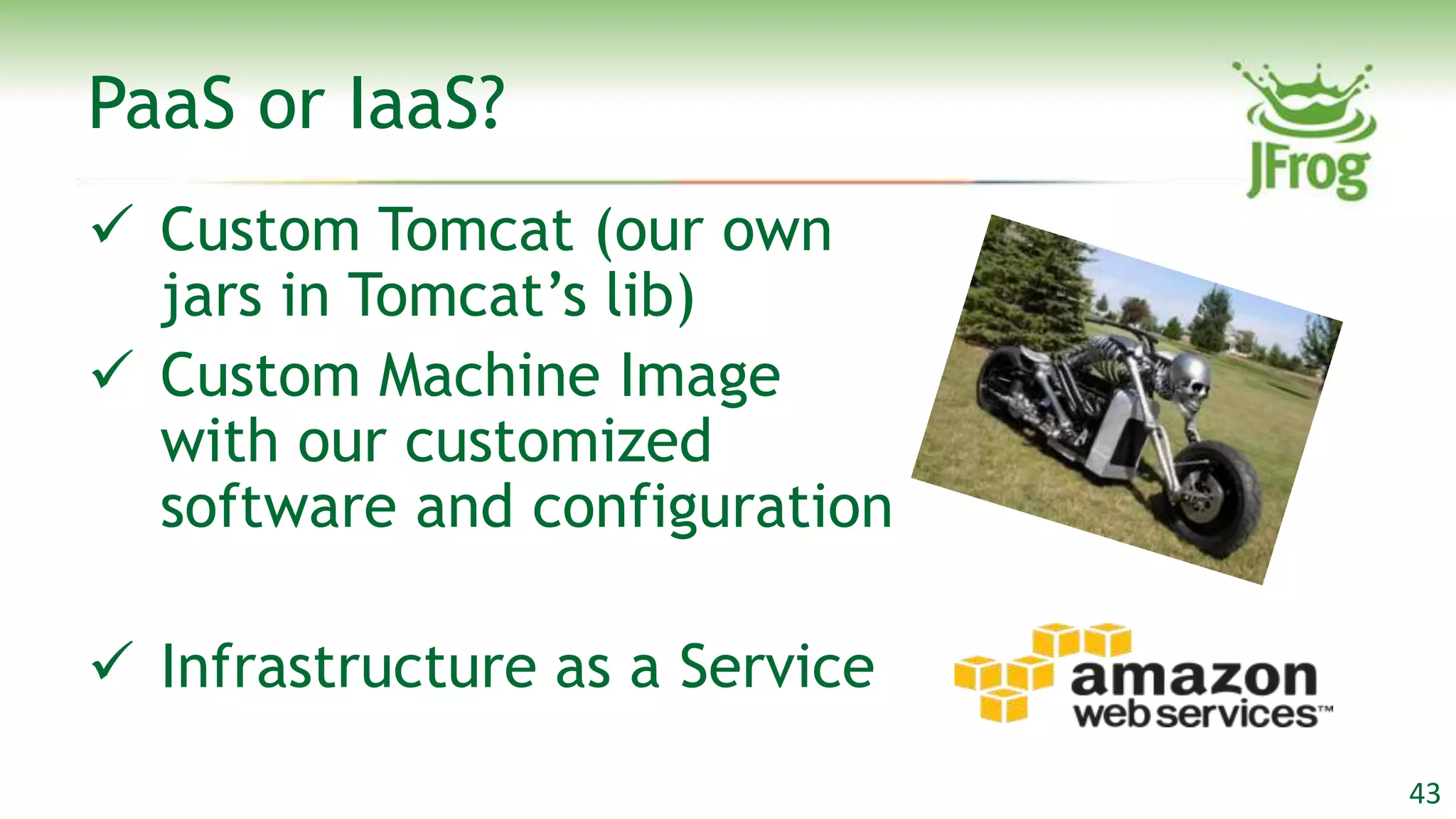
PaaS or IaaS?
 Custom Tomcat (our own
  jars in Tomcat‟s lib)
 Custom Machine Image
  with our customized
  software and configuration

 Infrastructure as a Service
                                43
What was it about DB upgrade?
 Distributed software is concerned with
  DB upgrade procedures
  > User experience involved
 Since we came from there, we have
  “Converters”
  > Our SaaS version got it for free

                                           44
THE DEVOPS
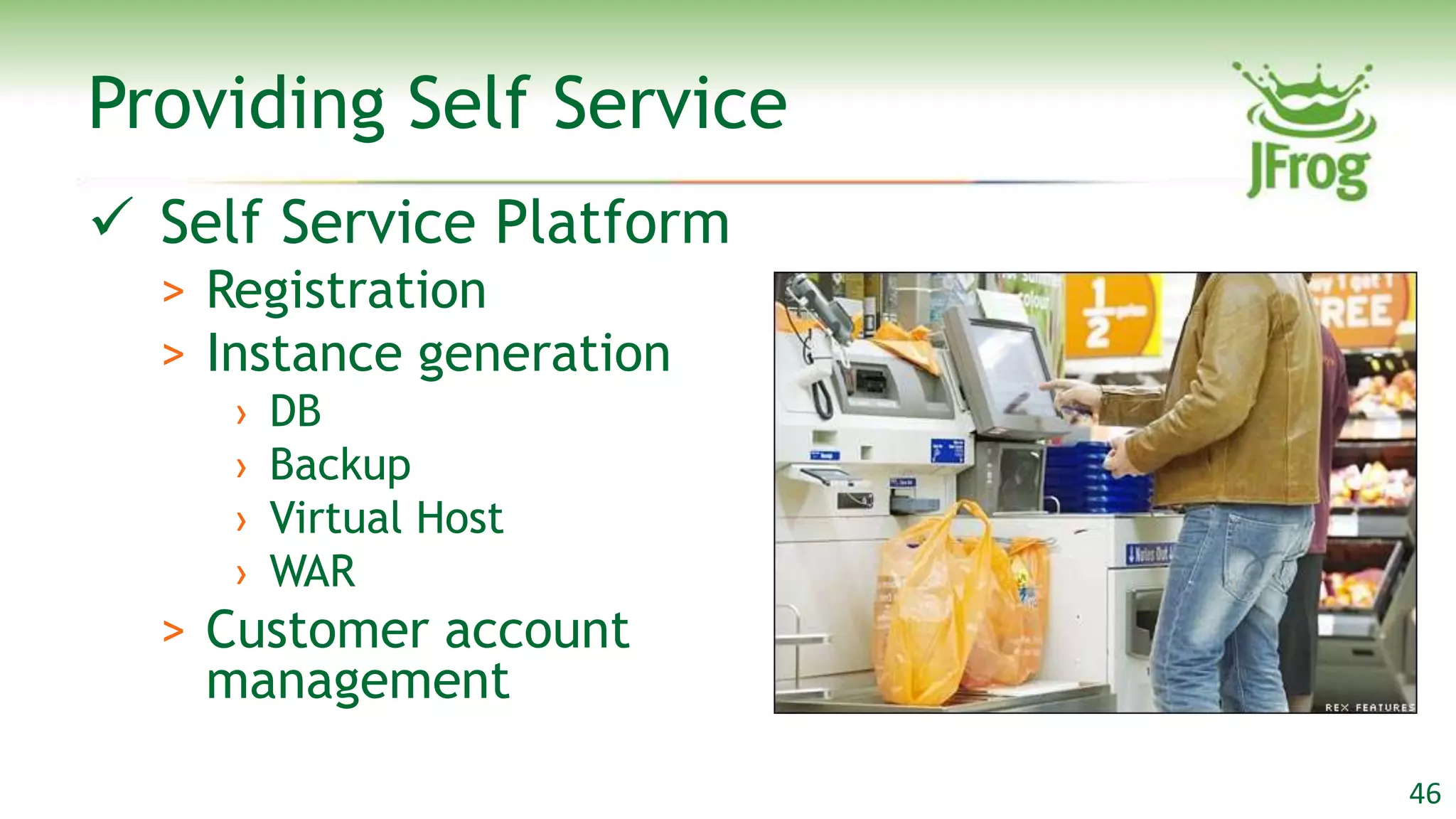
Providing Self Service
 Self Service Platform
  > Registration
  > Instance generation
     ›   DB
     ›   Backup
     ›   Virtual Host
     ›   WAR
  > Customer account
    management

                          46
Separating Concerns
 Customer account is only in SaaS
 Centralized Self-Service portal
 Intercommunication with the provisioned
  application of specific tenant
  > UI Branding
  > Virtual host control
  > Backups

                                            47
Outcome: DevOps
 4 TB of storage
 33 TB of traffic per month
 Increasing overall performance
  in an order of magnitude
  in the last 18 months


                                   48
THE PROCESS
Diversity
 3 Versions
 3 Deployment formats
  > WAR
  > ZIP
  > RPM
 Lots of dependencies
                         50
Recursive Slide (w. baby picture)
 We eat our own
  dog food
 Artifactory is built
  with Artifactory


                                    51
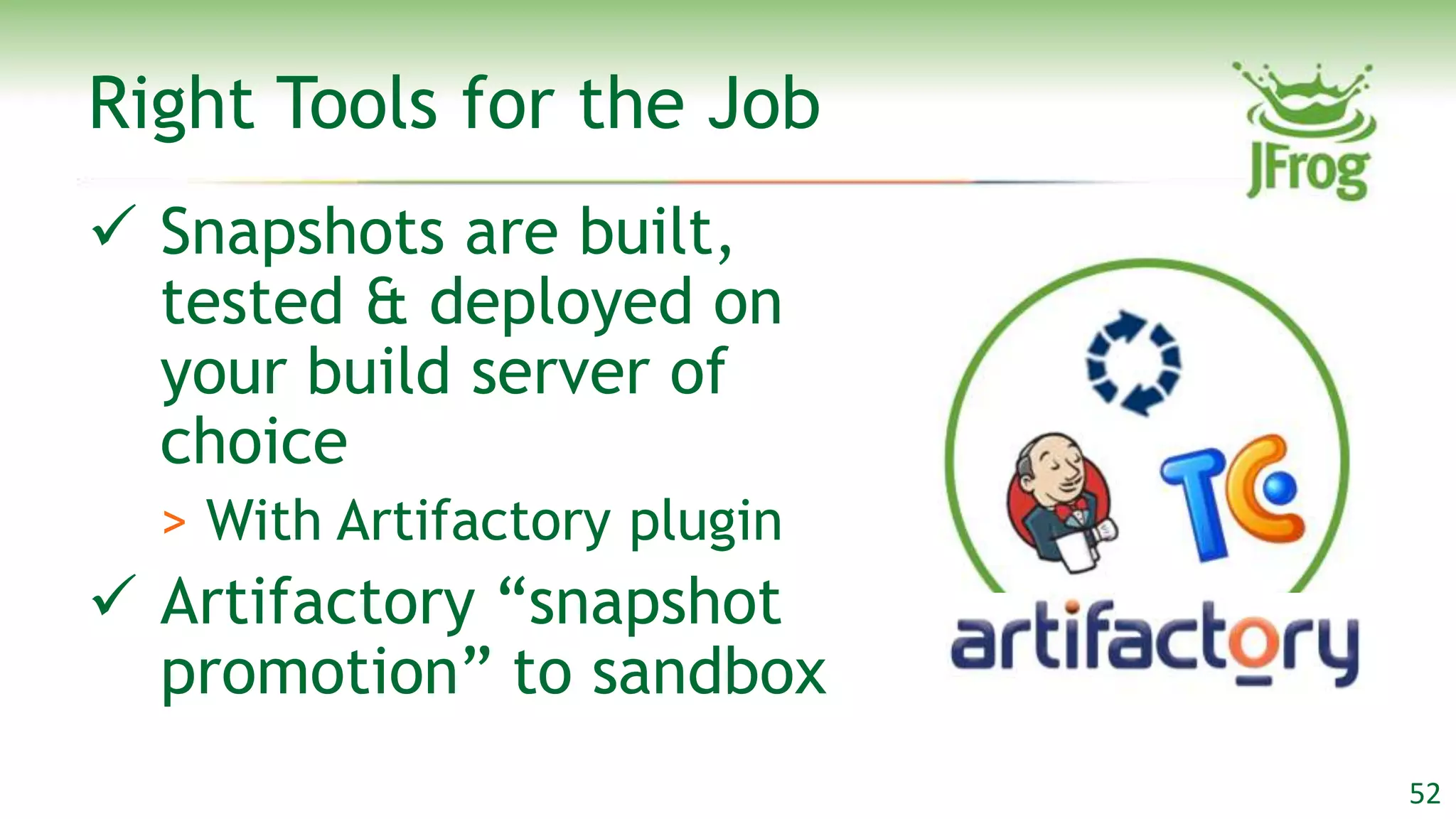
Right Tools for the Job
 Snapshots are built,
  tested & deployed on
  your build server of
  choice
  > With Artifactory plugin
 Artifactory “snapshot
  promotion” to sandbox
                              52
Right Tools for the Job
 Deploying to production using Chef
 Other options:
  > Puppet
  > Build Server plugins
  > ZT LiveRebel
  > Scripts

                                       53
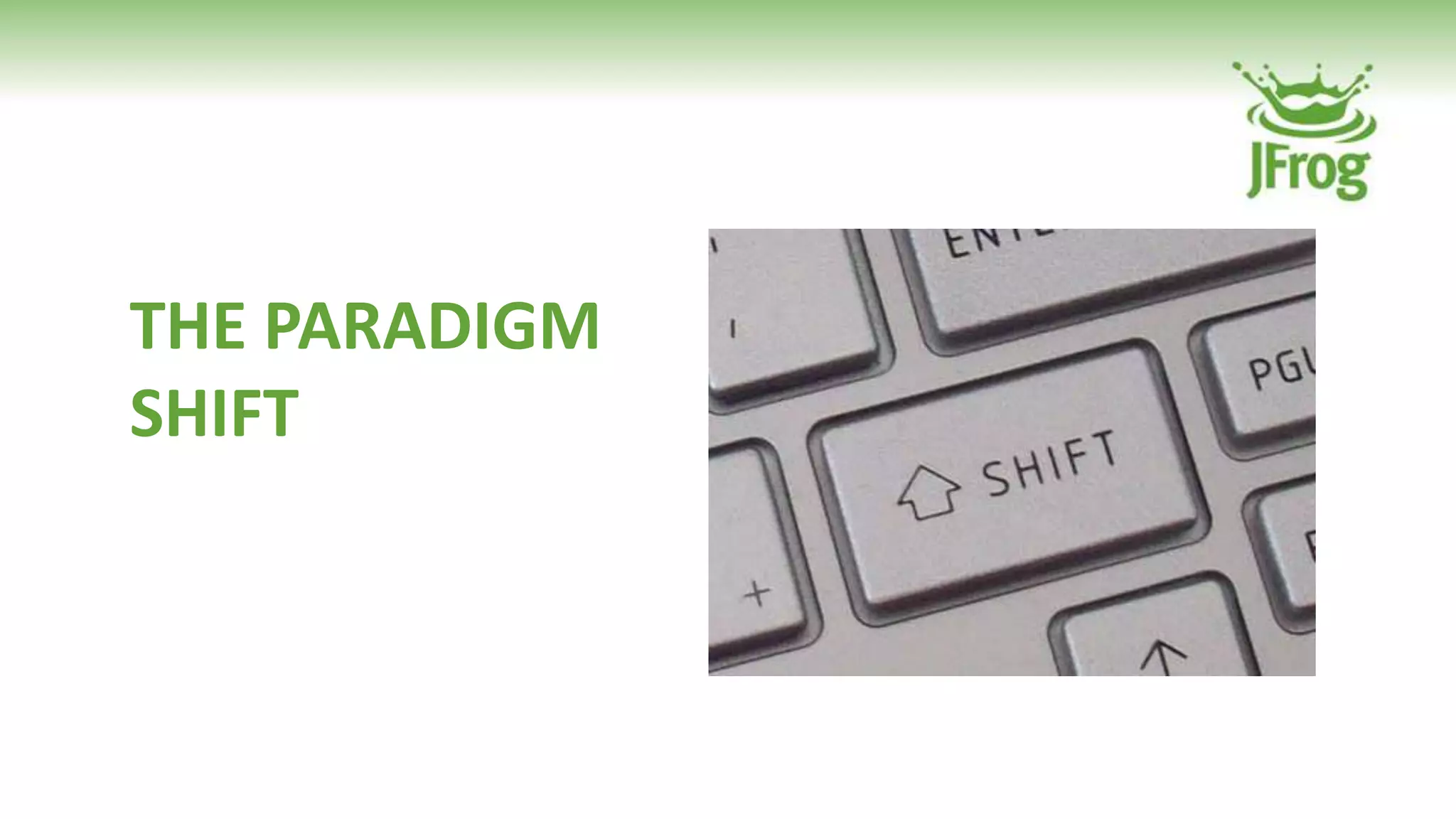
THE PARADIGM
SHIFT
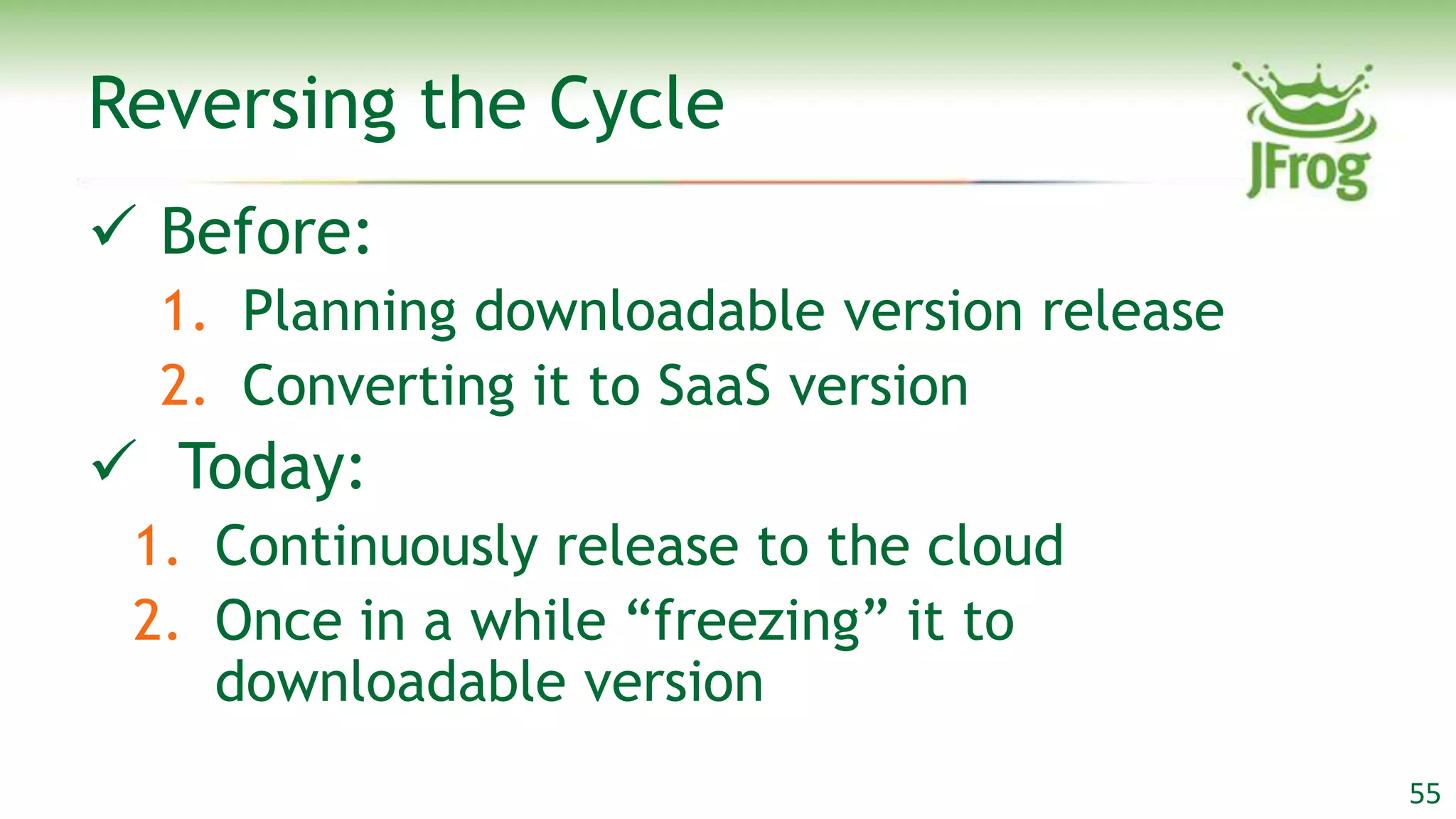
Reversing the Cycle
 Before:
  1. Planning downloadable version release
  2. Converting it to SaaS version
 Today:
 1. Continuously release to the cloud
 2. Once in a while “freezing” it to
    downloadable version
                                             55
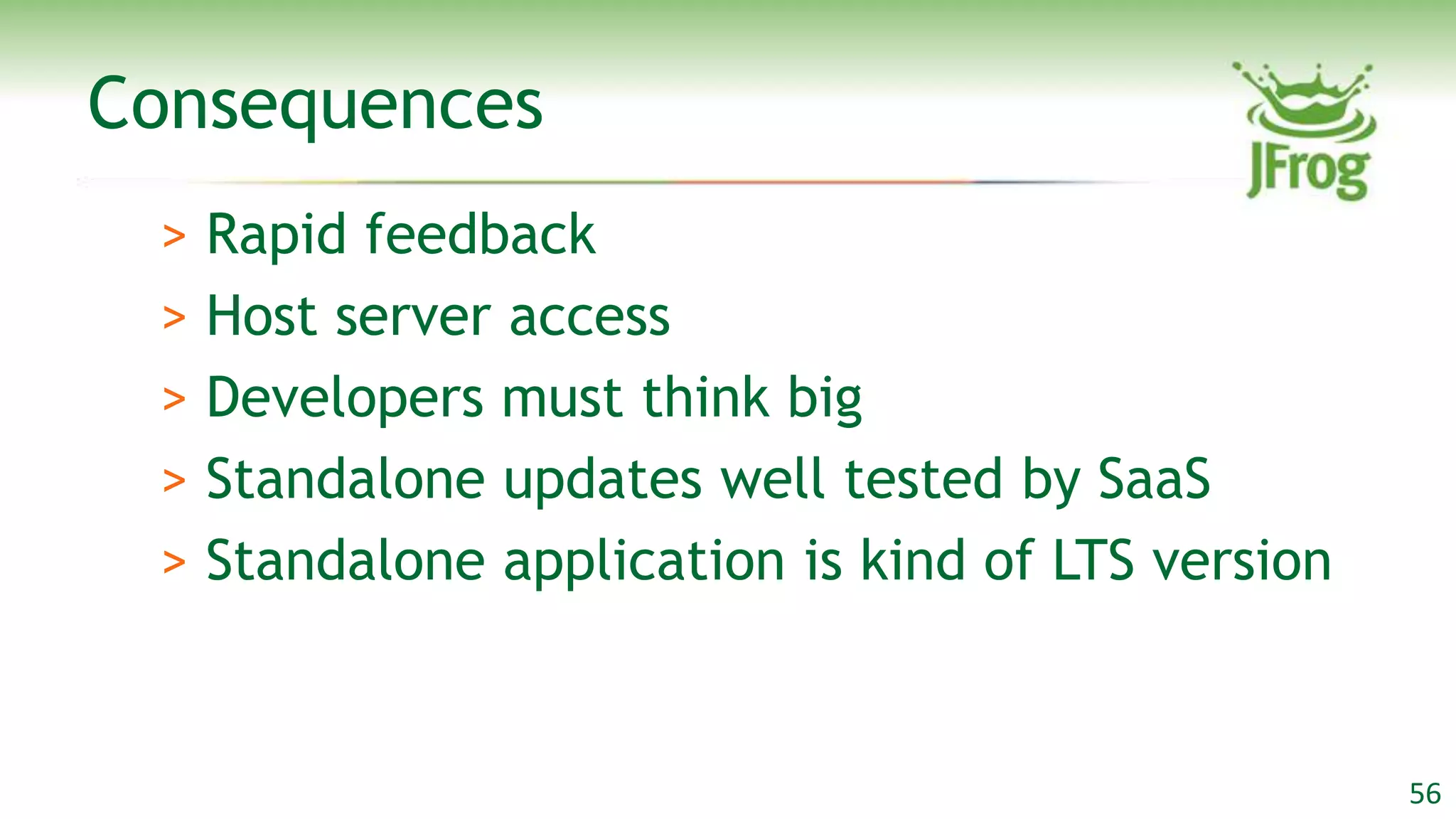
Consequences
 > Rapid feedback
 > Host server access
 > Developers must think big
 > Standalone updates well tested by SaaS
 > Standalone application is kind of LTS version


                                                   56
How we took our server side application to the cloud and liked what we got

How we took our server side application to the cloud and liked what we got

  • 1.
    HOW WE TOOKOUR SERVER- SIDE APPLICATION TO THE CLOUD… …and liked what we got
  • 2.
    Agenda  Where westarted  What we did  Paradigm shift 2
  • 3.
  • 4.
    Who‟s talking?  Fred Simon  @freddy33  Chief Architect of JFrog  Also Head of DevOps  Co-author of Artifactory 4
  • 5.
    Artifactory what?  Since 2006  Binary Repository Manager  Open Source  Standard Java Web Application > Spring > Spring Security > Wicket > JCR > Jersey 5
  • 6.
    Yet Another JavaServer App 6
  • 7.
    Moving Forward  Communitysuccess  JFrog established in 2008  JavaOne 2009 > Pro version > Software as a Service (SaaS version) › Heavly used by OSS community 7
  • 8.
    Artifactory SaaS  Benefitsfor the user: > Zero maintenance › Backups › Updates › Infrastructure > Support  Drawbacks for the user: > Can‟t install user plugins 8
  • 9.
  • 10.
    Moving Forward  3product flavors in production > Challenging support tasks > Completing, not competing  30 million requests/week > Mostly in the Pacific Time Monday mornings  4 TB of artifacts 10
  • 11.
    A load ofArtifacts! 11
  • 12.
  • 13.
  • 14.
    * As AService Self Service Multi-tenant
  • 15.
    GaaE: Google asan Example Product Self Multi- * aaS Service tenant Gmail   Not *aaS, web-app Google Apps   SaaS Google App Engine   PaaS Google Compute Engine   IaaS 15
  • 16.
    AaaE: Amazon asan Example Product Self Multi- * aaS Service tenant Amazon store   Not *aaS, web-app aStore   SaaS Amazon Elastic Beanstalk   PaaS Amazon Elastic Cloud   IaaS 16
  • 17.
    The SaaS Pains- Overview  Multi-tenancy  Platform selection > PaaS or IaaS  DB schema updates 17
  • 18.
    Multi-tenancy  Java 9already!  Until then select one of the following: > Use single application, separate data > Use separated applications > Use separated processes 18
  • 19.
    GaaE for MultiTenancy Types Product Muli-tenancy Type Google Apps Data Separation Google App Engine Application Separation Google Compute Engine Process Separation 19
  • 20.
    Comparing the Strategies Strategy Pros Cons Separating data  Normal Java Application  Manual state separation  Complicated and critical schema Separating  No shared state  Stay tuned… application  Or is it?  Simple transition from existing Separating processes  No shared state  JVM per tenant!  Simple transition from existing 20
  • 21.
    Comparing the Strategies  Strategy Pros Cons Separating data  Normal Java Application  Manual state separation  Complicated and critical schema Separating  No shared state  Stay tuned… application  Or is it?  Simple transition from existing Separating processes  No shared state  JVM per tenant!  Simple transition from existing 21
  • 22.
    Comparing the Strategies  Strategy Pros Cons Separating data  Normal Java Application  Manual state separation  Complicated and critical schema Separating  No shared state  Stay tuned… application  Or is it?  Simple transition from  existing Separating processes  No shared state  JVM per tenant!  Simple transition from existing 22
  • 23.
    Comparing the Strategies  Strategy Pros Cons Separating data  Normal Java Application  Manual state separation  Complicated and critical schema  Separating  No shared state  Stay tuned… application  Or is it?  Simple transition from  existing Separating processes  No shared state  JVM per tenant!  Simple transition from existing 23
  • 24.
    Separate Application: TomcatRoot ┌── lib ├── webapps │ ├── customer-name │ ├── other-customer-name │ └── many other customers └── other dirs (bin, conf, log, etc) 24
  • 25.
    Separate Application  Usingstandard Java WAR classloader isolation  Creating standard WAR with dependencies in „lib‟, classes in „classes‟  Creating per-user database  Done! 25
  • 26.
    Separate Application  Usingstandard Java WAR classloader isolation  Creating standard WAR with dependencies in „lib‟, classes in „classes‟  Creating per-user database  Done!  Perm Gen explodes after deploying 4 WARs > Even when set to 1Gb! 26
  • 27.
    The Quest forShared Libraries  The solution – move libraries to shared classloader > Both 3rd party and application > 25 Mbs of JAR files  Not as easy as it sounds  Review the source code of 3rd party libraries one by one > Open Source FTW 27
  • 28.
  • 29.
    Spring Framework  Perfect Make sure the context is bounded to thread/war 29
  • 30.
    Spring Framework public classAppCtxHolder implements ApplicationContextAware { private static ApplicationContext ctx; public AppCtxHolder() { } public void setApplicationContext(ApplicationContext applicationContext) { ctx = applicationContext; } public static ApplicationContext getApplicationContext() { return ctx; } } 30
  • 31.
    Spring Framework public classAppCtxHolder implements ApplicationContextAware { private static ApplicationContext ctx; public AppCtxHolder() { } public void setApplicationContext(ApplicationContext applicationContext) { ctx = applicationContext; } public static ApplicationContext getApplicationContext() { return ctx; } } 31
  • 32.
    Spring Framework public classAppCtxHolder implements ApplicationContextAware { private static ApplicationContext ctx; public AppCtxHolder() { } public void setApplicationContext(ApplicationContext applicationContext) { ctx = applicationContext; } public static ApplicationContext getApplicationContext() { return ctx; } } 32
  • 33.
    Apache Wicket  Wasgood  New versions added static map of applications > Lesson learned: Recheck on each version upgrade 33
  • 34.
    Thread Pools  Theyare not shared – good!  Need global management to adjust the size to match all the tenants > Without global thread pool 34
  • 35.
    Logger  Logger fieldsare (almost) always static > Can‟t fight it > We MITM-ed the LoggerFactory > Keeps Loggers per application instead of static 35
  • 36.
    Race conditions oncentral locks  Examples > Transaction ID > Tomcat ClassLoader  Solving race condition generates synchronous initialization 36
  • 37.
  • 38.
    Jackrabbit  Heap-wide tempfile cleaner thread > A static thread destroying the temp files of the other tenants > Not as funny as it sounds 38
  • 39.
    Heap-wide Caches  Luceneand other cache solutions are adjusted for the whole heap size  Use SoftReference based caches 39
  • 40.
    THE QUEST FORSHARED LIBRARIES: RESULTS
  • 41.
    Tomcat Root –Where‟s the JARs? ┌── lib ├── webapps │ ├── customer-name │ │ ├── favicon.ico │ │ ├── META-INF │ │ └── WEB-INF │ │ ├── web.xml │ │ └── classes │ │ └── DUMMY.TXT │ ├── other-customer-name │ │ ├── favicon.ico │ │ │ └── META-INF │ │ └── WEB-INF │ └── many other customers └── other dirs (bin, conf, log, etc) 41
  • 42.
    Tomcat Root –In Global Lib! ┌── lib │ ├── artifactory │ │ ├── artifactory-*.jar │ │ ├── jackrabbit-core-jfrog-2.2.8c.jar │ │ ├── spring-core-3.1.1.RELEASE.jar │ │ ├── wicket-core-1.5.3.jar │ │ └── other jars │ ├── catalina.jar │ ├── servlet-api.jar │ └── other jars ├── webapps └── other dirs (bin, conf, log, etc) 42
  • 43.
    PaaS or IaaS? Custom Tomcat (our own jars in Tomcat‟s lib)  Custom Machine Image with our customized software and configuration  Infrastructure as a Service 43
  • 44.
    What was itabout DB upgrade?  Distributed software is concerned with DB upgrade procedures > User experience involved  Since we came from there, we have “Converters” > Our SaaS version got it for free 44
  • 45.
  • 46.
    Providing Self Service Self Service Platform > Registration > Instance generation › DB › Backup › Virtual Host › WAR > Customer account management 46
  • 47.
    Separating Concerns  Customeraccount is only in SaaS  Centralized Self-Service portal  Intercommunication with the provisioned application of specific tenant > UI Branding > Virtual host control > Backups 47
  • 48.
    Outcome: DevOps  4TB of storage  33 TB of traffic per month  Increasing overall performance in an order of magnitude in the last 18 months 48
  • 49.
  • 50.
    Diversity  3 Versions 3 Deployment formats > WAR > ZIP > RPM  Lots of dependencies 50
  • 51.
    Recursive Slide (w.baby picture)  We eat our own dog food  Artifactory is built with Artifactory 51
  • 52.
    Right Tools forthe Job  Snapshots are built, tested & deployed on your build server of choice > With Artifactory plugin  Artifactory “snapshot promotion” to sandbox 52
  • 53.
    Right Tools forthe Job  Deploying to production using Chef  Other options: > Puppet > Build Server plugins > ZT LiveRebel > Scripts 53
  • 54.
  • 55.
    Reversing the Cycle Before: 1. Planning downloadable version release 2. Converting it to SaaS version  Today: 1. Continuously release to the cloud 2. Once in a while “freezing” it to downloadable version 55
  • 56.
    Consequences > Rapidfeedback > Host server access > Developers must think big > Standalone updates well tested by SaaS > Standalone application is kind of LTS version 56

Editor's Notes

  • #5 Going to talk about JFrog in 2 slidesGoing to talk about why DevOps in 3 slidesGoing to talk about Artifactory next