How to evaluate success with PGS 
Don Leigh 
ASPIRE April 2014
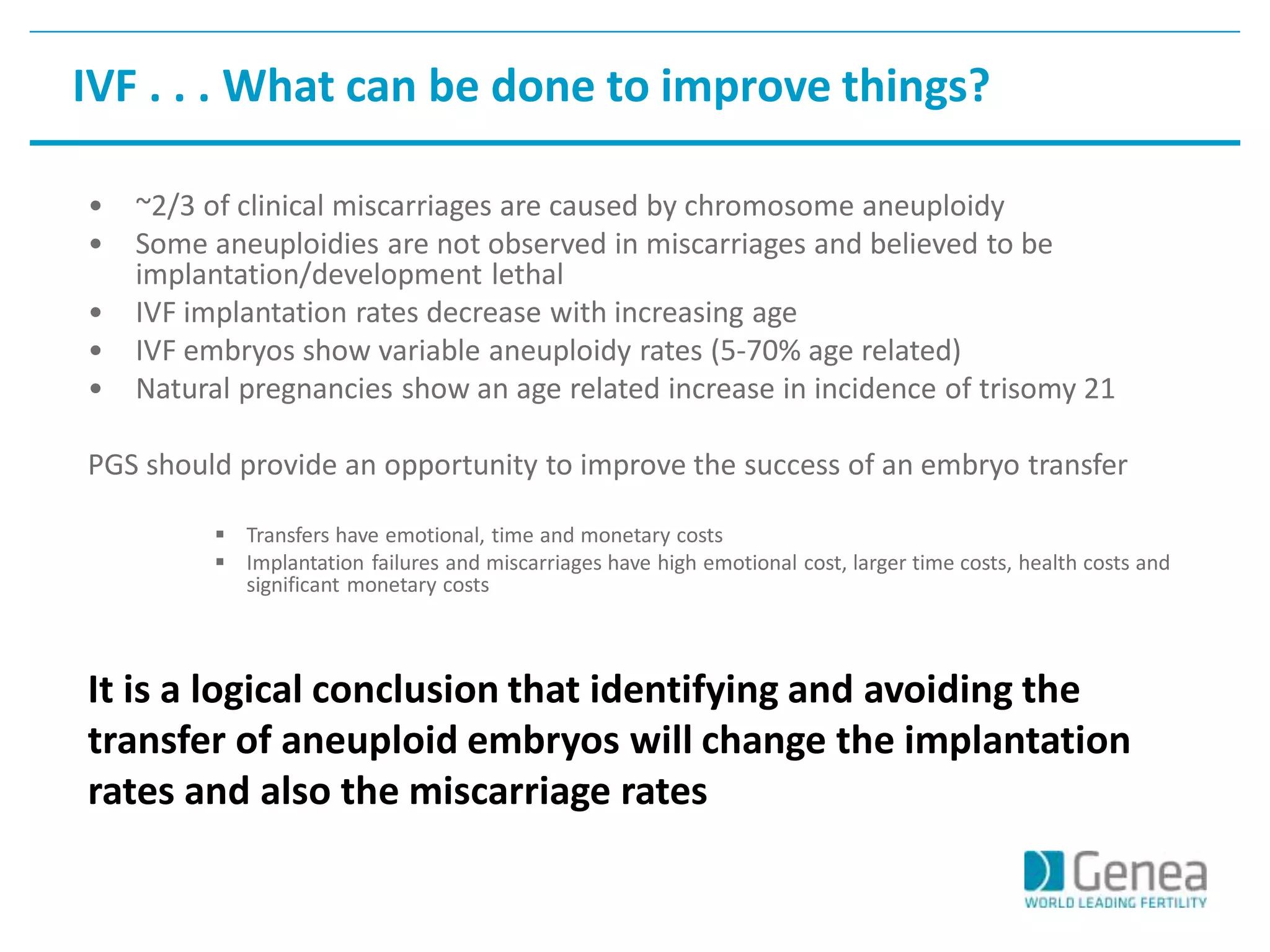
IVF . . . What can be done to improve things? 
• ~2/3 of clinical miscarriages are caused by chromosome aneuploidy 
• Some aneuploidies are not observed in miscarriages and believed to be 
implantation/development lethal 
• IVF implantation rates decrease with increasing age 
• IVF embryos show variable aneuploidy rates (5-70% age related) 
• Natural pregnancies show an age related increase in incidence of trisomy 21 
PGS should provide an opportunity to improve the success of an embryo transfer 
 Transfers have emotional, time and monetary costs 
 Implantation failures and miscarriages have high emotional cost, larger time costs, health costs and 
significant monetary costs 
It is a logical conclusion that identifying and avoiding the 
transfer of aneuploid embryos will change the implantation 
rates and also the miscarriage rates
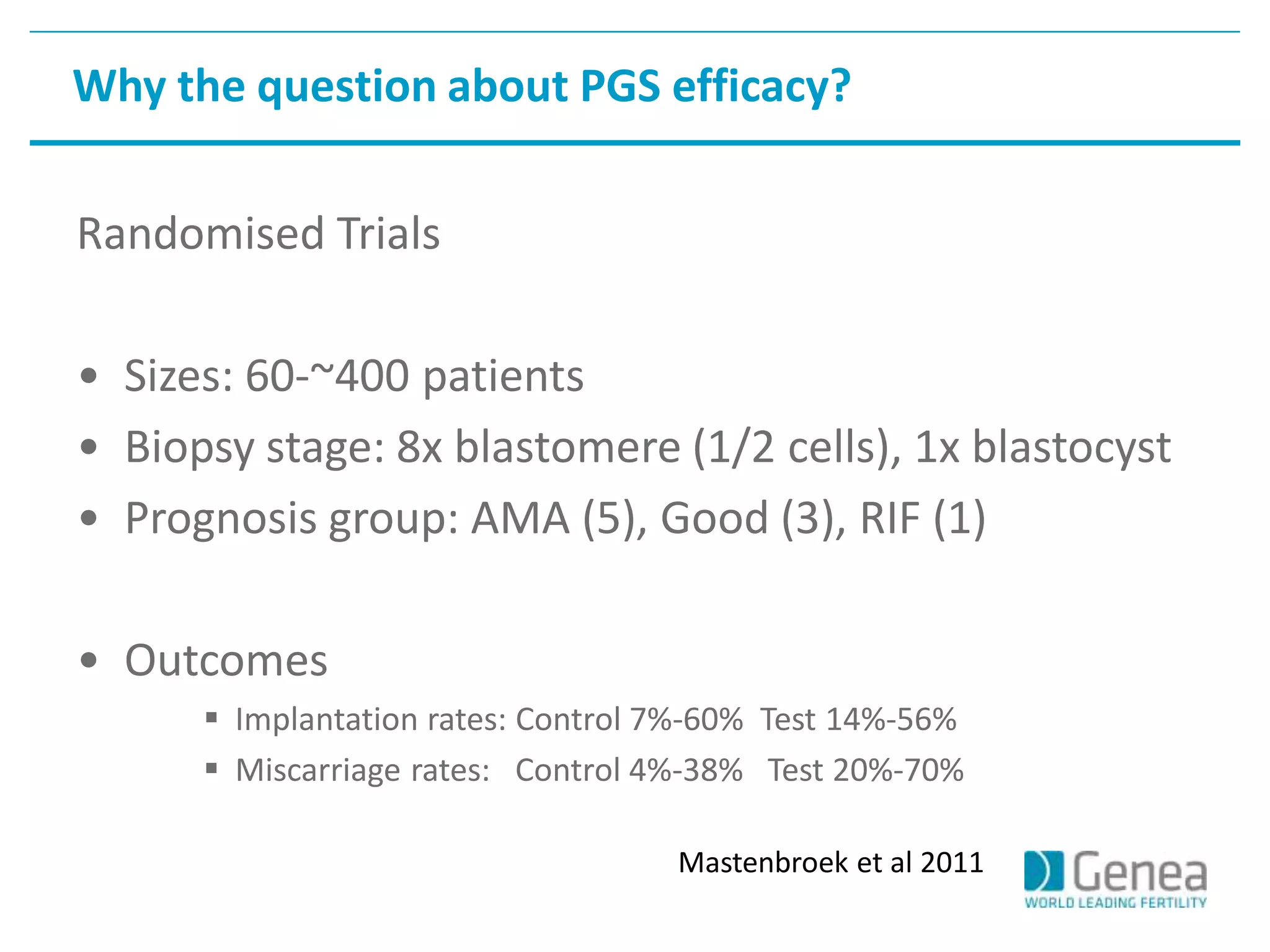
Why the question about PGS efficacy? 
Randomised Trials 
• Sizes: 60-~400 patients 
• Biopsy stage: 8x blastomere (1/2 cells), 1x blastocyst 
• Prognosis group: AMA (5), Good (3), RIF (1) 
• Outcomes 
 Implantation rates: Control 7%-60% Test 14%-56% 
 Miscarriage rates: Control 4%-38% Test 20%-70% 
Mastenbroek et al 2011
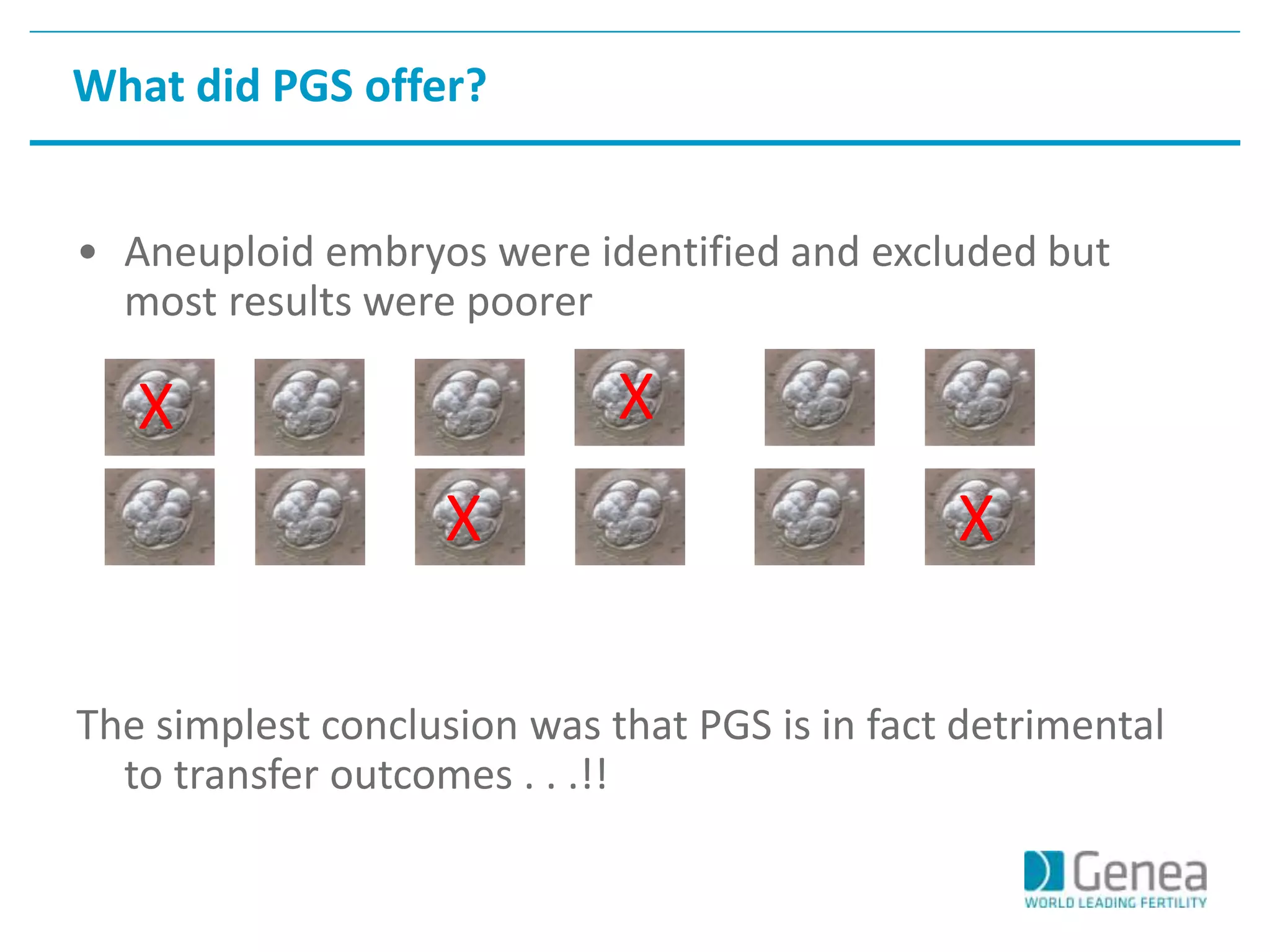
What did PGS offer? 
• Aneuploid embryos were identified and excluded but 
most results were poorer 
The simplest conclusion was that PGS is in fact detrimental 
to transfer outcomes . . .!! 
X 
X 
X 
X
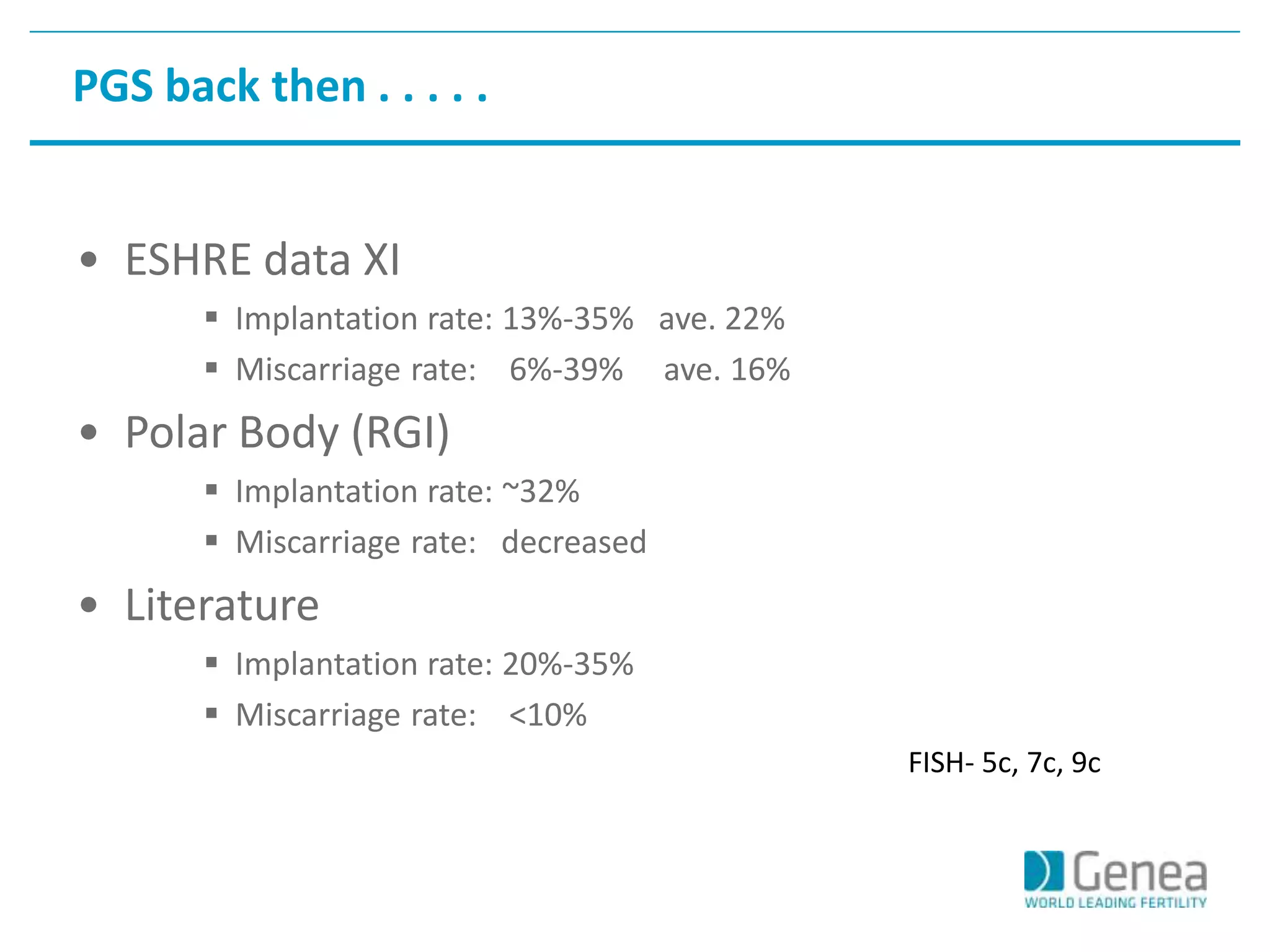
PGS back then . . . . . 
• ESHRE data XI 
 Implantation rate: 13%-35% ave. 22% 
 Miscarriage rate: 6%-39% ave. 16% 
• Polar Body (RGI) 
 Implantation rate: ~32% 
 Miscarriage rate: decreased 
• Literature 
 Implantation rate: 20%-35% 
 Miscarriage rate: <10% 
FISH- 5c, 7c, 9c
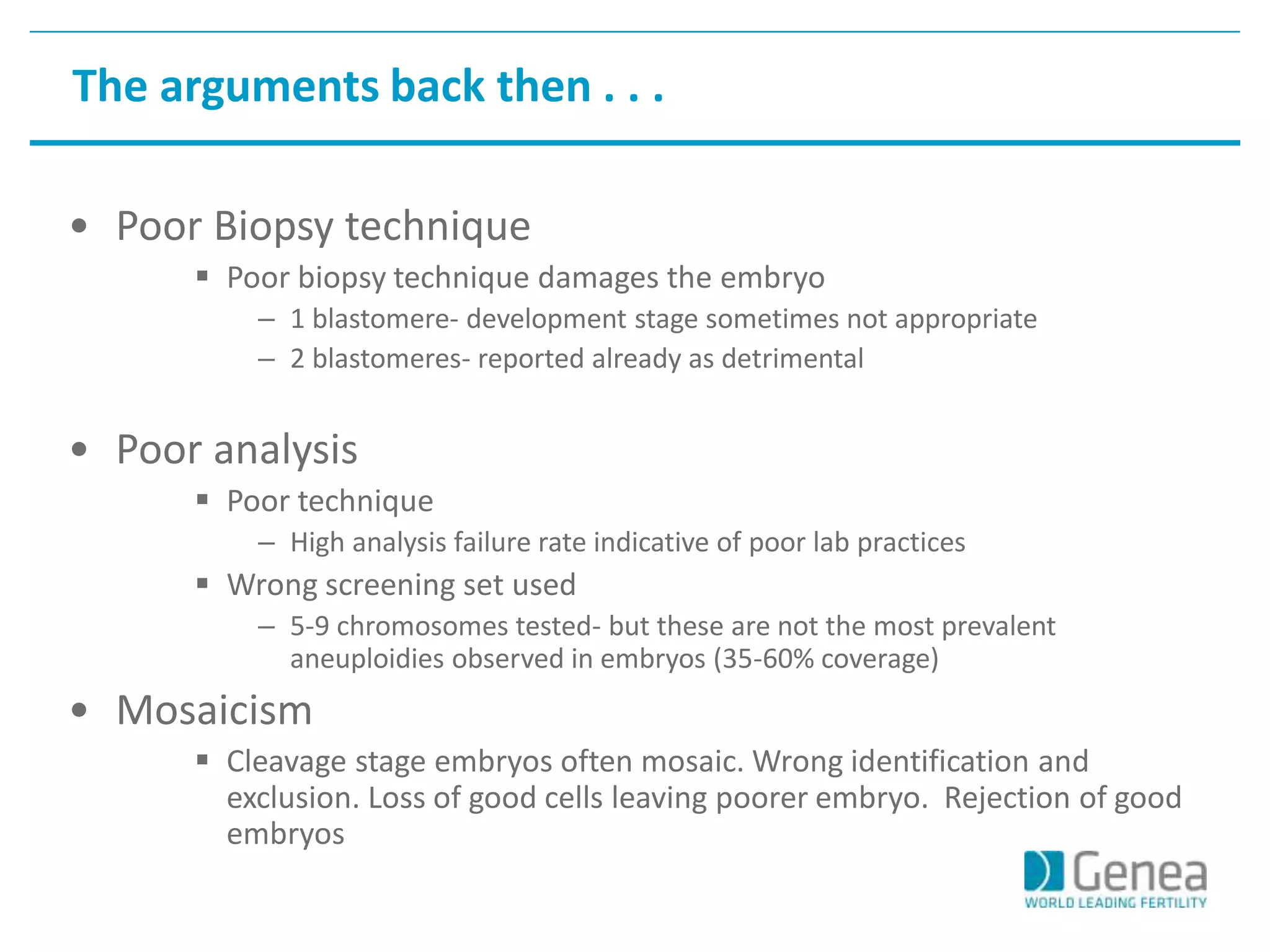
The arguments back then . . . 
• Poor Biopsy technique 
 Poor biopsy technique damages the embryo 
– 1 blastomere- development stage sometimes not appropriate 
– 2 blastomeres- reported already as detrimental 
• Poor analysis 
 Poor technique 
– High analysis failure rate indicative of poor lab practices 
 Wrong screening set used 
– 5-9 chromosomes tested- but these are not the most prevalent 
aneuploidies observed in embryos (35-60% coverage) 
• Mosaicism 
 Cleavage stage embryos often mosaic. Wrong identification and 
exclusion. Loss of good cells leaving poorer embryo. Rejection of good 
embryos
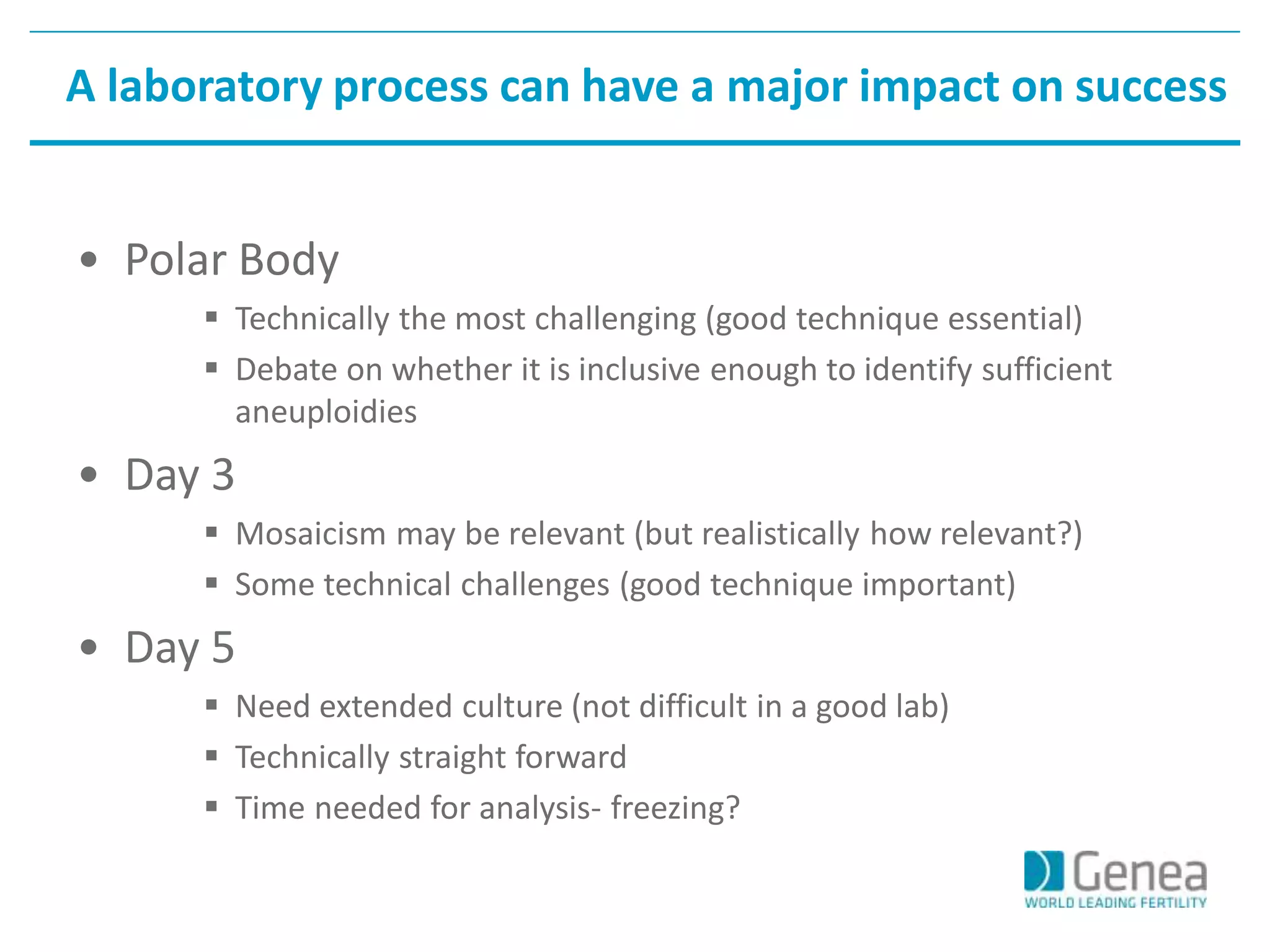
A laboratory process can have a major impact on success 
• Polar Body 
 Technically the most challenging (good technique essential) 
 Debate on whether it is inclusive enough to identify sufficient 
aneuploidies 
• Day 3 
 Mosaicism may be relevant (but realistically how relevant?) 
 Some technical challenges (good technique important) 
• Day 5 
 Need extended culture (not difficult in a good lab) 
 Technically straight forward 
 Time needed for analysis- freezing?
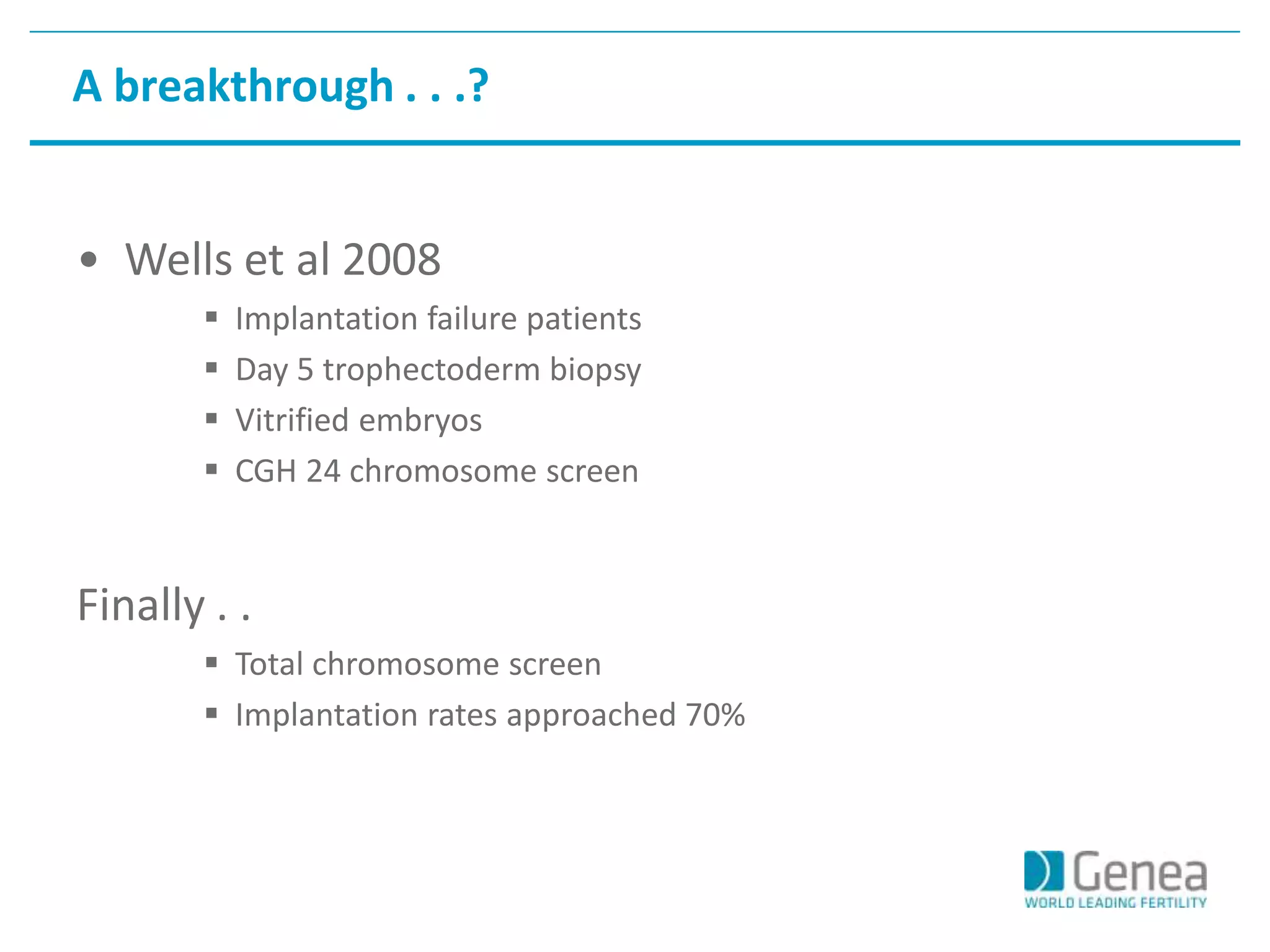
A breakthrough . . .? 
• Wells et al 2008 
 Implantation failure patients 
 Day 5 trophectoderm biopsy 
 Vitrified embryos 
 CGH 24 chromosome screen 
Finally . . 
 Total chromosome screen 
 Implantation rates approached 70%
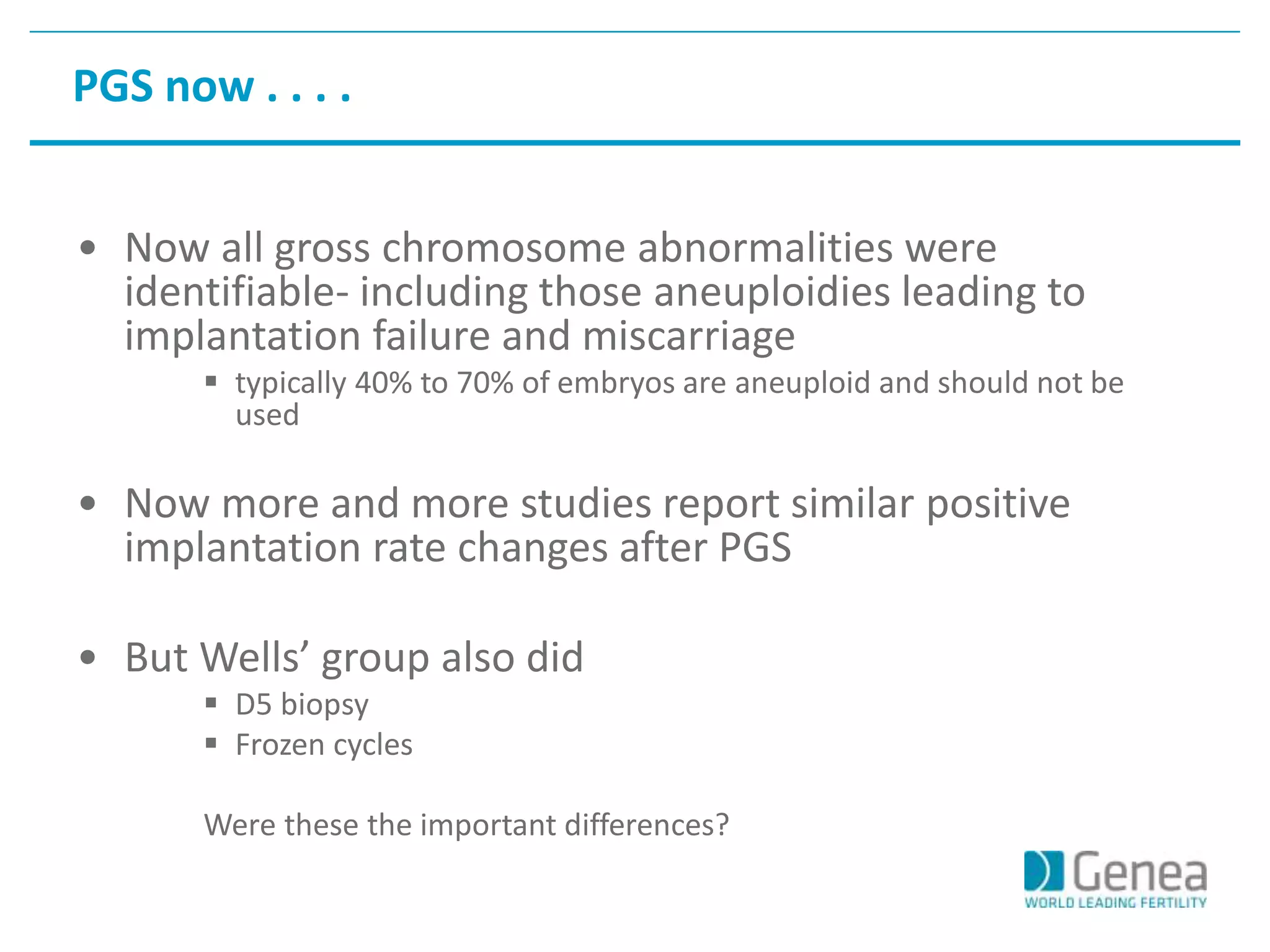
PGS now . . . . 
• Now all gross chromosome abnormalities were 
identifiable- including those aneuploidies leading to 
implantation failure and miscarriage 
 typically 40% to 70% of embryos are aneuploid and should not be 
used 
• Now more and more studies report similar positive 
implantation rate changes after PGS 
• But Wells’ group also did 
 D5 biopsy 
 Frozen cycles 
Were these the important differences?
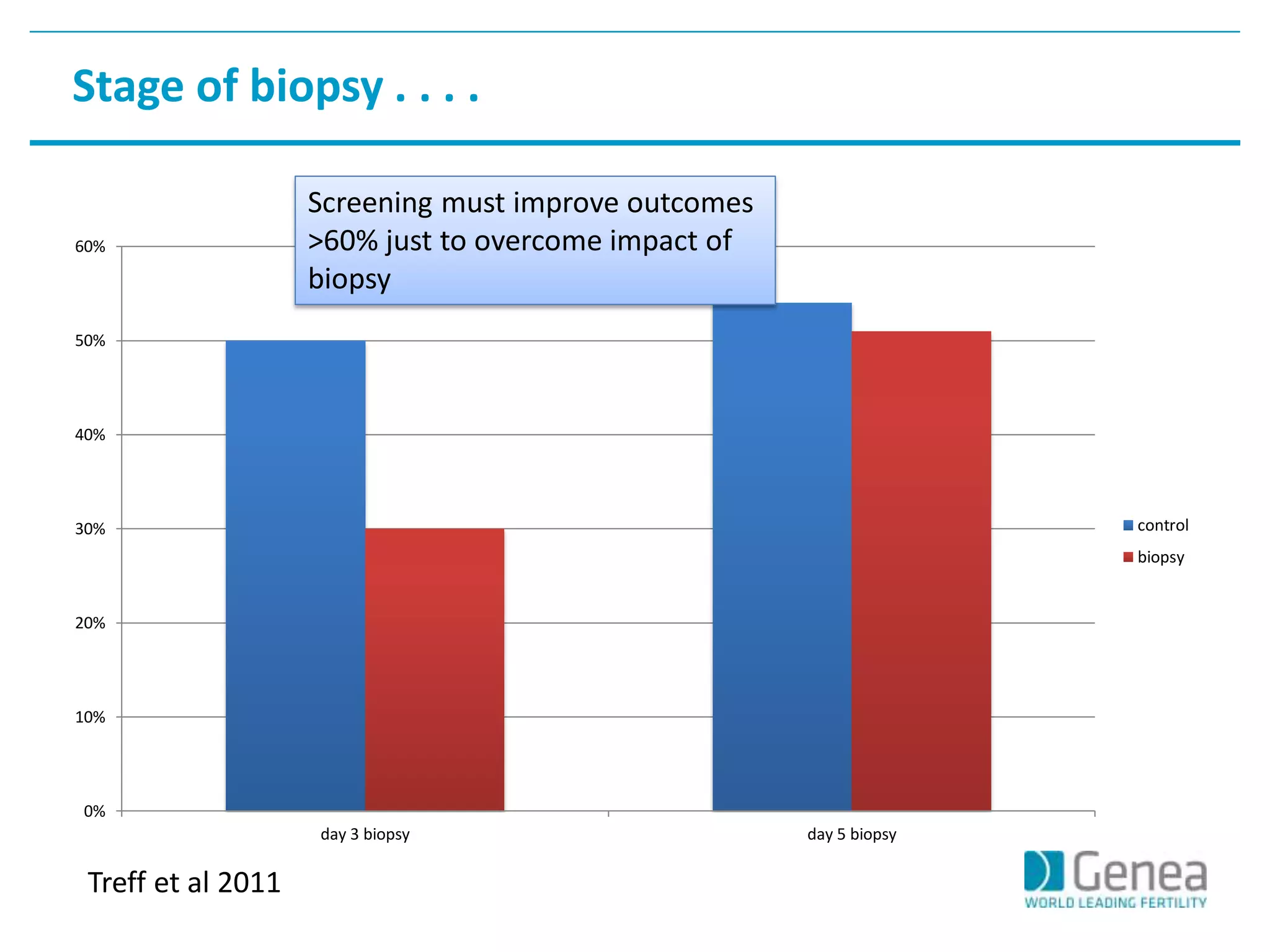
Stage of biopsy . . . . 
60% 
50% 
40% 
30% 
20% 
10% 
0% 
day 3 biopsy day 5 biopsy 
control 
biopsy 
Treff et al 2011 
Screening must improve outcomes 
>60% just to overcome impact of 
biopsy
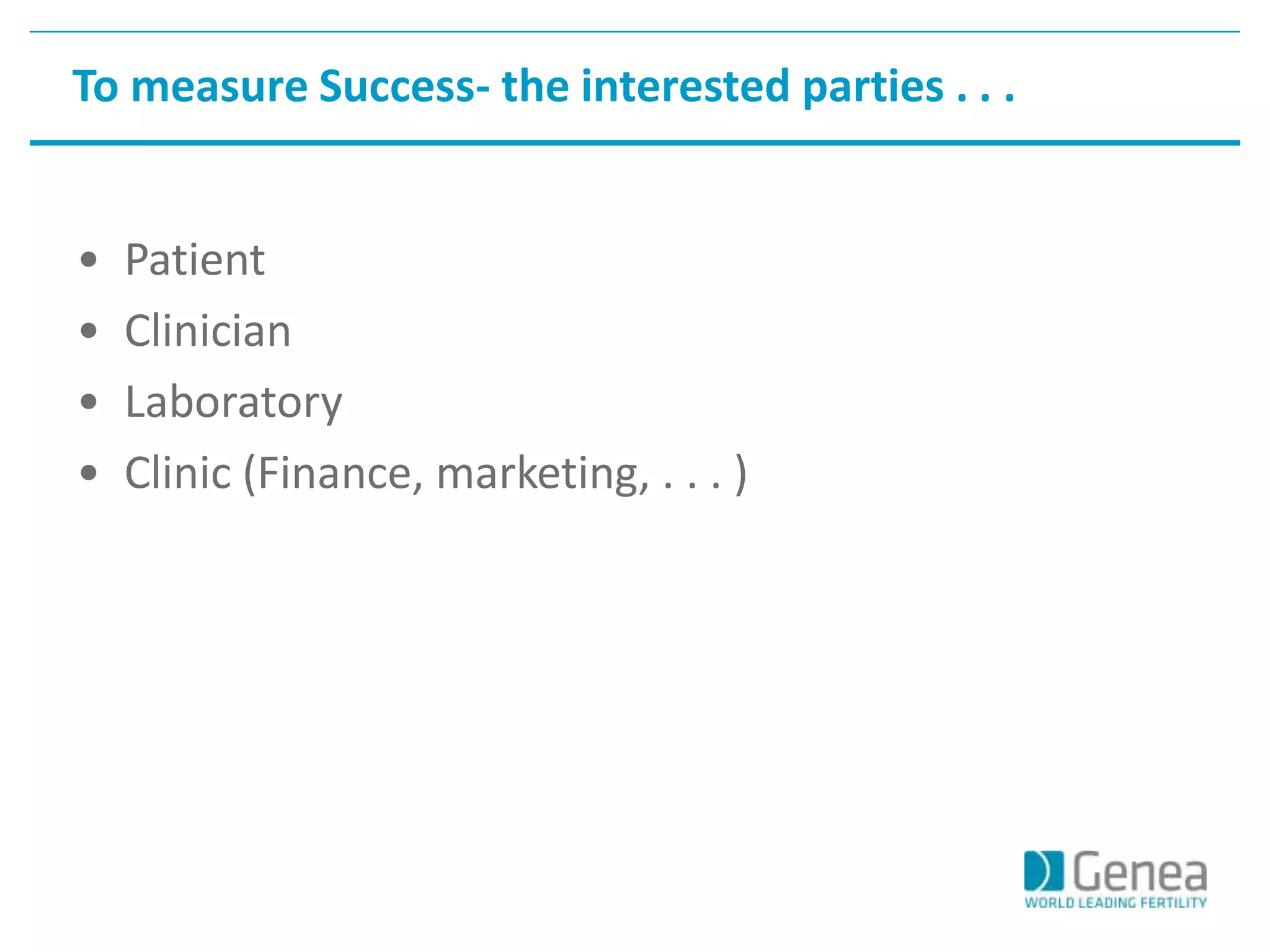
To measure Success- the interested parties . . . 
• Patient 
• Clinician 
• Laboratory 
• Clinic (Finance, marketing, . . . )
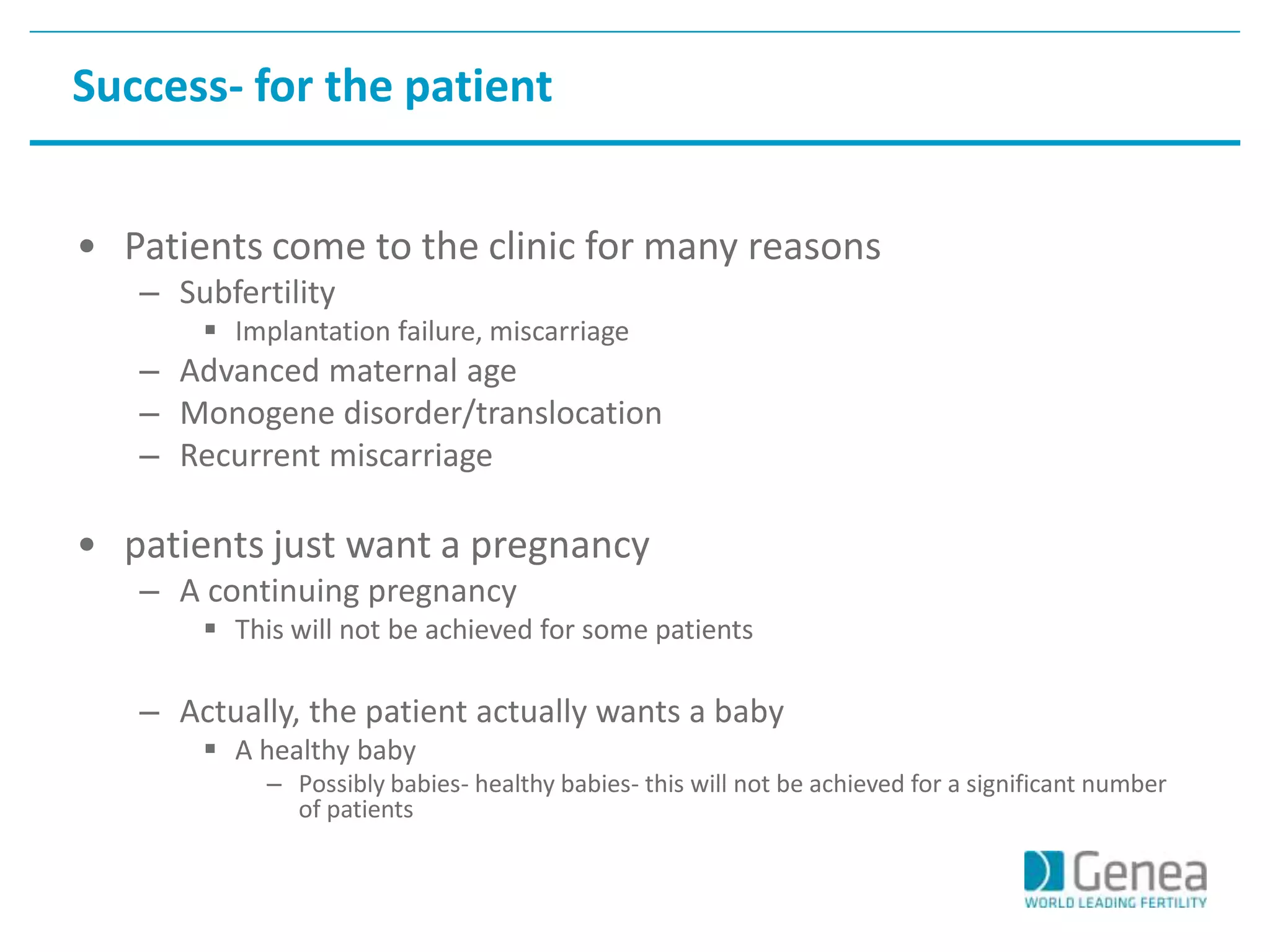
Success- for the patient 
• Patients come to the clinic for many reasons 
– Subfertility 
 Implantation failure, miscarriage 
– Advanced maternal age 
– Monogene disorder/translocation 
– Recurrent miscarriage 
• patients just want a pregnancy 
– A continuing pregnancy 
 This will not be achieved for some patients 
– Actually, the patient actually wants a baby 
 A healthy baby 
– Possibly babies- healthy babies- this will not be achieved for a significant number 
of patients
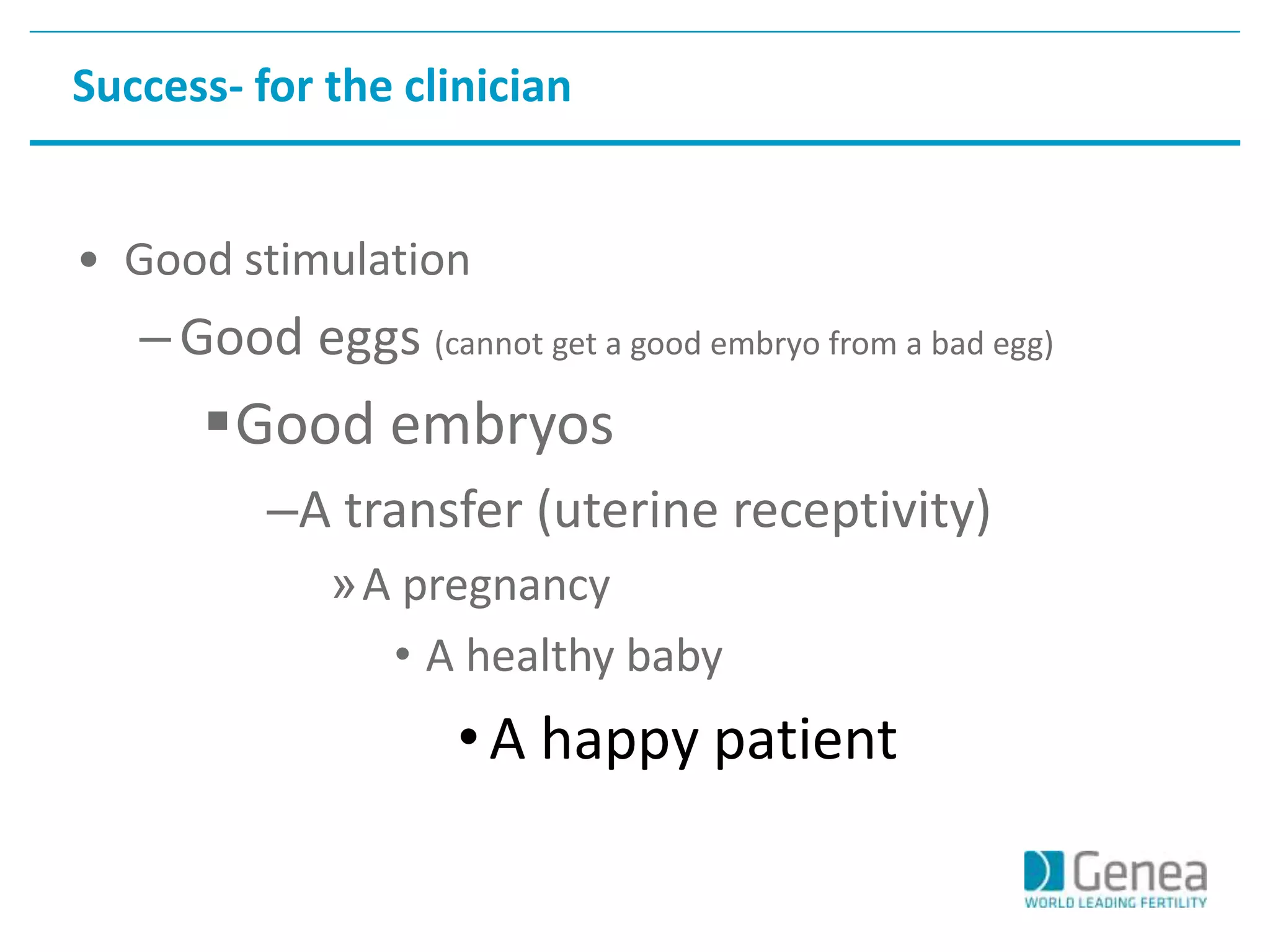
Success- for the clinician 
• Good stimulation 
– Good eggs (cannot get a good embryo from a bad egg) 
Good embryos 
–A transfer (uterine receptivity) 
»A pregnancy 
• A healthy baby 
• A happy patient
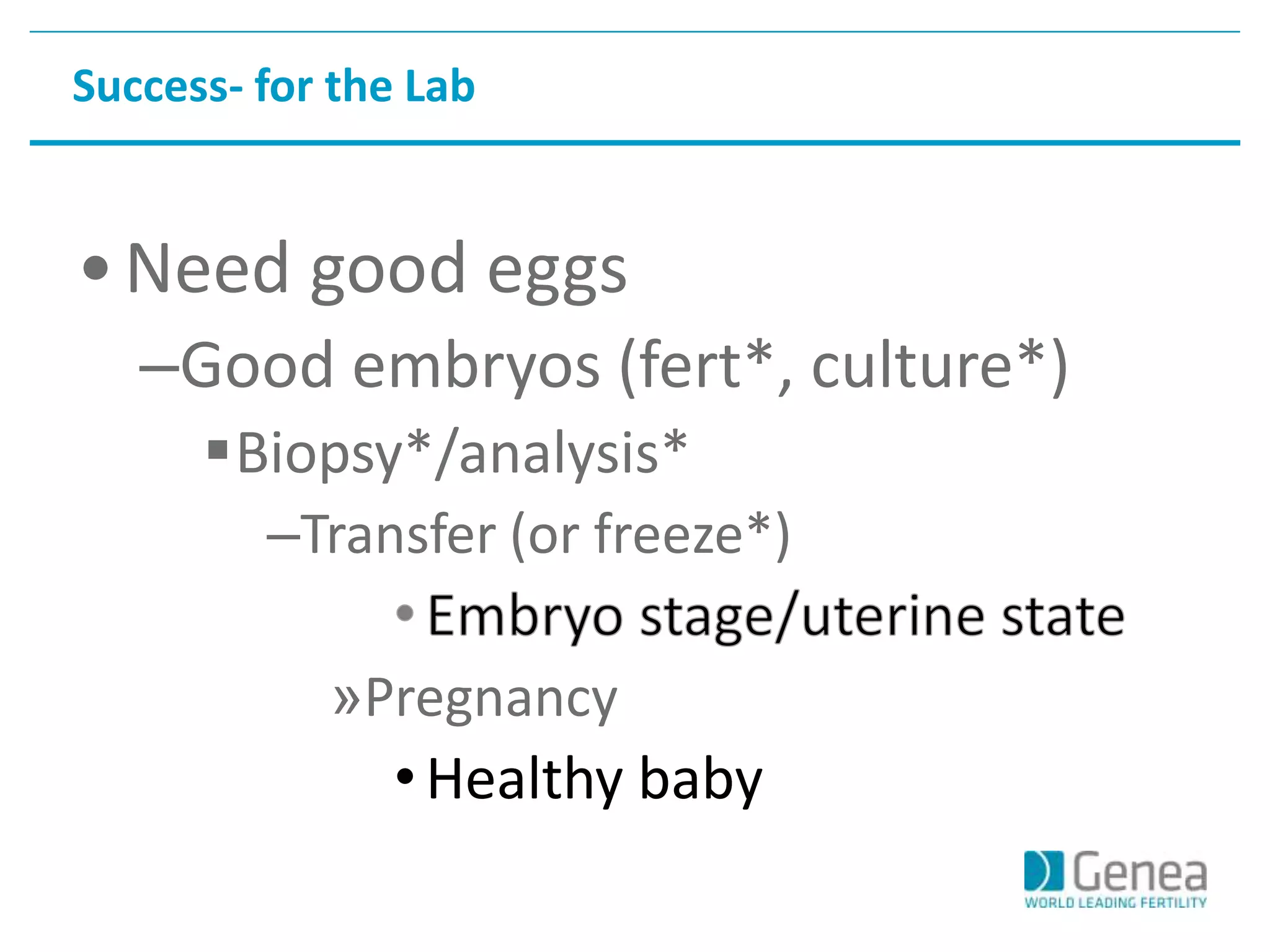
Success- for the Lab 
•Need good eggs 
–Good embryos (fert*, culture*) 
Biopsy*/analysis* 
–Transfer (or freeze*) 
»Pregnancy 
•Healthy baby
The caveats . . . . 
PGS does not make any embryo better- it is only a tool to facilitate 
embryo choice to avoid a significant source of biological negatives 
• At best, the laboratory maintains the vitality of an embryo . . . or in 
a poorly operating clinic makes it worse 
• PGS does not improve the patient factors (eg uterine receptivity) 
• PGS should not be thought of as the best way to improve a clinic’s 
outcomes 
 Implantation rate is a key lab performance indicator- general fresh and frozen 
implantation rates show how a clinic is performing 
 In some cases, lab improvements may be the best approach to give the 
improvements that a clinic is after (Beyer et al 2008)
PGS can be a positive 
Performed correctly, PGS 
• Improves implantation rates for some (most?) patients 
– Decreases the futile transfers for most patient types (young, 
AMA, recurrent implantation failure*, miscarriage*, tl) by 
avoiding transfer of unfit embryos 
• Decreases miscarriage rates 
– Minimises miscarriage especially for AMA and tl carriers (but 
only aneuploid related miscarriages) 
• Can offer single embryo transfer cycles as a real option 
– Without losing pregnancy rates 
– Double embryo transfers and the risks associated with multiple 
gestations can be a thing of the past
What limits successful application of PGS? 
-ve factors 
• Poor stimulation 
• Poor embryology- biopsied embryos show greater 
sensitivity to lab conditions 
• Biopsy- poor technique has greater negative impact 
• Biopsy timing- different costs at different stages 
• Poor freezing (fresh = frozen) 
• Analysis- poor analysis loses good embryos 
• Transfer- fresh vs frozen 
– Uterine receptivity and state, embryo/uterus synchronicity
Other considerations 
• Successful pregnancy is a +/- outcome 
– PGS only changes the approach to this outcome. 
• Some patients will not achieve a pregnancy 
– Not with their own eggs (sperm) 
– Not with anyone’s embryos 
• Everything we do to an embryo has a negative 
impact- some big, some small
Will PGS offer all clinics success? 
PGS does work in the right situations- previous failures to show 
improvements were likely a combination of too many 
negatives with insufficient positives. Current failures may 
point to clinic failures 
Biopsy may have a larger negative impact on outcome than the 
positive gain of excluding aneuploid embryos 
Different patient groups will see different levels of improvement 
after PGS- but most will see something 
• Some clinics should possibly not be attempting PGS until they 
improve general lab outcomes
The final measure of success . . . . 
When the result/outcome >> 
original likely outcome 
This will occur with PGS when all of the steps from 
egg through embryo through analysis through 
transfer/storage are all appropriate and optimal
PGS and its limits 
• PGS offers assistance in identifying the best starting 
point- it only changes implantation rate 
– Current form of PGS will improve 
 More detail ?more improvement in IR? 
BUT 
• Without better understanding of the patient variables as 
well, then the approach to a 100% outcome will stall 
In the future Preimplantation screening will include both 
embryo status and patient variables
Thank you
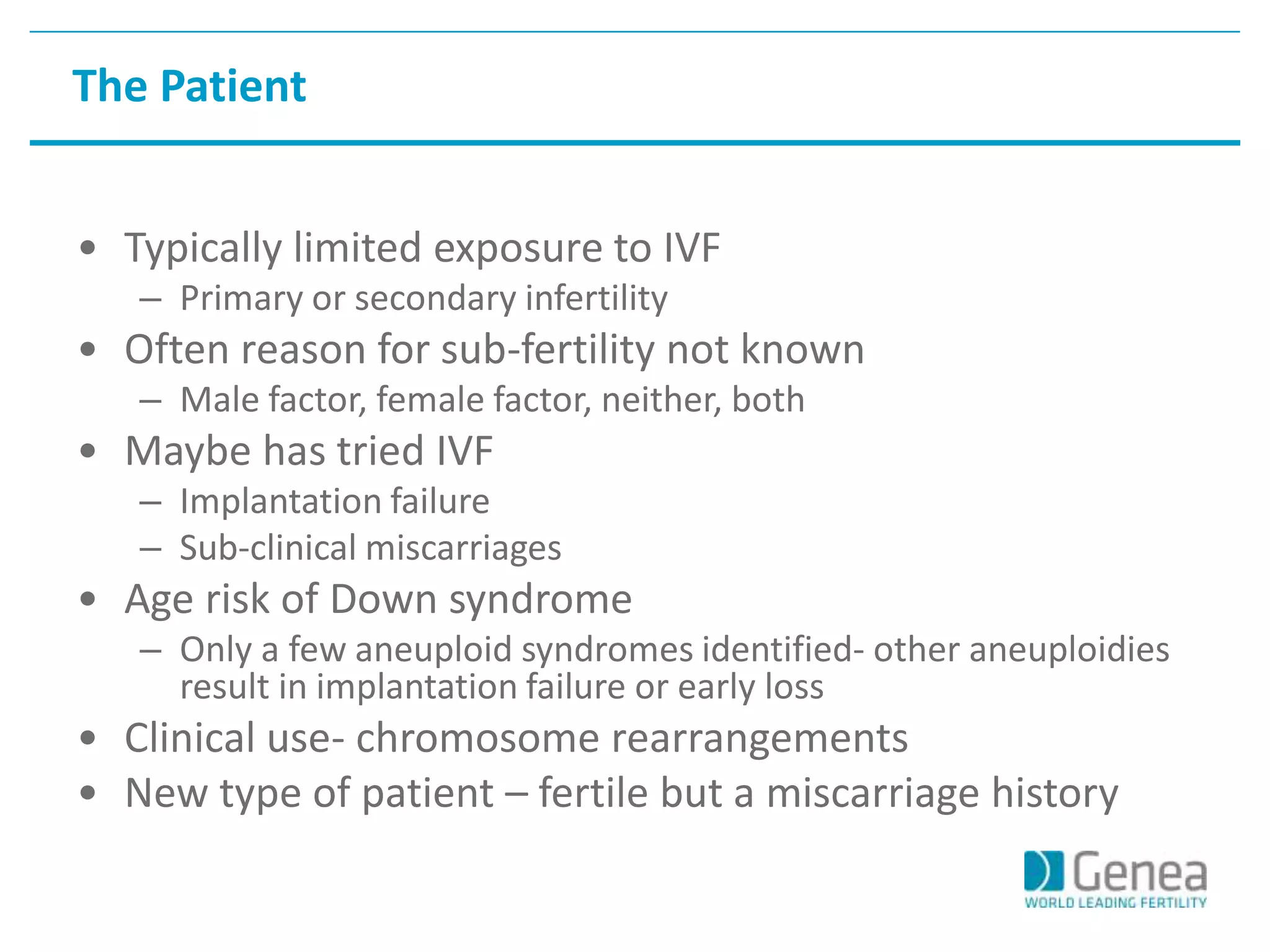
The Patient 
• Typically limited exposure to IVF 
– Primary or secondary infertility 
• Often reason for sub-fertility not known 
– Male factor, female factor, neither, both 
• Maybe has tried IVF 
– Implantation failure 
– Sub-clinical miscarriages 
• Age risk of Down syndrome 
– Only a few aneuploid syndromes identified- other aneuploidies 
result in implantation failure or early loss 
• Clinical use- chromosome rearrangements 
• New type of patient – fertile but a miscarriage history
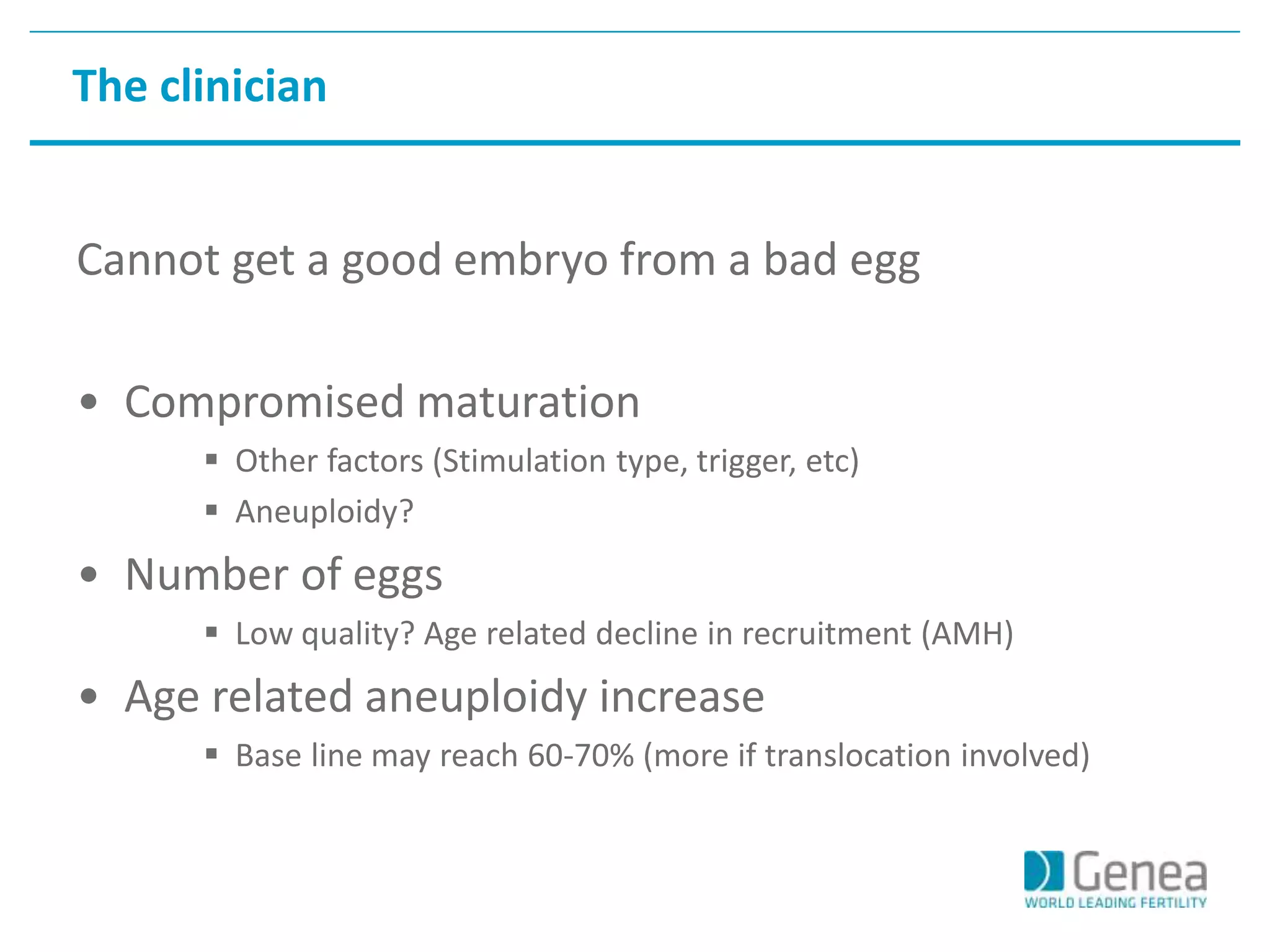
The clinician 
Cannot get a good embryo from a bad egg 
• Compromised maturation 
 Other factors (Stimulation type, trigger, etc) 
 Aneuploidy? 
• Number of eggs 
 Low quality? Age related decline in recruitment (AMH) 
• Age related aneuploidy increase 
 Base line may reach 60-70% (more if translocation involved)
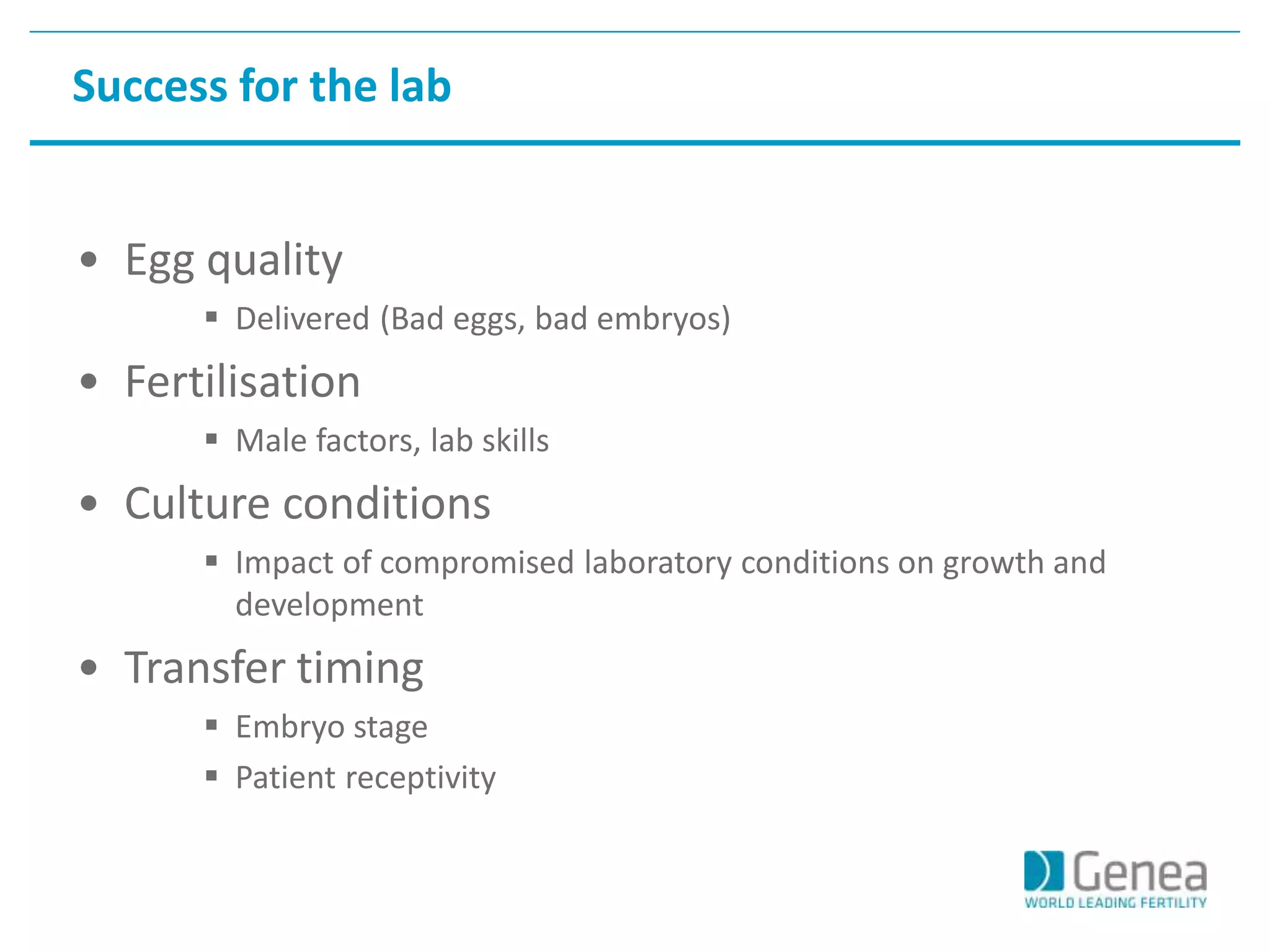
Success for the lab 
• Egg quality 
 Delivered (Bad eggs, bad embryos) 
• Fertilisation 
 Male factors, lab skills 
• Culture conditions 
 Impact of compromised laboratory conditions on growth and 
development 
• Transfer timing 
 Embryo stage 
 Patient receptivity

How to-evaluate-success-with-pgs-don-leigh

  • 1.
    How to evaluatesuccess with PGS Don Leigh ASPIRE April 2014
  • 2.
    IVF . .. What can be done to improve things? • ~2/3 of clinical miscarriages are caused by chromosome aneuploidy • Some aneuploidies are not observed in miscarriages and believed to be implantation/development lethal • IVF implantation rates decrease with increasing age • IVF embryos show variable aneuploidy rates (5-70% age related) • Natural pregnancies show an age related increase in incidence of trisomy 21 PGS should provide an opportunity to improve the success of an embryo transfer  Transfers have emotional, time and monetary costs  Implantation failures and miscarriages have high emotional cost, larger time costs, health costs and significant monetary costs It is a logical conclusion that identifying and avoiding the transfer of aneuploid embryos will change the implantation rates and also the miscarriage rates
  • 3.
    Why the questionabout PGS efficacy? Randomised Trials • Sizes: 60-~400 patients • Biopsy stage: 8x blastomere (1/2 cells), 1x blastocyst • Prognosis group: AMA (5), Good (3), RIF (1) • Outcomes  Implantation rates: Control 7%-60% Test 14%-56%  Miscarriage rates: Control 4%-38% Test 20%-70% Mastenbroek et al 2011
  • 4.
    What did PGSoffer? • Aneuploid embryos were identified and excluded but most results were poorer The simplest conclusion was that PGS is in fact detrimental to transfer outcomes . . .!! X X X X
  • 5.
    PGS back then. . . . . • ESHRE data XI  Implantation rate: 13%-35% ave. 22%  Miscarriage rate: 6%-39% ave. 16% • Polar Body (RGI)  Implantation rate: ~32%  Miscarriage rate: decreased • Literature  Implantation rate: 20%-35%  Miscarriage rate: <10% FISH- 5c, 7c, 9c
  • 6.
    The arguments backthen . . . • Poor Biopsy technique  Poor biopsy technique damages the embryo – 1 blastomere- development stage sometimes not appropriate – 2 blastomeres- reported already as detrimental • Poor analysis  Poor technique – High analysis failure rate indicative of poor lab practices  Wrong screening set used – 5-9 chromosomes tested- but these are not the most prevalent aneuploidies observed in embryos (35-60% coverage) • Mosaicism  Cleavage stage embryos often mosaic. Wrong identification and exclusion. Loss of good cells leaving poorer embryo. Rejection of good embryos
  • 7.
    A laboratory processcan have a major impact on success • Polar Body  Technically the most challenging (good technique essential)  Debate on whether it is inclusive enough to identify sufficient aneuploidies • Day 3  Mosaicism may be relevant (but realistically how relevant?)  Some technical challenges (good technique important) • Day 5  Need extended culture (not difficult in a good lab)  Technically straight forward  Time needed for analysis- freezing?
  • 8.
    A breakthrough .. .? • Wells et al 2008  Implantation failure patients  Day 5 trophectoderm biopsy  Vitrified embryos  CGH 24 chromosome screen Finally . .  Total chromosome screen  Implantation rates approached 70%
  • 9.
    PGS now .. . . • Now all gross chromosome abnormalities were identifiable- including those aneuploidies leading to implantation failure and miscarriage  typically 40% to 70% of embryos are aneuploid and should not be used • Now more and more studies report similar positive implantation rate changes after PGS • But Wells’ group also did  D5 biopsy  Frozen cycles Were these the important differences?
  • 10.
    Stage of biopsy. . . . 60% 50% 40% 30% 20% 10% 0% day 3 biopsy day 5 biopsy control biopsy Treff et al 2011 Screening must improve outcomes >60% just to overcome impact of biopsy
  • 11.
    To measure Success-the interested parties . . . • Patient • Clinician • Laboratory • Clinic (Finance, marketing, . . . )
  • 12.
    Success- for thepatient • Patients come to the clinic for many reasons – Subfertility  Implantation failure, miscarriage – Advanced maternal age – Monogene disorder/translocation – Recurrent miscarriage • patients just want a pregnancy – A continuing pregnancy  This will not be achieved for some patients – Actually, the patient actually wants a baby  A healthy baby – Possibly babies- healthy babies- this will not be achieved for a significant number of patients
  • 13.
    Success- for theclinician • Good stimulation – Good eggs (cannot get a good embryo from a bad egg) Good embryos –A transfer (uterine receptivity) »A pregnancy • A healthy baby • A happy patient
  • 14.
    Success- for theLab •Need good eggs –Good embryos (fert*, culture*) Biopsy*/analysis* –Transfer (or freeze*) »Pregnancy •Healthy baby
  • 15.
    The caveats .. . . PGS does not make any embryo better- it is only a tool to facilitate embryo choice to avoid a significant source of biological negatives • At best, the laboratory maintains the vitality of an embryo . . . or in a poorly operating clinic makes it worse • PGS does not improve the patient factors (eg uterine receptivity) • PGS should not be thought of as the best way to improve a clinic’s outcomes  Implantation rate is a key lab performance indicator- general fresh and frozen implantation rates show how a clinic is performing  In some cases, lab improvements may be the best approach to give the improvements that a clinic is after (Beyer et al 2008)
  • 16.
    PGS can bea positive Performed correctly, PGS • Improves implantation rates for some (most?) patients – Decreases the futile transfers for most patient types (young, AMA, recurrent implantation failure*, miscarriage*, tl) by avoiding transfer of unfit embryos • Decreases miscarriage rates – Minimises miscarriage especially for AMA and tl carriers (but only aneuploid related miscarriages) • Can offer single embryo transfer cycles as a real option – Without losing pregnancy rates – Double embryo transfers and the risks associated with multiple gestations can be a thing of the past
  • 17.
    What limits successfulapplication of PGS? -ve factors • Poor stimulation • Poor embryology- biopsied embryos show greater sensitivity to lab conditions • Biopsy- poor technique has greater negative impact • Biopsy timing- different costs at different stages • Poor freezing (fresh = frozen) • Analysis- poor analysis loses good embryos • Transfer- fresh vs frozen – Uterine receptivity and state, embryo/uterus synchronicity
  • 18.
    Other considerations •Successful pregnancy is a +/- outcome – PGS only changes the approach to this outcome. • Some patients will not achieve a pregnancy – Not with their own eggs (sperm) – Not with anyone’s embryos • Everything we do to an embryo has a negative impact- some big, some small
  • 19.
    Will PGS offerall clinics success? PGS does work in the right situations- previous failures to show improvements were likely a combination of too many negatives with insufficient positives. Current failures may point to clinic failures Biopsy may have a larger negative impact on outcome than the positive gain of excluding aneuploid embryos Different patient groups will see different levels of improvement after PGS- but most will see something • Some clinics should possibly not be attempting PGS until they improve general lab outcomes
  • 20.
    The final measureof success . . . . When the result/outcome >> original likely outcome This will occur with PGS when all of the steps from egg through embryo through analysis through transfer/storage are all appropriate and optimal
  • 21.
    PGS and itslimits • PGS offers assistance in identifying the best starting point- it only changes implantation rate – Current form of PGS will improve  More detail ?more improvement in IR? BUT • Without better understanding of the patient variables as well, then the approach to a 100% outcome will stall In the future Preimplantation screening will include both embryo status and patient variables
  • 22.
  • 23.
    The Patient •Typically limited exposure to IVF – Primary or secondary infertility • Often reason for sub-fertility not known – Male factor, female factor, neither, both • Maybe has tried IVF – Implantation failure – Sub-clinical miscarriages • Age risk of Down syndrome – Only a few aneuploid syndromes identified- other aneuploidies result in implantation failure or early loss • Clinical use- chromosome rearrangements • New type of patient – fertile but a miscarriage history
  • 24.
    The clinician Cannotget a good embryo from a bad egg • Compromised maturation  Other factors (Stimulation type, trigger, etc)  Aneuploidy? • Number of eggs  Low quality? Age related decline in recruitment (AMH) • Age related aneuploidy increase  Base line may reach 60-70% (more if translocation involved)
  • 25.
    Success for thelab • Egg quality  Delivered (Bad eggs, bad embryos) • Fertilisation  Male factors, lab skills • Culture conditions  Impact of compromised laboratory conditions on growth and development • Transfer timing  Embryo stage  Patient receptivity