How to write your assignment
Good Luck 2 every one
Saleh
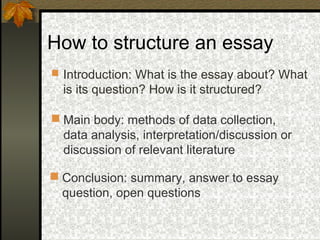
How to structure an essay
 Introduction: What is the essay about? What
is its question? How is it structured?
 Main body: methods of data collection,
data analysis, interpretation/discussion or
discussion of relevant literature
 Conclusion: summary, answer to essay
question, open questions
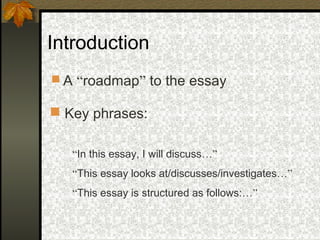
Introduction
 A “roadmap” to the essay
“In this essay, I will discuss…”
“This essay looks at/discusses/investigates…”
“This essay is structured as follows:…”
 Key phrases:
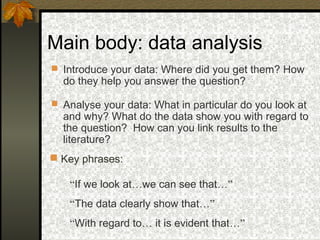
Main body: data analysis
 Introduce your data: Where did you get them? How
do they help you answer the question?
 Key phrases:
 Analyse your data: What in particular do you look at
and why? What do the data show you with regard to
the question? How can you link results to the
literature?
“If we look at…we can see that…”
“The data clearly show that…”
“With regard to… it is evident that…”
Main body: literature review
 Introduce your sources: What are they? How
do they help you answer the question?
 Key phrases:
 Discuss your sources: What points are
made? How do they relate to each other?
Where do you differ or agree?
“Author A claims/states/reports/suggests that…”
“Author B further develops/opposes/critiques the view that…”
“Author C makes a convincing/viable/important point”
“Author D’s theory seems debatable/in need of further
empirical evidence/is called into question by…”
Conclusion
 Sum up the argument: Where did you start
out from and what did you find? What’s the
answer to the question? What could still be
done?
 Key phrases:
“These results suggest that…”
“To sum up/in conclusion,…”
“Further research into… could show if…”
Essay style
 Be explicit
State your points explicitly – if you don’t state them
clearly the person marking your essay can’t give you
credit for them.
 Be relevant
All material should be relevant to the question –
irrelevant material will be ignored.
 Be logical
Watch out for logical gaps − do the facts you’re citing
really back up the point you’re making?
Essay style
 Be clear and concise
 Avoid long, wordy sentences: don’t ramble!
 Don’t use ten words when two will do
 Don’t use a “bookish” word when an
everyday word will do
 E.g. “parsimonious” instead of “scarce”
 Exception: technical linguistics terminology
(e.g. “adjacency pair”, “morpheme”)
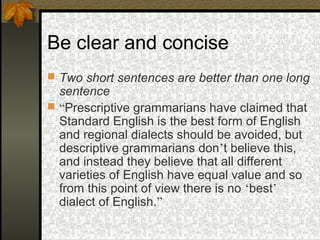
Be clear and concise
 Two short sentences are better than one long
sentence
 “Prescriptive grammarians have claimed that
Standard English is the best form of English
and regional dialects should be avoided, but
descriptive grammarians don’t believe this,
and instead they believe that all different
varieties of English have equal value and so
from this point of view there is no ‘best’
dialect of English.”
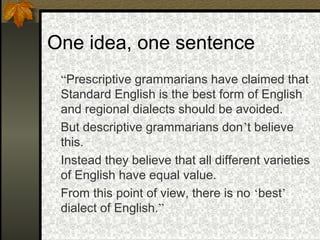
One idea, one sentence
“Prescriptive grammarians have claimed that
Standard English is the best form of English
and regional dialects should be avoided.
But descriptive grammarians don’t believe
this.
Instead they believe that all different varieties
of English have equal value.
From this point of view, there is no ‘best’
dialect of English.”
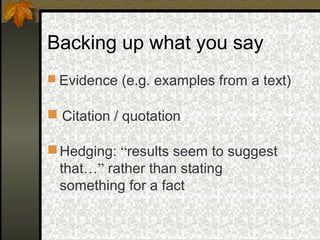
Backing up what you say
 Evidence (e.g. examples from a text)
 Citation / quotation
Hedging: “results seem to suggest
that…” rather than stating
something for a fact
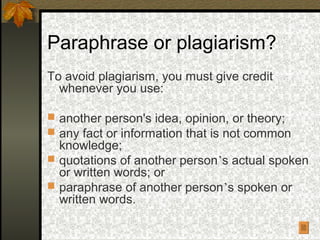
Paraphrase or plagiarism?
To avoid plagiarism, you must give credit
whenever you use:
 another person's idea, opinion, or theory;
 any fact or information that is not common
knowledge;
 quotations of another person’s actual spoken
or written words; or
 paraphrase of another person’s spoken or
written words.
Key phrases for citing and
quoting
“X puts the argument as follows: ‘…’”
“Y reinforces his/her claim when stating
that…”
“Following Z, we can say that…”
Long quotations
Long quotations take the form of a
separate paragraph with margins
adjusted:
blah blah blah blah blah blah blah
blah blah blah blah blah blah blah blah
(author year: page number).
Some more of your text here.
Short references
 As Smith (2000) has argued, we should not
discriminate based on accent.
 People tend to judge accents based on their
preconceptions about the speakers who use that
accent (Bloggs 1998: 32-34).
 It has been found that “people tend to make
inferences about the speaker based on his or her
accent” (Bloggs 1998: 32).
 Do not use footnotes for references!
 Both quotations and paraphrases of a
source MUST have a short reference
References list
 after your conclusion
 list all sources in one section
 list in alphabetical order:
Sloan, W. (2003) Title. Publisher.
Smith, A. (2004a) Title. Publisher.
Smith, A. (2004b) Title. Publisher.
Smith, T. (2001) Title. Publisher.
 web sources: give as much information as
available, give exact URLs and access dates
 list all, and only the sources quoted in the
essay
The most important rules:
 ALWAYS answer the question!
Reference EVERY fact or idea you
got from the literature!
Structure your essay, its sections and
sentences, so as to make it EASY on
the reader!

How to write your assignment

  • 1.
    How to writeyour assignment Good Luck 2 every one Saleh
  • 2.
    How to structurean essay  Introduction: What is the essay about? What is its question? How is it structured?  Main body: methods of data collection, data analysis, interpretation/discussion or discussion of relevant literature  Conclusion: summary, answer to essay question, open questions
  • 3.
    Introduction  A “roadmap”to the essay “In this essay, I will discuss…” “This essay looks at/discusses/investigates…” “This essay is structured as follows:…”  Key phrases:
  • 4.
    Main body: dataanalysis  Introduce your data: Where did you get them? How do they help you answer the question?  Key phrases:  Analyse your data: What in particular do you look at and why? What do the data show you with regard to the question? How can you link results to the literature? “If we look at…we can see that…” “The data clearly show that…” “With regard to… it is evident that…”
  • 5.
    Main body: literaturereview  Introduce your sources: What are they? How do they help you answer the question?  Key phrases:  Discuss your sources: What points are made? How do they relate to each other? Where do you differ or agree? “Author A claims/states/reports/suggests that…” “Author B further develops/opposes/critiques the view that…” “Author C makes a convincing/viable/important point” “Author D’s theory seems debatable/in need of further empirical evidence/is called into question by…”
  • 6.
    Conclusion  Sum upthe argument: Where did you start out from and what did you find? What’s the answer to the question? What could still be done?  Key phrases: “These results suggest that…” “To sum up/in conclusion,…” “Further research into… could show if…”
  • 7.
    Essay style  Beexplicit State your points explicitly – if you don’t state them clearly the person marking your essay can’t give you credit for them.  Be relevant All material should be relevant to the question – irrelevant material will be ignored.  Be logical Watch out for logical gaps − do the facts you’re citing really back up the point you’re making?
  • 8.
    Essay style  Beclear and concise  Avoid long, wordy sentences: don’t ramble!  Don’t use ten words when two will do  Don’t use a “bookish” word when an everyday word will do  E.g. “parsimonious” instead of “scarce”  Exception: technical linguistics terminology (e.g. “adjacency pair”, “morpheme”)
  • 9.
    Be clear andconcise  Two short sentences are better than one long sentence  “Prescriptive grammarians have claimed that Standard English is the best form of English and regional dialects should be avoided, but descriptive grammarians don’t believe this, and instead they believe that all different varieties of English have equal value and so from this point of view there is no ‘best’ dialect of English.”
  • 10.
    One idea, onesentence “Prescriptive grammarians have claimed that Standard English is the best form of English and regional dialects should be avoided. But descriptive grammarians don’t believe this. Instead they believe that all different varieties of English have equal value. From this point of view, there is no ‘best’ dialect of English.”
  • 11.
    Backing up whatyou say  Evidence (e.g. examples from a text)  Citation / quotation Hedging: “results seem to suggest that…” rather than stating something for a fact
  • 12.
    Paraphrase or plagiarism? Toavoid plagiarism, you must give credit whenever you use:  another person's idea, opinion, or theory;  any fact or information that is not common knowledge;  quotations of another person’s actual spoken or written words; or  paraphrase of another person’s spoken or written words.
  • 13.
    Key phrases forciting and quoting “X puts the argument as follows: ‘…’” “Y reinforces his/her claim when stating that…” “Following Z, we can say that…”
  • 14.
    Long quotations Long quotationstake the form of a separate paragraph with margins adjusted: blah blah blah blah blah blah blah blah blah blah blah blah blah blah blah (author year: page number). Some more of your text here.
  • 15.
    Short references  AsSmith (2000) has argued, we should not discriminate based on accent.  People tend to judge accents based on their preconceptions about the speakers who use that accent (Bloggs 1998: 32-34).  It has been found that “people tend to make inferences about the speaker based on his or her accent” (Bloggs 1998: 32).  Do not use footnotes for references!  Both quotations and paraphrases of a source MUST have a short reference
  • 16.
    References list  afteryour conclusion  list all sources in one section  list in alphabetical order: Sloan, W. (2003) Title. Publisher. Smith, A. (2004a) Title. Publisher. Smith, A. (2004b) Title. Publisher. Smith, T. (2001) Title. Publisher.  web sources: give as much information as available, give exact URLs and access dates  list all, and only the sources quoted in the essay
  • 17.
    The most importantrules:  ALWAYS answer the question! Reference EVERY fact or idea you got from the literature! Structure your essay, its sections and sentences, so as to make it EASY on the reader!