HOW TO WIN WITH INBOUND
MARKETING IN 2016
Distinguish your brand from the sea of sameness
John Beveridge is the
founder and President of
Rapidan Inbound, an
inbound marketing
agency and HubSpot-
certified partner based in
McLean, VA.
Twitter @JohnMBeveridge
Email john.beveridge@rapidanstrategies.com
Phone 866.610.0579
www.b2binboundmarketer.com
HubSpot 2015 State of Inbound
“The biggest change is that 2015’s report
doesn’t cover the emergence of inbound
marketing as it has in past years -- the
principles are now well-entrenched.”
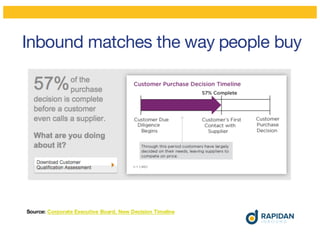
Inbound matches the way people buy
Source: Corporate Executive Board, New Decision Timeline
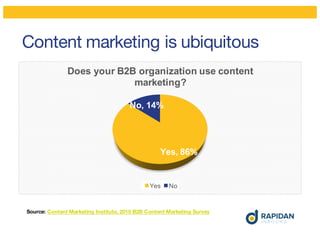
Content marketing is ubiquitous
Yes, 86%
No, 14%
Does your B2B organization use content
marketing?
Yes No
Source: Content Marketing Institute, 2015 B2B Content Marketing Survey
How can you distinguish
yourself from the noise your
prospects experience while they
are trying to accomplish their
goals and objectives?
AN EXECUTIVE KEYWORD
STRATEGY (SEO EXPERTISE
NOT REQUIRED)
What are keywords?
Keywords are phrases that your
prospects and customers use to
search for information about the
problems you solve on search engines
like Google, Bing and Yahoo.
Google algorithm changes
Over the past few years, Google has changed its ranking
algorithm to favor websites that produce good content.
• If you create good content that answers questions and provides information
that your target audience wants, you’re probably practicing good SEO without
knowing it.
• 15-20% of the searches Google sees every day are unique – they’ve never
been searched for before!
• Optimize your content for humans, not search engines.
Short-tail keywords
Short-tail keywords are short phrases (usually one or two
words) that describe what you do at the highest level.
Examples: Inbound marketing, cybersecurity, web design,
accounting, etc.
Characteristics of short-tail keywords
• Difficult to rank for
• Don’t reveal intent of searcher
Long-tail keywords
Long-tail keywords are longer phrases and questions that
buyers search to get specific information
(Example: How can I protect my government contracting
business from corporate identity theft?)
Characteristics of long-tail keywords
• Easier to rank for
• Often reveal a very specific intent
How to build your keyword strategy
Step 1: Choose your target short-tail keywords
For most of us, there are several short-tail keywords that
describe our businesses.
(Example: digital marketing, online marketing, internet
marketing, inbound marketing, social media marketing,
inbound marketing)
Choose your targets for business reasons.
How to build your keyword strategy
Step 2: Build long-tail keyword phrases based on your
root short-tail keywords.
1. Create long-tail keyword phrases based on the questions you hear from
prospects and customers.
2. Create long-tail keyword phrases based on your target audience (industry,
location, demographics, etc.) – e.g. How can I generate leads for my
technology company with inbound marketing?
3. Create long-tail keyword phrases (and content) for all phases of the buying
process (Awareness, Evaluation, Decision)
4. Look for niches that offer ranking opportunities.
How to build your keyword strategy
Step 3: Use your targeted keyword phrases based in all
aspects of your business
• Use keyword phrases for on-site SEO
• Use keyword phrases in the titles and body of your content (WRITE FOR
HUMANS!)
• Use targeted keyword phrases in your outbound marketing (emails and
calls)
• Train your sales and service people to use your keywords in the course of
their daily responsibilities
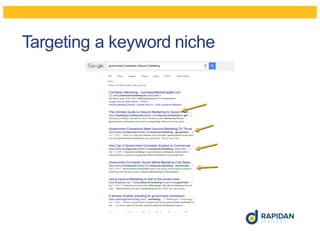
Targeting a keyword niche
OPTIMIZE YOUR BLOG FOR
YOUR TARGET AUDIENCE
Optimize your blog for your audience
“27 million pieces of content
are shared every day.”
Source: ION Interactive – 75 Essential Content Marketing Facts
Optimize your blog for your audience
Understand how people consume information on the
internet.
Most people will not read your blog post from beginning to
end. They search the web for specific information and scan
your content to find what they’re searching for. Make it
easy for them!
Source: ION Interactive – 75 Essential Content Marketing Facts
Optimize your blog for your audience
Format your blog to provide information in digestible
chunks.
• Use images!
• Break your blog post into sections – use headers,
horizontal lines, images and charts to give the reader
bite-size chunks.
• Use bulleted- and numbered-lists to present
information.
• Offer lead-generation content for a deeper dive
Source: ION Interactive – 75 Essential Content Marketing Facts
Optimize your blog for your audience
Present information visually
• Videos
• Infographics
• Use charts and images in your content
Source: ION Interactive – 75 Essential Content Marketing Facts
Optimize your blog for your audience
Don’t forget to promote your content!
• Social media – multiple postings
• Post evergreen content
• Use click-to-tweet to get readers to promote your
content
• Ask colleagues, friends and vendors to share your
content
Source: ION Interactive – 75 Essential Content Marketing Facts
Optimize your blog for your audience
Use your content in outbound marketing
• Use blog posts to reach out to potential buyers
• Use blog posts in lead nurturing
• Answer questions with blog posts
Source: ION Interactive – 75 Essential Content Marketing Facts
NEXT STEPS
Next steps
Download the presentation and get The Ultimate
Lead Generation Handbook: bit.ly/NVTCInbound
Schedule a free inbound marketing consultation:
bit.ly/InboundConsultation

How To Win With Inbound Marketing

  • 1.
    HOW TO WINWITH INBOUND MARKETING IN 2016 Distinguish your brand from the sea of sameness
  • 2.
    John Beveridge isthe founder and President of Rapidan Inbound, an inbound marketing agency and HubSpot- certified partner based in McLean, VA. Twitter @JohnMBeveridge Email john.beveridge@rapidanstrategies.com Phone 866.610.0579 www.b2binboundmarketer.com
  • 3.
    HubSpot 2015 Stateof Inbound “The biggest change is that 2015’s report doesn’t cover the emergence of inbound marketing as it has in past years -- the principles are now well-entrenched.”
  • 4.
    Inbound matches theway people buy Source: Corporate Executive Board, New Decision Timeline
  • 5.
    Content marketing isubiquitous Yes, 86% No, 14% Does your B2B organization use content marketing? Yes No Source: Content Marketing Institute, 2015 B2B Content Marketing Survey
  • 6.
    How can youdistinguish yourself from the noise your prospects experience while they are trying to accomplish their goals and objectives?
  • 7.
    AN EXECUTIVE KEYWORD STRATEGY(SEO EXPERTISE NOT REQUIRED)
  • 8.
    What are keywords? Keywordsare phrases that your prospects and customers use to search for information about the problems you solve on search engines like Google, Bing and Yahoo.
  • 9.
    Google algorithm changes Overthe past few years, Google has changed its ranking algorithm to favor websites that produce good content. • If you create good content that answers questions and provides information that your target audience wants, you’re probably practicing good SEO without knowing it. • 15-20% of the searches Google sees every day are unique – they’ve never been searched for before! • Optimize your content for humans, not search engines.
  • 10.
    Short-tail keywords Short-tail keywordsare short phrases (usually one or two words) that describe what you do at the highest level. Examples: Inbound marketing, cybersecurity, web design, accounting, etc. Characteristics of short-tail keywords • Difficult to rank for • Don’t reveal intent of searcher
  • 11.
    Long-tail keywords Long-tail keywordsare longer phrases and questions that buyers search to get specific information (Example: How can I protect my government contracting business from corporate identity theft?) Characteristics of long-tail keywords • Easier to rank for • Often reveal a very specific intent
  • 12.
    How to buildyour keyword strategy Step 1: Choose your target short-tail keywords For most of us, there are several short-tail keywords that describe our businesses. (Example: digital marketing, online marketing, internet marketing, inbound marketing, social media marketing, inbound marketing) Choose your targets for business reasons.
  • 13.
    How to buildyour keyword strategy Step 2: Build long-tail keyword phrases based on your root short-tail keywords. 1. Create long-tail keyword phrases based on the questions you hear from prospects and customers. 2. Create long-tail keyword phrases based on your target audience (industry, location, demographics, etc.) – e.g. How can I generate leads for my technology company with inbound marketing? 3. Create long-tail keyword phrases (and content) for all phases of the buying process (Awareness, Evaluation, Decision) 4. Look for niches that offer ranking opportunities.
  • 14.
    How to buildyour keyword strategy Step 3: Use your targeted keyword phrases based in all aspects of your business • Use keyword phrases for on-site SEO • Use keyword phrases in the titles and body of your content (WRITE FOR HUMANS!) • Use targeted keyword phrases in your outbound marketing (emails and calls) • Train your sales and service people to use your keywords in the course of their daily responsibilities
  • 15.
  • 16.
    OPTIMIZE YOUR BLOGFOR YOUR TARGET AUDIENCE
  • 17.
    Optimize your blogfor your audience “27 million pieces of content are shared every day.” Source: ION Interactive – 75 Essential Content Marketing Facts
  • 18.
    Optimize your blogfor your audience Understand how people consume information on the internet. Most people will not read your blog post from beginning to end. They search the web for specific information and scan your content to find what they’re searching for. Make it easy for them! Source: ION Interactive – 75 Essential Content Marketing Facts
  • 19.
    Optimize your blogfor your audience Format your blog to provide information in digestible chunks. • Use images! • Break your blog post into sections – use headers, horizontal lines, images and charts to give the reader bite-size chunks. • Use bulleted- and numbered-lists to present information. • Offer lead-generation content for a deeper dive Source: ION Interactive – 75 Essential Content Marketing Facts
  • 20.
    Optimize your blogfor your audience Present information visually • Videos • Infographics • Use charts and images in your content Source: ION Interactive – 75 Essential Content Marketing Facts
  • 21.
    Optimize your blogfor your audience Don’t forget to promote your content! • Social media – multiple postings • Post evergreen content • Use click-to-tweet to get readers to promote your content • Ask colleagues, friends and vendors to share your content Source: ION Interactive – 75 Essential Content Marketing Facts
  • 22.
    Optimize your blogfor your audience Use your content in outbound marketing • Use blog posts to reach out to potential buyers • Use blog posts in lead nurturing • Answer questions with blog posts Source: ION Interactive – 75 Essential Content Marketing Facts
  • 23.
  • 24.
    Next steps Download thepresentation and get The Ultimate Lead Generation Handbook: bit.ly/NVTCInbound Schedule a free inbound marketing consultation: bit.ly/InboundConsultation