Market With a Magnet
How Inbound Can Help Businesses Like Yours
Introduction
Inbound Marketing is a methodology focused on long-term planning and
building brand relationships. The emphasis is on developing a meaningful
connection between your brand and your ideal clients, so that when they
need your services, they come to you.
This presentation will discuss how an inbound marketing strategy can
benefit you, and then walk you through the process of developing and
implementing one.
Let’s go!
Inbound Marketing
Statistics
Create long-lasting marketing assets by publishing blog articles
optimized to get found and generate leads.
Blogging
•  There are 31% more bloggers today than there were three years ago
•  46% of people read blogs more than once a day
•  Most people read 5-10 blogs
•  Nearly 40% of U.S. companies use blogs for marketing purposes
•  Blog frequency impacts customer acquisition. 92% of companies who blogged
multiple times a day acquired a customer through their blog
•  57% of marketers acquired customers from blogging
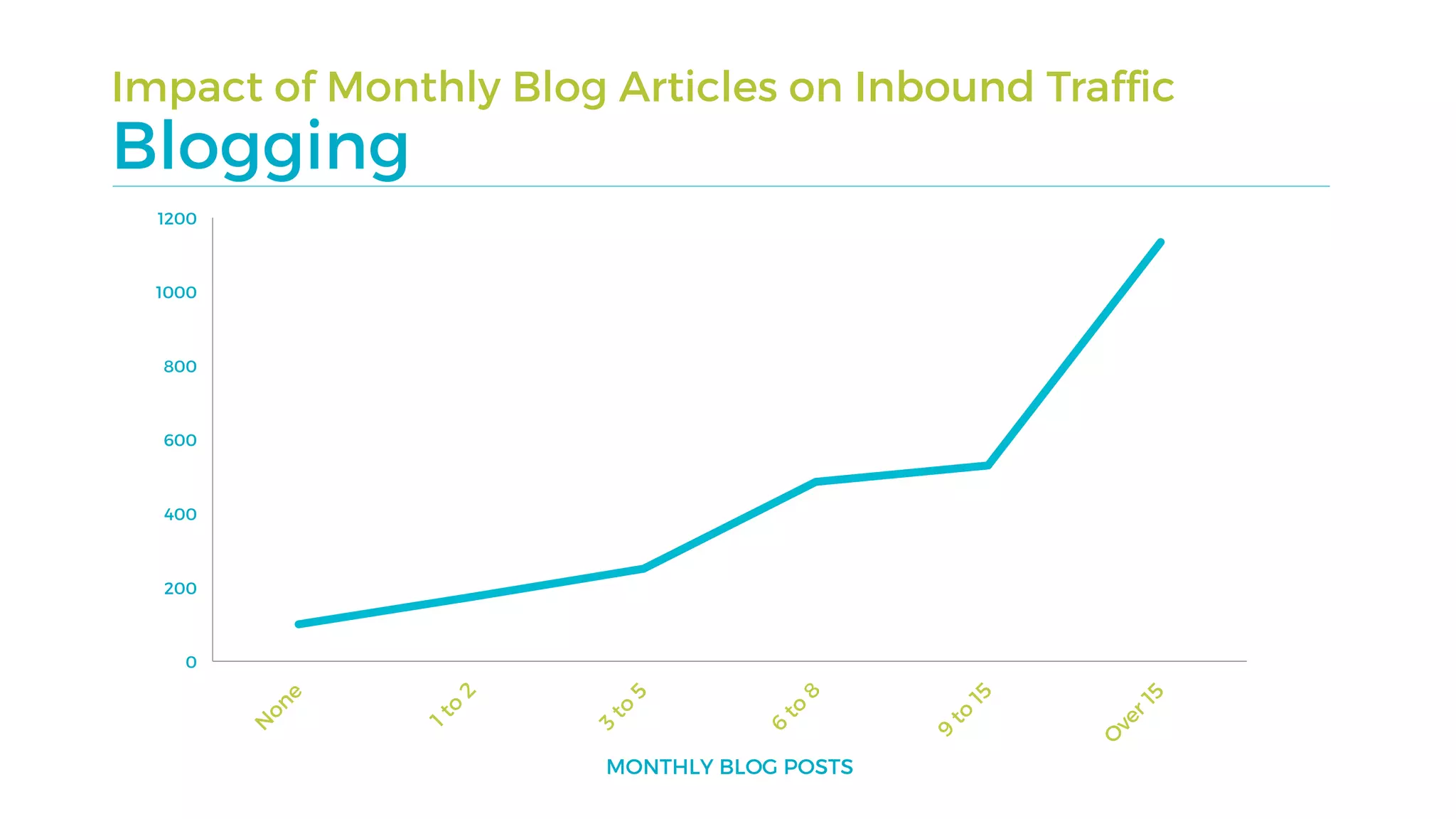
•  Companies that blog 15+ per month get 5x more traffic than companies that
don’t blog
•  Companies that increase blogging from 3-5x/month to 6-8x/month almost
double their leads
•  An average company will see a 45% growth in traffic when increasing total blog
articles from 11-20 to 21-50
Impact of Monthly Blog Articles on Inbound Traffic
Blogging
0
100
200
300
400
500
600
TRAFFIC
INDEX
MONTHLY BLOG POSTS
0
200
400
600
800
1000
1200
NEW
LEADS
INDEX
MONTHLY BLOG POSTS
Impact of Monthly Blog Articles on Inbound Traffic
Blogging
Publish and track messages across multiple platforms and accounts with
suggested times for increasing reach. Monitor the social activity of your leads.
Social Media
•  The world is becoming more social: 4.6 average hours per week worldwide
•  59% of marketers are using social media for 6 hours or more each week
•  83% of marketers indicate that social media is important for their business
•  Social media has a 100% higher lead-to-close rate than outbound marketing
•  Social media use in the U.S. has increased by 356% since 2006
•  42% of marketers say Facebook is critical or important to their business
•  Companies that acquired customers from Facebook: B2C is 77% and B2B is 43%
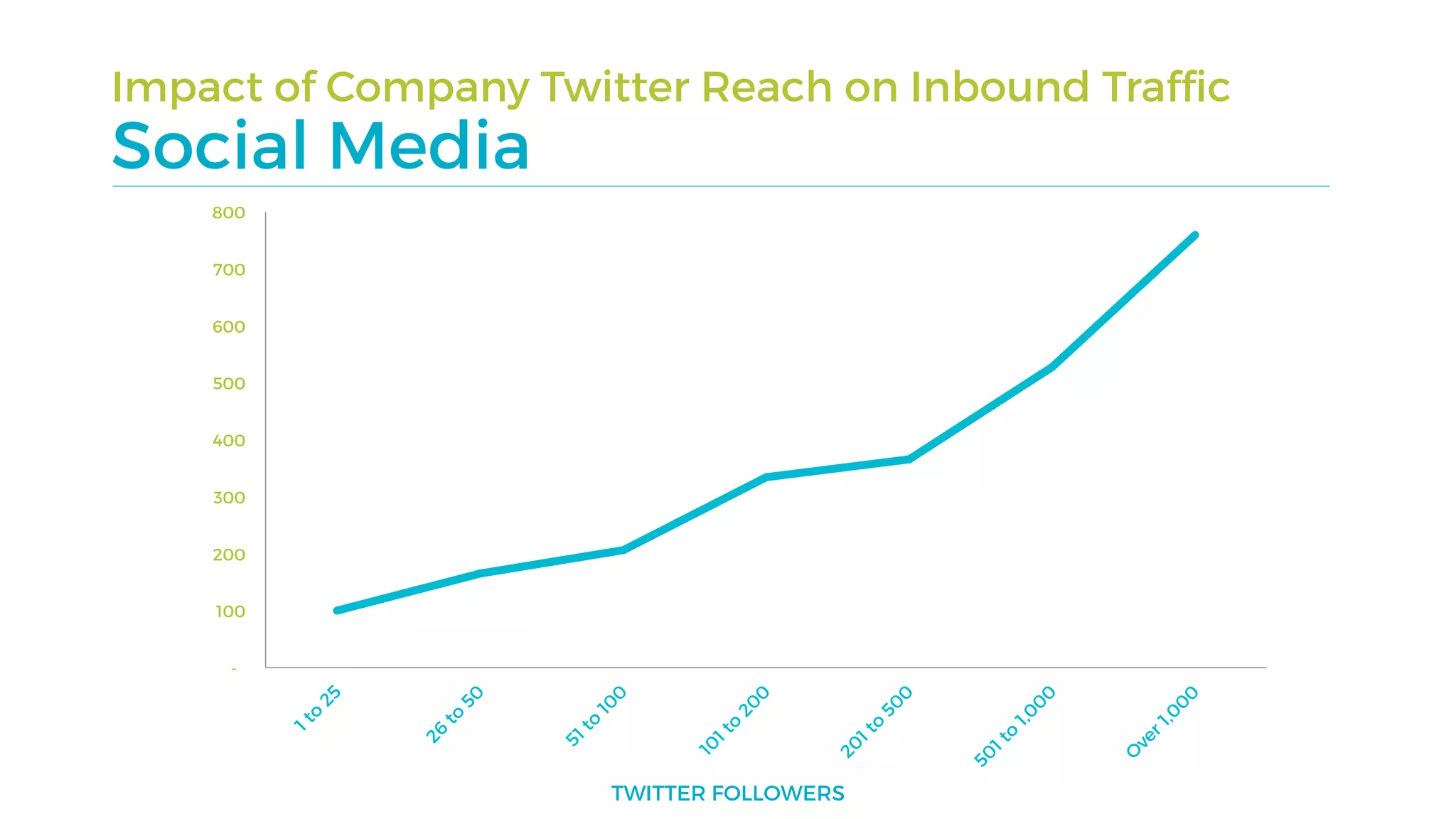
•  79% of U.S. Twitter users are more likely to recommend brands they follow
•  67% of U.S. Twitter users are more likely to buy brands they follow
Impact of Company Twitter Reach on Inbound Traffic
Social Media
-
100
200
300
400
500
600
700
800
TRAFFIC
INDEX
TWITTER FOLLOWERS
Discover which keywords will bring the best organic traffic to
your site and analyze your paid search campaigns.
SEO & Keywords
•  61% of global Internet users research products online
•  44% of online shoppers begin by using a search engine
•  Worldwide, we conduct 131 billion searches per month on the web
•  57% of TV viewers use the web simultaneously
•  60% of all organic clicks go to the top three organic search results
•  75% of users never scroll past the first page of search results
•  Companies that blog have 97% more inbound links
•  The average click-through rate for paid search in 2010 (worldwide) was
2%
Capture inbound leads through your website with landing pages
that are easy to customize, A/B test, personalize, and track.
Landing Pages
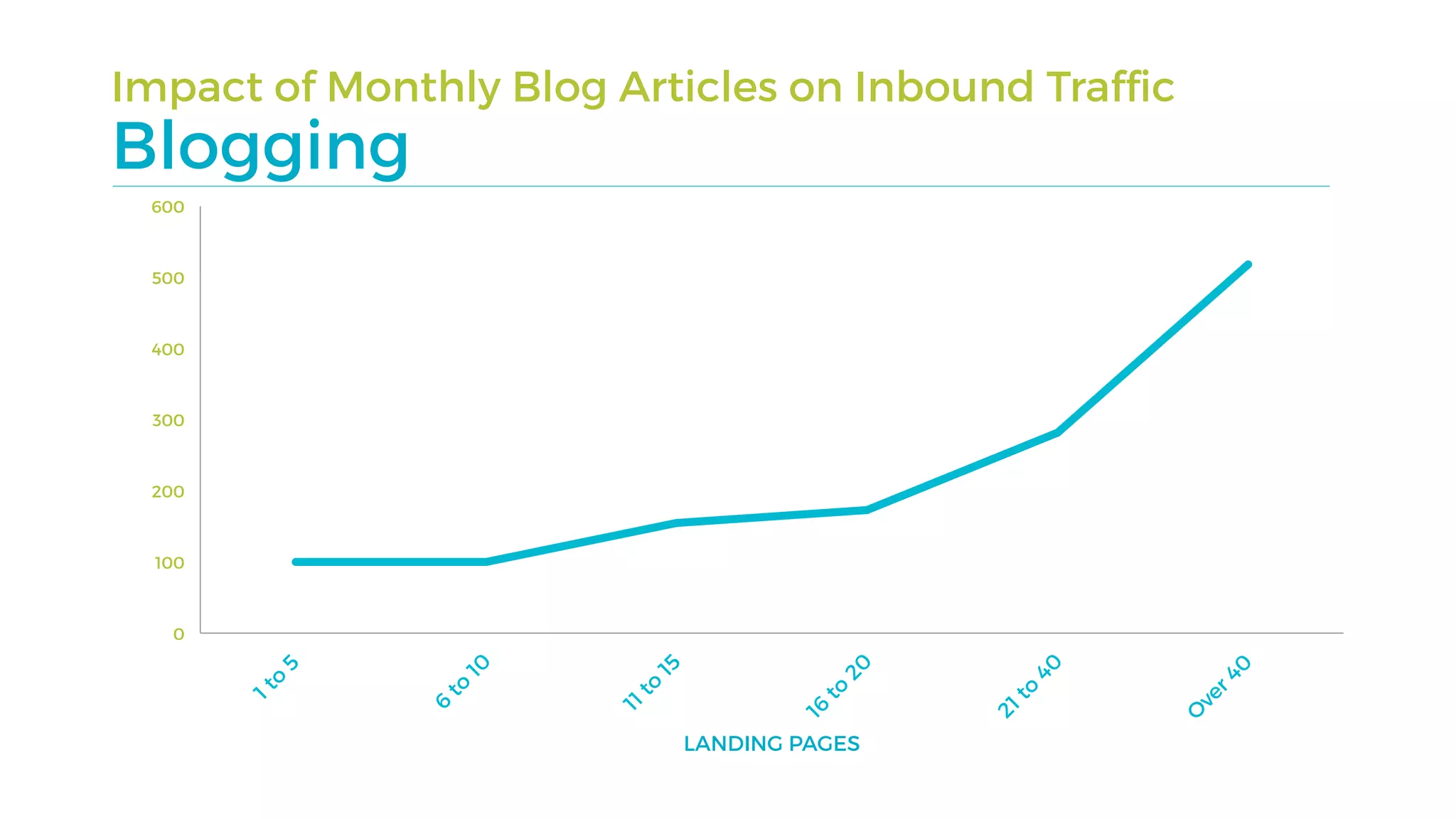
•  Companies with 30 or more landing pages generate 7x more leads than
those with fewer than 10
•  48% of marketers build a new landing page for each marketing
campaign
•  68% of B2B businesses use landing pages to garner a new sales lead for
future conversion
•  16% of landing pages are free of navigation bars
•  Businesses with over 40 landing pages got 12x more leads than those
with only 1 to 5 landing pages
Impact of Monthly Blog Articles on Inbound Traffic
Blogging
0
100
200
300
400
500
600
NEW
LEADS
INDEX
LANDING PAGES
Send personalized, beautiful emails that your prospects will look forward
to receiving and measure which messages are most effective.
Email
•  59% of B2B marketers say email is the most effective channel in
generating revenue
•  Relevant emails drive 18x more revenue than broadcast emails
•  Personalized emails improve click-through rates by 14%, and conversion
rates by 10%
•  Lead nurturing emails get 4 to 10 times the response rate compared to
standalone email blasts
•  Companies that excel at lead nurturing have 9% more sales reps
making quota
•  “Secrets” is the most clicked lead nurturing subject line word
•  “Posts” and “Jobs” is the most clicked subject line words
•  Your most recent subscribers are the most likely to click through
Marketing and Sales
•  50% of leads are qualified, but not yet ready to buy
•  Only 25% of leads are legitimate and should advance to sales
•  79% of marketing leads never convert into sales, with lack of lead
nurturing as the common cause
•  61% of B2B marketers send all leads directly to sales, however only
27% of those leads are qualified
•  Just 56% of B2B organizations verify valid business leads before
they are passed to sales
•  Companies that excel at lead nurturing generate 50% more sales
ready leads at 33% lower cost
Marketing and Sales
•  46% of marketers with mature lead management processes have sales
teams that follow up on more than 75% of marketing-generated leads
•  25% of marketers who adopt mature lead management processes have
sales teams that follow up on more than 75% of marketing-generated
leads
•  Companies with mature lead generation and management practices
have a 9.3% higher sales quota achievement rate
•  Companies that excel at lead nurturing have 9% more sales reps making
quota
•  Nurtured leads produce, on average, a 20% increase in sales
opportunities versus non-nurtured leads
•  Nurtured leads make 47% larger purchases than non-nurtured leads
	
  
About
Inbound Marketing
Market with a
magnet, not a
sledgehammer.
Marketing and Sales
Instead of buying ads, buying
email lists, or cold calling,
inbound marketing focuses on
creating educational content
that pulls people toward your
website where they can learn
more about what you sell on
their own accord.
Inbound is an approach to marketing that reaches today’s
consumer.
Get found by qualified
leads online with
content (website pages,
blog articles, social
messages) optimized
for search and social
media.
Understand what
content pulls your
buyers through the
sales funnel, and use
that context to
personalize your
marketing at scale.
Inbound
marketing is a
philosophy based
on the truth that
consumers buy
differently today
than they did 10
years ago.
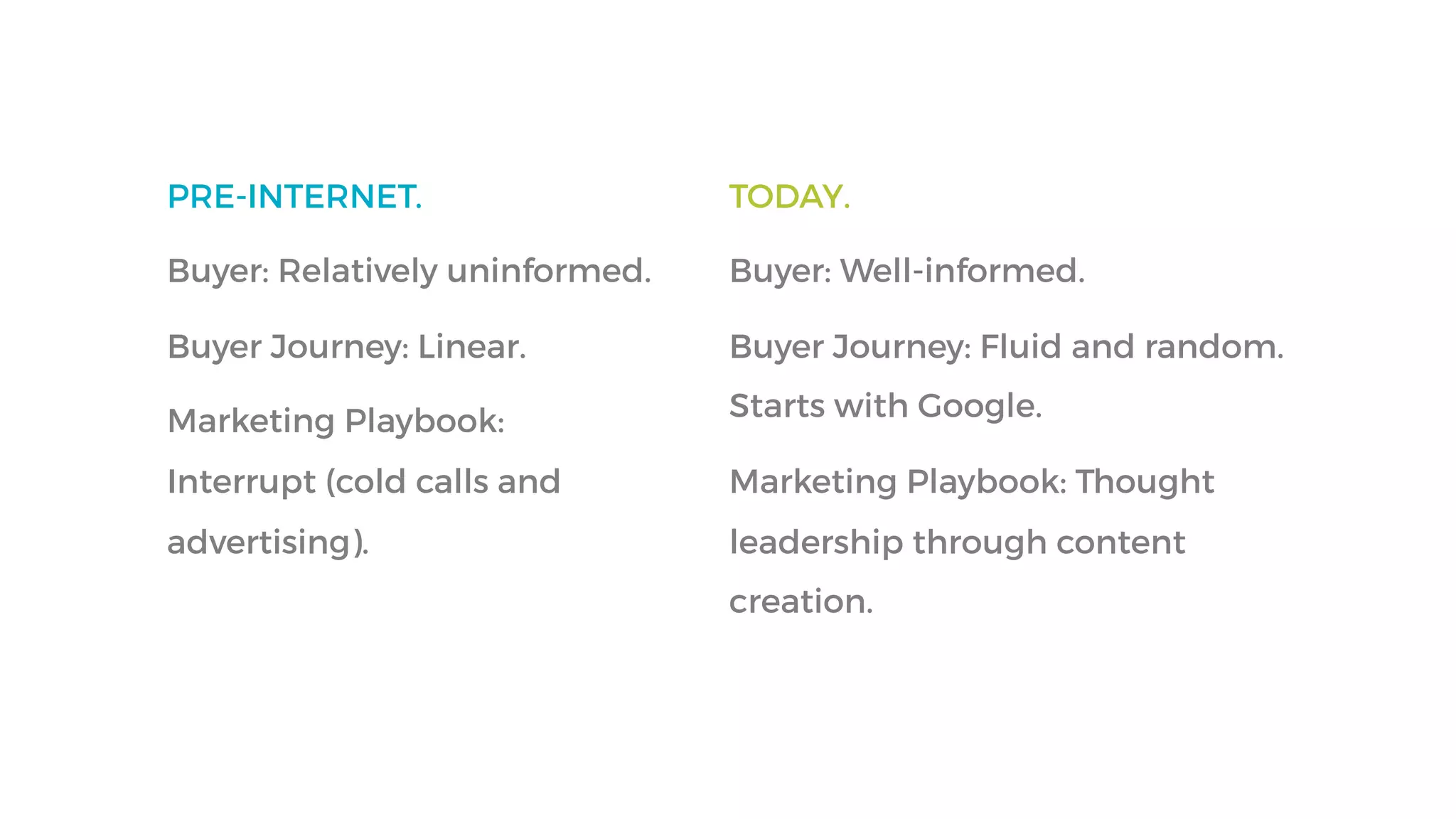
PRE-INTERNET.
Buyer: Relatively uninformed.
Buyer Journey: Linear.
Marketing Playbook:
Interrupt (cold calls and
advertising).
TODAY.
Buyer: Well-informed.
Buyer Journey: Fluid and random.
Starts with Google.
Marketing Playbook: Thought
leadership through content
creation.
Major Themes of Inbound Marketing
•  You create targeted content that answers your
customer's basic questions and needs, and you share
that content far and wide.
•  You recognize that people go through stages as they
interact with your company, and that each stage
requires different marketing actions
•  As you learn more about your leads over time, you can
better personalize your messages to their specific
needs.
•  Inbound marketing is multi-channel by nature
because it approaches people where they are, in the
channel where they want to interact with you.
•  Your publishing and analytics tools all work together
like a well-oiled machine, allowing you to focus on
publishing the right content in the right place at the
right time.
Inbound Marketing
Methodology
• The inbound philosophy is backed
by a methodology that helps
brands attract, convert, close, and
delight visitors, leads and
customers through a variety of
channels such as social media,
blogging, SEO, landing pages,
forms, and email.
• The methodology facilitates the
buyer journey through the sales
funnel – from strangers to
promoters of your brand.
Inbound and the Sales Funnel
How it Fits Together
Blog
Social Media
Keywords
Pages
Calls-to-Action
Landing Pages
Forms
Contacts
Email
Workflows
Lead Scoring
CRM Integrations
Social Media
Smart-Calls-to-
Action
Email
Workflows
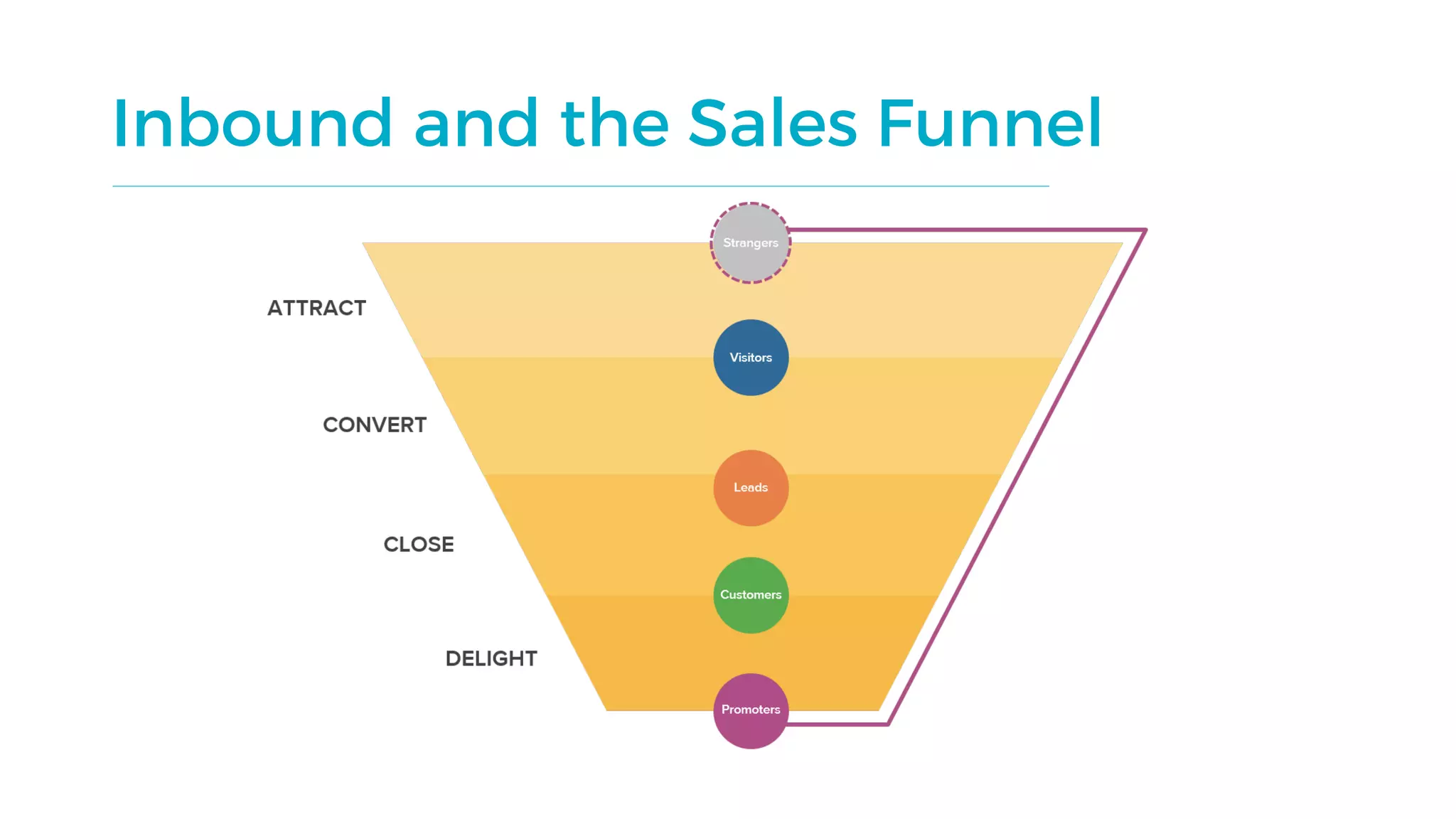
Attract Convert Close Delight
Strangers Visitors Leads Customers Promoters
THE METHODOLOGY VISUALIZED AS A SALES
FUNNEL.
Along the top are the four
actions (Attract, Convert,
Close, Delight) companies
must take in order to
obtain visitors, leads, and
customers.
Along the bottom are the tools companies use to
accomplish these actions.
Attract strangers and turn them into website visitors.
Step 1
You want to attract people
that will potentially become
leads. Attract your ideal
customer or buyer persona
by creating content that’s
valuable and easy for them
to find.
Convert website visitors into leads.
Step 2
Once you’ve got visitors to your
site, the next step is to convert
those visitors into leads by
gathering their contact
information. In order to get this
valuable information, you need
to offer something up in return
(ex: ebook).
Close leads into customers through nurturing
Step 3
Once you’ve attracted the right
visitors and converted the right
leads, you need to transform
those leads into customers with
targeted, automated email
nurturing and social media
interaction.
Attract strangers and turn them into website visitors.
Step 4
Using context and
personalization to deliver
tailored messages, continue to
engage with, delight, and
(hopefully) upsell your current
customer base into happy
promoters of your company.
Inbound Marketing
in Action
Attract strangers and turn them into website visitors.
Step 4
Tools to attract strangers to
your site include:
•  Blogging
•  Social Media
•  Keyword Optimization
•  Site Pages Blog
Social Media
Keywords
Pages
Attract
Strangers Visitors
Blogging Matters
We’re going to take a moment
to emphasize the importance
of blogging because it’s that
important.
Companies blog because it’s
one of the most effective ways
to attract potential customers
to your site.
	
  
The average company that
blogs generates:
•  55% more website
visitors.
•  97% more inbound links.
•  434% more indexed
pages.
Companies that blog generate 126% more leads than those that
don’t.
Blogging Matters
0%
20%
40%
60%
80%
100%
120%
140%
160%
180%
Blog No blog
AverageMonthlyLeadGrowth
Blogging is regularly linked to higher ROI
Blogging Matters
75%
82%
71%
67%
57%
14%
10%
14%
21%
25%
0%
10%
20%
30%
40%
50%
60%
70%
80%
90%
Multiple times per
day
Daily 2-3 times per week Weekly Monthly
B log g ing F requenc y
Percent of marketers who demonstrated inbound ROI
Percent of marketers who couldn't demonstrate inbound ROI
Blogging isn’t the only tool that effectively attracts
customers to you, though.
Strangers Leads
You need to be active on social
media, too.
•  You must share remarkable
content and valuable
information on the social web,
engage with your prospects, and
put a human face on your brand.
	
  
You should create content
around targeted keywords as
well.
•  You need to carefully,
analytically pick keywords,
optimize your pages, create
content, and build links around
the terms your ideal buyers are
searching for. (Psst! HubSpot’s
software gives you SEO advice as
you type).
Convert website visitors into leads.
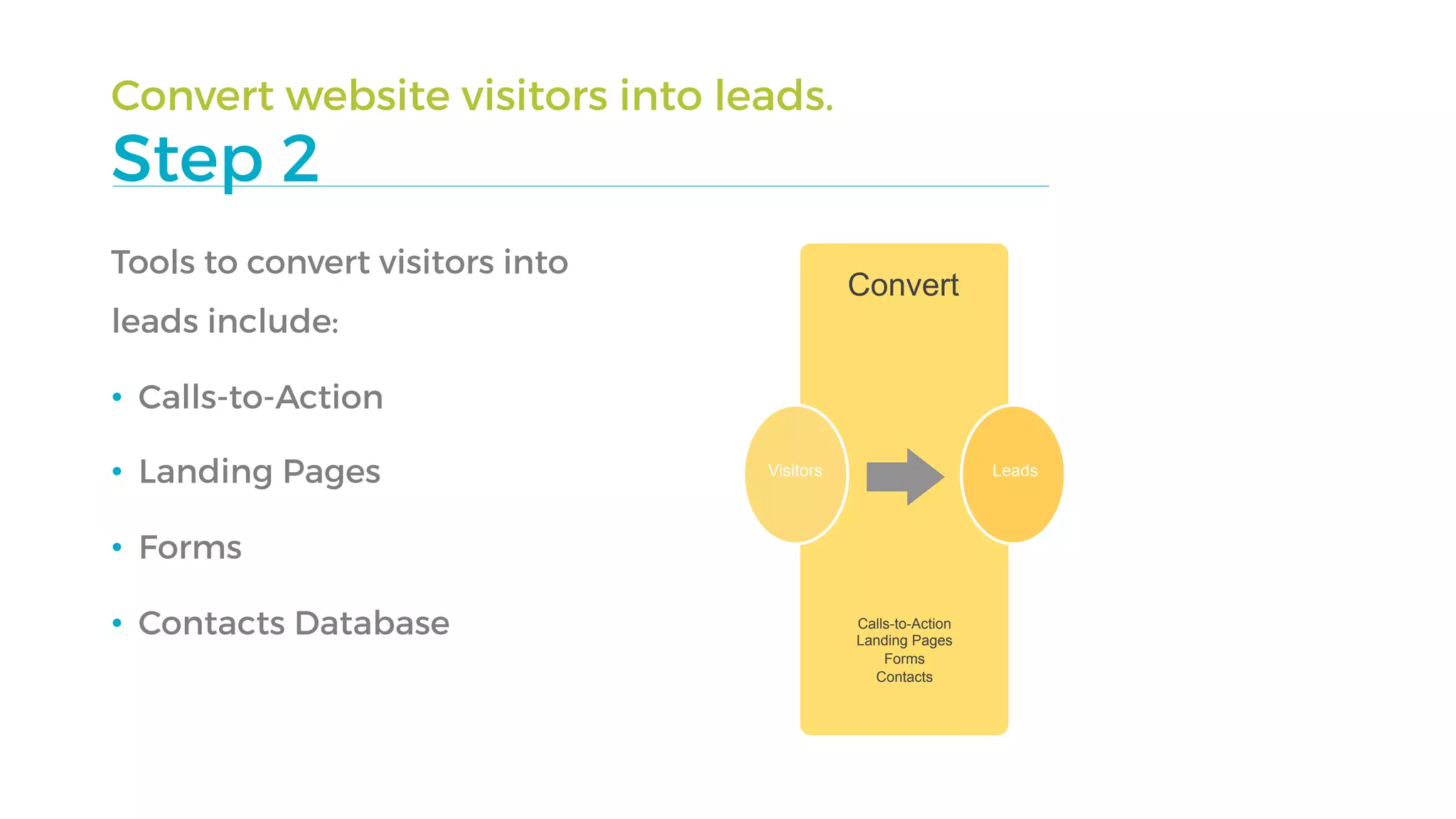
Step 2
Tools to convert visitors into
leads include:
•  Calls-to-Action
•  Landing Pages
•  Forms
•  Contacts Database Calls-to-Action
Landing Pages
Forms
Contacts
Convert
Visitors Leads
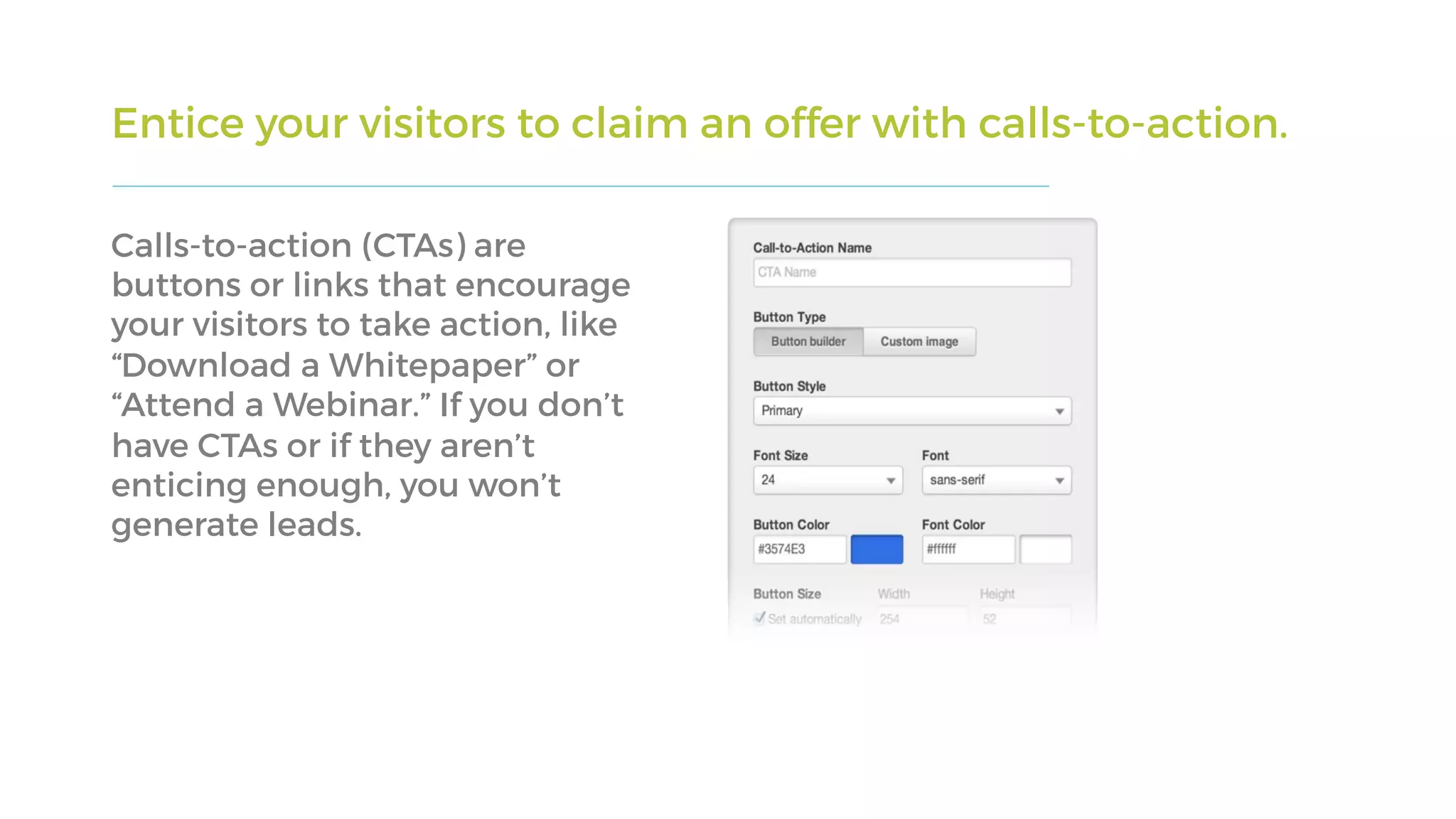
Entice your visitors to claim an offer with calls-to-action.
Calls-to-action (CTAs) are
buttons or links that encourage
your visitors to take action, like
“Download a Whitepaper” or
“Attend a Webinar.” If you don’t
have CTAs or if they aren’t
enticing enough, you won’t
generate leads.
Drive visitors to landing pages where they can become
leads.
When a website visitor clicks on
a CTA, they should then be sent
to a landing page where the
offer in the call-to-action is
fulfilled, and where the
prospect submits information
that your sales team can use to
begin a conversation with
them.
Use forms to get the information you need about your
prospects.
In order for visitors to become
leads, they must fill out a form
and submit their contact
information. Optimize your
form to make this step of the
conversion process as easy as
possible.
House all of your contacts in one place.
Keep track of the leads you're
converting in a centralized
marketing database so you can
make sense out of every
interaction you’ve had with
your contacts – be it through
email, a landing page, or social
media.
Close the leads into customers through nurturing
Step 3
Tools to delight your customers
include:
•  Smart Calls-to-Action
•  Social Media
•  Email and Marketing
Automation Social Media
Smart-Calls-to-
Action
Email
Workflows
Delight
Customers Promoters
Send targeted emails to leads to pull them through the
sales funnel.
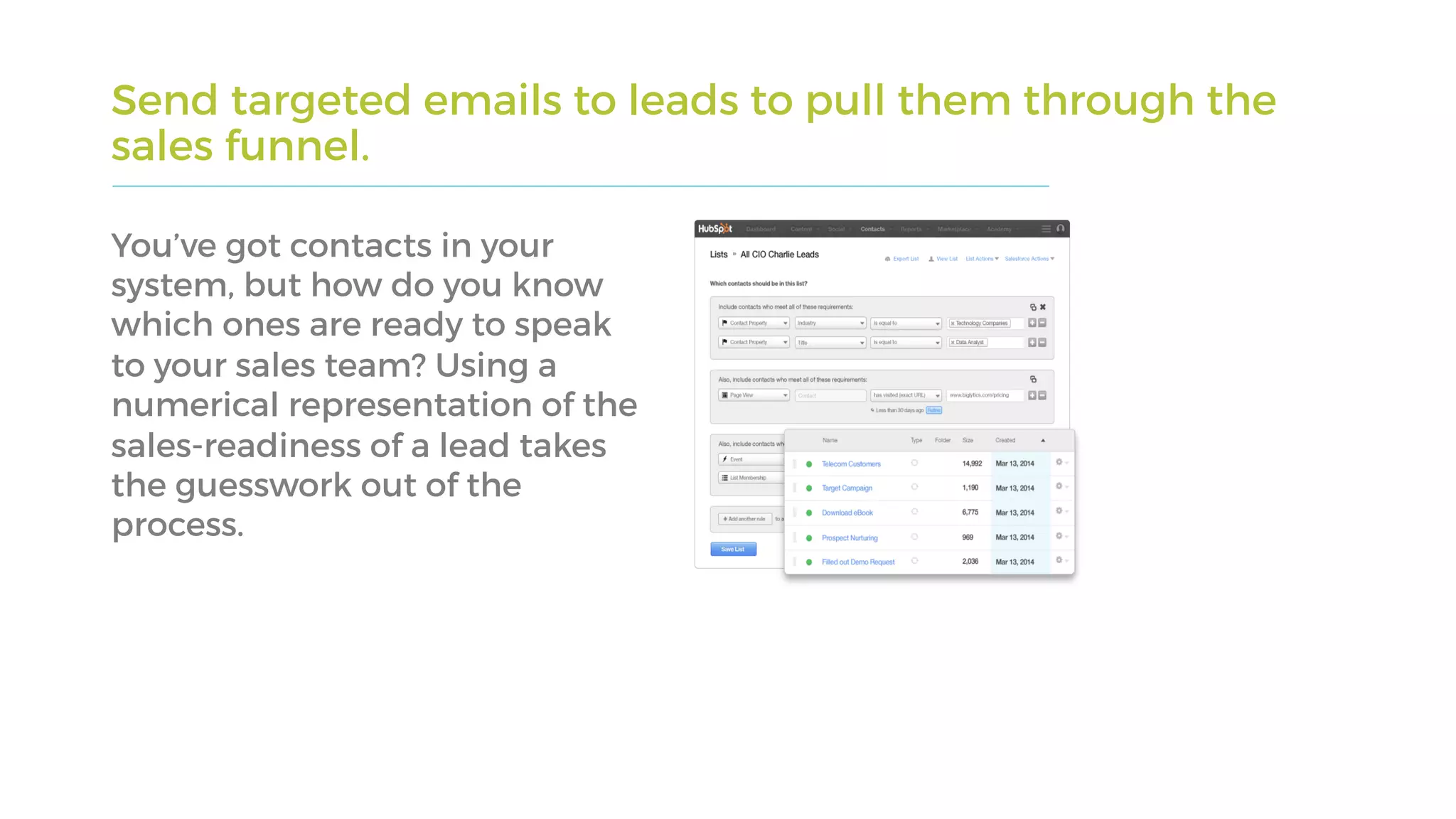
You’ve got contacts in your
system, but how do you know
which ones are ready to speak
to your sales team? Using a
numerical representation of the
sales-readiness of a lead takes
the guesswork out of the
process.
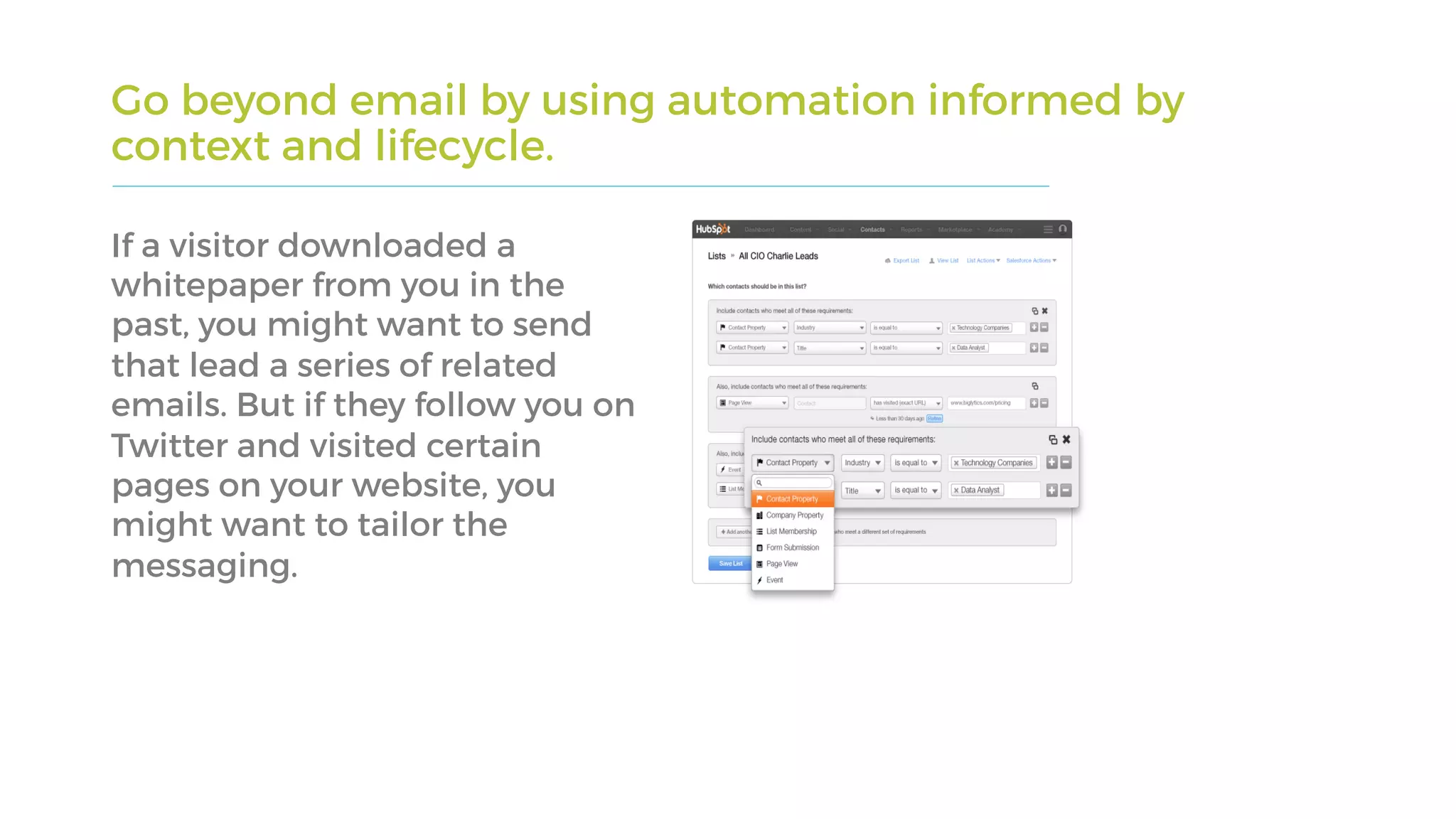
Go beyond email by using automation informed by
context and lifecycle.
If a visitor downloaded a
whitepaper from you in the
past, you might want to send
that lead a series of related
emails. But if they follow you on
Twitter and visited certain
pages on your website, you
might want to tailor the
messaging.
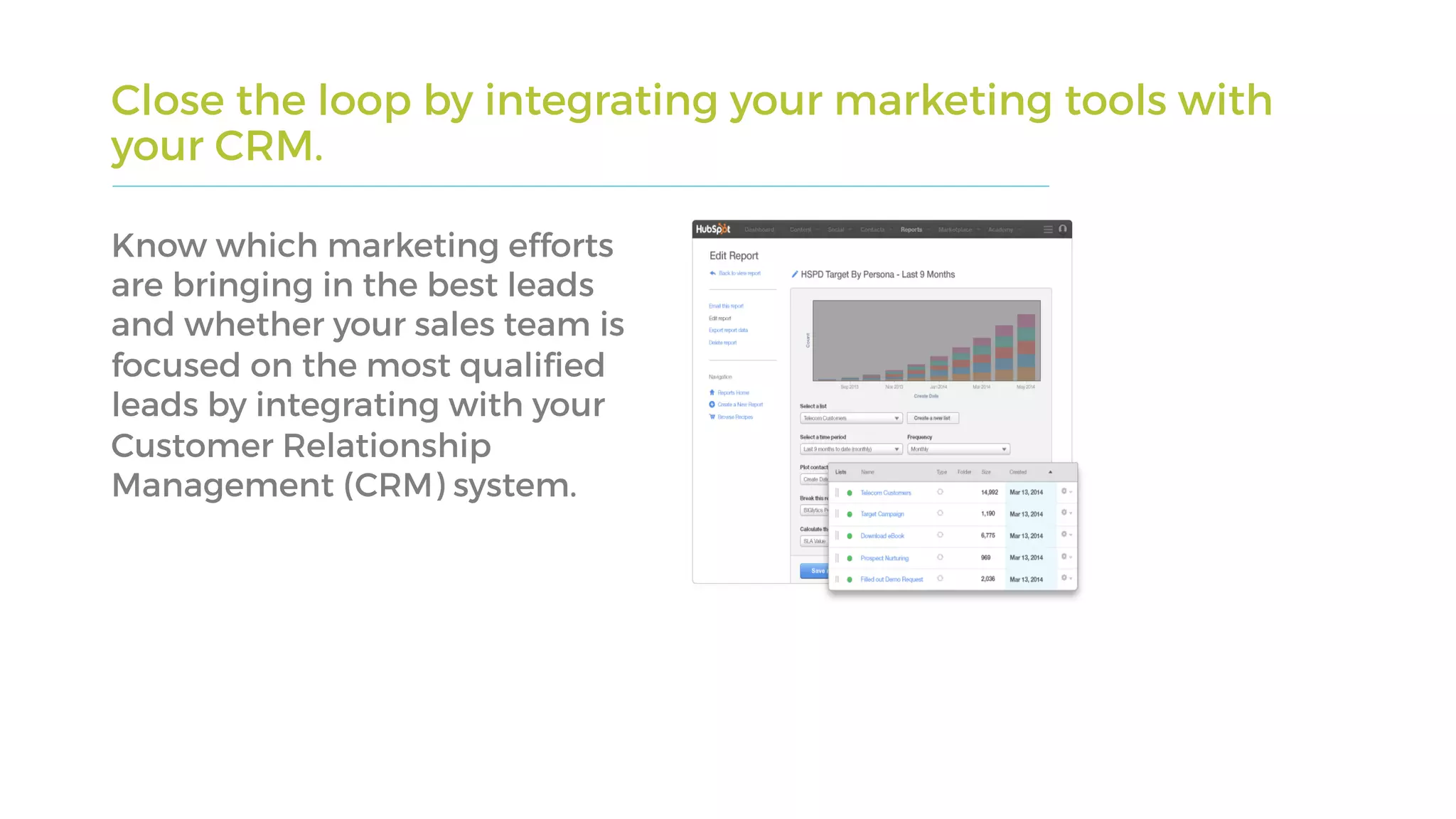
Close the loop by integrating your marketing tools with
your CRM.
Know which marketing efforts
are bringing in the best leads
and whether your sales team is
focused on the most qualified
leads by integrating with your
Customer Relationship
Management (CRM) system.
Attract strangers and turn them into website visitors.
Step 4
Using context and
personalization to deliver
tailored messages, continue to
engage with, delight, and
(hopefully) upsell your current
customer base into happy
promoters of your company.
Keep the cycle going by continually nurturing with
personalized content.
Treat people like people and
earn trust by using Smart
Content and Personalization
Tokens to create a tailored
experience based on prospects’
needs across all of your
marketing channels – from CTAs
to email to landing pages.
1) ATTRACT: GET TRAFFIC
2) CONVERT: GET LEADS
3) CLOSE: GET CUSTOMERS
4) DELIGHT: ANALYZE & OPTIMIZE
Create blog content, search engine optimize
(SEO) that content, and promote it on social
media sites.
Place calls-to-action throughout your website, blog,
social accounts, and email to drive visitors to landing
pages with forms.
Send leads targeted, automated emails to drive them through
your buying cycle. Provide your sales team with lead
intelligence for more effective sales calls.
Analyze the success of your marketing campaigns, and
determine which areas need further optimization or
personalization for future success.
Market with a Magnet

Market with a Magnet

  • 1.
    Market With aMagnet How Inbound Can Help Businesses Like Yours
  • 2.
    Introduction Inbound Marketing isa methodology focused on long-term planning and building brand relationships. The emphasis is on developing a meaningful connection between your brand and your ideal clients, so that when they need your services, they come to you. This presentation will discuss how an inbound marketing strategy can benefit you, and then walk you through the process of developing and implementing one. Let’s go!
  • 3.
  • 4.
    Create long-lasting marketingassets by publishing blog articles optimized to get found and generate leads. Blogging •  There are 31% more bloggers today than there were three years ago •  46% of people read blogs more than once a day •  Most people read 5-10 blogs •  Nearly 40% of U.S. companies use blogs for marketing purposes •  Blog frequency impacts customer acquisition. 92% of companies who blogged multiple times a day acquired a customer through their blog •  57% of marketers acquired customers from blogging •  Companies that blog 15+ per month get 5x more traffic than companies that don’t blog •  Companies that increase blogging from 3-5x/month to 6-8x/month almost double their leads •  An average company will see a 45% growth in traffic when increasing total blog articles from 11-20 to 21-50
  • 5.
    Impact of MonthlyBlog Articles on Inbound Traffic Blogging 0 100 200 300 400 500 600 TRAFFIC INDEX MONTHLY BLOG POSTS
  • 6.
    0 200 400 600 800 1000 1200 NEW LEADS INDEX MONTHLY BLOG POSTS Impactof Monthly Blog Articles on Inbound Traffic Blogging
  • 7.
    Publish and trackmessages across multiple platforms and accounts with suggested times for increasing reach. Monitor the social activity of your leads. Social Media •  The world is becoming more social: 4.6 average hours per week worldwide •  59% of marketers are using social media for 6 hours or more each week •  83% of marketers indicate that social media is important for their business •  Social media has a 100% higher lead-to-close rate than outbound marketing •  Social media use in the U.S. has increased by 356% since 2006 •  42% of marketers say Facebook is critical or important to their business •  Companies that acquired customers from Facebook: B2C is 77% and B2B is 43% •  79% of U.S. Twitter users are more likely to recommend brands they follow •  67% of U.S. Twitter users are more likely to buy brands they follow
  • 8.
    Impact of CompanyTwitter Reach on Inbound Traffic Social Media - 100 200 300 400 500 600 700 800 TRAFFIC INDEX TWITTER FOLLOWERS
  • 9.
    Discover which keywordswill bring the best organic traffic to your site and analyze your paid search campaigns. SEO & Keywords •  61% of global Internet users research products online •  44% of online shoppers begin by using a search engine •  Worldwide, we conduct 131 billion searches per month on the web •  57% of TV viewers use the web simultaneously •  60% of all organic clicks go to the top three organic search results •  75% of users never scroll past the first page of search results •  Companies that blog have 97% more inbound links •  The average click-through rate for paid search in 2010 (worldwide) was 2%
  • 10.
    Capture inbound leadsthrough your website with landing pages that are easy to customize, A/B test, personalize, and track. Landing Pages •  Companies with 30 or more landing pages generate 7x more leads than those with fewer than 10 •  48% of marketers build a new landing page for each marketing campaign •  68% of B2B businesses use landing pages to garner a new sales lead for future conversion •  16% of landing pages are free of navigation bars •  Businesses with over 40 landing pages got 12x more leads than those with only 1 to 5 landing pages
  • 11.
    Impact of MonthlyBlog Articles on Inbound Traffic Blogging 0 100 200 300 400 500 600 NEW LEADS INDEX LANDING PAGES
  • 12.
    Send personalized, beautifulemails that your prospects will look forward to receiving and measure which messages are most effective. Email •  59% of B2B marketers say email is the most effective channel in generating revenue •  Relevant emails drive 18x more revenue than broadcast emails •  Personalized emails improve click-through rates by 14%, and conversion rates by 10% •  Lead nurturing emails get 4 to 10 times the response rate compared to standalone email blasts •  Companies that excel at lead nurturing have 9% more sales reps making quota •  “Secrets” is the most clicked lead nurturing subject line word •  “Posts” and “Jobs” is the most clicked subject line words •  Your most recent subscribers are the most likely to click through
  • 13.
    Marketing and Sales • 50% of leads are qualified, but not yet ready to buy •  Only 25% of leads are legitimate and should advance to sales •  79% of marketing leads never convert into sales, with lack of lead nurturing as the common cause •  61% of B2B marketers send all leads directly to sales, however only 27% of those leads are qualified •  Just 56% of B2B organizations verify valid business leads before they are passed to sales •  Companies that excel at lead nurturing generate 50% more sales ready leads at 33% lower cost
  • 14.
    Marketing and Sales • 46% of marketers with mature lead management processes have sales teams that follow up on more than 75% of marketing-generated leads •  25% of marketers who adopt mature lead management processes have sales teams that follow up on more than 75% of marketing-generated leads •  Companies with mature lead generation and management practices have a 9.3% higher sales quota achievement rate •  Companies that excel at lead nurturing have 9% more sales reps making quota •  Nurtured leads produce, on average, a 20% increase in sales opportunities versus non-nurtured leads •  Nurtured leads make 47% larger purchases than non-nurtured leads  
  • 15.
  • 16.
    Market with a magnet,not a sledgehammer.
  • 17.
    Marketing and Sales Insteadof buying ads, buying email lists, or cold calling, inbound marketing focuses on creating educational content that pulls people toward your website where they can learn more about what you sell on their own accord.
  • 18.
    Inbound is anapproach to marketing that reaches today’s consumer. Get found by qualified leads online with content (website pages, blog articles, social messages) optimized for search and social media. Understand what content pulls your buyers through the sales funnel, and use that context to personalize your marketing at scale.
  • 19.
    Inbound marketing is a philosophybased on the truth that consumers buy differently today than they did 10 years ago.
  • 20.
    PRE-INTERNET. Buyer: Relatively uninformed. BuyerJourney: Linear. Marketing Playbook: Interrupt (cold calls and advertising). TODAY. Buyer: Well-informed. Buyer Journey: Fluid and random. Starts with Google. Marketing Playbook: Thought leadership through content creation.
  • 21.
    Major Themes ofInbound Marketing •  You create targeted content that answers your customer's basic questions and needs, and you share that content far and wide. •  You recognize that people go through stages as they interact with your company, and that each stage requires different marketing actions •  As you learn more about your leads over time, you can better personalize your messages to their specific needs. •  Inbound marketing is multi-channel by nature because it approaches people where they are, in the channel where they want to interact with you. •  Your publishing and analytics tools all work together like a well-oiled machine, allowing you to focus on publishing the right content in the right place at the right time.
  • 22.
  • 23.
    • The inbound philosophyis backed by a methodology that helps brands attract, convert, close, and delight visitors, leads and customers through a variety of channels such as social media, blogging, SEO, landing pages, forms, and email. • The methodology facilitates the buyer journey through the sales funnel – from strangers to promoters of your brand.
  • 24.
    Inbound and theSales Funnel
  • 25.
    How it FitsTogether Blog Social Media Keywords Pages Calls-to-Action Landing Pages Forms Contacts Email Workflows Lead Scoring CRM Integrations Social Media Smart-Calls-to- Action Email Workflows Attract Convert Close Delight Strangers Visitors Leads Customers Promoters
  • 26.
    THE METHODOLOGY VISUALIZEDAS A SALES FUNNEL. Along the top are the four actions (Attract, Convert, Close, Delight) companies must take in order to obtain visitors, leads, and customers. Along the bottom are the tools companies use to accomplish these actions.
  • 27.
    Attract strangers andturn them into website visitors. Step 1 You want to attract people that will potentially become leads. Attract your ideal customer or buyer persona by creating content that’s valuable and easy for them to find.
  • 28.
    Convert website visitorsinto leads. Step 2 Once you’ve got visitors to your site, the next step is to convert those visitors into leads by gathering their contact information. In order to get this valuable information, you need to offer something up in return (ex: ebook).
  • 29.
    Close leads intocustomers through nurturing Step 3 Once you’ve attracted the right visitors and converted the right leads, you need to transform those leads into customers with targeted, automated email nurturing and social media interaction.
  • 30.
    Attract strangers andturn them into website visitors. Step 4 Using context and personalization to deliver tailored messages, continue to engage with, delight, and (hopefully) upsell your current customer base into happy promoters of your company.
  • 31.
  • 32.
    Attract strangers andturn them into website visitors. Step 4 Tools to attract strangers to your site include: •  Blogging •  Social Media •  Keyword Optimization •  Site Pages Blog Social Media Keywords Pages Attract Strangers Visitors
  • 33.
    Blogging Matters We’re goingto take a moment to emphasize the importance of blogging because it’s that important. Companies blog because it’s one of the most effective ways to attract potential customers to your site.   The average company that blogs generates: •  55% more website visitors. •  97% more inbound links. •  434% more indexed pages.
  • 34.
    Companies that bloggenerate 126% more leads than those that don’t. Blogging Matters 0% 20% 40% 60% 80% 100% 120% 140% 160% 180% Blog No blog AverageMonthlyLeadGrowth
  • 35.
    Blogging is regularlylinked to higher ROI Blogging Matters 75% 82% 71% 67% 57% 14% 10% 14% 21% 25% 0% 10% 20% 30% 40% 50% 60% 70% 80% 90% Multiple times per day Daily 2-3 times per week Weekly Monthly B log g ing F requenc y Percent of marketers who demonstrated inbound ROI Percent of marketers who couldn't demonstrate inbound ROI
  • 36.
    Blogging isn’t theonly tool that effectively attracts customers to you, though. Strangers Leads You need to be active on social media, too. •  You must share remarkable content and valuable information on the social web, engage with your prospects, and put a human face on your brand.   You should create content around targeted keywords as well. •  You need to carefully, analytically pick keywords, optimize your pages, create content, and build links around the terms your ideal buyers are searching for. (Psst! HubSpot’s software gives you SEO advice as you type).
  • 37.
    Convert website visitorsinto leads. Step 2 Tools to convert visitors into leads include: •  Calls-to-Action •  Landing Pages •  Forms •  Contacts Database Calls-to-Action Landing Pages Forms Contacts Convert Visitors Leads
  • 38.
    Entice your visitorsto claim an offer with calls-to-action. Calls-to-action (CTAs) are buttons or links that encourage your visitors to take action, like “Download a Whitepaper” or “Attend a Webinar.” If you don’t have CTAs or if they aren’t enticing enough, you won’t generate leads.
  • 39.
    Drive visitors tolanding pages where they can become leads. When a website visitor clicks on a CTA, they should then be sent to a landing page where the offer in the call-to-action is fulfilled, and where the prospect submits information that your sales team can use to begin a conversation with them.
  • 40.
    Use forms toget the information you need about your prospects. In order for visitors to become leads, they must fill out a form and submit their contact information. Optimize your form to make this step of the conversion process as easy as possible.
  • 41.
    House all ofyour contacts in one place. Keep track of the leads you're converting in a centralized marketing database so you can make sense out of every interaction you’ve had with your contacts – be it through email, a landing page, or social media.
  • 42.
    Close the leadsinto customers through nurturing Step 3 Tools to delight your customers include: •  Smart Calls-to-Action •  Social Media •  Email and Marketing Automation Social Media Smart-Calls-to- Action Email Workflows Delight Customers Promoters
  • 43.
    Send targeted emailsto leads to pull them through the sales funnel. You’ve got contacts in your system, but how do you know which ones are ready to speak to your sales team? Using a numerical representation of the sales-readiness of a lead takes the guesswork out of the process.
  • 44.
    Go beyond emailby using automation informed by context and lifecycle. If a visitor downloaded a whitepaper from you in the past, you might want to send that lead a series of related emails. But if they follow you on Twitter and visited certain pages on your website, you might want to tailor the messaging.
  • 45.
    Close the loopby integrating your marketing tools with your CRM. Know which marketing efforts are bringing in the best leads and whether your sales team is focused on the most qualified leads by integrating with your Customer Relationship Management (CRM) system.
  • 46.
    Attract strangers andturn them into website visitors. Step 4 Using context and personalization to deliver tailored messages, continue to engage with, delight, and (hopefully) upsell your current customer base into happy promoters of your company.
  • 47.
    Keep the cyclegoing by continually nurturing with personalized content. Treat people like people and earn trust by using Smart Content and Personalization Tokens to create a tailored experience based on prospects’ needs across all of your marketing channels – from CTAs to email to landing pages.
  • 48.
    1) ATTRACT: GETTRAFFIC 2) CONVERT: GET LEADS 3) CLOSE: GET CUSTOMERS 4) DELIGHT: ANALYZE & OPTIMIZE Create blog content, search engine optimize (SEO) that content, and promote it on social media sites. Place calls-to-action throughout your website, blog, social accounts, and email to drive visitors to landing pages with forms. Send leads targeted, automated emails to drive them through your buying cycle. Provide your sales team with lead intelligence for more effective sales calls. Analyze the success of your marketing campaigns, and determine which areas need further optimization or personalization for future success.