+ =
+ =
+ =
+ =
+
+ =
+
+ =
+ =
+ =
+
+ =
+
+ =
+ =
Transitional
Devices as Tool for
Coherence and
Cohesion
a) determine the use of
transitional devices;
b) use transitional devices
appropriately; and
c) explain the importance of
using transitional devices.
OBJECTIVES
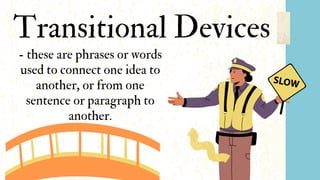
Transitional Devices
- these are phrases or words
used to connect one idea to
another, or from one
sentence or paragraph to
another.
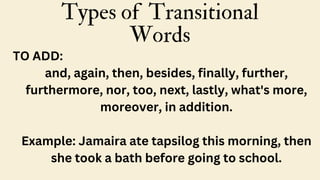
Types of Transitional
Words
TO ADD:
and, again, then, besides, finally, further,
furthermore, nor, too, next, lastly, what's more,
moreover, in addition.
Example: Jamaira ate tapsilog this morning, then
she took a bath before going to school.
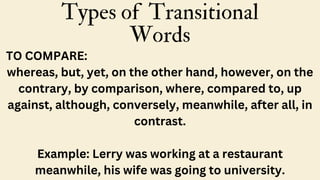
Types of Transitional
Words
TO COMPARE:
whereas, but, yet, on the other hand, however, on the
contrary, by comparison, where, compared to, up
against, although, conversely, meanwhile, after all, in
contrast.
Example: Lerry was working at a restaurant
meanwhile, his wife was going to university.
Types of Transitional
Words
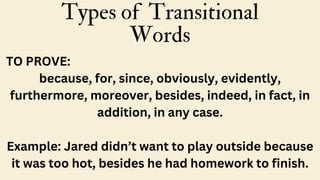
TO PROVE:
because, for, since, obviously, evidently,
furthermore, moreover, besides, indeed, in fact, in
addition, in any case.
Example: Jared didn’t want to play outside because
it was too hot, besides he had homework to finish.
Types of Transitional
Words
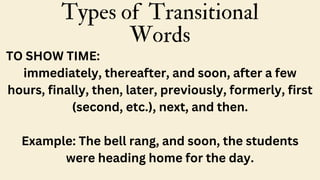
TO SHOW TIME:
immediately, thereafter, and soon, after a few
hours, finally, then, later, previously, formerly, first
(second, etc.), next, and then.
Example: The bell rang, and soon, the students
were heading home for the day.
Types of Transitional
Words
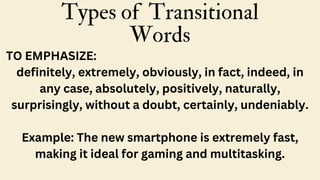
TO EMPHASIZE:
definitely, extremely, obviously, in fact, indeed, in
any case, absolutely, positively, naturally,
surprisingly, without a doubt, certainly, undeniably.
Example: The new smartphone is extremely fast,
making it ideal for gaming and multitasking.
Types of Transitional
Words
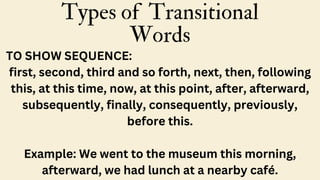
TO SHOW SEQUENCE:
first, second, third and so forth, next, then, following
this, at this time, now, at this point, after, afterward,
subsequently, finally, consequently, previously,
before this.
Example: We went to the museum this morning,
afterward, we had lunch at a nearby café.
Types of Transitional
Words
TO GIVE AN EXAMPLE:
for example, for instance, in this case, in another
case, on this occasion, in this situation, to
demonstrate, to illustrate.
Example: There are many ways to stay fit, for
instance, swimming, running, or practicing yoga.
Types of Transitional
Words
TO SUMMARIZE OR CONCLUDE:
in brief,on the whole, summing up, to conclude, in
conclusion, as I have shown, as I have said,
therefore, as a result.
Example: In summary, reading regularly can make
us better writers..
transitional devices also known
as linking words or cohesive
devices, are important because
they help readers interpret
ideas and make writing clearer
and more effective.
IMPORTANCE OF
TRANSITIONAL
DEVICES
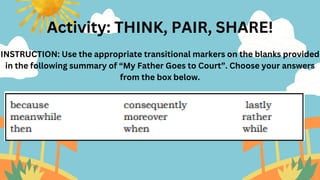
Activity: THINK, PAIR, SHARE!
INSTRUCTION: Use the appropriate transitional markers on the blanks provided
in the following summary of “My Father Goes to Court”. Choose your answers
from the box below.
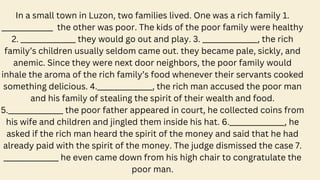
In a small town in Luzon, two families lived. One was a rich family 1.
______________ the other was poor. The kids of the poor family were healthy
2. _______________ they would go out and play. 3. _______________, the rich
family’s children usually seldom came out. they became pale, sickly, and
anemic. Since they were next door neighbors, the poor family would
inhale the aroma of the rich family’s food whenever their servants cooked
something delicious. 4._______________, the rich man accused the poor man
and his family of stealing the spirit of their wealth and food.
5._______________ the poor father appeared in court, he collected coins from
his wife and children and jingled them inside his hat. 6._______________, he
asked if the rich man heard the spirit of the money and said that he had
already paid with the spirit of the money. The judge dismissed the case 7.
_______________ he even came down from his high chair to congratulate the
poor man.
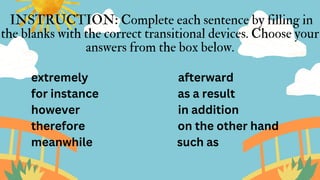
INSTRUCTION: Complete each sentence by filling in
the blanks with the correct transitional devices. Choose your
answers from the box below.
extremely afterward
for instance as a result
however in addition
therefore on the other hand
meanwhile such as
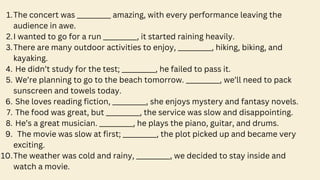
The concert was __________ amazing, with every performance leaving the
audience in awe.
1.
I wanted to go for a run __________, it started raining heavily.
2.
There are many outdoor activities to enjoy, __________, hiking, biking, and
kayaking.
3.
He didn’t study for the test; __________, he failed to pass it.
4.
We’re planning to go to the beach tomorrow. __________, we’ll need to pack
sunscreen and towels today.
5.
She loves reading fiction, __________, she enjoys mystery and fantasy novels.
6.
The food was great, but __________, the service was slow and disappointing.
7.
He’s a great musician. __________, he plays the piano, guitar, and drums.
8.
The movie was slow at first; __________, the plot picked up and became very
exciting.
9.
The weather was cold and rainy, __________, we decided to stay inside and
watch a movie.
10.


TRANSITIONALDEVICEShxvhjagdgsgdigsgy.pdf

  • 1.
  • 2.
  • 3.
  • 4.
  • 5.
  • 6.
  • 7.
  • 8.
  • 9.
  • 10.
  • 11.
  • 12.
    Transitional Devices as Toolfor Coherence and Cohesion
  • 13.
    a) determine theuse of transitional devices; b) use transitional devices appropriately; and c) explain the importance of using transitional devices. OBJECTIVES
  • 14.
    Transitional Devices - theseare phrases or words used to connect one idea to another, or from one sentence or paragraph to another.
  • 15.
    Types of Transitional Words TOADD: and, again, then, besides, finally, further, furthermore, nor, too, next, lastly, what's more, moreover, in addition. Example: Jamaira ate tapsilog this morning, then she took a bath before going to school.
  • 16.
    Types of Transitional Words TOCOMPARE: whereas, but, yet, on the other hand, however, on the contrary, by comparison, where, compared to, up against, although, conversely, meanwhile, after all, in contrast. Example: Lerry was working at a restaurant meanwhile, his wife was going to university.
  • 17.
    Types of Transitional Words TOPROVE: because, for, since, obviously, evidently, furthermore, moreover, besides, indeed, in fact, in addition, in any case. Example: Jared didn’t want to play outside because it was too hot, besides he had homework to finish.
  • 18.
    Types of Transitional Words TOSHOW TIME: immediately, thereafter, and soon, after a few hours, finally, then, later, previously, formerly, first (second, etc.), next, and then. Example: The bell rang, and soon, the students were heading home for the day.
  • 19.
    Types of Transitional Words TOEMPHASIZE: definitely, extremely, obviously, in fact, indeed, in any case, absolutely, positively, naturally, surprisingly, without a doubt, certainly, undeniably. Example: The new smartphone is extremely fast, making it ideal for gaming and multitasking.
  • 20.
    Types of Transitional Words TOSHOW SEQUENCE: first, second, third and so forth, next, then, following this, at this time, now, at this point, after, afterward, subsequently, finally, consequently, previously, before this. Example: We went to the museum this morning, afterward, we had lunch at a nearby café.
  • 21.
    Types of Transitional Words TOGIVE AN EXAMPLE: for example, for instance, in this case, in another case, on this occasion, in this situation, to demonstrate, to illustrate. Example: There are many ways to stay fit, for instance, swimming, running, or practicing yoga.
  • 22.
    Types of Transitional Words TOSUMMARIZE OR CONCLUDE: in brief,on the whole, summing up, to conclude, in conclusion, as I have shown, as I have said, therefore, as a result. Example: In summary, reading regularly can make us better writers..
  • 23.
    transitional devices alsoknown as linking words or cohesive devices, are important because they help readers interpret ideas and make writing clearer and more effective. IMPORTANCE OF TRANSITIONAL DEVICES
  • 25.
    Activity: THINK, PAIR,SHARE! INSTRUCTION: Use the appropriate transitional markers on the blanks provided in the following summary of “My Father Goes to Court”. Choose your answers from the box below.
  • 26.
    In a smalltown in Luzon, two families lived. One was a rich family 1. ______________ the other was poor. The kids of the poor family were healthy 2. _______________ they would go out and play. 3. _______________, the rich family’s children usually seldom came out. they became pale, sickly, and anemic. Since they were next door neighbors, the poor family would inhale the aroma of the rich family’s food whenever their servants cooked something delicious. 4._______________, the rich man accused the poor man and his family of stealing the spirit of their wealth and food. 5._______________ the poor father appeared in court, he collected coins from his wife and children and jingled them inside his hat. 6._______________, he asked if the rich man heard the spirit of the money and said that he had already paid with the spirit of the money. The judge dismissed the case 7. _______________ he even came down from his high chair to congratulate the poor man.
  • 27.
    INSTRUCTION: Complete eachsentence by filling in the blanks with the correct transitional devices. Choose your answers from the box below. extremely afterward for instance as a result however in addition therefore on the other hand meanwhile such as
  • 28.
    The concert was__________ amazing, with every performance leaving the audience in awe. 1. I wanted to go for a run __________, it started raining heavily. 2. There are many outdoor activities to enjoy, __________, hiking, biking, and kayaking. 3. He didn’t study for the test; __________, he failed to pass it. 4. We’re planning to go to the beach tomorrow. __________, we’ll need to pack sunscreen and towels today. 5. She loves reading fiction, __________, she enjoys mystery and fantasy novels. 6. The food was great, but __________, the service was slow and disappointing. 7. He’s a great musician. __________, he plays the piano, guitar, and drums. 8. The movie was slow at first; __________, the plot picked up and became very exciting. 9. The weather was cold and rainy, __________, we decided to stay inside and watch a movie. 10.