Manual “How to transform an association in a centre
of learning for creativity –Erasmus+ project - Articrea -
Artificial Intelligence for creativity and
entrepreneurship - 2023-1-ES01-KA210-ADU-
000161204 – v.1.0
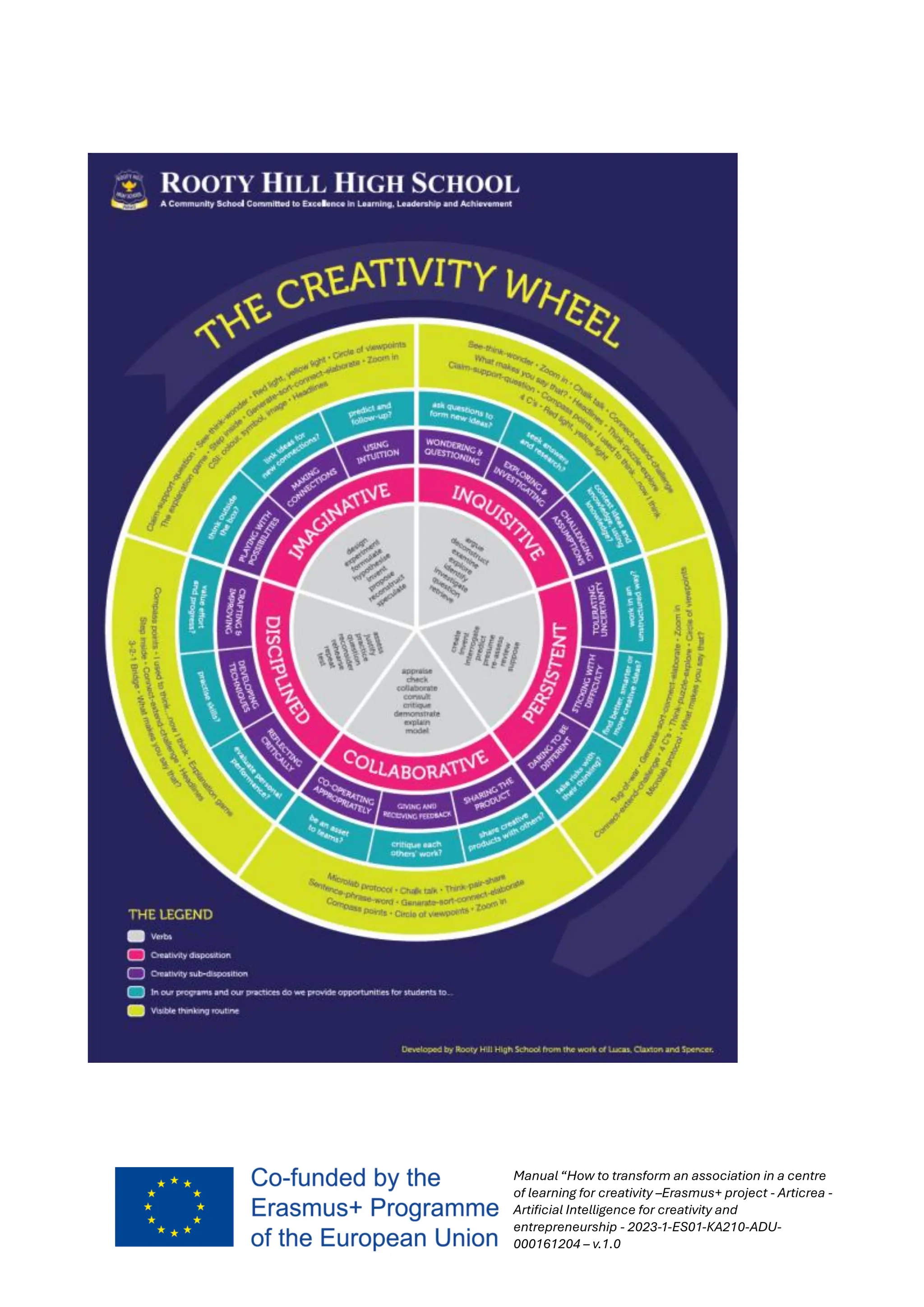
INTRODUCTION- WHAT IS CREATIVITY
There is not a common definition on creativity. In this manual
we will try to describe the definition that, in our opinion, are
useful for our goal (transform an association in a learning
creative centre). It is a learning habit that requires skill as well
as specific understanding of the contexts in which creativity is
being applied. The creative process is at the heart of innovation
and often the words are used interchangeably.
According to Kampylis and Berki (2014): “Creative thinking is
defined as the thinking that enables students to apply their
imagination to generating ideas, questions and hypotheses,
experimenting with alternatives and to evaluating their own and
their peers’ ideas, final products and processes.”
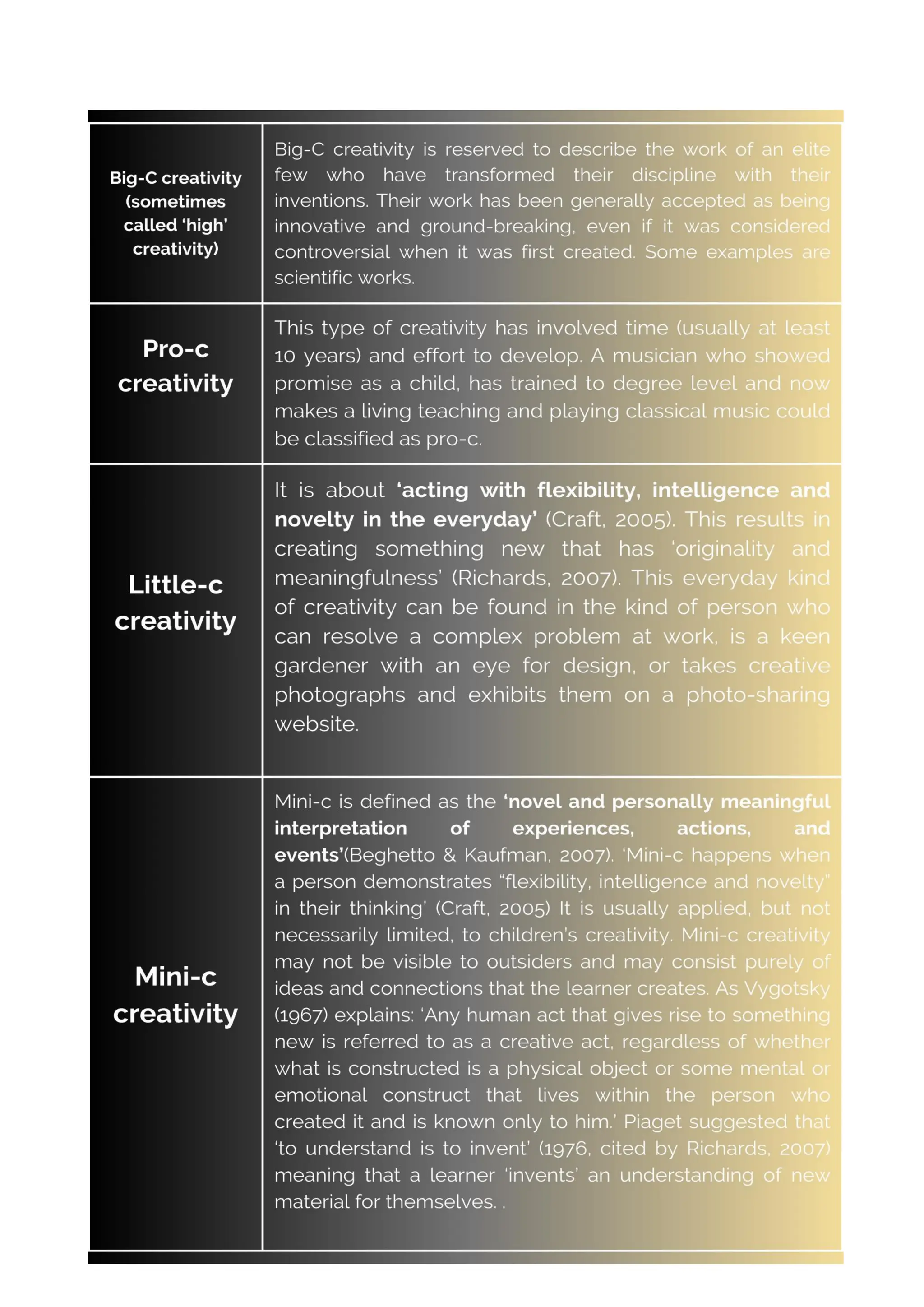
Kaufman and Beghetto (2009) developed four categories of
creativity which help to reveal the nuances between different
levels and types of creativity (see next page)
Manual “How to transform an association in a centre
of learning for creativity –Erasmus+ project - Articrea -
Artificial Intelligence for creativity and
entrepreneurship - 2023-1-ES01-KA210-ADU-
000161204 – v.1.0
Manual “How to transform an association in a centre
of learning for creativity –Erasmus+ project - Articrea -
Artificial Intelligence for creativity and
entrepreneurship - 2023-1-ES01-KA210-ADU-
000161204 – v.1.0
Creativity is fundamental to all disciplines and an essential part of the learning
process, forming an important dimension of learning how to learn. It is also
fundamental to teachers improving their professional practice and to school
development.
Being creative requires reflection, encourages engagement and develops
confidence and responsibility. The ability and inclination to be creative is
essential to living a fulfilled and successful life, and it is valued in higher
education and the workplace. There are many other benefits of maximising one’s
own creative potential such as physical and psychological health improvements,
improved resilience in the face of difficulties and even lower levels of aggression
(Richards, 2007, p.9).
Craft (2005, p.15) points out that our understanding of creativity have progressed
and broadened over time. In the early 20th century creativity was considered to
be an innate, elusive quality that individuals were born with. Initially creativity was
most closely associated with the arts but grew to include science, technology and
other disciplines. In the 21st century creativity is increasingly viewed as a
distributed and collaborative process of communal sense making and problem
solving.
As with all the learner attributes, cultural perspectives are also very important
when considering creativity. Confucian heritage cultures, for example, tend to see
creativity more as a collective exercise. They place responsibility for creativity on
the social group rather than the individual. Individuals, therefore, are not
encouraged to stand out from the class in the same way or to the same extent as
in Western cultures. This does not mean that creativity is in any way less valued.
As with all the learner attributes, ideas presented in this chapter need to be
interpreted and implemented in a culturally sensitive way.
Manual “How to transform an association in a centre
of learning for creativity –Erasmus+ project - Articrea -
Artificial Intelligence for creativity and
entrepreneurship - 2023-1-ES01-KA210-ADU-
000161204 – v.1.0
CREATIVITY AND LEARNING
Learning involves challenging, refining and improving understanding by being
made to think hard. Sometimes, to understand new concepts and broaden
perspectives, our approaches to thinking need to be creative, imaginative and
lateral (incorporating new ways of looking at things), as well as linear (using
existing patterns of thought).
One characteristic of the creative process that makes it particularly powerful is
that it requires not only knowledge and understanding of the domain being
investigated, but also a willingness to question and not be constrained by existing
knowledge.
Learners should understand how they can question, or challenge established
knowledge to help them to formulate their own understanding, and imagination
can play an important role:
‘One cannot think creatively unless one has the knowledge with which to think
creatively. Creativity represents a balance between knowledge and freeing
oneself of that knowledge’ (Johnson-Laird, 1988 - Sternberg, 2012)”
For creative thinking to deepen and extend learning, rather than be an enjoyable
but superficial activity, it must be grounded in understanding of the content being
investigated. It is vital that learners have sufficient understanding of the material
with which they are being asked to be creative. Creative practice needs to
complement diligent and deliberate practice that develops foundational skills –
not be a substitute for it.
Manual “How to transform an association in a centre
of learning for creativity –Erasmus+ project - Articrea -
Artificial Intelligence for creativity and
entrepreneurship - 2023-1-ES01-KA210-ADU-
000161204 – v.1.0
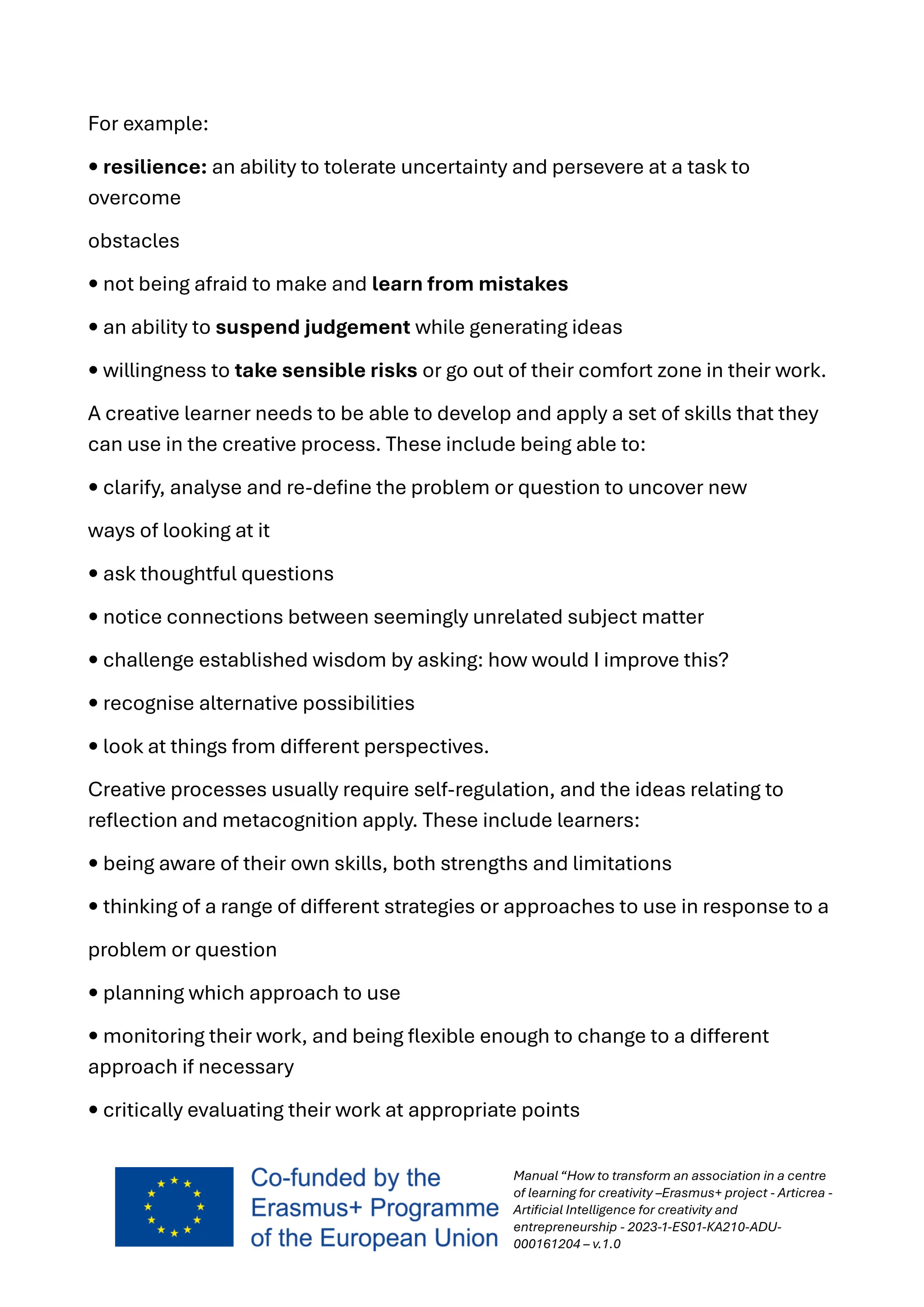
A revised version of Bloom’s original 1956 taxonomy by Krathwohl (2002)
includes creativity in the taxonomy and places creativity above evaluation
as a higher order thinking skill.
An alternative, and probably more accurate, representation would be to include
creativity as a process involved in skills at all levels represented in the taxonomy,
and increasingly so with higher order skills. It might be thought that remembering
information does not involve creative processes. In fact, creative approaches can
be very helpful in remembering information.
This is an area in which cultural sensitivity may be particularly important. If
learners are not used to being asked to demonstrate creative habits and skills,
they need to be guided. How the creative activity links to broader learning
objectives needs to be clearly understood by teachers and learners.
Having a creative habit, the disposition to behave creatively is critical.
Csikszentmihalyi (2002) emphasises the importance of having a playful attitude
while remaining disciplined. Whenever possible, play should be used to extend
the range of opportunities to think. There are several character traits and learning
habits that affect a learner’s personal disposition, motivation and confidence to
be creative.
Manual “How to transform an association in a centre
of learning for creativity –Erasmus+ project - Articrea -
Artificial Intelligence for creativity and
entrepreneurship - 2023-1-ES01-KA210-ADU-
000161204 – v.1.0
For example:
• resilience: an ability to tolerate uncertainty and persevere at a task to
overcome
obstacles
• not being afraid to make and learn from mistakes
• an ability to suspend judgement while generating ideas
• willingness to take sensible risks or go out of their comfort zone in their work.
A creative learner needs to be able to develop and apply a set of skills that they
can use in the creative process. These include being able to:
• clarify, analyse and re-define the problem or question to uncover new
ways of looking at it
• ask thoughtful questions
• notice connections between seemingly unrelated subject matter
• challenge established wisdom by asking: how would I improve this?
• recognise alternative possibilities
• look at things from different perspectives.
Creative processes usually require self-regulation, and the ideas relating to
reflection and metacognition apply. These include learners:
• being aware of their own skills, both strengths and limitations
• thinking of a range of different strategies or approaches to use in response to a
problem or question
• planning which approach to use
• monitoring their work, and being flexible enough to change to a different
approach if necessary
• critically evaluating their work at appropriate points
Manual “How to transform an association in a centre
of learning for creativity –Erasmus+ project - Articrea -
Artificial Intelligence for creativity and
entrepreneurship - 2023-1-ES01-KA210-ADU-
000161204 – v.1.0
HOW TO CREATE A CREATIVE CULTURE IN A LEARNING CENTER
We are all born with a creative instinct and all people have creative potential.
Young children naturally engage in play – a state when the imagination is used to
‘try out’ situations and possibilities. Learners can become fearful of making
mistakes if they only receive recognition for giving an answer understand the
discipline as a whole is spaced delivery of content in lessons. This involves
teachers revisiting related subject matter over a long time rather than just
teaching each topic as a separate entity.
Like any habit, creativity can be encouraged or discouraged. Having a learning
rather than a performance orientation, helps to create an environment where
creativity is encouraged.
Learning centre are successful at stimulating creative learning if they
• value and celebrate learners’ creative and innovative
contributions
• do not overcrowd the curriculum
• provide opportunities to explore, concentrate for
extended periods of time, reflect, discuss and review
• encourage a broad and balanced curriculum so that
learners experience a range of subjects and activities
• encourage learners not studying the arts as
qualifications to pursue creative activities in the co-
curricular programme
• develop codes of behaviour and classroom procedures
that value and promote creativity
• encourage sensible risk taking
Manual “How to transform an association in a centre
of learning for creativity –Erasmus+ project - Articrea -
Artificial Intelligence for creativity and
entrepreneurship - 2023-1-ES01-KA210-ADU-
000161204 – v.1.0
A study on creativity and innovation in education in European member states
(Craft, 2005) found that trainers preferred their learners to be ‘conforming’ or
‘considerate’to‘risk taking’and‘playful’(Ferrari, Cachia & Punie, 2009). A culture
of ‘one right answer’ stops learners from being willing to make mistakes. They
quickly learn to guess what answer the teacher has in their heads. As von Oech
(1998) points out, ‘many of us have been taught that the best ideas are in
someone else’s head’.
LET US BEGIN FROM THE TRAINERS
“Cambridge trainers are creative, experimenting with new ideas and pursuing an
enquiring approach in their teaching. They are open to new challenges, being
resourceful, imaginative, and flexible. They are always ready to learn and apply
new skills and techniques” 1
It highlights that effective teachers have a deep
knowledge of their subject as well as an understanding of how learners think
about subject content at different developmental stages (pedagogical
knowledge). They can make thinking visible, helping learners to recognise
misconceptions and manage their own learning. Because the creative process is
fundamental to learning, nurturing creativity is also an aspect of good teaching in
all subjects. Fostering a creative climate in the learning centre, supportive of
creative professionalism, is another theme considered in the Developing your
School with Cambridge guide. It is very hard for a trainer to be creative if they are
following a prescribed curriculum and given little or no room for their own creative
input into their teaching practice. Trainers can support creativity by:
1. Role modelling creative habits: Nothing is more important than the trainers
exemplifying the habits, behaviours and thinking they want trainees to
demonstrate. They need to exemplify creative traits such as curiosity and the
development of creative skills.
2. Appreciating the critical importance of questions, both their own and those
1
Chapter 4 of the Developing your School with Cambridge guide considers the attributes of effective teachers (available at
www.cambridgeinternational.org/teaching-andlearning/).
Manual “How to transform an association in a centre
of learning for creativity –Erasmus+ project - Articrea -
Artificial Intelligence for creativity and
entrepreneurship - 2023-1-ES01-KA210-ADU-
000161204 – v.1.0
asked by trainees.
3. Treating mistakes as learning opportunities and encouraging learners to take
sensible risks in the classroom
4. Encouraging learners to take ‘sensible risks’ in their work is important for
building up their creative confidence. It is important that this takes place in a
supportive environment, and that the teacher and learner have discussed what
boundaries are acceptable in their context. It is also important to set some
ground rules in collaboration with learners.
5. Giving learners sufficient time to complete their work: sometimes ideas
need time to develop before becoming valuable. Giving learners the scope to
come up with their own ideas can be challenging for both teachers and learners.
Learners will need time to think and work independently of the teacher. Delay
judgement of learners’ ideas until they have had time to work them out properly.
6. Scaffolding tasks carefully to provide the appropriate level of challenge.
Ideally, a trainer should try to design tasks that help the learner to cross over into
this area by ‘scaffolding’, or supporting them at first, and then withdrawing
support so that the learner can increasingly achieve the task on their own.
Even a small change in teaching approach can bring about a change in a learner’s
creative disposition. If learners start to see that there is not always ‘one right
answer’ to many questions, both in school and in life, then their creative
confidence will grow. The most important thing of all is for learners to lay the
foundation of their personal creative abilities, on which they will build throughout
their lives
A DIFFERENT CURRICULUM
Problem solving and enquiry are at the heart of learning. They require learners to
think hard using their existing understanding to engage with the question or
problem at hand and work out solutions.
Manual “How to transform an association in a centre
of learning for creativity –Erasmus+ project - Articrea -
Artificial Intelligence for creativity and
entrepreneurship - 2023-1-ES01-KA210-ADU-
000161204 – v.1.0
Pitching questions or problems at exactly the right level to stretch student
thinking, and providing just enough support, is the mark of a good teacher. How
trainers present problems and questions will vary depending on learners age, the
local culture, the discipline being studied and many other factors. There is a place
for a wide range of approaches including whole-class instruction as well as
individual and group collaborative work, and some variety is important.
Sometimes it is incorrectly assumed that creativity occurs best in group work with
the trainer acting as a facilitator. In fact, direct instruction involving the whole
class can encourage creativity as long as the classroom culture is supportive, and
the class focuses on powerful questions and problems.
It is important to note that direct instruction, well done, is identified in John
Hattie’s work (2009) as a highly effective approach to teaching and learning.
Direct instruction should involve a highly skilled active process in which the
trainer engages and challenges student thinking, responding quickly to student
thinking as it emerges. Discussions are focused on important concepts and ideas
with questions from students. The trainer stimulates thought and encourages
new ideas and new ways of thinking. Both trainees and trainers see errors as
guiding what still needs to be learned rather than signalling failure.
Enquiry-based learning is often associated with student-led projects. In this
context learning involves a trainer and/or learners setting a meaningful problem
or question which challenges and extends learners’ understanding over an
extended period of time. Projects could be within one subject or combine two or
more subjects. The problems or questions may be open ended, complex and
multi-faceted. Projects often culminate in learners doing a presentation of their
work to the rest of the class, but the‘product’created could be made public such
as a blog, website, exhibition or magazine. By its nature, project-based learning
involves learners using reflective, creative and critical thinking skills in
collaboration with others.
For project-based learning to work well it is important that the learning objectives
are clear, supportive of the broader curriculum, and the teacher plays an active
role in supporting the development of student understanding. This may involve
the teacher standing back for long periods, allowing students to explore and
Manual “How to transform an association in a centre
of learning for creativity –Erasmus+ project - Articrea -
Artificial Intelligence for creativity and
entrepreneurship - 2023-1-ES01-KA210-ADU-
000161204 – v.1.0
experiment and think through the problem, but they need to be active in
challenging student thinking and bringing learning to a productive conclusion.
One advantage of enquiry-based learning is that it provides an opportunity for
learners to collaboratively explore a question or problem from multiple
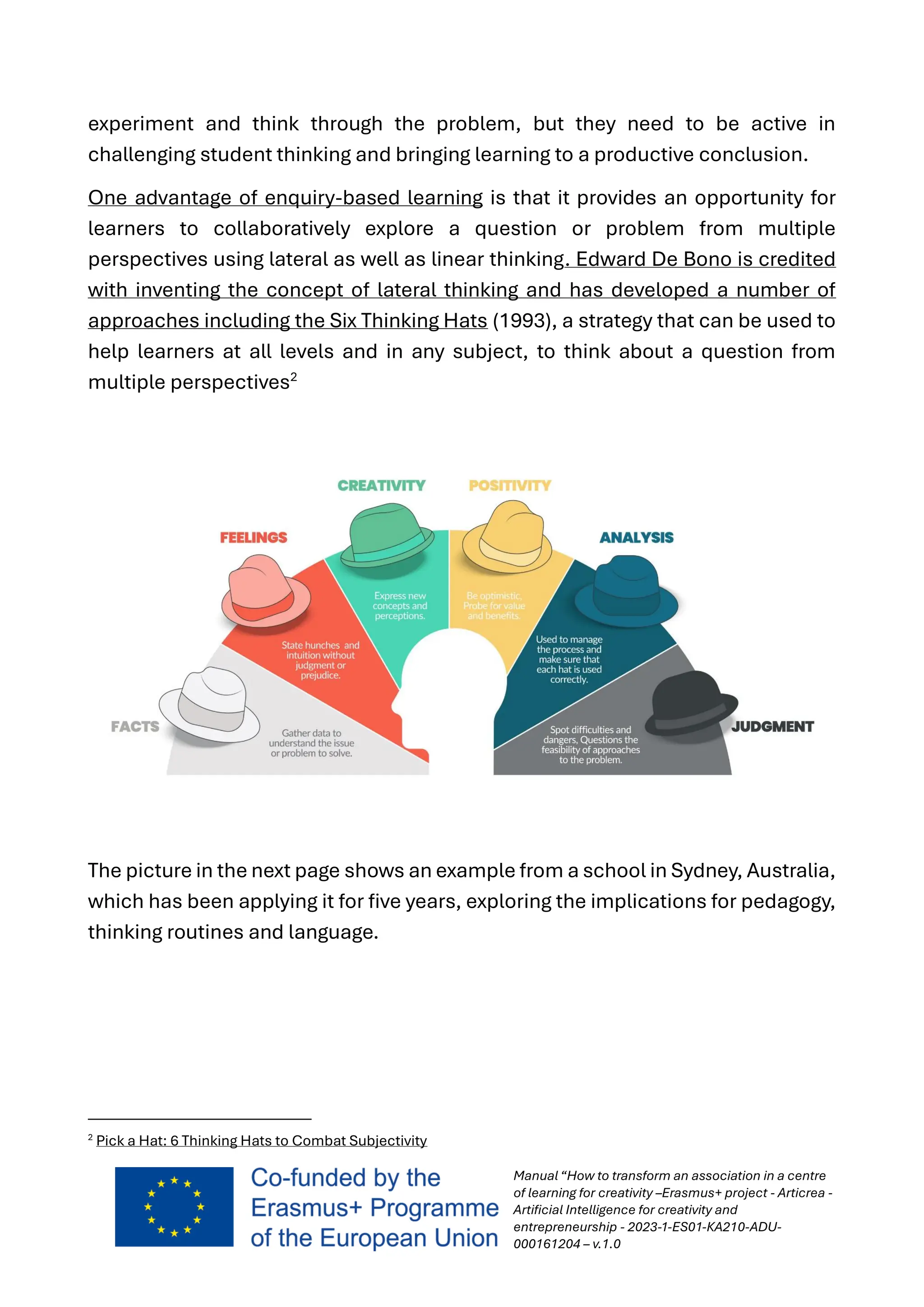
perspectives using lateral as well as linear thinking. Edward De Bono is credited
with inventing the concept of lateral thinking and has developed a number of
approaches including the Six Thinking Hats (1993), a strategy that can be used to
help learners at all levels and in any subject, to think about a question from
multiple perspectives2
The picture in the next page shows an example from a school in Sydney, Australia,
which has been applying it for five years, exploring the implications for pedagogy,
thinking routines and language.
2
Pick a Hat: 6 Thinking Hats to Combat Subjectivity
Manual “How to transform an association in a centre
of learning for creativity –Erasmus+ project - Articrea -
Artificial Intelligence for creativity and
entrepreneurship - 2023-1-ES01-KA210-ADU-
000161204 – v.1.0
Manual “How to transform an association in a centre
of learning for creativity –Erasmus+ project - Articrea -
Artificial Intelligence for creativity and
entrepreneurship - 2023-1-ES01-KA210-ADU-
000161204 – v.1.0
Linking creativity with other competences/skills3
What are the links between creativity and the eight key competences outlined in
the European Reference Framework?
What are the links between creativity and other competences and core life/21st
century skills as described in literature and learning frameworks?4
Creativity is linked with almost every term currently in use in describing
educational frameworks. We now draw together some of the links (and a lack of
connection) between creativity and the eight Key Competences for Lifelong
Learning in the European Reference Framework.5
The Council Recommendation of 22 May 2018 has defined the following
competences:
— Literacy competence
— Multilingual competence
— Mathematical competence and competence in science, technology and
engineering
— Digital competence
— Personal, social and learning to learn competence
— Citizenship competence
— Entrepreneurship competence
— Cultural awareness and expression competence
In the same Council recommendation
- we are reminded that 41 Key competences are those which all individuals
need for personal fulfilment and development, employability, social
3
Source; Creativity – a transversal skill for lifelong learning. An overview of existing concepts and practices
4
Source: OECD. (2018). The Future of Education and Skills: Education 2030 - The future we want. OECD
Publishing. Future of Education and Skills 2030 | OECD
5
Council Recommendation on Key Competences for Lifelong Learning - European Education Area
Manual “How to transform an association in a centre
of learning for creativity –Erasmus+ project - Articrea -
Artificial Intelligence for creativity and
entrepreneurship - 2023-1-ES01-KA210-ADU-
000161204 – v.1.0
inclusion, sustainable lifestyle, successful life in peaceful societies,
health-conscious life management and active citizenship.
- creativity, along with other items, is described as a skill which is embedded
throughout the key competences
While it is eminently sensible to seek to embed some aspects of key
competences across all competences it inevitably raises questions too:
- Is creativity a skill? The evidence would seem to suggest that creative
thinking is a cluster of skills, but that creativity is a multi-dimensional
concept best described in words such as competency, competence,
attribute, and disposition.
- How best does any framework such as the Key Competences for Lifelong
Learning recognise something as important as creativity? If it is simply left
to individual competence developers, this runs the risk of confusing
understanding of creativity.
- How best can the complexity of a concept such as creativity be recognised
so that it can be better developed across Europe? If creativity is set in a list
alongside teamwork or problem-solving then it is being implicitly compared
with smaller, different ideas.
The JRC has developed frameworks for individuals for the first three of these,
whereas cultural awareness and expression have been explored through the open
method of coordination by a working group of the EU Member States’ experts in
20166
, but as of September 2020, no common framework has been produced.
- Digital: Creativity is seen through the lens of digital activity. Creativity is
explicitly part of Problem-solving (Creatively using digital technologies) but
implicitly part of Communication and collaboration and Digital content
creation.
- Personal, Social and Learning: According to this Framework, creativity
‘enables individuals to question assumptions, reevaluate problems
considering different variables and to take sensible risks. Being persistent,
6
https://op.europa.eu/en/publication-detail/-/publication/6066c082-e68a-11e5-8a50-01aa75ed71a1
Manual “How to transform an association in a centre
of learning for creativity –Erasmus+ project - Articrea -
Artificial Intelligence for creativity and
entrepreneurship - 2023-1-ES01-KA210-ADU-
000161204 – v.1.0
collaborative, and disciplined sustain creativity.” and ‘While creativity is
visible, it sits among many other concepts within this framework.
- Entrepreneurship: Creativity is defined as ‘developing ideas and
opportunities to create value, including better solutions to existing and new
challenges; exploring and experimenting with innovative approaches;
combining knowledge and resources to achieve valuable effects.’Creativity
is seen as a sub-set of an Entrepreneurship competence, Ideas and
opportunities (along with spotting opportunities, vision, valuing ideas,
ethical and sustainable thinking). Creativity is explicitly mentioned but as a
small element of a larger competence. Creativity is also implicit in many of
the other competences/sub-competences such as coping with ambiguity,
uncertainty & risk, taking the initiative and mobilising others. While
creativity and entrepreneurship share common features such as the
generation of original ideas, entrepreneurship is an applied version of
creativity where the emphasis is on creating value or profit.
- Cultural awareness and expression competence: The description of this
competence is full of powerful expressions of the value of creativity, albeit
and understandably framed by its interest in culture and the arts. Its model
of creativity is the five-dimensional one published by the OECD (Lucas et
al., 2013).
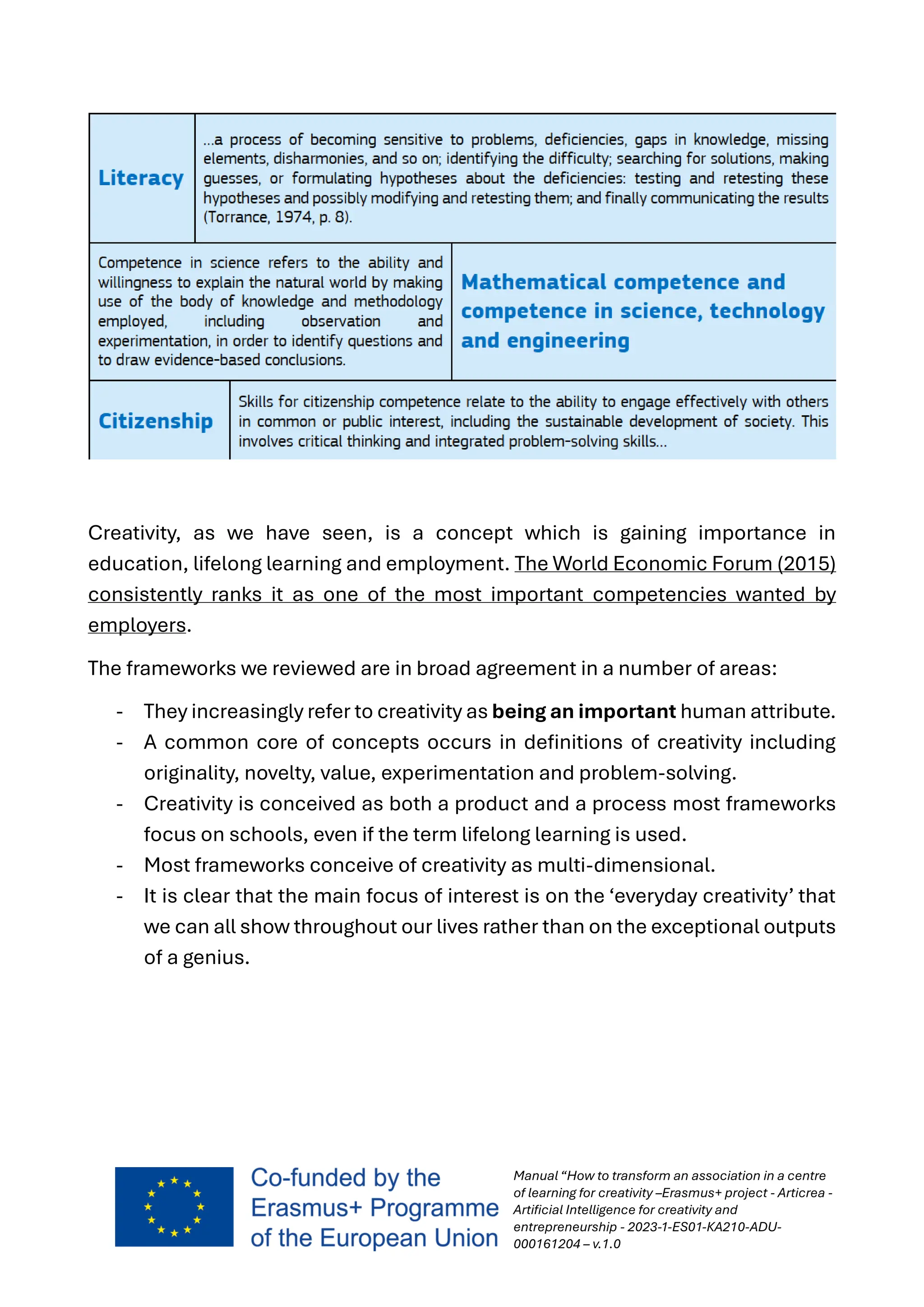
While creativity features the most in the descriptions of the four competences
listed above, there are clearly opportunities for recognising the role of this
transversal skill more explicitly in Literacy, Mathematical competence and
competence in science, technology and engineering and Citizenship. These
possible connections are indicated by extracts from the framework as presented
in the Council Recommendation of 22 May 2018 (see picture)
Manual “How to transform an association in a centre
of learning for creativity –Erasmus+ project - Articrea -
Artificial Intelligence for creativity and
entrepreneurship - 2023-1-ES01-KA210-ADU-
000161204 – v.1.0
Creativity, as we have seen, is a concept which is gaining importance in
education, lifelong learning and employment. The World Economic Forum (2015)
consistently ranks it as one of the most important competencies wanted by
employers.
The frameworks we reviewed are in broad agreement in a number of areas:
- They increasingly refer to creativity as being an important human attribute.
- A common core of concepts occurs in definitions of creativity including
originality, novelty, value, experimentation and problem-solving.
- Creativity is conceived as both a product and a process most frameworks
focus on schools, even if the term lifelong learning is used.
- Most frameworks conceive of creativity as multi-dimensional.
- It is clear that the main focus of interest is on the ‘everyday creativity’ that
we can all show throughout our lives rather than on the exceptional outputs
of a genius.
Manual “How to transform an association in a centre
of learning for creativity –Erasmus+ project - Articrea -
Artificial Intelligence for creativity and
entrepreneurship - 2023-1-ES01-KA210-ADU-
000161204 – v.1.0
A CREATIVE CENTER
Creative Centers have emerged as vital spaces where individuals and teams
can harness their creative potential and turn groundbreaking ideas into reality.
• Definition: Creative Centers are dedicated spaces that foster creativity and
innovation through collaboration, resource sharing, and structured
activities.
• Purpose: Their primary aim is to cultivate an environment where individuals
from diverse backgrounds can come together, share ideas, and collaborate
on projects, thereby enhancing the creative process.
Engaging with a Creative Center offers a wealth of advantages for both individuals
and organizations:
1. Access to Resources
• Creative Centers provide participants with access to specialized
tools, advanced technology, and materials that might be difficult to
obtain independently. This access can significantly enhance the
quality of projects and encourage experimentation.
• Many Creative Centers also offer workshops, classes, and
mentorship opportunities, allowing individuals to learn new skills and
techniques that can elevate their creative output.
2. Networking Opportunities
• Creative Centers act as hubs for like-minded individuals, fostering a
sense of community among participants. This environment
encourages networking, collaboration, and the exchange of ideas,
leading to potential partnerships and business opportunities.
• The diverse backgrounds of participants contribute to richer
discussions and brainstorming sessions, helping to generate
innovative solutions that would be harder to achieve in isolation.
Manual “How to transform an association in a centre
of learning for creativity –Erasmus+ project - Articrea -
Artificial Intelligence for creativity and
entrepreneurship - 2023-1-ES01-KA210-ADU-
000161204 – v.1.0
3. Enhanced Creativity
• Exposure to a variety of perspectives stimulates new ideas and
approaches to problem-solving. Creative Centers encourage
participants to think outside the box and challenge conventional
thinking.
• The collaborative atmosphere allows for the sharing of experiences
and insights, which can inspire individuals to take creative risks and
explore uncharted territory.
Let us see some example of Creative Centers
TechShop: a membership-based workshop that provides access to a wide range
of tools and equipment, from woodworking and metalworking to electronics and
textiles. With locations across the United States, TechShop caters to hobbyists,
entrepreneurs, and anyone looking to bring their creative ideas to life. By fostering
a supportive environment and encouraging members to collaborate on projects,
TechShop has become a breeding ground for innovation. Many successful
startups have emerged from its workshops, demonstrating the power of
community-driven creativity (more info on:
https://fundacionuniversidadempresa.es/en/innovation/techshop/ )
MakerSpaces: community-driven environments that provide individuals with
access to tools, resources, and workshops to facilitate creative projects. These
spaces cater to a wide range of interests, including art, technology, and
engineering. They often hosts events, challenges, and educational workshops,
promoting acultureof learning and experimentation. Participants cancollaborate
on projects, share ideas, and learn from one another, making MakerSpaces
invaluable for community engagement (more info at
https://www.makerspaces.com/what-is-a-makerspace/)
WeWork: Known primarily as a co-working space, WeWork has evolved to include
creative facilities such as art studios, event spaces, and collaborative work areas.
This integration allows members to work on projects and engage in creative
pursuits simultaneously. By blending professional and creative environments,
WeWork fosters a culture of innovation. Members have access to networking
Manual “How to transform an association in a centre
of learning for creativity –Erasmus+ project - Articrea -
Artificial Intelligence for creativity and
entrepreneurship - 2023-1-ES01-KA210-ADU-
000161204 – v.1.0
opportunities and resources that can enhance their creative projects while
maintaining a focus on productivity. (more info on https://www.wework.com/)
To fully leverage the benefits of a Creative Center, consider the following
strategies:
• Engage with the Community
• Actively participate in events, workshops, and networking
opportunities. Building relationships with other members can lead to
fruitful collaborations and fresh perspectives.
• Join interest groups or committees within the centre to deepen your
involvement and connect with others who share your passions.
• Set Clear Goals
• Define specific objectives for your projects before diving in. Having
clear goals helps maintain focus and provides a sense of direction as
you navigate the creative process.
• Regularly assess your progress and adjust your goals as needed to
stay aligned with your evolving creative vision.
• Balance Collaboration and Focus
• While collaboration is essential, ensure that you allocate time for
focused, independent work. Establish dedicated periods for
brainstorming with others and for concentrating on your tasks.
• Create a conducive environment for focused work, minimizing
distractions and setting aside specific times for deep creative
exploration.
While Creative Centers offer numerous advantages, there are challenges that
participants may encounter. Here are some common pitfalls and how to avoid
them:
Manual “How to transform an association in a centre
of learning for creativity –Erasmus+ project - Articrea -
Artificial Intelligence for creativity and
entrepreneurship - 2023-1-ES01-KA210-ADU-
000161204 – v.1.0
1. Feeling Overwhelmed
• Problem: The abundance of resources and opportunities can lead to
decision fatigue and paralysis.
• Solution: Prioritize your goals and break projects into smaller,
manageable tasks. By focusing on one step at a time, you can
maintain clarity and momentum.
2. Distractions
• Problem: The collaborative nature of Creative Centers can
sometimes lead to distractions that hinder productivity.
• Solution: Establish a structured routine that balances collaborative
brainstorming with independent work periods. Use tools like time-
blocking to manage your schedule effectively.
3. Fear of Failure
• Problem: Participants may hesitate to take risks due to a fear of
failure, stifling creativity and innovation.
• Solution: Embrace a mindset that views failure as a learning
opportunity. Encourage experimentation and iterative processes,
where mistakes are seen as valuable steps toward success.
Detailed Benefits of Engaging with Creative Centers
Engaging with Creative Centers provides profound benefits that extend beyond
immediate access to resources:
• Improved Problem-Solving Skills
• Working alongside individuals from diverse backgrounds exposes
participants to a variety of problem-solving techniques. This diversity
enriches the creative process and fosters innovative solutions.
• Encouragement of Experimentation
• Creative Centers cultivate an environment that promotes risk-taking
and experimentation. Participants learn to embrace failure as part of
Manual “How to transform an association in a centre
of learning for creativity –Erasmus+ project - Articrea -
Artificial Intelligence for creativity and
entrepreneurship - 2023-1-ES01-KA210-ADU-
000161204 – v.1.0
the creative journey, leading to iterative improvements and
groundbreaking innovations.
• Increased Motivation and Accountability
• The collaborative atmosphere of a Creative Center creates a sense of
accountability among members. When working alongside others,
individuals are often more motivated to complete their projects and
meet deadlines.
Best Practices for Enhancing Creativity
To optimize your experience in a Creative Center, consider these best practices:
• Structured Routines
• Establish regular brainstorming sessions, reflection periods, and
dedicated time for skill development. Consistency can enhance
creative output and foster innovation.
• Seek and Embrace Feedback
• Sharing your work with peers and mentors can provide valuable
insights and fresh perspectives. Embrace constructive criticism as a
tool for growth and refinement.
• Stay Open to New Ideas
• Maintain an open mind and be willing to explore ideas that may
initially seem unconventional. Some of the best innovations arise
from thinking outside traditional frameworks.
Manual “How to transform an association in a centre
of learning for creativity –Erasmus+ project - Articrea -
Artificial Intelligence for creativity and
entrepreneurship - 2023-1-ES01-KA210-ADU-
000161204 – v.1.0
START FORM THE DESIGN
“Designing the environment we live in a never-ending process. It is based on an
effort to become better, more vivacious, and to respond to how the society and
social needs are developing. In Trans Europe Halles member cultural centres,
design is firmly connected to other cultural activities that take place there. It is
not just about results. Its strengths consist chiefly in processes of formation and
subsequent use. Architectural design (as well as urban planning) and the
art/culture programmes are reciprocally formative. This is the biggest difference
when compared to large public institutions. It is not a question of facades,
sculptural volumes and investment amounts. The interesting part lies in the close
relationships between variedprogrammes, activities, employees, artists and their
audience. The solutions brought about in the world of cultural centres are often
unheard of in other sectors. They result from the creative clash between
architects, designers, artist, managers, volunteers, students, technicians,
audience and neighbours” Peter Lényi7
Here you can read the book:
https://www.teh.net/resources/design-handbook-for-cultural-centres/
A cultural center is a meeting place, integration and encounter of the
community. Therefore, it is important to consider that:
• The cultural management model must be born from the cultural and
artistic needs and demands of the community
• It must have inclusive and itinerant spaces that allow the full enjoyment of
the entire community in its cultural and artistic development
• An infrastructure that encourages community participation and diversity
of expressions through a cultural offer in accordance with local cultural
policies and the needs of the community
7
Design Hansbook for cultural centers by Peter Lényi
Manual “How to transform an association in a centre
of learning for creativity –Erasmus+ project - Articrea -
Artificial Intelligence for creativity and
entrepreneurship - 2023-1-ES01-KA210-ADU-
000161204 – v.1.0
• Spaces that serve as enhancers for the development of new languages
and the presence of all the arts
• To be a platform for the training, creation and dissemination of the artistic-
cultural work of the area
• A vehicle of identity reference of a community
• To become a landmark and support of the urban articulation
• To form a space for social integration and the structuring of the local
community
You should design a route to follow, a guide that allows them to meet their
objectives and goals, this is called planning. The generation of a work or
management plan is essential for the good performance of these spaces
Planning is defined as the rational and systematic process of foreseeing,
organizing and using resources to achieve objectives and goals in a
predetermined time and space, in a controlled and conscious way.
Strategy is the process that specifies a series of steps or concepts aimed at
achieving a common objective. We can also understand it as the art of
designing the way to achieve goals through ordered actions that shape the
work plan.
PLANNING PROCESS
According to ‘Execution Premium’ by Roberto Kaplan and David Norton, we can
identify the stages of the Strategic Planning process such as:
1. Creating the strategy
2. Planning the strategy
3. Aligning the organization with the strategy
4. Planning the operation of the organization
5. Controlling and learning from the operation
6. Testing and adapting the strategy
Manual “How to transform an association in a centre
of learning for creativity –Erasmus+ project - Articrea -
Artificial Intelligence for creativity and
entrepreneurship - 2023-1-ES01-KA210-ADU-
000161204 – v.1.0
There are also 5 essential phases in planning process:
1. Ideological phase: determination of the institutional role, expressed in the
elements that make up the backbone of what the cultural centre will be: its
lines of work, its audience, the values it represents, the mission, the vision,
the internal organization chart, the forms of financing, antecedents and
justifications, the nature and reason of being of the institution, general
objective, territorial location and those responsible for the execution. This
section of the plan describes the fundamental convictions of the directors,
officers and servants of the organization.
2. Analytical phase: In this phase we will carry out a diagnosis or SWOT
analysis of the internal and external reality to be clear about the points that
must be reinforced, identify problems and opportunities that affect the
centre and those needs that must be prioritized in the plan. The scope of
this diagnosis can be expressed from a general environment,
understanding global trends in the sector or a more specific environment
referring to situations of the population or specific actors. For its part, the
analysis of the internal operating environment includes a diagnosis of the
sector or subsector regulatory framework and the technical and
operational capacity of the organization.
3. Program phase: in this section we will define the general and specific
objectives of the plan. It should be noted that the general objective
proposed in phase A corresponds to the cultural centre from its existential
reason and that the general objectives developed here have to do with the
development of the plan as a management tool. The development then, of
the general and specific objectives will be based on the result of the
diagnosis carried out in phase B, where the critical factors that affect the
solution of the central macro problems and the global opportunities of the
organization and its environment are identified.
4. Operational phase: determination of strategies, policies and / or courses of
action based on the strengths of the organization and that, at the same
time, neutralize its weaknesses, to take advantage of opportunities and
counteract threats. The courses of action can be organized, following the
budget nomenclature, into programs, projects and activities.
Manual “How to transform an association in a centre
of learning for creativity –Erasmus+ project - Articrea -
Artificial Intelligence for creativity and
entrepreneurship - 2023-1-ES01-KA210-ADU-
000161204 – v.1.0
5. Evaluation phase: Design of the monitoring and evaluation system of the
plan, which includes the selection of performance indicators and the
specification of the values to be achieved for each indicator, as well as the
estimation of the essential financial resources. Indicators play a key role in
evaluating compliance with the plan, which is why it is considered an
indispensable element in the implementation of the plan. We will develop
this topic in the following instalments of this special.
MANAGEMENT PLAN
The Cultural Management Plan is a document that integrates an ordered set of
objectives, programs, projects and activities, defined by an institution or cultural
agent to carry out cultural objectives and deliver various services in a territory
determined, according to internal and / or local policies. It is a basic tool that
will guide the organization of resources for a certain time, to achieve the defined
purposes, based on a diagnosis, the projection of the objectives set and an
organizational and financial model that guarantees the provision of various
cultural services (programme = offer). It is essential that the institution that has
defined a cultural management plan carries out an analysis of its strengths and
limitations, this is what we call “organizational analysis”, which allows knowing
and keeping an eye on internal conditions to assess the main strengths and
weaknesses of the organization. The former constitute the driving forces of the
organization and facilitate the achievement of objectives, while the latter are the
limitations and restrictive forces that hinder or prevent the achievement of such
objectives.
THE BASIC PRINCIPLES TO BUILD A CULTURAL MANAGEMENT MODEL ARE:
1. Conception of its contents from the territorial environment (cultural,
artistic, social, urban, political, economic characteristics of the direct and
indirect territory that the plan addresses). The document is born from the
understanding of the identity and local characteristics.
Manual “How to transform an association in a centre
of learning for creativity –Erasmus+ project - Articrea -
Artificial Intelligence for creativity and
entrepreneurship - 2023-1-ES01-KA210-ADU-
000161204 – v.1.0
2. Integration of the cultural artistic community and citizens in the definition
and development of the cultural center with methodologies known as
citizen participation as a relevant element for the development of the plan.
3. Coherence of the definitions of the plan with the existing political-technical
framework (municipal, regional, national). Interrelation with the Regional
Development Strategy, regional and national Cultural Policies and other
management instruments, such as the Community Development Plan
(Pladeco), cultural consumption surveys, etc.
4. Project the sustainability and programmatic and economic sustainability of
the cultural center. Management as a key to developing the Cultural Policy
of the Cultural Center, seeking external support and strengthening the
internal.
5. Strengthen the human and material capacities of the commune.
6. Develop an integrated territorial view of the cultural services to be
delivered, promoting a community, provincial, regional and national
network for artistic and cultural dissemination.
7. Definition of the necessary infrastructure, defining the type of spaces
required, the location, the accesses and their functionality, among others.
Other examples:
https://www.archdaily.com/901626/cultural-centers-50-examples-in-plan-
and-section
https://divisare.com/ideas-for-cultural-centers
Other sources:
https://de.scribd.com/document/276679717/Concept-as-to-Planning-and-
Design-of-Cultural-Center
IL THINKERING
"It's fooling around directly with phenomena, with tools and materials. It's thinking
with your hands and learning through doing. It's slowing down and getting curious
about the mechanics and mysteries of everyday stuff around you. It's whimsical,
enjoyable, fraught with dead ends, frustrating, and, ultimately, about inquiry."
(Wilkinson & Petrich, The Art of Tinkering, 2014)
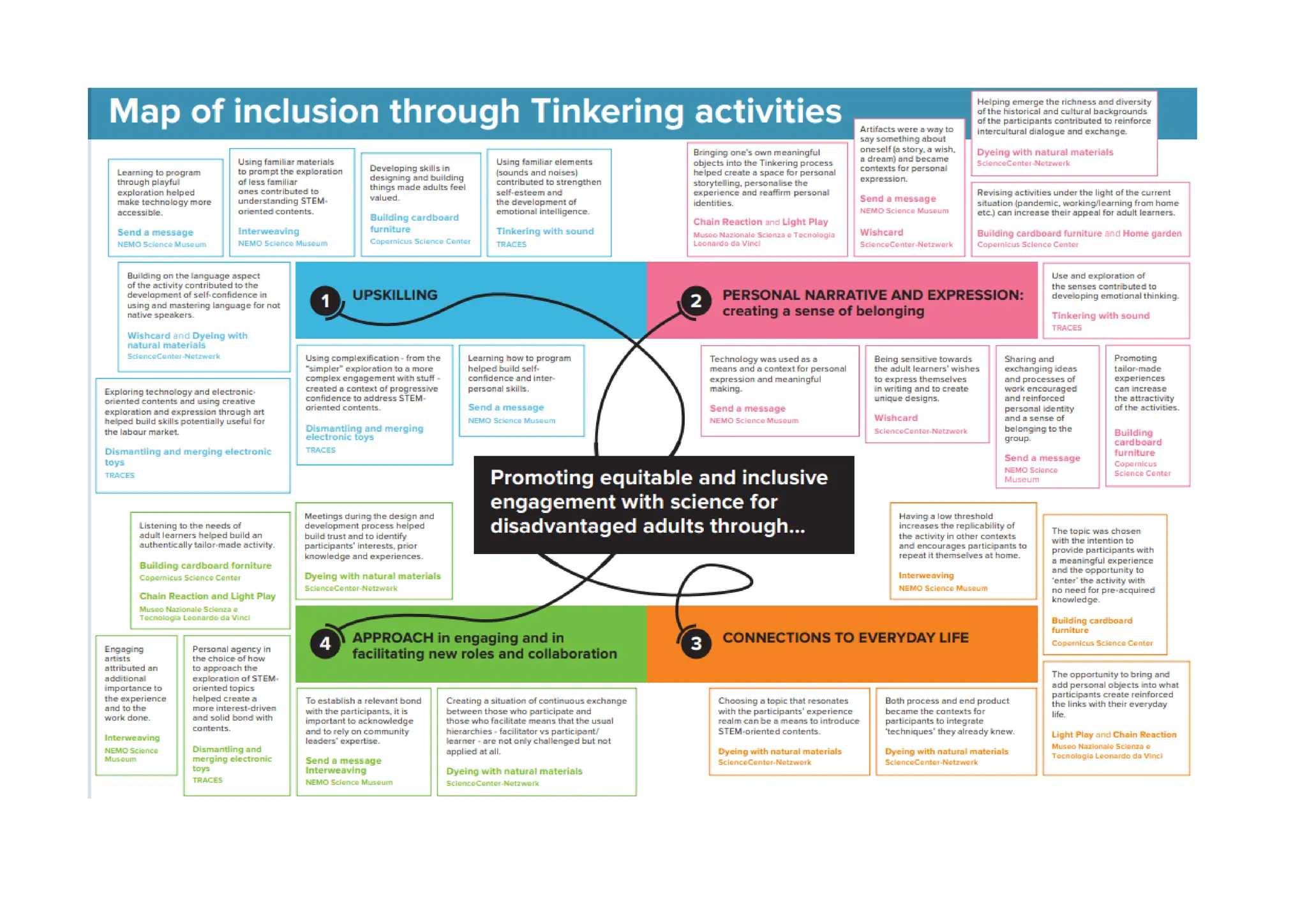
Tinkering is an innovative educational approach that combines elements of
different teaching methods – constructivism, constructionism and inquiry-based
learning – promoting the idea of learning that comes through engagement in
manual activities and revolves around the individual creative process.
Tinkering means to fiddle with or play around with something. And indeed,
tinkering involvesone’s intellect asmuch as one’sdexterity. Tinkerers feel theurge
to challenge themselves, individually or as a group, as they discover that it is
possible to think with their hands. Developed by the San Francisco Exploratorium
in the early 2000s, tinkering made its way to the Museum in 2012 when the
Museum’s Education team partnered with the Exploratorium’s Tinkering Studio to
enhance the ways in which strong, positive bonds could be forged between the
public and science and technology. Since then, the permanent lab in the
Museum’s Tinkering Zone is a place where people can take part in the various
activities and experiences designed by the team anddeveloped through a number
of different international partnerships (Tinkering EU).
Over the years, the Tinkering Studio and the Exploratorium researchers have
studied the public’s experience with tinkering to identify the characteristics of
“Tinkerability”. an aspect that defines the nature of the activities, distinguishes
them from inquiry-based learning or engineering and explains how learning takes
place through tinkering.
The research findings led to the definition of four key areas called the Learning
Dimensions – each with a series of indicators observable in the tinkering lab – that
demonstrate the depth and breadth of learning through tinkering.
The Exploratorium has identified the following Learning Dimensions:
• initiative and intentionality;
Manual “How to transform an association in a centre
of learning for creativity –Erasmus+ project - Articrea -
Artificial Intelligence for creativity and
entrepreneurship - 2023-1-ES01-KA210-ADU-
000161204 – v.1.0
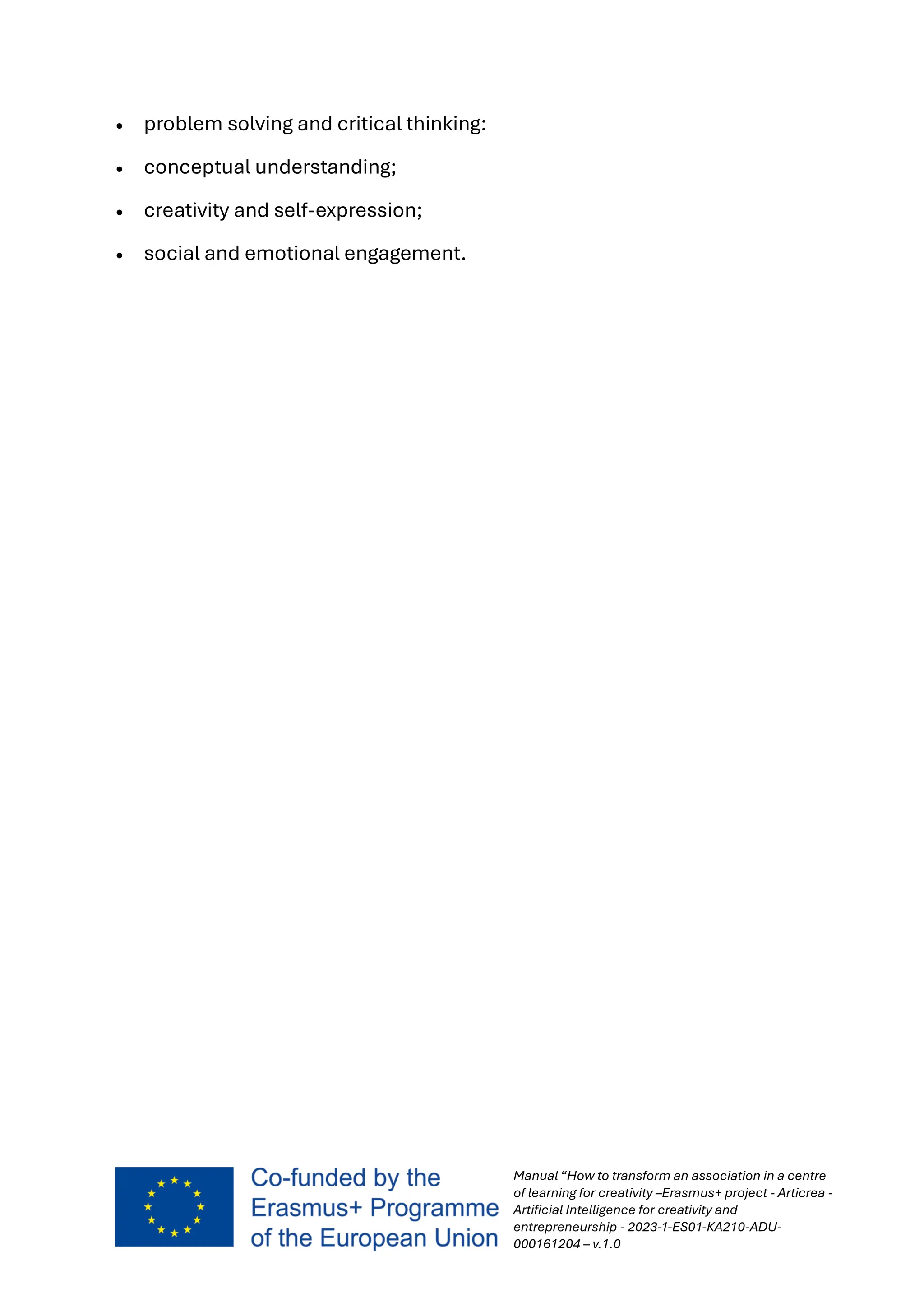
• problem solving and critical thinking:
• conceptual understanding;
• creativity and self-expression;
• social and emotional engagement.
CONCLUSION
To create a learning creative centre, we will do the following step
1. Find the right place. To find the right place we will follow the manual of design
of creative cultural centre with attention to the following aspect: “Designing
the environment we live in a never-ending process, based on an effort to
become better, more vivacious, and to respond to how the society and social
needs are developing. Design is firmly connected to other cultural activities
that take place there”
2. We will not change our“subject”but the method, starting from the trainers. We
think that fostering a creative climate in the learning centre is very important,
but It is very hard fora trainer to be creative if trainers are following a prescribed
curriculum and given little or no room for their own creative input into their
teaching practice. So, we will support their creativity by:
- Role modelling creative habits
- Appreciating the critical importance of questions,
- Treating mistakes as learning
- Encouraging learners to take ‘sensible risks’
- Giving learners sufficient time to complete their work
- Scaffolding tasks carefully to provide the appropriate level of challenge.
3. We will create a Strategic Planning process:
- Creating the strategy
- Planning the strategy
- Aligning the organization with the strategy
- Planning the operation of the organization
- Controlling and learning from the operation
- Testing and adapting the strategy
4. Define resources: providing participants with access to specialized tools,
advanced technology, and materials that might be difficult to obtain
independently
5. Giving Networking Opportunities
6. Use the thinkering method: Tinkering is an innovative educational approach
that combines elements of different teaching methods – constructivism,
constructionism and inquiry-based learning – promoting the idea of learning
Manual “How to transform an association in a centre
of learning for creativity –Erasmus+ project - Articrea -
Artificial Intelligence for creativity and
entrepreneurship - 2023-1-ES01-KA210-ADU-
000161204 – v.1.0
that comes through engagement in manual activities and revolves around the
individual creative process.
BIBLIOGRAPHY
DESIGN
• https://www.archdaily.com/901626/cultural-centers-50-examples-in-plan-and-
section
• https://divisare.com/ideas-for-cultural-centers
• https://de.scribd.com/document/276679717/Concept-as-to-Planning-and-Design-
of-Cultural-Center
• https://www.teh.net/resources/design-handbook-for-cultural-centres/
CREATIVE LEARNING IN STEM
• https://www.mdpi.com/2227-7102/13/12/1195
• https://www.je-lks.org/ojs/index.php/Je-LKS_EN/article/view/1135559
• https://pmc.ncbi.nlm.nih.gov/articles/PMC10301799/
EDUCATING FOR CREATIVITY
• https://www.creativeeducationfoundation.org/wp-content/uploads/2015/06/EFC-
Level-1-FINALelectronic.pdf
THINKERING
• http://www.museoscienza.it/tinkering-eu3/download/tinkering-addressing-the-
adults_Adult-learning-through-Tinkering.pdf
• http://www.museoscienza.it/tinkering-eu3/download/tinkering-addressing-the-
adults-framework.pdf
• http://www.museoscienza.it/tinkering-eu3/download/IO2_Tinkering-activity-
plans.pdf
• http://www.museoscienza.it/tinkering-eu3/download/adressing-the-adults/what-
we-learned%E2%80%93interactive.pdf
• http://www.museoscienza.it/tinkering-eu3/download/adressing-the-adults/what-
we-learned%E2%80%93full.pdf
Manual “How to transform an association in a centre
of learning for creativity –Erasmus+ project - Articrea -
Artificial Intelligence for creativity and
entrepreneurship - 2023-1-ES01-KA210-ADU-
000161204 – v.1.0
CREATIVITY AS A SKILL
• https://op.europa.eu/en/publication-detail/-/publication/6066c082-e68a-11e5-
8a50-01aa75ed71a1
• OECD. (2018). The Future of Education and Skills: Education 2030 - The future we
want. OECD Publishing. Future of Education and Skills 2030 | OECD -Council
Recommendation on Key Competences for Lifelong Learning - European Education
Area
• www.cambridgeinternational.org/teaching-andlearning
• https://www.mindtools.com/ajlpp1e/six-thinking-hats
Manual “How to transform an association in a centre
of learning for creativity –Erasmus+ project - Articrea -
Artificial Intelligence for creativity and
entrepreneurship - 2023-1-ES01-KA210-ADU-
000161204 – v.1.0

How to trasform an association in a creative learning center

  • 2.
    Manual “How totransform an association in a centre of learning for creativity –Erasmus+ project - Articrea - Artificial Intelligence for creativity and entrepreneurship - 2023-1-ES01-KA210-ADU- 000161204 – v.1.0 INTRODUCTION- WHAT IS CREATIVITY There is not a common definition on creativity. In this manual we will try to describe the definition that, in our opinion, are useful for our goal (transform an association in a learning creative centre). It is a learning habit that requires skill as well as specific understanding of the contexts in which creativity is being applied. The creative process is at the heart of innovation and often the words are used interchangeably. According to Kampylis and Berki (2014): “Creative thinking is defined as the thinking that enables students to apply their imagination to generating ideas, questions and hypotheses, experimenting with alternatives and to evaluating their own and their peers’ ideas, final products and processes.” Kaufman and Beghetto (2009) developed four categories of creativity which help to reveal the nuances between different levels and types of creativity (see next page)
  • 3.
    Manual “How totransform an association in a centre of learning for creativity –Erasmus+ project - Articrea - Artificial Intelligence for creativity and entrepreneurship - 2023-1-ES01-KA210-ADU- 000161204 – v.1.0
  • 4.
    Manual “How totransform an association in a centre of learning for creativity –Erasmus+ project - Articrea - Artificial Intelligence for creativity and entrepreneurship - 2023-1-ES01-KA210-ADU- 000161204 – v.1.0 Creativity is fundamental to all disciplines and an essential part of the learning process, forming an important dimension of learning how to learn. It is also fundamental to teachers improving their professional practice and to school development. Being creative requires reflection, encourages engagement and develops confidence and responsibility. The ability and inclination to be creative is essential to living a fulfilled and successful life, and it is valued in higher education and the workplace. There are many other benefits of maximising one’s own creative potential such as physical and psychological health improvements, improved resilience in the face of difficulties and even lower levels of aggression (Richards, 2007, p.9). Craft (2005, p.15) points out that our understanding of creativity have progressed and broadened over time. In the early 20th century creativity was considered to be an innate, elusive quality that individuals were born with. Initially creativity was most closely associated with the arts but grew to include science, technology and other disciplines. In the 21st century creativity is increasingly viewed as a distributed and collaborative process of communal sense making and problem solving. As with all the learner attributes, cultural perspectives are also very important when considering creativity. Confucian heritage cultures, for example, tend to see creativity more as a collective exercise. They place responsibility for creativity on the social group rather than the individual. Individuals, therefore, are not encouraged to stand out from the class in the same way or to the same extent as in Western cultures. This does not mean that creativity is in any way less valued. As with all the learner attributes, ideas presented in this chapter need to be interpreted and implemented in a culturally sensitive way.
  • 5.
    Manual “How totransform an association in a centre of learning for creativity –Erasmus+ project - Articrea - Artificial Intelligence for creativity and entrepreneurship - 2023-1-ES01-KA210-ADU- 000161204 – v.1.0 CREATIVITY AND LEARNING Learning involves challenging, refining and improving understanding by being made to think hard. Sometimes, to understand new concepts and broaden perspectives, our approaches to thinking need to be creative, imaginative and lateral (incorporating new ways of looking at things), as well as linear (using existing patterns of thought). One characteristic of the creative process that makes it particularly powerful is that it requires not only knowledge and understanding of the domain being investigated, but also a willingness to question and not be constrained by existing knowledge. Learners should understand how they can question, or challenge established knowledge to help them to formulate their own understanding, and imagination can play an important role: ‘One cannot think creatively unless one has the knowledge with which to think creatively. Creativity represents a balance between knowledge and freeing oneself of that knowledge’ (Johnson-Laird, 1988 - Sternberg, 2012)” For creative thinking to deepen and extend learning, rather than be an enjoyable but superficial activity, it must be grounded in understanding of the content being investigated. It is vital that learners have sufficient understanding of the material with which they are being asked to be creative. Creative practice needs to complement diligent and deliberate practice that develops foundational skills – not be a substitute for it.
  • 6.
    Manual “How totransform an association in a centre of learning for creativity –Erasmus+ project - Articrea - Artificial Intelligence for creativity and entrepreneurship - 2023-1-ES01-KA210-ADU- 000161204 – v.1.0 A revised version of Bloom’s original 1956 taxonomy by Krathwohl (2002) includes creativity in the taxonomy and places creativity above evaluation as a higher order thinking skill. An alternative, and probably more accurate, representation would be to include creativity as a process involved in skills at all levels represented in the taxonomy, and increasingly so with higher order skills. It might be thought that remembering information does not involve creative processes. In fact, creative approaches can be very helpful in remembering information. This is an area in which cultural sensitivity may be particularly important. If learners are not used to being asked to demonstrate creative habits and skills, they need to be guided. How the creative activity links to broader learning objectives needs to be clearly understood by teachers and learners. Having a creative habit, the disposition to behave creatively is critical. Csikszentmihalyi (2002) emphasises the importance of having a playful attitude while remaining disciplined. Whenever possible, play should be used to extend the range of opportunities to think. There are several character traits and learning habits that affect a learner’s personal disposition, motivation and confidence to be creative.
  • 7.
    Manual “How totransform an association in a centre of learning for creativity –Erasmus+ project - Articrea - Artificial Intelligence for creativity and entrepreneurship - 2023-1-ES01-KA210-ADU- 000161204 – v.1.0 For example: • resilience: an ability to tolerate uncertainty and persevere at a task to overcome obstacles • not being afraid to make and learn from mistakes • an ability to suspend judgement while generating ideas • willingness to take sensible risks or go out of their comfort zone in their work. A creative learner needs to be able to develop and apply a set of skills that they can use in the creative process. These include being able to: • clarify, analyse and re-define the problem or question to uncover new ways of looking at it • ask thoughtful questions • notice connections between seemingly unrelated subject matter • challenge established wisdom by asking: how would I improve this? • recognise alternative possibilities • look at things from different perspectives. Creative processes usually require self-regulation, and the ideas relating to reflection and metacognition apply. These include learners: • being aware of their own skills, both strengths and limitations • thinking of a range of different strategies or approaches to use in response to a problem or question • planning which approach to use • monitoring their work, and being flexible enough to change to a different approach if necessary • critically evaluating their work at appropriate points
  • 8.
    Manual “How totransform an association in a centre of learning for creativity –Erasmus+ project - Articrea - Artificial Intelligence for creativity and entrepreneurship - 2023-1-ES01-KA210-ADU- 000161204 – v.1.0 HOW TO CREATE A CREATIVE CULTURE IN A LEARNING CENTER We are all born with a creative instinct and all people have creative potential. Young children naturally engage in play – a state when the imagination is used to ‘try out’ situations and possibilities. Learners can become fearful of making mistakes if they only receive recognition for giving an answer understand the discipline as a whole is spaced delivery of content in lessons. This involves teachers revisiting related subject matter over a long time rather than just teaching each topic as a separate entity. Like any habit, creativity can be encouraged or discouraged. Having a learning rather than a performance orientation, helps to create an environment where creativity is encouraged. Learning centre are successful at stimulating creative learning if they • value and celebrate learners’ creative and innovative contributions • do not overcrowd the curriculum • provide opportunities to explore, concentrate for extended periods of time, reflect, discuss and review • encourage a broad and balanced curriculum so that learners experience a range of subjects and activities • encourage learners not studying the arts as qualifications to pursue creative activities in the co- curricular programme • develop codes of behaviour and classroom procedures that value and promote creativity • encourage sensible risk taking
  • 9.
    Manual “How totransform an association in a centre of learning for creativity –Erasmus+ project - Articrea - Artificial Intelligence for creativity and entrepreneurship - 2023-1-ES01-KA210-ADU- 000161204 – v.1.0 A study on creativity and innovation in education in European member states (Craft, 2005) found that trainers preferred their learners to be ‘conforming’ or ‘considerate’to‘risk taking’and‘playful’(Ferrari, Cachia & Punie, 2009). A culture of ‘one right answer’ stops learners from being willing to make mistakes. They quickly learn to guess what answer the teacher has in their heads. As von Oech (1998) points out, ‘many of us have been taught that the best ideas are in someone else’s head’. LET US BEGIN FROM THE TRAINERS “Cambridge trainers are creative, experimenting with new ideas and pursuing an enquiring approach in their teaching. They are open to new challenges, being resourceful, imaginative, and flexible. They are always ready to learn and apply new skills and techniques” 1 It highlights that effective teachers have a deep knowledge of their subject as well as an understanding of how learners think about subject content at different developmental stages (pedagogical knowledge). They can make thinking visible, helping learners to recognise misconceptions and manage their own learning. Because the creative process is fundamental to learning, nurturing creativity is also an aspect of good teaching in all subjects. Fostering a creative climate in the learning centre, supportive of creative professionalism, is another theme considered in the Developing your School with Cambridge guide. It is very hard for a trainer to be creative if they are following a prescribed curriculum and given little or no room for their own creative input into their teaching practice. Trainers can support creativity by: 1. Role modelling creative habits: Nothing is more important than the trainers exemplifying the habits, behaviours and thinking they want trainees to demonstrate. They need to exemplify creative traits such as curiosity and the development of creative skills. 2. Appreciating the critical importance of questions, both their own and those 1 Chapter 4 of the Developing your School with Cambridge guide considers the attributes of effective teachers (available at www.cambridgeinternational.org/teaching-andlearning/).
  • 10.
    Manual “How totransform an association in a centre of learning for creativity –Erasmus+ project - Articrea - Artificial Intelligence for creativity and entrepreneurship - 2023-1-ES01-KA210-ADU- 000161204 – v.1.0 asked by trainees. 3. Treating mistakes as learning opportunities and encouraging learners to take sensible risks in the classroom 4. Encouraging learners to take ‘sensible risks’ in their work is important for building up their creative confidence. It is important that this takes place in a supportive environment, and that the teacher and learner have discussed what boundaries are acceptable in their context. It is also important to set some ground rules in collaboration with learners. 5. Giving learners sufficient time to complete their work: sometimes ideas need time to develop before becoming valuable. Giving learners the scope to come up with their own ideas can be challenging for both teachers and learners. Learners will need time to think and work independently of the teacher. Delay judgement of learners’ ideas until they have had time to work them out properly. 6. Scaffolding tasks carefully to provide the appropriate level of challenge. Ideally, a trainer should try to design tasks that help the learner to cross over into this area by ‘scaffolding’, or supporting them at first, and then withdrawing support so that the learner can increasingly achieve the task on their own. Even a small change in teaching approach can bring about a change in a learner’s creative disposition. If learners start to see that there is not always ‘one right answer’ to many questions, both in school and in life, then their creative confidence will grow. The most important thing of all is for learners to lay the foundation of their personal creative abilities, on which they will build throughout their lives A DIFFERENT CURRICULUM Problem solving and enquiry are at the heart of learning. They require learners to think hard using their existing understanding to engage with the question or problem at hand and work out solutions.
  • 11.
    Manual “How totransform an association in a centre of learning for creativity –Erasmus+ project - Articrea - Artificial Intelligence for creativity and entrepreneurship - 2023-1-ES01-KA210-ADU- 000161204 – v.1.0 Pitching questions or problems at exactly the right level to stretch student thinking, and providing just enough support, is the mark of a good teacher. How trainers present problems and questions will vary depending on learners age, the local culture, the discipline being studied and many other factors. There is a place for a wide range of approaches including whole-class instruction as well as individual and group collaborative work, and some variety is important. Sometimes it is incorrectly assumed that creativity occurs best in group work with the trainer acting as a facilitator. In fact, direct instruction involving the whole class can encourage creativity as long as the classroom culture is supportive, and the class focuses on powerful questions and problems. It is important to note that direct instruction, well done, is identified in John Hattie’s work (2009) as a highly effective approach to teaching and learning. Direct instruction should involve a highly skilled active process in which the trainer engages and challenges student thinking, responding quickly to student thinking as it emerges. Discussions are focused on important concepts and ideas with questions from students. The trainer stimulates thought and encourages new ideas and new ways of thinking. Both trainees and trainers see errors as guiding what still needs to be learned rather than signalling failure. Enquiry-based learning is often associated with student-led projects. In this context learning involves a trainer and/or learners setting a meaningful problem or question which challenges and extends learners’ understanding over an extended period of time. Projects could be within one subject or combine two or more subjects. The problems or questions may be open ended, complex and multi-faceted. Projects often culminate in learners doing a presentation of their work to the rest of the class, but the‘product’created could be made public such as a blog, website, exhibition or magazine. By its nature, project-based learning involves learners using reflective, creative and critical thinking skills in collaboration with others. For project-based learning to work well it is important that the learning objectives are clear, supportive of the broader curriculum, and the teacher plays an active role in supporting the development of student understanding. This may involve the teacher standing back for long periods, allowing students to explore and
  • 12.
    Manual “How totransform an association in a centre of learning for creativity –Erasmus+ project - Articrea - Artificial Intelligence for creativity and entrepreneurship - 2023-1-ES01-KA210-ADU- 000161204 – v.1.0 experiment and think through the problem, but they need to be active in challenging student thinking and bringing learning to a productive conclusion. One advantage of enquiry-based learning is that it provides an opportunity for learners to collaboratively explore a question or problem from multiple perspectives using lateral as well as linear thinking. Edward De Bono is credited with inventing the concept of lateral thinking and has developed a number of approaches including the Six Thinking Hats (1993), a strategy that can be used to help learners at all levels and in any subject, to think about a question from multiple perspectives2 The picture in the next page shows an example from a school in Sydney, Australia, which has been applying it for five years, exploring the implications for pedagogy, thinking routines and language. 2 Pick a Hat: 6 Thinking Hats to Combat Subjectivity
  • 13.
    Manual “How totransform an association in a centre of learning for creativity –Erasmus+ project - Articrea - Artificial Intelligence for creativity and entrepreneurship - 2023-1-ES01-KA210-ADU- 000161204 – v.1.0
  • 14.
    Manual “How totransform an association in a centre of learning for creativity –Erasmus+ project - Articrea - Artificial Intelligence for creativity and entrepreneurship - 2023-1-ES01-KA210-ADU- 000161204 – v.1.0 Linking creativity with other competences/skills3 What are the links between creativity and the eight key competences outlined in the European Reference Framework? What are the links between creativity and other competences and core life/21st century skills as described in literature and learning frameworks?4 Creativity is linked with almost every term currently in use in describing educational frameworks. We now draw together some of the links (and a lack of connection) between creativity and the eight Key Competences for Lifelong Learning in the European Reference Framework.5 The Council Recommendation of 22 May 2018 has defined the following competences: — Literacy competence — Multilingual competence — Mathematical competence and competence in science, technology and engineering — Digital competence — Personal, social and learning to learn competence — Citizenship competence — Entrepreneurship competence — Cultural awareness and expression competence In the same Council recommendation - we are reminded that 41 Key competences are those which all individuals need for personal fulfilment and development, employability, social 3 Source; Creativity – a transversal skill for lifelong learning. An overview of existing concepts and practices 4 Source: OECD. (2018). The Future of Education and Skills: Education 2030 - The future we want. OECD Publishing. Future of Education and Skills 2030 | OECD 5 Council Recommendation on Key Competences for Lifelong Learning - European Education Area
  • 15.
    Manual “How totransform an association in a centre of learning for creativity –Erasmus+ project - Articrea - Artificial Intelligence for creativity and entrepreneurship - 2023-1-ES01-KA210-ADU- 000161204 – v.1.0 inclusion, sustainable lifestyle, successful life in peaceful societies, health-conscious life management and active citizenship. - creativity, along with other items, is described as a skill which is embedded throughout the key competences While it is eminently sensible to seek to embed some aspects of key competences across all competences it inevitably raises questions too: - Is creativity a skill? The evidence would seem to suggest that creative thinking is a cluster of skills, but that creativity is a multi-dimensional concept best described in words such as competency, competence, attribute, and disposition. - How best does any framework such as the Key Competences for Lifelong Learning recognise something as important as creativity? If it is simply left to individual competence developers, this runs the risk of confusing understanding of creativity. - How best can the complexity of a concept such as creativity be recognised so that it can be better developed across Europe? If creativity is set in a list alongside teamwork or problem-solving then it is being implicitly compared with smaller, different ideas. The JRC has developed frameworks for individuals for the first three of these, whereas cultural awareness and expression have been explored through the open method of coordination by a working group of the EU Member States’ experts in 20166 , but as of September 2020, no common framework has been produced. - Digital: Creativity is seen through the lens of digital activity. Creativity is explicitly part of Problem-solving (Creatively using digital technologies) but implicitly part of Communication and collaboration and Digital content creation. - Personal, Social and Learning: According to this Framework, creativity ‘enables individuals to question assumptions, reevaluate problems considering different variables and to take sensible risks. Being persistent, 6 https://op.europa.eu/en/publication-detail/-/publication/6066c082-e68a-11e5-8a50-01aa75ed71a1
  • 16.
    Manual “How totransform an association in a centre of learning for creativity –Erasmus+ project - Articrea - Artificial Intelligence for creativity and entrepreneurship - 2023-1-ES01-KA210-ADU- 000161204 – v.1.0 collaborative, and disciplined sustain creativity.” and ‘While creativity is visible, it sits among many other concepts within this framework. - Entrepreneurship: Creativity is defined as ‘developing ideas and opportunities to create value, including better solutions to existing and new challenges; exploring and experimenting with innovative approaches; combining knowledge and resources to achieve valuable effects.’Creativity is seen as a sub-set of an Entrepreneurship competence, Ideas and opportunities (along with spotting opportunities, vision, valuing ideas, ethical and sustainable thinking). Creativity is explicitly mentioned but as a small element of a larger competence. Creativity is also implicit in many of the other competences/sub-competences such as coping with ambiguity, uncertainty & risk, taking the initiative and mobilising others. While creativity and entrepreneurship share common features such as the generation of original ideas, entrepreneurship is an applied version of creativity where the emphasis is on creating value or profit. - Cultural awareness and expression competence: The description of this competence is full of powerful expressions of the value of creativity, albeit and understandably framed by its interest in culture and the arts. Its model of creativity is the five-dimensional one published by the OECD (Lucas et al., 2013). While creativity features the most in the descriptions of the four competences listed above, there are clearly opportunities for recognising the role of this transversal skill more explicitly in Literacy, Mathematical competence and competence in science, technology and engineering and Citizenship. These possible connections are indicated by extracts from the framework as presented in the Council Recommendation of 22 May 2018 (see picture)
  • 17.
    Manual “How totransform an association in a centre of learning for creativity –Erasmus+ project - Articrea - Artificial Intelligence for creativity and entrepreneurship - 2023-1-ES01-KA210-ADU- 000161204 – v.1.0 Creativity, as we have seen, is a concept which is gaining importance in education, lifelong learning and employment. The World Economic Forum (2015) consistently ranks it as one of the most important competencies wanted by employers. The frameworks we reviewed are in broad agreement in a number of areas: - They increasingly refer to creativity as being an important human attribute. - A common core of concepts occurs in definitions of creativity including originality, novelty, value, experimentation and problem-solving. - Creativity is conceived as both a product and a process most frameworks focus on schools, even if the term lifelong learning is used. - Most frameworks conceive of creativity as multi-dimensional. - It is clear that the main focus of interest is on the ‘everyday creativity’ that we can all show throughout our lives rather than on the exceptional outputs of a genius.
  • 18.
    Manual “How totransform an association in a centre of learning for creativity –Erasmus+ project - Articrea - Artificial Intelligence for creativity and entrepreneurship - 2023-1-ES01-KA210-ADU- 000161204 – v.1.0 A CREATIVE CENTER Creative Centers have emerged as vital spaces where individuals and teams can harness their creative potential and turn groundbreaking ideas into reality. • Definition: Creative Centers are dedicated spaces that foster creativity and innovation through collaboration, resource sharing, and structured activities. • Purpose: Their primary aim is to cultivate an environment where individuals from diverse backgrounds can come together, share ideas, and collaborate on projects, thereby enhancing the creative process. Engaging with a Creative Center offers a wealth of advantages for both individuals and organizations: 1. Access to Resources • Creative Centers provide participants with access to specialized tools, advanced technology, and materials that might be difficult to obtain independently. This access can significantly enhance the quality of projects and encourage experimentation. • Many Creative Centers also offer workshops, classes, and mentorship opportunities, allowing individuals to learn new skills and techniques that can elevate their creative output. 2. Networking Opportunities • Creative Centers act as hubs for like-minded individuals, fostering a sense of community among participants. This environment encourages networking, collaboration, and the exchange of ideas, leading to potential partnerships and business opportunities. • The diverse backgrounds of participants contribute to richer discussions and brainstorming sessions, helping to generate innovative solutions that would be harder to achieve in isolation.
  • 19.
    Manual “How totransform an association in a centre of learning for creativity –Erasmus+ project - Articrea - Artificial Intelligence for creativity and entrepreneurship - 2023-1-ES01-KA210-ADU- 000161204 – v.1.0 3. Enhanced Creativity • Exposure to a variety of perspectives stimulates new ideas and approaches to problem-solving. Creative Centers encourage participants to think outside the box and challenge conventional thinking. • The collaborative atmosphere allows for the sharing of experiences and insights, which can inspire individuals to take creative risks and explore uncharted territory. Let us see some example of Creative Centers TechShop: a membership-based workshop that provides access to a wide range of tools and equipment, from woodworking and metalworking to electronics and textiles. With locations across the United States, TechShop caters to hobbyists, entrepreneurs, and anyone looking to bring their creative ideas to life. By fostering a supportive environment and encouraging members to collaborate on projects, TechShop has become a breeding ground for innovation. Many successful startups have emerged from its workshops, demonstrating the power of community-driven creativity (more info on: https://fundacionuniversidadempresa.es/en/innovation/techshop/ ) MakerSpaces: community-driven environments that provide individuals with access to tools, resources, and workshops to facilitate creative projects. These spaces cater to a wide range of interests, including art, technology, and engineering. They often hosts events, challenges, and educational workshops, promoting acultureof learning and experimentation. Participants cancollaborate on projects, share ideas, and learn from one another, making MakerSpaces invaluable for community engagement (more info at https://www.makerspaces.com/what-is-a-makerspace/) WeWork: Known primarily as a co-working space, WeWork has evolved to include creative facilities such as art studios, event spaces, and collaborative work areas. This integration allows members to work on projects and engage in creative pursuits simultaneously. By blending professional and creative environments, WeWork fosters a culture of innovation. Members have access to networking
  • 20.
    Manual “How totransform an association in a centre of learning for creativity –Erasmus+ project - Articrea - Artificial Intelligence for creativity and entrepreneurship - 2023-1-ES01-KA210-ADU- 000161204 – v.1.0 opportunities and resources that can enhance their creative projects while maintaining a focus on productivity. (more info on https://www.wework.com/) To fully leverage the benefits of a Creative Center, consider the following strategies: • Engage with the Community • Actively participate in events, workshops, and networking opportunities. Building relationships with other members can lead to fruitful collaborations and fresh perspectives. • Join interest groups or committees within the centre to deepen your involvement and connect with others who share your passions. • Set Clear Goals • Define specific objectives for your projects before diving in. Having clear goals helps maintain focus and provides a sense of direction as you navigate the creative process. • Regularly assess your progress and adjust your goals as needed to stay aligned with your evolving creative vision. • Balance Collaboration and Focus • While collaboration is essential, ensure that you allocate time for focused, independent work. Establish dedicated periods for brainstorming with others and for concentrating on your tasks. • Create a conducive environment for focused work, minimizing distractions and setting aside specific times for deep creative exploration. While Creative Centers offer numerous advantages, there are challenges that participants may encounter. Here are some common pitfalls and how to avoid them:
  • 21.
    Manual “How totransform an association in a centre of learning for creativity –Erasmus+ project - Articrea - Artificial Intelligence for creativity and entrepreneurship - 2023-1-ES01-KA210-ADU- 000161204 – v.1.0 1. Feeling Overwhelmed • Problem: The abundance of resources and opportunities can lead to decision fatigue and paralysis. • Solution: Prioritize your goals and break projects into smaller, manageable tasks. By focusing on one step at a time, you can maintain clarity and momentum. 2. Distractions • Problem: The collaborative nature of Creative Centers can sometimes lead to distractions that hinder productivity. • Solution: Establish a structured routine that balances collaborative brainstorming with independent work periods. Use tools like time- blocking to manage your schedule effectively. 3. Fear of Failure • Problem: Participants may hesitate to take risks due to a fear of failure, stifling creativity and innovation. • Solution: Embrace a mindset that views failure as a learning opportunity. Encourage experimentation and iterative processes, where mistakes are seen as valuable steps toward success. Detailed Benefits of Engaging with Creative Centers Engaging with Creative Centers provides profound benefits that extend beyond immediate access to resources: • Improved Problem-Solving Skills • Working alongside individuals from diverse backgrounds exposes participants to a variety of problem-solving techniques. This diversity enriches the creative process and fosters innovative solutions. • Encouragement of Experimentation • Creative Centers cultivate an environment that promotes risk-taking and experimentation. Participants learn to embrace failure as part of
  • 22.
    Manual “How totransform an association in a centre of learning for creativity –Erasmus+ project - Articrea - Artificial Intelligence for creativity and entrepreneurship - 2023-1-ES01-KA210-ADU- 000161204 – v.1.0 the creative journey, leading to iterative improvements and groundbreaking innovations. • Increased Motivation and Accountability • The collaborative atmosphere of a Creative Center creates a sense of accountability among members. When working alongside others, individuals are often more motivated to complete their projects and meet deadlines. Best Practices for Enhancing Creativity To optimize your experience in a Creative Center, consider these best practices: • Structured Routines • Establish regular brainstorming sessions, reflection periods, and dedicated time for skill development. Consistency can enhance creative output and foster innovation. • Seek and Embrace Feedback • Sharing your work with peers and mentors can provide valuable insights and fresh perspectives. Embrace constructive criticism as a tool for growth and refinement. • Stay Open to New Ideas • Maintain an open mind and be willing to explore ideas that may initially seem unconventional. Some of the best innovations arise from thinking outside traditional frameworks.
  • 23.
    Manual “How totransform an association in a centre of learning for creativity –Erasmus+ project - Articrea - Artificial Intelligence for creativity and entrepreneurship - 2023-1-ES01-KA210-ADU- 000161204 – v.1.0 START FORM THE DESIGN “Designing the environment we live in a never-ending process. It is based on an effort to become better, more vivacious, and to respond to how the society and social needs are developing. In Trans Europe Halles member cultural centres, design is firmly connected to other cultural activities that take place there. It is not just about results. Its strengths consist chiefly in processes of formation and subsequent use. Architectural design (as well as urban planning) and the art/culture programmes are reciprocally formative. This is the biggest difference when compared to large public institutions. It is not a question of facades, sculptural volumes and investment amounts. The interesting part lies in the close relationships between variedprogrammes, activities, employees, artists and their audience. The solutions brought about in the world of cultural centres are often unheard of in other sectors. They result from the creative clash between architects, designers, artist, managers, volunteers, students, technicians, audience and neighbours” Peter Lényi7 Here you can read the book: https://www.teh.net/resources/design-handbook-for-cultural-centres/ A cultural center is a meeting place, integration and encounter of the community. Therefore, it is important to consider that: • The cultural management model must be born from the cultural and artistic needs and demands of the community • It must have inclusive and itinerant spaces that allow the full enjoyment of the entire community in its cultural and artistic development • An infrastructure that encourages community participation and diversity of expressions through a cultural offer in accordance with local cultural policies and the needs of the community 7 Design Hansbook for cultural centers by Peter Lényi
  • 24.
    Manual “How totransform an association in a centre of learning for creativity –Erasmus+ project - Articrea - Artificial Intelligence for creativity and entrepreneurship - 2023-1-ES01-KA210-ADU- 000161204 – v.1.0 • Spaces that serve as enhancers for the development of new languages and the presence of all the arts • To be a platform for the training, creation and dissemination of the artistic- cultural work of the area • A vehicle of identity reference of a community • To become a landmark and support of the urban articulation • To form a space for social integration and the structuring of the local community You should design a route to follow, a guide that allows them to meet their objectives and goals, this is called planning. The generation of a work or management plan is essential for the good performance of these spaces Planning is defined as the rational and systematic process of foreseeing, organizing and using resources to achieve objectives and goals in a predetermined time and space, in a controlled and conscious way. Strategy is the process that specifies a series of steps or concepts aimed at achieving a common objective. We can also understand it as the art of designing the way to achieve goals through ordered actions that shape the work plan. PLANNING PROCESS According to ‘Execution Premium’ by Roberto Kaplan and David Norton, we can identify the stages of the Strategic Planning process such as: 1. Creating the strategy 2. Planning the strategy 3. Aligning the organization with the strategy 4. Planning the operation of the organization 5. Controlling and learning from the operation 6. Testing and adapting the strategy
  • 25.
    Manual “How totransform an association in a centre of learning for creativity –Erasmus+ project - Articrea - Artificial Intelligence for creativity and entrepreneurship - 2023-1-ES01-KA210-ADU- 000161204 – v.1.0 There are also 5 essential phases in planning process: 1. Ideological phase: determination of the institutional role, expressed in the elements that make up the backbone of what the cultural centre will be: its lines of work, its audience, the values it represents, the mission, the vision, the internal organization chart, the forms of financing, antecedents and justifications, the nature and reason of being of the institution, general objective, territorial location and those responsible for the execution. This section of the plan describes the fundamental convictions of the directors, officers and servants of the organization. 2. Analytical phase: In this phase we will carry out a diagnosis or SWOT analysis of the internal and external reality to be clear about the points that must be reinforced, identify problems and opportunities that affect the centre and those needs that must be prioritized in the plan. The scope of this diagnosis can be expressed from a general environment, understanding global trends in the sector or a more specific environment referring to situations of the population or specific actors. For its part, the analysis of the internal operating environment includes a diagnosis of the sector or subsector regulatory framework and the technical and operational capacity of the organization. 3. Program phase: in this section we will define the general and specific objectives of the plan. It should be noted that the general objective proposed in phase A corresponds to the cultural centre from its existential reason and that the general objectives developed here have to do with the development of the plan as a management tool. The development then, of the general and specific objectives will be based on the result of the diagnosis carried out in phase B, where the critical factors that affect the solution of the central macro problems and the global opportunities of the organization and its environment are identified. 4. Operational phase: determination of strategies, policies and / or courses of action based on the strengths of the organization and that, at the same time, neutralize its weaknesses, to take advantage of opportunities and counteract threats. The courses of action can be organized, following the budget nomenclature, into programs, projects and activities.
  • 26.
    Manual “How totransform an association in a centre of learning for creativity –Erasmus+ project - Articrea - Artificial Intelligence for creativity and entrepreneurship - 2023-1-ES01-KA210-ADU- 000161204 – v.1.0 5. Evaluation phase: Design of the monitoring and evaluation system of the plan, which includes the selection of performance indicators and the specification of the values to be achieved for each indicator, as well as the estimation of the essential financial resources. Indicators play a key role in evaluating compliance with the plan, which is why it is considered an indispensable element in the implementation of the plan. We will develop this topic in the following instalments of this special. MANAGEMENT PLAN The Cultural Management Plan is a document that integrates an ordered set of objectives, programs, projects and activities, defined by an institution or cultural agent to carry out cultural objectives and deliver various services in a territory determined, according to internal and / or local policies. It is a basic tool that will guide the organization of resources for a certain time, to achieve the defined purposes, based on a diagnosis, the projection of the objectives set and an organizational and financial model that guarantees the provision of various cultural services (programme = offer). It is essential that the institution that has defined a cultural management plan carries out an analysis of its strengths and limitations, this is what we call “organizational analysis”, which allows knowing and keeping an eye on internal conditions to assess the main strengths and weaknesses of the organization. The former constitute the driving forces of the organization and facilitate the achievement of objectives, while the latter are the limitations and restrictive forces that hinder or prevent the achievement of such objectives. THE BASIC PRINCIPLES TO BUILD A CULTURAL MANAGEMENT MODEL ARE: 1. Conception of its contents from the territorial environment (cultural, artistic, social, urban, political, economic characteristics of the direct and indirect territory that the plan addresses). The document is born from the understanding of the identity and local characteristics.
  • 27.
    Manual “How totransform an association in a centre of learning for creativity –Erasmus+ project - Articrea - Artificial Intelligence for creativity and entrepreneurship - 2023-1-ES01-KA210-ADU- 000161204 – v.1.0 2. Integration of the cultural artistic community and citizens in the definition and development of the cultural center with methodologies known as citizen participation as a relevant element for the development of the plan. 3. Coherence of the definitions of the plan with the existing political-technical framework (municipal, regional, national). Interrelation with the Regional Development Strategy, regional and national Cultural Policies and other management instruments, such as the Community Development Plan (Pladeco), cultural consumption surveys, etc. 4. Project the sustainability and programmatic and economic sustainability of the cultural center. Management as a key to developing the Cultural Policy of the Cultural Center, seeking external support and strengthening the internal. 5. Strengthen the human and material capacities of the commune. 6. Develop an integrated territorial view of the cultural services to be delivered, promoting a community, provincial, regional and national network for artistic and cultural dissemination. 7. Definition of the necessary infrastructure, defining the type of spaces required, the location, the accesses and their functionality, among others. Other examples: https://www.archdaily.com/901626/cultural-centers-50-examples-in-plan- and-section https://divisare.com/ideas-for-cultural-centers Other sources: https://de.scribd.com/document/276679717/Concept-as-to-Planning-and- Design-of-Cultural-Center
  • 28.
    IL THINKERING "It's foolingaround directly with phenomena, with tools and materials. It's thinking with your hands and learning through doing. It's slowing down and getting curious about the mechanics and mysteries of everyday stuff around you. It's whimsical, enjoyable, fraught with dead ends, frustrating, and, ultimately, about inquiry." (Wilkinson & Petrich, The Art of Tinkering, 2014) Tinkering is an innovative educational approach that combines elements of different teaching methods – constructivism, constructionism and inquiry-based learning – promoting the idea of learning that comes through engagement in manual activities and revolves around the individual creative process. Tinkering means to fiddle with or play around with something. And indeed, tinkering involvesone’s intellect asmuch as one’sdexterity. Tinkerers feel theurge to challenge themselves, individually or as a group, as they discover that it is possible to think with their hands. Developed by the San Francisco Exploratorium in the early 2000s, tinkering made its way to the Museum in 2012 when the Museum’s Education team partnered with the Exploratorium’s Tinkering Studio to enhance the ways in which strong, positive bonds could be forged between the public and science and technology. Since then, the permanent lab in the Museum’s Tinkering Zone is a place where people can take part in the various activities and experiences designed by the team anddeveloped through a number of different international partnerships (Tinkering EU). Over the years, the Tinkering Studio and the Exploratorium researchers have studied the public’s experience with tinkering to identify the characteristics of “Tinkerability”. an aspect that defines the nature of the activities, distinguishes them from inquiry-based learning or engineering and explains how learning takes place through tinkering. The research findings led to the definition of four key areas called the Learning Dimensions – each with a series of indicators observable in the tinkering lab – that demonstrate the depth and breadth of learning through tinkering. The Exploratorium has identified the following Learning Dimensions: • initiative and intentionality;
  • 29.
    Manual “How totransform an association in a centre of learning for creativity –Erasmus+ project - Articrea - Artificial Intelligence for creativity and entrepreneurship - 2023-1-ES01-KA210-ADU- 000161204 – v.1.0 • problem solving and critical thinking: • conceptual understanding; • creativity and self-expression; • social and emotional engagement.
  • 31.
    CONCLUSION To create alearning creative centre, we will do the following step 1. Find the right place. To find the right place we will follow the manual of design of creative cultural centre with attention to the following aspect: “Designing the environment we live in a never-ending process, based on an effort to become better, more vivacious, and to respond to how the society and social needs are developing. Design is firmly connected to other cultural activities that take place there” 2. We will not change our“subject”but the method, starting from the trainers. We think that fostering a creative climate in the learning centre is very important, but It is very hard fora trainer to be creative if trainers are following a prescribed curriculum and given little or no room for their own creative input into their teaching practice. So, we will support their creativity by: - Role modelling creative habits - Appreciating the critical importance of questions, - Treating mistakes as learning - Encouraging learners to take ‘sensible risks’ - Giving learners sufficient time to complete their work - Scaffolding tasks carefully to provide the appropriate level of challenge. 3. We will create a Strategic Planning process: - Creating the strategy - Planning the strategy - Aligning the organization with the strategy - Planning the operation of the organization - Controlling and learning from the operation - Testing and adapting the strategy 4. Define resources: providing participants with access to specialized tools, advanced technology, and materials that might be difficult to obtain independently 5. Giving Networking Opportunities 6. Use the thinkering method: Tinkering is an innovative educational approach that combines elements of different teaching methods – constructivism, constructionism and inquiry-based learning – promoting the idea of learning
  • 32.
    Manual “How totransform an association in a centre of learning for creativity –Erasmus+ project - Articrea - Artificial Intelligence for creativity and entrepreneurship - 2023-1-ES01-KA210-ADU- 000161204 – v.1.0 that comes through engagement in manual activities and revolves around the individual creative process. BIBLIOGRAPHY DESIGN • https://www.archdaily.com/901626/cultural-centers-50-examples-in-plan-and- section • https://divisare.com/ideas-for-cultural-centers • https://de.scribd.com/document/276679717/Concept-as-to-Planning-and-Design- of-Cultural-Center • https://www.teh.net/resources/design-handbook-for-cultural-centres/ CREATIVE LEARNING IN STEM • https://www.mdpi.com/2227-7102/13/12/1195 • https://www.je-lks.org/ojs/index.php/Je-LKS_EN/article/view/1135559 • https://pmc.ncbi.nlm.nih.gov/articles/PMC10301799/ EDUCATING FOR CREATIVITY • https://www.creativeeducationfoundation.org/wp-content/uploads/2015/06/EFC- Level-1-FINALelectronic.pdf THINKERING • http://www.museoscienza.it/tinkering-eu3/download/tinkering-addressing-the- adults_Adult-learning-through-Tinkering.pdf • http://www.museoscienza.it/tinkering-eu3/download/tinkering-addressing-the- adults-framework.pdf • http://www.museoscienza.it/tinkering-eu3/download/IO2_Tinkering-activity- plans.pdf • http://www.museoscienza.it/tinkering-eu3/download/adressing-the-adults/what- we-learned%E2%80%93interactive.pdf • http://www.museoscienza.it/tinkering-eu3/download/adressing-the-adults/what- we-learned%E2%80%93full.pdf
  • 33.
    Manual “How totransform an association in a centre of learning for creativity –Erasmus+ project - Articrea - Artificial Intelligence for creativity and entrepreneurship - 2023-1-ES01-KA210-ADU- 000161204 – v.1.0 CREATIVITY AS A SKILL • https://op.europa.eu/en/publication-detail/-/publication/6066c082-e68a-11e5- 8a50-01aa75ed71a1 • OECD. (2018). The Future of Education and Skills: Education 2030 - The future we want. OECD Publishing. Future of Education and Skills 2030 | OECD -Council Recommendation on Key Competences for Lifelong Learning - European Education Area • www.cambridgeinternational.org/teaching-andlearning • https://www.mindtools.com/ajlpp1e/six-thinking-hats
  • 34.
    Manual “How totransform an association in a centre of learning for creativity –Erasmus+ project - Articrea - Artificial Intelligence for creativity and entrepreneurship - 2023-1-ES01-KA210-ADU- 000161204 – v.1.0