BUSINESS DECISION MAKING ADMN2167 Professor: Bob Carpenter
Today’s Agenda Financial Statement Exercises Group Assignments. Group Exercise Introduction to thinking process Individual case preparation Orangewerks Proforma Financial Statements (Forecasting) Assignments
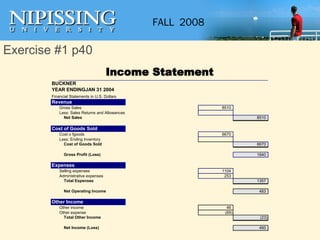
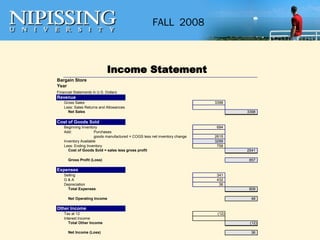
Exercise #1 p40
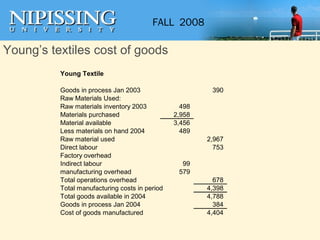
Young’s textiles cost of goods
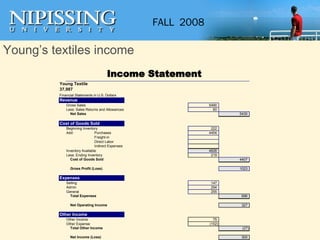
Young’s textiles income
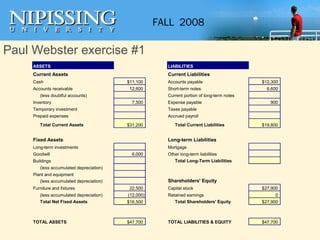
Paul Webster exercise #1
 
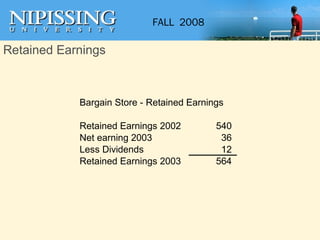
Retained Earnings
Balance Sheet Bargain stores
Survival     You have just survived the crash of a small plane.  Both the pilot and co-pilot were killed in the crash.  It is mid-January , and you are in Northern Canada.  The daily temperature is 25 below zero, and the night time temperature is 40 below zero.  There is snow on the ground,  and the countryside is wooded with with several creeks criss-crossing the area.  The nearest town is 20 miles away.  You are all dressed in city clothes appropriate for a business meeting.  Your group of survivors managed to salvage the following items:

Survival A ball of steel wool A small ax A  loaded  .45-caliber pistol Can of Crisco shortening Newspapers (one per person) Cigarette lighter (without fluid) Extra shirt and pants for each survivor 20 x 20 ft. piece of heavy-duty canvas A sectional air map made of plastic One quart of 100-proof whiskey A  compass Family-size chocolate bars (one per person)
Survival Take a piece of paper Make 4 columns and enter in the first your priority to keep the items listed and note their uses. Take 5 minutes to do this
Meet your Group – Section 1 Wednesday – Section 2 Friday
Meet your Group Get together in your groups and take 5 to get to know each other. Your task as a group is to list the above 12 items in order of importance for your survival.  List the uses for each.  You  MUST come to agreement as a group.  Enter the group score in the column next to yours
Survival – Results for Scoring 1.  not available until after discussion
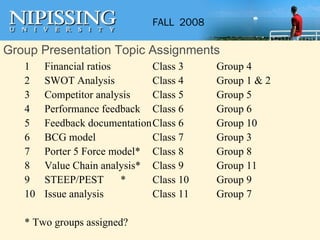
Group Presentation Topic Assignments Financial ratios Class 3 Group 4 SWOT Analysis Class 4 Group 1 & 2 Competitor analysis Class 5 Group 5 Performance feedback Class 6 Group 6 Feedback documentation Class 6 Group 10 BCG model Class 7 Group 3 Porter 5 Force model* Class 8 Group 8 Value Chain analysis* Class 9 Group 11 STEEP/PEST * Class 10 Group 9 Issue analysis Class 11 Group 7 * Two groups assigned?
The Learning Tower of Pizza Exercise This is a competition   You are to build a tower Towers will be judged based on: Height Beauty Stability You may use up to 20 index cards and 20 paper clips. You must be able to carry your tower up to the front for judging
The Learning Tower of Pizza Exercise Form groups Agree objectives for your group Make a design for a tower and plan  how you will construct it.   Plan decorations for your tower.
The Learning Tower of Pizza Exercise Get materials! You have 15 minutes
THINKING PROCESS
Discussion of the thinking process Are good thinkers more intelligent? Quick thinkers or slow thinkers? Can thinking be learned?
Discussion of the thinking process PISCO thinking process … De Bono To learn and practice a framework for thinking This is the thinking process rather than the discussion content
CASE METHODOLOGY Revisited
Case Method Define a problem Sort relevant and irrelevant information Separate fact from opinion Interpret and analyze information Come to reasoned decision and course of action Communicate your thoughts clearly and persuasively to others during class discussions
Suggested individual preparation Read quickly for an overview Skim exhibits and find out who is the decision taker, what the concerns, problems or issues are, why they have arisen and when the decision must be made. Read the case again more carefully. Highlight key information and make notes. Really get familiar with the information and do some additional research so that you are ready to analyze
Individual preparation/analysis (1) Try to answer at least the following questions: What business are they in, what are their objectives, strengths and weaknesses, opportunities and threats, what must they do well to satisfy customers? What facts are relevant and key to the solution? What are the causes vs. symptoms? Make quantitative and qualitative evaluations of the organization.
Individual preparation/analysis (2) Try to answer at least the following questions: What do the facts mean to the problem – here ask and answer a lot of questions. What are the decision criteria?
Individual preparation/alternative evaluation (1) Try to answer at least the following questions: What are the alternatives? Are they relevant to the problem? Try and make sure you have several alternatives to consider. What is your evaluation of the alternatives in view of the decision criteria? What are the pros and cons of each alternative?
Individual preparation/alternative evaluation (2) Try to answer at least the following questions: Which alternative or combination of alternatives do you choose and why? What is your plan of action? Who, what, where, when and how. What results do you expect?
Suggested format Title page Table of Contents Situational Analysis Environment Industry Organization Strategy Issues / Problems Statement of primary issue / problem Evidence of issue / problem Effects of issue / problem Statement of secondary issues / problems Evidence of issue / problem Effects of issue / problem
Suggested format Strategic alternatives Description of alternative 1 Benefits of alternate 1 Costs of alternative 1 Description of alternative 2 Benefits of alternate 2 Costs of alternative 2 Description of alternative  … n Benefits of alternate n Costs of alternative  … etc Selection of strategy and implementation Statement of selected strategy Justification of seleted strategy Description of implementation Appendices E.g. Analyses and financials
Suggested format Suggested case study format is at
Orangewerks case Individual work as if at home Group work Class discussion
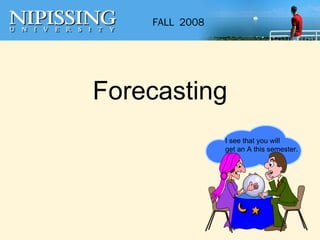
Forecasting I see that you will get an A this semester.
FORECAST: A statement about the future Develop Master Planning Schedule Used to help managers Plan the system Plan the use of the system
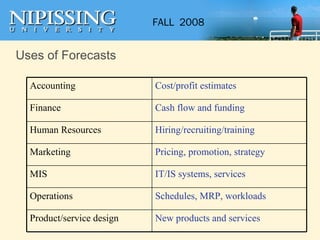
Uses of Forecasts New products and services Product/service design Schedules, MRP, workloads Operations IT/IS systems, services MIS Pricing, promotion, strategy Marketing Hiring/recruiting/training Human Resources Cash flow and funding Finance Cost/profit estimates Accounting
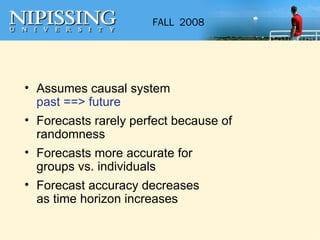
Assumes causal system past ==> future Forecasts rarely perfect because of  randomness Forecasts more accurate for groups vs. individuals Forecast accuracy decreases  as time horizon increases
Elements of a Good Forecast Timely Accurate Reliable Meaningful Written Easy to use
Types of Forecasts Judgmental  - uses subjective inputs Time series  - uses historical data assuming the future will be like the past Associative models  - uses explanatory variables to predict the future
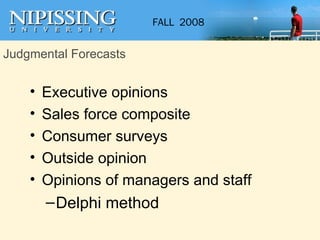
Judgmental Forecasts Executive opinions Sales force composite Consumer surveys Outside opinion Opinions of managers and staff Delphi method
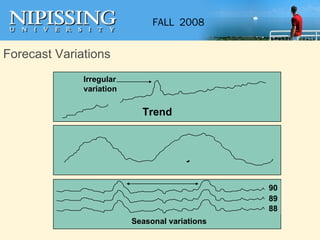
Time Series Forecasts Trend  - long-term movement in data Seasonality  - short-term regular variations in data Irregular variations  - caused by unusual circumstances Random variations  - caused by chance
Forecast Variations Trend Irregular variation Cycles Seasonal variations 90 89 88
Simple to use Virtually no cost Data analysis is nonexistent Easily understandable Cannot provide high accuracy Can be a standard for accuracy Naïve Forecasts
Stable time series data F(t) = A(t-1) Seasonal variations F(t) = A(t-n) Data with trends F(t) = A(t-1) + (A(t-1) – A(t-2)) Uses for Naïve Forecasts
Techniques for Averaging Moving average Weighted moving average Exponential smoothing
Simple Moving Average MA n  = n A i i = 1  n Actual MA3 MA5
Weighted Moving Average If more recent data is thought more indicative. Weight the historic actuals: E.g. 0.4 x A1+0.3 x A3 +0.2 x A3 +0.1 x A4 Example: 1 42 2 40 3 43 4 40 5 41 What is forecast for next month?
Exponential Smoothing Premise --The most recent observations might have the highest predictive value. Therefore, we should give more weight to the more recent time periods when forecasting. F t  = F t-1  +   ( A t-1  - F t-1 )
Example of Exponential Smoothing
Picking a Smoothing Constant  .1  .4 Actual
Forecast Accuracy Error - difference between actual value and predicted value Mean absolute deviation (MAD) Average absolute error Mean squared error (MSE) Average of squared error Tracking signal Ratio of cumulative error and MAD
Pro-forma financial statements are only forecasts :
Assignment Research whether good thinking is related to intelligence and/or whether it can be learned Read text p92-104,  Read CP p54-67 "The Leadership Challenge“ Prepare the Lawsons Case in text p154 Forward university email to the one you monitor

2167 class 2 fin statements & ethics

  • 1.
    BUSINESS DECISION MAKINGADMN2167 Professor: Bob Carpenter
  • 2.
    Today’s Agenda FinancialStatement Exercises Group Assignments. Group Exercise Introduction to thinking process Individual case preparation Orangewerks Proforma Financial Statements (Forecasting) Assignments
  • 3.
  • 4.
  • 5.
  • 6.
  • 7.
  • 8.
  • 9.
  • 10.
    Survival    You have just survived the crash of a small plane.  Both the pilot and co-pilot were killed in the crash.  It is mid-January , and you are in Northern Canada.  The daily temperature is 25 below zero, and the night time temperature is 40 below zero.  There is snow on the ground, and the countryside is wooded with with several creeks criss-crossing the area.  The nearest town is 20 miles away.  You are all dressed in city clothes appropriate for a business meeting.  Your group of survivors managed to salvage the following items:
  • 11.
    Survival A ballof steel wool A small ax A  loaded  .45-caliber pistol Can of Crisco shortening Newspapers (one per person) Cigarette lighter (without fluid) Extra shirt and pants for each survivor 20 x 20 ft. piece of heavy-duty canvas A sectional air map made of plastic One quart of 100-proof whiskey A  compass Family-size chocolate bars (one per person)
  • 12.
    Survival Take apiece of paper Make 4 columns and enter in the first your priority to keep the items listed and note their uses. Take 5 minutes to do this
  • 13.
    Meet your Group– Section 1 Wednesday – Section 2 Friday
  • 14.
    Meet your GroupGet together in your groups and take 5 to get to know each other. Your task as a group is to list the above 12 items in order of importance for your survival.  List the uses for each.  You  MUST come to agreement as a group. Enter the group score in the column next to yours
  • 15.
    Survival – Resultsfor Scoring 1.  not available until after discussion
  • 16.
    Group Presentation TopicAssignments Financial ratios Class 3 Group 4 SWOT Analysis Class 4 Group 1 & 2 Competitor analysis Class 5 Group 5 Performance feedback Class 6 Group 6 Feedback documentation Class 6 Group 10 BCG model Class 7 Group 3 Porter 5 Force model* Class 8 Group 8 Value Chain analysis* Class 9 Group 11 STEEP/PEST * Class 10 Group 9 Issue analysis Class 11 Group 7 * Two groups assigned?
  • 17.
    The Learning Towerof Pizza Exercise This is a competition You are to build a tower Towers will be judged based on: Height Beauty Stability You may use up to 20 index cards and 20 paper clips. You must be able to carry your tower up to the front for judging
  • 18.
    The Learning Towerof Pizza Exercise Form groups Agree objectives for your group Make a design for a tower and plan how you will construct it. Plan decorations for your tower.
  • 19.
    The Learning Towerof Pizza Exercise Get materials! You have 15 minutes
  • 20.
  • 21.
    Discussion of thethinking process Are good thinkers more intelligent? Quick thinkers or slow thinkers? Can thinking be learned?
  • 22.
    Discussion of thethinking process PISCO thinking process … De Bono To learn and practice a framework for thinking This is the thinking process rather than the discussion content
  • 23.
  • 24.
    Case Method Definea problem Sort relevant and irrelevant information Separate fact from opinion Interpret and analyze information Come to reasoned decision and course of action Communicate your thoughts clearly and persuasively to others during class discussions
  • 25.
    Suggested individual preparationRead quickly for an overview Skim exhibits and find out who is the decision taker, what the concerns, problems or issues are, why they have arisen and when the decision must be made. Read the case again more carefully. Highlight key information and make notes. Really get familiar with the information and do some additional research so that you are ready to analyze
  • 26.
    Individual preparation/analysis (1)Try to answer at least the following questions: What business are they in, what are their objectives, strengths and weaknesses, opportunities and threats, what must they do well to satisfy customers? What facts are relevant and key to the solution? What are the causes vs. symptoms? Make quantitative and qualitative evaluations of the organization.
  • 27.
    Individual preparation/analysis (2)Try to answer at least the following questions: What do the facts mean to the problem – here ask and answer a lot of questions. What are the decision criteria?
  • 28.
    Individual preparation/alternative evaluation(1) Try to answer at least the following questions: What are the alternatives? Are they relevant to the problem? Try and make sure you have several alternatives to consider. What is your evaluation of the alternatives in view of the decision criteria? What are the pros and cons of each alternative?
  • 29.
    Individual preparation/alternative evaluation(2) Try to answer at least the following questions: Which alternative or combination of alternatives do you choose and why? What is your plan of action? Who, what, where, when and how. What results do you expect?
  • 30.
    Suggested format Titlepage Table of Contents Situational Analysis Environment Industry Organization Strategy Issues / Problems Statement of primary issue / problem Evidence of issue / problem Effects of issue / problem Statement of secondary issues / problems Evidence of issue / problem Effects of issue / problem
  • 31.
    Suggested format Strategicalternatives Description of alternative 1 Benefits of alternate 1 Costs of alternative 1 Description of alternative 2 Benefits of alternate 2 Costs of alternative 2 Description of alternative … n Benefits of alternate n Costs of alternative … etc Selection of strategy and implementation Statement of selected strategy Justification of seleted strategy Description of implementation Appendices E.g. Analyses and financials
  • 32.
    Suggested format Suggestedcase study format is at
  • 33.
    Orangewerks case Individualwork as if at home Group work Class discussion
  • 34.
    Forecasting I seethat you will get an A this semester.
  • 35.
    FORECAST: A statementabout the future Develop Master Planning Schedule Used to help managers Plan the system Plan the use of the system
  • 36.
    Uses of ForecastsNew products and services Product/service design Schedules, MRP, workloads Operations IT/IS systems, services MIS Pricing, promotion, strategy Marketing Hiring/recruiting/training Human Resources Cash flow and funding Finance Cost/profit estimates Accounting
  • 37.
    Assumes causal systempast ==> future Forecasts rarely perfect because of randomness Forecasts more accurate for groups vs. individuals Forecast accuracy decreases as time horizon increases
  • 38.
    Elements of aGood Forecast Timely Accurate Reliable Meaningful Written Easy to use
  • 39.
    Types of ForecastsJudgmental - uses subjective inputs Time series - uses historical data assuming the future will be like the past Associative models - uses explanatory variables to predict the future
  • 40.
    Judgmental Forecasts Executiveopinions Sales force composite Consumer surveys Outside opinion Opinions of managers and staff Delphi method
  • 41.
    Time Series ForecastsTrend - long-term movement in data Seasonality - short-term regular variations in data Irregular variations - caused by unusual circumstances Random variations - caused by chance
  • 42.
    Forecast Variations TrendIrregular variation Cycles Seasonal variations 90 89 88
  • 43.
    Simple to useVirtually no cost Data analysis is nonexistent Easily understandable Cannot provide high accuracy Can be a standard for accuracy Naïve Forecasts
  • 44.
    Stable time seriesdata F(t) = A(t-1) Seasonal variations F(t) = A(t-n) Data with trends F(t) = A(t-1) + (A(t-1) – A(t-2)) Uses for Naïve Forecasts
  • 45.
    Techniques for AveragingMoving average Weighted moving average Exponential smoothing
  • 46.
    Simple Moving AverageMA n = n A i i = 1  n Actual MA3 MA5
  • 47.
    Weighted Moving AverageIf more recent data is thought more indicative. Weight the historic actuals: E.g. 0.4 x A1+0.3 x A3 +0.2 x A3 +0.1 x A4 Example: 1 42 2 40 3 43 4 40 5 41 What is forecast for next month?
  • 48.
    Exponential Smoothing Premise--The most recent observations might have the highest predictive value. Therefore, we should give more weight to the more recent time periods when forecasting. F t = F t-1 +  ( A t-1 - F t-1 )
  • 49.
  • 50.
    Picking a SmoothingConstant  .1  .4 Actual
  • 51.
    Forecast Accuracy Error- difference between actual value and predicted value Mean absolute deviation (MAD) Average absolute error Mean squared error (MSE) Average of squared error Tracking signal Ratio of cumulative error and MAD
  • 52.
    Pro-forma financial statementsare only forecasts :
  • 53.
    Assignment Research whethergood thinking is related to intelligence and/or whether it can be learned Read text p92-104, Read CP p54-67 "The Leadership Challenge“ Prepare the Lawsons Case in text p154 Forward university email to the one you monitor