Swing Trading Success!
How To Swing Trade Stocks
For Consistent Profits In
Both Up AND Down Markets
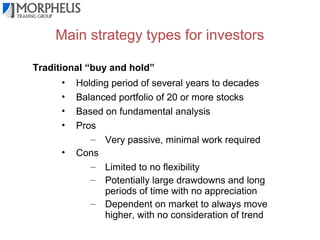
Main strategy types for investors
Traditional “buy and hold”
•
•
•
•
•

Holding period of several years to decades
Balanced portfolio of 20 or more stocks
Based on fundamental analysis
Pros
– Very passive, minimal work required
Cons
– Limited to no flexibility
– Potentially large drawdowns and long
periods of time with no appreciation
– Dependent on market to always move
higher, with no consideration of trend
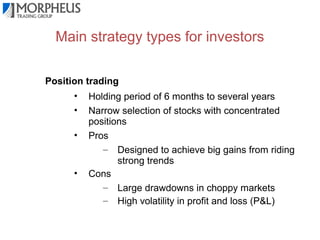
Main strategy types for investors
Position trading
•
•
•

•

Holding period of 6 months to several years
Narrow selection of stocks with concentrated
positions
Pros
– Designed to achieve big gains from riding
strong trends
Cons
– Large drawdowns in choppy markets
– High volatility in profit and loss (P&L)
Main strategy types for investors
Swing trading (near and intermediate-term)
•

•
•

•

Holding period
– Near-term trades are several days to
weeks
– Intermediate-term trades are 3 to 6 months
Flexible, well-balanced strategy with solid rewardrisk characteristics
Pros
– Strong risk control due to market timing
– Flexible enough to take advantage of
shorter-term trends in both directions
Cons
– Active management requires more
monitoring and solid market timing
Main strategy types for investors
Daytrading
•
•
•

•

Holding period of several minutes to 1 full day
Takes advantage of intraday price and volume
momentum in the markets
Pros
– Extremely risk-averse due to no overnight
exposure and risk of outside events
Cons
– Requires very active management, sitting
in front of monitor all day
– Physically and mentally demanding
(requires solid reflexes)
– Quite time consuming, only suitable for fulltime traders
Overview of MTG core beliefs
–

Swing trading in the near to intermediate-term timeframe is
the best fit for overall strategy

–

Trading with the intermediate-term trend

–

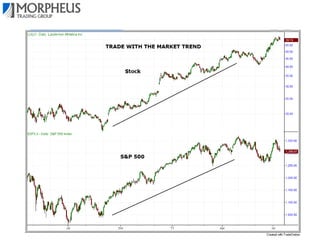
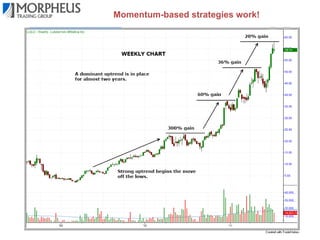
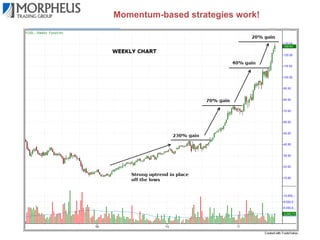
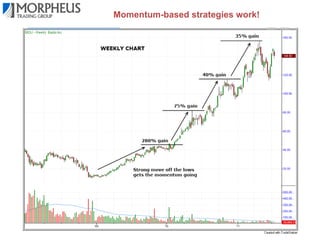
Momentum-based strategies work!
•
•

–

An object in motion tends to stay in motion
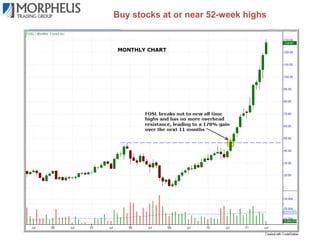
Stocks trading near 52-week highs have the least
amount of overhead resistance
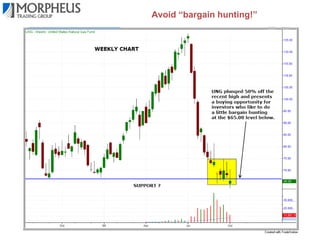
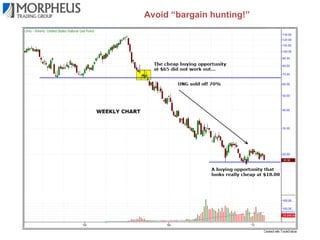
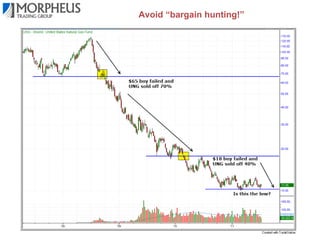
• Cheap stocks are cheap for a reason
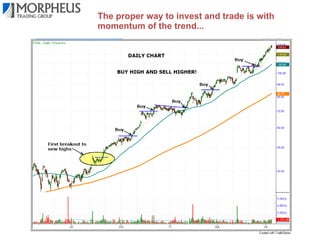
• We buy high and sell higher, not buy low and sell high
• Human nature is to underestimate how long a trend
can last
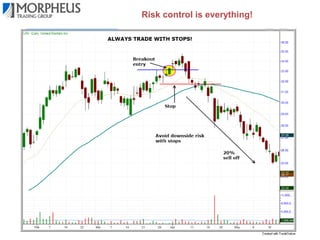
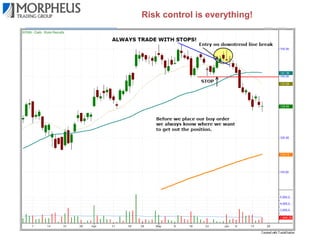
Risk control is everything!
•

–

Risk is defined upfront with every trade
Main market structure is base, breakout, pullback
Momentum-based strategies work!
Buy stocks at or near 52-week highs
Avoid “bargain hunting!”
The proper way to invest and trade is with
momentum of the trend...
Risk control is everything!
Overview of MTG trading strategy
5 steps to becoming a master trader
1)
2)
3)
4)

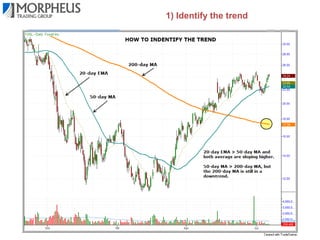
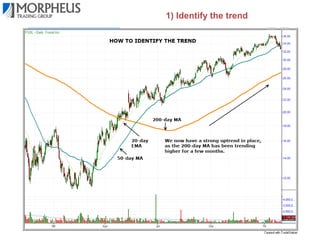
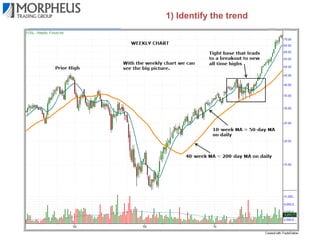
Identify the trend (with daily & weekly charts)
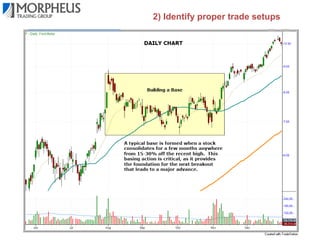
Identify proper trade “setups”
Have a clearly defined exit strategy
Have a disciplined money management
strategy
5) Understand the psychology of trading
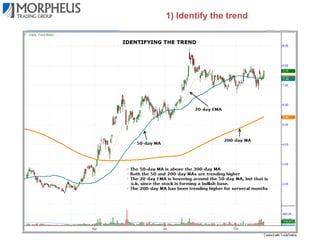
1) Identify the trend
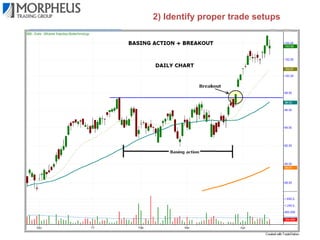
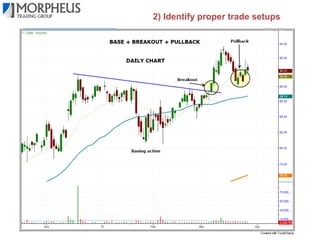
2) Identify proper trade setups
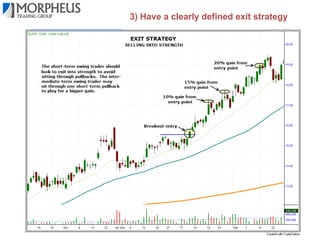
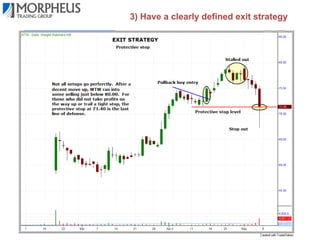
3) Have a clearly defined exit strategy
4) Have a disciplined
money management strategy
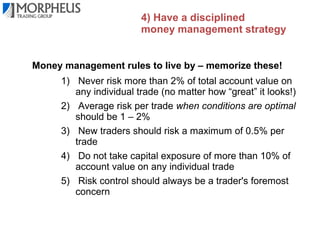
Money management rules to live by – memorize these!
1) Never risk more than 2% of total account value on
any individual trade (no matter how “great” it looks!)
2) Average risk per trade when conditions are optimal
should be 1 – 2%
3) New traders should risk a maximum of 0.5% per
trade
4) Do not take capital exposure of more than 10% of
account value on any individual trade
5) Risk control should always be a trader's foremost
concern
4) Have a disciplined
money management strategy
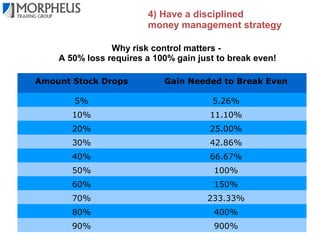
Why risk control matters A 50% loss requires a 100% gain just to break even!
Amount Stock Drops

Gain Needed to Break Even

5%

5.26%

10%

11.10%

20%

25.00%

30%

42.86%

40%

66.67%

50%

100%

60%

150%

70%

233.33%

80%

400%

90%

900%
5) Understand the psychology of trading
Price movements in all markets are driven by 3 primary emotions
1) Greed

Powerful emotion that can drive stock prices well beyond “reasonable”
valuations.

Creates a state of euphoria within individuals and the market (a group)
that has a “blinding” effect on rational thought
2) Fear

Another powerful emotion, even more so than greed

Fear is the reason markets trending steadily higher for years can erase
all those gains within just a matter of days (which is why stops are
crucial)

Fear of losing money puts investors into a panic, sending the market
sliding out of control
3) Hope

The most dangerous of the three emotions, as it can paralyze market
participants

Human nature is to analyze and justify the reasons why a stock should
not fall any further. Humans don't like to admit being wrong.

Consequently, traders can become paralyzed and avoid taking action to
eliminate a losing trade
To learn more about our strategy for swing trading stocks and ETFs, check
out the plethora of educational articles and videos on our blog at:

http://www.MorpheusTrading.com/blog
To receive our top “cherry picked” swing trade stock picks, you may wish to
check out our premium nightly newsletter, The Wagner Daily, at:

http://www.MorpheusTrading.com
Narrated video version of this presentation
is available on our YouTube channel at:

http://youtu.be/PqNnEjnbwaI

How To Swing Trade Stocks For Consistent Profits

  • 1.
    Swing Trading Success! HowTo Swing Trade Stocks For Consistent Profits In Both Up AND Down Markets
  • 2.
    Main strategy typesfor investors Traditional “buy and hold” • • • • • Holding period of several years to decades Balanced portfolio of 20 or more stocks Based on fundamental analysis Pros – Very passive, minimal work required Cons – Limited to no flexibility – Potentially large drawdowns and long periods of time with no appreciation – Dependent on market to always move higher, with no consideration of trend
  • 3.
    Main strategy typesfor investors Position trading • • • • Holding period of 6 months to several years Narrow selection of stocks with concentrated positions Pros – Designed to achieve big gains from riding strong trends Cons – Large drawdowns in choppy markets – High volatility in profit and loss (P&L)
  • 4.
    Main strategy typesfor investors Swing trading (near and intermediate-term) • • • • Holding period – Near-term trades are several days to weeks – Intermediate-term trades are 3 to 6 months Flexible, well-balanced strategy with solid rewardrisk characteristics Pros – Strong risk control due to market timing – Flexible enough to take advantage of shorter-term trends in both directions Cons – Active management requires more monitoring and solid market timing
  • 5.
    Main strategy typesfor investors Daytrading • • • • Holding period of several minutes to 1 full day Takes advantage of intraday price and volume momentum in the markets Pros – Extremely risk-averse due to no overnight exposure and risk of outside events Cons – Requires very active management, sitting in front of monitor all day – Physically and mentally demanding (requires solid reflexes) – Quite time consuming, only suitable for fulltime traders
  • 6.
    Overview of MTGcore beliefs – Swing trading in the near to intermediate-term timeframe is the best fit for overall strategy – Trading with the intermediate-term trend – Momentum-based strategies work! • • – An object in motion tends to stay in motion Stocks trading near 52-week highs have the least amount of overhead resistance • Cheap stocks are cheap for a reason • We buy high and sell higher, not buy low and sell high • Human nature is to underestimate how long a trend can last Risk control is everything! • – Risk is defined upfront with every trade Main market structure is base, breakout, pullback
  • 8.
  • 9.
  • 10.
  • 11.
    Buy stocks ator near 52-week highs
  • 12.
    Buy stocks ator near 52-week highs
  • 13.
  • 14.
  • 15.
  • 16.
    The proper wayto invest and trade is with momentum of the trend...
  • 17.
    Risk control iseverything!
  • 18.
    Risk control iseverything!
  • 19.
    Overview of MTGtrading strategy 5 steps to becoming a master trader 1) 2) 3) 4) Identify the trend (with daily & weekly charts) Identify proper trade “setups” Have a clearly defined exit strategy Have a disciplined money management strategy 5) Understand the psychology of trading
  • 20.
  • 21.
  • 22.
  • 23.
  • 24.
    2) Identify propertrade setups
  • 25.
    2) Identify propertrade setups
  • 26.
    2) Identify propertrade setups
  • 27.
    3) Have aclearly defined exit strategy
  • 28.
    3) Have aclearly defined exit strategy
  • 29.
    4) Have adisciplined money management strategy Money management rules to live by – memorize these! 1) Never risk more than 2% of total account value on any individual trade (no matter how “great” it looks!) 2) Average risk per trade when conditions are optimal should be 1 – 2% 3) New traders should risk a maximum of 0.5% per trade 4) Do not take capital exposure of more than 10% of account value on any individual trade 5) Risk control should always be a trader's foremost concern
  • 30.
    4) Have adisciplined money management strategy Why risk control matters A 50% loss requires a 100% gain just to break even! Amount Stock Drops Gain Needed to Break Even 5% 5.26% 10% 11.10% 20% 25.00% 30% 42.86% 40% 66.67% 50% 100% 60% 150% 70% 233.33% 80% 400% 90% 900%
  • 31.
    5) Understand thepsychology of trading Price movements in all markets are driven by 3 primary emotions 1) Greed  Powerful emotion that can drive stock prices well beyond “reasonable” valuations.  Creates a state of euphoria within individuals and the market (a group) that has a “blinding” effect on rational thought 2) Fear  Another powerful emotion, even more so than greed  Fear is the reason markets trending steadily higher for years can erase all those gains within just a matter of days (which is why stops are crucial)  Fear of losing money puts investors into a panic, sending the market sliding out of control 3) Hope  The most dangerous of the three emotions, as it can paralyze market participants  Human nature is to analyze and justify the reasons why a stock should not fall any further. Humans don't like to admit being wrong.  Consequently, traders can become paralyzed and avoid taking action to eliminate a losing trade
  • 32.
    To learn moreabout our strategy for swing trading stocks and ETFs, check out the plethora of educational articles and videos on our blog at: http://www.MorpheusTrading.com/blog To receive our top “cherry picked” swing trade stock picks, you may wish to check out our premium nightly newsletter, The Wagner Daily, at: http://www.MorpheusTrading.com Narrated video version of this presentation is available on our YouTube channel at: http://youtu.be/PqNnEjnbwaI