#ClioWeb
How to Start an Intellectual Property Law Practice
A Clio Webinar
Joshua Lenon – Clio
Nehal Madhani – Alt Legal
#ClioWeb
• CEO of Alt Legal
• @nehalm
Instructors
Joshua Lenon
• Lawyer in Residenceat Clio
• Attorney Admitted in New York
• @JoshuaLenon
Nehal Madhani
#ClioWeb
Agenda
• Intro to IntellectualProperty (IP)(10minutes)
• Settingupan IP lawpractice (15 minutes)
• Ethical obligationsandpitfallsin IP law (15minutes)
• Toolsfor IP lawyers. (10minutes)
• AssessingIP Needswith clients(5 minutes)
• Questions(5minutes)
Nehal Madhani
nehal@altlegal.com
@AltLegalHQ
Nehal Madhani
Founder & CEO
Alt Legal
@nehalm
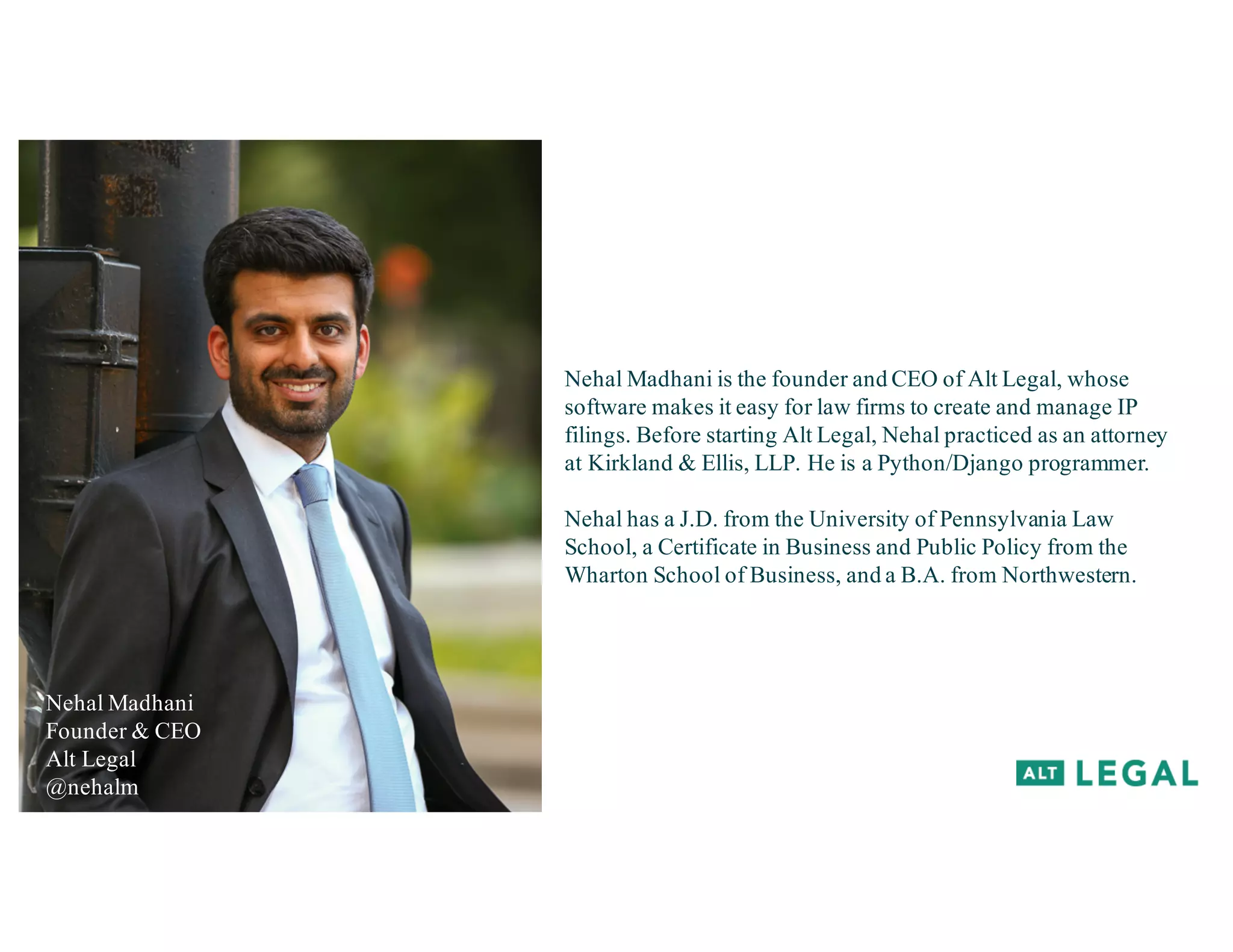
Nehal Madhani is the founder and CEO of Alt Legal, whose
software makes it easy for law firms to create and manage IP
filings. Before starting Alt Legal, Nehal practiced as an attorney
at Kirkland & Ellis, LLP. He is a Python/Django programmer.
Nehal has a J.D. from the University of Pennsylvania Law
School, a Certificate in Business and Public Policy from the
Wharton School of Business, and a B.A. from Northwestern.
INTRO TO IP
DEMAND FOR IP LEGAL SERVICES IS GROWING
Source: BTI Consulting Group, http://www.bticonsulting.com/ip-and-ip-litigation-outlook
• IP is a critical business asset that every business should protect.
• Companies are being brought and sold just for their IP portfolios.
• Nearly $2.7 billion is spent on IP litigation legal fees every year.
• Surge in the number of small businesses and startups is driving an increase in the number
of IP filings.
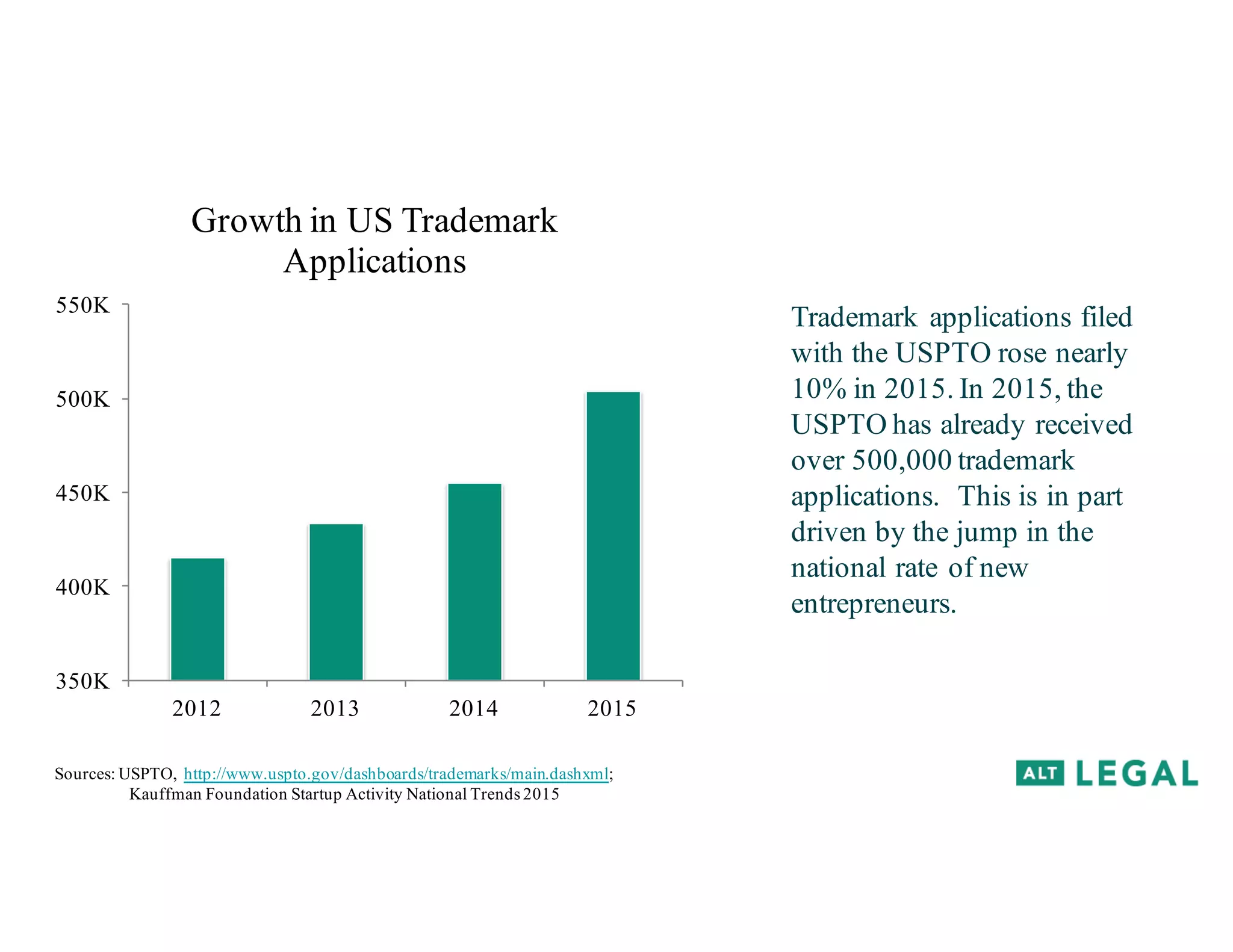
350K
400K
450K
500K
550K
2012 2013 2014 2015
Growth in US Trademark
Applications
Sources: USPTO, http://www.uspto.gov/dashboards/trademarks/main.dashxml;
Kauffman Foundation Startup Activity National Trends 2015
Trademark applications filed
with the USPTO rose nearly
10% in 2015. In 2015, the
USPTO has already received
over 500,000 trademark
applications. This is in part
driven by the jump in the
national rate of new
entrepreneurs.
TRADEMARKS OVERVIEW
• Scope: Protects word, phrase, symbol, and/or design that identifies and distinguishes the
source of the goods or services of one party from those of others.
• Expiration: None as long as use and filing requirements are satisfied.
• Attorney requirements: Must be an attorney in good standing in at least one US jurisdiction
to prosecute trademark filings.
PATENTS OVERVIEW
• Scope: Protects machines, manufactured articles, industrial processes, and chemical
compositions.
• Expiration: 14 years for design patents; 20 years for utility and plant patents.
• Attorney requirements: Must be admitted to patent bar to prosecute patents. A scientific or
technical training is a prerequisite for the patent bar.
COPYRIGHT OVERVIEW
• Scope: Protects works of authorship that. have been tangibly expressed in a physical form
(e.g., songs, books, movies, and works of art).
• Expiration: Varies depending on the type of work and authorship (e.g., life of the author +
70 years or if it’s work for hire or anonymous, it’s shorter of 95 years from publication or
120 years from creation)
• Attorney requirements: Must be an attorney in good standing in at least one US jurisdiction
to prosecute copyright filings
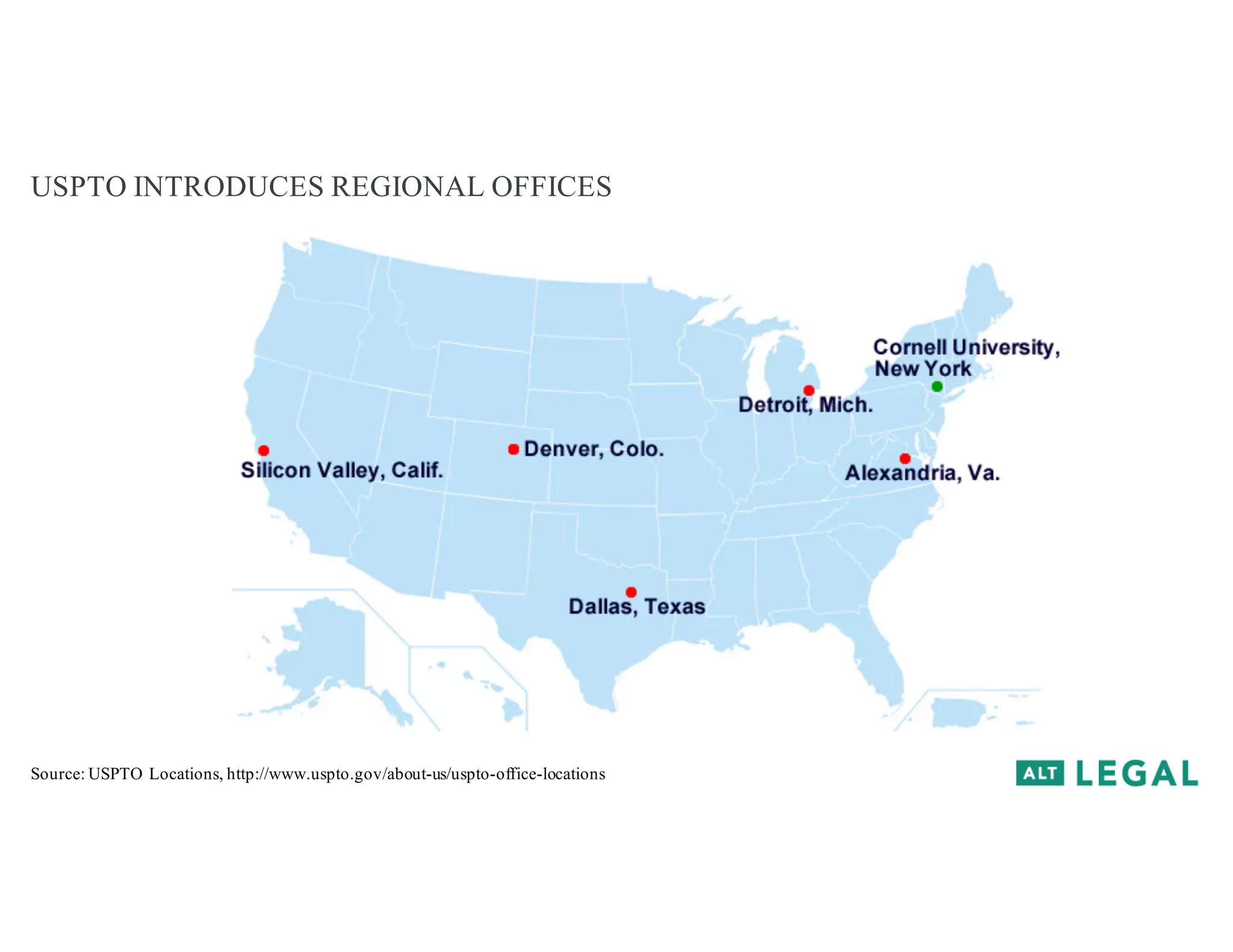
USPTO INTRODUCES REGIONAL OFFICES
Source: USPTO Locations, http://www.uspto.gov/about-us/uspto-office-locations
SETTING UPAN IP PRACTICE
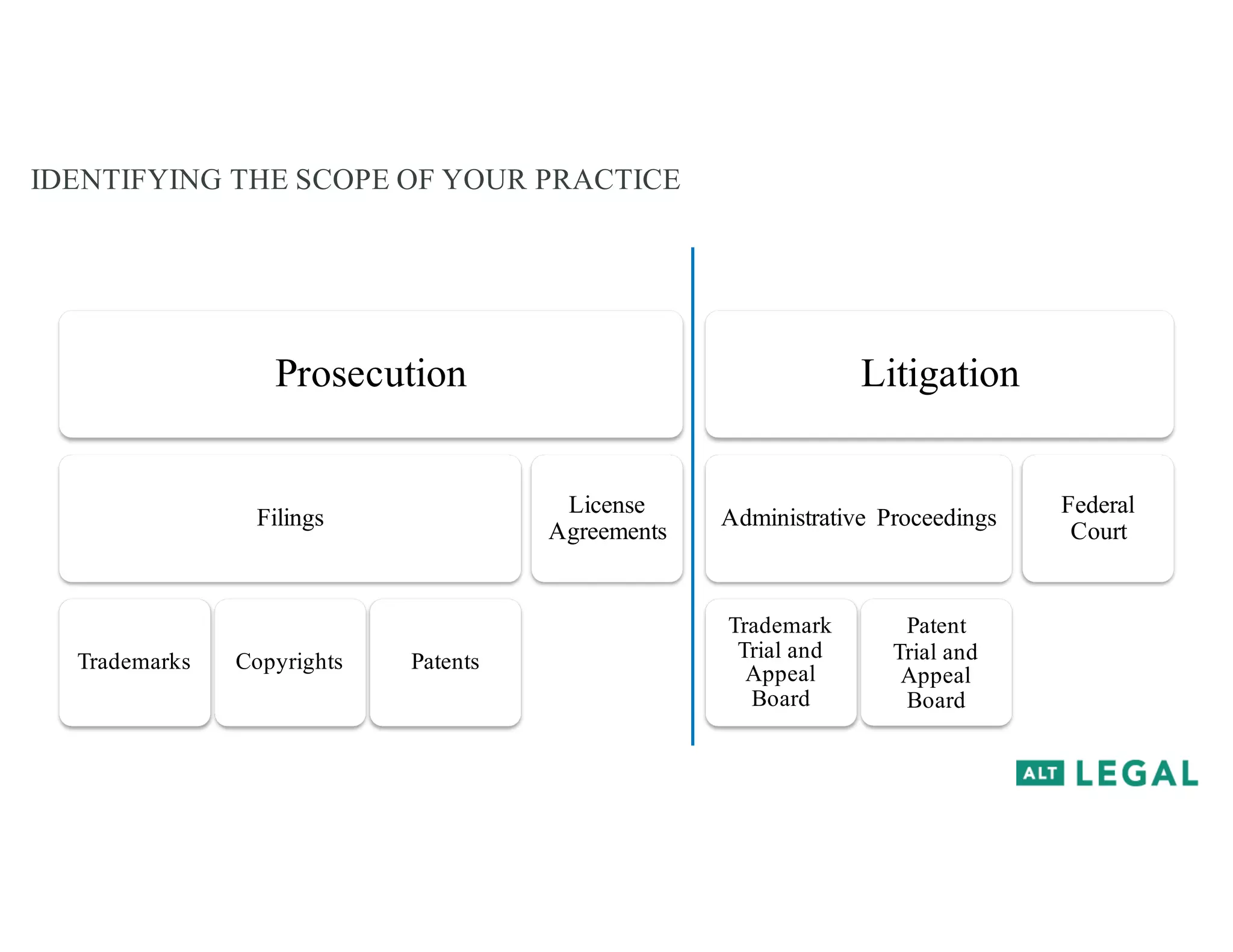
IDENTIFYING THE SCOPE OF YOUR PRACTICE
Prosecution
Filings
Trademarks Copyrights Patents
License
Agreements
Litigation
Administrative Proceedings
Trademark
Trial and
Appeal
Board
Patent
Trial and
Appeal
Board
Federal
Court
FIND YOUR NICHE
• Like any practice, you should identify your niche within IP after determining the scope of
your work in this field.
• You can more effectively focus your limited resources.
• You can quickly build expertise.
• You can rapidly develop a client base and network.
HOW TO FIND A NICHE
• Consider your interests and passions
• Identify trends in your current client base and/or network
• Assess your professional and personal strengths and weaknesses
• Explore the competitive landscape
A STRONG IP NETWORK IS CRITICAL
• IP law is a complex, global practice.
• The right network allows you to serve clients as a “full-service IP firm.”
• You can grow your practice through referrals.
BUILDING YOUR IP NETWORK
• Social media (Check out our list of Twitter influencers here:
http://www.twitter.com/AltLegalHQ/lists/ip-law)
• Read blogs and write your own. Popular ones include Likelihood of Confusion, TTABlog,
Everything Trademarks, and IP Watchdog)
• Become a member of the over 50 state and local IP bar associations
• Join trade organizations:
• International Trademark Association (INTA)
• American Intellectual Property Law Association (AIPLA)
• American Bar Association - Intellectual Property Law (ABA-IPL)
• Copyright Society of the USA (CSUSA)
CASE STUDIES OF SUCCESSFUL IP PRACTICES
• Background: Meet Rina. Rina is a former Big Law corporate attorney who set up her own
legal practice a few years ago. She focuses largely on emerging companies and securities
law.
• IP work: Over the last couple years, her emerging companies clients have become mature
companies and have sought trademark protection.
• Results: Rina has prosecuted over 60 trademarks for her clients and netted nearly $50,000
in legal fees ($800/trademark).
• Advice: Attend CLEs and IP conferences to learn the fundamentals and leverage close
relationships with experienced IP lawyers to help you avoid mistakes.
CASE STUDIES OF SUCCESSFUL IP PRACTICES
• Background: Meet Jason. Jason started his career at a mid-size IP law firm and worked
there for a couple years. About five years ago, he branched out on his own and initially
focused on TM and copyright prosecution and TM litigation.
• IP Work/Results: He has prosecuted over 500 trademarks and charges $1,000/TM filing
($400,000 in legal fees from TM prosecution alone). He also recently hired a patent lawyer
and litigator and grown his firm organically into a a full-service IP practice.
• Advice: Focus on growing your network, and particularly an international network of
fellow IP attorneys.
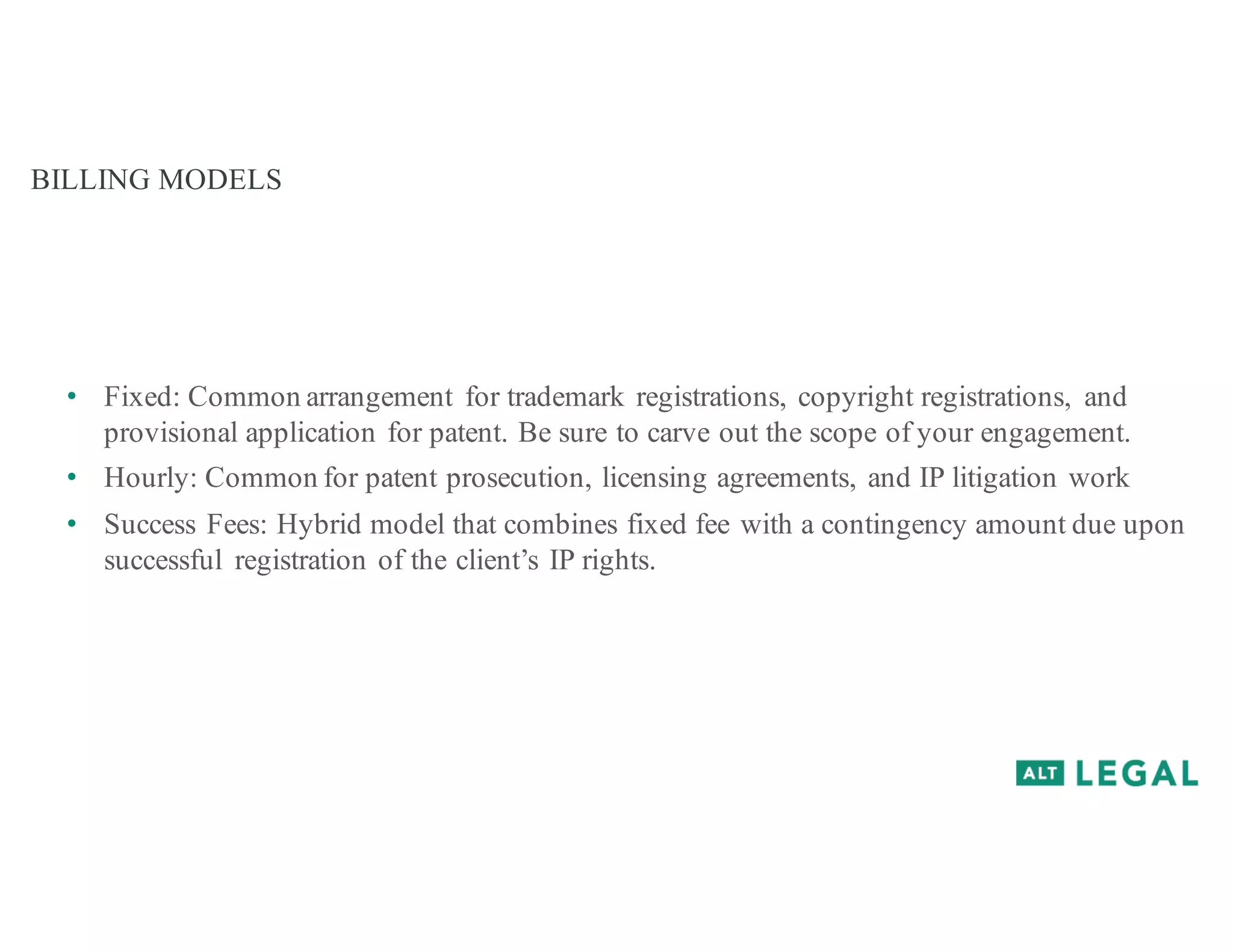
BILLING MODELS
• Fixed: Common arrangement for trademark registrations, copyright registrations, and
provisional application for patent. Be sure to carve out the scope of your engagement.
• Hourly: Common for patent prosecution, licensing agreements, and IP litigation work
• Success Fees: Hybrid model that combines fixed fee with a contingency amount due upon
successful registration of the client’s IP rights.
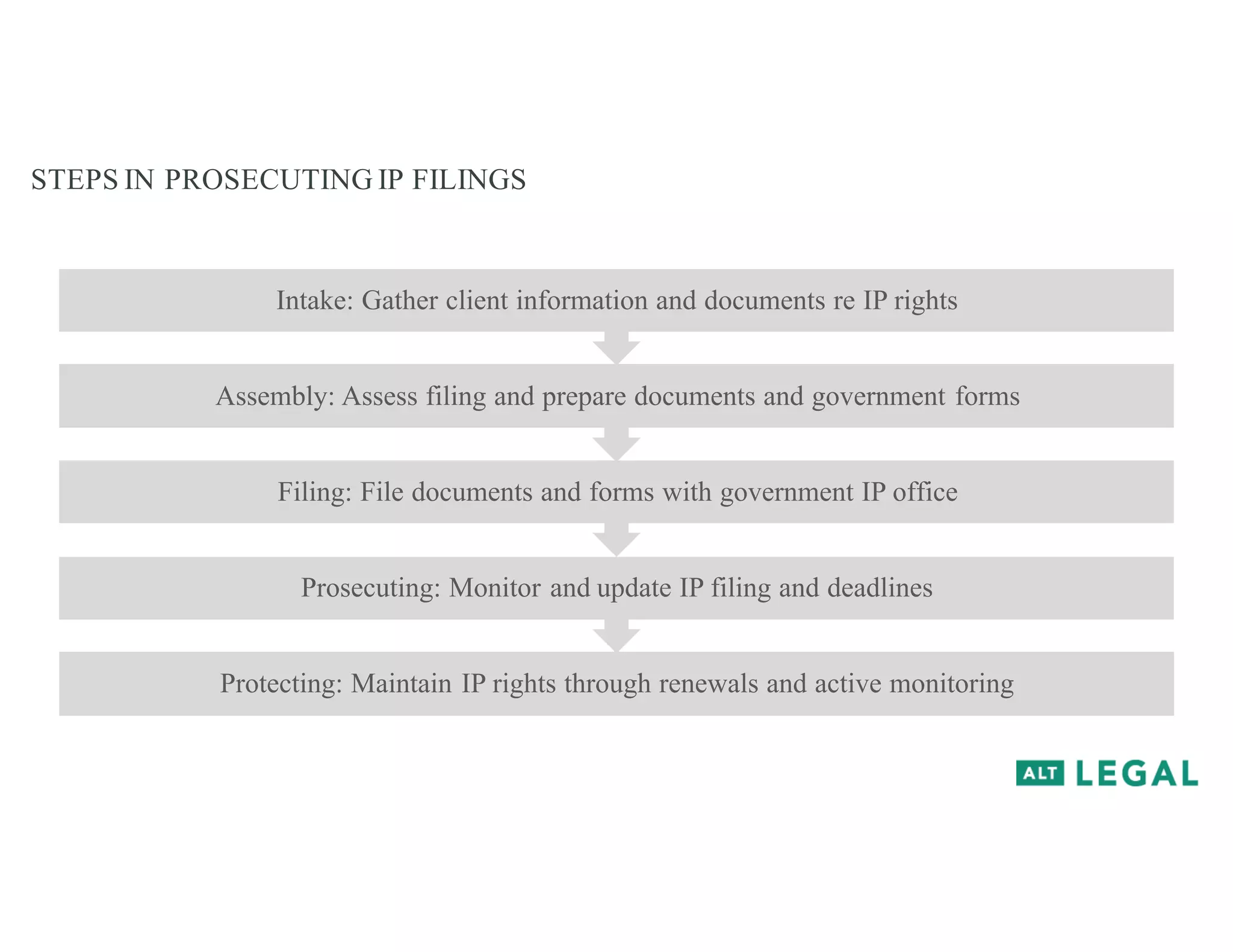
STEPS IN PROSECUTING IP FILINGS
Protecting: Maintain IP rights through renewals and active monitoring
Prosecuting: Monitor and update IP filing and deadlines
Filing: File documents and forms with government IP office
Assembly: Assess filing and prepare documents and government forms
Intake: Gather client information and documents re IP rights
ETHICALOBLIGATIONSAND PITFALLS
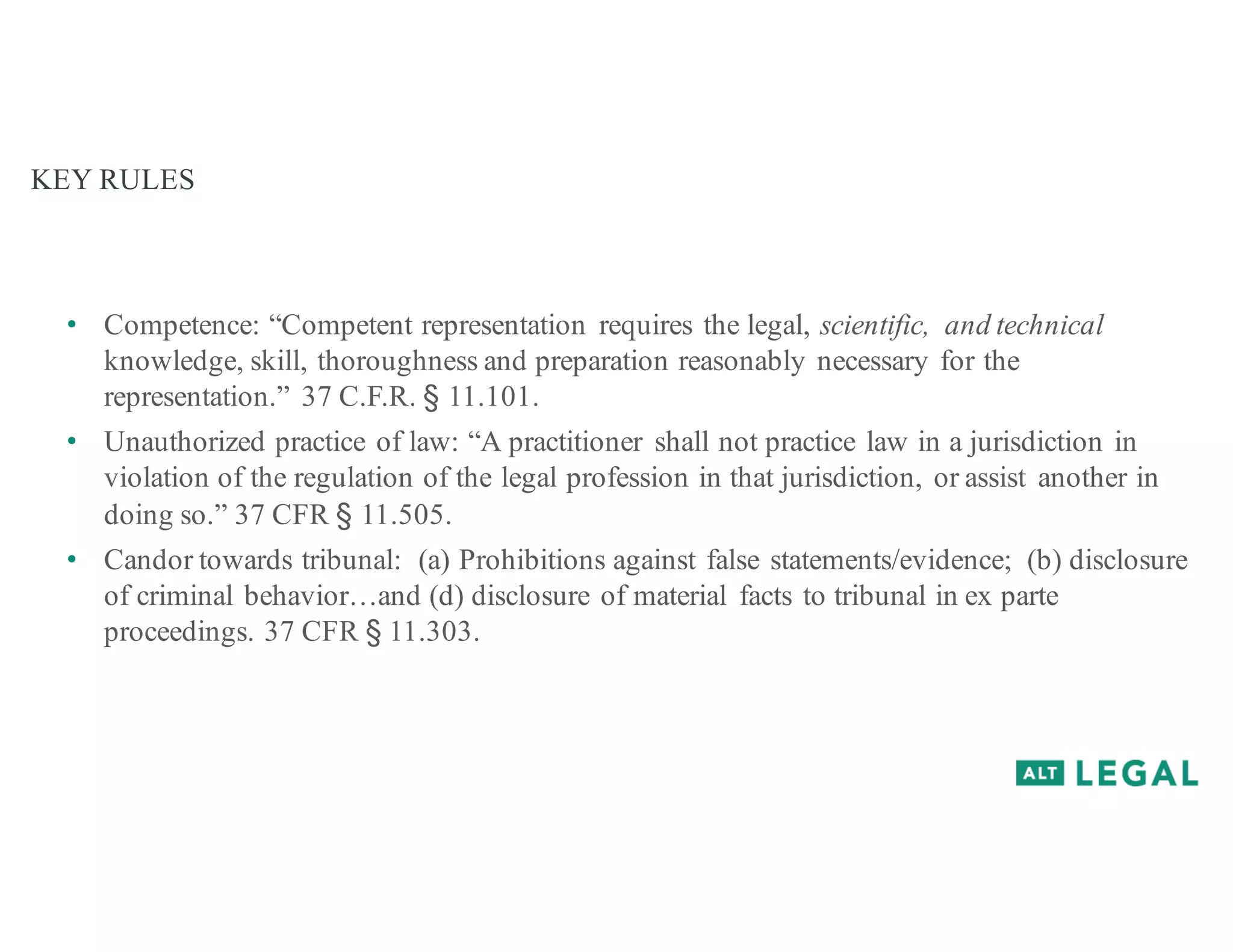
KEY RULES
• Competence: “Competent representation requires the legal, scientific, and technical
knowledge, skill, thoroughness and preparation reasonably necessary for the
representation.” 37 C.F.R. § 11.101.
• Unauthorized practice of law: “A practitioner shall not practice law in a jurisdiction in
violation of the regulation of the legal profession in that jurisdiction, or assist another in
doing so.” 37 CFR § 11.505.
• Candor towards tribunal: (a) Prohibitions against false statements/evidence; (b) disclosure
of criminal behavior…and (d) disclosure of material facts to tribunal in ex parte
proceedings. 37 CFR § 11.303.
ADMINISTRATIVE ERROR: MAKING FACTUAL ASSERTIONS
• US trademark applications must be signed by a person that can legally bind the applicant
or has first hand knowledge of the facts asserted in the application and authority to act
on behalf of the applicant, or a US attorney authorized to practice before the USPTO.
• Attorneys who execute trademark applications on behalf of clients may become a fact
witness and disqualified from representing the applicant if the application or registration
is disputed.
• You should email the application to your client to execute (despite the inconvenience)
through TEAS.
Source: BTI Consulting Group, http://www.bticonsulting.com/ip-and-ip-litigation-outlook
ADMINISTRATIVE ERROR: MAKING EXCESSIVELY BROAD ASSERTIONS
• Medinol Ltd. v. Neuro Vasx Inc. (TTAB 2003). The mark "NeuroVasx" was granted for
use in connection with "medical devices, namely, neurological stents and catheters."
• A petitioner wanted the mark cancelled because it was not being used in connections
with stents. Neuro Vasx attempted to amend their application to remove stents, which
were included because of an oversight.
• The court found fraud because Neuro Vasx knowingly made a false statement to the
USPTO to obtain registration, which would not have been issued if the USPTO knew it
was not being used for stents.
• Fraud cannot be cured by the deletion of goodsfrom the registrations.
MISSING DEADLINES: IN RE TACHNER
• In re Tachner (USPTO D2012-30):The Office of Enrollment and Discipline broughtan
action against a solo patent attorney after he missed several filing deadlines for clients’
filings.
• The attorney relied on an office manager and a manual docketing system. Through 2005, he
docketed matters by recording dates in a notebook. After 2005, his office relied solely on a
Word document that listed actions as single-line entries (no table and no calendar).
• The attorney admitted to a pattern of neglect of management of his law firm, including
reliance on an “unsound calendaring system for tracking deadlines.”
• The attorney was suspended for five years for violating several provisions the USPTO
Code of Professional Responsibility.
MISSING DEADLINES: THE MEDICINES CO. V. FISH & NEAVE
• In The Medicines Co. v. Fish & Neave, Medicines Co. sued Fish & Neave for missing a
patent term extension (“PTE”) application deadline that jeopardized about 4.5 years of
market exclusivity ($2 billion in sales).
• PTE applications allow applicants to extend the life of a patent for certain delays beyond
the applicant’s control. Here, it was the time MDCO spent seeking FDA approval of their
drug. Fish & Neave was to submit a PTE application within 60 days of the FDA approving
the drug.
• Ultimately, after a protracted, decade-long legal and legislative battle and nearly $20
million lobbying Congress, MDCO was able to reverse the docketing and patent filing
errors and restore the exclusivity period.
Ropes & Gray Settles, law360.com/articles/692712/ropes-gray-settles-patent-filing-malpractice-suit
Patent Bill Viewed as Bailout for a Law Firm, http://nyti.ms/1OR7Rra
TOOLS FOR IP LAWYERS
• Malpractice Insurance
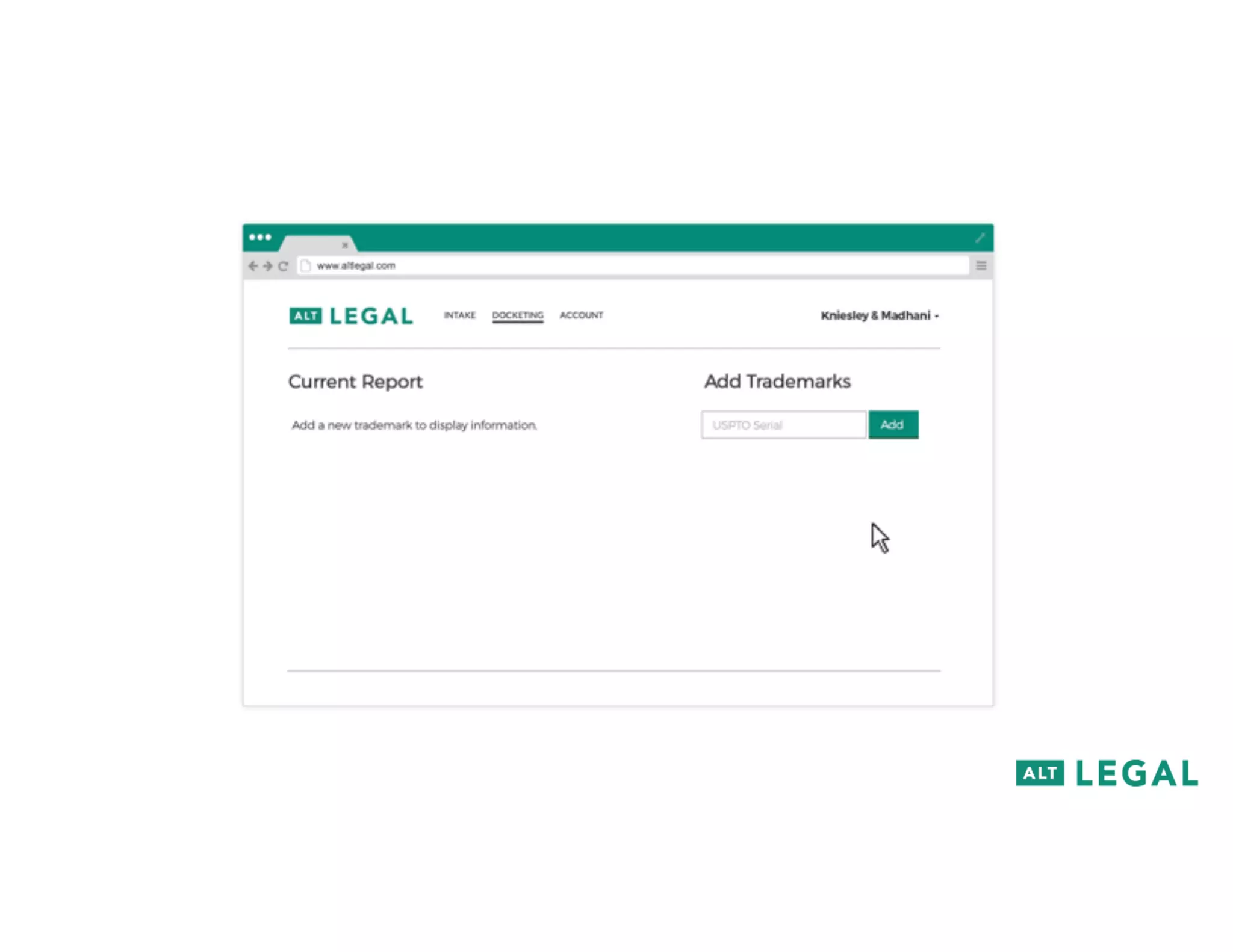
• Docketing System
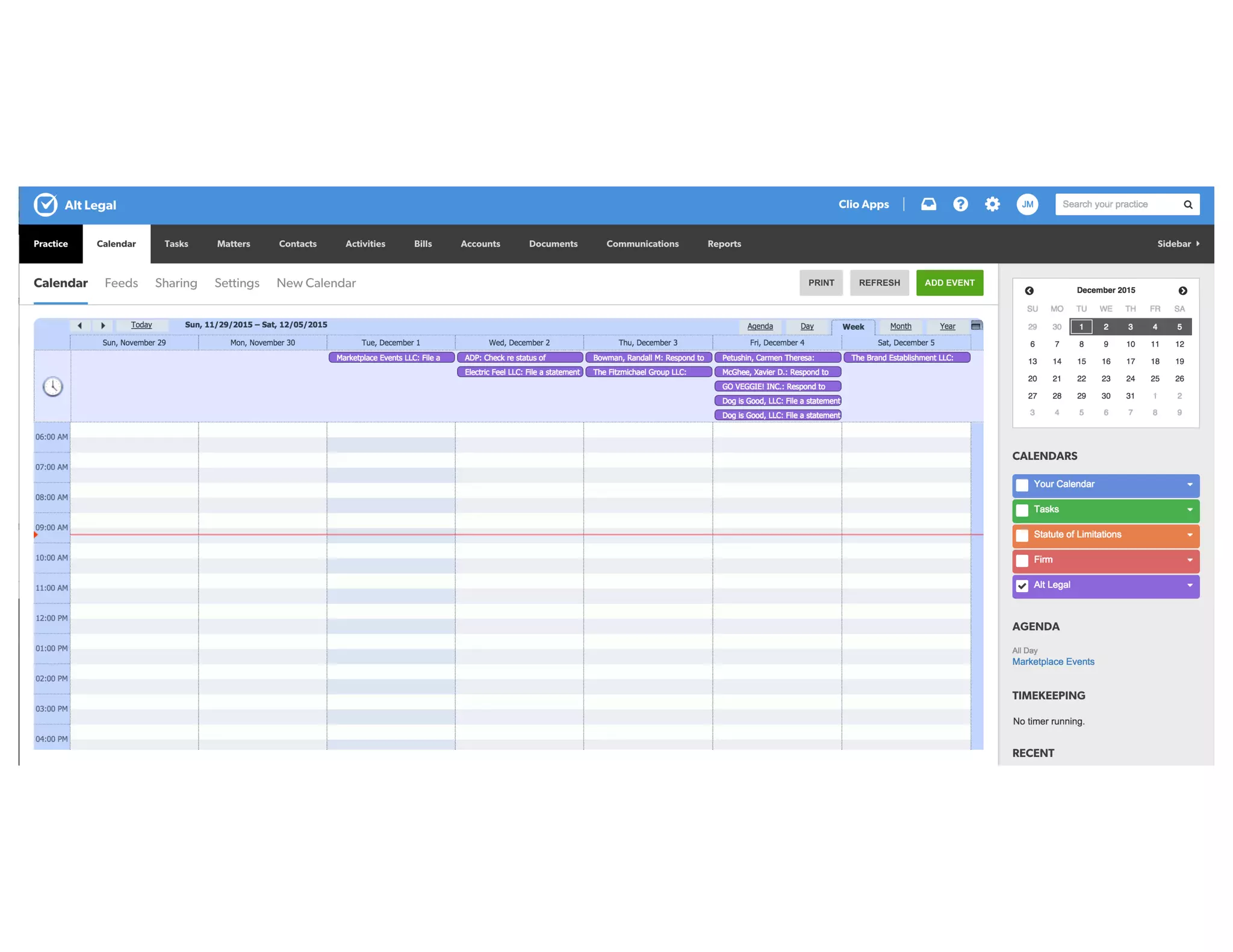
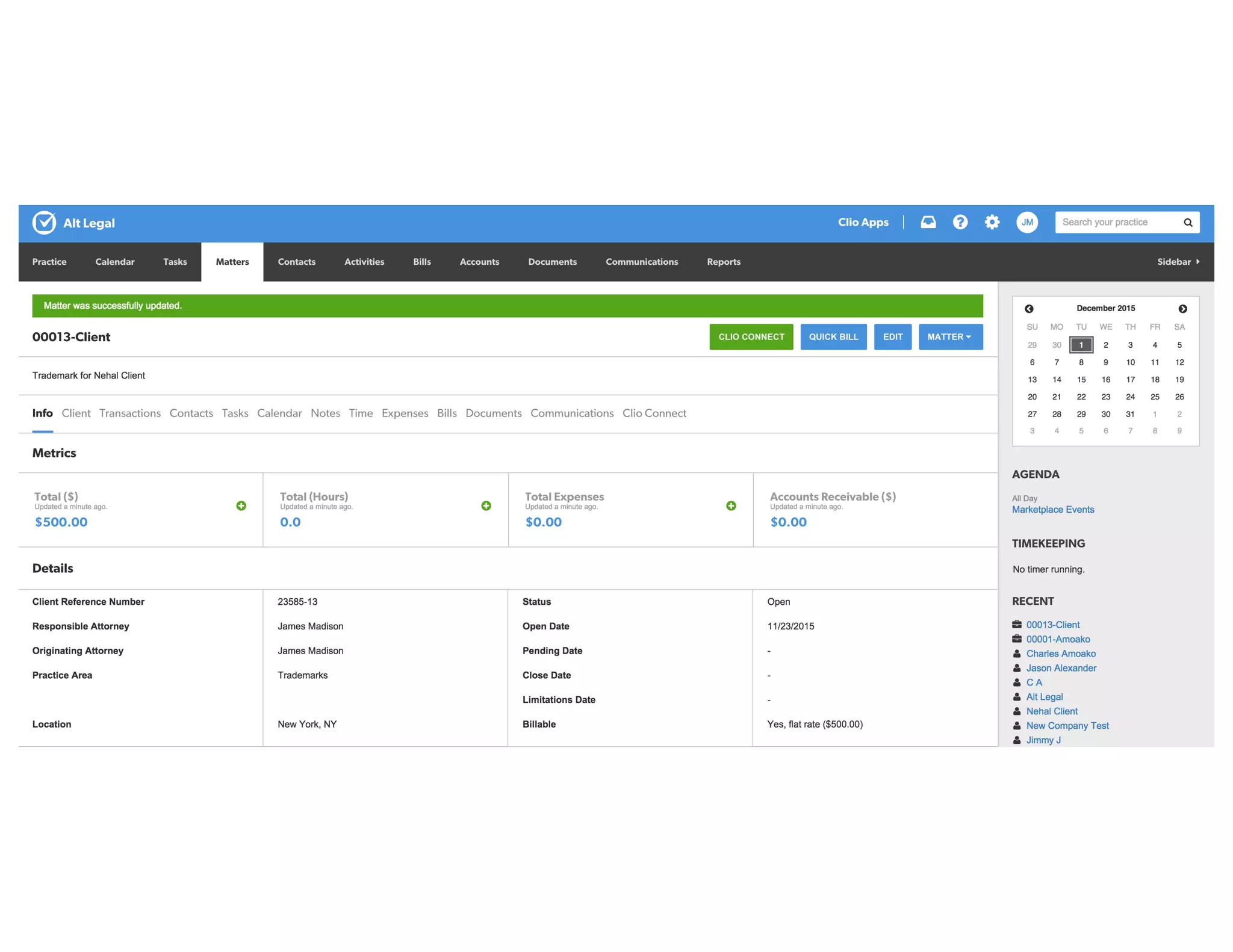
• Practice Management
• Client Intake
MALPRACTICE INSURANCE
• IP malpractice insurance is a must if you are going to do any kind of IP filing (even
trademarks).
• Typically, it’s more expensive than other practice areas given the high stakes of IP and the
liabilities associated with missed deadlines.
• Explore discounts that may be available through trade organizations (e.g., National
Association of Patent Practitioners).
• Consider policy limits, scope of coverage, retroactive dates, and expiration dates in
selecting a provider.
DOCKETING SYSTEM
• Timely filings for office actions, renewals, revivals, and objections are essential to protect
your clients’ IP rights.
• Complexity increases exponentially as you grow your IP practice.
• Key factors in selecting an IP docketing system
• Scope of your practice (e.g., trademarks or patents, domestic or international, litigation
or prosecution)
• Security
• Ease of use
• Automation
• Calendaring support
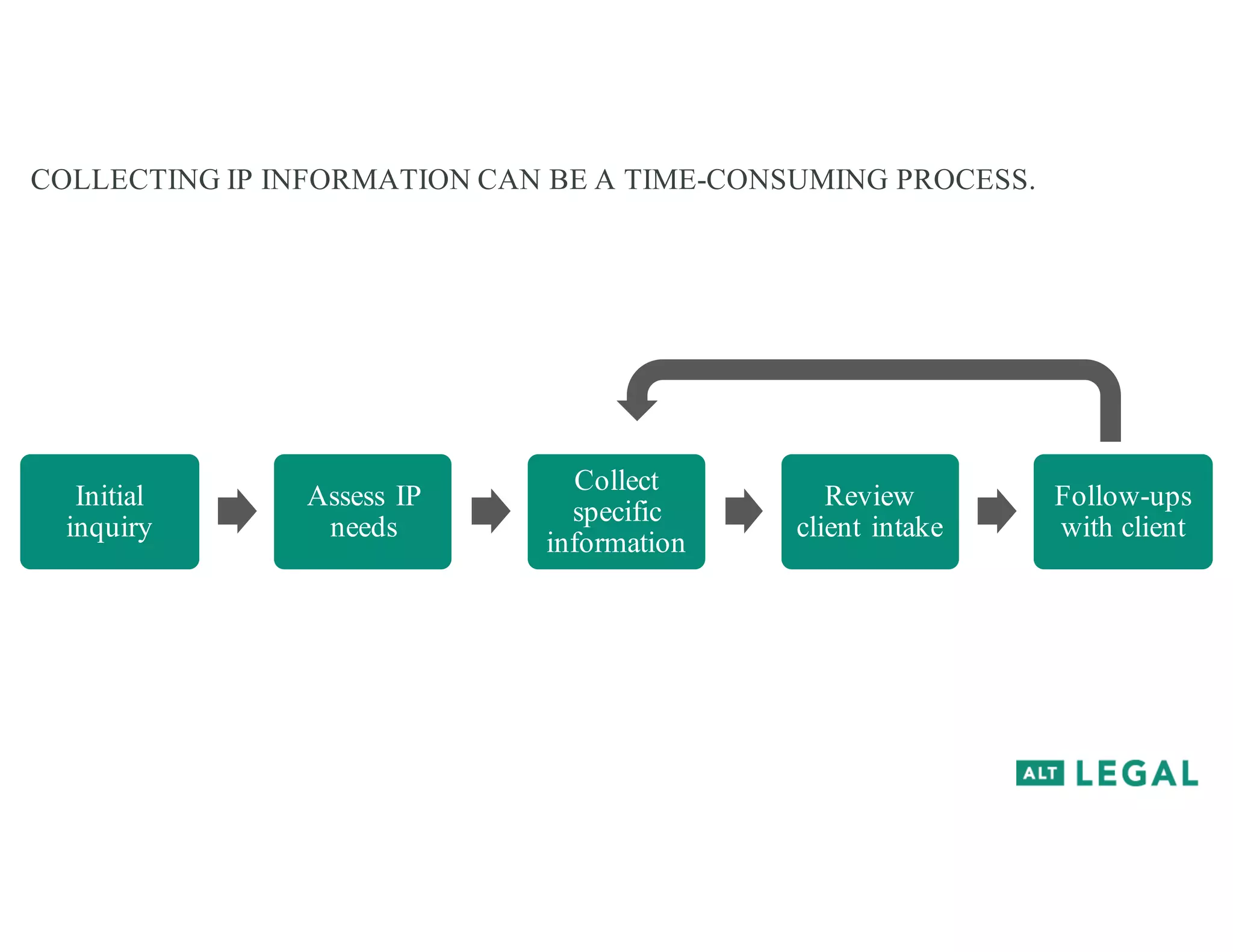
COLLECTING IP INFORMATION CAN BE A TIME-CONSUMING PROCESS.
Initial
inquiry
Assess IP
needs
Collect
specific
information
Review
client intake
Follow-ups
with client
BEST PRACTICES FOR IP INTAKE
• Present your client with questions that are easy to understand or not overly technical to
solicit accurate and complete answers.
• Leverage electronic forms to collect client information in the first instance to speed up the
process for both you and your client.
• Keep records of the information that your client provided to you.
PRACTICE MANAGEMENT
• IP practice (like other practices involving government filings and processes) can be
administrative at times.
• Practice management software will help you manage your contacts, organize your matters
and documents, and get paid faster.
• Reflect on your workflow to identify any administrative bottlenecks by considering which
elements are repetitive and don’t require any subjective assessments.
#ClioWeb
ASSESSING IP NEEDS WITH CLIENTS
#ClioWeb
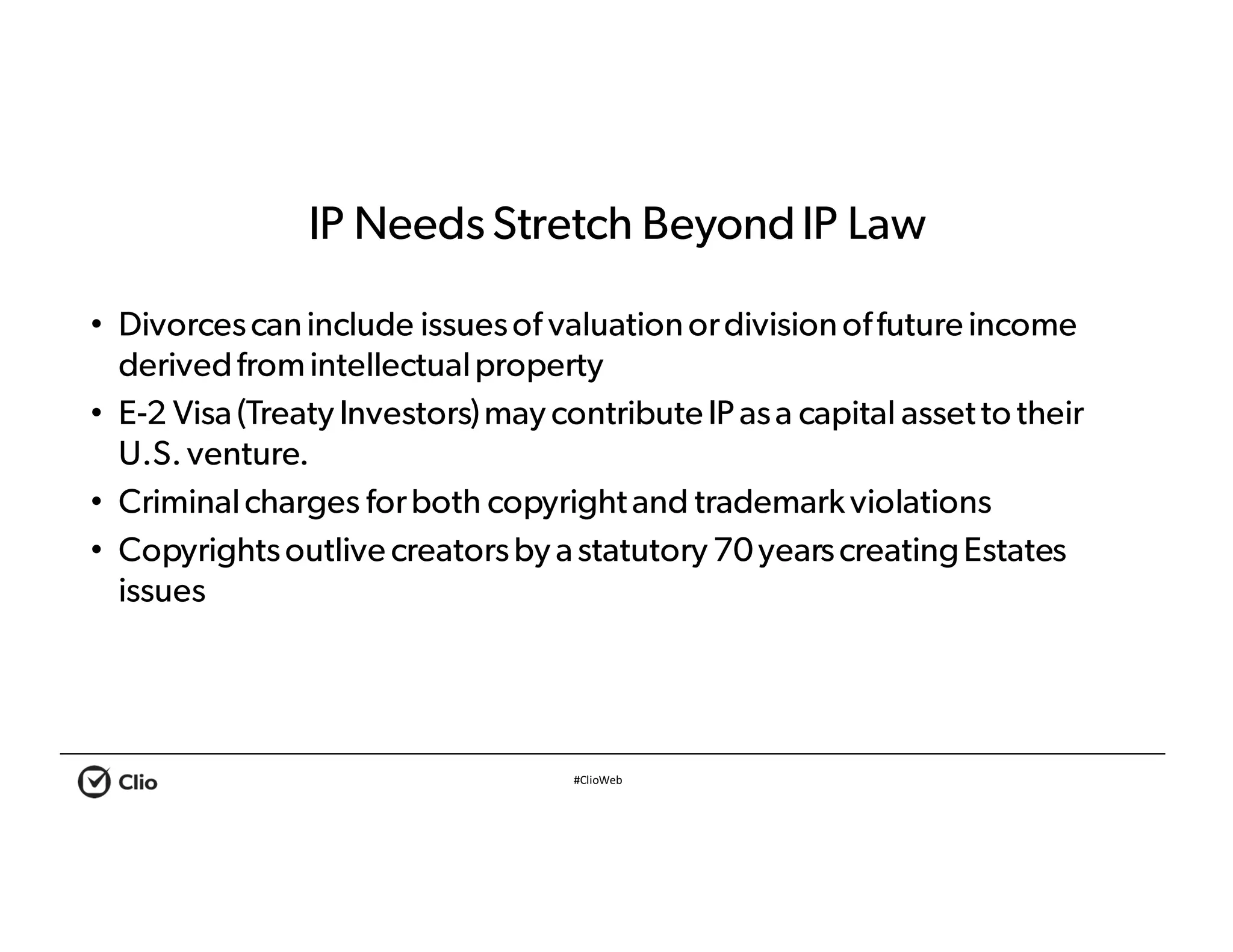
IP Needs Stretch BeyondIP Law
• Divorcescaninclude issuesof valuationordivisionoffuture income
derivedfromintellectualproperty
• E-2 Visa(Treaty Investors)may contribute IP asa capital assetto their
U.S. venture.
• Criminalcharges forboth copyrightand trademarkviolations
• Copyrightsoutlive creatorsby astatutory 70yearscreatingEstates
issues
#ClioWeb
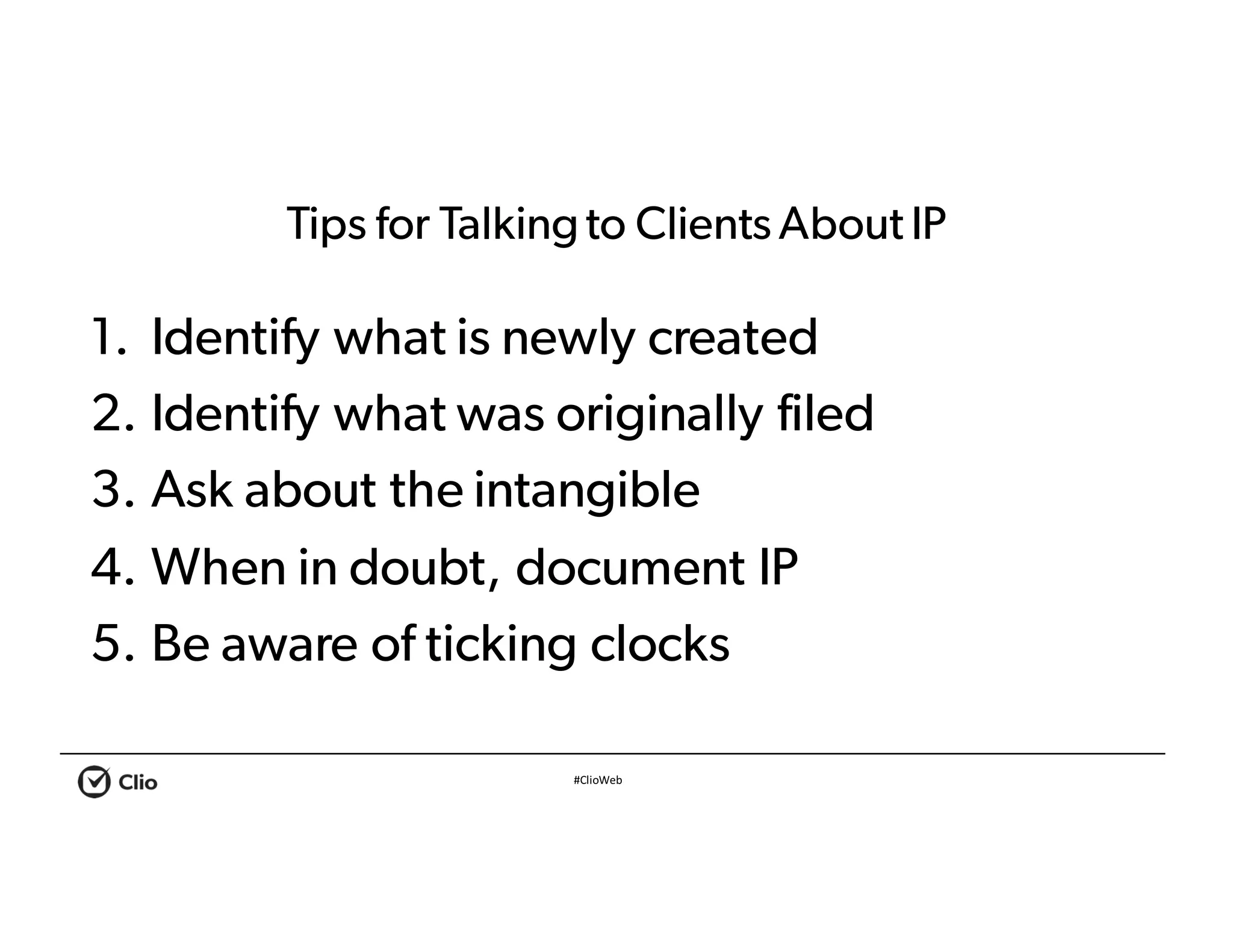
Tips for Talkingto Clients About IP
1. Identify what is newly created
2. Identify what was originally filed
3. Ask about the intangible
4. When in doubt, document IP
5. Be aware of ticking clocks
#ClioWeb
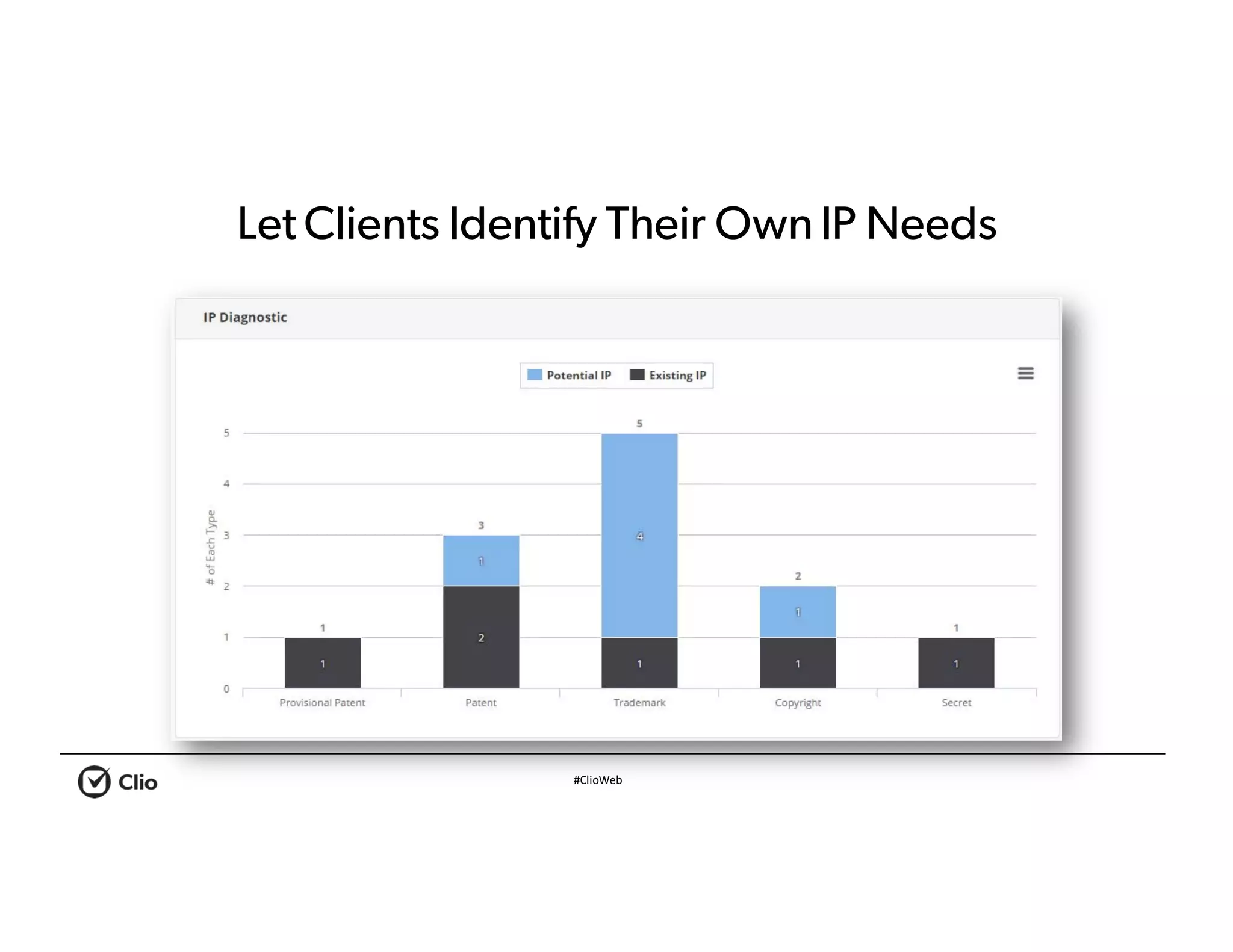
Let Clients Identify Their Own IP Needs
#ClioWeb
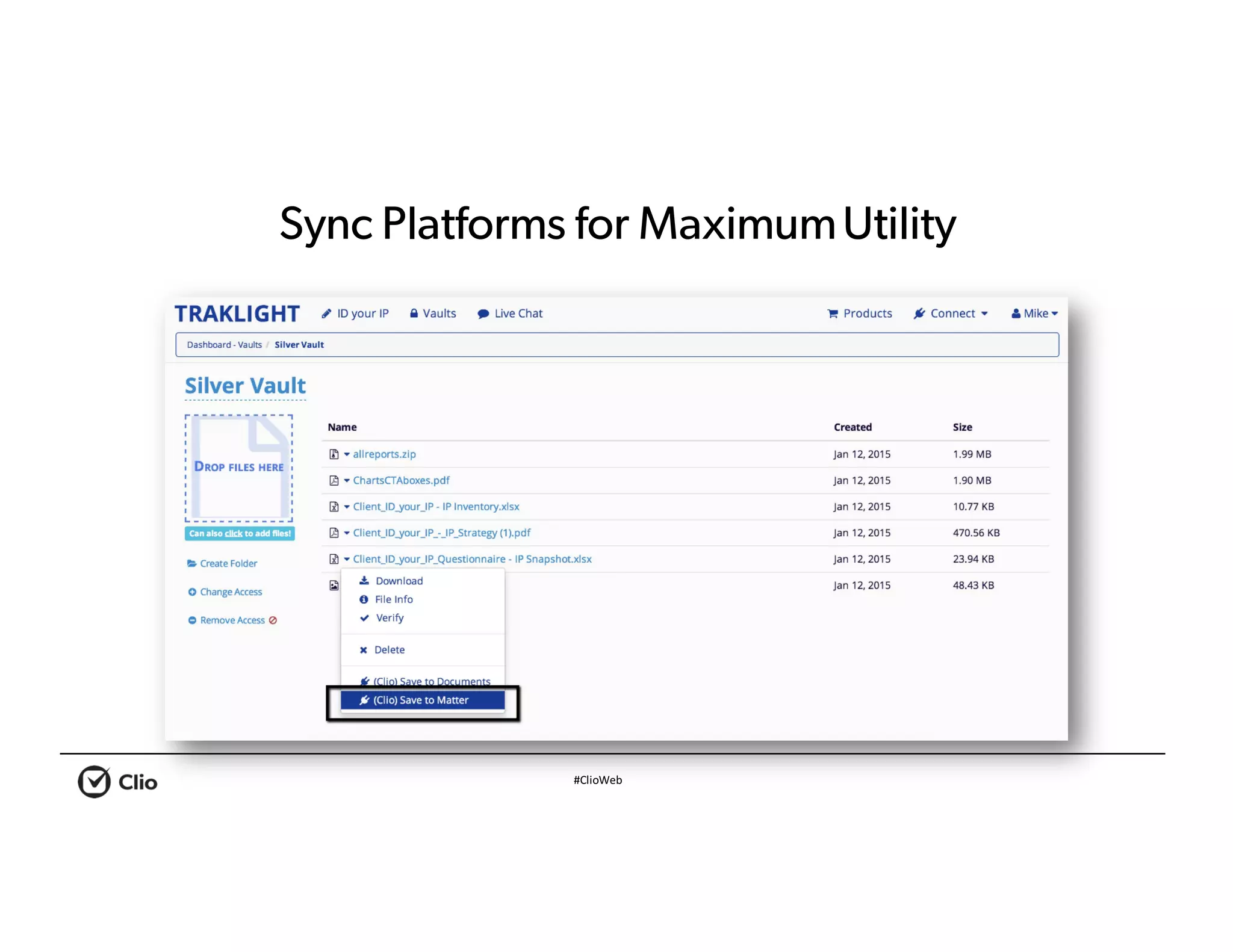
Sync Platforms for MaximumUtility
#ClioWeb
QUESTIONS?
#ClioWeb
Thank You
JoshuaLenon
joshua@clio.com
@JoshuaLenon
Linkedin.com/in/joshualenon

How to Start an Intellectual Property Law Practice

  • 1.
    #ClioWeb How to Startan Intellectual Property Law Practice A Clio Webinar Joshua Lenon – Clio Nehal Madhani – Alt Legal
  • 2.
    #ClioWeb • CEO ofAlt Legal • @nehalm Instructors Joshua Lenon • Lawyer in Residenceat Clio • Attorney Admitted in New York • @JoshuaLenon Nehal Madhani
  • 3.
    #ClioWeb Agenda • Intro toIntellectualProperty (IP)(10minutes) • Settingupan IP lawpractice (15 minutes) • Ethical obligationsandpitfallsin IP law (15minutes) • Toolsfor IP lawyers. (10minutes) • AssessingIP Needswith clients(5 minutes) • Questions(5minutes)
  • 4.
  • 5.
    Nehal Madhani Founder &CEO Alt Legal @nehalm Nehal Madhani is the founder and CEO of Alt Legal, whose software makes it easy for law firms to create and manage IP filings. Before starting Alt Legal, Nehal practiced as an attorney at Kirkland & Ellis, LLP. He is a Python/Django programmer. Nehal has a J.D. from the University of Pennsylvania Law School, a Certificate in Business and Public Policy from the Wharton School of Business, and a B.A. from Northwestern.
  • 6.
  • 7.
    DEMAND FOR IPLEGAL SERVICES IS GROWING Source: BTI Consulting Group, http://www.bticonsulting.com/ip-and-ip-litigation-outlook • IP is a critical business asset that every business should protect. • Companies are being brought and sold just for their IP portfolios. • Nearly $2.7 billion is spent on IP litigation legal fees every year. • Surge in the number of small businesses and startups is driving an increase in the number of IP filings.
  • 8.
    350K 400K 450K 500K 550K 2012 2013 20142015 Growth in US Trademark Applications Sources: USPTO, http://www.uspto.gov/dashboards/trademarks/main.dashxml; Kauffman Foundation Startup Activity National Trends 2015 Trademark applications filed with the USPTO rose nearly 10% in 2015. In 2015, the USPTO has already received over 500,000 trademark applications. This is in part driven by the jump in the national rate of new entrepreneurs.
  • 9.
    TRADEMARKS OVERVIEW • Scope:Protects word, phrase, symbol, and/or design that identifies and distinguishes the source of the goods or services of one party from those of others. • Expiration: None as long as use and filing requirements are satisfied. • Attorney requirements: Must be an attorney in good standing in at least one US jurisdiction to prosecute trademark filings.
  • 10.
    PATENTS OVERVIEW • Scope:Protects machines, manufactured articles, industrial processes, and chemical compositions. • Expiration: 14 years for design patents; 20 years for utility and plant patents. • Attorney requirements: Must be admitted to patent bar to prosecute patents. A scientific or technical training is a prerequisite for the patent bar.
  • 11.
    COPYRIGHT OVERVIEW • Scope:Protects works of authorship that. have been tangibly expressed in a physical form (e.g., songs, books, movies, and works of art). • Expiration: Varies depending on the type of work and authorship (e.g., life of the author + 70 years or if it’s work for hire or anonymous, it’s shorter of 95 years from publication or 120 years from creation) • Attorney requirements: Must be an attorney in good standing in at least one US jurisdiction to prosecute copyright filings
  • 12.
    USPTO INTRODUCES REGIONALOFFICES Source: USPTO Locations, http://www.uspto.gov/about-us/uspto-office-locations
  • 13.
  • 14.
    IDENTIFYING THE SCOPEOF YOUR PRACTICE Prosecution Filings Trademarks Copyrights Patents License Agreements Litigation Administrative Proceedings Trademark Trial and Appeal Board Patent Trial and Appeal Board Federal Court
  • 15.
    FIND YOUR NICHE •Like any practice, you should identify your niche within IP after determining the scope of your work in this field. • You can more effectively focus your limited resources. • You can quickly build expertise. • You can rapidly develop a client base and network.
  • 16.
    HOW TO FINDA NICHE • Consider your interests and passions • Identify trends in your current client base and/or network • Assess your professional and personal strengths and weaknesses • Explore the competitive landscape
  • 17.
    A STRONG IPNETWORK IS CRITICAL • IP law is a complex, global practice. • The right network allows you to serve clients as a “full-service IP firm.” • You can grow your practice through referrals.
  • 18.
    BUILDING YOUR IPNETWORK • Social media (Check out our list of Twitter influencers here: http://www.twitter.com/AltLegalHQ/lists/ip-law) • Read blogs and write your own. Popular ones include Likelihood of Confusion, TTABlog, Everything Trademarks, and IP Watchdog) • Become a member of the over 50 state and local IP bar associations • Join trade organizations: • International Trademark Association (INTA) • American Intellectual Property Law Association (AIPLA) • American Bar Association - Intellectual Property Law (ABA-IPL) • Copyright Society of the USA (CSUSA)
  • 19.
    CASE STUDIES OFSUCCESSFUL IP PRACTICES • Background: Meet Rina. Rina is a former Big Law corporate attorney who set up her own legal practice a few years ago. She focuses largely on emerging companies and securities law. • IP work: Over the last couple years, her emerging companies clients have become mature companies and have sought trademark protection. • Results: Rina has prosecuted over 60 trademarks for her clients and netted nearly $50,000 in legal fees ($800/trademark). • Advice: Attend CLEs and IP conferences to learn the fundamentals and leverage close relationships with experienced IP lawyers to help you avoid mistakes.
  • 20.
    CASE STUDIES OFSUCCESSFUL IP PRACTICES • Background: Meet Jason. Jason started his career at a mid-size IP law firm and worked there for a couple years. About five years ago, he branched out on his own and initially focused on TM and copyright prosecution and TM litigation. • IP Work/Results: He has prosecuted over 500 trademarks and charges $1,000/TM filing ($400,000 in legal fees from TM prosecution alone). He also recently hired a patent lawyer and litigator and grown his firm organically into a a full-service IP practice. • Advice: Focus on growing your network, and particularly an international network of fellow IP attorneys.
  • 21.
    BILLING MODELS • Fixed:Common arrangement for trademark registrations, copyright registrations, and provisional application for patent. Be sure to carve out the scope of your engagement. • Hourly: Common for patent prosecution, licensing agreements, and IP litigation work • Success Fees: Hybrid model that combines fixed fee with a contingency amount due upon successful registration of the client’s IP rights.
  • 22.
    STEPS IN PROSECUTINGIP FILINGS Protecting: Maintain IP rights through renewals and active monitoring Prosecuting: Monitor and update IP filing and deadlines Filing: File documents and forms with government IP office Assembly: Assess filing and prepare documents and government forms Intake: Gather client information and documents re IP rights
  • 23.
  • 24.
    KEY RULES • Competence:“Competent representation requires the legal, scientific, and technical knowledge, skill, thoroughness and preparation reasonably necessary for the representation.” 37 C.F.R. § 11.101. • Unauthorized practice of law: “A practitioner shall not practice law in a jurisdiction in violation of the regulation of the legal profession in that jurisdiction, or assist another in doing so.” 37 CFR § 11.505. • Candor towards tribunal: (a) Prohibitions against false statements/evidence; (b) disclosure of criminal behavior…and (d) disclosure of material facts to tribunal in ex parte proceedings. 37 CFR § 11.303.
  • 25.
    ADMINISTRATIVE ERROR: MAKINGFACTUAL ASSERTIONS • US trademark applications must be signed by a person that can legally bind the applicant or has first hand knowledge of the facts asserted in the application and authority to act on behalf of the applicant, or a US attorney authorized to practice before the USPTO. • Attorneys who execute trademark applications on behalf of clients may become a fact witness and disqualified from representing the applicant if the application or registration is disputed. • You should email the application to your client to execute (despite the inconvenience) through TEAS. Source: BTI Consulting Group, http://www.bticonsulting.com/ip-and-ip-litigation-outlook
  • 26.
    ADMINISTRATIVE ERROR: MAKINGEXCESSIVELY BROAD ASSERTIONS • Medinol Ltd. v. Neuro Vasx Inc. (TTAB 2003). The mark "NeuroVasx" was granted for use in connection with "medical devices, namely, neurological stents and catheters." • A petitioner wanted the mark cancelled because it was not being used in connections with stents. Neuro Vasx attempted to amend their application to remove stents, which were included because of an oversight. • The court found fraud because Neuro Vasx knowingly made a false statement to the USPTO to obtain registration, which would not have been issued if the USPTO knew it was not being used for stents. • Fraud cannot be cured by the deletion of goodsfrom the registrations.
  • 28.
    MISSING DEADLINES: INRE TACHNER • In re Tachner (USPTO D2012-30):The Office of Enrollment and Discipline broughtan action against a solo patent attorney after he missed several filing deadlines for clients’ filings. • The attorney relied on an office manager and a manual docketing system. Through 2005, he docketed matters by recording dates in a notebook. After 2005, his office relied solely on a Word document that listed actions as single-line entries (no table and no calendar). • The attorney admitted to a pattern of neglect of management of his law firm, including reliance on an “unsound calendaring system for tracking deadlines.” • The attorney was suspended for five years for violating several provisions the USPTO Code of Professional Responsibility.
  • 29.
    MISSING DEADLINES: THEMEDICINES CO. V. FISH & NEAVE • In The Medicines Co. v. Fish & Neave, Medicines Co. sued Fish & Neave for missing a patent term extension (“PTE”) application deadline that jeopardized about 4.5 years of market exclusivity ($2 billion in sales). • PTE applications allow applicants to extend the life of a patent for certain delays beyond the applicant’s control. Here, it was the time MDCO spent seeking FDA approval of their drug. Fish & Neave was to submit a PTE application within 60 days of the FDA approving the drug. • Ultimately, after a protracted, decade-long legal and legislative battle and nearly $20 million lobbying Congress, MDCO was able to reverse the docketing and patent filing errors and restore the exclusivity period. Ropes & Gray Settles, law360.com/articles/692712/ropes-gray-settles-patent-filing-malpractice-suit Patent Bill Viewed as Bailout for a Law Firm, http://nyti.ms/1OR7Rra
  • 30.
    TOOLS FOR IPLAWYERS
  • 31.
    TOOLS FOR IPLAWYERS • Malpractice Insurance • Docketing System • Practice Management • Client Intake
  • 32.
    MALPRACTICE INSURANCE • IPmalpractice insurance is a must if you are going to do any kind of IP filing (even trademarks). • Typically, it’s more expensive than other practice areas given the high stakes of IP and the liabilities associated with missed deadlines. • Explore discounts that may be available through trade organizations (e.g., National Association of Patent Practitioners). • Consider policy limits, scope of coverage, retroactive dates, and expiration dates in selecting a provider.
  • 33.
    DOCKETING SYSTEM • Timelyfilings for office actions, renewals, revivals, and objections are essential to protect your clients’ IP rights. • Complexity increases exponentially as you grow your IP practice. • Key factors in selecting an IP docketing system • Scope of your practice (e.g., trademarks or patents, domestic or international, litigation or prosecution) • Security • Ease of use • Automation • Calendaring support
  • 35.
    COLLECTING IP INFORMATIONCAN BE A TIME-CONSUMING PROCESS. Initial inquiry Assess IP needs Collect specific information Review client intake Follow-ups with client
  • 36.
    BEST PRACTICES FORIP INTAKE • Present your client with questions that are easy to understand or not overly technical to solicit accurate and complete answers. • Leverage electronic forms to collect client information in the first instance to speed up the process for both you and your client. • Keep records of the information that your client provided to you.
  • 37.
    PRACTICE MANAGEMENT • IPpractice (like other practices involving government filings and processes) can be administrative at times. • Practice management software will help you manage your contacts, organize your matters and documents, and get paid faster. • Reflect on your workflow to identify any administrative bottlenecks by considering which elements are repetitive and don’t require any subjective assessments.
  • 40.
  • 41.
    #ClioWeb IP Needs StretchBeyondIP Law • Divorcescaninclude issuesof valuationordivisionoffuture income derivedfromintellectualproperty • E-2 Visa(Treaty Investors)may contribute IP asa capital assetto their U.S. venture. • Criminalcharges forboth copyrightand trademarkviolations • Copyrightsoutlive creatorsby astatutory 70yearscreatingEstates issues
  • 42.
    #ClioWeb Tips for TalkingtoClients About IP 1. Identify what is newly created 2. Identify what was originally filed 3. Ask about the intangible 4. When in doubt, document IP 5. Be aware of ticking clocks
  • 43.
  • 44.
  • 45.
  • 46.