How to Sleep Better
Tired of tossing and turning at night? These simple tips will
help you sleep better and be more energetic and
productive during the day.
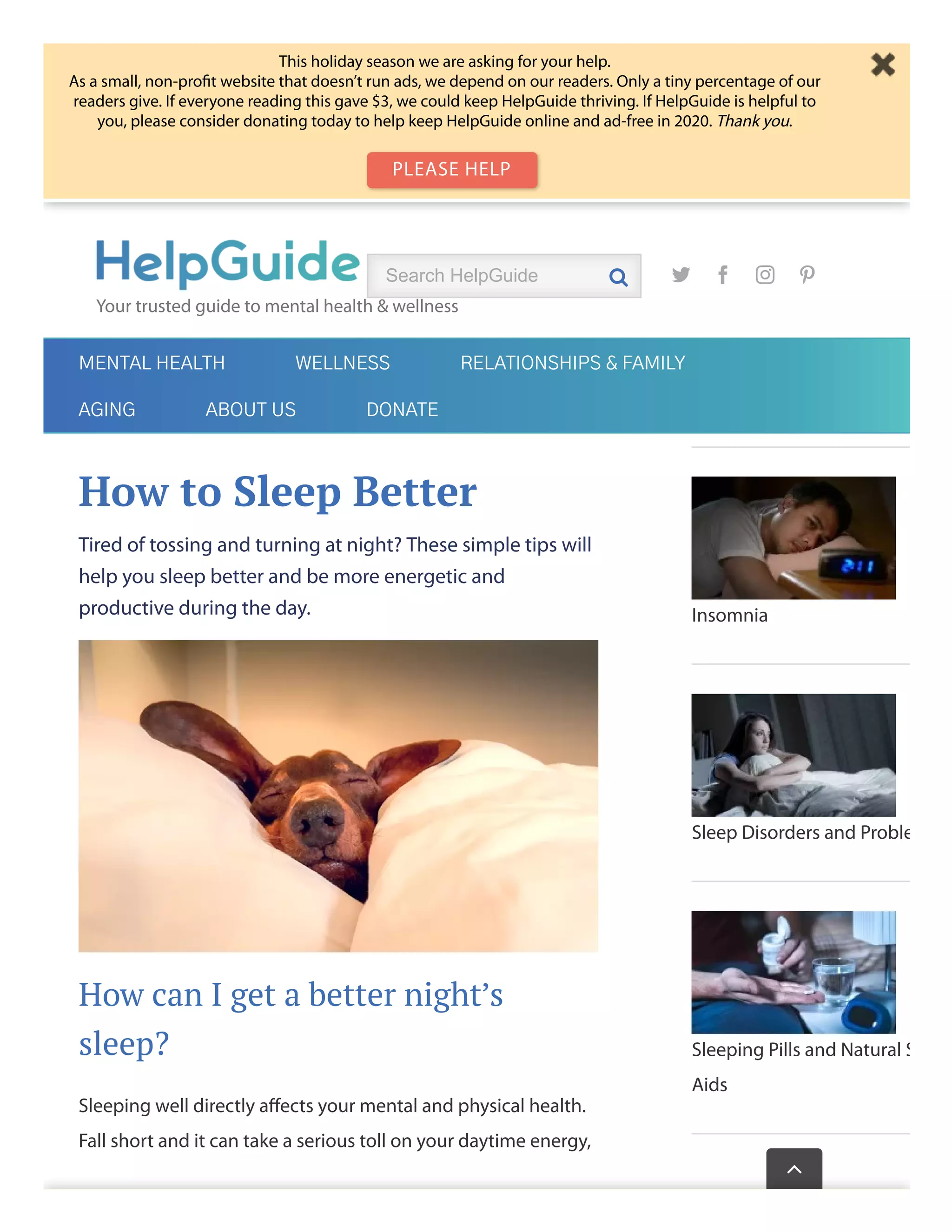
How can I get a better night’s
sleep?
Sleeping well directly affects your mental and physical health.
Fall short and it can take a serious toll on your daytime energy,
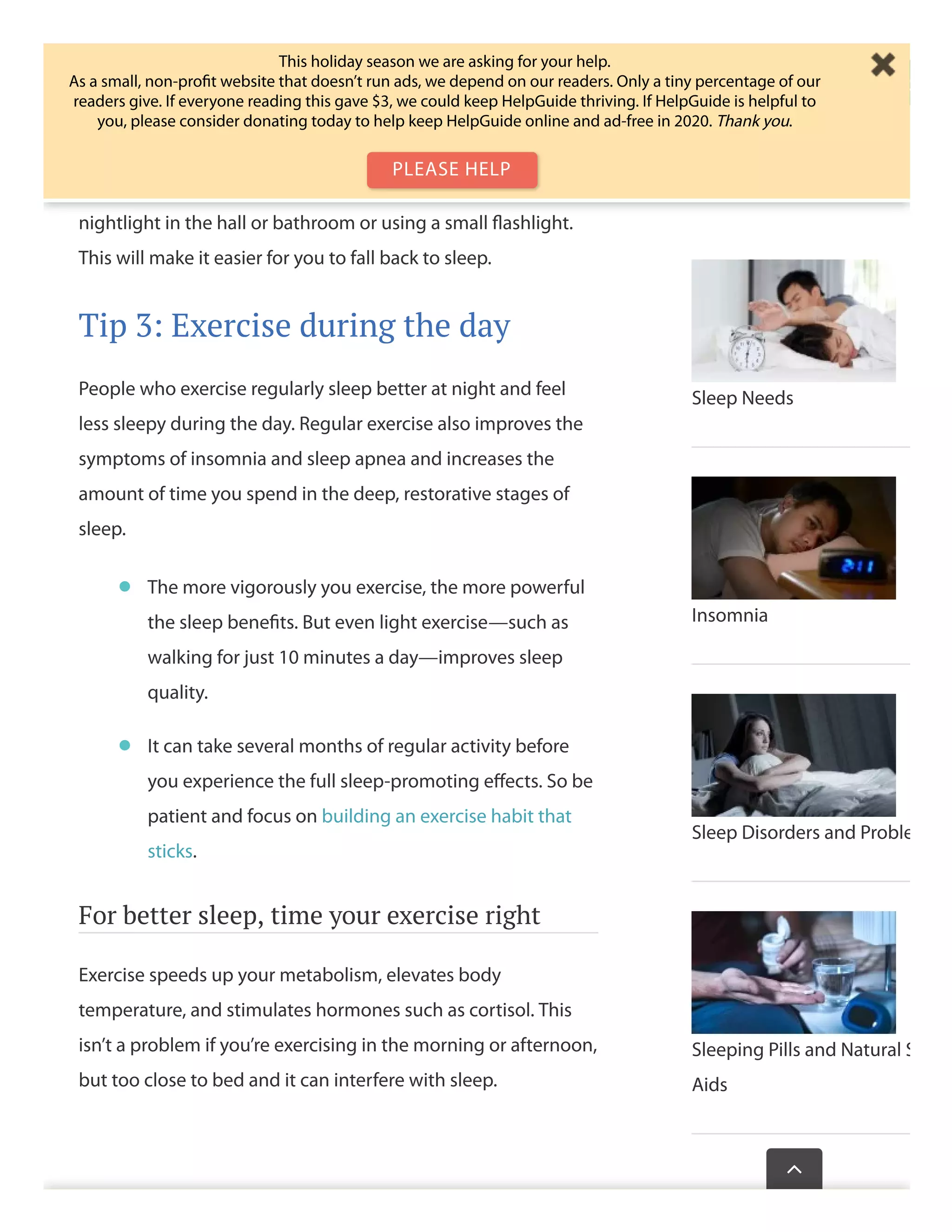
Sleep Needs
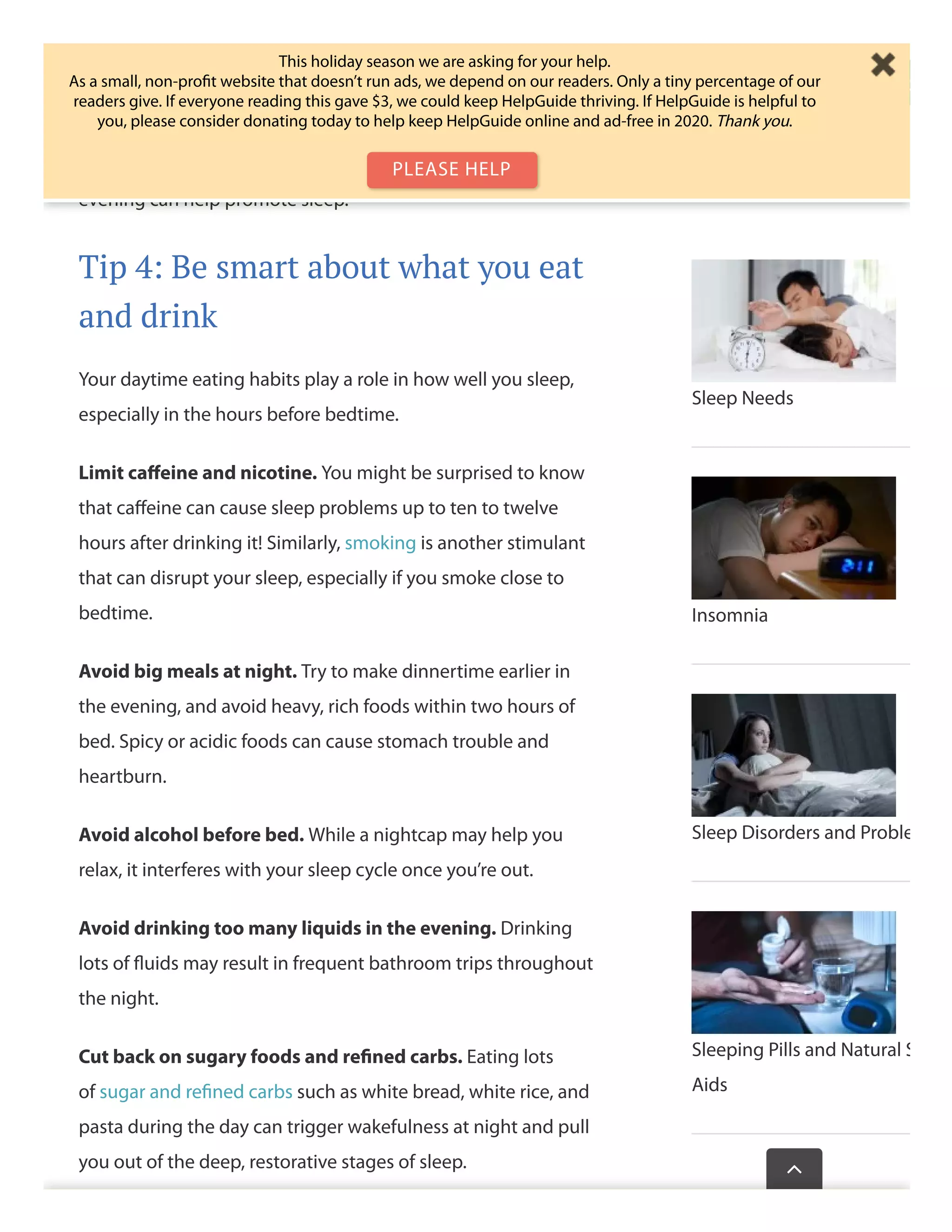
Insomnia
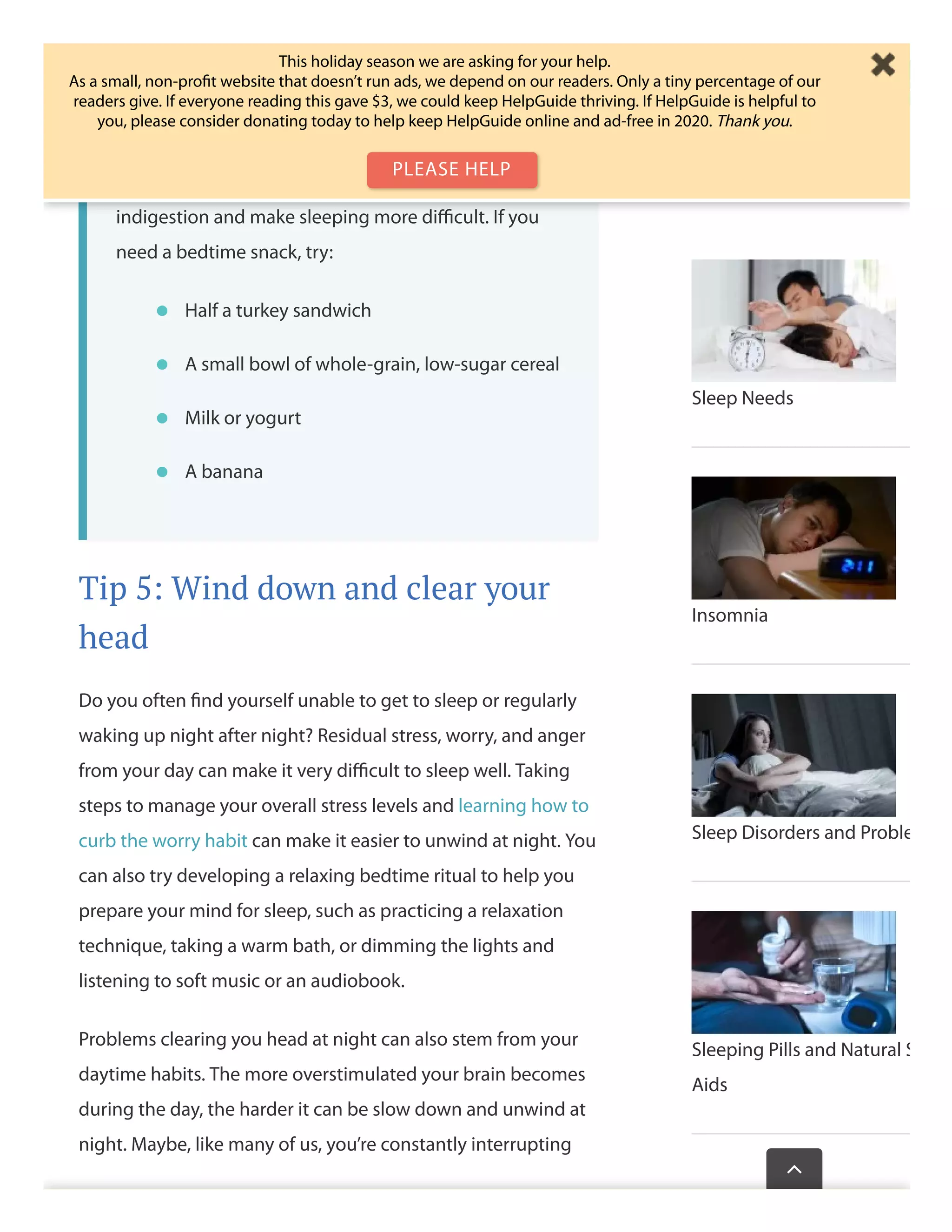
Sleep Disorders and Proble
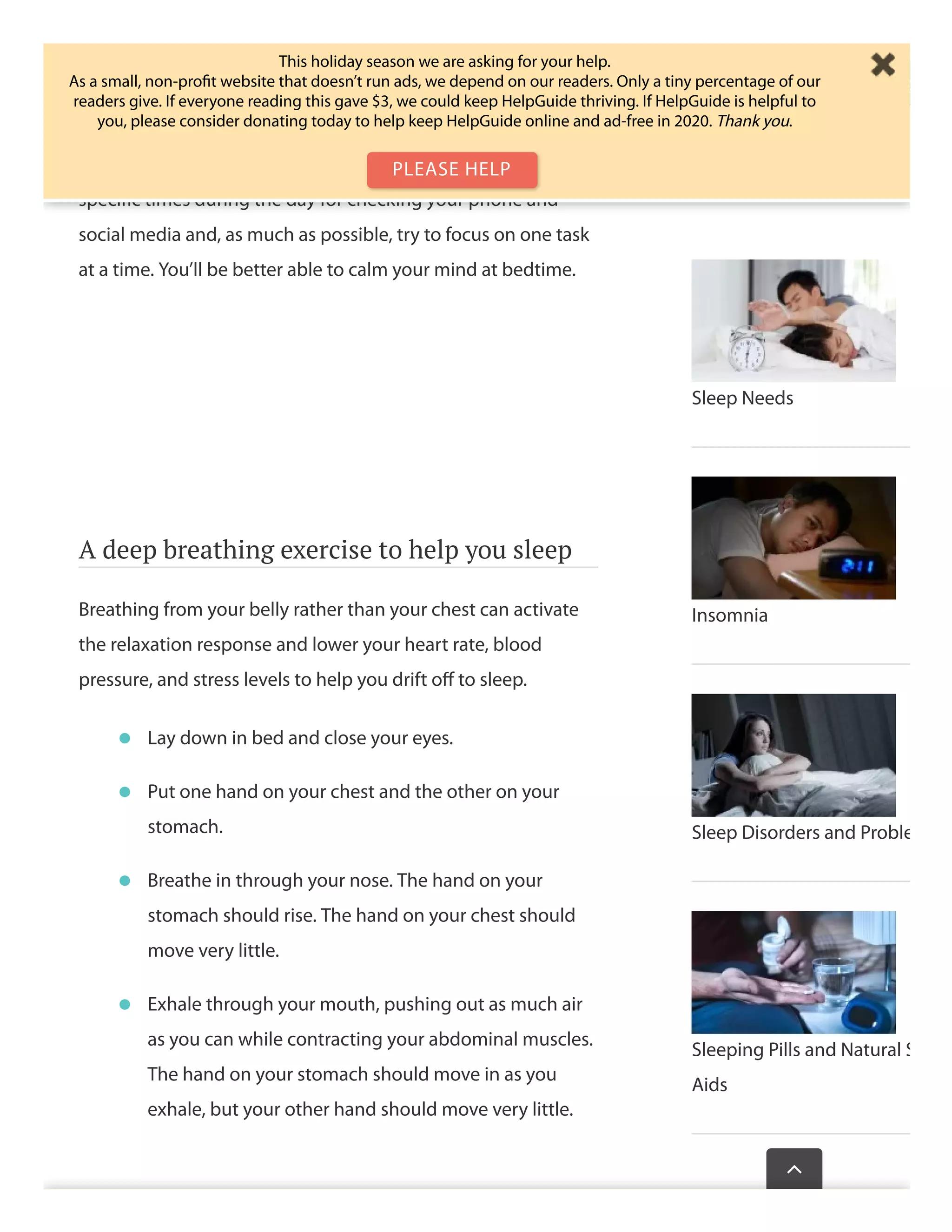
Sleeping Pills and Natural S
Aids
Your trusted guide to mental health & wellness
Search HelpGuide     
MENTAL HEALTH WELLNESS RELATIONSHIPS & FAMILY
AGING ABOUT US DONATE

This holiday season we are asking for your help.
As a small, non-profit website that doesn’t run ads, we depend on our readers. Only a tiny percentage of our
readers give. If everyone reading this gave $3, we could keep HelpGuide thriving. If HelpGuide is helpful to
you, please consider donating today to help keep HelpGuide online and ad-free in 2020. Thank you.
PLEASE HELP
productivity, emotional balance, and even your weight. Yet
many of us regularly toss and turn at night, struggling to get
the sleep we need. Getting a good night’s sleep may seem like
an impossible goal when you’re wide awake at 3 a.m., but you
have much more control over the quality of your sleep than
you probably realize. Just as the way you feel during your
waking hours often hinges on how well you sleep at night, so
the cure for sleep difficulties can often be found in your daily
routine.
Unhealthy daytime habits and lifestyle choices can leave you
tossing and turning at night and adversely affect your mood,
brain and heart health, immune system, creativity, vitality, and
weight. But by experimenting with the following tips, you can
enjoy better sleep at night, boost your health, and improve
how you think and feel during the day.
Tip 1: Keep in sync with your
body’s natural sleep-wake cycle
Getting in sync with your body’s natural sleep-wake cycle, or
circadian rhythm, is one of the most important strategies for
sleeping better. If you keep a regular sleep-wake schedule,
you’ll feel much more refreshed and energized than if you
sleep the same number of hours at different times, even if you
only alter your sleep schedule by an hour or two.
Try to go to sleep and get up at the same time every day.
This helps set your body’s internal clock and optimize the
quality of your sleep. Choose a bed time when you normally
feel tired, so that you don’t toss and turn. If you’re getting
enough sleep, you should wake up naturally without an alarm.
If you need an alarm clock, you may need an earlier bedtime.
Sleep Needs
Insomnia
Sleep Disorders and Proble
Sleeping Pills and Natural S
Aids
Wasthispagehelp

This holiday season we are asking for your help.
As a small, non-profit website that doesn’t run ads, we depend on our readers. Only a tiny percentage of our
readers give. If everyone reading this gave $3, we could keep HelpGuide thriving. If HelpGuide is helpful to
you, please consider donating today to help keep HelpGuide online and ad-free in 2020. Thank you.
PLEASE HELP
Avoid sleeping in—even on weekends. The more your
weekend/weekday sleep schedules differ, the worse the jetlag-
like symptoms you’ll experience. If you need to make up for a
late night, opt for a daytime nap rather than sleeping in. This
allows you to pay off your sleep debt without disturbing your
natural sleep-wake rhythm.
Be smart about napping. While napping is a good way to
make up for lost sleep, if you have trouble falling asleep or
staying asleep at night, napping can make things worse. Limit
naps to 15 to 20 minutes in the early afternoon.
Fight after-dinner drowsiness. If you get sleepy way before
your bedtime, get off the couch and do something mildly
stimulating, such as washing the dishes, calling a friend, or
getting clothes ready for the next day. If you give in to the
drowsiness, you may wake up later in the night and have
trouble getting back to sleep.
Tip 2: Control your exposure to
light
Melatonin is a naturally occurring hormone controlled by light
exposure that helps regulate your sleep-wake cycle. Your brain
secretes more melatonin when it’s dark—making you sleepy—
and less when it’s light—making you more alert. However,
many aspects of modern life can alter your body’s production
of melatonin and shift your circadian rhythm.
How to influence your exposure to light
During the day:
Sleep Needs
Insomnia
Sleep Disorders and Proble
Sleeping Pills and Natural S
Aids
Wasthispagehelp

This holiday season we are asking for your help.
As a small, non-profit website that doesn’t run ads, we depend on our readers. Only a tiny percentage of our
readers give. If everyone reading this gave $3, we could keep HelpGuide thriving. If HelpGuide is helpful to
you, please consider donating today to help keep HelpGuide online and ad-free in 2020. Thank you.
PLEASE HELP
Expose yourself to bright sunlight in the morning. The
closer to the time you get up, the better. Have your coffee
outside, for example, or eat breakfast by a sunny window. The
light on your face will help you wake up
Spend more time outside during daylight. Take your work
breaks outside in sunlight, exercise outside, or walk your dog
during the day instead of at night.
Let as much natural light into your home or workspace as
possible. Keep curtains and blinds open during the day, and
try to move your desk closer to the window.
If necessary, use a light therapy box. This simulates sunshine
and can be especially useful during short winter days.
At night:
Avoid bright screens within 1-2 hours of your bedtime. The
blue light emitted by your phone, tablet, computer, or TV is
especially disruptive. You can minimize the impact by using
devices with smaller screens, turning the brightness down, or
using light-altering software such as f.lux.
Say no to late-night television. Not only does the light from a
TV suppress melatonin, but many programs are stimulating
rather than relaxing. Try listening to music or audio books
instead.
Don’t read with backlit devices. Tablets that are backlit are
more disruptive than e-readers that don’t have their own light
source.
When it’s time to sleep, make sure the room is dark. Use
heavy curtains or shades to block light from windows, or try a
Sleep Needs
Insomnia
Sleep Disorders and Proble
Sleeping Pills and Natural S
Aids
Wasthispagehelp

This holiday season we are asking for your help.
As a small, non-profit website that doesn’t run ads, we depend on our readers. Only a tiny percentage of our
readers give. If everyone reading this gave $3, we could keep HelpGuide thriving. If HelpGuide is helpful to
you, please consider donating today to help keep HelpGuide online and ad-free in 2020. Thank you.
PLEASE HELP
sleep mask. Also consider covering up electronics that emit
light.
Keep the lights down if you get up during the night. If you
need some light to move around safely, try installing a dim
nightlight in the hall or bathroom or using a small flashlight.
This will make it easier for you to fall back to sleep.
Tip 3: Exercise during the day
People who exercise regularly sleep better at night and feel
less sleepy during the day. Regular exercise also improves the
symptoms of insomnia and sleep apnea and increases the
amount of time you spend in the deep, restorative stages of
sleep.
For better sleep, time your exercise right
Exercise speeds up your metabolism, elevates body
temperature, and stimulates hormones such as cortisol. This
isn’t a problem if you’re exercising in the morning or afternoon,
but too close to bed and it can interfere with sleep.
The more vigorously you exercise, the more powerful
the sleep benefits. But even light exercise—such as
walking for just 10 minutes a day—improves sleep
quality.
•
It can take several months of regular activity before
you experience the full sleep-promoting effects. So be
patient and focus on building an exercise habit that
sticks.
•
Sleep Needs
Insomnia
Sleep Disorders and Proble
Sleeping Pills and Natural S
Aids
Wasthispagehelp

This holiday season we are asking for your help.
As a small, non-profit website that doesn’t run ads, we depend on our readers. Only a tiny percentage of our
readers give. If everyone reading this gave $3, we could keep HelpGuide thriving. If HelpGuide is helpful to
you, please consider donating today to help keep HelpGuide online and ad-free in 2020. Thank you.
PLEASE HELP
Try to finish moderate to vigorous workouts at least three
hours before bedtime. If you’re still experiencing sleep
difficulties, move your workouts even earlier. Relaxing, low-
impact exercises such as yoga or gentle stretching in the
evening can help promote sleep.
Tip 4: Be smart about what you eat
and drink
Your daytime eating habits play a role in how well you sleep,
especially in the hours before bedtime.
Limit caffeine and nicotine. You might be surprised to know
that caffeine can cause sleep problems up to ten to twelve
hours after drinking it! Similarly, smoking is another stimulant
that can disrupt your sleep, especially if you smoke close to
bedtime.
Avoid big meals at night. Try to make dinnertime earlier in
the evening, and avoid heavy, rich foods within two hours of
bed. Spicy or acidic foods can cause stomach trouble and
heartburn.
Avoid alcohol before bed. While a nightcap may help you
relax, it interferes with your sleep cycle once you’re out.
Avoid drinking too many liquids in the evening. Drinking
lots of fluids may result in frequent bathroom trips throughout
the night.
Cut back on sugary foods and refined carbs. Eating lots
of sugar and refined carbs such as white bread, white rice, and
pasta during the day can trigger wakefulness at night and pull
you out of the deep, restorative stages of sleep.
Sleep Needs
Insomnia
Sleep Disorders and Proble
Sleeping Pills and Natural S
Aids
Wasthispagehelp

This holiday season we are asking for your help.
As a small, non-profit website that doesn’t run ads, we depend on our readers. Only a tiny percentage of our
readers give. If everyone reading this gave $3, we could keep HelpGuide thriving. If HelpGuide is helpful to
you, please consider donating today to help keep HelpGuide online and ad-free in 2020. Thank you.
PLEASE HELP
Nighttime snacks help you sleepNighttime snacks help you sleep
For some people, a light snack before bed can helpFor some people, a light snack before bed can help
promote sleep. For others, eating before bed leads topromote sleep. For others, eating before bed leads to
indigestion and make sleeping more difficult. If youindigestion and make sleeping more difficult. If you
need a bedtime snack, try:need a bedtime snack, try:
Tip 5: Wind down and clear your
head
Do you often find yourself unable to get to sleep or regularly
waking up night after night? Residual stress, worry, and anger
from your day can make it very difficult to sleep well. Taking
steps to manage your overall stress levels and learning how to
curb the worry habit can make it easier to unwind at night. You
can also try developing a relaxing bedtime ritual to help you
prepare your mind for sleep, such as practicing a relaxation
technique, taking a warm bath, or dimming the lights and
listening to soft music or an audiobook.
Problems clearing you head at night can also stem from your
daytime habits. The more overstimulated your brain becomes
during the day, the harder it can be slow down and unwind at
night. Maybe, like many of us, you’re constantly interrupting
Half a turkey sandwichHalf a turkey sandwich••
A small bowl of whole-grain, low-sugar cerealA small bowl of whole-grain, low-sugar cereal••
Milk or yogurtMilk or yogurt••
A bananaA banana••
Sleep Needs
Insomnia
Sleep Disorders and Proble
Sleeping Pills and Natural S
Aids
Wasthispagehelp

This holiday season we are asking for your help.
As a small, non-profit website that doesn’t run ads, we depend on our readers. Only a tiny percentage of our
readers give. If everyone reading this gave $3, we could keep HelpGuide thriving. If HelpGuide is helpful to
you, please consider donating today to help keep HelpGuide online and ad-free in 2020. Thank you.
PLEASE HELP
tasks during the day to check your phone, email, or social
media. Then when it comes to getting to sleep at night, your
brain is so accustomed to seeking fresh stimulation, it
becomes difficult to unwind. Help yourself by setting aside
specific times during the day for checking your phone and
social media and, as much as possible, try to focus on one task
at a time. You’ll be better able to calm your mind at bedtime.
A deep breathing exercise to help you sleep
Breathing from your belly rather than your chest can activate
the relaxation response and lower your heart rate, blood
pressure, and stress levels to help you drift off to sleep.
Lay down in bed and close your eyes.•
Put one hand on your chest and the other on your
stomach.
•
Breathe in through your nose. The hand on your
stomach should rise. The hand on your chest should
move very little.
•
Exhale through your mouth, pushing out as much air
as you can while contracting your abdominal muscles.
The hand on your stomach should move in as you
exhale, but your other hand should move very little.
•
Sleep Needs
Insomnia
Sleep Disorders and Proble
Sleeping Pills and Natural S
Aids
Wasthispagehelp

This holiday season we are asking for your help.
As a small, non-profit website that doesn’t run ads, we depend on our readers. Only a tiny percentage of our
readers give. If everyone reading this gave $3, we could keep HelpGuide thriving. If HelpGuide is helpful to
you, please consider donating today to help keep HelpGuide online and ad-free in 2020. Thank you.
PLEASE HELP
A body scan exercise to help you sleep
By focusing your attention on different parts of your body, you
can identify where you’re holding any stress or tension, and
release it.
Continue to breathe in through your nose and out
through your mouth. Try to inhale enough so that
your lower abdomen rises and falls. Count slowly as
you exhale.
•
Lie on your back, legs uncrossed, arms relaxed at your
sides, eyes closed. Focus on your breathing for about
two minutes until you start to feel relaxed.
•
Turn your focus to the toes of your right foot. Notice
any tension while continuing to also focus on your
breathing. Imagine each deep breath flowing to your
toes. Remain focused on this area for at least three to
five seconds.
•
Move your focus to the sole of your right foot. Tune in
to any sensations you feel in that part of your body
and imagine each breath flowing from the sole of your
foot. Then move your focus to your right ankle and
repeat. Move to your calf, knee, thigh, hip, and then
repeat the sequence for your left leg. From there,
move up your torso, through your lower back and
abdomen, your upper back and chest, and your
shoulders. Pay close attention to any area of the body
that feels tense.
•
After completing the body scan, relax, noting how
your body feels. You should feel so relaxed you can
•
Sleep Needs
Insomnia
Sleep Disorders and Proble
Sleeping Pills and Natural S
Aids
Wasthispagehelp

This holiday season we are asking for your help.
As a small, non-profit website that doesn’t run ads, we depend on our readers. Only a tiny percentage of our
readers give. If everyone reading this gave $3, we could keep HelpGuide thriving. If HelpGuide is helpful to
you, please consider donating today to help keep HelpGuide online and ad-free in 2020. Thank you.
PLEASE HELP
For more meditations to help you wind down and clear your
head at bedtime, see Relaxation Techniques for Stress Relief.
Tip 6: Improve your sleep
environment
A peaceful bedtime routine sends a powerful signal to your
brain that it’s time to wind down and let go of the day’s
stresses. Sometimes even small changes to your environment
can make a big difference to your quality of sleep.
Keep your room dark, cool, and quiet
Keep noise down. If you can’t avoid or eliminate noise from
neighbors, traffic, or other people in your household, try
masking it with a fan or sound machine. Earplugs may also
help.
Keep your room cool. Most people sleep best in a slightly cool
room (around 65° F or 18° C) with adequate ventilation. A
bedroom that is too hot or too cold can interfere with quality
sleep.
Make sure your bed is comfortable. Your bed covers should
leave you enough room to stretch and turn comfortably
without becoming tangled. If you often wake up with a sore
back or an aching neck, you may need to experiment with
different levels of mattress firmness, foam toppers, and pillows
that provide more or less support.
Reserve your bed for sleeping and sex. By not working,
watching TV, or using your phone, tablet, or computer in bed,
easily fall asleep.
Sleep Needs
Insomnia
Sleep Disorders and Proble
Sleeping Pills and Natural S
Aids
Wasthispagehelp

This holiday season we are asking for your help.
As a small, non-profit website that doesn’t run ads, we depend on our readers. Only a tiny percentage of our
readers give. If everyone reading this gave $3, we could keep HelpGuide thriving. If HelpGuide is helpful to
you, please consider donating today to help keep HelpGuide online and ad-free in 2020. Thank you.
PLEASE HELP
your brain will associate the bedroom with just sleep and sex,
which makes it easier to wind down at night.
Tip 7: Learn ways to get back to
sleep
It’s normal to wake briefly during the night but if you’re
having trouble falling back asleep, these tips may help:
Stay out of your head. Hard as it may be, try not to stress over
your inability to fall asleep again, because that stress only
encourages your body to stay awake. To stay out of your head,
focus on the feelings in your body or practice breathing
exercises. Take a breath in, then breathe out slowly while
saying or thinking the word, “Ahhh.” Take another breath and
repeat.
Make relaxation your goal, not sleep. If you find it hard to
fall back asleep, try a relaxation technique such as
visualization, progressive muscle relaxation, or meditation,
which can be done without even getting out of bed. Even
though it’s not a replacement for sleep, relaxation can still help
rejuvenate your body.
Do a quiet, non-stimulating activity. If you’ve been awake
for more than 15 minutes, get out of bed and do a quiet, non-
stimulating activity, such as reading a book. Keep the lights
dim and avoid screens so as not to cue your body that it’s time
to wake up.
Postpone worrying and brainstorming. If you wake during
the night feeling anxious about something, make a brief note
of it on paper and postpone worrying about it until the next
Sleep Needs
Insomnia
Sleep Disorders and Proble
Sleeping Pills and Natural S
Aids
Wasthispagehelp

This holiday season we are asking for your help.
As a small, non-profit website that doesn’t run ads, we depend on our readers. Only a tiny percentage of our
readers give. If everyone reading this gave $3, we could keep HelpGuide thriving. If HelpGuide is helpful to
you, please consider donating today to help keep HelpGuide online and ad-free in 2020. Thank you.
PLEASE HELP
 Print PDF
day when it will be easier to resolve. Similarly, if a great idea is
keeping you awake, make a note of it on paper and fall back to
sleep knowing you’ll be much more productive after a good
night’s rest.
Authors: Melinda Smith, M.A., Lawrence Robinson, and
Robert Segal, M.A. Last updated: August 2019.
Get more help
Sleep Needs
Insomnia
Sleep Disorders and Proble
Sleeping Pills and Natural S
Aids
Wasthispagehelp
   
HelpGuide's Supporters
Privacy Policy
Terms of Use
Contact Us
About Us
Harvard Collaboration
Get our newsletter
Weekly mental health & wellness
tips.
email address Subscribe
HELPGUIDEORG INTERNATIONAL is a tax-exempt 501(c)3 organization (ID #45-4510670). Our content does not
constitute a medical or psychological consultation. See a certified medical or mental health professional for
diagnosis. Learn more.
© 1999-2019 HelpGuide.org. All rights reserved.

This holiday season we are asking for your help.
As a small, non-profit website that doesn’t run ads, we depend on our readers. Only a tiny percentage of our
readers give. If everyone reading this gave $3, we could keep HelpGuide thriving. If HelpGuide is helpful to
you, please consider donating today to help keep HelpGuide online and ad-free in 2020. Thank you.
PLEASE HELP

How to Sleep Better

  • 1.
    How to SleepBetter Tired of tossing and turning at night? These simple tips will help you sleep better and be more energetic and productive during the day. How can I get a better night’s sleep? Sleeping well directly affects your mental and physical health. Fall short and it can take a serious toll on your daytime energy, Sleep Needs Insomnia Sleep Disorders and Proble Sleeping Pills and Natural S Aids Your trusted guide to mental health & wellness Search HelpGuide      MENTAL HEALTH WELLNESS RELATIONSHIPS & FAMILY AGING ABOUT US DONATE  This holiday season we are asking for your help. As a small, non-profit website that doesn’t run ads, we depend on our readers. Only a tiny percentage of our readers give. If everyone reading this gave $3, we could keep HelpGuide thriving. If HelpGuide is helpful to you, please consider donating today to help keep HelpGuide online and ad-free in 2020. Thank you. PLEASE HELP
  • 2.
    productivity, emotional balance,and even your weight. Yet many of us regularly toss and turn at night, struggling to get the sleep we need. Getting a good night’s sleep may seem like an impossible goal when you’re wide awake at 3 a.m., but you have much more control over the quality of your sleep than you probably realize. Just as the way you feel during your waking hours often hinges on how well you sleep at night, so the cure for sleep difficulties can often be found in your daily routine. Unhealthy daytime habits and lifestyle choices can leave you tossing and turning at night and adversely affect your mood, brain and heart health, immune system, creativity, vitality, and weight. But by experimenting with the following tips, you can enjoy better sleep at night, boost your health, and improve how you think and feel during the day. Tip 1: Keep in sync with your body’s natural sleep-wake cycle Getting in sync with your body’s natural sleep-wake cycle, or circadian rhythm, is one of the most important strategies for sleeping better. If you keep a regular sleep-wake schedule, you’ll feel much more refreshed and energized than if you sleep the same number of hours at different times, even if you only alter your sleep schedule by an hour or two. Try to go to sleep and get up at the same time every day. This helps set your body’s internal clock and optimize the quality of your sleep. Choose a bed time when you normally feel tired, so that you don’t toss and turn. If you’re getting enough sleep, you should wake up naturally without an alarm. If you need an alarm clock, you may need an earlier bedtime. Sleep Needs Insomnia Sleep Disorders and Proble Sleeping Pills and Natural S Aids Wasthispagehelp  This holiday season we are asking for your help. As a small, non-profit website that doesn’t run ads, we depend on our readers. Only a tiny percentage of our readers give. If everyone reading this gave $3, we could keep HelpGuide thriving. If HelpGuide is helpful to you, please consider donating today to help keep HelpGuide online and ad-free in 2020. Thank you. PLEASE HELP
  • 3.
    Avoid sleeping in—evenon weekends. The more your weekend/weekday sleep schedules differ, the worse the jetlag- like symptoms you’ll experience. If you need to make up for a late night, opt for a daytime nap rather than sleeping in. This allows you to pay off your sleep debt without disturbing your natural sleep-wake rhythm. Be smart about napping. While napping is a good way to make up for lost sleep, if you have trouble falling asleep or staying asleep at night, napping can make things worse. Limit naps to 15 to 20 minutes in the early afternoon. Fight after-dinner drowsiness. If you get sleepy way before your bedtime, get off the couch and do something mildly stimulating, such as washing the dishes, calling a friend, or getting clothes ready for the next day. If you give in to the drowsiness, you may wake up later in the night and have trouble getting back to sleep. Tip 2: Control your exposure to light Melatonin is a naturally occurring hormone controlled by light exposure that helps regulate your sleep-wake cycle. Your brain secretes more melatonin when it’s dark—making you sleepy— and less when it’s light—making you more alert. However, many aspects of modern life can alter your body’s production of melatonin and shift your circadian rhythm. How to influence your exposure to light During the day: Sleep Needs Insomnia Sleep Disorders and Proble Sleeping Pills and Natural S Aids Wasthispagehelp  This holiday season we are asking for your help. As a small, non-profit website that doesn’t run ads, we depend on our readers. Only a tiny percentage of our readers give. If everyone reading this gave $3, we could keep HelpGuide thriving. If HelpGuide is helpful to you, please consider donating today to help keep HelpGuide online and ad-free in 2020. Thank you. PLEASE HELP
  • 4.
    Expose yourself tobright sunlight in the morning. The closer to the time you get up, the better. Have your coffee outside, for example, or eat breakfast by a sunny window. The light on your face will help you wake up Spend more time outside during daylight. Take your work breaks outside in sunlight, exercise outside, or walk your dog during the day instead of at night. Let as much natural light into your home or workspace as possible. Keep curtains and blinds open during the day, and try to move your desk closer to the window. If necessary, use a light therapy box. This simulates sunshine and can be especially useful during short winter days. At night: Avoid bright screens within 1-2 hours of your bedtime. The blue light emitted by your phone, tablet, computer, or TV is especially disruptive. You can minimize the impact by using devices with smaller screens, turning the brightness down, or using light-altering software such as f.lux. Say no to late-night television. Not only does the light from a TV suppress melatonin, but many programs are stimulating rather than relaxing. Try listening to music or audio books instead. Don’t read with backlit devices. Tablets that are backlit are more disruptive than e-readers that don’t have their own light source. When it’s time to sleep, make sure the room is dark. Use heavy curtains or shades to block light from windows, or try a Sleep Needs Insomnia Sleep Disorders and Proble Sleeping Pills and Natural S Aids Wasthispagehelp  This holiday season we are asking for your help. As a small, non-profit website that doesn’t run ads, we depend on our readers. Only a tiny percentage of our readers give. If everyone reading this gave $3, we could keep HelpGuide thriving. If HelpGuide is helpful to you, please consider donating today to help keep HelpGuide online and ad-free in 2020. Thank you. PLEASE HELP
  • 5.
    sleep mask. Alsoconsider covering up electronics that emit light. Keep the lights down if you get up during the night. If you need some light to move around safely, try installing a dim nightlight in the hall or bathroom or using a small flashlight. This will make it easier for you to fall back to sleep. Tip 3: Exercise during the day People who exercise regularly sleep better at night and feel less sleepy during the day. Regular exercise also improves the symptoms of insomnia and sleep apnea and increases the amount of time you spend in the deep, restorative stages of sleep. For better sleep, time your exercise right Exercise speeds up your metabolism, elevates body temperature, and stimulates hormones such as cortisol. This isn’t a problem if you’re exercising in the morning or afternoon, but too close to bed and it can interfere with sleep. The more vigorously you exercise, the more powerful the sleep benefits. But even light exercise—such as walking for just 10 minutes a day—improves sleep quality. • It can take several months of regular activity before you experience the full sleep-promoting effects. So be patient and focus on building an exercise habit that sticks. • Sleep Needs Insomnia Sleep Disorders and Proble Sleeping Pills and Natural S Aids Wasthispagehelp  This holiday season we are asking for your help. As a small, non-profit website that doesn’t run ads, we depend on our readers. Only a tiny percentage of our readers give. If everyone reading this gave $3, we could keep HelpGuide thriving. If HelpGuide is helpful to you, please consider donating today to help keep HelpGuide online and ad-free in 2020. Thank you. PLEASE HELP
  • 6.
    Try to finishmoderate to vigorous workouts at least three hours before bedtime. If you’re still experiencing sleep difficulties, move your workouts even earlier. Relaxing, low- impact exercises such as yoga or gentle stretching in the evening can help promote sleep. Tip 4: Be smart about what you eat and drink Your daytime eating habits play a role in how well you sleep, especially in the hours before bedtime. Limit caffeine and nicotine. You might be surprised to know that caffeine can cause sleep problems up to ten to twelve hours after drinking it! Similarly, smoking is another stimulant that can disrupt your sleep, especially if you smoke close to bedtime. Avoid big meals at night. Try to make dinnertime earlier in the evening, and avoid heavy, rich foods within two hours of bed. Spicy or acidic foods can cause stomach trouble and heartburn. Avoid alcohol before bed. While a nightcap may help you relax, it interferes with your sleep cycle once you’re out. Avoid drinking too many liquids in the evening. Drinking lots of fluids may result in frequent bathroom trips throughout the night. Cut back on sugary foods and refined carbs. Eating lots of sugar and refined carbs such as white bread, white rice, and pasta during the day can trigger wakefulness at night and pull you out of the deep, restorative stages of sleep. Sleep Needs Insomnia Sleep Disorders and Proble Sleeping Pills and Natural S Aids Wasthispagehelp  This holiday season we are asking for your help. As a small, non-profit website that doesn’t run ads, we depend on our readers. Only a tiny percentage of our readers give. If everyone reading this gave $3, we could keep HelpGuide thriving. If HelpGuide is helpful to you, please consider donating today to help keep HelpGuide online and ad-free in 2020. Thank you. PLEASE HELP
  • 7.
    Nighttime snacks helpyou sleepNighttime snacks help you sleep For some people, a light snack before bed can helpFor some people, a light snack before bed can help promote sleep. For others, eating before bed leads topromote sleep. For others, eating before bed leads to indigestion and make sleeping more difficult. If youindigestion and make sleeping more difficult. If you need a bedtime snack, try:need a bedtime snack, try: Tip 5: Wind down and clear your head Do you often find yourself unable to get to sleep or regularly waking up night after night? Residual stress, worry, and anger from your day can make it very difficult to sleep well. Taking steps to manage your overall stress levels and learning how to curb the worry habit can make it easier to unwind at night. You can also try developing a relaxing bedtime ritual to help you prepare your mind for sleep, such as practicing a relaxation technique, taking a warm bath, or dimming the lights and listening to soft music or an audiobook. Problems clearing you head at night can also stem from your daytime habits. The more overstimulated your brain becomes during the day, the harder it can be slow down and unwind at night. Maybe, like many of us, you’re constantly interrupting Half a turkey sandwichHalf a turkey sandwich•• A small bowl of whole-grain, low-sugar cerealA small bowl of whole-grain, low-sugar cereal•• Milk or yogurtMilk or yogurt•• A bananaA banana•• Sleep Needs Insomnia Sleep Disorders and Proble Sleeping Pills and Natural S Aids Wasthispagehelp  This holiday season we are asking for your help. As a small, non-profit website that doesn’t run ads, we depend on our readers. Only a tiny percentage of our readers give. If everyone reading this gave $3, we could keep HelpGuide thriving. If HelpGuide is helpful to you, please consider donating today to help keep HelpGuide online and ad-free in 2020. Thank you. PLEASE HELP
  • 8.
    tasks during theday to check your phone, email, or social media. Then when it comes to getting to sleep at night, your brain is so accustomed to seeking fresh stimulation, it becomes difficult to unwind. Help yourself by setting aside specific times during the day for checking your phone and social media and, as much as possible, try to focus on one task at a time. You’ll be better able to calm your mind at bedtime. A deep breathing exercise to help you sleep Breathing from your belly rather than your chest can activate the relaxation response and lower your heart rate, blood pressure, and stress levels to help you drift off to sleep. Lay down in bed and close your eyes.• Put one hand on your chest and the other on your stomach. • Breathe in through your nose. The hand on your stomach should rise. The hand on your chest should move very little. • Exhale through your mouth, pushing out as much air as you can while contracting your abdominal muscles. The hand on your stomach should move in as you exhale, but your other hand should move very little. • Sleep Needs Insomnia Sleep Disorders and Proble Sleeping Pills and Natural S Aids Wasthispagehelp  This holiday season we are asking for your help. As a small, non-profit website that doesn’t run ads, we depend on our readers. Only a tiny percentage of our readers give. If everyone reading this gave $3, we could keep HelpGuide thriving. If HelpGuide is helpful to you, please consider donating today to help keep HelpGuide online and ad-free in 2020. Thank you. PLEASE HELP
  • 9.
    A body scanexercise to help you sleep By focusing your attention on different parts of your body, you can identify where you’re holding any stress or tension, and release it. Continue to breathe in through your nose and out through your mouth. Try to inhale enough so that your lower abdomen rises and falls. Count slowly as you exhale. • Lie on your back, legs uncrossed, arms relaxed at your sides, eyes closed. Focus on your breathing for about two minutes until you start to feel relaxed. • Turn your focus to the toes of your right foot. Notice any tension while continuing to also focus on your breathing. Imagine each deep breath flowing to your toes. Remain focused on this area for at least three to five seconds. • Move your focus to the sole of your right foot. Tune in to any sensations you feel in that part of your body and imagine each breath flowing from the sole of your foot. Then move your focus to your right ankle and repeat. Move to your calf, knee, thigh, hip, and then repeat the sequence for your left leg. From there, move up your torso, through your lower back and abdomen, your upper back and chest, and your shoulders. Pay close attention to any area of the body that feels tense. • After completing the body scan, relax, noting how your body feels. You should feel so relaxed you can • Sleep Needs Insomnia Sleep Disorders and Proble Sleeping Pills and Natural S Aids Wasthispagehelp  This holiday season we are asking for your help. As a small, non-profit website that doesn’t run ads, we depend on our readers. Only a tiny percentage of our readers give. If everyone reading this gave $3, we could keep HelpGuide thriving. If HelpGuide is helpful to you, please consider donating today to help keep HelpGuide online and ad-free in 2020. Thank you. PLEASE HELP
  • 10.
    For more meditationsto help you wind down and clear your head at bedtime, see Relaxation Techniques for Stress Relief. Tip 6: Improve your sleep environment A peaceful bedtime routine sends a powerful signal to your brain that it’s time to wind down and let go of the day’s stresses. Sometimes even small changes to your environment can make a big difference to your quality of sleep. Keep your room dark, cool, and quiet Keep noise down. If you can’t avoid or eliminate noise from neighbors, traffic, or other people in your household, try masking it with a fan or sound machine. Earplugs may also help. Keep your room cool. Most people sleep best in a slightly cool room (around 65° F or 18° C) with adequate ventilation. A bedroom that is too hot or too cold can interfere with quality sleep. Make sure your bed is comfortable. Your bed covers should leave you enough room to stretch and turn comfortably without becoming tangled. If you often wake up with a sore back or an aching neck, you may need to experiment with different levels of mattress firmness, foam toppers, and pillows that provide more or less support. Reserve your bed for sleeping and sex. By not working, watching TV, or using your phone, tablet, or computer in bed, easily fall asleep. Sleep Needs Insomnia Sleep Disorders and Proble Sleeping Pills and Natural S Aids Wasthispagehelp  This holiday season we are asking for your help. As a small, non-profit website that doesn’t run ads, we depend on our readers. Only a tiny percentage of our readers give. If everyone reading this gave $3, we could keep HelpGuide thriving. If HelpGuide is helpful to you, please consider donating today to help keep HelpGuide online and ad-free in 2020. Thank you. PLEASE HELP
  • 11.
    your brain willassociate the bedroom with just sleep and sex, which makes it easier to wind down at night. Tip 7: Learn ways to get back to sleep It’s normal to wake briefly during the night but if you’re having trouble falling back asleep, these tips may help: Stay out of your head. Hard as it may be, try not to stress over your inability to fall asleep again, because that stress only encourages your body to stay awake. To stay out of your head, focus on the feelings in your body or practice breathing exercises. Take a breath in, then breathe out slowly while saying or thinking the word, “Ahhh.” Take another breath and repeat. Make relaxation your goal, not sleep. If you find it hard to fall back asleep, try a relaxation technique such as visualization, progressive muscle relaxation, or meditation, which can be done without even getting out of bed. Even though it’s not a replacement for sleep, relaxation can still help rejuvenate your body. Do a quiet, non-stimulating activity. If you’ve been awake for more than 15 minutes, get out of bed and do a quiet, non- stimulating activity, such as reading a book. Keep the lights dim and avoid screens so as not to cue your body that it’s time to wake up. Postpone worrying and brainstorming. If you wake during the night feeling anxious about something, make a brief note of it on paper and postpone worrying about it until the next Sleep Needs Insomnia Sleep Disorders and Proble Sleeping Pills and Natural S Aids Wasthispagehelp  This holiday season we are asking for your help. As a small, non-profit website that doesn’t run ads, we depend on our readers. Only a tiny percentage of our readers give. If everyone reading this gave $3, we could keep HelpGuide thriving. If HelpGuide is helpful to you, please consider donating today to help keep HelpGuide online and ad-free in 2020. Thank you. PLEASE HELP
  • 12.
     Print PDF daywhen it will be easier to resolve. Similarly, if a great idea is keeping you awake, make a note of it on paper and fall back to sleep knowing you’ll be much more productive after a good night’s rest. Authors: Melinda Smith, M.A., Lawrence Robinson, and Robert Segal, M.A. Last updated: August 2019. Get more help Sleep Needs Insomnia Sleep Disorders and Proble Sleeping Pills and Natural S Aids Wasthispagehelp     HelpGuide's Supporters Privacy Policy Terms of Use Contact Us About Us Harvard Collaboration Get our newsletter Weekly mental health & wellness tips. email address Subscribe HELPGUIDEORG INTERNATIONAL is a tax-exempt 501(c)3 organization (ID #45-4510670). Our content does not constitute a medical or psychological consultation. See a certified medical or mental health professional for diagnosis. Learn more. © 1999-2019 HelpGuide.org. All rights reserved.  This holiday season we are asking for your help. As a small, non-profit website that doesn’t run ads, we depend on our readers. Only a tiny percentage of our readers give. If everyone reading this gave $3, we could keep HelpGuide thriving. If HelpGuide is helpful to you, please consider donating today to help keep HelpGuide online and ad-free in 2020. Thank you. PLEASE HELP