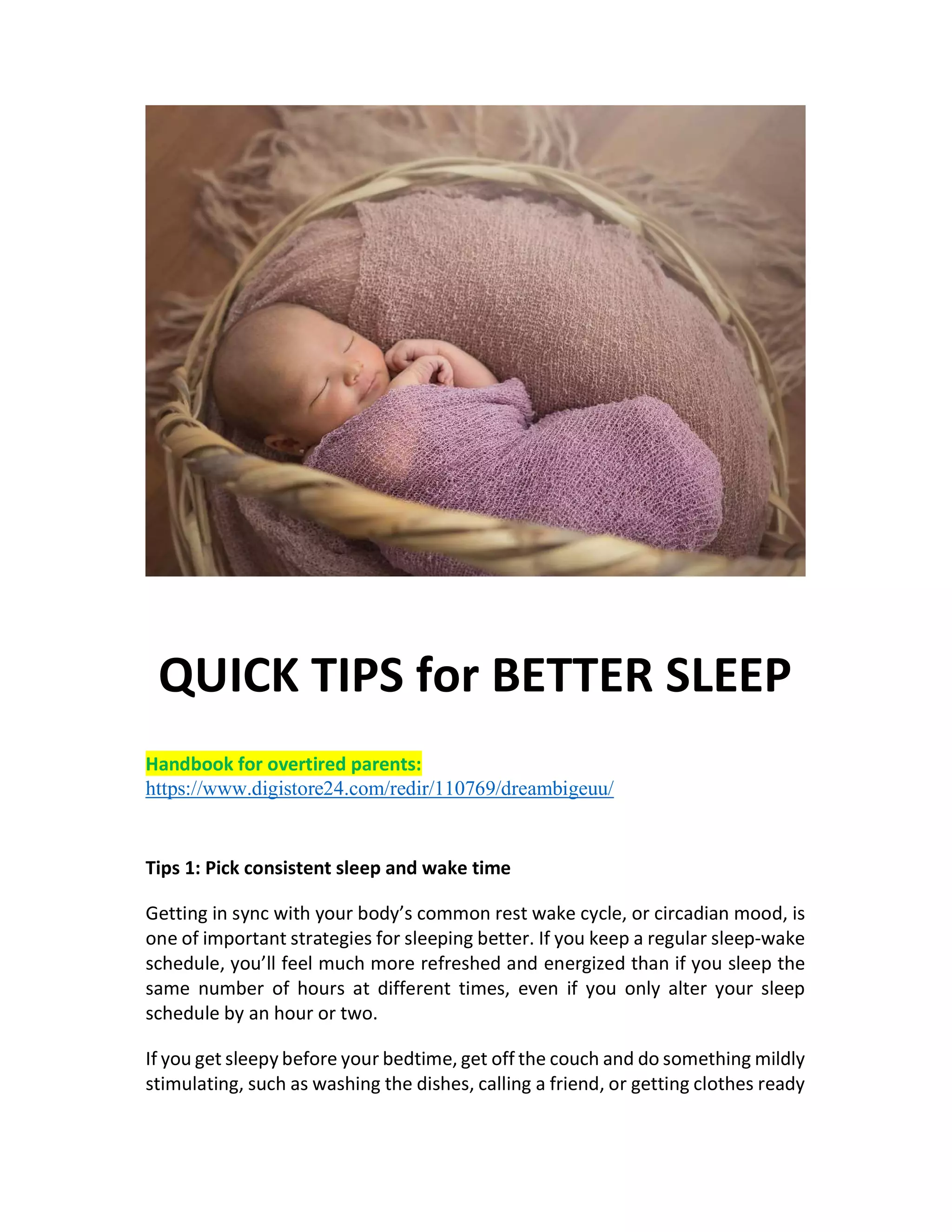
QUICK TIPS for BETTER SLEEP
Handbook for overtired parents:
https://www.digistore24.com/redir/110769/dreambigeuu/
Tips 1: Pick consistent sleep and wake time
Getting in sync with your body’s common rest wake cycle, or circadian mood, is
one of important strategies for sleeping better. If you keep a regular sleep-wake
schedule, you’ll feel much more refreshed and energized than if you sleep the
same number of hours at different times, even if you only alter your sleep
schedule by an hour or two.
If you get sleepy before your bedtime, get off the couch and do something mildly
stimulating, such as washing the dishes, calling a friend, or getting clothes ready
for the next day. If you give in to the drowsiness, you may wake up later in the
night and have trouble getting back to sleep.
Tips 2: Stay away from your gadget and electronic stuffs 1 hour before your
sleep time
Electronic back-lit devices like cell phones, tablets, readers, and computers emit
short-wavelength enriched light, also known as blue light. Fluorescent and LED
lights4
also emit blue light, which has been shown to reduce or delay the natural
production of melatonin in the evening and decrease feelings of sleepiness. Blue
light can also reduce the amount of time you spend in slow-wave and rapid-eye
movement (REM) sleep, two stages of the sleep cycle that are vital for cognitive
functioning.
While a lot of people prefer to keep a television in their bedroom, watching TV
before bed is generally discouraged due to the negative effect it can have on
your sleep. In fact, we recommend removing all of your electronic devices from
your bedroom – and encourage your kids to do the same.
Tips 3: Control your exposure to light
Light intensity is measured in a unit known as lux. Some studies have shown that
normal indoor light levels of 100 lux or more can suppress melatonin production
and interfere with your sleep-wake schedule. Dimmer indoor lighting affects
your melatonin production to a much lesser extent. Melatonin itself is a
hormone that your brain produces in response to darkness. Melatonin is a
naturally occurring hormone controlled by light exposure that helps regulate
your sleep-wake cycle. Being exposed to light at night can block melatonin
production.
Expose yourself to bright sunlight in the morning. The closer to the time you get
up, the better. Have your coffee outside, for example, or eat breakfast by a
sunny window. The light on your face will help you wake up
Spend more time outside during daylight. Take your work breaks outside in
sunlight, exercise outside, or walk your dog during the day instead of at night.
Let as much natural light into your home or workspace as possible. Keep curtains
and blinds open during the day and try to move your desk closer to the window.
Handbook for overtired parents:
https://www.digistore24.com/redir/110769/dreambigeuu/
Tips 4: Exercise during the day and Relax before bed time
People who exercise regularly sleep better at night and feel less sleepy during
the day. Regular exercise also improves the symptoms of insomnia and sleep
apnea and increases the amount of time you spend in the deep, restorative
stages of sleep.
Exercise speeds up your metabolism, elevates body temperature, and stimulates
hormones such as cortisol. This isn’t a problem if you’re exercising in the
morning or afternoon, but too close to bed and it can interfere with sleep.
Try to finish moderate to vigorous workouts at least three hours before bedtime.
If you’re still experiencing sleep difficulties, move your workouts even earlier.
Relaxing, low-impact exercises such as yoga or gentle stretching in the evening
can help promote sleep.
Tips 5: Be smart about what you eat and drink
Your daytime eating habits play a role in how well you sleep, especially in the
hours before bedtime.
Limit caffeine and nicotine. You might be surprised to know that caffeine can
cause sleep problems up to ten to twelve hours after drinking it!
Similarly, smoking is another stimulant that can disrupt your sleep, especially if
you smoke close to bedtime.
Avoid big meals at night. Try to make dinnertime earlier in the evening, and
avoid heavy, rich foods within two hours of bed. Spicy or acidic foods can cause
stomach trouble and heartburn.
Avoid alcohol before bed. While a nightcap may help you relax, it interferes with
your sleep cycle once you’re out.
Avoid drinking too many liquids in the evening. Drinking lots of fluids may result
in frequent bathroom trips throughout the night.
Cut back on sugary foods and refined carbs. Eating lots of sugar and refined
carbs such as white bread, white rice, and pasta during the day can trigger
wakefulness at night and pull you out of the deep, restorative stages of sleep.
Tips 6: Improve your sleep environment
A peaceful bedtime routine sends a powerful signal to your brain that it’s time
to wind down and let go of the day’s stresses. Sometimes even small changes to
your environment can make a big difference to your quality of sleep.
Keep your room dark, cool, and quiet
Keep noise down. If you can’t avoid or eliminate noise from neighbors, traffic,
or other people in your household, try masking it with a fan or sound machine.
Earplugs may also help.
Keep your room cool. Most people sleep best in a slightly cool room (around 65°
F or 18° C) with adequate ventilation. A bedroom that is too hot or too cold can
interfere with quality sleep.
Make sure your bed is comfortable. Your bed covers should leave you enough
room to stretch and turn comfortably without becoming tangled. If you often
wake up with a sore back or an aching neck, you may need to experiment with
different levels of mattress firmness, foam toppers, and pillows that provide
support.
Reserve your bed for sleeping and sex. By not working, watching TV, or using
your phone, tablet, or computer in bed, your brain will associate the bedroom
with just sleep and sex, which makes it easier to wind down at night.
Tip 7: Learn ways to get back to sleep
It’s normal to wake briefly during the night but if you’re having trouble falling
back asleep, these tips may help:
Stay out of your head. Hard as it may be, try not to stress over your inability to
fall asleep again, because that stress only encourages your body to stay awake.
To stay out of your head, focus on the feelings in your body or practice breathing
exercises. Take a breath in, then breathe out slowly while saying or thinking the
word, “Ahhh.” Take another breath and repeat.
Make relaxation your goal, not sleep. If you find it hard to fall back asleep, try a
relaxation technique such as visualization, progressive muscle relaxation, or
meditation, which can be done without even getting out of bed. Even though
it’s not a replacement for sleep, relaxation can still help rejuvenate your body.
Do a quiet, non-stimulating activity. If you’ve been awake for more than 15
minutes, get out of bed and do a quiet, non-stimulating activity, such as reading
a book. Keep the lights dim and avoid screens so as not to cue your body that
it’s time to wake up.
Postpone worrying and brainstorming. If you wake during the night feeling
anxious about something, make a brief note of it on paper and postpone
worrying about it until the next day when it will be easier to resolve. Similarly, if
a great idea is keeping you awake, make a note of it on paper and fall back to
sleep knowing you’ll be much more productive after a good night’s rest.
Handbook for overtired parents:
https://www.digistore24.com/redir/110769/dreambigeuu/
**Authors: Melinda Smith, M.A., Lawrence Robinson, and Robert Segal, M.A.

Quick tips for better sleep

  • 1.
    QUICK TIPS forBETTER SLEEP Handbook for overtired parents: https://www.digistore24.com/redir/110769/dreambigeuu/ Tips 1: Pick consistent sleep and wake time Getting in sync with your body’s common rest wake cycle, or circadian mood, is one of important strategies for sleeping better. If you keep a regular sleep-wake schedule, you’ll feel much more refreshed and energized than if you sleep the same number of hours at different times, even if you only alter your sleep schedule by an hour or two. If you get sleepy before your bedtime, get off the couch and do something mildly stimulating, such as washing the dishes, calling a friend, or getting clothes ready
  • 2.
    for the nextday. If you give in to the drowsiness, you may wake up later in the night and have trouble getting back to sleep. Tips 2: Stay away from your gadget and electronic stuffs 1 hour before your sleep time Electronic back-lit devices like cell phones, tablets, readers, and computers emit short-wavelength enriched light, also known as blue light. Fluorescent and LED lights4 also emit blue light, which has been shown to reduce or delay the natural production of melatonin in the evening and decrease feelings of sleepiness. Blue light can also reduce the amount of time you spend in slow-wave and rapid-eye movement (REM) sleep, two stages of the sleep cycle that are vital for cognitive functioning. While a lot of people prefer to keep a television in their bedroom, watching TV before bed is generally discouraged due to the negative effect it can have on your sleep. In fact, we recommend removing all of your electronic devices from your bedroom – and encourage your kids to do the same. Tips 3: Control your exposure to light Light intensity is measured in a unit known as lux. Some studies have shown that normal indoor light levels of 100 lux or more can suppress melatonin production and interfere with your sleep-wake schedule. Dimmer indoor lighting affects your melatonin production to a much lesser extent. Melatonin itself is a hormone that your brain produces in response to darkness. Melatonin is a naturally occurring hormone controlled by light exposure that helps regulate your sleep-wake cycle. Being exposed to light at night can block melatonin production. Expose yourself to bright sunlight in the morning. The closer to the time you get up, the better. Have your coffee outside, for example, or eat breakfast by a sunny window. The light on your face will help you wake up Spend more time outside during daylight. Take your work breaks outside in sunlight, exercise outside, or walk your dog during the day instead of at night. Let as much natural light into your home or workspace as possible. Keep curtains and blinds open during the day and try to move your desk closer to the window.
  • 3.
    Handbook for overtiredparents: https://www.digistore24.com/redir/110769/dreambigeuu/ Tips 4: Exercise during the day and Relax before bed time People who exercise regularly sleep better at night and feel less sleepy during the day. Regular exercise also improves the symptoms of insomnia and sleep apnea and increases the amount of time you spend in the deep, restorative stages of sleep. Exercise speeds up your metabolism, elevates body temperature, and stimulates hormones such as cortisol. This isn’t a problem if you’re exercising in the morning or afternoon, but too close to bed and it can interfere with sleep. Try to finish moderate to vigorous workouts at least three hours before bedtime. If you’re still experiencing sleep difficulties, move your workouts even earlier. Relaxing, low-impact exercises such as yoga or gentle stretching in the evening can help promote sleep. Tips 5: Be smart about what you eat and drink Your daytime eating habits play a role in how well you sleep, especially in the hours before bedtime. Limit caffeine and nicotine. You might be surprised to know that caffeine can cause sleep problems up to ten to twelve hours after drinking it! Similarly, smoking is another stimulant that can disrupt your sleep, especially if you smoke close to bedtime. Avoid big meals at night. Try to make dinnertime earlier in the evening, and avoid heavy, rich foods within two hours of bed. Spicy or acidic foods can cause stomach trouble and heartburn. Avoid alcohol before bed. While a nightcap may help you relax, it interferes with your sleep cycle once you’re out. Avoid drinking too many liquids in the evening. Drinking lots of fluids may result in frequent bathroom trips throughout the night.
  • 4.
    Cut back onsugary foods and refined carbs. Eating lots of sugar and refined carbs such as white bread, white rice, and pasta during the day can trigger wakefulness at night and pull you out of the deep, restorative stages of sleep. Tips 6: Improve your sleep environment A peaceful bedtime routine sends a powerful signal to your brain that it’s time to wind down and let go of the day’s stresses. Sometimes even small changes to your environment can make a big difference to your quality of sleep. Keep your room dark, cool, and quiet Keep noise down. If you can’t avoid or eliminate noise from neighbors, traffic, or other people in your household, try masking it with a fan or sound machine. Earplugs may also help. Keep your room cool. Most people sleep best in a slightly cool room (around 65° F or 18° C) with adequate ventilation. A bedroom that is too hot or too cold can interfere with quality sleep. Make sure your bed is comfortable. Your bed covers should leave you enough room to stretch and turn comfortably without becoming tangled. If you often wake up with a sore back or an aching neck, you may need to experiment with different levels of mattress firmness, foam toppers, and pillows that provide support. Reserve your bed for sleeping and sex. By not working, watching TV, or using your phone, tablet, or computer in bed, your brain will associate the bedroom with just sleep and sex, which makes it easier to wind down at night. Tip 7: Learn ways to get back to sleep It’s normal to wake briefly during the night but if you’re having trouble falling back asleep, these tips may help: Stay out of your head. Hard as it may be, try not to stress over your inability to fall asleep again, because that stress only encourages your body to stay awake. To stay out of your head, focus on the feelings in your body or practice breathing exercises. Take a breath in, then breathe out slowly while saying or thinking the word, “Ahhh.” Take another breath and repeat.
  • 5.
    Make relaxation yourgoal, not sleep. If you find it hard to fall back asleep, try a relaxation technique such as visualization, progressive muscle relaxation, or meditation, which can be done without even getting out of bed. Even though it’s not a replacement for sleep, relaxation can still help rejuvenate your body. Do a quiet, non-stimulating activity. If you’ve been awake for more than 15 minutes, get out of bed and do a quiet, non-stimulating activity, such as reading a book. Keep the lights dim and avoid screens so as not to cue your body that it’s time to wake up. Postpone worrying and brainstorming. If you wake during the night feeling anxious about something, make a brief note of it on paper and postpone worrying about it until the next day when it will be easier to resolve. Similarly, if a great idea is keeping you awake, make a note of it on paper and fall back to sleep knowing you’ll be much more productive after a good night’s rest. Handbook for overtired parents: https://www.digistore24.com/redir/110769/dreambigeuu/ **Authors: Melinda Smith, M.A., Lawrence Robinson, and Robert Segal, M.A.