



How to Select the
   Right ALT Approach
             ASQ Silicon Valley
             Quality Conference
                       by
        Fred Schenkelberg, CRE, CQE
Senior Reliability Engineer, Ops A La Carte LLC
     fms@opsalacarte.com // www.opsalacarte.com // (408) 710-8248
Objectives
• Introduce thought process
  to select ALT approach

• To discuss trade-off
  decisions involved

• To enable you to select
  the right ALT approach
  for your situation
Presenter Biography
Fred Schenkelberg is a Senior Reliability Engineering Consultant at Ops A La
    Carte. He is currently working with clients using reliability assessments as a
    starting point to develop and execute detailed reliability plans and programs.
    Also, he exercises his reliability engineering and statistical knowledge to
    design and conduct accelerated life tests.
Fred joined HP in February 1996 in Vancouver, WA. He joined ESTC, Palo Alto,
    CA., in January 1998 and co-founded the HP Product Reliability Team. He
    was responsible for the community building, consulting and training aspects of
    the Product Reliability Program. He was also responsible for research and
    development on selected product reliability management topics.
Prior to joining ESTC, he worked as a design for manufacturing engineer on
    DeskJet printers. Before HP he worked with Raychem Corporation in various
    positions, including research and development of accelerated life testing of
    polymer based heating cables.
He has a Bachelors of Science in Physics from the United States Military
    Academy and a Masters of Science in Statistics from Stanford University.
    Fred is an active member of the RAMS Management Committee and currently
    the IEEE Reliability Society Santa Clara Valley Chapter President.
• Respect constraints
  – Time, expenses, sample size, accuracy
• Use use conditions
  – Environment, frequency, loading
• Minimize assumptions
  – Statistical, modeling, variability
• Focus on failure mechanisms
  – Stress, damage, measurement


              Guiding Principles
With no constraints
• Build products and deploy,
   measure time to failure

   for every unit.

  – Real time
  – Real stresses
  – Real variability
  – “Customer” defines failure
Paperclip Experiment 1
           • What is use profile?

           • Environment

           • Probability of success

           • Duration

           • Failure definition
No Constraints


• Benefits
  – Perfect results
  – No assumptions

• Problems
  – Takes time
  – No Sales, or
  – Customer risk
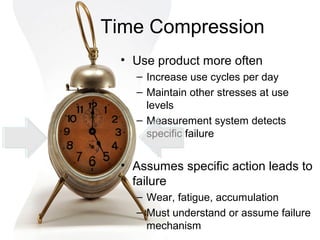
Time Compression
 • Use product more often
   – Increase use cycles per day
   – Maintain other stresses at use
     levels
   – Measurement system detects
     specific failure


 • Assumes specific action leads to
   failure
   – Wear, fatigue, accumulation
   – Must understand or assume failure
     mechanism
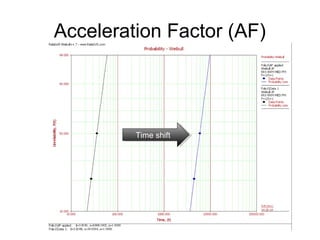
Acceleration Factor (AF)


         Time shift
          Time shift
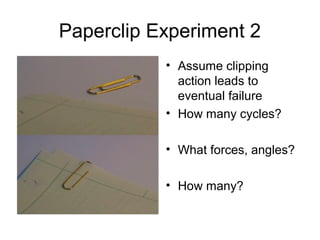
Paperclip Experiment 2
           • Assume clipping
             action leads to
             eventual failure
           • How many cycles?

           • What forces, angles?

           • How many?
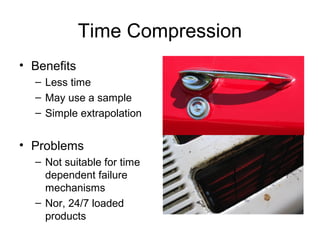
Time Compression
• Benefits
  – Less time
  – May use a sample
  – Simple extrapolation


• Problems
  – Not suitable for time
    dependent failure
    mechanisms
  – Nor, 24/7 loaded
    products
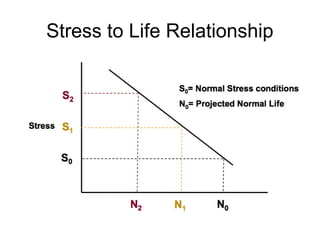
Stress to Life Relationship
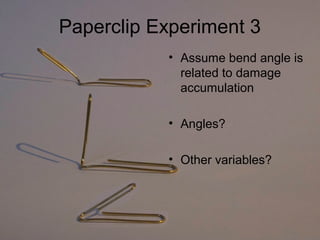
Paperclip Experiment 3
           • Assume bend angle is
             related to damage
             accumulation

           • Angles?

           • Other variables?
Stress to Life Relationship
• Benefits
  – Creates AF model
  – Product of use specific

• Problems
  – 1 or 2 stresses or
    failure mechanisms
  – Logistically challenging
Acceleration Model
• A model exists describing the stress
  to life relationship
  – Arrhenius, Peck, Coffin-Manson, prior
    work
  – The failure mechanism,
    use profile, and environment
    within applicable limits of model


• If failure mechanism doesn’t
  change, may use comparative testing
  in absence of model, giving up on
  accuracy of result.
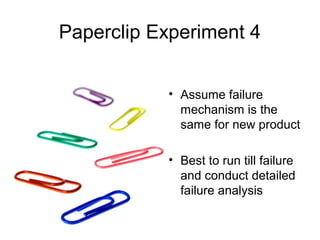
Paperclip Experiment 4


           • Assume failure
             mechanism is the
             same for new product

           • Best to run till failure
             and conduct detailed
             failure analysis
Acceleration Model
• Benefits
  – Single stress to apply
  – Fewer samples


• Problems
  – Assumptions
    multiplying
  – May miss new failure
    mechanism
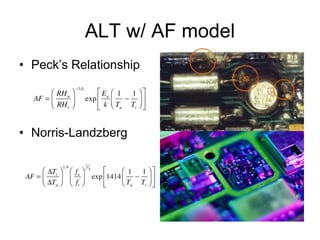
ALT w/ AF model
• Peck’s Relationship


• Norris-Landzberg
Step Stress

• Variation of acceleration model ALT, with
  samples experiencing step increases in
  stress
  – Quicker than acceleration model method
  – May require more samples
  – Requires careful control of stress and failure
    detection
  – Best with accumulated damage failure
    mechanisms
Degradation


• Useful when performance decays over
  time in a measurable way
  – Often used with an acceleration model
  – Failure is defined by threshold value
  – Non destructive measurements permit
    repeated measures on samples
ALT Limits
     • Extrapolation

     • Stresses

     • Failure Mechanisms
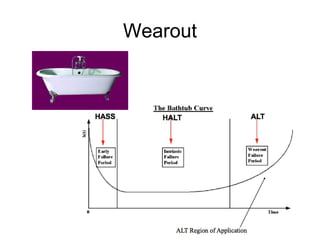
Wearout
Sample Size
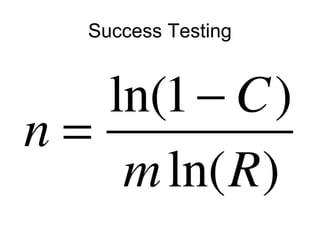
Success Testing
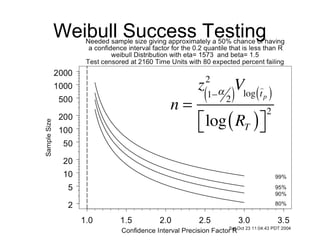
Weibull Success Testing

How to Select the Right ALT Approach

  • 1.
    How to Selectthe Right ALT Approach ASQ Silicon Valley Quality Conference by Fred Schenkelberg, CRE, CQE Senior Reliability Engineer, Ops A La Carte LLC fms@opsalacarte.com // www.opsalacarte.com // (408) 710-8248
  • 2.
    Objectives • Introduce thoughtprocess to select ALT approach • To discuss trade-off decisions involved • To enable you to select the right ALT approach for your situation
  • 3.
    Presenter Biography Fred Schenkelbergis a Senior Reliability Engineering Consultant at Ops A La Carte. He is currently working with clients using reliability assessments as a starting point to develop and execute detailed reliability plans and programs. Also, he exercises his reliability engineering and statistical knowledge to design and conduct accelerated life tests. Fred joined HP in February 1996 in Vancouver, WA. He joined ESTC, Palo Alto, CA., in January 1998 and co-founded the HP Product Reliability Team. He was responsible for the community building, consulting and training aspects of the Product Reliability Program. He was also responsible for research and development on selected product reliability management topics. Prior to joining ESTC, he worked as a design for manufacturing engineer on DeskJet printers. Before HP he worked with Raychem Corporation in various positions, including research and development of accelerated life testing of polymer based heating cables. He has a Bachelors of Science in Physics from the United States Military Academy and a Masters of Science in Statistics from Stanford University. Fred is an active member of the RAMS Management Committee and currently the IEEE Reliability Society Santa Clara Valley Chapter President.
  • 4.
    • Respect constraints – Time, expenses, sample size, accuracy • Use use conditions – Environment, frequency, loading • Minimize assumptions – Statistical, modeling, variability • Focus on failure mechanisms – Stress, damage, measurement Guiding Principles
  • 5.
    With no constraints •Build products and deploy, measure time to failure for every unit. – Real time – Real stresses – Real variability – “Customer” defines failure
  • 6.
    Paperclip Experiment 1 • What is use profile? • Environment • Probability of success • Duration • Failure definition
  • 7.
    No Constraints • Benefits – Perfect results – No assumptions • Problems – Takes time – No Sales, or – Customer risk
  • 8.
    Time Compression •Use product more often – Increase use cycles per day – Maintain other stresses at use levels – Measurement system detects specific failure • Assumes specific action leads to failure – Wear, fatigue, accumulation – Must understand or assume failure mechanism
  • 9.
    Acceleration Factor (AF) Time shift Time shift
  • 10.
    Paperclip Experiment 2 • Assume clipping action leads to eventual failure • How many cycles? • What forces, angles? • How many?
  • 11.
    Time Compression • Benefits – Less time – May use a sample – Simple extrapolation • Problems – Not suitable for time dependent failure mechanisms – Nor, 24/7 loaded products
  • 12.
    Stress to LifeRelationship
  • 13.
    Paperclip Experiment 3 • Assume bend angle is related to damage accumulation • Angles? • Other variables?
  • 14.
    Stress to LifeRelationship • Benefits – Creates AF model – Product of use specific • Problems – 1 or 2 stresses or failure mechanisms – Logistically challenging
  • 15.
    Acceleration Model • Amodel exists describing the stress to life relationship – Arrhenius, Peck, Coffin-Manson, prior work – The failure mechanism, use profile, and environment within applicable limits of model • If failure mechanism doesn’t change, may use comparative testing in absence of model, giving up on accuracy of result.
  • 16.
    Paperclip Experiment 4 • Assume failure mechanism is the same for new product • Best to run till failure and conduct detailed failure analysis
  • 17.
    Acceleration Model • Benefits – Single stress to apply – Fewer samples • Problems – Assumptions multiplying – May miss new failure mechanism
  • 18.
    ALT w/ AFmodel • Peck’s Relationship • Norris-Landzberg
  • 19.
    Step Stress • Variationof acceleration model ALT, with samples experiencing step increases in stress – Quicker than acceleration model method – May require more samples – Requires careful control of stress and failure detection – Best with accumulated damage failure mechanisms
  • 20.
    Degradation • Useful whenperformance decays over time in a measurable way – Often used with an acceleration model – Failure is defined by threshold value – Non destructive measurements permit repeated measures on samples
  • 21.
    ALT Limits • Extrapolation • Stresses • Failure Mechanisms
  • 22.
  • 23.
  • 24.
  • 25.

Editor's Notes