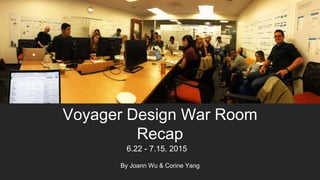
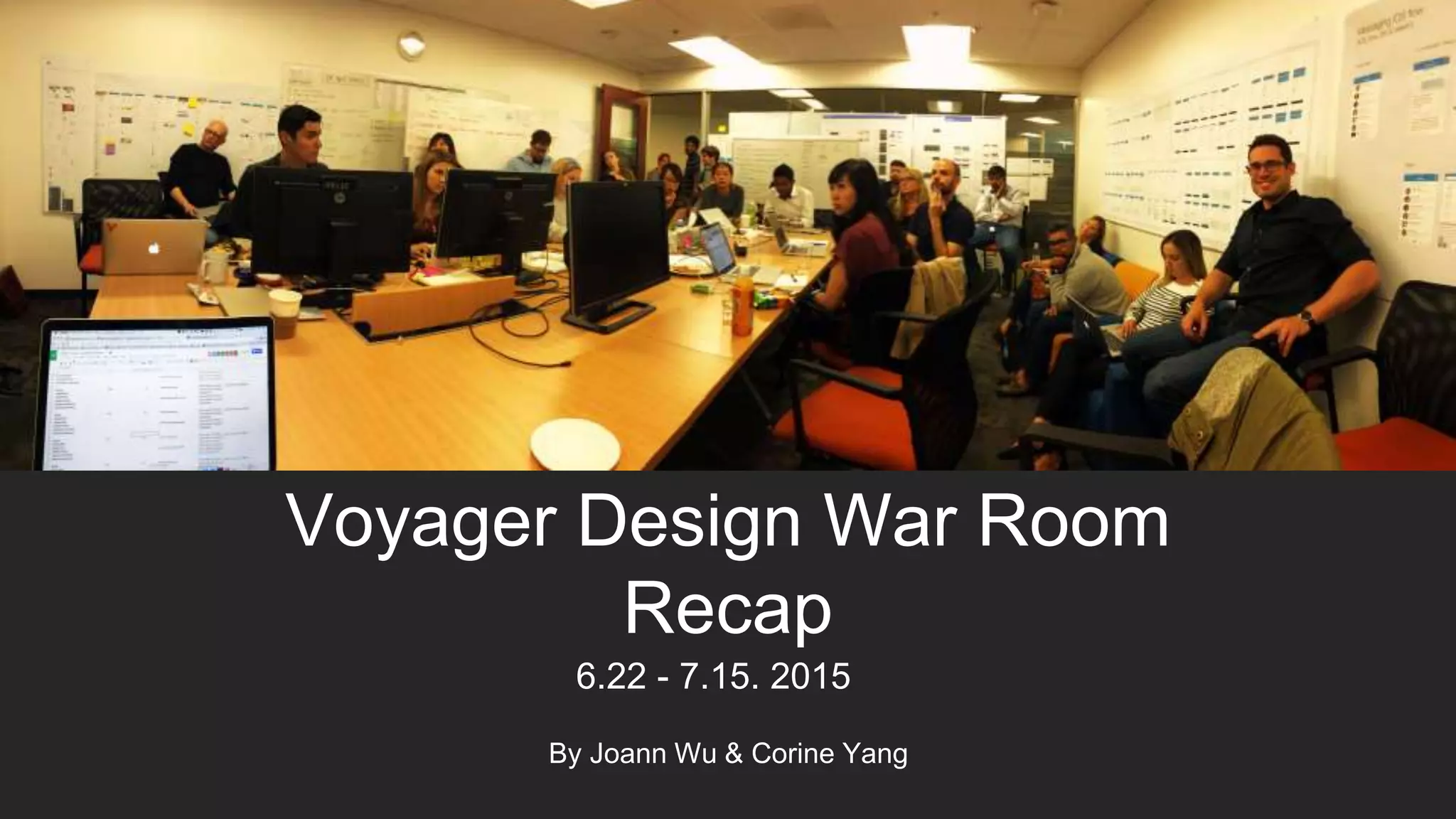
Voyager Design War Room Recap
6.22 - 7.15. 2015
By Joann Wu & Corine Yang
PROBLEMS & CHALLENGES
- 7 teams, 9 tracks had been designing in parallel
- UI looked similar but not as a family, nor ONE APP
- We had been meeting weekly but tight alignment was not happening fast
enough
Move Fast. Fail Fast. Act Fast.
STORMING STORMING NORMING PERFORMINGFORMING RECOGNIZING
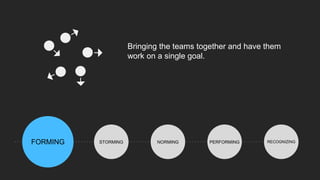
Bringing the teams together and have them
work on a single goal.
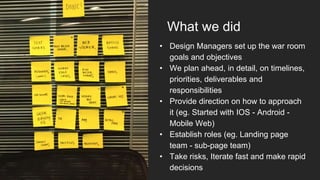
What we did
• Design Managers set up the war room
goals and objectives
• We plan ahead, in detail, on timelines,
priorities, deliverables and
responsibilities
• Provide direction on how to approach
it (eg. Started with IOS - Android -
Mobile Web)
• Establish roles (eg. Landing page
team - sub-page team)
• Take risks, Iterate fast and make rapid
decisions
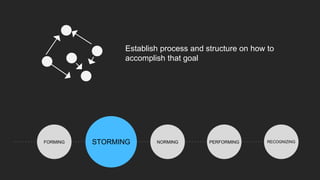
Establish process and structure on how to
accomplish that goal
FORMING STORMING NORMING PERFORMINGSTORMING RECOGNIZING
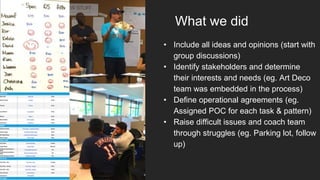
What we did
• Include all ideas and opinions (start with
group discussions)
• Identify stakeholders and determine
their interests and needs (eg. Art Deco
team was embedded in the process)
• Define operational agreements (eg.
Assigned POC for each task & pattern)
• Raise difficult issues and coach team
through struggles (eg. Parking lot, follow
up)
FORMING STORMING NORMING PERFORMINGNORMING RECOGNIZING
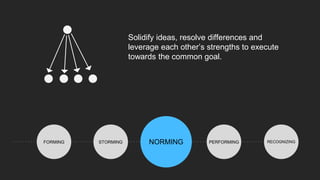
Solidify ideas, resolve differences and
leverage each other’s strengths to execute
towards the common goal.
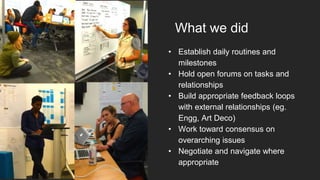
What we did
• Establish daily routines and
milestones
• Hold open forums on tasks and
relationships
• Build appropriate feedback loops
with external relationships (eg.
Engg, Art Deco)
• Work toward consensus on
overarching issues
• Negotiate and navigate where
appropriate
FORMING STORMING NORMING PERFORMINGPERFORMING RECOGNIZING
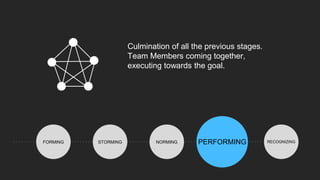
Culmination of all the previous stages.
Team Members coming together,
executing towards the goal.
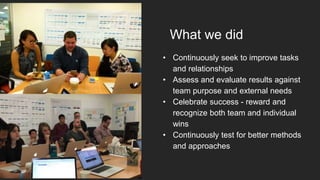
What we did
• Continuously seek to improve tasks
and relationships
• Assess and evaluate results against
team purpose and external needs
• Celebrate success - reward and
recognize both team and individual
wins
• Continuously test for better methods
and approaches
FORMING STORMING NORMING PERFORMING RECOGNIZING
Take the time to recognize the heroic effort
put in by the team and celebrate.
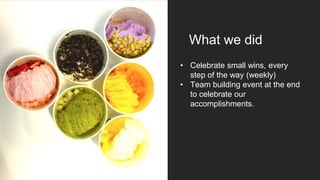
What we did
• Celebrate small wins, every
step of the way (weekly)
• Team building event at the end
to celebrate our
accomplishments.
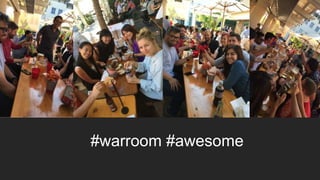
#warroom #awesome
ACHIEVEMENTS
- 17 business days, 20 designers
- Designed and aligned +350 screens
- Established Art Deco component library: can be leveraged not only by
designers, but also by Eng, Devs
- Created 3 inVision prototypes: IOS, Android, Mobile Web
- Proposed solution for Phone landscape and Tablet.
TAKEAWAYS for improvement
- Setting up design principles to guide design decisions
- Using the right set of tools to bring team efficiency
- Leveraging war room’s physical space better to mark down all decisions
made through the whole progress.
- “Parking lot” was useful, but should resolve “Left overs” as soon as possible

How to Run a Design War Room

  • 1.
    Voyager Design WarRoom Recap 6.22 - 7.15. 2015 By Joann Wu & Corine Yang
  • 2.
    PROBLEMS & CHALLENGES -7 teams, 9 tracks had been designing in parallel - UI looked similar but not as a family, nor ONE APP - We had been meeting weekly but tight alignment was not happening fast enough
  • 3.
    Move Fast. FailFast. Act Fast.
  • 4.
    STORMING STORMING NORMINGPERFORMINGFORMING RECOGNIZING Bringing the teams together and have them work on a single goal.
  • 5.
    What we did •Design Managers set up the war room goals and objectives • We plan ahead, in detail, on timelines, priorities, deliverables and responsibilities • Provide direction on how to approach it (eg. Started with IOS - Android - Mobile Web) • Establish roles (eg. Landing page team - sub-page team) • Take risks, Iterate fast and make rapid decisions
  • 6.
    Establish process andstructure on how to accomplish that goal FORMING STORMING NORMING PERFORMINGSTORMING RECOGNIZING
  • 7.
    What we did •Include all ideas and opinions (start with group discussions) • Identify stakeholders and determine their interests and needs (eg. Art Deco team was embedded in the process) • Define operational agreements (eg. Assigned POC for each task & pattern) • Raise difficult issues and coach team through struggles (eg. Parking lot, follow up)
  • 8.
    FORMING STORMING NORMINGPERFORMINGNORMING RECOGNIZING Solidify ideas, resolve differences and leverage each other’s strengths to execute towards the common goal.
  • 9.
    What we did •Establish daily routines and milestones • Hold open forums on tasks and relationships • Build appropriate feedback loops with external relationships (eg. Engg, Art Deco) • Work toward consensus on overarching issues • Negotiate and navigate where appropriate
  • 10.
    FORMING STORMING NORMINGPERFORMINGPERFORMING RECOGNIZING Culmination of all the previous stages. Team Members coming together, executing towards the goal.
  • 11.
    What we did •Continuously seek to improve tasks and relationships • Assess and evaluate results against team purpose and external needs • Celebrate success - reward and recognize both team and individual wins • Continuously test for better methods and approaches
  • 12.
    FORMING STORMING NORMINGPERFORMING RECOGNIZING Take the time to recognize the heroic effort put in by the team and celebrate.
  • 13.
    What we did •Celebrate small wins, every step of the way (weekly) • Team building event at the end to celebrate our accomplishments.
  • 14.
  • 15.
    ACHIEVEMENTS - 17 businessdays, 20 designers - Designed and aligned +350 screens - Established Art Deco component library: can be leveraged not only by designers, but also by Eng, Devs - Created 3 inVision prototypes: IOS, Android, Mobile Web - Proposed solution for Phone landscape and Tablet.
  • 16.
    TAKEAWAYS for improvement -Setting up design principles to guide design decisions - Using the right set of tools to bring team efficiency - Leveraging war room’s physical space better to mark down all decisions made through the whole progress. - “Parking lot” was useful, but should resolve “Left overs” as soon as possible

Editor's Notes

  • #4 As the leadership team, we went to the war room with the great attitude as “move fast, act fast, fail fast”. We prepared ourselves as “just do it” and “we will figure out and justificate everything on the way”
  • #5 Direct the team, and establish clear objectives, both, for the team as a whole, and for individual team members.
  • #8 Daily to-do list and decisions on white boards Identify key POC for each task Establish a clear folder system to share all works Create google spreadsheet to document all alignment decisions which leads us to build a component library for both design and eng.
  • #10 10:00 morning stand up to go over daily tasks/assignments Alternate between big group discussions and smaller group working sessions Daily 4:00 recap of decisions and achievements of the day Leverage Thursday Show & Tell as milestones