To listen to the audio of this program, put this link into
your browser
http://users.macrobatix.com/msatt/pricing.mp3


Pricing Your Services
Strategies, Tactics & Attitude

                      Mark Satterfield
                      Gentle Rain Marketing
The impact of Pricing decisions
is often underestimated

   McKinsey study: Pricing has a greater
    impact on profitability than either sales
    volume increases, cost reductions or other
    improved efficiencies.
What we’re going to cover
today

   Setting fees/prices
    – Models
    – Mindset

   Negotiating
    – Price comes up twice in the discussions.
    – How to determine if the person has money.
Pricing…more than just what
you charge.
   What prices say about your work
   Importance of having a pricing strategy
    – Dominate a market niche.

   However, we often approach pricing from the
    perspective of “It’s the primary reason people
    don’t hire us.”
    – Erroneous assumption
    – The research that has been conducted shows that it is
      not among the top 3.
    – However…it is the most often heard EXCUSE for not
      hiring someone.
Attitudes towards pricing
   Pricing is more a matter of communication and
    ATTITUDE

   You can always be under-priced so might as well
    stop using it as an excuse

   Price is based on VALUE.
    – If you don’t communicate BENEFITS your price is
      ALWAYS too much.
    – People are not as price conscious as they are VALUE
      conscious
Attitudes towards Pricing
   McKinsey Study: “Sellers of services usually have a
    lower perception of the VALUE of their services then the
    buyer.”

   Gartner Study: “Most providers of services have more
    problems with their price structures than anything else-
    Customers usually have fewer problems with the price.
    Price resistance is almost always in the mind of the seller
    not the buyer.

   Exercise…What is the value that others receive from
    working with you?

   Worthiness
    – www.MarianMassie.com
Setting your price
   Where in the market do you want to
    operate?
    – The reality is that prices are all over the map
 Volume
 Exclusivity
Pricing model: Hourly
 Least effective
 Trading time for dollars
 Ok for entry level services.
 Bad for projects…not good for you nor
  your clients.
Project Pricing Model:
The Michelangelo

 One price for you to do the work.
 Lower price for working with a member of
  your staff
 Middle price for working with a member
  of your staff who is supervised by you.
Pricing model: Success fees.
Contingency arrangements

 Pure success or retainer against success?
 The abandonment factor.
 How to keep people honest.
Pricing: Ascension
   Entry level the price very low. Add components
    incrementally

   Flow chart the process by which the client
    achieves success.
    – What will they need at various stages

   Works best with a Bundled/Unbundled strategy
Pricing: Bundling & Unbundling
 A “component” approach to pricing
 How it works
    – Break you services offer into all of its
      components. Over the course of a year, what
      would the client get?
    – What is the logical sequence?
GRM: Segment the market
   Those who want to Learn
    – Desire for Knowledge

   Those who want to Do
    – Desire for Results

   90%/10%
    – The appeal of information products is to the 90%.
Pricing for the 10%.
Components of Marketing
1.   Marketing message/Differentiation
2.   Creation of Free information article/report
3.   Development of one-page lead capture website.
4.   Autoresponder sequence
5.   Promotion of the free report
     –   Direct mail
     –   Google/Secondary search engines
     –   Articles (Article distribution services)
     –   Trade shows
     –   Co-registration
     –   Speaking
Pricing
   Bundled…$15,000 against 10%

   Unbundled A…Individual components. Client
    self-selects what they need.
    – We do them for you (Price X)
    – We teach you how to do them (Price Z)

   Unbundled B…We organize the sequence.
    – 6 months. March you through the drill.
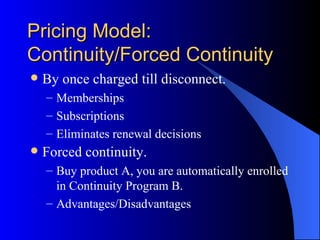
Pricing Model:
Continuity/Forced Continuity
   By once charged till disconnect.
    – Memberships
    – Subscriptions
    – Eliminates renewal decisions
   Forced continuity.
    – Buy product A, you are automatically enrolled
      in Continuity Program B.
    – Advantages/Disadvantages
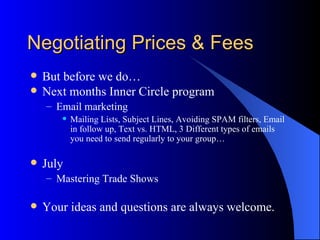
Negotiating Prices & Fees
   But before we do…
   Next months Inner Circle program
    – Email marketing
          Mailing Lists, Subject Lines, Avoiding SPAM filters, Email
           in follow up, Text vs. HTML, 3 Different types of emails
           you need to send regularly to your group…

   July
    – Mastering Trade Shows

   Your ideas and questions are always welcome.
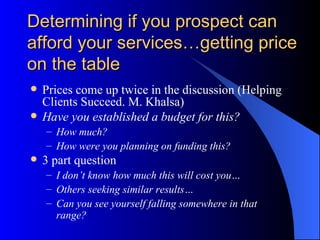
Determining if you prospect can
afford your services…getting price
on the table
   Prices come up twice in the discussion (Helping
    Clients Succeed. M. Khalsa)
   Have you established a budget for this?
    – How much?
    – How were you planning on funding this?
   3 part question
    – I don’t know how much this will cost you…
    – Others seeking similar results…
    – Can you see yourself falling somewhere in that
      range?
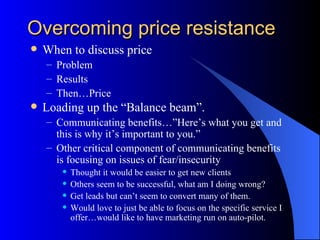
Overcoming price resistance
   When to discuss price
    – Problem
    – Results
    – Then…Price
   Loading up the “Balance beam”.
    – Communicating benefits…”Here’s what you get and
      this is why it’s important to you.”
    – Other critical component of communicating benefits
      is focusing on issues of fear/insecurity
          Thought it would be easier to get new clients
          Others seem to be successful, what am I doing wrong?
          Get leads but can’t seem to convert many of them.
          Would love to just be able to focus on the specific service I
           offer…would like to have marketing run on auto-pilot.
Summary on Pricing
   It’s a much a matter of Attitude as it is Tactics.
   Different approaches you can adopt.

   Naturally if you’d like to discuss your personal
    pricing strategy please let me know.

How to price your services

  • 1.
    To listen tothe audio of this program, put this link into your browser http://users.macrobatix.com/msatt/pricing.mp3 Pricing Your Services Strategies, Tactics & Attitude Mark Satterfield Gentle Rain Marketing
  • 2.
    The impact ofPricing decisions is often underestimated  McKinsey study: Pricing has a greater impact on profitability than either sales volume increases, cost reductions or other improved efficiencies.
  • 3.
    What we’re goingto cover today  Setting fees/prices – Models – Mindset  Negotiating – Price comes up twice in the discussions. – How to determine if the person has money.
  • 4.
    Pricing…more than justwhat you charge.  What prices say about your work  Importance of having a pricing strategy – Dominate a market niche.  However, we often approach pricing from the perspective of “It’s the primary reason people don’t hire us.” – Erroneous assumption – The research that has been conducted shows that it is not among the top 3. – However…it is the most often heard EXCUSE for not hiring someone.
  • 5.
    Attitudes towards pricing  Pricing is more a matter of communication and ATTITUDE  You can always be under-priced so might as well stop using it as an excuse  Price is based on VALUE. – If you don’t communicate BENEFITS your price is ALWAYS too much. – People are not as price conscious as they are VALUE conscious
  • 6.
    Attitudes towards Pricing  McKinsey Study: “Sellers of services usually have a lower perception of the VALUE of their services then the buyer.”  Gartner Study: “Most providers of services have more problems with their price structures than anything else- Customers usually have fewer problems with the price. Price resistance is almost always in the mind of the seller not the buyer.  Exercise…What is the value that others receive from working with you?  Worthiness – www.MarianMassie.com
  • 7.
    Setting your price  Where in the market do you want to operate? – The reality is that prices are all over the map  Volume  Exclusivity
  • 8.
    Pricing model: Hourly Least effective  Trading time for dollars  Ok for entry level services.  Bad for projects…not good for you nor your clients.
  • 9.
    Project Pricing Model: TheMichelangelo  One price for you to do the work.  Lower price for working with a member of your staff  Middle price for working with a member of your staff who is supervised by you.
  • 10.
    Pricing model: Successfees. Contingency arrangements  Pure success or retainer against success?  The abandonment factor.  How to keep people honest.
  • 11.
    Pricing: Ascension  Entry level the price very low. Add components incrementally  Flow chart the process by which the client achieves success. – What will they need at various stages  Works best with a Bundled/Unbundled strategy
  • 12.
    Pricing: Bundling &Unbundling  A “component” approach to pricing  How it works – Break you services offer into all of its components. Over the course of a year, what would the client get? – What is the logical sequence?
  • 13.
    GRM: Segment themarket  Those who want to Learn – Desire for Knowledge  Those who want to Do – Desire for Results  90%/10% – The appeal of information products is to the 90%.
  • 14.
    Pricing for the10%. Components of Marketing 1. Marketing message/Differentiation 2. Creation of Free information article/report 3. Development of one-page lead capture website. 4. Autoresponder sequence 5. Promotion of the free report – Direct mail – Google/Secondary search engines – Articles (Article distribution services) – Trade shows – Co-registration – Speaking
  • 15.
    Pricing  Bundled…$15,000 against 10%  Unbundled A…Individual components. Client self-selects what they need. – We do them for you (Price X) – We teach you how to do them (Price Z)  Unbundled B…We organize the sequence. – 6 months. March you through the drill.
  • 16.
    Pricing Model: Continuity/Forced Continuity  By once charged till disconnect. – Memberships – Subscriptions – Eliminates renewal decisions  Forced continuity. – Buy product A, you are automatically enrolled in Continuity Program B. – Advantages/Disadvantages
  • 17.
    Negotiating Prices &Fees  But before we do…  Next months Inner Circle program – Email marketing  Mailing Lists, Subject Lines, Avoiding SPAM filters, Email in follow up, Text vs. HTML, 3 Different types of emails you need to send regularly to your group…  July – Mastering Trade Shows  Your ideas and questions are always welcome.
  • 18.
    Determining if youprospect can afford your services…getting price on the table  Prices come up twice in the discussion (Helping Clients Succeed. M. Khalsa)  Have you established a budget for this? – How much? – How were you planning on funding this?  3 part question – I don’t know how much this will cost you… – Others seeking similar results… – Can you see yourself falling somewhere in that range?
  • 19.
    Overcoming price resistance  When to discuss price – Problem – Results – Then…Price  Loading up the “Balance beam”. – Communicating benefits…”Here’s what you get and this is why it’s important to you.” – Other critical component of communicating benefits is focusing on issues of fear/insecurity  Thought it would be easier to get new clients  Others seem to be successful, what am I doing wrong?  Get leads but can’t seem to convert many of them.  Would love to just be able to focus on the specific service I offer…would like to have marketing run on auto-pilot.
  • 20.
    Summary on Pricing  It’s a much a matter of Attitude as it is Tactics.  Different approaches you can adopt.  Naturally if you’d like to discuss your personal pricing strategy please let me know.