
How to Manage Future Grid Dynamics:
Quantifying Smart Power Generation Benefits
Prepared by KEMA, Inc
November 30, 2012
Copyright © 2012, KEMA, Inc.
This document and the information contained herein, is the exclusive, confidential and proprietary property of
KEMA, Inc. and is protected under the trade secret and copyright laws of the United States and other international
laws, treaties and conventions. No part of this work may be disclosed to any third party or used, reproduced or
transmitted in any form or by any means, electronic or mechanical, including photocopying and recording, or by any
information storage or retrieval system, without first receiving the express written permission of KEMA, Inc. Except
as otherwise noted, all trademarks appearing herein are proprietary to KEMA, Inc.
Table of Contents

1.   Introduction and Purpose ...................................................................................................................... 1
2.   CAISO Issues and 2020 Simulation Assumptions ................................................................................ 3
     2.1 Current Market and Operational Issues facing CAISO .............................................................. 3
     2.2   2020 Simulations ........................................................................................................................ 5
           2.2.1 2020 CAISO Load ......................................................................................................... 6
     2.3 System Flexibility: Ancillary Services Needed .......................................................................... 8
     2.4 2020 CAISO Generation Capacity ........................................................................................... 10
     2.5 2020 Smart Power Generation Parameters ............................................................................... 12
3.   CAISO Hourly Day-Ahead Integrated Forward Market ..................................................................... 14
     3.1 CAISO’s Day Ahead Markets .................................................................................................. 14
     3.2 Simulation Process, Scenarios and Metrics Evaluated ............................................................. 15
           3.2.1 The Role of Demand Response in the Simulations ..................................................... 16
     3.3 Day-Ahead Scenario 1 (Base Case) .......................................................................................... 18
     3.4 Day Ahead Scenario 2 (SPG Simple Cycle; No OTC) ............................................................. 24
     3.5 Day-Ahead Scenario 3 (SPG simple and combined capacity; No OTC).................................. 28
     3.6 Day Ahead Scenario 4 (SPG + Base Case) .............................................................................. 33
     3.7 Summary of Findings for Day-Ahead Scenarios ...................................................................... 38
4.   Quantifying Smart Power Generation Benefits in Real Time Dispatch .............................................. 40
     4.1 Procuring Resources and Ancillary Services in Real Time Markets ........................................ 40
     4.2 RT Scenario 1 (Base Case 5 Minute Dispatch) ........................................................................ 42
     4.3 RT Scenario 2 (SPG and OTC 5 Minute Dispatch) .................................................................. 43
     4.4 RT Scenario 3 (Added SPG combined cycle in simple cycle mode) ....................................... 46
     4.5 RT Scenario 3 (Base Case with Uncertainty in Wind and Solar) ............................................. 48
     4.6 RT Scenario 5: (SPG and Base Case with Uncertainty in Wind and Solar) ............................ 49
     4.7 Smart Power Generation and Flexible Ramping (or similar) Ancillary Service(s) .................. 50
     4.8 Summary of Real Time Results ................................................................................................ 51
5.   Smart Power Generation and Resource Adequacy ............................................................................. 53
6.   Conclusions ......................................................................................................................................... 55


Quantify Smart Power Generation Benefits                                 i                                                               November 2012
Table of Contents

List of Figures

Figure 1: Probability of Those Days Occurring ............................................................................................ 7
Figure 2: Time Line of Renewable Resource Frequency Control, after Skinner, et al, June 2012 ............... 8
Figure 3: Hourly Maximum and Minimum Ancillary Service Requirements for CAISO in 2020............. 10
Figure 4: 2020 Base Case CAISO Generation Capacity by Type, total = 78,367 MW .............................. 11
Figure 5: CAISO Day-Ahead Market Inputs, Processing and Outputs....................................................... 14
Figure 6: Average Cost ($/MWh) for Demand Response and Backstop Assumptions .............................. 17
Figure 7: Day-Ahead Scenario 1 Fossil Units Supply Stack ...................................................................... 18
Figure 8: Day-Ahead Scenario 1 Capacity Factors by Generation Type .................................................... 19
Figure 9: Day-Ahead Scenario 1 Hourly Dispatch, 7/22 Peak Hour Day................................................... 20
Figure 10: Day-Ahead Scenario 1 Hourly Dispatch, 5/26 High Variability Day ....................................... 21
Figure 11: Day-Ahead Scenario 2 Supply Stack ........................................................................................ 24
Figure 12: Capacity Factors: Day-Ahead Scenario 1 versus Scenario 2.................................................... 25
Figure 13: Day-Ahead Scenario 2 Hourly Dispatch, 7/22 Peak Hour Day................................................. 26
Figure 14: Day-Ahead Scenario 2 Hourly Dispatch, 5/26 High Variability Day ....................................... 26
Figure 15: Day-Ahead Scenario 3 Supply Stack ........................................................................................ 29
Figure 16: Day-Ahead Scenario 3 Capacity Factors ................................................................................... 30
Figure 17: Day-Ahead Scenario 3 Dispatch, 7/22 Peak Hour Day ............................................................. 31
Figure 18: Day-Ahead Scenario 3 Dispatch, 5/26 High Variability Day.................................................... 31
Figure 19: Day-Ahead Scenario 4, Supply Stack ....................................................................................... 34
Figure 20: Day-Ahead Scenario 4 Capacity Factors versus Base Case ...................................................... 34
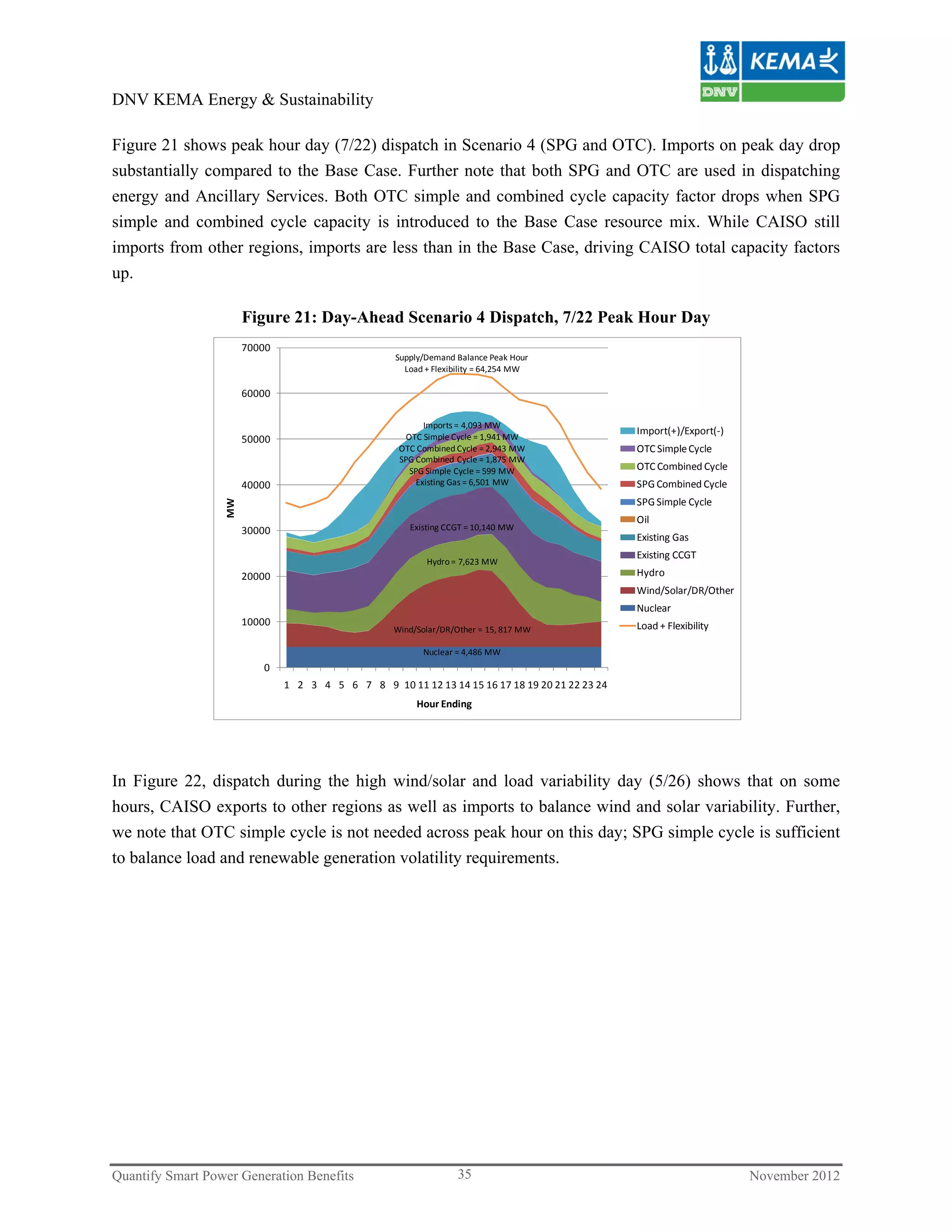
Figure 21: Day-Ahead Scenario 4 Dispatch, 7/22 Peak Hour Day ............................................................. 35
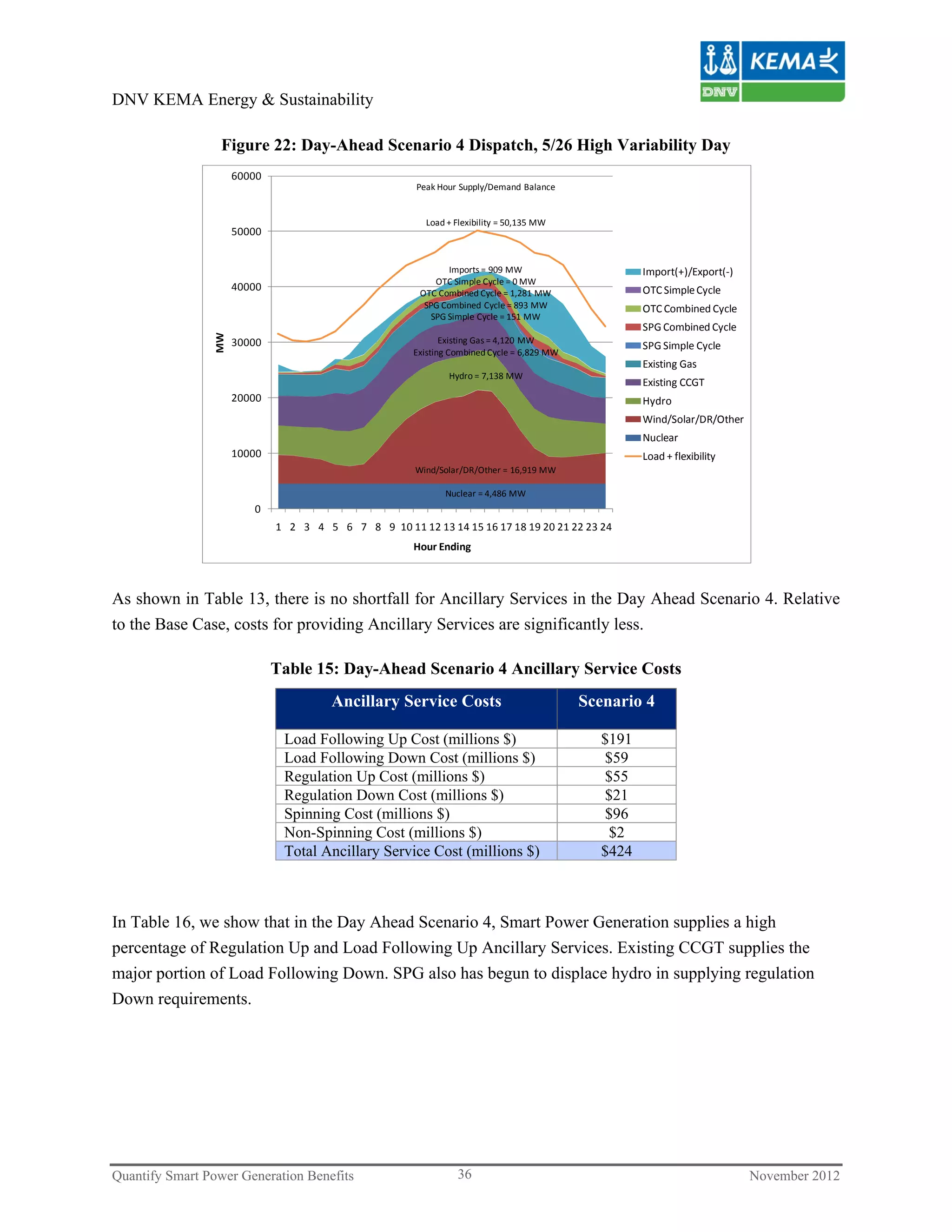
Figure 22: Day-Ahead Scenario 4 Dispatch, 5/26 High Variability Day.................................................... 36
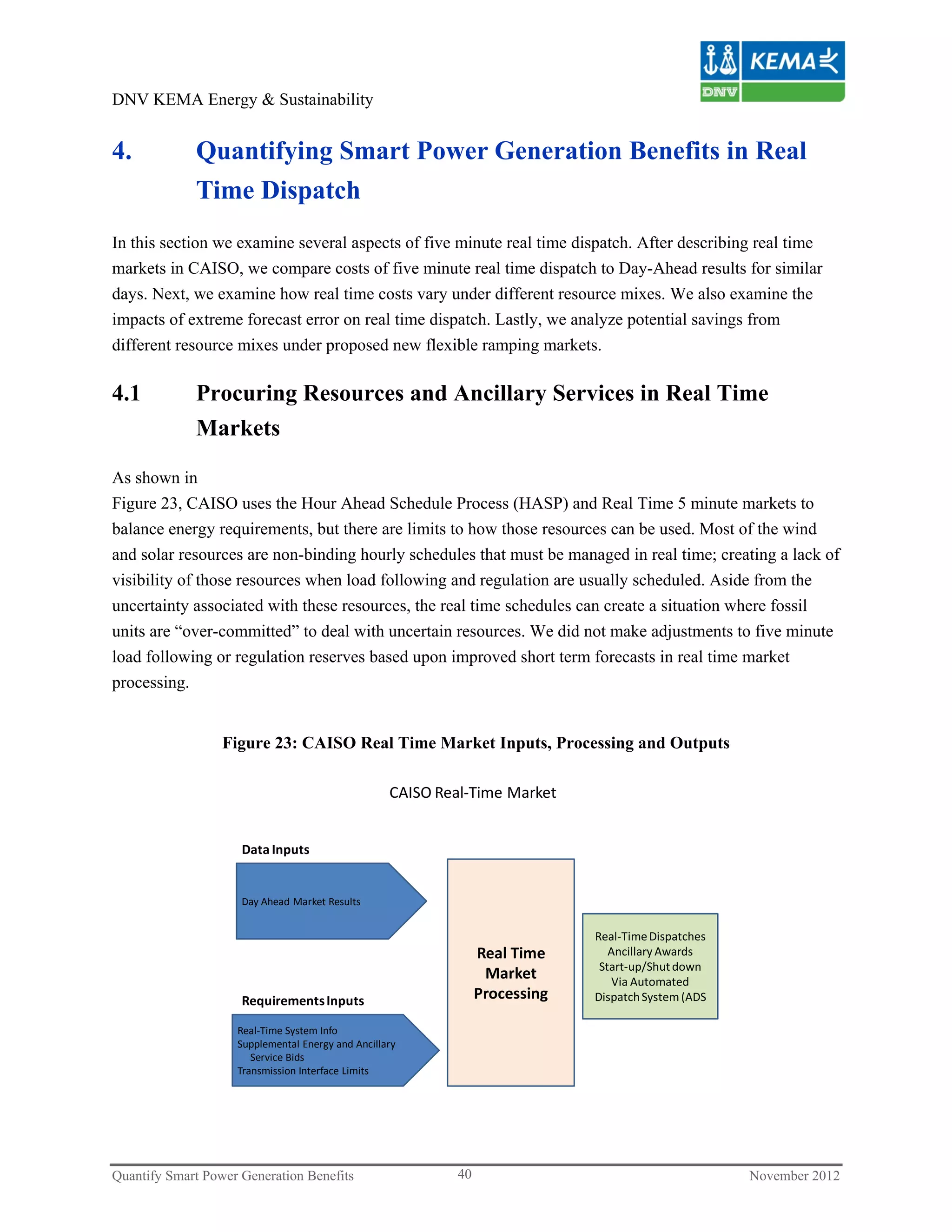
Figure 23: CAISO Real Time Market Inputs, Processing and Outputs ...................................................... 40
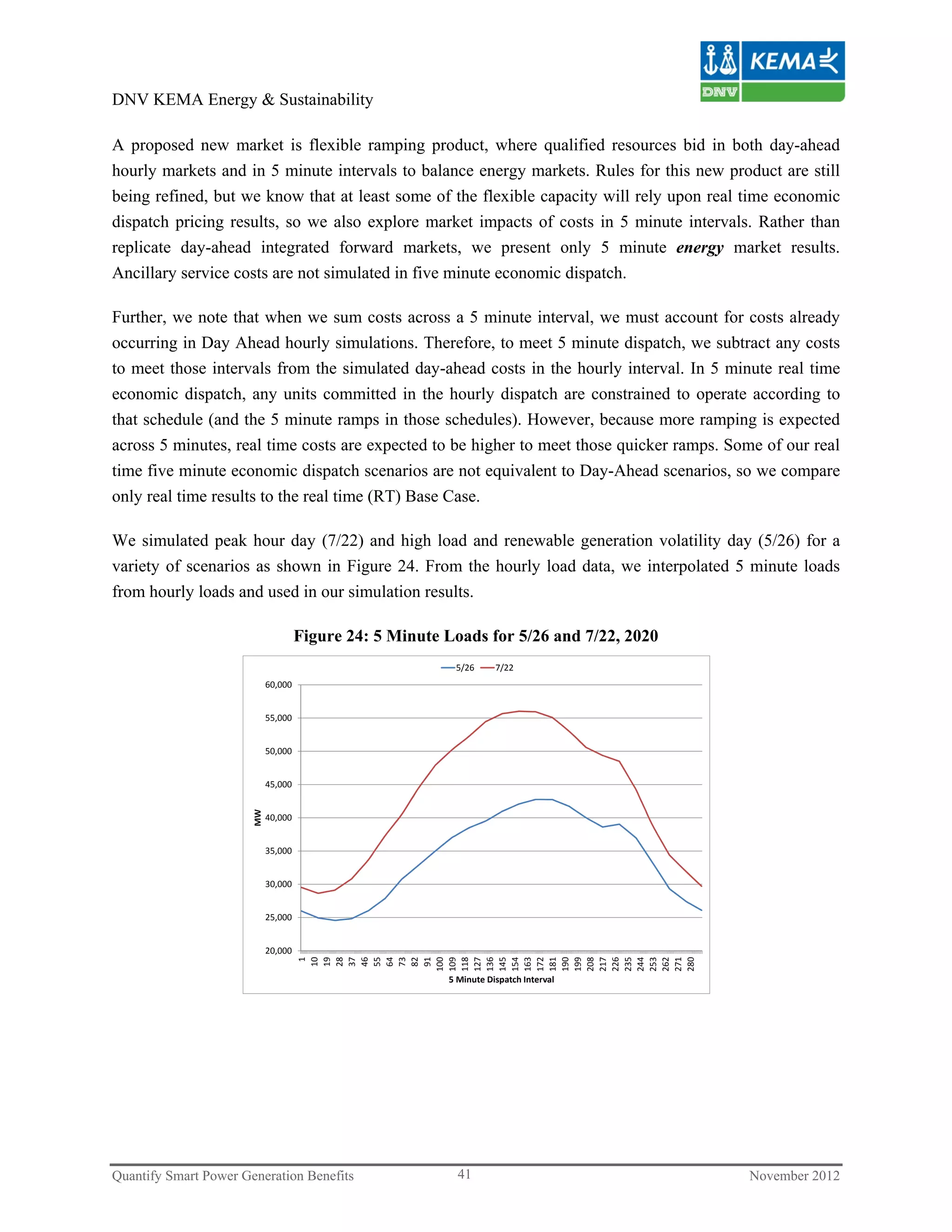
Figure 24: 5 Minute Loads for 5/26 and 7/22, 2020 ................................................................................... 41
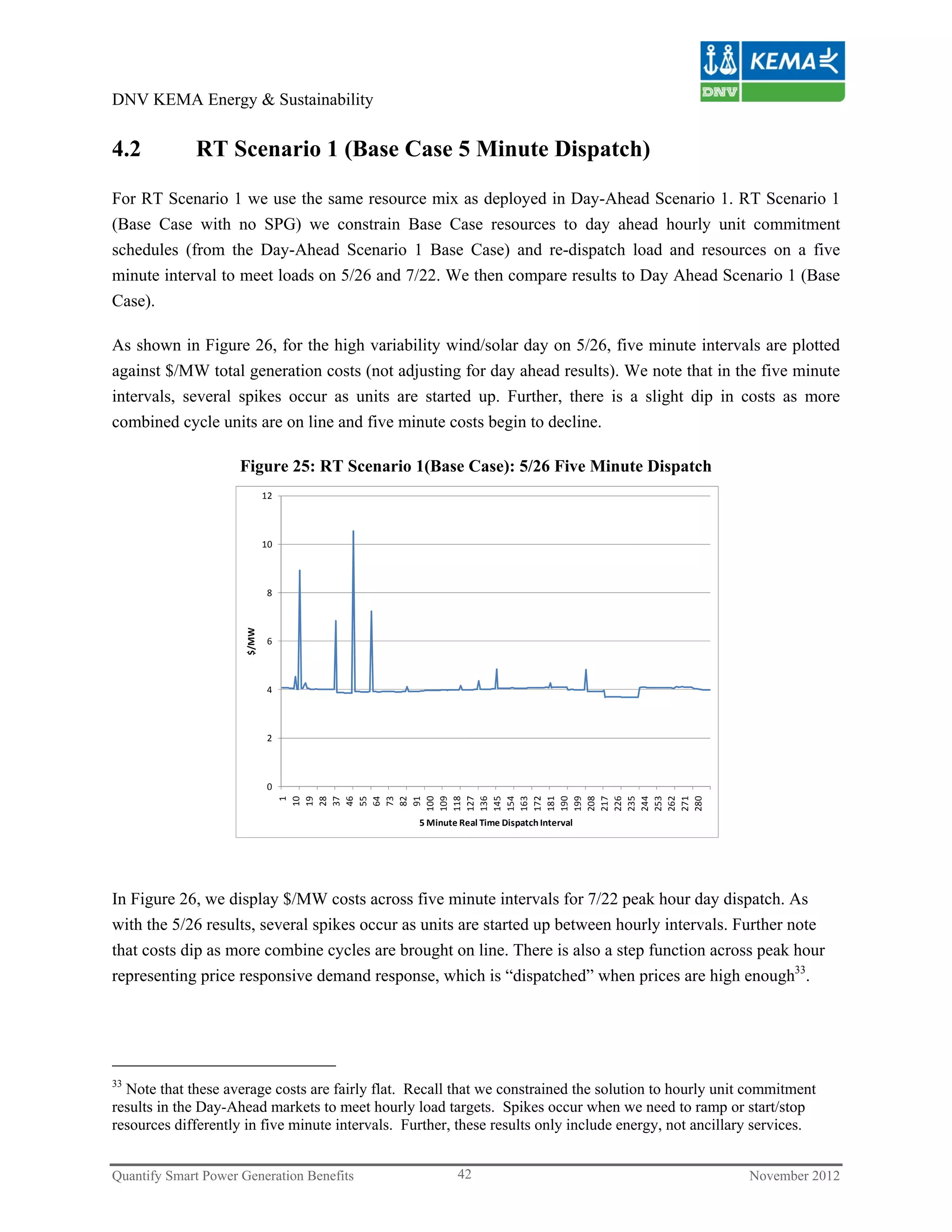
Figure 25: RT Scenario 1(Base Case): 5/26 Five Minute Dispatch ............................................................ 42
Figure 26: RT Scenario 1 (Base Case): 7/22 Five Minute Dispatch ........................................................... 43
Figure 27: 5/26 RT Scenario 2 versus RT Scenario 1 and differences ....................................................... 44
Figure 28: 7/22 RT Scenario 2 versus RT Scenario 1 and Differences ...................................................... 45
Figure 29: RT Scenario 3 versus RT Scenario 2 on 5/26 ............................................................................ 46
Figure 30: RT Scenario 3 versus RT Scenario 2 on 7/22 ............................................................................ 47
Figure 31: RT Scenario 4 versus RT Scenario 5 on 5/26 ............................................................................ 50
Figure 32: Deliverability @ Risk: Scenario 1 Base Case versus Scenario 4 All Generators ...................... 54


Quantify Smart Power Generation Benefits                          ii                                                      November 2012
Table of Contents

List of Tables

Table 1: Days Selected for Analysis ............................................................................................................. 6
Table 2: New and OTC re-powered Generator Performance Assumptions versus Smart Power Generation
    Performance Assumptions .................................................................................................................. 13
Table 3: Day-Ahead Scenario 1 Start/Stop Costs ....................................................................................... 19
Table 4: Day-Ahead Scenario 1 Ancillary Service Costs ........................................................................... 22
Table 5: Day Ahead Scenario 1 Ancillary Service Contribution ................................................................ 22
Table 6: Day-Ahead Scenario 1 CAISO Production Cost Summary .......................................................... 23
Table 7: Day-Ahead Scenario 2 Start/Stop Cost versus Base Case ............................................................ 25
Table 8: Day-Ahead Scenario 2 Ancillary Service Costs ........................................................................... 27
Table 9: Day-Ahead Scenario 2, Ancillary Service Contribution............................................................... 27
Table 10: Day-Ahead Scenario 2 CAISO Production Cost Summary ........................................................ 28
Table 11: Day-Ahead Scenario 3 Start/Stop versus Base Case .................................................................. 29
Table 12: Day-Ahead Scenario 3 Ancillary Service Costs ......................................................................... 32
Table 13: Day-Ahead Scenario 3, Contributions to Ancillary Services ..................................................... 32
Table 14: Day-Ahead Scenario 3 Production Cost Summary ..................................................................... 33
Table 15: Day-Ahead Scenario 4 Ancillary Service Costs ......................................................................... 36
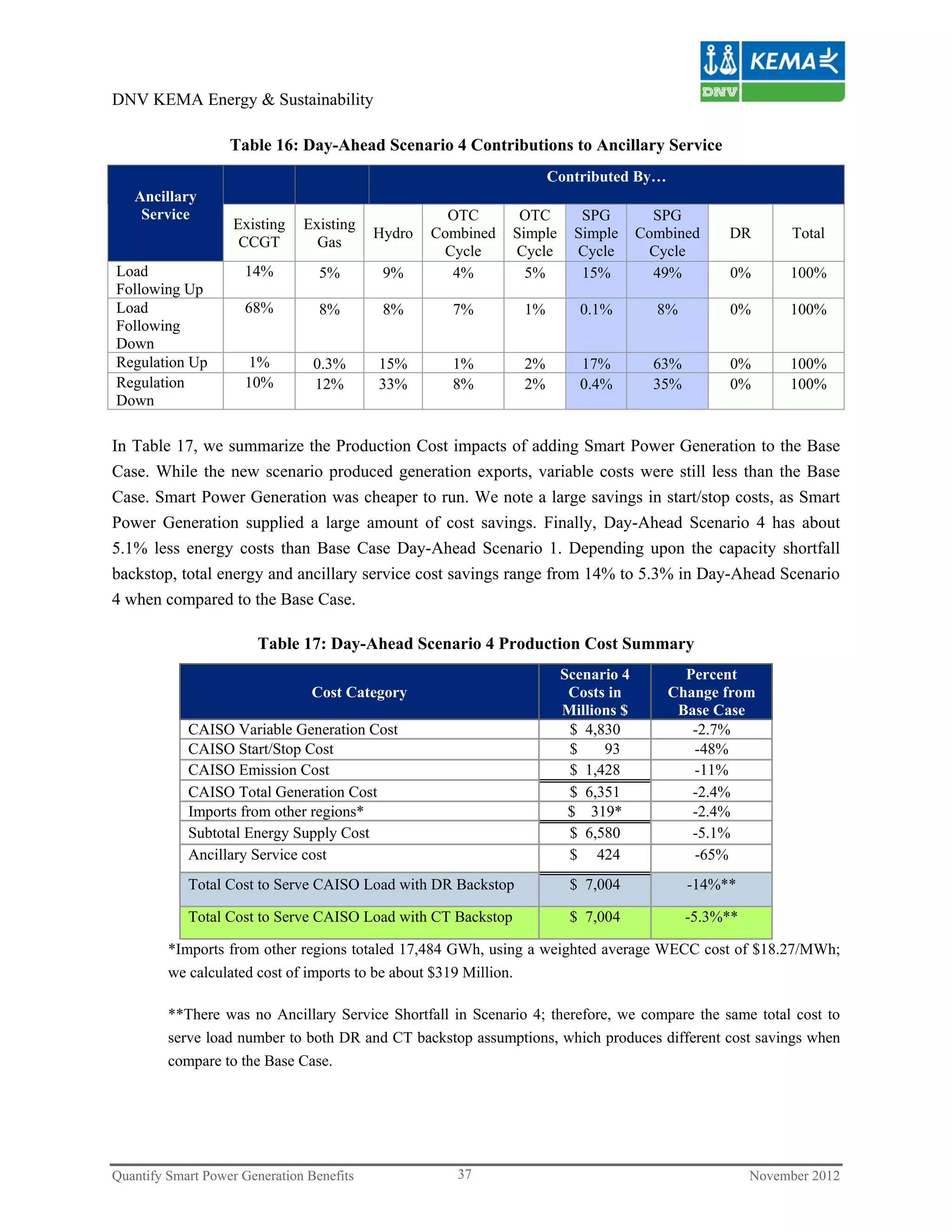
Table 16: Day-Ahead Scenario 4 Contributions to Ancillary Service ........................................................ 37
Table 17: Day-Ahead Scenario 4 Production Cost Summary ..................................................................... 37
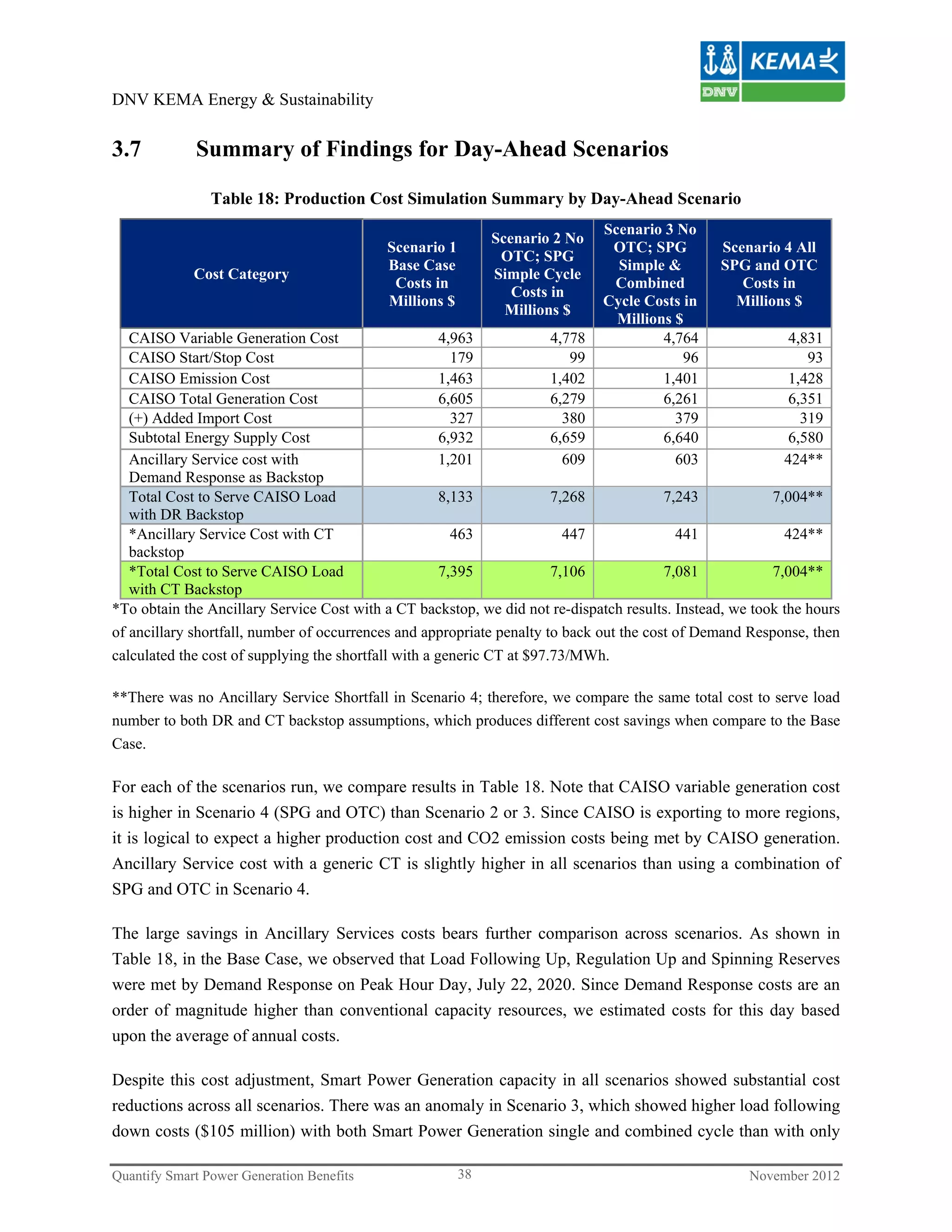
Table 18: Production Cost Simulation Summary by Day-Ahead Scenario ................................................ 38
Table 19: Summary of Production Cost Savings by Scenario .................................................................... 39
Table 20: Day-Ahead Scenario 1 versus Real Time Scenario 1 ................................................................. 43
Table 21: RT Scenario 1 versus RT Scenario 2 .......................................................................................... 45
Table 22: RT Scenario 3 versus RT Scenario 2 Cost Savings .................................................................... 47
Table 23: Comparison of Worst Case Forecast Error ................................................................................. 49
Table 24: RT Scenario 4 versus RT Scenario 1 .......................................................................................... 49
Table 25: RT Scenario 5 versus RT Scenario 4 .......................................................................................... 49
Table 26: Comparison of Flexible Ramping Cost Savings Potential .......................................................... 51
Table 27: RT Scenario Savings Summary .................................................................................................. 51


Quantify Smart Power Generation Benefits                             iii                                                        November 2012
DNV KEMA Energy & Sustainability


1.           Introduction and Purpose
Electricity grids face a variety of trends which impact current and future markets and operations.
Increased penetration of variable renewable energy production creates the need for more ancillary
services to smooth fluctuations in renewable output and to provide for forecast errors in those outputs.
Thermal plant retirements and environmental restrictions impact resource adequacy. Resources such as
Demand Response, distributed resources and new storage and communication technologies create
uncertainties in how these important new resources interact with one another. Lastly, new resources can
create changing power flows and import/export transfers between balancing authority which creates
uncertainties with network and/or grid expansion.

To investigate these future uncertainties we simulate market conditions to investigate impacts and plan for
future events. In this paper, we have created future scenarios to explore different resource portfolios meet
these key uncertainties cheaply and reliably. A key technology that we explore is Smart Power
Generation.

We define Smart Power Generation (SPG) as resource capacity having high operational flexibility, high
energy efficiency, and diverse fuel capability. Operational flexibility requires generation to have multiple
dynamic operation modes, from ultra-fast grid reserve to efficient base load generation. SPG has fast
start-up, shut-down, and load ramps with agile dispatch and is able to supply MWs to the electricity grid
within 1 minute and full power in 5-10 minutes. Ideally, SPG should be suitable for base load generation,
peaking, and balancing requirements and have independent operation of multiple units with remote
operation for off-site control. SPG should be capable of being situated within or near load pockets and
have low maintenance costs regardless of operation method including some sort of grid black-start
capability. SPG should be energy efficient with sustainable and affordable power systems requiring the
highest level of simple-cycle energy efficiency available. Characteristics of SPG include high efficiency
in a wide load range, from almost zero load to full load, low water consumption, and low CO2 emissions
regardless of operation method, expandable plant size for future plant size optimization and high
reliability and availability through multiple parallel units.

Modern, state of the art combustion engines designed for utility scale-operations (plant sizes 50 to over
500 MW), exhibit many features of the Smart Power Generation concept. They have the highest simple
cycle efficiency, lowest CO2 emissions and fastest ramp rates commercially available for thermal assets;
have minimal to no water consumption; deliver power to the grid within 1 minute and full output in 5 –
10 minutes; have no equivalent operating hour penalties for starts, stops or cycling; and can operate at
very low plant loads while maintaining high efficiencies. While all thermal technologies share some
features of the Smart Power Generation concept, modern combustion engines are considered here as an
alternative to the more traditional combustion turbine. Therefore, we use Wärtsilä engines as a proxy for
Smart Power Generation. Wärtsilä engines were chosen as representative of state of the art combustion
engine prime movers. The Wärtsilä 20V34SG (SPG simple cycle) is a state of the art combustion engine

Quantify Smart Power Generation Benefits           1                                           November 2012
DNV KEMA Energy & Sustainability

with a per-unit output of 10 MW. It is commonly configured with engines in parallel for plant sizes of
several hundred MW. The efficiency of this unit is greater than commercially available gas turbines but
less than a combined cycle combustion turbine. Start times are 5 minutes, with no minimum up or down
times, and no start cost penalties. Ramp rates are 6 MW/minute per unit, or 60 MW per minute per 100
MW block. Capital costs are equivalent to those of aeroderivative gas turbines but approximately 30%
less than Gas Turbine Combine Cycles (GTCCs). Smart Power Generation capacity such as Wärtsilä
20V34SG units reject heat to a radiator field and have no water consumption for process needs. For the
remainder of this document, we will investigate the impacts of SPG simple cycle using the Wärtsilä
20V34SG operating parameters unless otherwise noted.

In addition to the SPG simple cycle configuration, we also investigate resource portfolios using Smart
Power Generation combined cycle configurations. Wärtsilä 18V34SG units (Flexicycle™ solution)
combine the advantages of a flexible simple cycle plant with the superb efficiency of a combined cycle
plant, in a unique way. The Flexicycle™ power plants can be optimized for different outputs in the 100 to
500 MW range. The power plant solution is based on gas fired combustion engines and steam turbine
combined cycle. Each engine is equipped with waste heat recovery steam generator. The power plant has
one common steam turbine with condenser. The power plant cooling is typically arranged so that the
combustion engines are cooled with closed loop radiators and the steam cycle with cooling towers. For
the remainder of this document, we will investigate the impacts of SPG combined cycle using the
Wärtsilä Flexicycle™ power plants operating parameters unless otherwise noted.

In Section 2, we discuss our simulation assumptions specific to California; in Section 3 we discuss day
ahead hourly simulation results. In Section 4 we simulate 5 minute real time dispatch and in Section 5 we
examine long term planning Resource Adequacy impacts.


Quantify Smart Power Generation Benefits          2                                         November 2012
DNV KEMA Energy & Sustainability


2.           CAISO Issues and 2020 Simulation Assumptions
While there may be important differences in how North American Regional Transmission Organizations
manage markets and resources, they share many similarities including the desire to reduce the cost of
providing energy and ancillary services to their members. Ancillary services are those non-transmission
services that support delivery of energy from source to sink1.

We focus on the California ISO (CAISO) as a study system because it has well developed markets; a
clearly defined renewable energy target for the year 2020; has been active in adopting Demand Response,
new supply technologies and incorporating distributed energy resources into wholesale operations. In
addition, CAISO and the California Public Utility Commission (CPUC) have provided publicly available
electric grid data which support dispatch from a wider Western Electric Coordinating Council (WECC)
region through a variety of different production costing software. The data and tools provide the basis for
simulations and analysis in this white paper. The CPUC and CAISO host a public forum for long term
planning, providing future scenario descriptions and data that are publicly available and can be used to
estimate impacts. These future scenarios typically involve varying load patterns, renewable penetration,
demand response and the addition of new thermal generation (typically gas turbines in simple or
combined cycle).

2.1          Current Market and Operational Issues facing CAISO

The main trends and issues faced by CAISO2 include the following:

Renewable Portfolio Standards: The most recent drivers of infrastructure changes on the California grid
are primarily environmental policies. California’s Renewable Portfolio Standard (RPS) program aims to
alter the in-state generation and import mix by requiring jurisdictional utilities to obtain a progressively
larger proportion of their electricity delivered to end users from renewable energy. Legislation mandates
the renewable energy generation mix rising from approximately 14% in 2010 to 33% by 20203. In
addition, California has implemented a law that requires reductions in greenhouse gas emissions to 1990
levels by 2020. A combination of renewable energy and energy efficiency is expected to fulfill most of
those emissions reductions for the power sector, at least until 2020. With the exception of geothermal and
biomass, most other eligible renewable resources have variable production and also have relatively low
capacity factors as compared with fossil-fuel plants. Variability in renewable resources gives rise to
increased ancillary service requirements4 and interconnection standards debated in CAISO Rule 21


1
  Ancillary Services and System Flexibility requirements are discussed in Section 2.3.
2
  2011 Annual Report on Market Issues and Performance
3
  SB 1078 (2002), SB 107 (2006), and SB 2 (2011).
4
  www.nerc.com.


Quantify Smart Power Generation Benefits               3                                       November 2012
DNV KEMA Energy & Sustainability

discussions5. Larger interconnected renewable resources that directly bid on wholesale markets would
probably require direct telemetry under proposed Rule 21 amendments as well as changes to voltage
protection schema currently being discussed. Smart Power Generation can be used to balance fluctuations
in renewable generation created by miss-forecasted schedules.

Distributed Energy Resource (DER) Target: Targeting 12,000 MW of distributed6 generation resources
in California by 2020, CAISO load following requirements could triple7 over 2011 procurement to
account for forecast error. Regulation requirements could also double by 2020 to allow for greater need
for instantaneous balancing. Aware of these issues, CAISO has begun efforts to increase visibility of DER
resources leading to more efficient procurement of regulating and load following requirements. CAISO is
planning more efficient database of planned and existing DER projects and grid response programs, more
efficient loading of DER and existing grid components, and more efficient voltage management8
programs to reduce the need for regulation and load following.

Long Term Resource Adequacy: The California State Water Resources Control Board has called for the
retirement or modification of 16 power plants by 2020 within the CAISO balancing authority that are
critical for system and local reliability and to ensure sufficient availability of ancillary services to support
renewable resource integration9. In the State’s Long Term Procurement Planning process which ensures
reliable operation10, new or Once Through Cooling (OTC) re-powered generation capacity is planned but
not certain to replace the impacted generation. In addition, non-renewable generation capacity has not
grown significantly in the last few years, while renewable generation increases to meet the state’s
renewable requirements. As more renewable generation comes online, CAISO has highlighted the need to
backup and balance renewable generation with the flexibility of conventional generation resources to
maintain reliability.

New Market Rules to incent flexible generation and promote faster ramping responses. CAISO has
proposed spot market (five minute interval) and forward procurement (integrated day-ahead) products that
will provide additional generation dispatch flexibility to improve reliability as more variable energy
resources are integrated. CAISO has also proposed incorporating specific requirements for flexible unit

5
  www.cpuc.ca.gov/energy/procurement/LTPP/rule 21.htm.
6
  Distributed resources are utility, residential, commercial and industrial Photovoltaics (PV), Central Heat and Power
(CHP), Self Optimizing Customer bundles of technology (SOC), Plug in Electric Vehicles (PEV), utility, residential,
industrial and commercial Distributed Energy Storage and Demand Response Programs.
7
  Final Report for Assessment of Visibility and Control Options for Distributed Energy Resources, June 2012.
8
  Final Report for Assessment of Visibility and Control Options for Distributed Energy Resources, June 2012.
9
  The affected units will require a “Once-Through-Cooling” process to meet state standards and are often referred to
as “OTC re-powered” units. Capacity estimate vary but 12 GW is the usually sited estimate impacted by OTC
standards. http://www.caiso.com/208b/208b8ac831b00.pdf.
10
   According to NERC, Balancing Authorities should operate in normal operating conditions, protect for all single
contingencies (N-1), protect against (N-2) double line outages, and after a single contingency be able to re-adjust the
system to support the loss of the next most stringent contingency. See NERC Operating Guidelines,
www.NERC.com.


Quantify Smart Power Generation Benefits                4                                               November 2012
DNV KEMA Energy & Sustainability

operating characteristics in the state’s year-ahead resource adequacy requirements and may eventually
develop into a five year forward capacity procurement process. Currently the load pays for the
incremental costs for additional reserves and ancillary services, and there is debate surrounding whether
the resources causing those incremental reserves be responsible for the costs.

Heavy Use of Demand Response to meet load obligations invites uncertainty of response. Total demand
response programs in 2011 were estimated to be 2,270 MW. The most demand response dispatched
during any hour in 2011 was only about 350 MW during August and September; the bulk of the dispatch
was under price responsive programs. By 2020, Demand Response programs could be well over 10,000
MW11 and are subject to uncertainties in actual response, how quickly the resources respond to requests or
to price signals and early downturn of resources before the required response interval.

Limited Availability of Natural Gas Units reduces effectiveness to manage real time and peak
requirements: In 2011, almost 3,000 MW of use-limited gas resources are used to meet resource
adequacy requirements. Most of these resources are peaking units within more populated and
transmission constrained areas that are only allowed to operate 360 hours per year under current
California air permitting regulations. Market participants submit to the ISO use plans for these resources,
but are not actually required to make them available during peak hours. In 2011, only about 81 percent of
this capacity was available in the day-ahead market during the highest 210 load hours. In real-time, only
about 1,000 MW of this 3,000 MW of capacity was scheduled or bid into the real-time market.

Limited import availability to meet obligation: In 2011, almost 4,000 MW of imports are used to meet
resource adequacy requirements in California. About 93 percent of this capacity was scheduled or bid in
the day-ahead market during the 210 highest load hours. The high dependence of imports to meet critical
peak requirements places stress on the transmission system.

2.2            2020 Simulations

CAISO and the California Public Utility Commission (CPUC) have provided publicly available electric
grid data which support dispatch from a wider Western Electric region through a variety of different
production costing software. For our simulations, we use PLEXOS, production costing software licensed
by Energy Exemplar. As part of California’s Long Term Procurement Planning (LTPP) process, the
CPUC and CAISO host a public forum for long term planning, providing future scenario descriptions and
data that are publicly available and can be used to estimate impacts. Our data comes directly from these
sources.12 These future scenarios typically involve varying load patterns, renewable penetration, demand
response and the addition of new thermal generation capacity (typically gas turbines in simple or
combined cycle).


11
     Final Report for Assessment of Visibility and Control Options for Distributed Energy Resources, June 2012.
12
     http://www.caiso.com/planning/Pages/ReportsBulletins/Default.aspx


Quantify Smart Power Generation Benefits                 5                                            November 2012
DNV KEMA Energy & Sustainability

 2.2.1         2020 CAISO Load

We use the High Load Growth assumptions and create a load duration curve around days of interest. In
the High Load Growth case, CPUC Staff assumed a high load growth future, a high success of
incremental demand-side programs, and Low incremental supply-side DR. The High Load Growth
assumes a robust economic recovery and/or promoting policies that foster high load growth, high
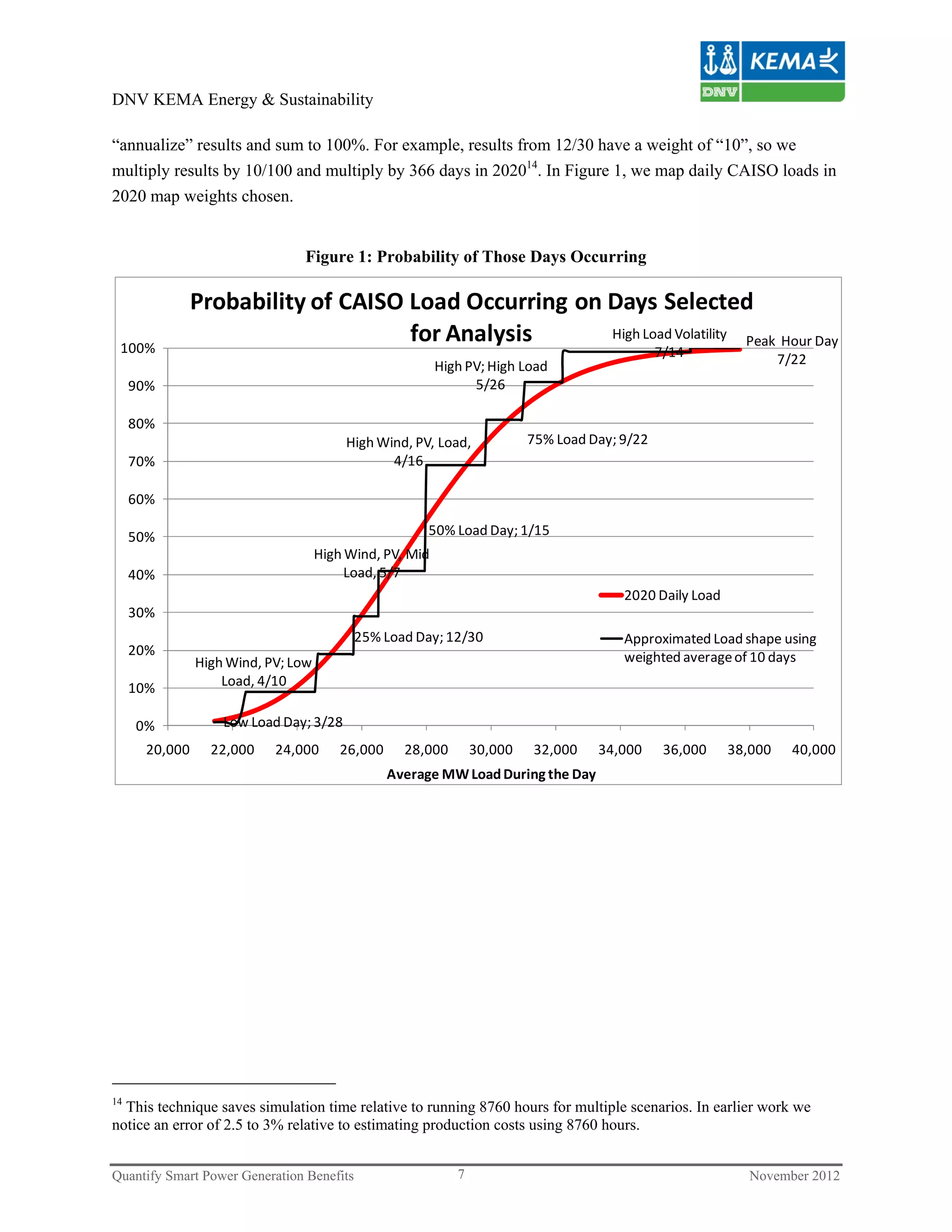
demand-side reductions, and low quantities of Demand Response. As shown in Table 1, we first identify
days which segment the load duration curve based upon probabilities. For example, the lowest load day is
Case 1 and has 0.01% probability that no load day will be lower. The Peak Hour day occurs on 7/22 and
has a 99.9% probability that all load days will be lower than peak hour day13.

                                      Table 1: Days Selected for Analysis

                                                      ISO
                                            ISO                     Load
                                                     Load                         Wind      PV               Annual
Case                Note                   Load                  Probability1),                     Date1)
                                                    Volatility                    Rank1)   Rank1)            Weight
                                           Rank1)                      2)
                                                     Rank1)
                                   Daily Cases Analyzed based upon Load Probabilities
       0.1% Probability CAISO
  1                                         366        364           0.01%           35       86    3/28       1
       Load Day
  2    25% Probability Load Day             281        218            25%           352       358   12/30      10
  3    50% Probability Load Day             164        267            50%           321       321    1/15      28
  4    75% Probability Load Day             83          78            25%           277       235    9/22      10
       99.9% Peak Hour Day
  5                                          1          11           99.9%          122       54    7/22       1
       CAISO
                               Daily Cases based upon Renewable and Load Volatility
  6    High Load Volatility Day              8           1            99%            95       70    7/14       8
       High PV; High Wind; High
  7                                          62         58            82%            27        6    5/26       10
       Load Day
  8    High PV; Low Load Day                203        208            43%             8        1     5/7       12
       High Wind; High PV;
  9                                         155        263            52%             1       11    4/16       12
       Middle Load Day
       High PV; High Wind; Low
 10                                         315        365            12%             2       15    4/10       8
       Load Day
                                                Total Weights                                                 100
1) 1 = Highest Observed Value; 366 = Lowest Observed Value
2) Load probability is the probability that Load will be less than or equal to what is observed.
3) Weights are chosen to segment the 366 days into 10 days.


We were also interested in examining the impact of Smart Power Generation to balance energy
requirements on volatile load, wind and photovoltaic (PV) days. We selected days, noted probabilities and
determined weights (Table 1) to segment the load duration curve (Figure 1). Weights are used to


13
  We fit a lognormal probability function using Anderson Darling goodness of fit test. Stephens, M. A. (1974). EDF
Statistics for Goodness of Fit and Some Comparisons, Journal of the American Statistical Association, 69, pp. 730-
737.


Quantify Smart Power Generation Benefits                 6                                            November 2012
DNV KEMA Energy & Sustainability

“annualize” results and sum to 100%. For example, results from 12/30 have a weight of “10”, so we
multiply results by 10/100 and multiply by 366 days in 202014. In Figure 1, we map daily CAISO loads in
2020 map weights chosen.


                                 Figure 1: Probability of Those Days Occurring

                Probability of CAISO Load Occurring on Days Selected 
 100%
                                     for Analysis      High Load Volatility Peak  Hour Day
                                                                                             7/14                7/22
                                                        High PV; High Load
     90%                                                      5/26

     80%
                                         High Wind, PV, Load,           75% Load Day; 9/22
     70%                                        4/16

     60%

     50%                                              50% Load Day; 1/15
                                  High Wind, PV, Mid 
     40%                               Load, 5/7
                                                                                      2020 Daily Load
     30%
                                           25% Load Day; 12/30                        Approximated Load shape using 
     20%                                                                              weighted average of 10 days
                High Wind, PV; Low 
     10%            Load, 4/10

     0%             Low Load Day; 3/28
       20,000     22,000    24,000    26,000      28,000       30,000   32,000    34,000      36,000    38,000     40,000
                                               Average MW Load During the Day


14
  This technique saves simulation time relative to running 8760 hours for multiple scenarios. In earlier work we
notice an error of 2.5 to 3% relative to estimating production costs using 8760 hours.


Quantify Smart Power Generation Benefits                   7                                               November 2012
DNV KEMA Energy & Sustainability


2.3           System Flexibility: Ancillary Services Needed

     Figure 2: Time Line of Renewable Resource Frequency Control, after Skinner, et al, June 201215

                        Impacts of Renewable Resources on Frequency Control

                                            Seconds                    Inertia
                       Primary                                    Governor Response
                       Control


                            Secondary        Seconds to Minutes
                                                                      Regulation
                             Control


                                     Tertiary           Minutes
                                                                           Economic Dispatch
                                     Control


                                             Time                 Hours
                                                                                      Supply Stack
                                            Control


                     Spinning Reserve                                                   Contingency
                                                                                          Reserve
                     Non‐Spinning Reserve
                                                              Minutes
                                  Forecast Error                                         Load Following


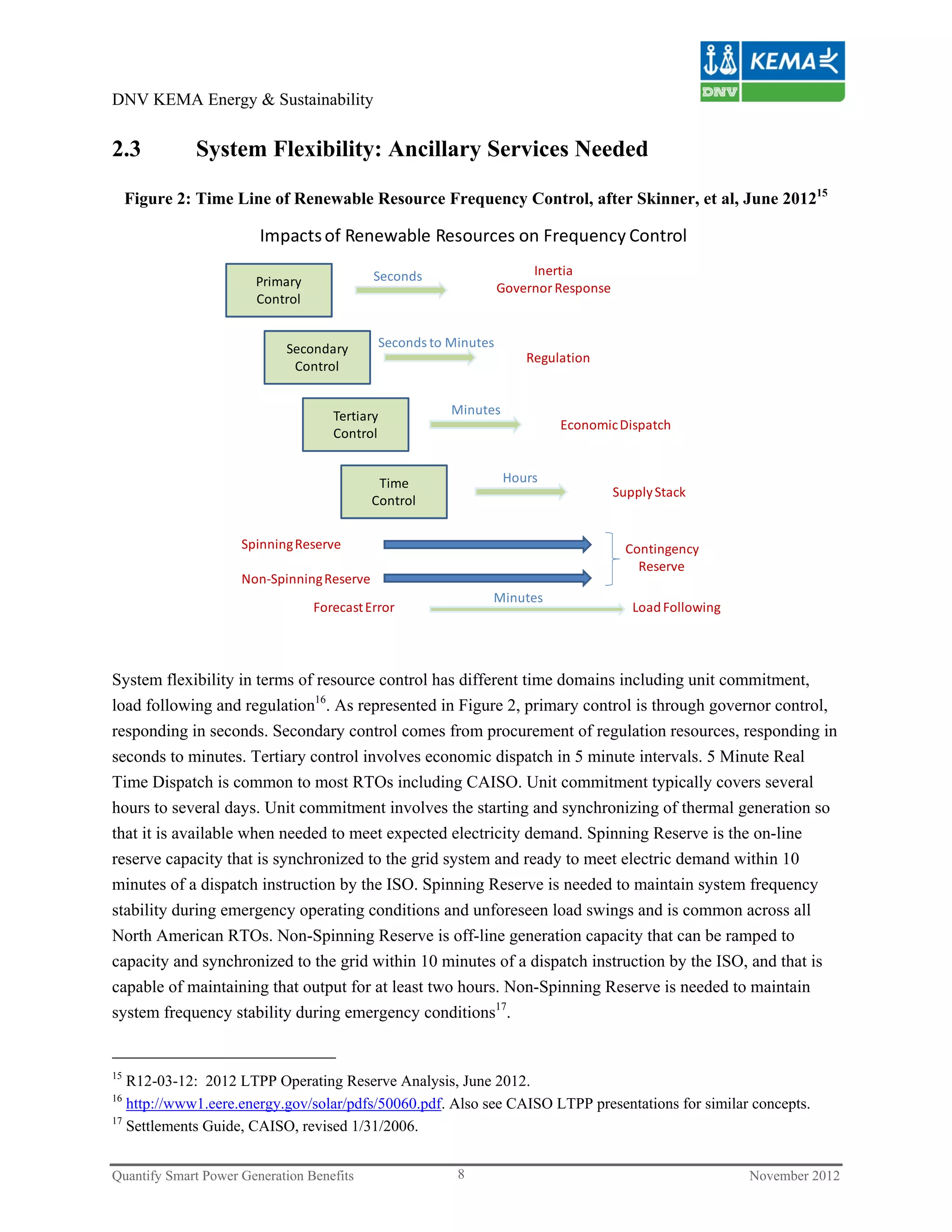
System flexibility in terms of resource control has different time domains including unit commitment,
load following and regulation16. As represented in Figure 2, primary control is through governor control,
responding in seconds. Secondary control comes from procurement of regulation resources, responding in
seconds to minutes. Tertiary control involves economic dispatch in 5 minute intervals. 5 Minute Real
Time Dispatch is common to most RTOs including CAISO. Unit commitment typically covers several
hours to several days. Unit commitment involves the starting and synchronizing of thermal generation so
that it is available when needed to meet expected electricity demand. Spinning Reserve is the on-line
reserve capacity that is synchronized to the grid system and ready to meet electric demand within 10
minutes of a dispatch instruction by the ISO. Spinning Reserve is needed to maintain system frequency
stability during emergency operating conditions and unforeseen load swings and is common across all
North American RTOs. Non-Spinning Reserve is off-line generation capacity that can be ramped to
capacity and synchronized to the grid within 10 minutes of a dispatch instruction by the ISO, and that is
capable of maintaining that output for at least two hours. Non-Spinning Reserve is needed to maintain
system frequency stability during emergency conditions17.


15
   R12-03-12: 2012 LTPP Operating Reserve Analysis, June 2012.
16
   http://www1.eere.energy.gov/solar/pdfs/50060.pdf. Also see CAISO LTPP presentations for similar concepts.
17
   Settlements Guide, CAISO, revised 1/31/2006.


Quantify Smart Power Generation Benefits                 8                                                November 2012
DNV KEMA Energy & Sustainability

A new flexible ramping market has emerged in California to address the need for flexible capacity in the
future. Flexible capacity has been defined by the CAISO18 for each resource based on the resource’s
ramping speed, ability to sustain a ramp, ability to change ramp directions, ability to reduce output and
not encounter emission limitations, start time, and ability to cycle on and off frequently. We investigate
potential cost impacts of future scenarios by simulating five minute real time dispatch in Section 4.

Load following in California typically ranges from 5–15 minutes to a few hours and is associated with
supplemental energy and capacity used to meet uncertainties in renewable generation and load19. Subject
to operating constraints on the generator, units that have been previously committed or are able to start
quickly can provide this service. We explore the potential impacts of load following in Section 3.

Regulation typically ranges from several seconds to 5 minutes, and covers the variability that occurs
between economic dispatches. Using automatic generation control (AGC), units automatically respond to
minute-by-minute load deviations in response to signals from grid operators. Changes in load and variable
renewable generation during the regulation time are typically not predicted or scheduled in advance and
must be met through generation that is on-line, grid-synchronized, and under automated control by the
grid operator. In the short run, ramp rates describe the ability of a resource to increase (ramp up) or
decrease (ramp down) generation. All operating reserves (load following and regulation) and contingency
reserves (spinning and non-spinning) are ancillary services.

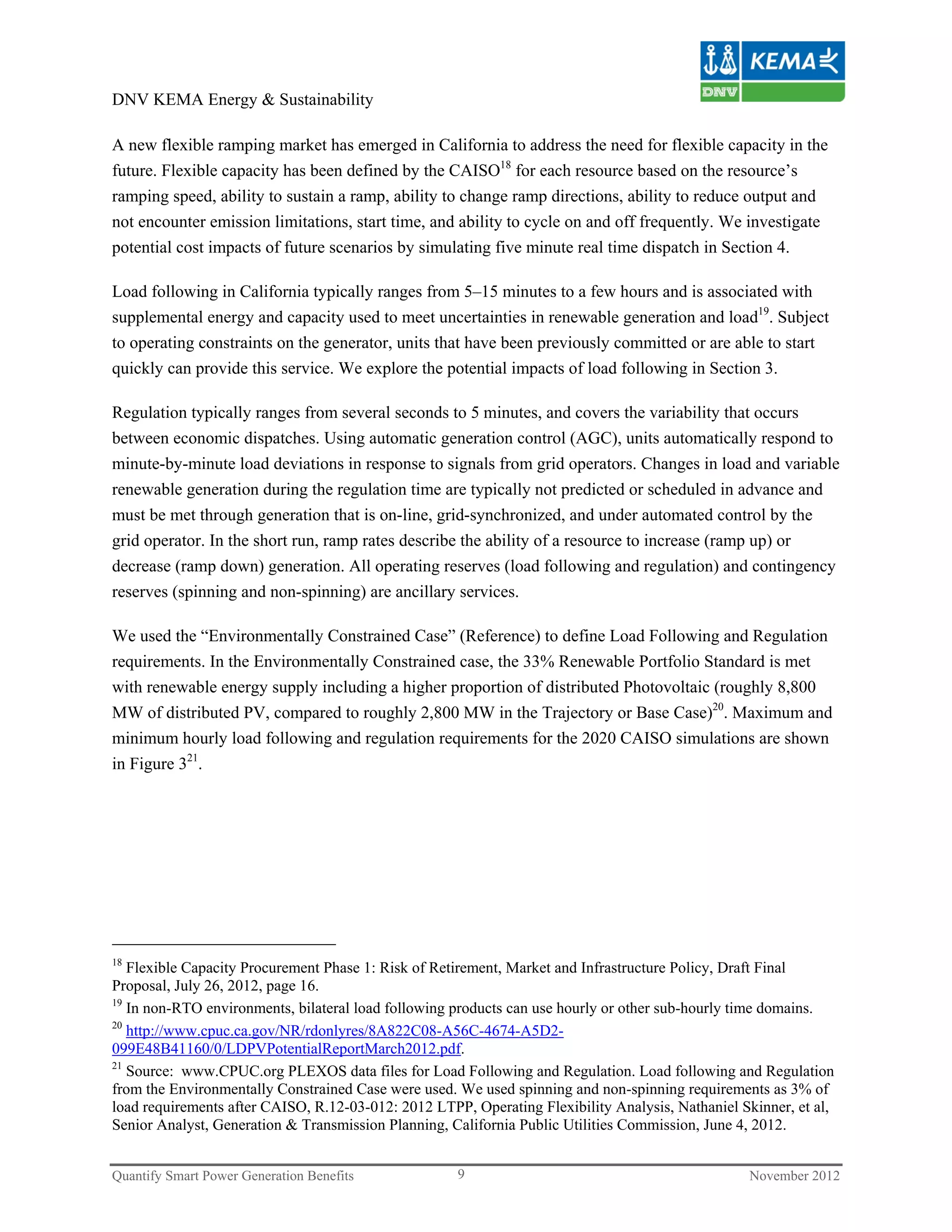
We used the “Environmentally Constrained Case” (Reference) to define Load Following and Regulation
requirements. In the Environmentally Constrained case, the 33% Renewable Portfolio Standard is met
with renewable energy supply including a higher proportion of distributed Photovoltaic (roughly 8,800
MW of distributed PV, compared to roughly 2,800 MW in the Trajectory or Base Case)20. Maximum and
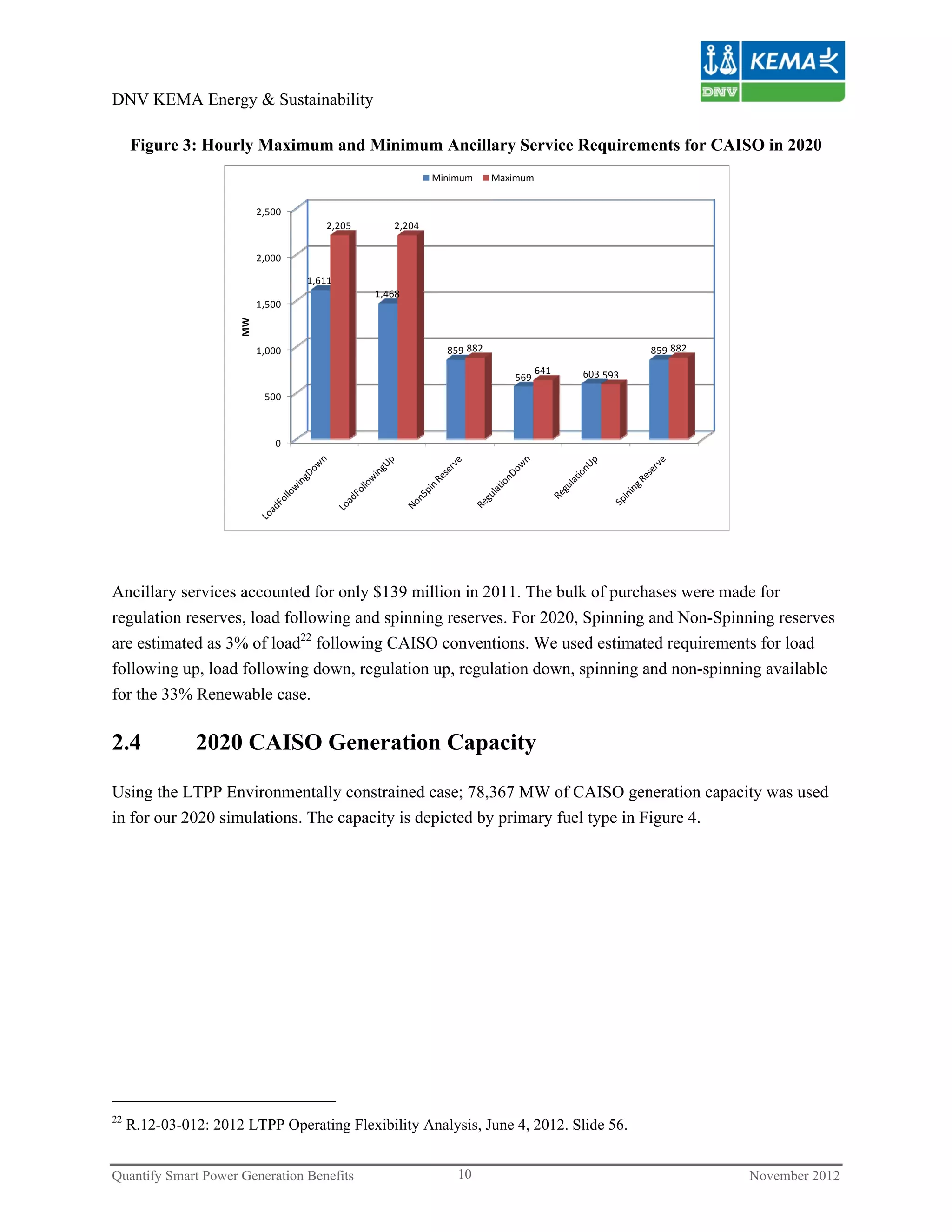
minimum hourly load following and regulation requirements for the 2020 CAISO simulations are shown
in Figure 321.


18
   Flexible Capacity Procurement Phase 1: Risk of Retirement, Market and Infrastructure Policy, Draft Final
Proposal, July 26, 2012, page 16.
19
   In non-RTO environments, bilateral load following products can use hourly or other sub-hourly time domains.
20
   http://www.cpuc.ca.gov/NR/rdonlyres/8A822C08-A56C-4674-A5D2-
099E48B41160/0/LDPVPotentialReportMarch2012.pdf.
21
   Source: www.CPUC.org PLEXOS data files for Load Following and Regulation. Load following and Regulation
from the Environmentally Constrained Case were used. We used spinning and non-spinning requirements as 3% of
load requirements after CAISO, R.12-03-012: 2012 LTPP, Operating Flexibility Analysis, Nathaniel Skinner, et al,
Senior Analyst, Generation & Transmission Planning, California Public Utilities Commission, June 4, 2012.


Quantify Smart Power Generation Benefits             9                                            November 2012
DNV KEMA Energy & Sustainability

     Figure 3: Hourly Maximum and Minimum Ancillary Service Requirements for CAISO in 2020
                                                         Minimum     Maximum


                           2,500
                                      2,205      2,204


                           2,000

                                   1,611
                                              1,468
                           1,500
                      MW


                           1,000                           859 882                             859 882
                                                                               641   603 593
                                                                        569
                            500


                              0


Ancillary services accounted for only $139 million in 2011. The bulk of purchases were made for
regulation reserves, load following and spinning reserves. For 2020, Spinning and Non-Spinning reserves
are estimated as 3% of load22 following CAISO conventions. We used estimated requirements for load
following up, load following down, regulation up, regulation down, spinning and non-spinning available
for the 33% Renewable case.

2.4            2020 CAISO Generation Capacity

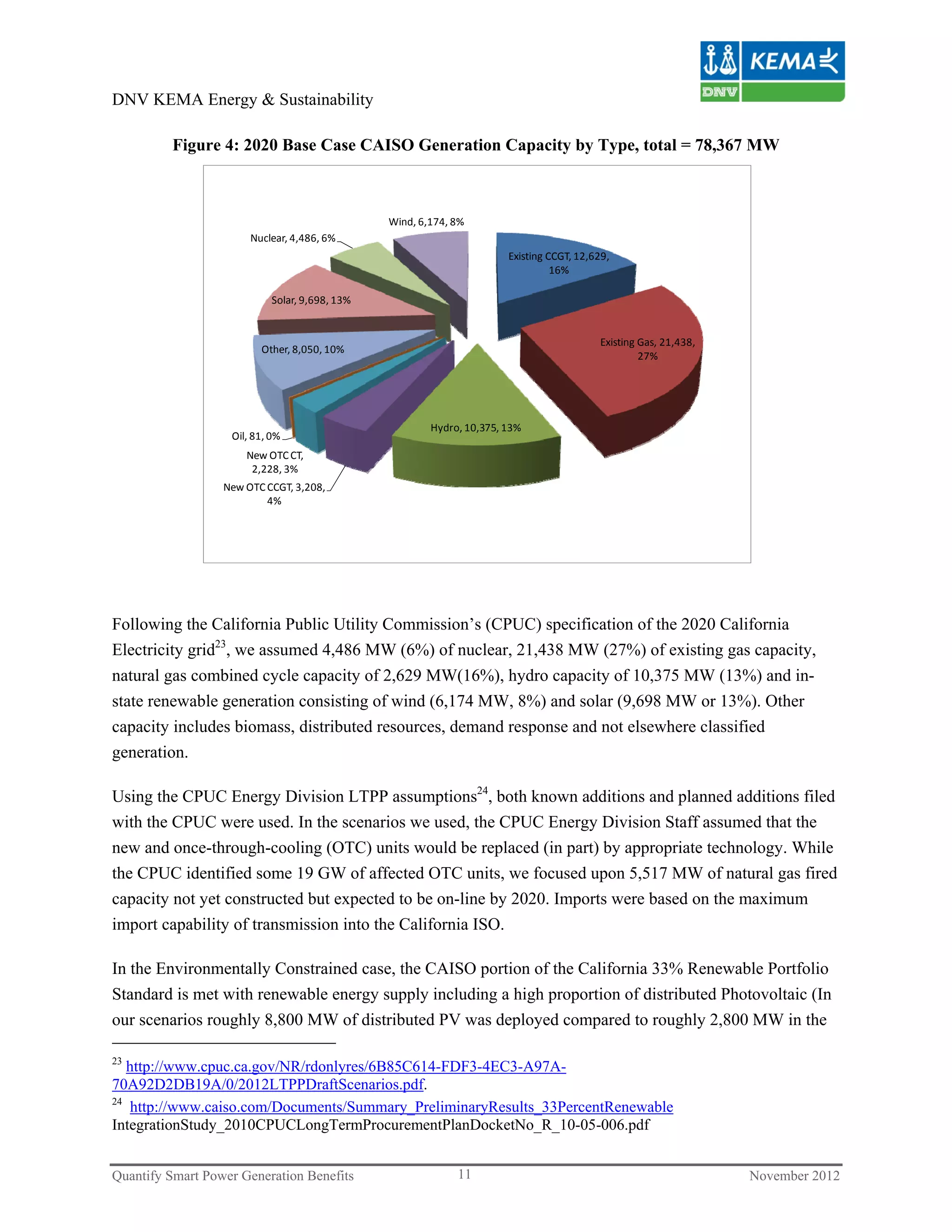
Using the LTPP Environmentally constrained case; 78,367 MW of CAISO generation capacity was used
in for our 2020 simulations. The capacity is depicted by primary fuel type in Figure 4.


22
     R.12-03-012: 2012 LTPP Operating Flexibility Analysis, June 4, 2012. Slide 56.


Quantify Smart Power Generation Benefits                     10                                          November 2012
DNV KEMA Energy & Sustainability

         Figure 4: 2020 Base Case CAISO Generation Capacity by Type, total = 78,367 MW


                                                Wind, 6,174, 8%
                       Nuclear, 4,486, 6%
                                                                       Existing CCGT, 12,629, 
                                                                                 16%

                            Solar, 9,698, 13%


                                                                                           Existing Gas, 21,438, 
                         Other, 8,050, 10%
                                                                                                    27%


                                                        Hydro, 10,375, 13%
                   Oil, 81, 0%
                      New OTC CT, 
                       2,228, 3%
                  New OTC CCGT, 3,208, 
                          4%


Following the California Public Utility Commission’s (CPUC) specification of the 2020 California
Electricity grid23, we assumed 4,486 MW (6%) of nuclear, 21,438 MW (27%) of existing gas capacity,
natural gas combined cycle capacity of 2,629 MW(16%), hydro capacity of 10,375 MW (13%) and in-
state renewable generation consisting of wind (6,174 MW, 8%) and solar (9,698 MW or 13%). Other
capacity includes biomass, distributed resources, demand response and not elsewhere classified
generation.

Using the CPUC Energy Division LTPP assumptions24, both known additions and planned additions filed
with the CPUC were used. In the scenarios we used, the CPUC Energy Division Staff assumed that the
new and once-through-cooling (OTC) units would be replaced (in part) by appropriate technology. While
the CPUC identified some 19 GW of affected OTC units, we focused upon 5,517 MW of natural gas fired
capacity not yet constructed but expected to be on-line by 2020. Imports were based on the maximum
import capability of transmission into the California ISO.

In the Environmentally Constrained case, the CAISO portion of the California 33% Renewable Portfolio
Standard is met with renewable energy supply including a high proportion of distributed Photovoltaic (In
our scenarios roughly 8,800 MW of distributed PV was deployed compared to roughly 2,800 MW in the

23
   http://www.cpuc.ca.gov/NR/rdonlyres/6B85C614-FDF3-4EC3-A97A-
70A92D2DB19A/0/2012LTPPDraftScenarios.pdf.
24
   http://www.caiso.com/Documents/Summary_PreliminaryResults_33PercentRenewable
IntegrationStudy_2010CPUCLongTermProcurementPlanDocketNo_R_10-05-006.pdf


Quantify Smart Power Generation Benefits                     11                                                     November 2012
DNV KEMA Energy & Sustainability

Trajectory or Base Case)25. In the High Load Growth case, CPUC Staff assumed a high load growth
future and a high success of incremental demand-side programs that would be available if conditions
warrant. There were two types of demand response which are modeled: price responsive demand
response and “backstop” demand response should there be a shortfall in load or ancillary service
requirements. The High Load Growth assumes a robust economic recovery and/or promoting policies that
foster high load growth, high demand-side reductions, and low quantities of Demand Response. We
assumed no forced or planned outages in any simulations.

2.5          2020 Smart Power Generation Parameters

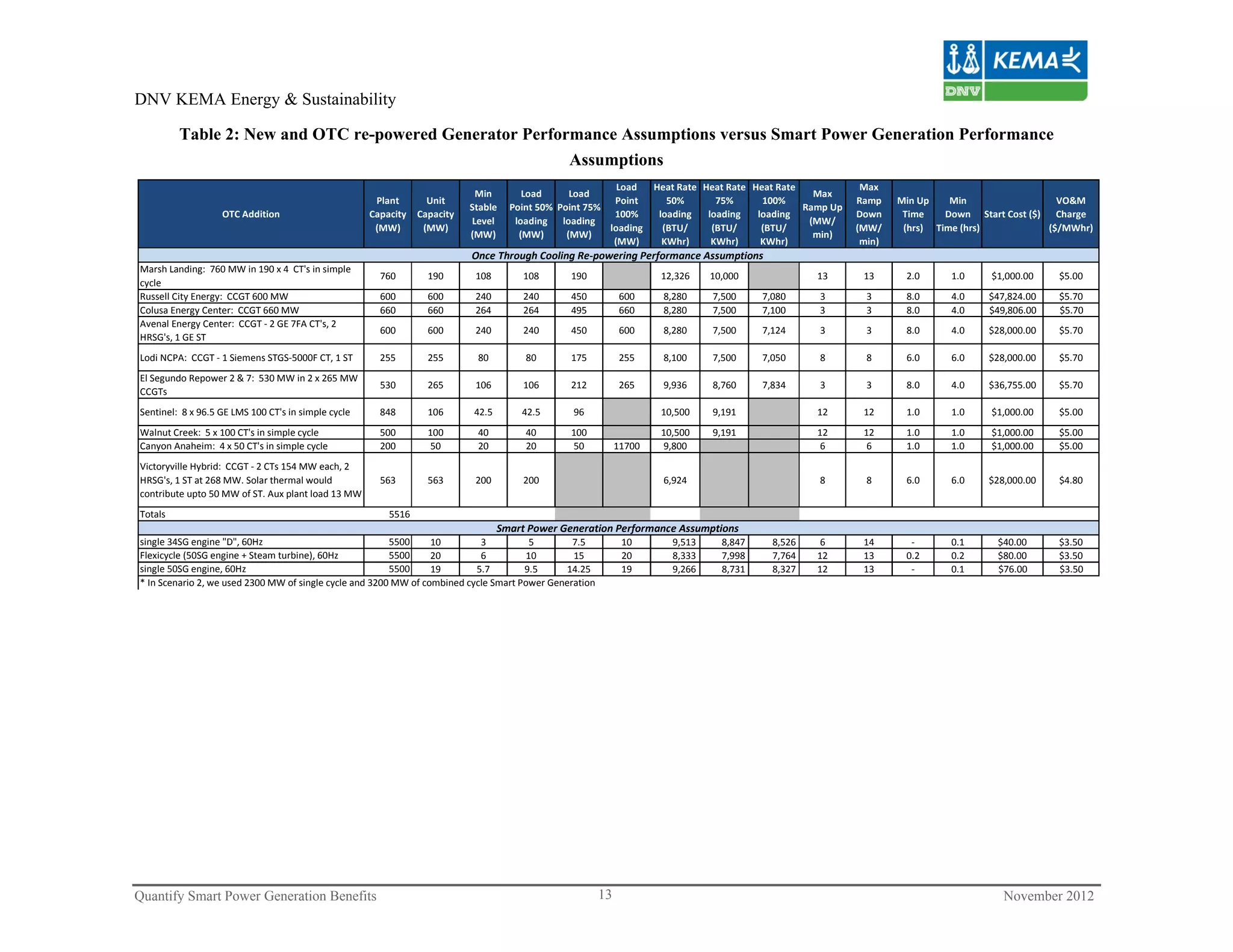
We contrast (combustion engine) Smart Power Generation operating parameters with those of the
repowered Once-Through-Cooling units (OTC re-powered units) in Table 2, listing new and re-powered
OTC generation capacity targeted in the study26. New and re-powered OTC generation assumptions used
for the 2020 CAISO simulation are listed along with the generator name. First, note that new and re-
powered OTC assumptions have a higher maximum capacity than the smaller Smart Power Generation
assumptions. With smaller units, minimum stable operating levels are lower and can be more efficient
than the larger new and re-powered OTC units. Second, note that there is a difference in the fuel
efficiency (heat rate) between the new and re-powered OTC units and Smart Power Generation
configurations. Marsh Landing, Sentinel, Walnut Creek and Canyon Anaheim are all projected to have
heat rates higher than both Smart Power simple cycle and combined cycle operating in simple cycle
mode. Smart Power Generation in simple cycle mode is less efficient than new or OTC re-powered
combined cycles such as Russell City Energy, Colusa Energy Center, Lodi and El Segundo, but has lower
variable O&M costs and faster ramp rates. While new or OTC re-powered combined cycles are more
efficient, the start costs are also significantly higher than those of the Smart Power Generation. In short,
new or OTC re-powered combined cycle generators provide inexpensive energy as long as the operator is
not required to start and stop them. In terms of ramping, Smart Power Generators are faster in simple
cycle mode than new or OTC re-powered generators but are more efficient than the new or OTC re-
powered simple cycles. Smart Power Generation multiple shaft plants can operate at part load by shutting
down engines, creating flexibility in use.


25
   http://www.cpuc.ca.gov/NR/rdonlyres/8A822C08-A56C-4674-A5D2-
099E48B41160/0/LDPVPotentialReportMarch2012.pdf.
26
   There are many units identified by the CPUC as potential new or OTC re-powering. These are a subset of those
units.


Quantify Smart Power Generation Benefits              12                                           November 2012
DNV KEMA Energy & Sustainability

         Table 2: New and OTC re-powered Generator Performance Assumptions versus Smart Power Generation Performance
                                                         Assumptions
                                                                                                            Load  Heat Rate  Heat Rate  Heat Rate                          Max 
                                                                             Min       Load       Load                                               Max 
                                                       Plant      Unit                                     Point     50%       75%        100%                            Ramp    Min Up    Min                   VO&M 
                                                                            Stable  Point 50%  Point 75%                                           Ramp Up 
                   OTC Addition                       Capacity  Capacity                                   100%    loading  loading  loading                              Down     Time    Down  Start Cost ($) Charge 
                                                                            Level    loading  loading                                               (MW/ 
                                                       (MW)      (MW)                                     loading   (BTU/     (BTU/      (BTU/                            (MW/     (hrs) Time (hrs)             ($/MWhr)
                                                                            (MW)      (MW)       (MW)                                                min)
                                                                                                           (MW)     KWhr)     KWhr)      KWhr)                             min)
                                                                            Once Through Cooling Re‐powering Performance Assumptions
Marsh Landing:  760 MW in 190 x 4  CT's in simple 
                                                        760       190        108        108      190                   12,326         10,000                         13    13      2.0      1.0     $1,000.00    $5.00
cycle
Russell City Energy:  CCGT 600 MW                       600       600        240        240      450         600       8,280           7,500          7,080          3     3       8.0      4.0    $47,824.00    $5.70
Colusa Energy Center:  CCGT 660 MW                      660       660        264        264      495         660       8,280           7,500          7,100          3     3       8.0      4.0    $49,806.00    $5.70
Avenal Energy Center:  CCGT ‐ 2 GE 7FA CT's, 2 
                                                        600       600        240        240      450         600       8,280           7,500          7,124          3     3       8.0      4.0    $28,000.00    $5.70
HRSG's, 1 GE ST
Lodi NCPA:  CCGT ‐ 1 Siemens STGS‐5000F CT, 1 ST        255       255        80         80       175         255       8,100           7,500          7,050          8     8       6.0      6.0    $28,000.00    $5.70
El Segundo Repower 2 & 7:  530 MW in 2 x 265 MW 
                                                        530       265        106        106      212         265       9,936           8,760          7,834          3     3       8.0      4.0    $36,755.00    $5.70
CCGTs
Sentinel:  8 x 96.5 GE LMS 100 CT's in simple cycle     848       106       42.5       42.5      96                    10,500          9,191                         12    12      1.0      1.0     $1,000.00    $5.00
Walnut Creek:  5 x 100 CT's in simple cycle             500       100        40         40       100                   10,500          9,191                         12    12      1.0      1.0     $1,000.00    $5.00
Canyon Anaheim:  4 x 50 CT's in simple cycle            200       50         20         20       50          11700     9,800                                          6     6      1.0      1.0     $1,000.00    $5.00
Victoryville Hybrid:  CCGT ‐ 2 CTs 154 MW each, 2 
HRSG's, 1 ST at 268 MW. Solar thermal would             563       563        200        200                            6,924                                         8     8       6.0      6.0    $28,000.00    $4.80
contribute upto 50 MW of ST. Aux plant load 13 MW
Totals                                                    5516
                                                                                   Smart Power Generation Performance Assumptions
single 34SG engine "D", 60Hz                             5500     10        3           5       7.5           10             9,513          8,847           8,526     6    14       ‐       0.1      $40.00      $3.50
Flexicycle (50SG engine + Steam turbine), 60Hz           5500     20        6          10       15            20             8,333          7,998           7,764    12    13      0.2      0.2      $80.00      $3.50
single 50SG engine, 60Hz                                 5500     19       5.7        9.5     14.25           19             9,266          8,731           8,327    12    13       ‐       0.1      $76.00      $3.50
* In Scenario 2, we used 2300 MW of single cycle and 3200 MW of combined cycle Smart Power Generation


Quantify Smart Power Generation Benefits                                                                13                                                                                            November 2012
DNV KEMA Energy & Sustainability


3.           CAISO Hourly Day-Ahead Integrated Forward Market
In this section, we deploy the main assumptions about CAISO markets in 2020 to analyze hourly
integrated day-ahead energy and ancillary service markets impacts of those assumptions across four
different day-ahead scenarios. First we provide a brief description of day-ahead markets and then we
describe scenarios and results.

3.1          CAISO’s Day Ahead Markets

                  Figure 5: CAISO Day-Ahead Market Inputs, Processing and Outputs


                                                         CAISO Day‐Ahead Market

                              Data Inputs
                          •    System Parameters
                          •    Resource Parameters
                          •    Outage Information                                      Outputs
                          •    Default Energy Bids                                 1. Day Ahead 
                          •    Bid Information                                        Energy 
                                                                   Day Ahead          Schedules
                                                                                   2. Virtual Awards
                                                                    Integrated     3. Ancillary 
                                                                 Forward Market       Service 
                              Requirements Inputs
                                                                   Processing         Awards
                          • Ancillary Service Requirements                         4. Residual Unit 
                          • Residual Unit Commitment                                  Commitment
                          • ISO Forecast of ISO Demand
                          • Manual Reliable Must Run 
                            Determinations
                          • Transmission Interface Limits


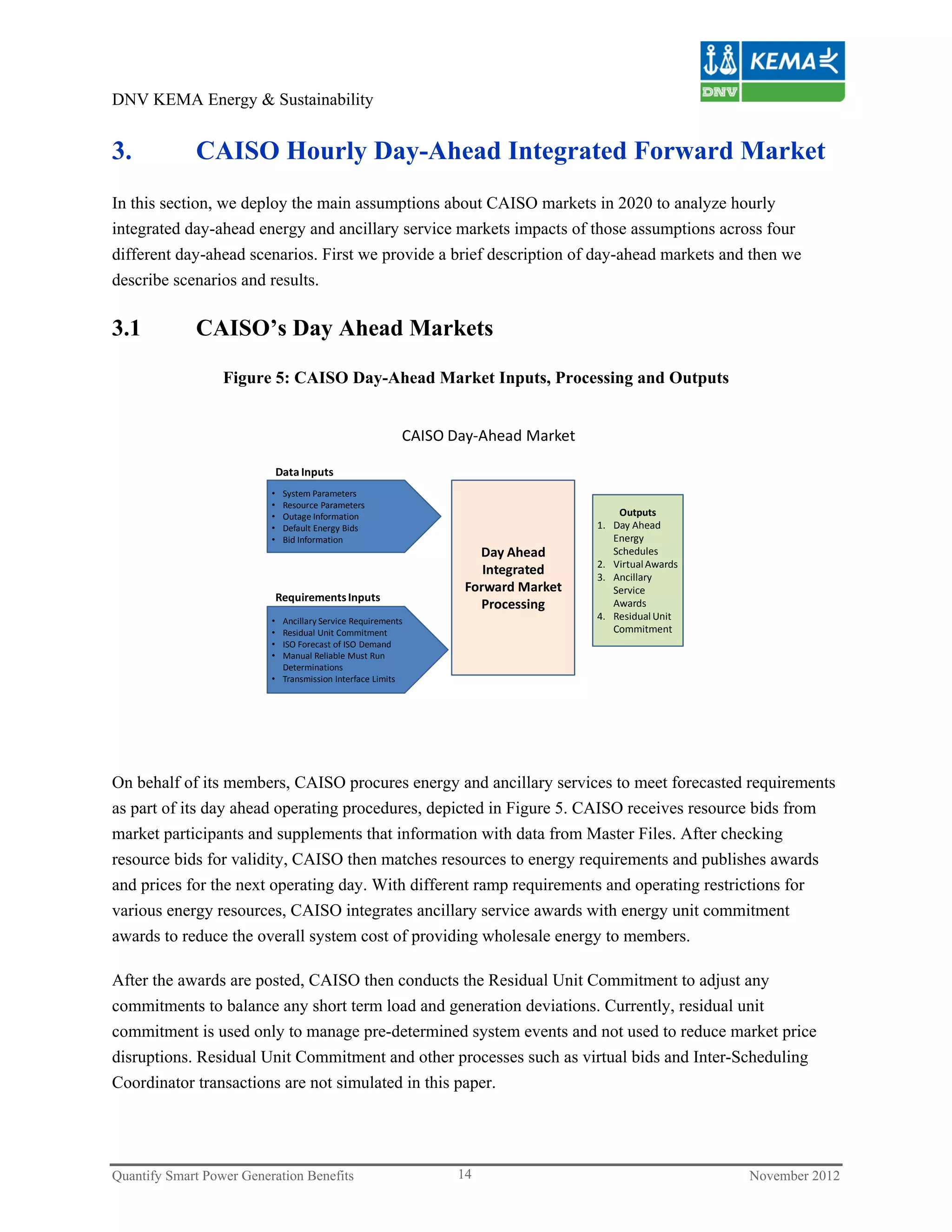
On behalf of its members, CAISO procures energy and ancillary services to meet forecasted requirements
as part of its day ahead operating procedures, depicted in Figure 5. CAISO receives resource bids from
market participants and supplements that information with data from Master Files. After checking
resource bids for validity, CAISO then matches resources to energy requirements and publishes awards
and prices for the next operating day. With different ramp requirements and operating restrictions for
various energy resources, CAISO integrates ancillary service awards with energy unit commitment
awards to reduce the overall system cost of providing wholesale energy to members.

After the awards are posted, CAISO then conducts the Residual Unit Commitment to adjust any
commitments to balance any short term load and generation deviations. Currently, residual unit
commitment is used only to manage pre-determined system events and not used to reduce market price
disruptions. Residual Unit Commitment and other processes such as virtual bids and Inter-Scheduling
Coordinator transactions are not simulated in this paper.


Quantify Smart Power Generation Benefits                        14                                     November 2012
DNV KEMA Energy & Sustainability


3.2          Simulation Process, Scenarios and Metrics Evaluated

To analyze the impacts of various future 2020 conditions, we used production costing simulation. In the
integrated hourly day-ahead simulations, production simulation27 is an hourly deterministic production
simulation of the entire WECC, including CAISO hourly dispatch with the objective of minimizing cost
while meeting the hourly load and ancillary service requirements, subject to resource and inter-regional
transmission constraints. If the production simulation is not able to meet one or more of these
requirements, a shortfall is identified and generic resource capacity is introduced to resolve the shortfall.
Following WECC and CPUC LTPP assumptions, we used either the General Electric LM 6000
combustion turbine or incremental Demand Response resources as a backstop against shortfalls in energy
production or in ancillary services28.

Using this product costing method, we then evaluated future market uncertainties related to renewable
and distributed generation resources, generation adequacy and other related issues in these four scenarios.

     1. In Day-Ahead Scenario 1 (the Base Case) we used the assumptions and architecture of the
        original Western Energy Coordinating Council (WECC) model. We specifically noted new or
        planned re-powering additions of 5.5 GW of identified Once-Through-Cooling (OTC) generation
        units (approximately 3.2 GW of gas turbine combined cycle, GTCC, and 2.3 GW of simple cycle
        gas turbines) which are assumed to be on line in 2020 and performing as specified. In our
         scenarios, the 5.5 GW of OTC capacity represents a potential for exploration in terms of “what-
         if” scenarios for system impacts; what if this 5.5 GW of OTC were supplanted or supplemented
         by Smart Power Generation (SPG)?

     2. For Day-Ahead Scenario 2 (SPG simple cycle; no OTC) we replaced all 5.5 GW of OTC capacity
        with the equivalent capacity of SPG simple cycle generating sets.

     3. For Day-Ahead Scenario 3 (SPG simple and combined cycle; no OTC) we replaced the 3.3 GW
        of new or repowered OTC gas turbine combined cycle capacity (GTCC) with 3.3 GW of Smart
        Power Generation combined cycles; and the new or repowered 2.2 GW of OTC simple cycle gas
        turbines with the equivalent capacity of Smart Power Generation simple cycle combustion
        engines.

     4. For Day-Ahead Scenario 4 (Base + SPG) we included the 5.5 GW of OTC combustion engines in
        simple and combined cycle and 5.5 GW of equivalent Smart Power Generation configurations.


27
   We used the Plexos Solutions representation of the WECC Transmission Expansion Planning Policy Committee
(TEPPC) model and inputs from two cases. We used the load profile from the High Load Scenario and all other
inputs came from the Environmental Constraint case.
28
   TRACK I DIRECT TESTIMONY OF MARK ROTHLEDER ON BEHALF OF THE CALIFORNIA
INDEPENDENT SYSTEM OPERATOR CORPORATION (CORRECTED), Rulemaking 10-05-006


Quantify Smart Power Generation Benefits           15                                          November 2012
DNV KEMA Energy & Sustainability

         Day-Ahead Scenario 4 represents an “overbuild” of capacity that allows the optimization
         algorithms to choose the least cost technology to meet energy and ancillary service needs.

The metrics we evaluated for each scenario include the following, for CAISO, for each scenario

        Variable cost of generation including fuel and operating and maintenance expenses

        Cost of Ancillary Services (i.e., load following (up and down) to account for miss-forecasted
         resources, regulation (up and down) which allows for automatic generation control by the ISO,
         spinning reserve and non-spin reserve.

        Contributions to Ancillary Service provisions by resource type

        Start/Stop costs (for all units collectively across the CAISO system)

        Emission costs (in this case, CO2 emissions)

        Capacity factors for each technology type in the CAISO system

        Dispatch profiles by technology type on select days; specifically the high volatility day (5/26) and
         the high load day (7/22).

These metrics and other factors are calculated for the Base Case, and compared to results obtained for the
additional scenarios. For each scenario, we explore cost impacts of meeting future market trends in 2020
with and without Smart Power Generation.

 3.2.1         The Role of Demand Response in the Simulations

In the WECC model 4,815 MW of available capacity acts as Price Sensitive Demand Response (DDR)
which can be invoked if prices are high enough in CAISO regions. There is no static price associated with
this Demand Response. Using program cost information, the WECC model employs various blocks of
potential energy savings ranging from low to high sensitivity to prices. Assuming $8/MMBTU gas prices
in 2020, a high response block of DDR at 1 MMBTU/MWh would then be “dispatched” or load reduced
when wholesale electricity prices reach $80/MWh. Similarly, low response blocks of DDR at 17
MMBTU/MWh would be “dispatched” or load reduced at $136/MWh with $8/MMBTU gas prices.

There is also backstop Demand Response which acts as a supplier of last resort for ancillary services. In
the WECC model, 148 MW of Regulation Up and Regulation Down and 240MW of Spin/NonSpin/Load
Following Up/Load Following Down are offered at the proxy price of “backing down
commercial/industrial load”. The WECC model has prices of $10,000/MW in the San Diego Gas and
Electric Region, $15,000/MW in the Southern California Edison’s region, $20,000/MW in Pacific Gas
and Electric’s Bay Area, and $25,000/MW in Pacific Gas and Electric’s Valley region. To contrast
against the Demand Response backstop, we also assume that a combustion turbine is on line and spinning
Quantify Smart Power Generation Benefits            16                                         November 2012
DNV KEMA Energy & Sustainability

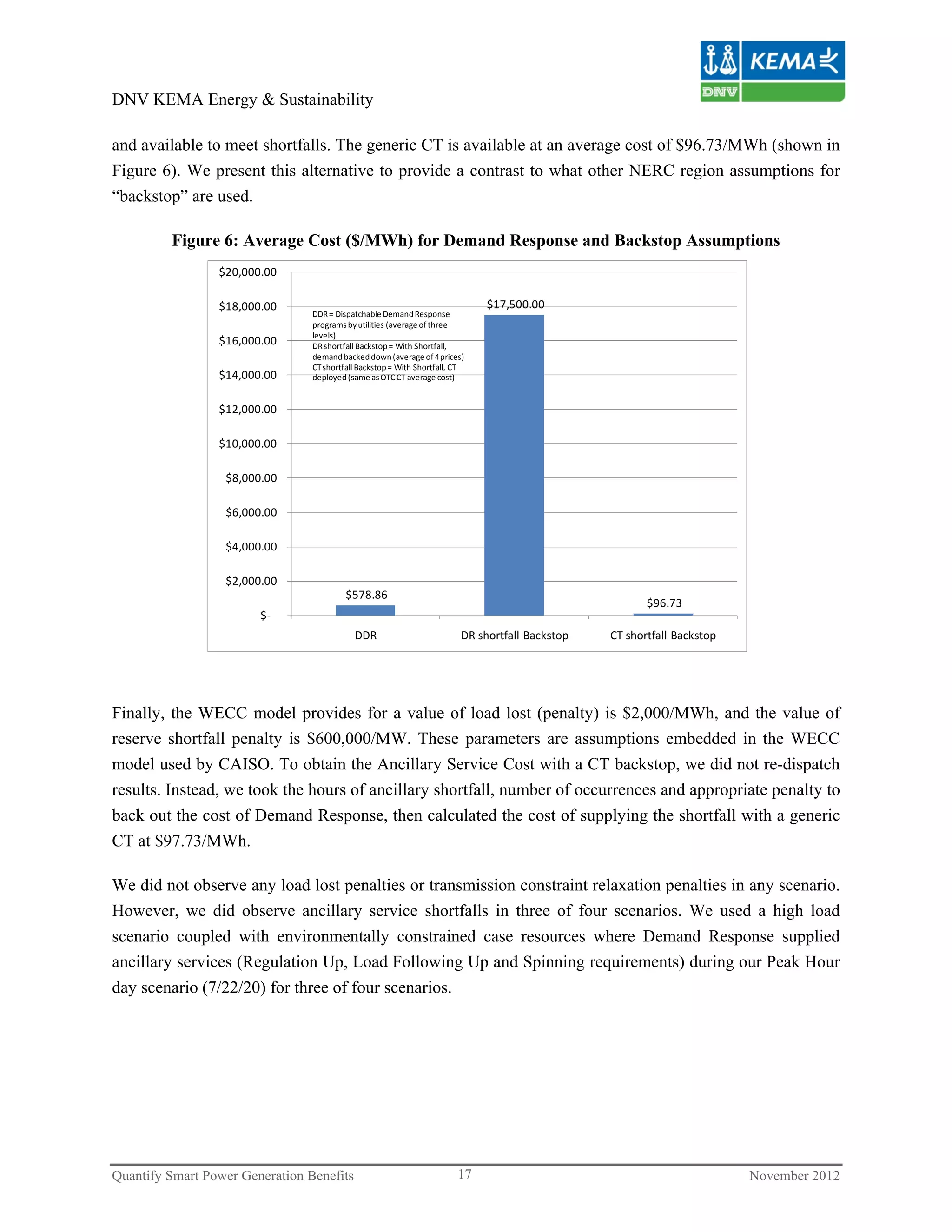
and available to meet shortfalls. The generic CT is available at an average cost of $96.73/MWh (shown in
Figure 6). We present this alternative to provide a contrast to what other NERC region assumptions for
“backstop” are used.

         Figure 6: Average Cost ($/MWh) for Demand Response and Backstop Assumptions
                 $20,000.00 

                 $18,000.00                                                     $17,500.00 
                                 DDR = Dispatchable Demand Response 
                                 programs by utilities (average of three
                                 levels)
                 $16,000.00      DR shortfall Backstop = With Shortfall, 
                                 demand backed down (average of 4 prices)
                                 CT shortfall Backstop = With Shortfall, CT 
                 $14,000.00      deployed (same as OTC CT average cost)


                 $12,000.00 

                 $10,000.00 

                  $8,000.00 

                  $6,000.00 

                  $4,000.00 

                  $2,000.00 
                                          $578.86 
                                                                                                          $96.73 
                        $‐
                                            DDR                            DR shortfall Backstop   CT shortfall Backstop


Finally, the WECC model provides for a value of load lost (penalty) is $2,000/MWh, and the value of
reserve shortfall penalty is $600,000/MW. These parameters are assumptions embedded in the WECC
model used by CAISO. To obtain the Ancillary Service Cost with a CT backstop, we did not re-dispatch
results. Instead, we took the hours of ancillary shortfall, number of occurrences and appropriate penalty to
back out the cost of Demand Response, then calculated the cost of supplying the shortfall with a generic
CT at $97.73/MWh.

We did not observe any load lost penalties or transmission constraint relaxation penalties in any scenario.
However, we did observe ancillary service shortfalls in three of four scenarios. We used a high load
scenario coupled with environmentally constrained case resources where Demand Response supplied
ancillary services (Regulation Up, Load Following Up and Spinning requirements) during our Peak Hour
day scenario (7/22/20) for three of four scenarios.


Quantify Smart Power Generation Benefits                                  17                                               November 2012
DNV KEMA Energy & Sustainability


3.3          Day-Ahead Scenario 1 (Base Case)

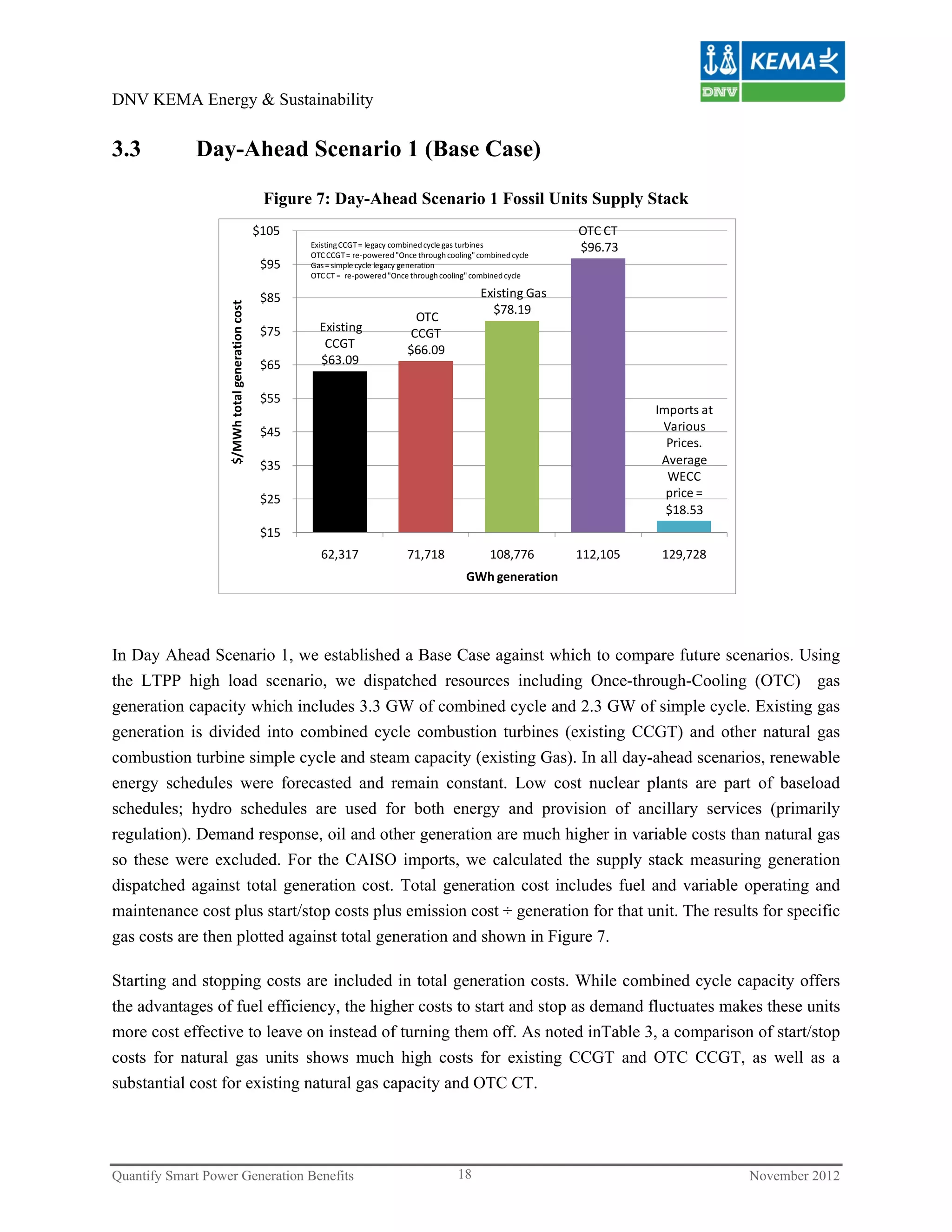
                                                  Figure 7: Day-Ahead Scenario 1 Fossil Units Supply Stack
                                                 $105                                                                  OTC CT
                                                         Existing CCGT = legacy combined cycle gas turbines            $96.73 
                                                         OTC CCGT = re‐powered "Once through cooling" combined cycle
                                                  $95    Gas = simple cycle legacy generation
                                                         OTC CT =  re‐powered "Once through cooling" combined cycle

                                                  $85                                                 Existing Gas 
                   $/MWh total generation cost


                                                                                                        $78.19 
                                                                                    OTC 
                                                  $75      Existing                CCGT 
                                                            CCGT                   $66.09 
                                                  $65      $63.09 

                                                  $55 
                                                                                                                                  Imports at
                                                  $45                                                                              Various 
                                                                                                                                    Prices.
                                                  $35                                                                              Average 
                                                                                                                                    WECC 
                                                  $25                                                                               price = 
                                                                                                                                    $18.53 
                                                  $15 
                                                           62,317                  71,718                108,776       112,105     129,728 
                                                                                                   GWh generation


In Day Ahead Scenario 1, we established a Base Case against which to compare future scenarios. Using
the LTPP high load scenario, we dispatched resources including Once-through-Cooling (OTC) gas
generation capacity which includes 3.3 GW of combined cycle and 2.3 GW of simple cycle. Existing gas
generation is divided into combined cycle combustion turbines (existing CCGT) and other natural gas
combustion turbine simple cycle and steam capacity (existing Gas). In all day-ahead scenarios, renewable
energy schedules were forecasted and remain constant. Low cost nuclear plants are part of baseload
schedules; hydro schedules are used for both energy and provision of ancillary services (primarily
regulation). Demand response, oil and other generation are much higher in variable costs than natural gas
so these were excluded. For the CAISO imports, we calculated the supply stack measuring generation
dispatched against total generation cost. Total generation cost includes fuel and variable operating and
maintenance cost plus start/stop costs plus emission cost ÷ generation for that unit. The results for specific
gas costs are then plotted against total generation and shown in Figure 7.

Starting and stopping costs are included in total generation costs. While combined cycle capacity offers
the advantages of fuel efficiency, the higher costs to start and stop as demand fluctuates makes these units
more cost effective to leave on instead of turning them off. As noted inTable 3, a comparison of start/stop
costs for natural gas units shows much high costs for existing CCGT and OTC CCGT, as well as a
substantial cost for existing natural gas capacity and OTC CT.


Quantify Smart Power Generation Benefits                                                        18                                             November 2012
DNV KEMA Energy & Sustainability


                               Table 3: Day-Ahead Scenario 1 Start/Stop Costs
                                                                            Start/Stop Cost
                                    Generation Type
                                                                              Millions ($)

                          Existing Natural Gas Combined Cycle                      $43
                          (Existing CCGT)
                          Other Existing Natural Gas capacity                      $29
                          New and OTC Combined Cycle (OTC                          $18
                          CCGT)
                          New and OTC Simple Cycle (OTC                            $29
                          CT)
                          All Others                                               $42
                          Total                                                    $162


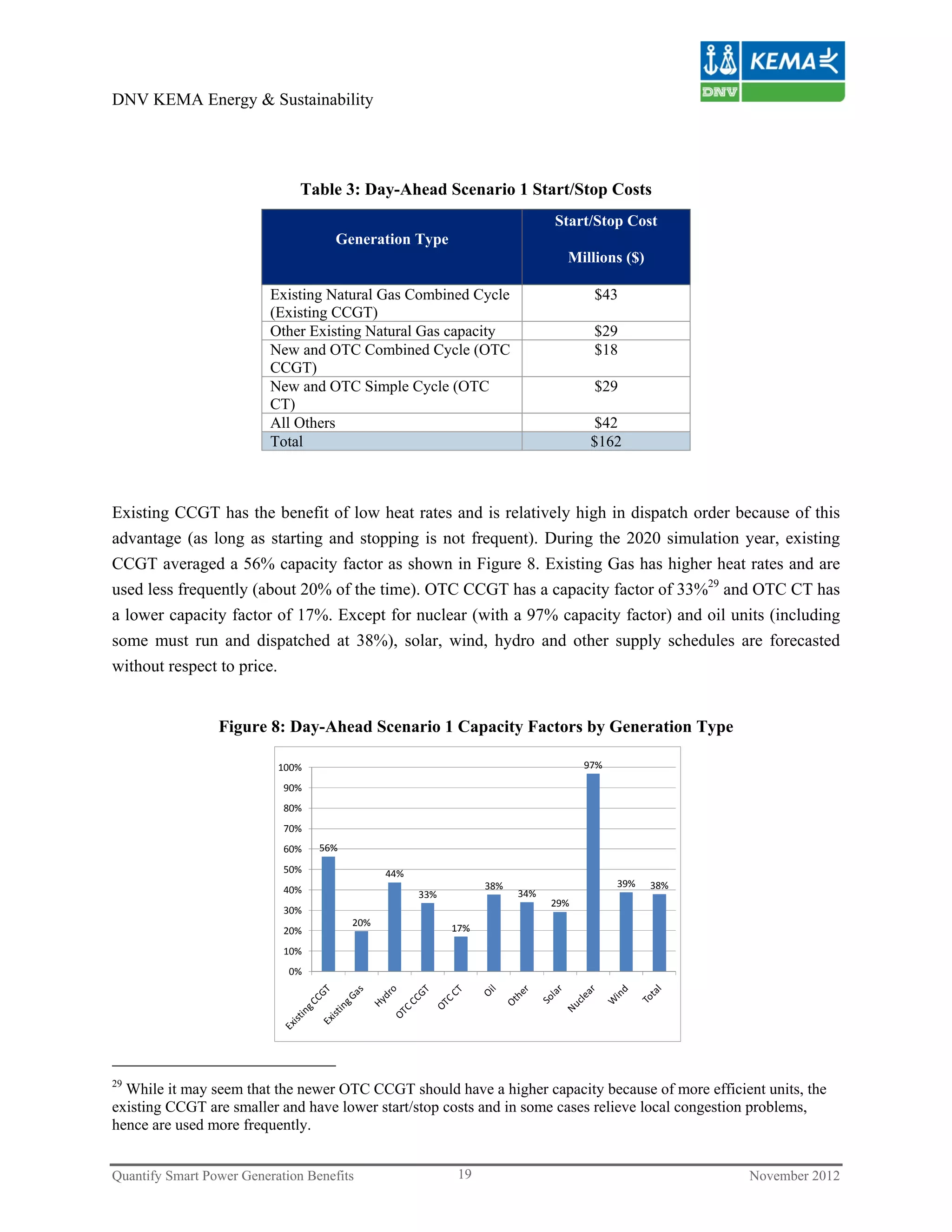
Existing CCGT has the benefit of low heat rates and is relatively high in dispatch order because of this
advantage (as long as starting and stopping is not frequent). During the 2020 simulation year, existing
CCGT averaged a 56% capacity factor as shown in Figure 8. Existing Gas has higher heat rates and are
used less frequently (about 20% of the time). OTC CCGT has a capacity factor of 33%29 and OTC CT has
a lower capacity factor of 17%. Except for nuclear (with a 97% capacity factor) and oil units (including
some must run and dispatched at 38%), solar, wind, hydro and other supply schedules are forecasted
without respect to price.


                 Figure 8: Day-Ahead Scenario 1 Capacity Factors by Generation Type

                           100%                                                   97%

                            90%
                            80%
                            70%
                            60%   56%

                            50%               44%
                                                                38%                     39%   38%
                            40%                     33%               34%
                                                                            29%
                            30%
                                        20%
                            20%                           17%

                            10%
                             0%


29
  While it may seem that the newer OTC CCGT should have a higher capacity because of more efficient units, the
existing CCGT are smaller and have lower start/stop costs and in some cases relieve local congestion problems,
hence are used more frequently.


Quantify Smart Power Generation Benefits                  19                                        November 2012
DNV KEMA Energy & Sustainability


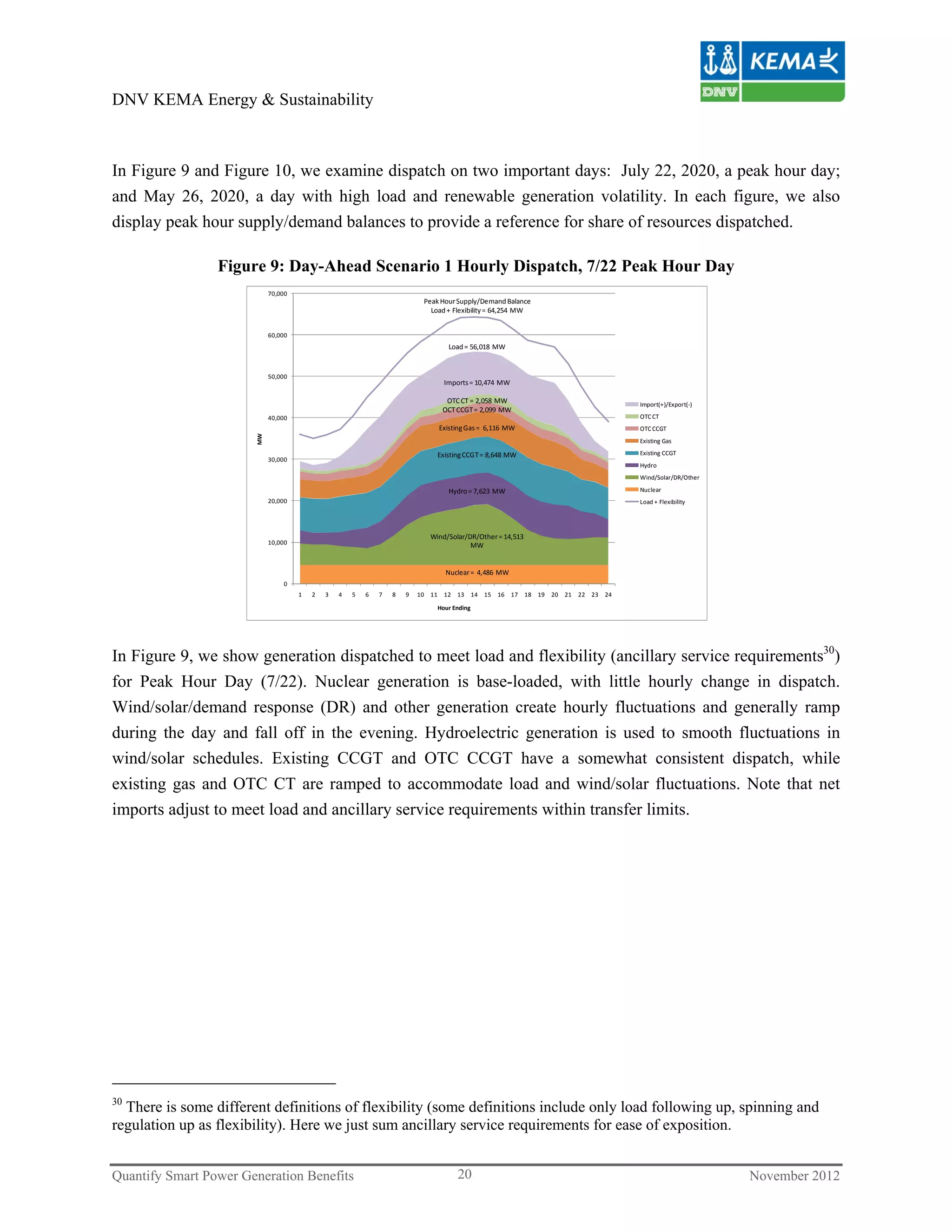
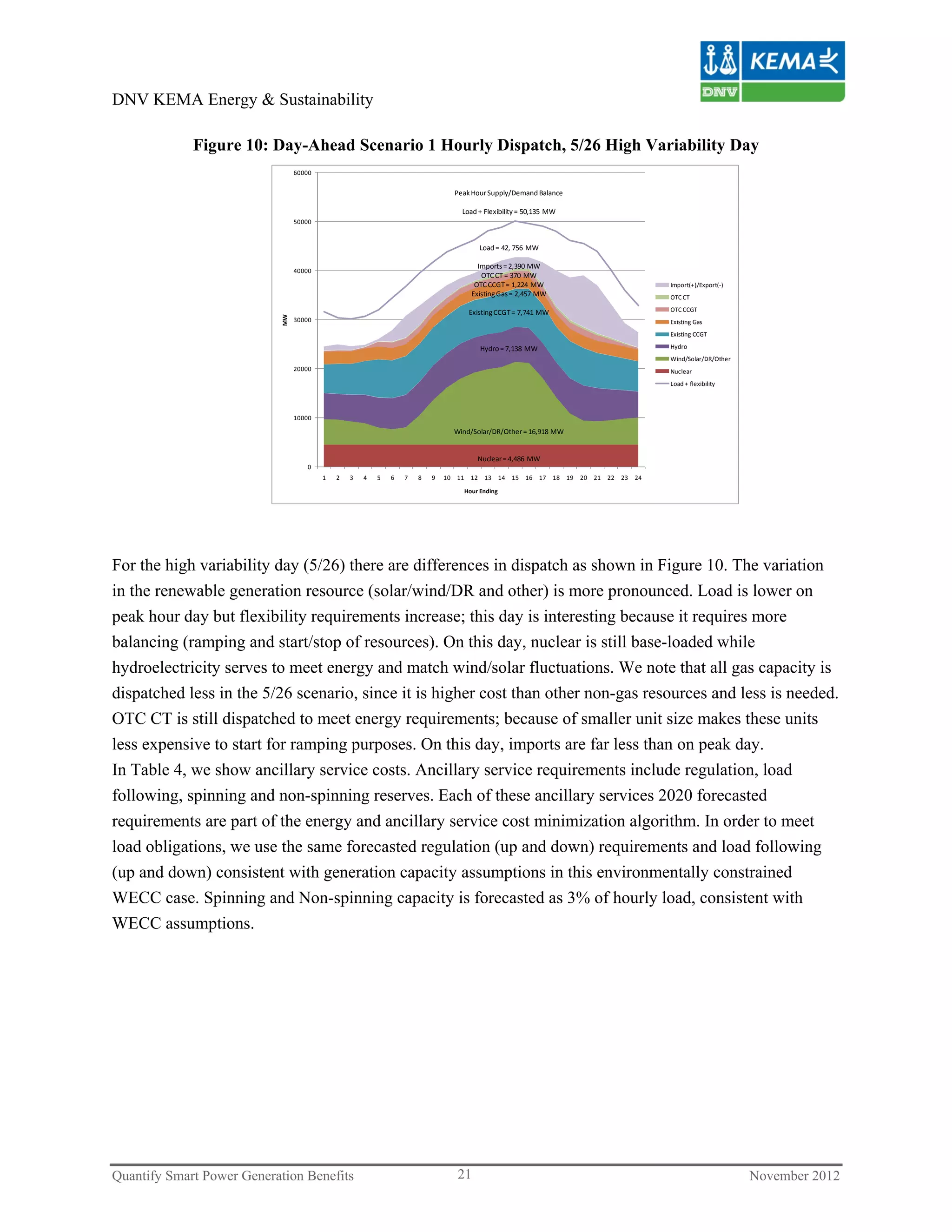
In Figure 9 and Figure 10, we examine dispatch on two important days: July 22, 2020, a peak hour day;
and May 26, 2020, a day with high load and renewable generation volatility. In each figure, we also
display peak hour supply/demand balances to provide a reference for share of resources dispatched.

                 Figure 9: Day-Ahead Scenario 1 Hourly Dispatch, 7/22 Peak Hour Day
                            70,000
                                                                          Peak Hour Supply/Demand Balance
                                                                            Load + Flexibility = 64,254  MW


                            60,000
                                                                                 Load = 56,018  MW


                            50,000
                                                                                Imports = 10,474  MW

                                                                                OTC CT = 2,058  MW                      Import(+)/Export(‐)
                                                                               OCT CCGT = 2,099  MW 
                            40,000                                                                                      OTC CT
                                                                              Existing Gas =  6,116  MW                 OTC CCGT
                       MW


                                                                                                                        Existing Gas

                                                                              Existing CCGT = 8,648 MW                  Existing CCGT
                            30,000
                                                                                                                        Hydro
                                                                                                                        Wind/Solar/DR/Other

                                                                                 Hydro = 7,623  MW                      Nuclear
                            20,000                                                                                      Load + Flexibility


                                                                            Wind/Solar/DR/Other = 14,513 
                            10,000                                                      MW


                                                                                Nuclear =  4,486  MW
                                0
                                     1   2   3   4   5   6   7   8   9   10 11 12 13 14 15 16 17 18 19 20 21 22 23 24

                                                                              Hour Ending


In Figure 9, we show generation dispatched to meet load and flexibility (ancillary service requirements30)
for Peak Hour Day (7/22). Nuclear generation is base-loaded, with little hourly change in dispatch.
Wind/solar/demand response (DR) and other generation create hourly fluctuations and generally ramp
during the day and fall off in the evening. Hydroelectric generation is used to smooth fluctuations in
wind/solar schedules. Existing CCGT and OTC CCGT have a somewhat consistent dispatch, while
existing gas and OTC CT are ramped to accommodate load and wind/solar fluctuations. Note that net
imports adjust to meet load and ancillary service requirements within transfer limits.


30
  There is some different definitions of flexibility (some definitions include only load following up, spinning and
regulation up as flexibility). Here we just sum ancillary service requirements for ease of exposition.


Quantify Smart Power Generation Benefits                                            20                                                        November 2012
DNV KEMA Energy & Sustainability

             Figure 10: Day-Ahead Scenario 1 Hourly Dispatch, 5/26 High Variability Day
                                 60000


                                                                                  Peak Hour Supply/Demand Balance

                                                                                    Load + Flexibility = 50,135  MW
                                 50000


                                                                                              Load = 42, 756  MW

                                                                                           Imports = 2,390 MW
                                 40000
                                                                                            OTC CT = 370  MW
                                                                                          OTC CCGT = 1,224  MW                                              Import(+)/Export(‐)
                                                                                         Existing Gas = 2,457 MW                                            OTC CT

                                                                                        Existing CCGT = 7,741 MW                                            OTC CCGT
                            MW


                                 30000                                                                                                                      Existing Gas
                                                                                                                                                            Existing CCGT

                                                                                              Hydro = 7,138  MW                                             Hydro
                                                                                                                                                            Wind/Solar/DR/Other
                                 20000                                                                                                                      Nuclear
                                                                                                                                                            Load + flexibility


                                 10000

                                                                                  Wind/Solar/DR/Other = 16,918 MW


                                                                                           Nuclear = 4,486  MW
                                    0
                                         1   2   3   4   5   6   7   8   9   10   11     12    13    14   15   16   17   18   19   20   21   22   23   24

                                                                                       Hour Ending


For the high variability day (5/26) there are differences in dispatch as shown in Figure 10. The variation
in the renewable generation resource (solar/wind/DR and other) is more pronounced. Load is lower on
peak hour day but flexibility requirements increase; this day is interesting because it requires more
balancing (ramping and start/stop of resources). On this day, nuclear is still base-loaded while
hydroelectricity serves to meet energy and match wind/solar fluctuations. We note that all gas capacity is
dispatched less in the 5/26 scenario, since it is higher cost than other non-gas resources and less is needed.
OTC CT is still dispatched to meet energy requirements; because of smaller unit size makes these units
less expensive to start for ramping purposes. On this day, imports are far less than on peak day.
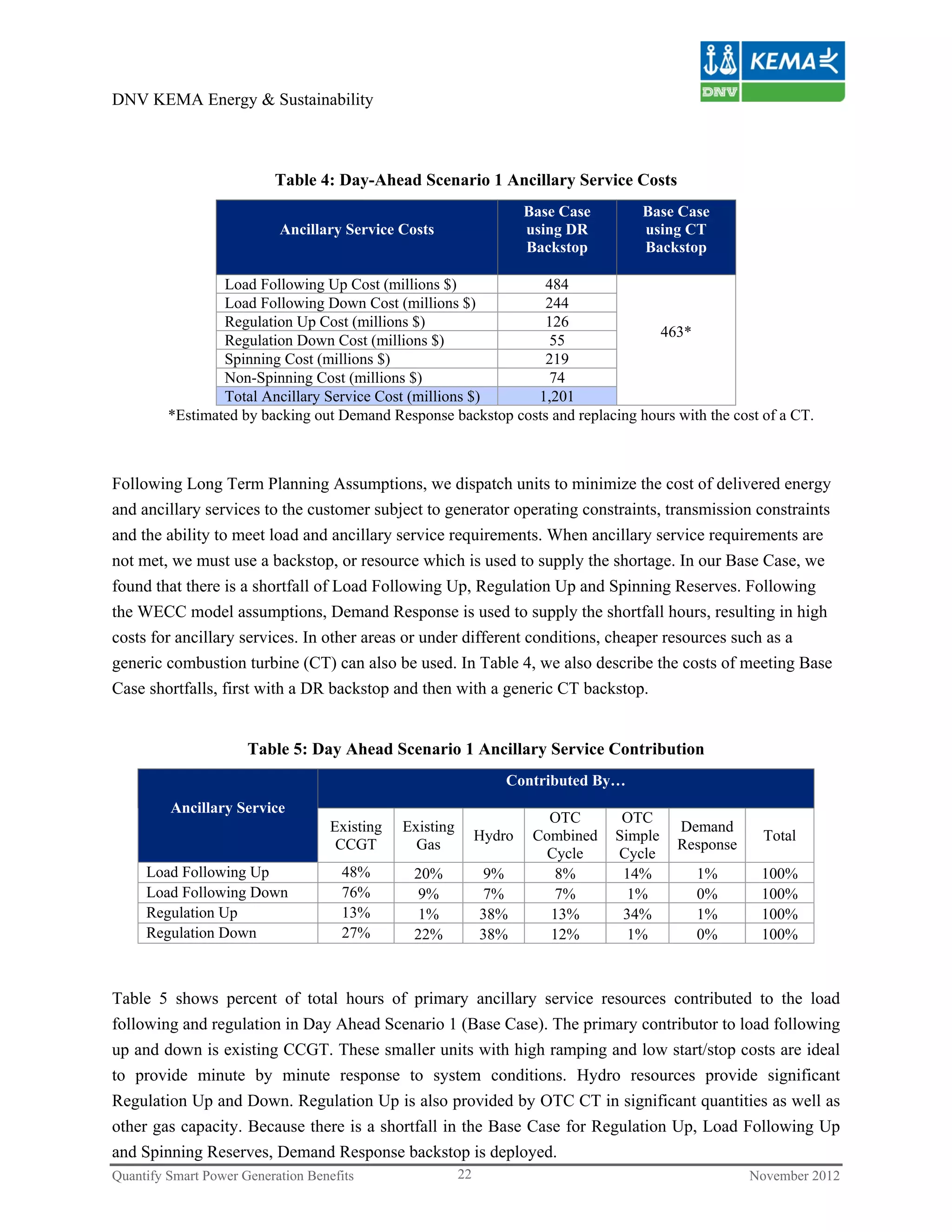
In Table 4, we show ancillary service costs. Ancillary service requirements include regulation, load
following, spinning and non-spinning reserves. Each of these ancillary services 2020 forecasted
requirements are part of the energy and ancillary service cost minimization algorithm. In order to meet
load obligations, we use the same forecasted regulation (up and down) requirements and load following
(up and down) consistent with generation capacity assumptions in this environmentally constrained
WECC case. Spinning and Non-spinning capacity is forecasted as 3% of hourly load, consistent with
WECC assumptions.


Quantify Smart Power Generation Benefits                                           21                                                                                             November 2012
DNV KEMA Energy & Sustainability


                          Table 4: Day-Ahead Scenario 1 Ancillary Service Costs
                                                                       Base Case      Base Case
                           Ancillary Service Costs                     using DR       using CT
                                                                       Backstop       Backstop

                 Load Following Up Cost (millions $)            484
                 Load Following Down Cost (millions $)          244
                 Regulation Up Cost (millions $)                126
                                                                                   463*
                 Regulation Down Cost (millions $)               55
                 Spinning Cost (millions $)                     219
                 Non-Spinning Cost (millions $)                  74
                 Total Ancillary Service Cost (millions $)     1,201
         *Estimated by backing out Demand Response backstop costs and replacing hours with the cost of a CT.


Following Long Term Planning Assumptions, we dispatch units to minimize the cost of delivered energy
and ancillary services to the customer subject to generator operating constraints, transmission constraints
and the ability to meet load and ancillary service requirements. When ancillary service requirements are
not met, we must use a backstop, or resource which is used to supply the shortage. In our Base Case, we
found that there is a shortfall of Load Following Up, Regulation Up and Spinning Reserves. Following
the WECC model assumptions, Demand Response is used to supply the shortfall hours, resulting in high
costs for ancillary services. In other areas or under different conditions, cheaper resources such as a
generic combustion turbine (CT) can also be used. In Table 4, we also describe the costs of meeting Base
Case shortfalls, first with a DR backstop and then with a generic CT backstop.


                      Table 5: Day Ahead Scenario 1 Ancillary Service Contribution
                                                                   Contributed By…
         Ancillary Service
                                                                          OTC       OTC
                                    Existing   Existing                                     Demand
                                                               Hydro    Combined   Simple               Total
                                     CCGT        Gas                                        Response
                                                                         Cycle     Cycle
     Load Following Up               48%        20%            9%         8%        14%       1%        100%
     Load Following Down             76%        9%             7%         7%         1%       0%        100%
     Regulation Up                   13%        1%             38%        13%       34%       1%        100%
     Regulation Down                 27%        22%            38%        12%        1%       0%        100%


Table 5 shows percent of total hours of primary ancillary service resources contributed to the load
following and regulation in Day Ahead Scenario 1 (Base Case). The primary contributor to load following
up and down is existing CCGT. These smaller units with high ramping and low start/stop costs are ideal
to provide minute by minute response to system conditions. Hydro resources provide significant
Regulation Up and Down. Regulation Up is also provided by OTC CT in significant quantities as well as
other gas capacity. Because there is a shortfall in the Base Case for Regulation Up, Load Following Up
and Spinning Reserves, Demand Response backstop is deployed.
Quantify Smart Power Generation Benefits                  22                                           November 2012
DNV KEMA Energy & Sustainability

In 2011, CAISO ancillary service costs were estimated to be $139 million31. Without shortages, load
following requirements alone are expected to triple by 2020 due to increased penetration of renewable
resources, higher levels of demand response and related system contingencies. Using a backstop such as a
combustion turbine, ancillary service costs are projected to increase by 233% to $463 million. With
ancillary service shortages and using expensive demand response as the backstop, costs could rise as high
as $1201 million. In using a CT as backstop, we did not re-dispatch any solutions, which may also offer
additional cost savings.

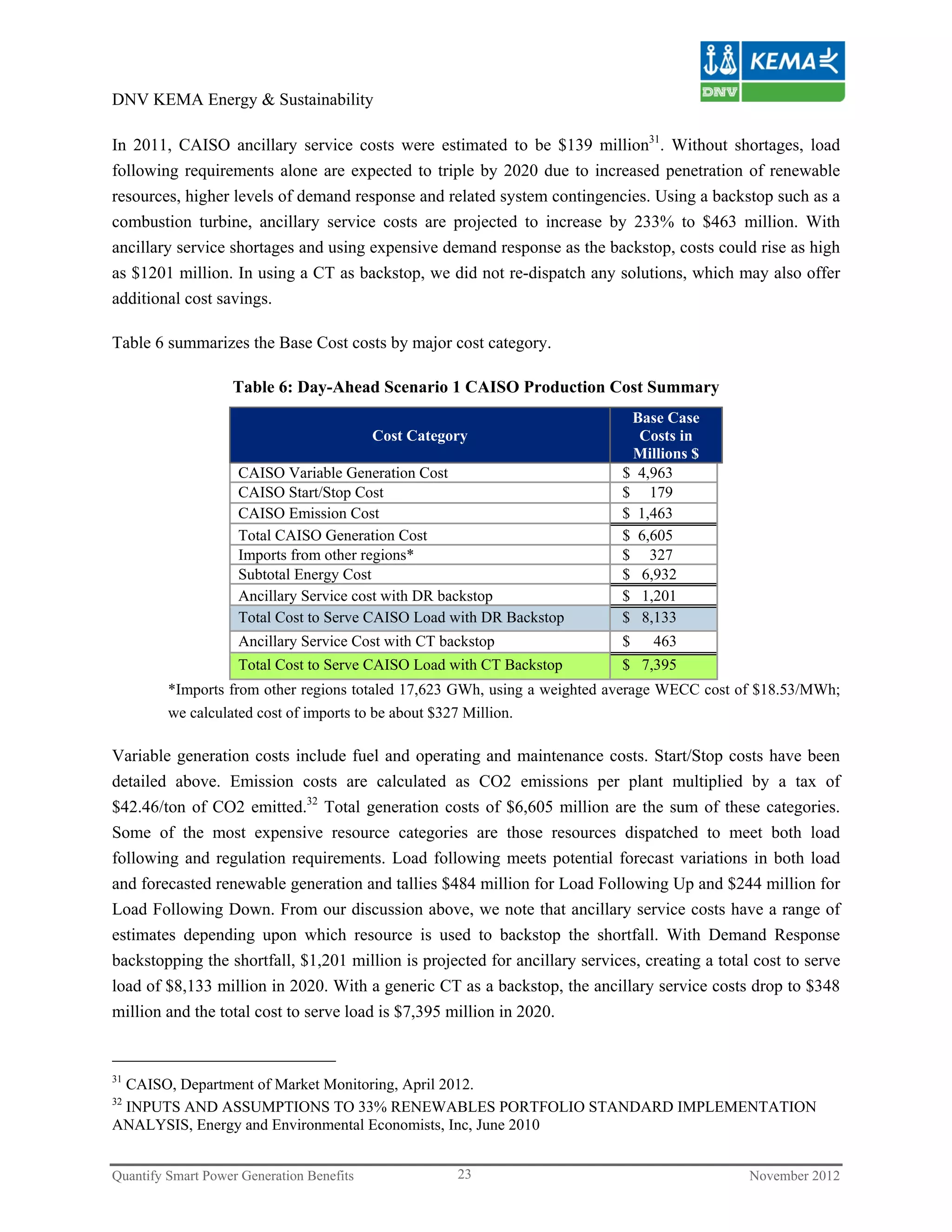
Table 6 summarizes the Base Cost costs by major cost category.

                   Table 6: Day-Ahead Scenario 1 CAISO Production Cost Summary
                                                                              Base Case
                                           Cost Category                       Costs in
                                                                              Millions $
                    CAISO Variable Generation Cost                           $ 4,963
                    CAISO Start/Stop Cost                                    $ 179
                    CAISO Emission Cost                                      $ 1,463
                    Total CAISO Generation Cost                              $ 6,605
                    Imports from other regions*                              $ 327
                    Subtotal Energy Cost                                     $ 6,932
                    Ancillary Service cost with DR backstop                  $ 1,201
                    Total Cost to Serve CAISO Load with DR Backstop          $ 8,133
                    Ancillary Service Cost with CT backstop                  $   463
                    Total Cost to Serve CAISO Load with CT Backstop          $ 7,395
         *Imports from other regions totaled 17,623 GWh, using a weighted average WECC cost of $18.53/MWh;
         we calculated cost of imports to be about $327 Million.

Variable generation costs include fuel and operating and maintenance costs. Start/Stop costs have been
detailed above. Emission costs are calculated as CO2 emissions per plant multiplied by a tax of
$42.46/ton of CO2 emitted.32 Total generation costs of $6,605 million are the sum of these categories.
Some of the most expensive resource categories are those resources dispatched to meet both load
following and regulation requirements. Load following meets potential forecast variations in both load
and forecasted renewable generation and tallies $484 million for Load Following Up and $244 million for
Load Following Down. From our discussion above, we note that ancillary service costs have a range of
estimates depending upon which resource is used to backstop the shortfall. With Demand Response
backstopping the shortfall, $1,201 million is projected for ancillary services, creating a total cost to serve
load of $8,133 million in 2020. With a generic CT as a backstop, the ancillary service costs drop to $348
million and the total cost to serve load is $7,395 million in 2020.


31
 CAISO, Department of Market Monitoring, April 2012.
32
 INPUTS AND ASSUMPTIONS TO 33% RENEWABLES PORTFOLIO STANDARD IMPLEMENTATION
ANALYSIS, Energy and Environmental Economists, Inc, June 2010


Quantify Smart Power Generation Benefits              23                                        November 2012
DNV KEMA Energy & Sustainability


3.4          Day Ahead Scenario 2 (SPG Simple Cycle; No OTC)

We evaluated this scenario to explore how replacing the 5.5 GW of new or repowered OTC units in the
WECC model with Smart Power Generation simple cycle units would impact CAISO system costs. We
re-simulated the 2020 Study year, and then analyzed market results.

                                   Figure 11: Day-Ahead Scenario 2 Supply Stack

                       $100.00
                                 Existing CCGT = legacy combined cycle gas turbines
                                 Gas = simple cycle legacy generation
                                 SPG simple cycle =  Smart Power Generation simple cycle
                        $90.00                                                                $76.37 
                                                                                               SPG
                        $80.00                                                             Simple Cycle
                                                                       $67.81 
                        $70.00                                          Gas

                        $60.00         $53.57                                                              Imports
               $/MWh


                                   Existing CCGT                                                             from 
                        $50.00                                                                               other 
                                                                                                           regions, 
                        $40.00                                                                            cost varies.
                                                                                                            WECC
                        $30.00                                                                             average
                                                                                                            cost = 
                        $20.00                                                                              $18.31

                        $10.00
                                        30,868                         88,833                96,224        116,967 
                                                                              GWh generation


As shown in Figure 11, displacing 5.5 GW OTC simple and combined cycle capacity with 5.5 GW Smart
Power Generation simple cycle units creates lower total generation costs for existing CCGT and less
dispatch when compared to the Base Case. Relative to existing CCGT, SPG Simple Cycle has lower
start/stop costs and provides quicker ramping which explains some of both the drop in total cost and less
dispatch. The other reason is that SPG is modular in design and has smaller start/stop loadings to ramp to
volatile profiles. By displacing OTC units with SPG simple cycle units, fewer start and stops are required
for existing CCGT, making them more efficient and lowering average cost.

Relative to the Base Case, existing gas capacity has a slightly lower cost ($67.68/MWh versus
$78.19/MWh) due to a smaller number of starts and stops (for balancing). SPG simple cycle displaces the
start/stop and ramping functions in existing gas units. But perhaps the largest change is the increased
amount of net imports when OTC capacity is removed. On the margin, there is significant gas import
capacity from neighboring regions which is used to reduce costs of energy and ancillary services in Day-
Ahead Scenario 2. We did not observe any transfer limit violations and transmission utilization increased
in Day-Ahead Scenario 2.

Quantify Smart Power Generation Benefits                                   24                                            November 2012
DNV KEMA Energy & Sustainability

                 Figure 12: Capacity Factors: Day-Ahead Scenario 1 versus Scenario 2
                                      Scenario 1 Base Case      Scenario 2 No OTC; SPG Simple Cycle
               70%


               60%           58%
                       56%


               50%


               40%                                                                                         38%37%
                                                   33%

               30%


                                     20%19%
               20%                                                17%                 16%


               10%


                                                         0%             0%       0%             0% 0%
                0%
                     Existing CCGT Existing Other  OTC Combined  OTC Simple    SPG Simple  SPG Combined     Total
                                         Gas           Cycle       Cycle         Cycle         Cycle


The amount of net imports also explains some of the differences observed in capacity factors when
comparing Base Case to Scenario 2 (SPG Simple Cycle; No OTC) in Figure 12. In Scenario 2, overall
capacity factors decline due to increased net imports. We find that SPG simple cycle displaces existing
CCGT and other gas capacity. We find that while SPG Simple Cycle provided cost savings and these
savings are slightly offset by higher import costs than in the Base Case.

                     Table 7: Day-Ahead Scenario 2 Start/Stop Cost versus Base Case
                                                              Scenario 2 Start/Stop             Base Case Start/Stop
                       Generation Type
                                                                Cost Millions ($)                Cost Millions ($)

            Existing Natural Gas Combined Cycle                          $28                            $43
            Other Existing Natural Gas capacity                          $18                            $29
            New and OTC Combined Cycle                                   N/A                            $18
            New and OTC Simple Cycle                                     N/A                             $29
            Smart Power Generation Simple Cycle                          $14                            N/A
            All Others                                                   $38                            $42
            Total                                                        $98                            $162

As shown in Table 7, total start costs are $98 million versus $162 million for the Base Case. Most of the
cost reduction comes in reducing existing CCGT and existing natural gas capacity start and stops
compared to the Base Case.


Quantify Smart Power Generation Benefits                       25                                                   November 2012
DNV KEMA Energy & Sustainability

                Figure 13: Day-Ahead Scenario 2 Hourly Dispatch, 7/22 Peak Hour Day
                        70,000
                                                            Peak Hour Supply/Demand balance
                                                              Load + Flexibility = 64,254 MW

                        60,000


                        50,000                                    Imports = 16,627 MW


                                                              SPG simple cycle = 2,491 MW                Imports(+)/Exports(‐)
                        40,000                                                                           spg‐simple cycle
                                                                Existing Gas = 6,116 MW
                   MW


                                                                                                         Existing Gas
                                                                                                         Existing CCGT
                        30,000                                  Existing CCGT = 8,648 MW                 Hydro
                                                                                                         Wind/Solar/DR/Other
                                                                   Hydro = 7,623 MW                      Nuclear
                        20,000
                                                                                                         Load + Flexibility


                        10,000                             Wind/Solar/DR/Other = 14,498 MW


                                                                  Nuclear = 4,486 MW
                            0
                                     1 2 3 4 5 6 7 8 9 10 11 12 13 14 15 16 17 18 19 20 21 22 23 24
                                                             GWh generation


Figure 13 shows dispatch by resource in Scenario 2 (SPG Simple Cycle; No OTC) for Peak Hour day on
July 22, 2020. The load and flexibility requirements remain the same as in the Base Case, but the
generation mix changes. Instead of 5.5 GW of OTC simple and combined cycle capacity, we make
available 5.5 GW of Smart Power Generation (SPG) simple cycle. Instead of about 4 GW of OTC at peak
hour, we only use about 2.5 GW of SPG simple cycle and import from neighboring regions.

             Figure 14: Day-Ahead Scenario 2 Hourly Dispatch, 5/26 High Variability Day
                         60,000
                                                            Peak Hour Supply/Demand Balance

                                                              Load + Flexibility =  50,135  MW
                         50,000


                         40,000                                    Imports =  5,256 MW
                                                                                                       Imports(+)/Exports(‐)
                                                                       SPG = 894 MW
                                                                 Existing Gas = 2,176 MW               SPG Simple Cycle
                    MW


                         30,000                                                                        Existing Gas
                                                                Existing CCGT = 5,858 MW
                                                                                                       Existing CCGT
                                                                    Hydro = 7,138 MW                   Hydro
                                                                                                       Wind/Solar/DR/Other
                         20,000
                                                                                                       Nuclear
                                                                                                       Load + Flexibility


                         10,000
                                                            Wind/Solar/DR/Other = 16,919 MW


                                                                   Nuclear = 4,486 MW
                                 0
                                      1 2 3 4 5 6 7 8 9 10 11 12 13 14 15 16 17 18 19 20 21 22 23 24
                                                                Hour Ending


Quantify Smart Power Generation Benefits                                26                                                       November 2012
DNV KEMA Energy & Sustainability

Similarly for Scenario 2 (SPG Simple Cycle; No OTC) on 5/26 peak hour, we find that in place of 1.6
GW of OTC generation at peak hour, only 0.9 GW of SPG simple cycle is used and the remaining portion
is imported. This dispatch result is shown in Figure 14 where we import 5,256 MW on peak hour in
Scenario 2 (SPG Simple Cycle; No OTC) versus 2,390 MW in the Base Case.

                          Table 8: Day-Ahead Scenario 2 Ancillary Service Costs
                                                                 Scenario 2        Base Case
                            Ancillary Service Costs              using DR          using CT
                                                                 Backstop          Backstop

                 Load Following Up Cost (millions $)            261
                 Load Following Down Cost (millions $)           93
                 Regulation Up Cost (millions $)                 77
                                                                                   447*
                 Regulation Down Cost (millions $)               34
                 Spinning Cost (millions $)                     131
                 Non-Spinning Cost (millions $)                  13
                 Total Ancillary Service Cost (millions $)      609
         *Estimated by backing out Demand Response backstop costs and replacing hours with the cost of a CT.


Table 8 summarizes Ancillary Service costs by type for Scenario 2. We note that a smaller portion of
Demand Response still supplies a shortfall in ancillary services in Scenario 2 and that cheaper imports
supply some of the energy and ancillary service requirements instead of OTC capacity. Note that we did
not increase system capacity – just replaced one type of generation with another.

                     Table 9: Day-Ahead Scenario 2, Ancillary Service Contribution
                                                                     Contributed By…
    Ancillary
     Service                                            OTC       OTC      SPG       SPG
                     Existing   Existing                                                       Demand
                                           Hydro      Combined   Simple   simple   combined               Total
                      CCGT        Gas                                                          Response
                                                       Cycle     Cycle     cycle     cycle
Load Following                                          N/A       N/A                N/A
                       27%         7%       8%                            57%                    <1%      100%
Up
Load Following                                          N/A       N/A                N/A
                       46%        16%       7%                            31%                    0%       100%
Down
Regulation Up          4%         <1%      19%          N/A       N/A     77%        N/A         <1%      100%
Regulation                                              N/A       N/A                N/A
                       26%        21%      38%                            15%                    0%       100%
Down


Table 9 shows the contribution to ancillary service by resource type for Scenario 2 (SPG simple cycle; No
OTC). From the table, we find that a majority of Load Following and Regulation Up requirements are met
by SPG simple cycle. Regulation Down is primarily supplied by Hydro; and existing CCGT supply Load
Following Down.

To summarize Scenario 2, we still had a shortfall in ancillary services. Therefore, we made two
calculations for ancillary service cost to compare to Base Case – one in which Demand Response
Quantify Smart Power Generation Benefits                27                                         November 2012
DNV KEMA Energy & Sustainability

provided a backstop for shortfall and one in which a generic CT provided reserve shortfall. Smart Power
Generators are being chosen based on reduced energy costs for dispatch, offset of start costs, and lower
cost ancillary services, as can be shown in
Table 10.


                   Table 10: Day-Ahead Scenario 2 CAISO Production Cost Summary
                                                                 Scenario 2        Percent
                                 Cost Category                    Costs in       Change from
                                                                 Millions $       Base Case
            CAISO Variable Generation Cost                        $ 4,778            -4%
            CAISO Start/Stop Cost                                 $    99           -44%
            CAISO Emission Cost                                   $ 1,402           -4.2%
            CAISO Total Generation Cost                           $ 6,279            -5%
            Imports from other regions*                           $ 380*            +14%
            Subtotal Energy Supply Cost                           $ 6,659           -3.9%
            Ancillary Service cost with DR backstop               $ 609             -49%
            Total Cost to Serve CAISO Load with DR Backstop       $ 7,268            -11%

            Ancillary Service Cost with CT backstop                $ 447            -3.5%
            Total Cost to Serve CAISO Load with CT Backstop       $ 7,106           -3.9%

         *Imports from other regions totaled 20,743 GWh, using a weighted average WECC cost of $18.31/MWh;
         we calculated cost of imports to be about $380 Million.

Overall, Smart Power Generation simple cycle greatly reduced costs to deliver energy and ancillary
services in Scenario 2 when compared with the Base Case. Faster and cheaper ramping and start/stop
costs required to meet energy and ancillary services over existing natural gas capacity are the primary
reason. There are substantial cost savings in start/stop and savings in variable costs drive reductions in
CO2 emissions cost.

3.5          Day-Ahead Scenario 3 (SPG simple and combined capacity; No
             OTC)

In this scenario we examine the market impacts of introducing both simple and combined cycle Smart
Power Generation capacity in place of OTC simple and combined cycle configurations. For Day-Ahead
Scenario 3, we displace 3.3 GW of OTC CCGT capacity with 3.3 GW of Smart Power combined cycle
generation capacity. We also displace 2.2 GW of OTC CT with 2.2 GW of Smart Power Generation
simple cycle capacity. After simulating day-ahead markets, we then compare metrics. As shown in Figure
15, the introduction of Smart Power Generation combined cycle alters the supply stack.


Quantify Smart Power Generation Benefits              28                                    November 2012
DNV KEMA Energy & Sustainability

                                  Figure 15: Day-Ahead Scenario 3 Supply Stack
             $95.00                                                                              $89.16
                       Existing CCGT = legacy combined cycle gas turbines                         SPG 
                       SPG CC= Smart Power Generation combined cycles                            Simple
                       Existing Gas =  legacy simple cycle gas turbines                           Cycle 
             $85.00    SPG Simple Cycle = Smart Power Generation simple cycle
                                                     $72.95                     $73.76
                                                      SPG                       Existing
             $75.00                                    CC                         Gas 

                           $60.40
             $65.00        Existing 
                            CCGT 

             $55.00 


             $45.00 
                                                                                                                  Added 
                                                                                                                 Imports
             $35.00                                                                                           Various Prices.
                                                                                                                  WECC
                                                                                                                 average
             $25.00                                                                                               price = 
                                                                                                                 $19.08

             $15.00 
                           63,575                    71,837                     110,218          111,791        131,672 


Relative to Day Ahead Scenario 1 (Base Case), existing CCGT are started and stopped less than in the
base case, lowering average cost ($63.09/MWh versus $60.40/MWh). Smart Power Generation combined
cycle displaces existing gas units in merit order ($72.95/MWh versus $73.16/MWh) because they are
more efficient to run and start/stop. The Smart Power Generation simple cycle displaces OTC CT along
with an increase in imports. There are still more imports in this case than in Day Ahead Scenario 1, the
Base Case. In the Base Case, cheaper OTC units were used; in this case, imports were cheaper to use.

                       Table 11: Day-Ahead Scenario 3 Start/Stop versus Base Case
                                                                                     Scenario 3               Base Case
                           Generation Type                                         Start/Stop Cost          Start/Stop Cost
                                                                                     Millions ($)             Millions ($)

           Existing Natural Gas Combined Cycle                                             $7                  $43
           Other Existing Natural Gas capacity                                             $28                 $29
           New and OTC Combined Cycle                                                      N/A                  $18
           New and OTC Simple Cycle                                                        N/A                  $29
           Smart Power Generation Simple Cycle                                             $29                 N/A
           Smart Power Generation Combined Cycle                                           $5                  N/A
           All Others                                                                      $27                 $42
           Total                                                                           $96                 $162


Quantify Smart Power Generation Benefits                                29                                                      November 2012
DNV KEMA Energy & Sustainability

In Day Ahead Scenario 3, introducing a mix of Smart Power Generation combined and simple cycle
capacity in place of OTC combined and simple cycle used in the Base Case creates lower start/stop costs
as shown in Table 11. Lower start/stop costs favor the Smart Power Generation and Existing Natural Gas
simple cycle, which is used more frequently than combined cycles (already deployed to meet energy
requirements). We also note that in Day Ahead Scenario 3, Smart Power Generation reduces start/stop
costs for existing natural gas combined cycle as well as all other unit start/stop costs.

                               Figure 16: Day-Ahead Scenario 3 Capacity Factors
                                     Scenario 1 Base Case          Scenario 3: No OTC; SPG Simple & Combined Cycle
                    70%


                    60%
                            56%57%


                    50%


                    40%                                                                                              38%37%
                                                            33%
                                                                                                             32%
                    30%


                                          20%19%                                              18%
                    20%                                                     17%


                    10%


                                                                  0%              0%     0%             0%
                     0%
                          Existing CCGT Existing Other  OTC Combined  OTC Simple        SPG Simple  SPG Combined      Total
                                              Gas           Cycle       Cycle             Cycle         Cycle


Figure 16 shows capacity factors for CAISO generation units in Scenario 3 (SPG simple and combined
cycle; No OTC). Overall, capacity factors for CAISO generation drop slightly when compared to the Base
Case because more imports are used in Scenario 3. OTC Simple and Combined Cycle capacity replaces
displaced OTC capacity for both simple and combined cycle.

Figure 17 shows 7/22 Peak Hour dispatch to meet load and flexibility requirements (where flexibility
includes all ancillary services). Relative to Base Case, we have slightly more imports in Scenario 3;
neighboring generation is slightly less expensive than SPG simple cycle generation. Smart Power
Generation still supplies about 2,400 MW during peak; but most of it comes from more cost efficient
combined cycle capacity.


Quantify Smart Power Generation Benefits                               30                                                     November 2012
DNV KEMA Energy & Sustainability

                        Figure 17: Day-Ahead Scenario 3 Dispatch, 7/22 Peak Hour Day
                        70,000
                                                              Supply /Demand Balance Peak Hour
                                                                Load + Flexibility = 64,254  MW

                        60,000


                                                                    Imports = 10,818  MW
                        50,000
                                                               SPG Combined Cycle = 2,174 MW
                                                                 SPG Simple Cycle = 319 MW                  Import(+)/Export(‐)
                                                                  Existing Gas = 7,270 MW                   SPG Combined Cycle
                        40,000
                                                                                                            SPG Simple Cycle
                   MW


                                                                 Existing CCGT = 10,228  MW
                                                                                                            Existing Gas
                        30,000                                                                              Existing CCGT
                                                                      Hydro = 7,623  MW                     Hydro
                                                                                                            Wind/Solar/DR/Other
                        20,000                                                                              Nuclear
                                                              Wind/Solar/DR/Other = 15,817 MW               Load + Flexibility

                        10,000

                                                                     Nuclear = 4,486  MW

                               0
                                       1 2 3 4 5 6 7 8 9 10 11 12 13 14 15 16 17 18 19 20 21 22 23 24
                                                                 Hour Ending


In Figure 18 dispatch for high variability days shows that peak hour supply and demand balances are met
with slightly more imports. Displaced OTC simple and combined cycle generation is partially met by
SPG simple cycle generation and partially by imports.

                  Figure 18: Day-Ahead Scenario 3 Dispatch, 5/26 High Variability Day
                             60,000
                                                                 Peak Hour Supply/Demand Balances


                                                                    Load + Flexibility =  50,135 MW
                             50,000


                             40,000                                     Imports = 4,213 MW                Import(+)/Export(‐)
                                                                          SPG CC = 753 MW
                                                                     SPG Simple Cycle = 300 MW
                                                                                                          SPG Combined Cycle
                                                                      Existing Gas = 2,476 MW             SPG Simple Cycle
                        MW


                             30,000                                   Existing CCGT =  6,426  MW          Existing Gas
                                                                                                          Existing CCGT
                                                                          Hydro = 7,138  MW               Hydro
                             20,000                                                                       Wind/Solar/DR/Other
                                                                                                          Nuclear
                                                                                                          Load + Flexibility
                             10,000
                                                                 Wind/Solar/DR/Other = 16,918 MW

                                                                         Nuclear = 4,486 MW
                                   0
                                         1 2 3 4 5 6 7 8 9 10 11 12 13 14 15 16 17 18 19 20 21 22 23 24
                                                                  Hour Ending


Quantify Smart Power Generation Benefits                                     31                                                   November 2012
DNV KEMA Energy & Sustainability

Table 12 shows Ancillary Service costs for Scenario 3 with both Demand Response and CT as a backstop
to the reserve shortfall. Load following up contributes the largest share of ancillary service costs.

                          Table 12: Day-Ahead Scenario 3 Ancillary Service Costs
                                                                Scenario 3        Base Case
                           Ancillary Service Costs              using DR          using CT
                                                                Backstop          Backstop

                 Load Following Up Cost (millions $)            254
                 Load Following Down Cost (millions $)          105
                 Regulation Up Cost (millions $)                 72
                                                                                   441*
                 Regulation Down Cost (millions $)               33
                 Spinning Cost (millions $)                     126
                 Non-Spinning Cost (millions $)                  13
                 Total Ancillary Service Cost (millions $)      603
         *Estimated by backing out Demand Response backstop costs and replacing hours with the cost of a CT.

Relative to the Base Case, Scenario 3 (SPG simple and combined cycle; No OTC) shows large reductions
in Load Following Up, Regulation Up and Spinning costs. SPG combined cycle is the major contributor
for Load Following Up and Regulation Up, while Existing CCGT is a heavier contributor to Load
Following Down and hydro is still the major contributor to Regulation Down. This pattern is consistent
with what we observed earlier. SPG has sufficient bandwidth to supply energy (note that imports decrease
slightly in this case) and is low cost provider of ancillary services.

                  Table 13: Day-Ahead Scenario 3, Contributions to Ancillary Services
                                                                    Contributed By…
    Ancillary
     Service                                           OTC       OTC      SPG       SPG
                     Existing    Existing                                                     Demand
                                            Hydro    Combined   Simple   simple   combined                Total
                      CCGT         Gas                                                        Response
                                                      Cycle     Cycle     cycle     cycle
Load Following                                         N/A       N/A
                       20%          7%       8%                          15%        50%         <1%      100%
Up
Load Following                                         N/A       N/A
                       75%         13%       7%                          <1%        5%          0%       100%
Down
Regulation Up           2%         <1%      17%        N/A       N/A     15%        67%         <1%      100%
Regulation Down        21%         28%      38%        N/A       N/A     <1%        23%         0%       100%


In Table 13, Scenario 3 contributions to Ancillary Service by type of resource are summarized.
Introducing SPG combined cycle capacity changes the main supplier of Load Following Up and
Regulation Up to SPG Combined Cycle. Once on line, the fuel efficiency savings favor this resource.
Existing CCGT provided the largest share of Load Following Down while Hydro provided Regulation
Down.


Quantify Smart Power Generation Benefits              32                                          November 2012
DNV KEMA Energy & Sustainability

In Table 14, Scenario 3 costs are summarized.

                        Table 14: Day-Ahead Scenario 3 Production Cost Summary
                                                                 Scenario 3        Percent
                                 Cost Category                    Costs in       Change from
                                                                 Millions $       Base Case
            CAISO Variable Generation Cost                        $ 4,764            -4%
            CAISO Start/Stop Cost                                 $    96           -46%
            CAISO Emission Cost                                   $ 1,401           -4.2%
            CAISO Total Generation Cost                           $ 6,261            -5%
            Imports from other regions*                           $ 379*            +14%
            Subtotal Energy Cost                                  $ 6,640           -4.2%
            Ancillary Service cost with DR backstop               $ 603             -49%
            Total Cost to Serve CAISO Load with DR Backstop       $ 7,243            -11%

            Ancillary Service Cost with CT backstop               $   441            -12%
            Total Cost to Serve CAISO Load with CT Backstop       $ 7,081           -4.2%

         *Imports from other regions totaled 19,881 GWh, using a weighted average WECC cost of $19.08/MWh;
         we calculated cost of imports to be about $379 Million.


Relative to the Base Case, Day-Ahead Scenario 3 (SPG simple and combined cycle; No OTC) shows
large changes in start/stop costs and in the provision of Ancillary Services with either Demand Response
or a generic Combustion Turbine as backstop to meet Ancillary Services shortfall. Adding SPG simple
and combined cycle (in place of OTC) lowers costs of energy supply and ancillary services about 4%
relative to the Base Case.

3.6          Day Ahead Scenario 4 (SPG + Base Case)

In this scenario, we wanted to explore the least cost case of meeting energy and ancillary service
requirements in 2020. To Base Case Capacity we added 3.3 GW of SPG combined cycle and 2.2 GW of
SPG simple cycle capacity. This was an exploratory simulation to understand what would happen if the
CAISO capacity were “overbuilt” and the optimization algorithms could choose, for every hour, the least
cost mix of energy in MWh (for both energy and Ancillary Services) where both traditional OTC (gas
turbine based) and SPG units were available for dispatch. After re-dispatching these units, we then
analyzed results.

In Figure 19, we display dispatch and average total cost of dispatch in a supply stack. Relative to Base
Case, Scenario 4 (OTC and SPG simple and combined cycles) shows lower costs for each natural gas
capacity grouping. Existing CCGT is lower, OTC and SPG combined cycles are lower and SPG and OTC
simple cycle is also cheaper. Because these units are more efficiently utilized, the new mix of CAISO
resources becomes a net exporter to other non-CAISO regions.


Quantify Smart Power Generation Benefits              33                                    November 2012
DNV KEMA Energy & Sustainability

                                   Figure 19: Day-Ahead Scenario 4, Supply Stack
                   $105.00                                                                                     $94.38
                              Existing CCGT =  Legacy  combined cycle gas turbines
                              OTC CCGT =  New or Repowered OTC combined cycle gas turbines                      OTC
                              SPG CCGT = Smart Power Generation combined cycle gas                $87.03         CT 
                    $95.00    Existing Gas = Legacy simple cycle gas capacity
                              SPG CT = Smart Power Generation simple cycle gas
                                                                                                   SPG
                              OTC CT = New or Repowered OTC gas simple cycle                        CT 
                    $85.00 
                                                                                    $72.96
                                                                                    Existing
                    $75.00                                          $65.87            Gas 
                                                   $61.50            SPG
                                 $60.50
                                                    OTC              CCGT 
                    $65.00       Existing 
                                  CCGT             CCGT 


                    $55.00 


                    $45.00 
                                                                                                                           Imports
                                                                                                                             Price 
                    $35.00                                                                                                  Varies.
                                                                                                                            WECC 
                                                                                                                           average
                    $25.00                                                                                                  price = 
                                                                                                                           $18.27 

                    $15.00 
                                 57,617            64,939          74,770           111,658      113,320       114,789     132,273 


As shown in Figure 20, capacity was utilized differently than in the Base Case. Capacity for Existing
CCGT and other gas capacity dropped as did OTC generation. Filling the void was SPG simple and
combined cycle. Further, because the natural gas generation was used more efficiently, lowering total
cost, CAISO becomes a net generator to other regions, raising the capacity factors for CAISO generators.

                  Figure 20: Day-Ahead Scenario 4 Capacity Factors versus Base Case
                                                     Scenario 1 Base Case            Scenario 4 OTC plus SPG
                 60%
                          56%
                                52%
                 50%


                                                                                                                                 39%
                 40%                                                                                                       38%
                                                                                                                    35%
                                                              33%

                 30%
                                                                    26%

                                             20%
                 20%                               18%                                               18%
                                                                                 17%


                 10%                                                                   8%


                                                                                                0%             0%
                  0%
                        Existing CCGT Existing Other  OTC Combined  OTC Simple                 SPG Simple  SPG Combined      Total
                                            Gas           Cycle       Cycle                      Cycle         Cycle


Quantify Smart Power Generation Benefits                                     34                                                        November 2012
DNV KEMA Energy & Sustainability

Figure 21 shows peak hour day (7/22) dispatch in Scenario 4 (SPG and OTC). Imports on peak day drop
substantially compared to the Base Case. Further note that both SPG and OTC are used in dispatching
energy and Ancillary Services. Both OTC simple and combined cycle capacity factor drops when SPG
simple and combined cycle capacity is introduced to the Base Case resource mix. While CAISO still
imports from other regions, imports are less than in the Base Case, driving CAISO total capacity factors
up.

                       Figure 21: Day-Ahead Scenario 4 Dispatch, 7/22 Peak Hour Day
                       70000
                                                    Supply/Demand Balance Peak Hour
                                                      Load + Flexibility = 64,254 MW

                       60000

                                                           Imports = 4,093 MW
                                                      OTC Simple Cycle = 1,941 MW
                                                                                                Import(+)/Export(‐)
                       50000
                                                     OTC Combined Cycle = 2,943 MW              OTC Simple Cycle
                                                     SPG Combined Cycle = 1,875 MW
                                                       SPG Simple Cycle = 599 MW                OTC Combined Cycle
                       40000                             Existing Gas = 6,501 MW                SPG Combined Cycle
                                                                                                SPG Simple Cycle
                  MW


                                                                                                Oil 
                       30000                           Existing CCGT = 10,140 MW
                                                                                                Existing Gas
                                                                                                Existing CCGT
                                                           Hydro = 7,623 MW
                       20000                                                                    Hydro
                                                                                                Wind/Solar/DR/Other
                                                                                                Nuclear
                       10000                                                                    Load + Flexibility
                                                    Wind/Solar/DR/Other = 15, 817 MW

                                                          Nuclear = 4,486 MW
                          0
                               1 2 3 4 5 6 7 8 9 10 11 12 13 14 15 16 17 18 19 20 21 22 23 24
                                                         Hour Ending


In Figure 22, dispatch during the high wind/solar and load variability day (5/26) shows that on some
hours, CAISO exports to other regions as well as imports to balance wind and solar variability. Further,
we note that OTC simple cycle is not needed across peak hour on this day; SPG simple cycle is sufficient
to balance load and renewable generation volatility requirements.


Quantify Smart Power Generation Benefits                           35                                                 November 2012
DNV KEMA Energy & Sustainability

                  Figure 22: Day-Ahead Scenario 4 Dispatch, 5/26 High Variability Day
                      60000
                                                       Peak Hour Supply/Demand Balance


                                                         Load + Flexibility = 50,135 MW
                      50000


                                                               Imports = 909 MW                      Import(+)/Export(‐)
                                                            OTC Simple Cycle = 0 MW
                      40000                             OTC Combined Cycle = 1,281 MW                OTC Simple Cycle
                                                         SPG Combined Cycle = 893 MW                 OTC Combined Cycle
                                                           SPG Simple Cycle = 151 MW
                                                                                                     SPG Combined Cycle
                 MW


                      30000                                   Existing Gas = 4,120 MW
                                                                                                     SPG Simple Cycle
                                                       Existing Combined Cycle = 6,829 MW
                                                                                                     Existing Gas
                                                               Hydro = 7,138 MW
                                                                                                     Existing CCGT
                      20000                                                                          Hydro
                                                                                                     Wind/Solar/DR/Other
                                                                                                     Nuclear
                      10000                                                                          Load + flexibility
                                                       Wind/Solar/DR/Other = 16,919 MW

                                                              Nuclear = 4,486 MW
                         0
                              1 2 3 4 5 6 7 8 9 10 11 12 13 14 15 16 17 18 19 20 21 22 23 24
                                                       Hour Ending


As shown in Table 13, there is no shortfall for Ancillary Services in the Day Ahead Scenario 4. Relative
to the Base Case, costs for providing Ancillary Services are significantly less.

                              Table 15: Day-Ahead Scenario 4 Ancillary Service Costs
                                        Ancillary Service Costs                             Scenario 4

                               Load Following Up Cost (millions $)                            $191
                               Load Following Down Cost (millions $)                          $59
                               Regulation Up Cost (millions $)                                $55
                               Regulation Down Cost (millions $)                              $21
                               Spinning Cost (millions $)                                     $96
                               Non-Spinning Cost (millions $)                                  $2
                               Total Ancillary Service Cost (millions $)                      $424


In Table 16, we show that in the Day Ahead Scenario 4, Smart Power Generation supplies a high
percentage of Regulation Up and Load Following Up Ancillary Services. Existing CCGT supplies the
major portion of Load Following Down. SPG also has begun to displace hydro in supplying regulation
Down requirements.


Quantify Smart Power Generation Benefits                         36                                                        November 2012
DNV KEMA Energy & Sustainability

                   Table 16: Day-Ahead Scenario 4 Contributions to Ancillary Service
                                                                    Contributed By…
   Ancillary
    Service                                          OTC       OTC        SPG         SPG
                    Existing   Existing
                                           Hydro   Combined   Simple     Simple     Combined     DR         Total
                     CCGT        Gas
                                                    Cycle     Cycle      Cycle       Cycle
Load                 14%          5%        9%       4%         5%        15%         49%        0%        100%
Following Up
Load                 68%          8%        8%       7%        1%        0.1%         8%         0%        100%
Following
Down
Regulation Up         1%         0.3%      15%       1%        2%        17%          63%        0%        100%
Regulation           10%         12%       33%       8%        2%        0.4%         35%        0%        100%
Down

In Table 17, we summarize the Production Cost impacts of adding Smart Power Generation to the Base
Case. While the new scenario produced generation exports, variable costs were still less than the Base
Case. Smart Power Generation was cheaper to run. We note a large savings in start/stop costs, as Smart
Power Generation supplied a large amount of cost savings. Finally, Day-Ahead Scenario 4 has about
5.1% less energy costs than Base Case Day-Ahead Scenario 1. Depending upon the capacity shortfall
backstop, total energy and ancillary service cost savings range from 14% to 5.3% in Day-Ahead Scenario
4 when compared to the Base Case.

                        Table 17: Day-Ahead Scenario 4 Production Cost Summary
                                                                       Scenario 4         Percent
                                 Cost Category                          Costs in        Change from
                                                                       Millions $        Base Case
            CAISO Variable Generation Cost                              $ 4,830            -2.7%
            CAISO Start/Stop Cost                                       $    93            -48%
            CAISO Emission Cost                                         $ 1,428            -11%
            CAISO Total Generation Cost                                 $ 6,351            -2.4%
            Imports from other regions*                                 $ 319*             -2.4%
            Subtotal Energy Supply Cost                                 $ 6,580            -5.1%
            Ancillary Service cost                                      $ 424              -65%
            Total Cost to Serve CAISO Load with DR Backstop             $ 7,004             -14%**

            Total Cost to Serve CAISO Load with CT Backstop             $ 7,004             -5.3%**

         *Imports from other regions totaled 17,484 GWh, using a weighted average WECC cost of $18.27/MWh;
         we calculated cost of imports to be about $319 Million.

         **There was no Ancillary Service Shortfall in Scenario 4; therefore, we compare the same total cost to
         serve load number to both DR and CT backstop assumptions, which produces different cost savings when
         compare to the Base Case.


Quantify Smart Power Generation Benefits              37                                              November 2012
DNV KEMA Energy & Sustainability


3.7          Summary of Findings for Day-Ahead Scenarios

                Table 18: Production Cost Simulation Summary by Day-Ahead Scenario
                                                                              Scenario 3 No
                                                             Scenario 2 No
                                           Scenario 1                          OTC; SPG          Scenario 4 All
                                                              OTC; SPG
                                           Base Case                            Simple &         SPG and OTC
             Cost Category                                   Simple Cycle
                                            Costs in                           Combined             Costs in
                                                                Costs in
                                           Millions $                         Cycle Costs in       Millions $
                                                               Millions $
                                                                                Millions $
   CAISO Variable Generation Cost                      4,963            4,778          4,764                4,831
   CAISO Start/Stop Cost                                 179               99             96                   93
   CAISO Emission Cost                                 1,463            1,402          1,401                1,428
   CAISO Total Generation Cost                         6,605            6,279          6,261                6,351
   (+) Added Import Cost                                 327              380            379                  319
   Subtotal Energy Supply Cost                         6,932            6,659          6,640                6,580
   Ancillary Service cost with                         1,201              609            603               424**
   Demand Response as Backstop
   Total Cost to Serve CAISO Load                      8,133            7,268            7,243           7,004**
   with DR Backstop
   *Ancillary Service Cost with CT                       463              447              441             424**
   backstop
   *Total Cost to Serve CAISO Load                     7,395            7,106            7,081           7,004**
   with CT Backstop
*To obtain the Ancillary Service Cost with a CT backstop, we did not re-dispatch results. Instead, we took the hours
of ancillary shortfall, number of occurrences and appropriate penalty to back out the cost of Demand Response, then
calculated the cost of supplying the shortfall with a generic CT at $97.73/MWh.

**There was no Ancillary Service Shortfall in Scenario 4; therefore, we compare the same total cost to serve load
number to both DR and CT backstop assumptions, which produces different cost savings when compare to the Base
Case.

For each of the scenarios run, we compare results in Table 18. Note that CAISO variable generation cost
is higher in Scenario 4 (SPG and OTC) than Scenario 2 or 3. Since CAISO is exporting to more regions,
it is logical to expect a higher production cost and CO2 emission costs being met by CAISO generation.
Ancillary Service cost with a generic CT is slightly higher in all scenarios than using a combination of
SPG and OTC in Scenario 4.

The large savings in Ancillary Services costs bears further comparison across scenarios. As shown in
Table 18, in the Base Case, we observed that Load Following Up, Regulation Up and Spinning Reserves
were met by Demand Response on Peak Hour Day, July 22, 2020. Since Demand Response costs are an
order of magnitude higher than conventional capacity resources, we estimated costs for this day based
upon the average of annual costs.

Despite this cost adjustment, Smart Power Generation capacity in all scenarios showed substantial cost
reductions across all scenarios. There was an anomaly in Scenario 3, which showed higher load following
down costs ($105 million) with both Smart Power Generation single and combined cycle than with only

Quantify Smart Power Generation Benefits                38                                           November 2012
DNV KEMA Energy & Sustainability

Smart Power Generation simple cycle used in Scenario 2 ($93 million). Using Smart Power Generation in
Combined cycle mode has (in aggregate) higher minimum operating levels than does the simple cycle
configuration. When needing load following down, these aggregate minimum thresholds explain this
result. Table 19 summarizes the net savings from Smart Power Generation in each Day Ahead Integrated
Forward Market Scenario. We note that the largest savings comes from Ancillary Service when Demand
Response is used to backstop ancillary service shortfall.

                       Table 19: Summary of Production Cost Savings by Scenario
                                                   Energy       DR Backstop    CT Backstop
                                                 Market Costs    Ancillary      Ancillary
                        Scenarios Run              Savings      Service Cost   Service Cost
                                                  Millions $     Millions $     Millions $
                                                  (percent)      (percent)      (percent)
             DA Scenario 1 Base Case (No SPG)          N/A          N/A            N/A
              DA Scenario 2 (SPG simple cycle;
                                                 $273 (3.9%)    $592 (49%)      $16 (3.5%)
                         No OTC)
               DA Scenario 3 (SPG simple and
                                                 $292 (4.2%)    $598 (50%)      $22 (4.8%)
                 combined cycle; No OTC)

                DA Scenario 4 (SPG and OTC)       $352 (5.1%    $777 (65%)      $39 (8.4%)


Quantify Smart Power Generation Benefits          39                                     November 2012
DNV KEMA Energy & Sustainability


4.           Quantifying Smart Power Generation Benefits in Real
             Time Dispatch
In this section we examine several aspects of five minute real time dispatch. After describing real time
markets in CAISO, we compare costs of five minute real time dispatch to Day-Ahead results for similar
days. Next, we examine how real time costs vary under different resource mixes. We also examine the
impacts of extreme forecast error on real time dispatch. Lastly, we analyze potential savings from
different resource mixes under proposed new flexible ramping markets.

4.1          Procuring Resources and Ancillary Services in Real Time
             Markets

As shown in
Figure 23, CAISO uses the Hour Ahead Schedule Process (HASP) and Real Time 5 minute markets to
balance energy requirements, but there are limits to how those resources can be used. Most of the wind
and solar resources are non-binding hourly schedules that must be managed in real time; creating a lack of
visibility of those resources when load following and regulation are usually scheduled. Aside from the
uncertainty associated with these resources, the real time schedules can create a situation where fossil
units are “over-committed” to deal with uncertain resources. We did not make adjustments to five minute
load following or regulation reserves based upon improved short term forecasts in real time market
processing.


                  Figure 23: CAISO Real Time Market Inputs, Processing and Outputs

                                                    CAISO Real‐Time Market


                     Data Inputs


                     Day Ahead Market Results


                                                                              Real‐Time Dispatches
                                                                 Real Time       Ancillary Awards
                                                                               Start‐up/Shut down
                                                                  Market         Via Automated
                     Requirements Inputs                         Processing   Dispatch System (ADS

                    Real‐Time System Info
                    Supplemental Energy and Ancillary 
                       Service Bids
                    Transmission Interface Limits


Quantify Smart Power Generation Benefits                    40                                       November 2012
DNV KEMA Energy & Sustainability

A proposed new market is flexible ramping product, where qualified resources bid in both day-ahead
hourly markets and in 5 minute intervals to balance energy markets. Rules for this new product are still
being refined, but we know that at least some of the flexible capacity will rely upon real time economic
dispatch pricing results, so we also explore market impacts of costs in 5 minute intervals. Rather than
replicate day-ahead integrated forward markets, we present only 5 minute energy market results.
Ancillary service costs are not simulated in five minute economic dispatch.

Further, we note that when we sum costs across a 5 minute interval, we must account for costs already
occurring in Day Ahead hourly simulations. Therefore, to meet 5 minute dispatch, we subtract any costs
to meet those intervals from the simulated day-ahead costs in the hourly interval. In 5 minute real time
economic dispatch, any units committed in the hourly dispatch are constrained to operate according to
that schedule (and the 5 minute ramps in those schedules). However, because more ramping is expected
across 5 minutes, real time costs are expected to be higher to meet those quicker ramps. Some of our real
time five minute economic dispatch scenarios are not equivalent to Day-Ahead scenarios, so we compare
only real time results to the real time (RT) Base Case.

We simulated peak hour day (7/22) and high load and renewable generation volatility day (5/26) for a
variety of scenarios as shown in Figure 24. From the hourly load data, we interpolated 5 minute loads
from hourly loads and used in our simulation results.

                                     Figure 24: 5 Minute Loads for 5/26 and 7/22, 2020
                                                          5/26      7/22
                            60,000


                            55,000


                            50,000


                            45,000
                       MW


                            40,000


                            35,000


                            30,000


                            25,000


                            20,000
                                       1
                                      10
                                      19
                                      28
                                      37
                                      46
                                      55
                                      64
                                      73
                                      82
                                      91
                                     100
                                     109
                                     118
                                     127
                                     136
                                     145
                                     154
                                     163
                                     172
                                     181
                                     190
                                     199
                                     208
                                     217
                                     226
                                     235
                                     244
                                     253
                                     262
                                     271
                                     280


                                                         5 Minute Dispatch Interval


Quantify Smart Power Generation Benefits                   41                              November 2012
DNV KEMA Energy & Sustainability


4.2          RT Scenario 1 (Base Case 5 Minute Dispatch)

For RT Scenario 1 we use the same resource mix as deployed in Day-Ahead Scenario 1. RT Scenario 1
(Base Case with no SPG) we constrain Base Case resources to day ahead hourly unit commitment
schedules (from the Day-Ahead Scenario 1 Base Case) and re-dispatch load and resources on a five
minute interval to meet loads on 5/26 and 7/22. We then compare results to Day Ahead Scenario 1 (Base
Case).

As shown in Figure 26, for the high variability wind/solar day on 5/26, five minute intervals are plotted
against $/MW total generation costs (not adjusting for day ahead results). We note that in the five minute
intervals, several spikes occur as units are started up. Further, there is a slight dip in costs as more
combined cycle units are on line and five minute costs begin to decline.

                     Figure 25: RT Scenario 1(Base Case): 5/26 Five Minute Dispatch
                             12


                             10


                             8
                      $/MW


                             6


                             4


                             2


                             0
                                  100
                                  109
                                  118
                                  127
                                  136
                                  145
                                  154
                                  163
                                  172
                                  181
                                  190
                                  199
                                  208
                                  217
                                  226
                                  235
                                  244
                                  253
                                  262
                                  271
                                  280
                                   10
                                   19
                                   28
                                   37
                                   46
                                   55
                                   64
                                   73
                                   82
                                   91
                                    1


                                                  5 Minute Real Time Dispatch Interval


In Figure 26, we display $/MW costs across five minute intervals for 7/22 peak hour day dispatch. As
with the 5/26 results, several spikes occur as units are started up between hourly intervals. Further note
that costs dip as more combine cycles are brought on line. There is also a step function across peak hour
representing price responsive demand response, which is “dispatched” when prices are high enough33.


33
  Note that these average costs are fairly flat. Recall that we constrained the solution to hourly unit commitment
results in the Day-Ahead markets to meet hourly load targets. Spikes occur when we need to ramp or start/stop
resources differently in five minute intervals. Further, these results only include energy, not ancillary services.


Quantify Smart Power Generation Benefits                  42                                            November 2012
DNV KEMA Energy & Sustainability

                    Figure 26: RT Scenario 1 (Base Case): 7/22 Five Minute Dispatch
                                 14


                                 12


                                 10


                                 8
                          $/MW


                                 6


                                 4


                                 2


                                 0    100
                                      109
                                      118
                                      127
                                      136
                                      145
                                      154
                                      163
                                      172
                                      181
                                      190
                                      199
                                      208
                                      217
                                      226
                                      235
                                      244
                                      253
                                      262
                                      271
                                      280
                                       10
                                       19
                                       28
                                       37
                                       46
                                       55
                                       64
                                       73
                                       82
                                       91
                                        1


                                                 5 Minute Dispatch Interval


In Table 20, we show the net impact of five minute real time economic dispatch in Real Time Scenario 1
(Base Case) compared to Day Ahead Scenario 1 (Base Case) for both 5/26 and 7/22.

                       Table 20: Day-Ahead Scenario 1 versus Real Time Scenario 1
                                            Total Cost                  Add 5 minute      Percent
                        Scenario
                                            (millions $)                cost (millions)   Change

                 Day Ahead Scenario 1
                                               $17.7
                  (Base Case) on 5/26
                                                                              $2.1         12%
                 Real Time Scenario 1
                                               $19.8
                  (Base Case) on 5/26
                 Day Ahead Scenario 1
                                               $30.3
                  (Base Case) on 7/22
                                                                              $5.4         18%
                 Real Time Scenario 1
                                               $35.7
                  (Base Case) on 7/22

We note that five minute dispatch intervals increase costs over day-ahead simulations for both 5/26 and
7/22. On the high renewable generation variability day (5/26) costs to start earlier and ramp quicker leads
to $2.1 million or 12% of day-ahead costs. On 7/22 peak hour day, costs to start and ramp earlier was
slightly higher ($5.4 million or 18% of day-ahead costs).

4.3          RT Scenario 2 (SPG and OTC 5 Minute Dispatch)

For RT Scenario 2 we use the same resource mix as in Day-Ahead Scenario 4. In RT Scenario 2 (Base +
SPG) we add 3.3 GW of SPG combined cycle capacity and 2.2 GW of SPG simple cycle capacity to Base
Case resources, constrain results to day ahead hourly unit commitment and re-dispatch load and resources
on a five minute interval. We then compare results of Day Ahead Scenario 4 (Base + SPG) to RT
Scenario 2 (Base + SPG).

Quantify Smart Power Generation Benefits            43                                              November 2012
DNV KEMA Energy & Sustainability

                        Figure 27: 5/26 RT Scenario 2 versus RT Scenario 1 and differences
                                  RT Scenario 2 (SPG & OTC)         RT Scenario 1 (Base Case)   Difference
                        12


                        10


                        8


                        6
                 $/MW


                        4


                        2


                        0
                               1
                              10
                              19
                              28
                              37
                              46
                              55
                              64
                              73
                              82
                              91
                             100
                             109
                             118
                             127
                             136
                             145
                             154
                             163
                             172
                             181
                             190
                             199
                             208
                             217
                             226
                             235
                             244
                             253
                             262
                             271
                             280
                        ‐2
                                                              5 Minute Dispatch Interval


In Figure 27, we show the differences in five minute economic dispatch between RT Scenario 1 (Base
Case; No SPG) and Scenario 2 (Base + SPG) for the high renewable generation variability day (5/26).
There are a number of smaller start/stop cost savings in Scenario 2 reflecting the lower start/stop and
ramping costs of SPG substituted in dispatch. There are 5 minute intervals in which RT Scenario 2 (with
added capacity) shows a loss relative to RT Scenario 1 (with less capacity). This is due to the algorithm
which first takes a first pass on daily results, recognizing the need to save total costs on the day, will start
units earlier in one scenario relative to the other.


Quantify Smart Power Generation Benefits                          44                                         November 2012
DNV KEMA Energy & Sustainability

                   Figure 28: 7/22 RT Scenario 2 versus RT Scenario 1 and Differences
                                 RT Scenario 2 (SPG & OTC)         RT Scenario 1 (Base Case)   Difference
                         14


                         12


                         10


                          8


                          6
                  $/MW


                          4


                          2


                          0
                                1
                               10
                               19
                               28
                               37
                               46
                               55
                               64
                               73
                               82
                               91
                              100
                              109
                              118
                              127
                              136
                              145
                              154
                              163
                              172
                              181
                              190
                              199
                              208
                              217
                              226
                              235
                              244
                              253
                              262
                              271
                              280
                         ‐2


                         ‐4
                                                             5 Minute Dispatch Interval


In Figure 28, we show the five minute economic dispatch results for peak hour day (7/22) for RT
Scenario 2 and RT Scenario 1. In the Base Case (with no SPG), there are a number of price spikes
representing intra-hour starts and quicker ramping required. For RT Scenario 2 (with SPG), those spikes
are generally less. Further note that price responsive demand is not used in RT Scenario 2, which lowers
cost substantially. Once again, there are five minute intervals in which units in Scenario 2 are started
earlier than in Scenario 1, showing added costs. The overall daily costs with added capacity are much
lower.

Table 21 shows the differences in Real Time Scenario 1 versus Real Time Scenario 2. Adding SPG to the
Base Case mix in RT Scenario 2 saves 28% or $5.6 million on 5/26 and 40% or $14.5 million on 7/22.

                                Table 21: RT Scenario 1 versus RT Scenario 2
                                                                                Total Cost
                                  Scenario                                                          Percent Change
                                                                                (millions $)

               Real Time Scenario 1 (Base Case) on 5/26                             $19.8
                                                                                                            28%
              Real Time Scenario 2 (SPG and OTC) on 5/26                            $14.2
               Real Time Scenario 1 (Base Case) on 7/22                             $35.7
                                                                                                            40%
              Real Time Scenario 1 (SPG and OTC) on 7/22                            $21.2


Quantify Smart Power Generation Benefits                         45                                                  November 2012
DNV KEMA Energy & Sustainability


4.4          RT Scenario 3 (Added SPG combined cycle in simple cycle
             mode)

To investigate the benefits of added flexibility in five minute economic dispatch we introduced additional
SPG combined cycle capacity operating in simple cycle mode. To RT Scenario 2, we add an additional
3.3 GW of SPG combined cycle capacity operating in simple cycle mode to represent the capability to
switch between simple and combined cycle mode. After simulation we compare results in RT Scenario 3
(Base + SPG + SPG combined cycle in simple cycle mode) to RT Scenario 2 (Base + SPG). We expect
that some SPG operating in either simple or combined cycle mode will add cost savings over operating
SPG in combined cycle mode.

                                Figure 29: RT Scenario 3 versus RT Scenario 2 on 5/26
                                SPG & Base Case   SPG & Base Case + SPG combined cycle in single cycle mode   Difference
                           8


                           7


                           6


                           5


                           4
                    $/MW


                           3


                           2


                           1


                           0
                                  1
                                 10
                                 19
                                 28
                                 37
                                 46
                                 55
                                 64
                                 73
                                 82
                                 91
                                100
                                109
                                118
                                127
                                136
                                145
                                154
                                163
                                172
                                181
                                190
                                199
                                208
                                217
                                226
                                235
                                244
                                253
                                262
                                271
                                280


                           ‐1
                                                                    5 minute interval


As shown in Figure 29, the added cost savings of having flexibility with SPG combined cycle operating
in either combined or simple cycle mode creates savings in ramping costs on 5/26.


Quantify Smart Power Generation Benefits                             46                                                    November 2012
DNV KEMA Energy & Sustainability

                                  Figure 30: RT Scenario 3 versus RT Scenario 2 on 7/22
                                  SPG & Base Case + SPG combined cycle in single cycle mode    SPG & Base Case   Difference
                           12


                           10


                           8


                           6
                    $/MW


                           4


                           2


                           0
                                  1
                                 10
                                 19
                                 28
                                 37
                                 46
                                 55
                                 64
                                 73
                                 82
                                 91
                                100
                                109
                                118
                                127
                                136
                                145
                                154
                                163
                                172
                                181
                                190
                                199
                                208
                                217
                                226
                                235
                                244
                                253
                                262
                                271
                                280
                           ‐2
                                                                           5 minute interval


Figure 30 shows that adding flexibility of SPG combined cycles operating in simple cycle mode creates
savings for the peak hour day when compared to Scenario 2.

Table 22 compares the added cost savings of additional flexibility in operating SPG in either simple or
combined cycle mode. Note that the cost savings is highest in the high renewable and load variability day
on 5/26.

                                Table 22: RT Scenario 3 versus RT Scenario 2 Cost Savings
                                                                                                  Total Cost          Percent
                                                  Scenario
                                                                                                 (millions $)         Change

                   Real Time Scenario 2 (SPG and OTC) on 5/26                                         $14.2
                   Real Time Scenario 3 (SPG & OTC with SPG                                                             2.1%
                                                                                                      $13.9
                   combined cycle in simple cycle mode) on 5/26
                   Real Time Scenario 2 (SPG and OTC) on 7/22                                         $21.2
                   Real Time Scenario 3 (SPG & OTC with SPG                                                             1.9%
                                                                                                      $20.8
                   combined cycle in simple cycle mode) on 7/22


Quantify Smart Power Generation Benefits                                   47                                                   November 2012
DNV KEMA Energy & Sustainability


4.5          RT Scenario 4 (Base Case with Uncertainty in Wind and Solar)

To investigate the impacts of miss-forecasting wind and solar generation in real time, we constructed a
worst case forecast for both wind and solar generation and determined the impacts on five minute
dispatch.

To construct a forecast, we utilized the 2020 CAISO wind and solar hourly schedules for each region
available in the PLEXOS model. We interpolated the hourly regional wind and solar schedules to create a
five minute wind and solar schedule for each region. We then forecasted five minute wind schedules
based upon a commonly used neural net application34. Using the forecasted model error associated with
wind, we then calculated the 95% worst case forecast error assuming a normally distributed forecast error.
The forecast error can be both higher and lower than the projected 2020 wind schedule. This worst case
2020 5 Minute Wind Forecast schedule was then simulated in PLEXOS to determine costs to meet the
forecast error.

For the 2020 Solar Forecast worst case error, we applied a neural net forecast to daylight hours and took a
95% confidence interval around the forecast error. The 95th percentile worst case forecast errors are
bunched around daylight hours with both positive and negative differences.

To compare forecast errors, Day-Ahead hour forecast errors reported by CAISO35. Lacking data for
clearness indexes over which the forecast error is defined, we took a simple average of solar forecast
errors across these indexes (5%). For wind forecast errors, we applied an average to seasonal forecast
errors and obtained (4.5%). Noting that these forecast errors are average, we then computed a worst case
forecast error at 95% confidence interval and multiplied each forecast error by a factor of 1.645 (8.2% for
solar and 7.4% for wind).36 We then interpolated hourly schedules across five minute intervals to produce
a five minute schedule for wind and solar on 5/26 and 7/22 in 2020. Applying the worst case forecast
error to both wind and solar, we then created a new wind and solar schedule and then simulated five
minute real time economic dispatch and analyzed results. Table 23 compares average worst case forecast
errors.


34
   Time Series Prediction and Neural Networks, R.J.Frank, N.Davey, S.P.Hunt, Department of Computer Science,
University of Hertfordshire, Hatfield, UK.
35
   See Track 1 Direct Testimony of Mark Rothleder on behalf of the California Independent System Operator
Corporation (Corrected), R.10-05-006. Slides 65-70.
36
   Assuming a normal distribution of forecast errors and applying 1.645 from Ostle and Mensing, Statistics and
Research, Iowa State University Press, page 535.


Quantify Smart Power Generation Benefits             48                                           November 2012
DNV KEMA Energy & Sustainability


                            Table 23: Comparison of Worst Case Forecast Error
                 Renewable Generation              Reported Day-Ahead           Forecast error through
                        Type                    forecast error proxy worst        neural net forecast
                                                case translated to 5 minute         used in study
                                                       real time error
              Solar/PV generation                            8.2%                       11%
              Wind generation                                7.4%                       9%


We first simulated worst case renewable generation schedule forecast in the Base Case and compare
results as shown in
Table 24. We found that worst case forecasts relying on Base Case resources increased costs to meet the
forecast by 7.4% or $1.2 million.


                                Table 24: RT Scenario 4 versus RT Scenario 1
                                                                      Total Cost          Percent
                                     Scenario
                                                                      (millions $)        Change

                    Real Time Scenario 1 (Base Case) on 5/26             $19.8
                    Real Time Scenario 4 (Base Case; Worst                                  7.4%
                                                                         $21.2
                          Renewable Forecast) on 5/26


4.6          RT Scenario 5: (SPG and Base Case with Uncertainty in Wind
             and Solar)

To analyze the impact of SPG on worst case uncertainty of wind and solar/PV generation forecasts, we
simulated worst case renewable generation schedule forecast adding SPG simple and combined cycle
generation to Base Case resources and simulated results in five minute economic dispatch. Results are
compared in Table 25.

                                Table 25: RT Scenario 5 versus RT Scenario 4
                                                                     Total Cost          Percent
                                     Scenario
                                                                     (millions $)        Change

                    Real Time Scenario 4 (Base Case; Worst
                                                                        $21.2
                          Renewable Forecast) on 5/26
                                                                                          36%
                    Real Time Scenario 5 (Base Case + SPG;
                                                                        $13.6
                      Worst Renewable Forecast) on 5/26


Quantify Smart Power Generation Benefits                49                                           November 2012
DNV KEMA Energy & Sustainability

SPG reduced costs by $7.6 million or 36%. Most of the cost reductions came from cheaper start/stop and
ramping costs as shown in Figure 31.

                             Figure 31: RT Scenario 4 versus RT Scenario 5 on 5/26
                             Worst Case Forecast Base + SPG    Worst Case Forecast Base Case   Difference
                        12


                        10


                        8


                        6
                 $/MW


                        4


                        2


                        0
                             100
                             109
                             118
                             127
                             136
                             145
                             154
                             163
                             172
                             181
                             190
                             199
                             208
                             217
                             226
                             235
                             244
                             253
                             262
                             271
                             280
                              10
                              19
                              28
                              37
                              46
                              55
                              64
                              73
                              82
                              91
                               1


                        ‐2
                                                              5 minute interval


4.7          Smart Power Generation and Flexible Ramping (or similar)
             Ancillary Service(s)

CAISO has proposed to implement a flexible ramping constraint to address reliability and operational
issues observed in the CAISO’s operation of the grid37. CAISO has observed that there is a lack of
sufficient ramping capability and flexibility to handle imbalances in 5 minute dispatch intervals,
manifested in procuring an inefficient level of high ramping frequency resources in regulation markets.

Flexible ramping products have two major goals. One is to improve the ISO’s dispatch flexibility, and the
other is to do so in a cost effective way. Flexible ramping products are 5-minute flexible capacities
dispatchable by CAISO, which are able to deal with the energy imbalances in Real Time 5 minute
Dispatch intervals. The flexible ramping consists of separate products in the upward and downward
directions as the imbalances may be positive and negative. The imbalances can result from variability or
uncertainties.


37
 Flexible Ramping Products, Draft Final Proposal; by Lin Xu, Ph.D. Market Analysis and Development and
Donald Tretheway, Market and Infrastructure Policy, April 9, 2012


Quantify Smart Power Generation Benefits                      50                                            November 2012
DNV KEMA Energy & Sustainability

While it is clear that some flexible ramping products will be procured in the Day Ahead Hourly Integrated
Forward Market, some of the settlement will occur based upon five minute real time prices. The 5 minute
real-time dispatch interval matches real time ramping requirements under Flexible Ramping rules (load
following up and down).

Based upon the scenarios simulated in this section for select days, there is substantial 5 minute real time
cost savings summarized in Table 26. We estimate that flexible ramping product cost savings in real time
could be as high at $14.5 million on peak hour day to $5.6 million on high load, wind and solar volatility
days when compared the RT Scenario 1 Base Case.

                    Table 26: Comparison of Flexible Ramping Cost Savings Potential
                                                                              High Load,
                                                                              Wind, Solar     Peak Hour
                                    Scenario
                                                                             Volatility Day   Day (7/22)
                                                                                 (5/26)

                       Incremental Savings in Millions of Dollars ($)/ percent savings (%)
   RT Scenario 1 (Base Case) versus RT Scenario 2 (SPG and OTC)
                                                                                 $5.6/28%     $14.5/40%
   incremental savings


4.8          Summary of Real Time Results

Trends in RTO markets will create a lot of uncertainty in how resources are used, requiring more reserves
and balancing impacting real time five minute economic dispatch. We examined how some of this
uncertainty unfolds with both Base Case resources and with Smart Power Generation. We found that
Smart Power Generation can reduce the cost of producing energy in several ways. By ramping and
starting/stopping quickly, Smart Power Generation can improve costs of other resources in real time five
minute economic dispatch. We investigated five different real time scenarios and we summarize these
results in Table 27.

                                   Table 27: RT Scenario Savings Summary
                                                                              High Load,
                                                                              Wind, Solar     Peak Hour
                                    Scenario
                                                                             Volatility Day   Day (7/22)
                                                                                 (5/26)

                       Incremental Savings in Millions of Dollars ($)/ percent savings (%)
   RT Scenario 1 (Base Case) versus RT Scenario 2 (Base + SPG)
                                                                                 $5.6/28%     $14.5/40%
   incremental savings
   RT Scenario 2 (Base + SPG) versus RT Scenario 3 (Base + SPG + SPG
                                                                                 $0.3/2.1%    $0.4/1.9%
   combined cycle in simple cycle mode) incremental savings
   RT Scenario 1 (Base Case) versus RT Scenario 3 (Base Case -- Worst
                                                                                 $0.3/2.1%
   Case Forecast) incremental savings
                                                                                                 N/A
   RT Scenario 3 (Base Case -- Worst Case Forecast) versus RT Scenario
                                                                                 $7.6/36%
   4 (SPG and OTC -- Worst Case Forecast) incremental savings

Quantify Smart Power Generation Benefits             51                                         November 2012
DNV KEMA Energy & Sustainability

In RT Scenario 1, we establish a real time Base Case against which to compare other real time scenarios.
In the Base Case we constrain resources to meet Base Case unit commitment in the day-ahead solution
and then dispatch all resources to meet a five minute load instead of an hourly load. We focused only
upon two days: (a) five minute economic dispatch on 7/22 peak hour day, and, (b) five minute economic
dispatch on 5/26 high load, wind and solar volatility day. Five minute real time dispatch created higher
costs than day-ahead unit commitment results because of earlier ramping and start/stop costs in the real
time market.

In RT Scenario 2 (Base + SPG), we added 2.2 GW of SPG simple and 3.3 GW of SPG combined cycle
capacity to Base Case resources and re-dispatched across five minute real time intervals. Relative to RT
Scenario 1 (Base Case) we found $5.6 million in cost savings (28%) on 5/26 and $14.5 million in cost
savings (40%) on 7/22. These cost savings are due to cheaper starts/stops and ramping costs from SPG.
These savings provide a range of estimates for potential cost savings of SPG in the new flexible ramping
market.

In RT Scenario 3 (Base + SPG + SPG combined cycle in simple cycle operating mode), we added 3.3
GW of SPG combined cycle capacity to Scenario 2 and re-dispatched across five minute real time
intervals. This scenario examines additional cost savings from the flexibility of running SPG combined
cycle in either combined cycle mode or in simple cycle mode. We found additional cost savings of $0.3
million (2.1%) on 5/26 high load, solar and wind variability day; and $0.4 million (1.9%) cost savings on
peak hour day of 7/22.

In RT Scenario 4 (Base Case with 95% worst case renewable generation forecast) and RT Scenario 5
(Base + SPG with 95% worst case renewable generation forecast), we create a 95th percentile worst case
wind and solar forecast. We found that wind forecasts created an incremental cost $0.3 million (2.1%)
relative to RT Scenario 1 (Base Case). Adding 5.5 GW of SPG simple and combined cycle capacity
creates cost savings of $7.6 million (36%) over Base Case resources.


Quantify Smart Power Generation Benefits          52                                        November 2012
DNV KEMA Energy & Sustainability


5.           Smart Power Generation and Resource Adequacy
To measure resource adequacy with diverse resources, it is necessary to incorporate measures of supply
disruption/uncertainties using different resource mixes for each scenario and for each supply resource. For
example, we use substantially more demand response to meet shortages in regulation, load following and
spinning in Day Ahead Scenario 1 (Base Case). In Day-Ahead Scenario 2 (Base + SPG simple cycle; No
OTC), we remove new or re-powered OTC re-powered generation and replace them with Smart Power
Generation simple cycle units, finding that Smart Power Generation units reduce the shortfall costs of
ancillary services.

Any time there is a substantial resource mix change, it is prudent to calculate long term resource
adequacy. Because there is more variability in supply in 2020, we need to expand traditional measures of
resource adequacy which focus only on forced outage rates to include other uncertainties such as forecast
error, startup failure and ramp rate variability. Forecast error is defined as the difference between planned
and forecasted generation38. From the study we calculate an average error of 2% distributed normally.
Starting error is a five year average ratio of number of times that units did not start divided by the total
start attempts from NERC GADS data39. Forced outage rates were used from NERC data by unit type.
Ramp rate variability was calculated from prior work on distributed energy resource simulation for
CAISO40. We also used forced outage and startup failure rates from industry sources.41 For Demand
Response, we estimated uncertainties from industry sources.42

Much like Loss of Load Equivalence, we examine a threshold of adding capacity to meet the one day in
ten years to meet those supply disruptions/uncertainties. We then calculate Combustion Turbine capacity
required versus Smart Power Generation (simple cycle and combined cycle) capacity required. The results
are shown in Figure 32.


38
   Final Report for Assessment of Visibility and Control Options for Distributed Energy Resources, June 2012
39
   www.NERC.com
40
   Final Report for Assessment of Visibility and Control Options for Distributed Energy Resources, June 2012
41
   Technology Characterization: Reciprocating Engines, ICF, December 2008.
42
   Johanna Mathieu, Duncan Callaway, Sila Kiliccote, Environmental Energy Technologies Division, Examining
Uncertainty in Demand Response Baseline Models and Variability in Automated Responses to Dynamic Pricing,
Lawrence Berkeley National Laboratory, August 2011.


Quantify Smart Power Generation Benefits             53                                          November 2012
DNV KEMA Energy & Sustainability

        Figure 32: Deliverability @ Risk: Scenario 1 Base Case versus Scenario 4 All Generators
                                 [1]                    [2]                   [3]                       [4]                [5]        [6]         [7]         [8]
                                        Scenario 2: Replace  Scenario 3: Replace OTC 
                          Scenario 1:     OTC with Single  with Single & Combined  Scenario 4: All 
                          Base Case (1) Cycle Smart Power      Cycle Smart Power      Generation
                                                                                                                                 Uncertainty Estimate
     Resource                              Generation 
                                                      (1)
                                                                 Generation 
                                                                              (1)


                            Peak Hour                                                              Peak Hour              Forced    forecast    startup    ramp rate 
                                                 Peak Hour Resource   Peak Hour Resource
                              Resource                                                              Resource              outage      error     failure    variability
                                  MW                      MW                                  MW         MW                 %           %          %           %
                Nuclear                  
                                        4,486
                                                                     4,486                                    4,486
                                                                                                                 4,486         2%                     2%
                  Other                  
                                        4,575
                                                                     3,556                                    3,556
                                                                                                                 2,787                                5%             1%
     Demand Response                         ‐
                                                                          
                                                                         ‐                                         ‐
                                                                                                                     ‐                                5% 20%  5%    10%
                   Solar                 
                                        8,776
                                                                     8,776                                    8,776
                                                                                                                 8,776                                5% 10%  5%    10%
                  Wind                   
                                        1,147
                                                                     1,147                                    1,147
                                                                                                                 1,147                                5% 10%  5%    10%
                 Hydro                   
                                        7,623
                                                                     8,311                                    8,306
                                                                                                                 8,106                                     6%
                    Gas               14,764                       16,636                                   16,637
                                                                                                               
                                                                                                              15,795                                     12%     2%
         New OTC Gens                    
                                        4,157
                                                                          
                                                                         ‐                                         ‐
                                                                                                                 4,884                                     7%    1%
  SPG combined cycle)                        ‐
                                                                          
                                                                         ‐                                     2,174
                                                                                                                 1,875                                     6%    1%
        SPG single cycle                     ‐
                                                                     1,593                                       319
                                                                                                                    599                                    6%    1%
    Import(+)/Export(‐)               10,474                       11,497                                   10,601
                                                                                                                 7,562                                     2%
Smart Power 
Generation (single                      n/a                          9,206                                    9,148                   8,683
Smart Power 
Generation (combined                    n/a                             n/a                                    9,148                   8,683
CT Capacity to Meet 1 d                
                                      9,576                             n/a                                       n/a                   8,794             
                                                                                                                                                         111
(1) In the Base Case 5.6 GW of repowered OTC generation was used; in Scenario 2, we replaced that generation with Smart Power Generation.
[5] For Gas and New OTC Generation, we used NERC GADS FOR rates.  For Demand Response, we used estimates from DNV KEMA's DER estimates.  For 
[6] Forecast Error measures difference between monitored variable resource and naïve forecast from DNV KEMA's DER estimate.
[7] For Gas, OTC and Wartsila, we used NERC GADS data.  For Demand Response, we used DNV KEMA's DER study.
[8] For Demand Response Ramp Rate Variability we used DNV KEMA's DER study.


As shown in Figure 32, Demand Response has more uncertainty than most of the fossil generation used in
its place. By reducing the use of demand response, resource adequacy in our scenarios improves. Further,
because Smart Power Generation has less uncertainty than the displaced new or OTC re-powered
generation, less capacity is required to meet the 1 day in 10 years resource adequacy construct.

Relative to the Base Case without Smart Power Generation, Scenario 2 shows that less Smart Power
Generation Capacity is required to meet a one day in ten years resource adequacy criteria (9576 MW
versus 9206 MW).

Relative to the Base Case without Smart Power Generation, Scenario 3 shows that less 50% mix of single
and combined cycle Smart Power Generation Capacity is required to meet a one day in ten years resource
adequacy criteria (9576 MW versus 9148 MW).

Relative to the Base Case without Smart Power Generation, Scenario 4 shows that less 50% mix of single
and combined cycle Smart Power Generation Capacity and new or OTC re-powered generation is
required to meet a one day in ten years resource adequacy criteria (9576 MW versus 8683 or 8794 MW).


Quantify Smart Power Generation Benefits                                      54                                                                    November 2012
DNV KEMA Energy & Sustainability


6.           Conclusions
    Like many North American RTOs, CAISO faces a number of future challenges to meet wholesale
     energy and ancillary service requirements. In this paper, we simulated 2020 wholesale market
     conditions and operational constraints likely to be faced by CAISO and other RTOs facing similar
     challenges such as heavy penetration of renewable generation and other variable resources. These
     simulations are used to analyze impacts and plan for future trends.

    In Day-Ahead Integrated Forward Markets, we found that high load growth and high levels of
     renewable generation and other distributed generation lead to shortfalls in meeting projected ancillary
     service requirements for three of the four scenarios investigated.

          We found that either Demand Response or Generic CT backstops to meet projected ancillary
           service shortfalls are more expensive alternatives than using Smart Power Generation in
           resource portfolios.

          In 2020, we found energy cost savings ranging from 3.9% to 5.1% ($273 million to $352
           million, respectively) by introducing Smart Power Generation into the mix of resources to
           meet energy requirements. Those cost savings come from utilizing relatively more efficient
           Smart Power Generation simple cycle capacity in place of existing CCGT, existing gas and
           even new or re-powered OTC generation.

          In 2020, we found that costs to provide ancillary services can be reduced from 3.5% to 8.4%
             ($16 million to $39 million, respectively) by introducing Smart Power Generation into the
             mix of resources instead of using a generic CT backstop. We found even greater ancillary
             service cost savings when Smart Power Generation replaces Demand Response as a backstop.

          Smart Power Generation provides Ancillary Services because it delivers fast, low cost
           ramping and low start costs. Smart Power Generation allows other units (like combined
           cycles) to operate in a more uniform fashion and minimize expensive start/stop cycles when
           other units are used to provide Ancillary Services. Depending on the SPG scenario and the
           choice of backstop in case of shortfalls, savings in total delivered costs range between 4%
           and 15%. These cost savings occur only with respect to changing 5.5 GW of at 78 GW
           (about 7%) of the CAISO resource portfolio.

    We simulated five minute real time economic dispatch to determine (i) how Smart Power Generation
     added to the resource mix may save incremental real time costs; (ii) determine the impact of worst
     case renewable generation forecast; and (iii) the range of potential cost savings provided by Smart
     Power Generation in the new flexible ramping product.


Quantify Smart Power Generation Benefits            55                                              July 2012
DNV KEMA Energy & Sustainability


          Smart Power Generation lowers Real Time dispatch costs. This is due to lower start/stop
           costs and more efficient simple cycle machines in dispatch. We found that introduce SPG
           simple and combined cycle capacity into Base Case resource mixes will lower dispatch costs
           on peak day (7/22) by $14.5 million (40%) and on a highly volatile wind, solar and load day
           (5/26) by $5.6 million (28%).

          Introducing flexibility of SPG combined cycle in simple or combined cycle mode provides
           additional cost savings. On peak hour day (7/22), we found cost savings of $0.3 million
           (2.1%) when compared to RT Scenario 2 (Base + SPG). On the high wind, solar and load
           volatility day (5/26), we found cost savings of $0.4 million (40%) when compared to RT
           Scenario 2 (Base + SPG).

          Renewable generation is subject to forecast errors. By examining worst case forecast error
             impacts on five minute real time economic dispatch, we find that five minute real time
             economic dispatch cost decreases occurs with Smart Power Generation configurations. For
             the high volatility day, SPG capacity can reduce costs by as much as $7.6 million (36%).

          Under flexible ramping rules, a portion of five minute flexible ramping requirements will be
           managed in real time economic dispatch. While the portion of flexible ramping settlements in
           five minute economic dispatch is still uncertain, the range of cost savings is 28 to 40%.

   CAISO is considering several long term planning alternatives to increase Resource Adequacy. A
    traditional measure of resource adequacy is to build enough capacity to meet a loss of load criteria of
    less than or equal to one day in ten years, assuming uncertainty in forced or unplanned outage of
    generation units. Expanding uncertainty to include start-up failures, miss-forecasted resources, and
    ramping uncertainty in addition to forced outages, we calculated the probabilities of these
    uncertainties based upon publicly available NERC data or industry resources. We then measured
    Deliverability@Risk which is the additional capacity required to be less than or equal to one day in
    ten years deliverability requirement. Smart Power Generation requires 364 MW less capacity than
    combustion turbines because of lower forced outage probability, higher start-up probability and more
    certain ramping.


Quantify Smart Power Generation Benefits           56                                               July 2012

How to manage future grid dynamics: system value of Smart Power Generation in California in 2020

  • 1.
    How to ManageFuture Grid Dynamics: Quantifying Smart Power Generation Benefits Prepared by KEMA, Inc November 30, 2012
  • 2.
    Copyright © 2012,KEMA, Inc. This document and the information contained herein, is the exclusive, confidential and proprietary property of KEMA, Inc. and is protected under the trade secret and copyright laws of the United States and other international laws, treaties and conventions. No part of this work may be disclosed to any third party or used, reproduced or transmitted in any form or by any means, electronic or mechanical, including photocopying and recording, or by any information storage or retrieval system, without first receiving the express written permission of KEMA, Inc. Except as otherwise noted, all trademarks appearing herein are proprietary to KEMA, Inc.
  • 3.
    Table of Contents 1. Introduction and Purpose ...................................................................................................................... 1 2. CAISO Issues and 2020 Simulation Assumptions ................................................................................ 3 2.1 Current Market and Operational Issues facing CAISO .............................................................. 3 2.2 2020 Simulations ........................................................................................................................ 5 2.2.1 2020 CAISO Load ......................................................................................................... 6 2.3 System Flexibility: Ancillary Services Needed .......................................................................... 8 2.4 2020 CAISO Generation Capacity ........................................................................................... 10 2.5 2020 Smart Power Generation Parameters ............................................................................... 12 3. CAISO Hourly Day-Ahead Integrated Forward Market ..................................................................... 14 3.1 CAISO’s Day Ahead Markets .................................................................................................. 14 3.2 Simulation Process, Scenarios and Metrics Evaluated ............................................................. 15 3.2.1 The Role of Demand Response in the Simulations ..................................................... 16 3.3 Day-Ahead Scenario 1 (Base Case) .......................................................................................... 18 3.4 Day Ahead Scenario 2 (SPG Simple Cycle; No OTC) ............................................................. 24 3.5 Day-Ahead Scenario 3 (SPG simple and combined capacity; No OTC).................................. 28 3.6 Day Ahead Scenario 4 (SPG + Base Case) .............................................................................. 33 3.7 Summary of Findings for Day-Ahead Scenarios ...................................................................... 38 4. Quantifying Smart Power Generation Benefits in Real Time Dispatch .............................................. 40 4.1 Procuring Resources and Ancillary Services in Real Time Markets ........................................ 40 4.2 RT Scenario 1 (Base Case 5 Minute Dispatch) ........................................................................ 42 4.3 RT Scenario 2 (SPG and OTC 5 Minute Dispatch) .................................................................. 43 4.4 RT Scenario 3 (Added SPG combined cycle in simple cycle mode) ....................................... 46 4.5 RT Scenario 3 (Base Case with Uncertainty in Wind and Solar) ............................................. 48 4.6 RT Scenario 5: (SPG and Base Case with Uncertainty in Wind and Solar) ............................ 49 4.7 Smart Power Generation and Flexible Ramping (or similar) Ancillary Service(s) .................. 50 4.8 Summary of Real Time Results ................................................................................................ 51 5. Smart Power Generation and Resource Adequacy ............................................................................. 53 6. Conclusions ......................................................................................................................................... 55 Quantify Smart Power Generation Benefits i November 2012
  • 4.
    Table of Contents Listof Figures Figure 1: Probability of Those Days Occurring ............................................................................................ 7 Figure 2: Time Line of Renewable Resource Frequency Control, after Skinner, et al, June 2012 ............... 8 Figure 3: Hourly Maximum and Minimum Ancillary Service Requirements for CAISO in 2020............. 10 Figure 4: 2020 Base Case CAISO Generation Capacity by Type, total = 78,367 MW .............................. 11 Figure 5: CAISO Day-Ahead Market Inputs, Processing and Outputs....................................................... 14 Figure 6: Average Cost ($/MWh) for Demand Response and Backstop Assumptions .............................. 17 Figure 7: Day-Ahead Scenario 1 Fossil Units Supply Stack ...................................................................... 18 Figure 8: Day-Ahead Scenario 1 Capacity Factors by Generation Type .................................................... 19 Figure 9: Day-Ahead Scenario 1 Hourly Dispatch, 7/22 Peak Hour Day................................................... 20 Figure 10: Day-Ahead Scenario 1 Hourly Dispatch, 5/26 High Variability Day ....................................... 21 Figure 11: Day-Ahead Scenario 2 Supply Stack ........................................................................................ 24 Figure 12: Capacity Factors: Day-Ahead Scenario 1 versus Scenario 2.................................................... 25 Figure 13: Day-Ahead Scenario 2 Hourly Dispatch, 7/22 Peak Hour Day................................................. 26 Figure 14: Day-Ahead Scenario 2 Hourly Dispatch, 5/26 High Variability Day ....................................... 26 Figure 15: Day-Ahead Scenario 3 Supply Stack ........................................................................................ 29 Figure 16: Day-Ahead Scenario 3 Capacity Factors ................................................................................... 30 Figure 17: Day-Ahead Scenario 3 Dispatch, 7/22 Peak Hour Day ............................................................. 31 Figure 18: Day-Ahead Scenario 3 Dispatch, 5/26 High Variability Day.................................................... 31 Figure 19: Day-Ahead Scenario 4, Supply Stack ....................................................................................... 34 Figure 20: Day-Ahead Scenario 4 Capacity Factors versus Base Case ...................................................... 34 Figure 21: Day-Ahead Scenario 4 Dispatch, 7/22 Peak Hour Day ............................................................. 35 Figure 22: Day-Ahead Scenario 4 Dispatch, 5/26 High Variability Day.................................................... 36 Figure 23: CAISO Real Time Market Inputs, Processing and Outputs ...................................................... 40 Figure 24: 5 Minute Loads for 5/26 and 7/22, 2020 ................................................................................... 41 Figure 25: RT Scenario 1(Base Case): 5/26 Five Minute Dispatch ............................................................ 42 Figure 26: RT Scenario 1 (Base Case): 7/22 Five Minute Dispatch ........................................................... 43 Figure 27: 5/26 RT Scenario 2 versus RT Scenario 1 and differences ....................................................... 44 Figure 28: 7/22 RT Scenario 2 versus RT Scenario 1 and Differences ...................................................... 45 Figure 29: RT Scenario 3 versus RT Scenario 2 on 5/26 ............................................................................ 46 Figure 30: RT Scenario 3 versus RT Scenario 2 on 7/22 ............................................................................ 47 Figure 31: RT Scenario 4 versus RT Scenario 5 on 5/26 ............................................................................ 50 Figure 32: Deliverability @ Risk: Scenario 1 Base Case versus Scenario 4 All Generators ...................... 54 Quantify Smart Power Generation Benefits ii November 2012
  • 5.
    Table of Contents Listof Tables Table 1: Days Selected for Analysis ............................................................................................................. 6 Table 2: New and OTC re-powered Generator Performance Assumptions versus Smart Power Generation Performance Assumptions .................................................................................................................. 13 Table 3: Day-Ahead Scenario 1 Start/Stop Costs ....................................................................................... 19 Table 4: Day-Ahead Scenario 1 Ancillary Service Costs ........................................................................... 22 Table 5: Day Ahead Scenario 1 Ancillary Service Contribution ................................................................ 22 Table 6: Day-Ahead Scenario 1 CAISO Production Cost Summary .......................................................... 23 Table 7: Day-Ahead Scenario 2 Start/Stop Cost versus Base Case ............................................................ 25 Table 8: Day-Ahead Scenario 2 Ancillary Service Costs ........................................................................... 27 Table 9: Day-Ahead Scenario 2, Ancillary Service Contribution............................................................... 27 Table 10: Day-Ahead Scenario 2 CAISO Production Cost Summary ........................................................ 28 Table 11: Day-Ahead Scenario 3 Start/Stop versus Base Case .................................................................. 29 Table 12: Day-Ahead Scenario 3 Ancillary Service Costs ......................................................................... 32 Table 13: Day-Ahead Scenario 3, Contributions to Ancillary Services ..................................................... 32 Table 14: Day-Ahead Scenario 3 Production Cost Summary ..................................................................... 33 Table 15: Day-Ahead Scenario 4 Ancillary Service Costs ......................................................................... 36 Table 16: Day-Ahead Scenario 4 Contributions to Ancillary Service ........................................................ 37 Table 17: Day-Ahead Scenario 4 Production Cost Summary ..................................................................... 37 Table 18: Production Cost Simulation Summary by Day-Ahead Scenario ................................................ 38 Table 19: Summary of Production Cost Savings by Scenario .................................................................... 39 Table 20: Day-Ahead Scenario 1 versus Real Time Scenario 1 ................................................................. 43 Table 21: RT Scenario 1 versus RT Scenario 2 .......................................................................................... 45 Table 22: RT Scenario 3 versus RT Scenario 2 Cost Savings .................................................................... 47 Table 23: Comparison of Worst Case Forecast Error ................................................................................. 49 Table 24: RT Scenario 4 versus RT Scenario 1 .......................................................................................... 49 Table 25: RT Scenario 5 versus RT Scenario 4 .......................................................................................... 49 Table 26: Comparison of Flexible Ramping Cost Savings Potential .......................................................... 51 Table 27: RT Scenario Savings Summary .................................................................................................. 51 Quantify Smart Power Generation Benefits iii November 2012
  • 6.
    DNV KEMA Energy& Sustainability 1. Introduction and Purpose Electricity grids face a variety of trends which impact current and future markets and operations. Increased penetration of variable renewable energy production creates the need for more ancillary services to smooth fluctuations in renewable output and to provide for forecast errors in those outputs. Thermal plant retirements and environmental restrictions impact resource adequacy. Resources such as Demand Response, distributed resources and new storage and communication technologies create uncertainties in how these important new resources interact with one another. Lastly, new resources can create changing power flows and import/export transfers between balancing authority which creates uncertainties with network and/or grid expansion. To investigate these future uncertainties we simulate market conditions to investigate impacts and plan for future events. In this paper, we have created future scenarios to explore different resource portfolios meet these key uncertainties cheaply and reliably. A key technology that we explore is Smart Power Generation. We define Smart Power Generation (SPG) as resource capacity having high operational flexibility, high energy efficiency, and diverse fuel capability. Operational flexibility requires generation to have multiple dynamic operation modes, from ultra-fast grid reserve to efficient base load generation. SPG has fast start-up, shut-down, and load ramps with agile dispatch and is able to supply MWs to the electricity grid within 1 minute and full power in 5-10 minutes. Ideally, SPG should be suitable for base load generation, peaking, and balancing requirements and have independent operation of multiple units with remote operation for off-site control. SPG should be capable of being situated within or near load pockets and have low maintenance costs regardless of operation method including some sort of grid black-start capability. SPG should be energy efficient with sustainable and affordable power systems requiring the highest level of simple-cycle energy efficiency available. Characteristics of SPG include high efficiency in a wide load range, from almost zero load to full load, low water consumption, and low CO2 emissions regardless of operation method, expandable plant size for future plant size optimization and high reliability and availability through multiple parallel units. Modern, state of the art combustion engines designed for utility scale-operations (plant sizes 50 to over 500 MW), exhibit many features of the Smart Power Generation concept. They have the highest simple cycle efficiency, lowest CO2 emissions and fastest ramp rates commercially available for thermal assets; have minimal to no water consumption; deliver power to the grid within 1 minute and full output in 5 – 10 minutes; have no equivalent operating hour penalties for starts, stops or cycling; and can operate at very low plant loads while maintaining high efficiencies. While all thermal technologies share some features of the Smart Power Generation concept, modern combustion engines are considered here as an alternative to the more traditional combustion turbine. Therefore, we use Wärtsilä engines as a proxy for Smart Power Generation. Wärtsilä engines were chosen as representative of state of the art combustion engine prime movers. The Wärtsilä 20V34SG (SPG simple cycle) is a state of the art combustion engine Quantify Smart Power Generation Benefits 1 November 2012
  • 7.
    DNV KEMA Energy& Sustainability with a per-unit output of 10 MW. It is commonly configured with engines in parallel for plant sizes of several hundred MW. The efficiency of this unit is greater than commercially available gas turbines but less than a combined cycle combustion turbine. Start times are 5 minutes, with no minimum up or down times, and no start cost penalties. Ramp rates are 6 MW/minute per unit, or 60 MW per minute per 100 MW block. Capital costs are equivalent to those of aeroderivative gas turbines but approximately 30% less than Gas Turbine Combine Cycles (GTCCs). Smart Power Generation capacity such as Wärtsilä 20V34SG units reject heat to a radiator field and have no water consumption for process needs. For the remainder of this document, we will investigate the impacts of SPG simple cycle using the Wärtsilä 20V34SG operating parameters unless otherwise noted. In addition to the SPG simple cycle configuration, we also investigate resource portfolios using Smart Power Generation combined cycle configurations. Wärtsilä 18V34SG units (Flexicycle™ solution) combine the advantages of a flexible simple cycle plant with the superb efficiency of a combined cycle plant, in a unique way. The Flexicycle™ power plants can be optimized for different outputs in the 100 to 500 MW range. The power plant solution is based on gas fired combustion engines and steam turbine combined cycle. Each engine is equipped with waste heat recovery steam generator. The power plant has one common steam turbine with condenser. The power plant cooling is typically arranged so that the combustion engines are cooled with closed loop radiators and the steam cycle with cooling towers. For the remainder of this document, we will investigate the impacts of SPG combined cycle using the Wärtsilä Flexicycle™ power plants operating parameters unless otherwise noted. In Section 2, we discuss our simulation assumptions specific to California; in Section 3 we discuss day ahead hourly simulation results. In Section 4 we simulate 5 minute real time dispatch and in Section 5 we examine long term planning Resource Adequacy impacts. Quantify Smart Power Generation Benefits 2 November 2012
  • 8.
    DNV KEMA Energy& Sustainability 2. CAISO Issues and 2020 Simulation Assumptions While there may be important differences in how North American Regional Transmission Organizations manage markets and resources, they share many similarities including the desire to reduce the cost of providing energy and ancillary services to their members. Ancillary services are those non-transmission services that support delivery of energy from source to sink1. We focus on the California ISO (CAISO) as a study system because it has well developed markets; a clearly defined renewable energy target for the year 2020; has been active in adopting Demand Response, new supply technologies and incorporating distributed energy resources into wholesale operations. In addition, CAISO and the California Public Utility Commission (CPUC) have provided publicly available electric grid data which support dispatch from a wider Western Electric Coordinating Council (WECC) region through a variety of different production costing software. The data and tools provide the basis for simulations and analysis in this white paper. The CPUC and CAISO host a public forum for long term planning, providing future scenario descriptions and data that are publicly available and can be used to estimate impacts. These future scenarios typically involve varying load patterns, renewable penetration, demand response and the addition of new thermal generation (typically gas turbines in simple or combined cycle). 2.1 Current Market and Operational Issues facing CAISO The main trends and issues faced by CAISO2 include the following: Renewable Portfolio Standards: The most recent drivers of infrastructure changes on the California grid are primarily environmental policies. California’s Renewable Portfolio Standard (RPS) program aims to alter the in-state generation and import mix by requiring jurisdictional utilities to obtain a progressively larger proportion of their electricity delivered to end users from renewable energy. Legislation mandates the renewable energy generation mix rising from approximately 14% in 2010 to 33% by 20203. In addition, California has implemented a law that requires reductions in greenhouse gas emissions to 1990 levels by 2020. A combination of renewable energy and energy efficiency is expected to fulfill most of those emissions reductions for the power sector, at least until 2020. With the exception of geothermal and biomass, most other eligible renewable resources have variable production and also have relatively low capacity factors as compared with fossil-fuel plants. Variability in renewable resources gives rise to increased ancillary service requirements4 and interconnection standards debated in CAISO Rule 21 1 Ancillary Services and System Flexibility requirements are discussed in Section 2.3. 2 2011 Annual Report on Market Issues and Performance 3 SB 1078 (2002), SB 107 (2006), and SB 2 (2011). 4 www.nerc.com. Quantify Smart Power Generation Benefits 3 November 2012
  • 9.
    DNV KEMA Energy& Sustainability discussions5. Larger interconnected renewable resources that directly bid on wholesale markets would probably require direct telemetry under proposed Rule 21 amendments as well as changes to voltage protection schema currently being discussed. Smart Power Generation can be used to balance fluctuations in renewable generation created by miss-forecasted schedules. Distributed Energy Resource (DER) Target: Targeting 12,000 MW of distributed6 generation resources in California by 2020, CAISO load following requirements could triple7 over 2011 procurement to account for forecast error. Regulation requirements could also double by 2020 to allow for greater need for instantaneous balancing. Aware of these issues, CAISO has begun efforts to increase visibility of DER resources leading to more efficient procurement of regulating and load following requirements. CAISO is planning more efficient database of planned and existing DER projects and grid response programs, more efficient loading of DER and existing grid components, and more efficient voltage management8 programs to reduce the need for regulation and load following. Long Term Resource Adequacy: The California State Water Resources Control Board has called for the retirement or modification of 16 power plants by 2020 within the CAISO balancing authority that are critical for system and local reliability and to ensure sufficient availability of ancillary services to support renewable resource integration9. In the State’s Long Term Procurement Planning process which ensures reliable operation10, new or Once Through Cooling (OTC) re-powered generation capacity is planned but not certain to replace the impacted generation. In addition, non-renewable generation capacity has not grown significantly in the last few years, while renewable generation increases to meet the state’s renewable requirements. As more renewable generation comes online, CAISO has highlighted the need to backup and balance renewable generation with the flexibility of conventional generation resources to maintain reliability. New Market Rules to incent flexible generation and promote faster ramping responses. CAISO has proposed spot market (five minute interval) and forward procurement (integrated day-ahead) products that will provide additional generation dispatch flexibility to improve reliability as more variable energy resources are integrated. CAISO has also proposed incorporating specific requirements for flexible unit 5 www.cpuc.ca.gov/energy/procurement/LTPP/rule 21.htm. 6 Distributed resources are utility, residential, commercial and industrial Photovoltaics (PV), Central Heat and Power (CHP), Self Optimizing Customer bundles of technology (SOC), Plug in Electric Vehicles (PEV), utility, residential, industrial and commercial Distributed Energy Storage and Demand Response Programs. 7 Final Report for Assessment of Visibility and Control Options for Distributed Energy Resources, June 2012. 8 Final Report for Assessment of Visibility and Control Options for Distributed Energy Resources, June 2012. 9 The affected units will require a “Once-Through-Cooling” process to meet state standards and are often referred to as “OTC re-powered” units. Capacity estimate vary but 12 GW is the usually sited estimate impacted by OTC standards. http://www.caiso.com/208b/208b8ac831b00.pdf. 10 According to NERC, Balancing Authorities should operate in normal operating conditions, protect for all single contingencies (N-1), protect against (N-2) double line outages, and after a single contingency be able to re-adjust the system to support the loss of the next most stringent contingency. See NERC Operating Guidelines, www.NERC.com. Quantify Smart Power Generation Benefits 4 November 2012
  • 10.
    DNV KEMA Energy& Sustainability operating characteristics in the state’s year-ahead resource adequacy requirements and may eventually develop into a five year forward capacity procurement process. Currently the load pays for the incremental costs for additional reserves and ancillary services, and there is debate surrounding whether the resources causing those incremental reserves be responsible for the costs. Heavy Use of Demand Response to meet load obligations invites uncertainty of response. Total demand response programs in 2011 were estimated to be 2,270 MW. The most demand response dispatched during any hour in 2011 was only about 350 MW during August and September; the bulk of the dispatch was under price responsive programs. By 2020, Demand Response programs could be well over 10,000 MW11 and are subject to uncertainties in actual response, how quickly the resources respond to requests or to price signals and early downturn of resources before the required response interval. Limited Availability of Natural Gas Units reduces effectiveness to manage real time and peak requirements: In 2011, almost 3,000 MW of use-limited gas resources are used to meet resource adequacy requirements. Most of these resources are peaking units within more populated and transmission constrained areas that are only allowed to operate 360 hours per year under current California air permitting regulations. Market participants submit to the ISO use plans for these resources, but are not actually required to make them available during peak hours. In 2011, only about 81 percent of this capacity was available in the day-ahead market during the highest 210 load hours. In real-time, only about 1,000 MW of this 3,000 MW of capacity was scheduled or bid into the real-time market. Limited import availability to meet obligation: In 2011, almost 4,000 MW of imports are used to meet resource adequacy requirements in California. About 93 percent of this capacity was scheduled or bid in the day-ahead market during the 210 highest load hours. The high dependence of imports to meet critical peak requirements places stress on the transmission system. 2.2 2020 Simulations CAISO and the California Public Utility Commission (CPUC) have provided publicly available electric grid data which support dispatch from a wider Western Electric region through a variety of different production costing software. For our simulations, we use PLEXOS, production costing software licensed by Energy Exemplar. As part of California’s Long Term Procurement Planning (LTPP) process, the CPUC and CAISO host a public forum for long term planning, providing future scenario descriptions and data that are publicly available and can be used to estimate impacts. Our data comes directly from these sources.12 These future scenarios typically involve varying load patterns, renewable penetration, demand response and the addition of new thermal generation capacity (typically gas turbines in simple or combined cycle). 11 Final Report for Assessment of Visibility and Control Options for Distributed Energy Resources, June 2012. 12 http://www.caiso.com/planning/Pages/ReportsBulletins/Default.aspx Quantify Smart Power Generation Benefits 5 November 2012
  • 11.
    DNV KEMA Energy& Sustainability 2.2.1 2020 CAISO Load We use the High Load Growth assumptions and create a load duration curve around days of interest. In the High Load Growth case, CPUC Staff assumed a high load growth future, a high success of incremental demand-side programs, and Low incremental supply-side DR. The High Load Growth assumes a robust economic recovery and/or promoting policies that foster high load growth, high demand-side reductions, and low quantities of Demand Response. As shown in Table 1, we first identify days which segment the load duration curve based upon probabilities. For example, the lowest load day is Case 1 and has 0.01% probability that no load day will be lower. The Peak Hour day occurs on 7/22 and has a 99.9% probability that all load days will be lower than peak hour day13. Table 1: Days Selected for Analysis ISO ISO Load Load Wind PV Annual Case Note Load Probability1), Date1) Volatility Rank1) Rank1) Weight Rank1) 2) Rank1) Daily Cases Analyzed based upon Load Probabilities 0.1% Probability CAISO 1 366 364 0.01% 35 86 3/28 1 Load Day 2 25% Probability Load Day 281 218 25% 352 358 12/30 10 3 50% Probability Load Day 164 267 50% 321 321 1/15 28 4 75% Probability Load Day 83 78 25% 277 235 9/22 10 99.9% Peak Hour Day 5 1 11 99.9% 122 54 7/22 1 CAISO Daily Cases based upon Renewable and Load Volatility 6 High Load Volatility Day 8 1 99% 95 70 7/14 8 High PV; High Wind; High 7 62 58 82% 27 6 5/26 10 Load Day 8 High PV; Low Load Day 203 208 43% 8 1 5/7 12 High Wind; High PV; 9 155 263 52% 1 11 4/16 12 Middle Load Day High PV; High Wind; Low 10 315 365 12% 2 15 4/10 8 Load Day Total Weights 100 1) 1 = Highest Observed Value; 366 = Lowest Observed Value 2) Load probability is the probability that Load will be less than or equal to what is observed. 3) Weights are chosen to segment the 366 days into 10 days. We were also interested in examining the impact of Smart Power Generation to balance energy requirements on volatile load, wind and photovoltaic (PV) days. We selected days, noted probabilities and determined weights (Table 1) to segment the load duration curve (Figure 1). Weights are used to 13 We fit a lognormal probability function using Anderson Darling goodness of fit test. Stephens, M. A. (1974). EDF Statistics for Goodness of Fit and Some Comparisons, Journal of the American Statistical Association, 69, pp. 730- 737. Quantify Smart Power Generation Benefits 6 November 2012
  • 12.
    DNV KEMA Energy& Sustainability “annualize” results and sum to 100%. For example, results from 12/30 have a weight of “10”, so we multiply results by 10/100 and multiply by 366 days in 202014. In Figure 1, we map daily CAISO loads in 2020 map weights chosen. Figure 1: Probability of Those Days Occurring Probability of CAISO Load Occurring on Days Selected  100% for Analysis High Load Volatility Peak  Hour Day 7/14 7/22 High PV; High Load 90% 5/26 80% High Wind, PV, Load,  75% Load Day; 9/22 70% 4/16 60% 50% 50% Load Day; 1/15 High Wind, PV, Mid  40% Load, 5/7 2020 Daily Load 30% 25% Load Day; 12/30 Approximated Load shape using  20% weighted average of 10 days High Wind, PV; Low  10% Load, 4/10 0% Low Load Day; 3/28 20,000 22,000 24,000 26,000 28,000 30,000 32,000 34,000 36,000 38,000 40,000 Average MW Load During the Day 14 This technique saves simulation time relative to running 8760 hours for multiple scenarios. In earlier work we notice an error of 2.5 to 3% relative to estimating production costs using 8760 hours. Quantify Smart Power Generation Benefits 7 November 2012
  • 13.
    DNV KEMA Energy& Sustainability 2.3 System Flexibility: Ancillary Services Needed Figure 2: Time Line of Renewable Resource Frequency Control, after Skinner, et al, June 201215 Impacts of Renewable Resources on Frequency Control Seconds Inertia Primary  Governor Response Control Secondary  Seconds to Minutes Regulation Control Tertiary  Minutes Economic Dispatch Control Time  Hours Supply Stack Control Spinning Reserve Contingency Reserve Non‐Spinning Reserve Minutes Forecast Error Load Following System flexibility in terms of resource control has different time domains including unit commitment, load following and regulation16. As represented in Figure 2, primary control is through governor control, responding in seconds. Secondary control comes from procurement of regulation resources, responding in seconds to minutes. Tertiary control involves economic dispatch in 5 minute intervals. 5 Minute Real Time Dispatch is common to most RTOs including CAISO. Unit commitment typically covers several hours to several days. Unit commitment involves the starting and synchronizing of thermal generation so that it is available when needed to meet expected electricity demand. Spinning Reserve is the on-line reserve capacity that is synchronized to the grid system and ready to meet electric demand within 10 minutes of a dispatch instruction by the ISO. Spinning Reserve is needed to maintain system frequency stability during emergency operating conditions and unforeseen load swings and is common across all North American RTOs. Non-Spinning Reserve is off-line generation capacity that can be ramped to capacity and synchronized to the grid within 10 minutes of a dispatch instruction by the ISO, and that is capable of maintaining that output for at least two hours. Non-Spinning Reserve is needed to maintain system frequency stability during emergency conditions17. 15 R12-03-12: 2012 LTPP Operating Reserve Analysis, June 2012. 16 http://www1.eere.energy.gov/solar/pdfs/50060.pdf. Also see CAISO LTPP presentations for similar concepts. 17 Settlements Guide, CAISO, revised 1/31/2006. Quantify Smart Power Generation Benefits 8 November 2012
  • 14.
    DNV KEMA Energy& Sustainability A new flexible ramping market has emerged in California to address the need for flexible capacity in the future. Flexible capacity has been defined by the CAISO18 for each resource based on the resource’s ramping speed, ability to sustain a ramp, ability to change ramp directions, ability to reduce output and not encounter emission limitations, start time, and ability to cycle on and off frequently. We investigate potential cost impacts of future scenarios by simulating five minute real time dispatch in Section 4. Load following in California typically ranges from 5–15 minutes to a few hours and is associated with supplemental energy and capacity used to meet uncertainties in renewable generation and load19. Subject to operating constraints on the generator, units that have been previously committed or are able to start quickly can provide this service. We explore the potential impacts of load following in Section 3. Regulation typically ranges from several seconds to 5 minutes, and covers the variability that occurs between economic dispatches. Using automatic generation control (AGC), units automatically respond to minute-by-minute load deviations in response to signals from grid operators. Changes in load and variable renewable generation during the regulation time are typically not predicted or scheduled in advance and must be met through generation that is on-line, grid-synchronized, and under automated control by the grid operator. In the short run, ramp rates describe the ability of a resource to increase (ramp up) or decrease (ramp down) generation. All operating reserves (load following and regulation) and contingency reserves (spinning and non-spinning) are ancillary services. We used the “Environmentally Constrained Case” (Reference) to define Load Following and Regulation requirements. In the Environmentally Constrained case, the 33% Renewable Portfolio Standard is met with renewable energy supply including a higher proportion of distributed Photovoltaic (roughly 8,800 MW of distributed PV, compared to roughly 2,800 MW in the Trajectory or Base Case)20. Maximum and minimum hourly load following and regulation requirements for the 2020 CAISO simulations are shown in Figure 321. 18 Flexible Capacity Procurement Phase 1: Risk of Retirement, Market and Infrastructure Policy, Draft Final Proposal, July 26, 2012, page 16. 19 In non-RTO environments, bilateral load following products can use hourly or other sub-hourly time domains. 20 http://www.cpuc.ca.gov/NR/rdonlyres/8A822C08-A56C-4674-A5D2- 099E48B41160/0/LDPVPotentialReportMarch2012.pdf. 21 Source: www.CPUC.org PLEXOS data files for Load Following and Regulation. Load following and Regulation from the Environmentally Constrained Case were used. We used spinning and non-spinning requirements as 3% of load requirements after CAISO, R.12-03-012: 2012 LTPP, Operating Flexibility Analysis, Nathaniel Skinner, et al, Senior Analyst, Generation & Transmission Planning, California Public Utilities Commission, June 4, 2012. Quantify Smart Power Generation Benefits 9 November 2012
  • 15.
    DNV KEMA Energy& Sustainability Figure 3: Hourly Maximum and Minimum Ancillary Service Requirements for CAISO in 2020 Minimum Maximum 2,500 2,205 2,204 2,000 1,611 1,468 1,500 MW 1,000 859 882 859 882 641 603 593 569 500 0 Ancillary services accounted for only $139 million in 2011. The bulk of purchases were made for regulation reserves, load following and spinning reserves. For 2020, Spinning and Non-Spinning reserves are estimated as 3% of load22 following CAISO conventions. We used estimated requirements for load following up, load following down, regulation up, regulation down, spinning and non-spinning available for the 33% Renewable case. 2.4 2020 CAISO Generation Capacity Using the LTPP Environmentally constrained case; 78,367 MW of CAISO generation capacity was used in for our 2020 simulations. The capacity is depicted by primary fuel type in Figure 4. 22 R.12-03-012: 2012 LTPP Operating Flexibility Analysis, June 4, 2012. Slide 56. Quantify Smart Power Generation Benefits 10 November 2012
  • 16.
    DNV KEMA Energy& Sustainability Figure 4: 2020 Base Case CAISO Generation Capacity by Type, total = 78,367 MW Wind, 6,174, 8% Nuclear, 4,486, 6% Existing CCGT, 12,629,  16% Solar, 9,698, 13% Existing Gas, 21,438,  Other, 8,050, 10% 27% Hydro, 10,375, 13% Oil, 81, 0% New OTC CT,  2,228, 3% New OTC CCGT, 3,208,  4% Following the California Public Utility Commission’s (CPUC) specification of the 2020 California Electricity grid23, we assumed 4,486 MW (6%) of nuclear, 21,438 MW (27%) of existing gas capacity, natural gas combined cycle capacity of 2,629 MW(16%), hydro capacity of 10,375 MW (13%) and in- state renewable generation consisting of wind (6,174 MW, 8%) and solar (9,698 MW or 13%). Other capacity includes biomass, distributed resources, demand response and not elsewhere classified generation. Using the CPUC Energy Division LTPP assumptions24, both known additions and planned additions filed with the CPUC were used. In the scenarios we used, the CPUC Energy Division Staff assumed that the new and once-through-cooling (OTC) units would be replaced (in part) by appropriate technology. While the CPUC identified some 19 GW of affected OTC units, we focused upon 5,517 MW of natural gas fired capacity not yet constructed but expected to be on-line by 2020. Imports were based on the maximum import capability of transmission into the California ISO. In the Environmentally Constrained case, the CAISO portion of the California 33% Renewable Portfolio Standard is met with renewable energy supply including a high proportion of distributed Photovoltaic (In our scenarios roughly 8,800 MW of distributed PV was deployed compared to roughly 2,800 MW in the 23 http://www.cpuc.ca.gov/NR/rdonlyres/6B85C614-FDF3-4EC3-A97A- 70A92D2DB19A/0/2012LTPPDraftScenarios.pdf. 24 http://www.caiso.com/Documents/Summary_PreliminaryResults_33PercentRenewable IntegrationStudy_2010CPUCLongTermProcurementPlanDocketNo_R_10-05-006.pdf Quantify Smart Power Generation Benefits 11 November 2012
  • 17.
    DNV KEMA Energy& Sustainability Trajectory or Base Case)25. In the High Load Growth case, CPUC Staff assumed a high load growth future and a high success of incremental demand-side programs that would be available if conditions warrant. There were two types of demand response which are modeled: price responsive demand response and “backstop” demand response should there be a shortfall in load or ancillary service requirements. The High Load Growth assumes a robust economic recovery and/or promoting policies that foster high load growth, high demand-side reductions, and low quantities of Demand Response. We assumed no forced or planned outages in any simulations. 2.5 2020 Smart Power Generation Parameters We contrast (combustion engine) Smart Power Generation operating parameters with those of the repowered Once-Through-Cooling units (OTC re-powered units) in Table 2, listing new and re-powered OTC generation capacity targeted in the study26. New and re-powered OTC generation assumptions used for the 2020 CAISO simulation are listed along with the generator name. First, note that new and re- powered OTC assumptions have a higher maximum capacity than the smaller Smart Power Generation assumptions. With smaller units, minimum stable operating levels are lower and can be more efficient than the larger new and re-powered OTC units. Second, note that there is a difference in the fuel efficiency (heat rate) between the new and re-powered OTC units and Smart Power Generation configurations. Marsh Landing, Sentinel, Walnut Creek and Canyon Anaheim are all projected to have heat rates higher than both Smart Power simple cycle and combined cycle operating in simple cycle mode. Smart Power Generation in simple cycle mode is less efficient than new or OTC re-powered combined cycles such as Russell City Energy, Colusa Energy Center, Lodi and El Segundo, but has lower variable O&M costs and faster ramp rates. While new or OTC re-powered combined cycles are more efficient, the start costs are also significantly higher than those of the Smart Power Generation. In short, new or OTC re-powered combined cycle generators provide inexpensive energy as long as the operator is not required to start and stop them. In terms of ramping, Smart Power Generators are faster in simple cycle mode than new or OTC re-powered generators but are more efficient than the new or OTC re- powered simple cycles. Smart Power Generation multiple shaft plants can operate at part load by shutting down engines, creating flexibility in use. 25 http://www.cpuc.ca.gov/NR/rdonlyres/8A822C08-A56C-4674-A5D2- 099E48B41160/0/LDPVPotentialReportMarch2012.pdf. 26 There are many units identified by the CPUC as potential new or OTC re-powering. These are a subset of those units. Quantify Smart Power Generation Benefits 12 November 2012
  • 18.
    DNV KEMA Energy& Sustainability Table 2: New and OTC re-powered Generator Performance Assumptions versus Smart Power Generation Performance Assumptions Load  Heat Rate  Heat Rate  Heat Rate  Max  Min  Load  Load  Max  Plant  Unit  Point  50%  75%  100%  Ramp  Min Up  Min  VO&M  Stable  Point 50%  Point 75%  Ramp Up  OTC Addition Capacity  Capacity  100%  loading  loading  loading  Down  Time  Down  Start Cost ($) Charge  Level  loading  loading  (MW/  (MW) (MW) loading  (BTU/  (BTU/  (BTU/  (MW/  (hrs) Time (hrs) ($/MWhr) (MW) (MW) (MW) min) (MW) KWhr) KWhr) KWhr) min) Once Through Cooling Re‐powering Performance Assumptions Marsh Landing:  760 MW in 190 x 4  CT's in simple  760 190 108 108 190 12,326 10,000 13 13 2.0 1.0 $1,000.00 $5.00 cycle Russell City Energy:  CCGT 600 MW 600 600 240 240 450 600 8,280 7,500 7,080 3 3 8.0 4.0 $47,824.00 $5.70 Colusa Energy Center:  CCGT 660 MW 660 660 264 264 495 660 8,280 7,500 7,100 3 3 8.0 4.0 $49,806.00 $5.70 Avenal Energy Center:  CCGT ‐ 2 GE 7FA CT's, 2  600 600 240 240 450 600 8,280 7,500 7,124 3 3 8.0 4.0 $28,000.00 $5.70 HRSG's, 1 GE ST Lodi NCPA:  CCGT ‐ 1 Siemens STGS‐5000F CT, 1 ST 255 255 80 80 175 255 8,100 7,500 7,050 8 8 6.0 6.0 $28,000.00 $5.70 El Segundo Repower 2 & 7:  530 MW in 2 x 265 MW  530 265 106 106 212 265 9,936 8,760 7,834 3 3 8.0 4.0 $36,755.00 $5.70 CCGTs Sentinel:  8 x 96.5 GE LMS 100 CT's in simple cycle 848 106 42.5 42.5 96 10,500 9,191 12 12 1.0 1.0 $1,000.00 $5.00 Walnut Creek:  5 x 100 CT's in simple cycle 500 100 40 40 100 10,500 9,191 12 12 1.0 1.0 $1,000.00 $5.00 Canyon Anaheim:  4 x 50 CT's in simple cycle 200 50 20 20 50 11700 9,800 6 6 1.0 1.0 $1,000.00 $5.00 Victoryville Hybrid:  CCGT ‐ 2 CTs 154 MW each, 2  HRSG's, 1 ST at 268 MW. Solar thermal would  563 563 200 200 6,924 8 8 6.0 6.0 $28,000.00 $4.80 contribute upto 50 MW of ST. Aux plant load 13 MW Totals 5516 Smart Power Generation Performance Assumptions single 34SG engine "D", 60Hz 5500 10 3 5 7.5 10         9,513          8,847           8,526  6 14 ‐ 0.1 $40.00 $3.50 Flexicycle (50SG engine + Steam turbine), 60Hz 5500 20 6 10 15 20         8,333          7,998           7,764  12 13 0.2 0.2 $80.00 $3.50 single 50SG engine, 60Hz 5500 19 5.7 9.5 14.25 19         9,266          8,731           8,327  12 13 ‐ 0.1 $76.00 $3.50 * In Scenario 2, we used 2300 MW of single cycle and 3200 MW of combined cycle Smart Power Generation Quantify Smart Power Generation Benefits 13 November 2012
  • 19.
    DNV KEMA Energy& Sustainability 3. CAISO Hourly Day-Ahead Integrated Forward Market In this section, we deploy the main assumptions about CAISO markets in 2020 to analyze hourly integrated day-ahead energy and ancillary service markets impacts of those assumptions across four different day-ahead scenarios. First we provide a brief description of day-ahead markets and then we describe scenarios and results. 3.1 CAISO’s Day Ahead Markets Figure 5: CAISO Day-Ahead Market Inputs, Processing and Outputs CAISO Day‐Ahead Market Data Inputs • System Parameters • Resource Parameters • Outage Information Outputs • Default Energy Bids 1. Day Ahead  • Bid Information Energy  Day Ahead  Schedules 2. Virtual Awards Integrated  3. Ancillary  Forward Market  Service  Requirements Inputs Processing Awards • Ancillary Service Requirements 4. Residual Unit  • Residual Unit Commitment Commitment • ISO Forecast of ISO Demand • Manual Reliable Must Run  Determinations • Transmission Interface Limits On behalf of its members, CAISO procures energy and ancillary services to meet forecasted requirements as part of its day ahead operating procedures, depicted in Figure 5. CAISO receives resource bids from market participants and supplements that information with data from Master Files. After checking resource bids for validity, CAISO then matches resources to energy requirements and publishes awards and prices for the next operating day. With different ramp requirements and operating restrictions for various energy resources, CAISO integrates ancillary service awards with energy unit commitment awards to reduce the overall system cost of providing wholesale energy to members. After the awards are posted, CAISO then conducts the Residual Unit Commitment to adjust any commitments to balance any short term load and generation deviations. Currently, residual unit commitment is used only to manage pre-determined system events and not used to reduce market price disruptions. Residual Unit Commitment and other processes such as virtual bids and Inter-Scheduling Coordinator transactions are not simulated in this paper. Quantify Smart Power Generation Benefits 14 November 2012
  • 20.
    DNV KEMA Energy& Sustainability 3.2 Simulation Process, Scenarios and Metrics Evaluated To analyze the impacts of various future 2020 conditions, we used production costing simulation. In the integrated hourly day-ahead simulations, production simulation27 is an hourly deterministic production simulation of the entire WECC, including CAISO hourly dispatch with the objective of minimizing cost while meeting the hourly load and ancillary service requirements, subject to resource and inter-regional transmission constraints. If the production simulation is not able to meet one or more of these requirements, a shortfall is identified and generic resource capacity is introduced to resolve the shortfall. Following WECC and CPUC LTPP assumptions, we used either the General Electric LM 6000 combustion turbine or incremental Demand Response resources as a backstop against shortfalls in energy production or in ancillary services28. Using this product costing method, we then evaluated future market uncertainties related to renewable and distributed generation resources, generation adequacy and other related issues in these four scenarios. 1. In Day-Ahead Scenario 1 (the Base Case) we used the assumptions and architecture of the original Western Energy Coordinating Council (WECC) model. We specifically noted new or planned re-powering additions of 5.5 GW of identified Once-Through-Cooling (OTC) generation units (approximately 3.2 GW of gas turbine combined cycle, GTCC, and 2.3 GW of simple cycle gas turbines) which are assumed to be on line in 2020 and performing as specified. In our scenarios, the 5.5 GW of OTC capacity represents a potential for exploration in terms of “what- if” scenarios for system impacts; what if this 5.5 GW of OTC were supplanted or supplemented by Smart Power Generation (SPG)? 2. For Day-Ahead Scenario 2 (SPG simple cycle; no OTC) we replaced all 5.5 GW of OTC capacity with the equivalent capacity of SPG simple cycle generating sets. 3. For Day-Ahead Scenario 3 (SPG simple and combined cycle; no OTC) we replaced the 3.3 GW of new or repowered OTC gas turbine combined cycle capacity (GTCC) with 3.3 GW of Smart Power Generation combined cycles; and the new or repowered 2.2 GW of OTC simple cycle gas turbines with the equivalent capacity of Smart Power Generation simple cycle combustion engines. 4. For Day-Ahead Scenario 4 (Base + SPG) we included the 5.5 GW of OTC combustion engines in simple and combined cycle and 5.5 GW of equivalent Smart Power Generation configurations. 27 We used the Plexos Solutions representation of the WECC Transmission Expansion Planning Policy Committee (TEPPC) model and inputs from two cases. We used the load profile from the High Load Scenario and all other inputs came from the Environmental Constraint case. 28 TRACK I DIRECT TESTIMONY OF MARK ROTHLEDER ON BEHALF OF THE CALIFORNIA INDEPENDENT SYSTEM OPERATOR CORPORATION (CORRECTED), Rulemaking 10-05-006 Quantify Smart Power Generation Benefits 15 November 2012
  • 21.
    DNV KEMA Energy& Sustainability Day-Ahead Scenario 4 represents an “overbuild” of capacity that allows the optimization algorithms to choose the least cost technology to meet energy and ancillary service needs. The metrics we evaluated for each scenario include the following, for CAISO, for each scenario  Variable cost of generation including fuel and operating and maintenance expenses  Cost of Ancillary Services (i.e., load following (up and down) to account for miss-forecasted resources, regulation (up and down) which allows for automatic generation control by the ISO, spinning reserve and non-spin reserve.  Contributions to Ancillary Service provisions by resource type  Start/Stop costs (for all units collectively across the CAISO system)  Emission costs (in this case, CO2 emissions)  Capacity factors for each technology type in the CAISO system  Dispatch profiles by technology type on select days; specifically the high volatility day (5/26) and the high load day (7/22). These metrics and other factors are calculated for the Base Case, and compared to results obtained for the additional scenarios. For each scenario, we explore cost impacts of meeting future market trends in 2020 with and without Smart Power Generation. 3.2.1 The Role of Demand Response in the Simulations In the WECC model 4,815 MW of available capacity acts as Price Sensitive Demand Response (DDR) which can be invoked if prices are high enough in CAISO regions. There is no static price associated with this Demand Response. Using program cost information, the WECC model employs various blocks of potential energy savings ranging from low to high sensitivity to prices. Assuming $8/MMBTU gas prices in 2020, a high response block of DDR at 1 MMBTU/MWh would then be “dispatched” or load reduced when wholesale electricity prices reach $80/MWh. Similarly, low response blocks of DDR at 17 MMBTU/MWh would be “dispatched” or load reduced at $136/MWh with $8/MMBTU gas prices. There is also backstop Demand Response which acts as a supplier of last resort for ancillary services. In the WECC model, 148 MW of Regulation Up and Regulation Down and 240MW of Spin/NonSpin/Load Following Up/Load Following Down are offered at the proxy price of “backing down commercial/industrial load”. The WECC model has prices of $10,000/MW in the San Diego Gas and Electric Region, $15,000/MW in the Southern California Edison’s region, $20,000/MW in Pacific Gas and Electric’s Bay Area, and $25,000/MW in Pacific Gas and Electric’s Valley region. To contrast against the Demand Response backstop, we also assume that a combustion turbine is on line and spinning Quantify Smart Power Generation Benefits 16 November 2012
  • 22.
    DNV KEMA Energy& Sustainability and available to meet shortfalls. The generic CT is available at an average cost of $96.73/MWh (shown in Figure 6). We present this alternative to provide a contrast to what other NERC region assumptions for “backstop” are used. Figure 6: Average Cost ($/MWh) for Demand Response and Backstop Assumptions $20,000.00  $18,000.00  $17,500.00  DDR = Dispatchable Demand Response  programs by utilities (average of three levels) $16,000.00  DR shortfall Backstop = With Shortfall,  demand backed down (average of 4 prices) CT shortfall Backstop = With Shortfall, CT  $14,000.00  deployed (same as OTC CT average cost) $12,000.00  $10,000.00  $8,000.00  $6,000.00  $4,000.00  $2,000.00  $578.86  $96.73  $‐ DDR DR shortfall Backstop CT shortfall Backstop Finally, the WECC model provides for a value of load lost (penalty) is $2,000/MWh, and the value of reserve shortfall penalty is $600,000/MW. These parameters are assumptions embedded in the WECC model used by CAISO. To obtain the Ancillary Service Cost with a CT backstop, we did not re-dispatch results. Instead, we took the hours of ancillary shortfall, number of occurrences and appropriate penalty to back out the cost of Demand Response, then calculated the cost of supplying the shortfall with a generic CT at $97.73/MWh. We did not observe any load lost penalties or transmission constraint relaxation penalties in any scenario. However, we did observe ancillary service shortfalls in three of four scenarios. We used a high load scenario coupled with environmentally constrained case resources where Demand Response supplied ancillary services (Regulation Up, Load Following Up and Spinning requirements) during our Peak Hour day scenario (7/22/20) for three of four scenarios. Quantify Smart Power Generation Benefits 17 November 2012
  • 23.
    DNV KEMA Energy& Sustainability 3.3 Day-Ahead Scenario 1 (Base Case) Figure 7: Day-Ahead Scenario 1 Fossil Units Supply Stack $105  OTC CT Existing CCGT = legacy combined cycle gas turbines $96.73  OTC CCGT = re‐powered "Once through cooling" combined cycle $95  Gas = simple cycle legacy generation OTC CT =  re‐powered "Once through cooling" combined cycle $85  Existing Gas  $/MWh total generation cost $78.19  OTC  $75  Existing  CCGT  CCGT  $66.09  $65  $63.09  $55  Imports at $45  Various  Prices. $35  Average  WECC  $25  price =  $18.53  $15  62,317  71,718  108,776  112,105  129,728  GWh generation In Day Ahead Scenario 1, we established a Base Case against which to compare future scenarios. Using the LTPP high load scenario, we dispatched resources including Once-through-Cooling (OTC) gas generation capacity which includes 3.3 GW of combined cycle and 2.3 GW of simple cycle. Existing gas generation is divided into combined cycle combustion turbines (existing CCGT) and other natural gas combustion turbine simple cycle and steam capacity (existing Gas). In all day-ahead scenarios, renewable energy schedules were forecasted and remain constant. Low cost nuclear plants are part of baseload schedules; hydro schedules are used for both energy and provision of ancillary services (primarily regulation). Demand response, oil and other generation are much higher in variable costs than natural gas so these were excluded. For the CAISO imports, we calculated the supply stack measuring generation dispatched against total generation cost. Total generation cost includes fuel and variable operating and maintenance cost plus start/stop costs plus emission cost ÷ generation for that unit. The results for specific gas costs are then plotted against total generation and shown in Figure 7. Starting and stopping costs are included in total generation costs. While combined cycle capacity offers the advantages of fuel efficiency, the higher costs to start and stop as demand fluctuates makes these units more cost effective to leave on instead of turning them off. As noted inTable 3, a comparison of start/stop costs for natural gas units shows much high costs for existing CCGT and OTC CCGT, as well as a substantial cost for existing natural gas capacity and OTC CT. Quantify Smart Power Generation Benefits 18 November 2012
  • 24.
    DNV KEMA Energy& Sustainability Table 3: Day-Ahead Scenario 1 Start/Stop Costs Start/Stop Cost Generation Type Millions ($) Existing Natural Gas Combined Cycle $43 (Existing CCGT) Other Existing Natural Gas capacity $29 New and OTC Combined Cycle (OTC $18 CCGT) New and OTC Simple Cycle (OTC $29 CT) All Others $42 Total $162 Existing CCGT has the benefit of low heat rates and is relatively high in dispatch order because of this advantage (as long as starting and stopping is not frequent). During the 2020 simulation year, existing CCGT averaged a 56% capacity factor as shown in Figure 8. Existing Gas has higher heat rates and are used less frequently (about 20% of the time). OTC CCGT has a capacity factor of 33%29 and OTC CT has a lower capacity factor of 17%. Except for nuclear (with a 97% capacity factor) and oil units (including some must run and dispatched at 38%), solar, wind, hydro and other supply schedules are forecasted without respect to price. Figure 8: Day-Ahead Scenario 1 Capacity Factors by Generation Type 100% 97% 90% 80% 70% 60% 56% 50% 44% 38% 39% 38% 40% 33% 34% 29% 30% 20% 20% 17% 10% 0% 29 While it may seem that the newer OTC CCGT should have a higher capacity because of more efficient units, the existing CCGT are smaller and have lower start/stop costs and in some cases relieve local congestion problems, hence are used more frequently. Quantify Smart Power Generation Benefits 19 November 2012
  • 25.
    DNV KEMA Energy& Sustainability In Figure 9 and Figure 10, we examine dispatch on two important days: July 22, 2020, a peak hour day; and May 26, 2020, a day with high load and renewable generation volatility. In each figure, we also display peak hour supply/demand balances to provide a reference for share of resources dispatched. Figure 9: Day-Ahead Scenario 1 Hourly Dispatch, 7/22 Peak Hour Day 70,000 Peak Hour Supply/Demand Balance Load + Flexibility = 64,254  MW 60,000 Load = 56,018  MW 50,000 Imports = 10,474  MW OTC CT = 2,058  MW Import(+)/Export(‐) OCT CCGT = 2,099  MW  40,000 OTC CT Existing Gas =  6,116  MW OTC CCGT MW Existing Gas Existing CCGT = 8,648 MW Existing CCGT 30,000 Hydro Wind/Solar/DR/Other Hydro = 7,623  MW  Nuclear 20,000 Load + Flexibility Wind/Solar/DR/Other = 14,513  10,000 MW Nuclear =  4,486  MW 0 1 2 3 4 5 6 7 8 9 10 11 12 13 14 15 16 17 18 19 20 21 22 23 24 Hour Ending In Figure 9, we show generation dispatched to meet load and flexibility (ancillary service requirements30) for Peak Hour Day (7/22). Nuclear generation is base-loaded, with little hourly change in dispatch. Wind/solar/demand response (DR) and other generation create hourly fluctuations and generally ramp during the day and fall off in the evening. Hydroelectric generation is used to smooth fluctuations in wind/solar schedules. Existing CCGT and OTC CCGT have a somewhat consistent dispatch, while existing gas and OTC CT are ramped to accommodate load and wind/solar fluctuations. Note that net imports adjust to meet load and ancillary service requirements within transfer limits. 30 There is some different definitions of flexibility (some definitions include only load following up, spinning and regulation up as flexibility). Here we just sum ancillary service requirements for ease of exposition. Quantify Smart Power Generation Benefits 20 November 2012
  • 26.
    DNV KEMA Energy& Sustainability Figure 10: Day-Ahead Scenario 1 Hourly Dispatch, 5/26 High Variability Day 60000 Peak Hour Supply/Demand Balance Load + Flexibility = 50,135  MW 50000 Load = 42, 756  MW Imports = 2,390 MW 40000 OTC CT = 370  MW OTC CCGT = 1,224  MW Import(+)/Export(‐) Existing Gas = 2,457 MW OTC CT Existing CCGT = 7,741 MW OTC CCGT MW 30000 Existing Gas Existing CCGT Hydro = 7,138  MW Hydro Wind/Solar/DR/Other 20000 Nuclear Load + flexibility 10000 Wind/Solar/DR/Other = 16,918 MW Nuclear = 4,486  MW 0 1 2 3 4 5 6 7 8 9 10 11 12 13 14 15 16 17 18 19 20 21 22 23 24 Hour Ending For the high variability day (5/26) there are differences in dispatch as shown in Figure 10. The variation in the renewable generation resource (solar/wind/DR and other) is more pronounced. Load is lower on peak hour day but flexibility requirements increase; this day is interesting because it requires more balancing (ramping and start/stop of resources). On this day, nuclear is still base-loaded while hydroelectricity serves to meet energy and match wind/solar fluctuations. We note that all gas capacity is dispatched less in the 5/26 scenario, since it is higher cost than other non-gas resources and less is needed. OTC CT is still dispatched to meet energy requirements; because of smaller unit size makes these units less expensive to start for ramping purposes. On this day, imports are far less than on peak day. In Table 4, we show ancillary service costs. Ancillary service requirements include regulation, load following, spinning and non-spinning reserves. Each of these ancillary services 2020 forecasted requirements are part of the energy and ancillary service cost minimization algorithm. In order to meet load obligations, we use the same forecasted regulation (up and down) requirements and load following (up and down) consistent with generation capacity assumptions in this environmentally constrained WECC case. Spinning and Non-spinning capacity is forecasted as 3% of hourly load, consistent with WECC assumptions. Quantify Smart Power Generation Benefits 21 November 2012
  • 27.
    DNV KEMA Energy& Sustainability Table 4: Day-Ahead Scenario 1 Ancillary Service Costs Base Case Base Case Ancillary Service Costs using DR using CT Backstop Backstop Load Following Up Cost (millions $) 484 Load Following Down Cost (millions $) 244 Regulation Up Cost (millions $) 126 463* Regulation Down Cost (millions $) 55 Spinning Cost (millions $) 219 Non-Spinning Cost (millions $) 74 Total Ancillary Service Cost (millions $) 1,201 *Estimated by backing out Demand Response backstop costs and replacing hours with the cost of a CT. Following Long Term Planning Assumptions, we dispatch units to minimize the cost of delivered energy and ancillary services to the customer subject to generator operating constraints, transmission constraints and the ability to meet load and ancillary service requirements. When ancillary service requirements are not met, we must use a backstop, or resource which is used to supply the shortage. In our Base Case, we found that there is a shortfall of Load Following Up, Regulation Up and Spinning Reserves. Following the WECC model assumptions, Demand Response is used to supply the shortfall hours, resulting in high costs for ancillary services. In other areas or under different conditions, cheaper resources such as a generic combustion turbine (CT) can also be used. In Table 4, we also describe the costs of meeting Base Case shortfalls, first with a DR backstop and then with a generic CT backstop. Table 5: Day Ahead Scenario 1 Ancillary Service Contribution Contributed By… Ancillary Service OTC OTC Existing Existing Demand Hydro Combined Simple Total CCGT Gas Response Cycle Cycle Load Following Up 48% 20% 9% 8% 14% 1% 100% Load Following Down 76% 9% 7% 7% 1% 0% 100% Regulation Up 13% 1% 38% 13% 34% 1% 100% Regulation Down 27% 22% 38% 12% 1% 0% 100% Table 5 shows percent of total hours of primary ancillary service resources contributed to the load following and regulation in Day Ahead Scenario 1 (Base Case). The primary contributor to load following up and down is existing CCGT. These smaller units with high ramping and low start/stop costs are ideal to provide minute by minute response to system conditions. Hydro resources provide significant Regulation Up and Down. Regulation Up is also provided by OTC CT in significant quantities as well as other gas capacity. Because there is a shortfall in the Base Case for Regulation Up, Load Following Up and Spinning Reserves, Demand Response backstop is deployed. Quantify Smart Power Generation Benefits 22 November 2012
  • 28.
    DNV KEMA Energy& Sustainability In 2011, CAISO ancillary service costs were estimated to be $139 million31. Without shortages, load following requirements alone are expected to triple by 2020 due to increased penetration of renewable resources, higher levels of demand response and related system contingencies. Using a backstop such as a combustion turbine, ancillary service costs are projected to increase by 233% to $463 million. With ancillary service shortages and using expensive demand response as the backstop, costs could rise as high as $1201 million. In using a CT as backstop, we did not re-dispatch any solutions, which may also offer additional cost savings. Table 6 summarizes the Base Cost costs by major cost category. Table 6: Day-Ahead Scenario 1 CAISO Production Cost Summary Base Case Cost Category Costs in Millions $ CAISO Variable Generation Cost $ 4,963 CAISO Start/Stop Cost $ 179 CAISO Emission Cost $ 1,463 Total CAISO Generation Cost $ 6,605 Imports from other regions* $ 327 Subtotal Energy Cost $ 6,932 Ancillary Service cost with DR backstop $ 1,201 Total Cost to Serve CAISO Load with DR Backstop $ 8,133 Ancillary Service Cost with CT backstop $ 463 Total Cost to Serve CAISO Load with CT Backstop $ 7,395 *Imports from other regions totaled 17,623 GWh, using a weighted average WECC cost of $18.53/MWh; we calculated cost of imports to be about $327 Million. Variable generation costs include fuel and operating and maintenance costs. Start/Stop costs have been detailed above. Emission costs are calculated as CO2 emissions per plant multiplied by a tax of $42.46/ton of CO2 emitted.32 Total generation costs of $6,605 million are the sum of these categories. Some of the most expensive resource categories are those resources dispatched to meet both load following and regulation requirements. Load following meets potential forecast variations in both load and forecasted renewable generation and tallies $484 million for Load Following Up and $244 million for Load Following Down. From our discussion above, we note that ancillary service costs have a range of estimates depending upon which resource is used to backstop the shortfall. With Demand Response backstopping the shortfall, $1,201 million is projected for ancillary services, creating a total cost to serve load of $8,133 million in 2020. With a generic CT as a backstop, the ancillary service costs drop to $348 million and the total cost to serve load is $7,395 million in 2020. 31 CAISO, Department of Market Monitoring, April 2012. 32 INPUTS AND ASSUMPTIONS TO 33% RENEWABLES PORTFOLIO STANDARD IMPLEMENTATION ANALYSIS, Energy and Environmental Economists, Inc, June 2010 Quantify Smart Power Generation Benefits 23 November 2012
  • 29.
    DNV KEMA Energy& Sustainability 3.4 Day Ahead Scenario 2 (SPG Simple Cycle; No OTC) We evaluated this scenario to explore how replacing the 5.5 GW of new or repowered OTC units in the WECC model with Smart Power Generation simple cycle units would impact CAISO system costs. We re-simulated the 2020 Study year, and then analyzed market results. Figure 11: Day-Ahead Scenario 2 Supply Stack $100.00 Existing CCGT = legacy combined cycle gas turbines Gas = simple cycle legacy generation SPG simple cycle =  Smart Power Generation simple cycle $90.00 $76.37  SPG $80.00 Simple Cycle $67.81  $70.00 Gas $60.00 $53.57  Imports $/MWh Existing CCGT from  $50.00 other  regions,  $40.00 cost varies. WECC $30.00 average cost =  $20.00 $18.31 $10.00 30,868  88,833  96,224  116,967  GWh generation As shown in Figure 11, displacing 5.5 GW OTC simple and combined cycle capacity with 5.5 GW Smart Power Generation simple cycle units creates lower total generation costs for existing CCGT and less dispatch when compared to the Base Case. Relative to existing CCGT, SPG Simple Cycle has lower start/stop costs and provides quicker ramping which explains some of both the drop in total cost and less dispatch. The other reason is that SPG is modular in design and has smaller start/stop loadings to ramp to volatile profiles. By displacing OTC units with SPG simple cycle units, fewer start and stops are required for existing CCGT, making them more efficient and lowering average cost. Relative to the Base Case, existing gas capacity has a slightly lower cost ($67.68/MWh versus $78.19/MWh) due to a smaller number of starts and stops (for balancing). SPG simple cycle displaces the start/stop and ramping functions in existing gas units. But perhaps the largest change is the increased amount of net imports when OTC capacity is removed. On the margin, there is significant gas import capacity from neighboring regions which is used to reduce costs of energy and ancillary services in Day- Ahead Scenario 2. We did not observe any transfer limit violations and transmission utilization increased in Day-Ahead Scenario 2. Quantify Smart Power Generation Benefits 24 November 2012
  • 30.
    DNV KEMA Energy& Sustainability Figure 12: Capacity Factors: Day-Ahead Scenario 1 versus Scenario 2 Scenario 1 Base Case Scenario 2 No OTC; SPG Simple Cycle 70% 60% 58% 56% 50% 40% 38%37% 33% 30% 20%19% 20% 17% 16% 10% 0% 0% 0% 0% 0% 0% Existing CCGT Existing Other  OTC Combined  OTC Simple  SPG Simple  SPG Combined  Total Gas Cycle Cycle Cycle Cycle The amount of net imports also explains some of the differences observed in capacity factors when comparing Base Case to Scenario 2 (SPG Simple Cycle; No OTC) in Figure 12. In Scenario 2, overall capacity factors decline due to increased net imports. We find that SPG simple cycle displaces existing CCGT and other gas capacity. We find that while SPG Simple Cycle provided cost savings and these savings are slightly offset by higher import costs than in the Base Case. Table 7: Day-Ahead Scenario 2 Start/Stop Cost versus Base Case Scenario 2 Start/Stop Base Case Start/Stop Generation Type Cost Millions ($) Cost Millions ($) Existing Natural Gas Combined Cycle $28 $43 Other Existing Natural Gas capacity $18 $29 New and OTC Combined Cycle N/A $18 New and OTC Simple Cycle N/A $29 Smart Power Generation Simple Cycle $14 N/A All Others $38 $42 Total $98 $162 As shown in Table 7, total start costs are $98 million versus $162 million for the Base Case. Most of the cost reduction comes in reducing existing CCGT and existing natural gas capacity start and stops compared to the Base Case. Quantify Smart Power Generation Benefits 25 November 2012
  • 31.
    DNV KEMA Energy& Sustainability Figure 13: Day-Ahead Scenario 2 Hourly Dispatch, 7/22 Peak Hour Day 70,000 Peak Hour Supply/Demand balance Load + Flexibility = 64,254 MW 60,000 50,000 Imports = 16,627 MW SPG simple cycle = 2,491 MW Imports(+)/Exports(‐) 40,000 spg‐simple cycle Existing Gas = 6,116 MW MW Existing Gas Existing CCGT 30,000 Existing CCGT = 8,648 MW Hydro Wind/Solar/DR/Other Hydro = 7,623 MW Nuclear 20,000 Load + Flexibility 10,000 Wind/Solar/DR/Other = 14,498 MW Nuclear = 4,486 MW 0 1 2 3 4 5 6 7 8 9 10 11 12 13 14 15 16 17 18 19 20 21 22 23 24 GWh generation Figure 13 shows dispatch by resource in Scenario 2 (SPG Simple Cycle; No OTC) for Peak Hour day on July 22, 2020. The load and flexibility requirements remain the same as in the Base Case, but the generation mix changes. Instead of 5.5 GW of OTC simple and combined cycle capacity, we make available 5.5 GW of Smart Power Generation (SPG) simple cycle. Instead of about 4 GW of OTC at peak hour, we only use about 2.5 GW of SPG simple cycle and import from neighboring regions. Figure 14: Day-Ahead Scenario 2 Hourly Dispatch, 5/26 High Variability Day 60,000 Peak Hour Supply/Demand Balance Load + Flexibility =  50,135  MW 50,000 40,000 Imports =  5,256 MW Imports(+)/Exports(‐) SPG = 894 MW Existing Gas = 2,176 MW SPG Simple Cycle MW 30,000 Existing Gas Existing CCGT = 5,858 MW Existing CCGT Hydro = 7,138 MW Hydro Wind/Solar/DR/Other 20,000 Nuclear Load + Flexibility 10,000 Wind/Solar/DR/Other = 16,919 MW Nuclear = 4,486 MW 0 1 2 3 4 5 6 7 8 9 10 11 12 13 14 15 16 17 18 19 20 21 22 23 24 Hour Ending Quantify Smart Power Generation Benefits 26 November 2012
  • 32.
    DNV KEMA Energy& Sustainability Similarly for Scenario 2 (SPG Simple Cycle; No OTC) on 5/26 peak hour, we find that in place of 1.6 GW of OTC generation at peak hour, only 0.9 GW of SPG simple cycle is used and the remaining portion is imported. This dispatch result is shown in Figure 14 where we import 5,256 MW on peak hour in Scenario 2 (SPG Simple Cycle; No OTC) versus 2,390 MW in the Base Case. Table 8: Day-Ahead Scenario 2 Ancillary Service Costs Scenario 2 Base Case Ancillary Service Costs using DR using CT Backstop Backstop Load Following Up Cost (millions $) 261 Load Following Down Cost (millions $) 93 Regulation Up Cost (millions $) 77 447* Regulation Down Cost (millions $) 34 Spinning Cost (millions $) 131 Non-Spinning Cost (millions $) 13 Total Ancillary Service Cost (millions $) 609 *Estimated by backing out Demand Response backstop costs and replacing hours with the cost of a CT. Table 8 summarizes Ancillary Service costs by type for Scenario 2. We note that a smaller portion of Demand Response still supplies a shortfall in ancillary services in Scenario 2 and that cheaper imports supply some of the energy and ancillary service requirements instead of OTC capacity. Note that we did not increase system capacity – just replaced one type of generation with another. Table 9: Day-Ahead Scenario 2, Ancillary Service Contribution Contributed By… Ancillary Service OTC OTC SPG SPG Existing Existing Demand Hydro Combined Simple simple combined Total CCGT Gas Response Cycle Cycle cycle cycle Load Following N/A N/A N/A 27% 7% 8% 57% <1% 100% Up Load Following N/A N/A N/A 46% 16% 7% 31% 0% 100% Down Regulation Up 4% <1% 19% N/A N/A 77% N/A <1% 100% Regulation N/A N/A N/A 26% 21% 38% 15% 0% 100% Down Table 9 shows the contribution to ancillary service by resource type for Scenario 2 (SPG simple cycle; No OTC). From the table, we find that a majority of Load Following and Regulation Up requirements are met by SPG simple cycle. Regulation Down is primarily supplied by Hydro; and existing CCGT supply Load Following Down. To summarize Scenario 2, we still had a shortfall in ancillary services. Therefore, we made two calculations for ancillary service cost to compare to Base Case – one in which Demand Response Quantify Smart Power Generation Benefits 27 November 2012
  • 33.
    DNV KEMA Energy& Sustainability provided a backstop for shortfall and one in which a generic CT provided reserve shortfall. Smart Power Generators are being chosen based on reduced energy costs for dispatch, offset of start costs, and lower cost ancillary services, as can be shown in Table 10. Table 10: Day-Ahead Scenario 2 CAISO Production Cost Summary Scenario 2 Percent Cost Category Costs in Change from Millions $ Base Case CAISO Variable Generation Cost $ 4,778 -4% CAISO Start/Stop Cost $ 99 -44% CAISO Emission Cost $ 1,402 -4.2% CAISO Total Generation Cost $ 6,279 -5% Imports from other regions* $ 380* +14% Subtotal Energy Supply Cost $ 6,659 -3.9% Ancillary Service cost with DR backstop $ 609 -49% Total Cost to Serve CAISO Load with DR Backstop $ 7,268 -11% Ancillary Service Cost with CT backstop $ 447 -3.5% Total Cost to Serve CAISO Load with CT Backstop $ 7,106 -3.9% *Imports from other regions totaled 20,743 GWh, using a weighted average WECC cost of $18.31/MWh; we calculated cost of imports to be about $380 Million. Overall, Smart Power Generation simple cycle greatly reduced costs to deliver energy and ancillary services in Scenario 2 when compared with the Base Case. Faster and cheaper ramping and start/stop costs required to meet energy and ancillary services over existing natural gas capacity are the primary reason. There are substantial cost savings in start/stop and savings in variable costs drive reductions in CO2 emissions cost. 3.5 Day-Ahead Scenario 3 (SPG simple and combined capacity; No OTC) In this scenario we examine the market impacts of introducing both simple and combined cycle Smart Power Generation capacity in place of OTC simple and combined cycle configurations. For Day-Ahead Scenario 3, we displace 3.3 GW of OTC CCGT capacity with 3.3 GW of Smart Power combined cycle generation capacity. We also displace 2.2 GW of OTC CT with 2.2 GW of Smart Power Generation simple cycle capacity. After simulating day-ahead markets, we then compare metrics. As shown in Figure 15, the introduction of Smart Power Generation combined cycle alters the supply stack. Quantify Smart Power Generation Benefits 28 November 2012
  • 34.
    DNV KEMA Energy& Sustainability Figure 15: Day-Ahead Scenario 3 Supply Stack $95.00  $89.16 Existing CCGT = legacy combined cycle gas turbines SPG  SPG CC= Smart Power Generation combined cycles Simple Existing Gas =  legacy simple cycle gas turbines Cycle  $85.00  SPG Simple Cycle = Smart Power Generation simple cycle $72.95 $73.76 SPG Existing $75.00  CC  Gas  $60.40 $65.00  Existing  CCGT  $55.00  $45.00  Added  Imports $35.00  Various Prices. WECC average $25.00  price =  $19.08 $15.00  63,575  71,837  110,218  111,791  131,672  Relative to Day Ahead Scenario 1 (Base Case), existing CCGT are started and stopped less than in the base case, lowering average cost ($63.09/MWh versus $60.40/MWh). Smart Power Generation combined cycle displaces existing gas units in merit order ($72.95/MWh versus $73.16/MWh) because they are more efficient to run and start/stop. The Smart Power Generation simple cycle displaces OTC CT along with an increase in imports. There are still more imports in this case than in Day Ahead Scenario 1, the Base Case. In the Base Case, cheaper OTC units were used; in this case, imports were cheaper to use. Table 11: Day-Ahead Scenario 3 Start/Stop versus Base Case Scenario 3 Base Case Generation Type Start/Stop Cost Start/Stop Cost Millions ($) Millions ($) Existing Natural Gas Combined Cycle $7 $43 Other Existing Natural Gas capacity $28 $29 New and OTC Combined Cycle N/A $18 New and OTC Simple Cycle N/A $29 Smart Power Generation Simple Cycle $29 N/A Smart Power Generation Combined Cycle $5 N/A All Others $27 $42 Total $96 $162 Quantify Smart Power Generation Benefits 29 November 2012
  • 35.
    DNV KEMA Energy& Sustainability In Day Ahead Scenario 3, introducing a mix of Smart Power Generation combined and simple cycle capacity in place of OTC combined and simple cycle used in the Base Case creates lower start/stop costs as shown in Table 11. Lower start/stop costs favor the Smart Power Generation and Existing Natural Gas simple cycle, which is used more frequently than combined cycles (already deployed to meet energy requirements). We also note that in Day Ahead Scenario 3, Smart Power Generation reduces start/stop costs for existing natural gas combined cycle as well as all other unit start/stop costs. Figure 16: Day-Ahead Scenario 3 Capacity Factors Scenario 1 Base Case Scenario 3: No OTC; SPG Simple & Combined Cycle 70% 60% 56%57% 50% 40% 38%37% 33% 32% 30% 20%19% 18% 20% 17% 10% 0% 0% 0% 0% 0% Existing CCGT Existing Other  OTC Combined  OTC Simple  SPG Simple  SPG Combined  Total Gas Cycle Cycle Cycle Cycle Figure 16 shows capacity factors for CAISO generation units in Scenario 3 (SPG simple and combined cycle; No OTC). Overall, capacity factors for CAISO generation drop slightly when compared to the Base Case because more imports are used in Scenario 3. OTC Simple and Combined Cycle capacity replaces displaced OTC capacity for both simple and combined cycle. Figure 17 shows 7/22 Peak Hour dispatch to meet load and flexibility requirements (where flexibility includes all ancillary services). Relative to Base Case, we have slightly more imports in Scenario 3; neighboring generation is slightly less expensive than SPG simple cycle generation. Smart Power Generation still supplies about 2,400 MW during peak; but most of it comes from more cost efficient combined cycle capacity. Quantify Smart Power Generation Benefits 30 November 2012
  • 36.
    DNV KEMA Energy& Sustainability Figure 17: Day-Ahead Scenario 3 Dispatch, 7/22 Peak Hour Day 70,000 Supply /Demand Balance Peak Hour Load + Flexibility = 64,254  MW 60,000 Imports = 10,818  MW 50,000 SPG Combined Cycle = 2,174 MW SPG Simple Cycle = 319 MW Import(+)/Export(‐) Existing Gas = 7,270 MW SPG Combined Cycle 40,000 SPG Simple Cycle MW Existing CCGT = 10,228  MW Existing Gas 30,000 Existing CCGT Hydro = 7,623  MW Hydro Wind/Solar/DR/Other 20,000 Nuclear Wind/Solar/DR/Other = 15,817 MW Load + Flexibility 10,000 Nuclear = 4,486  MW 0 1 2 3 4 5 6 7 8 9 10 11 12 13 14 15 16 17 18 19 20 21 22 23 24 Hour Ending In Figure 18 dispatch for high variability days shows that peak hour supply and demand balances are met with slightly more imports. Displaced OTC simple and combined cycle generation is partially met by SPG simple cycle generation and partially by imports. Figure 18: Day-Ahead Scenario 3 Dispatch, 5/26 High Variability Day 60,000 Peak Hour Supply/Demand Balances Load + Flexibility =  50,135 MW 50,000 40,000 Imports = 4,213 MW Import(+)/Export(‐) SPG CC = 753 MW SPG Simple Cycle = 300 MW SPG Combined Cycle Existing Gas = 2,476 MW SPG Simple Cycle MW 30,000 Existing CCGT =  6,426  MW Existing Gas Existing CCGT Hydro = 7,138  MW Hydro 20,000 Wind/Solar/DR/Other Nuclear Load + Flexibility 10,000 Wind/Solar/DR/Other = 16,918 MW Nuclear = 4,486 MW 0 1 2 3 4 5 6 7 8 9 10 11 12 13 14 15 16 17 18 19 20 21 22 23 24 Hour Ending Quantify Smart Power Generation Benefits 31 November 2012
  • 37.
    DNV KEMA Energy& Sustainability Table 12 shows Ancillary Service costs for Scenario 3 with both Demand Response and CT as a backstop to the reserve shortfall. Load following up contributes the largest share of ancillary service costs. Table 12: Day-Ahead Scenario 3 Ancillary Service Costs Scenario 3 Base Case Ancillary Service Costs using DR using CT Backstop Backstop Load Following Up Cost (millions $) 254 Load Following Down Cost (millions $) 105 Regulation Up Cost (millions $) 72 441* Regulation Down Cost (millions $) 33 Spinning Cost (millions $) 126 Non-Spinning Cost (millions $) 13 Total Ancillary Service Cost (millions $) 603 *Estimated by backing out Demand Response backstop costs and replacing hours with the cost of a CT. Relative to the Base Case, Scenario 3 (SPG simple and combined cycle; No OTC) shows large reductions in Load Following Up, Regulation Up and Spinning costs. SPG combined cycle is the major contributor for Load Following Up and Regulation Up, while Existing CCGT is a heavier contributor to Load Following Down and hydro is still the major contributor to Regulation Down. This pattern is consistent with what we observed earlier. SPG has sufficient bandwidth to supply energy (note that imports decrease slightly in this case) and is low cost provider of ancillary services. Table 13: Day-Ahead Scenario 3, Contributions to Ancillary Services Contributed By… Ancillary Service OTC OTC SPG SPG Existing Existing Demand Hydro Combined Simple simple combined Total CCGT Gas Response Cycle Cycle cycle cycle Load Following N/A N/A 20% 7% 8% 15% 50% <1% 100% Up Load Following N/A N/A 75% 13% 7% <1% 5% 0% 100% Down Regulation Up 2% <1% 17% N/A N/A 15% 67% <1% 100% Regulation Down 21% 28% 38% N/A N/A <1% 23% 0% 100% In Table 13, Scenario 3 contributions to Ancillary Service by type of resource are summarized. Introducing SPG combined cycle capacity changes the main supplier of Load Following Up and Regulation Up to SPG Combined Cycle. Once on line, the fuel efficiency savings favor this resource. Existing CCGT provided the largest share of Load Following Down while Hydro provided Regulation Down. Quantify Smart Power Generation Benefits 32 November 2012
  • 38.
    DNV KEMA Energy& Sustainability In Table 14, Scenario 3 costs are summarized. Table 14: Day-Ahead Scenario 3 Production Cost Summary Scenario 3 Percent Cost Category Costs in Change from Millions $ Base Case CAISO Variable Generation Cost $ 4,764 -4% CAISO Start/Stop Cost $ 96 -46% CAISO Emission Cost $ 1,401 -4.2% CAISO Total Generation Cost $ 6,261 -5% Imports from other regions* $ 379* +14% Subtotal Energy Cost $ 6,640 -4.2% Ancillary Service cost with DR backstop $ 603 -49% Total Cost to Serve CAISO Load with DR Backstop $ 7,243 -11% Ancillary Service Cost with CT backstop $ 441 -12% Total Cost to Serve CAISO Load with CT Backstop $ 7,081 -4.2% *Imports from other regions totaled 19,881 GWh, using a weighted average WECC cost of $19.08/MWh; we calculated cost of imports to be about $379 Million. Relative to the Base Case, Day-Ahead Scenario 3 (SPG simple and combined cycle; No OTC) shows large changes in start/stop costs and in the provision of Ancillary Services with either Demand Response or a generic Combustion Turbine as backstop to meet Ancillary Services shortfall. Adding SPG simple and combined cycle (in place of OTC) lowers costs of energy supply and ancillary services about 4% relative to the Base Case. 3.6 Day Ahead Scenario 4 (SPG + Base Case) In this scenario, we wanted to explore the least cost case of meeting energy and ancillary service requirements in 2020. To Base Case Capacity we added 3.3 GW of SPG combined cycle and 2.2 GW of SPG simple cycle capacity. This was an exploratory simulation to understand what would happen if the CAISO capacity were “overbuilt” and the optimization algorithms could choose, for every hour, the least cost mix of energy in MWh (for both energy and Ancillary Services) where both traditional OTC (gas turbine based) and SPG units were available for dispatch. After re-dispatching these units, we then analyzed results. In Figure 19, we display dispatch and average total cost of dispatch in a supply stack. Relative to Base Case, Scenario 4 (OTC and SPG simple and combined cycles) shows lower costs for each natural gas capacity grouping. Existing CCGT is lower, OTC and SPG combined cycles are lower and SPG and OTC simple cycle is also cheaper. Because these units are more efficiently utilized, the new mix of CAISO resources becomes a net exporter to other non-CAISO regions. Quantify Smart Power Generation Benefits 33 November 2012
  • 39.
    DNV KEMA Energy& Sustainability Figure 19: Day-Ahead Scenario 4, Supply Stack $105.00  $94.38 Existing CCGT =  Legacy  combined cycle gas turbines OTC CCGT =  New or Repowered OTC combined cycle gas turbines OTC SPG CCGT = Smart Power Generation combined cycle gas  $87.03  CT  $95.00  Existing Gas = Legacy simple cycle gas capacity SPG CT = Smart Power Generation simple cycle gas SPG OTC CT = New or Repowered OTC gas simple cycle CT  $85.00  $72.96 Existing $75.00  $65.87 Gas  $61.50 SPG $60.50 OTC CCGT  $65.00  Existing  CCGT  CCGT  $55.00  $45.00  Imports Price  $35.00  Varies. WECC  average $25.00  price =  $18.27  $15.00  57,617  64,939  74,770  111,658  113,320  114,789  132,273  As shown in Figure 20, capacity was utilized differently than in the Base Case. Capacity for Existing CCGT and other gas capacity dropped as did OTC generation. Filling the void was SPG simple and combined cycle. Further, because the natural gas generation was used more efficiently, lowering total cost, CAISO becomes a net generator to other regions, raising the capacity factors for CAISO generators. Figure 20: Day-Ahead Scenario 4 Capacity Factors versus Base Case Scenario 1 Base Case Scenario 4 OTC plus SPG 60% 56% 52% 50% 39% 40% 38% 35% 33% 30% 26% 20% 20% 18% 18% 17% 10% 8% 0% 0% 0% Existing CCGT Existing Other  OTC Combined  OTC Simple  SPG Simple  SPG Combined  Total Gas Cycle Cycle Cycle Cycle Quantify Smart Power Generation Benefits 34 November 2012
  • 40.
    DNV KEMA Energy& Sustainability Figure 21 shows peak hour day (7/22) dispatch in Scenario 4 (SPG and OTC). Imports on peak day drop substantially compared to the Base Case. Further note that both SPG and OTC are used in dispatching energy and Ancillary Services. Both OTC simple and combined cycle capacity factor drops when SPG simple and combined cycle capacity is introduced to the Base Case resource mix. While CAISO still imports from other regions, imports are less than in the Base Case, driving CAISO total capacity factors up. Figure 21: Day-Ahead Scenario 4 Dispatch, 7/22 Peak Hour Day 70000 Supply/Demand Balance Peak Hour Load + Flexibility = 64,254 MW 60000 Imports = 4,093 MW OTC Simple Cycle = 1,941 MW Import(+)/Export(‐) 50000 OTC Combined Cycle = 2,943 MW OTC Simple Cycle SPG Combined Cycle = 1,875 MW SPG Simple Cycle = 599 MW OTC Combined Cycle 40000 Existing Gas = 6,501 MW SPG Combined Cycle SPG Simple Cycle MW Oil  30000 Existing CCGT = 10,140 MW Existing Gas Existing CCGT Hydro = 7,623 MW 20000 Hydro Wind/Solar/DR/Other Nuclear 10000 Load + Flexibility Wind/Solar/DR/Other = 15, 817 MW Nuclear = 4,486 MW 0 1 2 3 4 5 6 7 8 9 10 11 12 13 14 15 16 17 18 19 20 21 22 23 24 Hour Ending In Figure 22, dispatch during the high wind/solar and load variability day (5/26) shows that on some hours, CAISO exports to other regions as well as imports to balance wind and solar variability. Further, we note that OTC simple cycle is not needed across peak hour on this day; SPG simple cycle is sufficient to balance load and renewable generation volatility requirements. Quantify Smart Power Generation Benefits 35 November 2012
  • 41.
    DNV KEMA Energy& Sustainability Figure 22: Day-Ahead Scenario 4 Dispatch, 5/26 High Variability Day 60000 Peak Hour Supply/Demand Balance Load + Flexibility = 50,135 MW 50000 Imports = 909 MW Import(+)/Export(‐) OTC Simple Cycle = 0 MW 40000 OTC Combined Cycle = 1,281 MW OTC Simple Cycle SPG Combined Cycle = 893 MW OTC Combined Cycle SPG Simple Cycle = 151 MW SPG Combined Cycle MW 30000 Existing Gas = 4,120 MW SPG Simple Cycle Existing Combined Cycle = 6,829 MW Existing Gas Hydro = 7,138 MW Existing CCGT 20000 Hydro Wind/Solar/DR/Other Nuclear 10000 Load + flexibility Wind/Solar/DR/Other = 16,919 MW Nuclear = 4,486 MW 0 1 2 3 4 5 6 7 8 9 10 11 12 13 14 15 16 17 18 19 20 21 22 23 24 Hour Ending As shown in Table 13, there is no shortfall for Ancillary Services in the Day Ahead Scenario 4. Relative to the Base Case, costs for providing Ancillary Services are significantly less. Table 15: Day-Ahead Scenario 4 Ancillary Service Costs Ancillary Service Costs Scenario 4 Load Following Up Cost (millions $) $191 Load Following Down Cost (millions $) $59 Regulation Up Cost (millions $) $55 Regulation Down Cost (millions $) $21 Spinning Cost (millions $) $96 Non-Spinning Cost (millions $) $2 Total Ancillary Service Cost (millions $) $424 In Table 16, we show that in the Day Ahead Scenario 4, Smart Power Generation supplies a high percentage of Regulation Up and Load Following Up Ancillary Services. Existing CCGT supplies the major portion of Load Following Down. SPG also has begun to displace hydro in supplying regulation Down requirements. Quantify Smart Power Generation Benefits 36 November 2012
  • 42.
    DNV KEMA Energy& Sustainability Table 16: Day-Ahead Scenario 4 Contributions to Ancillary Service Contributed By… Ancillary Service OTC OTC SPG SPG Existing Existing Hydro Combined Simple Simple Combined DR Total CCGT Gas Cycle Cycle Cycle Cycle Load 14% 5% 9% 4% 5% 15% 49% 0% 100% Following Up Load 68% 8% 8% 7% 1% 0.1% 8% 0% 100% Following Down Regulation Up 1% 0.3% 15% 1% 2% 17% 63% 0% 100% Regulation 10% 12% 33% 8% 2% 0.4% 35% 0% 100% Down In Table 17, we summarize the Production Cost impacts of adding Smart Power Generation to the Base Case. While the new scenario produced generation exports, variable costs were still less than the Base Case. Smart Power Generation was cheaper to run. We note a large savings in start/stop costs, as Smart Power Generation supplied a large amount of cost savings. Finally, Day-Ahead Scenario 4 has about 5.1% less energy costs than Base Case Day-Ahead Scenario 1. Depending upon the capacity shortfall backstop, total energy and ancillary service cost savings range from 14% to 5.3% in Day-Ahead Scenario 4 when compared to the Base Case. Table 17: Day-Ahead Scenario 4 Production Cost Summary Scenario 4 Percent Cost Category Costs in Change from Millions $ Base Case CAISO Variable Generation Cost $ 4,830 -2.7% CAISO Start/Stop Cost $ 93 -48% CAISO Emission Cost $ 1,428 -11% CAISO Total Generation Cost $ 6,351 -2.4% Imports from other regions* $ 319* -2.4% Subtotal Energy Supply Cost $ 6,580 -5.1% Ancillary Service cost $ 424 -65% Total Cost to Serve CAISO Load with DR Backstop $ 7,004 -14%** Total Cost to Serve CAISO Load with CT Backstop $ 7,004 -5.3%** *Imports from other regions totaled 17,484 GWh, using a weighted average WECC cost of $18.27/MWh; we calculated cost of imports to be about $319 Million. **There was no Ancillary Service Shortfall in Scenario 4; therefore, we compare the same total cost to serve load number to both DR and CT backstop assumptions, which produces different cost savings when compare to the Base Case. Quantify Smart Power Generation Benefits 37 November 2012
  • 43.
    DNV KEMA Energy& Sustainability 3.7 Summary of Findings for Day-Ahead Scenarios Table 18: Production Cost Simulation Summary by Day-Ahead Scenario Scenario 3 No Scenario 2 No Scenario 1 OTC; SPG Scenario 4 All OTC; SPG Base Case Simple & SPG and OTC Cost Category Simple Cycle Costs in Combined Costs in Costs in Millions $ Cycle Costs in Millions $ Millions $ Millions $ CAISO Variable Generation Cost 4,963 4,778 4,764 4,831 CAISO Start/Stop Cost 179 99 96 93 CAISO Emission Cost 1,463 1,402 1,401 1,428 CAISO Total Generation Cost 6,605 6,279 6,261 6,351 (+) Added Import Cost 327 380 379 319 Subtotal Energy Supply Cost 6,932 6,659 6,640 6,580 Ancillary Service cost with 1,201 609 603 424** Demand Response as Backstop Total Cost to Serve CAISO Load 8,133 7,268 7,243 7,004** with DR Backstop *Ancillary Service Cost with CT 463 447 441 424** backstop *Total Cost to Serve CAISO Load 7,395 7,106 7,081 7,004** with CT Backstop *To obtain the Ancillary Service Cost with a CT backstop, we did not re-dispatch results. Instead, we took the hours of ancillary shortfall, number of occurrences and appropriate penalty to back out the cost of Demand Response, then calculated the cost of supplying the shortfall with a generic CT at $97.73/MWh. **There was no Ancillary Service Shortfall in Scenario 4; therefore, we compare the same total cost to serve load number to both DR and CT backstop assumptions, which produces different cost savings when compare to the Base Case. For each of the scenarios run, we compare results in Table 18. Note that CAISO variable generation cost is higher in Scenario 4 (SPG and OTC) than Scenario 2 or 3. Since CAISO is exporting to more regions, it is logical to expect a higher production cost and CO2 emission costs being met by CAISO generation. Ancillary Service cost with a generic CT is slightly higher in all scenarios than using a combination of SPG and OTC in Scenario 4. The large savings in Ancillary Services costs bears further comparison across scenarios. As shown in Table 18, in the Base Case, we observed that Load Following Up, Regulation Up and Spinning Reserves were met by Demand Response on Peak Hour Day, July 22, 2020. Since Demand Response costs are an order of magnitude higher than conventional capacity resources, we estimated costs for this day based upon the average of annual costs. Despite this cost adjustment, Smart Power Generation capacity in all scenarios showed substantial cost reductions across all scenarios. There was an anomaly in Scenario 3, which showed higher load following down costs ($105 million) with both Smart Power Generation single and combined cycle than with only Quantify Smart Power Generation Benefits 38 November 2012
  • 44.
    DNV KEMA Energy& Sustainability Smart Power Generation simple cycle used in Scenario 2 ($93 million). Using Smart Power Generation in Combined cycle mode has (in aggregate) higher minimum operating levels than does the simple cycle configuration. When needing load following down, these aggregate minimum thresholds explain this result. Table 19 summarizes the net savings from Smart Power Generation in each Day Ahead Integrated Forward Market Scenario. We note that the largest savings comes from Ancillary Service when Demand Response is used to backstop ancillary service shortfall. Table 19: Summary of Production Cost Savings by Scenario Energy DR Backstop CT Backstop Market Costs Ancillary Ancillary Scenarios Run Savings Service Cost Service Cost Millions $ Millions $ Millions $ (percent) (percent) (percent) DA Scenario 1 Base Case (No SPG) N/A N/A N/A DA Scenario 2 (SPG simple cycle; $273 (3.9%) $592 (49%) $16 (3.5%) No OTC) DA Scenario 3 (SPG simple and $292 (4.2%) $598 (50%) $22 (4.8%) combined cycle; No OTC) DA Scenario 4 (SPG and OTC) $352 (5.1% $777 (65%) $39 (8.4%) Quantify Smart Power Generation Benefits 39 November 2012
  • 45.
    DNV KEMA Energy& Sustainability 4. Quantifying Smart Power Generation Benefits in Real Time Dispatch In this section we examine several aspects of five minute real time dispatch. After describing real time markets in CAISO, we compare costs of five minute real time dispatch to Day-Ahead results for similar days. Next, we examine how real time costs vary under different resource mixes. We also examine the impacts of extreme forecast error on real time dispatch. Lastly, we analyze potential savings from different resource mixes under proposed new flexible ramping markets. 4.1 Procuring Resources and Ancillary Services in Real Time Markets As shown in Figure 23, CAISO uses the Hour Ahead Schedule Process (HASP) and Real Time 5 minute markets to balance energy requirements, but there are limits to how those resources can be used. Most of the wind and solar resources are non-binding hourly schedules that must be managed in real time; creating a lack of visibility of those resources when load following and regulation are usually scheduled. Aside from the uncertainty associated with these resources, the real time schedules can create a situation where fossil units are “over-committed” to deal with uncertain resources. We did not make adjustments to five minute load following or regulation reserves based upon improved short term forecasts in real time market processing. Figure 23: CAISO Real Time Market Inputs, Processing and Outputs CAISO Real‐Time Market Data Inputs Day Ahead Market Results Real‐Time Dispatches Real Time  Ancillary Awards Start‐up/Shut down Market  Via Automated Requirements Inputs Processing Dispatch System (ADS Real‐Time System Info Supplemental Energy and Ancillary  Service Bids Transmission Interface Limits Quantify Smart Power Generation Benefits 40 November 2012
  • 46.
    DNV KEMA Energy& Sustainability A proposed new market is flexible ramping product, where qualified resources bid in both day-ahead hourly markets and in 5 minute intervals to balance energy markets. Rules for this new product are still being refined, but we know that at least some of the flexible capacity will rely upon real time economic dispatch pricing results, so we also explore market impacts of costs in 5 minute intervals. Rather than replicate day-ahead integrated forward markets, we present only 5 minute energy market results. Ancillary service costs are not simulated in five minute economic dispatch. Further, we note that when we sum costs across a 5 minute interval, we must account for costs already occurring in Day Ahead hourly simulations. Therefore, to meet 5 minute dispatch, we subtract any costs to meet those intervals from the simulated day-ahead costs in the hourly interval. In 5 minute real time economic dispatch, any units committed in the hourly dispatch are constrained to operate according to that schedule (and the 5 minute ramps in those schedules). However, because more ramping is expected across 5 minutes, real time costs are expected to be higher to meet those quicker ramps. Some of our real time five minute economic dispatch scenarios are not equivalent to Day-Ahead scenarios, so we compare only real time results to the real time (RT) Base Case. We simulated peak hour day (7/22) and high load and renewable generation volatility day (5/26) for a variety of scenarios as shown in Figure 24. From the hourly load data, we interpolated 5 minute loads from hourly loads and used in our simulation results. Figure 24: 5 Minute Loads for 5/26 and 7/22, 2020 5/26 7/22 60,000 55,000 50,000 45,000 MW 40,000 35,000 30,000 25,000 20,000 1 10 19 28 37 46 55 64 73 82 91 100 109 118 127 136 145 154 163 172 181 190 199 208 217 226 235 244 253 262 271 280 5 Minute Dispatch Interval Quantify Smart Power Generation Benefits 41 November 2012
  • 47.
    DNV KEMA Energy& Sustainability 4.2 RT Scenario 1 (Base Case 5 Minute Dispatch) For RT Scenario 1 we use the same resource mix as deployed in Day-Ahead Scenario 1. RT Scenario 1 (Base Case with no SPG) we constrain Base Case resources to day ahead hourly unit commitment schedules (from the Day-Ahead Scenario 1 Base Case) and re-dispatch load and resources on a five minute interval to meet loads on 5/26 and 7/22. We then compare results to Day Ahead Scenario 1 (Base Case). As shown in Figure 26, for the high variability wind/solar day on 5/26, five minute intervals are plotted against $/MW total generation costs (not adjusting for day ahead results). We note that in the five minute intervals, several spikes occur as units are started up. Further, there is a slight dip in costs as more combined cycle units are on line and five minute costs begin to decline. Figure 25: RT Scenario 1(Base Case): 5/26 Five Minute Dispatch 12 10 8 $/MW 6 4 2 0 100 109 118 127 136 145 154 163 172 181 190 199 208 217 226 235 244 253 262 271 280 10 19 28 37 46 55 64 73 82 91 1 5 Minute Real Time Dispatch Interval In Figure 26, we display $/MW costs across five minute intervals for 7/22 peak hour day dispatch. As with the 5/26 results, several spikes occur as units are started up between hourly intervals. Further note that costs dip as more combine cycles are brought on line. There is also a step function across peak hour representing price responsive demand response, which is “dispatched” when prices are high enough33. 33 Note that these average costs are fairly flat. Recall that we constrained the solution to hourly unit commitment results in the Day-Ahead markets to meet hourly load targets. Spikes occur when we need to ramp or start/stop resources differently in five minute intervals. Further, these results only include energy, not ancillary services. Quantify Smart Power Generation Benefits 42 November 2012
  • 48.
    DNV KEMA Energy& Sustainability Figure 26: RT Scenario 1 (Base Case): 7/22 Five Minute Dispatch 14 12 10 8 $/MW 6 4 2 0 100 109 118 127 136 145 154 163 172 181 190 199 208 217 226 235 244 253 262 271 280 10 19 28 37 46 55 64 73 82 91 1 5 Minute Dispatch Interval In Table 20, we show the net impact of five minute real time economic dispatch in Real Time Scenario 1 (Base Case) compared to Day Ahead Scenario 1 (Base Case) for both 5/26 and 7/22. Table 20: Day-Ahead Scenario 1 versus Real Time Scenario 1 Total Cost Add 5 minute Percent Scenario (millions $) cost (millions) Change Day Ahead Scenario 1 $17.7 (Base Case) on 5/26 $2.1 12% Real Time Scenario 1 $19.8 (Base Case) on 5/26 Day Ahead Scenario 1 $30.3 (Base Case) on 7/22 $5.4 18% Real Time Scenario 1 $35.7 (Base Case) on 7/22 We note that five minute dispatch intervals increase costs over day-ahead simulations for both 5/26 and 7/22. On the high renewable generation variability day (5/26) costs to start earlier and ramp quicker leads to $2.1 million or 12% of day-ahead costs. On 7/22 peak hour day, costs to start and ramp earlier was slightly higher ($5.4 million or 18% of day-ahead costs). 4.3 RT Scenario 2 (SPG and OTC 5 Minute Dispatch) For RT Scenario 2 we use the same resource mix as in Day-Ahead Scenario 4. In RT Scenario 2 (Base + SPG) we add 3.3 GW of SPG combined cycle capacity and 2.2 GW of SPG simple cycle capacity to Base Case resources, constrain results to day ahead hourly unit commitment and re-dispatch load and resources on a five minute interval. We then compare results of Day Ahead Scenario 4 (Base + SPG) to RT Scenario 2 (Base + SPG). Quantify Smart Power Generation Benefits 43 November 2012
  • 49.
    DNV KEMA Energy& Sustainability Figure 27: 5/26 RT Scenario 2 versus RT Scenario 1 and differences RT Scenario 2 (SPG & OTC) RT Scenario 1 (Base Case) Difference 12 10 8 6 $/MW 4 2 0 1 10 19 28 37 46 55 64 73 82 91 100 109 118 127 136 145 154 163 172 181 190 199 208 217 226 235 244 253 262 271 280 ‐2 5 Minute Dispatch Interval In Figure 27, we show the differences in five minute economic dispatch between RT Scenario 1 (Base Case; No SPG) and Scenario 2 (Base + SPG) for the high renewable generation variability day (5/26). There are a number of smaller start/stop cost savings in Scenario 2 reflecting the lower start/stop and ramping costs of SPG substituted in dispatch. There are 5 minute intervals in which RT Scenario 2 (with added capacity) shows a loss relative to RT Scenario 1 (with less capacity). This is due to the algorithm which first takes a first pass on daily results, recognizing the need to save total costs on the day, will start units earlier in one scenario relative to the other. Quantify Smart Power Generation Benefits 44 November 2012
  • 50.
    DNV KEMA Energy& Sustainability Figure 28: 7/22 RT Scenario 2 versus RT Scenario 1 and Differences RT Scenario 2 (SPG & OTC) RT Scenario 1 (Base Case) Difference 14 12 10 8 6 $/MW 4 2 0 1 10 19 28 37 46 55 64 73 82 91 100 109 118 127 136 145 154 163 172 181 190 199 208 217 226 235 244 253 262 271 280 ‐2 ‐4 5 Minute Dispatch Interval In Figure 28, we show the five minute economic dispatch results for peak hour day (7/22) for RT Scenario 2 and RT Scenario 1. In the Base Case (with no SPG), there are a number of price spikes representing intra-hour starts and quicker ramping required. For RT Scenario 2 (with SPG), those spikes are generally less. Further note that price responsive demand is not used in RT Scenario 2, which lowers cost substantially. Once again, there are five minute intervals in which units in Scenario 2 are started earlier than in Scenario 1, showing added costs. The overall daily costs with added capacity are much lower. Table 21 shows the differences in Real Time Scenario 1 versus Real Time Scenario 2. Adding SPG to the Base Case mix in RT Scenario 2 saves 28% or $5.6 million on 5/26 and 40% or $14.5 million on 7/22. Table 21: RT Scenario 1 versus RT Scenario 2 Total Cost Scenario Percent Change (millions $) Real Time Scenario 1 (Base Case) on 5/26 $19.8 28% Real Time Scenario 2 (SPG and OTC) on 5/26 $14.2 Real Time Scenario 1 (Base Case) on 7/22 $35.7 40% Real Time Scenario 1 (SPG and OTC) on 7/22 $21.2 Quantify Smart Power Generation Benefits 45 November 2012
  • 51.
    DNV KEMA Energy& Sustainability 4.4 RT Scenario 3 (Added SPG combined cycle in simple cycle mode) To investigate the benefits of added flexibility in five minute economic dispatch we introduced additional SPG combined cycle capacity operating in simple cycle mode. To RT Scenario 2, we add an additional 3.3 GW of SPG combined cycle capacity operating in simple cycle mode to represent the capability to switch between simple and combined cycle mode. After simulation we compare results in RT Scenario 3 (Base + SPG + SPG combined cycle in simple cycle mode) to RT Scenario 2 (Base + SPG). We expect that some SPG operating in either simple or combined cycle mode will add cost savings over operating SPG in combined cycle mode. Figure 29: RT Scenario 3 versus RT Scenario 2 on 5/26 SPG & Base Case SPG & Base Case + SPG combined cycle in single cycle mode Difference 8 7 6 5 4 $/MW 3 2 1 0 1 10 19 28 37 46 55 64 73 82 91 100 109 118 127 136 145 154 163 172 181 190 199 208 217 226 235 244 253 262 271 280 ‐1 5 minute interval As shown in Figure 29, the added cost savings of having flexibility with SPG combined cycle operating in either combined or simple cycle mode creates savings in ramping costs on 5/26. Quantify Smart Power Generation Benefits 46 November 2012
  • 52.
    DNV KEMA Energy& Sustainability Figure 30: RT Scenario 3 versus RT Scenario 2 on 7/22 SPG & Base Case + SPG combined cycle in single cycle mode SPG & Base Case Difference 12 10 8 6 $/MW 4 2 0 1 10 19 28 37 46 55 64 73 82 91 100 109 118 127 136 145 154 163 172 181 190 199 208 217 226 235 244 253 262 271 280 ‐2 5 minute interval Figure 30 shows that adding flexibility of SPG combined cycles operating in simple cycle mode creates savings for the peak hour day when compared to Scenario 2. Table 22 compares the added cost savings of additional flexibility in operating SPG in either simple or combined cycle mode. Note that the cost savings is highest in the high renewable and load variability day on 5/26. Table 22: RT Scenario 3 versus RT Scenario 2 Cost Savings Total Cost Percent Scenario (millions $) Change Real Time Scenario 2 (SPG and OTC) on 5/26 $14.2 Real Time Scenario 3 (SPG & OTC with SPG 2.1% $13.9 combined cycle in simple cycle mode) on 5/26 Real Time Scenario 2 (SPG and OTC) on 7/22 $21.2 Real Time Scenario 3 (SPG & OTC with SPG 1.9% $20.8 combined cycle in simple cycle mode) on 7/22 Quantify Smart Power Generation Benefits 47 November 2012
  • 53.
    DNV KEMA Energy& Sustainability 4.5 RT Scenario 4 (Base Case with Uncertainty in Wind and Solar) To investigate the impacts of miss-forecasting wind and solar generation in real time, we constructed a worst case forecast for both wind and solar generation and determined the impacts on five minute dispatch. To construct a forecast, we utilized the 2020 CAISO wind and solar hourly schedules for each region available in the PLEXOS model. We interpolated the hourly regional wind and solar schedules to create a five minute wind and solar schedule for each region. We then forecasted five minute wind schedules based upon a commonly used neural net application34. Using the forecasted model error associated with wind, we then calculated the 95% worst case forecast error assuming a normally distributed forecast error. The forecast error can be both higher and lower than the projected 2020 wind schedule. This worst case 2020 5 Minute Wind Forecast schedule was then simulated in PLEXOS to determine costs to meet the forecast error. For the 2020 Solar Forecast worst case error, we applied a neural net forecast to daylight hours and took a 95% confidence interval around the forecast error. The 95th percentile worst case forecast errors are bunched around daylight hours with both positive and negative differences. To compare forecast errors, Day-Ahead hour forecast errors reported by CAISO35. Lacking data for clearness indexes over which the forecast error is defined, we took a simple average of solar forecast errors across these indexes (5%). For wind forecast errors, we applied an average to seasonal forecast errors and obtained (4.5%). Noting that these forecast errors are average, we then computed a worst case forecast error at 95% confidence interval and multiplied each forecast error by a factor of 1.645 (8.2% for solar and 7.4% for wind).36 We then interpolated hourly schedules across five minute intervals to produce a five minute schedule for wind and solar on 5/26 and 7/22 in 2020. Applying the worst case forecast error to both wind and solar, we then created a new wind and solar schedule and then simulated five minute real time economic dispatch and analyzed results. Table 23 compares average worst case forecast errors. 34 Time Series Prediction and Neural Networks, R.J.Frank, N.Davey, S.P.Hunt, Department of Computer Science, University of Hertfordshire, Hatfield, UK. 35 See Track 1 Direct Testimony of Mark Rothleder on behalf of the California Independent System Operator Corporation (Corrected), R.10-05-006. Slides 65-70. 36 Assuming a normal distribution of forecast errors and applying 1.645 from Ostle and Mensing, Statistics and Research, Iowa State University Press, page 535. Quantify Smart Power Generation Benefits 48 November 2012
  • 54.
    DNV KEMA Energy& Sustainability Table 23: Comparison of Worst Case Forecast Error Renewable Generation Reported Day-Ahead Forecast error through Type forecast error proxy worst neural net forecast case translated to 5 minute used in study real time error Solar/PV generation 8.2% 11% Wind generation 7.4% 9% We first simulated worst case renewable generation schedule forecast in the Base Case and compare results as shown in Table 24. We found that worst case forecasts relying on Base Case resources increased costs to meet the forecast by 7.4% or $1.2 million. Table 24: RT Scenario 4 versus RT Scenario 1 Total Cost Percent Scenario (millions $) Change Real Time Scenario 1 (Base Case) on 5/26 $19.8 Real Time Scenario 4 (Base Case; Worst 7.4% $21.2 Renewable Forecast) on 5/26 4.6 RT Scenario 5: (SPG and Base Case with Uncertainty in Wind and Solar) To analyze the impact of SPG on worst case uncertainty of wind and solar/PV generation forecasts, we simulated worst case renewable generation schedule forecast adding SPG simple and combined cycle generation to Base Case resources and simulated results in five minute economic dispatch. Results are compared in Table 25. Table 25: RT Scenario 5 versus RT Scenario 4 Total Cost Percent Scenario (millions $) Change Real Time Scenario 4 (Base Case; Worst $21.2 Renewable Forecast) on 5/26 36% Real Time Scenario 5 (Base Case + SPG; $13.6 Worst Renewable Forecast) on 5/26 Quantify Smart Power Generation Benefits 49 November 2012
  • 55.
    DNV KEMA Energy& Sustainability SPG reduced costs by $7.6 million or 36%. Most of the cost reductions came from cheaper start/stop and ramping costs as shown in Figure 31. Figure 31: RT Scenario 4 versus RT Scenario 5 on 5/26 Worst Case Forecast Base + SPG Worst Case Forecast Base Case Difference 12 10 8 6 $/MW 4 2 0 100 109 118 127 136 145 154 163 172 181 190 199 208 217 226 235 244 253 262 271 280 10 19 28 37 46 55 64 73 82 91 1 ‐2 5 minute interval 4.7 Smart Power Generation and Flexible Ramping (or similar) Ancillary Service(s) CAISO has proposed to implement a flexible ramping constraint to address reliability and operational issues observed in the CAISO’s operation of the grid37. CAISO has observed that there is a lack of sufficient ramping capability and flexibility to handle imbalances in 5 minute dispatch intervals, manifested in procuring an inefficient level of high ramping frequency resources in regulation markets. Flexible ramping products have two major goals. One is to improve the ISO’s dispatch flexibility, and the other is to do so in a cost effective way. Flexible ramping products are 5-minute flexible capacities dispatchable by CAISO, which are able to deal with the energy imbalances in Real Time 5 minute Dispatch intervals. The flexible ramping consists of separate products in the upward and downward directions as the imbalances may be positive and negative. The imbalances can result from variability or uncertainties. 37 Flexible Ramping Products, Draft Final Proposal; by Lin Xu, Ph.D. Market Analysis and Development and Donald Tretheway, Market and Infrastructure Policy, April 9, 2012 Quantify Smart Power Generation Benefits 50 November 2012
  • 56.
    DNV KEMA Energy& Sustainability While it is clear that some flexible ramping products will be procured in the Day Ahead Hourly Integrated Forward Market, some of the settlement will occur based upon five minute real time prices. The 5 minute real-time dispatch interval matches real time ramping requirements under Flexible Ramping rules (load following up and down). Based upon the scenarios simulated in this section for select days, there is substantial 5 minute real time cost savings summarized in Table 26. We estimate that flexible ramping product cost savings in real time could be as high at $14.5 million on peak hour day to $5.6 million on high load, wind and solar volatility days when compared the RT Scenario 1 Base Case. Table 26: Comparison of Flexible Ramping Cost Savings Potential High Load, Wind, Solar Peak Hour Scenario Volatility Day Day (7/22) (5/26) Incremental Savings in Millions of Dollars ($)/ percent savings (%) RT Scenario 1 (Base Case) versus RT Scenario 2 (SPG and OTC) $5.6/28% $14.5/40% incremental savings 4.8 Summary of Real Time Results Trends in RTO markets will create a lot of uncertainty in how resources are used, requiring more reserves and balancing impacting real time five minute economic dispatch. We examined how some of this uncertainty unfolds with both Base Case resources and with Smart Power Generation. We found that Smart Power Generation can reduce the cost of producing energy in several ways. By ramping and starting/stopping quickly, Smart Power Generation can improve costs of other resources in real time five minute economic dispatch. We investigated five different real time scenarios and we summarize these results in Table 27. Table 27: RT Scenario Savings Summary High Load, Wind, Solar Peak Hour Scenario Volatility Day Day (7/22) (5/26) Incremental Savings in Millions of Dollars ($)/ percent savings (%) RT Scenario 1 (Base Case) versus RT Scenario 2 (Base + SPG) $5.6/28% $14.5/40% incremental savings RT Scenario 2 (Base + SPG) versus RT Scenario 3 (Base + SPG + SPG $0.3/2.1% $0.4/1.9% combined cycle in simple cycle mode) incremental savings RT Scenario 1 (Base Case) versus RT Scenario 3 (Base Case -- Worst $0.3/2.1% Case Forecast) incremental savings N/A RT Scenario 3 (Base Case -- Worst Case Forecast) versus RT Scenario $7.6/36% 4 (SPG and OTC -- Worst Case Forecast) incremental savings Quantify Smart Power Generation Benefits 51 November 2012
  • 57.
    DNV KEMA Energy& Sustainability In RT Scenario 1, we establish a real time Base Case against which to compare other real time scenarios. In the Base Case we constrain resources to meet Base Case unit commitment in the day-ahead solution and then dispatch all resources to meet a five minute load instead of an hourly load. We focused only upon two days: (a) five minute economic dispatch on 7/22 peak hour day, and, (b) five minute economic dispatch on 5/26 high load, wind and solar volatility day. Five minute real time dispatch created higher costs than day-ahead unit commitment results because of earlier ramping and start/stop costs in the real time market. In RT Scenario 2 (Base + SPG), we added 2.2 GW of SPG simple and 3.3 GW of SPG combined cycle capacity to Base Case resources and re-dispatched across five minute real time intervals. Relative to RT Scenario 1 (Base Case) we found $5.6 million in cost savings (28%) on 5/26 and $14.5 million in cost savings (40%) on 7/22. These cost savings are due to cheaper starts/stops and ramping costs from SPG. These savings provide a range of estimates for potential cost savings of SPG in the new flexible ramping market. In RT Scenario 3 (Base + SPG + SPG combined cycle in simple cycle operating mode), we added 3.3 GW of SPG combined cycle capacity to Scenario 2 and re-dispatched across five minute real time intervals. This scenario examines additional cost savings from the flexibility of running SPG combined cycle in either combined cycle mode or in simple cycle mode. We found additional cost savings of $0.3 million (2.1%) on 5/26 high load, solar and wind variability day; and $0.4 million (1.9%) cost savings on peak hour day of 7/22. In RT Scenario 4 (Base Case with 95% worst case renewable generation forecast) and RT Scenario 5 (Base + SPG with 95% worst case renewable generation forecast), we create a 95th percentile worst case wind and solar forecast. We found that wind forecasts created an incremental cost $0.3 million (2.1%) relative to RT Scenario 1 (Base Case). Adding 5.5 GW of SPG simple and combined cycle capacity creates cost savings of $7.6 million (36%) over Base Case resources. Quantify Smart Power Generation Benefits 52 November 2012
  • 58.
    DNV KEMA Energy& Sustainability 5. Smart Power Generation and Resource Adequacy To measure resource adequacy with diverse resources, it is necessary to incorporate measures of supply disruption/uncertainties using different resource mixes for each scenario and for each supply resource. For example, we use substantially more demand response to meet shortages in regulation, load following and spinning in Day Ahead Scenario 1 (Base Case). In Day-Ahead Scenario 2 (Base + SPG simple cycle; No OTC), we remove new or re-powered OTC re-powered generation and replace them with Smart Power Generation simple cycle units, finding that Smart Power Generation units reduce the shortfall costs of ancillary services. Any time there is a substantial resource mix change, it is prudent to calculate long term resource adequacy. Because there is more variability in supply in 2020, we need to expand traditional measures of resource adequacy which focus only on forced outage rates to include other uncertainties such as forecast error, startup failure and ramp rate variability. Forecast error is defined as the difference between planned and forecasted generation38. From the study we calculate an average error of 2% distributed normally. Starting error is a five year average ratio of number of times that units did not start divided by the total start attempts from NERC GADS data39. Forced outage rates were used from NERC data by unit type. Ramp rate variability was calculated from prior work on distributed energy resource simulation for CAISO40. We also used forced outage and startup failure rates from industry sources.41 For Demand Response, we estimated uncertainties from industry sources.42 Much like Loss of Load Equivalence, we examine a threshold of adding capacity to meet the one day in ten years to meet those supply disruptions/uncertainties. We then calculate Combustion Turbine capacity required versus Smart Power Generation (simple cycle and combined cycle) capacity required. The results are shown in Figure 32. 38 Final Report for Assessment of Visibility and Control Options for Distributed Energy Resources, June 2012 39 www.NERC.com 40 Final Report for Assessment of Visibility and Control Options for Distributed Energy Resources, June 2012 41 Technology Characterization: Reciprocating Engines, ICF, December 2008. 42 Johanna Mathieu, Duncan Callaway, Sila Kiliccote, Environmental Energy Technologies Division, Examining Uncertainty in Demand Response Baseline Models and Variability in Automated Responses to Dynamic Pricing, Lawrence Berkeley National Laboratory, August 2011. Quantify Smart Power Generation Benefits 53 November 2012
  • 59.
    DNV KEMA Energy& Sustainability Figure 32: Deliverability @ Risk: Scenario 1 Base Case versus Scenario 4 All Generators [1] [2] [3] [4] [5] [6] [7] [8] Scenario 2: Replace  Scenario 3: Replace OTC  Scenario 1:   OTC with Single  with Single & Combined  Scenario 4: All  Base Case (1) Cycle Smart Power  Cycle Smart Power  Generation Uncertainty Estimate Resource Generation  (1) Generation  (1) Peak Hour  Peak Hour  Forced  forecast  startup  ramp rate  Peak Hour Resource Peak Hour Resource Resource Resource outage error failure variability MW MW MW MW % % % % Nuclear                 4,486                          4,486                                    4,486                   4,486 2% 2% Other                 4,575                          3,556                                    3,556                   2,787 5% 1% Demand Response                    ‐                                ‐                                        ‐                       ‐ 5% 20% 5% 10% Solar                 8,776                          8,776                                    8,776                   8,776 5% 10% 5% 10% Wind                 1,147                          1,147                                    1,147                   1,147 5% 10% 5% 10% Hydro                 7,623                          8,311                                    8,306                   8,106 6% Gas             14,764                       16,636                                   16,637                  15,795 12% 2% New OTC Gens                 4,157                                ‐                                        ‐                   4,884 7% 1% SPG combined cycle)                    ‐                                ‐                                    2,174                   1,875 6% 1% SPG single cycle                    ‐                          1,593                                       319                      599 6% 1% Import(+)/Export(‐)             10,474                       11,497                                   10,601                   7,562 2% Smart Power  Generation (single  n/a                          9,206                                    9,148                   8,683 Smart Power  Generation (combined  n/a n/a                                    9,148                   8,683 CT Capacity to Meet 1 d                 9,576 n/a n/a                   8,794              111 (1) In the Base Case 5.6 GW of repowered OTC generation was used; in Scenario 2, we replaced that generation with Smart Power Generation. [5] For Gas and New OTC Generation, we used NERC GADS FOR rates.  For Demand Response, we used estimates from DNV KEMA's DER estimates.  For  [6] Forecast Error measures difference between monitored variable resource and naïve forecast from DNV KEMA's DER estimate. [7] For Gas, OTC and Wartsila, we used NERC GADS data.  For Demand Response, we used DNV KEMA's DER study. [8] For Demand Response Ramp Rate Variability we used DNV KEMA's DER study. As shown in Figure 32, Demand Response has more uncertainty than most of the fossil generation used in its place. By reducing the use of demand response, resource adequacy in our scenarios improves. Further, because Smart Power Generation has less uncertainty than the displaced new or OTC re-powered generation, less capacity is required to meet the 1 day in 10 years resource adequacy construct. Relative to the Base Case without Smart Power Generation, Scenario 2 shows that less Smart Power Generation Capacity is required to meet a one day in ten years resource adequacy criteria (9576 MW versus 9206 MW). Relative to the Base Case without Smart Power Generation, Scenario 3 shows that less 50% mix of single and combined cycle Smart Power Generation Capacity is required to meet a one day in ten years resource adequacy criteria (9576 MW versus 9148 MW). Relative to the Base Case without Smart Power Generation, Scenario 4 shows that less 50% mix of single and combined cycle Smart Power Generation Capacity and new or OTC re-powered generation is required to meet a one day in ten years resource adequacy criteria (9576 MW versus 8683 or 8794 MW). Quantify Smart Power Generation Benefits 54 November 2012
  • 60.
    DNV KEMA Energy& Sustainability 6. Conclusions  Like many North American RTOs, CAISO faces a number of future challenges to meet wholesale energy and ancillary service requirements. In this paper, we simulated 2020 wholesale market conditions and operational constraints likely to be faced by CAISO and other RTOs facing similar challenges such as heavy penetration of renewable generation and other variable resources. These simulations are used to analyze impacts and plan for future trends.  In Day-Ahead Integrated Forward Markets, we found that high load growth and high levels of renewable generation and other distributed generation lead to shortfalls in meeting projected ancillary service requirements for three of the four scenarios investigated.  We found that either Demand Response or Generic CT backstops to meet projected ancillary service shortfalls are more expensive alternatives than using Smart Power Generation in resource portfolios.  In 2020, we found energy cost savings ranging from 3.9% to 5.1% ($273 million to $352 million, respectively) by introducing Smart Power Generation into the mix of resources to meet energy requirements. Those cost savings come from utilizing relatively more efficient Smart Power Generation simple cycle capacity in place of existing CCGT, existing gas and even new or re-powered OTC generation.  In 2020, we found that costs to provide ancillary services can be reduced from 3.5% to 8.4% ($16 million to $39 million, respectively) by introducing Smart Power Generation into the mix of resources instead of using a generic CT backstop. We found even greater ancillary service cost savings when Smart Power Generation replaces Demand Response as a backstop.  Smart Power Generation provides Ancillary Services because it delivers fast, low cost ramping and low start costs. Smart Power Generation allows other units (like combined cycles) to operate in a more uniform fashion and minimize expensive start/stop cycles when other units are used to provide Ancillary Services. Depending on the SPG scenario and the choice of backstop in case of shortfalls, savings in total delivered costs range between 4% and 15%. These cost savings occur only with respect to changing 5.5 GW of at 78 GW (about 7%) of the CAISO resource portfolio.  We simulated five minute real time economic dispatch to determine (i) how Smart Power Generation added to the resource mix may save incremental real time costs; (ii) determine the impact of worst case renewable generation forecast; and (iii) the range of potential cost savings provided by Smart Power Generation in the new flexible ramping product. Quantify Smart Power Generation Benefits 55 July 2012
  • 61.
    DNV KEMA Energy& Sustainability  Smart Power Generation lowers Real Time dispatch costs. This is due to lower start/stop costs and more efficient simple cycle machines in dispatch. We found that introduce SPG simple and combined cycle capacity into Base Case resource mixes will lower dispatch costs on peak day (7/22) by $14.5 million (40%) and on a highly volatile wind, solar and load day (5/26) by $5.6 million (28%).  Introducing flexibility of SPG combined cycle in simple or combined cycle mode provides additional cost savings. On peak hour day (7/22), we found cost savings of $0.3 million (2.1%) when compared to RT Scenario 2 (Base + SPG). On the high wind, solar and load volatility day (5/26), we found cost savings of $0.4 million (40%) when compared to RT Scenario 2 (Base + SPG).  Renewable generation is subject to forecast errors. By examining worst case forecast error impacts on five minute real time economic dispatch, we find that five minute real time economic dispatch cost decreases occurs with Smart Power Generation configurations. For the high volatility day, SPG capacity can reduce costs by as much as $7.6 million (36%).  Under flexible ramping rules, a portion of five minute flexible ramping requirements will be managed in real time economic dispatch. While the portion of flexible ramping settlements in five minute economic dispatch is still uncertain, the range of cost savings is 28 to 40%.  CAISO is considering several long term planning alternatives to increase Resource Adequacy. A traditional measure of resource adequacy is to build enough capacity to meet a loss of load criteria of less than or equal to one day in ten years, assuming uncertainty in forced or unplanned outage of generation units. Expanding uncertainty to include start-up failures, miss-forecasted resources, and ramping uncertainty in addition to forced outages, we calculated the probabilities of these uncertainties based upon publicly available NERC data or industry resources. We then measured Deliverability@Risk which is the additional capacity required to be less than or equal to one day in ten years deliverability requirement. Smart Power Generation requires 364 MW less capacity than combustion turbines because of lower forced outage probability, higher start-up probability and more certain ramping. Quantify Smart Power Generation Benefits 56 July 2012