GayleL. McDowell | Founder/ CEO, CareerCup
gayle in/gaylemcdgayle
How to Interview Like
Google (or not) – But Better
Best& WorsePractices
Oct 1,2016
gayle in/gaylemcdgayleGayle Laakmann McDowell 2
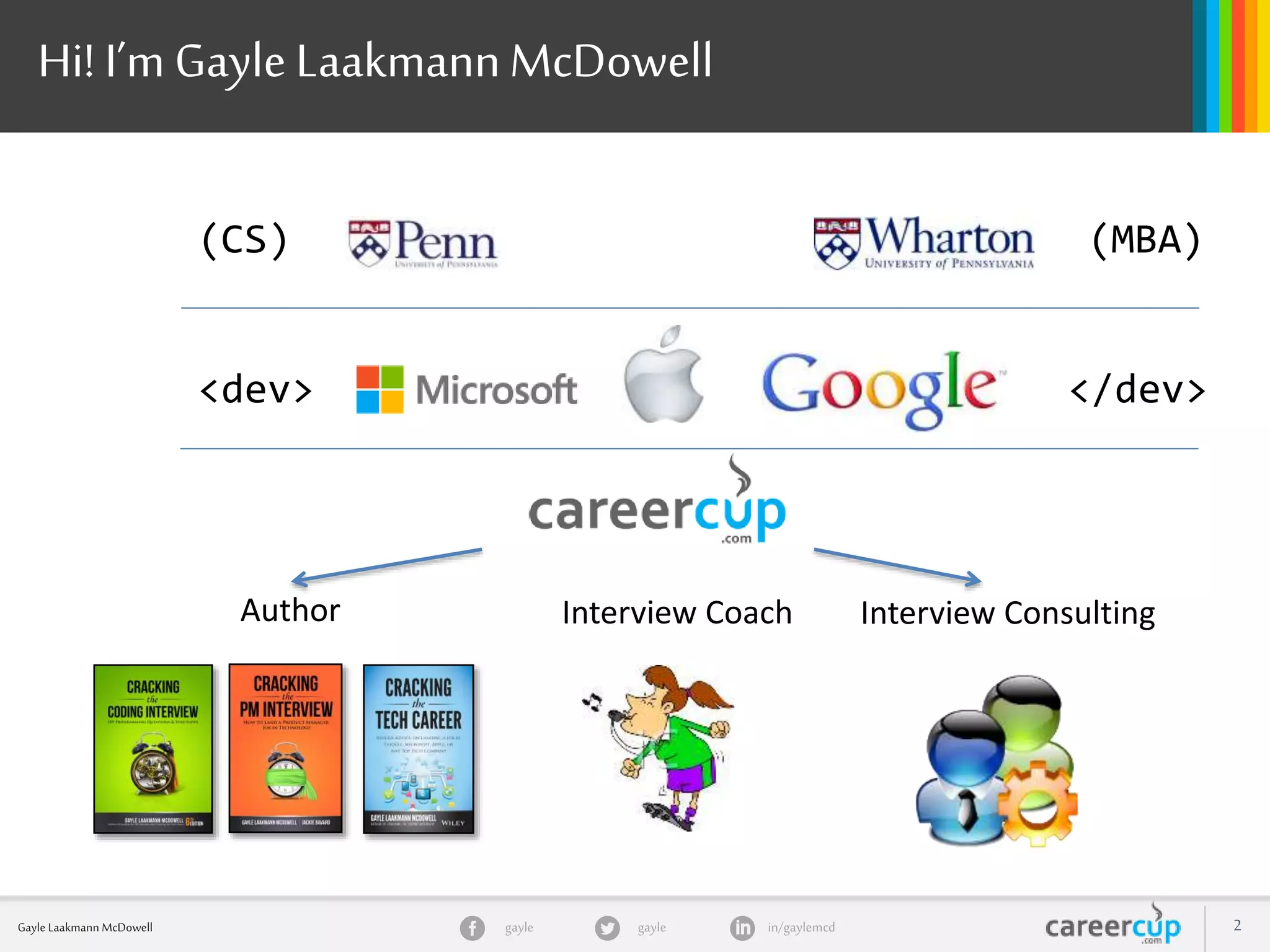
Hi! I’m Gayle LaakmannMcDowell
Author Interview Coach Interview Consulting
<dev> </dev>
(CS) (MBA)
How People Hire
Current strategies
00
gayle in/gaylemcdgayle 4Gayle Laakmann McDowell
How
We
Hire
Problem-solving questions
Onsite “real-world” tests
Homework
Take-Home Tests
Prior experience
References
Gayle Laakmann McDowell 5gayle in/gaylemcdgayle
It’s all broken
There’s no “perfect” interview.
Always false negatives.
Always false positives.
Gayle Laakmann McDowell 6gayle in/gaylemcdgayle
Problem Solving
Intelligencematters (a
lot)
Lots of communication
Ability to push through
hard problems
Intimidating
Prep helps
Other ways to be “great”
Can turn off sr. candidates
Lots of bad questions
Gayle Laakmann McDowell 7gayle in/gaylemcdgayle
OnsiteReal-World Tests
See real-world skills Identifiescurrent skill
set, notpotential
Lack of communication
Gayle Laakmann McDowell 8gayle in/gaylemcdgayle
Homework
Sees real-world skills.
Cheap & easy
Identifiescurrent skill
set, notpotential
Candidatescan feel
exploited
Gayle Laakmann McDowell 9gayle in/gaylemcdgayle
Prior Experience
It matters
Lots of communication
Some can “talka good
game”
ïź Somecan’t

Gayle Laakmann McDowell 10gayle in/gaylemcdgayle
References
Prior experience is
good
Hand-picked
Differentcompanies
have differentneeds
Not always 100%
honest
gayle in/gaylemcdgayle 11
z
Gayle Laakmann McDowell
Not
To
Mention

NONE evaluate workethic or
ability to focus
(whichisn’tnecessarilyconstant
anyway)
gayle in/gaylemcdgayle 12
z
Gayle Laakmann McDowell
What
To
Do?
Find what’s right for you
Identify theflaws
Make it as un-brokenas possible
Core Beliefs
Philosophies around hiring
01
Gayle Laakmann McDowell 14gayle in/gaylemcdgayle
#1: Goodcandidateexperiences matter
Gayle Laakmann McDowell 15gayle in/gaylemcdgayle
#2: Smart beatsknowledgable
Gayle Laakmann McDowell 16gayle in/gaylemcdgayle
#3: It’s On YouTo Get What YouWant
Gayle Laakmann McDowell 17gayle in/gaylemcdgayle
#4: Nothing Is Perfect
The Interview
Goals & Questions
02
gayle in/gaylemcdgayleGayle Laakmann McDowell 19
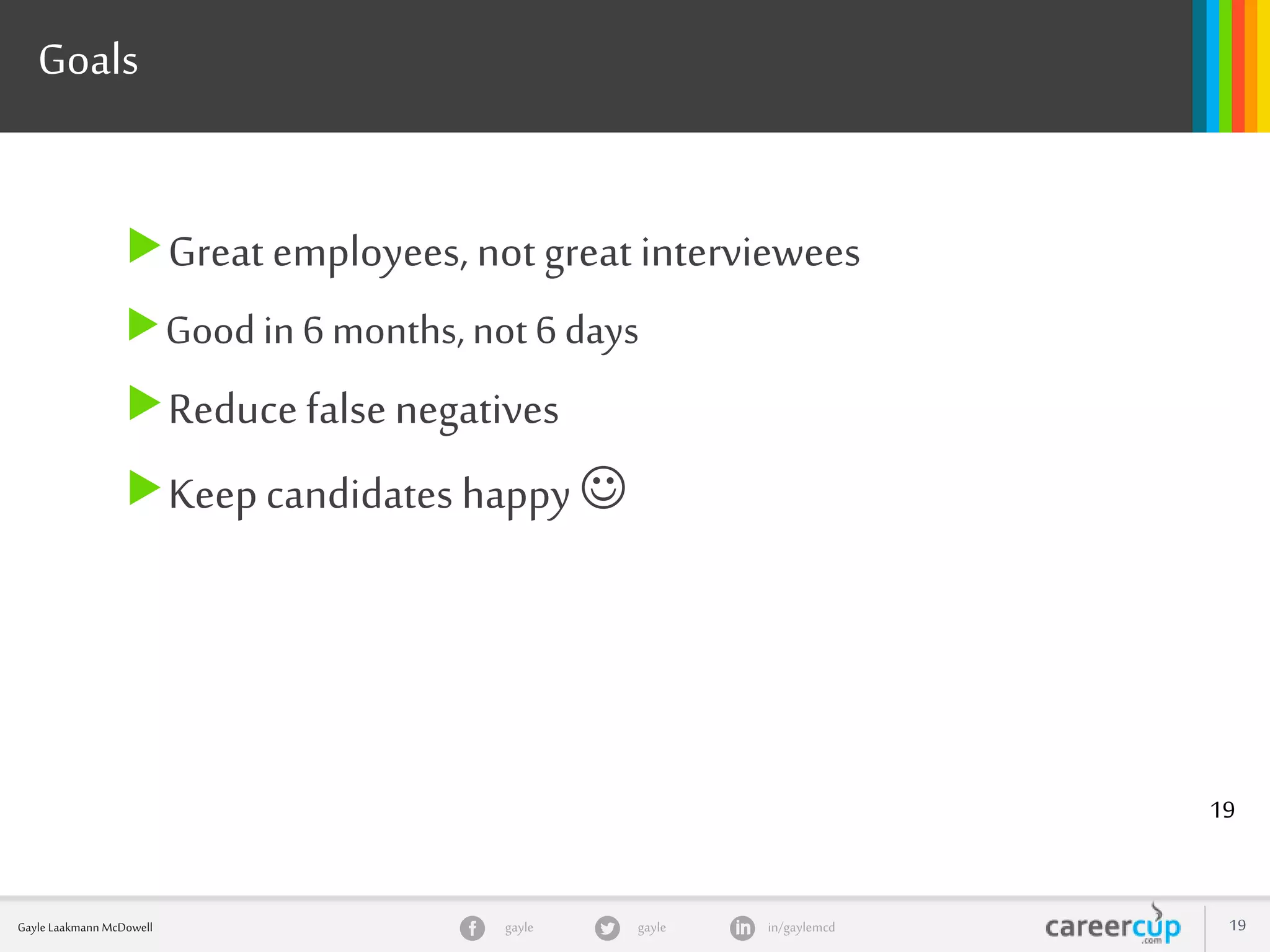
Goals
Great employees, not great interviewees
Goodin 6months,not 6days
Reducefalsenegatives
Keepcandidates happy 
19
gayle in/gaylemcdgayle 20
z
Gayle Laakmann McDowell
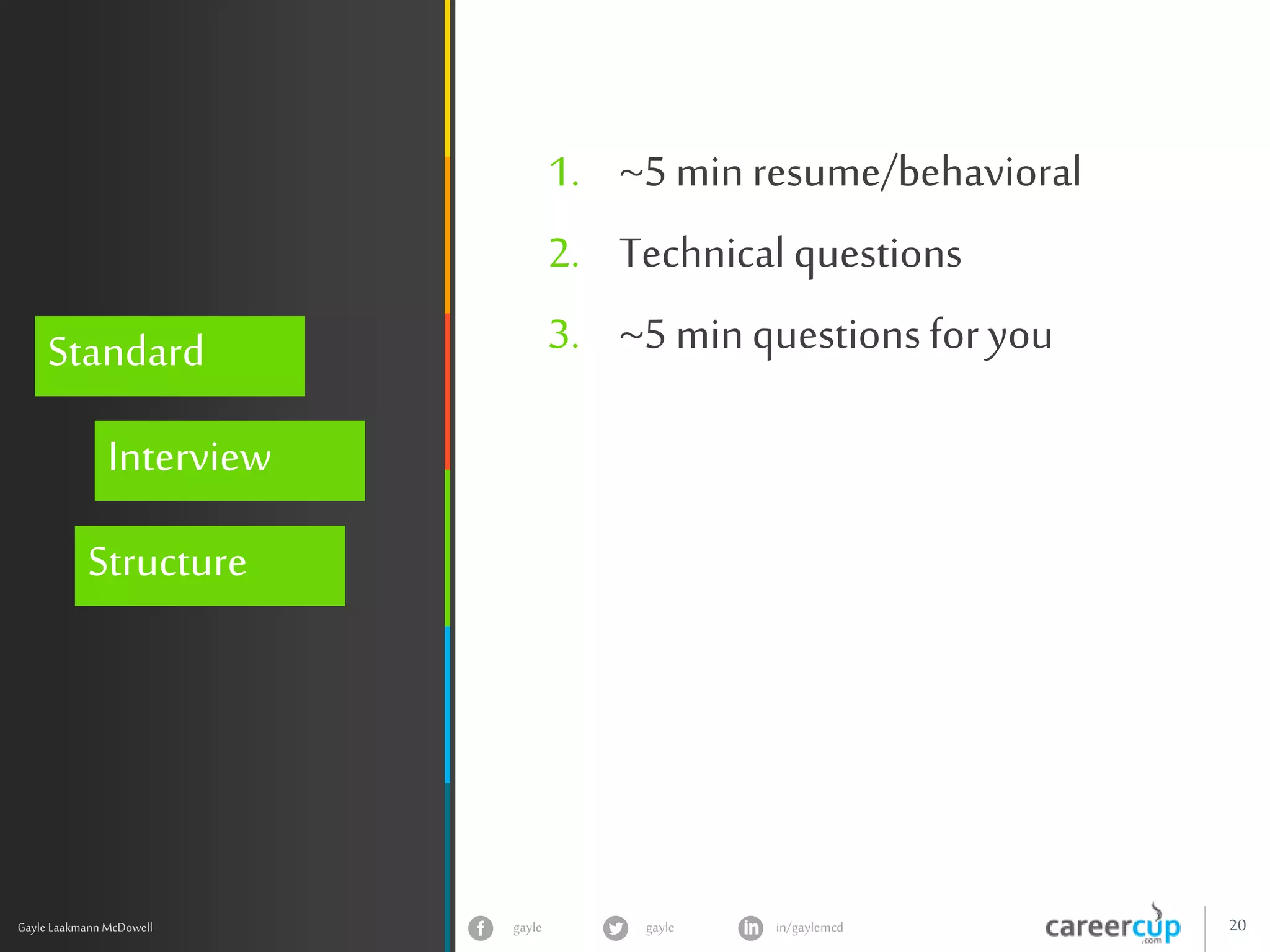
Standard
Interview
Structure
1. ~5 min resume/behavioral
2. Technical questions
3. ~5 minquestions for you
gayle in/gaylemcdgayleGayle Laakmann McDowell 21
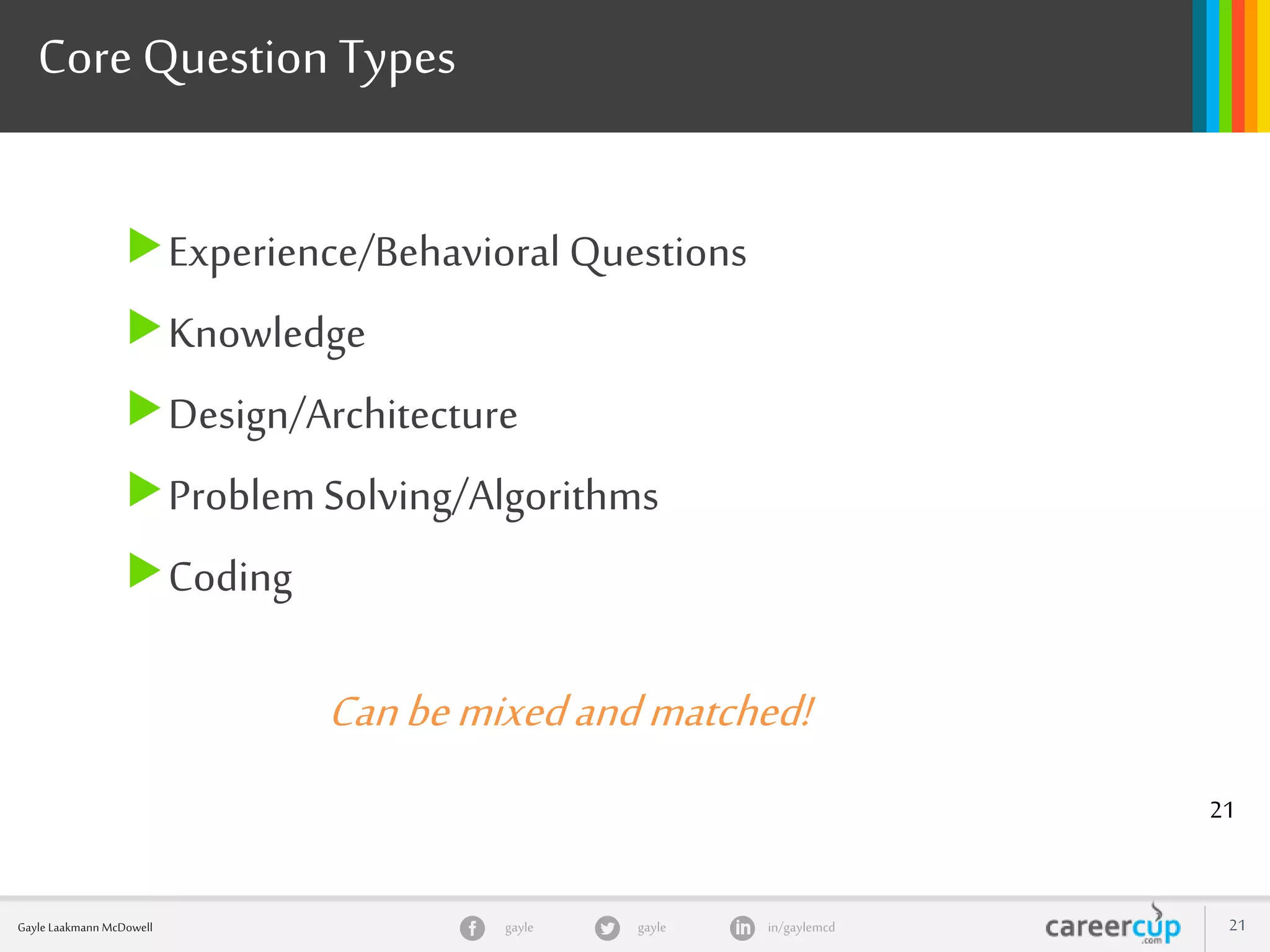
Core Question Types
Experience/Behavioral Questions
Knowledge
Design/Architecture
ProblemSolving/Algorithms
Coding
21
Canbemixedandmatched!
Behavioral/Experience
What doyou ask andwhy?
03
gayle in/gaylemcdgayleGayle Laakmann McDowell 23
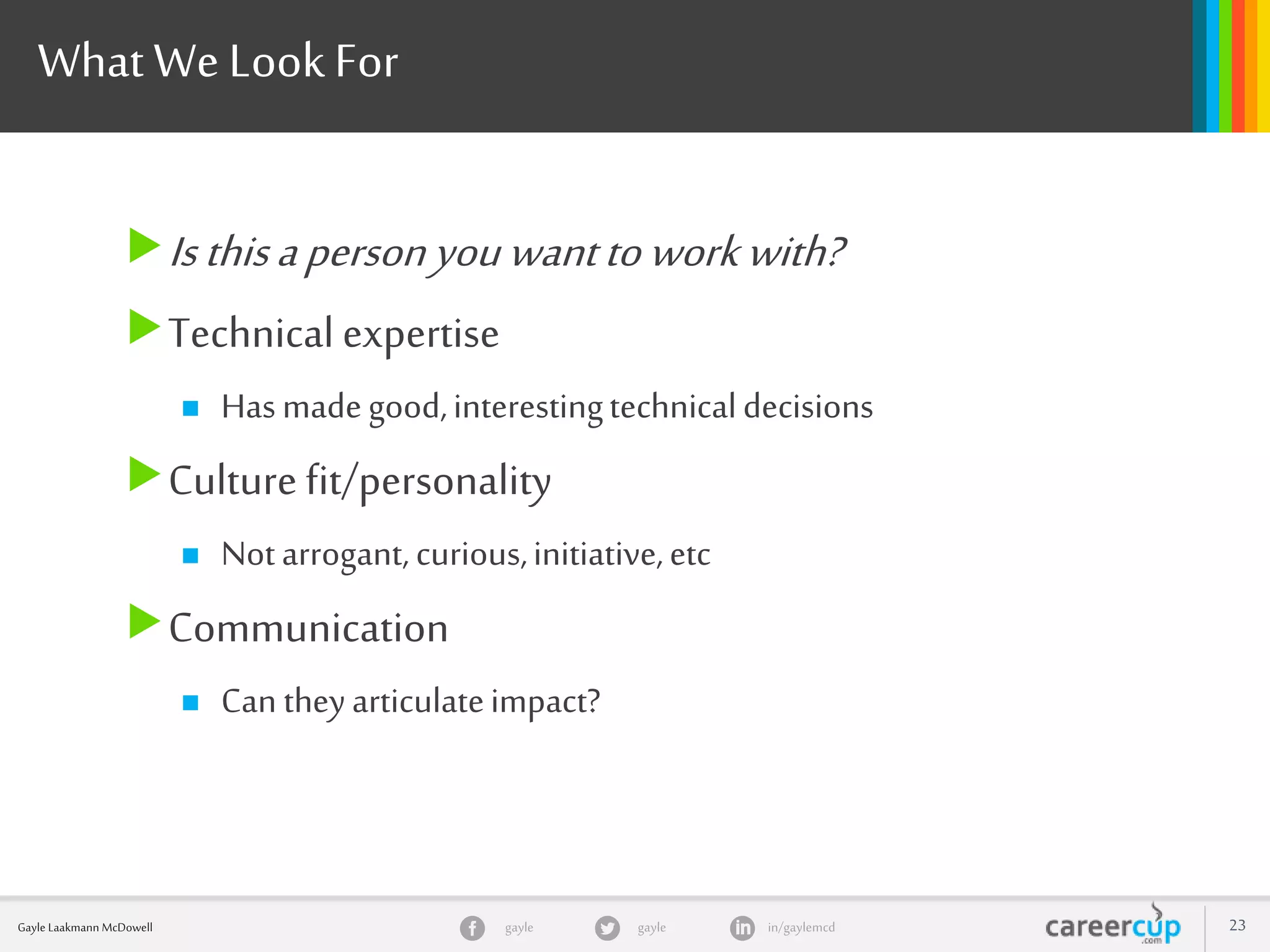
What We LookFor
Isthisapersonyouwanttoworkwith?
Technical expertise
ïź Hasmadegood,interestingtechnicaldecisions
Culturefit/personality
ïź Notarrogant,curious,initiative,etc
Communication
ïź Can theyarticulateimpact?
Gayle Laakmann McDowell 24gayle in/gaylemcdgayle
Engineers don’tlikeinterviews
Hostilitytowards “cheesy” questions
Don’t “get” interviewing
gayle in/gaylemcdgayleGayle Laakmann McDowell 25
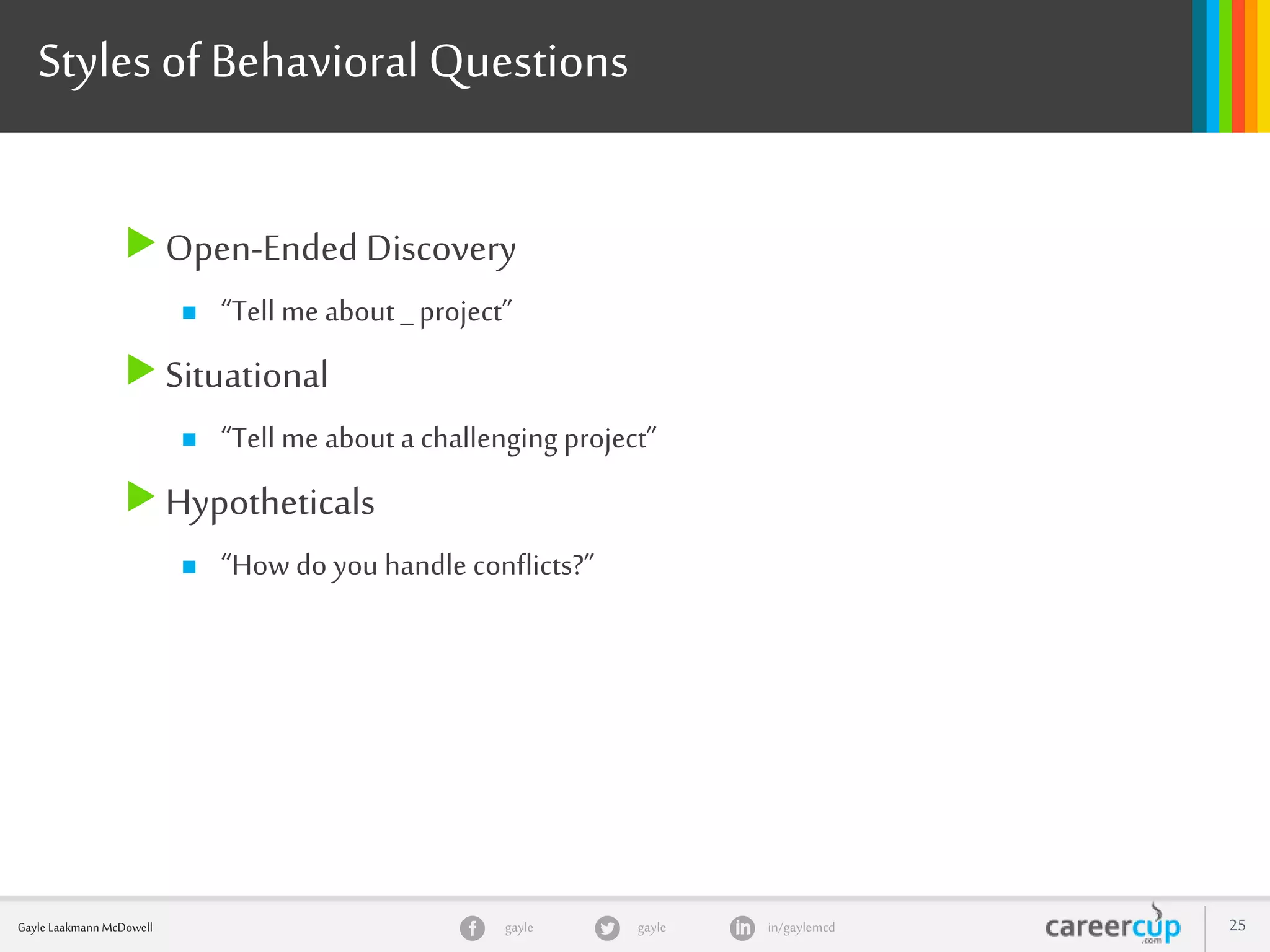
Styles of BehavioralQuestions
Open-Ended Discovery
ïź “Tell me about _ project”
Situational
ïź “Tell me about a challenging project”
Hypotheticals
ïź “How do you handle conflicts?”
Open-EndedDiscovery
gayle in/gaylemcdgayleGayle Laakmann McDowell 27
ExampleQuestions
“Walk methrough your resume”
“Tellme about theprojects you’ve worked on.”
“Tellmeabout your job. Whatdo you like?”
gayle in/gaylemcdgayleGayle Laakmann McDowell 28
‱ Candidates
feel

gayle in/gaylemcdgayleGayle Laakmann McDowell 29
The Good andBad
Gives opportunity to talk about whatthey want
Finds stuff noton their resume
Won’t throw themoff
But

ïź Unstructured,mightnotgetinfoyouwant
Situational
gayle in/gaylemcdgayleGayle Laakmann McDowell 31
ExampleQuestions
Tellme about a timewhenyou faced a conflict
Tellme about a timeyou had to influencepeople
Tellmeabout a difficultdecision you had to make
gayle in/gaylemcdgayleGayle Laakmann McDowell 32
Avoid Hypotheticals
Best Practices
gayle in/gaylemcdgayleGayle Laakmann McDowell 34
Avoid priming
gayle in/gaylemcdgayleGayle Laakmann McDowell 35
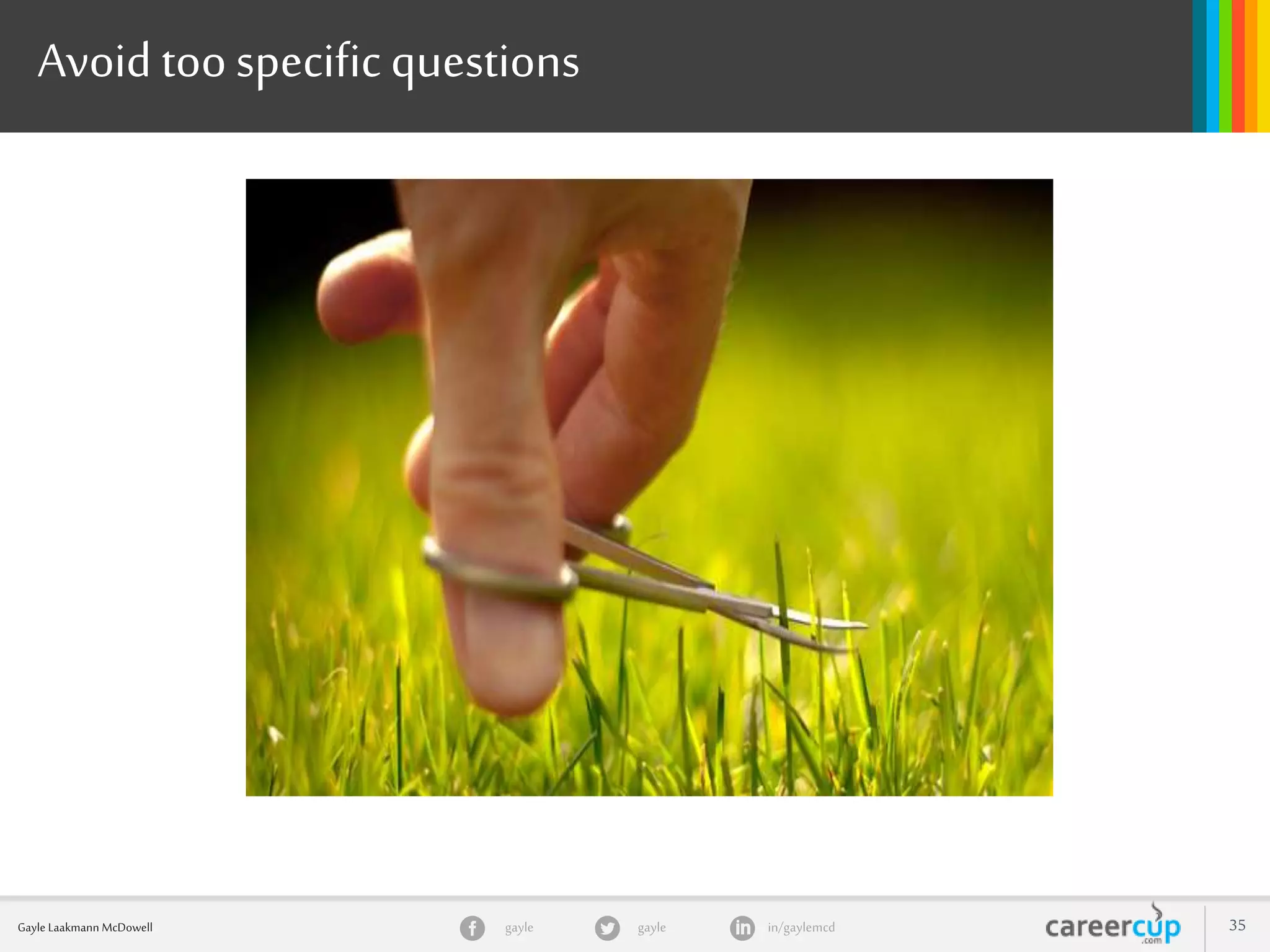
Avoid toospecificquestions
gayle in/gaylemcdgayleGayle Laakmann McDowell 36
Avoid superlatives
gayle in/gaylemcdgayleGayle Laakmann McDowell 37
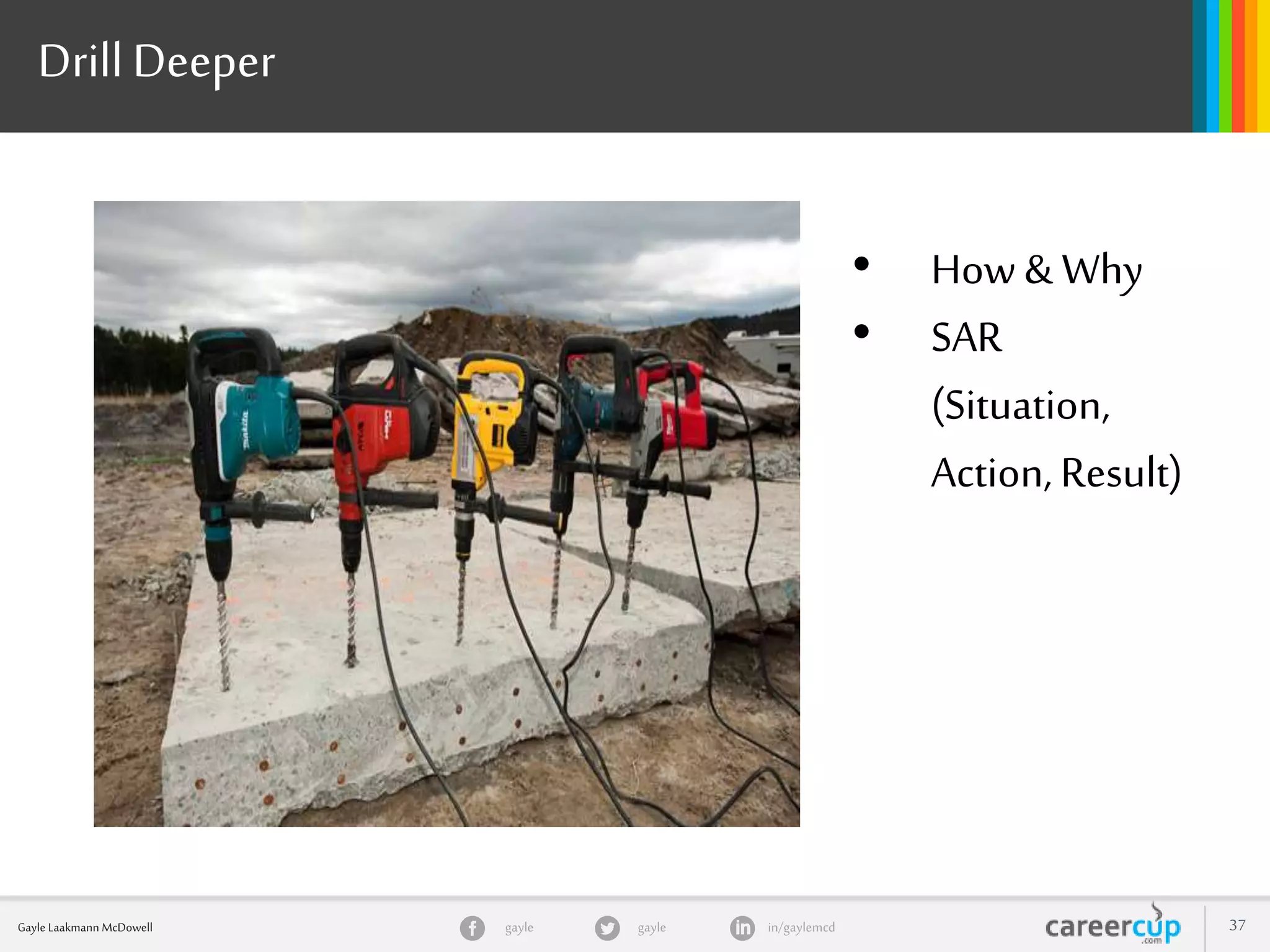
Drill Deeper
‱ How & Why
‱ SAR
(Situation,
Action, Result)
gayle in/gaylemcdgayleGayle Laakmann McDowell 38
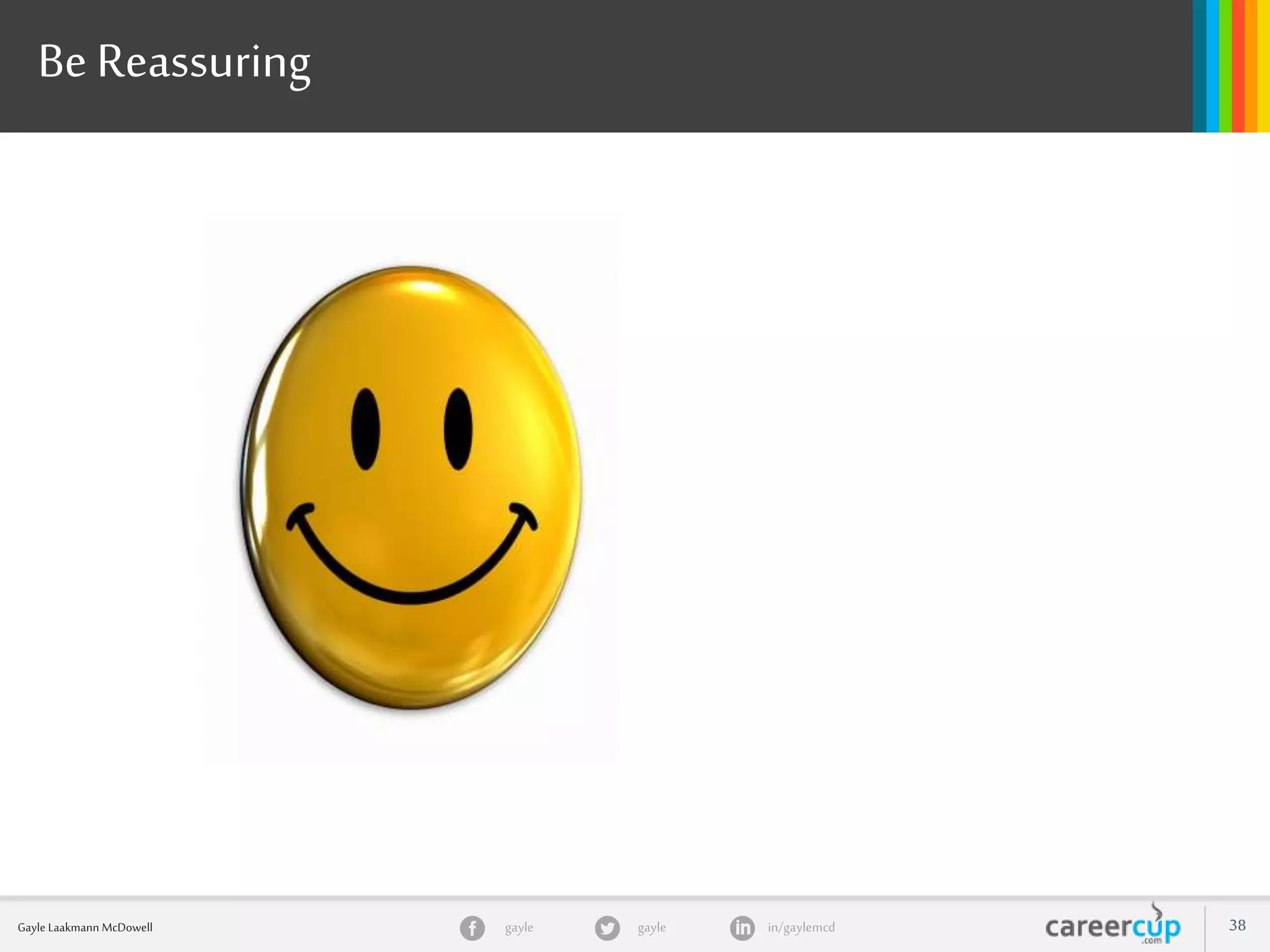
Be Reassuring
gayle in/gaylemcdgayleGayle Laakmann McDowell 39
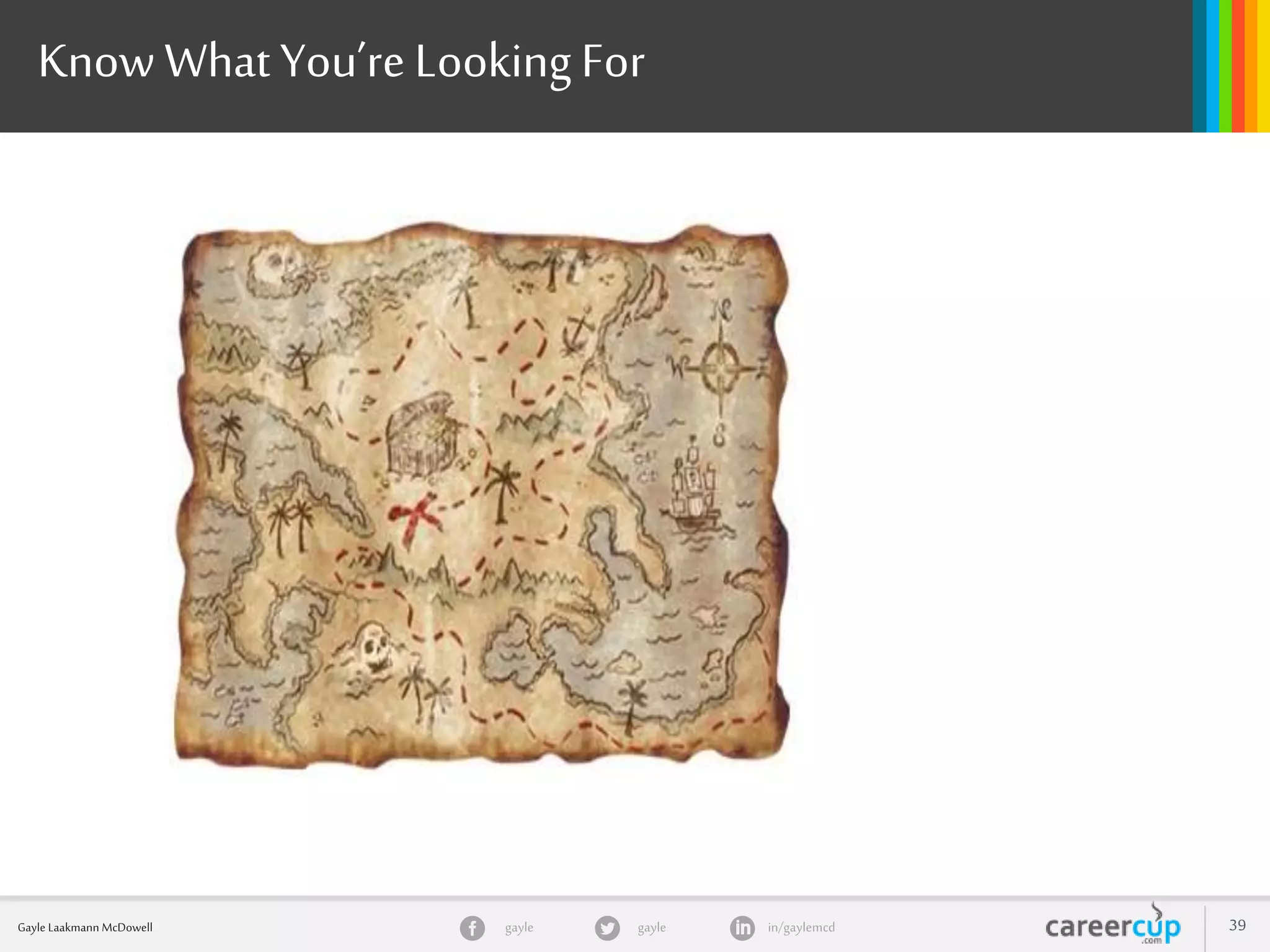
Know What You’re Looking For
gayle in/gaylemcdgayleGayle Laakmann McDowell 40
Cross Check
gayle in/gaylemcdgayleGayle Laakmann McDowell 41
My Favorites
Resumewalk-through
ïź Doityourselffirst,tosetthestage
Hobbies & stuffnoton your resume
ïź Warnthatit’sokaytonothaveanything
Pastprojects and work
ïź Walk throughdesignonwhiteboard
ïź Discusstradeoffs,keydecisions,etc.
ïź Extensionstoproject(scaling,etc.)
ïź Focusonpersonalimpact
gayle in/gaylemcdgayle 42
z
Gayle Laakmann McDowell
Check
Your
Interviewers
Is the question likelyto annoy a
candidate?
Did they go beyond surface level?
What did they learn?
Are they surethey learned that?
Knowledge
What do you really need?
04
gayle in/gaylemcdgayleGayle Laakmann McDowell 44
Examples
What’s thedifference between__ and __?
What are the benefitsof __?
Whatdoes __mean?
gayle in/gaylemcdgayleGayle Laakmann McDowell 45
Goals
Assess candidate’s skills
ïź Relativetopositionneeds
ïź Relativetoexpectations
Make candidate’s experience feel valued
gayle in/gaylemcdgayleGayle Laakmann McDowell 46
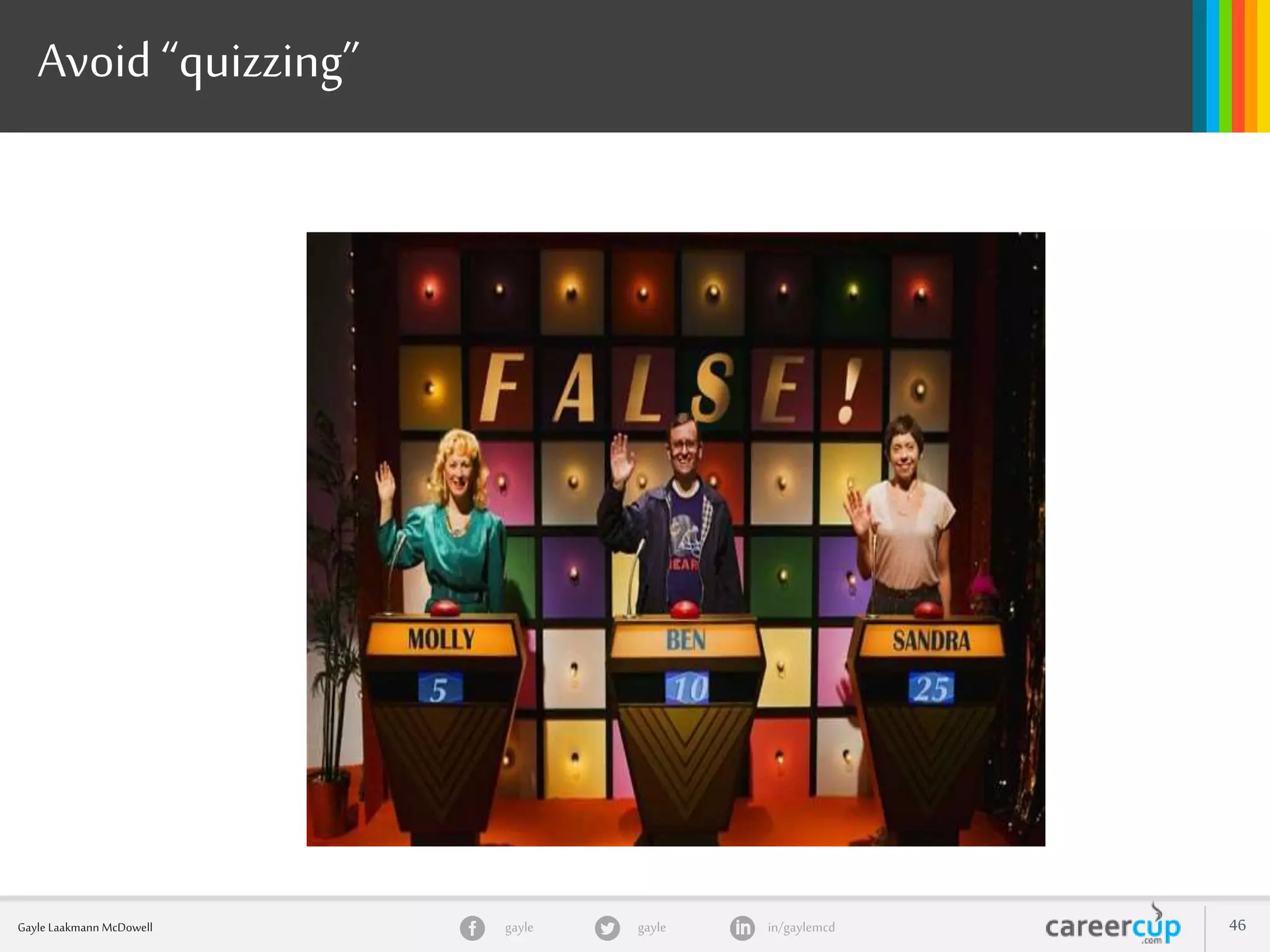
Avoid “quizzing”
gayle in/gaylemcdgayleGayle Laakmann McDowell 47
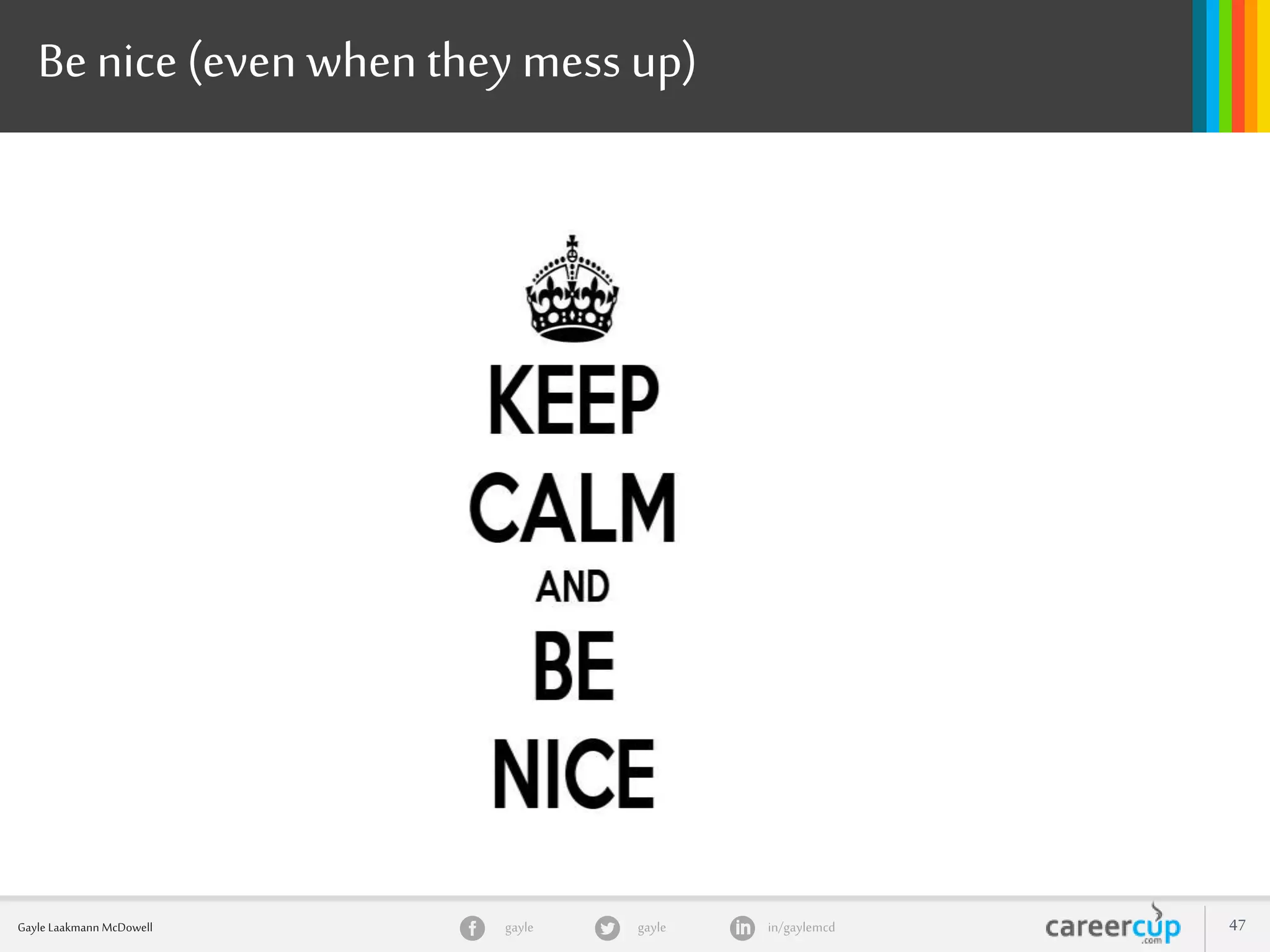
Be nice (even when they mess up)
gayle in/gaylemcdgayleGayle Laakmann McDowell 48
Knowledge ShouldBe

Hard to obtain
or
A red flag to lack
gayle in/gaylemcdgayleGayle Laakmann McDowell 49
gayle in/gaylemcdgayleGayle Laakmann McDowell 50
My Favorites
How does ____ work?
How do you thinkit’s implemented?
Teach meabout ____.
gayle in/gaylemcdgayle 51
z
Gayle Laakmann McDowell
Questions
ForYour
Interviewers
Was it a discussion?
Did you probe deeper?
How long would it take to teach this
depth?
If the candidate didn’t know
something: Why not?
Were you positive & reassuring?
Design
Big, meaty problems
05
gayle in/gaylemcdgayleGayle Laakmann McDowell 53
Why?
Tests:
ïź Abilitytotackleopen-endedproblems
ïź Communication/teamworkskills
ïź Adifferentsideofproblem-solving
Respects experience of senior candidates
Gayle Laakmann McDowell 54gayle in/gaylemcdgayle
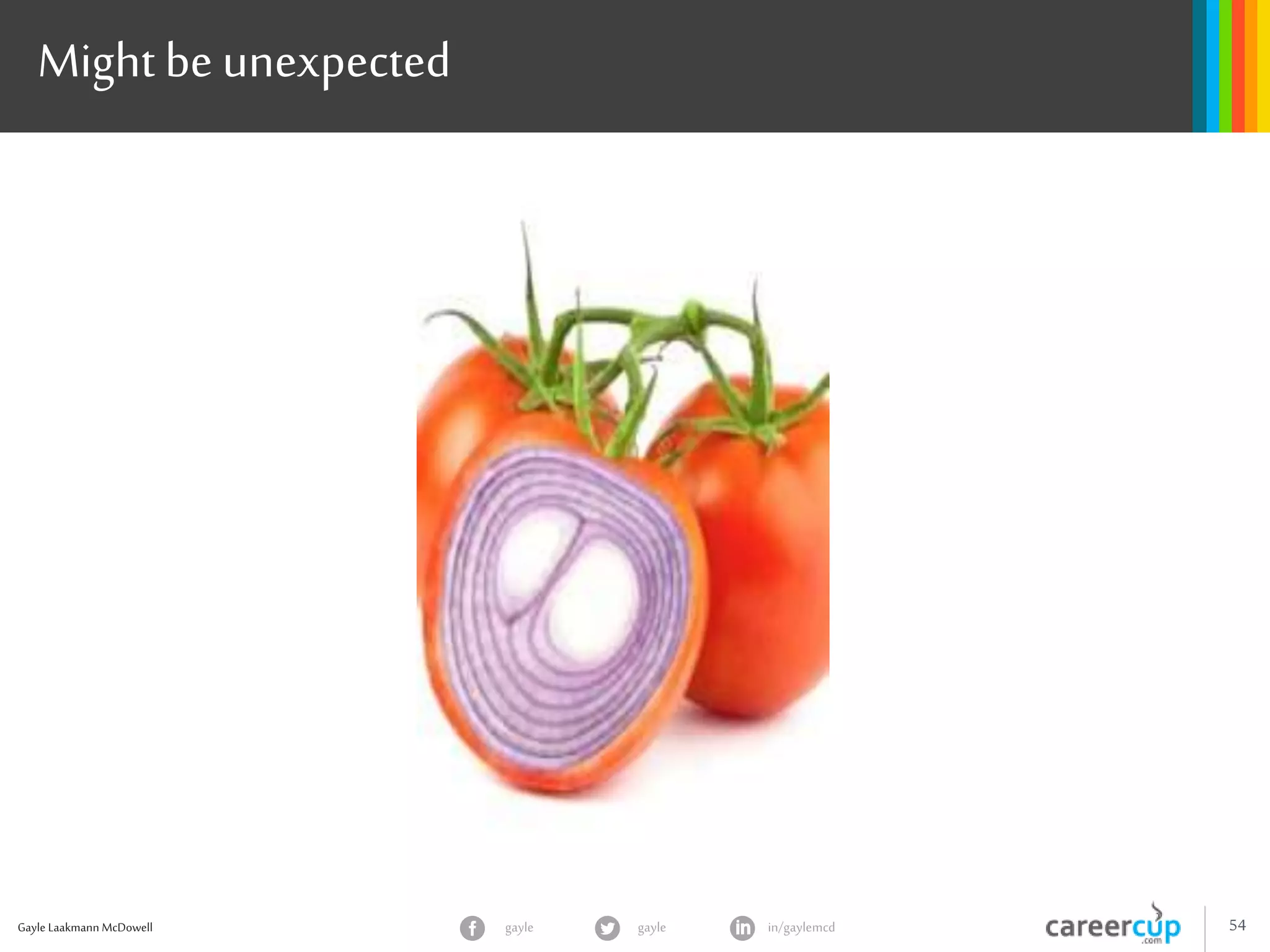
Might be unexpected
Gayle Laakmann McDowell 55gayle in/gaylemcdgayle
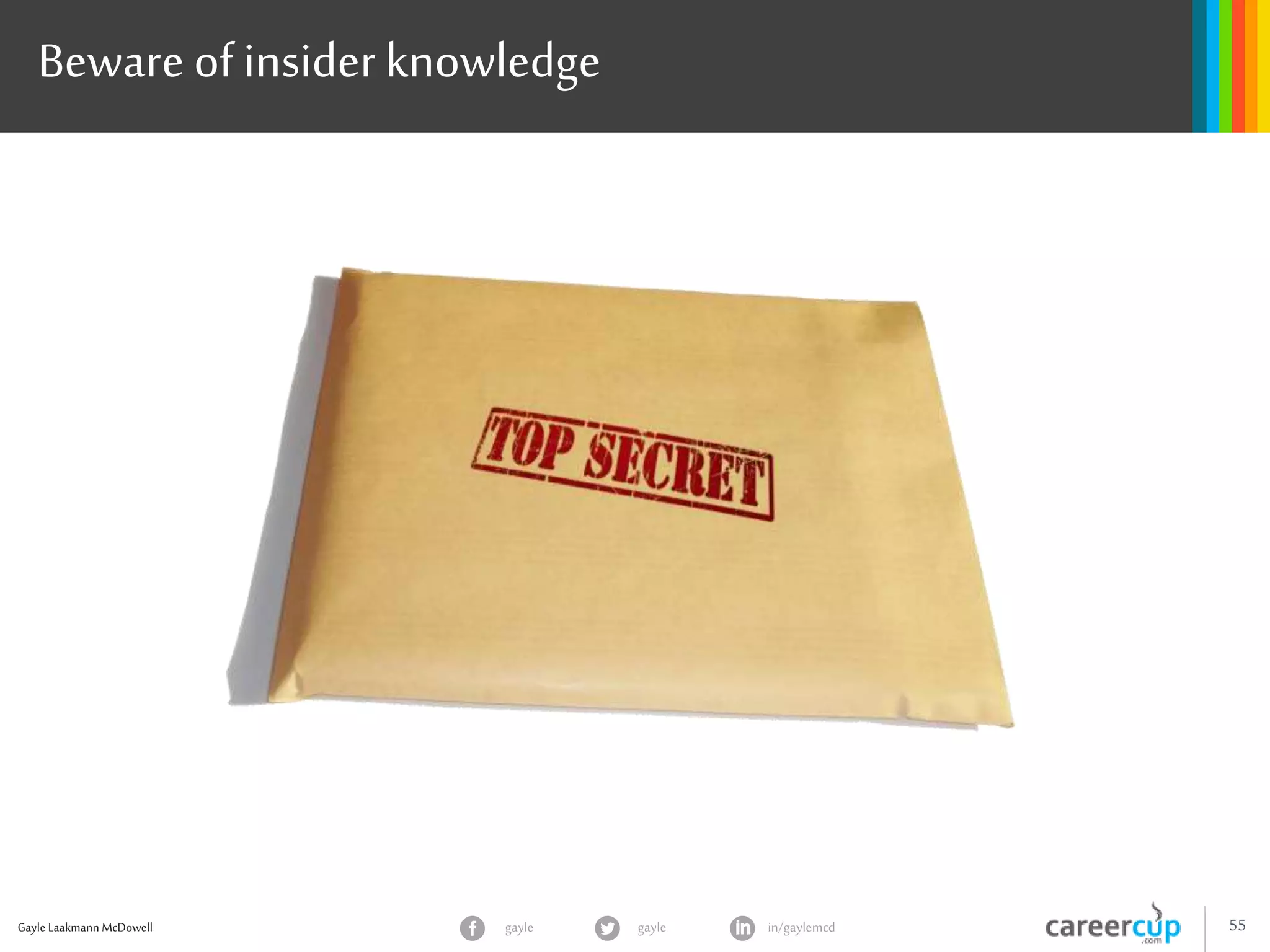
Beware of insiderknowledge
Gayle Laakmann McDowell 56gayle in/gaylemcdgayle
Encourage them todrive
Gayle Laakmann McDowell 57gayle in/gaylemcdgayle
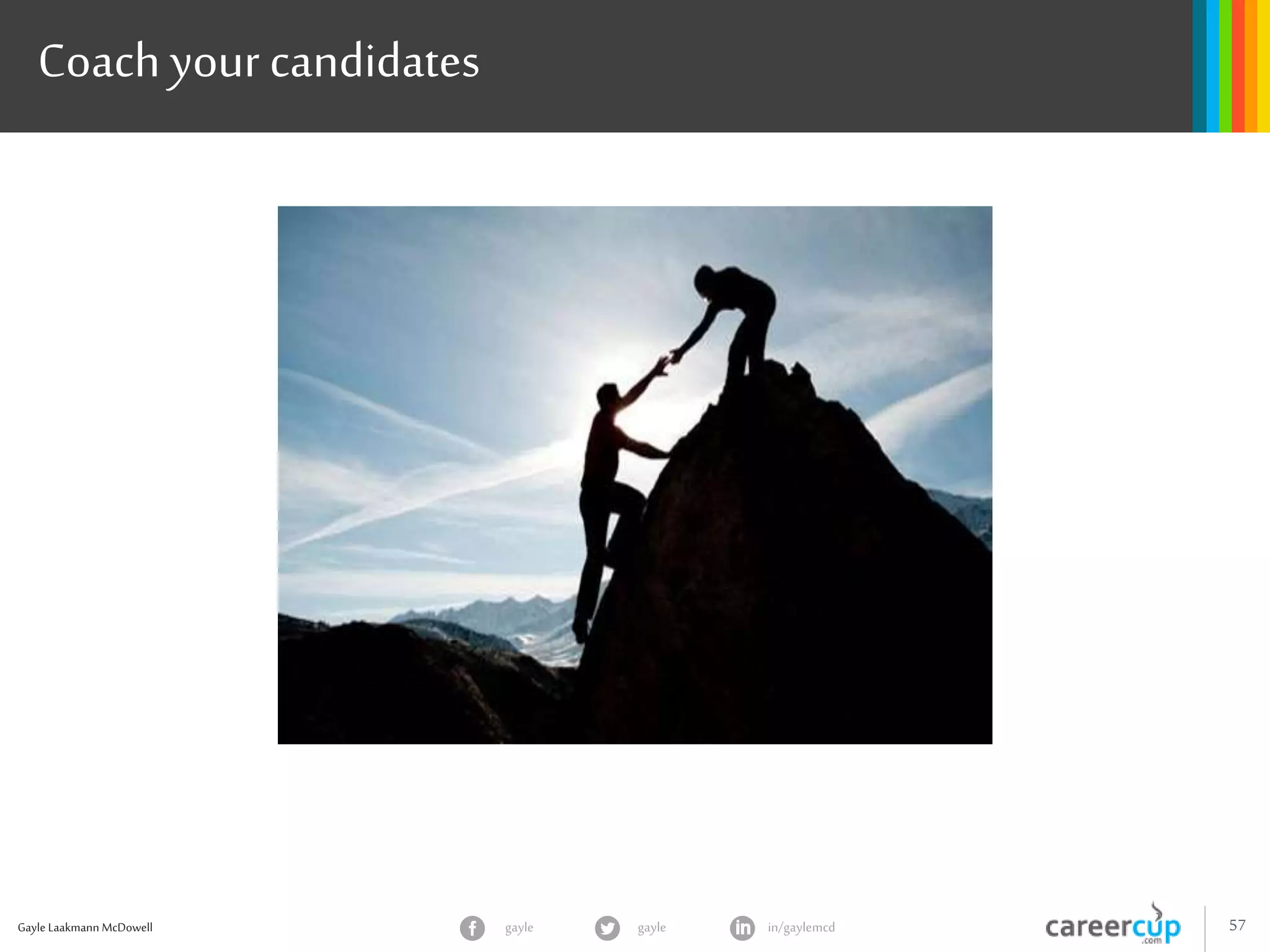
Coach your candidates
gayle in/gaylemcdgayleGayle Laakmann McDowell 58
Evaluation
Ability to make tradeoffs
Ability to identify issues
Separate knowledgefrom attributes
Response to feedback
Higherstandards for more senior candidates
gayle in/gaylemcdgayleGayle Laakmann McDowell 59
Examples
DesignAPI for

System for Amazon book rank
System for TinyURL
OOD for a music library
gayle in/gaylemcdgayle 60
z
Gayle Laakmann McDowell
Questions
ForYour
Interviewers
Did the candidate need to reallythink?
Did you go deep?
Did you help the candidate through?
Algorithms
Make ‘em think
06
gayle in/gaylemcdgayleGayle Laakmann McDowell 62
Why?
Smart people do good work
Hires adaptable people
Very effectiveifdonewell
gayle in/gaylemcdgayleGayle Laakmann McDowell 63
BadPractices& False Negatives
Easy questions
Questions with “a ha” moments
Well knownproblems (or patterns)
gayle in/gaylemcdgayleGayle Laakmann McDowell 64
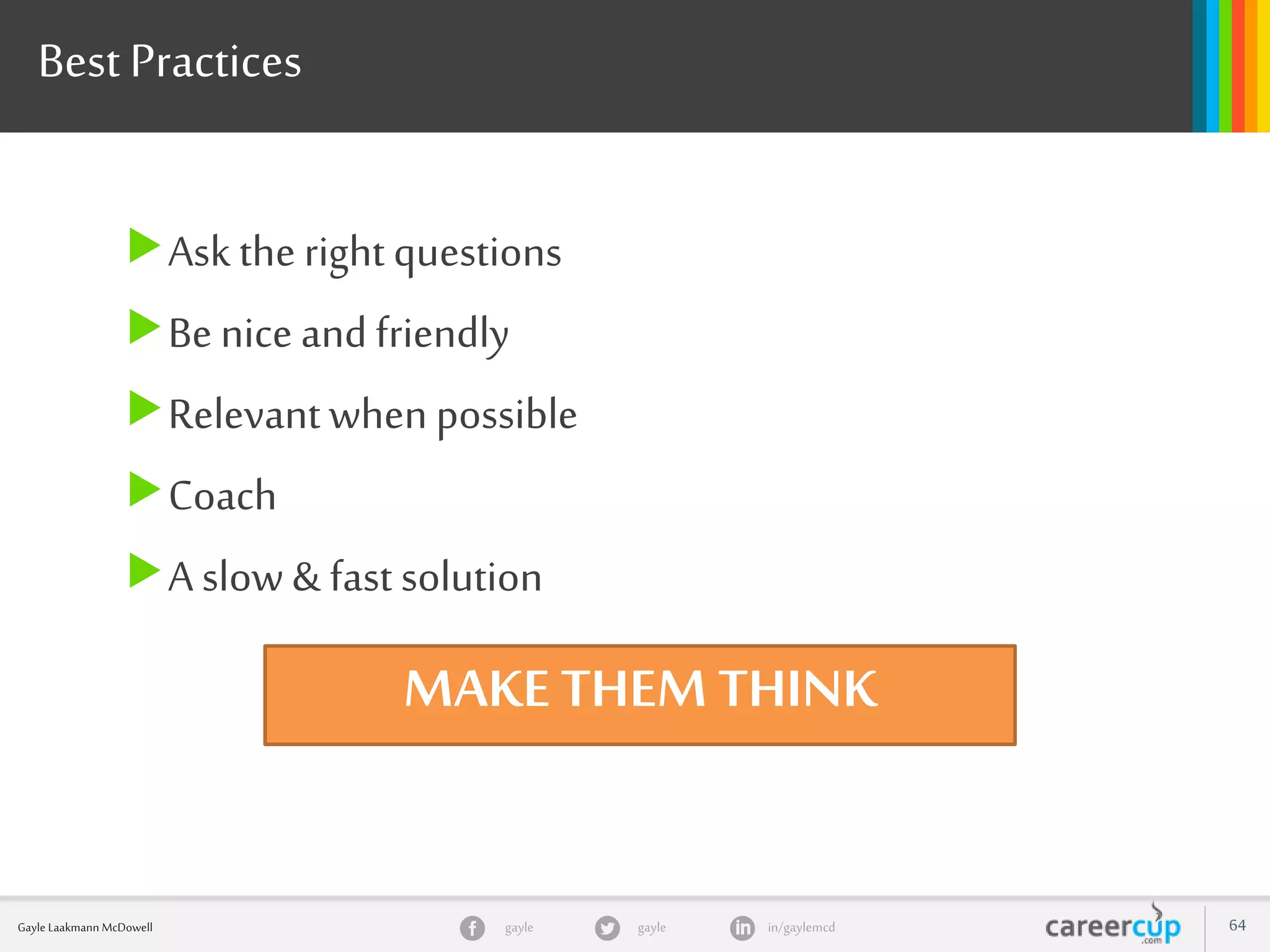
Best Practices
Ask the right questions
Be nice and friendly
Relevantwhen possible
Coach
A slow & fast solution
MAKE THEM THINK
gayle in/gaylemcdgayleGayle Laakmann McDowell 65
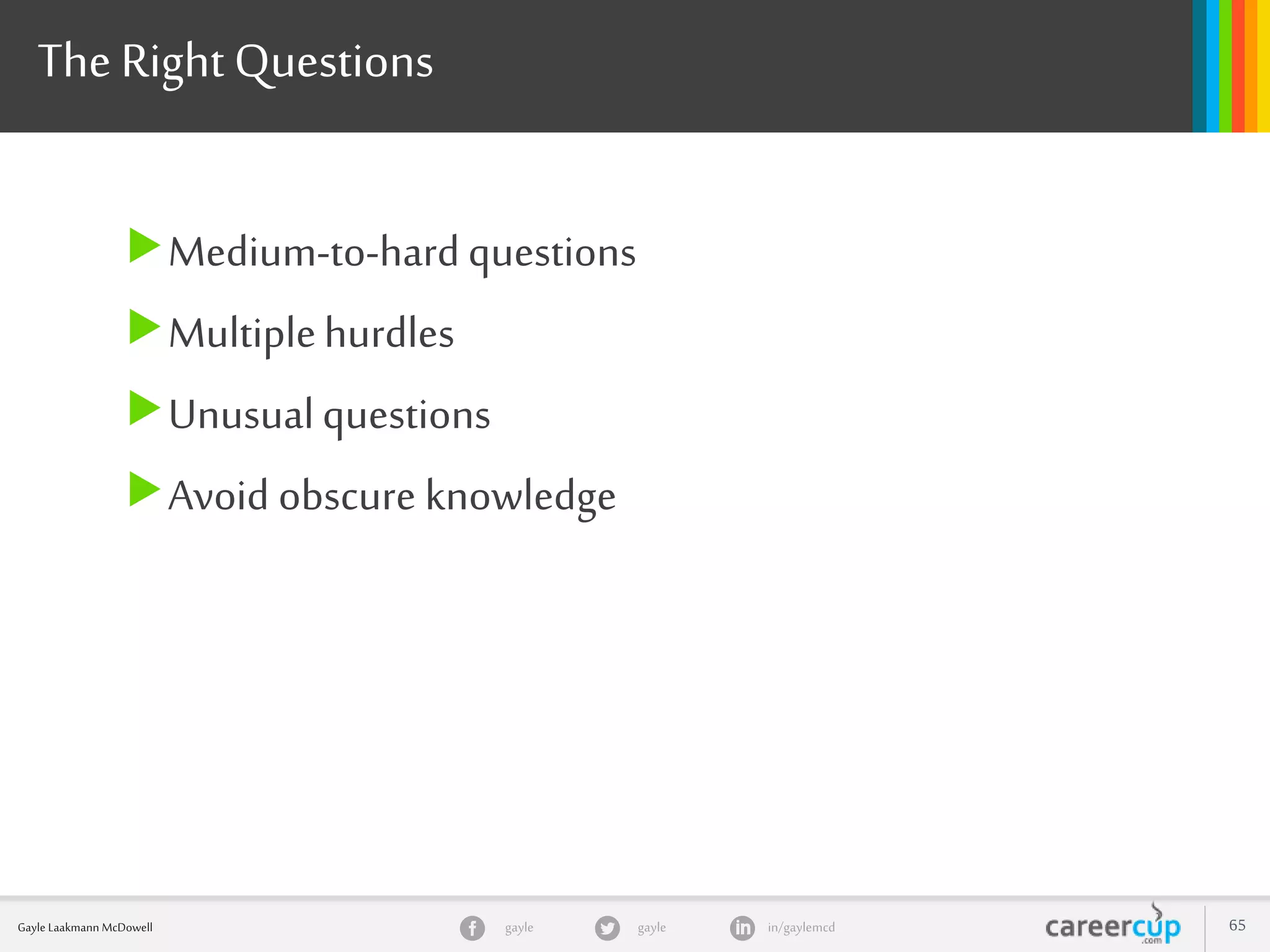
The Right Questions
Medium-to-hardquestions
Multiplehurdles
Unusualquestions
Avoid obscure knowledge
gayle in/gaylemcdgayleGayle Laakmann McDowell 66
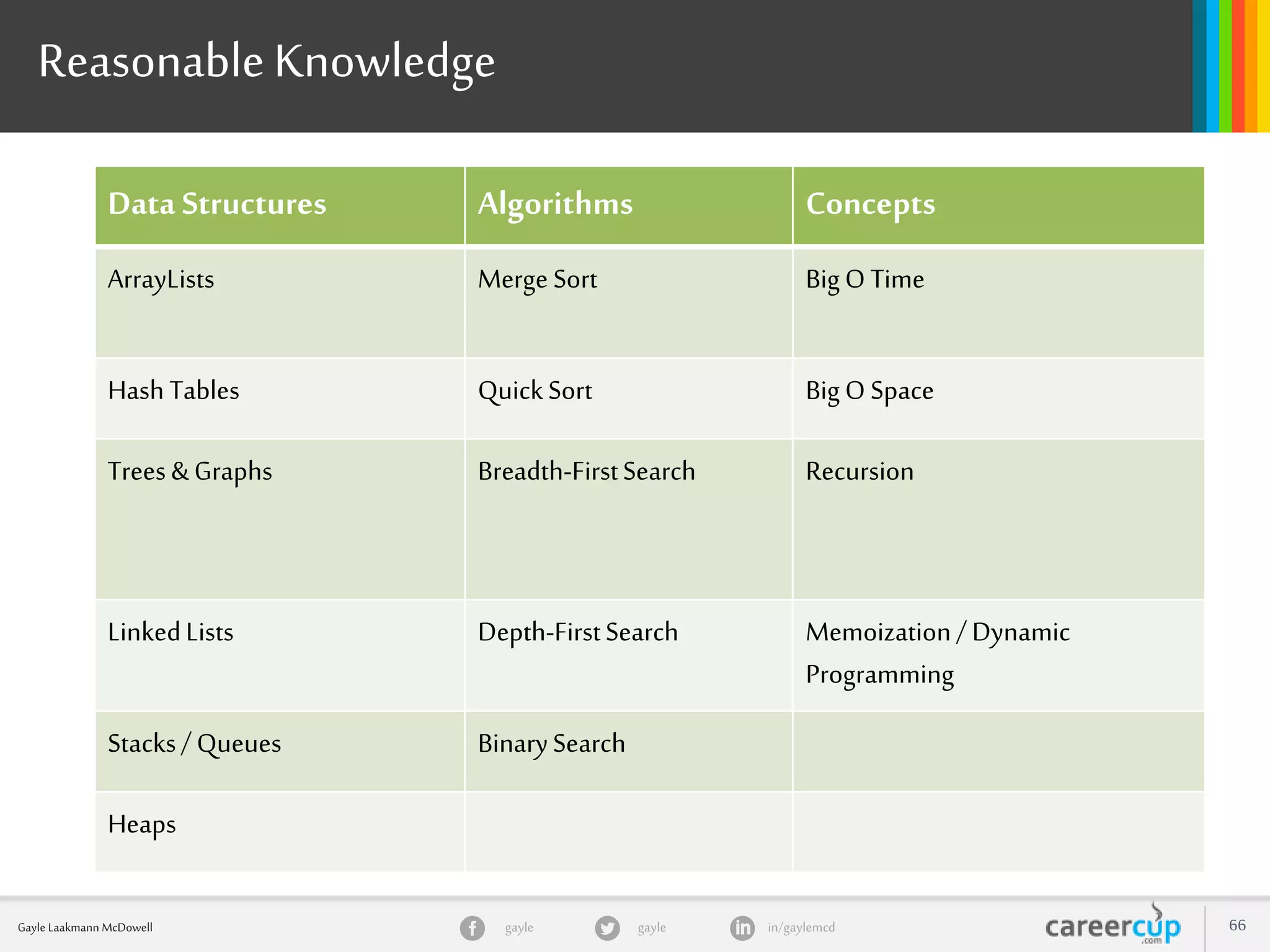
ReasonableKnowledge
Data Structures Algorithms Concepts
ArrayLists Merge Sort BigO Time
Hash Tables QuickSort BigO Space
Trees&Graphs Breadth-FirstSearch Recursion
LinkedLists Depth-FirstSearch Memoization/ Dynamic
Programming
Stacks/ Queues BinarySearch
Heaps
gayle in/gaylemcdgayleGayle Laakmann McDowell 67
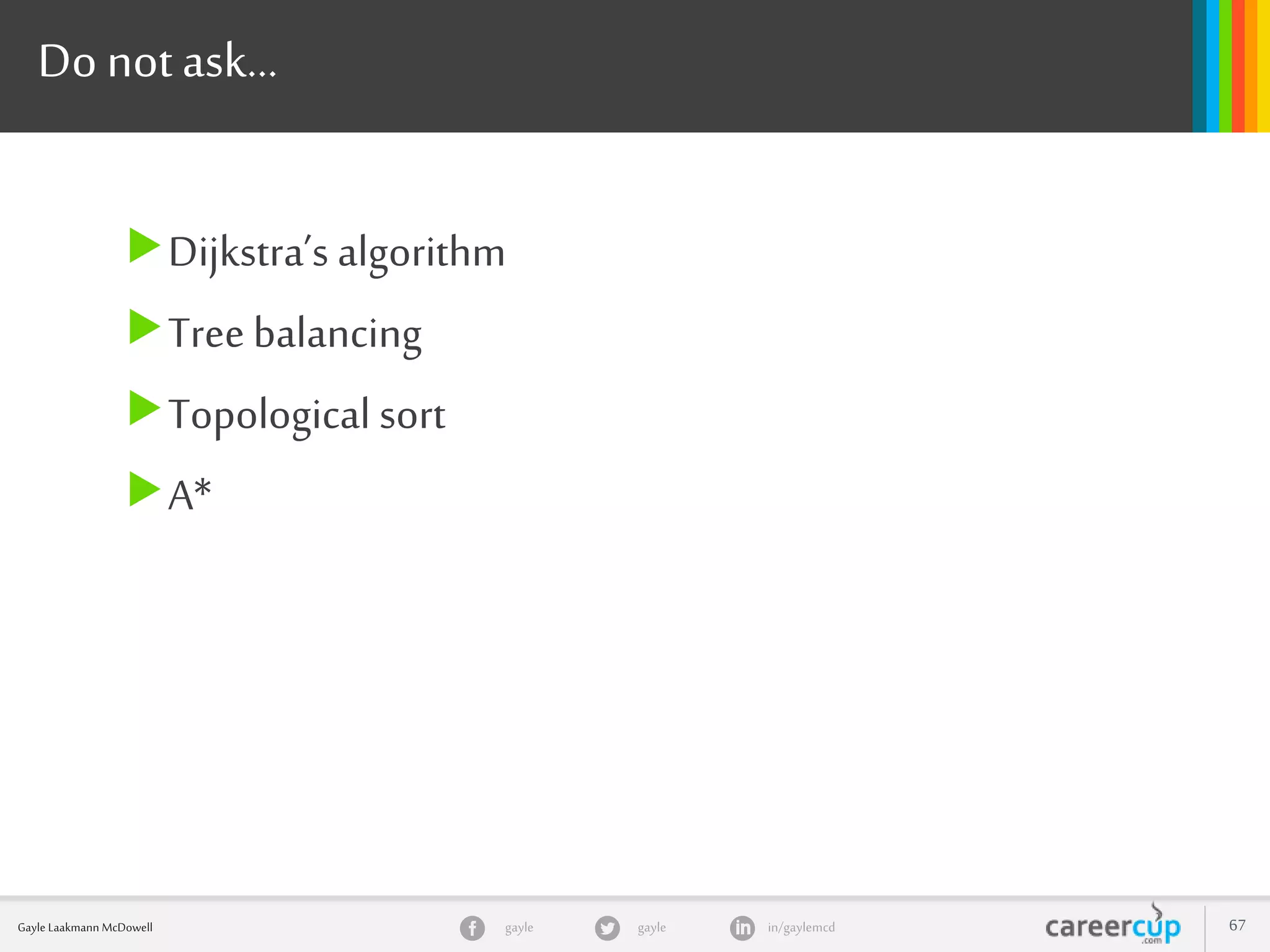
Do notask

Dijkstra’s algorithm
Tree balancing
Topological sort
A*
gayle in/gaylemcdgayleGayle Laakmann McDowell 68
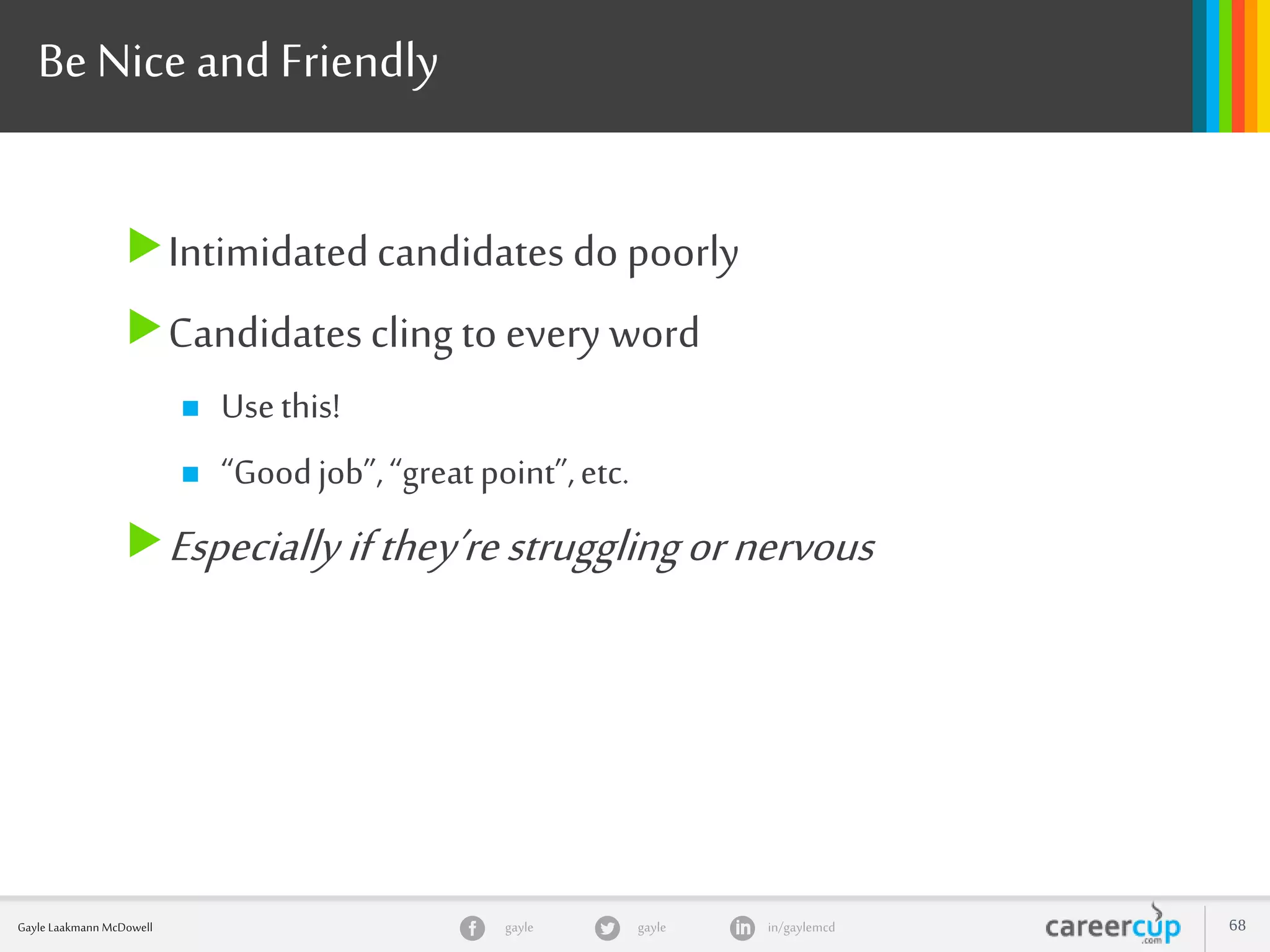
Be Nice and Friendly
Intimidatedcandidates do poorly
Candidatescling to every word
ïź Usethis!
ïź “Goodjob”,“greatpoint”,etc.
Especiallyifthey’restrugglingornervous
gayle in/gaylemcdgayleGayle Laakmann McDowell 69
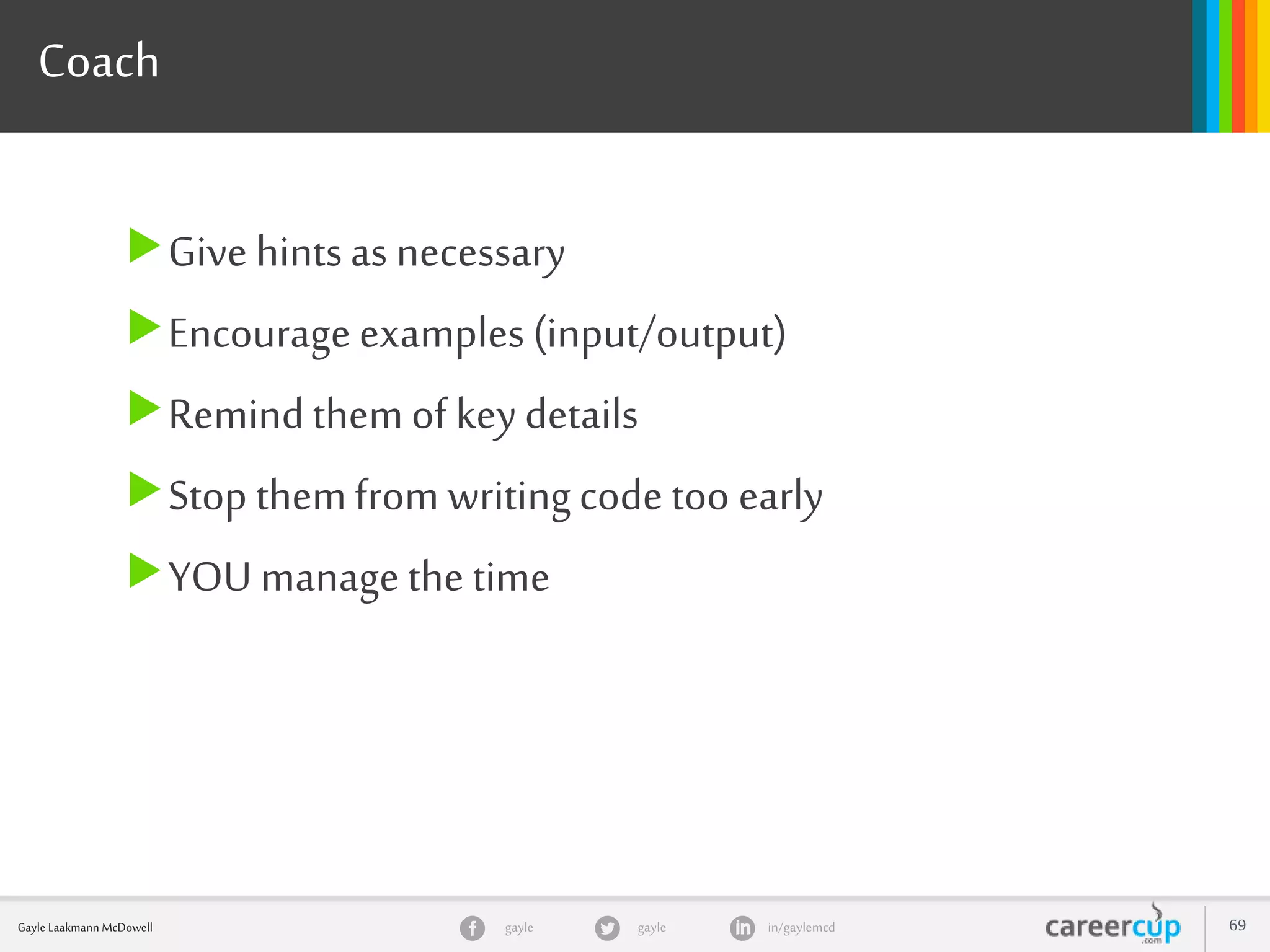
Coach
Give hintsas necessary
Encourage examples (input/output)
Remindthemof keydetails
Stop themfrom writingcode too early
YOU managethe time
gayle in/gaylemcdgayleGayle Laakmann McDowell 70
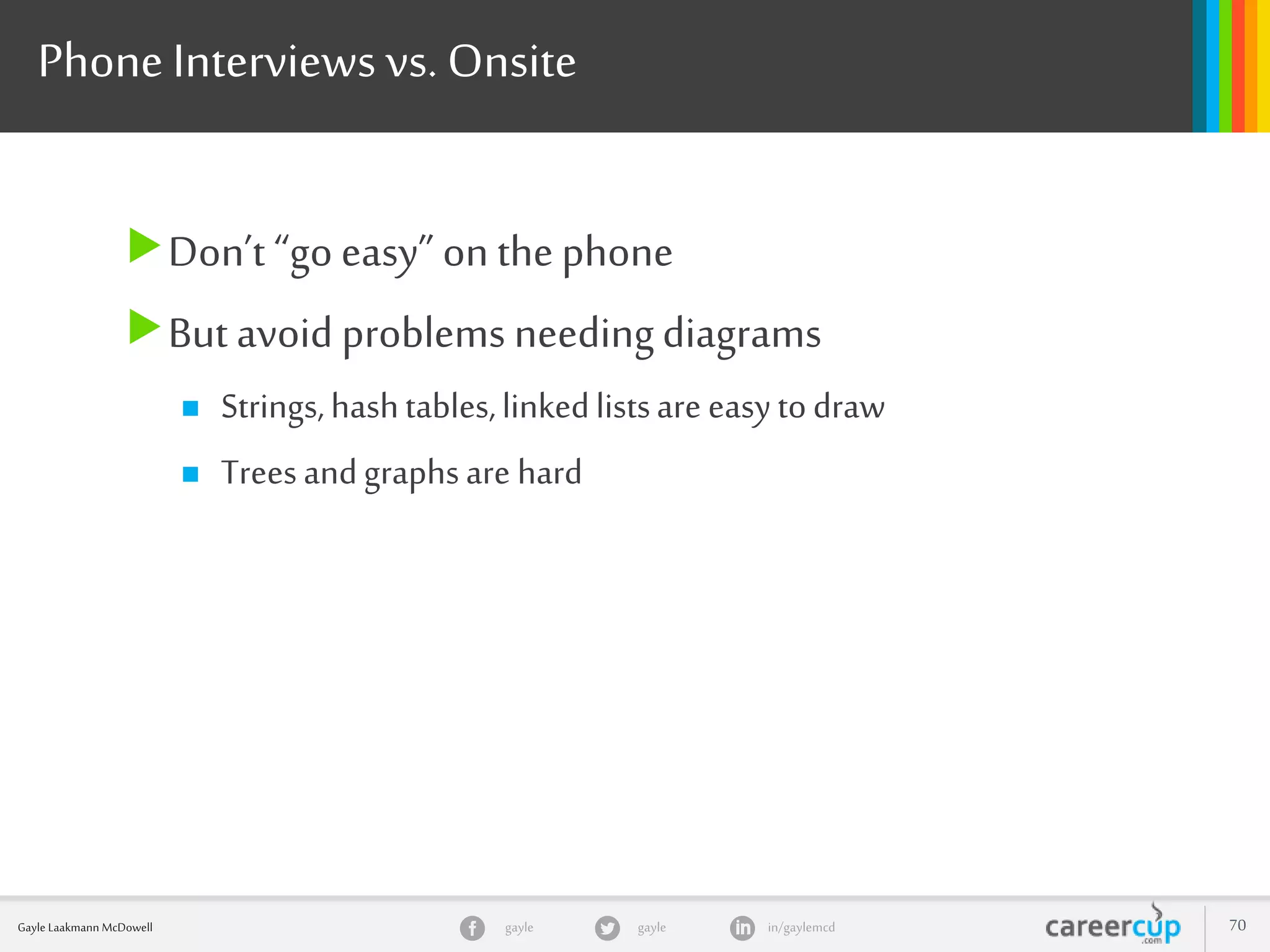
Phone Interviews vs. Onsite
Don’t “go easy” on thephone
But avoid problems needingdiagrams
ïź Strings,hashtables,linkedlistsare easytodraw
ïź Treesandgraphsare hard
gayle in/gaylemcdgayleGayle Laakmann McDowell 71
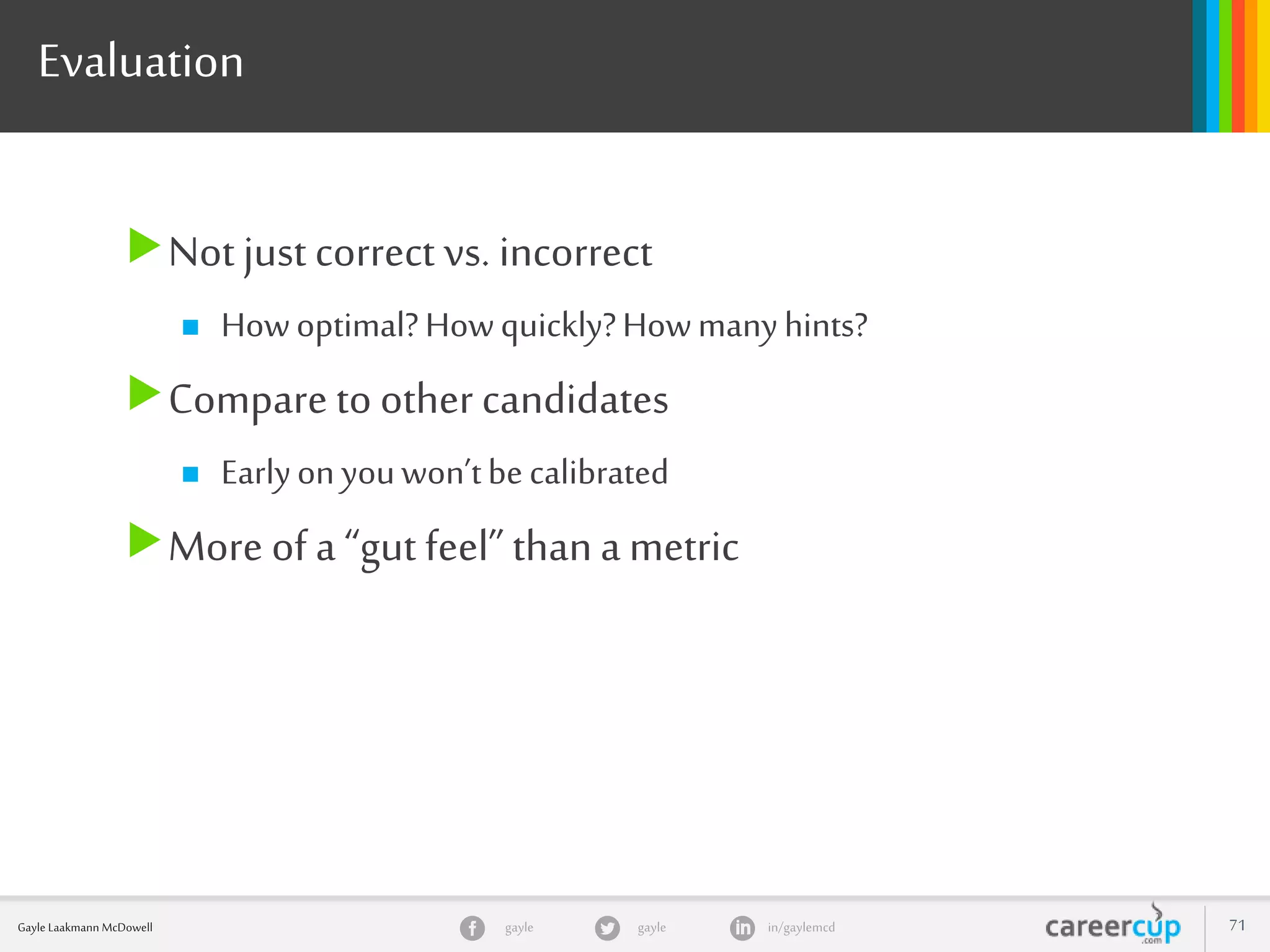
Evaluation
Not just correct vs. incorrect
ïź Howoptimal?Howquickly?Howmanyhints?
Compare to other candidates
ïź Earlyonyouwon’tbecalibrated
More of a “gut feel”thana metric
gayle in/gaylemcdgayleGayle Laakmann McDowell 72
Rand7: Given rand5(), implementrand7()
ïź Has“aha” moment
Bad Questions
gayle in/gaylemcdgayleGayle Laakmann McDowell 73
More Bad Questions
Implementa stack with a singly linked list
Reverse order of words in a sentence
Merge two sorted arrays
Find duplicates in a string
Given a book, find uniquewords & occurrences
Replace spaces with“-”
gayle in/gaylemcdgayleGayle Laakmann McDowell 74
Sub Permutations: Given two strings, s and b, find all
permutationsof s within b.
Good Question
Hardquestion
Many parts
Easyknowledge
Uncommon
gayle in/gaylemcdgayleGayle Laakmann McDowell 75
Max Alive:Given a list of people withbirth/death years,
find peak population
Good Question
Medium difficultyquestion
Several optimizations
Easy knowledge
Uncommon
gayle in/gaylemcdgayle 76
z
Gayle Laakmann McDowell
Check
Your
Interviewers
Did the candidate need to reallythink?
Is the question unusual?
Coding
Practical stuff
07
gayle in/gaylemcdgayleGayle Laakmann McDowell 78
Why?
Code quality matters
Not everyone can translatealgorithm into code
gayle in/gaylemcdgayleGayle Laakmann McDowell 79
Bad Practices & False Negatives
Requiring every detail
Tedious questions
Takingover thetesting
Lettingthe candidate code too early
gayle in/gaylemcdgayleGayle Laakmann McDowell 80
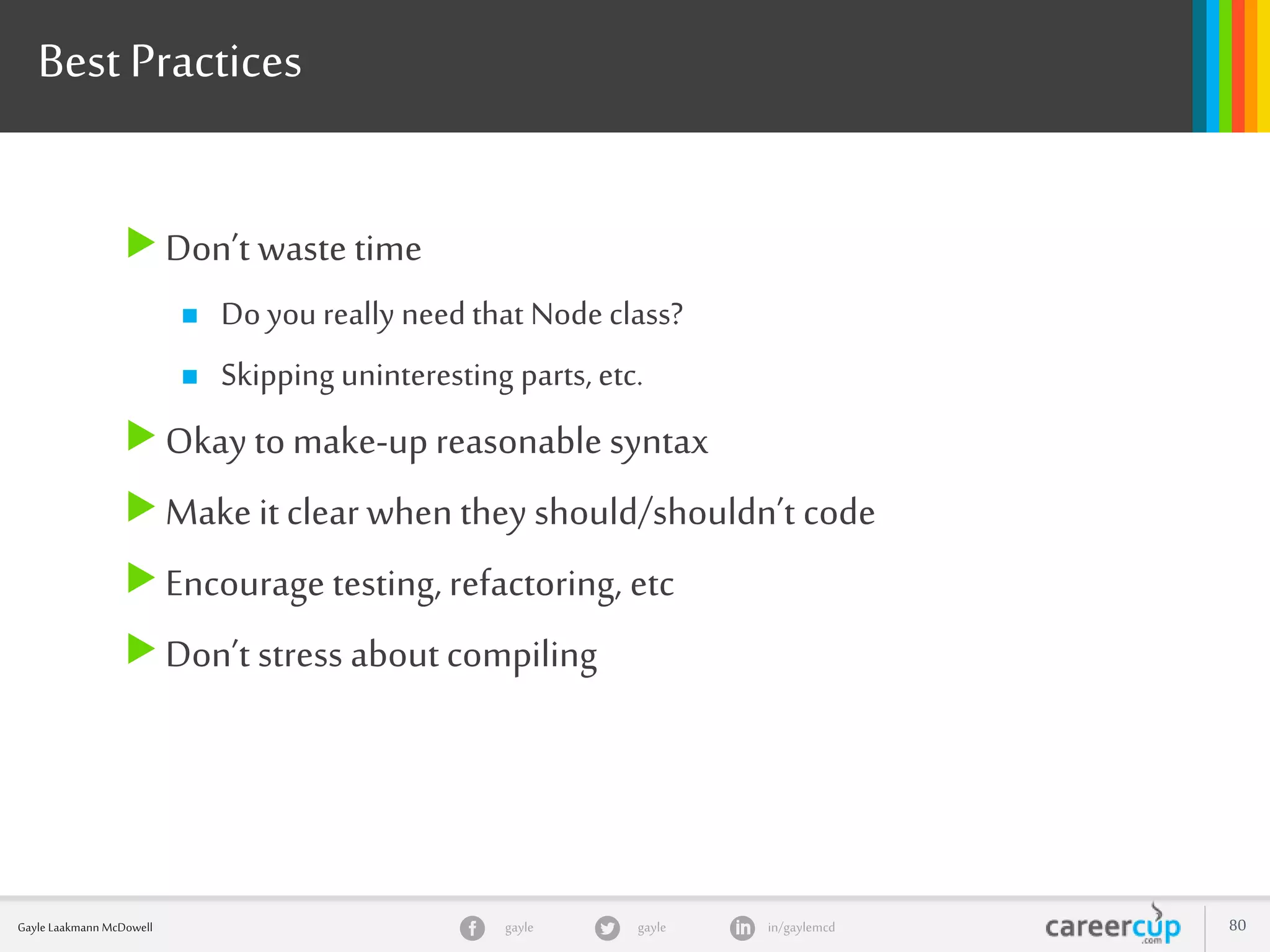
Don’t waste time
ïź Do you really need that Node class?
ïź Skipping uninteresting parts, etc.
Okay to make-up reasonable syntax
Make it clear when they should/shouldn’t code
Encourage testing, refactoring, etc
Don’t stress about compiling
Best Practices
gayle in/gaylemcdgayleGayle Laakmann McDowell 81
CompilingCode
Requires a lot of overhead
Do it onlyfor good reason
gayle in/gaylemcdgayleGayle Laakmann McDowell 82
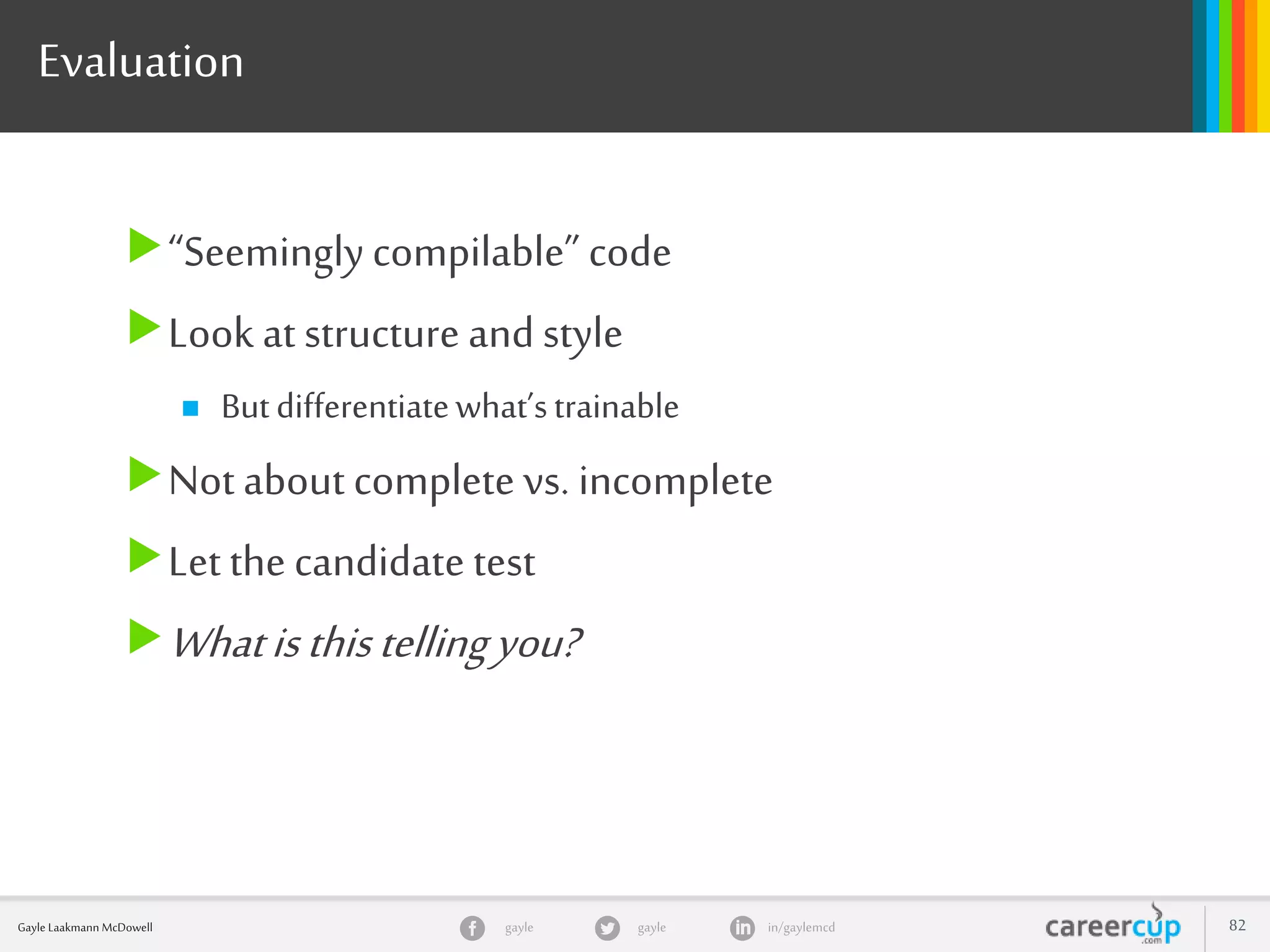
Evaluation
“Seeminglycompilable” code
Look at structure and style
ïź Butdifferentiatewhat’strainable
Not about complete vs. incomplete
Let the candidate test
Whatisthistellingyou?
gayle in/gaylemcdgayle 83
z
Gayle Laakmann McDowell
Check
Your
Interviewers
What did you learn about the
candidate’s coding?
Can the issues be fixed?
Final Thoughts
Things to remember
07
gayle in/gaylemcdgayleGayle Laakmann McDowell 85
Remember:
It’s on YOU to get theinfo you want
Challengeyour assumptions
Separate “did they do X?” from “can theydo X?”
Whatdid___tellyouaboutthecandidate?
gayle in/gaylemcdgayleGayle Laakmann McDowell 86
Check Your Interviewers
What didyou learn from thisquestion/answer?
Were they happy andsupportive?
Did they challenge the candidate?
THANK YOU
gayle@gayle.com
gayle in/gaylemcdgayle

How to Interview Like Google (But Better) - SVCC