© CareerCup.com
Books by
Gayle
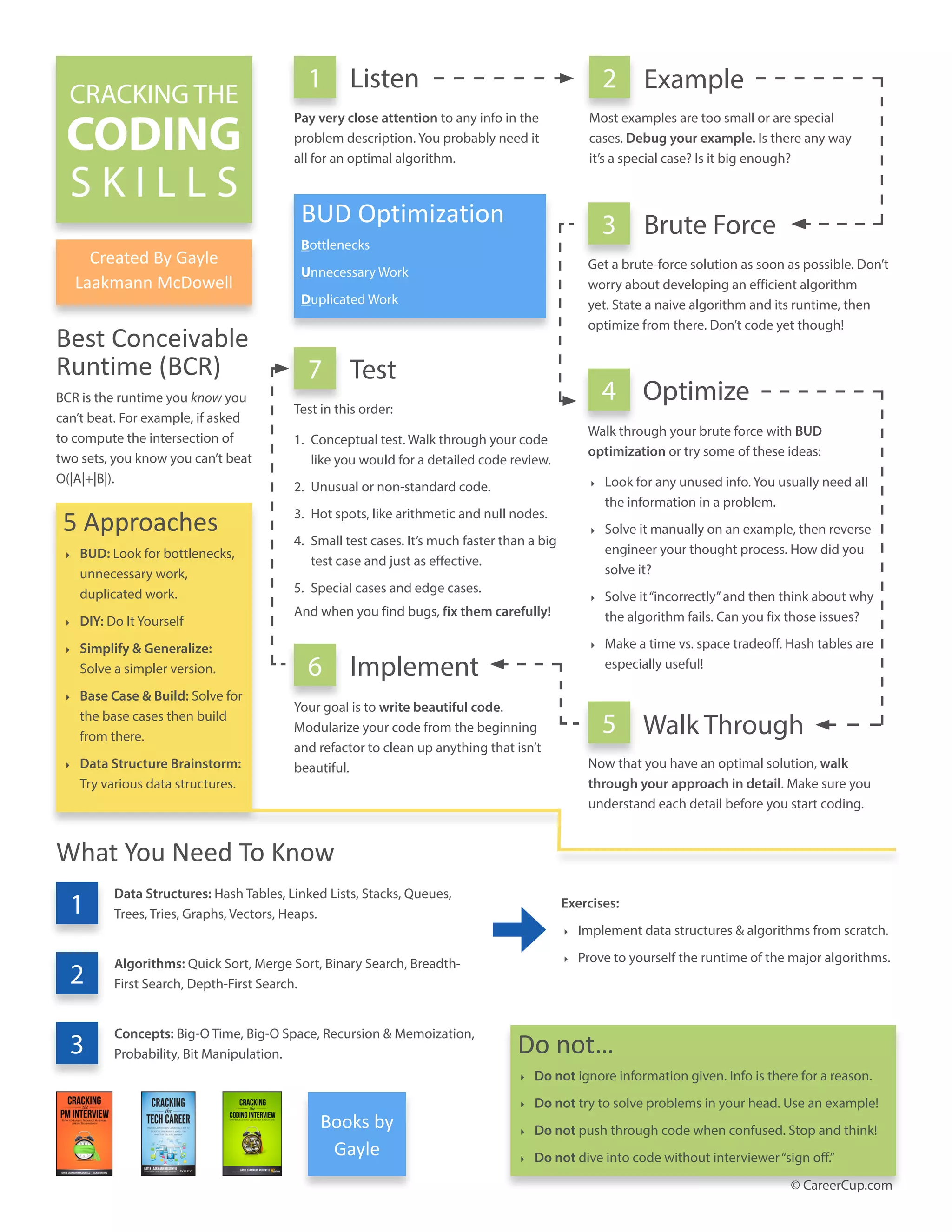
CRACKING THE
CODING
S K I L L S
1 Listen
Pay very close attention to any info in the
problem description. You probably need it
all for an optimal algorithm.
2 Example
Most examples are too small or are special
cases. Debug your example. Is there any way
it’s a special case? Is it big enough?
3 Brute Force
Get a brute-force solution as soon as possible. Don’t
worry about developing an efficient algorithm
yet. State a naive algorithm and its runtime, then
optimize from there. Don’t code yet though!
4 Optimize
Walk through your brute force with BUD
optimization or try some of these ideas:
 Look for any unused info. You usually need all
the information in a problem.
 Solve it manually on an example, then reverse
engineer your thought process. How did you
solve it?
 Solve it“incorrectly”and then think about why
the algorithm fails. Can you fix those issues?
 Make a time vs. space tradeoff. Hash tables are
especially useful!
5 Walk Through
Now that you have an optimal solution, walk
through your approach in detail. Make sure you
understand each detail before you start coding.
6 Implement
Your goal is to write beautiful code.
Modularize your code from the beginning
and refactor to clean up anything that isn’t
beautiful.
7 Test
Test in this order:
1.	 Conceptual test. Walk through your code
like you would for a detailed code review.
2.	 Unusual or non-standard code.
3.	 Hot spots, like arithmetic and null nodes.
4.	 Small test cases. It’s much faster than a big
test case and just as effective.
5.	 Special cases and edge cases.
And when you find bugs, fix them carefully!
BUD Optimization
Bottlenecks
Unnecessary Work
Duplicated Work
Created By Gayle
Laakmann McDowell
Best Conceivable
Runtime (BCR)
BCR is the runtime you know you
can’t beat. For example, if asked
to compute the intersection of
two sets, you know you can’t beat
O(|A|+|B|).
5 Approaches
 BUD: Look for bottlenecks,
unnecessary work,
duplicated work.
 DIY: Do It Yourself
 Simplify  Generalize:
Solve a simpler version.
 Base Case  Build: Solve for
the base cases then build
from there.
 Data Structure Brainstorm:
Try various data structures.
Do not…
 Do not ignore information given. Info is there for a reason.
 Do not try to solve problems in your head. Use an example!
 Do not push through code when confused. Stop and think!
 Do not dive into code without interviewer“sign off.”
What You Need To Know
1
Data Structures: Hash Tables, Linked Lists, Stacks, Queues,
Trees, Tries, Graphs, Vectors, Heaps.
2
Algorithms: Quick Sort, Merge Sort, Binary Search, Breadth-
First Search, Depth-First Search.
3
Concepts: Big-O Time, Big-O Space, Recursion  Memoization,
Probability, Bit Manipulation.
Exercises:
 Implement data structures  algorithms from scratch.
 Prove to yourself the runtime of the major algorithms.
© CareerCup.com
Books by
Gayle
Must Knows
 “So, tell me a bit about yourself…”
 “Why do you want to work here?”
 “Why should we hire you?”
 “Why are you leaving your current job?”
 “Where do you see yourself in 5 years?”
 “What do you do outside of work?”
 “What are your strengths and
weaknesses?”
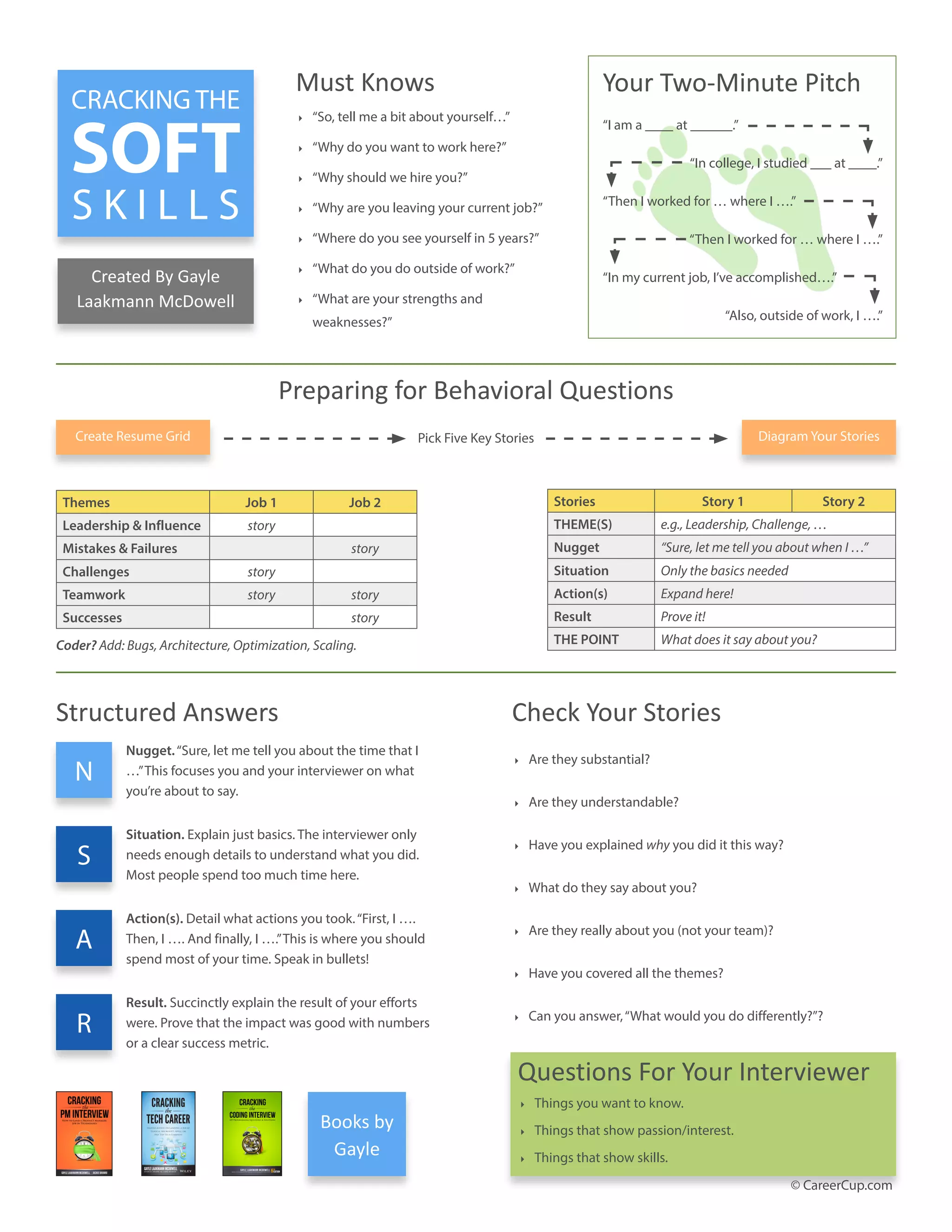
Your Two-Minute Pitch
“I am a ____ at ______.”
“In college, I studied ___ at ____.”
“Then I worked for … where I ….”
“In my current job, I’ve accomplished….”
“Also, outside of work, I ….”
Preparing for Behavioral Questions
Create Resume Grid Pick Five Key Stories
Themes Job 1 Job 2
Leadership  Influence story
Mistakes  Failures story
Challenges story
Teamwork story story
Successes story
Coder? Add: Bugs, Architecture, Optimization, Scaling.
Diagram Your Stories
Stories Story 1 Story 2
THEME(S) e.g., Leadership, Challenge, …
Nugget “Sure, let me tell you about when I …”
Situation Only the basics needed
Action(s) Expand here!
Result Prove it!
THE POINT What does it say about you?
Structured Answers
N
Nugget.“Sure, let me tell you about the time that I
…”This focuses you and your interviewer on what
you’re about to say.
S
Situation. Explain just basics. The interviewer only
needs enough details to understand what you did.
Most people spend too much time here.
A
Action(s). Detail what actions you took.“First, I ….
Then, I …. And finally, I ….”This is where you should
spend most of your time. Speak in bullets!
R
Result. Succinctly explain the result of your efforts
were. Prove that the impact was good with numbers
or a clear success metric.
Check Your Stories
 Are they substantial?
 Are they understandable?
 Have you explained why you did it this way?
 What do they say about you?
 Are they really about you (not your team)?
 Have you covered all the themes?
 Can you answer,“What would you do differently?”?
Questions For Your Interviewer
 Things you want to know.
 Things that show passion/interest.
 Things that show skills.
CRACKING THE
SOFT
S K I L L S
Created By Gayle
Laakmann McDowell
© CareerCup.com
Books by
Gayle
CRACKING THE
It’s always about …
 Structure: Demonstrate that you can break down a problem and
discuss it in an organization fashion. 
 User-Focused Thinking: Put yourself in the user’s shoes and
think about what they want.
 Problem-Solving Ability: Companies want smart people.
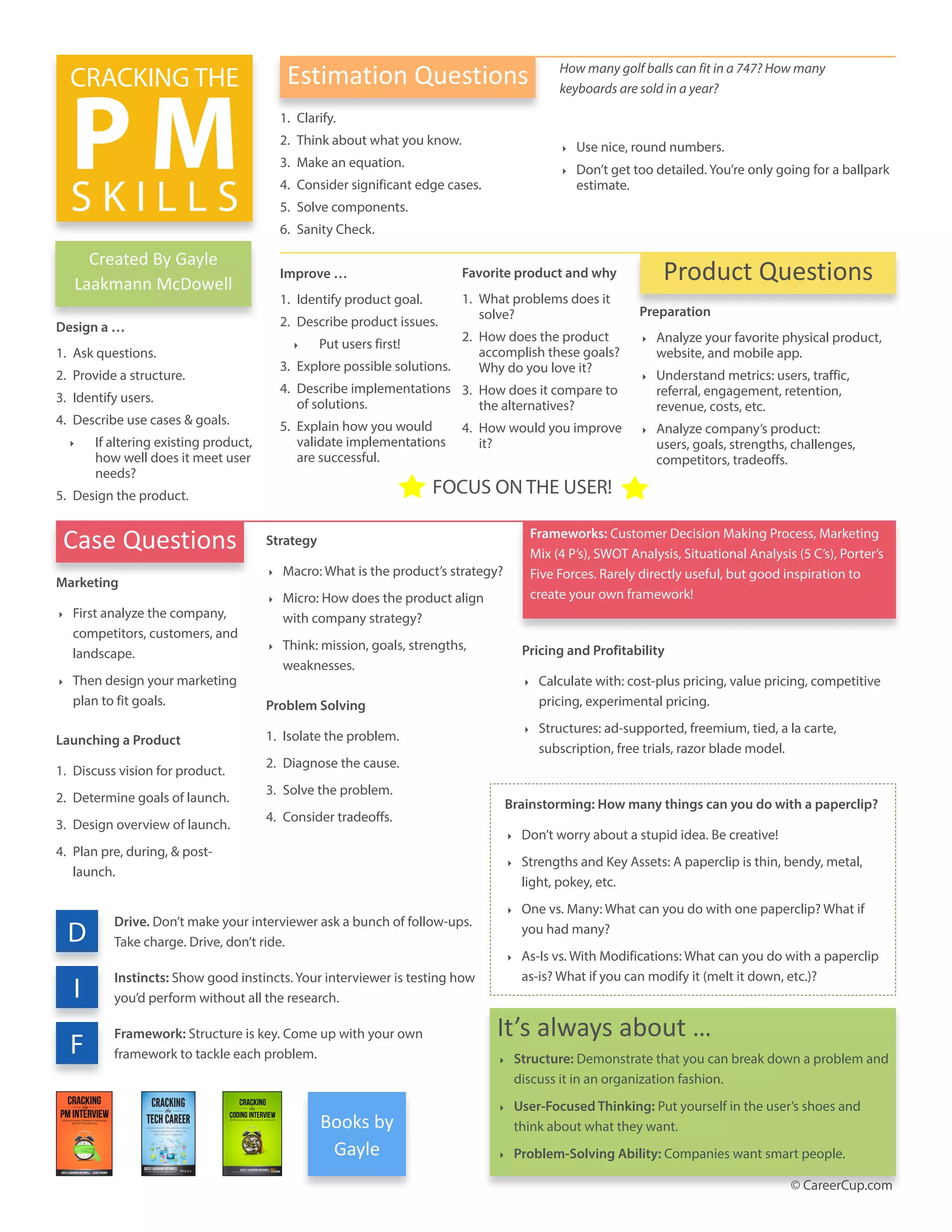
Estimation Questions
1.	 Clarify.
2.	 Think about what you know.
3.	 Make an equation.
4.	 Consider significant edge cases.
5.	 Solve components.
6.	 Sanity Check.
How many golf balls can fit in a 747? How many
keyboards are sold in a year?
 Use nice, round numbers.
 Don’t get too detailed. You’re only going for a ballpark
estimate.
Product Questions
Design a …
1.	 Ask questions.
2.	 Provide a structure.
3.	 Identify users.
4.	 Describe use cases  goals.
 If altering existing product,
how well does it meet user
needs?
5.	 Design the product.
Improve …
1.	 Identify product goal.
2.	 Describe product issues.
 Put users first!
3.	 Explore possible solutions.
4.	 Describe implementations
of solutions.
5.	 Explain how you would
validate implementations
are successful.
Favorite product and why
1.	 What problems does it
solve?
2.	 How does the product
accomplish these goals?
Why do you love it?
3.	 How does it compare to
the alternatives?
4.	 How would you improve
it?
Preparation
 Analyze your favorite physical product,
website, and mobile app.
 Understand metrics: users, traffic,
referral, engagement, retention,
revenue, costs, etc.
 Analyze company’s product:
users, goals, strengths, challenges,
competitors, tradeoffs.
FOCUS ON THE USER!
Case Questions
Marketing
 First analyze the company,
competitors, customers, and
landscape.
 Then design your marketing
plan to fit goals.
Launching a Product
1.	 Discuss vision for product.
2.	 Determine goals of launch.
3.	 Design overview of launch.
4.	 Plan pre, during,  post-
launch.
D
Drive. Don’t make your interviewer ask a bunch of follow-ups.
Take charge. Drive, don’t ride.
I
Instincts: Show good instincts. Your interviewer is testing how
you’d perform without all the research.
F
Framework: Structure is key. Come up with your own
framework to tackle each problem.
Strategy
 Macro: What is the product’s strategy?
 Micro: How does the product align
with company strategy?
 Think: mission, goals, strengths,
weaknesses.
Problem Solving
1.	 Isolate the problem.
2.	 Diagnose the cause.
3.	 Solve the problem.
4.	 Consider tradeoffs.
Pricing and Profitability
 Calculate with: cost-plus pricing, value pricing, competitive
pricing, experimental pricing.
 Structures: ad-supported, freemium, tied, a la carte,
subscription, free trials, razor blade model.
Brainstorming: How many things can you do with a paperclip?
 Don’t worry about a stupid idea. Be creative!
 Strengths and Key Assets: A paperclip is thin, bendy, metal,
light, pokey, etc.
 One vs. Many: What can you do with one paperclip? What if
you had many?
 As-Is vs. With Modifications: What can you do with a paperclip
as-is? What if you can modify it (melt it down, etc.)?
Frameworks: Customer Decision Making Process, Marketing
Mix (4 P’s), SWOT Analysis, Situational Analysis (5 C’s), Porter’s
Five Forces. Rarely directly useful, but good inspiration to
create your own framework!
CRACKING THE
P MS K I L L S
Created By Gayle
Laakmann McDowell

Cracking the Interview Skills (Coding, Soft Skills, Product Management) Handouts

  • 1.
    © CareerCup.com Books by Gayle CRACKINGTHE CODING S K I L L S 1 Listen Pay very close attention to any info in the problem description. You probably need it all for an optimal algorithm. 2 Example Most examples are too small or are special cases. Debug your example. Is there any way it’s a special case? Is it big enough? 3 Brute Force Get a brute-force solution as soon as possible. Don’t worry about developing an efficient algorithm yet. State a naive algorithm and its runtime, then optimize from there. Don’t code yet though! 4 Optimize Walk through your brute force with BUD optimization or try some of these ideas: Look for any unused info. You usually need all the information in a problem. Solve it manually on an example, then reverse engineer your thought process. How did you solve it? Solve it“incorrectly”and then think about why the algorithm fails. Can you fix those issues? Make a time vs. space tradeoff. Hash tables are especially useful! 5 Walk Through Now that you have an optimal solution, walk through your approach in detail. Make sure you understand each detail before you start coding. 6 Implement Your goal is to write beautiful code. Modularize your code from the beginning and refactor to clean up anything that isn’t beautiful. 7 Test Test in this order: 1. Conceptual test. Walk through your code like you would for a detailed code review. 2. Unusual or non-standard code. 3. Hot spots, like arithmetic and null nodes. 4. Small test cases. It’s much faster than a big test case and just as effective. 5. Special cases and edge cases. And when you find bugs, fix them carefully! BUD Optimization Bottlenecks Unnecessary Work Duplicated Work Created By Gayle Laakmann McDowell Best Conceivable Runtime (BCR) BCR is the runtime you know you can’t beat. For example, if asked to compute the intersection of two sets, you know you can’t beat O(|A|+|B|). 5 Approaches BUD: Look for bottlenecks, unnecessary work, duplicated work. DIY: Do It Yourself Simplify Generalize: Solve a simpler version. Base Case Build: Solve for the base cases then build from there. Data Structure Brainstorm: Try various data structures. Do not… Do not ignore information given. Info is there for a reason. Do not try to solve problems in your head. Use an example! Do not push through code when confused. Stop and think! Do not dive into code without interviewer“sign off.” What You Need To Know 1 Data Structures: Hash Tables, Linked Lists, Stacks, Queues, Trees, Tries, Graphs, Vectors, Heaps. 2 Algorithms: Quick Sort, Merge Sort, Binary Search, Breadth- First Search, Depth-First Search. 3 Concepts: Big-O Time, Big-O Space, Recursion Memoization, Probability, Bit Manipulation. Exercises: Implement data structures algorithms from scratch. Prove to yourself the runtime of the major algorithms.
  • 2.
    © CareerCup.com Books by Gayle MustKnows “So, tell me a bit about yourself…” “Why do you want to work here?” “Why should we hire you?” “Why are you leaving your current job?” “Where do you see yourself in 5 years?” “What do you do outside of work?” “What are your strengths and weaknesses?” Your Two-Minute Pitch “I am a ____ at ______.” “In college, I studied ___ at ____.” “Then I worked for … where I ….” “Then I worked for … where I ….” “In my current job, I’ve accomplished….” “Also, outside of work, I ….” Preparing for Behavioral Questions Create Resume Grid Pick Five Key Stories Themes Job 1 Job 2 Leadership Influence story Mistakes Failures story Challenges story Teamwork story story Successes story Coder? Add: Bugs, Architecture, Optimization, Scaling. Diagram Your Stories Stories Story 1 Story 2 THEME(S) e.g., Leadership, Challenge, … Nugget “Sure, let me tell you about when I …” Situation Only the basics needed Action(s) Expand here! Result Prove it! THE POINT What does it say about you? Structured Answers N Nugget.“Sure, let me tell you about the time that I …”This focuses you and your interviewer on what you’re about to say. S Situation. Explain just basics. The interviewer only needs enough details to understand what you did. Most people spend too much time here. A Action(s). Detail what actions you took.“First, I …. Then, I …. And finally, I ….”This is where you should spend most of your time. Speak in bullets! R Result. Succinctly explain the result of your efforts were. Prove that the impact was good with numbers or a clear success metric. Check Your Stories Are they substantial? Are they understandable? Have you explained why you did it this way? What do they say about you? Are they really about you (not your team)? Have you covered all the themes? Can you answer,“What would you do differently?”? Questions For Your Interviewer Things you want to know. Things that show passion/interest. Things that show skills. CRACKING THE SOFT S K I L L S Created By Gayle Laakmann McDowell
  • 3.
    © CareerCup.com Books by Gayle CRACKINGTHE It’s always about … Structure: Demonstrate that you can break down a problem and discuss it in an organization fashion. User-Focused Thinking: Put yourself in the user’s shoes and think about what they want. Problem-Solving Ability: Companies want smart people. Estimation Questions 1. Clarify. 2. Think about what you know. 3. Make an equation. 4. Consider significant edge cases. 5. Solve components. 6. Sanity Check. How many golf balls can fit in a 747? How many keyboards are sold in a year? Use nice, round numbers. Don’t get too detailed. You’re only going for a ballpark estimate. Product Questions Design a … 1. Ask questions. 2. Provide a structure. 3. Identify users. 4. Describe use cases goals. If altering existing product, how well does it meet user needs? 5. Design the product. Improve … 1. Identify product goal. 2. Describe product issues. Put users first! 3. Explore possible solutions. 4. Describe implementations of solutions. 5. Explain how you would validate implementations are successful. Favorite product and why 1. What problems does it solve? 2. How does the product accomplish these goals? Why do you love it? 3. How does it compare to the alternatives? 4. How would you improve it? Preparation Analyze your favorite physical product, website, and mobile app. Understand metrics: users, traffic, referral, engagement, retention, revenue, costs, etc. Analyze company’s product: users, goals, strengths, challenges, competitors, tradeoffs. FOCUS ON THE USER! Case Questions Marketing First analyze the company, competitors, customers, and landscape. Then design your marketing plan to fit goals. Launching a Product 1. Discuss vision for product. 2. Determine goals of launch. 3. Design overview of launch. 4. Plan pre, during, post- launch. D Drive. Don’t make your interviewer ask a bunch of follow-ups. Take charge. Drive, don’t ride. I Instincts: Show good instincts. Your interviewer is testing how you’d perform without all the research. F Framework: Structure is key. Come up with your own framework to tackle each problem. Strategy Macro: What is the product’s strategy? Micro: How does the product align with company strategy? Think: mission, goals, strengths, weaknesses. Problem Solving 1. Isolate the problem. 2. Diagnose the cause. 3. Solve the problem. 4. Consider tradeoffs. Pricing and Profitability Calculate with: cost-plus pricing, value pricing, competitive pricing, experimental pricing. Structures: ad-supported, freemium, tied, a la carte, subscription, free trials, razor blade model. Brainstorming: How many things can you do with a paperclip? Don’t worry about a stupid idea. Be creative! Strengths and Key Assets: A paperclip is thin, bendy, metal, light, pokey, etc. One vs. Many: What can you do with one paperclip? What if you had many? As-Is vs. With Modifications: What can you do with a paperclip as-is? What if you can modify it (melt it down, etc.)? Frameworks: Customer Decision Making Process, Marketing Mix (4 P’s), SWOT Analysis, Situational Analysis (5 C’s), Porter’s Five Forces. Rarely directly useful, but good inspiration to create your own framework! CRACKING THE P MS K I L L S Created By Gayle Laakmann McDowell