
Moving Forward:
Implementing the ‘Guidelines for
the Alternative Care of Children’


In association with


Supported by
COPYRIGHT

© Centre for Excellence for Looked After Children in Scotland
(CELCIS) at the University of Strathclyde; International
Social Service (ISS); Oak Foundation; SOS Children’s Villages
International; and United Nations Children’s Fund (UNICEF) 2012

Published by:
The Centre for Excellence for Looked After Children in Scotland
(CELCIS)
University of Strathclyde
141 St James Road
Glasgow
G4 0LT
Scotland, United Kingdom

The material in this handbook has been commissioned by ISS,
Oak Foundation, SOS Children’s Villages International and
UNICEF. The contents do not necessarily reflect the policies
or the views of these organisations.

The designations employed and the presentation of the material
in this handbook do not imply on the part of the commissioners
or authors the expression of any opinion whatsoever concerning
the legal status of any country or territory, or of its authorities
or the delimitation of its frontiers.

Any part of this handbook may be freely reproduced with the
appropriate acknowledgement.

Front cover image (centre) and all others as marked are the
copyright of Maureen Anderson and may not be reproduced
separately.

Permission to translate all or any part of this handbook should
be obtained through ISS:
International Social Service
Quai du Seujet 32
1201 Geneva
Switzerland

ISBN
978-0-947649-91-3

Authors:
Nigel Cantwell, Jennifer Davidson, Susan Elsley, Ian Milligan
and Neil Quinn

Cite as:
Cantwell, N.; Davidson, J.; Elsley, S.; Milligan, I.; Quinn, N. (2012).
Moving Forward: Implementing the ‘Guidelines for the Alternative
Care of Children’. UK: Centre for Excellence for Looked After
Children in Scotland.

www.alternativecareguidelines.org
3

FOREWORD
The situation of children deprived of parental care has been     As with all internationally agreed standards and principles,
the subject of constant and serious concern expressed by the     however, the real test lies in determining how they can be
Committee on the Rights of the Child over its two decades        made a reality throughout the world for those that they
of work to monitor and promote the implementation of the         target – in this case, children who are without, or are at risk
Convention on the Rights of the Child. This concern is not       of losing, parental care. Identifying those measures means,
only evident from the Committee’s findings when reviewing        first of all, understanding the implications of the ‘policy
individual States’ compliance with the treaty’s provisions,      orientations’ proposed in the Guidelines, and then devising
but was also manifested clearly and in global terms when         the most effective and ‘do-able’ ways of meeting their
it decided to devote its annual Day of General Discussion        requirements. Importantly, moreover, the Guidelines are
to that issue in 2005.                                           by no means addressed to States alone: they are to be taken
                                                                 into account by everyone, at every level, who is involved
The Committee’s preoccupations are based on a variety
                                                                 in some manner with issues and programmes concerning
of factors. These include:
                                                                 alternative care provision for children.
 •	 the large number of children coming into alternative
    
                                                                 This is where the Moving Forward handbook steps in.
    care in many countries, too often essentially due
                                                                 As its title suggests, it seeks precisely to assist all concerned
    to their family’s material poverty,
                                                                 to advance along the road to implementation, by explaining
 •	  he conditions under which that care is provided, and
    t                                                            the key thrusts of the Guidelines, outlining the kind of policy
                                                                 responses required, and describing ‘promising’ examples of
 •	  he low priority that may be afforded to responding
    t
                                                                 efforts already made to apply them in diverse communities,
    appropriately to these children who, lacking the
                                                                 countries, regions and cultures.
    primary protection normally assured by parents,
    are particularly vulnerable.                                 I congratulate all the organisations and individuals that
                                                                 have contributed to bringing the Moving Forward project
                                                                 to fruition. This handbook is clearly an important tool for
The reasons for which children find themselves in                informing and inspiring practitioners, organisations and
alternative care are wide-ranging, and addressing these          governments across the globe who are seeking to provide the
diverse situations – preventively or reactively – similarly      best possible rights-based solutions and care for their children.
requires a panoply of measures to be in place. While the
Convention sets out basic State obligations in that regard,
it does not provide significant guidance on meeting them.

This is why, from the very outset of the initiative in 2004,
the Committee gave whole-hearted support to the idea
of developing the Guidelines for the Alternative Care of
Children that would gain the approval of the international
community at the highest level.

The acceptance of the Guidelines by the UN General                                                       Jean Zermatten
Assembly in 2009 signalled all governments’ general                     Chairperson UN Committee on the Rights of the Child
agreement that the ‘orientations for policy and practice’ they                                           31 October 2012
set out are both well-founded and desirable. Since that time,
the Committee has been making full use of the principles and
objectives established in the Guidelines when examining the
reports of States Parties to the Convention and in formulating
its observations and recommendations to them.
4

ACKNOWLEDGEMENTS
The research, collaboration and consultation for this project     We are also very grateful to the numerous individuals
involved many partners and contributors, and the authors          who gave their time and expertise to provide feedback
would like to express their sincere gratitude to all who helped   and/or review sections of earlier drafts: Benyam Dawit
to bring this work to fruition.                                   Mezmur (University of Western Cape and University of
                                                                  Addis Ababa); Brussels Mughogho (Family for Every Child
Firstly, our thanks go to the members of the Working Group
                                                                  Malawi); Bill Bell (Save the Children, UK); Delia Pop (Hope
on Children without Parental Care of the NGO Group for
                                                                  and Homes for Children); Diane Swales (UNICEF, East Asia
the Convention on the Rights of the Child, who ambitiously
                                                                  and Pacific); Ghazal Keshavarzian (Maestral International);
initiated this project.
                                                                  Jean-Claude Legrand (UNICEF); Jenny Degeling (Attorney
The project’s Steering Group members then led the                 General’s Department, Australia); John Pilkington (Queen’s
vision for this project, and provided guidance throughout         University of Belfast); John Williamson (Displaced Children
the process. They helped to identify important policy             and Orphans Fund (DCOF) or USAID); June Thoburn
orientations, ‘promising practice’ examples and other             (University of East Anglia); Keith White (Mill Grove, UK);
key resources; they facilitated contact between the               Maria Herczog (Eszterházy Károly College and Family
project team and a wide range of experts, international           Child Youth Association); Mike Stein (University of York)
professional networks, and key regional contacts; and             and Rebecca Smith (Save the Children).
they oversaw the field testing process.
                                                                  Special thanks are due to Oliver Robertson of the Quaker
We therefore express special appreciation to Mia                  United Nations Office in Geneva for his invaluable inputs on
Dambach (ISS), Alan Kikuchi-White (SOS Children’s Villages        ‘the care of children whose primary caregiver is in custody’.
International), Amanda Cox (Family for Every Child),
                                                                  We also extend warm thanks to the many other
Emily Delap (Family for Every Child), Janet Nelson (ATD
                                                                  individuals and organisations that supported the project
Fouth World), Kathleen Riordan (Better Care Network),
                                                                  by recommending resources, contacts, policy and practice
Mara Tissera Luna (RELAF), Matilde Luna (RELAF), Megumi
                                                                  examples, as well as to those who participated in the
Furubayashi (ATD Fourth World), Peter Gross (UNICEF)
                                                                  field test consultations. In particular: Aaron Greenberg
and Séverine Chevrel (Better Care Network).
                                                                  (UNICEF); Alison Lane (JUCONI); Andro Dadiani (Georgian
The main funders of the project enabled this vision to become     Foster Care Organisation); Andy Elvin (Children and Families
reality, and we gratefully acknowledge the financial support      Across Borders, International Social Service UK); Anna
granted by International Social Service (ISS), Oak Foundation,    Nordenmark Severinsson (UNICEF); Barsukova Tatiana
SOS Children’s Villages International and UNICEF.                 Mitrophanovna (State Governmental Institution Social
                                                                  Rehabilitation Center Otradnoye, Russia); Bep Van Sloten
Additional funds from the NGO Group for the Convention            (Better Care Network, Netherlands); Chabad Lubavitch
on the Rights of the Child, Save the Children and The U.S.        (IELADEINU, Argentina); Christina Baglietto (UNICEF);
President’s Emergency Plan for AIDS Relief through USAID          Christine Gale (UNICEF); Claudia Cabral (Terra dos Homens
has allowed this project to be widely disseminated and we         and RELAF, Brazil); Daniel Miranda (Institute of Childhood
appreciate their support.                                         and Adolescence of Uruguay (INAU); Daniela Koleva
5

(National Network for Children, Bulgaria); Denny               Argentina Field Test Participants
Ford (Who Cares? Scotland); Eduardo Garcia-Rolland             Alejandra Rodriguez (Enfoque Niñez, Paraguay);
(International Rescue Committee); Elize Coetzee (Give          Alejandro Astorga (Opción Chile); Alejandro Molina
A Child A Family); Emmanuel Sherwin (SOS Children’s            (Judge, Argentina); Andrea Ventura (Lawer, Argentina);
Villages International); Evren Guncel Ermisket (Ministry of    Camilo Guaqueta (SOS Children’s Villages, Colombia);
Family and Social Policies of Turkey); Flora Vivanco Giesen    Carmen Rodriguez (UNICEF, Uruguay); Cecilia Ceriani
(National Childhood and Youth Service, Government of           (RELAF, Argentina); Cruz Encina de Riera (Corazones
Chile); James Kofi Annan (Challenging Heights, Ghana); Jini    por la Infancia, Paraguay); Daniela Vetere (Ministry of
Roby (Brigham Young University); Jo Rogers (Partnership        Human Rights of Argentina); Débora Miculitzki (Leladeinu
for Every Child, Russia); Kelley Bunkers (Independent          Program, Argentina, and RELAF); Federico Kapustianski
Consultant); Kristīne Venta-Kittele (Ministry of Welfare       (RELAF, Argentina); Gimol Pinto (UNICEF, Argentina);
of the Republic of Latvia); Larisa Buchelnikova (Partnership   Henry Chiroque (Save the Children Argentina); Hernán
Family to Children, Yekaterinburg, Russia); Laura Martínez     Lago (Governmental body, Argentina); Irina Villalba
de la Mora (RELAF and Patronato Pro-Hogar del Niño             (Governmental body, Paraguay); Jorge Ferrando (Institute
Irapuato, México); Leonel Asdrubal Dubón Bendfeldt             of Childhood and Adolescence of Uruguay (INAU); Karina
(Refugio de la Niñez, Guatemala); Lisa Lovatt-Smith            Pincever (RELAF, Argentina); Leticia Virosta (RELAF,
(Orphan Aid Africa); Maki Noda (UNICEF); Marketa               Argentina); Lidia Batista (Provincial Diputie, Argentina);
Hrodkova (Ministry of Labour and Social Affairs of the         Liliana Gaitán (Governmental body, Argentina); Lucas Aon
Czech Republic); Marova Alexandra (The Charitable              (Judge, Argentina); Luciana Rampi (RELAF, Argentina);
Foundation of Social Orphanhood Prevention, Russia);           M. Elena Naddeo (Legislator, Argentina); Marcelo Acsebrud
Marta Iglesias Benet (ATD Fourth World); Martha                (IELADEINU, Argentina); Marina Rojas (Governmental
Eugenia Segura (KidSave, Colombia); Matthew Dalling            body, Argentina); Marina Sawatzky (Governmental body,
(UNICEF); Feride Dashi (UNICEF); Maxine King (Child            Paraguay); Marta Pesenti (Ministry of Human Rights,
Welfare Organizing Project, USA); Meseret Tadesse              Argentina); Miguel Sorbello (RELAF, Argentina); Mora
(Forum on Sustainable Child Empowerment); Milena               Podestá (UNICEF, Uruguay); Néstor Alvarez (Governmental
Harizanova (UNICEF); Mir Anwar Shahzad (Society for            body, Argentina); Norberto Liwski (DNI Latin America,
Sustainable Development, Pakistan); Mooly Wong (The            Argentina); Pablo Almeida (INAU, Uruguay); Pablo González
Chinese University of Hong Kong); Moushira Khattab             (Governmental body, Argentina); Romina Pzellinski (UNICEF,
(Woodrow Wilson International Center for Scholars); Munir      Argentina); Sara González (RELAF Argentina); Verónica de
Mammadzade (UNICEF); Naira Avetisyan (UNICEF); Néstor          los Santos (Uruguayan network for foster care); Virginia
Álvarez (Governmental technical team, Argentina); Rachel       Emilse Soto (Sierra Dorada, Argentina) and Viviana
Szabo (Myers-JDC-Brookdale Institute); Rawan W. Ibrahim        González (Governmental body, Argentina).
(Columbia University Middle East Research Center); Rusudan
Chkheidze (SOS Children’s Villages International); Sarah
Mbira (Pendekezu Letu Kenya); Sylvia Lupan (UNICEF);
Omattie Madray (ChildLink Inc); Tata Sudrajat (Save the
Children Indonesia) and Todijin Jalolov (Childs Rights
Centre, Tajikistan).
6

Malawi Field Test Participants                                   We are very grateful to photographer Maureen Anderson
Andrew Mganga (Plan Malawi); Anord Satumba (Mzimba               and friends at Vatsalya, India for use of their inspiring
Social Welfare); Brenda Phiri (World Vision International);      images. Much appreciation also goes to the team at
Cecilia Maganga (World Vision International); Derek              Transform Brands who worked patiently and tirelessly with
Luhanga (EveryChild Malawi); Enock Bonongwe (Ministry            us to create an attractive and reader-friendly publication
of Gender, Children and Social Welfare); Frank Damalekani        out of a daunting mass of text.
(Dowa District Social Welfare); Grace Siwombo (EveryChild
                                                                 Finally, the translators for this project, and those who step
Malawi); Harry Satumba (Ministry of Gender, Children
                                                                 in to disseminate the handbook’s messages in the coming
and Social Welfare); Hope Msosa (SOS Children’s Villages
                                                                 months and years, will be instrumental in ensuring it can
Malawi); Hycinth Kulemeka (Ministry of Gender, Children and
                                                                 reach a wide audience and we recognise in advance the
Social Welfare); Isaac Phiri (Chancellor College, University
                                                                 significant value of these efforts.
of Malawi); Jacqueline Kabambe (UNICEF); Mirriam Kaluwa
(UNICEF); James Gondwe (EveryChild Malawi); John                 We hope that the product of this joint exercise will make
Washali (District Social Welfare Office, Dowa District); Josen   everyone mentioned – as well as those whose names
Shella-Chanyama (Community Based Organizatin, Mzimba             we may have inadvertently omitted – feel that their
District); Justin Hamela (Ministry of Gender, Children and       considerable efforts were worthwhile.
Social Welfare); Keston Ndlovu (EveryChild Malawi); Laurent
Kansinjiro (Ministry of Gender, Children and Social Welfare);
                                                                  THE AUTHORS
MacPherson Mdalla (Save the Children); Mathuzella
                                                                  Nigel Cantwell, International Consultant on Child
Zyoya (Ministry of Gender, Children and Social Welfare);
                                                                  Protection Policies (Lead Consultant for the Moving
Mike Maulidi (District Social Welfare Officer, Chiradzulu);
                                                                  Forward Project)
Nicodemus Mphande (EveryChild Malawi); Nyuma Mkhalipi-
Chanyama (Community Based Organization, Mzimba                    Jennifer Davidson, Director, CELCIS, University of
District); Pilirani Banda (Child Protection Worker, Dowa          Strathclyde (Director of the Moving Forward Project)
District); Richard Chilinda (EveryChild Malawi); Rodney           Susan Elsley, Independent Consultant in Children’s
Chiwengo (St. Johns Ambulance); Thomas Moyo (EveryChild           Rights, Policy and Research
Malawi) and Tissie Msonkho (EveryChild Malawi).
                                                                  Ian Milligan, International Lead, CELCIS, University
The support of the CELCIS team has been second to                 of Strathclyde
none and we are deeply appreciative of our colleagues’
                                                                  Neil Quinn, Senior Lecturer and International Co-ordinator,
contributions to this project. In particular, Heather Lawrence
                                                                  School of Applied Social Sciences, University of Strathclyde
has expertly coordinated this project with an outstanding
combination of professionalism, commitment and good
humour that was invaluable in ensuring completion within
the timescale required. The literature research undertaken
by Zoe Tennant provided a solid foundation for our
work. Our thanks also go to Graham Connelly, John Paul
Fitzpatrick, Katie Hunter, Lillemor McDerment, Lorraine
McGuinness, Louise Hill and Vicki Welch for their helpful
reflections, translation and proofreading.
7

SYMBOLS  ACRONYMS
§ – refers to a paragraph within a document

AIDS – Acquired Immunodeficiency Syndrome

ATD (Fourth World) – ‘Aide à Toute Détresse’

BCN – Better Care Network

Beijing Rules – Standard Minimum Rules for the Administration of Juvenile Justice

BID – Best Interests Determination

CAT – Convention against Torture

CEDAW – Convention on the Elimination of Discrimination against Women

CELCIS – Centre for Excellence for Looked After Children in Scotland

CESCR – Covenant on Economics, Social and Cultural Rights

CoE – Council of Europe

CRC – Convention on the Rights of the Child

CRC Committee – Committee on the Rights of the Child

CRPD – Convention on the Rights of People with Disabilities

HIV – Human Immunodeficiency Virus

HRC – Human Rights Council

ISS – International Social Service

NGO – Non-Governmental Organisation

OHCHR – Office of the High Commissioner for Human Rights

OVC – Orphans and Vulnerable Children

Paris Principles – Principles relating to the status of national human rights institutions

RELAF – Latin American Foster Care Network

The Guidelines – Guidelines for the Alternative Care of Children

The handbook – Moving Forward: Implementing the ‘Guidelines for the Alternative Care of Children’

UN – United Nations

UNGA – United Nations General Assembly

UNHCR – United Nations High Commissioner for Refugees

UNICEF – United Nations Children’s Fund
8

CHAPTERS
CHAPTER 1:
THE MOVING FORWARD PROJECT:
PUTTING THE GUIDELINES INTO PRACTICE	                    13

CHAPTER 2:
DEVELOPMENT AND KEY FOUNDATIONS OF THE GUIDELINES	       18

CHAPTER 3:
SCOPE AND TERMINOLOGY OF THE GUIDELINES’	                30

CHAPTER 4:
GENERAL PRINCIPLES AND PERSPECTIVES OF THE GUIDELINES	   35

CHAPTER 5:
THE ‘NECESSITY PRINCIPLE’:
PREVENTING THE NEED FOR ALTERNATIVE CARE	                49

CHAPTER 6:
THE ‘SUITABILITY PRINCIPLE’:
DETERMINATION OF THE MOST APPROPRIATE FORM OF CARE	      66

CHAPTER 7:
DEVELOPING POLICIES FOR ALTERNATIVE CARE	                75

CHAPTER 8:
CARE SETTINGS	                                           86

CHAPTER 9:
SUPPORT FOR AFTERCARE	                                   97

CHAPTER 10:
FINANCING, AUTHORISING AND ENSURING QUALITY CARE	        103

CHAPTER 11:
CARE PROVISION ABROAD AND IN EMERGENCY SITUATIONS	       113

CHAPTER 12:
CLOSING THE GAP BETWEEN INTENTION AND REALITY	           120

FURTHER RESOURCES	                                       128
9

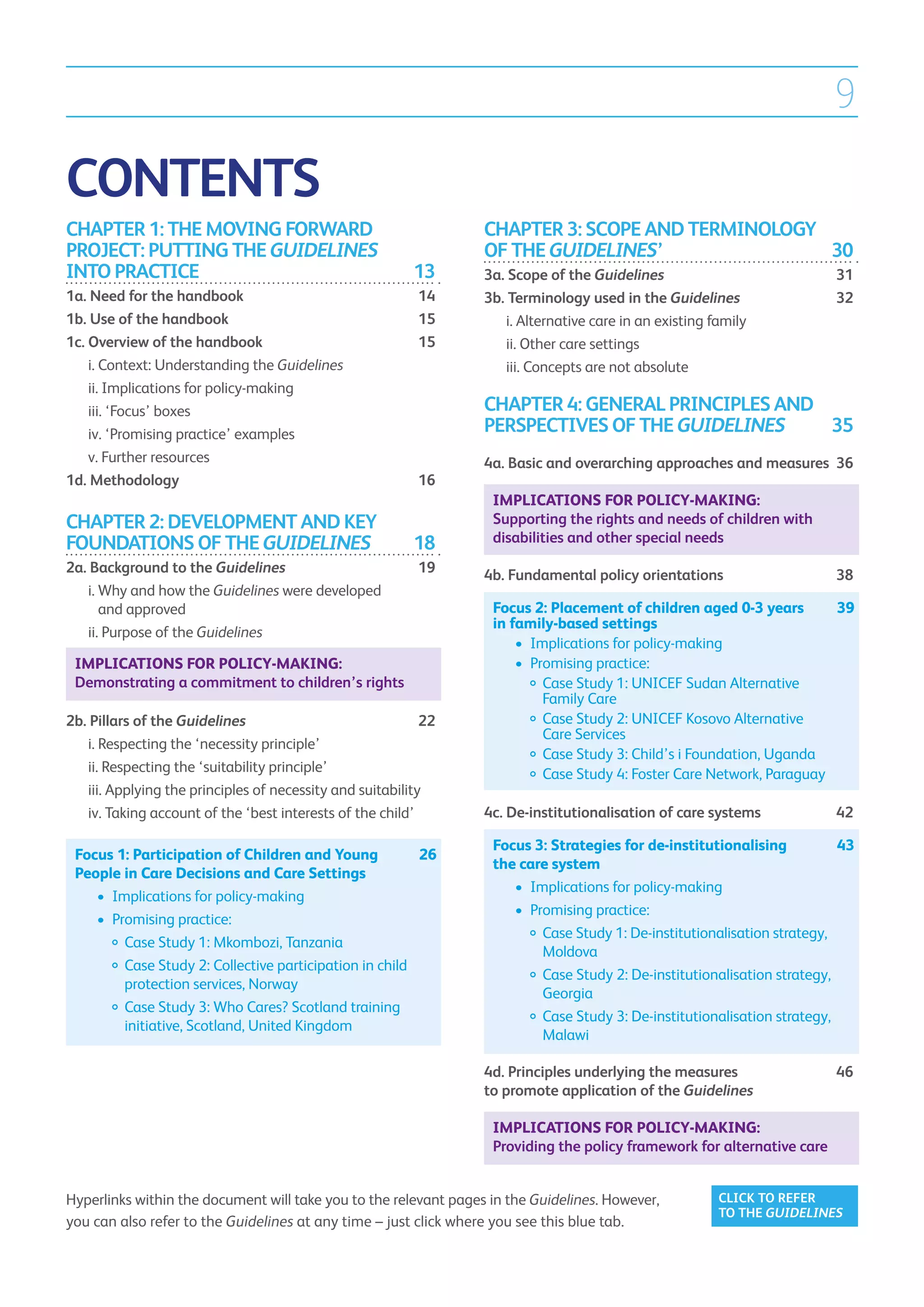
CONTENTS
CHAPTER 1: THE MOVING FORWARD                                     CHAPTER 3: SCOPE AND TERMINOLOGY
PROJECT: PUTTING THE GUIDELINES                                   OF THE GUIDELINES’	30
INTO PRACTICE	                                          13        3a. Scope of the Guidelines	31
1a.  eed for the handbook	
     N                                                   14       3b. Terminology used in the Guidelines	32
1b.  se of the handbook	
     U                                                   15       	 i.  lternative care in an existing family	
                                                                       A
1c.  verview of the handbook	
    O                                                    15       	 ii.  ther care settings	
                                                                        O
	 Context: Understanding the Guidelines	
    i.                                                            	 iii.  oncepts are not absolute
                                                                         C
	 Implications for policy-making	
    ii.
	 ‘Focus’ boxes	
    iii.                                                          CHAPTER 4: GENERAL PRINCIPLES AND
	 ‘Promising practice’ examples	
    iv.                                                           PERSPECTIVES OF THE GUIDELINES	35
	 Further resources	
    v.                                                            4a.  asic and overarching approaches and measures	 36
                                                                      B
1d. Methodology	                                        16
                                                                   Implications for policy-making:
CHAPTER 2: DEVELOPMENT AND KEY                                     Supporting the rights and needs of children with
FOUNDATIONS OF THE GUIDELINES	18                                   disabilities and other special needs
2a.  ackground to the Guidelines	19
    B                                                             4b.  undamental policy orientations	
                                                                      F                                                  38
	 i.  hy and how the Guidelines were developed
      W
      and approved	                                                Focus 2: Placement of children aged 0-3 years 	 39
                                                                   in family-based settings	
	 ii.  urpose of the Guidelines	
      P
                                                                   	 •	  mplications for policy-making
                                                                        I
 Implications for policy-making:                                   	 •	  romising practice:
                                                                        P
 Demonstrating a commitment to children’s rights                           
                                                                   		 Case Study 1: UNICEF Sudan Alternative
                                                                           Family Care
2b.  illars of the Guidelines	22
    P                                                                      
                                                                   		 Case Study 2: UNICEF Kosovo Alternative
                                                                           Care Services
	 i.  especting the ‘necessity principle’	
      R
                                                                   		 Case Study 3: Child’s i Foundation, Uganda
	 ii.  especting the ‘suitability principle’	
       R                                                           		 Case Study 4: Foster Care Network, Paraguay
	 iii. Applying the principles of necessity and suitability	
        
	 iv.  aking account of the ‘best interests of the child’	
        T                                                         4c. De-institutionalisation of care systems	           42

                                                                   Focus 3: Strategies for de-institutionalising 	    43
 Focus 1: Participation of Children and Young	       26	
                                                                   the care system
 People in Care Decisions and Care Settings	
                                                                   	 •	 Implications for policy-making
 	 •	  mplications for policy-making
      I
                                                                   	 •	 Promising practice:
 	 •	  romising practice:
      P
                                                                          
                                                                   		 Case Study 1: De-institutionalisation strategy,
 		 Case Study 1: Mkombozi, Tanzania
                                                                          Moldova
 		  ase Study 2: Collective participation in child
         C                                                                
                                                                   		 Case Study 2: De-institutionalisation strategy,
         protection services, Norway
                                                                          Georgia
 		  ase Study 3: Who Cares? Scotland training
         C                                                                
                                                                   		 Case Study 3: De-institutionalisation strategy,
         initiative, Scotland, United Kingdom
                                                                          Malawi

                                                                  4d. Principles underlying the measures 	               46
                                                                  to promote application of the Guidelines	

                                                                   Implications for policy-making:
                                                                   Providing the policy framework for alternative care


Hyperlinks within the document will take you to the relevant pages in the Guidelines. However,        CLICK TO REFER
                                                                                                      TO THE GUIDELINES
you can also refer to the Guidelines at any time – just click where you see this blue tab.
10

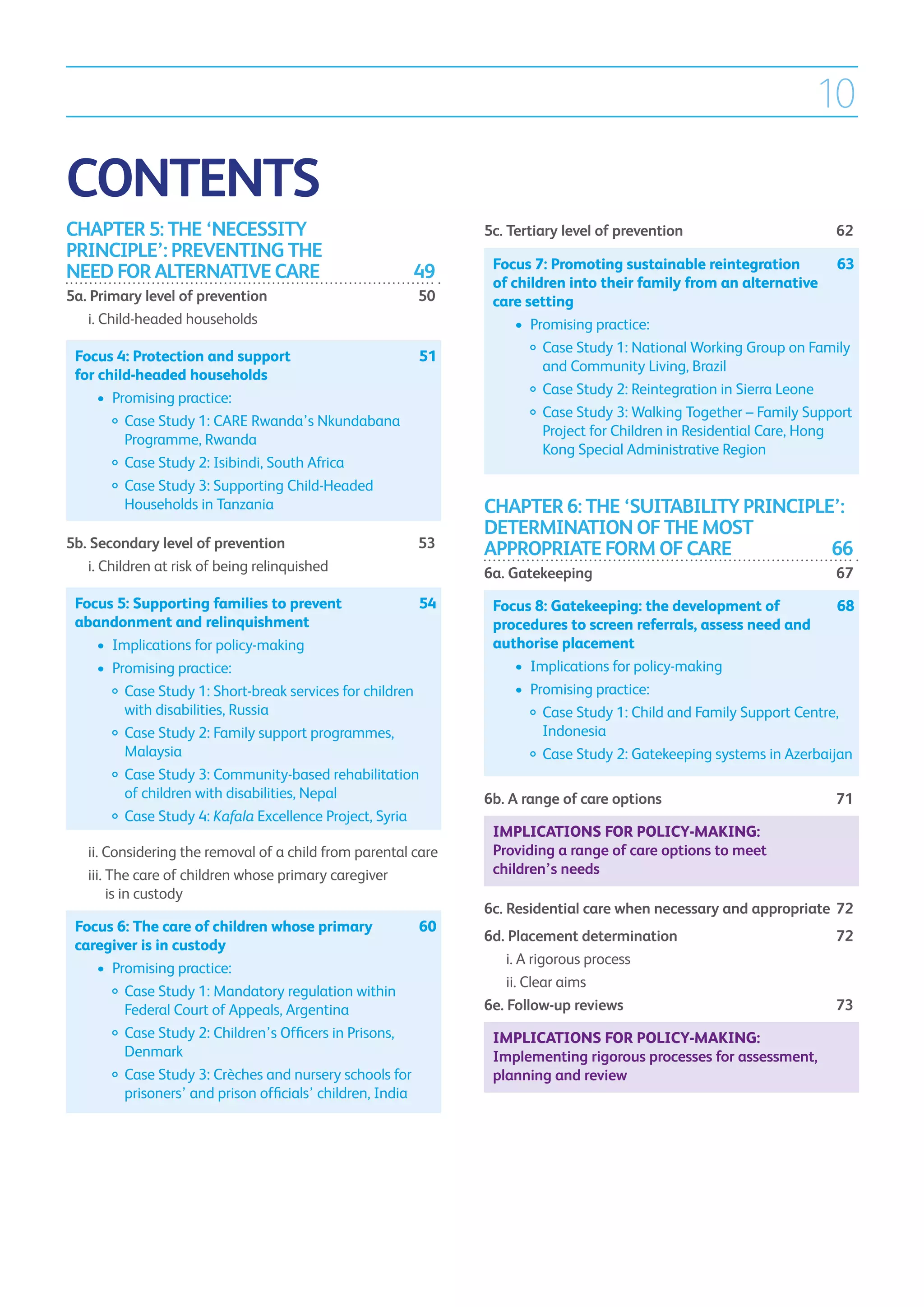
CONTENTS
CHAPTER 5: THE ‘NECESSITY                                          5c. Tertiary level of prevention	                      62
PRINCIPLE’: PREVENTING THE
                                                                    Focus 7: Promoting sustainable reintegration 	         63
NEED FOR ALTERNATIVE CARE	                                 49       of children into their family from an alternative
5a. Primary level of prevention	                            50      care setting
	 i.  hild-headed households
     C                                                              	 •	  romising practice:
                                                                          P
                                                                    		  ase Study 1: National Working Group on Family
                                                                            C
    Focus 4: Protection and support 	                       51
                                                                            and Community Living, Brazil
    for child-headed households
                                                                    		  ase Study 2: Reintegration in Sierra Leone
                                                                            C
    	 •	 Promising practice:
                                                                    		  ase Study 3: Walking Together – Family Support
                                                                            C
    		  ase Study 1: CARE Rwanda’s Nkundabana
            C
                                                                            Project for Children in Residential Care, Hong
            Programme, Rwanda
                                                                            Kong Special Administrative Region
    		  ase Study 2: Isibindi, South Africa
            C
    		  ase Study 3: Supporting Child-Headed
            C
            Households in Tanzania                                 CHAPTER 6: THE ‘SUITABILITY PRINCIPLE’:
                                                                   DETERMINATION OF THE MOST
5b. Secondary level of prevention	                          53     APPROPRIATE FORM OF CARE	            66
	 i.  hildren at risk of being relinquished	
     C                                                             6a. Gatekeeping	                                       67
    Focus 5: Supporting families to prevent 	           54          Focus 8: Gatekeeping: the development of 	       68
    abandonment and relinquishment                                  procedures to screen referrals, assess need and
    	 •	  mplications for policy-making
         I                                                          authorise placement
    	 •	  romising practice:
         P                                                          	 •	  mplications for policy-making
                                                                         I
    		  ase Study 1: Short-break services for children
            C                                                       	 •	  romising practice:
                                                                         P
            with disabilities, Russia                               		  ase Study 1: Child and Family Support Centre,
                                                                            C
    		  ase Study 2: Family support programmes,
            C                                                               Indonesia
            Malaysia                                                		  ase Study 2: Gatekeeping systems in Azerbaijan
                                                                            C
    		    Case Study 3: Community-based rehabilitation
            of children with disabilities, Nepal                   6b. A range of care options	                           71
    		  ase Study 4: Kafala Excellence Project, Syria
            C
                                                                    Implications for policy-making:
	     ii.  onsidering the removal of a child from parental care
          C                                                         Providing a range of care options to meet
	     iii. The care of children whose primary caregiver
                                                                   children’s needs
           is in custody
                                                                   6c. Residential care when necessary and appropriate	 72
    Focus 6: The care of children whose primary 	            60
                                                                   6d. Placement determination	                           72
    caregiver is in custody
                                                                   	 i.  rigorous process	
                                                                        A
    	 •	  romising practice:
         P
                                                                   	 ii.  lear aims	
                                                                         C
    		  ase Study 1: Mandatory regulation within
            C
            Federal Court of Appeals, Argentina                    6e. Follow-up reviews	                                 73
    		  ase Study 2: Children’s Officers in Prisons,
            C                                                       Implications for policy-making:
            Denmark                                                 Implementing rigorous processes for assessment,
    		    Case Study 3: Crèches and nursery schools for           planning and review
            prisoners’ and prison officials’ children, India
11

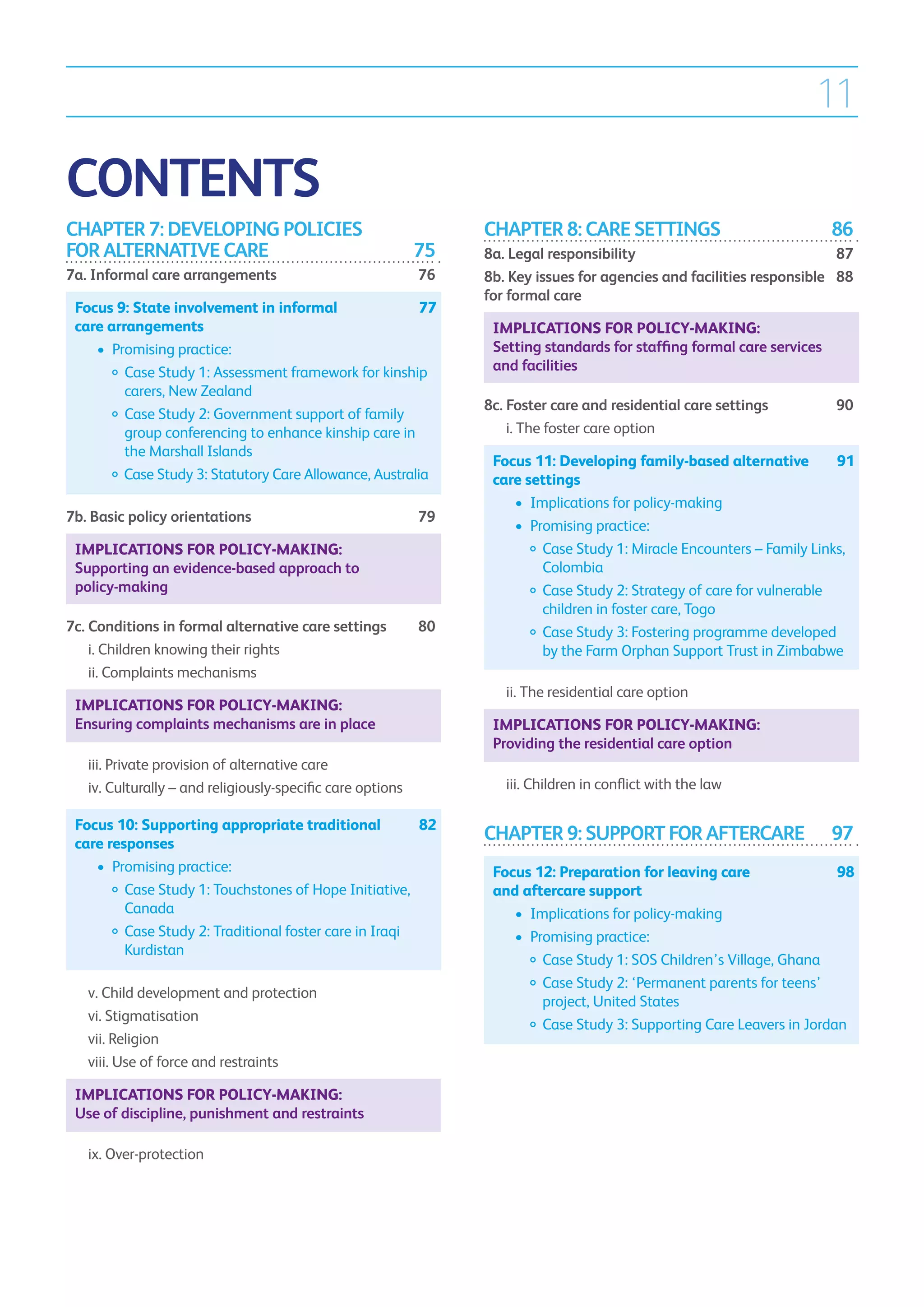
CONTENTS
CHAPTER 7: DEVELOPING POLICIES                                       CHAPTER 8: CARE SETTINGS	                                 86
FOR ALTERNATIVE CARE	                                           75   8a. Legal responsibility	                                87
7a. Informal care arrangements	                                 76   8b. Key issues for agencies and facilities responsible 	 88
                                                                     for formal care	
    Focus 9: State involvement in informal 	              77
    care arrangements                                                    Implications for policy-making:
    	 •	 Promising practice:                                             Setting standards for staffing formal care services
    		  ase Study 1: Assessment framework for kinship
            C                                                            and facilities
            carers, New Zealand
                                                                     8c. Foster care and residential care settings	            90
    		  ase Study 2: Government support of family
            C
            group conferencing to enhance kinship care in            	 i.  he foster care option	
                                                                          T
            the Marshall Islands
                                                                         Focus 11: Developing family-based alternative 	 91
    		  ase Study 3: Statutory Care Allowance, Australia
           C                                                             care settings
                                                                         	 •	 Implications for policy-making
7b. Basic policy orientations	                                  79
                                                                         	 •	 Promising practice:
    Implications for policy-making:                                      		  ase Study 1: Miracle Encounters – Family Links,
                                                                                C
    Supporting an evidence-based approach to                                    Colombia
    policy-making                                                        		  ase Study 2: Strategy of care for vulnerable
                                                                                C
                                                                                children in foster care, Togo
7c. Conditions in formal alternative care settings	             80       		  ase Study 3: Fostering programme developed
                                                                                C
	 i.  hildren knowing their rights	
     C                                                                          by the Farm Orphan Support Trust in Zimbabwe
	 ii.  omplaints mechanisms	
      C
                                                                     	     ii.  he residential care option	
                                                                               T
    Implications for policy-making:
    Ensuring complaints mechanisms are in place                          Implications for policy-making:
                                                                         Providing the residential care option
	     iii. Private provision of alternative care	
           
	     iv. Culturally – and religiously-specific care options	
                                                                    	     iii.  hildren in conflict with the law	
                                                                                C

    Focus 10: Supporting appropriate traditional 	     82
    care responses
                                                                     CHAPTER 9: SUPPORT FOR AFTERCARE	                         97
    	 •	 Promising practice:                                             Focus 12: Preparation for leaving care 	          98
    		  ase Study 1: Touchstones of Hope Initiative,
            C                                                            and aftercare support
            Canada                                                       	 •	 Implications for policy-making
    		  ase Study 2: Traditional foster care in Iraqi
            C                                                            	 •	 Promising practice:
            Kurdistan
                                                                         		  ase Study 1: SOS Children’s Village, Ghana
                                                                                C
                                                                         		  ase Study 2: ‘Permanent parents for teens’
                                                                                C
	     v.  hild development and protection	
         C
                                                                                project, United States
	     vi. Stigmatisation	
                                                                         		  ase Study 3: Supporting Care Leavers in Jordan
                                                                                C
	     vii. Religion	
	     viii.  se of force and restraints	
            U

    Implications for policy-making:
    Use of discipline, punishment and restraints

	     ix. Over-protection
12

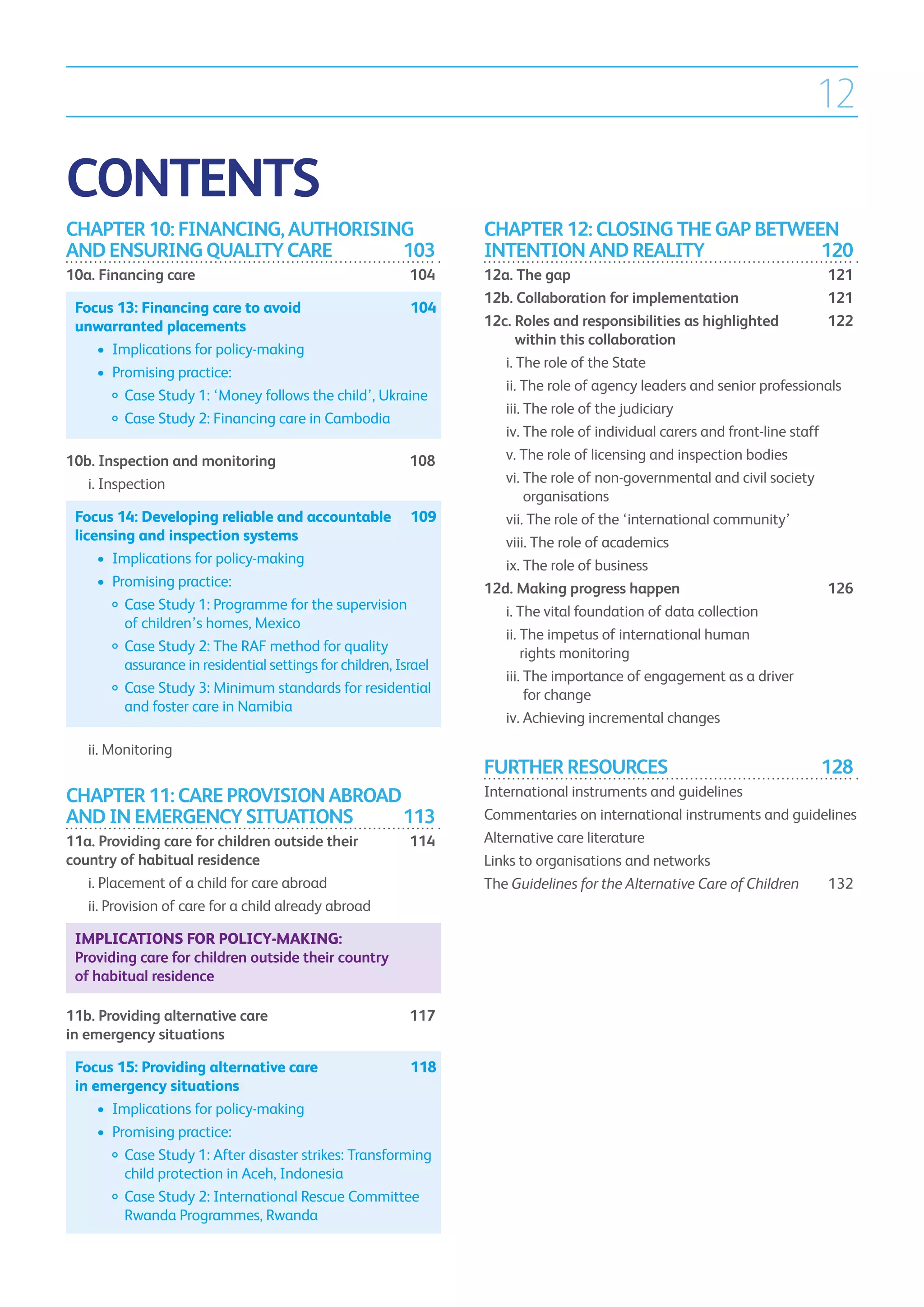
CONTENTS
CHAPTER 10: FINANCING, AUTHORISING                                   CHAPTER 12: CLOSING THE GAP BETWEEN
AND ENSURING QUALITY CARE	       103                                 INTENTION AND REALITY	            120
10a. Financing care	                                         104     12a. The gap	                                              121
                                                                     12b. Collaboration for implementation	                     121
    Focus 13: Financing care to avoid 	               104
    unwarranted placements                                           12c.  oles and responsibilities as highlighted 	
                                                                          R                                                     122
                                                                          within this collaboration	
    	 •	 Implications for policy-making
                                                                     	 i.  he role of the State	
                                                                          T
    	 •	 Promising practice:
                                                                     	 ii.  he role of agency leaders and senior professionals	
                                                                           T
    		  ase Study 1: ‘Money follows the child’, Ukraine
           C
                                                                     	 iii.  he role of the judiciary	
                                                                            T
    		   Case Study 2: Financing care in Cambodia
                                                                     	 iv.  he role of individual carers and front-line staff	
                                                                            T
10b. Inspection and monitoring	                              108     	 v.  he role of licensing and inspection bodies	
                                                                           T
	 i. Inspection	                                                    	 vi.  he role of non-governmental and civil society
                                                                            T
                                                                            organisations	
    Focus 14: Developing reliable and accountable 	 109              	 vii.  he role of the ‘international community’	
                                                                             T
    licensing and inspection systems                                 	 viii.  he role of academics	
                                                                              T
    	 •	 Implications for policy-making                              	 ix.  he role of business	
                                                                            T
    	 •	 Promising practice:                                         12d. Making progress happen	                               126
    		  ase Study 1: Programme for the supervision
            C                                                        	 i.  he vital foundation of data collection	
                                                                          T
            of children’s homes, Mexico
                                                                     	 ii.  he impetus of international human
                                                                           T
    		  ase Study 2: The RAF method for quality
            C                                                              rights monitoring	
            assurance in residential settings for children, Israel
                                                                     	 iii.  he importance of engagement as a driver
                                                                            T
    		  ase Study 3: Minimum standards for residential
            C                                                               for change	
            and foster care in Namibia
                                                                     	 iv.  chieving incremental changes	
                                                                            A

	     ii. Monitoring	
                                                                     FURTHER RESOURCES	                                      128
CHAPTER 11: CARE PROVISION ABROAD                                    International instruments and guidelines
AND IN EMERGENCY SITUATIONS	      113                                Commentaries on international instruments and guidelines
11a. Providing care for children outside their 	             114     Alternative care literature
country of habitual residence	                                       Links to organisations and networks
	 i.  lacement of a child for care abroad	
     P                                                               The Guidelines for the Alternative Care of Children	 132
	 ii.  rovision of care for a child already abroad	
      P

    Implications for policy-making:
    Providing care for children outside their country
    of habitual residence

11b. Providing alternative care 	                            117
in emergency situations	

    Focus 15: Providing alternative care 	             118
    in emergency situations
    	 •	  mplications for policy-making
         I
    	 •	  romising practice:
         P
    		  ase Study 1: After disaster strikes: Transforming
            C
            child protection in Aceh, Indonesia
    		  ase Study 2: International Rescue Committee
            C
            Rwanda Programmes, Rwanda
Chapter 1
                                                      THE MOVING FORWARD PROJECT:
                                               PUTTING THE GUIDELINES INTO PRACTICE   13

THE MOVING FORWARD
PROJECT: PUTTING THE
GUIDELINES INTO PRACTICE


In this chapter you will find:
1a.  eed for the handbook	
    N

1b.  se of the handbook	
    U

1c. Overview of the handbook	
    
	 		 Context: Understanding the Guidelines	
  i.
	 	Implications for policy-making	
  ii.
	 ‘Focus’ boxes	
  iii.
	 ‘Promising practice’ examples	
  iv.
	 	Further resources	
  v.

1d. Methodology	


                                                                        CLICK TO REFER
                                                                        TO THE GUIDELINES
Chapter 1
                                                                               THE MOVING FORWARD PROJECT:
                                                                        PUTTING THE GUIDELINES INTO PRACTICE              14


The last decade has seen big steps taken toward the goal         1a. Need for the handbook
of placing children’s rights at the heart of alternative care.   It is not always easy to interpret the intended meaning
                                                                 of international instruments, and understand the thinking
From the initial concept, to the development and approval
                                                                 behind their provisions, on the basis of the texts alone.
of the Guidelines for the Alternative Care of Children (the
                                                                 Consequently, the real implications of putting them
Guidelines) by the United Nations General Assembly in its
                                                                 into effect are often difficult to determine. That is why
resolution A/RES/64/142, we now have a more coherent
                                                                 additional documents are prepared to clarify the origins,
policy framework. Today, the Guidelines shape how policy-
                                                                 development and intended purpose of each instrument.
makers, decision-makers and professionals approach both the
prevention and the provision of alternative care for children.   These documents can take different forms. For binding
                                                                 international treaties, such as the Convention on the Rights
This handbook, Moving Forward, has been created
                                                                 of the Child (CRC), the background to the drafting is often
to take us even further along the road to embedding
                                                                 recorded in ‘travaux préparatoires’ (records of the debates).
children’s rights in alternative care provision. It aims
                                                                 In some instances, such as the 1993 Hague Convention
to support implementation of the Guidelines by making
                                                                 on Intercountry Adoption, an Explanatory Report is drawn
strong connections between national policy, direct
                                                                 up after the event. Whatever their form, such documents
practice and the Guidelines themselves.
                                                                 help those responsible for implementing and monitoring
Moving Forward reflects the core message in the Guidelines       the treaties to understand why certain provisions were included
– that children must never be placed in alternative care         (or, in some cases, excluded), why they are phrased in particular
unnecessarily, and where out-of-home care must be                way, and what basic intentions lie behind their inclusion. They
provided it should be appropriate to each child’s specific       contribute to interpreting obligations under the treaties and
needs, circumstances and best interests.                         can, therefore, usefully guide their practical enforcement.

This chapter explains why and how this handbook
was developed and outlines its contents.


                                                                                                          CLICK TO REFER
                                                                                                          TO THE GUIDELINES
Chapter 1
                                                                                THE MOVING FORWARD PROJECT:
                                                                         PUTTING THE GUIDELINES INTO PRACTICE              15

In the case of non-binding instruments such as declarations,       of provisions that follow, as far as possible, the structure
rules and guidelines, an Explanatory Report may also be            of the Guidelines, and are considered from the standpoints
prepared – examples include a number of Council of Europe          of Context, Implications and Examples.
texts, such as the Recommendation on the Rights of
Children in Residential Institutions and the Guidelines            i. Context: Understanding the Guidelines
for Child-Friendly Justice. In rare instances (the UN’s            In the sections entitled ‘Understanding the Guidelines’,
1985 Standard Minimum Rules for the Administration                 our aim is to highlight the main innovative points and
of Juvenile Justice (Beijing Rules) being a good example)          indicate the thinking behind the inclusion or wording
an explanatory commentary is incorporated in the official          of certain provisions. Given the length and detail of the
text after each provision.                                         Guidelines, it would be impossible for this handbook to
                                                                   summarise or comment on every aspect of the text. It
None of these potential sources of guidance and inspiration
                                                                   follows that the handbook cannot replace the Guidelines,
existed for the Guidelines for the Alternative Care of Children.
                                                                   and should therefore be consulted in conjunction with them.
This handbook, therefore, sets out the reasoning behind the
main orientations of the Guidelines and indicates legislative,
                                                                   ii. Implications for policy-making
policy and programming initiatives that should enable the
                                                                   We recognise that each State develops policy according
provisions to be put into practice effectively.
                                                                   to its own social, political, cultural and economic context.
                                                                   Nevertheless, the Implications for Policy-Making sections
1b. Use of the handbook                                            of the handbook are important in highlighting areas
The handbook is designed as a resource tool for legislators,
                                                                   where national governments should provide leadership
policy-makers and decision-makers in the field of child
                                                                   and oversight for a range of policy activities (legislation,
protection and alternative care for children. Like the
                                                                   policy frameworks, guidance and programmes). Policy
Guidelines themselves, however, it should also be of interest
                                                                   implications are offered in eleven stand-alone sections
to all professionals and care providers. In other words, it is
                                                                   entitled ‘Implications for Policy-Making’, where they
intended for the broadest range of entities and individuals,
                                                                   correspond to the Guidelines provisions being considered.
in the governmental, private and civil society sectors.
                                                                   ‘Implications for Policy-Making’ sections are also located
It can be used in a variety of ways:                               within groupings of relevant ‘Focus boxes’ and ‘promising
                                                                   practice’ examples. These eleven sections outline policy-
 •	 To enhance understanding of the various provisions in
                                                                  making implications relating to:
    the Guidelines: why they were included and what their
    ramifications might be for policy and practice                  •	  emonstrating a commitment to children’s rights
                                                                       D

 •	  s an advocacy tool
    A                                                               •	  upporting the rights and needs of children with
                                                                       S
                                                                       disabilities and other special needs
 •	  s a basis and/or instigator of debates, with a view
    A
    to adjusting alternative care systems                           •	  roviding the policy framework for alternative care
                                                                       P

 •	  s a reference base or benchmark for assessing and
    A                                                               •	  roviding a range of care options to meet children’s
                                                                       P
    monitoring current alternative care systems, and for               needs
    reporting to national and international bodies                  •	  mplementing rigorous processes for assessment,
                                                                       I
                                                                       planning and review
                                                                    •	  upporting an evidence-based approach
                                                                       S
1c. Overview of the handbook                                           to policy-making
The handbook provides key information on the approach
                                                                    •	  nsuring complaints mechanisms are in place
                                                                       E
taken and the main issues raised by the Guidelines. It links
to policy and ‘promising practice’ examples, and provides           •	  se of discipline, punishment and restraints
                                                                       U
signposts to useful additional resources. To this end, the
                                                                    •	  etting standards for staffing formal care services
                                                                       S
main body of the handbook is organised around ‘clusters’
                                                                       and facilities


                                                                                                           CLICK TO REFER
                                                                                                           TO THE GUIDELINES
Chapter 1
                                                                              THE MOVING FORWARD PROJECT:
                                                                       PUTTING THE GUIDELINES INTO PRACTICE              16

 •	 Providing residential care option                            examples have been submitted by experts and NGOs
                                                                 or identified by our own research. They are deliberately
 •	  roviding care for children outside their country
    P
                                                                 called examples of ‘promising’ rather than ‘best’ practices,
    of habitual residence
                                                                 and their inclusion does not represent an endorsement
                                                                 from the handbook authors as to their on-going quality.
iii. ‘Focus’ boxes                                               Nevertheless, we believe that there is sufficient evidence for
Within each cluster of provisions, certain topics are examined   them to be described as the kind of ‘promising’ development
in more depth, and are analysed in ‘Focus’ boxes. The            that the Guidelines are intended to encourage. Importantly,
topics were selected not because they are necessarily more       they link the Guidelines and the handbook to work that
important than other issues, but because it was felt that they   is already happening ‘on the ground’. Where possible,
needed more explanation and illustrative examples of how         we provide a publicly available account of the project and,
they can be put into practice. Fifteen topics are examined:      in some cases, we are able to provide a link to an evaluation.
1.	Participation of children and young people in care
    decisions and care settings
                                                                 v. Further resources
                                                                 An appendix is provided that includes further resources
2.	Placement of children aged 0-3 in family-based settings      and the full text of the Guidelines. The Further Resources
                                                                 section includes: International instruments and guidelines,
3.	Strategies for de-institutionalising the care system
                                                                 Commentaries on international instruments and guidelines,
4.	Protection and support for child-headed households           a selection of key Literature on alternative care and websites
                                                                 of major Children’s rights organisations and networks.
5.	Supporting families to prevent abandonment
    and relinquishment                                           Key resources used in developing the handbook are listed
                                                                 here, along with all the instruments and guidelines referred
6.	The care of children whose primary caregiver is in custody   to in the text – many with web-links provided. All the resources
                                                                 listed are provided in their English-language version and,
7.	Promoting sustainable reintegration of children
                                                                 in the case of United Nations instruments, the web-links give
    into their family from an alternative care setting
                                                                 access to other UN language versions. The Alternative Care
8.	Gatekeeping: The development of procedures to screen         section of resources is an indicative, but in no way exhaustive,
    referrals, assess need and authorise placement               list of references that signposts readers to valuable sources
                                                                 of information for further learning. Only documents that have
9.	State involvement in informal care arrangements              relevance across a variety of contexts or regions of the world
10.	 upporting appropriate traditional care responses
    S                                                            have been included.

11.	 eveloping family-based alternative care settings
    D                                                            1d. Methodology
                                                                 Policy implications, ‘promising practices’ and resources
12.	 reparation for leaving care and aftercare support
    P
                                                                 were identified during an extensive consultation process.
13.	 inancing care to avoid unwarranted placements
    F                                                            The handbook steering group contacted a wide range
                                                                 of experts and, using existing international professional
14.	 eveloping reliable and accountable licensing
    D                                                            networks, identified key contacts in regions. The handbook
    and inspection systems                                       was field tested in Argentina (through RELAF) and Malawi
15.	 Providing alternative care in emergency situations          (through BCN-Malawi), and went through a robust grey
                                                                 and academic literature review.
iv. ‘Promising practice’ examples                                Researchers from the handbook team have drawn
For each topic, an explanation of the issues at stake is         from a range of resources including reports and studies
followed by at least two ‘promising practice’ examples           on alternative care in a global context, international
drawn from countries in all regions of the world. These          documents, and responses to the consultation process.


                                                                                                         CLICK TO REFER
                                                                                                         TO THE GUIDELINES
Chapter 1
                                                                             THE MOVING FORWARD PROJECT:
                                                                      PUTTING THE GUIDELINES INTO PRACTICE             17

A particular search strategy was used for selecting the
‘promising practice’ examples. They were retrieved using
various combinations of search terms based on the selected
topics, well-specified geographical gaps, and terms relating
to inspiring practice. The search used various general terms
relating to each of the topics (e.g. ‘aftercare’, ‘informal
care’, ‘kinship care’, etc). Articles were retrieved based
on database findings, and specific journals suggested
by the steering group were then targeted. After academic
databases were reviewed, a hand-search was conducted
of report documents suggested by consultation respondents,
steering group members and the project team. The steering
group was also asked to circulate requests for practice
examples to its members, which helped to identify further
examples. Finally, the project team reviewed all the examples   Overall, there is a very good regional spread of practice
against the topic descriptor and agreed on which to include.    examples. While it was not possible to provide a regional
                                                                spread for every topic, selecting no more than one example
The range of practice studies aims to reflect the richness
                                                                per country was balanced with other considerations. There
and diversity of ‘promising practice’ internationally,
                                                                was a desire to have strong evidence for every example
therefore no more than one practice example per country
                                                                of ‘promising practice’ and to represent the work of diverse
was included in the handbook for all but one of the topics
                                                                sectors (e.g. governmental, NGOs, civil society) as well
in the text. Due to the limited number of countries that have
                                                                as a wide range of different agencies. Ensuring this was
needed to develop emergency responses, and the resulting
                                                                the case limited opportunities to achieve better regional
limited examples of accessible good practice within this
                                                                balance for some topics.
context, countries were referred to again in the chapter
on ‘Providing alternative care in emergency situations’.


                                                                                                       CLICK TO REFER
                                                                                                       TO THE GUIDELINES
Chapter 2
                                                                  DEVELOPMENT AND KEY FOUNDATIONS
                                                                                 OF THE GUIDELINES    18

DEVELOPMENT AND
KEY FOUNDATIONS
OF THE GUIDELINES


In this chapter you will find:
2a.  ackground to the Guidelines
    B
	 i.  hy and how the Guidelines were developed and approved
     W
	 ii.  urpose of the Guidelines
      P

    Implications for policy-making:
    Demonstrating a commitment to children’s rights

2b.  illars of the Guidelines	
    P
	   i.  especting the ‘necessity principle’
       R
	   ii.  especting the ‘suitability principle’
        R
	   iii.  pplying the principles of necessity and suitability	
         A
	   iv.  aking account of the ‘best interests of the child’
         T

    Focus 1: Participation of Children and Young People in Care Decisions and Care Settings	
    	•	 mplications for policy-making
       I
    	•	 romising practice:
       P
    		 Case Study 1: Mkombozi, Tanzania
    		  ase Study 2: Collective participation in child protection services, Norway
          C
    		  ase Study 3: Who Cares? Scotland training initiative, Scotland, United Kingdom
          C


                                                                                         CLICK TO REFER
                                                                                         TO THE GUIDELINES
Chapter 2                                                                                                                 19


2a. Background to the Guidelines                                 CRC Article 20
i. Why and how the Guidelines                                    1. A child temporarily or permanently deprived of his or
                                                                    
were developed and approved                                         her family environment, or in whose own best interests
The Convention on the Rights of the Child (CRC) seeks               cannot be allowed to remain in that environment,
to protect children who are unable to live with their parents       shall be entitled to special protection and assistance
or remain in a stable family setting (notably, though not           provided by the State.
only, in Article 20). However, the CRC does not describe         2. States Parties shall in accordance with their national
                                                                    
in any depth what measures should be taken. The same                laws ensure alternative care for such a child.
applies to many other topics covered by the CRC. As a            3. Such care could include, inter alia, foster
                                                                    
result, more detailed, internationally recognised guidance          placement, kafala of Islamic law, adoption or if
is necessary. For example, the CRC is already supplemented          necessary placement in suitable institutions for the
by a substantial set of standards relating to juvenile              care of children. When considering solutions, due regard
justice, a major treaty devoted to intercountry adoption,           shall be paid to the desirability of continuity in a child’s
and a guide to best interests determination for refugee             upbringing and to the child’s ethnic, religious, cultural
and unaccompanied children.                                         and linguistic background.

                                                                The desirability of having specific ‘Guidelines on the Use
                                                                and Conditions of Alternative Care for Children’ was first
                                                                broached by the Child Protection Section at UNICEF
                                                                Headquarters. In 2004, they commissioned International
                                                                Social Service (ISS) to draw up a series of working papers
                                                                on children who lack adequate family care. ISS were also
                                                                tasked with developing a ‘call for action’ on the subject.
                                                                This ‘call’ was submitted for consideration to a number


                                                                                                          CLICK TO REFER
                                                                                                          TO THE GUIDELINES
Chapter 2                                                                                                                20

of bodies, including the Committee on the Rights of the          In response, Brazil officially circulated a draft of the
Child (CRC Committee).                                           Guidelines through the Office of the High Commissioner
                                                                 for Human Rights (OHCHR) and called for formal comments
The CRC Committee agreed with the need for the
                                                                 by the end of January 2009. Brazil then organised a series
Guidelines and transmitted its ‘decision’ to the (then)
                                                                 of open inter-governmental consultations from March to
Commission on Human Rights in late 2004. The CRC
                                                                 June 2009 in Geneva, where all comments were reviewed
Committee went on to devote its Day of General Discussion
                                                                 in a transparent participatory forum. A revised draft was
in September 2005 to the question of children without
                                                                 prepared as a result.
parental care.
                                                                 On 17 June 2009, the 11th session of the HRC adopted
One of the main recommendations to emerge from
                                                                 by consensus a procedural resolution (A/HRC/RES/11/7)
that discussion was for the international community to
                                                                 and submitted the new draft of the ‘Guidelines for the
formulate draft guidelines to improve the implementation
                                                                 Alternative Care of Children’ to the United Nations General
of the CRC for children deprived of their family. UNICEF
                                                                 Assembly (UNGA) in New York for consideration and
and international NGOs joined forces in a working group
                                                                 possible adoption on 20 November, the 20th anniversary
of the NGO Group for the CRC, as well as with a number
                                                                 of the CRC.
of individual experts and young people with experience
of alternative care to complete the text by early 2006.          At its meeting on 20 November 2009, the Third Committee
                                                                 of the UNGA indeed recommended approval. Then, on 18
In August 2006, the Brazilian authorities hosted an inter-
                                                                 December 2009, through its Resolution A/RES/64/142, the
governmental meeting of experts to review that draft
                                                                 UNGA itself duly ‘welcomed’ the Guidelines by consensus
Guidelines text. Some 40 governments attended, along
                                                                 – signalling that no country in the world had objections to
with UNICEF, concerned international NGOs and three
                                                                 their content.
members of the CRC Committee. A revised draft that took
into account views and suggestions aired at the meeting
                                                                 ii. Purpose of the Guidelines
was then circulated for comment in the first half of 2007.
                                                                 The Guidelines are a non-binding international instrument.
A ‘group of friends’ of the Guidelines also emerged from         So, while their general merit for informing the approach
that 2006 meeting. Coordinated by Brazil, it initially           to alternative care for children is clearly recognised, they
comprised government representatives from Argentina,             comprise no obligations on the part of States or any other
Chile, Egypt, Georgia, Ghana, India, Mexico, Morocco,            concerned parties. As a result, provisions of the Guidelines
Philippines, Portugal, Sudan, Sweden, Ukraine and Uruguay,       are formulated using the term ‘should’ rather than ‘shall’
and several others – including Austria, Finland, Italy,          or ‘must’, except when existing fully-fledged rights (notably
Netherlands and Switzerland – became associated with             those in the CRC) are being referred to.
its work. The group continued to have an important role
                                                                 The Guidelines, being grounded in the CRC (see Guidelines
during subsequent negotiations on the text. Delegates from
                                                                 § 1), are designed to ‘assist and encourage’ governments
many other countries worldwide were also deeply involved
                                                                 to optimise the implementation of the treaty (§ 2.c), and
and played a very significant and constructive part in the
                                                                 to ‘guide policies, decisions and activities’ at all levels and
drafting process.
                                                                 in both the public and private sectors’ (§ 2.d). This statement
The first expression of support for the Guidelines from the      of purpose also reflects the considerable emphasis that the
UN Human Rights Council (HRC) was contained in a wide            drafters placed not only on the need for the Guidelines to
ranging resolution on the rights of the child adopted in         be viewed as ‘desirable orientations for policy and practice’
March 2008 (A/HRC/RES/7/29, § 20), which ‘encourage[d]           (§ 2) rather than required standards, but also on the fact
the advancement’ of the draft. Progress was reported to          that they are addressed to ‘all sectors directly or indirectly
the HRC’s 9th session six months later, when a specific          concerned’, and by no means just to governments.
resolution (A/HRC/RES/9/13) invited States ‘to dedicate all
                                                                 While they are not binding, the Guidelines can have
their efforts, in a transparent process, with a view to taking
                                                                 a potentially very significant impact on practice in this
possible action’ on the draft at its next session.

                                                                                                         CLICK TO REFER
                                                                                                         TO THE GUIDELINES
Chapter 2                                                                                                                21

sphere. Their status as a UN-approved set of principles         It is also important to acknowledge, however, that (as is
is important in itself and enables them to serve, among         the case for virtually all similar international instruments)
other things, as a basic reference for the CRC Committee        the ‘orientations’ of the Guidelines do not take account
in its Concluding Observations on States’ compliance with       of the availability of resources in any given country for full
relevant provisions of the treaty. They can also similarly be   implementation. While the Guidelines encourage the allocation
taken into account by the bodies monitoring several other       of resources (§ 24-25), their primary role is to set out a path
treaties, such as the Convention Against Torture and the        that should be followed. This handbook reflects that stance.
Convention on the Rights of Disabled Persons.


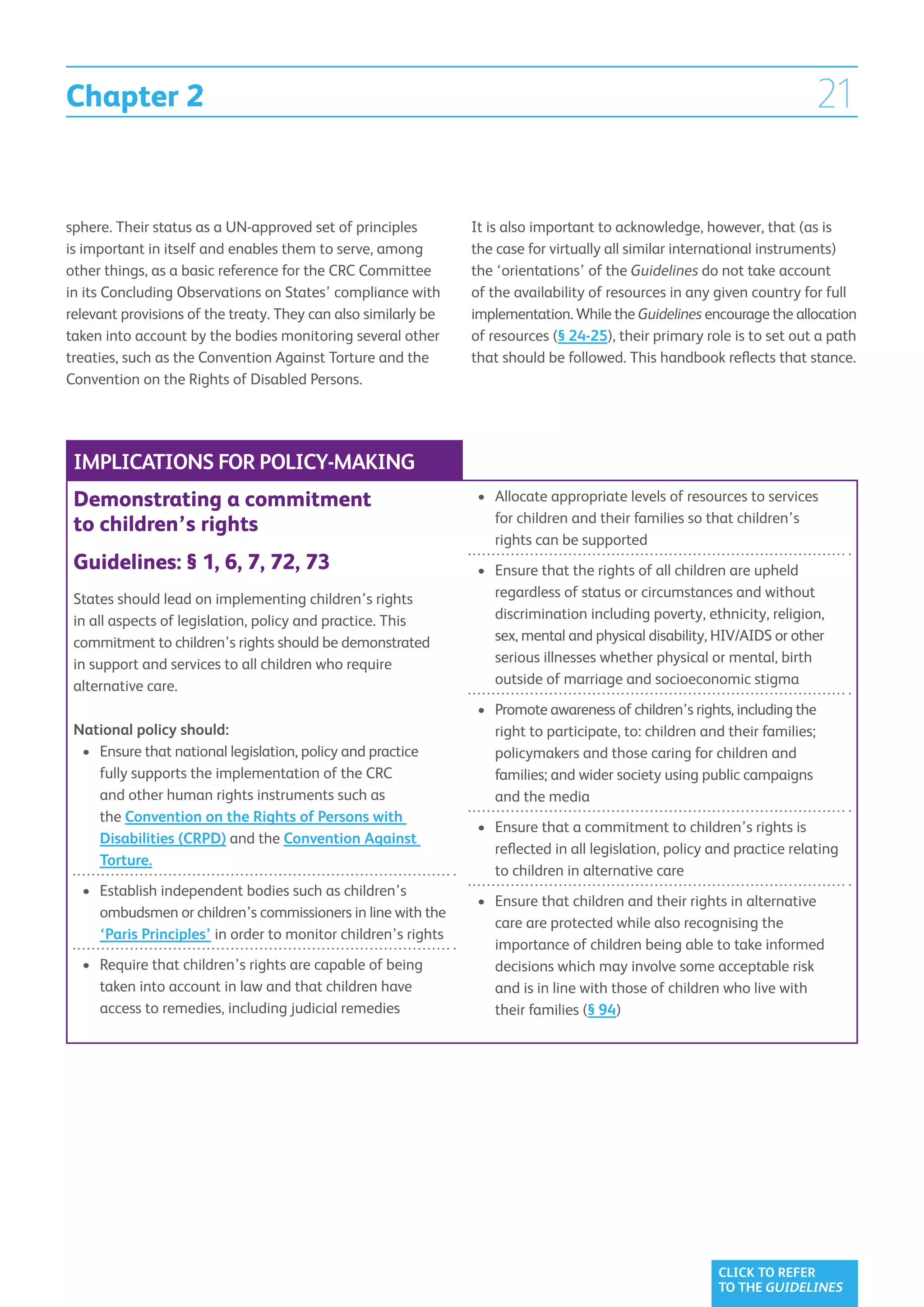
 IMPLICATIONS FOR POLICY-MAKING
 Demonstrating a commitment                                     •	  llocate appropriate levels of resources to services
                                                                   A
                                                                   for children and their families so that children’s
 to children’s rights
                                                                   rights can be supported
 Guidelines: § 1, 6, 7, 72, 73                                  •	  nsure that the rights of all children are upheld
                                                                   E
 States should lead on implementing children’s rights              regardless of status or circumstances and without
 in all aspects of legislation, policy and practice. This          discrimination including poverty, ethnicity, religion,
 commitment to children’s rights should be demonstrated            sex, mental and physical disability, HIV/AIDS or other
 in support and services to all children who require               serious illnesses whether physical or mental, birth
 alternative care.                                                 outside of marriage and socioeconomic stigma
                                                                •	  romote awareness of children’s rights, including the
                                                                   P
 National policy should:                                           right to participate, to: children and their families;
  •	  nsure that national legislation, policy and practice
     E                                                             policymakers and those caring for children and
     fully supports the implementation of the CRC                  families; and wider society using public campaigns
     and other human rights instruments such as                    and the media
     the Convention on the Rights of Persons with
                                                                •	  nsure that a commitment to children’s rights is
                                                                   E
     Disabilities (CRPD) and the Convention Against
                                                                   reflected in all legislation, policy and practice relating
     Torture.
                                                                   to children in alternative care
  •	  stablish independent bodies such as children’s
     E
                                                                •	  nsure that children and their rights in alternative
                                                                   E
     ombudsmen or children’s commissioners in line with the
                                                                   care are protected while also recognising the
     ‘Paris Principles’ in order to monitor children’s rights
                                                                   importance of children being able to take informed
  •	  equire that children’s rights are capable of being
     R                                                             decisions which may involve some acceptable risk
     taken into account in law and that children have              and is in line with those of children who live with
     access to remedies, including judicial remedies               their families (§ 94)


                                                                                                        CLICK TO REFER
                                                                                                        TO THE GUIDELINES
Chapter 2                                                                                                                   22


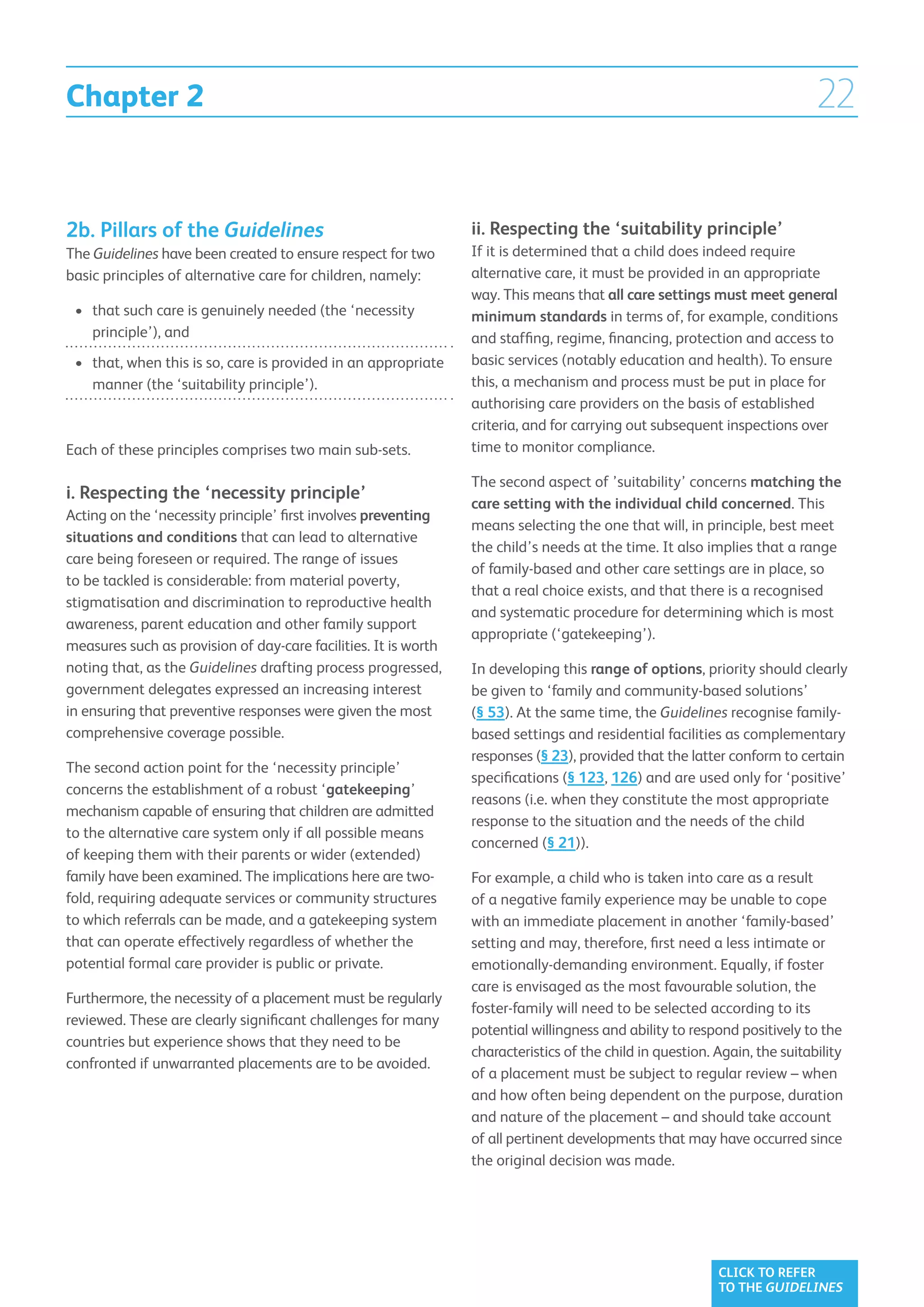
2b. Pillars of the Guidelines                                    ii. Respecting the ‘suitability principle’
The Guidelines have been created to ensure respect for two       If it is determined that a child does indeed require
basic principles of alternative care for children, namely:       alternative care, it must be provided in an appropriate
                                                                 way. This means that all care settings must meet general
 •	 that such care is genuinely needed (the ‘necessity
                                                                minimum standards in terms of, for example, conditions
    principle’), and                                             and staffing, regime, financing, protection and access to
 •	  hat, when this is so, care is provided in an appropriate
    t                                                            basic services (notably education and health). To ensure
    manner (the ‘suitability principle’).                        this, a mechanism and process must be put in place for
                                                                 authorising care providers on the basis of established
                                                                 criteria, and for carrying out subsequent inspections over
Each of these principles comprises two main sub-sets.            time to monitor compliance.

                                                                 The second aspect of ’suitability’ concerns matching the
i. Respecting the ‘necessity principle’
                                                                 care setting with the individual child concerned. This
Acting on the ‘necessity principle’ first involves preventing
                                                                 means selecting the one that will, in principle, best meet
situations and conditions that can lead to alternative
                                                                 the child’s needs at the time. It also implies that a range
care being foreseen or required. The range of issues
                                                                 of family-based and other care settings are in place, so
to be tackled is considerable: from material poverty,
                                                                 that a real choice exists, and that there is a recognised
stigmatisation and discrimination to reproductive health
                                                                 and systematic procedure for determining which is most
awareness, parent education and other family support
                                                                 appropriate (‘gatekeeping’).
measures such as provision of day-care facilities. It is worth
noting that, as the Guidelines drafting process progressed,      In developing this range of options, priority should clearly
government delegates expressed an increasing interest            be given to ‘family and community-based solutions’
in ensuring that preventive responses were given the most        (§ 53). At the same time, the Guidelines recognise family-
comprehensive coverage possible.                                 based settings and residential facilities as complementary
                                                                 responses (§ 23), provided that the latter conform to certain
The second action point for the ‘necessity principle’
                                                                 specifications (§ 123, 126) and are used only for ‘positive’
concerns the establishment of a robust ‘gatekeeping’
                                                                 reasons (i.e. when they constitute the most appropriate
mechanism capable of ensuring that children are admitted
                                                                 response to the situation and the needs of the child
to the alternative care system only if all possible means
                                                                 concerned (§ 21)).
of keeping them with their parents or wider (extended)
family have been examined. The implications here are two-        For example, a child who is taken into care as a result
fold, requiring adequate services or community structures        of a negative family experience may be unable to cope
to which referrals can be made, and a gatekeeping system         with an immediate placement in another ‘family-based’
that can operate effectively regardless of whether the           setting and may, therefore, first need a less intimate or
potential formal care provider is public or private.             emotionally-demanding environment. Equally, if foster
                                                                 care is envisaged as the most favourable solution, the
Furthermore, the necessity of a placement must be regularly
                                                                 foster-family will need to be selected according to its
reviewed. These are clearly significant challenges for many
                                                                 potential willingness and ability to respond positively to the
countries but experience shows that they need to be
                                                                 characteristics of the child in question. Again, the suitability
confronted if unwarranted placements are to be avoided.
                                                                 of a placement must be subject to regular review – when
                                                                 and how often being dependent on the purpose, duration
                                                                 and nature of the placement – and should take account
                                                                 of all pertinent developments that may have occurred since
                                                                 the original decision was made.


                                                                                                           CLICK TO REFER
                                                                                                           TO THE GUIDELINES
Chapter 2                                                                                                                    23


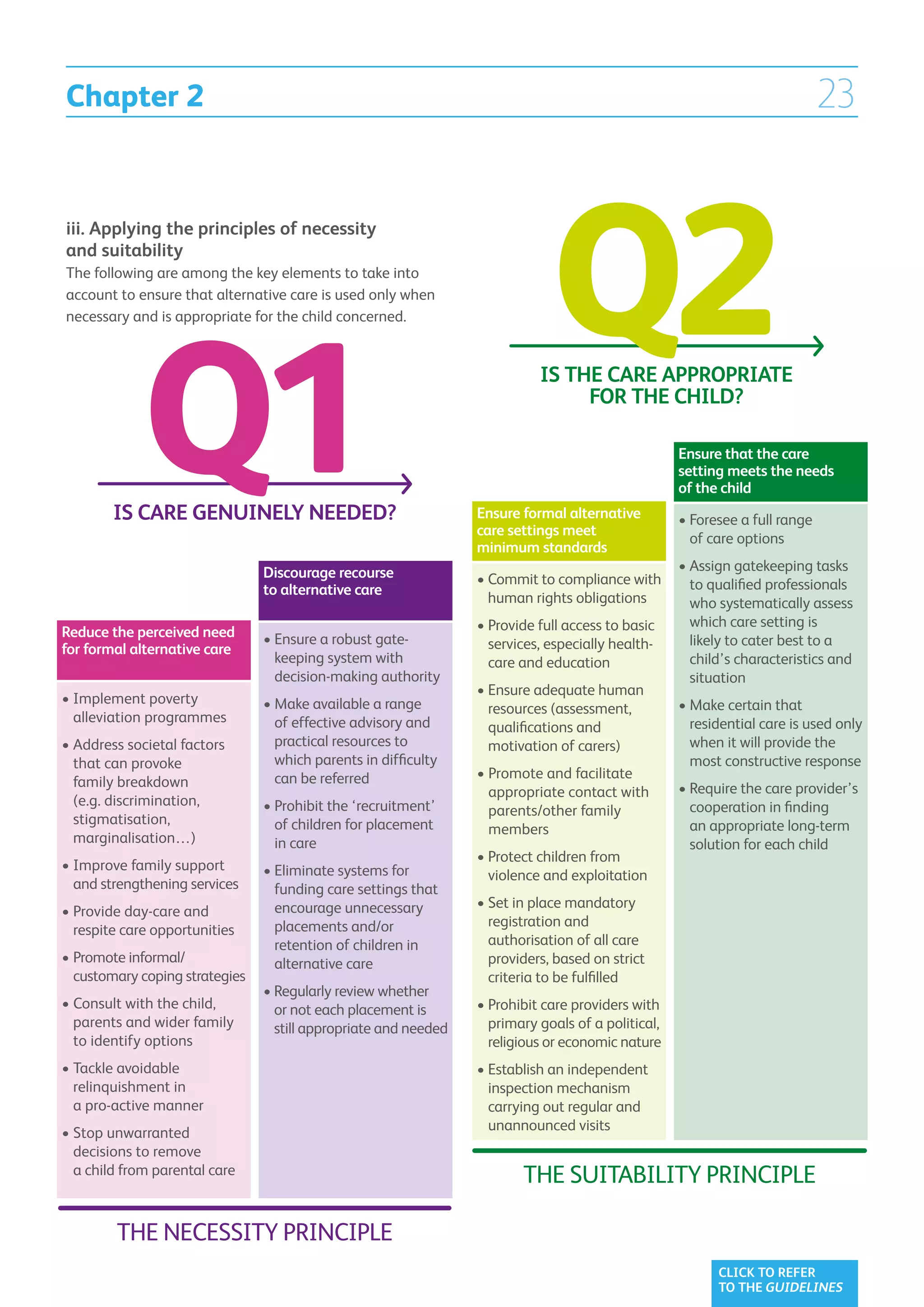
                                                                              Q2
iii. Applying the principles of necessity
and suitability
The following are among the key elements to take into
account to ensure that alternative care is used only when


             Q1
necessary and is appropriate for the child concerned.


                                                                            IS THE CARE APPROPRIATE
                                                                                 FOR THE CHILD?

                                                                                                   Ensure that the care
                                                                                                   setting meets the needs
                                                                                                   of the child
        IS CARE GENUINELY NEEDED?                                Ensure formal alternative         •  oresee a full range
                                                                                                     F
                                                                 care settings meet
                                                                                                     of care options
                                                                 minimum standards
                                Discourage recourse                                                •  ssign gatekeeping tasks
                                                                                                     A
                                                                 •  ommit to compliance with
                                                                   C                                 to qualified professionals
                                to alternative care
                                                                   human rights obligations          who systematically assess
                                                                 •  rovide full access to basic
                                                                   P                                 which care setting is
Reduce the perceived need       •  nsure a robust gate-
                                  E                                services, especially health-      likely to cater best to a
for formal alternative care
                                  keeping system with              care and education                child’s characteristics and
                                  decision-making authority                                          situation
                                                                 •  nsure adequate human
                                                                   E
•  mplement poverty
  I                             •  ake available a range
                                  M                                                                •  ake certain that
                                                                                                     M
                                                                   resources (assessment,
  alleviation programmes          of effective advisory and                                          residential care is used only
                                                                   qualifications and
•  ddress societal factors
  A                               practical resources to           motivation of carers)             when it will provide the
  that can provoke                which parents in difficulty                                        most constructive response
                                  can be referred                •  romote and facilitate
                                                                   P
  family breakdown                                                                                 •  equire the care provider’s
                                                                                                     R
                                                                   appropriate contact with
  (e.g. discrimination,         •  rohibit the ‘recruitment’
                                  P                                                                  cooperation in finding
                                                                   parents/other family
  stigmatisation,                 of children for placement                                          an appropriate long-term
                                                                   members
  marginalisation…)               in care                                                            solution for each child
                                                                 •  rotect children from
                                                                   P
•  mprove family support
  I                             •  liminate systems for
                                  E                                violence and exploitation
  and strengthening services      funding care settings that
                                  encourage unnecessary          •  et in place mandatory
                                                                   S
•  rovide day-care and
  P
                                  placements and/or                registration and
  respite care opportunities
                                  retention of children in         authorisation of all care
•  romote informal/
  P                               alternative care                 providers, based on strict
  customary coping strategies                                      criteria to be fulfilled
                                •  egularly review whether
                                  R
•  onsult with the child,
  C                               or not each placement is       •  rohibit care providers with
                                                                   P
  parents and wider family        still appropriate and needed     primary goals of a political,
  to identify options                                              religious or economic nature
•  ackle avoidable
  T                                                              •  stablish an independent
                                                                   E
  relinquishment in                                                inspection mechanism
  a pro-active manner                                              carrying out regular and
•  top unwarranted
  S                                                                unannounced visits
  decisions to remove
  a child from parental care                                             THE SUITABILITY PRINCIPLE

         THE NECESSITY PRINCIPLE
                                                                                                         CLICK TO REFER
                                                                                                         TO THE GUIDELINES
Chapter 2                                                                                                                    24


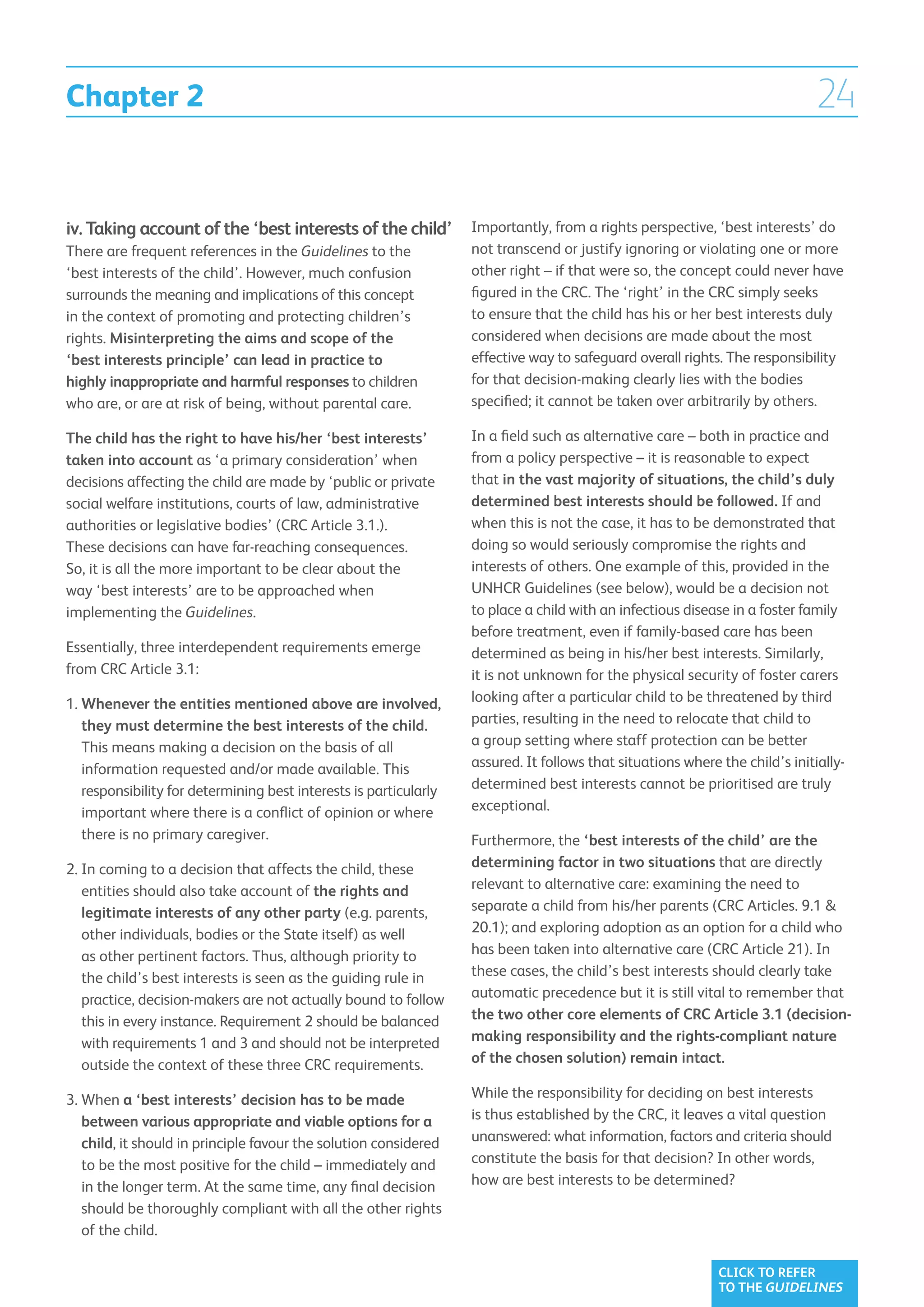
iv. Taking account of the ‘best interests of the child’            Importantly, from a rights perspective, ‘best interests’ do
There are frequent references in the Guidelines to the             not transcend or justify ignoring or violating one or more
‘best interests of the child’. However, much confusion             other right – if that were so, the concept could never have
surrounds the meaning and implications of this concept             figured in the CRC. The ‘right’ in the CRC simply seeks
in the context of promoting and protecting children’s              to ensure that the child has his or her best interests duly
rights. Misinterpreting the aims and scope of the                  considered when decisions are made about the most
‘best interests principle’ can lead in practice to                 effective way to safeguard overall rights. The responsibility
highly inappropriate and harmful responses to children             for that decision-making clearly lies with the bodies
who are, or are at risk of being, without parental care.           specified; it cannot be taken over arbitrarily by others.

The child has the right to have his/her ‘best interests’           In a field such as alternative care – both in practice and
taken into account as ‘a primary consideration’ when               from a policy perspective – it is reasonable to expect
decisions affecting the child are made by ‘public or private       that in the vast majority of situations, the child’s duly
social welfare institutions, courts of law, administrative         determined best interests should be followed. If and
authorities or legislative bodies’ (CRC Article 3.1.).             when this is not the case, it has to be demonstrated that
These decisions can have far-reaching consequences.                doing so would seriously compromise the rights and
So, it is all the more important to be clear about the             interests of others. One example of this, provided in the
way ‘best interests’ are to be approached when                     UNHCR Guidelines (see below), would be a decision not
implementing the Guidelines.                                       to place a child with an infectious disease in a foster family
                                                                   before treatment, even if family-based care has been
Essentially, three interdependent requirements emerge              determined as being in his/her best interests. Similarly,
from CRC Article 3.1:                                              it is not unknown for the physical security of foster carers
1.  henever the entities mentioned above are involved,
   W                                                               looking after a particular child to be threatened by third
   they must determine the best interests of the child.            parties, resulting in the need to relocate that child to
   This means making a decision on the basis of all                a group setting where staff protection can be better
   information requested and/or made available. This               assured. It follows that situations where the child’s initially-
   responsibility for determining best interests is particularly   determined best interests cannot be prioritised are truly
   important where there is a conflict of opinion or where         exceptional.
   there is no primary caregiver.                                  Furthermore, the ‘best interests of the child’ are the
2.  n coming to a decision that affects the child, these
   I                                                               determining factor in two situations that are directly
   entities should also take account of the rights and             relevant to alternative care: examining the need to
   legitimate interests of any other party (e.g. parents,          separate a child from his/her parents (CRC Articles. 9.1 
   other individuals, bodies or the State itself) as well          20.1); and exploring adoption as an option for a child who
   as other pertinent factors. Thus, although priority to          has been taken into alternative care (CRC Article 21). In
   the child’s best interests is seen as the guiding rule in       these cases, the child’s best interests should clearly take
   practice, decision-makers are not actually bound to follow      automatic precedence but it is still vital to remember that
   this in every instance. Requirement 2 should be balanced        the two other core elements of CRC Article 3.1 (decision-
   with requirements 1 and 3 and should not be interpreted         making responsibility and the rights-compliant nature
   outside the context of these three CRC requirements.            of the chosen solution) remain intact.

3. When a ‘best interests’ decision has to be made                While the responsibility for deciding on best interests
    between various appropriate and viable options for a           is thus established by the CRC, it leaves a vital question
    child, it should in principle favour the solution considered   unanswered: what information, factors and criteria should
    to be the most positive for the child – immediately and        constitute the basis for that decision? In other words,
    in the longer term. At the same time, any final decision       how are best interests to be determined?
    should be thoroughly compliant with all the other rights
    of the child.

                                                                                                             CLICK TO REFER
                                                                                                             TO THE GUIDELINES
Chapter 2                                                                                                                    25

To date, the most comprehensive attempt to respond                 5.  he child’s special developmental needs:
                                                                      T
to that question at international level is undoubtedly
                                                                   	   a)  elated to a physical or mental disability
                                                                          R
the ‘Guidelines on Determining the Best Interests of
                                                                   	   b)  elated to other particular characteristics
                                                                          R
the Child’ drawn up by the UNHCR (2008). Although the
                                                                          or circumstances.
Best Interests Determination (BID) model it proposes
was largely designed with unaccompanied and separated              6.  ther issues as appropriate. For example:
                                                                      O
refugee children in mind, it is a prime source of inspiration
when any significant decisions are to be made about                	   a)  he child’s ethnic, religious, cultural and/or linguistic
                                                                          T
a child and his/her future.                                               background, so that efforts can be made, as far
                                                                          as possible, to ensure continuity in upbringing and,
With children for whom alternative care is, or may be,                    in principle, maintenance of links with the child’s
a reality, BID should be grounded in an assessment                        community
undertaken by qualified professionals, and should                  	   b)  reparation for transition to independent living.
                                                                          P
cover at least the following issues:
                                                                   7.  review of the suitability of each possible care option
                                                                      A
1.  he child’s own freely expressed opinions and wishes
   T                                                                  for meeting the child’s needs, in light of all the above
   (on the basis of the fullest possible information), taking         considerations.
   into account the child’s maturity and ability to evaluate
   the possible consequences of each option presented.             The results of such an assessment should form the basis
                                                                   of BID by the competent bodies, who will also consider
2.  he situation, attitudes, capacities, opinions and
   T                                                               all other factors (including the availability of options in
   wishes of the child’s family members (parents, siblings,        practice, and the interests and rights of others) before
   adult relatives, close ‘others’), and the nature of their       coming to a decision. The reason for their decision should
   emotional relationship with the child.                          be explained to the child, especially if it does not correspond
                                                                   to the opinion s/he expressed. A BID assessment should also
3.  he level of stability and security provided by the child’s
   T
                                                                   be carried out each time a placement comes up for review
   day-to-day living environment (whether with parents, in
                                                                   (see CRC Article 25, Guidelines § 67).
   kinship or other informal care, or in a formal care setting):
                                                                   In certain egregious situations, the danger facing a child
	   a)  urrently (immediate risk assessment)
       C
                                                                   will require immediate protective action. Here, it is vital
	   b)  reviously in that same environment (overall
       P
                                                                   to ensure that the full BID process is launched as soon as
       risk assessment)
                                                                   practicable after the initial emergency response – ideally
	   c) Potentially in that same environment (e.g.
       
                                                                   with an agreed protocol for doing so. In particular, no
       with any necessary support and/or supervision)
                                                                   definitive and durable solution must ever be arranged before
	   d) Potentially in any of the other care settings
       
                                                                   the assessment process has been completed, and its findings
       that could be considered.
                                                                   have been taken into account by a competent authority.
4.  here relevant, the likely effects of separation
   W
   and the potential for family reintegration.


                                                                                                            CLICK TO REFER
                                                                                                            TO THE GUIDELINES
Chapter 2                                                                                                                 26
Focus 1: Participation of children and young people
in care decisions and care settings
OVERVIEW
Too often, children are placed in alternative care without        There is clearly an intimate connection between such ‘child
fully understanding why, or without being given a chance          participation’ and consideration of the best interests of
to express their opinions. This clearly contravenes CRC           the child, and this is reflected in § 7. Any determination
Article 12, which gives children the ‘right to be heard’          of best interests must be based in part on the preferences
in all judicial or administrative procedures affecting            and concerns of the child in question, while taking account
their lives. In many cases, children who are arbitrarily          of a wide variety of other opinions and factors. These include
or inappropriately placed in care subsequently make               the foreseeable short-term and longer-term consequences
their views known in various ‘non-verbal’ ways, such as           of a given solution for the effective protection of all other
withdrawal, refusal to cooperate, absconding or otherwise         rights, and are also determined by the availability of
disrupting the placement. This means that their overall           suitable options provided or promoted by the State.
experience of alternative care will be resolutely negative
                                                                  Equally, as reflected in § 6 (and again in § 64 for example),
and may have serious repercussions for their present
                                                                  children must have access to all the information they need
and for their future.
                                                                  to allow them to reach well-founded conclusions about the
The drafters of the Guidelines therefore paid special             options open to them.
attention to the need to consult with every child for whom
                                                                  ‘Child participation’ is inexorably linked to consultation
an alternative care placement might be envisaged. They
                                                                  with the child’s family, appointed representative and/or
stated that consultation should cover all decision-making
                                                                  other persons they see as important and trusted. This
related to the care setting, throughout the placement
                                                                  point is emphasised frequently in the Guidelines. Seeking
and prior to leaving the care system. The drafters not only
                                                                  the views and, ideally, the approval of those on whom the
included this in the General Principles of the Guidelines
                                                                  child has come to rely helps ensure that decisions about
(§ 6-7) but also recalled it at many specific points
                                                                  an alternative care placement correspond as far as possible
in the text (see § 40, 57, 65, 67 for example). This is a
                                                                  to the child’s own expectations. This clearly enhances
key component of the individualised, case-by-case theme
                                                                  the likelihood that an alternative care placement will
promoted in the Guidelines regarding alternative care
                                                                  have a positive outcome.
decision-making.


IMPLICATIONS FOR POLICY-MAKING
Guidelines: § 6, 7, 40, 49, 57, 64, 65,                           National policy should:
67, 94, 98, 99, 104, 132                                          Embed children’s rights to participate in legislation
                                                                  and policy
The Guidelines are underpinned by a commitment to
                                                                   •	  nsure that a commitment to children’s views
                                                                      E
children’s right to be heard in matters that affect them,
                                                                      being heard is embedded in all legislation and
in line with Article 12 of the CRC. This is a General Principle
                                                                      policy relating to children and their families in
of the Guidelines which should be reflected in all policy
                                                                      line with Article 12 of the CRC
and practice related to alternative care.


                                                                                                          CLICK TO REFER
                                                                                                          TO THE GUIDELINES
Chapter 2                                                                                                                    27
Focus 1: Participation of children and young people
in care decisions and care settings (cont.)
IMPLICATIONS FOR POLICY-MAKING (cont.)
 •	  stablish independent human rights institutions such
    E                                                             •	  rovide children with information so that they can
                                                                     P
    as children’s ombudsmen or children’s commissioners              make informed choices and can fully participate in
    to uphold children’s right to be heard                           decision-making processes. This should include access
                                                                     to child friendly versions of their rights and free legal
 •	  ake into account the UN General Comment
    T
                                                                     representation of lawyers trained in care matters
    No. 12 The right of the child to be heard
                                                                     where appropriate
    to inform children’s participation in processes
    and administrative proceedings                                •	  reserve information on children’s background and
                                                                     P
                                                                     origins so that children, or others with children’s
 •	  romote awareness of children’s rights, including
    P
                                                                     permission, can research their origins
    the right to participate, to: children and their families;
    policymakers and those caring for children and                •	  nsure that the child’s family, or other significant
                                                                     E
    families; and wider society using public campaigns               people that a child trusts, are also consulted
    and the media                                                    on decisions
 •	  nsure that all children have the right to participate
    E                                                             •	  equire that children have access to a trusted adult
                                                                     R
    regardless of status or circumstances and without                where they want support and to talk to someone
    discrimination                                                   confidentially
 •	  nsure that there is no lower age limit to children’s
    E                                                             •	  ake provision so that a child can be heard directly
                                                                     M
    participation and provide support for children in their          through a representative or body where a child is very
    communication needs, including support for non-                  young or is unable to express an opinion verbally
    verbal forms of communication                                    or through other means of communication
 •	  ncourage organisations or groups, which are peer-led
    E                                                             •	  nsure that children’s views are taken into account
                                                                     E
    or which significantly support children’s participation,         in decisions on contact with, and during visits to,
    to contribute to the development and implementation              their families
    of policy and practice on alternative care
                                                                 Support children to raise concerns and complaints
Support the participation of children in alternative             (§ 98-99)
care procedures and processes                                      •	  equire mechanisms to be in place so that children
                                                                      R
 •	  nsure legislation and national policies on child
    E                                                                 can raise informal concerns
    protection and alternative care include a commitment
                                                                  •	  ut in place clear mechanisms for formal complaints
                                                                     P
    to children’s participation and are underpinned
                                                                     so that children in alternative care can safely report
    by a child rights approach
                                                                     infringements of their rights including abuse and
 •	  equire children’s views to be sought for decisions
    R                                                                exploitation
    regarding their placement, the development of care
                                                                  •	  nsure that children are informed of their right
                                                                     E
    assessments, plans and reviews. This should include
                                                                     to make complaints. They should have access
    seeking children’s views on services which can
                                                                     to an independent trusted adult to support them
    support children and their families and carers
                                                                     take forward a complaint where required


                                                                                                          CLICK TO REFER
                                                                                                          TO THE GUIDELINES
Chapter 2                                                                                                              28
Focus 1: Participation of children and young people
in care decisions and care settings (cont.)
IMPLICATIONS FOR POLICY-MAKING (cont.)
 •	  nsure that children have access to legal remedy
    E                                                            •	  equire that complaints are recorded and are
                                                                    R
    and judicial review. They should have access to legal           regularly reviewed. Establish an identifiable, impartial
    representatives and support from independent trusted            and independent body which can monitor complaints
    adults as required
                                                                 •	  eek the views and ongoing participation of children
                                                                    S
 •	  nsure that children are aware of the extent and
    E                                                               in how to improve complaints mechanisms
    limits of confidentiality when making complaints
    and that making complaints is without retribution.
    Children should receive systematic feedback on how
    their concerns and complaints have been dealt with
    and what the outcomes are


PROMISING PRACTICE 1.1
Mkombozi, Tanzania                                              Throughout 2010, children also contributed much
Mkombozi works with children at risk of migrating to the        to Mkombozi’s strategic planning processes through
streets in the Arusha and Kilimanjaro regions of northern       meetings, discussions and reflections.
Tanzania. It supports moving away from residential care
                                                                Some of the older children acted as ambassadors and
of street-involved children towards care within families
                                                                shared their own life experiences whilst discussing the
and communities. As a result, it has transformed its original
                                                                negative consequences of longer term institutional care.
residential facility into a ‘transition home’. Mkombozi
                                                                In 2010 the annual child satisfaction survey was conducted
appreciates the value and impact of meaningful child
                                                                with children and older youth staying at the transition
participation and enabling opportunities for former and
                                                                home. The survey highlighted communication between
current street-involved children and young people to raise
                                                                social workers and children as an area for development.
their voices and to be heard. Young people participated
                                                                The results of the satisfaction survey were presented
in the Baraza la Watoto (Children’s Council) in Arusha
                                                                to staff and provided an opportunity for staff to reflect
Municipality, which has led to the municipal authority
                                                                on progress from the perspective of young people.
recognising issues facing children and young people and
finding ways to assist them.                                    For more information see: The Mkombozi Annual Report
                                                                (2010) www.mkombozi.org


                                                                                                        CLICK TO REFER
                                                                                                        TO THE GUIDELINES
Chapter 2                                                                                                               29
Focus 1: Participation of children and young people
in care decisions and care settings (cont.)
PROMISING PRACTICE 1.2
Collective participation in child protection services, Norway   to influence child protection services by enabling parents
‘User participation and professional practice in child          to develop greater consciousness concerning possibilities
protection services’ is an action research project run in       for taking effective action in relation to care decisions
cooperation with two child protection services in Norway        affecting their own children. The experience from this project
looking at how to strengthen the participation of young         suggests that there is a need to support the development
people in decisions about their care. It uses a dialogue-       of models of collective user participation in order to provide
based participation group for young people in child             service users with the power to influence service delivery.
protection and a group for parents who have lost custody
                                                                For more information see: Seim, S. and Siettebo, T. (2011).
of their children. The initiative for young people resulted
                                                                Collective participation in child protection services:
in changes in the practice of the child protection centre
                                                                partnership or tokenism? European Journal of Social Work,
so that young people were now fully involved in meetings
                                                                14(4), 497-512. DOI: 10.1080/13691457.2010.500477
that would make decisions about their future care. The
parents group provided the parents with the opportunity


PROMISING PRACTICE 1.3
Who Cares? Scotland training initiative,                        sessions to these senior people. Positive evaluations
Scotland, United Kingdom                                        showed young people’s involvement in the training
In 2010 Who Cares? Scotland received three years                sessions made the training particularly effective. Young
of funding to design, develop and deliver a national            people have gone on to be employed as trainers on the
training initiative aimed at raising awareness and              programme and have represented the organisation
developing the capacity of locally elected representatives      internationally. The programme has resulted in changes
and key agencies with decision-making responsibilities for      to local policy and practice in a number of ways including
children’s services. Children and young people in formal        improvements in local housing policy for young people
alternative care and care leavers have been involved            leaving care, enhanced opportunities for training and
throughout the development and delivery of the national         employment, better access to sport and leisure facilities
training programme. 127 young people were involved in           and improved participation in decision-making.
this process via making local training films for the training
                                                                For more information visit:
sessions and involved in the delivery of the training
                                                                www.corporateparenting.co.uk


                                                                                                        CLICK TO REFER
                                                                                                        TO THE GUIDELINES
Chapter 3
                                                   SCOPE AND TERMINOLOGY
                                                         OF THE GUIDELINES   30

SCOPE AND TERMINOLOGY
OF THE GUIDELINES
© Maureen Anderson


In this chapter you will find:
3a. Scope of the Guidelines	

3b. Terminology used in the Guidelines	
	 i. 		 Alternative care in an existing family	
	 ii. 	Other care settings	
	 iii. Concepts are not absolute


                                                                CLICK TO REFER
                                                                TO THE GUIDELINES
Chapter 3
                                                                                         SCOPE AND TERMINOLOGY
                                                                                               OF THE GUIDELINES           31


3a. Scope of the Guidelines
For the most part, the Guidelines apply to the provision           	intended to cover a child’s occasional informal care
of formal alternative care for all children (i.e. persons under       with relatives or friends, say for holidays or during short
the age of 18, unless majority is attained earlier, in line with      parental absences [§ 30.c].
the CRC) without parental care or at risk of being so [§ 27].
                                                                    •	  hile informal arrangements are by definition not
                                                                       W
At the same time, the Guidelines’ coverage extends to
                                                                       the result of formal official intervention and decisions
young people leaving the formal care system and needing
                                                                       (and therefore difficult to be covered by set standards)
support after reaching the age of majority [§ 28]. They
                                                                       they may require oversight and/or may benefit from
may also be applicable in settings that do not constitute
                                                                       State support to ensure optimum child protection.
‘alternative care’ as such but have a responsibility to care
                                                                       It is here that standards have their role to play.
for children (e.g. boarding schools, school hostels and
treatment centres [§ 31]).
                                                                   This said, it should always be borne in mind that the overall
However, the Guidelines are also the first international           standards and principles set out in the Guidelines only
instrument to cover not only all types of ‘formal’                 concern formal care [§ 27]; those that apply to informal
alternative care but also ‘informal’ arrangements                  care are specifically mentioned as such [notably § 56,
[§ 27]. They do so for two main reasons:                           § 76-79] [See also Focus 9].
 •	 Alternative care for most children who cannot live
                                                                  Two groups of children are explicitly excluded from
    with their parents is, in fact, informal in nature. In other   coverage in the Guidelines:
    words, the majority of alternative care throughout
    the world is organised spontaneously between private            •	  hildren who are deprived of their liberty as a result of
                                                                       C
    individuals – most often parent(s) and relatives –                 being in conflict with the law, or alleged as such, since
    through informal, societally accepted practices.                   their situation is already covered in other international
    The drafters felt that this reality needed to be fully             instruments in the sphere of juvenile justice [§ 30.a].
    acknowledged. However, the Guidelines are not
                                                                                                           CLICK TO REFER
                                                                                                           TO THE GUIDELINES
Chapter 3
                                                                                       SCOPE AND TERMINOLOGY
                                                                                             OF THE GUIDELINES           32

 •	  hildren who have been adopted (§ 30.b). This
    C                                                            3b. Terminology used in the Guidelines
    is because an adopted child is in parental care              There are a number of important points to highlight
    as soon as the adoption order is made. Therefore,            about the concepts used, and definitions given (§ 29),
    a completed adoption is not a form of alternative care,      in the Guidelines when referring to different forms
    since it establishes a full parent-child relationship.       of alternative care.
    It is not subject to the many facets of alternative care
    management, such as a care plan or periodic review.          Informal care (§ 29.b.i) is seen as an active or tacit
    Nevertheless, the period prior to the adoption being         arrangement between a child’s parents or guardians and
    finalised is logically considered to come within the         one or more individual (usually relatives or persons close
    scope of the Guidelines. Furthermore, it is important        to the family) who have no officially-sanctioned mandate
    to note that efforts foreseen in the Guidelines to           as carers at the time of taking on that responsibility.
    prevent family breakdown apply as much to adoptive           Informal care also covers spontaneous offers of care
    families as to any others.                                   by private individuals in the absence of parents or other
                                                                 primary caregivers.

                                                                 It follows that formal care encompasses all placements
On this second point, the complex question of kafala
                                                                 with a recognised caregiver, regardless of how they are
under Islamic law and its relationship to adoption needs
                                                                 arranged and on whose initiative (§ 29.b.ii). Of special
to be addressed.
                                                                 note in this respect is that every admission to a residential
Islamic law does not recognise adoption, and adoption-           facility is considered to be ‘formal’. In other words, since
type care arrangements are generally possible only for           the Guidelines require that all facilities be registered
abandoned young children whose parents are unknown.              and authorised to operate, it is assumed that they are
Such arrangements consequently concern an extremely              ‘recognised’. Importantly, this means that States and care
small proportion of children without parental care.              providers cannot invoke the supposedly ‘informal’ nature
                                                                 of any placement in residential care – even when it was,
Thus, in recent decades (and notably during the drafting         for example, at the sole request of the parent or guardian
of the CRC), there has been a tendency to refer to the far       – to justify non-compliance with protection standards
more widespread practice of kafala – the nearest Islamic         regarding the child concerned, as set out in the Guidelines.
equivalent to adoption. The Guidelines follow this trend
of linking adoption and kafala (e.g. § 2.a, 123, 161).           The Guidelines refer to two distinct groups of formal
However, the way in which kafala is conceived in practice        care providers (§ 29.d):
varies greatly from one country to another – ranging from
                                                                  •	 Agencies that organise alternative care placements
anonymous financial support for a child in a residential
                                                                      (such as a social service or gatekeeping body)
facility to a quasi-adoptive relationship where the child
may, under certain circumstances, take on the family name         •	 Facilities that are establishments providing residential
of, and be allowed to inherit from, the carer in virtually the        care to children
same manner as an adopted child.

In the context of the Guidelines, interpretation of the          Agencies and facilities may be public or private in nature,
term ‘kafala’ can therefore only be very pragmatic.              with ‘private’ taken to mean ‘non-State’. Private agencies,
The Guidelines cover the practice when it involves direct        therefore, include NGOs, associations and faith-based
day-to-day care for a child. However, that care may be           organisations as well as private enterprises. The Guidelines
arranged on an informal or more formal basis – something         make no distinction between for-profit and non-profit
that must be taken into account when determining                 operations, but specify that profit should not be ‘a prime
obligations to the child. In the relatively rare instances       purpose’ of the provider (§ 20).
where kafala is tantamount to a legalised life-long care
arrangement, it may well fall outside the scope of the           There is a vast array of alternative care settings throughout
Guidelines in the same way that adoption does.                   the world. For the purposes of the Guidelines, they are


                                                                                                        CLICK TO REFER
                                                                                                        TO THE GUIDELINES
Chapter 3
                                                                                       SCOPE AND TERMINOLOGY
                                                                                             OF THE GUIDELINES            33

divided into two basic types: those where an existing            ii. Other care settings
family is the care provider, and those founded on a              For the purposes of the Guidelines, all alternative
different care arrangement.                                      care settings that are not family-based are classified
                                                                 as ‘residential’.
i. Alternative care in an existing family
The Guidelines pinpoint three types of care under this            •	 ‘Family-like’ care (§ 29.c.iii) is included under
heading:                                                              residential care because, in contrast to ‘family-based’
                                                                      care, it refers to the way that care is organised
 •	 Kinship care (§ 29.c.i) is provided by relatives or other        rather than to any pre-existing ‘family’ status of the
    caregivers close to the family and known to the child.            care setting. Family-like care is provided in largely
    While such arrangements have so far tended to be                  autonomous small-groups under conditions that
    informal, some countries are now making increased                 resemble a family environment as much as possible.
    use of formalised placements within the extended                  One or more surrogate parents serve as caregivers,
    family (kinship foster care). This enables all parties            although not in those persons’ normal home
    concerned to benefit from levels of guidance and                  environment.
    support on a par with those of any other foster care
    placement.                                                       The family-like characteristics of a residential care
 •	 Foster care (§ 29.c.ii) is provided by authorised               setting is an important criterion when determining its
     couples or individuals in their own homes, within the           general suitability. For example, Recommendation
     framework of formal alternative care provision.                 2005(5) of the Committee of Ministers of the
                                                                     Council of Europe specifies that, to be consistent
    −−    hort-term foster care may be provided to cover
         S                                                           with children’s rights, ‘a small family-style living unit
         a temporary crisis, or as planned ‘respite care’            should be provided’ in residential facilities. A similar
         for a few days to relieve parents, particularly             stance is taken by the Guidelines (§ 123).
         those who care for a child with a disability or
         other special needs.                                     •	 Residential care (§ 29.c.iv) encompasses a wide
                                                                      range of settings, from emergency shelters and small-
    −−   Medium-term foster care may be required while
                                                                     group homes to the biggest residential facilities. The
         support is being offered to parents or the wider             Guidelines look on residential care as a necessary
         family to enable them to resume care for the                 component in the range of alternative care options
         child, or where efforts are being made to trace              that must be in place, provided it satisfies a number
         a family.                                                    of conditions. A small group setting with trained
    −−   Long-term foster care meets the needs of
                                                                     staff can provide therapeutic care or treatment for
         certain children – such as those for whom                    children who have suffered trauma or severe abuse
         adoption cannot be envisaged or is against their             or neglect. To enable large sibling groups to remain
         wishes – by providing family-based care for many             together, a residential care setting may also be the
         years, sometimes into adulthood.                             best option. Children can value residential care when
                                                                      it focuses on providing individualised opportunities
 •	  ther family-based care (§ 29.c.iii) covers care
    O
                                                                      for social and emotional development. Thus, while the
    settings where an existing family plays a formal care
                                                                      Guidelines set out strict standards to be met, and clear
    role similar to that of a foster carer – but does not
                                                                      restrictions on recourse to residential care, they also
    operate within the foster care service. For example,
                                                                      recognise the ‘constructive’ role it can play (§ 21).
    families may be designated to look after children
    transitioning out of residential care, or to act as
    ’guardians’ for children with long-term alternative
    care needs.


                                                                                                         CLICK TO REFER
                                                                                                         TO THE GUIDELINES
Chapter 3
                                                                                        SCOPE AND TERMINOLOGY
                                                                                              OF THE GUIDELINES           34

It is vital to distinguish between ‘residential facilities’       iii. Concepts are not absolute
and ‘institutions’. The latter term is used only once in the      The above review of the nomenclature and categories
Guidelines – to describe ‘large residential facilities’ (§ 23).   within alternative care settings is intended to provide the
It is of course ‘institutions’, and not residential facilities    necessary foundations for a common understanding of the
as a whole, that are to be targeted through a                     scope and intentions of the Guidelines. Such a common
‘de-institutionalisation strategy’ [see Focus 3].                 understanding is particularly important because the same
                                                                  or similar terms may be used around the world to define
In truth, there is no universally agreed definition –
                                                                  what are significantly different care settings and/or diverse
in the Guidelines or elsewhere – of what constitutes an
                                                                  legal and administrative requirements and responsibilities.
‘institution’ as opposed to other residential care settings.
According to the Guidelines, size is one factor, but this         But the categories cannot be seen as watertight or
is largely because of the now well-documented negative            definitive concepts. The variety of recognised care settings
impact that large-scale group care frequently has on              that exist in practice do not always correspond perfectly
the well-being and development of children, and on                to generic descriptions; some have been described as
the capacity to safeguard and promote their rights.               ‘hybrid’. For example, a residential facility may be both
                                                                  ‘family-like’ and smaller than certain family-based settings,
So, rather than simply focus on every residential facility
                                                                  and a ‘family-type home’ may not only look after children
above a given size, it is important to tackle what is often
                                                                  but also young people who, having been placed there
called an ‘institutional culture’ – the regimes and day-to-
                                                                  as children, remain there while they set out on the path
day organisation that take little account of individuality,
                                                                  to achieving an independent life.
or psychological and emotional needs, and tend to isolate
children from the outside world. In other words, a degree         The main concern for implementing the Guidelines is the
of pragmatism is required to determine whether or not             extent to which any alternative care option, no matter how
a given facility should be considered as an ‘institution’.        it is defined, provides necessary and individualised quality
                                                                  care in line with international standards, and respects the
Finally, the Guidelines also mention ‘supervised independent
                                                                  overall rights and best interests of the child.
living arrangements’ (§ 29.c.v). These are designed for
children and young people in transition from a formal
care setting to an independent life in the community.


                                                                                                          CLICK TO REFER
                                                                                                          TO THE GUIDELINES
Chapter 4
                                                        GENERAL PRINCIPLES AND PERSPECTIVES
                                                                          OF THE GUIDELINES     35

GENERAL PRINCIPLES
AND PERSPECTIVES
OF THE GUIDELINES


In this chapter you will find:
4a.  asic and overarching approaches and measures
    B

  Implications for policy-making:
  Supporting the rights and needs of children with disabilities and other special needs

4b.  undamental policy orientations
    F

  Focus 2: Placement of children aged 0-3 years in family-based settings
  	•	 mplications for policy-making
     I
  	•	 romising practice:
     P
  		  ase Study 1: UNICEF Sudan: Alternative Family Care
        C
  		  ase Study 2: UNICEF Kosovo Alternative Care Services
        C
  		  Case Study 3: Child’s i Foundation, Uganda
  		  ase Study 4: Foster Care Network, Paraguay
        C

4c. De-institutionalisation of care systems

  Focus 3: Strategies for de-institutionalising the care system
  	•	Implications for policy-making
  	•	Promising practice:
  		 Case Study 1: De-institutionalisation strategy, Moldova
  		 Case Study 2: De-institutionalisation strategy, Georgia
  		 Case Study 3: De-institutionalisation strategy, Malawi

4d. Principles underlying the measures to promote application of the Guidelines

  Implications for policy-making:
  Providing the policy framework for alternative care

                                                                                   CLICK TO REFER
                                                                                   TO THE GUIDELINES
Chapter 4
                                                                        GENERAL PRINCIPLES AND PERSPECTIVES
                                                                                          OF THE GUIDELINES                36


Context: Understanding the Guidelines
The general principles and perspectives in the Guidelines         Other ‘principles and perspectives’ include:
(§ 3-26) are important for two main reasons.
                                                                   •	  rioritising efforts to enable children to remain
                                                                      p
                                                                      with their families,
4a. Basic and overarching approaches
and measures                                                       •	  aking decisions on care placements that take
                                                                      m
Firstly, the ‘general principles and perspectives’ set out            account of each child’s opinion and best interests
certain basic and overarching approaches and measures                 [see Focus 1],
that should shape the way alternative care for children is
                                                                   •	 non-discrimination,
handled. These are echoed, re-emphasised and developed
in subsequent provisions of the Guidelines.                        •	  he vital role played by informal care [see Focus 9],
                                                                      t
                                                                      and
The main principle that underpins the Guidelines is
                                                                   •	  nsuring that a child in alternative care always has a
                                                                      e
that all preventive actions to strengthen families, and
                                                                      legal guardian or analogous person or body to rely on.
provide suitable alternative care when necessary, should
be founded on case-by-case decisions. This leads to
appropriately tailored responses to specific circumstances
                                                                  These topics are covered in more detail later in the handbook.
that are, at all times, in the best interests of the child(ren)
concerned (§ 6).                                                  A substantial sub-paragraph (§ 9.b) in the Guidelines
                                                                  provides an indicative (but not exclusive) list of what
                                                                  constitutes ‘special needs’ – a term that is used at various
                                                                  points in the text, often in conjunction with issues relating
                                                                  to disability and HIV/AIDS. ‘Children with special needs’


                                                                                                          CLICK TO REFER
                                                                                                          TO THE GUIDELINES
Chapter 4
                                                                        GENERAL PRINCIPLES AND PERSPECTIVES
                                                                                          OF THE GUIDELINES               37

include victims of violence and exploitation, children living    context of every needs assessment and response, but also
on the street, and those displaced within or outside their       that they should be the subject of particular attention,
country of habitual residence. The description gives rise        given their vulnerability, as far as care and protection
to another important principle: that not only must the           measures are concerned.
‘special’ needs’ of these children be considered in the


 IMPLICATIONS FOR POLICY-MAKING
 Supporting the rights and needs of                               •	  nsure that children with disabilities and other
                                                                     E
                                                                     special needs are not placed in institutions, and that
 children with disabilities and other
                                                                     this includes children aged 0-3 years. A range of care
 special needs                                                       options appropriate to the needs of individual children
 Guidelines: § 9, 10, 34b, 38, 117, 132                              should be provided as alternatives to institutions and
                                                                     where children cannot live at home
 Children with disabilities and other special needs are often
 placed in alternative care unnecessarily. National policy        Provide appropriate care and support
 and services should provide support to children, and their        •	 Require mechanisms to be in place so that the needs
                                                                      
 families and carers to prevent children with disabilities and        of children with disabilities and other special needs
 other special needs being placed in alternative care where           can be fully assessed and ensure that there is input
 they could live with their families. Where this is not possible,     from specialist professionals where needed
 States should ensure that alternative care meets the needs        •	  nsure children with disabilities have access to
                                                                      E
 of children with disabilities and other special needs.               education (including vocational training and tertiary
                                                                      education), rehabilitation services, occupational
 National policy should:                                              therapy, health care and child welfare
 Ensure policy, guidance, planning and assessment                  •	  rovide support for families caring for children with
                                                                      P
 is in place                                                          disabilities and other special needs. This could
   •	  mplement the provisions of the CRC, the
      I                                                               include financial support, day care and respite
      Convention on the Rights of People with                         care, education, health, community support and
      Disabilities (CRPD), other international instruments            rehabilitation services in order that parents and
      as appropriate, and the Guidelines in upholding the             he extended family can care for their children
      rights of children with disabilities and other special
      needs in legislation and policy                              •	  rovide planned, short term, temporary respite care
                                                                      P
                                                                      for children with disabilities as one means to prevent
   •	  evelop strategies and services to ensure that
      D                                                               placement in long-term formal care
      children with disabilities are not placed, and do
      not remain, in alternative care on the basis of their        •	  rovide support including financial support so
                                                                      P
      or their parents’ disability alone, in line with Article        that foster carers and carers in family-based care
      23 (4) of the CRPD                                              appropriately care for children with disabilities. Where
                                                                      appropriate, children with disabilities should continue
   •	  rovide integrated planning and support across
      P                                                               to receive support as they move into adult life
      services including health, education, child welfare,
      social protection and housing to meet the needs              •	  nsure that attention is given to the importance of
                                                                      E
      of children with disabilities and other special needs           early childhood development and early intervention
      and their families                                              to ensure that the needs of children with disabilities
                                                                      and other special needs are met


                                                                                                          CLICK TO REFER
                                                                                                          TO THE GUIDELINES
Chapter 4
                                                                       GENERAL PRINCIPLES AND PERSPECTIVES
                                                                                         OF THE GUIDELINES                  38
 IMPLICATIONS FOR POLICY-MAKING (cont.)
  •	  equire appropriate physical access to be provided
     R                                                          Promote awareness and counter stigmatisation
     within homes, residential facilities and services          and discrimination
     supporting children and their families                      •	  hallenge and develop measures to counter
                                                                    C
                                                                    discrimination and stigmatisation of children with
  •	  nsure that children with disabilities and other
     E
                                                                    disabilities and other special needs and their families.
     special needs are fully protected by having child
                                                                    This should include training and awareness raising
     protection measures in place wherever they live
                                                                    for carers
  •	  rovide appropriate care for children with disabilities
     P
                                                                 •	  romote awareness of the rights of children with
                                                                    P
     in emergency settings
                                                                    disabilities and other special needs and encourage
  •	  equire planning, resources and support to be
     R                                                              the extended family, community and civil society
     available to children with disabilities and other               to provide informal support
     special needs when leaving care and aftercare
                                                                 •	  ollect and analyse data and undertake research
                                                                    C
                                                                    to better understand the needs of children with
                                                                    disabilities and other special needs and to inform
                                                                    alternative care services


4b. Fundamental policy orientations
Secondly, the Guidelines stipulate a number of fundamental       •	  are providers should never be motivated principally
                                                                    C
policy orientations that are not referred to subsequently in        by political, religious or economic goals (§ 20).
the text and therefore need to be highlighted here. They are:       Pursuing such aims can lead to, among other things,
                                                                    active searches (‘harvesting’) for children to take in,
 •	 Poverty alone should never justify the admission of
                                                                    especially by those running residential facilities that
     a child into formal alternative care. On the contrary,
                                                                    are privately financed and/or funded on the basis
     it should be the trigger for providing appropriate
                                                                    of the number of children in their care.
     support for the family (§ 15). Research has shown that
     this principle is of particular significance worldwide,     •	 While residential facilities are recognised as a
     where regardless of a country’s economic situation,             necessary component of care provision, placements in
     children are often relinquished or removed from the             them should only be made for positive reasons, based
     care of their parents ostensibly because of the parents’        on an assessment of what is best for the child (§ 21).
     inability to meet their material needs. This means that         In other words, a lack of alternatives or time/resources
     the provision of cash or other material support would,          to find a more appropriate setting is no excuse.
     in principle, be enough to keep the family together.            [See paragraph on residential care].

 •	  s a general rule, siblings should not be separated
    A                                                            •	  hildren aged 0-3 years should not be placed in
                                                                    C
    from each other in care placements unless there are             residential facilities, but in family-based settings,
    compelling reasons for doing so. These reasons must             subject to a number of exceptions (§ 22).
    always be in the best interests of any of the children
    concerned (§ 17). While this may seem an obvious
    policy directive, the number of documented cases
    where siblings are separated without regard to their
    best interests made it necessary to stipulate it as a
    general principle of the Guidelines.


                                                                                                         CLICK TO REFER
                                                                                                         TO THE GUIDELINES
Chapter 4
                                                                     GENERAL PRINCIPLES AND PERSPECTIVES
                                                                                       OF THE GUIDELINES            39
Focus 2: Placement of children aged 0-3 years
in family-based settings
OVERVIEW
Special attention has been paid in recent years to the        However, it is also recognised that a short-term placement
negative effects of institutional care on younger children,   in a residential facility (that otherwise meets standards
particularly those in the 0-3 year age group. A number        set out in the Guidelines) is unlikely to have a lasting and
of studies have shown that there is a high probability that   severe negative impact on the child. Here, findings suggest
young children will suffer lasting damage if they are not     that significant and potentially permanent effects
in a care setting where they receive individual attention     on development usually begin only after three months
and, more importantly, have the opportunity to bond           in residential care. As a result, a number of exceptions
with a caregiver.                                             to the ban are foreseen:

According to the UN’s World Report on Violence against         •	  or short-term placements in an emergency
                                                                  f
Children (2006), such children may suffer from ‘poor
                                                               •	  hen family reintegration or another family-based
                                                                  w
physical health, severe developmental delays, disability
                                                                  solution is planned within a short period, and/or
and potentially irreversible psychological damage’. These
findings, and others, have prompted many international         •	  hen siblings need to be kept together and other
                                                                  w
agencies to take action. For example, in 2011, UNICEF and         care settings immediately available would mean
the UN Office of the High Commissioner for Human Rights           separating them.
launched a ‘Call for Action’ in Central and Eastern Europe, Experience in certain countries that have sought
urging an end to the placement of all children aged 0-3      to implement a policy of partial, priority de-
years (including those with disabilities) in institutions.   institutionalisation has highlighted the need to ensure
                                                             that sufficient preventive measures and suitable family-
But the Guidelines go even further. Stipulating that,
                                                             based substitute options are in place. This will help
‘in accordance with the predominant view of experts’,
                                                             avoid the situation in some countries where the closure
children aged under three who need alternative care
                                                             of ‘baby-homes’ has simply led to children relinquished
should be placed in family-based settings (§ 22), they
                                                             or abandoned in maternity clinics being relocated to
implicitly exclude all residential care options, not just
                                                             paediatric wards for many months. Once again, this
‘institutions’, In other words, they are saying that, for
                                                             underlines the need for a fully-fledged and comprehensive
these youngest children, the condition that residential
                                                             strategy when envisaging the closure of facilities
care only be used when it is beneficial for the child (§ 21)
                                                             [see Focus 3].
cannot generally be met.


                                                                                                     CLICK TO REFER
                                                                                                     TO THE GUIDELINES
Chapter 4
                                                                         GENERAL PRINCIPLES AND PERSPECTIVES
                                                                                           OF THE GUIDELINES              40
Focus 2: Placement of children aged 0-3 years
in family-based settings (cont.)
IMPLICATIONS FOR POLICY-MAKING
Guidelines: § 22                                                  Ensure that the national plan on de-institutionalisation
                                                                  takes account of the needs of young children
The Guidelines state that residential care should only be
                                                                  Support the rights of children and their families
used when it is deemed to be more beneficial for the child
                                                                   •	  ake the needs of young children with disabilities and
                                                                      T
than any other setting (§ 21). Since this is normally not
                                                                      other special needs and their families into account in
the case for young children, those aged 0-3 years should
                                                                      response to the high number in residential facilities
invariably be placed in family-based settings.
                                                                   •	  rovide support to families who need it so that
                                                                      P
National policy should:                                               children aged 0-3 years can remain in the family. This
                                                                      may include: day care and respite care, financial and
Place young children in family-based care where
                                                                      welfare support, parenting education and counselling
alternative care is required
                                                                      and access to appropriate housing
 •	  nsure that legislation is in place to limit the placement
    E
    of children aged 0-3 years in residential care. Exceptions     •	  xplore ways of communicating changes in care to
                                                                      E
    are: where short term placements are made in an                   young children in ways which are appropriate to their
    emergency, when family reintegration or another                   age and capacity and providing them with support
    family-based solution is foreseen within a short                  as part of this transition
    period and/or when siblings need to be kept together
                                                                   •	  rovide guidance so that children aged 0-3 years are
                                                                      P
 •	  rovide resources to local services so that adequate
    P                                                                 placed in family-based settings with their siblings
    alternative approaches are developed to avoid the
    placement of children aged 0-3 years in residential care


PROMISING PRACTICE 2.1
UNICEF Sudan Alternative Family Care                              through issuing a fatwa which contributed to a change in
Research from 2003 indicated that 110 newborn babies on           social perceptions of abandoned children. The programme
average were being abandoned in Khartoum every month.             has run since 2003, initially funded by UNICEF and NGO
This was driven by the social stigma attached to children         partners but now primarily by the State Ministry of Social
born to unmarried parents. It was recognised that current         Affairs. Initial results have been positive in terms of the
institutional care arrangements were not in the best              de-institutionalisation of vulnerable children with a total of
interests of the child and that the potential for developing      500 emergency family placements and 2,000 permanent
forms of alternative family-based care existed. Against this      family placements made between 2003 and 2007. The
background UNICEF set out with Government and NGO                 programme has also helped to shape policy affecting
partners, to examine the potential for an alternative to          vulnerable mothers and children. The Child Act 2010 places
institutional care. In addition to stabilising conditions in      an emphasis on the primary source of care for abandoned
institutional care, key aims of the programme included the        children to be within a family unit and also guarantees
design of acceptable alternative family care arrangements,        access to education and health care for abandoned children.
and changes in attitudes, procedures and laws relating
                                                                  For more information see ‘UNICEF Sudan Technical
to the abandonment of young children. In doing so the
                                                                  Briefing Paper 1’: Alternative Family Care www.unicef.org/
programme is a good example of overcoming obstacles
                                                                  sudan/UNICEF_Sudan_Technical_Briefing_Paper_1_-_
to developing family-based care through its success in
                                                                  Alternative_family_care.pdf
engaging with Islamic leaders and gaining their support


                                                                                                          CLICK TO REFER
                                                                                                          TO THE GUIDELINES
Chapter 4
                                                                        GENERAL PRINCIPLES AND PERSPECTIVES
                                                                                          OF THE GUIDELINES            41
Focus 2: Placement of children aged 0-3 years
in family-based settings (cont.)
PROMISING PRACTICE 2.2
UNICEF Kosovo Alternative Care Services                          The government through the Centres for Social Work
Political change and instability, economic and social            recruited foster carers through radio, TV, newspaper
distress related to the post-conflict situation and lack         articles, publicity materials and meetings with community
of adequate social safety nets, have contributed to an           groups. Initially the project was funded by UNICEF but
increase in child abandonment in Kosovo. More than               now the Ministry of Labour and Social Welfare has built
600 infants have been abandoned in Kosovo since 1999.            foster care allowances into the Kosovo national budget,
Initially a ‘transit baby house’ was established for infants     thereby demonstrating commitment to developing family-
abandoned in the hospital, attempting to move the                based foster care as an alternative to institutional care.
children to adoption, foster care or reintegrate them back       By 2011 around 400 children were placed in foster care
to birth families. UNICEF, the Ministry of Labour and            and 40 foster families became active foster carers for
Social Welfare and EveryChild implemented a Short Term           all categories of children in need of care and protection
Professional Foster Care Project, focusing exclusively           in Kosovo.
on under- twos deprived of parental care, as the number
                                                                 For more information visit www.unicef.org/kosovo
of abandoned infants in state hospitals increased.


PROMISING PRACTICE 2.3
Child’s i Foundation, Uganda                                     found for them within an average of 4 months. There were
The Child’s i Foundation in Uganda aims to maintain or           65 children reunited with their biological families and
reunite children with their families or, if necessary, to find   given on-going support for a further year to ensure child
alternative family placements for them. It therefore works       safety and to ensure the family could fulfil its caretaking
to prevent abandonment, provide temporary short-term             role. Domestic adoption within Uganda has been
residential care if required, reunite families, provide on-      promoted through television and radio advertising, leading
going support to families, promote domestic adoption and         to 150 families contacting the adoption hotline and
find new families.                                               resulting in a waiting list of prospective adopters. Within
                                                                 an 18 month period, 21 children were placed with adoptive
Results achieved during its first two years of operation
                                                                 parents in Uganda. Thorough assessments were carried
were positive. Thus, for example, more than 200 mothers
                                                                 out in line with the Children’s Act and approval by a multi-
were successfully encouraged and enabled not to abandon
                                                                 agency panel.
their children as a result of the provision of these services.
Short-term care was provided for 100 children and families       For more information visit www.childsifoundation.org


                                                                                                        CLICK TO REFER
                                                                                                        TO THE GUIDELINES
Chapter 4
                                                                       GENERAL PRINCIPLES AND PERSPECTIVES
                                                                                         OF THE GUIDELINES              42
Focus 2: Placement of children aged 0-3 years
in family-based settings (cont.)
 PROMISING PRACTICE 2.4
 Foster Care Network, Paraguay                                  initiated. Other significant signs of progress are the
 In Paraguay, some 5,000 children are living in institutions,   reorganisation of governmental institutions for children
 and the actors in the field of child care and protection       and the approval by the State of a National Welfare
 have been cooperating since 2006 to develop and                Policy for children deprived of parental care.
 promote foster care as an alternative care measure to
                                                                There is a strong commitment on the part of governmental
 institutionalisation, with the support of the international
                                                                authorities, NGOs and professionals to ensuring babies
 NGO, RELAF. A Paraguayan Foster Care Network has been
                                                                are cared for in family-based and family-like care settings.
 set up, comprising civil society organisations and the State
                                                                Their work revolves around creating awareness among
 government, represented by the Centre of Adoptions
                                                                judges responsible for determining the care setting of
 of the National Childhood and Adolescence Secretariat.
                                                                children deprived of parental care; the promotion of foster
 A key step forward was the publication of a Presidential
                                                                care in wider society; and the recruitment, training, support
 Decree in 2010 establishing a foster care programme
                                                                and monitoring of foster families. In addition, specialists
 for children and adolescents in need of protection and
                                                                from the government and NGOs are preparing to launch
 support. Another major achievement was the closure
                                                                a Foster Care Implementation Handbook.
 of the Hogarcito, a ‘baby-home’ under the auspices
 of the National Childhood and Adolescence Secretariat.         For further information visit:
 The 22 babies there were placed with foster families,          www.corazonesporlainfancia.org.py/doc/relaf.pdf
 and procedures for reintegrating them with their families      and www.enfoque.org.py/acogimiento-familiar/
 of origin or identifying suitable adoptive families were


4c. De-institutionalisation
of care systems
While forms of residential care are recognised as a necessary   There is also broad agreement on the likely (but not always
component within the range of options to meet the different     automatic) consequences of managing a ‘large’ facility.
needs of children requiring alternative care, ‘institutional    These can include impersonal (or depersonalising), rigid
placements’ are not seen in such a positive light.              regimes that are built around the inherent limits of day-
                                                                to-day systems – such as the need for care staff to work
The term ‘institution’ has generally taken on a very negative
                                                                pre-determined shifts.
connotation, but there is still no international agreement
on its definition: The CRC (Article 20) merely mentions         Although the drafters of the Guidelines were reluctant
‘institutions’ as the only example of a non family-based        to recommend an outright ban on the construction of new
care setting, while the Guidelines simply use the term          institutions, they did agree on the need for the well-planned
to describe ‘large residential facilities’.                     and (eventually) complete de-institutionalisation of care
                                                                systems. Any decisions on setting up new facilities should
Furthermore, what is considered ‘large’ varies from
                                                                therefore be made in the context of that strategy (§ 23).
country to country. Many specialists describe a group living
arrangement for more than 10 children as large, while others
set a higher baseline. There is general consensus, however,
that size itself is not the only, or determining, factor.


                                                                                                        CLICK TO REFER
                                                                                                        TO THE GUIDELINES
Chapter 4
                                                                        GENERAL PRINCIPLES AND PERSPECTIVES
                                                                                          OF THE GUIDELINES                43
Focus 3: Strategies for de-institutionalising
the care system
OVERVIEW
The potentially damaging and long-term impact on                 strategy for progressively de-institutionalising its alternative
children placed in ‘institutions’ is now well documented.        care system – rather than proposing an outright ban on
These negative outcomes are due to many factors,                 institutions. The Guidelines also recommend that any
including the absence of a primary caregiver with whom           initiative to set up a new institution should be critically
to bond, a lack of stimulation and constructive activity,        examined within the context of the relevant strategy.
poor access to basic services, violence, and isolation
                                                                 It is important to emphasise here that while such
from the family and the ‘outside world’. In many care
                                                                 strategies may include procedures for finding alternative
systems, there are even more problems associated with
                                                                 care settings for children already in institutions, they
institutionalisation, caused when there are no attempts
                                                                 should be primarily focused on de-institutionalising
to achieve family reintegration, no periodic review of
                                                                 the system itself. In other words, the priority should be
the suitability of (or need for) the placement, and a lack
                                                                 to prevent the future need for, and recourse to, alternative
of preparation for life after leaving the facility.
                                                                 care and to develop a range of non-institutional options
As a result, many countries have already phased out              when such care is required. Special attention has to be
institutional care for children, or are on the way to doing      paid to fully include children with disabilities and other
so. However, there are other countries where, for varied         special needs in each State’s strategy – in practice, they
reasons, the current alternative care system consists            have generally been the last to benefit.
almost entirely of ‘institutions’. Here the challenge
                                                                 Experience has clearly demonstrated that de-
of phasing them out is considerable. That challenge is
                                                                 institutionalisation – if it is to be successful and protect
all the greater where facilities are in the hands of private
                                                                 children’s rights – is a highly complex and multi-faceted
providers. A worldwide phasing out of institutions is further
                                                                 process. It requires careful planning. Furthermore, because
complicated by the fact that many States do not yet
                                                                 not everyone supports change, it is important that all
believe that a full-scale move towards de-institutionalisation
                                                                 concerned individuals and agencies agree on the reasons
is justified. In a small number of cases, moreover, large
                                                                 behind a de-institutionalisation policy and understand
facilities may manage to avoid the harmful practices
                                                                 its implications.
and inadequacies described above. None of this, however,
should stand in the way of the overall objective, set in the     Among other things, particular attention should be paid
Guidelines, to phase out institutions as a care option.          to securing the broad support of institutional staff at all
                                                                 levels, and to ensure wherever possible that those with
In light of all of the above, the drafters of the Guidelines
                                                                 suitable skills and expertise can be retained in other roles
opted, in § 23, to call on each State to draw up its own
                                                                 within the new system.


                                                                                                           CLICK TO REFER
                                                                                                           TO THE GUIDELINES
Chapter 4
                                                                    GENERAL PRINCIPLES AND PERSPECTIVES
                                                                                      OF THE GUIDELINES              44
Focus 3: Strategies for de-institutionalising
the care system (cont.)
IMPLICATIONS FOR POLICY-MAKING
Guidelines: § 23                                               •	  rovide specialist support to children who have lived
                                                                  P
                                                                  in institutions and who may find the transition to
The Guidelines call on each State to draw up its own              other forms of care challenging
strategy for progressively de-institutionalising its
                                                               •	  nsure that siblings are placed together in family-
                                                                  E
alternative care system. National policy should ensure that
                                                                  based care wherever possible and that contact is
there are alternatives to institutional care available for
                                                                  maintained between parents and children
children, with a range of family-based options in place.
                                                               •	  ave a process for deciding that a child who is well
                                                                  H
National policy should:                                           settled in a foster family or family-like care should
                                                                  remain there as a long-term placement where this
De-institutionalise the care system
                                                                  is appropriate
 •	  evelop a national strategic plan to de-
    D
    institutionalise the alternative care system               •	  ay specific attention to providing appropriate
                                                                  P
                                                                  care for children with disabilities and other special
 •	  evelop alternatives to institutions with a range
    D
                                                                  needs. This should include access to respite care and
    of options including small-group homes, foster care
                                                                  day care as well as providing for their health and
    (from temporary respite care to long-term care),
                                                                  education needs
    support to parents and extended family, and support
    to children living independently                           •	  upport families to receive children who have been
                                                                  S
                                                                  de-instutionalised so that children’s return to families
 •	  nsure that de-institutionalisation plans take into
    E
                                                                  is durable and sustainable
    account the needs of children with disabilities and
    other special needs
                                                              Ensure the infrastructure is in place
 •	  xplicitly prohibit the placement of young children
    E                                                          •	 Provide financial resources to support national
                                                                  
    between 0 and 3 years in institutions except in               planning for the development of new care services
    exceptional circumstances: to prevent siblings being          and the consequent closure of institutions
    separated; as a planned temporary measure;
                                                               •	  rovide retraining and redeployment opportunities
                                                                  P
    or as an emergency short-term response
                                                                  for carers employed in institutions where possible
 •	  nsure that plans to move away from institutional
    E
                                                               •	  ollect and analyse data at national level to monitor
                                                                  C
    care include support to families so that children
                                                                  the number of children who remain in institutional
    can be re-integrated with their families where this
                                                                  care and those who have moved out of care (for
    is possible or, if not, placed in a more appropriate
                                                                  more details see Manual for the Measurement of
    care setting
                                                                  Indicators for Children in Formal Care)

Support the rights and needs of children and their             •	  rovide awareness raising for carers and other
                                                                  P
families                                                          professionals on the inappropriateness of
 •	  rovide support to parents so that newborn and
    P                                                             institutional care for the developmental, emotional,
    young children, including young children with                 social and physical needs of children
    disabilities and other special needs, are not placed
                                                               •	  rovide opportunities to explore the problems
                                                                  P
    in institutional care
                                                                  associated with institutional care for children with
 •	  nsure that children are involved in planning their
    E                                                             providers and funders of such care in order to build
    move from institutions to other forms of care and are         consensus and support for change
    provided with up to date information on the process
                                                               •	  nstigate public awareness campaigns in partnership
                                                                  I
                                                                  with media and civil society on the damaging effects
                                                                  of institutional care over time

                                                                                                      CLICK TO REFER
                                                                                                      TO THE GUIDELINES
Chapter 4
                                                                        GENERAL PRINCIPLES AND PERSPECTIVES
                                                                                          OF THE GUIDELINES             45
Focus 3: Strategies for de-institutionalising
the care system (cont.)
PROMISING PRACTICE 3.1
De-institutionalisation strategy, Moldova                        ownership of the reforms, which has been crucial to their
Moldova has introduced de-institutionalisation reforms           success, and the strategy has involved forging partnerships
as part of its 2007-2011 Strategy and Action Plan. The           with a wide range of NGOs to provide coordinated support
number of children in residential institutions has decreased     to Government in implementing these reforms. A number
by 50% since the beginning of the reform from 11,442             of important sustainable changes have been introduced to
at the end of 2006 to 5,723 at the end of 2011. This has         help achieve these changes, including a national network of
been achieved through more successful preventive work            social workers within the community, a nationwide system
to help families to continue to care for their children at       of gatekeeping commissions, development of family-type
home and the reintegration of over 900 children into             alternatives with the number of children in foster care
their community, the majority (86%) with biological or           having doubled, the development of family support services
extended family. For children who cannot continue to live        and the closure/transformation of residential institutions.
with their families, family-based alternatives are overtaking
                                                                 For more information visit: www.unicef.org/moldova/
residential care as the most likely option for the alternative
                                                                 reallives_20084.html
placement of children. The Government has taken


PROMISING PRACTICE 3.2
De-institutionalisation strategy, Georgia                        the possibility of intervening with parents in a preventive
The Government of Georgia has led a major child protection       manner to avoid the need for recourse to alternative care.
reform process in recent years, using the entry point of
                                                                 The results of the reform have nonetheless been
ending the use of institutional care to strengthen the
                                                                 significant. The number of children living in all forms
overall child protection system. As institutions have closed,
                                                                 of large state run institutional care decreased from
funds have been diverted to: increase the number of state
                                                                 nearly 2,500 to under 250 between 2008 and 2012.
statutory social workers; increase the foster care allowance;
                                                                 Approximately 33% of all children from institutions
introduce emergency short-term foster care for infants;
                                                                 have been reunited with their families. In 2010, the
and strengthen prevention services, such as day care. A
                                                                 Government re-doubled its efforts to support reunification
new gatekeeping policy – so far just for State-run facilities
                                                                 by introducing a two year package of $50 per month per
– is being rolled out across the country to try and ensure
                                                                 child to enable families to take their children back, health
children come into the care system only for valid reasons.
                                                                 insurance for the child, free school textbooks, and day
At the same time, the number of trained state social             care. Foster care has also expanded and strengthened. For
workers has steadily expanded, from just 18 in 1999              those children who could not be reunified with family, the
to over 160 in 2009 and with 250 in place by 2012. A             number of small group homes was increased from 15 to 45
remaining challenge, however, is that delivery of social         in just two years, housing approximately 400 children.
services currently targets only children in difficulty rather
                                                                 For more information visit: www.unicef.org/georgia/OPM_
than foreseeing a family-wide approach, thus limiting
                                                                 report_edited.pdf


                                                                                                        CLICK TO REFER
                                                                                                        TO THE GUIDELINES
Chapter 4
                                                                      GENERAL PRINCIPLES AND PERSPECTIVES
                                                                                        OF THE GUIDELINES             46
Focus 3: Strategies for de-institutionalising
the care system (cont.)
 PROMISING PRACTICE 3.3
 De-institutionalisation strategy, Malawi                      institutional care, with an increase in the number of foster
 The Malawian Government is seeking to reduce reliance         parents, community-based childcare centres and other
 on institutions for children requiring alternative care.      community-based structures, such as support groups.
 The government is therefore currently scaling down the        The new law is also a culmination of the outcomes of the
 number of ‘orphanages’ in the country. In addition, the       National Plan of Action for Orphans and other Vulnerable
 government introduced the Malawi Child Care, Protection       Children and its related policy, the National Early
 and Justice Act 2010, which provides the overall legal        Childhood Development Policy and its implementation
 policy framework for care and protection of children in       framework. These provide a framework for directing
 Malawi. The new law approaches child welfare in a more        attention towards family and community-based care for
 holistic way by: providing for a child as a subject of care   children without parental care or for children at risk of
 and protection; strengthening adoption procedures; and        losing parental care.
 legally recognising foster care. The law also strengthens
                                                               For more information see: Ministry of Gender, Children and
 the family and community-based care model of addressing
                                                               Community Development (2010). Monitoring Of Orphans
 child welfare. The effect of the law has supported efforts
                                                               And Other Vulnerable Children (OVC) Programme In
 towards de-institutionalising the child care system. There
                                                               Malawi: 2009 Annual Report. Malawi
 has been a reduction in the number of children living in


4d. Principles underlying the measures
to promote application of the Guidelines
A number of important principles support the ‘measures          •	 The responsibility of each State to determine whether
to promote application’ of the Guidelines (§ 24-26):                it needs international assistance to implement these
                                                                    Guidelines, and the requirement that any assistance
 •	 The need for cooperation among all governmental
    
                                                                    provided is in line with the Guidelines. One of the
    bodies directly or indirectly concerned. In many
                                                                    main and vital intentions here is to avoid situations
    instances, ministries and other governmental entities
                                                                    where pressure is exerted from abroad to introduce
    have been found to be working in isolation – or,
                                                                    alternative care solutions that are neither in line with
    in extreme cases, virtual competition – on both the
                                                                    government policy nor the situation on the ground.
    prevention and provision of alternative care.
                                                                    For example, this can result in the unwarranted
 •	  he desirability of using the Guidelines to inspire
    T                                                               development of institutional forms of alternative care,
    country-specific or profession-specific texts. This             or undue recourse to inter-country adoption.
    will encourage ‘ownership’ of the policy perspectives,
    and make them more relevant to national realities.


                                                                                                       CLICK TO REFER
                                                                                                       TO THE GUIDELINES
Chapter 4
                                                                       GENERAL PRINCIPLES AND PERSPECTIVES
                                                                                         OF THE GUIDELINES                47
IMPLICATIONS FOR POLICY-MAKING
Providing the policy framework                                  Support children and their families to prevent
                                                                separation
for alternative care
                                                                 •	  roactively implement measures that can prevent
                                                                    P
Guidelines: § 8                                                     separation of children from their families and
                                                                    communities, including anti poverty strategies
The Guidelines highlight the need for transformative
policy that guarantees children’s rights, prevents children      •	  evelop a range of strategies to support parents,
                                                                    D
entering care where possible and provides high quality              including professional and financial support across
alternative care when it is required.                               a range of agencies and services
                                                                 •	  rovide support to families by empowering them,
                                                                    P
Although each State develops policy and services
                                                                    providing capacity development and supporting
according to its own political, social, cultural and economic
                                                                    them to utilise their own resources
context, the legislative and policy framework should:
                                                                 •	  nsure that all services support children with
                                                                    E
Implement international rights conventions, standards               disabilities and other special needs and their families,
and guidelines                                                      and that specialist services are available where
 •	  omply with international conventions, standards
    C                                                               required
    and guidelines, in particular the CRC and the                •	  nsure that children are not placed for adoption,
                                                                    E
    Guidelines                                                      either in country or inter-country, without the free
 •	  nsure policy includes clear definitions of alternative
    E                                                               and informed consent of parents (or, in their absence,
    care in line with the Guidelines                                a legally mandated person or body), and are not
                                                                    separated from their families unless there is no
 •	  evelop an overarching national plan for how
    D
                                                                    appropriate alternative
    the State will implement, monitor and review the
    provisions contained in the Guidelines                      Ensure that children and their families participate fully
 •	  ctively promote children’s rights in all aspects
    A                                                            •	  uarantee children’s right to be heard so that they
                                                                    G
    of legislation, policy and practice                             are involved in decisions that affect them, and are
                                                                    supported to have their views taken into account
 •	  rovide legal protection for the rights of children
    P
    without parental care and ensure that there are              •	  nsure that children are provided with sufficient
                                                                    E
    remedies for children whose rights are not protected            information so that they can make informed
                                                                    choices and can fully participate in decision-making
Develop national frameworks for supporting, protecting              processes
and caring for children
                                                                 •	  upport the participation of parents and families
                                                                    S
 •	  ut in place comprehensive social welfare and child
    P
                                                                    in all processes and decision-making
    protection policies so that children are only placed
    in suitable alternative care where necessary                 •	  nsure that children can maintain contact with their
                                                                    E
                                                                    families, including situations where their parents are
 •	  nsure the active cooperation of all relevant
    E
                                                                    in prison or are hospitalised, unless this is not in the
    authorities and government ministries with a role
                                                                    best interests of the children
    in supporting children and their families
                                                                 •	  rovide training, guidance and support to carers so
                                                                    P
 •	  oordinate policy so that there are working links
    C
                                                                    that they can support the participation of children
    between services including child and social protection
                                                                    and their families
    and other areas including education, health, police,
    justice, housing and social welfare
 •	  llocate adequate financial resources to ensure that
    A
    legislation, policy and practice can be put in place


                                                                                                         CLICK TO REFER
                                                                                                         TO THE GUIDELINES
Chapter 4
                                                                      GENERAL PRINCIPLES AND PERSPECTIVES
                                                                                        OF THE GUIDELINES                48
IMPLICATIONS FOR POLICY-MAKING (cont.)
Provide a range of care options                                Develop a skilled workforce of carers and professionals
 •	  rovide a range of high quality care options where
    P                                                           •	  ssess the competence of those who provide services
                                                                   A
    alternative care is required with a preference for             and support for children and their families
    placing children in family-based care
                                                                •	  nsure that there is national guidance on
                                                                   E
 •	  evelop a national plan to de-institutionalise
    D                                                              recruitment, selection, supervision and monitoring
    institutions                                                   of carers and access to training for carers in line
                                                                   with their role
 •	  nsure children aged 0-3 years are placed in family-
    E
    based settings with a ban on using residential care         •	  nsure that there is training for other professionals
                                                                   E
    for young children except where there are good                 involved in providing support to families, child
    reasons for short-term placements                              protection and alternative care
 •	  espond to the needs of children living on the street
    R                                                           •	  dentify appropriate staffing levels for alternative
                                                                   I
    without adult care and ensure that appropriate care            care services so that children’s care meets their needs
    is available without forcibly or arbitrarily placing           and they are safe and protected
    them in care. Appropriate alternative care should be
                                                                •	  oresee conditions of work, including remuneration,
                                                                   F
    among the services offered to children living on the
                                                                   that enable and motivate staff to fulfil their
    street
                                                                   responsibilities to a high standard and avoid the
 •	  nsure that children’s transitions in and out of care
    E                                                              negative effects of high staff turnover for children
    are duly planned, managed and effectively supported
                                                               Promote inclusion of all children and their families
Ensure the provision of high quality care                       •	  romote inclusive approaches to supporting all
                                                                   P
 •	  rovide independent mechanisms for formal
    P                                                              children and their families
    complaints so that children in alternative care
                                                                •	  evelop and implement measures to counter
                                                                   D
    can safely report abuse and exploitation
                                                                   discrimination so that all children and families have
 •	  utline a system of registration, licensing, regulation
    O                                                              access to the support and services that they need
    and inspection which ensures that providers of formal
                                                                •	  nsure that all children and their families are
                                                                   E
    care meet quality standards
                                                                   included and have access to services regardless of
 •	  rovide policy guidance on record keeping which
    P                                                              status or circumstances and without discrimination
    allows for the collection of data and information              or stigmatisation. These include: poverty, ethnicity,
    at national and local level in order to inform the             religion, sex, mental and physical disability, HIV/AIDS or
    development of a range of care options                         other serious illnesses whether physical or mental, birth
                                                                   outside of marriage and socio-economic stigma (§ 10)


                                                                                                        CLICK TO REFER
                                                                                                        TO THE GUIDELINES
Chapter 5
                                                                     THE ‘NECESSITY PRINCIPLE’:
                                                     PREVENTING THE NEED FOR ALTERNATIVE CARE        49

THE ‘NECESSITY PRINCIPLE’:
PREVENTING THE NEED FOR
ALTERNATIVE CARE


In this chapter you will find:                       	 ii. 
                                                           Considering the removal of a child from
                                                           parental care
5a. Primary level of prevention                      	 iii.  he care of children whose primary
                                                            T
	 i. Child-headed households
                                                           caregiver is in custody

  Focus 4: Protection and support for                  Focus 6: The care of children whose
  child-headed households                              primary caregiver is in custody
  	•	Promising practice:                               	•	 romising practice:
                                                          P
  		  ase Study 1: CARE Rwanda’s
       C                                               		  ase Study 1: Mandatory regulation
                                                             C
       Nkundabana Programme, Rwanda                          within Federal Court of Appeals, Argentina
  		  ase Study 2: Isibindi, South Africa
       C                                               		  ase Study 2: Children’s Officers in Prisons,
                                                             C
                                                             Denmark
  		  ase Study 3: Supporting Child-Headed
       C
       Households in Tanzania                          		  ase Study 3: Crèches and nursery
                                                             C
                                                             schools for prisoners’ and prison officials’
5b. Secondary level of prevention                            children, India
	 i.  hildren at risk of being relinquished
     C
                                                     5c. Tertiary level of prevention
  Focus 5: Supporting families to prevent
  abandonment and relinquishment                       Focus 7: Promoting sustainable
  	•	 mplications for policy-making
     I                                                 reintegration of children into their
                                                       family from an alternative care setting
  	•	 romising practice:
     P
                                                       	•	 romising practice:
                                                          P
  		  ase Study 1: Short-break services for
        C
        children with disabilities, Russia             		  ase Study 1: National Working Group on
                                                             C
                                                             Family and Community Living, Brazil
  		  Case Study 2: Family support programmes,
        Malaysia                                       		  ase Study 2: Reintegration in Sierra Leone
                                                             C
  		  ase Study 3: Community-based rehabilitation
        C                                              		  ase Study 3: Walking Together – Family
                                                             C
        of children with disabilities, Nepal                 Support Project for Children in Residential
                                                             Care, Hong Kong Special Administrative
  		  ase Study 4: Kafala Excellence Project,
        C                                                    Region
        Syria

  	
                                                                                        CLICK TO REFER
                                                                                        TO THE GUIDELINES
Chapter 5
                                                                                  THE ‘NECESSITY PRINCIPLE’:
                                                                  PREVENTING THE NEED FOR ALTERNATIVE CARE               50


Context: Understanding the Guidelines
The first step towards applying the ‘necessity principle’ is      5a. Primary level of prevention
to combat the factors that contribute to family breakdown.        At its primary level, prevention is achieved by ensuring the
This is the focus of § 32-52 of the Guidelines.                   general population’s access to basic services, social justice
                                                                  and the protection of human rights without discrimination.
While each of these paragraphs is important in itself,
                                                                  Prevention is therefore grounded in a wide range of CRC
it is perhaps collectively that their significance is greatest.
                                                                  provisions, from health care (CRC Article 24) and education
The length and substance of the provisions on prevention
                                                                  (CRC Article 28) to birth registration (CRC Article 7), social
demonstrate the drafters’ level of concern at the high
                                                                  security (CRC Article 25) and non-discrimination (CRC Articles
numbers of children in the alternative care system who
                                                                  2, 30). The overall aim is to enable and empower parents to
do not need to be there. As the drafting process progressed,
                                                                  care for their children so that families can remain together.
increasing emphasis was placed on the preventive aspects
of the ‘alternative care’ issue.                                  With this in mind, the Guidelines list key policy issues
                                                                  to be addressed (§ 32), and set out a number of specific
Family breakdown and separation are the result of
                                                                  measures to be taken to strengthen families (§ 33, 34.a),
many single or multiple factors. These include poverty,
                                                                  provide family support (§ 34.b, 38), empower young people
inadequate housing, lack of access to effective health,
                                                                  (§ 34.c) and help single and adolescent parents (§ 36).
education and social welfare services, HIV/AIDS or other
serious illness, substance abuse, violence, imprisonment          The Guidelines also highlight the necessary and
and displacement, as well as birth to an unmarried mother         complementary roles of the State and non-State
and discrimination on the basis of ethnicity, religion,           sectors to provide these services.
gender and disability.
                                                                  i. Child-headed households
The approach taken by the Guidelines for tackling this wide
                                                                  Of particular significance is the approach taken to child-
spectrum of issues is built around the three basic levels of
                                                                  headed households (§ 37). Under certain conditions, they
preventive action.
                                                                  are seen as family groups whose members require support
                                                                  and protection, rather than children without parents who
                                                                  need alternative care.

                                                                                                         CLICK TO REFER
                                                                                                         TO THE GUIDELINES
Chapter 5
                                                                                THE ‘NECESSITY PRINCIPLE’:
                                                                PREVENTING THE NEED FOR ALTERNATIVE CARE                51
Focus 4: Protection and support
for child-headed households
OVERVIEW
Although there have always been children living in              In recent times, the latter view has gained increasing sway
households without an adult caregiver, the perception           (CRC Committee’s General Comment No. 3 on HIV/AIDS
of such child-headed households as a significant child          and the rights of the child (2003)), not least because
protection issue dates back only to the 1980s and the first     children have been directly consulted.
major impact of the HIV/AIDS pandemic. Since then, large
                                                                Research findings invariably show that a solid majority
numbers of sibling groups who have lost their parents to
                                                                of children prefer the family-support solution to any other
the disease have decided to remain together – sometimes
                                                                feasible option – provided, naturally, that they receive
taking in cousins or friends as well – rather than seek
                                                                effective protection and can access education and other
protection from their extended family or elsewhere. Similar
                                                                basic services. Many fear losing the family home if they
responses have been noted in post-disaster situations
                                                                leave it, or being deprived of their inheritance rights, or
(e.g. children orphaned in the Rwanda genocide of 1994).
                                                                being otherwise exploited – even if they go to live with
While it is often seen as a predominantly sub-Saharan           members of their extended family. They resist separation
Africa phenomenon, it is certainly not confined to that         from their siblings, an outcome that would in many cases be
region. Many children in all parts of the world today are       inevitable in anything other than a residential care setting.
serving as household heads – as ‘carers’ for one or both
                                                                The Guidelines have, therefore, taken a major step forward
parents and/or taking day-to-day responsibilities in the
                                                                in clarifying an internationally-approved approach: they
family home due to parental illness or other incapacity.
                                                                come down unequivocally in favour of enabling children
Because the scale of this phenomenon was only beginning         to remain as a household with their rights safeguarded
to emerge at the time the CRC was being adopted, the            (§ 37). Of course, this is conditional on the household
Convention does not provide explicit guidance on the            head being able to play that role and wanting to do so.
status of child-headed households or obligations towards        The same provision in the Guidelines also sets out the
their members. For many years, debate raged as to               general conditions that need to be met for the household
whether these children were in need of alternative care         head and all others in the group to benefit from necessary
or, in contrast, should be viewed as an especially vulnerable   assistance, guidance and protection.
family group requiring empowerment and protection
in a family-support approach.


                                                                                                        CLICK TO REFER
                                                                                                        TO THE GUIDELINES
Chapter 5
                                                                               THE ‘NECESSITY PRINCIPLE’:
                                                               PREVENTING THE NEED FOR ALTERNATIVE CARE                 52
Focus 4: Protection and support
for child-headed households (cont.)
PROMISING PRACTICE 4.1
CARE Rwanda’s Nkundabana Programme, Rwanda                     active listening, and life skills instruction, these volunteers
Christian Action Research and Education (CARE)                 provide the best alternative for children with no adult family
Rwanda’s Nkundabana approach provides a community-             members available for guidance and care. By making regular
based solution to the overwhelming problem of child-           visits, Nkundabana has supported children to attend school
headed households. Challenged by the impact of civil           or seek medical assistance, as well as provide an important
war, genocide and HIV/AIDS, Rwanda is confronted               emotional outlet in the form of psychosocial support.
with one of the highest percentages of orphans in the          Learning from the project suggests the Nkundabana
world. Communities already overburdened by social              model provides a foundation for establishing economic
fragmentation, loss of labour from the HIV/AIDS pandemic,      and food security and a basis from which advocacy and
and crippling poverty are unprepared to provide care for       child protection functions can be initiated.
the children left behind. Even the capacity of extended
                                                               For more information see: Lessons Learned: a model
family members to absorb orphaned children often reaches
                                                               for community-based care for orphans and vulnerable
its limits; and frequently children are left to their own
                                                               children – Nkundabana, www.crin.org/docs/Rwanda%20
devices. The Nkundabana model mobilises adult volunteers
                                                               Nkundabana.pdf
from the community – Nkundabana – to provide guidance
and care for children living in households without adult
support. Trained and supported by CARE in counselling,


PROMISING PRACTICE 4.2
Isibindi, South Africa                                         services and government offices, psychological support
An example of work with child-headed households is part        through memory box activities, grief work, building of
of the overall Isibindi programme. Isibindi was launched       relationships, identifying needs and feelings, providing
by the National Association of Childcare Workers and is        developmental care, behaviour management, activity
a recruitment and training programme of child and youth        programming, risk assessment and life space counselling,
care workers using innovative distance learning techniques.    material assistance to access government grants and
Care workers visit identified orphans and vulnerable           provide food parcels, ensuring that children attend school
children in their homes and provide comprehensive              (and receive the material and educational support to
services. They work with some of South Africa’s most           continue attending and succeeding in the classroom);
vulnerable children, including those affected by HIV/AIDS      drawing up a developmental plan for each family (based
where children are orphaned and live in child-headed           on the values of independence, mastery, belonging and
households. Liyema Ikhaya, an adolescent development           generosity); and offering life skills training (covering areas
programme for child-headed households, was launched            such as health, hygiene, children’s rights, budgeting and
in February 2010, with 25 young people attending weekly        nutrition). Isibindi is financed using a ‘social franchising’
life skills training courses designed to equip them with the   model, which enables its replication both within South
necessary skills and knowledge to care for their siblings      Africa and elsewhere without major resource implications.
and for themselves, and to make responsible life choices.
                                                               For more information visit: www.jameshouse.org.za/
A range of services are provided including advocacy work,      isibindi.html
accompanying and representing children at schools, health


                                                                                                        CLICK TO REFER
                                                                                                        TO THE GUIDELINES
Chapter 5
                                                                                  THE ‘NECESSITY PRINCIPLE’:
                                                                  PREVENTING THE NEED FOR ALTERNATIVE CARE                53
Focus 4: Protection and support
for child-headed households (cont.)
 PROMISING PRACTICE 4.3
 Supporting Child-Headed Households in Tanzania                   and adopt a holistic approach to their lives that analyses
 Three decades of the HIV epidemic have led to changing           the physical assets, material resources, human and social
 patterns of care and inheritance in eastern and southern         capital available to the household, as well as individual
 Africa and the loss of the parental ‘middle generation’          young people’s well-being, outlook and aspirations. It was
 has led to the emergence of new household forms, such            also recognised that support needs to foster peer solidarity
 as child- and youth-headed households. A study found             and youth-led collective mobilisation. It suggests that
 that material and emotional support from NGOs played             such practices can enhance young people’s capacities
 a significant role in sustaining these households. In            to care for their siblings and enable them to sustain
 this programme, individually tailored approaches that            their households over time, as well as help to build more
 take a holistic perspective were targeted to support             supportive social environments that challenge stigma and
 child- and youth-headed households. Non-governmental             safeguard young people’s inheritance.
 organisations provided children and young people with
                                                                  For more information see: The experiences and priorities
 a range of services and support, including food, regular
                                                                  of young people who care for their siblings in Tanzania
 cash support, school fees, uniforms and materials, health
                                                                  and Uganda www.crin.org/docs/Sibling%20Caregivers_
 care, emotional support, peer support clubs, life skills and
                                                                  Evans.pdf
 vocational training, self-defence clubs, capital for income-
 generation projects and community volunteer schemes.             Also see: Evans, R. (2012) Safeguarding inheritance and
 Young people saw this support as crucial in helping them         enhancing the resilience of orphaned young people living
 to care for their siblings and live independently.               in child- and youth-headed households in Tanzania and
                                                                  Uganda, African Journal of AIDS Research, 11(3): 177-189.
 Findings suggest that support for child- and youth-headed
                                                                  DOI: 10.2989/16085906.2012.734977
 households needs to recognise young people’s agency


5b. Secondary level of prevention
i. Children at risk of being relinquished                         If a parent or guardian approaches an agency or facility
Secondary prevention is the ‘safety net’ and is targeted          with a view to relinquishing the child, immediate steps
at individuals and families (and sometimes groups) who are        should be taken to prevent this happening – as far as
identified or have declared themselves as being vulnerable,       possible (§ 44). These steps include offering counselling
and for whom, for whatever reason, primary prevention             and social support to enable the parents to continue
measures have proved inadequate. The children concerned           looking after the child themselves, as well as examining the
here include those who are at risk of being relinquished          possibility of making appropriate care arrangements with
and those whose removal from the parental home on                 relatives. Similar assistance should be offered to parents
protection grounds may have to be considered.                     seeking to place their child with an agency or in a facility
                                                                  for a temporary or indeterminate period (§ 45).
 •	 The first set of measures are directed towards
    
    providing tailored family support for parents                 It is important to note that, in both instances, the Guidelines
    experiencing difficulties in caring for their child (§ 34),   place an obligation on all agencies and facilities (not only
    with special attention to adolescent parents (§ 41).          public but also those that are privately run) to ensure
                                                                  that potential alternatives to placement are followed up.
 •	  he second set of measures focuses on children for
    T
                                                                  This follows concern among the drafters that some private
    whom the risk of being relinquished or withdrawn
                                                                  facilities were willing to accept children into their care
    from the parental home is imminent or current.
                                                                  without question and without seeking first to refer the
                                                                  parents to an appropriate service.

                                                                                                          CLICK TO REFER
                                                                                                          TO THE GUIDELINES
Chapter 5
                                                                                 THE ‘NECESSITY PRINCIPLE’:
                                                                 PREVENTING THE NEED FOR ALTERNATIVE CARE                54
Focus 5: Supporting families to prevent
abandonment and relinquishment
OVERVIEW
The Guidelines devote considerable attention                     challenge in terms of the human and financial resources
to efforts required to minimise the abandonment                  involved. The programmes not only require qualified
 or surrender (relinquishment) of children. This is              respondents to deal with self-referrals, they also need
part of a deliberate emphasis on overall preventive              an outreach dimension so those at risk can be identified
and family-strengthening efforts.                                and offered assistance.

Many of the initiatives proposed by the Guidelines are           Among measures explicitly mentioned in the Guidelines
conceived at the primary prevention level to address             (over and above financial help and income generation
‘root causes’ – in other words, policies and actions with        opportunities), are services for parents and children with
general application to tackle societal factors that can          disabilities (§ 34.b), home visits, and discussion with other
lead a parent to abandon or relinquish a child. These            families in difficulty (§ 35). Support and care should also
wide-ranging measures include strategies to combat               be anticipated for single and adolescent parents (§ 36)
poverty, discrimination and stigmatisation, to change            with particular attention to the period before and after
attitudes towards disability and single parenthood,              birth of a child, as well as at the time of the birth itself
and to adopt social policies promoting family                    (§ 41). This implies the need for a qualified preventive
empowerment and parenting skills (§ 10, 32, 34, 36).             presence at facilities such as pre-natal and maternity
                                                                 clinics, for example.
Perhaps less immediately obvious in the Guidelines, however,
are the targeted programmes at the secondary prevention          The final safety net – as far as projected relinquishment
level. These important programmes are designed to provide        is concerned – lies in an effective gatekeeping system
individualised counselling and support in cases where there      [see Focus 8] to refer parents applying to place their
is a specific risk (or even a stated intention) of abandonment   child in alternative care to appropriate psycho-social
or relinquishment. They complement broader preventive            and practical support services (§ 44).
measures but their implementation often presents a major


                                                                                                         CLICK TO REFER
                                                                                                         TO THE GUIDELINES
Chapter 5
                                                                               THE ‘NECESSITY PRINCIPLE’:
                                                               PREVENTING THE NEED FOR ALTERNATIVE CARE                 55
Focus 5: Supporting families to prevent
abandonment and relinquishment (cont.)
IMPLICATIONS FOR POLICY-MAKING
Guidelines: § 3, 9, 15, 32, 33, 34, 35,                         •	  rovide support to parents through a range
                                                                   P
                                                                   of approaches including: parenting courses and
36, 37, 38
                                                                   education; providing accessible information; access
The Guidelines emphasise that States should seek to                to trained professionals who support families; home
prevent the separation of children from their parents              visits; groups where parents can meet together; family
and families where possible. States should have national           centres; and access to informal community support
policies in place which support families and prevent
                                                                •	  rovide support for families in local communities
                                                                   P
children being placed unnecessarily in alternative care.
                                                                   which is available to mothers and fathers so that both
                                                                   parents contribute to providing a caring environment
National policy should:
                                                                •	  rovide specialist family strengthening support
                                                                   P
Provide a national framework for supporting families:
                                                                   to those who need it. This could include: conflict
 •	  evelop national strategies on the range of measures
    D
                                                                   resolution and mediation; counselling; substance
    that are needed to support families. This should
                                                                   abuse treatment; and family case conferences
    include integrated approaches to: financial support;
    access to basic services; parenting support and             •	  rovide support to families by empowering them,
                                                                   P
    specialist services                                            providing capacity development and supporting
                                                                   them to utilise their own resources
 •	  evelop anti-poverty strategies, including financial
    D
    assistance, so that children do not need to be              •	  acilitate contact between children and their families,
                                                                   F
    separated from their families due to financial reasons         where a child is placed in alternative care and where
    such as poverty, low income, unemployment and the              this is in a child’s best interests
    impact of disability or ill health
                                                               Target services at families in specific circumstances
 •	  trengthen child protection services so that
    S                                                           •	  rovide services for children with disabilities and
                                                                   P
    assessment processes fully consider measures which             other special needs so that parents and families
    can prevent separation of families                             get the support they need. This could include: the
 •	  ndertake research to gain a better understanding
    U                                                              provision of day care and respite care; access to
    of what contributes to family separation and use this          education and vocational training for children; health
    knowledge to inform policy and services                        and rehabilitation services; and physical adaptations
                                                                   and equipment
 •	  ncrease understanding of the best approaches to
    I
    providing family support and facilitate opportunities       •	  rovide support to young parents including: pre and
                                                                   P
    for sharing learning with those who provide support            post natal care; public awareness raising to reduce
    to families                                                    stigma; financial assistance; and support for young
                                                                   parents in continuing their studies
Provide services to support families:
                                                                •	  rovide support to single parents including: public
                                                                   P
 •	  nsure that there is a comprehensive assessment
    E
                                                                   awareness raising to reduce stigma; access to day
    process for families so that support can be put in place
                                                                   care; and financial assistance where required
    where it is needed from different services such as
    health, social welfare, housing, justice and education      •	  rovide support to families in parenting of older
                                                                   P
                                                                   children, specifically those who are vulnerable through
                                                                   disability and other special needs or circumstances


                                                                                                       CLICK TO REFER
                                                                                                       TO THE GUIDELINES
Chapter 5
                                                                                 THE ‘NECESSITY PRINCIPLE’:
                                                                 PREVENTING THE NEED FOR ALTERNATIVE CARE                 56
Focus 5: Supporting families to prevent
abandonment and relinquishment (cont.)
IMPLICATIONS FOR POLICY-MAKING (cont.)
 •	  rovide support to parents whose children have
    P                                                             •	  rovide training for professionals including carers,
                                                                     P
    challenging behaviour due to behavioural or                      teachers, doctors, health visitors and police officers so
    emotional problems                                               that they are able to identify children who are at risk
                                                                     and families needing support
 •	  rovide support to parents who were unable to grow
    P
    up with their own parents and were in alternative             •	  nvolve children and parents with experience of
                                                                     I
    care as children                                                 family support services or alternative care in the
                                                                     training of professionals, to give professionals a
 •	  rovide support to parents who have disabilities,
    P
                                                                     better understanding of the needs of families and the
    are in ill health or are vulnerable for other reasons
                                                                     obstacles that need to be addressed to meet them
 •	  rovide support to children in child-headed
    P
                                                                  •	  nsure that there is involvement of parents in
                                                                     E
    households (§ 37) with specific attention to their
                                                                     developing family strengthening services and in
    needs including: child protection and legal protection;
                                                                     planning the support that they need
    financial assistance; and access to a range of
    supportive services                                           •	  rovide leadership so that public, private, NGO and
                                                                     P
                                                                     civil society organisations develop coordinated and
Strengthen work with families:                                       collaborative approaches to supporting families
 •	  nsure that support to families is provided without
    E
                                                                  •	  ork in partnership with the media to encourage
                                                                     W
    discrimination or stigmatisation and is culturally
                                                                     wider societal awareness of the needs of families
    sensitive. This should be supported through awareness
                                                                     and the importance of supporting parents
    raising and by promoting anti-discriminatory policies


PROMISING PRACTICE 5.1
Short-break services for children with disabilities, Russia      including: the continued care of the child at home
Short-break services for children with disabilities have         when normal caring arrangements within the family are
been developed in order to prevent these children                disrupted due to illness or family conflict; assistance to the
entering institutional care. The service was developed           parents isolated from extended family members; practical
in St Petersburg and provides respite care in a family           support for exhausted parents at times when they need
who have received training in supporting children with           it most; improved confidence of the parents when caring
disabilities. The service is flexible in meeting the needs of    for the child with disabilities; and practical assistance in
each individual family and the care can be provided in the       enabling visits for medical or physical treatments essential
child’s own home or the carers’ home. An evaluation of           to the child’s well-being.
the programme has demonstrated that it has successfully
                                                                 For more information see: Enabling Reform: why
prevented admission to institutional care. To date, all
                                                                 supporting children with disabilities must be at
of the 61 children with disabilities (many of whom have
                                                                 the heart of successful child care reform. www.crin.org/
profound disabilities) involved in the programme have
                                                                 docs/Enabling%20Reform_March2012.pdf
remained in the care of their families. In addition the
evaluation has identified significant quality of life benefits
for the child with disabilities, the parents and other
children in the families involved in the programme,


                                                                                                          CLICK TO REFER
                                                                                                          TO THE GUIDELINES
Chapter 5
                                                                               THE ‘NECESSITY PRINCIPLE’:
                                                               PREVENTING THE NEED FOR ALTERNATIVE CARE                57
Focus 5: Supporting families to prevent
abandonment and relinquishment (cont.)
PROMISING PRACTICE 5.2
Family support programmes, Malaysia                            financial need while the capacity of parents or relatives
Family support programmes are the first level of care          to provide care and a safe environment is evaluated, with
to prevent children entering institutional care. A range       grants available for up to 30 months. It is planned that the
of services such as financial assistance and psychosocial      programme will assist more than 17,000 families and over
interventions are provided to families in crisis situations    52,000 children. Children of poor families will also receive
in order to try to prevent a child being separated from        government assistance to cover the cost of books, clothing
his or her family. The Department of Social Welfare runs       and other materials needed for their schooling. Support
programmes to help families improve their socioeconomic        is provided to enable families to access micro-finance and
situations and to enhance their quality of life. These         engage in livelihood projects. Meanwhile, child activity
programmes are two-fold: 1) direct financial assistance        centres serve as a resource where community members
and psychosocial support to poor families and their            can meet and exchange ideas, thus fostering community
children; and 2) community-based preventive services           spirit among specific target groups such as poor families,
provided to children at risk and their families through        families with problems and/or in crisis, and children at risk.
child activity centres supervised by child protection teams.   Other services include counselling and crisis intervention
These services were mandated to be set up throughout           services, educational support services, child development
Malaysia under the Child Act 2001, which requires that         activities, seminars/workshops/lectures on parenting and
groups of people form protection teams to coordinate           other family-oriented topics, as well as motivational camps
locally based services to families and children, if children   for children and young people.
are, or are suspected of being, in need of protection.
                                                               For more information see: Alternative care for children
This programme for assistance was established to help          without primary caregivers in tsunami-affected countries:
poor families, single parents and relatives who take care      Indonesia, Malaysia, Myanmar and Thailand, www.unicef.
of their own children or kin. A means test assesses            org/eapro/Alternative care for children.pdf


                                                                                                       CLICK TO REFER
                                                                                                       TO THE GUIDELINES
Chapter 5
                                                                                 THE ‘NECESSITY PRINCIPLE’:
                                                                 PREVENTING THE NEED FOR ALTERNATIVE CARE               58
Focus 5: Supporting families to prevent
abandonment and relinquishment (cont.)
PROMISING PRACTICE 5.3
Community-based rehabilitation of children with                  to special schools, including over 500 children with hearing
disabilities, Nepal                                              impairments who are learning in mainstream schools;
Large numbers of children with disabilities continue             raising awareness to reduce stigma against those with
to be placed in institutional care. The community-based          disabilities and increasing the understanding of disabilities
rehabilitation (CBR) model has been developed to prevent         in families; and also advocating for legislative change to
institutionalisation by providing support to children with       provide disability scholarships and creating a disability
disabilities and their carers in a number of settings. The       identity card system to ease access to allowances.
CBR approach has been adopted as a national programme            Social inclusion work has involved helping to ensure that
for children with disabilities in Nepal, which comprises         children with disabilities have access to children’s clubs
of direct services, advocacy and social inclusion. Direct        in schools and promoting employment opportunities
services included providing preventive health care and           through providing vocational training for young people
corrective surgery to reduce the overall numbers of children     with disabilities and training, micro-finance and help with
with disabilities and training parents to assist in the          employment for parents.
rehabilitation of their children, including helping parents to
                                                                 For more information see: Final Evaluation of Community
communicate with children with hearing impairments by
                                                                 Based Rehabilitation Program: A Report. www.
teaching them sign language. Advocacy work has involved:
                                                                 norad.no/en/tools-and-publications/publications/
working to integrate 10,000 children with disabilities into
                                                                 publication?key=381038
mainstream schools or providing them with access


PROMISING PRACTICE 5.4
Kafala Excellence Project, Syria                                 psychological. Currently some 3,100 children benefit
In Syria, external kafala enables a child to remain with         from the scheme. As well as a monthly financial payment,
his/her parent(s) instead of being placed in a residential       the project also provides various supplementary forms
facility. It involves a private person (kafil) providing the     of in-kind support and access to specific services based
parent(s) with regular financial support for the child’s         on individual need.
upkeep and education. Hufez Al Nemah NGO has
                                                                 For more information see: Cantwell, N. and Jacomy-Vite,
developed the Kafala Excellence Project, which is designed
                                                                 S. (2011) Assessment of the Alternative Care System in the
to ensure external kafala for children who are looked after
                                                                 Syrian Arab Republic, UNICEF.
within their vulnerable extended families and focuses
on broad care needs; physical, educational, health and


                                                                                                         CLICK TO REFER
                                                                                                         TO THE GUIDELINES
Chapter 5
                                                                                  THE ‘NECESSITY PRINCIPLE’:
                                                                  PREVENTING THE NEED FOR ALTERNATIVE CARE     59


5b. Secondary level of prevention (cont.)
ii. Considering the removal of a child from
parental care
When it comes to removing a child from parental care, the
competent decision-making authority must first ensure that
a professional and participatory assessment is made of the
parents’ actual and potential caring capacities (§ 39-40).
Removal should not proceed unless the results show it is the


                                                                  © Maureen Anderson
sole way to adequately safeguard the well-being of the child
– and only after judicial review if the parents object (§ 47).

It should always be remembered that the general principles
of the Guidelines stipulate that removing a child from
parental care is a ‘last resort’ (§ 14) and that poverty and
its direct and unique consequences can never be sufficient
cause to do so (§ 15).

However, in extreme circumstances, immediate removal
may be required for the child’s safety or survival. In such
cases, a protocol should be in place setting out the criteria,
responsibilities and follow-up actions that need to be applied.

iii. The care of children whose primary
caregiver is in custody
Finally, the Guidelines (§ 48) devote special attention
to children whose sole or main carer is deprived of
their liberty [see Focus 6]. The Guidelines propose that
alternatives to detention in custody should be considered
in such cases wherever possible. But they do not take a
position on whether young children should accompany
their mother when she is imprisoned and, if so, what
conditions should apply to ensure that the best interests
and other rights of children are preserved. Instead, the
Guidelines require individualised solutions – based on
the same criteria as those used for deciding whether to
separate a child from his or her parents in any situation.


                                                                                                  CLICK TO REFER
                                                                                                  TO THE GUIDELINES
Chapter 5
                                                                               THE ‘NECESSITY PRINCIPLE’:
                                                               PREVENTING THE NEED FOR ALTERNATIVE CARE                 60
Focus 6: The care of children whose primary
caregiver is in custody
OVERVIEW
When a child’s primary caregiver (usually, but not always,     Many custodial facilities for women have special mother-
the mother) is detained in custody, the issue of the           and-child units and/or child-friendly spaces, where mothers
on-going care of the child is inevitably raised. Separation    can provide mutual support and, in the best cases, the
and the need for alternative care can be short- or long-       children can avoid the most detrimental consequences
term. Separation is possible at various points: upon arrest,   of life behind bars. However, other mothers prefer not to
in pre-trial detention (also called ‘remand’), following       subject their child(ren) to this experience and opt to rely
conviction and, in some cases, following release.              on family members or other alternative care arrangements
                                                               during their sentence.
In terms of policy and practice, current approaches
and responses vary widely around the world. At the             Family relations are strained, often severely, by imprisonment
worst extreme, babies born to women who are in prison          and there can be a host of practical and policy difficulties
for a criminal offence (pre-trial or sentenced) may be         for maintaining contact, either face-to-face (through visits
automatically removed from maternal care within a few          to prison by children or temporary release for parents) or
days. Elsewhere, children may be cared for, under more         by letters, telephone calls or other forms of communication.
or less favourable conditions, by the incarcerated mother      This can affect the children’s experience during the period
(and sometimes the father) until a relatively advanced         of imprisonment and reduce the likelihood of a successful
age (in some cases, up to six years or even above). Against    reunification afterwards.
that background, setting out a consensual child-focused
                                                               Where parents are detained for violations of immigration
standard or ‘orientation’ in the Guidelines (§ 48) was
                                                               laws, the family is rarely separated but the overall conditions
particularly challenging.
                                                               and consequences of detention may be particularly
The first principle established in the Guidelines is, not      disturbing for children. Often, immigration centres are not
surprisingly, that alternatives to a custodial response        set up specifically for families, and there may be changes in
should be considered wherever possible for a sole or           location and a constant atmosphere of anxiety and insecurity
primary caregiver (usually the mother) who has infringed       awaiting deportation. Here, the call for ‘adequate care and
penal or administrative laws. This corresponds not only        protection’ in the Guidelines is clearly of special importance.
to concerns about a child’s immediate care situation
                                                               To sum up, the Guidelines do not take a position of principle
but also to at least two other factors:
                                                               on whether young children should accompany (usually) their
 •	  he longer-term consequences of separation
    T                                                          mother when she is imprisoned and, if so, what conditions
    for the child                                              should apply to ensure that the best interests and other
                                                               rights of the children are preserved. Consistent with their
 •	  he mother’s ability to resume the primary
    T
                                                               overall approach, the Guidelines require case-by-case
    care-giving role after release
                                                               solutions that are based on the same criteria for deciding
                                                               on the separation of the child from parents in any situation.
When detention or imprisonment is ordered, it is first         The Day of General Discussion on ‘Children of
necessary to discuss the child-care options with the child     Incarcerated Parents’, organised by the Committee on
(where feasible) and determine their wishes. The mother,       the Rights of the Child in 2011, came to similar conclusions.
too, should be consulted.                                      It recommended particular consideration of CRC Article
                                                               9 (on separation from parents against their will), but also
It is often the case that a mother cannot envisage
                                                               expressed the need for case-by-case determination.
incarceration without her child. In principle, this should
be seen as a positive factor for the child’s welfare and
development even if material conditions are poor.


                                                                                                        CLICK TO REFER
                                                                                                        TO THE GUIDELINES
Chapter 5
                                                                                 THE ‘NECESSITY PRINCIPLE’:
                                                                 PREVENTING THE NEED FOR ALTERNATIVE CARE               61
Focus 6: The care of children whose primary
caregiver is in custody (cont.)
PROMISING PRACTICE 6.1
Mandatory regulation within Federal Court of Appeals,            The caring arrangements will be considered at court, with
Argentina                                                        opportunities for children to voice their opinions and for
The Federal Court of Appeals for San Martín in Argentina         arrested parents and new carers to confirm or change their
has a mandatory regulation that its judges must verify           mind about the care arrangements after being interviewed
whether arrested persons are the sole carers for children.       by court social workers.
To enable this, police officers ask each person arrested if
                                                                 For more information see: Collateral Convicts: Children of
they are sole carers. If this is the case and the detained
                                                                 incarcerated parents. Recommendations and good practice
person has provided the name and address of an
                                                                 from the UN Committee on the Rights of the Child Day
alternative temporary carer, the children are taken to the
                                                                 of General Discussion 2011. www.quno.org/geneva/pdf/
alternative carer. The police must take the name, address
                                                                 humanrights/women-in-prison/201203Analytical-DGD-
and signature of the new carers so that they stay in touch
                                                                 Report-internet.pdf
with parents and a competent child protection body.


PROMISING PRACTICE 6.2
Children’s Officers in Prisons, Denmark                          prisoners’ family support, and learn from visits
In Denmark, a joint initiative between individual prisons,       to institutions with existing good practice.
the Department of Prison and Probation Service and the
                                                                 For more information see: Collateral Convicts: Children of
Danish Institute of Human Rights has led to the creation
                                                                 incarcerated parents. Recommendations and good practice
of ‘children’s officers’ in prisons, who ‘work on securing the
                                                                 from the UN Committee on the Rights of the Child Day
rights and needs of children of imprisoned parents’. These
                                                                 of General Discussion 2011. www.quno.org/geneva/pdf/
‘children’s officers’ may include prison officers or social
                                                                 humanrights/women-in-prison/201203Analytical-DGD-
workers; they receive training from professionals working
                                                                 Report-internet.pdf
in the areas of human rights, prisons, psychiatric and


PROMISING PRACTICE 6.3
Crèches and nursery schools for prisoners’ and prison            helps to mitigate the problem of children living in prison
officials’ children, India                                       becoming socially isolated by allowing them to mix with
Following a Commission of Investigation and Supreme              children from the surrounding area.
Court ruling in 2006, Indian prisons have to provide a
                                                                 For more information see: Collateral Convicts: Children of
crèche for children below the age of three and a nursery for
                                                                 incarcerated parents. Recommendations and good practice
children below the age of six. Prisons in Karnataka state,
                                                                 from the UN Committee on the Rights of the Child Day
India, have set up crèches and nursery schools attended by
                                                                 of General Discussion 2011. www.quno.org/geneva/pdf/
children imprisoned with their parents, children of prison
                                                                 humanrights/women-in-prison/201203Analytical-DGD-
officials and children living close to the prison. These joint
                                                                 Report-internet.pdf
facilities prevent duplication of provision or the creation
of crèches with very small numbers of users. The scheme


                                                                                                         CLICK TO REFER
                                                                                                         TO THE GUIDELINES
Chapter 5
                                                                                  THE ‘NECESSITY PRINCIPLE’:
                                                                  PREVENTING THE NEED FOR ALTERNATIVE CARE                 62


5c. Tertiary level of prevention
Tertiary prevention is the name given to actions taken            The drafters have, therefore, emphasised that not only
in cases where neither primary nor secondary prevention           must the return be well-prepared with both the child
have succeeded, making – in this instance – entry into the        and the family, it must also be followed up assiduously
alternative care system unavoidable. Efforts at this stage        since, depending on the length of the separation and
focus on securing conditions that enable a positive re-start      the reasons it occurred, there are likely to be as many
and prevent a return to alternative care.                         difficulties as there are steps forward. Developing the
                                                                  renewed relationship is not a linear process, and demands
Prevention at this level is aimed at returning a child in
                                                                  supervision and support to different degrees in every case.
alternative care to the care of his or her parents wherever
possible, at an appropriate moment and under appropriate          Finally, it should be noted that the promotion of effective
conditions (cf. § 2.a, 3, among others).                          tertiary prevention is also one of the major justifications
                                                                  for two important requirements of the Guidelines:
The section on ‘promoting family reintegration’ in the
Guidelines (§ 49-52) implies a professional assessment of          •	  roviding alternative care as close as possible to the
                                                                      P
the possibilities for reintegration, and outlines the tasks and       child’s habitual place of residence (§ 11) so that
responsibilities that need to be assigned and carried out if          contact with family is facilitated
the assessment is to take place in the child’s best interests.
                                                                   •	  egularly reviewing the suitability and necessity
                                                                      R
Crucially, reintegration is conceived in the Guidelines as a          of the placement (§ 67 and CRC Article 25) so
gradual process, both before and after the event. Indeed,             that reintegration can take place at the earliest
the drafters were concerned that, too often, ‘returning               appropriate time if that corresponds to the wishes
home’ – and not only from alternative care placements                 and best interests of the child
– has simply meant the moment and fact of the child’s
physical return to the family household.


                                                                                                           CLICK TO REFER
                                                                                                           TO THE GUIDELINES
Chapter 5
                                                                                   THE ‘NECESSITY PRINCIPLE’:
                                                                   PREVENTING THE NEED FOR ALTERNATIVE CARE                63
Focus 7: Promoting sustainable reintegration of children
into their family from an alternative care setting
OVERVIEW
From the start, the Guidelines set family reintegration as         Special consideration should be paid to the child’s
the desired outcome of placing children in alternative care        emotional attachments with parents and other family
(§ 2.a, 3). It is reiterated at various other points in the text   members, and of course to their own wishes.
(§ 14-15, 49-52, 60, 123, 166-167). This primary goal also         If reintegration is decided, careful preparation and the
underpins provisions in the Guidelines that promote the            full participation of all concerned will be necessary.
child’s contact with the family while in alternative care,         As well as the child and parent(s), this includes siblings
and seeks to ensure that placement settings are located            and others in the household, close relatives and current
as close as possible to the child’s usual place of residence       alternative caregivers. It also requires follow-up support
(§ 11, 81, 119).                                                   as reintegration may not prove to be a linear process of
                                                                   readjustment. Depending on the situation, there is often
A return to the family, whenever this is possible and
                                                                   a risk that previous problems reappear or new ones need
deemed consistent with the best interests of the child,
                                                                   to be confronted.
clearly involves much more than simply ensuring a physical
reunion, after which the child and family are left to rebuild      In short, the Guidelines do not simply confirm family
their relationship. But all too frequently, and in many            reintegration as the most desirable aim of alternative
cases because of resource constraints, this is how family          care, they also recognise the considerable challenges of
reintegration is carried out in practice. Instead, it should       successfully achieving this. In addition to prescribing the
be a ‘gradual and supervised process’ (§ 52).                      general need to prepare a child for any change of care
                                                                   setting (§ 68), the Guidelines call for a written agreement
To be sustainable, family reintegration first requires a
                                                                   between the family and the current care provider that
comprehensive assessment of whether a return home
                                                                   specifies the responsibilities of each in working towards
is appropriate (with judicial involvement if removal was
                                                                   reintegration (§ 50). They also underline the need for
ordered by a court). In particular, the assessment should
                                                                   professional guidance and supervision at both the
ensure that the problems that prompted the placement in
                                                                   preparatory stage for reintegration (§ 49, 51) and during
the first place have been tackled and adequately resolved.
                                                                   the period following the child’s return (§ 52).


                                                                                                           CLICK TO REFER
                                                                                                           TO THE GUIDELINES
Chapter 5
                                                                                  THE ‘NECESSITY PRINCIPLE’:
                                                                  PREVENTING THE NEED FOR ALTERNATIVE CARE                64
Focus 7: Promoting sustainable reintegration of children
into their family from an alternative care setting (cont.)
PROMISING PRACTICE 7.1
National Working Group on Family and Community                    Between 2005 and 2009 the programme welcomed 555
Living, Brazil                                                    children, of whom 73% were re-integrated into their
Composed of representatives from civil society and from           family. Another programme is ‘Family and Community
municipal, state and federal governments, the National            Reintegration for Street Children and Adolescents’ in
Working Group on Family and Community Living promotes             Recife, which was implemented over 3 years from 2006
common guidelines regarding the care of children that             to 2008. By prioritising and investing in collaborative work
are or are about to be separated from their families. They        with the family of origin, the programme has doubled the
have developed a National Plan, which aims to break with          number of successful cases of family reintegration with
the culture of systematic institutionalisation of children        street children. The Foster Family Programme in Maranhao
and adolescents and commit to a programme                         arranges for children and adolescents separated from their
of de-institutionalisation. A major aim of the programme          families to be received into foster families as a protective
is to support the reintegration of the child to the family        measure until the time that family reintegration is possible.
of origin. To support this process the Working Group              In all its work, the Group promotes the importance of
has supported the development of a number of pilot                working with families of origin and reinforces the premise
projects in North-East Brazil. One programme, ’Casa de            that whenever possible, care outside of the home should
Passagem Diagnostica’ in Pernambuco, provides short-              be seen as a temporary and exceptional measure.
term residential care for families in crisis to support family
                                                                  For more information visit: www.saoluis.ma.gov.br/semcas
reintegration, or if not possible, to find another alternative.


PROMISING PRACTICE 7.2
Reintegration in Sierra Leone                                     using an inspection guidance form, which specifies the
In 2008, a study found that there were 1,871 children             improvements they need to make before they can be
(1,070 boys and 801 girls) living in the country’s                licensed. Care reviews of all children in homes were carried
48 children’s homes – 52% because of poverty, 30%                 out and already 317 children had been reunited with
because their carers had died, 8% because they had been           their families by the end of 2008, with plans to reunite
abandoned and 5% because they had been neglected or               250 more in 2009. An assessment of the reunification
abused. The Child Rights Act 2007 gives child welfare staff       process is ongoing. Two homes have decided to change
greater responsibility to protect children and requires the       into community care organisations and close down their
Ministry to establish Child Welfare Committees in every           childcare institutions.
village and Chiefdom. Minimum Standards for Care were
                                                                  For more information see: Keeping Children Out of Harmful
drawn up, based on the Act and the 2008 assessment,
                                                                  Institutions: Why we should be investing in family-based
in collaboration with the children’s homes, the Ministry
                                                                  care www.savethechildren.org.uk/resources/online-
and district councils. A regulatory framework was also
                                                                  library/keeping-children-out-of-harmful-institutions-
developed and staff in the children’s homes, Ministry and
                                                                  why-we-should-be-investing-in-family-based-care
councils received training in implementing this. At least
one further assessment has been done of each home


                                                                                                          CLICK TO REFER
                                                                                                          TO THE GUIDELINES
Chapter 5
                                                                                THE ‘NECESSITY PRINCIPLE’:
                                                                PREVENTING THE NEED FOR ALTERNATIVE CARE                65
Focus 7: Promoting sustainable reintegration of children
into their family from an alternative care setting (cont.)
PROMISING PRACTICE 7.3
Walking Together – Family Support Project                       long-term alternative care setting, the Home was already
for Children in Residential Care, Hong Kong                     organising regular case conferences for all the children
Special Administrative Region                                   and their parents to strengthen family relationships.
Many children who are referred to a child residential care
                                                                The rationale of the Walking Together project is to take
service have a disadvantaged family background. However,
                                                                this further by adopting a family-centred approach
the service in Hong Kong had adopted an exclusively child-
                                                                designed to support families whose children are currently
centred approach, without taking account of the child’s
                                                                in residential care at the Home. Its specific goals are to:
wider family. Based on the encouraging results of a pilot
                                                                decrease parental stress; enhance family cohesion; and
project in 2011 to 2012, a new project, ‘Walking Together
                                                                break the social isolation and stigmatisation that these
– Family Support Project for Children in Residential
                                                                families may experience. In this way, preparations can be
Care’ was launched in April 2012 to better address the
                                                                made for reintegrating the child on the basis of a stabilised
child’s family context. This project is a collaborative
                                                                family relationship, with follow-up after family reunion.
effort between the Department of Social Work of the
                                                                The project includes staff training, research study and
Chinese University of Hong Kong and Sheng Kung Hui St.
                                                                direct service. While the university offers family-centred
Christopher’s Home. This Home is a residential facility
                                                                practice training to the staff of the Home and heads
for children and young people aged 4 to 18 years whose
                                                                up the research study, two staff-persons from the Home
families are experiencing various problems and crises.
                                                                provide clinical and group work for the families.
Since its goal was already to provide care until the children
can return to their families or, if necessary, be placed in a   For more information visit: www.skhsch.org.hk


                                                                                                        CLICK TO REFER
                                                                                                        TO THE GUIDELINES
Chapter 6
                                                                THE ‘SUITABILITY PRINCIPLE’:
                                       DETERMINATION OF THE MOST APPROPRIATE FORM OF CARE      66

THE ‘SUITABILITY PRINCIPLE’:
DETERMINATION OF THE MOST
APPROPRIATE FORM OF CARE


In this chapter you will find:
6a. Gatekeeping

  Focus 8: Gatekeeping: the development of procedures to screen referrals, assess need
  and authorise placement
  	•	 mplications for policy-making
     I
  	•	 romising practice:
     P
  		  ase Study 1: Child and Family Support Centre, Indonesia
        C
  		  ase Study 2: Gatekeeping systems in Azerbaijan
        C
6b. A range of care options

  Implications for policy-making:
  Providing a range of care options to meet children’s needs

6c. Residential care when necessary and appropriate

6d. Placement determination
	 i.  rigorous process
     A
	 ii.  lear aims
      C

6e. Follow-up reviews

  Implications for policy-making:
  Implementing rigorous processes for assessment, planning and review


                                                                                  CLICK TO REFER
                                                                                  TO THE GUIDELINES
Chapter 6
                                                                           THE ‘SUITABILITY PRINCIPLE’:
                                                  DETERMINATION OF THE MOST APPROPRIATE FORM OF CARE                   67


Context: Understanding the Guidelines
6a. Gatekeeping
There is no explicit mention of ‘gatekeeping’ in the          In other words, after it has been established and agreed
Guidelines, but the aims, tasks and responsibilities that     that a formal out-of-home care placement is necessary,
the term implies are represented consistently throughout      a decision has to be made on the care setting that will
the text. Gatekeeping is seen as a key process to ensure      correspond best to the child’s needs, characteristics,
that alternative care for children is used only when          experiences and circumstances. This involves applying
necessary and that the chosen setting is the most             the ‘suitability principle’ – the second main responsibility
appropriate for each child. It plays a pivotal role by,       of the gatekeeping function [see Focus 8].
for example:

 •	 preventing children coming into alternative care solely
    
    because of poverty (§ 15),
 •	  nsuring that family support and informal kinship
    e
    care opportunities are considered before a formal
    care placement is envisaged (§ 44),
 •	  xamining the best care options for a child whose
    e
    main caregiver is deprived of liberty (§ 48) and/or
i
mplementing the ‘rigorous screening’ required
for admission to residential care (§ 21, 125).


                                                                                                      CLICK TO REFER
                                                                                                      TO THE GUIDELINES
Chapter 6
                                                                             THE ‘SUITABILITY PRINCIPLE’:
                                                    DETERMINATION OF THE MOST APPROPRIATE FORM OF CARE                     68
Focus 8: Gatekeeping: Developing procedures to screen
referrals, assess need and authorise placement
OVERVIEW
Gatekeeping is the link between the preventive and reactive       effectively if family support, casework and therapy services
child protection services envisaged by the Guidelines – a         have been developed (cf. § 44-45 for example)
guarantee of the proper use of alternative care, according        and a ‘range of care options’ are in place. If gatekeepers
to the principles of ‘necessity’ and ‘suitability’                cannot refer families to viable and trustworthy agencies for
                                                                  assistance, or if their hands are tied because there are few
Gatekeeping involves a systematic, recognised process.
                                                                  real choices among approved care settings, they have little
Firstly, to determine whether a child needs to be placed
                                                                  or no chance of fulfilling their role adequately.
in an alternative care setting. Then, to either refer the child
and his/her family to appropriate forms of family support         There is a special challenge for gatekeeping in the many
and other services. Finally, to decide from the available         countries where alternative care provision is largely in
range, which is the alternative care arrangement that best        private hands. Even where they exist, officially sanctioned
corresponds to the child’s situation.                             and operational gatekeeping mechanisms often do not
                                                                  apply to private providers. As a result, there are no admission
The Guidelines are not prescriptive about how that
                                                                  safeguards. Nevertheless, to adhere to the Guidelines,
process is to be carried out. They recognise that it might
                                                                  it is essential that private providers agree to refer a child
be undertaken by a designated body, a multi-professional
                                                                  and his/her family to such mechanisms each time they are
team, or even by different decision-makers, to establish
                                                                  approached (§ 44-45) – as is the case with public agencies
necessity on the one hand and the appropriate form of
                                                                  and facilities.
care on the other. The Guidelines do, however, demand
that thorough assessments and subsequent decisions are            Agreement to a robust gatekeeping procedure should
made by authorised professionals on a case-by-case basis          simply be considered one of the basic criteria when
in every instance where alternative care is envisaged.            licensing all agencies and facilities. However, obtaining
                                                                  a commitment to enforce adequate authorisation rules,
Implicit in that demand is the necessary independence
                                                                  establish a viable gatekeeping mechanism and ensure
of those responsible for gatekeeping, especially in relation
                                                                  that the necessary preventive and reactive responses are
to providers whose interests may lie in securing a low
                                                                  in place remains a difficult task under current conditions
threshold for admitting children into their care.
                                                                  in many countries.
It is important to note that as the gatekeeping mechanism
is not in itself a service provider, it can only function


                                                                                                           CLICK TO REFER
                                                                                                           TO THE GUIDELINES
Chapter 6
                                                                           THE ‘SUITABILITY PRINCIPLE’:
                                                  DETERMINATION OF THE MOST APPROPRIATE FORM OF CARE                   69
Focus 8: Gatekeeping: Developing procedures to screen
referrals, assess need and authorise placement (cont.)
IMPLICATIONS FOR POLICY-MAKING
Guidelines: § 19, 21, 54, 55, 57, 69                           •	  equire gatekeeping processes to apply to all
                                                                  R
                                                                  public, private, NGO and civil society providers
Effective gatekeeping mechanisms should ensure that               of alternative care
children are not admitted into care unnecessarily and that
                                                               •	  ink gatekeeping to licensing, regulation, monitoring
                                                                  L
there are a range of care options for those children who
                                                                  and inspection services with enforcement measures
require alternative care. There should be national policy
                                                                  for these requirements
direction on the role of the gatekeeping agencies and the
processes which determine how children’s needs will be met.
                                                              Ensure effective gatekeeping services are in place:
                                                               •	 Provide a range of high quality care options with
                                                                  
National policy should:
                                                                  a special emphasis on promoting informal care
Provide national leadership and coordination                      and, where appropriate, formal care in family and
on the gatekeeping role                                           community-based settings
 •	  nsure that there is legislation and policy guidance
    E
                                                               •	  nsure adequate financing for a range of care
                                                                  E
    that define a systematic process to determining if
                                                                  options based on information about what services
    a child needs to be placed in alternative care in line
                                                                  are required and appropriate. These options should
    with the Guidelines
                                                                  take into account the need for a planned and
 •	  equire that decisions on children’s care are made
    R                                                             strategic move away from institutional care
    by an authorised gatekeeping agency
                                                               •	  rovide leadership to ensure collaboration between
                                                                  P
 •	  nsure gatekeeping agencies use authorised and
    E                                                             child protection agencies, services for children and
    appropriately trained professionals in all cases. Those       families and alternative care services
    in a gatekeeping role should be independent in their
                                                               •	  nsure that there are multi-disciplinary approaches
                                                                  E
    decision-making so children only enter care where it
                                                                  to meeting the needs of children from health,
    is necessary
                                                                  education, child welfare, housing, social protection,
 •	  rohibit the placement of children in alternative care
    P                                                             justice and other services as required
    settings where there is no gatekeeping process and
                                                               •	  ut in place financial assistance and other kinds
                                                                  P
    ensure that children have a legal guardian at all times
                                                                  of support for families in order to prevent family
 •	  equire decisions about children’s care to be made
    R                                                             separation and to support family reintegration
    on an individual case by case basis


                                                                                                      CLICK TO REFER
                                                                                                      TO THE GUIDELINES
Chapter 6
                                                                           THE ‘SUITABILITY PRINCIPLE’:
                                                  DETERMINATION OF THE MOST APPROPRIATE FORM OF CARE                         70
Focus 8: Gatekeeping: Developing procedures to screen
referrals, assess need and authorise placement (cont.)
PROMISING PRACTICE 8.1
Child and Family Support Centre, Indonesia                       managers including: reunification of children from
The aim of the child and family support centre in West           institutions to their family with appropriate follow up
Java Province is to provide professional, effective and          support provided for families – 30 children have been
direct support to children in need of care and protection.       reunified with their parents and other family members
Through comprehensive assessment of the child’s                  (kinship care); prevention of institutionalisation of children
needs, the best course of action is determined to prevent        through family support and support for educational needs –
unnecessary institutionalisation. This has been achieved         450 children have benefitted from this initiative; an initiative
through the development of a gatekeeping system in               to establish a formal foster care mechanism and foster
the Department of Social Affairs within the Bandung              parent group to promote family-based alternative care.
municipality in order to create procedures and tools             There has also been work to establish effective monitoring
to respond most appropriately to children in need of             of childcare institutions within the context of national care
care and protection. A case management approach is               standards and the piloting of the standard of care for three
used to ensure that alternative care for children is used        selected childcare institutions within the province.
only when necessary and that the chosen setting is the
                                                                 For more information visit: Family support centre and good
most appropriate in terms of each child’s needs and
                                                                 parenting training (5 minutes): vimeo.com/24906564
circumstances. A referral system has been established
involving key local government agencies and social service       Research on the quality of care in childcare Indonesia: Part 1:
providers to improve access to services for children and         youtu.be/HUq8VriEFO8 and Part 2: youtu.be/dfOtuFYHxSQ
their families. A number of options are open to the case


PROMISING PRACTICE 8.2
Gatekeeping systems in Azerbaijan                                which reviews care plans and ensures each child’s needs
Azerbaijan has developed gatekeeping systems to keep             are being met as well as highlighting the needs of families
the number of children in state care at a minimum                whose children are at risk of institutionalisation. Finally, there
level. By developing a filter system in each region and          has been the development of a simple information system
at each point of entry into and exit out of the system,          which keeps track of all children that enter and exit state care.
United Aid for Azerbaijan has developed a gatekeeping            This provides the necessary information for performance
system in Guba and based this system on a number of              indicators which are useful for assessing the role of social
components of entry/exit mechanisms. First, there is             workers, the changing function of an institution and the
an agency coordinating the assessment of children’s              efficacy of each service within a community.
situations, considering possible alternatives to institutional
                                                                 Experience in Guba has shown that it is possible to develop
placement and referring to appropriate service providers.
                                                                 gatekeeping mechanisms in accordance with international
In Guba this is provided by the Internat (institution) in
                                                                 standards of social work practice. The gatekeeping system
the absence of any governmental coordination at this
                                                                 has made it possible to prevent some children from being
stage, which although may not be viewed as ideal, means
                                                                 placed in institutions. However, it is recommended that local
that a gatekeeping policy has been introduced. Second, a
                                                                 reforms need national commitment from government to
range of services have been developed in the community
                                                                 succeed and gatekeeping mechanisms must be adapted to
to provide help and support to children and their families.
                                                                 local and regional needs.
In addition, decision-making is based on assessment
and review of children’s needs and family circumstances          For more information see: Trialing Gate-Keeping Systems in
through the development of a Child Protection Council,           Azerbaijan www.crin.org/docs/Gatekeeping%20UAFA.pdf


                                                                                                            CLICK TO REFER
                                                                                                            TO THE GUIDELINES
Chapter 6
                                                                                THE ‘SUITABILITY PRINCIPLE’:
                                                       DETERMINATION OF THE MOST APPROPRIATE FORM OF CARE                       71


6b. A range of care options
If deciding on ‘suitability’ is to be a meaningful exercise,         The importance of determining the most suitable care
there must clearly be a range of valid care options from which       option for a child is underlined by the need to avoid
to choose. The Guidelines require that States ensure that such       ‘frequent changes in care setting’ (§ 60). For this to be
a range exists, ‘with priority to family and community-based         achieved, the range of options must first be available,
solutions’ (§ 53-54), but add that residential settings also         then thoroughly assessed against the child’s needs, and
may be ‘appropriate, necessary and constructive’ for given           reviewed as the placement progresses.
children at given moments (§ 21).


 IMPLICATIONS FOR POLICY-MAKING
 Providing a range of care options                                   Provide appropriate high quality placements for children
                                                                      •	  nsure that licensing, regulation, monitoring and
                                                                         E
 to meet children’s needs
                                                                         inspection processes are in place to ensure the quality
 Guidelines: § 29, 53, 54                                                of alternative care services

 Children should not be separated from their families where           •	  mplement legislation and guidance which outlines
                                                                         I
 it is possible to support them to stay together, in line with the       decision-making processes around assessment, planning
 Guidelines principles. Where children do require alternative            and review processes
 care, a range of high quality care options should be available       •	  equire that checks are always undertaken on the
                                                                         R
 with the choice of care setting appropriate for each child.             suitability of potential carers and that carers are trained
                                                                         to meet the needs of children
 National policy should:
                                                                      •	  nsure that children and their families participate fully
                                                                         E
 Provide a range of care options                                         in assessment, planning and reviews of their placements
  •	  nsure legislation and national policy outline
     E
                                                                      •	  equire placements to be monitored and supported by
                                                                         R
     appropriate high quality care options which
                                                                         trained professionals
     meet the needs of children
  •	  rovide leadership on the development of family-based
     P                                                               Ensure that the rights and needs of children are met
     and family-like care settings, with a planned move               •	  nsure that children and their parents are provided with
                                                                         E
     away from institutional care                                        information on placement options and have their voices
                                                                         heard and taken into account in decision-making
  •	  equire that placements for individual children
     R
     are decided on a case by case basis in order to                  •	  ake specialised therapeutic treatment and assistance
                                                                         M
     meet their needs                                                    available for children who require support

  •	  rovide placements that respond to the needs of
     P                                                                •	  nsure that the needs of all children are met including
                                                                         E
     children whether these placements are emergencies,                  those of children with disabilities and other special needs
     respite care, short term or longer term                          •	  nsure that placement options take into account the
                                                                         E
  •	  equire effective gatekeeping and proper planning
     R                                                                   cultural and religious needs of children and their families
     so that no child is placed in alternative care or placed         •	  rovide suitable guidance on the importance
                                                                         P
     for adoption and cut off from their family of origin,               of keeping siblings together
     either in country or inter-country, unless appropriate
                                                                      •	  equire children to be placed near to their families
                                                                         R
                                                                         and communities where possible


                                                                                                               CLICK TO REFER
                                                                                                               TO THE GUIDELINES
Chapter 6
                                                                             THE ‘SUITABILITY PRINCIPLE’:
                                                    DETERMINATION OF THE MOST APPROPRIATE FORM OF CARE                       72


6c. Residential care when necessary                                Such consultation implies two things in particular: that all
and appropriate                                                    parties receive full information about the choices to be made
Developing a range of informal and other family-based              (§ 64), and that suitable opportunities are given for them to
solutions will meet the alternative care needs of most             express their views. For the child, in line with CRC Article 12,
children. But there are several reasons that can make              this will include providing a child-friendly setting where s/he
residential care the best option for a small minority              can freely make known any concerns and suggestions.
of children at a given point in their lives. A child with
                                                                   The Guidelines also place emphasis on ensuring that the
a negative experience of family life may find it impossible
                                                                   child, the parents or other representatives are able to apply
to settle immediately into a foster care setting, leading
                                                                   for judicial review of a placement determination if they
to the placement breaking down. In such circumstances,
                                                                   wish to challenge it (§ 66).
a determination to provide family-based care ‘come what
may’ may only lead to the highly damaging serial foster
                                                                   ii. Clear aims
placements that some children go through. Indeed, some
                                                                   Simply put, the objectives of the process are to provide the
adolescents express a preference for living in a small-
                                                                   most appropriate alternative care setting for the child and
group home with peers, for example, as they feel unable
                                                                   to plan for ‘permanency’. The Guidelines set out a number
to cope with the intimacy and expectations of life in a
                                                                   of specific factors that need to be taken into account before
family environment. And some children need specialised
                                                                   achieving that dual aim.
treatment and assistance, for a time at least, that could
not usually be provided by a foster family.                        Placement determination and the assessment on which
                                                                   it is based need to take a short-term and a long-term view;
Acknowledging this reality is sometimes seen as potentially
                                                                   the appropriateness of the immediate care setting should
diluting advocacy – or even jeopardising practical efforts
                                                                   be decided in the context of an overall plan to secure the
to develop family-based care. Such concerns are misplaced,
                                                                   child’s ‘permanency’ in due course. That is why, ideally,
however. The Guidelines do indeed reflect the fact that
                                                                   planning should start before the placement begins (§ 61).
too few children who need alternative care currently
benefit from a family-based environment. But they also             The term ‘permanency’, though frequently used in the
acknowledge that the availability of appropriate residential       field of alternative care, is not always perceived in the same
care settings, within a range of alternative care options,         way. In some quarters, for example, it is seen as meaning
is vital to cover all children’s individual needs and situations   either living in (or returning to) the parental home or being
at any given time.                                                 formally adopted by another family. Without denying the
                                                                   child’s need to retain or put down roots, the Guidelines take
6d. Placement determination                                        a flexible view, emphasising the ‘stable’ (and of course
The Guidelines highlight two main aspects of placement             appropriate) nature of the placement rather than the setting
determination: the process and the aims.                           itself (§ 60). This very much reflects the line taken by children
                                                                   and young people with experience of alternative care: their
i. A rigorous process                                              primary concern is not so much ‘permanency’ in its ‘forever’
The determination process should be both rigorous and              meaning but a sense of belonging and being cared for in a
– in keeping with the general approach of the Guidelines           safe, stable and supportive environment. In alternative care
– participatory (§ 57, 65). Here, the drafters were anxious        situations, this would imply that the same feeling of security
to ensure that established judicial or administrative              and support must be ensured even when changes in setting
mechanisms and procedures are always in place, that they           are proposed. Thus, both desirably and realistically, the
are used systematically, and that the assessment is carried        Guidelines indicate that a wide range of informal and formal
out by a team of qualified professionals. They also sought         care options, in addition to returning to the parental home
to make certain that, at all stages of the process, there would    wherever possible, can constitute potential solutions for
be consultation with the child, the parents or legal guardians     ‘permanency’ if they meet those conditions.
and, where appropriate, other persons important to the child.


                                                                                                            CLICK TO REFER
                                                                                                            TO THE GUIDELINES
Chapter 6
                                                                            THE ‘SUITABILITY PRINCIPLE’:
                                                   DETERMINATION OF THE MOST APPROPRIATE FORM OF CARE                      73

Echoing the CRC (Article 20.3), the Guidelines place              6e. Follow-up reviews
considerable emphasis on taking account of the child’s ethnic,    The CRC states that any placement for care, protection
cultural, linguistic and religious background, both at the        or treatment must be subject to ‘regular review’ to
time of the initial BID process to determine the alternative      determine its continuing appropriateness (CRC Article 25).
care option that would best meet his/her needs, and when          The drafters of the Guidelines have given a more precise
planning for ‘permanency’ in the longer-term (§ 58, 62).          indication of what is required, specifying that ‘regular’
                                                                  should be interpreted as ‘preferably at least every three
The Guidelines also restate ‘the desirability of the child
                                                                  months’ (§ 67).
remaining within his/her community and country’ when
planning for care provision and permanency (§ 62). This           Some concerns were expressed, during drafting, that this
consideration reflects both the reference to ‘the desirability    interval was too short. However, it is clear that if real efforts
of continuity in a child’s upbringing’ in CRC Article 20.3 and    are being made to secure ‘permanency’ – including, in
the priority that is to be given – notably regarding adoption     particular, the child’s return to their parents or extended
– to identifying suitable care solutions in the child’s country   family – significant changes can occur within that
of habitual residence (CRC Article 21.b).                         timeframe. Reviews at least every three months will ensure
                                                                  that the period a child needs to remain in alternative care is
The drafters of the Guidelines were not only keen to
                                                                  kept to a minimum.
promote ‘local’ responses to avoid disruption of all kinds for
the child, but also actively sought to combat initiatives that    The same provision of the Guidelines also makes explicit
tend to downplay the significance and repercussions of such       reference for the first time to the fact that the review, in
changes. A child’s familiarity with an environment (even          addition to being thorough and participatory, is designed
when some of its aspects may seem objectively negative or         to examine both ‘the adequacy and necessity of the
unimportant) is usually an essential part of his/her well-        current placement’. This is a significant and very welcome
being. Uprooting a child – to an unknown part of town, to         clarification of ‘treatment […] and all other circumstances
another area or region, to another country or to another          relevant to [the] placement’, the term used in CRC Article 25.
cultural context – is undoubtedly a move that, while it may
in the end be necessary in certain cases, must be regarded        This said, such reviews should not be undertaken or
as a potentially destabilising event and treated accordingly.     perceived as inherently ‘aggressive’ exercises. This could
The Guidelines provide the basis for such an approach.            easily lead to anxiety that a positive and stable care
                                                                  placement was going to be disrupted by the review
                                                                  (cf. § 59). In addition, any change or termination of
                                                                  placement as a result of a follow-up review must be
                                                                  determined and managed in accordance with relevant
                                                                  provisions of the Guidelines, notably regarding proper
                                                                  preparation (e.g. § 68) and the procedures to be respected
                                                                  (e.g. § 49, 65).


                                                                                                           CLICK TO REFER
                                                                                                           TO THE GUIDELINES
Chapter 6
                                                                            THE ‘SUITABILITY PRINCIPLE’:
                                                   DETERMINATION OF THE MOST APPROPRIATE FORM OF CARE                      74
IMPLICATIONS FOR POLICY-MAKING
Implementing rigorous processes for                               •	  nsure that children have access to support, through
                                                                     E
                                                                     trusted adults or legal representatives as appropriate,
assessment, planning and review
                                                                     to make their views known and make representations
Guidelines: § 11, 12, 57, 58, 59, 60, 61,                         •	  nsure that parents and families are involved
                                                                     E
62, 63, 64, 65, 66, 67,68                                            in decisions and have means to make their views
                                                                     known. They should be able to choose to be
The Guidelines identify that there should be rigorous
                                                                     accompanied to any proceedings, if they so wish,
approaches in all processes related to alternative care. These
                                                                     by a person of their choice, such as from another
should be transparent and comprehensive and take into
                                                                     agency or civil society organisation
account the rights and needs of children and their families.
                                                                 Ensure placement decisions are in children’s best
National policy should:                                          interests
Ensure processes are planned and thorough                          •	  rovide accurate and up to date information
                                                                      P
 •	  nsure that there are comprehensive and thorough
    E                                                                 to children and their families on the care options
    assessment, planning and review processes in place.               that are available
    Decision-making processes should be recorded with             •	  ave a focus on the stability of placement in order
                                                                     H
    written plans which include outlines of placement                for children to have continuity of care in a stable
    goals and timetables for review                                  home which allows for the development of positive
 •	  equire that assessment, planning and review processes
    R                                                                relationships with carers, meets children’s development
    are monitored, evaluated and reviewed and that                   needs and recognises the importance of attachment
    professionals are fully trained in using these processes      •	  anage transitions in and out of care by having
                                                                     M
 •	  nsure that there is adequate recording and
    E                                                                adequate planning processes which require information
    confidential record keeping for every child and that             to be provided for the child and ensure that a child’s
    these records should ‘travel’ with the child to ensure           views inform decision-making
    well-informed processes and care arrangements.                •	  equire planning and placement processes to take into
                                                                     R
    There should be a requirement that children can                  account the need to place a child with his/her siblings
    review and contribute to their confidential records              unless this is not in the best interests of the child
 •	  ollect information on decision-making processes in
    C                                                             •	  ake account of, and respect, children’s cultural and
                                                                     T
    order to inform resource allocation and the planning             religious backgrounds and their linguistic preferences
    of services                                                      when placing children in care
 •	  nsure that there are thorough and regular reviews
    E                                                             •	  nsure that assessment, planning and review
                                                                     E
    of children’s care and that these are timetabled,                processes consider the needs of children with
    preferably every three months in line with the                   disabilities and other special needs, with input
    Guidelines (§ 67). Reviews should be handled                     sought from professionals with specific knowledge
    sensitively so that they are not intrusive and are               of their needs as required
    adapted, as appropriate, to take account of whether
    a child is in a temporary or longer term placement
 •	  equire assessment, planning and review processes
    R
    to support children’s participation so that children’s
    views are taken into account in decisions that affect
    them. This involvement should include the initial
    move into care, any proposed movements when
    in care and proposed moves back to families


                                                                                                          CLICK TO REFER
                                                                                                          TO THE GUIDELINES
Chapter 7
                                                                                       DEVELOPING POLICIES FOR
                                                                                             ALTERNATIVE CARE        75

DEVELOPING POLICIES
FOR ALTERNATIVE CARE
© Maureen Anderson


In this chapter you will find:                                       Implications for policy-making:
                                                                     Ensuring complaints mechanisms are in place
7a. Informal care arrangements                                     	 iii. 	Private provision of alternative care	
                                                                   	 iv. 	
                                                                          Culturally – and religiously-specific
                     Focus 9: State involvement in informal 	             care options
                     care arrangements
                     	•	Promising practice:                          Focus 10: Supporting appropriate
                     		  ase Study 1: Assessment framework for
                          C                                          traditional care responses
                          kinship carers, New Zealand                	•	Promising practice:
                     		  ase Study 2: Government support of
                          C                                          		  ase Study 1: Touchstones of Hope
                                                                              C
                          family group conferencing to enhance                Initiative, Canada
                          kinship care in the Marshall Islands       		  ase Study 2: Traditional foster care
                                                                              C
                     		  ase Study 3: Statutory Care Allowance,
                          C                                                   in Iraqi Kurdistan
                          Australia                                  	v.  hild development and protection
                                                                          C
7b. Basic policy orientations                                        	 vi. Stigmatisation
                                                                     	 vii. Religion
                     Implications for policy-making:                 	viii.  se of force and restraints
                                                                             U
                     Supporting an evidence-based approach
                     to policy-making                                Implications for policy-making:
                                                                     Use of discipline, punishment and restraints
7c. Conditions in formal alternative care settings
                                                                   	 ix. Over-protection
	 i. 	Children knowing their rights
	 ii.  omplaints mechanisms
       C


                                                                                                       CLICK TO REFER
                                                                                                       TO THE GUIDELINES
Chapter 7
                                                                                      DEVELOPING POLICIES FOR
                                                                                            ALTERNATIVE CARE            76


Context: Understanding the Guidelines
Not surprisingly, the longest section of the Guidelines         7a. Informal care arrangements
(Part VII, § 69-136) is devoted to the consideration of         In most countries around the world, a sizeable majority of
what conditions the alternative care system itself should       children who are unable to live with their parents are cared
meet. This chapter covers the first half of Part VII of the     for under informal arrangements made with grandparents,
Guidelines: basic policy orientations governing the system      other relatives or, in some cases, other persons who are close
(§ 69-75) and conditions to be respected by caregivers and      to the family. This is often known as ‘informal kinship care’.
care providers in all formal alternative care settings (§ 80-
100). The intervening sub-section (§ 76-79) deals separately    The Guidelines acknowledge this reality and address this
with informal care provision [see Focus 9], which is not        significant form of alternative care for children. No other
subject to policies and conditions that apply to formal care.   international standards have explicitly done so to date.
                                                                However, situations where children voluntarily stay with
                                                                relatives for reasons not linked to their parents’ general
                                                                inability or unwillingness to take care of them (§ 30.c)
                                                                are deliberately excluded from consideration.


                                                                                                        CLICK TO REFER
                                                                                                        TO THE GUIDELINES
Chapter 7
                                                                                        DEVELOPING POLICIES FOR
                                                                                              ALTERNATIVE CARE            77
Focus 9: State involvement in informal
care arrangements
OVERVIEW
The drafters of the Guidelines agreed that a clear                Rather than requiring kinship carers to notify the
distinction had to be made between State responsibilities         authorities of their role, emphasis has instead been placed
in the case of an informal setting and those in ‘formal           on offering carer support and services (which might
care’ situations. Generally, therefore, the Guidelines            include preparation and advice as much as financial help)
only apply to informal care when this term is explicitly          to actively encourage voluntary registration. As many
mentioned (§ 56 and 76-79).                                       informal carers, especially grandmothers, are themselves
                                                                  in difficult circumstances, the provision of such assistance
Working with children in informal kinship care means
                                                                  helps to ease their psychological and material burdens,
striking a delicate balance between adhering to the
                                                                  thereby potentially improving overall conditions for the
State’s child protection obligations (§ 79) and respecting
                                                                  child in their care.
decisions by parents (or, in their absence, the informal
carers themselves) that are made with the best interests          There are instances where formalising a well-established
of the child in mind. By definition, official agencies are not    and successful informal care arrangement can be
directly involved in informal care initiatives, and their scope   beneficial to all concerned. The Guidelines encourage
of action is relatively limited in such cases. Nevertheless       informal carers to consider doing this if all parties agree
it is desirable that children’s whereabouts are known to          and if such a move corresponds to the best interests
the competent services so they are in a position to offer         of the child in the longer term (§ 56).
protection and support as required.


PROMISING PRACTICE 9.1
Assessment framework for kinship carers, New Zealand              A medical report is also required for non-family caregivers,
A caregiver assessment and approval framework was                 but with the family caregiver applicant medical assessment
developed for kinship carers as a way of offering informal        can be done directly in discussion. Where there are any
carers support and services as an active encouragement            concerns the social worker will seek permission to get a
to voluntary registration. Alongside this, a health and           written report from the applicant’s doctor. The interview/
education assessment for children entering care was               discussion with family is intended to be a joint exploration
undertaken so that agencies implementing services could           of the needs of the child and the caregiver’s needs with
ensure their health and education needs are met. The              respect to their support of the child. In this way formalising
formal aspects of the assessment process are the same             a well-established informal care arrangement can be
for non-family caregivers and family caregivers (or, in the       beneficial to both the child and the carers.
Maori context ‘whanau’, meaning extended family). Police,
                                                                  For more information see: A Framework of Practice for
referee checks, background departmental information
                                                                  Implementing a Kinship Care Program www.bensoc.org.au
checks, assessment of home and physical environment,
and social work interviews, are carried out for both groups.


                                                                                                          CLICK TO REFER
                                                                                                          TO THE GUIDELINES
Chapter 7
                                                                                        DEVELOPING POLICIES FOR
                                                                                              ALTERNATIVE CARE            78
Focus 9: State involvement in informal
care arrangements (cont.)
PROMISING PRACTICE 9.2
Government support of family group conferencing                   placement of their young relatives. Early signs of this
to enhance kinship care in the Marshall Islands                   practice are encouraging. Extended families have
The Republic of the Marshall Islands Government                   generally been very willing to participate in the process
introduced the practice of family group conferencing for          and according to Central Authority staff, inter-country
kinship networks as a key part of the process of making           adoption placement has been prevented in about 70-80%
and implementing plans for the care and well-being of             of the cases through extended family involvement.
children and young people. Utilising the principles of cultural
                                                                  For more information visit: www.crin.org/bcn/details.
competence and strengths-based solutions, the Government
                                                                  asp?id=29191themeID=1000topicID=1000
recognised that the extended family must be part of the
decision-making process for a child’s stability. As a result,     Also see: Rotabi, K.S., Pennell, J., Roby, J.L. and Bunkers,
the country’s adoption code mandates the Central Authority        K.M. (2012) Family Group Conferencing as a culturally
to meet with the extended family to explore solutions for         adaptable intervention: Reforming intercountry adoption
the child. The Islands’ child welfare services have integrated    in Guatemala, International Social Work, 55 (3), 402-416.
family group conferencing as a best practice, with the goal       DOI: 10.1177/0020872812437229
of empowering the extended family to have a voice in the


PROMISING PRACTICE 9.3
Statutory Care Allowance, Australia                               by the child with their birth family). After the new payment
In New South Wales, kinship carers are provided with              system was introduced in 2006, members of carer support
allowances in order to support them in their role of looking      groups fed back that this change was of great benefit to
children within the extended family. These allowances are         grandparent carers in particular. One of the key challenges to
at the same level as those of foster carers. Statutory Care       overcome in implementing this policy was ensuring that carers
Allowance is provided to kinship carers where parental            were aware of and able to access their entitlements as it was
responsibility is with the Minister; while other kinship carers   noted that individual managers and workers took a variable
receive a Supported Care Allowance. The payment regime            approach in pointing out the existence of this allowance.
for kinship carers includes provisions for enhanced rates for
                                                                  For more information see: A Framework of Practice for
children with high and complex needs, as well as additional
                                                                  Implementing a Kinship Care Program www.bensoc.org.au
financial support for goods and services, (e.g. medical
needs, counselling, and assistance in supporting contact


                                                                                                          CLICK TO REFER
                                                                                                          TO THE GUIDELINES
Chapter 7
                                                                                   DEVELOPING POLICIES FOR
                                                                                         ALTERNATIVE CARE            79


7b. Basic policy orientations
To best respond to children’s rights and needs:               •	  process should ensure that the person or entity
                                                                 a
                                                                 responsible for the child is clearly designated at all
 •	 it is essential to develop an integrated approach
    
                                                                 stages. This responsibility should lie with the parents
    to formal and informal care provision, so that the
                                                                 or principal caregivers in the absence of any decision
    role and strengths and weaknesses of both can be
                                                                 to the contrary (§ 69: see also ‘Legal responsibility’
    recognised and the use of either is determined in a
                                                                 at § 101-104). This is important for clarifying the roles
    coordinated and coherent fashion (§ 69),
                                                                 and functions of alternative care providers in relation
 •	  olicy-making must be evidence-based, informed
    p                                                            to those of parents and guardians, and for avoiding
    by ‘sound information and statistical data’ (§ 69) to        conflicts arising from different viewpoints.
    determine needs, identify successful practices and
                                                              •	 Cooperation among and between public and private
    single out problem areas, rather than accepting how
                                                                  entities ensures that information-sharing and contacts
    something has been done in the past and/or pursuing
                                                                  can be maximised to provide the best protection and
    an ideologically-based perspective,
                                                                  most appropriate alternative care for each child (§ 70).


 IMPLICATIONS FOR POLICY-MAKING
 Supporting an evidence-based                                 •	 
                                                                 Lead on national collaboration with agencies and
                                                                 organisations providing formal care in order to design
 approach to policy-making
                                                                 and implement an information system which gathers
 Guidelines: § 69, 70                                            data regularly

 The national collection and analysis of data and sound       •	  equire gatekeeping agencies and alternative care
                                                                 R
 information is essential for developing an evidence-based       services to keep appropriate records and collate
 approach to policy and service development. This should         formal care indicators. These should be monitored
 be complemented by clear policies on sharing information        through appropriate inspection processes
 which protect the confidentiality and anonymity of           •	  ollect statistical data on factors which may
                                                                 C
 children and families.
                                                                 lead to children being placed in alternative care
 National policy should:                                         including poverty, disability, family separation,
  •	  evelop effective systems for the national collection
     D                                                           irregular living conditions, health including
     of data in order to provide evidence which informs          HIV/AIDS and social exclusion
     policy-making and practice (for further details see      •	  nsure that data collection takes into account
                                                                 E
     Manual for the Measurement of Indicators for                the need to protect the confidentiality of children
     Children in Formal Care)                                    and their families. Data collection should focus
  •	  ndertake regular collection and analysis of data
     U                                                           on anonymised data sets required for national and
     (annually where possible) to identify the number            local data analysis and planning systems. It should
     of children who need alternative care (those already        not use identifying case information on individual
     in care and those at risk of being placed in care).         children and their families
     Ways of collecting information on children in
     informal care should be explored                         •	  stablish guidance on sharing information to inform
                                                                 E
                                                                 services for children and ensure effective networking
  •	  nsure that data collection includes: the number
     E                                                           and partnership working
     of children in formal alternative care settings, by
     age, sex and type of setting; average length of
     stay in each formal setting and age at which first
     placementcommences; frequency of the


                                                                                                     CLICK TO REFER
                                                                                                     TO THE GUIDELINES
Chapter 7
                                                                                    DEVELOPING POLICIES FOR
                                                                                          ALTERNATIVE CARE                80


7c. Conditions in formal alternative                          ii.  omplaints mechanisms
                                                                  C
care settings                                                 Linked to this, the Guidelines recognise the need for
                                                              children in alternative care to be able, without fear
i.  hildren knowing their rights
   C
                                                              of retribution, to express concerns about their situation
It is vital that children know and understand their rights
                                                              or treatment by confiding in a person they can trust
and obligations in formal alternative care settings (§ 72).
                                                              (§ 98), and by having access to an effective complaints
A lack of understanding can lead to conflicts that could
                                                              mechanism (§ 99). Young people with experience
otherwise be avoided and may have a negative impact on
                                                              of alternative care should be invited to play a role
the outcome of the placement.
                                                              in the complaints process.


 IMPLICATIONS FOR POLICY-MAKING
 Ensuring complaints mechanisms are                            •	  nsure that children have access to legal remedy
                                                                  E
                                                                  and judicial review. They should have access to
 in place
                                                                  legal representatives and support from independent
 Guidelines: § 98, 99                                             trusted adults as required

 National policy should explicitly support children’s right    •	  nsure that children are aware of the extent and
                                                                  E
 to raise concerns and make complaints.                           limits of confidentiality when making complaints
                                                                  and that making complaints is without retribution.
 Is there adequate guidance on complaints mechanisms?             Children should receive systematic feedback on how
                                                                  their concerns and complaints have been dealt with
 National policy should:                                          and what the outcomes are
  •	  equire mechanisms to be in place so that children
     R
     can raise informal concerns                               •	  equire that complaints are recorded and are
                                                                  R
                                                                  regularly reviewed. Establish an identifiable, impartial
  •	  ut in place clear mechanisms for formal complaints
     P                                                            and independent body which can monitor complaints
     so that children in alternative care can safely report
     infringements of their rights including abuse and         •	  eek the views and ongoing participation of children
                                                                  S
     exploitation                                                 in how to improve complaints mechanisms

  •	  nsure that children are informed of their right
     E
     to make complaints. They should have access
     to an independent trusted adult to support them
     take forward a complaint where required


                                                                                                       CLICK TO REFER
                                                                                                       TO THE GUIDELINES
Chapter 7
                                                                                       DEVELOPING POLICIES FOR
                                                                                             ALTERNATIVE CARE           81


iii.  rivate provision of alternative care
     P                                                            iv. Culturally- and religiously-specific
One of the major problems with providing formal                   care options
alternative care in many countries is the fact that most          When considering policy, it is important to respect different
services are privately run. Providers often operate without       culturally- and religiously-specific forms and settings of
being authorised or monitored by the State, despite the           alternative care – as long as they are consistent with the
State’s clear child protection obligations under the CRC.         CRC (§ 75). This is an important but often sensitive issue
The Guidelines stipulate that authorities need to draw up         for many countries and concerns both formal and informal
criteria against which to assess the ability of all individuals   alternative care provision [see Focus 9].
and facilities to care for children, and to use these criteria
                                                                  As regards formal care settings, the issues raised in § 75
to authorise and then monitor their activities (§ 55).
                                                                  relate particularly to the widespread use of residential
One way of securing such authorisation is to require              facilities, often set up by a religious base, and/or where
that the care provider submits a document setting out             the development of family-based alternative care settings
the objectives of their services, their responsibilities for      currently meets a number of cultural and religious
providing these services, and the form in which these             obstacles. If these settings do not conform strictly to the
services will be monitored. This document should be in            policy orientations of the Guidelines, they must be carefully
accordance with the CRC, the Guidelines and national law          debated locally and in context. According to the Guidelines,
(§ 73). The main aim of this document is to secure from           the guiding principle for establishing the acceptability
the provider a written commitment that they will adhere           of promoting such practices lies in a broad consultation
to international and national standards. This serves both         process involving cultural and religious leaders, child
to sensitise the provider to the standards and expectations       protection professionals and the community.
of the State, and to provide an agreed benchmark against
which to assess the quality of their services on an on-going
basis [see Focus 14].


                                                                                                         CLICK TO REFER
                                                                                                         TO THE GUIDELINES
Chapter 7
                                                                                  DEVELOPING POLICIES FOR
                                                                                        ALTERNATIVE CARE            82
Focus 10: Supporting appropriate traditional
care responses
OVERVIEW
The Guidelines (§ 75) highlight the need to ensure that     The combined consequence of this, especially in
traditional coping mechanisms for children lacking          economically disadvantaged countries and communities
parental care are respected and promoted.                   where international intervention is common, include
                                                            the unwarranted establishment of residential facilities,
Among the most vocal advocates for including this
                                                            the introduction of culturally-unknown alternative care
provision were representatives of industrialised States
                                                            practices (e.g. formal foster care and adoption), or the
whose populations include First Nations (minority
                                                            promotion of inter-country adoption. The Guidelines
indigenous communities). They wanted to ensure that
                                                            militate against such initiatives.
the Guidelines did not prescribe policy orientations or
governmental responsibilities that might (passively or      At the same time, it also has to be recognised that certain
actively) undermine the long-standing alternative care      traditional practices are not always respectful of the
practices of these indigenous communities; practices        rights of the child. There is evidence from many countries
that clearly needed to be supported and preserved.          of children who are placed with relatives (especially
A similar position was adopted by certain States            uncles and aunts) only to be exploited or discriminated
with multi-cultural populations. In both cases, their       against. Not surprisingly, this is a genuine fear of many
main concern was to preclude any discriminatory             children who choose to set up and remain in child-headed
approach towards the traditional coping systems of their    households instead (§ 37, and see Focus 4).
indigenous and ethnic minority communities. Instead,
                                                            There is even greater concern at practices that involve
the representatives wanted to recognise and enhance
                                                            sending a child to distant locations, often from rural to
these coping systems by incorporating them into overall
                                                            urban areas, to live with family members, acquaintances
alternative care policy.
                                                            or even strangers, and where instead of receiving an
On a wider level, there is a growing tendency to promote    education in return for light work in the home, they are
formalised (and often legalised) alternative care           ruthlessly exploited.
arrangements as the most desirable. This view has been
                                                            As a result, the acceptability and promotion of culturally
partly inspired by the ‘Western’ approach to resolving
                                                            and religion based responses is subject to two major
social problems. It is claimed in some quarters that
                                                            conditions in the Guidelines. Firstly, those practices should
only formal arrangements can provide the accountable
                                                            be determined, through a ‘broadly participatory’ process,
guarantees necessary for safeguarding the best interests
                                                            as being in line with recognised children’s rights (§ 75).
and other rights of the children concerned. But this view
                                                            Secondly, since States remain ultimately responsible for
has a number of negative consequences. It is somewhat
                                                            protecting children from all forms of maltreatment and
dismissive of (and underrates) the benefits of care
                                                            exploitation in informal care, they should pay special
arrangements that are based more on custom and oral
                                                            attention to practices that involve carers who are not
commitments. In doing so, it actually discourages support
                                                            previously known to the child and/or who are far from
for informal systems and carers.
                                                            the child’s habitual residence (§ 79).


                                                                                                    CLICK TO REFER
                                                                                                    TO THE GUIDELINES
Chapter 7
                                                                                      DEVELOPING POLICIES FOR
                                                                                            ALTERNATIVE CARE            83
Focus 10: Supporting appropriate traditional
care responses (cont.)
PROMISING PRACTICE 10.1
Touchstones of Hope Initiative, Canada                          working in child welfare, support more respectful practice
The Touchstones of Hope initiative is a grassroots              by child welfare staff members, and supported families to
movement for reconciliation in Aboriginal child welfare         learn new coping skills, which enabled them to be reunited
systems. The Touchstones of Hope are guiding principles,        with their children as a result. Participants emphasised the
interpreted by Aboriginal communities to respect the            self-determination as crucial to realising a better future for
diversity of cultures and contexts. They are the foundation     Aboriginal children and youth. Gains have been made by
for a reconciliation movement that aims to strengthen           professionals, community members and leaders as a result
relationships among individuals, with a focus on child          of sharing knowledge with one another. Child welfare
welfare. The overall goal is to identify gaps in services       staff members reported more collaborative interactions
and policies, define what is needed for improvements            with Aboriginal families and improved outcomes for
and implement next steps for a healthier population. The        children and youth as a result of their involvement with
movement aims to remodel child welfare systems so that          the Touchstones of Hope initiative. Participants also
they foster Aboriginal cultures and values in order to ensure   expressed their enthusiasm for and deep engagement in
the success of all Aboriginal children, youth and families.     the reconciliation process, while recognising the challenge
                                                                of keeping key people actively involved over the long-term.
As part of the process of developing this initiative, a
participatory evaluation was conducted to provide their         For more information see: Reconciliation in Child Welfare:
insights into the cultural understandings that constitute       Touchstones of Hope for Indigenous Children, Youth,
Aboriginal communities’ experiences with child welfare          and Families www.reconciliationmovement.org/docs/
services. This helped increase collaboration among groups       Touchstones_of_Hope.pdf


PROMISING PRACTICE 10.2
Traditional foster care in Iraqi Kurdistan                      the benefit of the system of traditional care as an
Support for appropriate traditional alternative care            important social policy that should be applied to
responses can be found in Iraqi Kurdistan, where orphaned       avoid unexpected negative consequences of imported
children are cared for either by relatives or a non-relative    interventions from overseas.
family in the region. This provision of support is based on
                                                                For more information see: Ahmad, A., Qahar, J., Siddiq,
the traditional family system in Kurdistan that allows the
                                                                A., Majeed, A., Rasheed, J., Jabar, F. and Von Knorring,
orphaned child to be integrated into the foster family.
                                                                A.-L. (2005). A 2-year follow-up of orphans’ competence,
Taking care of an orphan confers social status and is seen
                                                                socioemotional problems and post-traumatic stress
as securing a place in paradise according to Islam. A study
                                                                symptoms in traditional foster care and orphanages in
was undertaken to compare these children’s development
                                                                Iraqi Kurdistan. Child: Care, Health and Development, 31,
in traditional foster care (n=94) and ‘orphanages’ (n=48)
                                                                203-215. doi: 10.1111/j.1365-2214.2004.00477.x www.
and found greater improvement in activity levels and
                                                                anst.uu.se/abduahma/Original%20articles/c6.%20A%20
reductions in psychological symptoms and levels of post-
                                                                two-year%20follow-up%20of%20orphans.pdf
traumatic stress amongst those in traditional foster care as
compared with those in ‘orphanages’. The study highlights


                                                                                                        CLICK TO REFER
                                                                                                        TO THE GUIDELINES
Chapter 7
                                                                                         DEVELOPING POLICIES FOR
                                                                                               ALTERNATIVE CARE             84


v.  hild development and protection
   C                                                               •	  he mention of the need to ‘minimise the
                                                                      T
Although the general conditions of care provision set                 identification of a child as being looked after in an
out in the Guidelines naturally address the physical and              alternative care setting’ (§ 95) is an important step
material needs of children – nutrition (§ 83), health care            forward in combating stigmatisation. Residential
(§ 84) and accommodation (§ 89, 91) – their main                      facilities should not be identified by large signboards
emphasis is on other aspects of child development                     as being an ‘orphanage’ or ‘home for the disabled’,
and, particularly, protection.                                        for example, nor should any vehicles used to transport
                                                                      the children in their care be similarly labelled. Such
Provisions for child development range from access                    distinctive markings are common worldwide, but
to education and vocational training (§ 85), to insistence            respect for the children concerned undoubtedly
that children can maintain contact with family and other              means that their acceptability must be questioned.
familiar persons (§ 81, 82), the optimal development
of children with special needs (§ 86) and of babies and
toddlers (§ 87), and the importance that carers should place
                                                                  vii. Religion
on creating nurturing relationships with the children they
                                                                  Noteworthy too is the provision that not only preserves
are looking after (§ 90). The selection and professional skills
                                                                  children’s rights to participate in religious and spiritual life
of carers are clearly critical in promoting child development
                                                                  but also prohibits attempts by the care provider to modify
and ensuring protection: this is recognised in a general
                                                                  their religion or belief (§ 88). This links in with one of the
manner in § 71, with more detailed consideration later
                                                                  ‘general principles’ of the Guidelines: that the provision
in the Guidelines (notably § 105-107 and 113-117).
                                                                  of alternative care should never be aimed at furthering
It is in the protection field, however, that most of the more     the religious goals of the providers (§ 20). It responds
innovative provisions in the Guidelines are to be found.          to the regrettable frequency with which this occurs, more
                                                                  commonly in countries where alternative care is provided
vi. Stigmatisation                                               by private providers with little supervision.
The Guidelines pay specific attention to avoiding the
stigmatisation of children in alternative care settings –         viii.  se of force and restraints
                                                                        U
an issue on which young people with experience of                 Treatment and punishment while in an alternative care
alternative care have often expressed special concern.            settings are covered under international law on torture and
Two provisions can be mentioned in this regard:                   associated acts (§ 96). The Guidelines echo these and deal
                                                                  in particular with the ‘use of force and restraints’ (§ 97).
 •	 When a child is taken into care, particularly if it is
                                                                 While such measures should constitute a last resort and be
    contested by the parents, the transfer needs to be            subject to strict limitations under the law, it is recognised
    well organised. Failure to plan ahead can make this           – including by young people with experience of alternative
    a highly disturbing process for the child, and can also       care – that there are extreme occasions when force and/or
    shame the child in front of the family and community.         restraint are necessary to protect other children and adults
    This explains the reference (§ 80) to the involvement,        in the care setting. In contrast, the administration of drugs
    in principle, of non-uniformed personnel who can be           and medication for anything but therapeutic ends should
    much less visible and therefore less stigmatising. The        be banned in all circumstances.
    insertion of the term ‘in principle’ in the Guidelines
    was requested by certain delegations who, while
    agreeing with the fundamental idea of this provision,
    felt there were occasions when the intervention
    of uniformed officials might be necessary to resolve
    an exceptionally difficult situation more effectively.


                                                                                                            CLICK TO REFER
                                                                                                            TO THE GUIDELINES
Chapter 7
                                                                                       DEVELOPING POLICIES FOR
                                                                                             ALTERNATIVE CARE           85
 IMPLICATIONS FOR POLICY-MAKING
 Use of discipline, punishment                                    •	  ave child safeguarding policies in place which
                                                                     H
                                                                     ensure that children’s needs are adequately met
 and restraints
                                                                  •	  nsure that training and awareness raising for
                                                                     E
 Guidelines: § 96, 97                                                appropriate approaches to discipline and punishment
 The Guidelines recall that international law prohibits              in line with the CRC, the Guidelines and international
 the use of discipline or behaviour management which                 human rights law are provided for professionals and
 constitutes ‘torture, cruel inhuman or degrading                    carers
 treatment’ (§ 96). In addition, the Guidelines place severe      •	  equire training for carers in techniques using
                                                                     R
 restrictions on the use of force and restraints (§ 97), and         non-violent de-escalation techniques and where
 the prohibition of all treatment that may compromise a              necessary, the appropriate use of physical restraint
 child’s physical or mental health.
                                                                  •	  nsure that children are aware of policies on
                                                                     E
                                                                     disciplinary measures, behaviour management and
 Provide adequate guidance on discipline
                                                                     the use of force and restraints and know how to raise
 and punishment
                                                                     concerns and make complaints
  •	  rohibit by law all forms of violence against children
     P
     in alternative care                                          •	  equire records to be kept and monitored on the use
                                                                     R
                                                                     of discipline generally and physical restraints
  •	  nsure that all professionals and carers are aware
     E
     of different forms of violence including physical,           •	  nsure that the administration of drugs and
                                                                     E
     psychological and verbal abuse                                  medication is used only for therapeutic needs
                                                                     and overseen by specialists
  •	  stablish clear and enforced instructions throughout the
     E
     alternative care system regarding acceptable behaviour
     management techniques and disciplinary measures


ix. Over-protection
Alongside all these protective measures, young people             an ‘acceptable’ degree of risk (§ 94). Too frequently,
with experience of alternative care pointed out the dangers       the young people stated, they are prevented from taking
of ‘over-protecting’ children in care. Their concerns are         initiatives on ‘health and safety’ grounds that children
reflected in three points in the Guidelines. Firstly, there are   in the care of their own families would be allowed to take.
important warnings against taking measures that would             It was felt that these rules were designed more to make
unreasonably restrict children’s ‘liberty and conduct’ in         care management easier, and to protect the care provider
the name of protection (§ 92-93), and a similarly important       rather than the children. Young people believed it put them
provision that children should be encouraged to take              at a disadvantage in relation to their peers when leaving
responsibility for making decisions that may involve              the alternative care setting.


                                                                                                        CLICK TO REFER
                                                                                                        TO THE GUIDELINES
Chapter 8                                                                  CARE SETTINGS     86

CARE SETTINGS


In this chapter you will find:
8a. Legal responsibility

8b. Key issues for agencies and facilities responsible for formal care

  Implications for policy-making:
  Setting standards for staffing formal care services and facilities

8c. Foster care and residential care settings
	 i. The foster care option
     

  Focus 11: Developing family-based alternative care settings
  	•	Implications for policy-making
  	•	Promising practice:
  		 Case Study 1: Miracle Encounters – Family Links, Colombia
  		  ase Study 2: Strategy of care for vulnerable children in foster care, Togo
         C
  		  ase Study 3: Fostering programme developed by the Farm Orphan Support Trust in Zimbabwe	
         C
  	ii.  he residential care option
       T

  Implications for policy-making:
  Providing the residential care option
	 iii. Children in conflict with the law


                                                                                CLICK TO REFER
                                                                                TO THE GUIDELINES
Chapter 8                                                                                          CARE SETTINGS        87


Context: Understanding the Guidelines
This chapter covers the second group of issues considered       implies looking after the child in one’s own home. Thus,
in Part VII of the Guidelines (§ 101-136), focusing on the      the term ‘guardian’ could not be used in this section of the
roles and responsibilities of those involved in providing       Guidelines. In some countries, legal responsibility can be
formal alternative care.                                        entrusted to an agency instead of a designated individual,
                                                                hence the necessary reference here to ‘person or entity’.
8a. Legal responsibility                                        Elsewhere, even if the law provides for the possibility
The first issue broached is that of legal responsibility        of bestowing legal responsibility, this is very rarely the
for the child when the latter’s parents are absent or not       case in practice: it is more likely that responsibility will be
in a position to make ‘day-to-day decisions’ deemed to          recognised on a pragmatic basis, in line with the idea that
be in the child’s best interests. The objective of these        principal caregivers can be presumed responsible for the
provisions (§ 101-104) is to ensure that there is always        child in the absence of parents (§ 69).
a legally-recognised person or body tasked with making
                                                                In summary, the key message of the Guidelines is that
decisions when the parents are unable to do so. The
                                                                a child should never be left in a ‘no-man’s-land’, where
foundations for this concern are set out as a ‘general
                                                                no one is competent and responsible for ensuring that his
principle’ of the Guidelines (§ 19).
                                                                or her best interests and other rights are protected and
Despite general agreement on this objective, the drafting       promoted. This protective role should be approved and
of these provisions proved difficult for several reasons.       accepted, where possible by legal decision, or by custom
In many countries, a ‘guardian’ would be given legal            that is not challenged before a court of law.
responsibility, but, in others, the concept of ‘guardianship’


                                                                                                        CLICK TO REFER
                                                                                                        TO THE GUIDELINES
Chapter 8                                                                                           CARE SETTINGS         88


8b. Key issues for agencies and facilities
responsible for formal care
The section dealing with ‘agencies and facilities                This part of the Guidelines also deals with staffing issues.
responsible for formal care’ (§ 105-117) provides                It requires that recruitment standards be established in
a detailed review of general requirements to be made             writing (§ 106) and that a code of conduct be developed
of care providers, some of which are referred to earlier         for all staff and for each function (§ 107). It also demands
in the Guidelines. For example, in addition to recalling that    that, prior to employment, an assessment be made of
providers must be registered and authorised to operate           an applicant’s fitness to work with children (§ 113). This
(cf. § 55), it highlights the issues to be taken into account    assessment might include criminal and other background
when considering applications to do so (§ 105). Similarly,       checks, though it was not possible to specify such
the need for written policy and practice statements, initially   requirements in the Guidelines, given the diversity
stipulated in § 73, is further explored here (§ 106).            of country realities.

Additionally, certain key issues find their first mention        One of the problems in alternative care provision is the
in this section. One of these is the importance of record-       frequently low status of caring staff, reflected in low salaries
keeping (§ 109-112), especially as it relates to data on         and often inadequate training. Such conditions of work
each child in the care setting. Emphasis is placed on the        have a negative effect on motivation and on quality of care.
scope of information required (for example, to include           They may also lead to high rates of staff turnover, further
family situation), the requirement to be up-to-date and          affecting the quality of care. The Guidelines highlight the
thorough, and the question of access to the file. The            importance of positive working conditions (§ 114) and
principle of confidentiality is upheld, but access is granted    appropriate training for staff (§ 115), including how to deal
to authorised professionals in addition to the child and,        with challenging behaviour (§ 116) and how to respond
generally, the family concerned. When the child and/or           to children with special needs (§ 117).
family consult the file, counselling must be available before,
during and after. Possibly contentious or sensitive issues
can be discussed and, where necessary, aspects of the
record can be explained.


                                                                                                          CLICK TO REFER
                                                                                                          TO THE GUIDELINES
Chapter 8                                                                                            CARE SETTINGS           89
IMPLICATIONS FOR POLICY-MAKING
Setting standards for staffing formal                              •	  mphasis on the importance of appropriate
                                                                      E
                                                                      relationships between carers and children including
care services and facilities
                                                                      recognition of the role of trusted adults in supporting
Guidelines: § 71, 84, 87, 89, 90,                                     children to speak out
106,107, 113-117                                                   •	  roactive awareness-raising efforts in order
                                                                      P
                                                                      to counter stigmatisation and discrimination
Ensuring high quality recruitment, selection, training,
                                                                      of children in alternative care
employment, supervision, support and registration of
formal carers (§ 71) helps to ensure that people caring           Put in place national policy on standards
for children have the skills, knowledge, qualities and values     of professional practice
required to effectively meet the wide ranging needs of the         •	 Ensure that carers undergo appropriate selection
                                                                      
children in their care.                                               procedures during the recruitment process. These
                                                                      procedures should identify the skills, experience
National policy should:                                               and vocational requirements that are required
 •	  rovide leadership on the training and qualification
    P                                                                 and include child protection checks
    of carers
                                                                   •	  rovide carers with clearly identified roles and regular
                                                                      P
 •	  rovide national leadership on high quality caring
    P                                                                 supervision, and ensure that procedures are in place
    through investing in a carers’ workforce which is                 for the monitoring and evaluation of standards of care
    committed to the inclusion of all children and recognises
    the importance of individual children’s needs being met        •	  mploy adequate numbers of carers to undertake
                                                                      E
                                                                      realistic workloads with specific attention to the
 •	  nsure that there is recognition of the professional
    E                                                                 caseloads for social workers and carers
    status of those working in alternative care
                                                                   •	  nsure carers are able to support children’s
                                                                      E
 •	  rovide for working conditions, including
    P                                                                 participation and their right to have a say in formal
    remuneration, that reflect the professional status                proceedings and in their everyday activities
    of the carers’ workforce and enable them to carry
    out their duties to the highest standard at all times          •	  nable carers to support children reaching their full
                                                                      E
                                                                      potential in areas that promote their well-being
 •	  ave a commitment to carers in formal care being
    H                                                                 including education, health and play
    suitably qualified and trained with access to regular
    professional development opportunities                         •	  nsure carers support and facilitate contact between
                                                                      E
                                                                      children and their parents, families and communities
 •	  nsure adequate training and employment of social
    E                                                                 where this is appropriate
    workers with specialist skills in child protection and
    child welfare                                                  •	  uild awareness among service providers and carers
                                                                      B
                                                                      of the potentially negative effect of institutional care
Outline the skills and knowledge to be covered                        on child development and provide training in other
in training. Core elements should include:                            and new approaches to alternative care
  •	  eneral care which promotes children’s health and
     G                                                             •	  nsure service providers and carers are trained
                                                                      E
     well-being, with specific attention to training on the           in facilitating family tracing in order to support
     care of children with disabilities and other special needs       the reunification of families
 •	  raining on the central importance of child development,
    T                                                              •	  equire that a commitment to confidentiality
                                                                      R
    attachment theory, supporting children’s resilience,              and to involving children is reflected in assessment
    maintaining family relationships and children’s rights            and planning processes
 •	  raining on family tracing in order to support
    T
    reintegration of children into their families


                                                                                                           CLICK TO REFER
                                                                                                           TO THE GUIDELINES
Chapter 8                                                                            CARE SETTINGS    90


8c. Foster care and residential care
settings
The following two sub-sections look at issues specific
to the two basic types of formal alternative care: foster
care (§ 118-122) and residential care (§ 123-127).


                                                                © Maureen Anderson
i.  he foster care option
   T
The main focus areas of these provisions are the need for
appropriate preparation and training, and the need for a
procedure for matching a child with foster carers most apt
to meet his or her needs, so as to maximise the likelihood
of a positive outcome for the placement. The Guidelines
are also innovative in seeking improvements. It was agreed
that foster care is a complex and highly specialised task
that deserves greater recognition. One complaint often
heard from foster carers is that they lack opportunities
for expressing their concerns and ideas that could positively
influence policy on this alternative care option. This is
addressed in § 121. There was also acceptance of the
potential benefits of encouraging foster carers to form
associations. These can serve both as a means of providing
mutual support through a forum where they can express
concerns and/or gain from the experience of others,
and as a more effective means of putting forward their
views to influence practice and policy (§ 122).


                                                                                         CLICK TO REFER
                                                                                         TO THE GUIDELINES
Chapter 8                                                                                          CARE SETTINGS        91
Focus 11: Developing family-based
alternative care settings
OVERVIEW
Among the range of alternative care options required to         While meeting these challenges successfully has proved
ensure the availability of care settings that can respond       possible in many instances, such situations have to be
to the different needs and circumstances of each child          approached and handled sensitively and pragmatically.
(§ 54), priority is to be given to promoting ‘family- and
                                                                In addition to pointing to the benefits for most children
community-based solutions’ (§ 53). These may be
                                                                of family-based over residential care, it is often argued
formal, customary or informal (§ 69, 75, 76). Developing
                                                                that the cost of supporting a child in foster care is lower.
such solutions is also a necessary pre-condition for
                                                                This can lead to family-based care being viewed as a far
implementing a viable de-institutionalisation strategy.
                                                                cheaper option. Such would surely be true if it required
Where this involves providing enhanced support for              little more than attracting a sufficient number of volunteer
the extension of traditional coping strategies, the main        families with minimal financial compensation. This,
problem is often one of resource allocation. It can be          however, is not the case.
difficult getting agreement to divert funds from other care
                                                                The Guidelines are clear on the need for ‘conditions of
settings and identifying additional sources of financing.
                                                                work, including remuneration, [to] be such as to maximise
Securing these kinds of changes in funding can be a long
                                                                motivation’ of carers (§ 114). The importance of setting
and delicate process, and active resistance to such moves
                                                                in place quality assurance regarding ‘the professional
is normally restricted to certain groups. The interests of
                                                                skills, selection, training and supervision of [all] carers’
these groups often lie in preserving the current allocation
                                                                (§ 71), providing ‘special preparation, support and
system [see Focus 13].
                                                                counselling services for foster carers’ before, during and
In contrast, where the promotion of more formal types of        after placements (§ 120), and foreseeing a system for
family-based care is envisaged, the process can be far more     matching the child with potential foster carers (§ 118) are
complex. For most countries in the world, formal foster         also detailed. These various aspects of quality assurance
care and similar arrangements are unknown practices.            that enable foster care to constitute a valid response to
In some societies, the idea of taking an unrelated child        children’s needs have considerable resource implications.
into one’s family home goes against customs and values.         Immediate costs-per-child in foster care may not be
It may also be difficult to conceive of taking children         dissimilar to those of certain residential care settings.
into one’s home and bonding with them, only to see
                                                                The point is that family-based care tends to be more
them leave. Elsewhere, there is little or no experience
                                                                cost-effective for most children. It not only responds
of an administrative system whereby children are placed
                                                                more appropriately to most children’s needs but often
with a substitute family. In these instances, there is a
                                                                avoids longer-term expenditures linked with unsatisfactory
fundamental hurdle of acceptance to be overcome. This
                                                                care outcomes. It is vital that cost-effective high quality
issue is in addition to the need to set in place a functional
                                                                alternative care rather than simply a ‘low cost’ objective be
decision-making mechanism that may be alien to the way
                                                                the driver for developing policy and practice in this sphere.
in which communities approach child protection problems.


                                                                                                        CLICK TO REFER
                                                                                                        TO THE GUIDELINES
Chapter 8                                                                                          CARE SETTINGS           92
Focus 11: Developing family-based
alternative care settings (cont.)
IMPLICATIONS FOR POLICY-MAKING
Guidelines: §118-122                                           Invest in foster care
                                                                •	  nvest resources in foster care programmes so that
                                                                   I
Foster care is generally to be seen as an integral part of         foster care is available widely as a family-based
alternative care and provides care for children in family-         option for alternative care
based settings. Foster carers require specific support and
                                                                •	  ecognise the diversity of foster care placements
                                                                   R
access to training and development to ensure that they
                                                                   that should be available and ensure that they are
can provide high quality care for children.
                                                                   appropriate for children with a range of needs

National policy should:                                         •	  rovide financial support to foster carers for the
                                                                   P
                                                                   upkeep of children and as remuneration for their
Support high quality foster care
                                                                   caring
 •	  evelop a national policy framework for foster
    D
    care which contributes to the State’s national              •	  ndertake research on the impact and outcomes
                                                                   U
    plan on alternative care                                       of foster care for children

 •	  rovide financing so that foster care can be adequately
    P
                                                               Provide support and training for foster carers
    supported and developed as alternative care where
                                                                •	  stablish strategies to recruit, select and accredit
                                                                   E
    children require this form of care
                                                                   foster carers
 •	  nsure that there is regulation and monitoring
    E
                                                                •	  rovide appropriate support and training which
                                                                   P
    of foster care
                                                                   includes child development and attachment,
 •	  romote awareness of the role of foster care in order
    P                                                              children’s rights and child well-being
    to recruit new carers and highlight its contribution
                                                                •	  rovide support and training for foster carers who care
                                                                   P
    to the care of children
                                                                   for children with disabilities and other special needs
 •	  romote awareness of the range of foster care
    P
                                                                •	  nsure foster carers have access to day care and
                                                                   E
    options including emergency placements, respite
                                                                   respite care, health and education services in order
    care, short term and longer term placements
                                                                   to meet the needs of children with disabilities and
 •	  nsure that the child welfare workforce supports
    E                                                              other special needs
    children and foster carers as part of its role
                                                                •	  nsure that foster carers can participate in discussions
                                                                   E
    in supporting children’s care and protection
                                                                   and decisions on matters relating to the children
                                                                   in their care as well as contribute to the development
Support children’s rights in foster care
                                                                   of policy on foster care
 •	  nsure that foster carers support children’s right
    E
    to participate in decisions that affect them                •	  upport the development of foster carer networks in
                                                                   S
                                                                   order to facilitate the exchange of learning, expertise
 •	  nsure that children in foster care have contact with
    E
                                                                   and support
    their parents, wider family, friends and community
 •	  rovide mechanisms so that children can raise
    P
    informal and formal concerns or complaints
 •	  equire that siblings are placed together in foster
    R
    care unless there are compelling reasons for not
    doing so


                                                                                                        CLICK TO REFER
                                                                                                        TO THE GUIDELINES
Chapter 8                                                                                              CARE SETTINGS        93
Focus 11: Developing family-based
alternative care settings (cont.)
PROMISING PRACTICE 11.1
Miracle Encounters – Family Links, Colombia                         agencies; support for children/young people and the foster
This Project, developed by a local NGO, Kidsave Colombia,           families to improve interaction and relationship building;
in partnership with the Colombian Government, aims to               awareness-raising to influence the attitudes of political
provide children and young people with an opportunity               leaders and decision-makers in relation to children/young
to live within a foster family where necessary. The                 people without birth families. External evaluation found
programme was developed over 27 months from 2006                    children and young people were helped to develop social
to 2008. The children and young people involved in                  competencies and their social network, which helped
this project were from family backgrounds where they                to strengthen family integration, with the children and
had suffered abuse, neglect, lack of affection and poor             young people showing positive interaction towards both
attachment to their birth parents and many of the children          adults and children within the foster family. The feedback
and young people had addiction problems. Overall the                from the foster families was also very positive and the
majority of the children and young people had spent a               programme had exceeded their expectations.
third of their lives in the care system. The Project had four
                                                                    For more information visit: www.kidsave.org.co
main components: training and capacity building of


PROMISING PRACTICE 11.2
Strategy of care for vulnerable children                            monitoring of all children without parental care or at risk;
in foster care, Togo                                                and an interdisciplinary team providing support (counselling,
Institutional care has long been the favoured option                rehabilitation and reintegration) for children within foster
for the protection of vulnerable children in Togo, where            families. The application of this strategy has decreased the
there are more than 250 private institutions. A number              number of vulnerable children in institutions, established a
of problems result from this, including lack of access to           national mechanism for collecting information on vulnerable
protection and risk of exploitation, violence and abuse.            children and supported the development of a welfare system
The Togolese government has developed, in collaboration             for children in alternative care. Currently, the Government
with partners UNICEF, Plan Togo and Terre des Hommes,               is documenting the strategy, extending it to all communities
the strategy of care for vulnerable children in foster care.        including rural areas, and strengthening members of the
The objective is to improve the protection and well-being           specialised child protection committees at village level
of children without parental care. In order to implement            so they can effectively monitor children in foster care.
this strategy in family-based settings, a number of
                                                                    For more information see: Azambo-Aquiteme, A. (2012,
activities were conducted including: awareness raising
                                                                    May), Mobilisation around the Strengthening of Family
to recruit foster carers, training for potential foster families,
                                                                    and alternative care conference, Senegal: ‘Presentation:
accreditation of host families, placement within foster
                                                                    Guidelines on Alternative Care’ (In French). ‘Lignes
families and monitoring of children. The government, with
                                                                    Directrices sur la Prise en Charge Alternative. Impact sur la
support from UNICEF, strengthened its national system of
                                                                    prise en charge des enfants privés de protection parentale
protection of vulnerable children by creating a centralised
                                                                    au Togo. www.conf-famillepriseencharge-dakar.org/
system for the referral of children without parental care,
an orientation centre providing emergency shelter and


                                                                                                            CLICK TO REFER
                                                                                                            TO THE GUIDELINES
Chapter 8                                                                                           CARE SETTINGS         94
Focus 11: Developing family-based
alternative care settings (cont.)
 PROMISING PRACTICE 11.3
 Fostering programme developed by the Farm Orphan                to discuss questions and problems of mutual concern, with
 Support Trust in Zimbabwe                                       informal training provided on issues such as psychosocial
 The Farm Orphan Support Trust (FOST) programme was              care. The childcare representative undertook regular visits
 implemented as a means of responding to the problems            to the foster home to monitor and support the placement.
 of children who had been orphaned (mainly by HIV/AIDS)          Material support (e.g., school fees and uniforms) was
 in the commercial farming areas of Zimbabwe. Because            provided where necessary and a farmer’s assistance with
 these communities of migrant labourers had become               growing crops was encouraged to facilitate the family’s
 largely detached from their extended family networks,           self-sufficiency.
 when children were orphaned the most usual option was to
                                                                 Foster carers took on their role voluntarily, which contributed
 place them in an institution far removed from their familiar
                                                                 to the quality of the care, preferring an informal type
 surroundings. As an alternative, fostering was a culturally
                                                                 of fostering to any more formal arrangement such as
 unfamiliar concept and careful work had to be undertaken
                                                                 guardianship or adoption. The reason appeared to be that,
 to promote the concept within farming communities.
                                                                 in the Shona culture, traditional beliefs about ancestors
 At local level, child welfare committees (CWCs) were set up,
                                                                 make it difficult for families to take in a child unless s/he
 often supported by a childcare representative appointed
                                                                 has the same totem. Fostering places the child in the role of
 by FOST. Together, they identified and supported children
                                                                 ‘guest’, which builds on the tradition of treating guests well.
 affected by HIV/AIDS and, following the death of their
 parents, took all possible steps to ensure the children         For more information see: A Sense of Belonging: Case
 were placed within the extended family. Where that was          studies in positive care options for children www.
 impossible, they sought foster homes for the children.          savethechildren.org.uk/resources/online-library/a-sense-
 Potential foster carers were identified by the CWCs and         of-belonging-case-studies-in-positive-care-options-for-
 a pattern of regular meetings with carers was established       children


ii.  he residential care option
    T                                                            (§ 122). Linked to this is the need for sufficient staff
Regarding the requirements to be met by residential care         to provide individualised attention (§ 126). Residential
providers, the Guidelines stipulate that the facilities should   facilities are generally expected to take on a temporary
be small, and organised to resemble, as far as possible,         care role while efforts are made to identify a stable family-
a family-type or small-group situation. This echoes the          based care arrangement for the child (§ 122). This does not
recommendations of the Council of Europe (2005) and              preclude longer-term care provision in a small-group setting in
highlights the difference between what may be ‘suitable’         accordance with duly determined best interests, and especially
residential care as opposed to an ‘institutional’ placement      if this corresponds with the wishes of the child concerned.


                                                                                                          CLICK TO REFER
                                                                                                          TO THE GUIDELINES
Chapter 8                                                                                         CARE SETTINGS         95
IMPLICATIONS FOR POLICY-MAKING
Providing the residential care option                           •	  rovide finance so that residential care can be
                                                                   P
                                                                   adequately supported and developed as an alternative
Guidelines: § 21, 123-127                                          care service where children require this form of care

Residential care should be an integral part of alternative      •	 
                                                                   Ensure that there is regulation, monitoring and
care, providing care for children in family-like settings.         inspection of residential care
High quality residential care in small family type or group     •	  nsure that the child welfare workforce works closely
                                                                   E
settings should be used as a temporary measure or where            with carers in residential care as part of their role in
other informal or formal care is not suitable for children.        supporting children’s care and protection

National policy should:                                        Support children’s rights in residential care
                                                                •	 Ensure that carers in residential care support children’s
                                                                   
Use residential care appropriately as a care option
                                                                   right to participate in decisions that affect them
 •	  equire that assessment, planning and review
    R
    processes are thorough so that children are only            •	  nsure that children in residential care have contact
                                                                   E
    placed in residential care when it is the best response        with their parents, wider family, friends and community
    to their individual needs and circumstances
                                                                •	  rovide mechanisms so that children can raise
                                                                   P
 •	  nsure that residential care is based on small-group
    E                                                              concerns or complaints
    living which is of high quality and promotes appropriate
                                                                •	  equire siblings to be placed together in residential
                                                                   R
    caring relationships between carers and children
                                                                   care unless there are compelling reasons for not doing
 •	  tate that residential care is a temporary placement
    S                                                              so. This should be a temporary measure until longer
    in line with the Guidelines, with a placement                  term options for care are identified which keeps siblings
    objective to return children to the care of their              together. Where siblings are separated, facilitate
    families where possible. However, consideration                contact so that meaningful links can be maintained
    should be given to the needs of a small number of
                                                                •	  ndertake research on the impact and outcomes
                                                                   U
    children who might need longer term placement in
                                                                   of children in residential care
    residential care where they cannot return to their
    families and for whom foster care is not appropriate       Provide support and training for residential care workers
 •	  lan for, and provide, separate facilities or units
    P                                                           •	  stablish strategies to recruit, select and accredit
                                                                   E
    for children who are solely in need of protection              carers in residential care
    and those whose care needs must take account                •	  rovide appropriate support and training which
                                                                   P
    of involvement with the criminal justice system                should include child development, attachment,
 •	  ake into account the importance of attachment
    T                                                              children’s rights and child well-being
    and supporting relationships with specific carers           •	  dentify suitable staff-to-child ratios in order to meet
                                                                   I
    to children’s well-being                                       the needs of children
 •	  ecognise that some children may prefer residential
    R                                                           •	  rovide support and training for carers in residential
                                                                   P
    care to foster care which may not meet their needs             care who care for children with disabilities and other
    or preferences                                                 special needs

Support high quality residential care                           •	  nsure that carers for children with disabilities and
                                                                   E
 •	  evelop a national policy framework for residential
    D                                                              other special needs in residential settings can access
    care which contributes to the State’s national plan            day care and respite care, health and education
    on alternative care                                            services in order to meet those children’s needs


                                                                                                        CLICK TO REFER
                                                                                                        TO THE GUIDELINES
Chapter 8                                                        CARE SETTINGS    96


iii.  hildren in conflict with the law
     C
In the final decades of the 20th century (especially in
industrialised countries), there was a tendency to promote
the idea that, since children in conflict with the law clearly
required care and protection, they could be accommodated
in residential facilities together with children who only
needed protective measures. The Guidelines take the
view (§ 124) that, while this may be so in some cases, it is
necessary to make provision for separate accommodation
‘where necessary and appropriate’. Since the Guidelines do
not apply to children whose situation is covered by juvenile
justice standards, the best interests of the children who are
not in conflict with the law should prevail when coming to
a decision on placements of this kind.

The two other provisions in this sub-section deliberately
reaffirm concerns taken up elsewhere in the Guidelines.
The need for screening admissions to avoid unnecessary
placements (§ 125) falls within gatekeeping [see Focus 8].
The prohibition, by law, of procuring children for residential
care (§ 127) relates to avoiding unwarranted care procedures
as well as to the question of how alternative care is financed
[see Focus 13].


                                                                     CLICK TO REFER
                                                                     TO THE GUIDELINES
Chapter 9
                                                                                             SUPPORT FOR
                                                                                               AFTERCARE    97

SUPPORT FOR AFTERCARE
© Maureen Anderson


In this chapter you will find:
                     Focus 12: Preparation for leaving care and aftercare support
                     	•	Implications for policy-making
                     	•	Promising practice:
                     		 Case Study 1: SOS Children’s Village, Ghana
                     		 Case Study 2: ‘Permanent parents for teens’ project, United States
                     		 Case Study 3: Supporting Care Leavers in Jordan


                                                                                               CLICK TO REFER
                                                                                               TO THE GUIDELINES
Chapter 9
                                                                                                    SUPPORT FOR
                                                                                                      AFTERCARE         98


Context: Understanding the Guidelines
During the drafting process, young people with experience       promote effective follow-up and counselling for children and
of out-of-home care underlined the importance of timely and     young people transitioning out of the alternative care system.
adequate preparation for leaving care, and for support during   They also highlight the need for careful preparation of the
the aftercare phase. The resulting Guidelines (§ 131-136)       transition during the care placement [see Focus 12].


Focus 12: Preparation for leaving care
and aftercare support
 OVERVIEW
 As well as highlighting the need to plan for a child’s         renewed placement in an (adult) residential facility,
 return to his/her family after a period in alternative care    or even suicide.
 [see Focus 7], the Guidelines also deal with preparing
                                                                As with all aspects of alternative care, the Guidelines
 for the transition of children or young people from the
                                                                emphasise the need for individualised planning – to
 alternative care system to independent living (§ 131-136).
                                                                directly involve the child in determining the most suitable
 When too little (or no) importance is given to this key        option for them, and how it is to be organised (§ 132).
 transitional period in a child’s life, the consequences in
                                                                To help reduce the challenges of independent living, it is
 all parts of the world are often disastrous. They include
                                                                very important that young people are not disadvantaged
 indigence, homelessness, offending, substance abuse,
                                                                by being ‘cast adrift’ from alternative care at an earlier


                                                                                                       CLICK TO REFER
                                                                                                       TO THE GUIDELINES
Chapter 9
                                                                                                   SUPPORT FOR
                                                                                                     AFTERCARE         99
Focus 12: Preparation for leaving care
and aftercare support (cont.)
OVERVIEW (cont.)
age than their peers usually leave the family home.           living environment. This could include accommodation
Instead, and if they so wish, children and young people       with varying degrees of supervision and assistance
should be allowed, encouraged and enabled to remain           according to need, or an independent flat. Whatever
in touch with, or in the care of, foster parents or other     is decided upon, it is necessary to ensure the most
caregivers after ‘ageing out’ of the system.                  appropriate support system is also put in place (§ 134).
                                                              This system should be able to help resolve practical
Studies show that young people who benefit from gradual,
                                                              problems and provide psycho-social support when required,
extended and supported transitions from care have better
                                                              recognising that adjustment to independent living is
outcomes than those who leave care early and abruptly.
                                                              unlikely to be a linear process. Ideally, a ‘specialised
Successful transitions are built on solid foundations:
                                                              person’ should be designated who can oversee and
 •	  ood quality placements, providing young people
    G                                                         support the young person during the transition period,
    with stability and continuity of care                     and intervene as necessary to facilitate the process (§ 133).
                                                              Access to basic services should also be assured (§ 136).
 •	  positive experience of education
    A
                                                              The Guidelines also underline the need for special support
 •	  ssessing and responding to young people’s health
    A
                                                              for children with disabilities and other special needs who
    and emotional needs
                                                              are leaving care. Clearly, a lack of opportunities to ensure
 •	  reparation in self-care, practical and inter-personal
    P                                                         financial independence on leaving care is a major factor
    skills                                                    in ensuing problems, so pro-active efforts are required
                                                              to persuade employers to take on young people leaving
                                                              care, and those with disabilities in particular (§ 132). If
Achieving such goals is clearly anything but a last-minute    no immediate employment is possible, those leaving care
exercise (§ 131).                                             should be supported in educational and vocational training
                                                              courses that will increase their chances of finding a job
It is equally important to work with the young person
                                                              in the medium term (§ 135).
concerned to determine the most appropriate post-care


                                                                                                       CLICK TO REFER
                                                                                                       TO THE GUIDELINES
Chapter 9
                                                                                                   SUPPORT FOR
                                                                                                     AFTERCARE     100
Focus 12: Preparation for leaving care
and aftercare support (cont.)
IMPLICATIONS FOR POLICY-MAKING
Guidelines: § 131-136                                          Provide support to children leaving care
                                                                •	  rovide opportunities for children to develop the
                                                                   P
Children who leave care require support through planning,          necessary life skills and to have access to information
preparation and information in order to prepare them               when they are preparing to leave care
positively for moving on from care. They should have the
                                                                •	  equire systems to be in place that ensure support
                                                                   R
opportunity to develop skills as preparation for independent
                                                                   for young people after they leave care with a named
or semi-independent living as young adults. Support should
                                                                   person available as ongoing contact
be available for young people after they have left care and
into young adulthood.                                           •	  rovide services for children who are leaving care
                                                                   P
                                                                   including access to health, social welfare, educational,
National policy should:                                            vocational and employment opportunities. This
                                                                   should include specialist support for children with
Ensure planning is in place for children leaving care
                                                                   disabilities and other special needs
 •	  evelop and implement legislation and guidance
    D
    which outlines measures to support children who             •	  onsult with children leaving care to identify where
                                                                   C
    are leaving care and provides for aftercare support            they would like to live. If this is not close to the
                                                                   community where they were living during or prior
 •	  ssign a specialised support worker to provide
    A
                                                                   to entering alternative care, discuss the implications
    guidance, advice, facilitate and empower each child
                                                                   and respond accordingly
    throughout the process of preparing to leave care
    and during aftercare support                                •	  nsure that children who are currently in education
                                                                   E
                                                                   and wish to continue their studies are supported
 •	  rovide consistent assessment, individualised planning
    P
                                                                   in the transition to leaving care
    and appropriate support for all children leaving care
    and as early as possible in their placement                 •	  nsure that a range of different living and housing
                                                                   E
                                                                   arrangements are available to children leaving care
 •	  nsure that children are not leaving care too young
    E
                                                                   and that this is of appropriate quality
    by supporting them to remain in their long-term care
    as they move into young adulthood
                                                               Provide aftercare support to young people
 •	  upport foster carers and children so as to encourage
    S                                                           •	  upport opportunities for young people to maintain
                                                                   S
    the foster family to continue to be there for the child        contact with their previous care service, carers and
    when they move into adult life                                 friends, in recognition of the importance of ongoing
                                                                   relationships
 •	  ut in place mechanisms so that children can
    P
    participate in planning for leaving care and can            •	  nsure that contact can be maintained with
                                                                   E
    contribute to how this will be organised                       siblings who remain in care and other family
                                                                   members as appropriate
 •	  nsure that different agencies with, for example,
    E
    responsibility for housing, welfare, health and             •	  nsure that children leaving care have access
                                                                   E
    education are involved in planning and ongoing                 to high quality vocational and tertiary education,
    support to children leaving care                               where appropriate, so that they have the same
                                                                   opportunities as their peers in parental care
 •	  equire the monitoring and review of aftercare plans
    R
    regularly after a child moves on from care until s/he is
    able to live independently without systematic support


                                                                                                       CLICK TO REFER
                                                                                                       TO THE GUIDELINES
Chapter 9
                                                                                                 SUPPORT FOR
                                                                                                   AFTERCARE     101
Focus 12: Preparation for leaving care
and aftercare support (cont.)
IMPLICATIONS FOR POLICY-MAKING (cont.)
 •	  rovide support with accessing education and
    P                                                        •	  ncourage the extended family, community
                                                                E
    vocational training, including financial support.           and civil society to provide support to young people
    Consideration should be given to the provision              who have left care. This should include support and
    of scholarships or fee elimination to offset the            encouragement for former foster carers and staff
    disadvantage experienced by children raised in              in formal care to stay in touch where a child wishes
    alternative care
                                                             •	  ounter stigma and discrimination of young people
                                                                C
 •	  ollect data on the progress of young people
    C                                                           who have been in care and promote children and
    who have left care in order to contribute to greater        young people’s contributions as citizens
    knowledge and understanding on the outcomes
    of children in care


PROMISING PRACTICE 12.1
Case Study 1: SOS Children’s Village, Ghana                 together with the support of a group leader and have
The number of children requiring out-of-home care in        an opportunity to develop independent living skills
Ghana has increased in the last two decades because         in preparation for adulthood. As in many other cases,
of the growing incidence of poverty and HIV/AIDS. With      an independent evaluation found young adults who had
the gradual disintegration of the extended family system,   exited the village did experience a number of challenges
residential care has become the main form of substitute     in their preparation for leaving care including finance,
care. As a result, many care leavers are unprepared for     accommodation and cultural skills. However, they were
adulthood and face challenges such as poverty and           able to use a variety of sources in preparing for adulthood
unemployment. Few countries in Africa have mandated         including the SOS ‘mother’ and youth facilities and the
the provision of services to support young people leaving   secondary school boarding houses.
care, and such a scheme is indeed lacking in Ghana.
                                                            For more information visit: www.sos-kdiafme.org/Ghana/
The SOS Children’s Village in Tema was established
                                                            Also see: Manso, K.A.F (2012) Preparation for Young People
in 1974 to provide support to abandoned and destitute
                                                            Leaving Care: The Case of SOS Children’s Village, Ghana,
children. It has a specialised programme for preparing
                                                            Child Care in Practice, 18 (4), 341-356. DOI:10.1080/1357
its residents for independence through youth homes,
                                                            5279.2012.713850
located in nearby communities, where young people live


                                                                                                    CLICK TO REFER
                                                                                                    TO THE GUIDELINES
Chapter 9
                                                                                                     SUPPORT FOR
                                                                                                       AFTERCARE    102
Focus 12: Preparation for leaving care
and aftercare support (cont.)
PROMISING PRACTICE 12.2
‘Permanent parents for teens’ project, United States             permanency outcomes. Of the 199 young people referred
The project used a ‘social capital building’ model to            to the programme, the majority of whom were living in
achieve permanence for young people at risk of ageing            residential care, 98 young people (almost 50%) were
out of care unconnected to permanent families. The               permanently placed into family homes by the end of the
goal of the project was to find permanent parents for            project period (Avery 2010). The evaluation found that
young people in care. The project model consisted of a           the strategy of family placement used in the project and
combination of specialised case-work activity and parent         the dual strategy of child-specific recruitment and focused
education and training. A ‘child-specific recruitment            parenting training were primarily responsible for the high
approach’ was used in which family permanency                    placement rate.
advocates would work with the young person to identify
                                                                 For more information visit: yougottabelieve.org/about-us/
significant others (kin, friends, acquaintances) in their life
                                                                 our-story/
with whom they had a constructive relationship and who
could potentially be a permanent placement for them.             Also see: Avery, R.J. (2010). An examination of theory
Once prospective families had been identified, parent            and promising practice for achieving permanency for
education was delivered to prepare new families for              teens before they age out of foster care, Children and
unconditional commitment to teens and to increase the            Youth Services Review, 32, 399-408. doi:10.1016/j.
receptivity of trained families for youth placement in the       childyouth.2009.10.011
future. The project was highly successful in terms of


PROMISING PRACTICE 12.3
Supporting Care Leavers in Jordan                                Initiatives targeting care leavers in Jordan have gained
The Ministry of Social Development is the main                   further momentum through the establishment of the
governmental body responsible for children in need of            Aman Fund. The Fund secures educational and vocational
care until age 18. Annually, 50 to 70 young people leave         training scholarships for care leavers, offers career
care homes. The Ministry of Social Development has had a         guidance and development, counselling and financial
long history of informally and sporadically supporting care      support. All care leavers applying to the fund receive
leavers and has increased some formal services to include        appropriate financial assistance until employment is
the provision of health insurance and the establishment          secure. Additionally, there is an ‘open door policy’ to
of a small housing project for female care leavers. Due to       respond to the needs of care leavers and the Fund has
continuing challenges faced by care leavers, a committee         so far succeeded in supporting 1,700 young people.
was formed to advocate for their rights, mobilise existing
                                                                 For more information visit: www.alamanfund.jo/
resources and develop new post-care organisations
seeking to offer support with housing, education, work
and more general psychosocial needs. The committee was
spearheaded by SOS Children’s Villages International in
Jordan, and includes academics, concerned professionals
and care leavers themselves.


                                                                                                        CLICK TO REFER
                                                                                                        TO THE GUIDELINES
Chapter 10
                                                                          FINANCING, AUTHORISING
                                                                        AND ENSURINGQUALITY CARE     103

FINANCING, AUTHORISING
AND ENSURING QUALITY CARE


In this chapter you will find:
10a. Financing care	

    Focus 13: Financing care to avoid unwarranted placements	
    	•	Implications for policy-making
    	•	Promising practice:
    		 Case Study 1: ‘Money follows the child’, Ukraine
    		 Case Study 2: Financing care in Cambodia
10b. Inspection and monitoring	
	 i. Inspection

    Focus 14: Developing reliable and accountable licensing and inspection systems	
    	•	Implications for policy-making
    	•	Promising practice:
    		  ase Study 1: Programme for the supervision of children’s homes, Mexico
         C
    		 Case Study 2: The RAF method for quality assurance in residential settings for children, Israel
    		  ase Study 3: Minimum standards for residential and foster care in Namibia
         C
	   ii. Monitoring	


                                                                                          CLICK TO REFER
                                                                                          TO THE GUIDELINES
Chapter 10
                                                                                    FINANCING, AUTHORISING
                                                                                  AND ENSURINGQUALITY CARE           104


Context Setting : Understanding the Guidelines
10a. Financing care                                             care placements are financed. The key message here is that
The wide-ranging second section of Part VII of the              funding systems that encourage placing or retaining children
Guidelines also deals with the important issue of how           in an alternative care setting should be avoided (§ 108).


Focus 13: Financing care to avoid
unwarranted placements
 OVERVIEW
 The issue of resource allocation is fundamental in             has major implications for how the system is used and
 determining compliance with the ‘necessity and                 organised – but is too frequently neglected. For the first
 suitability’ principles contained in the Guidelines. Funding   time in an international standards text, this question
 models need to be designed to minimise recourse to formal      is taken up in the Guidelines.
 alternative care (e.g. through family support) but at the
                                                                Firstly, the Guidelines warn against practices that may
 same time need to be adequate to ensure the psycho-
                                                                lead to children being unduly admitted to, or retained
 emotional and physical well-being of children who do
                                                                in, a formal care setting (§ 108). The principal cause of
 require such care.
                                                                concern here lies in funding arrangements (for residential
 The basis on which resources are secured, granted and          facilities in particular) that base resources on the number
 distributed within the alternative care system also            of children being looked after – and adjust the levels
                                                                of funding without question.


                                                                                                        CLICK TO REFER
                                                                                                        TO THE GUIDELINES
Chapter 10
                                                                                      FINANCING, AUTHORISING
                                                                                    AND ENSURINGQUALITY CARE          105
Focus 13: Financing care to avoid
unwarranted placements (cont.)
OVERVIEW (cont.)
of children being looked after – and adjust the levels            All these considerations are linked to two other provisions
of funding without question.                                      in the Guidelines, which were included in light of frequent
                                                                  negative experiences: the banning of alternative care
For public facilities, this will usually mean a per-child
                                                                  services motivated by economic goals (§ 20) and the
subsidy. But the viability of such a facility, and the job
                                                                  prohibition on actively procuring children for care in
security of its staff, depends considerably on maximising
                                                                  residential facilities (§ 127).
these subsidies. As a result, there is a potential disincentive
to support or implement effective gatekeeping, cooperate          The way different care providers are financed may also
on family reintegration, and undertake objective reviews          affect decisions on the placement setting. For example,
to determine the on-going need for, and appropriateness           a municipality responsible for providing and funding foster
of, each placement. In some countries, selected private           care services may choose to place a child in a residential
facilities and agencies also receive government funding           facility funded privately or at State level in order to keep
on a per capita basis. But an added concern is the case           its own expenditures as low as possible.
of private facilities being set up and/or financed by foreign
                                                                  It follows from the above that special attention must
donors. The more children taken care of, the greater are the
                                                                  be paid to developing funding models for alternative
demands that can be made of such charitable donors – so
                                                                  care settings that will promote, rather than hinder, efforts
again, there are financial incentives to maintain or expand
                                                                  to keep placements at a minimum, and encourage a shift
numbers. With so many private facilities operating outside
                                                                  in placements away from institutional forms of care.
the effective control of the competent authorities, and with
little or no oversight over their financial management, this
situation continues to be a major concern.


                                                                                                          CLICK TO REFER
                                                                                                          TO THE GUIDELINES
Chapter 10
                                                                                    FINANCING, AUTHORISING
                                                                                  AND ENSURINGQUALITY CARE           106
Focus 13: Financing care to avoid
unwarranted placements (cont.)
IMPLICATIONS FOR POLICY-MAKING
Guidelines: § 20, 24, 25, 108                                   Provide finance for a range of care services
                                                                 •	  und new family-based alternative care as a move
                                                                    F
Adequate levels of financing for alternative care are               away from institutional care, identifying and putting
needed in order to resource alternative care services for           in place transitional costs where institutional care
children and provide support for families. The Guidelines           is being phased out
recognise that each State will have different economic
                                                                 •	  rovide financial and other forms of support
                                                                    P
conditions but emphasise that each State should provide
                                                                    to children leaving care and aftercare so that
finance to alternative care which is to the ‘maximum
                                                                    they can live independently
extent’ of the resources they can make available (§ 24).
                                                                 •	  rovide finance to underpin the training and
                                                                    P
National policy should:                                             development of carers and others working with
                                                                    children and families
Ensure financial resources are available to support
alternative care                                                 •	  nsure that foster carers are supported financially
                                                                    E
 •	  llocate financial resources which adequately meet
    A                                                               in caring for children and have access to training
    the costs of a national plan for implementing policy            and support. The need for this support may also
    and practice on alternative care                                apply to former foster carers where young adults
                                                                    with disabilities or other special needs remain part
 •	  ave a commitment at a national level to financing
    H
                                                                    of their foster family after the age of majority
    programmes which tackle the factors which can lead
    to children being placed in alternative care, including
                                                                Require financial resources to be used appropriately
    poverty, unemployment, low income, disability,
                                                                 •	  ut in place monitoring arrangements so that
                                                                    P
    health and conflict
                                                                    financing of care is linked to children receiving
                                                                    appropriate care and that individual placements
Provide finance to prevent the separation of families
                                                                    are neither undertaken nor prolonged for the
 •	  rovide financial resources for family support
    P
                                                                    financial benefit of the provider
    in order to prevent the separation of families.
    This should include: financial assistance, parenting         •	  nsure financial resourcing and allocation reflects
                                                                    E
    and community support                                           the best interest of each child concerned

 •	  nsure that there are financial resources available
    E                                                            •	  nsure that licensing and regulation mechanisms
                                                                    E
    to support families caring for children with disabilities       require that funding is directed appropriately, and
    and other special needs including financial assistance          that this also applies to private facilities funded
    and services such as day care and respite care, health,         by foreign donors
    education and community support


                                                                                                        CLICK TO REFER
                                                                                                        TO THE GUIDELINES
Chapter 10
                                                                                    FINANCING, AUTHORISING
                                                                                  AND ENSURINGQUALITY CARE           107
Focus 13: Financing care to avoid
unwarranted placements (cont.)
PROMISING PRACTICE 13.1
‘Money follows the child’, Ukraine                             As this programme was rolled out experimentally, and
In common with other countries of the former Soviet            while the flexibility it introduced was seen as a positive
Union, alternative care for children in Ukraine was            first step, the Government and its partners have also
essentially provided in institutional facilities. In order     become aware of some of its limitations. Specifically the
to develop family-based and family-type care settings,         subsidies are directed at existing care providers rather than
the way in which care provision was funded was a               as a means of encouraging innovative and cost-effective
significant obstacle to overcome. Institutional care –         responses, and they concern only children who are taken
as well as being the easiest to organise – was funded          into alternative care, with the result that they may not
from the central State budget, although managed by             motivate efforts to keep children out of the alternative
local authorities. Local authorities did not have the          care system altogether.
flexibility to redirect resources to other forms of care.
                                                               Consequently, there is currently a concerted move
An important element of Presidential Decree 1086 of July       to determine how the resource allocation system might
2005 on priority measures to improve child protection          be further refined to best meet these challenges.
concerned the development of a ‘mechanism to finance
                                                               For more information see: www.unicef.org/ceecis/
maintenance costs for orphans and children deprived of
                                                               BilsonCarterReportFinal.pdf
parental care’ using alternative family-base care, referred
to as ’money follows the child’. The basic aim was to
provide greater funding opportunities for family-based
care, family-type homes and foster care.


PROMISING PRACTICE 13.2
Financing care in Cambodia                                     volunteers and other key stakeholders, with advocacy
The Government of Cambodia is seeking to reduce                against ‘orphanage tourism’. Advocacy materials have
reliance on institutions for children requiring alternative    been developed for various stakeholders to explain the
care and supports family and community-based care.             adverse effects of residential care and promote family-and
The Ministry of Social Affairs, Veterans and Youth             community-based support initiatives. Social protection
Rehabilitation promotes family-based care through the          measures have been expanded, including social transfer
Policy on Alternative Care for Children and the Minimum        programmes targeting vulnerable households, with the
Standards, however the financing of care remains a major       explicit objective of family preservation and reunification
barrier with local and international donors supporting         and de-institutionalisation of children. Finally, local
residential forms of care. The Ministry, with the support      government has been linked with community-based care
of UNICEF, has produced a report in which it sets out a        programmes and school-support programmes so that they
number of recommendations for supporting a financing           can help make families aware of the available support
system that encourages the development of alternatives         options that enable them to keep their children at home.
to institutional care. Overseas donors have been informed
                                                               For more information see: A study of attitudes towards
of the negative impacts of residential care and the benefits
                                                               residential care in Cambodia www.crin.org/docs/Study_
of family-based and community-based care. Family and
                                                               Attitudes_towards_RC.pdf
community-based care has been promoted through online
sources, including weblogs and sites frequented by tourists,


                                                                                                        CLICK TO REFER
                                                                                                        TO THE GUIDELINES
Chapter 10
                                                                                        FINANCING, AUTHORISING
                                                                                      AND ENSURINGQUALITY CARE   108


10b. Inspection and monitoring
i. Inspection
The provisions in this sub-section explicitly devoted to
inspection are remarkably brief (§ 128-129). But this belies
the crucial importance of inspections in ensuring quality
alternative care for children. The provisions do, however,


                                                                 © Maureen Anderson
build on previous references to such duties in the Guidelines,
notably the requirement that alternative care providers
are authorised by a competent authority responsible for
‘regular monitoring and review’ of their operation (§ 55),
and that ‘authorisation should be […] regularly reviewed
by the competent authorities’ (§ 105). Although there
is no mention of ‘inspection’ as such in those provisions,
its role is implicitly recognised as the necessary basis
for such monitoring and review.

In addition to specifying that all care providers must
be frequently inspected by officials from a public body,
the provisions (§ 128-129) highlight three main issues:

 •	 The need to make both scheduled and unannounced
    
    visits
 •	  he need to interact with staff and children
    T
 •	  he desirability of ensuring that inspectors play
    T
    an oversight role as well as a capacity-building role
    when required [see Focus 14]


                                                                                                     CLICK TO REFER
                                                                                                     TO THE GUIDELINES
Chapter 10
                                                                                     FINANCING, AUTHORISING
                                                                                   AND ENSURINGQUALITY CARE           109
Focus 14: Developing reliable and accountable licensing
and inspection systems
OVERVIEW
For States to determine the extent to which they are     The core criteria to be taken into account are necessarily
                                                         broad. They include a written statement of the provider’s
fulfilling their obligation to ‘ensure alternative care’ (CRC
                                                         aims, objectives and responsibilities (§ 73, 105); functioning;
Article 20.b, recalled in § 5) – and in a manner that respects
                                                         staffing issues; conditions of care; and financial management
children’s rights set out in the Convention – they must have
a comprehensive knowledge of where such care is being    (§ 105-106). Even where criteria for authorisation exist,
provided and what the quality of that care is.           they are too often focused on material conditions of care,
                                                         with little reference to issues such as treatment, protection,
Two systems are fundamental to acquiring this knowledge:
                                                         contact with family, and staff qualifications.
 •	  reliable system of obligatory authorisation for all
    A
                                                                 The attempt here is to underline the importance of
    non-State providers
                                                                 ensuring that all relevant areas covered by the Guidelines
 •	  n inspection system that oversees compliance with
    A                                                            and the CRC form part of the assessment process (§ 73).
    standards, on an on-going basis, in all facilities and       The clear implication is that authorisation to operate
    agencies - both State and non-State                          requires far more than a form of registration, which is often
                                                                 the norm in practice. The demands made of the provider
                                                                 must be wide-ranging, stringent and systematically applied.
In many countries, many or most private providers
                                                                 Inspection: every initial authorisation to provide
operate without being duly licensed. Sometimes there is
                                                                 alternative care is to be subject to ‘regular monitoring
no effective inspectorate in place at all. In such instances,
                                                                 and review’ by the competent authority (§ 55, 105). What
the authorities are unaware of the number of children in
                                                                 this means in practice is that the results of the ‘frequent
alternative care in their country, let alone the justification
                                                                 inspections’ of the provider’s services or facilities should
for them being there and the quality of the care they
                                                                 be reviewed by the ‘specific public authority’ to which
receive. In light of this reality and its implications for
                                                                 the provider is accountable (§ 128). Making certain that
child protection, the drafters of the Guidelines have paid
                                                                 inspections are carried out rigorously, thoroughly and
particular attention to emphasising the requirements
                                                                 ethically can be fraught with obstacles. A particular concern
for authorisation and inspection.
                                                                 is the level of remuneration for inspectors which, given
Authorisation: the fact that civil society organisations         the financial resources available to certain providers, may
involved in care provision should be ‘duly authorised’           leave them vulnerable to influence. Investment in ensuring
is a general principle of the Guidelines (§ 5). Authorisation    effective monitoring needs to take account of this risk.
of all entities and persons providing care is to be granted
by ‘social welfare services or another competent authority’
(§ 105) on the basis of an established set of criteria for
assessing a provider’s fitness to operate (§ 55).


                                                                                                         CLICK TO REFER
                                                                                                         TO THE GUIDELINES
Chapter 10
                                                                                    FINANCING, AUTHORISING
                                                                                  AND ENSURINGQUALITY CARE            110
Focus 14: Developing reliable and accountable licensing
and inspection systems (cont.)
IMPLICATIONS FOR POLICY-MAKING
Guidelines: § 20, 55, 71, 73, 128, 129                          Require all non-State services and providers to secure
                                                                authorisation to operate
The assessment, authorisation and regular inspection             •	  ake it an explicit legal obligation for all persons
                                                                    M
of all formal alternative care providers is fundamental             or entities offering formal alternative care for children
to ensuring appropriate and high-quality responses.                 to have been duly authorised to do so after satisfying
                                                                    the conditions of the assessment
National policy should:
                                                                 •	  oresee severe punitive measures for any person
                                                                    F
Require registration and evaluation of all non-State                or entity providing formal care without the necessary
care providers and services                                         authorisation
 •	  ake it an explicit legal obligation for all persons
    M
                                                                 •	  equire such care services and providers to apply
                                                                    R
    or entities seeking to offer formal alternative care for
                                                                    for re-authorisation after inspection at appropriate
    children to register that intention with a designated
                                                                    intervals (e.g. every two years)
    competent authority, ensuring that such registration
    does not signify a licence to operate
                                                                Set in place an effective inspection mechanism for
 •	  oresee severe punitive measures for any person or
    F                                                           all State and non-State care providers and services
    entity providing formal care that fails to register or       •	  nsure that a designated official body is responsible
                                                                     E
    that operates purely on the basis of that registration           for carrying out both unannounced and regular
                                                                     inspections of all services and facilities providing
 •	  ave in place a comprehensive list of conditions to
    H
                                                                     formal alternative care for children, both State
    be fulfilled by applicants in order to operate, including
                                                                     and non-State
    written confirmation of the applicant’s objectives,
    verified evidence of relevant qualifications and ethical     •	  efine its responsibilities as including thorough
                                                                    D
    suitability, capacity to select and supervise appropriate       review of the provider’s adherence to national policy
    carers, ability to ensure children’s material and               requirements regarding the protection and welfare
    psycho-social well-being, agreement to promoting                of children in formal alternative care as well as, in
    and facilitating children’s contact and reintegration           the case of non-State providers, to their conditions
    with family wherever possible, and a guarantee                  of authorisation
    of willingness to cooperate fully and systematically
                                                                 •	  nsure that the inspection body has a recognised
                                                                    E
    with the designated competent authority
                                                                    status and is both adequately resourced to visit
 •	  scertain that the proposed form of care provision
    A                                                               all services and facilities and appropriately staffed
    is necessary and corresponds to national policy                 to carry out its tasks, including training for consulting
    on alternative care for children, including its                 directly and appropriately with children in alternative
    de-institutionalisation strategy                                care settings

 •	  oresee refusal of any application that does not
    F                                                            •	  tipulate working conditions, including remuneration,
                                                                    S
    satisfy those conditions, and/or that contravenes               that enable and motivate inspectors to fulfil their
    the requirement that care providers not be primarily            roles effectively and objectively
    motivated by political, religious or economic
                                                                 •	  ave in place a recognised and effective channel
                                                                    H
    considerations
                                                                    for inspection reports to be submitted, considered
                                                                    and acted upon as required
                                                                 •	  ake re-authorisation of non-State care providers
                                                                    M
                                                                    contingent on their satisfying inspection criteria


                                                                                                         CLICK TO REFER
                                                                                                         TO THE GUIDELINES
Chapter 10
                                                                                     FINANCING, AUTHORISING
                                                                                   AND ENSURINGQUALITY CARE          111
Focus 14: Developing reliable and accountable licensing
and inspection systems (cont.)
PROMISING PRACTICE 14.1
Programme for the supervision of children’s homes, Mexico        required standards, identify any irregularities in their
There have been concerns in Mexico about the well-               operation and professionalise the care provided in these
being and protection of children in alternative care,            homes. To date the programme has assessed the care
first prompted by the possible fate of several children          and services provided by children’s homes and developed
who disappeared from a private children’s home in                a register of all children’s homes and all the young people
Mexico City. The local Human Rights Commission issued            placed in these institutions. It now intends to use this
observations and recommendations calling for more                information to suggest potential improvements to the
adequate follow up of children in alternative care by the        provision of alternative care and develop legislation to
authorities as well as an efficient system of registration       provide legal recognition and sustainability to a mechanism
and supervision of alternative care. As a result, Mexico         of supervision of children´s homes. Professional tools and
City’s local government has created a programme                  technical standards are also being developed, with UNICEF
for supervising children’s homes, involving agencies             Mexico’s technical assistance.
with local responsibilities comprising: the Ministry of
                                                                 For more information see: The ‘Recommendation of the local
Social Development, the Attorney General and Public
                                                                 Human Rights Commission’ (in Spanish): www.cdhdf.org.
Prosecutor in matters of child protection, the social welfare
                                                                 mx/images/pdfs/recomendasiones/2009/R200904.pdf
authority and the umbrella organisation of civil society
                                                                 and portaldic10.cdhdf.org.mx/index.php?id=sere0409
organisations. The initiative aimed to ascertain that
children’s homes are operating in accordance with


PROMISING PRACTICE 14.2
The RAF method for quality assurance in residential              and include for example, safety, personnel and nutrition.
settings for children, Israel                                    Information is collected by inspectors both on the personal
The RAF (Regulation, Assessment and Follow-up) Initiative        and institutional level, with a strong emphasis on utilising
has been implemented by the Ministry of Social Affairs           the client as a key source of information, along with
to improve the quality of care. It involves an external          staff interviews, documentation and observation. The
inspection element with an internal quality assurance            monitoring process has seven main stages and follows
approach. Developed in Israel, the RAF is a method               a regulation cycle. The data from RAF has served as a basis
for regulation and inspection aimed at improving the             for a structured treatment plan for each child and there
quality of care provided by a facility or service using an       is evidence of an improvement in the quality of care and
objective, systematic and uniform method of regulation.          the well-being of children. In addition, the impact of RAF
It was implemented in 85 residential settings serving            has been shown in an improvement in work procedures,
5,000 young people aged 6-18, in order to improve the            decision-making processes and personnel qualifications.
quality of care – and ultimately the quality of life – for the
                                                                 For more information see: Zemach-Marom, T. (2008)
children residing there. The RAF uses a ‘tracer’ approach,
                                                                 The Relationship Between Research and Practice in
where a set of well-defined problems or conditions, which
                                                                 Implementing the RAF Method for Quality Assurance
characterise the residents in a setting, serve as tracers for
                                                                 in Residential Settings in Israel. In R.J. Chaskin and J.
the evaluation of the quality of care. Examples of tracers
                                                                 Rosenfield (eds) Research for Action: Cross National
include low achievement at school, aggression, depression
                                                                 Perspectives on Connecting Knowledge, Policy and Practice
and anxiety. In addition there is a set of comprehensive
                                                                 for Children, Oxford: Oxford University Press. www.books.
indices designed to check the functioning of the institution
                                                                 google.co.uk/books?isbn=0195314085
as a whole. These indices are more general in nature


                                                                                                         CLICK TO REFER
                                                                                                         TO THE GUIDELINES
Chapter 10
                                                                                       FINANCING, AUTHORISING
                                                                                     AND ENSURINGQUALITY CARE            112
Focus 14: Developing reliable and accountable licensing
and inspection systems (cont.)
 PROMISING PRACTICE 14.3
 Minimum standards for residential                                countrywide with all NGOs and government social
 and foster care in Namibia                                       workers, and a task force was put together to facilitate
 In order to strengthen alternative care services for             implementation. Minimum standards for foster care
 vulnerable children in need of protection, care and              were also developed, and NGOs and social workers
 support in Namibia, an alternative care assessment was           were trained on them too. These standards include
 undertaken in 2008. It identified that there were large          guidelines for foster care, a social work training manual for
 numbers of children in unregulated care. As a result,            assessing prospective foster parents; a training workbook
 Residential Child Care Standards were introduced to              for prospective foster parents; a manual for training
 ensure minimum standards were in place for all residential       prospective foster parents, and a toolkit for support groups
 facilities in the country and allow for their registration and   for foster parents. The Ministry was also supported to set
 monitoring. These addressed issues such as management            up a database for potential foster care service providers,
 and staffing, premises, administration and finance, as well      and foster children.
 as different aspects of the care giving process including
                                                                  For more information visit:
 admission, participation, case recording, health, education,
                                                                  www.namchild.gov.na/index.php
 leaving care and aftercare support. Training took place


ii. Monitoring                                                    in mind, when making recommendations to government
The monitoring role covered by § 130 in this sub-section          on policies, ‘the preponderance of research findings’ in the
of the Guidelines is not connected directly with that of          field of alternative care as well as in the wider child welfare
‘regular monitoring’ (§ 55) or the inspection function            and development domains.
(§ 128-129) as such. It focuses on ensuring that an
                                                                  While the functions of such a monitoring body are of great
independent but officially-sanctioned body is in place
                                                                  importance, it is vital to distinguish between them and the
whose status, nature, resources and mandate correspond
                                                                  similarly important monitoring function that falls to the
to the criteria set out in the so-called ‘Paris Principles’.
                                                                  inspection service.
These principles were approved by the UN General
Assembly in 1993 and concern national institutions for            Equally, the ‘monitoring mechanism’ in § 130 is not the
the promotion and protection of human rights – the best-          same as the ‘known, effective and impartial mechanism
known example of which is the office of ombudsman.                to which children can notify complaints or concerns’
                                                                  referred to in § 99. The mechanism in that case is a ‘first
As concerns alternative care, the functions of this
                                                                  port of call’ at the facility or local level. The monitoring
monitoring body set out in the Guidelines reflect a number
                                                                  mechanism described in § 130 is a national structure
of those to be found in the ‘Paris Principles’. However,
                                                                  (though ideally with regional and local outreach to make
three significant additional points are stressed regarding its
                                                                  it accessible) that might be contacted, for example, if an
operation, including the need for the body to be accessible,
                                                                  approach to that first port of call is deemed impossible
and the requirement that children can be consulted in
                                                                  or unsatisfactory in its results.
conditions of privacy. The third point is of special interest
as it stresses the need for the monitoring body to bear


                                                                                                            CLICK TO REFER
                                                                                                            TO THE GUIDELINES
Chapter 11
                                                                 CARE PROVISION ABROAD AND IN
                                                                        EMERGENCY SITUATIONS    113

CARE PROVISION
ABROAD AND IN
EMERGENCY SITUATIONS


In this chapter you will find:
11a. Providing care for children outside their country of habitual residence	
	 i.  lacement of a child for care abroad	
     P
	 ii.  rovision of care for a child already abroad	
      P

  Implications for policy-making:
  Providing care for children outside their country of habitual residence

11b. Providing alternative care in emergency situations	

  Focus 15: Providing alternative care in emergency situations	
  	•	 mplications for policy-making
     I
  	•	 romising practice:
     P
  		 Case Study 1: After disaster strikes: Transforming child protection in Aceh, Indonesia
  		 Case Study 2: International Rescue Committee Rwanda Programmes, Rwanda


                                                                                      CLICK TO REFER
                                                                                      TO THE GUIDELINES
Chapter 11
                                                                                 CARE PROVISION ABROAD AND IN
                                                                                        EMERGENCY SITUATIONS            114


Context: Understanding the Guidelines
Up to this point, the Guidelines expand on the CRC and             The Guidelines use the term ‘country of habitual residence’
other texts to provide more specific orientations for              (§ 137, 140) to ensure that the criterion for application of
policy and practice. In contrast, Parts VIII and IX of the         these provisions is based on the place where the child has
Guidelines cover situations that are already the subject           been voluntarily living to date. In most cases, this is also
of detailed consideration. These Parts are therefore more          the place to which the child will return. However, this is not
a condensation of existing international standards and             seen as an absolute condition for determining ‘habitual
principles than a development of new guidance.                     residence’ at a given point in time. Instead, primary
                                                                   consideration is given to the current situation, rather
In light of this, they are dealt with together in this handbook,
                                                                   than plans for the future.
without more in-depth examination of certain issues through
“Focus” boxes. Users are invited to consult the relevant           It is important to note the reference to the 1996 Hague
instruments and related documentation as required.                 Convention (§ 139). This treaty sets out the division of
                                                                   responsibilities for child protection between the two States
11a. Providing care for children outside                           involved in any cross-border case. Crucially, it prescribes
their country of habitual residence                                what protection measures must, may, and may not be
Alternative care provision has had to confront the                 undertaken by the State where the child has been sent
challenges resulting from the rapid expansion of cross-            or has arrived.
border movement in recent decades. As such, it was
                                                                   Unfortunately, reference to this 1996 Convention in the
important to devote a section of the Guidelines to the two
                                                                   Guidelines is positioned under ‘placement for care abroad’,
facets of this issue: children who are sent abroad for care,
                                                                   whereas it also provides vital overarching guidance and
and children who are in need of care when already abroad.
                                                                   obligations for the second category (care for children


                                                                                                           CLICK TO REFER
                                                                                                           TO THE GUIDELINES
Chapter 11
                                                                                 CARE PROVISION ABROAD AND IN
                                                                                        EMERGENCY SITUATIONS             115

already abroad). Its applicability – and advocacy for its          ii.  rovision of care for a child already abroad
                                                                       P
ratification, where still necessary – is therefore fundamental     In contrast to planned formal or informal care provision
to safeguarding the rights of the child who is outside his         abroad, this sub-section (§ 140-152) deals with the
or her habitual country of residence for whatever reason.          more common need to ensure alternative care for an
                                                                   unaccompanied or separated child who is outside his/her
i.  lacement of a child for care abroad
   P                                                               country of habitual residence. It covers children in a wide
Various alternative care arrangements – including informal         range of situations, including refugees and asylum seekers,
kinship care – are made for children abroad. One of the            irregular migrants, and victims of trafficking, abduction
main reasons for taking up this question in the Guidelines,        or other forms of forced migration.
however, was to address concerns over international short-
term ‘hosting’ and ‘respite care’ initiatives. Programmes          Since this issue is already well-recognised, the drafters of
of this kind, involving a stay of several weeks with a             the Guidelines were able to take inspiration from a number
volunteer family abroad, are very frequently organised with        of existing international instruments and policy documents,
few safeguards and no oversight, particularly in terms of          ranging from the above-mentioned 1996 Hague
ensuring the suitability of the host families. This is the first   Convention to the UNHCR Guidelines on Determination
time that an attempt has been made to tackle this issue            of the Best Interests of the Child (2008). The Guidelines
in an international standard-setting text.                         require that alternative care provision in these cases take
                                                                   account of each child’s characteristics and also of their
It is first reasserted that the Guidelines as a whole should       individual experience (§ 142). The other main thrusts of
be applied in this kind of situation (§ 137). Then, in addition    the provisions are that such children should not be detained
to urging the designation of a body with responsibility for        or punished in relation to their presence in the country.
ensuring respect for such safeguards, the Guidelines also          They should be systematically advised and assisted in
demand that follow-up to these kinds of visits be ensured          procedures to identify the most appropriate solution for
(§ 138). This is a crucial requirement. Invariably, the children   them and all possible information should be obtained
involved live in situations of deprivation or other difficult      on which to base decision-making in that regard. Finally,
circumstances in their country of habitual residence: family       they should not be returned to their country of habitual
poverty, institutional care or even armed conflict situations.     residence unless there are sufficient guarantees as to their
Too often, little attention is paid to helping these children      safety and care arrangements there.
readjust to ‘normal life’ after an experience of relative
material comfort in a secure environment. Failure to address       Importantly, the final provision in this sub-section (§ 152)
this can result in significant behavioural and psychological       states that definitive care measures in the host country,
problems and, in extreme cases, a breakdown in intra-              such as adoption or kafala, should never be envisaged
familial relationships. It is therefore a vital component          before all efforts to trace family or primary caregivers
of any temporary planned care programme abroad.                    have been exhausted.


                                                                                                            CLICK TO REFER
                                                                                                            TO THE GUIDELINES
Chapter 11
                                                                            CARE PROVISION ABROAD AND IN
                                                                                   EMERGENCY SITUATIONS             116
IMPLICATIONS FOR POLICY-MAKING
Providing care for children outside                            •	  nsure that support is available to all children without
                                                                  E
                                                                  discrimination or stigmatisation, taking account of
their country of habitual residence
                                                                  the child’s ethnic, cultural and social background
Guidelines: § 137-152                                          •	  rovide access to health, education, play and other
                                                                  P
Children who are sent abroad for care, and those who              services for children so that they access the same
are in need of care when already abroad, require access           rights as other children
to support and services in line with the rights and needs      •	  upport children’s rights to participate by providing
                                                                  S
of other children. However, they have specific needs which        access to a translator and other support, if required,
national policy should take into account.                         so that a child can communicate and understand
                                                                  communications in their preferred language
National policy should:
                                                              Protecting children who are abroad
Ensure that international responsibilities are met
                                                               •	 Ensure that children who arrive unaccompanied,
                                                                  
 •	 Ratify the 1996 Hague Convention (where it is
                                                                  separated or are victims of trafficking, are placed
     not already ratified), which outlines responsibilities
                                                                  in environments appropriate for children and are
     for child protection between two countries
                                                                  not deprived of their liberty solely on the grounds
 •	  nsure that all policy and services for the care of
    E                                                             of their presence in the country
    children abroad are in line with the 1996 Hague
                                                               •	  nsure that officials who come into contact with
                                                                  E
    Convention as well as other international instruments
                                                                  children, such as customs, immigration and border
    such as the UNHCR Guidelines on Determination
                                                                  officials, are trained to respond to the needs of
    of the Best Interests of the Child (2008)
                                                                  children sensitively
 •	  nsure that the Guidelines underpin all policy
    E
                                                               •	  equire a legal guardian to be appointed for children
                                                                  R
    and services for children abroad who are already
                                                                  as soon as possible in accordance with practice for
    in, or may require, alternative care
                                                                  all children who require care and protection. The
 •	  dentify the agency responsible for standards
    I                                                             guardian should have knowledge and understanding
    of care for each child who is abroad. This agency             of the specific needs of children who are abroad
    should be experienced in promoting standards
                                                               •	  equire child welfare agencies to register and
                                                                  R
    of care for all children
                                                                  undertake thorough assessments of a child’s
Promote children’s rights                                         needs as soon as possible and in collaboration
 •	  romote awareness of the rights and needs
    P                                                             with others including health and education
    of children who are abroad to all appropriate              •	  equire child welfare agencies to seek documentation
                                                                  R
    carers and professionals                                      from a child’s country of usual residence in order
 •	  ake provision for children to have a right to be
    M                                                             to conduct an assessment of the child’s needs
    heard in all matters that affect them in line with         •	  equire processes for tracing a child’s family to be in
                                                                  R
    good practice in alternative care and the Guidelines          place with trained professionals undertaking tracing. This
 •	  nsure that children have information and know
    E                                                             should happen as soon as the child is taken into care
    about their rights                                         •	  equire that appropriate risk assessments be
                                                                  R
 •	  rovide children with access to an independent
    P                                                             undertaken before returning children to their country
    trusted adult who can provide support as well                 of origin or to the care of other family members
    as any free legal representation that is required             where this is possible

 •	  equire agencies to facilitate communication between
    R                                                          •	  rovide leadership on cooperation with other
                                                                  P
    children and their families to support reintegration or       countries to ensure that children’s needs are met
    to maintain contact where reintegration is not possible


                                                                                                       CLICK TO REFER
                                                                                                       TO THE GUIDELINES
Chapter 11
                                                                             CARE PROVISION ABROAD AND IN
                                                                                    EMERGENCY SITUATIONS             117


11b. Providing alternative care
in emergency situations
While the Guidelines as a whole apply in situations of         As part of efforts to prevent family separation in these
natural or man-made disaster (§ 153), specific concerns        circumstances, the Guidelines highlight the need to ensure
also have to be addressed regarding the alternative care       that relief work focuses on assistance to families rather
of children in such circumstances. Furthermore, there can      than providing aid only to children (§ 155, 156.a).
be confusion regarding the responsibilities and competences
                                                               In addition to reasserting the priority of supporting
of those operating in post-disaster situations. Personnel
                                                               community involvement and promoting and monitoring
not normally confronted with child protection issues or
                                                               family-based alternative care in the child’s community, the
decision-making are invariably involved in post-disaster
                                                               sub-section on care arrangements in emergency situations
efforts, where they are frequently subject to minimal
                                                               (§ 157-161) considers two issues of special concern:
authority, supervision and guidance. The provisions in the
Guidelines specifically relating to emergency situations       In line with international guidance on evacuations
(§ 153-167) attempt to assist all concerned regarding child    (cf. ICRC (2004) pp, 24-26), the Guidelines warn that
protection in emergencies.                                     cross-border displacement of children must be carried
                                                               out only for compelling medical or safety reasons. Even then,
As initiatives in disaster situations both prior to and
                                                               it may only take place when the child is accompanied by a
following the approval of the Guidelines have clearly
                                                               relative or known caregiver, and with concrete plans
demonstrated, the risks of highly inappropriate responses
                                                               for a return to the country of habitual residence (§ 160). There
to the situation of children identified as being without
                                                               should be no evacuations or displacements that cannot be
parental care in such circumstances are severe, frequent
                                                               justified by imminent or actual life-threatening events, and that
and widespread. From the start, this section of the
                                                               take place without due preparation and planning – attention
Guidelines tackles some of the most basic and egregious
                                                               to verifying family status and to ensuring that all necessary
problems (§ 154):
                                                               documentation has been assembled, for example. This rule
 •	 Interventions by inexperienced and unqualified
                                                              thus outlaws, among other things, expedited measures in post-
    individuals and bodies;                                    disaster situations to move children for adoption to a receiving
                                                               country, a phenomenon that remains a major concern.
 •	  ecourse to residential care rather than family-based
    R
    arrangements;                                              The Guidelines also provide for ‘stable and definitive’ care
 •	  nwarranted cross-border displacements
    U                                                          measures, such as adoption and kafala, to be considered
                                                               if family reunification efforts have failed (§ 161). The
 •	  efusal to promote and facilitate family tracing
    R
                                                               term ‘adoption’ is not qualified, so can be taken to mean
                                                               both domestic and inter-country. Other long-term alterative
                                                               care options may be envisaged when such a solution is
Of particular note here are the references to residential
                                                               not feasible. The crucial point here is that sufficient time
facilities (§ 154. c  d, 156.b). In the emergency context,
                                                               must have been allocated, and put to good use, to ensure
the Guidelines take a far stronger line on the use of
                                                               that there is no reasonable prospect of the child being
residential care than their consideration at a general level
                                                               reintegrated with his/her family. The period required may
(notably § 21-23). Thus, in this special case, there is an
                                                               be as long as two years in certain circumstances.
outright prohibition on setting up new long-term facilities.
This hard-line approach is grounded largely in experience      Finally, the sub-section on ‘tracing and family
of foreign non-State actors arriving in a disaster zone        reintegration’ is a summary of the main conditions set
with the intention and resources to establish a residential    out in more detailed guidance (such as the Inter-agency
facility, regardless of existing policies. In the worst        Guiding Principles on Unaccompanied and Separated
instances, they may subsequently decline to cooperate          Children and The lost ones: emergency care and family
in, or even actively obstruct, family reunification efforts    tracing for separated children from birth to five years),
on behalf of children in their care.                           regarding the way in which efforts to trace and reintegrate
                                                               families should be conducted.
                                                                                                        CLICK TO REFER
                                                                                                        TO THE GUIDELINES
Chapter 11
                                                                              CARE PROVISION ABROAD AND IN
                                                                                     EMERGENCY SITUATIONS              118
Focus 15: Providing alternative care
in emergency situations
IMPLICATIONS FOR POLICY-MAKING
Guidelines: § 153-167                                            •	  llow for consideration of alternative care options
                                                                    A
                                                                    where children cannot be reunified with their
In emergency situations families should be supported to             families. A definitive response such as adoption or
stay together. However, in some instances, children may             kafala should only be considered after a reasonable
require alternative care, which should be provided in line          period when there is no realistic prospect of family
with the Guidelines. The challenges that are inherent               reunification
in emergency situations should not undermine the right
of children to have their rights and needs met.                 Ensure that children’s rights and needs are met
                                                                 •	 Require that children’s views are sought in line
                                                                    
In this instance, the policy implications apply to the              with all alternative care services
State and also any foreign or international entity taking
                                                                 •	  equire that siblings are kept together and that
                                                                    R
on responsibility in the effective absence of national
                                                                    strenuous efforts are made to keep children in contact
authorities. Policy should:
                                                                    with their extended families and communities
Provide leadership on planning and coordination
                                                                 •	  nsure that support is available to all children without
                                                                    E
of emergency care
                                                                    discrimination, taking account of the child’s ethnic,
 •	  nsure national plans for coordination and oversight
    E
                                                                    cultural and social background
    of support to children and families can be put in
    place in emergency situations                                •	  rovide access to health, education, play and other
                                                                    P
                                                                    services for children so that they access the same
 •	  dhere to international guidance on evacuations
    A
                                                                    rights as other children and as soon as possible
    and other international guidance and protocols,
                                                                    in the immediate aftermath of an emergency
    specifically to avoid cross-border displacement
    of children except in compelling situations (§ 160)         Require experienced and expert support from
 •	  xplicitly state that relief should be targeted at
    E                                                           organisations
    families so that families are not separated and that         •	  nsure that all agencies and organisations are
                                                                    E
    children remain with their parents and extended                 experienced and equipped for responding to
    family where possible                                           emergency situations with staff who are trained
                                                                    and experienced in emergency situations
 •	  ut in place mechanisms to provide holistic support
    P
    to families and communities                                  •	  equire child protection procedures to be in place so
                                                                    R
                                                                    that children are protected from abuse, exploitation
 •	  upervise and carry out registration of children to
    S
                                                                    and harm
    facilitate reunification with families. This information
    should be confidential                                       •	  equire processes for tracing a child’s family to be in
                                                                    R
                                                                    place with trained professionals undertaking tracing
 •	  equire all organisations supporting children and
    R
                                                                    and supporting reunification of families. This should
    families in emergencies to adhere to the Guidelines
                                                                    happen as soon as the child is taken into care
    in line with the rights and needs of all children
                                                                 •	  equire agencies to facilitate communication
                                                                    R
 •	  nsure that a range of care options are put in place
    E
                                                                    between children and their families to support
    for children requiring alternative care with a preference
                                                                    reintegration or to maintain contact where
    for care in family-based community settings
                                                                    reintegration is not possible
 •	  tate specifically that residential care may
    S
    be foreseen only as a temporary measure with
    a prohibition on setting up long-term facilities


                                                                                                         CLICK TO REFER
                                                                                                         TO THE GUIDELINES
Chapter 11
                                                                              CARE PROVISION ABROAD AND IN
                                                                                     EMERGENCY SITUATIONS           119
Focus 15: Providing alternative care
in emergency situations (cont.)
PROMISING PRACTICE 15.1
After disaster strikes: Transforming child protection           now evolved into substantial child protection services
in Aceh, Indonesia                                              in Aceh, with international agency support helping to
When the tsunami hit in late 2004, the impact for               “pave the way for new child care and placement policies
children in Aceh, one of Indonesia’s poorest areas,             and practices, including a shift in governmental policy
was immediate. UNICEF estimated that up to 15,000               away from sole support for ‘orphanages’ as a childcare
children were separated from their families, with the vast      option in favour of substantial support for vulnerable
majority spontaneously taken in by neighbours, friends          families in order to prevent child-family separations”.
and extended family overnight.
                                                                Key components of Aceh’s child protection transformation
The Indonesian government reacted decisively, issuing           include: establishment of a child protection unit in Aceh’s
a number of policies to prevent further separation of           Ministry of Social Affairs and child protection bodies
children from their families, including putting in place        in sub-districts; revision of laws and policies on child
a ban on adoption, travel restrictions and deployment           protection including the promotion/regulation of family-
of police officers to exit points such as airports and sea      based care for children without parental care; a rise in
ports to prevent children being taken away. As part of          numbers of trained social workers and child protection
the emergency response, government and civil society            staff; and a huge increase in government allocations
staff were mobilised to carry out family tracing and            to child protection and social welfare.
reunification, whereby 2,853 children were registered and
                                                                For more information see: Misguided Kindness: Making
82% were placed in family care. Humanitarian agencies
                                                                the right decisions for children in emergencies www.
also worked with the government to develop a structured
                                                                savethechildren.org.uk/resources/online-library/
system of family monitoring and support and to advocate
                                                                misguided-kindness-making-the-right-decisions-for-
against institutionalisation. According to a recent
                                                                children-in-emergencies
evaluation, these initial emergency responses have


PROMISING PRACTICE 15.2
International Rescue Committee Rwanda Programmes,               and implementation strategies. In 1999, the International
Rwanda                                                          Rescue Committee’s reunification programme introduced
Long-term separation between child and family due o conflict    new ways to document and trace ‘untraceable children’
creates a number of challenges for family reunification         and in 2000, it designed an innovative community-based
programmes – children placed in institutional care risk         reunification project for difficult-to-place children. As
becoming institutionalised and ill prepared for community       a result 736 children were reunited / reintegrated into
life. Families also change, both as a result of post-conflict   families. Although much smaller than the high numbers
circumstances and family reconstitution. A reintegration        achieved in the early years, these numbers are significant
and reunification programme for unaccompanied children          because they represent the most difficult cases, which were
was developed by the International Rescue Committee             effectively considered closed after failed attempts to trace
Rwanda Programme. Its goal was to reunify/reintegrate           or reunify by previous agencies.
children living in unaccompanied children’s centres with
                                                                For more information visit: www.rescue.org/where/rwanda
families or communities, and to devise national guidelines


                                                                                                       CLICK TO REFER
                                                                                                       TO THE GUIDELINES
Chapter 12
                                                                          CLOSING THE GAP BETWEEN
                                                                            INTENTION AND REALITY   120

CLOSING THE GAP BETWEEN
INTENTION AND REALITY


In this chapter you will find:
12a. The gap	

12b. Collaboration for implementation	

12c.  oles and responsibilities as highlighted within this collaboration	
     R
	   i. 		 The role of the State	
	   ii. 	 he role of agency leaders and senior professionals	
           T
	   iii. The role of the judiciary	
          
	   iv. The role of individual carers and front-line staff	
          
	   v. 	The role of licensing and inspection bodies	
	   vi. 	 he role of non-governmental and civil society organisations	
           T
	   vii. The role of the ‘international community’	
           
	   viii.The role of academics	
	   ix. 	The role of business	

12d. Making progress happen	
	   i. 		 he vital foundation of data collection	
          T
	   ii. 	The impetus of international human rights monitoring	
	   iii. 	The importance of engagement as a driver for change	
	   iv. 	Achieving incremental changes


                                                                                        CLICK TO REFER
                                                                                        TO THE GUIDELINES
Chapter 12
                                                                                      CLOSING THE GAP BETWEEN
                                                                                        INTENTION AND REALITY          121


This final chapter outlines the range of relevant parties        To address this, the Guidelines outline the application of
who have a key role in implementing the Guidelines.              the CRC to children in particular circumstances to ensure
Their responsibilities, to initiate and move forward the         that alternative care, where required, meets the needs of
process to successful implementation of the Guidelines           childen with their rights upheld. The Guidelines indicate
are highlighted.                                                 the priorities required for a clear policy framework for State
                                                                 parties and civil society to adequately provide special
12a. The gap                                                     protection. A clear understanding of the Guidelines is an
There is a gap between our collective aspirations for            essential starting point in their effective implementation.
children’s well-being and the realisation of their rights in
                                                                 The term ‘implementation’ is frequently used with regards
everyday life. Children without or at risk of losing parental
                                                                 to carrying out or fulfilling the responsibilities outlined in
care are amongst the most vulnerable people in our
                                                                 the CRC. Moving Forward aims to enable the main thrusts
communities to violations of their human rights. And while
                                                                 of the Guidelines to become a reality at a local level. It is
different countries will respond to various aspects of these
                                                                 hoped that they can be used as a tool to make a critical
children’s vulnerabilities effectively, ultimately this risk
                                                                 contribution to this very complex area, ensuring that the
remains global.
                                                                 systems and services that impact on children and families
The CRC requires States to ensure that a child receives          function in the best interests of children first and foremost,
‘special protection and assistance [when] temporarily or         and assist children to achieve their full potential.
permanently deprived of [her or his] family environment,
or in whose own best interests cannot be allowed to              12b. Collaboration for implementation
remain in that environment’ (see Article 20). Services for       The responsibility to ensure the CRC is implemented lies
the prevention of family separation and the provision of         with the State. Indeed, strong national leadership alongside
alternative care for these children are fundamental to States’   a robust legislative and policy framework are fundamental
effective delivery of special protection and assistance.         to ensuring that children’s rights are upheld. Though
                                                                 essential, these alone do not make a sufficient difference


                                                                                                          CLICK TO REFER
                                                                                                          TO THE GUIDELINES
Chapter 12
                                                                                     CLOSING THE GAP BETWEEN
                                                                                       INTENTION AND REALITY          122

to the circumstances of children in or at risk of being         State creates policy and practice frameworks through which
placed in alternative care. Rather, all actors involved         all these international instruments flow. To ensure that these
need to be working together and in the same direction           Guidelines are considered, implemented and monitored, the
to achieve effective implementation of the Guidelines.          State must reflect on its commitments in terms of legislation,
As such, it is worth re-emphasising here that the Guidelines    strategic planning and direction, and policy guidance for the
are ‘desirable orientations for policy and practice’ and        well-being of children and their families.
are addressed not just to governments but to ‘all sectors
                                                                 •	  or the State to uphold its obligations, it implements
                                                                    F
directly or indirectly concerned’ (§ 2).
                                                                    and monitors the CRC and other human rights
In the Guidelines, and in this handbook, emphasis is placed         instruments, and fulfils reporting obligations to the
on the importance of working together in collaboration and          UN Committee on the Rights of the Child and other
aiming to achieve consensus on the best approaches to               UN bodies.
supporting children and their families in both preventing,
                                                                 •	  thorough knowledge of the characteristics of
                                                                    A
and providing, alternative care. This can benefit the
                                                                    children in care, the reasons they are there, and thus
implementation of the Guidelines by ensuring that the
                                                                    the situations and conditions that need to be tackled
State develops effective working partnership relationships
                                                                    to keep the need for alternative care placements
with public providers of services as well as NGO and private
                                                                    to a minimum is essential for the State to carry out
providers. These can include civil society organisations such
                                                                    these implementing and monitoring responsibilities
as faith based agencies, labour unions and community
                                                                    effectively. This knowledge base must cover at least all
groups, and national and local bodies representing providers,
                                                                    formal alternative care settings, not only those where
carers, parents and carers, and children. Cooperation among
                                                                    the State is a direct provider (see also 12d.i, below).
and between these entities ensures that information-sharing
and contacts are maximised to provide the best protection        •	  his vital knowledge base should be seen as a
                                                                    T
and most appropriate alternative care for every child (§ 70).       foundation for State initiatives to develop policy
                                                                    and practical responses to prevent the need for
12c. Roles and responsibilities as                                  alternative care and to ensure that care provision
highlighted within this collaboration                               corresponds to the needs, characteristics and
                                                                    situation of each child concerned.
i.  he role of the State
   T
(including policy-makers, legislators, government officials,     •	  n addition, the State uses policy mechanisms to
                                                                    I
civil servants)                                                     strengthen awareness of the CRC and the Guidelines
                                                                    for those involved in the care of children and for the
The State holds obligations under international human rights        wider public. It provides opportunities to increase
conventions and instruments, in particular the CRC, which           awareness of public responsibilities for protecting
have a direct relation to children in alternative care. The         children in order to bring about positive changes
                                                                    in social attitudes and practices towards children.
                                                                 •	  he State also works to ensure that children and their
                                                                    T
                                                                    families are aware of their rights. It supports high
                                                                    quality practice by ensuring that education, health,
                                                                    social welfare, housing, justice, child protection, family
                                                                    support and other relevant services take into account
                                                                    the rights and needs of children in alternative care.


                                                                To execute this leadership role effectively, it is essential
                                                                that the State also identifies the connections across
                                                                different ministries, services and professional interests
                                                                that reach beyond children’s services to link together

                                                                                                         CLICK TO REFER
                                                                                                         TO THE GUIDELINES
Chapter 12
                                                                                    CLOSING THE GAP BETWEEN
                                                                                      INTENTION AND REALITY         123

the range of agencies involved with children and families.      iii.  he role of the judiciary
                                                                     T
Though the ways the State leads coordinated activities          (including judges, magistrates and tribunal members
in these areas will depend on the nature of government          in civil, criminal and family jurisdictions)
structures, cooperation among all governmental bodies
directly or indirectly concerned is vital. In many instances,   Courts of law play an important role at several levels.
ministries and other governmental entities are found            Firstly, judges’ decision-making impacts directly on
to be working in isolation on both the prevention               individual children and their families when providing
and provision of alternative care.                              legal remedies and in other specific circumstances
                                                                outlined in the handbook. For example:
ii. The role of agency leaders                                   •	  hen judicial involvement is required for the removal of
                                                                    w
and senior professionals                                            a child from their family, and subsequently when a child
(including leaders within public and private social welfare         is reintegrated into the family following a court ruling,
organisations, senior service provider professionals, service
level policy-makers and professional groups)                     •	  hen a parent is considered for incarceration, where
                                                                    w
                                                                    judges are required to verify whether arrested persons
Strategic direction to support the Guidelines’                      are the sole carers for children and consider at court
implementation requires the full participation and                  the caring arrangements for this child [see Focus 6],
cooperation of all service providers. Of particular                 and/or
importance is the role of leaders and professionals
                                                                 •	  hen making a legal decision to approve and accept
                                                                    w
providing family support, child protection and alternative
                                                                    the designation of a legally-recognised person or
care services in the strategic planning, coordination,
                                                                    body tasked with making decisions for a child when
delivery and continuous evaluation of services. To ensure
                                                                    their parents are absent or are otherwise not in a
the alignment of all services to the Guidelines, close
                                                                    position to make ‘day-to-day decisions’ (§ 101-104).
partnerships – with working links and multi-disciplinary
approaches – need to be forged between education,
health, social welfare, housing and justice services.
                                                                Secondly, courts’ wider authority influences the
In particular, their leadership is important in:                development of legislation, especially where explicit
                                                                commitments are written into legislation. Where
 •	 addressing the factors which contribute to children        appropriate, this can be an important contributor
    being in alternative care,                                  to the Guidelines implementation.
 •	  ackling stigmatisation and discrimination of children
    t
                                                                Finally, campaigning organisations may bring an individual
    and their families,
                                                                case before the courts with the intention of achieving
 •	  nsuring that a recognised and systematic
    e                                                           broader changes in society. This strategic litigation aims
    gatekeeping procedure for determining both that
    a care placement is needed, and that an individual
    child’s needs are matched with the proposed care
    setting,
 •	  aving an appropriate mechanism and process
    h
    in place for authorising care services and ensuring
    minimum standards of care are met and maintained,
 •	  nsuring that children have access to legal remedies
    e
    and complaints mechanisms guaranteed with access
    to a trusted adult or legal representative, and
 •	  eveloping and maintaining a rights-respecting
    d
    culture within agencies.


                                                                                                       CLICK TO REFER
                                                                                                       TO THE GUIDELINES
Chapter 12
                                                                                       CLOSING THE GAP BETWEEN
                                                                                         INTENTION AND REALITY          124

to use the courts to have an effect on larger populations         To ensure high quality care, it is essential that the services:
as well as to achieve the actual end result of the case itself.
                                                                   •	  upport a carer workforce that is equipped to deliver
                                                                      s
In this way, the courts shape the wider policy landscape
                                                                      consistently high quality care that meets the individual
that can reinforce adherence to the Guidelines through
                                                                      needs of the child, including effective engagement with
the development of jurisprudence.
                                                                      the child’s family, where appropriate,
Given the high level of influence held by the judiciary,
                                                                   •	  rovide leadership on the development and retention
                                                                      p
cooperation between judges and multi-disciplinary teams,
                                                                      of a high quality workforce,
ensuring that all relevant information is secured by the
courts in advance of decisions being made, is essential.           •	  nsure that checks are always undertaken on the
                                                                      e
Judges’ awareness of child development and its related                suitability of potential carers and that carers are
implications for an individual child’s circumstances is a             trained to meet the needs of children,
vital foundation on which sound judgements are formed.             •	  ollow national guidance on recruitment, selection,
                                                                      f
                                                                      supervision and monitoring of carers, and
iv. The role of individual carers
                                                                   •	  rovide access to training for carers in line with
                                                                      p
and front-line staff
                                                                      their role and ensure that there is training for other
The positive relationships that children make with the
                                                                      professionals involved in providing support to families,
people caring directly for them, particularly when these
                                                                      child protection and alternative care.
carers are supported by effective services more widely,
will have a significant and long-term impact on the child’s
development, experiences and long-term outcomes. Given
the complexity of the needs of some children in alternative       v. The role of licensing and inspection bodies
care, individual carers and front-line staff require support      The functions of regulation, licensing, inspection and
from their agency to deliver consistently high quality            monitoring of alternative care ensures that providers
care to children. This can include the provision of on-           of formal care meet quality standards. The bodies fulfilling
going learning, development and professional support,             these functions require credibility, authority and resources
underpinned by recognition of the value of this workforce.        to ensure providers maintain standards. This calls for States
                                                                  to establish independent bodies which inspect services;
At a practice level, these carers and staff play a critical
                                                                  independent ombudsman/national bodies that listen to
role in ensuring that policy and practice meet the rights
                                                                  children; and professional regulating bodies which oversee
and needs of children. This is to be achieved in part
                                                                  the training, recruitment, registration and regulation
through foreseeing a recognised consultative forum where
                                                                  of professionals, carers and workforce in alternative care.
they can express their views, concerns and proposals to
                                                                  When effectively implementing the Guidelines, these
decision-makers. It also requires a commitment to ensuring
                                                                  bodies will also:
children’s participation in the decisions that affect them,
and families’ opportunities to participate and contribute          •	  rovide independent mechanisms for formal
                                                                      p
to decision-making.                                                   complaints so that children in alternative care
                                                                      can safely report abuse and exploitation,
                                                                   •	 ink ‘gatekeeping’ to licensing, regulation, monitoring
                                                                      l
                                                                      and inspection services with enforcement measures
                                                                      for these requirements,
                                                                   •	  equire placements to be monitored and supported
                                                                      r
                                                                      by trained professionals, and
                                                                   •	  nsure that licensing and regulation mechanisms
                                                                      e
                                                                      require that funding, including private facilities
                                                                      funded by foreign donors, is directed appropriately.


                                                                                                           CLICK TO REFER
                                                                                                           TO THE GUIDELINES
Chapter 12
                                                                                    CLOSING THE GAP BETWEEN
                                                                                      INTENTION AND REALITY          125


                                                                vii. The role of the ‘international community’
                                                                States that provide funding to reach across international
                                                                borders play a significant role in upholding the Guidelines
                                                                through the priorities they set and the decisions they make.
                                                                These donor countries can:

                                                                 •	 n the context of their development assistance
                                                                    i
                                                                    strategies and programmes, invite requests for
                                                                    funding child protection and alternative measures
                                                                    that comply with the Guidelines and contribute
                                                                    to their implementation, including targeted
                                                                    preventive services and support for traditional coping
                                                                    mechanisms and other forms of informal care,
vi. The role of non-governmental and civil                       •	  esist funding any child protection and alternative
                                                                    r
society organisations                                               care programmes that do not uphold the principles
Independent advocacy for children’s rights in the context           of the Guidelines,
of alternative care contributes a vital mechanism to keep
                                                                 •	  ork to prevent private initiatives from within their
                                                                    w
States and others accountable on behalf of children. NGOs
                                                                    counties to promote or establish alternative care
and community organisations have a major role to play
                                                                    responses in other countries that do not reflect the
in monitoring respect for laws and policies. This could
                                                                    Guidelines, and
include authorisation requirements for service providers,
transparency on financial matters, and practices concerning      •	  nsure that private funders within the country
                                                                    e
the placement and treatment of children – including                 understand the reasons why the Guidelines should
a facility’s openness to the family and community.                  be followed.

Advocacy also allows for children and their families to voice
their experiences individually and collectively. This can
                                                                States should consider how best to incorporate into their
function as a key driver for change at both national and
                                                                development aid strategy a wide child protection component
international levels and takes many forms, such as analysis
                                                                that includes the proactive promotion of initiatives in line
of data and targeted campaigning initiatives, enlisting
                                                                with the Guidelines.
the cooperation of the media for making concerns and
proposals widely known, and providing support for children      The Guidelines can serve in the deliberations and
and families claiming rights violations in the context of       considerations of treaty bodies monitoring a number
alternative care. NGO ‘alternative’ reports to international    of conventions in addition to the CRC, such as CESCR,
bodies such as the CRC Committee and within the Universal       CAT, CRPD and CEDAW, where child protection and
Periodic Review process at the UN Human Rights Council          alternative care issues are relevant. All involved in the
can inform conclusions that often have a significant impact     reporting and follow-up processes related to the work
on government policy.                                           of these Committees can usefully bear in mind the need
                                                                to ensure that the Guidelines are taken into account.
Influential community leaders and organisations have a
responsibility to promote understanding of, and adherence
                                                                viii. The role of academics
to, the Guidelines. Experience shows that a stand taken
                                                                Academic and research communities contribute to building
by such actors can greatly facilitate transformative and
                                                                a collective understanding of the complex problems facing
sustained change within whole communities.
                                                                States and services in relation to the implementation of the
                                                                Guidelines and their potential solutions. Their comparative
                                                                independence often enables them to explore difficult
                                                                questions with a more critical eye than is possible for
                                                                those employed within service providers or the State.

                                                                                                        CLICK TO REFER
                                                                                                        TO THE GUIDELINES
Chapter 12
                                                                                         CLOSING THE GAP BETWEEN
                                                                                           INTENTION AND REALITY         126

Academics are in a prime position to fulfil an indispensable         12d. Making progress happen
role in translating research and data into practice and
policy to facilitate improvements for children and their
                                                                     i. The vital foundation of data collection
                                                                     Collecting national data and information on children and
families. Their role in Guidelines’ implementation should
                                                                     their families is essential to informing the development
not be underestimated: whether it be devising data
                                                                     of a range of care options through effective service
collection and analytical methodologies to improve
                                                                     commissioning, decision-making, and resource allocation.
the knowledge base, undertaking situation assessments
                                                                     It is also required for international reporting. Data
to identify issues that need to be addressed, research
                                                                     collection will include compiling national data systematically
to indicate effectiveness of interventions, or longitudinal
                                                                     to determine the number of children who access or might
studies to identify trends and outcomes over a wider time
                                                                     require informal and formal care, their characteristics and
span. Researchers should be able to offer a perspective and
                                                                     situation. This includes the organisation and oversight
analysis that can inform effective planning and reflective
                                                                     of local data collection on children who are at risk of being
reviewing. Where most useful to the implementation
                                                                     placed in care and the availability of support, which should
of the Guidelines’, academics, often with the support of
                                                                     include data identifying the root causes of separation
professional experts, can make use of methods to translate
                                                                     of children from their families.
research knowledge into both practice and policy for the
purposes of systems improvement.                                     International tools that offer an overview of indicators for
                                                                     data collection are available. These include the Manual
ix. The role of business                                             for the Measurement of Indicators for Children in Formal
While business communities do not replace the State                  Care, which offers a set of common global indicators for
in matters concerning children’s rights, there is a clear role for   children in formal care, allowing States to better understand
business of all kinds to respect and support children’s rights.      the strengths and weaknesses of their alternative care
Given the pivotal role businesses play within communities, it is     system. The Urban Health Equity Assessment and
important that businesses also help build strong communities;        Response Tool is a health-based framework to support
ultimately, healthy communities are vital to a stable, inclusive     systems change by using sound evidence and comparable
and sustainable business environment.                                data to support local communities’ and national policy-
                                                                     makers’ decision-making. It helps users to better understand
The Children’s Rights and Business Principles set out
                                                                     their context, advocate for improvements, work more
business actions to respect and support children’s rights
                                                                     collaboratively across government sectors, and determine
throughout their activities and business relationships,
                                                                     solutions in relation to allocation of resources.
including in the workplace, the marketplace, the
community and the environment. These principles identify
a comprehensive range of actions that all businesses
                                                                     ii. The impetus of international human
should take to prevent and address any adverse impact
                                                                     rights monitoring
                                                                     By implementing the Guidelines, States will find that they
on children’s human rights. They also set out measures
                                                                     are better placed to assess their effectiveness in upholding
that will help advance children’s rights, ensuring their
                                                                     children’s rights in alternative care, which can then be
safety and reinforcing community and government efforts
                                                                     reflected in their regular reporting to the CRC Committee,
to uphold children’s rights.
                                                                     and to other concerned treaty bodies, such as the body
This principled approach to business develops stronger               monitoring compliance with the Convention on the Rights
communities, supports families, and contributes to                   of Persons with Disabilities. The handbook can assist
the prevention of children needing alternative care.                 States in this respect, as well as similarly serving the non-
                                                                     governmental community in each country when drawing
                                                                     up their ‘alternative’ reports for the Committee. As such,
                                                                     it is one of a number of tools supporting international
                                                                     human rights reporting processes as well as supporting
                                                                     in-country implementation and monitoring. Other such
                                                                     tools providing helpful resources to support implementation

                                                                                                             CLICK TO REFER
                                                                                                             TO THE GUIDELINES
Chapter 12
                                                                                      CLOSING THE GAP BETWEEN
                                                                                        INTENTION AND REALITY         127

of the Guidelines include the series of General Comments          strengths of existing services and systems, and build on
issued by the CRC Committee, which interpret the                  these. A sound implementation plan will incorporate
provisions of the CRC to give practical guidance and              ‘anchors’ to sustain long-term changes. Data collection
are in many cases relevant to alternative care.                   is essential to define the context, identify the problem
                                                                  and establish the best solution. Determining and engaging
iii. The importance of engagement                                 the important stakeholders, alongside setting of clear goals
as a driver for change                                            and specific objectives, forms the basis of solid planning.
A rights-based approach requires children and their families
                                                                  Lead and drive the action plan for each step, working
to be engaged as participants in administrative processes
                                                                  across both policy and practice levels, to achieve law reform,
and systems relating to alternative care. Engagement as
                                                                  policy and programme development, and tailored service
described in the Guidelines reaches far beyond that of
                                                                  interventions. Bring agencies and the people working within
consultation with individuals in specific situations. While
                                                                  them on board with enthusiasm and interest for using the
important, the Guidelines extend this understanding of
                                                                  Guidelines in a productive way.
participation to include incorporating the rich contribution
of children and their families to influence legislation, policy   Evaluate what works well and what has been less
and practice at local and national levels. To achieve this        successful through each step in the journey of change,
participation, States, agencies and civil society will develop    ensuring the input of all stakeholders in the implementation
and embed culturally specific processes to engage and             collaboration. Look for unanticipated, unintended
empower these children and their families, and will also          consequences. Adjust planning and actions accordingly.
include those adults who have previously experienced
alternative care where appropriate. As a result, services, the    Incorporate this learning into future cycles of planning
policies governing these agencies, and the people working         and action to ensure effective progression in line with the
within them, are more suitably placed to respond effectively      Guidelines. Ensure a strong scrutiny process, with internal
to the rights and needs of these children and their families.     and independent mechanisms for accountability and
                                                                  thorough reporting processes, to maintain and improve
iv. Achieving incremental changes                                 on these changes.
Implementation of the Guidelines requires strategic
                                                                  Implementing the Guidelines effectively and sustainably
planning, action and review to develop and improve
                                                                  is essential to realising the rights and meeting the needs
services that have an influence on children and their
                                                                  of children either without, or at risk of losing, parental
families. To move forward, the emphasis will necessarily be
                                                                  care. These Guidelines present crucial guidance to
on incremental progress. This is an important perspective,
                                                                  lead empowering, preventive work with families at risk,
given the range of challenges States face in light of the
                                                                  and to ensure suitable high quality alternative care is
end goal of the Guidelines’ implementation, not least the
                                                                  provided only when necessary. The information offered
challenge of limited resources. With urgency and a focus
                                                                  in this handbook on the thinking and implications of
on step changes, leaders will act in a planned way based
                                                                  the Guidelines’ provisions, and the specific and practical
on collaborative discussion, and will:
                                                                  guidance regarding policy and programmatic initiatives,
Identify the specific steps necessary for reform of services      should help all concerned actors take further steps along
and systems to achieve progress toward the Guidelines.            the collaborative journey of making the Guidelines a reality
These steps should begin with the identification of the           for children’s lived experiences.


                                                                                                          CLICK TO REFER
                                                                                                          TO THE GUIDELINES
APPENDICES                                                                                   FURTHER RESOURCES          128

FURTHER RESOURCES
The following is a manageable number of the many                 UNICEF, OHCHR. (2011). Call for action to end placement
pertinent sources and resources available that may be of         of babies and young children 0 -3 in institutions. www.
value for those involved in policy and service development.      unicef.org/media/media_59030.html
It is in no way intended as an exhaustive list, and only
                                                                 UNICEF, UN Global Compact, and Save the Children
documents which have relevance across a variety of
                                                                 (2012). Children’s Rights and Business Principles. www.
contexts or regions of the world have been included. Links
                                                                 unglobalcompact.org/docs/issues_doc/human_rights/
to key UN conventions and documents, references to online
                                                                 CRBP/Childrens_Rights_and_Business_Principles.pdf
resource hubs, and other over-arching reports, are provided
in this section. The full text of the Guidelines is reproduced   United Nations (1984). Convention against Torture
at the end of this selection.                                    and Other Cruel, Inhuman or Degrading Treatment or
                                                                 Punishment. www2.ohchr.org/english/law/cat.htm
This publication is also available online at
www.alternativecareguidelines.org                                United Nations (1985). United Nations Standard Minimum
                                                                 Rules for the Administration of Juvenile Justice (‘The Beijing
The web-links included were all live links at the time
                                                                 Rules’) www2.ohchr.org/english/law/beijingrules.htm
of publication.
                                                                 United Nations (1986). Declaration on Social and Legal
International instruments and guidelines                         Principles relating to the Protection and Welfare of Children,
African Union (1990). African Charter on the Rights              with Special Reference to Foster Placement and Adoption
and Welfare of the Child. www.africa-union.org/child/            Nationally and Internationally. Geneva: United Nations.
home.htm                                                         www.un.org/documents/ga/res/41/a41r085.htm
Council of Europe (2005). Recommendation Rec(2005)5 of           United Nations (1989). Convention on the Rights of the
the Committee of Ministers to member states on the rights        Child (CRC):
of children living in residential institutions. wcd.coe.int/
ViewDoc.jsp?Ref=Rec(2005)5Language=lanEnglishVer                •	  ull text of the convention: www2.ohchr.org/english/
                                                                     F
=originalSite=CMBackColorInternet=C3C3C3BackCo                    law/crc.htm
lorIntranet=EDB021BackColorLogged=F5D383                         •	  arious languages, and child friendly versions:
                                                                     V
                                                                     www.unicef.org/magic/briefing/uncorc.html
Council of Europe (2010). Guidelines on child-friendly
justice. www.coe.int/t/dghl/standardsetting/childjustice/        United Nations (1993). Principles relating to the Status of
Guidelines%20on%20child-friendly%20justice%20and%20              National Institutions (The Paris Principles). www2.ohchr.
their%20explanatory%20memorandum%20_4_.pdf                       org/english/law/parisprinciples.htm

HCCH (1993). Hague Convention of 29 May 1993 on                  United Nations (1997). UNHCR Guidelines on Policies
Protection of Children and Cooperation in Respect of             and Procedures in Dealing with Unaccompanied Children
Intercountry Adoption (Hague Adoption Convention).               Seeking Asylum www.unhcr.org/3d4f91cf4.html
www.hcch.net/index_en.php?act=text.displaytid=45
                                                                 United Nations (2006a). Convention on the Rights of
HCCH (1996). Hague Convention of 19 October 1996                 Persons with Disabilities. www.un.org/disabilities/default.
on Jurisdiction, Applicable Law, Recognition, Enforcement        asp?id=259
and Co-operation in Respect of Parental Responsibility and
                                                                 United Nations (2006b). United Nations study on violence
Measures for the Protection of Children. www.hcch.net/
                                                                 against children. www2.ohchr.org/english/bodies/crc/
index_en.php?act=conventions.textcid=70
                                                                 study.htm
ICRC (2004). Inter-Agency Guiding Principles
                                                                 United Nations. (2008). UNHCR Guidelines on
on Unaccompanied and Separated Children.
                                                                 Determination of the Best Interests of the Child.
www.unhcr.org/4098b3172.html
                                                                 www.unhcr.org/4566b16b2.pdf
APPENDICES                                                                                 FURTHER RESOURCES      129

UN Human Rights Council (2008). Report of 8th session,          United Nations Committee on the Rights of the Child
special event on draft Guidelines on Alternative Care of        (2003). General Comment No. 3: HIV/AIDS and the rights
Children. www2.ohchr.org/english/bodies/hrcouncil/              of the child. www.unhchr.ch/tbs/doc.nsf/(symbol)/CRC.
docs/8session/Children-Conceptpaper050608.pdf                   GC.2003.3.En?OpenDocument

United Nations. (2011). UNCRC Optional protocol on a            United Nations Committee on the Rights of the
communications procedure (establishing an individual            Child (2005a). General Comment No. 6: Treatment
complaints mechanism). treaties.un.org/doc/source/              of Unaccompanied and Separated Children Outside
signature/2012/CTC_4-11d.pdf                                    Their Country of Origin. www.unhchr.ch/tbs/doc.
                                                                nsf/%28symbol%29/CRC.GC.2005.6.En?OpenDocument
United Nations Committee on the Rights of the Child.
www2.ohchr.org/english/bodies/crc/                              United Nations Committee on the Rights of the Child
                                                                (2005b). Day of General Discussion on Children without
Commentaries on international instruments                       Parental Care www2.ohchr.org/english/bodies/crc/
and guidelines                                                  discussion2012.htm
Cantwell, N.  Holzscheiter, A. (2008). ‘Article 20: Children
                                                                United Nations Committee on the Rights of the Child
Deprived of their Family Environment’. In Alen, A.; Vande
                                                                (2006). General Comment No. 9: The Rights of Children
Lanotte, J.; Verhellen, E.; Ang, F.; Berghanns, E.; and
                                                                with Disabilities. www.unhchr.ch/tbs/doc.
Verheyde, M. (Eds). A Commentary on the United Nations
                                                                nsf/%28Symbol%29/CRC.C.GC.9.En
Convention on the Rights of the Child. Leiden: Martinus
Nijhof Publishers. ISBN 9789004148734.                          United Nations Committee on the Rights of the Child
                                                                (2009a). General Comment No. 11: Indigenous Children
Council of Europe (2008). Rights of Children in Institutions
                                                                and Their Rights Under the Convention. www2.ohchr.org/
– Report on the implementation of the Council of Europe
                                                                english/bodies/crc/docs/GC.11_indigenous_New.pdf
Recommendation Rec(2005)5 on the rights of children
living in residential institutions. Council of Europe. www.     United Nations Committee on the Rights of the Child
coe.int/t/dg3/children/childrenincare/ECDCS(2009)9%20           (2009b). General Comment No. 12: The Right of the
Report%20on%20the%20Implementation%20of%20                      Child to be Heard. www2.ohchr.org/english/bodies/crc/
Rec(2005)5.pdf                                                  comments.htm
NGO Working Group on Children Without Parental Care             United Nations Committee on the Rights of the
(2005). Day of General Discussion on ‘Children without          Child (2011). Day of General Discussion on Children
parental care’ – Recommendation for the development             of Incarcerated Parents. www2.ohchr.org/english/bodies/
of international guidelines for the protection of children      crc/discussion2011.htm
without parental care. www.childrightsnet.org/docs/
resources/treaties/crc.40/GDD_2005_NGO_Group.pdf                Alternative care literature
                                                                ATD Fourth World (2004). How poverty separates parents
UNICEF (2007). Implementation Handbook for the
                                                                and children: a challenge to human rights. France: Fourth
Convention on the Rights of the Child – Fully Revised
                                                                World publications. www.atd-fourthworld.org/IMG/pdf/
Third Edition. Geneva: UNICEF. www.unicef.org/crc/files/
                                                                howpov.pdf
Implementation%20Handbook%203rd%20ed.pdf
                                                                Better Care Network, UNICEF (2009). Manual for the
UNICEF Innocenti Research Centre (2008). Law Reform
                                                                Measurement of Indicators for Children in Formal Care.
and the Implementation of the Convention on the Rights
                                                                New York: Better Care Network, UNICEF. www.unicef.org/
of the Child. www.unicef-irc.org/publications/493
                                                                ceecis/Manuel_for_the_measurement_of_indicators_
                                                                for_children_in_formal_care_in_English.pdf
APPENDICES                                                                                  FURTHER RESOURCES       130

Better Care Network (2011). National Standard of care for       Johnson, R., Browne K.,  Hamilton-Giachritsis, C. (2006).
child welfare institutions. bettercarenetwork.org/BCN/          Young children in institutional care at risk of harm. London:
details.asp?id=27571themeID=1001topicID=1007                  Sage Publications.

Better Care Network (2012a). Separated children                 RELAF, UNICEF (2011a). Application of the Guidelines
in an emergency. www.crin.org/bcn/theme_more.                   for the Alternative Care of Children – Your right to live
asp?themeID=1005pageID=1048                                    in a family and to be cared for in all the situations of
                                                                your life. Buenos Aires: RELAF, UNICEF. www.relaf.org/
Better Care Network. (2012b). Better Care Network Toolkit.
                                                                Guidelines%20FV%20Children.pdf
www.bettercarenetwork.org/bcn/toolkit/
                                                                RELAF, UNICEF (2011b). Users Guide – Application of the
Better Care Network and EveryChild (2012). Enabling
                                                                Guidelines for the Alternative Care of Children. Buenos
Reform. Why Children with Disabilities Must be at the
                                                                Aires: RELAF, UNICEF. www.relaf.org/guia_ingles.pdf
Heart of Child Care Reform. New York: Better Care Network,
New York. www.crin.org/docs/Enabling%20Reform_                  Robertson, O. (2012). Collateral Convicts: Children of
March2012.pdf                                                   incarcerated parents. Geneva: Quaker United Nations
                                                                Office. www.quno.org/geneva/pdf/humanrights/women-
Council of Europe (2009). Children and young people in care
                                                                in-prison/201203Analytical-DGD-Report-internet.pdf
– Discover your rights! SOS Children’s Villages International
 Council of Europe. www.sos-childrensvillages.org/             Roby, J. (2011). Children in Informal Alternative Care.
what-we-do/childrens-rights/advocacy-in-action/pages/           Geneva: UNICEF. www.unicef.org/protection/Informal_
childrenandyoungpeopleincare-discoveryourrights!.aspx           care_discussion_paper_final.pdf

EveryChild (2010). Missing: children without parental care      Save the Children (2010). Misguided Kindness: Making
in international development policy. London: EveryChild.        the right decisions for children in emergencies. www.
www.everychild.org.uk/docs/EveryChild_Missing.pdf               savethechildren.org.uk/sites/default/files/docs/
                                                                Misguided_Kindness_3.pdf
EveryChild (2011a). Scaling Down: Rethinking, reshaping
and resizing residential care. London: EveryChild.              Save the Children Alliance, UNHCR, UNICEF and OHCHR
www.everychild.org.uk/resources/policy_and_research/            (2007). The Lost Ones Emergency Care and Family Tracing
Alternative_care                                                for Separated Children from Birth to Five Years. www.crin.
                                                                org/docs/The%20Lost%20Ones.pdf
EveryChild (2011b). Fostering Better Care: Improving
Foster Care Provision Around the World. London: EveryChild.     SOS Children’s Villages International (2007).
www.everychild.org.uk/resources/policy_and_research/            Quality4Children Standards for out-of-home child care in
Alternative_care                                                Europe. Innsbruck: SOS Children’s Villages International.
                                                                www.quality4children.info/content/cms,id,89,nodeid,31,_
EveryChild (2012). Making Social Work Work. London:
                                                                language,en.html
EveryChild. www.everychild.org.uk/resources/policy_and_
research/making_social_work_work                                SOS Children’s Villages International (2011). ‘Aging out of
                                                                care’: An international analysis. Innsbruck: SOS Children’s
Fulford, L. for the Interagency Working Group on Separated
                                                                Villages International. www.sos-childrensvillages.
and Unaccompanied Children, Save the Children (2010).
                                                                org/About-us/Library/Pages/Ageing-out-of-care-
Alternative Care in Emergencies (ACE) Toolkit – Extended
                                                                international-analysis.aspx
Guidance. resourcecentre.savethechildren.se/node/5414
APPENDICES                                                                                  FURTHER RESOURCES       131

SOS Children’s Villages International (2012). Because we         Links to organisations and networks
are brothers and sisters: Sibling relationships in alternative   Africa Child Policy Forum – www.africanchildforum.org
care. Innsbruck: SOS Children’s Villages International. www.
                                                                 ATD Fourth World – www.atd-fourthworld.org
sos-childrensvillages.org/About-us/Publications/Reports-
studies/Documents/SiblingsBrochure-WEB-EN.pdf                    Better Care Network (BCN) – www.bettercarenetwork.org
Stein, M.  Verweijen-Slamnescu, R. (2012). Where care           Centre for Excellence for Looked After Children (CELCIS)
ends: Lessons from peer research. Innsbruck: SOS Children’s      – www.celcis.org
Villages International. www.sos-childrensvillages.org/
News-and-Stories/Family-Focus-2012/Documents/When-               Child’s Rights Information Network (CRIN) – www.crin.org
Care-Ends-SOS-Childrens-Villages.pdf
                                                                 Every Child – www.everychild.org.uk
UNICEF East Asia and Pacific Regional Office (2006).
                                                                 Fédération Internationale des Communautés Educatives
Alternative Care for Children Without Primary Caregivers in
                                                                 – www.fice-europe.org
Tsunami-Affected Countries (Indonesia, Malaysia, Myanmar
and Thailand). Bangkok: UNICEF EAPRO. www.unicef.org/            The International Child and Youth Care Network
eapro/Alternative_care_for_children.pdf                          – www.cyc-net.org

UNICEF Eastern  Southern Africa Regional Office (2008).         International Federation of Social Workers – www.ifsw.org
Alternative Care for Children in South Africa: Progress,
Challenges and Future Directions. Nairobi: UNICEF ESARO.         International Foster Care Organisation – www.ifco.info
www.crin.org/docs/Alt%20Care%20in%20Southern%20                  International Social Service – www.iss-ssi.org
Africa.pdf
                                                                 NGO Group for the Convention on the Rights of the Child
                                                                 – www.childrightsnet.org

                                                                 Orphans and Vulnerable Children (OVC) Support.net
                                                                 – www.ovcsupport.net

                                                                 PLAN – www.plan-international.org

                                                                 RELAF (Latin American Foster Care Network) – www.relaf.org

                                                                 Save The Children – www.savethechildren.net
                                                                 and resourcecentre.savethechildren.se

                                                                 SOS Children’s Villages International – www.sos-
                                                                 childrensvillages.org

                                                                 Terre des Hommes – www.terredeshommes.org

                                                                 United Nations Children’s Fund (UNICEF)
                                                                 – www.unicef.org
APPENDICES                                                                                  FURTHER RESOURCES     132

Guidelines for the
Alternative Care of Children


                                                                                                        CLICK TO REFER
To return to the Moving Forward handbook at any time, click where you see this blue tab. You can also   TO THE HANDBOOK	
return directly to the last page you viewed by clicking  Previous View in your Adobe Reader toolbar.
United Nations                                                                                       A/RES/64/142*


                 General Assembly                                                                                        Distr.: General
                                                                                                                      24 February 2010


 Sixty-fourth session
 Agenda item 64


                            Resolution adopted by the General Assembly
                                      [on the report of the Third Committee (A/64/434)]


                        64/142. Guidelines for the Alternative Care of Children

                    The General Assembly,
                   Reaffirming the Universal Declaration of Human Rights 1 and the Convention
              on the Rights of the Child, 2 and celebrating the twentieth anniversary of the
              Convention in 2009,
                    Reaffirming also all previous resolutions on the rights of the child of the
              Human Rights Council, the Commission on Human Rights and the General
              Assembly, the most recent being Council resolutions 7/29 of 28 March 2008, 3 9/13
              of 24 September 2008 4 and 10/8 of 26 March 20095 and Assembly resolution 63/241
              of 24 December 2008,
                    Considering that the Guidelines for the Alternative Care of Children, the text
              of which is annexed to the present resolution, set out desirable orientations for
              policy and practice with the intention of enhancing the implementation of the
              Convention on the Rights of the Child and of relevant provisions of other
              international instruments regarding the protection and well-being of children
              deprived of parental care or who are at risk of being so,
                   1.    Welcomes the Guidelines for the Alternative Care of Children, as
              contained in the annex to the present resolution, as a set of orientations to help to
              inform policy and practice;
                   2.   Encourages States to take the Guidelines into account and to bring them
              to the attention of the relevant executive, legislative and judiciary bodies of
              government, human rights defenders and lawyers, the media and the public in
              general;


              _______________
              * Reissued for technical reasons on 13 April 2010.
              1
                Resolution 217 A (III).
              2
                United Nations, Treaty Series, vol. 1577, No. 27531.
              3
                See Official Records of the General Assembly, Sixty-third Session, Supplement No. 53 (A/63/53), chap. II.
              4
                Ibid., Supplement No. 53A (A/63/53/Add.1), chap. I.
              5
                Ibid., Sixty-fourth Session, Supplement No. 53 (A/64/53), chap. II, sect. A.


09-47035*                                                                                                              Please recycle   ♲
*0947035*


                                                                                                                     CLICK TO REFER
                                                                                                                     TO THE HANDBOOK
A/RES/64/142


                     3.    Requests the Secretary-General, within existing resources, to take steps
               to disseminate the Guidelines in all the official languages of the United Nations,
               including by transmitting them to all Member States, regional commissions and
               relevant intergovernmental and non-governmental organizations.

                                                                               65th plenary meeting
                                                                                 18 December 2009

               Annex
               Guidelines for the Alternative Care of Children

               I.    Purpose
§1             1.    The present Guidelines are intended to enhance the implementation of the
               Convention on the Rights of the Child2 and of relevant provisions of other
               international instruments regarding the protection and well-being of children who
               are deprived of parental care or who are at risk of being so.

§2             2.    Against the background of these international instruments and taking account
               of the developing body of knowledge and experience in this sphere, the Guidelines
               set out desirable orientations for policy and practice. They are designed for wide
               dissemination among all sectors directly or indirectly concerned with issues relating
               to alternative care, and seek in particular:
                    (a) To support efforts to keep children in, or return them to, the care of their
               family or, failing this, to find another appropriate and permanent solution, including
               adoption and kafala of Islamic law;
                     (b) To ensure that, while such permanent solutions are being sought, or in
               cases where they are not possible or are not in the best interests of the child, the
               most suitable forms of alternative care are identified and provided, under conditions
               that promote the child’s full and harmonious development;
                     (c) To assist and encourage Governments to better implement their
               responsibilities and obligations in these respects, bearing in mind the econ omic,
               social and cultural conditions prevailing in each State; and
                     (d) To guide policies, decisions and activities of all concerned with social
               protection and child welfare in both the public and the private sectors, including
               civil society.

               II.   General principles and perspectives
               A.    The child and the family

§3             3.    The family being the fundamental group of society and the natural
               environment for the growth, well-being and protection of children, efforts should
               primarily be directed to enabling the child to remain in or return to the care of
               his/her parents, or when appropriate, other close family members. The State should
               ensure that families have access to forms of support in the caregiving role.

§4             4.   Every child and young person should live in a supportive, protective and
               caring environment that promotes his/her full potential. Children with inadequate or
               no parental care are at special risk of being denied such a nurturing environment.


2


                                                                                                CLICK TO REFER
                                                                                                TO THE HANDBOOK
A/RES/64/142


§5     5.    Where the child’s own family is unable, even with appropriate support, to
       provide adequate care for the child, or abandons or relinquishes the child, the State
       is responsible for protecting the rights of the child and ensuring appropriate
       alternative care, with or through competent local authorities and duly authorized
       civil society organizations. It is the role of the State, through its competent
       authorities, to ensure the supervision of the safety, well-being and development of
       any child placed in alternative care and the regular review of the appropriateness of
       the care arrangement provided.
§6     6.    All decisions, initiatives and approaches falling within the scope of the present
       Guidelines should be made on a case-by-case basis, with a view, notably, to
       ensuring the child’s safety and security, and must be grounded in the best interests
       and rights of the child concerned, in conformity with the principle of
       non-discrimination and taking due account of the gender perspective. They should
       respect fully the child’s right to be consulted and to have his/her views duly taken
       into account in accordance with his/her evolving capacities, and on the basis of
       his/her access to all necessary information. Every effort should be made to enable
       such consultation and information provision to be carried out in the child’s preferred
       language.
§7     7.     In applying the present Guidelines, determination of the best interests of the
       child shall be designed to identify courses of action for children deprived of parental
       care, or at risk of being so, that are best suited to satisfying their needs and rights,
       taking into account the full and personal development of their rights in their family,
       social and cultural environment and their status as subjects of rights, both at the
       time of the determination and in the longer term. The determination process should
       take account of, inter alia, the right of the child to be heard and to have his/her
       views taken into account in accordance with his/her age and maturity.
§8
       8.   States should develop and implement comprehensive child welfare and
       protection policies within the framework of their overall social and human
       development policy, with attention to the improvement of existing alternative care
       provision, reflecting the principles contained in the present Guidelines.
§9
       9.    As part of efforts to prevent the separation of children from their parents,
       States should seek to ensure appropriate and culturally sensitive measures:
            (a) To support family caregiving environments whose capacities are limited
       by factors such as disability, drug and alcohol misuse, discrimination against
       families with indigenous or minority backgrounds, and living in armed conflict
       regions or under foreign occupation;
             (b) To provide appropriate care and protection for vulnerable children, such
       as child victims of abuse and exploitation, abandoned children, children living on
       the street, children born out of wedlock, unaccompanied and separated children,
       internally displaced and refugee children, children of migrant workers, children of
       asylum-seekers, or children living with or affected by HIV/AIDS and other serious
       illnesses.
§ 10   10. Special efforts should be made to tackle discrimination on the basis of any
       status of the child or parents, including poverty, ethnicity, religion, sex, mental and
       physical disability, HIV/AIDS or other serious illnesses, whether physical or mental,
       birth out of wedlock, and socio-economic stigma, and all other statuses and
       circumstances that can give rise to relinquishment, abandonment and/or removal of
       a child.


                                                                                                            3


                                                                                            CLICK TO REFER
                                                                                            TO THE HANDBOOK
A/RES/64/142


§ 11           B.   Alternative care
               11. All decisions concerning alternative care should take full account of the
               desirability, in principle, of maintaining the child as close as possible to his/her
               habitual place of residence, in order to facilitate contact and potential reintegration
               with his/her family and to minimize disruption of his/her educational, cultural and
               social life.
§ 12           12. Decisions regarding children in alternative care, including those in informal
               care, should have due regard for the importance of ensuring children a stable home
               and of meeting their basic need for safe and continuous attachment to their
               caregivers, with permanency generally being a key goal.

§ 13           13. Children must be treated with dignity and respect at all times and must benefit
               from effective protection from abuse, neglect and all forms of exploitation, whether
               on the part of care providers, peers or third parties, in whatever care setting they
               may find themselves.

§ 14           14. Removal of a child from the care of the family should be seen as a measure of
               last resort and should, whenever possible, be temporary and for the shortest possible
               duration. Removal decisions should be regularly reviewed and the child’s return to
               parental care, once the original causes of removal have been resolved or have
               disappeared, should be in the best interests of the child, in keeping with the
               assessment foreseen in paragraph 49 below.
§ 15           15. Financial and material poverty, or conditions directly and uniquely imputable
               to such poverty, should never be the only justification for the removal of a child
               from parental care, for receiving a child into alternative care, or for preventing
               his/her reintegration, but should be seen as a signal for the need to provide
               appropriate support to the family.
§ 16           16. Attention must be paid to promoting and safeguarding all other rights of
               special pertinence to the situation of children without parental care, including, but
               not limited to, access to education, health and other basic services, the right to
               identity, freedom of religion or belief, language and protection of property and
               inheritance rights.

§ 17           17. Siblings with existing bonds should in             principle not be separated by
               placements in alternative care unless there is         a clear risk of abuse or other
               justification in the best interests of the child. In   any case, every effort should be
               made to enable siblings to maintain contact with       each other, unless this is against
               their wishes or interests.
§ 18
               18. Recognizing that, in most countries, the majority of children without parental
               care are looked after informally by relatives or others, States should seek to devise
               appropriate means, consistent with the present Guidelines, to ensure their welfare
               and protection while in such informal care arrangements, with due respect for
               cultural, economic, gender and religious differences and practices that do not
               conflict with the rights and best interests of the child.
§ 19           19. No child should be without the support and protection of a legal guardian or
               other recognized responsible adult or competent public body at any time.
§ 20           20. The provision of alternative care should never be undertaken with a prime
               purpose of furthering the political, religious or economic goals of the providers.


4


                                                                                                   CLICK TO REFER
                                                                                                   TO THE HANDBOOK
A/RES/64/142


§ 21   21. The use of residential care should be limited to cases where such a setting is
       specifically appropriate, necessary and constructive for the individual child
       concerned and in his/her best interests.
§ 22   22. In accordance with the predominant opinion of experts, alternative care for
       young children, especially those under the age of 3 years, should be provided in
       family-based settings. Exceptions to this principle may be warranted in order to
       prevent the separation of siblings and in cases where the placement is of an
       emergency nature or is for a predetermined and very limited duration, with planned
       family reintegration or other appropriate long-term care solution as its outcome.
§ 23   23. While recognizing that residential care facilities and family-based care
       complement each other in meeting the needs of children, where large residential
       care facilities (institutions) remain, alternatives should be developed in the context
       of an overall deinstitutionalization strategy, with precise goals and objectives, which
       will allow for their progressive elimination. To this end, States should establish care
       standards to ensure the quality and conditions that are conducive to the child’s
       development, such as individualized and small-group care, and should evaluate
       existing facilities against these standards. Decisions regarding the establishment of,
       or permission to establish, new residential care facilities, whether public or private,
       should take full account of this deinstitutionalization objective and strategy.

       Measures to promote application

§ 24   24. States should, to the maximum extent of their available resources and, where
       appropriate, within the framework of development cooperation, allocate human and
       financial resources to ensure the optimal and progressive implementation of the
       present Guidelines throughout their respective territories in a timely manner. States
       should facilitate active cooperation among all relevant authorities and the
       mainstreaming of child and family welfare issues within all ministries directly or
       indirectly concerned.
§ 25   25. States are responsible for determining any need for, and requesting,
       international cooperation in implementing the present Guidelines. Such requests
       should be given due consideration and should receive a favourable response
       wherever possible and appropriate. The enhanced implementation of the present
       Guidelines should figure in development cooperation programmes. When providing
       assistance to a State, foreign entities should abstain from any initiative inconsistent
       with the Guidelines.

§ 26   26. Nothing in the present Guidelines should be interpreted as encouraging or
       condoning lower standards than those that may exist in given States, including in
       their legislation. Similarly, competent authorities, professional organizations and
       others are encouraged to develop national or professionally specific guidelines that
       build upon the letter and spirit of the present Guidelines.

       III. Scope of the Guidelines
§ 27   27. The present Guidelines apply to the appropriate use and conditions of
       alternative formal care for all persons under the age of 18 years, unless, under the
       law applicable to the child, majority is attained earlier. Only where indicated do the
       Guidelines also apply to informal care settings, having due regard for both the
       important role played by the extended family and the community and the obligations
       of States for all children not in the care of their parents or legal and customar y
       caregivers, as set out in the Convention on the Rights of the Child. 2


                                                                                                           5


                                                                                           CLICK TO REFER
                                                                                           TO THE HANDBOOK
A/RES/64/142


§ 28           28. Principles in the present Guidelines are also applicable, as appropriate, to
               young persons already in alternative care and who need continuing care or support
               for a transitional period after reaching the age of majority under applicable law.
§ 29           29. For the purposes of the present Guidelines, and subject, notably, to the
               exceptions listed in paragraph 30 below, the following definitions shall apply:
                     (a) Children without parental care: all children not in the overnight care of at
               least one of their parents, for whatever reason and under whatever circumstances.
               Children without parental care who are outside their country of habitual residence or
               victims of emergency situations may be designated as:
                    (i) “Unaccompanied” if they are not cared for by another relative or an adult
                    who by law or custom is responsible for doing so; or
                    (ii) “Separated” if they are separated from a previous legal or customary
                    primary caregiver, but who may nevertheless be accompanied by another
                    relative;
                    (b)   Alternative care may take the form of:
                    (i) Informal care: any private arrangement provided in a family
                    environment, whereby the child is looked after on an ongoing or indefinite
                    basis by relatives or friends (informal kinship care) or by others in their
                    individual capacity, at the initiative of the child, his/her parents or other person
                    without this arrangement having been ordered by an administrative or judicial
                    authority or a duly accredited body;
                    (ii) Formal care: all care provided in a family environment which has been
                    ordered by a competent administrative body or judicial authority, and all care
                    provided in a residential environment, including in private facilities, whether
                    or not as a result of administrative or judicial measures;
                    (c)   With respect to the environment where it is provided, alternative care
               may be:
                    (i) Kinship care: family-based care within the child’s extended family or
                    with close friends of the family known to the child, whether formal or informal
                    in nature;
                    (ii) Foster care: situations where children are placed by a competent
                    authority for the purpose of alternative care in the domestic environment of a
                    family other than the children’s own family that has been selected, qualified,
                    approved and supervised for providing such care;
                    (iii) Other forms of family-based or family-like care placements;
                    (iv) Residential care: care provided in any non-family-based group setting,
                    such as places of safety for emergency care, transit centres in emergency
                    situations, and all other short- and long-term residential care facilities,
                    including group homes;
                    (v)   Supervised independent living arrangements for children;
                    (d)   With respect to those responsible for alternative care:
                    (i) Agencies are the public or private bodies and services that organize
                    alternative care for children;
                    (ii) Facilities are the individual public or private establishments that provide
                    residential care for children.

6


                                                                                                  CLICK TO REFER
                                                                                                  TO THE HANDBOOK
A/RES/64/142


§ 30   30. The scope of alternative care as foreseen in the present Guidelines does not
       extend, however, to:
             (a) Persons under the age of 18 years who are deprived of their liberty by
       decision of a judicial or administrative authority as a result of being alleged as,
       accused of or recognized as having infringed the law, and whose situation is covered
       by the United Nations Standard Minimum Rules for the Administration of Juvenile
       Justice 6 and the United Nations Rules for the Protection of Juveniles Deprived of
       Their Liberty;7

             (b) Care by adoptive parents from the moment the child concerned is
       effectively placed in their custody pursuant to a final adoption order, as of which
       moment, for the purposes of the present Guidelines, the child is considered to be in
       parental care. The Guidelines are, however, applicable to pre-adoption or
       probationary placement of a child with the prospective adoptive parents, as far as
       they are compatible with requirements governing such placements as stipulated in
       other relevant international instruments;
             (c) Informal arrangements whereby a child voluntarily stays with relatives or
       friends for recreational purposes and reasons not connected with the parents’ general
       inability or unwillingness to provide adequate care.

§ 31   31. Competent authorities and others concerned are also encouraged to make use
       of the present Guidelines, as applicable, at boarding schools, hospitals, centres for
       children with mental and physical disabilities or other special needs, camps, the
       workplace and other places which may be responsible for the care of children.

       IV.      Preventing the need for alternative care
       A.       Promoting parental care

§ 32   32. States should pursue policies that ensure support for families in meeting their
       responsibilities towards the child and promote the right of the child to have a
       relationship with both parents. These policies should address the root causes of child
       abandonment, relinquishment and separation of the child from his/her family by
       ensuring, inter alia, the right to birth registration, and access to adequate housing
       and to basic health, education and social welfare services, as well as by promoting
       measures to combat poverty, discrimination, marginalization, stigmatization,
       violence, child maltreatment and sexual abuse, and substance abuse.

§ 33   33. States should develop and implement consistent and mutually reinforcing
       family-oriented policies designed to promote and strengthen parents’ ability to care
       for their children.
§ 34   34. States should implement effective measures to prevent child abandonment,
       relinquishment and separation of the child from his/her family. Social policies and
       programmes should, inter alia, empower families with attitudes, skills, capacities
       and tools to enable them to provide adequately for the protection, care and
       development of their children. The complementary capacities of the State and civil
       society, including non-governmental and community-based organizations, religious


       _______________
       6
           Resolution 40/33, annex.
       7
           Resolution 45/113, annex.


                                                                                                          7


                                                                                          CLICK TO REFER
                                                                                          TO THE HANDBOOK
A/RES/64/142


               leaders and the media should be engaged to this end. These social protection
               measures should include:
                     (a) Family strengthening services, such as parenting courses and sessions,
               the promotion of positive parent-child relationships, conflict resolution skills,
               opportunities for employment and income generation and, where required, social
               assistance;
                     (b) Supportive social services, such as day care, mediation and conciliation
               services, substance abuse treatment, financial assistance, and services for parents
               and children with disabilities. Such services, preferably of an integrated and
               non-intrusive nature, should be directly accessible at the community level and
               should actively involve the participation of families as partners, combining their
               resources with those of the community and the carer;
                     (c) Youth policies aiming at empowering youth to face positively the
               challenges of everyday life, including when they decide to leave the parental home,
               and preparing future parents to make informed decisions regarding their sexual and
               reproductive health and to fulfil their responsibilities in this respect.
§ 35           35. Various complementary methods and techniques should be used for family
               support, varying throughout the process of support, such as home visits, group
               meetings with other families, case conferences and securing commitments by the
               family concerned. They should be directed towards both facilitating intrafamilial
               relationships and promoting the family’s integration within its community.
               36. Special attention should be paid, in accordance with local laws, to the
§ 36
               provision and promotion of support and care services for single and adolescent
               parents and their children, whether or not born out of wedlock. States should ensure
               that adolescent parents retain all rights inherent to their status both as parents and as
               children, including access to all appropriate services for their own development,
               allowances to which parents are entitled, and their inheritance rights. Measures
               should be adopted to ensure the protection of pregnant adolescents and to guarantee
               that they do not interrupt their studies. Efforts should also be made to reduce the
               stigma attached to single and adolescent parenthood.

§ 37           37. Support and services should be available to siblings who have lost their
               parents or caregivers and choose to remain together in their household, to the extent
               that the eldest sibling is both willing and deemed capable of acting as the household
               head. States should ensure, including through the appointment of a legal guardian, a
               recognized responsible adult or, where appropriate, a public body legally mandated
               to act as guardian, as stipulated in paragraph 19 above, that such households benefit
               from mandatory protection from all forms of exploitation and abuse, and
               supervision and support on the part of the local community and its competent
               services, such as social workers, with particular concern for the children’s health,
               housing, education and inheritance rights. Special attention should be given to
               ensuring that the head of such a household retains all rights inherent to his/her child
               status, including access to education and leisure, in addition to his/her rights as a
               household head.

§ 38           38. States should ensure opportunities for day care, including all-day schooling,
               and respite care which would enable parents better to cope with their overall
               responsibilities towards the family, including additional responsibilities inherent in
               caring for children with special needs.


8


                                                                                                  CLICK TO REFER
                                                                                                  TO THE HANDBOOK
A/RES/64/142


       Preventing family separation
§ 39   39. Proper criteria based on sound professional principles should be developed and
       consistently applied for assessing the child’s and the family’s situation, including
       the family’s actual and potential capacity to care for the child, in cases where the
       competent authority or agency has reasonable grounds to believe that the well-being
       of the child is at risk.
§ 40   40. Decisions regarding removal or reintegration should be based on this
       assessment and should be made by suitably qualified and trained professionals, on
       behalf of or authorized by a competent authority, in full consultation with all
       concerned and bearing in mind the need to plan for the child’s future.

§ 41   41. States are encouraged to adopt measures for the integral protection and
       guarantee of rights during pregnancy, birth and the breastfeeding period, in order to
       ensure conditions of dignity and equality for the adequate development of the
       pregnancy and the care of the child. Therefore, support programmes should be
       provided to future mothers and fathers, particularly adolescent parents, who have
       difficulty exercising their parental responsibilities. Such programmes should aim at
       empowering mothers and fathers to exercise their parental responsibilities in
       conditions of dignity and at avoiding their being induced to surrender their child
       because of their vulnerability.
§ 42   42. When a child is relinquished or abandoned, States should ensure that this may
       take place in conditions of confidentiality and safety for the child, respecting his/her
       right to access information on his/her origins where appropriate and possible under
       the law of the State.

§ 43   43. States should formulate clear policies to address situations where a child has
       been abandoned anonymously, which indicate whether and how family tracing
       should be undertaken and reunification or placement within the extended family
       pursued. Policies should also allow for timely decision-making on the child’s
       eligibility for permanent family placement and for arranging such placements
       expeditiously.
§ 44
       44. When a public or private agency or facility is approached by a parent or legal
       guardian wishing to relinquish a child permanently, the State should ensure that the
       family receives counselling and social support to encourage and enable them to
       continue to care for the child. If this fails, a social worker or other appropriate
       professional assessment should be undertaken to determine whether there are other
       family members who wish to take permanent responsibility for the child, and
       whether such arrangements would be in the best interests of the child. Where such
       arrangements are not possible or are not in the best interests of the child, efforts
       should be made to find a permanent family placement within a reasonable period.
§ 45   45. When a public or private agency or facility is approached by a parent or
       caregiver wishing to place a child in care for a short or indefinite period, the State
       should ensure the availability of counselling and social support to encourage and
       enable him or her to continue to care for the child. A child should be admitted to
       alternative care only when such efforts have been exhausted and acceptable and
       justified reasons for entry into care exist.
§ 46   46. Specific training should be provided to teachers and others working with
       children in order to help them to identify situations of abuse, neglect, exploitation or
       risk of abandonment and to refer such situations to competent bodies.


                                                                                                            9


                                                                                            CLICK TO REFER
                                                                                            TO THE HANDBOOK
A/RES/64/142


§ 47           47. Any decision to remove a child against the will of his/her parents must be
               made by competent authorities, in accordance with applicable law and procedures
               and subject to judicial review, the parents being assured the right of appeal and
               access to appropriate legal representation.
§ 48           48. When the child’s sole or main carer may be the subject of deprivation of
               liberty as a result of preventive detention or sentencing decisions, non-custodial
               remand measures and sentences should be taken in appropriate cases wherever
               possible, the best interests of the child being given due consideration. States should
               take into account the best interests of the child when deciding whether to remove
               children born in prison and children living in prison with a parent. The removal of
               such children should be treated in the same way as other instances where separation
               is considered. Best efforts should be made to ensure that children remaining in
               custody with their parent benefit from adequate care and protection, while
               guaranteeing their own status as free individuals and access to activities in the
               community.

               B.   Promoting family reintegration
§ 49           49. In order to prepare and support the child and the family for his/her possible
               return to the family, his/her situation should be assessed by a duly designated
               individual or team with access to multidisciplinary advice, in consultation with the
               different actors involved (the child, the family, the alternative caregiver), so as to
               decide whether the reintegration of the child in the family is possible and in the best
               interests of the child, which steps this would involve and under whose supervision.
§ 50           50. The aims of the reintegration and the family’s and alternative caregiver ’s
               principal tasks in this respect should be set out in writing and agreed on by all
               concerned.
§ 51           51. Regular and appropriate contact between the child and his/her family
               specifically for the purpose of reintegration should be developed, supported and
               monitored by the competent body.
§ 52           52. Once decided, the reintegration of the child in his/her family should be
               designed as a gradual and supervised process, accompanied by follow-up and
               support measures that take account of the child’s age, needs and evolving capacities,
               as well as the cause of the separation.

               V.   Framework of care provision
§ 53           53. In order to meet the specific psychoemotional, social and other needs of each
               child without parental care, States should take all necessary measures to ensure that
               the legislative, policy and financial conditions exist to provide for adequate
               alternative care options, with priority to family- and community-based solutions.

§ 54           54. States should ensure the availability of a range of alternative care options,
               consistent with the general principles of the present Guidelines, for emergency,
               short-term and long-term care.

§ 55           55. States should ensure that all entities and individuals engaged in the provision
               of alternative care for children receive due authorization to do so from a competent
               authority and are subject to regular monitoring and review by the latter in keeping
               with the present Guidelines. To this end, these authorities should develop
               appropriate criteria for assessing the professional and ethical fitness of care
               providers and for their accreditation, monitoring and supervision.


10


                                                                                                CLICK TO REFER
                                                                                                TO THE HANDBOOK
A/RES/64/142


§ 56   56. With regard to informal care arrangements for the child, whether within the
       extended family, with friends or with other parties, States should, where appropriate,
       encourage such carers to notify the competent authorities accordingly so that they
       and the child may receive any necessary financial and other support that would
       promote the child’s welfare and protection. Where possible and appropriate, States
       should encourage and enable informal caregivers, with the consent of the child and
       parents concerned, to formalize the care arrangement after a suitable lapse of time,
       to the extent that the arrangement has proved to be in the best interests of the child
       to date and is expected to continue in the foreseeable future.

       VI. Determination of the most appropriate form of care

§ 57   57. Decision-making on alternative care in the best interests of the child should
       take place through a judicial, administrative or other adequate and recognized
       procedure, with legal safeguards, including, where appropriate, legal representation
       on behalf of children in any legal proceedings. It should be based on rigorous
       assessment, planning and review, through established structures and mechanisms,
       and should be carried out on a case-by-case basis, by suitably qualified
       professionals in a multidisciplinary team, wherever possible. It should involve full
       consultation at all stages with the child, according to his/her evolving capacities,
       and with his/her parents or legal guardians. To this end, all concerned should be
       provided with the necessary information on which to base their opinion. States
       should make every effort to provide adequate resources and channels for the training
       and recognition of the professionals responsible for determining the best form of
       care so as to facilitate compliance with these provisions.
§ 58   58. Assessment should be carried out expeditiously, thoroughly and carefully. It
       should take into account the child’s immediate safety and well-being, as well as
       his/her longer-term care and development, and should cover the child’s personal and
       developmental characteristics, ethnic, cultural, linguistic and religious background,
       family and social environment, medical history and any special needs.
§ 59   59. The resulting initial and review reports should be used as essential tools for
       planning decisions from the time of their acceptance by the competent authorities
       onwards, with a view to, inter alia, avoiding undue disruption and contradictory
       decisions.

§ 60   60. Frequent changes in care setting are detrimental to the child’s development
       and ability to form attachments, and should be avoided. Short-term placements
       should aim at enabling an appropriate permanent solution to be arranged.
       Permanency for the child should be secured without undue delay through
       reintegration in his/her nuclear or extended family or, if this is not possible, in an
       alternative stable family setting or, where paragraph 21 above applies, in stable and
       appropriate residential care.
§ 61   61. Planning for care provision and permanency should be carried out from the
       earliest possible time, ideally before the child enters care, taking into account the
       immediate and longer-term advantages and disadvantages of each option considered,
       and should comprise short- and long-term propositions.

§ 62   62. Planning for care provision and permanency should be based on, notably, the
       nature and quality of the child’s attachment to his/her family, the family’s capacity
       to safeguard the child’s well-being and harmonious development, the child’s need or
       desire to feel part of a family, the desirability of the child remaining within his/her
       community and country, the child’s cultural, linguistic and religious background,
       and the child’s relationships with siblings, with a view to avoiding their separation.

                                                                                                          11


                                                                                           CLICK TO REFER
                                                                                           TO THE HANDBOOK
A/RES/64/142


§ 63           63. The plan should clearly state, inter alia, the goals of the placement and the
               measures to achieve them.
§ 64           64. The child and his/her parents or legal guardians should be fully informed about
               the alternative care options available, the implications of each option and their
               rights and obligations in the matter.
§ 65           65. The preparation, enforcement and evaluation of a protective measure for a
               child should be carried out, to the greatest extent possible, with the participation of
               his/her parents or legal guardians and potential foster carers and caregivers, with
               respect to his/her particular needs, convictions and special wishes. At the request of
               the child, parents or legal guardians, other important persons in the child’s life may
               also be consulted in any decision-making process, at the discretion of the competent
               authority.
§ 66           66. States should ensure that any child who has been placed in alternative care by
               a properly constituted court, tribunal or administrative or other competent body, as
               well as his/her parents or others with parental responsibility, are given the
               opportunity to make representations on the placement decision before a court, are
               informed of their rights to make such representations and are assisted in doing so.
§ 67           67. States should ensure the right of any child who has been placed in temporary
               care to regular and thorough review – preferably at least every three months – of the
               appropriateness of his/her care and treatment, taking into account, notably, his/her
               personal development and any changing needs, developments in his/her family
               environment, and the adequacy and necessity of the current placement in these
               circumstances. The review should be carried out by duly qualified and authorized
               persons, and should fully involve the child and all relevant persons in the child’s life.
§ 68           68. The child should be prepared for all changes of care settings resulting from the
               planning and review processes.

               VII. Provision of alternative care
               A.   Policies
§ 69           69. It is a responsibility of the State or appropriate level of government to ensure
               the development and implementation of coordinated policies regarding formal and
               informal care for all children who are without parental care. Such policies should be
               based on sound information and statistical data. They should define a process for
               determining who has responsibility for a child, taking into account the role of the
               child’s parents or principal caregivers in his/her protection, care and development.
               Presumptive responsibility, unless shown to be otherwise, is with the child’s parents
               or principal caregivers.
§ 70           70. All State entities involved in the referral of, and assistance to, children without
               parental care, in cooperation with civil society, should adopt policies and procedures
               which favour information-sharing and networking between agencies and individuals
               in order to ensure effective care, aftercare and protection for these children. The
               location and/or design of the agency responsible for the oversight of alternative care
               should be established so as to maximize its accessibility to those who require the
               services provided.

§ 71           71. Special attention should be paid to the quality of alternative care provision,
               both in residential and in family-based care, in particular with regard to the
               professional skills, selection, training and supervision of carers. Their role and
               functions should be clearly defined and clarified with respect to those of the child’s
               parents or legal guardians.

12


                                                                                                  CLICK TO REFER
                                                                                                  TO THE HANDBOOK
A/RES/64/142


§ 72   72. In each country, the competent authorities should draw up a document setting
       out the rights of children in alternative care in keeping with the present Guidelines.
       Children in alternative care should be enabled to understand fully the rules,
       regulations and objectives of the care setting and their rights and obligations therein.
§ 73   73. All alternative care provision should be based on a written statement of the
       provider ’s aims and objectives in providing the service and the nature of the
       provider’s responsibilities to the child that reflects the standards set by the
       Convention on the Rights of the Child, 2 the present Guidelines and applicable law.
       All providers should be appropriately qualified or approved in accordance with legal
       requirements to provide alternative care services.
§ 74   74. A regulatory framework should be established to ensure a standard process for
       the referral or admission of a child to an alternative care setting.
§ 75   75. Cultural and religious practices regarding the provision of alternative care,
       including those related to gender perspectives, should be respected and promoted to
       the extent that they can be shown to be consistent with the rights and best interests
       of the children. The process of considering whether such practices should be
       promoted should be carried out in a broadly participatory way, involving the cultural
       and religious leaders concerned, professionals and those caring for children without
       parental care, parents and other relevant stakeholders, as well as the children
       themselves.

       1.   Informal care

§ 76   76. With a view to ensuring that appropriate conditions of care are met in informal
       care provided by individuals or families, States should recognize the role played by
       this type of care and take adequate measures to support its optimal provision on the
       basis of an assessment of which particular settings may require special assistance or
       oversight.
§ 77   77. Competent authorities should, where appropriate, encourage informal carers to
       notify the care arrangement and should seek to ensure their access to all available
       services and benefits likely to assist them in discharging their duty to care for and
       protect the child.

§ 78   78. The State should recognize the de facto responsibility of informal carers for
       the child.
§ 79   79. States should devise special and appropriate measures designed to protect
       children in informal care from abuse, neglect, child labour and all other forms of
       exploitation, with particular attention to informal care provided by non-relatives, or
       by relatives previously unknown to the children or living far from the children’s
       habitual place of residence.

       2.   General conditions applying to all forms of formal alternative care
            arrangements
§ 80   80. The transfer of a child into alternative care should be carried out with the
       utmost sensitivity and in a child-friendly manner, in particular involving specially
       trained and, in principle, non-uniformed personnel.
§ 81   81. When a child is placed in alternative care, contact with his/her family, as well
       as with other persons close to him or her, such as friends, neighbours and previous
       carers, should be encouraged and facilitated, in keeping with the child’s protection
       and best interests. The child should have access to information on the situation of
       his/her family members in the absence of contact with them.

                                                                                                           13


                                                                                            CLICK TO REFER
                                                                                            TO THE HANDBOOK
A/RES/64/142


§ 82           82. States should pay special attention to ensuring that children in alternative care
               because of parental imprisonment or prolonged hospitalization have the opportunity
               to maintain contact with their parents and receive any necessary counselling and
               support in that regard.
§ 83           83. Carers should ensure that children receive adequate amounts of wholesome
               and nutritious food in accordance with local dietary habits and relevant dietary
               standards, as well as with the children’s religious beliefs. Appropriate nutritional
               supplementation should also be provided when necessary.
§ 84           84. Carers should promote the health of the children for whom they are
               responsible and make arrangements to ensure that medical care, counselling and
               support are made available as required.
§ 85           85. Children should have access to formal, non-formal and vocational education in
               accordance with their rights, to the maximum extent possible in educational
               facilities in the local community.
§ 86           86. Carers should ensure that the right of every child, including children with
               disabilities, living with or affected by HIV/AIDS or having any other special needs,
               to develop through play and leisure activities is respected and that opportunities for
               such activities are created within and outside the care setting. Contact with the
               children and others in the local community should be encouraged and facilitated.
§ 87           87. The specific safety, health, nutritional, developmental and other needs of
               babies and young children, including those with special needs, should be catered for
               in all care settings, including ensuring their ongoing attachment to a specific carer.
§ 88           88. Children should be allowed to satisfy the needs of their religious and spiritual
               life, including by receiving visits from a qualified representative of their religion,
               and to freely decide whether or not to participate in religious services, religious
               education or counselling. The child’s own religious background should be respected,
               and no child should be encouraged or persuaded to change his/her religion or belief
               during a care placement.
§ 89           89. All adults responsible for children should respect and promote the right to
               privacy, including appropriate facilities for hygiene and sanitary needs, respecting
               gender differences and interaction, and adequate, secure and accessible storage
               space for personal possessions.
§ 90           90. Carers should understand the importance of their role in developing positive,
               safe and nurturing relationships with children, and should be able to do so.
§ 91           91. Accommodation in all alternative care settings should meet the requirements
               of health and safety.
§ 92           92. States must ensure through their competent authorities that accommodation
               provided to children in alternative care, and their supervision in such placements,
               enable them to be effectively protected against abuse. Particular attention needs to
               be paid to the age, maturity and degree of vulnerability of each child in determining
               his/her living arrangements. Measures aimed at protecting children in care should be
               in conformity with the law and should not involve unreasonable constraints on their
               liberty and conduct in comparison with children of similar age in their community.

§ 93           93. All alternative care settings should provide adequate protection to children
               from abduction, trafficking, sale and all other forms of exploitation. Any consequent
               constraints on their liberty and conduct should be no more than are strictly
               necessary to ensure their effective protection from such acts.


14


                                                                                                CLICK TO REFER
                                                                                                TO THE HANDBOOK
A/RES/64/142


§ 94    94. All carers should promote and encourage children and young people to
        develop and exercise informed choices, taking account of acceptable risks and the
        child’s age, and according to his/her evolving capacities.
§ 95    95. States, agencies and facilities, schools and other community services should
        take appropriate measures to ensure that children in alternative care are not
        stigmatized during or after their placement. This should include efforts to minimize
        the identification of children as being looked after in an alternative care setting.
§ 96    96. All disciplinary measures and behaviour management constituting torture,
        cruel, inhuman or degrading treatment, including closed or solitary confinement or
        any other forms of physical or psychological violence that are likely to compromise
        the physical or mental health of the child, must be strictly prohibited in conformity
        with international human rights law. States must take all necessary measures to
        prevent such practices and ensure that they are punishable by law. Restriction of
        contact with members of the child’s family and other persons of special importance
        to the child should never be used as a sanction.
§ 97    97. Use of force and restraints of whatever nature should not be authorized unless
        strictly necessary for safeguarding the child’s or others’ physical or psychological
        integrity, in conformity with the law and in a reasonable and proportionate manner
        and with respect for the fundamental rights of the child. Restraint by means of drugs
        and medication should be based on therapeutic needs and should never be employed
        without evaluation and prescription by a specialist.
§ 98    98. Children in care should be offered access to a person of trust in whom they
        may confide in total confidentiality. This person should be designated by the
        competent authority with the agreement of the child concerned. The child should be
        informed that legal or ethical standards may require breaching confidentiality under
        certain circumstances.
§ 99    99. Children in care should have access to a known, effective and impartial
        mechanism whereby they can notify complaints or concerns regarding their
        treatment or conditions of placement. Such mechanisms should include initial
        consultation, feedback, implementation and further consultation. Young people with
        previous care experience should be involved in this process, due weight being given
        to their opinions. This process should be conducted by competent persons trained to
        work with children and young people.
§ 100   100. To promote the child’s sense of self-identity, a life story book comprising
        appropriate information, pictures, personal objects and mementoes regarding each
        step of the child’s life should be maintained with the child’s participation and made
        available to the child throughout his/her life.

        B.   Legal responsibility for the child
§ 101   101. In situations where the child’s parents are absent or are incapable of making
        day-to-day decisions in the best interests of the child, and the child’s placement in
        alternative care has been ordered or authorized by a competent administrative body
        or judicial authority, a designated individual or competent entity should be vested
        with the legal right and responsibility to make such decisions in the place of parents,
        in full consultation with the child. States should ensure that a mechanism is in place
        for designating such an individual or entity.
§ 102   102. Such legal responsibility should be attributed by the competent authorities and
        be supervised directly by them or through formally accredited entities, including
        non-governmental organizations. Accountability for the actions of the individual or
        entity concerned should lie with the designating body.

                                                                                                           15


                                                                                            CLICK TO REFER
                                                                                            TO THE HANDBOOK
A/RES/64/142


§ 103          103. Persons exercising such legal responsibility should be reputable individuals
               with relevant knowledge of children’s issues, an ability to work directly with
               children and an understanding of any special and cultural needs of the children to be
               entrusted to them. They should receive appropriate training and professional support
               in this regard. They should be in a position to make independent and impartial
               decisions that are in the best interests of the children concerned and that promote
               and safeguard each child’s welfare.
§ 104          104. The role and specific responsibilities of the designated person or entity should
               include:
                     (a) Ensuring that the rights of the child are protected and, in particular, that
               the child has appropriate care, accommodation, health-care provision, developmental
               opportunities, psychosocial support, education and language support;
                     (b) Ensuring that the child has access to legal and other representation where
               necessary, consulting with the child so that the child’s views are taken into account
               by decision-making authorities, and advising and keeping the child informed of
               his/her rights;
                     (c) Contributing to the identification of a stable solution in the best interests
               of the child;
                    (d) Providing a link between the child and various organizations that may
               provide services to the child;
                    (e)   Assisting the child in family tracing;
                    (f) Ensuring that, if repatriation or family reunification is carried out, it is
               done in the best interests of the child;
                    (g)   Helping the child to keep in touch with his/her family, when appropriate.

               1.   Agencies and facilities responsible for formal care
§ 105          105. Legislation should stipulate that all agencies and facilities must be registered
               and authorized to operate by social welfare services or another competent authority,
               and that failure to comply with such legislation constitutes an offence punishable by
               law. Authorization should be granted and be regularly reviewed by the competent
               authorities on the basis of standard criteria covering, at a minimum, the agency’s or
               facility’s objectives, functioning, staff recruitment and qualifications, conditions of
               care and financial resources and management.
§ 106          106. All agencies and facilities should have written policy and practice statements,
               consistent with the present Guidelines, setting out clearly their aims, policies,
               methods and the standards applied for the recruitment, monitoring, supervision and
               evaluation of qualified and suitable carers to ensure that those aims are met.

§ 107          107. All agencies and facilities should develop a staff code of conduct, consistent
               with the present Guidelines, that defines the role of each professional and of the
               carers in particular and includes clear reporting procedures on allegations of
               misconduct by any team member.
§ 108          108. The forms of financing care provision should never be such as to encourage a
               child’s unnecessary placement or prolonged stay in care arrangements organized or
               provided by an agency or facility.


16


                                                                                                 CLICK TO REFER
                                                                                                 TO THE HANDBOOK
A/RES/64/142


§ 109   109. Comprehensive and up-to-date records should be maintained regarding the
        administration of alternative care services, including detailed files on all children in
        their care, staff employed and financial transactions.
§ 110   110. The records on children in care should be complete, up to date, confidential
        and secure, and should include information on their admission and departure and the
        form, content and details of the care placement of each child, together with any
        appropriate identity documents and other personal information. Information on the
        child’s family should be included in the child’s file as well as in the reports based on
        regular evaluations. This record should follow the child throughout the alternative
        care period and be consulted by duly authorized professionals responsible for
        his/her current care.
§ 111   111. The above-mentioned records could be made available to the child, as well as
        to the parents or guardians, within the limits of the child’s right to privacy and
        confidentiality, as appropriate. Appropriate counselling should be provided before,
        during and after consultation of the record.
§ 112   112. All alternative care services should have a clear policy on maintaining the
        confidentiality of information pertaining to each child, which all carers are aware of
        and adhere to.
§ 113   113. As a matter of good practice, all agencies and facilities should systematically
        ensure that, prior to employment, carers and other staff in direct contact with
        children undergo an appropriate and comprehensive assessment of their suitability
        to work with children.
§ 114   114. Conditions of work, including remuneration, for carers employed by agencies
        and facilities should be such as to maximize motivation, job satisfaction and
        continuity, and hence their disposition to fulfil their role in the most appropriate and
        effective manner.
§ 115   115. Training should be provided to all carers on the rights of children without
        parental care and on the specific vulnerability of children, in particularly difficult
        situations, such as emergency placements or placements outside their area of
        habitual residence. Cultural, social, gender and religious sensitization should also be
        assured. States should also provide adequate resources and channels for the
        recognition of these professionals in order to favour the implementation of these
        provisions.
§ 116   116. Training in dealing appropriately with challenging behaviour, including
        conflict resolution techniques and means to prevent acts of harm or self-harm,
        should be provided to all care staff employed by agencies and facilities.
§ 117   117. Agencies and facilities should ensure that, wherever appropriate, carers are
        prepared to respond to children with special needs, notably those living with
        HIV/AIDS or other chronic physical or mental illnesses, and children with physical
        or mental disabilities.

        2.   Foster care
§ 118   118. The competent authority or agency should devise a system, and should train
        concerned staff accordingly, to assess and match the needs of the child with the
        abilities and resources of potential foster carers and to prepare all concerned for the
        placement.


                                                                                                            17


                                                                                             CLICK TO REFER
                                                                                             TO THE HANDBOOK
A/RES/64/142


§ 119          119. A pool of accredited foster carers should be identified in each locality who can
               provide children with care and protection while maintaining ties to family,
               community and cultural group.
§ 120          120. Special preparation, support and counselling services for foster carers should
               be developed and made available to carers at regular intervals, before, during and
               after the placement.

§ 121          121. Carers should have, within fostering agencies and other systems involved with
               children without parental care, the opportunity to make their voice heard and to
               influence policy.
§ 122          122. Encouragement should be given to the establishment of associations of foster
               carers that can provide important mutual support and contribute to practice and
               policy development.

               C.   Residential care

§ 123          123. Facilities providing residential care should be small and be organized around
               the rights and needs of the child, in a setting as close as possible to a family or small
               group situation. Their objective should generally be to provide temporary care and
               to contribute actively to the child’s family reintegration or, if this is not possible, to
               secure his/her stable care in an alternative family setting, including through
               adoption or kafala of Islamic law, where appropriate.

§ 124          124. Measures should be taken so that, where necessary and appropriate, a child
               solely in need of protection and alternative care may be accommodated separately
               from children who are subject to the criminal justice system.
§ 125          125. The competent national or local authority should establish rigorous screening
               procedures to ensure that only appropriate admissions to such facilities are made.

§ 126          126. States should ensure that there are sufficient carers in residential care settings
               to allow individualized attention and to give the child, where appropriate, the
               opportunity to bond with a specific carer. Carers should also be deployed within the
               care setting in such a way as to implement effectively its aims and objectives and
               ensure child protection.
§ 127          127. Laws, policies and regulations should prohibit the recruitment and solicitation
               of children for placement in residential care by agencies, facilities or individuals.

               D.   Inspection and monitoring
§ 128          128. Agencies, facilities and professionals involved in care provision should be
               accountable to a specific public authority, which should ensure, inter alia, frequent
               inspections comprising both scheduled and unannounced visits, involving discussion
               with and observation of the staff and the children.

§ 129          129. To the extent possible and appropriate, inspection functions should include a
               component of training and capacity-building for care providers.
§ 130          130. States should be encouraged to ensure that an independent monitoring
               mechanism is in place, with due consideration for the principles relating to the status
               of national institutions for the promotion and protection of human rights (the Paris


18


                                                                                                   CLICK TO REFER
                                                                                                   TO THE HANDBOOK
A/RES/64/142


        Principles). 8 The monitoring mechanism should be easily accessible to children,
        parents and those responsible for children without parental care. The functions of the
        monitoring mechanism should include:
              (a) Consulting in conditions of privacy with children in all forms of
        alternative care, visiting the care settings in which they live and undertaking
        investigations into any alleged situation of violation of children’s rights in those
        settings, on complaint or on its own initiative;
              (b) Recommending relevant policies to appropriate authorities with the aim
        of improving the treatment of children deprived of parental care and ensuring that it
        is in keeping with the preponderance of research findings on child protection,
        health, development and care;
                 (c)   Submitting proposals and observations concerning draft legislation;
             (d) Contributing independently to the reporting process under the
        Convention on the Rights of the Child, 2 including to periodic State party reports to
        the Committee on the Rights of the Child with regard to the implementation of the
        present Guidelines.

        E.       Support for aftercare
§ 131   131. Agencies and facilities should have a clear policy and should carry out agreed
        procedures relating to the planned and unplanned conclusion of their work with
        children to ensure appropriate aftercare and/or follow-up. Throughout the period of
        care, they should systematically aim at preparing children to assume self-reliance
        and to integrate fully in the community, notably through the acquisition of social
        and life skills, which are fostered by participation in the life of the local community.

§ 132   132. The process of transition from care to aftercare should take into consideration
        children’s gender, age, maturity and particular circumstances and include
        counselling and support, notably to avoid exploitation. Children leaving care should
        be encouraged to take part in the planning of aftercare life. Children with special
        needs, such as disabilities, should benefit from an appropriate support system,
        ensuring, inter alia, avoidance of unnecessary institutionalization. Both the public
        and the private sectors should be encouraged, including through incentives, to
        employ children from different care services, particularly children with special
        needs.
§ 133   133. Special efforts should be made to allocate to each child, whenever possible, a
        specialized person who can facilitate his/her independence when leaving care.
§ 134   134. Aftercare should be prepared as early as possible in the placement and, in any
        case, well before the child leaves the care setting.
§ 135   135. Ongoing educational and vocational training opportunities should be imparted
        as part of life skills education to young people leaving care in order to help them to
        become financially independent and generate their own income.
§ 136   136. Access to social, legal and health services, together with appropriate financial
        support, should also be provided to young people leaving care and during aftercare.


        _______________
        8
            Resolution 48/134, annex.


                                                                                                            19


                                                                                             CLICK TO REFER
                                                                                             TO THE HANDBOOK
A/RES/64/142


               VIII. Care provision for children outside their country of habitual residence
               A.       Placement of a child for care abroad
§ 137          137. The present Guidelines should apply to all public and private entities and all
               persons involved in arrangements for a child to be sent for care to a country other
               than his/her country of habitual residence, whether for medical treatment, temporary
               hosting, respite care or any other reason.
§ 138          138. States concerned should ensure that a designated body has responsibility for
               determining specific standards to be met regarding, in particular, the criteria for
               selecting carers in the host country and the quality of care and follow-up, as well as
               for supervising and monitoring the operation of such schemes.
§ 139          139. To ensure appropriate international cooperation and child protection in such
               situations, States are encouraged to ratify or accede to the Hague Convention on
               Jurisdiction, Applicable Law, Recognition, Enforcement and Cooperation in respect
               of Parental Responsibility and Measures for the Protection of Children, of
               19 October 1996. 9

               B.       Provision of care for a child already abroad

§ 140          140. The present Guidelines, as well as other relevant international provisions,
               should apply to all public and private entities and all persons involved in
               arrangements for a child needing care while in a country other than his/her country
               of habitual residence, for whatever reason.
§ 141          141. Unaccompanied or separated children already abroad should, in principle, enjoy
               the same level of protection and care as national children in the country concerned.
§ 142          142. In determining appropriate care provision, the diversity and disparity of
               unaccompanied or separated children (such as ethnic and migratory background or
               cultural and religious diversity) should be taken into consideration on a case-by-case
               basis.
§ 143          143. Unaccompanied or separated children, including those who arrive irregularly
               in a country, should not, in principle, be deprived of their liberty solely for having
               breached any law governing access to and stay within the territory.
§ 144          144. Child victims of trafficking should neither be detained in police custody nor
               subjected to penalties for their involvement under compulsion in unlawful activities.
§ 145          145. As soon as an unaccompanied child is identified, States are strongly
               encouraged to appoint a guardian or, where necessary, representation by an
               organization responsible for his/her care and well-being to accompany the child
               throughout the status determination and decision-making process.
§ 146          146. As soon as an unaccompanied or separated child is taken into care, all
               reasonable efforts should be made to trace his/her family and re-establish family ties,
               when this is in the best interests of the child and would not endanger those involved.
§ 147          147. In order to assist in planning the future of an unaccompanied or separated
               child in a manner that best protects his/her rights, relevant State and social service
               authorities should make all reasonable efforts to procure documentation and
               information in order to conduct an assessment of the child’s risk and social and
               family conditions in his/her country of habitual residence.

               _______________
               9
                   United Nations, Treaty Series, vol. 2204, No. 39130.


20


                                                                                                 CLICK TO REFER
                                                                                                 TO THE HANDBOOK
A/RES/64/142


§ 148   148. Unaccompanied or separated children must not be returned to their country of
        habitual residence:
              (a) If, following the risk and security assessment, there are reasons to
        believe that the child’s safety and security are in danger;
              (b) Unless, prior to the return, a suitable caregiver, such as a parent, other
        relative, other adult caretaker, a Government agency or an authorized agency or
        facility in the country of origin, has agreed and is able to take responsibility for the
        child and provide him or her with appropriate care and protection;
              (c) If, for other reasons, it is not in the best interests of the child, according
        to the assessment of the competent authorities.
§ 149   149. With the above aims in mind, cooperation among States, regions, local
        authorities and civil society associations should be promoted, strengthened and
        enhanced.
§ 150   150. The effective involvement of consular services or, failing that, legal
        representatives of the country of origin should be foreseen, when this is in the best
        interests of the child and would not endanger the child or his/her family.
§ 151   151. Those responsible for the welfare of an unaccompanied or separated child
        should facilitate regular communication between the child and his/her family, except
        where this is against the child’s wishes or is demonstrably not in his/her best
        interests.
§ 152   152. Placement with a view to adoption or kafala of Islamic law should not be
        considered a suitable initial option for an unaccompanied or separated child. States
        are encouraged to consider this option only after efforts to determine the location of
        his/her parents, extended family or habitual carers have been exhausted.

        IX. Care in emergency situations
        A.   Application of the Guidelines

§ 153   153. The present Guidelines should continue to apply in situations of emergency
        arising from natural and man-made disasters, including international and
        non-international armed conflicts, as well as foreign occupation. Individuals and
        organizations wishing to work on behalf of children without parental care in
        emergency situations are strongly encouraged to operate in accordance with the
        Guidelines.
§ 154   154. In such circumstances, the State or de facto authorities in the region
        concerned, the international community and all local, national, foreign and
        international agencies providing or intending to provide child-focused services
        should pay special attention:
             (a) To ensure that all entities and persons involved in responding to
        unaccompanied or separated children are sufficiently experienced, trained,
        resourceful and equipped to do so in an appropriate manner;
             (b)   To develop, as necessary, temporary and long-term family-based care;
              (c) To use residential care only as a temporary measure until family-based
        care can be developed;


                                                                                                            21


                                                                                             CLICK TO REFER
                                                                                             TO THE HANDBOOK
A/RES/64/142


                     (d) To prohibit the establishment of new residential facilities structured to
               provide simultaneous care to large groups of children on a permanent or long-term
               basis;
                    (e) To prevent the cross-border displacement of children, except under the
               circumstances described in paragraph 160 below;
                   (f) To make cooperation with family tracing and reintegration efforts
               mandatory.

               Preventing separation
§ 155          155. Organizations and authorities should make every effort to prevent the
               separation of children from their parents or primary caregivers, unless the best
               interests of the child so require, and ensure that their actions do not inadvertently
               encourage family separation by providing services and benefits to children alone
               rather than to families.
§ 156          156. Separation initiated by the child’s parents or other primary caregivers should
               be prevented by:
                    (a) Ensuring that all households have access to basic food and medical
               supplies and other services, including education;
                     (b) Limiting the development of residential care options and restricting their
               use to those situations where it is absolutely necessary.

               B.   Care arrangements
§ 157          157. Communities should be assisted in playing an active role in monitoring and
               responding to care and protection issues facing children in their local context.

§ 158          158. Care within a child’s own community, including fostering, should be
               encouraged, as it provides continuity in socialization and development.
§ 159          159. As unaccompanied or separated children may be at heightened risk of abuse
               and exploitation, monitoring and specific support to carers should be foreseen to
               ensure their protection.
§ 160          160. Children in emergency situations should not be moved to a country other than
               that of their habitual residence for alternative care except temporarily for
               compelling health, medical or safety reasons. In that case, this should be as close as
               possible to their home, they should be accompanied by a parent or caregiver known
               to them, and a clear return plan should be established.
§ 161          161. Should family reintegration prove impossible within an appropriate period or
               be deemed contrary to the best interests of the child, stable and definitive solutions,
               such as adoption or kafala of Islamic law, should be envisaged; failing this, other
               long-term options should be considered, such as foster care or appropriate
               residential care, including group homes and other supervised living arrangements.

               C.   Tracing and family reintegration
§ 162          162. Identifying, registering and documenting unaccompanied or separated children
               are priorities in any emergency and should be carried out as quickly as possible.
§ 163          163. Registration activities should be conducted by or under the direct supervision
               of State authorities and explicitly mandated entities with responsibility for and
               experience in this task.


22


                                                                                                 CLICK TO REFER
                                                                                                 TO THE HANDBOOK
A/RES/64/142


§ 164   164. The confidential nature of the information collected should be respected and
        systems put in place for safe forwarding and storage of information. Information
        should only be shared among duly mandated agencies for the purpose of tracing,
        family reintegration and care.
§ 165   165. All those engaged in tracing family members or primary legal or customary
        caregivers should operate within a coordinated system, using standardized forms
        and mutually compatible procedures, wherever possible. They should ensure that the
        child and others concerned would not be endangered by their actions.
§ 166   166. The validity of relationships and the confirmation of the willingness of the
        child and family members to be reunited must be verified for every child. No action
        should be taken that may hinder eventual family reintegration, such as adoption,
        change of name or movement to places far from the family’s likely location, until all
        tracing efforts have been exhausted.
§ 167   167. Appropriate records of any placement of a child should be made and kept in a
        safe and secure manner so that reunification can be facilitated in the future.


                                                                                                         23


                                                                                          CLICK TO REFER
                                                                                          TO THE HANDBOOK
CELCIS
University of Strathclyde
Level 3, Lord Hope Building
141 St James Road
Glasgow G4 0LT
United Kingdom

t: +44 (0)141 444 8500
e: celcis@strath.ac.uk
w: www.celcis.org

CELCIS is the Centre for Excellence for Looked After Children in Scotland, based at the University of Strathclyde. Together
with partners, we are working to improve the lives of all children living in alternative care. We do so by providing a focal
point for the sharing of knowledge and the development of best practice, by providing a wide range of services to improve
policies, services and the skills of those working with children and families, and by placing the rights and interests of
children at the heart of our work.

‘Moving Forward: Implementing the ‘Guidelines for the Alternative Care of Children’

  • 1.
    Moving Forward: Implementing the‘Guidelines for the Alternative Care of Children’ In association with Supported by
  • 2.
    COPYRIGHT © Centre forExcellence for Looked After Children in Scotland (CELCIS) at the University of Strathclyde; International Social Service (ISS); Oak Foundation; SOS Children’s Villages International; and United Nations Children’s Fund (UNICEF) 2012 Published by: The Centre for Excellence for Looked After Children in Scotland (CELCIS) University of Strathclyde 141 St James Road Glasgow G4 0LT Scotland, United Kingdom The material in this handbook has been commissioned by ISS, Oak Foundation, SOS Children’s Villages International and UNICEF. The contents do not necessarily reflect the policies or the views of these organisations. The designations employed and the presentation of the material in this handbook do not imply on the part of the commissioners or authors the expression of any opinion whatsoever concerning the legal status of any country or territory, or of its authorities or the delimitation of its frontiers. Any part of this handbook may be freely reproduced with the appropriate acknowledgement. Front cover image (centre) and all others as marked are the copyright of Maureen Anderson and may not be reproduced separately. Permission to translate all or any part of this handbook should be obtained through ISS: International Social Service Quai du Seujet 32 1201 Geneva Switzerland ISBN 978-0-947649-91-3 Authors: Nigel Cantwell, Jennifer Davidson, Susan Elsley, Ian Milligan and Neil Quinn Cite as: Cantwell, N.; Davidson, J.; Elsley, S.; Milligan, I.; Quinn, N. (2012). Moving Forward: Implementing the ‘Guidelines for the Alternative Care of Children’. UK: Centre for Excellence for Looked After Children in Scotland. www.alternativecareguidelines.org
  • 3.
    3 FOREWORD The situation ofchildren deprived of parental care has been As with all internationally agreed standards and principles, the subject of constant and serious concern expressed by the however, the real test lies in determining how they can be Committee on the Rights of the Child over its two decades made a reality throughout the world for those that they of work to monitor and promote the implementation of the target – in this case, children who are without, or are at risk Convention on the Rights of the Child. This concern is not of losing, parental care. Identifying those measures means, only evident from the Committee’s findings when reviewing first of all, understanding the implications of the ‘policy individual States’ compliance with the treaty’s provisions, orientations’ proposed in the Guidelines, and then devising but was also manifested clearly and in global terms when the most effective and ‘do-able’ ways of meeting their it decided to devote its annual Day of General Discussion requirements. Importantly, moreover, the Guidelines are to that issue in 2005. by no means addressed to States alone: they are to be taken into account by everyone, at every level, who is involved The Committee’s preoccupations are based on a variety in some manner with issues and programmes concerning of factors. These include: alternative care provision for children. • the large number of children coming into alternative This is where the Moving Forward handbook steps in. care in many countries, too often essentially due As its title suggests, it seeks precisely to assist all concerned to their family’s material poverty, to advance along the road to implementation, by explaining • he conditions under which that care is provided, and t the key thrusts of the Guidelines, outlining the kind of policy responses required, and describing ‘promising’ examples of • he low priority that may be afforded to responding t efforts already made to apply them in diverse communities, appropriately to these children who, lacking the countries, regions and cultures. primary protection normally assured by parents, are particularly vulnerable. I congratulate all the organisations and individuals that have contributed to bringing the Moving Forward project to fruition. This handbook is clearly an important tool for The reasons for which children find themselves in informing and inspiring practitioners, organisations and alternative care are wide-ranging, and addressing these governments across the globe who are seeking to provide the diverse situations – preventively or reactively – similarly best possible rights-based solutions and care for their children. requires a panoply of measures to be in place. While the Convention sets out basic State obligations in that regard, it does not provide significant guidance on meeting them. This is why, from the very outset of the initiative in 2004, the Committee gave whole-hearted support to the idea of developing the Guidelines for the Alternative Care of Children that would gain the approval of the international community at the highest level. The acceptance of the Guidelines by the UN General Jean Zermatten Assembly in 2009 signalled all governments’ general Chairperson UN Committee on the Rights of the Child agreement that the ‘orientations for policy and practice’ they 31 October 2012 set out are both well-founded and desirable. Since that time, the Committee has been making full use of the principles and objectives established in the Guidelines when examining the reports of States Parties to the Convention and in formulating its observations and recommendations to them.
  • 4.
    4 ACKNOWLEDGEMENTS The research, collaborationand consultation for this project We are also very grateful to the numerous individuals involved many partners and contributors, and the authors who gave their time and expertise to provide feedback would like to express their sincere gratitude to all who helped and/or review sections of earlier drafts: Benyam Dawit to bring this work to fruition. Mezmur (University of Western Cape and University of Addis Ababa); Brussels Mughogho (Family for Every Child Firstly, our thanks go to the members of the Working Group Malawi); Bill Bell (Save the Children, UK); Delia Pop (Hope on Children without Parental Care of the NGO Group for and Homes for Children); Diane Swales (UNICEF, East Asia the Convention on the Rights of the Child, who ambitiously and Pacific); Ghazal Keshavarzian (Maestral International); initiated this project. Jean-Claude Legrand (UNICEF); Jenny Degeling (Attorney The project’s Steering Group members then led the General’s Department, Australia); John Pilkington (Queen’s vision for this project, and provided guidance throughout University of Belfast); John Williamson (Displaced Children the process. They helped to identify important policy and Orphans Fund (DCOF) or USAID); June Thoburn orientations, ‘promising practice’ examples and other (University of East Anglia); Keith White (Mill Grove, UK); key resources; they facilitated contact between the Maria Herczog (Eszterházy Károly College and Family project team and a wide range of experts, international Child Youth Association); Mike Stein (University of York) professional networks, and key regional contacts; and and Rebecca Smith (Save the Children). they oversaw the field testing process. Special thanks are due to Oliver Robertson of the Quaker We therefore express special appreciation to Mia United Nations Office in Geneva for his invaluable inputs on Dambach (ISS), Alan Kikuchi-White (SOS Children’s Villages ‘the care of children whose primary caregiver is in custody’. International), Amanda Cox (Family for Every Child), We also extend warm thanks to the many other Emily Delap (Family for Every Child), Janet Nelson (ATD individuals and organisations that supported the project Fouth World), Kathleen Riordan (Better Care Network), by recommending resources, contacts, policy and practice Mara Tissera Luna (RELAF), Matilde Luna (RELAF), Megumi examples, as well as to those who participated in the Furubayashi (ATD Fourth World), Peter Gross (UNICEF) field test consultations. In particular: Aaron Greenberg and Séverine Chevrel (Better Care Network). (UNICEF); Alison Lane (JUCONI); Andro Dadiani (Georgian The main funders of the project enabled this vision to become Foster Care Organisation); Andy Elvin (Children and Families reality, and we gratefully acknowledge the financial support Across Borders, International Social Service UK); Anna granted by International Social Service (ISS), Oak Foundation, Nordenmark Severinsson (UNICEF); Barsukova Tatiana SOS Children’s Villages International and UNICEF. Mitrophanovna (State Governmental Institution Social Rehabilitation Center Otradnoye, Russia); Bep Van Sloten Additional funds from the NGO Group for the Convention (Better Care Network, Netherlands); Chabad Lubavitch on the Rights of the Child, Save the Children and The U.S. (IELADEINU, Argentina); Christina Baglietto (UNICEF); President’s Emergency Plan for AIDS Relief through USAID Christine Gale (UNICEF); Claudia Cabral (Terra dos Homens has allowed this project to be widely disseminated and we and RELAF, Brazil); Daniel Miranda (Institute of Childhood appreciate their support. and Adolescence of Uruguay (INAU); Daniela Koleva
  • 5.
    5 (National Network forChildren, Bulgaria); Denny Argentina Field Test Participants Ford (Who Cares? Scotland); Eduardo Garcia-Rolland Alejandra Rodriguez (Enfoque Niñez, Paraguay); (International Rescue Committee); Elize Coetzee (Give Alejandro Astorga (Opción Chile); Alejandro Molina A Child A Family); Emmanuel Sherwin (SOS Children’s (Judge, Argentina); Andrea Ventura (Lawer, Argentina); Villages International); Evren Guncel Ermisket (Ministry of Camilo Guaqueta (SOS Children’s Villages, Colombia); Family and Social Policies of Turkey); Flora Vivanco Giesen Carmen Rodriguez (UNICEF, Uruguay); Cecilia Ceriani (National Childhood and Youth Service, Government of (RELAF, Argentina); Cruz Encina de Riera (Corazones Chile); James Kofi Annan (Challenging Heights, Ghana); Jini por la Infancia, Paraguay); Daniela Vetere (Ministry of Roby (Brigham Young University); Jo Rogers (Partnership Human Rights of Argentina); Débora Miculitzki (Leladeinu for Every Child, Russia); Kelley Bunkers (Independent Program, Argentina, and RELAF); Federico Kapustianski Consultant); Kristīne Venta-Kittele (Ministry of Welfare (RELAF, Argentina); Gimol Pinto (UNICEF, Argentina); of the Republic of Latvia); Larisa Buchelnikova (Partnership Henry Chiroque (Save the Children Argentina); Hernán Family to Children, Yekaterinburg, Russia); Laura Martínez Lago (Governmental body, Argentina); Irina Villalba de la Mora (RELAF and Patronato Pro-Hogar del Niño (Governmental body, Paraguay); Jorge Ferrando (Institute Irapuato, México); Leonel Asdrubal Dubón Bendfeldt of Childhood and Adolescence of Uruguay (INAU); Karina (Refugio de la Niñez, Guatemala); Lisa Lovatt-Smith Pincever (RELAF, Argentina); Leticia Virosta (RELAF, (Orphan Aid Africa); Maki Noda (UNICEF); Marketa Argentina); Lidia Batista (Provincial Diputie, Argentina); Hrodkova (Ministry of Labour and Social Affairs of the Liliana Gaitán (Governmental body, Argentina); Lucas Aon Czech Republic); Marova Alexandra (The Charitable (Judge, Argentina); Luciana Rampi (RELAF, Argentina); Foundation of Social Orphanhood Prevention, Russia); M. Elena Naddeo (Legislator, Argentina); Marcelo Acsebrud Marta Iglesias Benet (ATD Fourth World); Martha (IELADEINU, Argentina); Marina Rojas (Governmental Eugenia Segura (KidSave, Colombia); Matthew Dalling body, Argentina); Marina Sawatzky (Governmental body, (UNICEF); Feride Dashi (UNICEF); Maxine King (Child Paraguay); Marta Pesenti (Ministry of Human Rights, Welfare Organizing Project, USA); Meseret Tadesse Argentina); Miguel Sorbello (RELAF, Argentina); Mora (Forum on Sustainable Child Empowerment); Milena Podestá (UNICEF, Uruguay); Néstor Alvarez (Governmental Harizanova (UNICEF); Mir Anwar Shahzad (Society for body, Argentina); Norberto Liwski (DNI Latin America, Sustainable Development, Pakistan); Mooly Wong (The Argentina); Pablo Almeida (INAU, Uruguay); Pablo González Chinese University of Hong Kong); Moushira Khattab (Governmental body, Argentina); Romina Pzellinski (UNICEF, (Woodrow Wilson International Center for Scholars); Munir Argentina); Sara González (RELAF Argentina); Verónica de Mammadzade (UNICEF); Naira Avetisyan (UNICEF); Néstor los Santos (Uruguayan network for foster care); Virginia Álvarez (Governmental technical team, Argentina); Rachel Emilse Soto (Sierra Dorada, Argentina) and Viviana Szabo (Myers-JDC-Brookdale Institute); Rawan W. Ibrahim González (Governmental body, Argentina). (Columbia University Middle East Research Center); Rusudan Chkheidze (SOS Children’s Villages International); Sarah Mbira (Pendekezu Letu Kenya); Sylvia Lupan (UNICEF); Omattie Madray (ChildLink Inc); Tata Sudrajat (Save the Children Indonesia) and Todijin Jalolov (Childs Rights Centre, Tajikistan).
  • 6.
    6 Malawi Field TestParticipants We are very grateful to photographer Maureen Anderson Andrew Mganga (Plan Malawi); Anord Satumba (Mzimba and friends at Vatsalya, India for use of their inspiring Social Welfare); Brenda Phiri (World Vision International); images. Much appreciation also goes to the team at Cecilia Maganga (World Vision International); Derek Transform Brands who worked patiently and tirelessly with Luhanga (EveryChild Malawi); Enock Bonongwe (Ministry us to create an attractive and reader-friendly publication of Gender, Children and Social Welfare); Frank Damalekani out of a daunting mass of text. (Dowa District Social Welfare); Grace Siwombo (EveryChild Finally, the translators for this project, and those who step Malawi); Harry Satumba (Ministry of Gender, Children in to disseminate the handbook’s messages in the coming and Social Welfare); Hope Msosa (SOS Children’s Villages months and years, will be instrumental in ensuring it can Malawi); Hycinth Kulemeka (Ministry of Gender, Children and reach a wide audience and we recognise in advance the Social Welfare); Isaac Phiri (Chancellor College, University significant value of these efforts. of Malawi); Jacqueline Kabambe (UNICEF); Mirriam Kaluwa (UNICEF); James Gondwe (EveryChild Malawi); John We hope that the product of this joint exercise will make Washali (District Social Welfare Office, Dowa District); Josen everyone mentioned – as well as those whose names Shella-Chanyama (Community Based Organizatin, Mzimba we may have inadvertently omitted – feel that their District); Justin Hamela (Ministry of Gender, Children and considerable efforts were worthwhile. Social Welfare); Keston Ndlovu (EveryChild Malawi); Laurent Kansinjiro (Ministry of Gender, Children and Social Welfare); THE AUTHORS MacPherson Mdalla (Save the Children); Mathuzella Nigel Cantwell, International Consultant on Child Zyoya (Ministry of Gender, Children and Social Welfare); Protection Policies (Lead Consultant for the Moving Mike Maulidi (District Social Welfare Officer, Chiradzulu); Forward Project) Nicodemus Mphande (EveryChild Malawi); Nyuma Mkhalipi- Chanyama (Community Based Organization, Mzimba Jennifer Davidson, Director, CELCIS, University of District); Pilirani Banda (Child Protection Worker, Dowa Strathclyde (Director of the Moving Forward Project) District); Richard Chilinda (EveryChild Malawi); Rodney Susan Elsley, Independent Consultant in Children’s Chiwengo (St. Johns Ambulance); Thomas Moyo (EveryChild Rights, Policy and Research Malawi) and Tissie Msonkho (EveryChild Malawi). Ian Milligan, International Lead, CELCIS, University The support of the CELCIS team has been second to of Strathclyde none and we are deeply appreciative of our colleagues’ Neil Quinn, Senior Lecturer and International Co-ordinator, contributions to this project. In particular, Heather Lawrence School of Applied Social Sciences, University of Strathclyde has expertly coordinated this project with an outstanding combination of professionalism, commitment and good humour that was invaluable in ensuring completion within the timescale required. The literature research undertaken by Zoe Tennant provided a solid foundation for our work. Our thanks also go to Graham Connelly, John Paul Fitzpatrick, Katie Hunter, Lillemor McDerment, Lorraine McGuinness, Louise Hill and Vicki Welch for their helpful reflections, translation and proofreading.
  • 7.
    7 SYMBOLS ACRONYMS §– refers to a paragraph within a document AIDS – Acquired Immunodeficiency Syndrome ATD (Fourth World) – ‘Aide à Toute Détresse’ BCN – Better Care Network Beijing Rules – Standard Minimum Rules for the Administration of Juvenile Justice BID – Best Interests Determination CAT – Convention against Torture CEDAW – Convention on the Elimination of Discrimination against Women CELCIS – Centre for Excellence for Looked After Children in Scotland CESCR – Covenant on Economics, Social and Cultural Rights CoE – Council of Europe CRC – Convention on the Rights of the Child CRC Committee – Committee on the Rights of the Child CRPD – Convention on the Rights of People with Disabilities HIV – Human Immunodeficiency Virus HRC – Human Rights Council ISS – International Social Service NGO – Non-Governmental Organisation OHCHR – Office of the High Commissioner for Human Rights OVC – Orphans and Vulnerable Children Paris Principles – Principles relating to the status of national human rights institutions RELAF – Latin American Foster Care Network The Guidelines – Guidelines for the Alternative Care of Children The handbook – Moving Forward: Implementing the ‘Guidelines for the Alternative Care of Children’ UN – United Nations UNGA – United Nations General Assembly UNHCR – United Nations High Commissioner for Refugees UNICEF – United Nations Children’s Fund
  • 8.
    8 CHAPTERS CHAPTER 1: THE MOVINGFORWARD PROJECT: PUTTING THE GUIDELINES INTO PRACTICE 13 CHAPTER 2: DEVELOPMENT AND KEY FOUNDATIONS OF THE GUIDELINES 18 CHAPTER 3: SCOPE AND TERMINOLOGY OF THE GUIDELINES’ 30 CHAPTER 4: GENERAL PRINCIPLES AND PERSPECTIVES OF THE GUIDELINES 35 CHAPTER 5: THE ‘NECESSITY PRINCIPLE’: PREVENTING THE NEED FOR ALTERNATIVE CARE 49 CHAPTER 6: THE ‘SUITABILITY PRINCIPLE’: DETERMINATION OF THE MOST APPROPRIATE FORM OF CARE 66 CHAPTER 7: DEVELOPING POLICIES FOR ALTERNATIVE CARE 75 CHAPTER 8: CARE SETTINGS 86 CHAPTER 9: SUPPORT FOR AFTERCARE 97 CHAPTER 10: FINANCING, AUTHORISING AND ENSURING QUALITY CARE 103 CHAPTER 11: CARE PROVISION ABROAD AND IN EMERGENCY SITUATIONS 113 CHAPTER 12: CLOSING THE GAP BETWEEN INTENTION AND REALITY 120 FURTHER RESOURCES 128
  • 9.
    9 CONTENTS CHAPTER 1: THEMOVING FORWARD CHAPTER 3: SCOPE AND TERMINOLOGY PROJECT: PUTTING THE GUIDELINES OF THE GUIDELINES’ 30 INTO PRACTICE 13 3a. Scope of the Guidelines 31 1a. eed for the handbook N 14 3b. Terminology used in the Guidelines 32 1b. se of the handbook U 15 i. lternative care in an existing family A 1c. verview of the handbook O 15 ii. ther care settings O Context: Understanding the Guidelines i. iii. oncepts are not absolute C Implications for policy-making ii. ‘Focus’ boxes iii. CHAPTER 4: GENERAL PRINCIPLES AND ‘Promising practice’ examples iv. PERSPECTIVES OF THE GUIDELINES 35 Further resources v. 4a. asic and overarching approaches and measures 36 B 1d. Methodology 16 Implications for policy-making: CHAPTER 2: DEVELOPMENT AND KEY Supporting the rights and needs of children with FOUNDATIONS OF THE GUIDELINES 18 disabilities and other special needs 2a. ackground to the Guidelines 19 B 4b. undamental policy orientations F 38 i. hy and how the Guidelines were developed W and approved Focus 2: Placement of children aged 0-3 years 39 in family-based settings ii. urpose of the Guidelines P • mplications for policy-making I Implications for policy-making: • romising practice: P Demonstrating a commitment to children’s rights Case Study 1: UNICEF Sudan Alternative Family Care 2b. illars of the Guidelines 22 P Case Study 2: UNICEF Kosovo Alternative Care Services i. especting the ‘necessity principle’ R Case Study 3: Child’s i Foundation, Uganda ii. especting the ‘suitability principle’ R Case Study 4: Foster Care Network, Paraguay iii. Applying the principles of necessity and suitability iv. aking account of the ‘best interests of the child’ T 4c. De-institutionalisation of care systems 42 Focus 3: Strategies for de-institutionalising 43 Focus 1: Participation of Children and Young 26 the care system People in Care Decisions and Care Settings • Implications for policy-making • mplications for policy-making I • Promising practice: • romising practice: P Case Study 1: De-institutionalisation strategy, Case Study 1: Mkombozi, Tanzania Moldova ase Study 2: Collective participation in child C Case Study 2: De-institutionalisation strategy, protection services, Norway Georgia ase Study 3: Who Cares? Scotland training C Case Study 3: De-institutionalisation strategy, initiative, Scotland, United Kingdom Malawi 4d. Principles underlying the measures 46 to promote application of the Guidelines Implications for policy-making: Providing the policy framework for alternative care Hyperlinks within the document will take you to the relevant pages in the Guidelines. However, CLICK TO REFER TO THE GUIDELINES you can also refer to the Guidelines at any time – just click where you see this blue tab.
  • 10.
    10 CONTENTS CHAPTER 5: THE‘NECESSITY 5c. Tertiary level of prevention 62 PRINCIPLE’: PREVENTING THE Focus 7: Promoting sustainable reintegration 63 NEED FOR ALTERNATIVE CARE 49 of children into their family from an alternative 5a. Primary level of prevention 50 care setting i. hild-headed households C • romising practice: P ase Study 1: National Working Group on Family C Focus 4: Protection and support 51 and Community Living, Brazil for child-headed households ase Study 2: Reintegration in Sierra Leone C • Promising practice: ase Study 3: Walking Together – Family Support C ase Study 1: CARE Rwanda’s Nkundabana C Project for Children in Residential Care, Hong Programme, Rwanda Kong Special Administrative Region ase Study 2: Isibindi, South Africa C ase Study 3: Supporting Child-Headed C Households in Tanzania CHAPTER 6: THE ‘SUITABILITY PRINCIPLE’: DETERMINATION OF THE MOST 5b. Secondary level of prevention 53 APPROPRIATE FORM OF CARE 66 i. hildren at risk of being relinquished C 6a. Gatekeeping 67 Focus 5: Supporting families to prevent 54 Focus 8: Gatekeeping: the development of 68 abandonment and relinquishment procedures to screen referrals, assess need and • mplications for policy-making I authorise placement • romising practice: P • mplications for policy-making I ase Study 1: Short-break services for children C • romising practice: P with disabilities, Russia ase Study 1: Child and Family Support Centre, C ase Study 2: Family support programmes, C Indonesia Malaysia ase Study 2: Gatekeeping systems in Azerbaijan C Case Study 3: Community-based rehabilitation of children with disabilities, Nepal 6b. A range of care options 71 ase Study 4: Kafala Excellence Project, Syria C Implications for policy-making: ii. onsidering the removal of a child from parental care C Providing a range of care options to meet iii. The care of children whose primary caregiver children’s needs is in custody 6c. Residential care when necessary and appropriate 72 Focus 6: The care of children whose primary 60 6d. Placement determination 72 caregiver is in custody i. rigorous process A • romising practice: P ii. lear aims C ase Study 1: Mandatory regulation within C Federal Court of Appeals, Argentina 6e. Follow-up reviews 73 ase Study 2: Children’s Officers in Prisons, C Implications for policy-making: Denmark Implementing rigorous processes for assessment, Case Study 3: Crèches and nursery schools for planning and review prisoners’ and prison officials’ children, India
  • 11.
    11 CONTENTS CHAPTER 7: DEVELOPINGPOLICIES CHAPTER 8: CARE SETTINGS 86 FOR ALTERNATIVE CARE 75 8a. Legal responsibility 87 7a. Informal care arrangements 76 8b. Key issues for agencies and facilities responsible 88 for formal care Focus 9: State involvement in informal 77 care arrangements Implications for policy-making: • Promising practice: Setting standards for staffing formal care services ase Study 1: Assessment framework for kinship C and facilities carers, New Zealand 8c. Foster care and residential care settings 90 ase Study 2: Government support of family C group conferencing to enhance kinship care in i. he foster care option T the Marshall Islands Focus 11: Developing family-based alternative 91 ase Study 3: Statutory Care Allowance, Australia C care settings • Implications for policy-making 7b. Basic policy orientations 79 • Promising practice: Implications for policy-making: ase Study 1: Miracle Encounters – Family Links, C Supporting an evidence-based approach to Colombia policy-making ase Study 2: Strategy of care for vulnerable C children in foster care, Togo 7c. Conditions in formal alternative care settings 80 ase Study 3: Fostering programme developed C i. hildren knowing their rights C by the Farm Orphan Support Trust in Zimbabwe ii. omplaints mechanisms C ii. he residential care option T Implications for policy-making: Ensuring complaints mechanisms are in place Implications for policy-making: Providing the residential care option iii. Private provision of alternative care iv. Culturally – and religiously-specific care options iii. hildren in conflict with the law C Focus 10: Supporting appropriate traditional 82 care responses CHAPTER 9: SUPPORT FOR AFTERCARE 97 • Promising practice: Focus 12: Preparation for leaving care 98 ase Study 1: Touchstones of Hope Initiative, C and aftercare support Canada • Implications for policy-making ase Study 2: Traditional foster care in Iraqi C • Promising practice: Kurdistan ase Study 1: SOS Children’s Village, Ghana C ase Study 2: ‘Permanent parents for teens’ C v. hild development and protection C project, United States vi. Stigmatisation ase Study 3: Supporting Care Leavers in Jordan C vii. Religion viii. se of force and restraints U Implications for policy-making: Use of discipline, punishment and restraints ix. Over-protection
  • 12.
    12 CONTENTS CHAPTER 10: FINANCING,AUTHORISING CHAPTER 12: CLOSING THE GAP BETWEEN AND ENSURING QUALITY CARE 103 INTENTION AND REALITY 120 10a. Financing care 104 12a. The gap 121 12b. Collaboration for implementation 121 Focus 13: Financing care to avoid 104 unwarranted placements 12c. oles and responsibilities as highlighted R 122 within this collaboration • Implications for policy-making i. he role of the State T • Promising practice: ii. he role of agency leaders and senior professionals T ase Study 1: ‘Money follows the child’, Ukraine C iii. he role of the judiciary T Case Study 2: Financing care in Cambodia iv. he role of individual carers and front-line staff T 10b. Inspection and monitoring 108 v. he role of licensing and inspection bodies T i. Inspection vi. he role of non-governmental and civil society T organisations Focus 14: Developing reliable and accountable 109 vii. he role of the ‘international community’ T licensing and inspection systems viii. he role of academics T • Implications for policy-making ix. he role of business T • Promising practice: 12d. Making progress happen 126 ase Study 1: Programme for the supervision C i. he vital foundation of data collection T of children’s homes, Mexico ii. he impetus of international human T ase Study 2: The RAF method for quality C rights monitoring assurance in residential settings for children, Israel iii. he importance of engagement as a driver T ase Study 3: Minimum standards for residential C for change and foster care in Namibia iv. chieving incremental changes A ii. Monitoring FURTHER RESOURCES 128 CHAPTER 11: CARE PROVISION ABROAD International instruments and guidelines AND IN EMERGENCY SITUATIONS 113 Commentaries on international instruments and guidelines 11a. Providing care for children outside their 114 Alternative care literature country of habitual residence Links to organisations and networks i. lacement of a child for care abroad P The Guidelines for the Alternative Care of Children 132 ii. rovision of care for a child already abroad P Implications for policy-making: Providing care for children outside their country of habitual residence 11b. Providing alternative care 117 in emergency situations Focus 15: Providing alternative care 118 in emergency situations • mplications for policy-making I • romising practice: P ase Study 1: After disaster strikes: Transforming C child protection in Aceh, Indonesia ase Study 2: International Rescue Committee C Rwanda Programmes, Rwanda
  • 13.
    Chapter 1 THE MOVING FORWARD PROJECT: PUTTING THE GUIDELINES INTO PRACTICE 13 THE MOVING FORWARD PROJECT: PUTTING THE GUIDELINES INTO PRACTICE In this chapter you will find: 1a. eed for the handbook N 1b. se of the handbook U 1c. Overview of the handbook Context: Understanding the Guidelines i. Implications for policy-making ii. ‘Focus’ boxes iii. ‘Promising practice’ examples iv. Further resources v. 1d. Methodology CLICK TO REFER TO THE GUIDELINES
  • 14.
    Chapter 1 THE MOVING FORWARD PROJECT: PUTTING THE GUIDELINES INTO PRACTICE 14 The last decade has seen big steps taken toward the goal 1a. Need for the handbook of placing children’s rights at the heart of alternative care. It is not always easy to interpret the intended meaning of international instruments, and understand the thinking From the initial concept, to the development and approval behind their provisions, on the basis of the texts alone. of the Guidelines for the Alternative Care of Children (the Consequently, the real implications of putting them Guidelines) by the United Nations General Assembly in its into effect are often difficult to determine. That is why resolution A/RES/64/142, we now have a more coherent additional documents are prepared to clarify the origins, policy framework. Today, the Guidelines shape how policy- development and intended purpose of each instrument. makers, decision-makers and professionals approach both the prevention and the provision of alternative care for children. These documents can take different forms. For binding international treaties, such as the Convention on the Rights This handbook, Moving Forward, has been created of the Child (CRC), the background to the drafting is often to take us even further along the road to embedding recorded in ‘travaux préparatoires’ (records of the debates). children’s rights in alternative care provision. It aims In some instances, such as the 1993 Hague Convention to support implementation of the Guidelines by making on Intercountry Adoption, an Explanatory Report is drawn strong connections between national policy, direct up after the event. Whatever their form, such documents practice and the Guidelines themselves. help those responsible for implementing and monitoring Moving Forward reflects the core message in the Guidelines the treaties to understand why certain provisions were included – that children must never be placed in alternative care (or, in some cases, excluded), why they are phrased in particular unnecessarily, and where out-of-home care must be way, and what basic intentions lie behind their inclusion. They provided it should be appropriate to each child’s specific contribute to interpreting obligations under the treaties and needs, circumstances and best interests. can, therefore, usefully guide their practical enforcement. This chapter explains why and how this handbook was developed and outlines its contents. CLICK TO REFER TO THE GUIDELINES
  • 15.
    Chapter 1 THE MOVING FORWARD PROJECT: PUTTING THE GUIDELINES INTO PRACTICE 15 In the case of non-binding instruments such as declarations, of provisions that follow, as far as possible, the structure rules and guidelines, an Explanatory Report may also be of the Guidelines, and are considered from the standpoints prepared – examples include a number of Council of Europe of Context, Implications and Examples. texts, such as the Recommendation on the Rights of Children in Residential Institutions and the Guidelines i. Context: Understanding the Guidelines for Child-Friendly Justice. In rare instances (the UN’s In the sections entitled ‘Understanding the Guidelines’, 1985 Standard Minimum Rules for the Administration our aim is to highlight the main innovative points and of Juvenile Justice (Beijing Rules) being a good example) indicate the thinking behind the inclusion or wording an explanatory commentary is incorporated in the official of certain provisions. Given the length and detail of the text after each provision. Guidelines, it would be impossible for this handbook to summarise or comment on every aspect of the text. It None of these potential sources of guidance and inspiration follows that the handbook cannot replace the Guidelines, existed for the Guidelines for the Alternative Care of Children. and should therefore be consulted in conjunction with them. This handbook, therefore, sets out the reasoning behind the main orientations of the Guidelines and indicates legislative, ii. Implications for policy-making policy and programming initiatives that should enable the We recognise that each State develops policy according provisions to be put into practice effectively. to its own social, political, cultural and economic context. Nevertheless, the Implications for Policy-Making sections 1b. Use of the handbook of the handbook are important in highlighting areas The handbook is designed as a resource tool for legislators, where national governments should provide leadership policy-makers and decision-makers in the field of child and oversight for a range of policy activities (legislation, protection and alternative care for children. Like the policy frameworks, guidance and programmes). Policy Guidelines themselves, however, it should also be of interest implications are offered in eleven stand-alone sections to all professionals and care providers. In other words, it is entitled ‘Implications for Policy-Making’, where they intended for the broadest range of entities and individuals, correspond to the Guidelines provisions being considered. in the governmental, private and civil society sectors. ‘Implications for Policy-Making’ sections are also located It can be used in a variety of ways: within groupings of relevant ‘Focus boxes’ and ‘promising practice’ examples. These eleven sections outline policy- • To enhance understanding of the various provisions in making implications relating to: the Guidelines: why they were included and what their ramifications might be for policy and practice • emonstrating a commitment to children’s rights D • s an advocacy tool A • upporting the rights and needs of children with S disabilities and other special needs • s a basis and/or instigator of debates, with a view A to adjusting alternative care systems • roviding the policy framework for alternative care P • s a reference base or benchmark for assessing and A • roviding a range of care options to meet children’s P monitoring current alternative care systems, and for needs reporting to national and international bodies • mplementing rigorous processes for assessment, I planning and review • upporting an evidence-based approach S 1c. Overview of the handbook to policy-making The handbook provides key information on the approach • nsuring complaints mechanisms are in place E taken and the main issues raised by the Guidelines. It links to policy and ‘promising practice’ examples, and provides • se of discipline, punishment and restraints U signposts to useful additional resources. To this end, the • etting standards for staffing formal care services S main body of the handbook is organised around ‘clusters’ and facilities CLICK TO REFER TO THE GUIDELINES
  • 16.
    Chapter 1 THE MOVING FORWARD PROJECT: PUTTING THE GUIDELINES INTO PRACTICE 16 • Providing residential care option examples have been submitted by experts and NGOs or identified by our own research. They are deliberately • roviding care for children outside their country P called examples of ‘promising’ rather than ‘best’ practices, of habitual residence and their inclusion does not represent an endorsement from the handbook authors as to their on-going quality. iii. ‘Focus’ boxes Nevertheless, we believe that there is sufficient evidence for Within each cluster of provisions, certain topics are examined them to be described as the kind of ‘promising’ development in more depth, and are analysed in ‘Focus’ boxes. The that the Guidelines are intended to encourage. Importantly, topics were selected not because they are necessarily more they link the Guidelines and the handbook to work that important than other issues, but because it was felt that they is already happening ‘on the ground’. Where possible, needed more explanation and illustrative examples of how we provide a publicly available account of the project and, they can be put into practice. Fifteen topics are examined: in some cases, we are able to provide a link to an evaluation. 1. Participation of children and young people in care decisions and care settings v. Further resources An appendix is provided that includes further resources 2. Placement of children aged 0-3 in family-based settings and the full text of the Guidelines. The Further Resources section includes: International instruments and guidelines, 3. Strategies for de-institutionalising the care system Commentaries on international instruments and guidelines, 4. Protection and support for child-headed households a selection of key Literature on alternative care and websites of major Children’s rights organisations and networks. 5. Supporting families to prevent abandonment and relinquishment Key resources used in developing the handbook are listed here, along with all the instruments and guidelines referred 6. The care of children whose primary caregiver is in custody to in the text – many with web-links provided. All the resources listed are provided in their English-language version and, 7. Promoting sustainable reintegration of children in the case of United Nations instruments, the web-links give into their family from an alternative care setting access to other UN language versions. The Alternative Care 8. Gatekeeping: The development of procedures to screen section of resources is an indicative, but in no way exhaustive, referrals, assess need and authorise placement list of references that signposts readers to valuable sources of information for further learning. Only documents that have 9. State involvement in informal care arrangements relevance across a variety of contexts or regions of the world 10. upporting appropriate traditional care responses S have been included. 11. eveloping family-based alternative care settings D 1d. Methodology Policy implications, ‘promising practices’ and resources 12. reparation for leaving care and aftercare support P were identified during an extensive consultation process. 13. inancing care to avoid unwarranted placements F The handbook steering group contacted a wide range of experts and, using existing international professional 14. eveloping reliable and accountable licensing D networks, identified key contacts in regions. The handbook and inspection systems was field tested in Argentina (through RELAF) and Malawi 15. Providing alternative care in emergency situations (through BCN-Malawi), and went through a robust grey and academic literature review. iv. ‘Promising practice’ examples Researchers from the handbook team have drawn For each topic, an explanation of the issues at stake is from a range of resources including reports and studies followed by at least two ‘promising practice’ examples on alternative care in a global context, international drawn from countries in all regions of the world. These documents, and responses to the consultation process. CLICK TO REFER TO THE GUIDELINES
  • 17.
    Chapter 1 THE MOVING FORWARD PROJECT: PUTTING THE GUIDELINES INTO PRACTICE 17 A particular search strategy was used for selecting the ‘promising practice’ examples. They were retrieved using various combinations of search terms based on the selected topics, well-specified geographical gaps, and terms relating to inspiring practice. The search used various general terms relating to each of the topics (e.g. ‘aftercare’, ‘informal care’, ‘kinship care’, etc). Articles were retrieved based on database findings, and specific journals suggested by the steering group were then targeted. After academic databases were reviewed, a hand-search was conducted of report documents suggested by consultation respondents, steering group members and the project team. The steering group was also asked to circulate requests for practice examples to its members, which helped to identify further examples. Finally, the project team reviewed all the examples Overall, there is a very good regional spread of practice against the topic descriptor and agreed on which to include. examples. While it was not possible to provide a regional spread for every topic, selecting no more than one example The range of practice studies aims to reflect the richness per country was balanced with other considerations. There and diversity of ‘promising practice’ internationally, was a desire to have strong evidence for every example therefore no more than one practice example per country of ‘promising practice’ and to represent the work of diverse was included in the handbook for all but one of the topics sectors (e.g. governmental, NGOs, civil society) as well in the text. Due to the limited number of countries that have as a wide range of different agencies. Ensuring this was needed to develop emergency responses, and the resulting the case limited opportunities to achieve better regional limited examples of accessible good practice within this balance for some topics. context, countries were referred to again in the chapter on ‘Providing alternative care in emergency situations’. CLICK TO REFER TO THE GUIDELINES
  • 18.
    Chapter 2 DEVELOPMENT AND KEY FOUNDATIONS OF THE GUIDELINES 18 DEVELOPMENT AND KEY FOUNDATIONS OF THE GUIDELINES In this chapter you will find: 2a. ackground to the Guidelines B i. hy and how the Guidelines were developed and approved W ii. urpose of the Guidelines P Implications for policy-making: Demonstrating a commitment to children’s rights 2b. illars of the Guidelines P i. especting the ‘necessity principle’ R ii. especting the ‘suitability principle’ R iii. pplying the principles of necessity and suitability A iv. aking account of the ‘best interests of the child’ T Focus 1: Participation of Children and Young People in Care Decisions and Care Settings • mplications for policy-making I • romising practice: P Case Study 1: Mkombozi, Tanzania ase Study 2: Collective participation in child protection services, Norway C ase Study 3: Who Cares? Scotland training initiative, Scotland, United Kingdom C CLICK TO REFER TO THE GUIDELINES
  • 19.
    Chapter 2 19 2a. Background to the Guidelines CRC Article 20 i. Why and how the Guidelines 1. A child temporarily or permanently deprived of his or were developed and approved her family environment, or in whose own best interests The Convention on the Rights of the Child (CRC) seeks cannot be allowed to remain in that environment, to protect children who are unable to live with their parents shall be entitled to special protection and assistance or remain in a stable family setting (notably, though not provided by the State. only, in Article 20). However, the CRC does not describe 2. States Parties shall in accordance with their national in any depth what measures should be taken. The same laws ensure alternative care for such a child. applies to many other topics covered by the CRC. As a 3. Such care could include, inter alia, foster result, more detailed, internationally recognised guidance placement, kafala of Islamic law, adoption or if is necessary. For example, the CRC is already supplemented necessary placement in suitable institutions for the by a substantial set of standards relating to juvenile care of children. When considering solutions, due regard justice, a major treaty devoted to intercountry adoption, shall be paid to the desirability of continuity in a child’s and a guide to best interests determination for refugee upbringing and to the child’s ethnic, religious, cultural and unaccompanied children. and linguistic background. The desirability of having specific ‘Guidelines on the Use and Conditions of Alternative Care for Children’ was first broached by the Child Protection Section at UNICEF Headquarters. In 2004, they commissioned International Social Service (ISS) to draw up a series of working papers on children who lack adequate family care. ISS were also tasked with developing a ‘call for action’ on the subject. This ‘call’ was submitted for consideration to a number CLICK TO REFER TO THE GUIDELINES
  • 20.
    Chapter 2 20 of bodies, including the Committee on the Rights of the In response, Brazil officially circulated a draft of the Child (CRC Committee). Guidelines through the Office of the High Commissioner for Human Rights (OHCHR) and called for formal comments The CRC Committee agreed with the need for the by the end of January 2009. Brazil then organised a series Guidelines and transmitted its ‘decision’ to the (then) of open inter-governmental consultations from March to Commission on Human Rights in late 2004. The CRC June 2009 in Geneva, where all comments were reviewed Committee went on to devote its Day of General Discussion in a transparent participatory forum. A revised draft was in September 2005 to the question of children without prepared as a result. parental care. On 17 June 2009, the 11th session of the HRC adopted One of the main recommendations to emerge from by consensus a procedural resolution (A/HRC/RES/11/7) that discussion was for the international community to and submitted the new draft of the ‘Guidelines for the formulate draft guidelines to improve the implementation Alternative Care of Children’ to the United Nations General of the CRC for children deprived of their family. UNICEF Assembly (UNGA) in New York for consideration and and international NGOs joined forces in a working group possible adoption on 20 November, the 20th anniversary of the NGO Group for the CRC, as well as with a number of the CRC. of individual experts and young people with experience of alternative care to complete the text by early 2006. At its meeting on 20 November 2009, the Third Committee of the UNGA indeed recommended approval. Then, on 18 In August 2006, the Brazilian authorities hosted an inter- December 2009, through its Resolution A/RES/64/142, the governmental meeting of experts to review that draft UNGA itself duly ‘welcomed’ the Guidelines by consensus Guidelines text. Some 40 governments attended, along – signalling that no country in the world had objections to with UNICEF, concerned international NGOs and three their content. members of the CRC Committee. A revised draft that took into account views and suggestions aired at the meeting ii. Purpose of the Guidelines was then circulated for comment in the first half of 2007. The Guidelines are a non-binding international instrument. A ‘group of friends’ of the Guidelines also emerged from So, while their general merit for informing the approach that 2006 meeting. Coordinated by Brazil, it initially to alternative care for children is clearly recognised, they comprised government representatives from Argentina, comprise no obligations on the part of States or any other Chile, Egypt, Georgia, Ghana, India, Mexico, Morocco, concerned parties. As a result, provisions of the Guidelines Philippines, Portugal, Sudan, Sweden, Ukraine and Uruguay, are formulated using the term ‘should’ rather than ‘shall’ and several others – including Austria, Finland, Italy, or ‘must’, except when existing fully-fledged rights (notably Netherlands and Switzerland – became associated with those in the CRC) are being referred to. its work. The group continued to have an important role The Guidelines, being grounded in the CRC (see Guidelines during subsequent negotiations on the text. Delegates from § 1), are designed to ‘assist and encourage’ governments many other countries worldwide were also deeply involved to optimise the implementation of the treaty (§ 2.c), and and played a very significant and constructive part in the to ‘guide policies, decisions and activities’ at all levels and drafting process. in both the public and private sectors’ (§ 2.d). This statement The first expression of support for the Guidelines from the of purpose also reflects the considerable emphasis that the UN Human Rights Council (HRC) was contained in a wide drafters placed not only on the need for the Guidelines to ranging resolution on the rights of the child adopted in be viewed as ‘desirable orientations for policy and practice’ March 2008 (A/HRC/RES/7/29, § 20), which ‘encourage[d] (§ 2) rather than required standards, but also on the fact the advancement’ of the draft. Progress was reported to that they are addressed to ‘all sectors directly or indirectly the HRC’s 9th session six months later, when a specific concerned’, and by no means just to governments. resolution (A/HRC/RES/9/13) invited States ‘to dedicate all While they are not binding, the Guidelines can have their efforts, in a transparent process, with a view to taking a potentially very significant impact on practice in this possible action’ on the draft at its next session. CLICK TO REFER TO THE GUIDELINES
  • 21.
    Chapter 2 21 sphere. Their status as a UN-approved set of principles It is also important to acknowledge, however, that (as is is important in itself and enables them to serve, among the case for virtually all similar international instruments) other things, as a basic reference for the CRC Committee the ‘orientations’ of the Guidelines do not take account in its Concluding Observations on States’ compliance with of the availability of resources in any given country for full relevant provisions of the treaty. They can also similarly be implementation. While the Guidelines encourage the allocation taken into account by the bodies monitoring several other of resources (§ 24-25), their primary role is to set out a path treaties, such as the Convention Against Torture and the that should be followed. This handbook reflects that stance. Convention on the Rights of Disabled Persons. IMPLICATIONS FOR POLICY-MAKING Demonstrating a commitment • llocate appropriate levels of resources to services A for children and their families so that children’s to children’s rights rights can be supported Guidelines: § 1, 6, 7, 72, 73 • nsure that the rights of all children are upheld E States should lead on implementing children’s rights regardless of status or circumstances and without in all aspects of legislation, policy and practice. This discrimination including poverty, ethnicity, religion, commitment to children’s rights should be demonstrated sex, mental and physical disability, HIV/AIDS or other in support and services to all children who require serious illnesses whether physical or mental, birth alternative care. outside of marriage and socioeconomic stigma • romote awareness of children’s rights, including the P National policy should: right to participate, to: children and their families; • nsure that national legislation, policy and practice E policymakers and those caring for children and fully supports the implementation of the CRC families; and wider society using public campaigns and other human rights instruments such as and the media the Convention on the Rights of Persons with • nsure that a commitment to children’s rights is E Disabilities (CRPD) and the Convention Against reflected in all legislation, policy and practice relating Torture. to children in alternative care • stablish independent bodies such as children’s E • nsure that children and their rights in alternative E ombudsmen or children’s commissioners in line with the care are protected while also recognising the ‘Paris Principles’ in order to monitor children’s rights importance of children being able to take informed • equire that children’s rights are capable of being R decisions which may involve some acceptable risk taken into account in law and that children have and is in line with those of children who live with access to remedies, including judicial remedies their families (§ 94) CLICK TO REFER TO THE GUIDELINES
  • 22.
    Chapter 2 22 2b. Pillars of the Guidelines ii. Respecting the ‘suitability principle’ The Guidelines have been created to ensure respect for two If it is determined that a child does indeed require basic principles of alternative care for children, namely: alternative care, it must be provided in an appropriate way. This means that all care settings must meet general • that such care is genuinely needed (the ‘necessity minimum standards in terms of, for example, conditions principle’), and and staffing, regime, financing, protection and access to • hat, when this is so, care is provided in an appropriate t basic services (notably education and health). To ensure manner (the ‘suitability principle’). this, a mechanism and process must be put in place for authorising care providers on the basis of established criteria, and for carrying out subsequent inspections over Each of these principles comprises two main sub-sets. time to monitor compliance. The second aspect of ’suitability’ concerns matching the i. Respecting the ‘necessity principle’ care setting with the individual child concerned. This Acting on the ‘necessity principle’ first involves preventing means selecting the one that will, in principle, best meet situations and conditions that can lead to alternative the child’s needs at the time. It also implies that a range care being foreseen or required. The range of issues of family-based and other care settings are in place, so to be tackled is considerable: from material poverty, that a real choice exists, and that there is a recognised stigmatisation and discrimination to reproductive health and systematic procedure for determining which is most awareness, parent education and other family support appropriate (‘gatekeeping’). measures such as provision of day-care facilities. It is worth noting that, as the Guidelines drafting process progressed, In developing this range of options, priority should clearly government delegates expressed an increasing interest be given to ‘family and community-based solutions’ in ensuring that preventive responses were given the most (§ 53). At the same time, the Guidelines recognise family- comprehensive coverage possible. based settings and residential facilities as complementary responses (§ 23), provided that the latter conform to certain The second action point for the ‘necessity principle’ specifications (§ 123, 126) and are used only for ‘positive’ concerns the establishment of a robust ‘gatekeeping’ reasons (i.e. when they constitute the most appropriate mechanism capable of ensuring that children are admitted response to the situation and the needs of the child to the alternative care system only if all possible means concerned (§ 21)). of keeping them with their parents or wider (extended) family have been examined. The implications here are two- For example, a child who is taken into care as a result fold, requiring adequate services or community structures of a negative family experience may be unable to cope to which referrals can be made, and a gatekeeping system with an immediate placement in another ‘family-based’ that can operate effectively regardless of whether the setting and may, therefore, first need a less intimate or potential formal care provider is public or private. emotionally-demanding environment. Equally, if foster care is envisaged as the most favourable solution, the Furthermore, the necessity of a placement must be regularly foster-family will need to be selected according to its reviewed. These are clearly significant challenges for many potential willingness and ability to respond positively to the countries but experience shows that they need to be characteristics of the child in question. Again, the suitability confronted if unwarranted placements are to be avoided. of a placement must be subject to regular review – when and how often being dependent on the purpose, duration and nature of the placement – and should take account of all pertinent developments that may have occurred since the original decision was made. CLICK TO REFER TO THE GUIDELINES
  • 23.
    Chapter 2 23 Q2 iii. Applying the principles of necessity and suitability The following are among the key elements to take into account to ensure that alternative care is used only when Q1 necessary and is appropriate for the child concerned. IS THE CARE APPROPRIATE FOR THE CHILD? Ensure that the care setting meets the needs of the child IS CARE GENUINELY NEEDED? Ensure formal alternative • oresee a full range F care settings meet of care options minimum standards Discourage recourse • ssign gatekeeping tasks A • ommit to compliance with C to qualified professionals to alternative care human rights obligations who systematically assess • rovide full access to basic P which care setting is Reduce the perceived need • nsure a robust gate- E services, especially health- likely to cater best to a for formal alternative care keeping system with care and education child’s characteristics and decision-making authority situation • nsure adequate human E • mplement poverty I • ake available a range M • ake certain that M resources (assessment, alleviation programmes of effective advisory and residential care is used only qualifications and • ddress societal factors A practical resources to motivation of carers) when it will provide the that can provoke which parents in difficulty most constructive response can be referred • romote and facilitate P family breakdown • equire the care provider’s R appropriate contact with (e.g. discrimination, • rohibit the ‘recruitment’ P cooperation in finding parents/other family stigmatisation, of children for placement an appropriate long-term members marginalisation…) in care solution for each child • rotect children from P • mprove family support I • liminate systems for E violence and exploitation and strengthening services funding care settings that encourage unnecessary • et in place mandatory S • rovide day-care and P placements and/or registration and respite care opportunities retention of children in authorisation of all care • romote informal/ P alternative care providers, based on strict customary coping strategies criteria to be fulfilled • egularly review whether R • onsult with the child, C or not each placement is • rohibit care providers with P parents and wider family still appropriate and needed primary goals of a political, to identify options religious or economic nature • ackle avoidable T • stablish an independent E relinquishment in inspection mechanism a pro-active manner carrying out regular and • top unwarranted S unannounced visits decisions to remove a child from parental care THE SUITABILITY PRINCIPLE THE NECESSITY PRINCIPLE CLICK TO REFER TO THE GUIDELINES
  • 24.
    Chapter 2 24 iv. Taking account of the ‘best interests of the child’ Importantly, from a rights perspective, ‘best interests’ do There are frequent references in the Guidelines to the not transcend or justify ignoring or violating one or more ‘best interests of the child’. However, much confusion other right – if that were so, the concept could never have surrounds the meaning and implications of this concept figured in the CRC. The ‘right’ in the CRC simply seeks in the context of promoting and protecting children’s to ensure that the child has his or her best interests duly rights. Misinterpreting the aims and scope of the considered when decisions are made about the most ‘best interests principle’ can lead in practice to effective way to safeguard overall rights. The responsibility highly inappropriate and harmful responses to children for that decision-making clearly lies with the bodies who are, or are at risk of being, without parental care. specified; it cannot be taken over arbitrarily by others. The child has the right to have his/her ‘best interests’ In a field such as alternative care – both in practice and taken into account as ‘a primary consideration’ when from a policy perspective – it is reasonable to expect decisions affecting the child are made by ‘public or private that in the vast majority of situations, the child’s duly social welfare institutions, courts of law, administrative determined best interests should be followed. If and authorities or legislative bodies’ (CRC Article 3.1.). when this is not the case, it has to be demonstrated that These decisions can have far-reaching consequences. doing so would seriously compromise the rights and So, it is all the more important to be clear about the interests of others. One example of this, provided in the way ‘best interests’ are to be approached when UNHCR Guidelines (see below), would be a decision not implementing the Guidelines. to place a child with an infectious disease in a foster family before treatment, even if family-based care has been Essentially, three interdependent requirements emerge determined as being in his/her best interests. Similarly, from CRC Article 3.1: it is not unknown for the physical security of foster carers 1. henever the entities mentioned above are involved, W looking after a particular child to be threatened by third they must determine the best interests of the child. parties, resulting in the need to relocate that child to This means making a decision on the basis of all a group setting where staff protection can be better information requested and/or made available. This assured. It follows that situations where the child’s initially- responsibility for determining best interests is particularly determined best interests cannot be prioritised are truly important where there is a conflict of opinion or where exceptional. there is no primary caregiver. Furthermore, the ‘best interests of the child’ are the 2. n coming to a decision that affects the child, these I determining factor in two situations that are directly entities should also take account of the rights and relevant to alternative care: examining the need to legitimate interests of any other party (e.g. parents, separate a child from his/her parents (CRC Articles. 9.1 other individuals, bodies or the State itself) as well 20.1); and exploring adoption as an option for a child who as other pertinent factors. Thus, although priority to has been taken into alternative care (CRC Article 21). In the child’s best interests is seen as the guiding rule in these cases, the child’s best interests should clearly take practice, decision-makers are not actually bound to follow automatic precedence but it is still vital to remember that this in every instance. Requirement 2 should be balanced the two other core elements of CRC Article 3.1 (decision- with requirements 1 and 3 and should not be interpreted making responsibility and the rights-compliant nature outside the context of these three CRC requirements. of the chosen solution) remain intact. 3. When a ‘best interests’ decision has to be made While the responsibility for deciding on best interests between various appropriate and viable options for a is thus established by the CRC, it leaves a vital question child, it should in principle favour the solution considered unanswered: what information, factors and criteria should to be the most positive for the child – immediately and constitute the basis for that decision? In other words, in the longer term. At the same time, any final decision how are best interests to be determined? should be thoroughly compliant with all the other rights of the child. CLICK TO REFER TO THE GUIDELINES
  • 25.
    Chapter 2 25 To date, the most comprehensive attempt to respond 5. he child’s special developmental needs: T to that question at international level is undoubtedly a) elated to a physical or mental disability R the ‘Guidelines on Determining the Best Interests of b) elated to other particular characteristics R the Child’ drawn up by the UNHCR (2008). Although the or circumstances. Best Interests Determination (BID) model it proposes was largely designed with unaccompanied and separated 6. ther issues as appropriate. For example: O refugee children in mind, it is a prime source of inspiration when any significant decisions are to be made about a) he child’s ethnic, religious, cultural and/or linguistic T a child and his/her future. background, so that efforts can be made, as far as possible, to ensure continuity in upbringing and, With children for whom alternative care is, or may be, in principle, maintenance of links with the child’s a reality, BID should be grounded in an assessment community undertaken by qualified professionals, and should b) reparation for transition to independent living. P cover at least the following issues: 7. review of the suitability of each possible care option A 1. he child’s own freely expressed opinions and wishes T for meeting the child’s needs, in light of all the above (on the basis of the fullest possible information), taking considerations. into account the child’s maturity and ability to evaluate the possible consequences of each option presented. The results of such an assessment should form the basis of BID by the competent bodies, who will also consider 2. he situation, attitudes, capacities, opinions and T all other factors (including the availability of options in wishes of the child’s family members (parents, siblings, practice, and the interests and rights of others) before adult relatives, close ‘others’), and the nature of their coming to a decision. The reason for their decision should emotional relationship with the child. be explained to the child, especially if it does not correspond to the opinion s/he expressed. A BID assessment should also 3. he level of stability and security provided by the child’s T be carried out each time a placement comes up for review day-to-day living environment (whether with parents, in (see CRC Article 25, Guidelines § 67). kinship or other informal care, or in a formal care setting): In certain egregious situations, the danger facing a child a) urrently (immediate risk assessment) C will require immediate protective action. Here, it is vital b) reviously in that same environment (overall P to ensure that the full BID process is launched as soon as risk assessment) practicable after the initial emergency response – ideally c) Potentially in that same environment (e.g. with an agreed protocol for doing so. In particular, no with any necessary support and/or supervision) definitive and durable solution must ever be arranged before d) Potentially in any of the other care settings the assessment process has been completed, and its findings that could be considered. have been taken into account by a competent authority. 4. here relevant, the likely effects of separation W and the potential for family reintegration. CLICK TO REFER TO THE GUIDELINES
  • 26.
    Chapter 2 26 Focus 1: Participation of children and young people in care decisions and care settings OVERVIEW Too often, children are placed in alternative care without There is clearly an intimate connection between such ‘child fully understanding why, or without being given a chance participation’ and consideration of the best interests of to express their opinions. This clearly contravenes CRC the child, and this is reflected in § 7. Any determination Article 12, which gives children the ‘right to be heard’ of best interests must be based in part on the preferences in all judicial or administrative procedures affecting and concerns of the child in question, while taking account their lives. In many cases, children who are arbitrarily of a wide variety of other opinions and factors. These include or inappropriately placed in care subsequently make the foreseeable short-term and longer-term consequences their views known in various ‘non-verbal’ ways, such as of a given solution for the effective protection of all other withdrawal, refusal to cooperate, absconding or otherwise rights, and are also determined by the availability of disrupting the placement. This means that their overall suitable options provided or promoted by the State. experience of alternative care will be resolutely negative Equally, as reflected in § 6 (and again in § 64 for example), and may have serious repercussions for their present children must have access to all the information they need and for their future. to allow them to reach well-founded conclusions about the The drafters of the Guidelines therefore paid special options open to them. attention to the need to consult with every child for whom ‘Child participation’ is inexorably linked to consultation an alternative care placement might be envisaged. They with the child’s family, appointed representative and/or stated that consultation should cover all decision-making other persons they see as important and trusted. This related to the care setting, throughout the placement point is emphasised frequently in the Guidelines. Seeking and prior to leaving the care system. The drafters not only the views and, ideally, the approval of those on whom the included this in the General Principles of the Guidelines child has come to rely helps ensure that decisions about (§ 6-7) but also recalled it at many specific points an alternative care placement correspond as far as possible in the text (see § 40, 57, 65, 67 for example). This is a to the child’s own expectations. This clearly enhances key component of the individualised, case-by-case theme the likelihood that an alternative care placement will promoted in the Guidelines regarding alternative care have a positive outcome. decision-making. IMPLICATIONS FOR POLICY-MAKING Guidelines: § 6, 7, 40, 49, 57, 64, 65, National policy should: 67, 94, 98, 99, 104, 132 Embed children’s rights to participate in legislation and policy The Guidelines are underpinned by a commitment to • nsure that a commitment to children’s views E children’s right to be heard in matters that affect them, being heard is embedded in all legislation and in line with Article 12 of the CRC. This is a General Principle policy relating to children and their families in of the Guidelines which should be reflected in all policy line with Article 12 of the CRC and practice related to alternative care. CLICK TO REFER TO THE GUIDELINES
  • 27.
    Chapter 2 27 Focus 1: Participation of children and young people in care decisions and care settings (cont.) IMPLICATIONS FOR POLICY-MAKING (cont.) • stablish independent human rights institutions such E • rovide children with information so that they can P as children’s ombudsmen or children’s commissioners make informed choices and can fully participate in to uphold children’s right to be heard decision-making processes. This should include access to child friendly versions of their rights and free legal • ake into account the UN General Comment T representation of lawyers trained in care matters No. 12 The right of the child to be heard where appropriate to inform children’s participation in processes and administrative proceedings • reserve information on children’s background and P origins so that children, or others with children’s • romote awareness of children’s rights, including P permission, can research their origins the right to participate, to: children and their families; policymakers and those caring for children and • nsure that the child’s family, or other significant E families; and wider society using public campaigns people that a child trusts, are also consulted and the media on decisions • nsure that all children have the right to participate E • equire that children have access to a trusted adult R regardless of status or circumstances and without where they want support and to talk to someone discrimination confidentially • nsure that there is no lower age limit to children’s E • ake provision so that a child can be heard directly M participation and provide support for children in their through a representative or body where a child is very communication needs, including support for non- young or is unable to express an opinion verbally verbal forms of communication or through other means of communication • ncourage organisations or groups, which are peer-led E • nsure that children’s views are taken into account E or which significantly support children’s participation, in decisions on contact with, and during visits to, to contribute to the development and implementation their families of policy and practice on alternative care Support children to raise concerns and complaints Support the participation of children in alternative (§ 98-99) care procedures and processes • equire mechanisms to be in place so that children R • nsure legislation and national policies on child E can raise informal concerns protection and alternative care include a commitment • ut in place clear mechanisms for formal complaints P to children’s participation and are underpinned so that children in alternative care can safely report by a child rights approach infringements of their rights including abuse and • equire children’s views to be sought for decisions R exploitation regarding their placement, the development of care • nsure that children are informed of their right E assessments, plans and reviews. This should include to make complaints. They should have access seeking children’s views on services which can to an independent trusted adult to support them support children and their families and carers take forward a complaint where required CLICK TO REFER TO THE GUIDELINES
  • 28.
    Chapter 2 28 Focus 1: Participation of children and young people in care decisions and care settings (cont.) IMPLICATIONS FOR POLICY-MAKING (cont.) • nsure that children have access to legal remedy E • equire that complaints are recorded and are R and judicial review. They should have access to legal regularly reviewed. Establish an identifiable, impartial representatives and support from independent trusted and independent body which can monitor complaints adults as required • eek the views and ongoing participation of children S • nsure that children are aware of the extent and E in how to improve complaints mechanisms limits of confidentiality when making complaints and that making complaints is without retribution. Children should receive systematic feedback on how their concerns and complaints have been dealt with and what the outcomes are PROMISING PRACTICE 1.1 Mkombozi, Tanzania Throughout 2010, children also contributed much Mkombozi works with children at risk of migrating to the to Mkombozi’s strategic planning processes through streets in the Arusha and Kilimanjaro regions of northern meetings, discussions and reflections. Tanzania. It supports moving away from residential care Some of the older children acted as ambassadors and of street-involved children towards care within families shared their own life experiences whilst discussing the and communities. As a result, it has transformed its original negative consequences of longer term institutional care. residential facility into a ‘transition home’. Mkombozi In 2010 the annual child satisfaction survey was conducted appreciates the value and impact of meaningful child with children and older youth staying at the transition participation and enabling opportunities for former and home. The survey highlighted communication between current street-involved children and young people to raise social workers and children as an area for development. their voices and to be heard. Young people participated The results of the satisfaction survey were presented in the Baraza la Watoto (Children’s Council) in Arusha to staff and provided an opportunity for staff to reflect Municipality, which has led to the municipal authority on progress from the perspective of young people. recognising issues facing children and young people and finding ways to assist them. For more information see: The Mkombozi Annual Report (2010) www.mkombozi.org CLICK TO REFER TO THE GUIDELINES
  • 29.
    Chapter 2 29 Focus 1: Participation of children and young people in care decisions and care settings (cont.) PROMISING PRACTICE 1.2 Collective participation in child protection services, Norway to influence child protection services by enabling parents ‘User participation and professional practice in child to develop greater consciousness concerning possibilities protection services’ is an action research project run in for taking effective action in relation to care decisions cooperation with two child protection services in Norway affecting their own children. The experience from this project looking at how to strengthen the participation of young suggests that there is a need to support the development people in decisions about their care. It uses a dialogue- of models of collective user participation in order to provide based participation group for young people in child service users with the power to influence service delivery. protection and a group for parents who have lost custody For more information see: Seim, S. and Siettebo, T. (2011). of their children. The initiative for young people resulted Collective participation in child protection services: in changes in the practice of the child protection centre partnership or tokenism? European Journal of Social Work, so that young people were now fully involved in meetings 14(4), 497-512. DOI: 10.1080/13691457.2010.500477 that would make decisions about their future care. The parents group provided the parents with the opportunity PROMISING PRACTICE 1.3 Who Cares? Scotland training initiative, sessions to these senior people. Positive evaluations Scotland, United Kingdom showed young people’s involvement in the training In 2010 Who Cares? Scotland received three years sessions made the training particularly effective. Young of funding to design, develop and deliver a national people have gone on to be employed as trainers on the training initiative aimed at raising awareness and programme and have represented the organisation developing the capacity of locally elected representatives internationally. The programme has resulted in changes and key agencies with decision-making responsibilities for to local policy and practice in a number of ways including children’s services. Children and young people in formal improvements in local housing policy for young people alternative care and care leavers have been involved leaving care, enhanced opportunities for training and throughout the development and delivery of the national employment, better access to sport and leisure facilities training programme. 127 young people were involved in and improved participation in decision-making. this process via making local training films for the training For more information visit: sessions and involved in the delivery of the training www.corporateparenting.co.uk CLICK TO REFER TO THE GUIDELINES
  • 30.
    Chapter 3 SCOPE AND TERMINOLOGY OF THE GUIDELINES 30 SCOPE AND TERMINOLOGY OF THE GUIDELINES © Maureen Anderson In this chapter you will find: 3a. Scope of the Guidelines 3b. Terminology used in the Guidelines i. Alternative care in an existing family ii. Other care settings iii. Concepts are not absolute CLICK TO REFER TO THE GUIDELINES
  • 31.
    Chapter 3 SCOPE AND TERMINOLOGY OF THE GUIDELINES 31 3a. Scope of the Guidelines For the most part, the Guidelines apply to the provision intended to cover a child’s occasional informal care of formal alternative care for all children (i.e. persons under with relatives or friends, say for holidays or during short the age of 18, unless majority is attained earlier, in line with parental absences [§ 30.c]. the CRC) without parental care or at risk of being so [§ 27]. • hile informal arrangements are by definition not W At the same time, the Guidelines’ coverage extends to the result of formal official intervention and decisions young people leaving the formal care system and needing (and therefore difficult to be covered by set standards) support after reaching the age of majority [§ 28]. They they may require oversight and/or may benefit from may also be applicable in settings that do not constitute State support to ensure optimum child protection. ‘alternative care’ as such but have a responsibility to care It is here that standards have their role to play. for children (e.g. boarding schools, school hostels and treatment centres [§ 31]). This said, it should always be borne in mind that the overall However, the Guidelines are also the first international standards and principles set out in the Guidelines only instrument to cover not only all types of ‘formal’ concern formal care [§ 27]; those that apply to informal alternative care but also ‘informal’ arrangements care are specifically mentioned as such [notably § 56, [§ 27]. They do so for two main reasons: § 76-79] [See also Focus 9]. • Alternative care for most children who cannot live Two groups of children are explicitly excluded from with their parents is, in fact, informal in nature. In other coverage in the Guidelines: words, the majority of alternative care throughout the world is organised spontaneously between private • hildren who are deprived of their liberty as a result of C individuals – most often parent(s) and relatives – being in conflict with the law, or alleged as such, since through informal, societally accepted practices. their situation is already covered in other international The drafters felt that this reality needed to be fully instruments in the sphere of juvenile justice [§ 30.a]. acknowledged. However, the Guidelines are not CLICK TO REFER TO THE GUIDELINES
  • 32.
    Chapter 3 SCOPE AND TERMINOLOGY OF THE GUIDELINES 32 • hildren who have been adopted (§ 30.b). This C 3b. Terminology used in the Guidelines is because an adopted child is in parental care There are a number of important points to highlight as soon as the adoption order is made. Therefore, about the concepts used, and definitions given (§ 29), a completed adoption is not a form of alternative care, in the Guidelines when referring to different forms since it establishes a full parent-child relationship. of alternative care. It is not subject to the many facets of alternative care management, such as a care plan or periodic review. Informal care (§ 29.b.i) is seen as an active or tacit Nevertheless, the period prior to the adoption being arrangement between a child’s parents or guardians and finalised is logically considered to come within the one or more individual (usually relatives or persons close scope of the Guidelines. Furthermore, it is important to the family) who have no officially-sanctioned mandate to note that efforts foreseen in the Guidelines to as carers at the time of taking on that responsibility. prevent family breakdown apply as much to adoptive Informal care also covers spontaneous offers of care families as to any others. by private individuals in the absence of parents or other primary caregivers. It follows that formal care encompasses all placements On this second point, the complex question of kafala with a recognised caregiver, regardless of how they are under Islamic law and its relationship to adoption needs arranged and on whose initiative (§ 29.b.ii). Of special to be addressed. note in this respect is that every admission to a residential Islamic law does not recognise adoption, and adoption- facility is considered to be ‘formal’. In other words, since type care arrangements are generally possible only for the Guidelines require that all facilities be registered abandoned young children whose parents are unknown. and authorised to operate, it is assumed that they are Such arrangements consequently concern an extremely ‘recognised’. Importantly, this means that States and care small proportion of children without parental care. providers cannot invoke the supposedly ‘informal’ nature of any placement in residential care – even when it was, Thus, in recent decades (and notably during the drafting for example, at the sole request of the parent or guardian of the CRC), there has been a tendency to refer to the far – to justify non-compliance with protection standards more widespread practice of kafala – the nearest Islamic regarding the child concerned, as set out in the Guidelines. equivalent to adoption. The Guidelines follow this trend of linking adoption and kafala (e.g. § 2.a, 123, 161). The Guidelines refer to two distinct groups of formal However, the way in which kafala is conceived in practice care providers (§ 29.d): varies greatly from one country to another – ranging from • Agencies that organise alternative care placements anonymous financial support for a child in a residential (such as a social service or gatekeeping body) facility to a quasi-adoptive relationship where the child may, under certain circumstances, take on the family name • Facilities that are establishments providing residential of, and be allowed to inherit from, the carer in virtually the care to children same manner as an adopted child. In the context of the Guidelines, interpretation of the Agencies and facilities may be public or private in nature, term ‘kafala’ can therefore only be very pragmatic. with ‘private’ taken to mean ‘non-State’. Private agencies, The Guidelines cover the practice when it involves direct therefore, include NGOs, associations and faith-based day-to-day care for a child. However, that care may be organisations as well as private enterprises. The Guidelines arranged on an informal or more formal basis – something make no distinction between for-profit and non-profit that must be taken into account when determining operations, but specify that profit should not be ‘a prime obligations to the child. In the relatively rare instances purpose’ of the provider (§ 20). where kafala is tantamount to a legalised life-long care arrangement, it may well fall outside the scope of the There is a vast array of alternative care settings throughout Guidelines in the same way that adoption does. the world. For the purposes of the Guidelines, they are CLICK TO REFER TO THE GUIDELINES
  • 33.
    Chapter 3 SCOPE AND TERMINOLOGY OF THE GUIDELINES 33 divided into two basic types: those where an existing ii. Other care settings family is the care provider, and those founded on a For the purposes of the Guidelines, all alternative different care arrangement. care settings that are not family-based are classified as ‘residential’. i. Alternative care in an existing family The Guidelines pinpoint three types of care under this • ‘Family-like’ care (§ 29.c.iii) is included under heading: residential care because, in contrast to ‘family-based’ care, it refers to the way that care is organised • Kinship care (§ 29.c.i) is provided by relatives or other rather than to any pre-existing ‘family’ status of the caregivers close to the family and known to the child. care setting. Family-like care is provided in largely While such arrangements have so far tended to be autonomous small-groups under conditions that informal, some countries are now making increased resemble a family environment as much as possible. use of formalised placements within the extended One or more surrogate parents serve as caregivers, family (kinship foster care). This enables all parties although not in those persons’ normal home concerned to benefit from levels of guidance and environment. support on a par with those of any other foster care placement. The family-like characteristics of a residential care • Foster care (§ 29.c.ii) is provided by authorised setting is an important criterion when determining its couples or individuals in their own homes, within the general suitability. For example, Recommendation framework of formal alternative care provision. 2005(5) of the Committee of Ministers of the Council of Europe specifies that, to be consistent −− hort-term foster care may be provided to cover S with children’s rights, ‘a small family-style living unit a temporary crisis, or as planned ‘respite care’ should be provided’ in residential facilities. A similar for a few days to relieve parents, particularly stance is taken by the Guidelines (§ 123). those who care for a child with a disability or other special needs. • Residential care (§ 29.c.iv) encompasses a wide range of settings, from emergency shelters and small- −− Medium-term foster care may be required while group homes to the biggest residential facilities. The support is being offered to parents or the wider Guidelines look on residential care as a necessary family to enable them to resume care for the component in the range of alternative care options child, or where efforts are being made to trace that must be in place, provided it satisfies a number a family. of conditions. A small group setting with trained −− Long-term foster care meets the needs of staff can provide therapeutic care or treatment for certain children – such as those for whom children who have suffered trauma or severe abuse adoption cannot be envisaged or is against their or neglect. To enable large sibling groups to remain wishes – by providing family-based care for many together, a residential care setting may also be the years, sometimes into adulthood. best option. Children can value residential care when it focuses on providing individualised opportunities • ther family-based care (§ 29.c.iii) covers care O for social and emotional development. Thus, while the settings where an existing family plays a formal care Guidelines set out strict standards to be met, and clear role similar to that of a foster carer – but does not restrictions on recourse to residential care, they also operate within the foster care service. For example, recognise the ‘constructive’ role it can play (§ 21). families may be designated to look after children transitioning out of residential care, or to act as ’guardians’ for children with long-term alternative care needs. CLICK TO REFER TO THE GUIDELINES
  • 34.
    Chapter 3 SCOPE AND TERMINOLOGY OF THE GUIDELINES 34 It is vital to distinguish between ‘residential facilities’ iii. Concepts are not absolute and ‘institutions’. The latter term is used only once in the The above review of the nomenclature and categories Guidelines – to describe ‘large residential facilities’ (§ 23). within alternative care settings is intended to provide the It is of course ‘institutions’, and not residential facilities necessary foundations for a common understanding of the as a whole, that are to be targeted through a scope and intentions of the Guidelines. Such a common ‘de-institutionalisation strategy’ [see Focus 3]. understanding is particularly important because the same or similar terms may be used around the world to define In truth, there is no universally agreed definition – what are significantly different care settings and/or diverse in the Guidelines or elsewhere – of what constitutes an legal and administrative requirements and responsibilities. ‘institution’ as opposed to other residential care settings. According to the Guidelines, size is one factor, but this But the categories cannot be seen as watertight or is largely because of the now well-documented negative definitive concepts. The variety of recognised care settings impact that large-scale group care frequently has on that exist in practice do not always correspond perfectly the well-being and development of children, and on to generic descriptions; some have been described as the capacity to safeguard and promote their rights. ‘hybrid’. For example, a residential facility may be both ‘family-like’ and smaller than certain family-based settings, So, rather than simply focus on every residential facility and a ‘family-type home’ may not only look after children above a given size, it is important to tackle what is often but also young people who, having been placed there called an ‘institutional culture’ – the regimes and day-to- as children, remain there while they set out on the path day organisation that take little account of individuality, to achieving an independent life. or psychological and emotional needs, and tend to isolate children from the outside world. In other words, a degree The main concern for implementing the Guidelines is the of pragmatism is required to determine whether or not extent to which any alternative care option, no matter how a given facility should be considered as an ‘institution’. it is defined, provides necessary and individualised quality care in line with international standards, and respects the Finally, the Guidelines also mention ‘supervised independent overall rights and best interests of the child. living arrangements’ (§ 29.c.v). These are designed for children and young people in transition from a formal care setting to an independent life in the community. CLICK TO REFER TO THE GUIDELINES
  • 35.
    Chapter 4 GENERAL PRINCIPLES AND PERSPECTIVES OF THE GUIDELINES 35 GENERAL PRINCIPLES AND PERSPECTIVES OF THE GUIDELINES In this chapter you will find: 4a. asic and overarching approaches and measures B Implications for policy-making: Supporting the rights and needs of children with disabilities and other special needs 4b. undamental policy orientations F Focus 2: Placement of children aged 0-3 years in family-based settings • mplications for policy-making I • romising practice: P ase Study 1: UNICEF Sudan: Alternative Family Care C ase Study 2: UNICEF Kosovo Alternative Care Services C Case Study 3: Child’s i Foundation, Uganda ase Study 4: Foster Care Network, Paraguay C 4c. De-institutionalisation of care systems Focus 3: Strategies for de-institutionalising the care system • Implications for policy-making • Promising practice: Case Study 1: De-institutionalisation strategy, Moldova Case Study 2: De-institutionalisation strategy, Georgia Case Study 3: De-institutionalisation strategy, Malawi 4d. Principles underlying the measures to promote application of the Guidelines Implications for policy-making: Providing the policy framework for alternative care CLICK TO REFER TO THE GUIDELINES
  • 36.
    Chapter 4 GENERAL PRINCIPLES AND PERSPECTIVES OF THE GUIDELINES 36 Context: Understanding the Guidelines The general principles and perspectives in the Guidelines Other ‘principles and perspectives’ include: (§ 3-26) are important for two main reasons. • rioritising efforts to enable children to remain p with their families, 4a. Basic and overarching approaches and measures • aking decisions on care placements that take m Firstly, the ‘general principles and perspectives’ set out account of each child’s opinion and best interests certain basic and overarching approaches and measures [see Focus 1], that should shape the way alternative care for children is • non-discrimination, handled. These are echoed, re-emphasised and developed in subsequent provisions of the Guidelines. • he vital role played by informal care [see Focus 9], t and The main principle that underpins the Guidelines is • nsuring that a child in alternative care always has a e that all preventive actions to strengthen families, and legal guardian or analogous person or body to rely on. provide suitable alternative care when necessary, should be founded on case-by-case decisions. This leads to appropriately tailored responses to specific circumstances These topics are covered in more detail later in the handbook. that are, at all times, in the best interests of the child(ren) concerned (§ 6). A substantial sub-paragraph (§ 9.b) in the Guidelines provides an indicative (but not exclusive) list of what constitutes ‘special needs’ – a term that is used at various points in the text, often in conjunction with issues relating to disability and HIV/AIDS. ‘Children with special needs’ CLICK TO REFER TO THE GUIDELINES
  • 37.
    Chapter 4 GENERAL PRINCIPLES AND PERSPECTIVES OF THE GUIDELINES 37 include victims of violence and exploitation, children living context of every needs assessment and response, but also on the street, and those displaced within or outside their that they should be the subject of particular attention, country of habitual residence. The description gives rise given their vulnerability, as far as care and protection to another important principle: that not only must the measures are concerned. ‘special’ needs’ of these children be considered in the IMPLICATIONS FOR POLICY-MAKING Supporting the rights and needs of • nsure that children with disabilities and other E special needs are not placed in institutions, and that children with disabilities and other this includes children aged 0-3 years. A range of care special needs options appropriate to the needs of individual children Guidelines: § 9, 10, 34b, 38, 117, 132 should be provided as alternatives to institutions and where children cannot live at home Children with disabilities and other special needs are often placed in alternative care unnecessarily. National policy Provide appropriate care and support and services should provide support to children, and their • Require mechanisms to be in place so that the needs families and carers to prevent children with disabilities and of children with disabilities and other special needs other special needs being placed in alternative care where can be fully assessed and ensure that there is input they could live with their families. Where this is not possible, from specialist professionals where needed States should ensure that alternative care meets the needs • nsure children with disabilities have access to E of children with disabilities and other special needs. education (including vocational training and tertiary education), rehabilitation services, occupational National policy should: therapy, health care and child welfare Ensure policy, guidance, planning and assessment • rovide support for families caring for children with P is in place disabilities and other special needs. This could • mplement the provisions of the CRC, the I include financial support, day care and respite Convention on the Rights of People with care, education, health, community support and Disabilities (CRPD), other international instruments rehabilitation services in order that parents and as appropriate, and the Guidelines in upholding the he extended family can care for their children rights of children with disabilities and other special needs in legislation and policy • rovide planned, short term, temporary respite care P for children with disabilities as one means to prevent • evelop strategies and services to ensure that D placement in long-term formal care children with disabilities are not placed, and do not remain, in alternative care on the basis of their • rovide support including financial support so P or their parents’ disability alone, in line with Article that foster carers and carers in family-based care 23 (4) of the CRPD appropriately care for children with disabilities. Where appropriate, children with disabilities should continue • rovide integrated planning and support across P to receive support as they move into adult life services including health, education, child welfare, social protection and housing to meet the needs • nsure that attention is given to the importance of E of children with disabilities and other special needs early childhood development and early intervention and their families to ensure that the needs of children with disabilities and other special needs are met CLICK TO REFER TO THE GUIDELINES
  • 38.
    Chapter 4 GENERAL PRINCIPLES AND PERSPECTIVES OF THE GUIDELINES 38 IMPLICATIONS FOR POLICY-MAKING (cont.) • equire appropriate physical access to be provided R Promote awareness and counter stigmatisation within homes, residential facilities and services and discrimination supporting children and their families • hallenge and develop measures to counter C discrimination and stigmatisation of children with • nsure that children with disabilities and other E disabilities and other special needs and their families. special needs are fully protected by having child This should include training and awareness raising protection measures in place wherever they live for carers • rovide appropriate care for children with disabilities P • romote awareness of the rights of children with P in emergency settings disabilities and other special needs and encourage • equire planning, resources and support to be R the extended family, community and civil society available to children with disabilities and other to provide informal support special needs when leaving care and aftercare • ollect and analyse data and undertake research C to better understand the needs of children with disabilities and other special needs and to inform alternative care services 4b. Fundamental policy orientations Secondly, the Guidelines stipulate a number of fundamental • are providers should never be motivated principally C policy orientations that are not referred to subsequently in by political, religious or economic goals (§ 20). the text and therefore need to be highlighted here. They are: Pursuing such aims can lead to, among other things, active searches (‘harvesting’) for children to take in, • Poverty alone should never justify the admission of especially by those running residential facilities that a child into formal alternative care. On the contrary, are privately financed and/or funded on the basis it should be the trigger for providing appropriate of the number of children in their care. support for the family (§ 15). Research has shown that this principle is of particular significance worldwide, • While residential facilities are recognised as a where regardless of a country’s economic situation, necessary component of care provision, placements in children are often relinquished or removed from the them should only be made for positive reasons, based care of their parents ostensibly because of the parents’ on an assessment of what is best for the child (§ 21). inability to meet their material needs. This means that In other words, a lack of alternatives or time/resources the provision of cash or other material support would, to find a more appropriate setting is no excuse. in principle, be enough to keep the family together. [See paragraph on residential care]. • s a general rule, siblings should not be separated A • hildren aged 0-3 years should not be placed in C from each other in care placements unless there are residential facilities, but in family-based settings, compelling reasons for doing so. These reasons must subject to a number of exceptions (§ 22). always be in the best interests of any of the children concerned (§ 17). While this may seem an obvious policy directive, the number of documented cases where siblings are separated without regard to their best interests made it necessary to stipulate it as a general principle of the Guidelines. CLICK TO REFER TO THE GUIDELINES
  • 39.
    Chapter 4 GENERAL PRINCIPLES AND PERSPECTIVES OF THE GUIDELINES 39 Focus 2: Placement of children aged 0-3 years in family-based settings OVERVIEW Special attention has been paid in recent years to the However, it is also recognised that a short-term placement negative effects of institutional care on younger children, in a residential facility (that otherwise meets standards particularly those in the 0-3 year age group. A number set out in the Guidelines) is unlikely to have a lasting and of studies have shown that there is a high probability that severe negative impact on the child. Here, findings suggest young children will suffer lasting damage if they are not that significant and potentially permanent effects in a care setting where they receive individual attention on development usually begin only after three months and, more importantly, have the opportunity to bond in residential care. As a result, a number of exceptions with a caregiver. to the ban are foreseen: According to the UN’s World Report on Violence against • or short-term placements in an emergency f Children (2006), such children may suffer from ‘poor • hen family reintegration or another family-based w physical health, severe developmental delays, disability solution is planned within a short period, and/or and potentially irreversible psychological damage’. These findings, and others, have prompted many international • hen siblings need to be kept together and other w agencies to take action. For example, in 2011, UNICEF and care settings immediately available would mean the UN Office of the High Commissioner for Human Rights separating them. launched a ‘Call for Action’ in Central and Eastern Europe, Experience in certain countries that have sought urging an end to the placement of all children aged 0-3 to implement a policy of partial, priority de- years (including those with disabilities) in institutions. institutionalisation has highlighted the need to ensure that sufficient preventive measures and suitable family- But the Guidelines go even further. Stipulating that, based substitute options are in place. This will help ‘in accordance with the predominant view of experts’, avoid the situation in some countries where the closure children aged under three who need alternative care of ‘baby-homes’ has simply led to children relinquished should be placed in family-based settings (§ 22), they or abandoned in maternity clinics being relocated to implicitly exclude all residential care options, not just paediatric wards for many months. Once again, this ‘institutions’, In other words, they are saying that, for underlines the need for a fully-fledged and comprehensive these youngest children, the condition that residential strategy when envisaging the closure of facilities care only be used when it is beneficial for the child (§ 21) [see Focus 3]. cannot generally be met. CLICK TO REFER TO THE GUIDELINES
  • 40.
    Chapter 4 GENERAL PRINCIPLES AND PERSPECTIVES OF THE GUIDELINES 40 Focus 2: Placement of children aged 0-3 years in family-based settings (cont.) IMPLICATIONS FOR POLICY-MAKING Guidelines: § 22 Ensure that the national plan on de-institutionalisation takes account of the needs of young children The Guidelines state that residential care should only be Support the rights of children and their families used when it is deemed to be more beneficial for the child • ake the needs of young children with disabilities and T than any other setting (§ 21). Since this is normally not other special needs and their families into account in the case for young children, those aged 0-3 years should response to the high number in residential facilities invariably be placed in family-based settings. • rovide support to families who need it so that P National policy should: children aged 0-3 years can remain in the family. This may include: day care and respite care, financial and Place young children in family-based care where welfare support, parenting education and counselling alternative care is required and access to appropriate housing • nsure that legislation is in place to limit the placement E of children aged 0-3 years in residential care. Exceptions • xplore ways of communicating changes in care to E are: where short term placements are made in an young children in ways which are appropriate to their emergency, when family reintegration or another age and capacity and providing them with support family-based solution is foreseen within a short as part of this transition period and/or when siblings need to be kept together • rovide guidance so that children aged 0-3 years are P • rovide resources to local services so that adequate P placed in family-based settings with their siblings alternative approaches are developed to avoid the placement of children aged 0-3 years in residential care PROMISING PRACTICE 2.1 UNICEF Sudan Alternative Family Care through issuing a fatwa which contributed to a change in Research from 2003 indicated that 110 newborn babies on social perceptions of abandoned children. The programme average were being abandoned in Khartoum every month. has run since 2003, initially funded by UNICEF and NGO This was driven by the social stigma attached to children partners but now primarily by the State Ministry of Social born to unmarried parents. It was recognised that current Affairs. Initial results have been positive in terms of the institutional care arrangements were not in the best de-institutionalisation of vulnerable children with a total of interests of the child and that the potential for developing 500 emergency family placements and 2,000 permanent forms of alternative family-based care existed. Against this family placements made between 2003 and 2007. The background UNICEF set out with Government and NGO programme has also helped to shape policy affecting partners, to examine the potential for an alternative to vulnerable mothers and children. The Child Act 2010 places institutional care. In addition to stabilising conditions in an emphasis on the primary source of care for abandoned institutional care, key aims of the programme included the children to be within a family unit and also guarantees design of acceptable alternative family care arrangements, access to education and health care for abandoned children. and changes in attitudes, procedures and laws relating For more information see ‘UNICEF Sudan Technical to the abandonment of young children. In doing so the Briefing Paper 1’: Alternative Family Care www.unicef.org/ programme is a good example of overcoming obstacles sudan/UNICEF_Sudan_Technical_Briefing_Paper_1_-_ to developing family-based care through its success in Alternative_family_care.pdf engaging with Islamic leaders and gaining their support CLICK TO REFER TO THE GUIDELINES
  • 41.
    Chapter 4 GENERAL PRINCIPLES AND PERSPECTIVES OF THE GUIDELINES 41 Focus 2: Placement of children aged 0-3 years in family-based settings (cont.) PROMISING PRACTICE 2.2 UNICEF Kosovo Alternative Care Services The government through the Centres for Social Work Political change and instability, economic and social recruited foster carers through radio, TV, newspaper distress related to the post-conflict situation and lack articles, publicity materials and meetings with community of adequate social safety nets, have contributed to an groups. Initially the project was funded by UNICEF but increase in child abandonment in Kosovo. More than now the Ministry of Labour and Social Welfare has built 600 infants have been abandoned in Kosovo since 1999. foster care allowances into the Kosovo national budget, Initially a ‘transit baby house’ was established for infants thereby demonstrating commitment to developing family- abandoned in the hospital, attempting to move the based foster care as an alternative to institutional care. children to adoption, foster care or reintegrate them back By 2011 around 400 children were placed in foster care to birth families. UNICEF, the Ministry of Labour and and 40 foster families became active foster carers for Social Welfare and EveryChild implemented a Short Term all categories of children in need of care and protection Professional Foster Care Project, focusing exclusively in Kosovo. on under- twos deprived of parental care, as the number For more information visit www.unicef.org/kosovo of abandoned infants in state hospitals increased. PROMISING PRACTICE 2.3 Child’s i Foundation, Uganda found for them within an average of 4 months. There were The Child’s i Foundation in Uganda aims to maintain or 65 children reunited with their biological families and reunite children with their families or, if necessary, to find given on-going support for a further year to ensure child alternative family placements for them. It therefore works safety and to ensure the family could fulfil its caretaking to prevent abandonment, provide temporary short-term role. Domestic adoption within Uganda has been residential care if required, reunite families, provide on- promoted through television and radio advertising, leading going support to families, promote domestic adoption and to 150 families contacting the adoption hotline and find new families. resulting in a waiting list of prospective adopters. Within an 18 month period, 21 children were placed with adoptive Results achieved during its first two years of operation parents in Uganda. Thorough assessments were carried were positive. Thus, for example, more than 200 mothers out in line with the Children’s Act and approval by a multi- were successfully encouraged and enabled not to abandon agency panel. their children as a result of the provision of these services. Short-term care was provided for 100 children and families For more information visit www.childsifoundation.org CLICK TO REFER TO THE GUIDELINES
  • 42.
    Chapter 4 GENERAL PRINCIPLES AND PERSPECTIVES OF THE GUIDELINES 42 Focus 2: Placement of children aged 0-3 years in family-based settings (cont.) PROMISING PRACTICE 2.4 Foster Care Network, Paraguay initiated. Other significant signs of progress are the In Paraguay, some 5,000 children are living in institutions, reorganisation of governmental institutions for children and the actors in the field of child care and protection and the approval by the State of a National Welfare have been cooperating since 2006 to develop and Policy for children deprived of parental care. promote foster care as an alternative care measure to There is a strong commitment on the part of governmental institutionalisation, with the support of the international authorities, NGOs and professionals to ensuring babies NGO, RELAF. A Paraguayan Foster Care Network has been are cared for in family-based and family-like care settings. set up, comprising civil society organisations and the State Their work revolves around creating awareness among government, represented by the Centre of Adoptions judges responsible for determining the care setting of of the National Childhood and Adolescence Secretariat. children deprived of parental care; the promotion of foster A key step forward was the publication of a Presidential care in wider society; and the recruitment, training, support Decree in 2010 establishing a foster care programme and monitoring of foster families. In addition, specialists for children and adolescents in need of protection and from the government and NGOs are preparing to launch support. Another major achievement was the closure a Foster Care Implementation Handbook. of the Hogarcito, a ‘baby-home’ under the auspices of the National Childhood and Adolescence Secretariat. For further information visit: The 22 babies there were placed with foster families, www.corazonesporlainfancia.org.py/doc/relaf.pdf and procedures for reintegrating them with their families and www.enfoque.org.py/acogimiento-familiar/ of origin or identifying suitable adoptive families were 4c. De-institutionalisation of care systems While forms of residential care are recognised as a necessary There is also broad agreement on the likely (but not always component within the range of options to meet the different automatic) consequences of managing a ‘large’ facility. needs of children requiring alternative care, ‘institutional These can include impersonal (or depersonalising), rigid placements’ are not seen in such a positive light. regimes that are built around the inherent limits of day- to-day systems – such as the need for care staff to work The term ‘institution’ has generally taken on a very negative pre-determined shifts. connotation, but there is still no international agreement on its definition: The CRC (Article 20) merely mentions Although the drafters of the Guidelines were reluctant ‘institutions’ as the only example of a non family-based to recommend an outright ban on the construction of new care setting, while the Guidelines simply use the term institutions, they did agree on the need for the well-planned to describe ‘large residential facilities’. and (eventually) complete de-institutionalisation of care systems. Any decisions on setting up new facilities should Furthermore, what is considered ‘large’ varies from therefore be made in the context of that strategy (§ 23). country to country. Many specialists describe a group living arrangement for more than 10 children as large, while others set a higher baseline. There is general consensus, however, that size itself is not the only, or determining, factor. CLICK TO REFER TO THE GUIDELINES
  • 43.
    Chapter 4 GENERAL PRINCIPLES AND PERSPECTIVES OF THE GUIDELINES 43 Focus 3: Strategies for de-institutionalising the care system OVERVIEW The potentially damaging and long-term impact on strategy for progressively de-institutionalising its alternative children placed in ‘institutions’ is now well documented. care system – rather than proposing an outright ban on These negative outcomes are due to many factors, institutions. The Guidelines also recommend that any including the absence of a primary caregiver with whom initiative to set up a new institution should be critically to bond, a lack of stimulation and constructive activity, examined within the context of the relevant strategy. poor access to basic services, violence, and isolation It is important to emphasise here that while such from the family and the ‘outside world’. In many care strategies may include procedures for finding alternative systems, there are even more problems associated with care settings for children already in institutions, they institutionalisation, caused when there are no attempts should be primarily focused on de-institutionalising to achieve family reintegration, no periodic review of the system itself. In other words, the priority should be the suitability of (or need for) the placement, and a lack to prevent the future need for, and recourse to, alternative of preparation for life after leaving the facility. care and to develop a range of non-institutional options As a result, many countries have already phased out when such care is required. Special attention has to be institutional care for children, or are on the way to doing paid to fully include children with disabilities and other so. However, there are other countries where, for varied special needs in each State’s strategy – in practice, they reasons, the current alternative care system consists have generally been the last to benefit. almost entirely of ‘institutions’. Here the challenge Experience has clearly demonstrated that de- of phasing them out is considerable. That challenge is institutionalisation – if it is to be successful and protect all the greater where facilities are in the hands of private children’s rights – is a highly complex and multi-faceted providers. A worldwide phasing out of institutions is further process. It requires careful planning. Furthermore, because complicated by the fact that many States do not yet not everyone supports change, it is important that all believe that a full-scale move towards de-institutionalisation concerned individuals and agencies agree on the reasons is justified. In a small number of cases, moreover, large behind a de-institutionalisation policy and understand facilities may manage to avoid the harmful practices its implications. and inadequacies described above. None of this, however, should stand in the way of the overall objective, set in the Among other things, particular attention should be paid Guidelines, to phase out institutions as a care option. to securing the broad support of institutional staff at all levels, and to ensure wherever possible that those with In light of all of the above, the drafters of the Guidelines suitable skills and expertise can be retained in other roles opted, in § 23, to call on each State to draw up its own within the new system. CLICK TO REFER TO THE GUIDELINES
  • 44.
    Chapter 4 GENERAL PRINCIPLES AND PERSPECTIVES OF THE GUIDELINES 44 Focus 3: Strategies for de-institutionalising the care system (cont.) IMPLICATIONS FOR POLICY-MAKING Guidelines: § 23 • rovide specialist support to children who have lived P in institutions and who may find the transition to The Guidelines call on each State to draw up its own other forms of care challenging strategy for progressively de-institutionalising its • nsure that siblings are placed together in family- E alternative care system. National policy should ensure that based care wherever possible and that contact is there are alternatives to institutional care available for maintained between parents and children children, with a range of family-based options in place. • ave a process for deciding that a child who is well H National policy should: settled in a foster family or family-like care should remain there as a long-term placement where this De-institutionalise the care system is appropriate • evelop a national strategic plan to de- D institutionalise the alternative care system • ay specific attention to providing appropriate P care for children with disabilities and other special • evelop alternatives to institutions with a range D needs. This should include access to respite care and of options including small-group homes, foster care day care as well as providing for their health and (from temporary respite care to long-term care), education needs support to parents and extended family, and support to children living independently • upport families to receive children who have been S de-instutionalised so that children’s return to families • nsure that de-institutionalisation plans take into E is durable and sustainable account the needs of children with disabilities and other special needs Ensure the infrastructure is in place • xplicitly prohibit the placement of young children E • Provide financial resources to support national between 0 and 3 years in institutions except in planning for the development of new care services exceptional circumstances: to prevent siblings being and the consequent closure of institutions separated; as a planned temporary measure; • rovide retraining and redeployment opportunities P or as an emergency short-term response for carers employed in institutions where possible • nsure that plans to move away from institutional E • ollect and analyse data at national level to monitor C care include support to families so that children the number of children who remain in institutional can be re-integrated with their families where this care and those who have moved out of care (for is possible or, if not, placed in a more appropriate more details see Manual for the Measurement of care setting Indicators for Children in Formal Care) Support the rights and needs of children and their • rovide awareness raising for carers and other P families professionals on the inappropriateness of • rovide support to parents so that newborn and P institutional care for the developmental, emotional, young children, including young children with social and physical needs of children disabilities and other special needs, are not placed • rovide opportunities to explore the problems P in institutional care associated with institutional care for children with • nsure that children are involved in planning their E providers and funders of such care in order to build move from institutions to other forms of care and are consensus and support for change provided with up to date information on the process • nstigate public awareness campaigns in partnership I with media and civil society on the damaging effects of institutional care over time CLICK TO REFER TO THE GUIDELINES
  • 45.
    Chapter 4 GENERAL PRINCIPLES AND PERSPECTIVES OF THE GUIDELINES 45 Focus 3: Strategies for de-institutionalising the care system (cont.) PROMISING PRACTICE 3.1 De-institutionalisation strategy, Moldova ownership of the reforms, which has been crucial to their Moldova has introduced de-institutionalisation reforms success, and the strategy has involved forging partnerships as part of its 2007-2011 Strategy and Action Plan. The with a wide range of NGOs to provide coordinated support number of children in residential institutions has decreased to Government in implementing these reforms. A number by 50% since the beginning of the reform from 11,442 of important sustainable changes have been introduced to at the end of 2006 to 5,723 at the end of 2011. This has help achieve these changes, including a national network of been achieved through more successful preventive work social workers within the community, a nationwide system to help families to continue to care for their children at of gatekeeping commissions, development of family-type home and the reintegration of over 900 children into alternatives with the number of children in foster care their community, the majority (86%) with biological or having doubled, the development of family support services extended family. For children who cannot continue to live and the closure/transformation of residential institutions. with their families, family-based alternatives are overtaking For more information visit: www.unicef.org/moldova/ residential care as the most likely option for the alternative reallives_20084.html placement of children. The Government has taken PROMISING PRACTICE 3.2 De-institutionalisation strategy, Georgia the possibility of intervening with parents in a preventive The Government of Georgia has led a major child protection manner to avoid the need for recourse to alternative care. reform process in recent years, using the entry point of The results of the reform have nonetheless been ending the use of institutional care to strengthen the significant. The number of children living in all forms overall child protection system. As institutions have closed, of large state run institutional care decreased from funds have been diverted to: increase the number of state nearly 2,500 to under 250 between 2008 and 2012. statutory social workers; increase the foster care allowance; Approximately 33% of all children from institutions introduce emergency short-term foster care for infants; have been reunited with their families. In 2010, the and strengthen prevention services, such as day care. A Government re-doubled its efforts to support reunification new gatekeeping policy – so far just for State-run facilities by introducing a two year package of $50 per month per – is being rolled out across the country to try and ensure child to enable families to take their children back, health children come into the care system only for valid reasons. insurance for the child, free school textbooks, and day At the same time, the number of trained state social care. Foster care has also expanded and strengthened. For workers has steadily expanded, from just 18 in 1999 those children who could not be reunified with family, the to over 160 in 2009 and with 250 in place by 2012. A number of small group homes was increased from 15 to 45 remaining challenge, however, is that delivery of social in just two years, housing approximately 400 children. services currently targets only children in difficulty rather For more information visit: www.unicef.org/georgia/OPM_ than foreseeing a family-wide approach, thus limiting report_edited.pdf CLICK TO REFER TO THE GUIDELINES
  • 46.
    Chapter 4 GENERAL PRINCIPLES AND PERSPECTIVES OF THE GUIDELINES 46 Focus 3: Strategies for de-institutionalising the care system (cont.) PROMISING PRACTICE 3.3 De-institutionalisation strategy, Malawi institutional care, with an increase in the number of foster The Malawian Government is seeking to reduce reliance parents, community-based childcare centres and other on institutions for children requiring alternative care. community-based structures, such as support groups. The government is therefore currently scaling down the The new law is also a culmination of the outcomes of the number of ‘orphanages’ in the country. In addition, the National Plan of Action for Orphans and other Vulnerable government introduced the Malawi Child Care, Protection Children and its related policy, the National Early and Justice Act 2010, which provides the overall legal Childhood Development Policy and its implementation policy framework for care and protection of children in framework. These provide a framework for directing Malawi. The new law approaches child welfare in a more attention towards family and community-based care for holistic way by: providing for a child as a subject of care children without parental care or for children at risk of and protection; strengthening adoption procedures; and losing parental care. legally recognising foster care. The law also strengthens For more information see: Ministry of Gender, Children and the family and community-based care model of addressing Community Development (2010). Monitoring Of Orphans child welfare. The effect of the law has supported efforts And Other Vulnerable Children (OVC) Programme In towards de-institutionalising the child care system. There Malawi: 2009 Annual Report. Malawi has been a reduction in the number of children living in 4d. Principles underlying the measures to promote application of the Guidelines A number of important principles support the ‘measures • The responsibility of each State to determine whether to promote application’ of the Guidelines (§ 24-26): it needs international assistance to implement these Guidelines, and the requirement that any assistance • The need for cooperation among all governmental provided is in line with the Guidelines. One of the bodies directly or indirectly concerned. In many main and vital intentions here is to avoid situations instances, ministries and other governmental entities where pressure is exerted from abroad to introduce have been found to be working in isolation – or, alternative care solutions that are neither in line with in extreme cases, virtual competition – on both the government policy nor the situation on the ground. prevention and provision of alternative care. For example, this can result in the unwarranted • he desirability of using the Guidelines to inspire T development of institutional forms of alternative care, country-specific or profession-specific texts. This or undue recourse to inter-country adoption. will encourage ‘ownership’ of the policy perspectives, and make them more relevant to national realities. CLICK TO REFER TO THE GUIDELINES
  • 47.
    Chapter 4 GENERAL PRINCIPLES AND PERSPECTIVES OF THE GUIDELINES 47 IMPLICATIONS FOR POLICY-MAKING Providing the policy framework Support children and their families to prevent separation for alternative care • roactively implement measures that can prevent P Guidelines: § 8 separation of children from their families and communities, including anti poverty strategies The Guidelines highlight the need for transformative policy that guarantees children’s rights, prevents children • evelop a range of strategies to support parents, D entering care where possible and provides high quality including professional and financial support across alternative care when it is required. a range of agencies and services • rovide support to families by empowering them, P Although each State develops policy and services providing capacity development and supporting according to its own political, social, cultural and economic them to utilise their own resources context, the legislative and policy framework should: • nsure that all services support children with E Implement international rights conventions, standards disabilities and other special needs and their families, and guidelines and that specialist services are available where • omply with international conventions, standards C required and guidelines, in particular the CRC and the • nsure that children are not placed for adoption, E Guidelines either in country or inter-country, without the free • nsure policy includes clear definitions of alternative E and informed consent of parents (or, in their absence, care in line with the Guidelines a legally mandated person or body), and are not separated from their families unless there is no • evelop an overarching national plan for how D appropriate alternative the State will implement, monitor and review the provisions contained in the Guidelines Ensure that children and their families participate fully • ctively promote children’s rights in all aspects A • uarantee children’s right to be heard so that they G of legislation, policy and practice are involved in decisions that affect them, and are supported to have their views taken into account • rovide legal protection for the rights of children P without parental care and ensure that there are • nsure that children are provided with sufficient E remedies for children whose rights are not protected information so that they can make informed choices and can fully participate in decision-making Develop national frameworks for supporting, protecting processes and caring for children • upport the participation of parents and families S • ut in place comprehensive social welfare and child P in all processes and decision-making protection policies so that children are only placed in suitable alternative care where necessary • nsure that children can maintain contact with their E families, including situations where their parents are • nsure the active cooperation of all relevant E in prison or are hospitalised, unless this is not in the authorities and government ministries with a role best interests of the children in supporting children and their families • rovide training, guidance and support to carers so P • oordinate policy so that there are working links C that they can support the participation of children between services including child and social protection and their families and other areas including education, health, police, justice, housing and social welfare • llocate adequate financial resources to ensure that A legislation, policy and practice can be put in place CLICK TO REFER TO THE GUIDELINES
  • 48.
    Chapter 4 GENERAL PRINCIPLES AND PERSPECTIVES OF THE GUIDELINES 48 IMPLICATIONS FOR POLICY-MAKING (cont.) Provide a range of care options Develop a skilled workforce of carers and professionals • rovide a range of high quality care options where P • ssess the competence of those who provide services A alternative care is required with a preference for and support for children and their families placing children in family-based care • nsure that there is national guidance on E • evelop a national plan to de-institutionalise D recruitment, selection, supervision and monitoring institutions of carers and access to training for carers in line with their role • nsure children aged 0-3 years are placed in family- E based settings with a ban on using residential care • nsure that there is training for other professionals E for young children except where there are good involved in providing support to families, child reasons for short-term placements protection and alternative care • espond to the needs of children living on the street R • dentify appropriate staffing levels for alternative I without adult care and ensure that appropriate care care services so that children’s care meets their needs is available without forcibly or arbitrarily placing and they are safe and protected them in care. Appropriate alternative care should be • oresee conditions of work, including remuneration, F among the services offered to children living on the that enable and motivate staff to fulfil their street responsibilities to a high standard and avoid the • nsure that children’s transitions in and out of care E negative effects of high staff turnover for children are duly planned, managed and effectively supported Promote inclusion of all children and their families Ensure the provision of high quality care • romote inclusive approaches to supporting all P • rovide independent mechanisms for formal P children and their families complaints so that children in alternative care • evelop and implement measures to counter D can safely report abuse and exploitation discrimination so that all children and families have • utline a system of registration, licensing, regulation O access to the support and services that they need and inspection which ensures that providers of formal • nsure that all children and their families are E care meet quality standards included and have access to services regardless of • rovide policy guidance on record keeping which P status or circumstances and without discrimination allows for the collection of data and information or stigmatisation. These include: poverty, ethnicity, at national and local level in order to inform the religion, sex, mental and physical disability, HIV/AIDS or development of a range of care options other serious illnesses whether physical or mental, birth outside of marriage and socio-economic stigma (§ 10) CLICK TO REFER TO THE GUIDELINES
  • 49.
    Chapter 5 THE ‘NECESSITY PRINCIPLE’: PREVENTING THE NEED FOR ALTERNATIVE CARE 49 THE ‘NECESSITY PRINCIPLE’: PREVENTING THE NEED FOR ALTERNATIVE CARE In this chapter you will find: ii. Considering the removal of a child from parental care 5a. Primary level of prevention iii. he care of children whose primary T i. Child-headed households caregiver is in custody Focus 4: Protection and support for Focus 6: The care of children whose child-headed households primary caregiver is in custody • Promising practice: • romising practice: P ase Study 1: CARE Rwanda’s C ase Study 1: Mandatory regulation C Nkundabana Programme, Rwanda within Federal Court of Appeals, Argentina ase Study 2: Isibindi, South Africa C ase Study 2: Children’s Officers in Prisons, C Denmark ase Study 3: Supporting Child-Headed C Households in Tanzania ase Study 3: Crèches and nursery C schools for prisoners’ and prison officials’ 5b. Secondary level of prevention children, India i. hildren at risk of being relinquished C 5c. Tertiary level of prevention Focus 5: Supporting families to prevent abandonment and relinquishment Focus 7: Promoting sustainable • mplications for policy-making I reintegration of children into their family from an alternative care setting • romising practice: P • romising practice: P ase Study 1: Short-break services for C children with disabilities, Russia ase Study 1: National Working Group on C Family and Community Living, Brazil Case Study 2: Family support programmes, Malaysia ase Study 2: Reintegration in Sierra Leone C ase Study 3: Community-based rehabilitation C ase Study 3: Walking Together – Family C of children with disabilities, Nepal Support Project for Children in Residential Care, Hong Kong Special Administrative ase Study 4: Kafala Excellence Project, C Region Syria CLICK TO REFER TO THE GUIDELINES
  • 50.
    Chapter 5 THE ‘NECESSITY PRINCIPLE’: PREVENTING THE NEED FOR ALTERNATIVE CARE 50 Context: Understanding the Guidelines The first step towards applying the ‘necessity principle’ is 5a. Primary level of prevention to combat the factors that contribute to family breakdown. At its primary level, prevention is achieved by ensuring the This is the focus of § 32-52 of the Guidelines. general population’s access to basic services, social justice and the protection of human rights without discrimination. While each of these paragraphs is important in itself, Prevention is therefore grounded in a wide range of CRC it is perhaps collectively that their significance is greatest. provisions, from health care (CRC Article 24) and education The length and substance of the provisions on prevention (CRC Article 28) to birth registration (CRC Article 7), social demonstrate the drafters’ level of concern at the high security (CRC Article 25) and non-discrimination (CRC Articles numbers of children in the alternative care system who 2, 30). The overall aim is to enable and empower parents to do not need to be there. As the drafting process progressed, care for their children so that families can remain together. increasing emphasis was placed on the preventive aspects of the ‘alternative care’ issue. With this in mind, the Guidelines list key policy issues to be addressed (§ 32), and set out a number of specific Family breakdown and separation are the result of measures to be taken to strengthen families (§ 33, 34.a), many single or multiple factors. These include poverty, provide family support (§ 34.b, 38), empower young people inadequate housing, lack of access to effective health, (§ 34.c) and help single and adolescent parents (§ 36). education and social welfare services, HIV/AIDS or other serious illness, substance abuse, violence, imprisonment The Guidelines also highlight the necessary and and displacement, as well as birth to an unmarried mother complementary roles of the State and non-State and discrimination on the basis of ethnicity, religion, sectors to provide these services. gender and disability. i. Child-headed households The approach taken by the Guidelines for tackling this wide Of particular significance is the approach taken to child- spectrum of issues is built around the three basic levels of headed households (§ 37). Under certain conditions, they preventive action. are seen as family groups whose members require support and protection, rather than children without parents who need alternative care. CLICK TO REFER TO THE GUIDELINES
  • 51.
    Chapter 5 THE ‘NECESSITY PRINCIPLE’: PREVENTING THE NEED FOR ALTERNATIVE CARE 51 Focus 4: Protection and support for child-headed households OVERVIEW Although there have always been children living in In recent times, the latter view has gained increasing sway households without an adult caregiver, the perception (CRC Committee’s General Comment No. 3 on HIV/AIDS of such child-headed households as a significant child and the rights of the child (2003)), not least because protection issue dates back only to the 1980s and the first children have been directly consulted. major impact of the HIV/AIDS pandemic. Since then, large Research findings invariably show that a solid majority numbers of sibling groups who have lost their parents to of children prefer the family-support solution to any other the disease have decided to remain together – sometimes feasible option – provided, naturally, that they receive taking in cousins or friends as well – rather than seek effective protection and can access education and other protection from their extended family or elsewhere. Similar basic services. Many fear losing the family home if they responses have been noted in post-disaster situations leave it, or being deprived of their inheritance rights, or (e.g. children orphaned in the Rwanda genocide of 1994). being otherwise exploited – even if they go to live with While it is often seen as a predominantly sub-Saharan members of their extended family. They resist separation Africa phenomenon, it is certainly not confined to that from their siblings, an outcome that would in many cases be region. Many children in all parts of the world today are inevitable in anything other than a residential care setting. serving as household heads – as ‘carers’ for one or both The Guidelines have, therefore, taken a major step forward parents and/or taking day-to-day responsibilities in the in clarifying an internationally-approved approach: they family home due to parental illness or other incapacity. come down unequivocally in favour of enabling children Because the scale of this phenomenon was only beginning to remain as a household with their rights safeguarded to emerge at the time the CRC was being adopted, the (§ 37). Of course, this is conditional on the household Convention does not provide explicit guidance on the head being able to play that role and wanting to do so. status of child-headed households or obligations towards The same provision in the Guidelines also sets out the their members. For many years, debate raged as to general conditions that need to be met for the household whether these children were in need of alternative care head and all others in the group to benefit from necessary or, in contrast, should be viewed as an especially vulnerable assistance, guidance and protection. family group requiring empowerment and protection in a family-support approach. CLICK TO REFER TO THE GUIDELINES
  • 52.
    Chapter 5 THE ‘NECESSITY PRINCIPLE’: PREVENTING THE NEED FOR ALTERNATIVE CARE 52 Focus 4: Protection and support for child-headed households (cont.) PROMISING PRACTICE 4.1 CARE Rwanda’s Nkundabana Programme, Rwanda active listening, and life skills instruction, these volunteers Christian Action Research and Education (CARE) provide the best alternative for children with no adult family Rwanda’s Nkundabana approach provides a community- members available for guidance and care. By making regular based solution to the overwhelming problem of child- visits, Nkundabana has supported children to attend school headed households. Challenged by the impact of civil or seek medical assistance, as well as provide an important war, genocide and HIV/AIDS, Rwanda is confronted emotional outlet in the form of psychosocial support. with one of the highest percentages of orphans in the Learning from the project suggests the Nkundabana world. Communities already overburdened by social model provides a foundation for establishing economic fragmentation, loss of labour from the HIV/AIDS pandemic, and food security and a basis from which advocacy and and crippling poverty are unprepared to provide care for child protection functions can be initiated. the children left behind. Even the capacity of extended For more information see: Lessons Learned: a model family members to absorb orphaned children often reaches for community-based care for orphans and vulnerable its limits; and frequently children are left to their own children – Nkundabana, www.crin.org/docs/Rwanda%20 devices. The Nkundabana model mobilises adult volunteers Nkundabana.pdf from the community – Nkundabana – to provide guidance and care for children living in households without adult support. Trained and supported by CARE in counselling, PROMISING PRACTICE 4.2 Isibindi, South Africa services and government offices, psychological support An example of work with child-headed households is part through memory box activities, grief work, building of of the overall Isibindi programme. Isibindi was launched relationships, identifying needs and feelings, providing by the National Association of Childcare Workers and is developmental care, behaviour management, activity a recruitment and training programme of child and youth programming, risk assessment and life space counselling, care workers using innovative distance learning techniques. material assistance to access government grants and Care workers visit identified orphans and vulnerable provide food parcels, ensuring that children attend school children in their homes and provide comprehensive (and receive the material and educational support to services. They work with some of South Africa’s most continue attending and succeeding in the classroom); vulnerable children, including those affected by HIV/AIDS drawing up a developmental plan for each family (based where children are orphaned and live in child-headed on the values of independence, mastery, belonging and households. Liyema Ikhaya, an adolescent development generosity); and offering life skills training (covering areas programme for child-headed households, was launched such as health, hygiene, children’s rights, budgeting and in February 2010, with 25 young people attending weekly nutrition). Isibindi is financed using a ‘social franchising’ life skills training courses designed to equip them with the model, which enables its replication both within South necessary skills and knowledge to care for their siblings Africa and elsewhere without major resource implications. and for themselves, and to make responsible life choices. For more information visit: www.jameshouse.org.za/ A range of services are provided including advocacy work, isibindi.html accompanying and representing children at schools, health CLICK TO REFER TO THE GUIDELINES
  • 53.
    Chapter 5 THE ‘NECESSITY PRINCIPLE’: PREVENTING THE NEED FOR ALTERNATIVE CARE 53 Focus 4: Protection and support for child-headed households (cont.) PROMISING PRACTICE 4.3 Supporting Child-Headed Households in Tanzania and adopt a holistic approach to their lives that analyses Three decades of the HIV epidemic have led to changing the physical assets, material resources, human and social patterns of care and inheritance in eastern and southern capital available to the household, as well as individual Africa and the loss of the parental ‘middle generation’ young people’s well-being, outlook and aspirations. It was has led to the emergence of new household forms, such also recognised that support needs to foster peer solidarity as child- and youth-headed households. A study found and youth-led collective mobilisation. It suggests that that material and emotional support from NGOs played such practices can enhance young people’s capacities a significant role in sustaining these households. In to care for their siblings and enable them to sustain this programme, individually tailored approaches that their households over time, as well as help to build more take a holistic perspective were targeted to support supportive social environments that challenge stigma and child- and youth-headed households. Non-governmental safeguard young people’s inheritance. organisations provided children and young people with For more information see: The experiences and priorities a range of services and support, including food, regular of young people who care for their siblings in Tanzania cash support, school fees, uniforms and materials, health and Uganda www.crin.org/docs/Sibling%20Caregivers_ care, emotional support, peer support clubs, life skills and Evans.pdf vocational training, self-defence clubs, capital for income- generation projects and community volunteer schemes. Also see: Evans, R. (2012) Safeguarding inheritance and Young people saw this support as crucial in helping them enhancing the resilience of orphaned young people living to care for their siblings and live independently. in child- and youth-headed households in Tanzania and Uganda, African Journal of AIDS Research, 11(3): 177-189. Findings suggest that support for child- and youth-headed DOI: 10.2989/16085906.2012.734977 households needs to recognise young people’s agency 5b. Secondary level of prevention i. Children at risk of being relinquished If a parent or guardian approaches an agency or facility Secondary prevention is the ‘safety net’ and is targeted with a view to relinquishing the child, immediate steps at individuals and families (and sometimes groups) who are should be taken to prevent this happening – as far as identified or have declared themselves as being vulnerable, possible (§ 44). These steps include offering counselling and for whom, for whatever reason, primary prevention and social support to enable the parents to continue measures have proved inadequate. The children concerned looking after the child themselves, as well as examining the here include those who are at risk of being relinquished possibility of making appropriate care arrangements with and those whose removal from the parental home on relatives. Similar assistance should be offered to parents protection grounds may have to be considered. seeking to place their child with an agency or in a facility for a temporary or indeterminate period (§ 45). • The first set of measures are directed towards providing tailored family support for parents It is important to note that, in both instances, the Guidelines experiencing difficulties in caring for their child (§ 34), place an obligation on all agencies and facilities (not only with special attention to adolescent parents (§ 41). public but also those that are privately run) to ensure that potential alternatives to placement are followed up. • he second set of measures focuses on children for T This follows concern among the drafters that some private whom the risk of being relinquished or withdrawn facilities were willing to accept children into their care from the parental home is imminent or current. without question and without seeking first to refer the parents to an appropriate service. CLICK TO REFER TO THE GUIDELINES
  • 54.
    Chapter 5 THE ‘NECESSITY PRINCIPLE’: PREVENTING THE NEED FOR ALTERNATIVE CARE 54 Focus 5: Supporting families to prevent abandonment and relinquishment OVERVIEW The Guidelines devote considerable attention challenge in terms of the human and financial resources to efforts required to minimise the abandonment involved. The programmes not only require qualified or surrender (relinquishment) of children. This is respondents to deal with self-referrals, they also need part of a deliberate emphasis on overall preventive an outreach dimension so those at risk can be identified and family-strengthening efforts. and offered assistance. Many of the initiatives proposed by the Guidelines are Among measures explicitly mentioned in the Guidelines conceived at the primary prevention level to address (over and above financial help and income generation ‘root causes’ – in other words, policies and actions with opportunities), are services for parents and children with general application to tackle societal factors that can disabilities (§ 34.b), home visits, and discussion with other lead a parent to abandon or relinquish a child. These families in difficulty (§ 35). Support and care should also wide-ranging measures include strategies to combat be anticipated for single and adolescent parents (§ 36) poverty, discrimination and stigmatisation, to change with particular attention to the period before and after attitudes towards disability and single parenthood, birth of a child, as well as at the time of the birth itself and to adopt social policies promoting family (§ 41). This implies the need for a qualified preventive empowerment and parenting skills (§ 10, 32, 34, 36). presence at facilities such as pre-natal and maternity clinics, for example. Perhaps less immediately obvious in the Guidelines, however, are the targeted programmes at the secondary prevention The final safety net – as far as projected relinquishment level. These important programmes are designed to provide is concerned – lies in an effective gatekeeping system individualised counselling and support in cases where there [see Focus 8] to refer parents applying to place their is a specific risk (or even a stated intention) of abandonment child in alternative care to appropriate psycho-social or relinquishment. They complement broader preventive and practical support services (§ 44). measures but their implementation often presents a major CLICK TO REFER TO THE GUIDELINES
  • 55.
    Chapter 5 THE ‘NECESSITY PRINCIPLE’: PREVENTING THE NEED FOR ALTERNATIVE CARE 55 Focus 5: Supporting families to prevent abandonment and relinquishment (cont.) IMPLICATIONS FOR POLICY-MAKING Guidelines: § 3, 9, 15, 32, 33, 34, 35, • rovide support to parents through a range P of approaches including: parenting courses and 36, 37, 38 education; providing accessible information; access The Guidelines emphasise that States should seek to to trained professionals who support families; home prevent the separation of children from their parents visits; groups where parents can meet together; family and families where possible. States should have national centres; and access to informal community support policies in place which support families and prevent • rovide support for families in local communities P children being placed unnecessarily in alternative care. which is available to mothers and fathers so that both parents contribute to providing a caring environment National policy should: • rovide specialist family strengthening support P Provide a national framework for supporting families: to those who need it. This could include: conflict • evelop national strategies on the range of measures D resolution and mediation; counselling; substance that are needed to support families. This should abuse treatment; and family case conferences include integrated approaches to: financial support; access to basic services; parenting support and • rovide support to families by empowering them, P specialist services providing capacity development and supporting them to utilise their own resources • evelop anti-poverty strategies, including financial D assistance, so that children do not need to be • acilitate contact between children and their families, F separated from their families due to financial reasons where a child is placed in alternative care and where such as poverty, low income, unemployment and the this is in a child’s best interests impact of disability or ill health Target services at families in specific circumstances • trengthen child protection services so that S • rovide services for children with disabilities and P assessment processes fully consider measures which other special needs so that parents and families can prevent separation of families get the support they need. This could include: the • ndertake research to gain a better understanding U provision of day care and respite care; access to of what contributes to family separation and use this education and vocational training for children; health knowledge to inform policy and services and rehabilitation services; and physical adaptations and equipment • ncrease understanding of the best approaches to I providing family support and facilitate opportunities • rovide support to young parents including: pre and P for sharing learning with those who provide support post natal care; public awareness raising to reduce to families stigma; financial assistance; and support for young parents in continuing their studies Provide services to support families: • rovide support to single parents including: public P • nsure that there is a comprehensive assessment E awareness raising to reduce stigma; access to day process for families so that support can be put in place care; and financial assistance where required where it is needed from different services such as health, social welfare, housing, justice and education • rovide support to families in parenting of older P children, specifically those who are vulnerable through disability and other special needs or circumstances CLICK TO REFER TO THE GUIDELINES
  • 56.
    Chapter 5 THE ‘NECESSITY PRINCIPLE’: PREVENTING THE NEED FOR ALTERNATIVE CARE 56 Focus 5: Supporting families to prevent abandonment and relinquishment (cont.) IMPLICATIONS FOR POLICY-MAKING (cont.) • rovide support to parents whose children have P • rovide training for professionals including carers, P challenging behaviour due to behavioural or teachers, doctors, health visitors and police officers so emotional problems that they are able to identify children who are at risk and families needing support • rovide support to parents who were unable to grow P up with their own parents and were in alternative • nvolve children and parents with experience of I care as children family support services or alternative care in the training of professionals, to give professionals a • rovide support to parents who have disabilities, P better understanding of the needs of families and the are in ill health or are vulnerable for other reasons obstacles that need to be addressed to meet them • rovide support to children in child-headed P • nsure that there is involvement of parents in E households (§ 37) with specific attention to their developing family strengthening services and in needs including: child protection and legal protection; planning the support that they need financial assistance; and access to a range of supportive services • rovide leadership so that public, private, NGO and P civil society organisations develop coordinated and Strengthen work with families: collaborative approaches to supporting families • nsure that support to families is provided without E • ork in partnership with the media to encourage W discrimination or stigmatisation and is culturally wider societal awareness of the needs of families sensitive. This should be supported through awareness and the importance of supporting parents raising and by promoting anti-discriminatory policies PROMISING PRACTICE 5.1 Short-break services for children with disabilities, Russia including: the continued care of the child at home Short-break services for children with disabilities have when normal caring arrangements within the family are been developed in order to prevent these children disrupted due to illness or family conflict; assistance to the entering institutional care. The service was developed parents isolated from extended family members; practical in St Petersburg and provides respite care in a family support for exhausted parents at times when they need who have received training in supporting children with it most; improved confidence of the parents when caring disabilities. The service is flexible in meeting the needs of for the child with disabilities; and practical assistance in each individual family and the care can be provided in the enabling visits for medical or physical treatments essential child’s own home or the carers’ home. An evaluation of to the child’s well-being. the programme has demonstrated that it has successfully For more information see: Enabling Reform: why prevented admission to institutional care. To date, all supporting children with disabilities must be at of the 61 children with disabilities (many of whom have the heart of successful child care reform. www.crin.org/ profound disabilities) involved in the programme have docs/Enabling%20Reform_March2012.pdf remained in the care of their families. In addition the evaluation has identified significant quality of life benefits for the child with disabilities, the parents and other children in the families involved in the programme, CLICK TO REFER TO THE GUIDELINES
  • 57.
    Chapter 5 THE ‘NECESSITY PRINCIPLE’: PREVENTING THE NEED FOR ALTERNATIVE CARE 57 Focus 5: Supporting families to prevent abandonment and relinquishment (cont.) PROMISING PRACTICE 5.2 Family support programmes, Malaysia financial need while the capacity of parents or relatives Family support programmes are the first level of care to provide care and a safe environment is evaluated, with to prevent children entering institutional care. A range grants available for up to 30 months. It is planned that the of services such as financial assistance and psychosocial programme will assist more than 17,000 families and over interventions are provided to families in crisis situations 52,000 children. Children of poor families will also receive in order to try to prevent a child being separated from government assistance to cover the cost of books, clothing his or her family. The Department of Social Welfare runs and other materials needed for their schooling. Support programmes to help families improve their socioeconomic is provided to enable families to access micro-finance and situations and to enhance their quality of life. These engage in livelihood projects. Meanwhile, child activity programmes are two-fold: 1) direct financial assistance centres serve as a resource where community members and psychosocial support to poor families and their can meet and exchange ideas, thus fostering community children; and 2) community-based preventive services spirit among specific target groups such as poor families, provided to children at risk and their families through families with problems and/or in crisis, and children at risk. child activity centres supervised by child protection teams. Other services include counselling and crisis intervention These services were mandated to be set up throughout services, educational support services, child development Malaysia under the Child Act 2001, which requires that activities, seminars/workshops/lectures on parenting and groups of people form protection teams to coordinate other family-oriented topics, as well as motivational camps locally based services to families and children, if children for children and young people. are, or are suspected of being, in need of protection. For more information see: Alternative care for children This programme for assistance was established to help without primary caregivers in tsunami-affected countries: poor families, single parents and relatives who take care Indonesia, Malaysia, Myanmar and Thailand, www.unicef. of their own children or kin. A means test assesses org/eapro/Alternative care for children.pdf CLICK TO REFER TO THE GUIDELINES
  • 58.
    Chapter 5 THE ‘NECESSITY PRINCIPLE’: PREVENTING THE NEED FOR ALTERNATIVE CARE 58 Focus 5: Supporting families to prevent abandonment and relinquishment (cont.) PROMISING PRACTICE 5.3 Community-based rehabilitation of children with to special schools, including over 500 children with hearing disabilities, Nepal impairments who are learning in mainstream schools; Large numbers of children with disabilities continue raising awareness to reduce stigma against those with to be placed in institutional care. The community-based disabilities and increasing the understanding of disabilities rehabilitation (CBR) model has been developed to prevent in families; and also advocating for legislative change to institutionalisation by providing support to children with provide disability scholarships and creating a disability disabilities and their carers in a number of settings. The identity card system to ease access to allowances. CBR approach has been adopted as a national programme Social inclusion work has involved helping to ensure that for children with disabilities in Nepal, which comprises children with disabilities have access to children’s clubs of direct services, advocacy and social inclusion. Direct in schools and promoting employment opportunities services included providing preventive health care and through providing vocational training for young people corrective surgery to reduce the overall numbers of children with disabilities and training, micro-finance and help with with disabilities and training parents to assist in the employment for parents. rehabilitation of their children, including helping parents to For more information see: Final Evaluation of Community communicate with children with hearing impairments by Based Rehabilitation Program: A Report. www. teaching them sign language. Advocacy work has involved: norad.no/en/tools-and-publications/publications/ working to integrate 10,000 children with disabilities into publication?key=381038 mainstream schools or providing them with access PROMISING PRACTICE 5.4 Kafala Excellence Project, Syria psychological. Currently some 3,100 children benefit In Syria, external kafala enables a child to remain with from the scheme. As well as a monthly financial payment, his/her parent(s) instead of being placed in a residential the project also provides various supplementary forms facility. It involves a private person (kafil) providing the of in-kind support and access to specific services based parent(s) with regular financial support for the child’s on individual need. upkeep and education. Hufez Al Nemah NGO has For more information see: Cantwell, N. and Jacomy-Vite, developed the Kafala Excellence Project, which is designed S. (2011) Assessment of the Alternative Care System in the to ensure external kafala for children who are looked after Syrian Arab Republic, UNICEF. within their vulnerable extended families and focuses on broad care needs; physical, educational, health and CLICK TO REFER TO THE GUIDELINES
  • 59.
    Chapter 5 THE ‘NECESSITY PRINCIPLE’: PREVENTING THE NEED FOR ALTERNATIVE CARE 59 5b. Secondary level of prevention (cont.) ii. Considering the removal of a child from parental care When it comes to removing a child from parental care, the competent decision-making authority must first ensure that a professional and participatory assessment is made of the parents’ actual and potential caring capacities (§ 39-40). Removal should not proceed unless the results show it is the © Maureen Anderson sole way to adequately safeguard the well-being of the child – and only after judicial review if the parents object (§ 47). It should always be remembered that the general principles of the Guidelines stipulate that removing a child from parental care is a ‘last resort’ (§ 14) and that poverty and its direct and unique consequences can never be sufficient cause to do so (§ 15). However, in extreme circumstances, immediate removal may be required for the child’s safety or survival. In such cases, a protocol should be in place setting out the criteria, responsibilities and follow-up actions that need to be applied. iii. The care of children whose primary caregiver is in custody Finally, the Guidelines (§ 48) devote special attention to children whose sole or main carer is deprived of their liberty [see Focus 6]. The Guidelines propose that alternatives to detention in custody should be considered in such cases wherever possible. But they do not take a position on whether young children should accompany their mother when she is imprisoned and, if so, what conditions should apply to ensure that the best interests and other rights of children are preserved. Instead, the Guidelines require individualised solutions – based on the same criteria as those used for deciding whether to separate a child from his or her parents in any situation. CLICK TO REFER TO THE GUIDELINES
  • 60.
    Chapter 5 THE ‘NECESSITY PRINCIPLE’: PREVENTING THE NEED FOR ALTERNATIVE CARE 60 Focus 6: The care of children whose primary caregiver is in custody OVERVIEW When a child’s primary caregiver (usually, but not always, Many custodial facilities for women have special mother- the mother) is detained in custody, the issue of the and-child units and/or child-friendly spaces, where mothers on-going care of the child is inevitably raised. Separation can provide mutual support and, in the best cases, the and the need for alternative care can be short- or long- children can avoid the most detrimental consequences term. Separation is possible at various points: upon arrest, of life behind bars. However, other mothers prefer not to in pre-trial detention (also called ‘remand’), following subject their child(ren) to this experience and opt to rely conviction and, in some cases, following release. on family members or other alternative care arrangements during their sentence. In terms of policy and practice, current approaches and responses vary widely around the world. At the Family relations are strained, often severely, by imprisonment worst extreme, babies born to women who are in prison and there can be a host of practical and policy difficulties for a criminal offence (pre-trial or sentenced) may be for maintaining contact, either face-to-face (through visits automatically removed from maternal care within a few to prison by children or temporary release for parents) or days. Elsewhere, children may be cared for, under more by letters, telephone calls or other forms of communication. or less favourable conditions, by the incarcerated mother This can affect the children’s experience during the period (and sometimes the father) until a relatively advanced of imprisonment and reduce the likelihood of a successful age (in some cases, up to six years or even above). Against reunification afterwards. that background, setting out a consensual child-focused Where parents are detained for violations of immigration standard or ‘orientation’ in the Guidelines (§ 48) was laws, the family is rarely separated but the overall conditions particularly challenging. and consequences of detention may be particularly The first principle established in the Guidelines is, not disturbing for children. Often, immigration centres are not surprisingly, that alternatives to a custodial response set up specifically for families, and there may be changes in should be considered wherever possible for a sole or location and a constant atmosphere of anxiety and insecurity primary caregiver (usually the mother) who has infringed awaiting deportation. Here, the call for ‘adequate care and penal or administrative laws. This corresponds not only protection’ in the Guidelines is clearly of special importance. to concerns about a child’s immediate care situation To sum up, the Guidelines do not take a position of principle but also to at least two other factors: on whether young children should accompany (usually) their • he longer-term consequences of separation T mother when she is imprisoned and, if so, what conditions for the child should apply to ensure that the best interests and other rights of the children are preserved. Consistent with their • he mother’s ability to resume the primary T overall approach, the Guidelines require case-by-case care-giving role after release solutions that are based on the same criteria for deciding on the separation of the child from parents in any situation. When detention or imprisonment is ordered, it is first The Day of General Discussion on ‘Children of necessary to discuss the child-care options with the child Incarcerated Parents’, organised by the Committee on (where feasible) and determine their wishes. The mother, the Rights of the Child in 2011, came to similar conclusions. too, should be consulted. It recommended particular consideration of CRC Article 9 (on separation from parents against their will), but also It is often the case that a mother cannot envisage expressed the need for case-by-case determination. incarceration without her child. In principle, this should be seen as a positive factor for the child’s welfare and development even if material conditions are poor. CLICK TO REFER TO THE GUIDELINES
  • 61.
    Chapter 5 THE ‘NECESSITY PRINCIPLE’: PREVENTING THE NEED FOR ALTERNATIVE CARE 61 Focus 6: The care of children whose primary caregiver is in custody (cont.) PROMISING PRACTICE 6.1 Mandatory regulation within Federal Court of Appeals, The caring arrangements will be considered at court, with Argentina opportunities for children to voice their opinions and for The Federal Court of Appeals for San Martín in Argentina arrested parents and new carers to confirm or change their has a mandatory regulation that its judges must verify mind about the care arrangements after being interviewed whether arrested persons are the sole carers for children. by court social workers. To enable this, police officers ask each person arrested if For more information see: Collateral Convicts: Children of they are sole carers. If this is the case and the detained incarcerated parents. Recommendations and good practice person has provided the name and address of an from the UN Committee on the Rights of the Child Day alternative temporary carer, the children are taken to the of General Discussion 2011. www.quno.org/geneva/pdf/ alternative carer. The police must take the name, address humanrights/women-in-prison/201203Analytical-DGD- and signature of the new carers so that they stay in touch Report-internet.pdf with parents and a competent child protection body. PROMISING PRACTICE 6.2 Children’s Officers in Prisons, Denmark prisoners’ family support, and learn from visits In Denmark, a joint initiative between individual prisons, to institutions with existing good practice. the Department of Prison and Probation Service and the For more information see: Collateral Convicts: Children of Danish Institute of Human Rights has led to the creation incarcerated parents. Recommendations and good practice of ‘children’s officers’ in prisons, who ‘work on securing the from the UN Committee on the Rights of the Child Day rights and needs of children of imprisoned parents’. These of General Discussion 2011. www.quno.org/geneva/pdf/ ‘children’s officers’ may include prison officers or social humanrights/women-in-prison/201203Analytical-DGD- workers; they receive training from professionals working Report-internet.pdf in the areas of human rights, prisons, psychiatric and PROMISING PRACTICE 6.3 Crèches and nursery schools for prisoners’ and prison helps to mitigate the problem of children living in prison officials’ children, India becoming socially isolated by allowing them to mix with Following a Commission of Investigation and Supreme children from the surrounding area. Court ruling in 2006, Indian prisons have to provide a For more information see: Collateral Convicts: Children of crèche for children below the age of three and a nursery for incarcerated parents. Recommendations and good practice children below the age of six. Prisons in Karnataka state, from the UN Committee on the Rights of the Child Day India, have set up crèches and nursery schools attended by of General Discussion 2011. www.quno.org/geneva/pdf/ children imprisoned with their parents, children of prison humanrights/women-in-prison/201203Analytical-DGD- officials and children living close to the prison. These joint Report-internet.pdf facilities prevent duplication of provision or the creation of crèches with very small numbers of users. The scheme CLICK TO REFER TO THE GUIDELINES
  • 62.
    Chapter 5 THE ‘NECESSITY PRINCIPLE’: PREVENTING THE NEED FOR ALTERNATIVE CARE 62 5c. Tertiary level of prevention Tertiary prevention is the name given to actions taken The drafters have, therefore, emphasised that not only in cases where neither primary nor secondary prevention must the return be well-prepared with both the child have succeeded, making – in this instance – entry into the and the family, it must also be followed up assiduously alternative care system unavoidable. Efforts at this stage since, depending on the length of the separation and focus on securing conditions that enable a positive re-start the reasons it occurred, there are likely to be as many and prevent a return to alternative care. difficulties as there are steps forward. Developing the renewed relationship is not a linear process, and demands Prevention at this level is aimed at returning a child in supervision and support to different degrees in every case. alternative care to the care of his or her parents wherever possible, at an appropriate moment and under appropriate Finally, it should be noted that the promotion of effective conditions (cf. § 2.a, 3, among others). tertiary prevention is also one of the major justifications for two important requirements of the Guidelines: The section on ‘promoting family reintegration’ in the Guidelines (§ 49-52) implies a professional assessment of • roviding alternative care as close as possible to the P the possibilities for reintegration, and outlines the tasks and child’s habitual place of residence (§ 11) so that responsibilities that need to be assigned and carried out if contact with family is facilitated the assessment is to take place in the child’s best interests. • egularly reviewing the suitability and necessity R Crucially, reintegration is conceived in the Guidelines as a of the placement (§ 67 and CRC Article 25) so gradual process, both before and after the event. Indeed, that reintegration can take place at the earliest the drafters were concerned that, too often, ‘returning appropriate time if that corresponds to the wishes home’ – and not only from alternative care placements and best interests of the child – has simply meant the moment and fact of the child’s physical return to the family household. CLICK TO REFER TO THE GUIDELINES
  • 63.
    Chapter 5 THE ‘NECESSITY PRINCIPLE’: PREVENTING THE NEED FOR ALTERNATIVE CARE 63 Focus 7: Promoting sustainable reintegration of children into their family from an alternative care setting OVERVIEW From the start, the Guidelines set family reintegration as Special consideration should be paid to the child’s the desired outcome of placing children in alternative care emotional attachments with parents and other family (§ 2.a, 3). It is reiterated at various other points in the text members, and of course to their own wishes. (§ 14-15, 49-52, 60, 123, 166-167). This primary goal also If reintegration is decided, careful preparation and the underpins provisions in the Guidelines that promote the full participation of all concerned will be necessary. child’s contact with the family while in alternative care, As well as the child and parent(s), this includes siblings and seeks to ensure that placement settings are located and others in the household, close relatives and current as close as possible to the child’s usual place of residence alternative caregivers. It also requires follow-up support (§ 11, 81, 119). as reintegration may not prove to be a linear process of readjustment. Depending on the situation, there is often A return to the family, whenever this is possible and a risk that previous problems reappear or new ones need deemed consistent with the best interests of the child, to be confronted. clearly involves much more than simply ensuring a physical reunion, after which the child and family are left to rebuild In short, the Guidelines do not simply confirm family their relationship. But all too frequently, and in many reintegration as the most desirable aim of alternative cases because of resource constraints, this is how family care, they also recognise the considerable challenges of reintegration is carried out in practice. Instead, it should successfully achieving this. In addition to prescribing the be a ‘gradual and supervised process’ (§ 52). general need to prepare a child for any change of care setting (§ 68), the Guidelines call for a written agreement To be sustainable, family reintegration first requires a between the family and the current care provider that comprehensive assessment of whether a return home specifies the responsibilities of each in working towards is appropriate (with judicial involvement if removal was reintegration (§ 50). They also underline the need for ordered by a court). In particular, the assessment should professional guidance and supervision at both the ensure that the problems that prompted the placement in preparatory stage for reintegration (§ 49, 51) and during the first place have been tackled and adequately resolved. the period following the child’s return (§ 52). CLICK TO REFER TO THE GUIDELINES
  • 64.
    Chapter 5 THE ‘NECESSITY PRINCIPLE’: PREVENTING THE NEED FOR ALTERNATIVE CARE 64 Focus 7: Promoting sustainable reintegration of children into their family from an alternative care setting (cont.) PROMISING PRACTICE 7.1 National Working Group on Family and Community Between 2005 and 2009 the programme welcomed 555 Living, Brazil children, of whom 73% were re-integrated into their Composed of representatives from civil society and from family. Another programme is ‘Family and Community municipal, state and federal governments, the National Reintegration for Street Children and Adolescents’ in Working Group on Family and Community Living promotes Recife, which was implemented over 3 years from 2006 common guidelines regarding the care of children that to 2008. By prioritising and investing in collaborative work are or are about to be separated from their families. They with the family of origin, the programme has doubled the have developed a National Plan, which aims to break with number of successful cases of family reintegration with the culture of systematic institutionalisation of children street children. The Foster Family Programme in Maranhao and adolescents and commit to a programme arranges for children and adolescents separated from their of de-institutionalisation. A major aim of the programme families to be received into foster families as a protective is to support the reintegration of the child to the family measure until the time that family reintegration is possible. of origin. To support this process the Working Group In all its work, the Group promotes the importance of has supported the development of a number of pilot working with families of origin and reinforces the premise projects in North-East Brazil. One programme, ’Casa de that whenever possible, care outside of the home should Passagem Diagnostica’ in Pernambuco, provides short- be seen as a temporary and exceptional measure. term residential care for families in crisis to support family For more information visit: www.saoluis.ma.gov.br/semcas reintegration, or if not possible, to find another alternative. PROMISING PRACTICE 7.2 Reintegration in Sierra Leone using an inspection guidance form, which specifies the In 2008, a study found that there were 1,871 children improvements they need to make before they can be (1,070 boys and 801 girls) living in the country’s licensed. Care reviews of all children in homes were carried 48 children’s homes – 52% because of poverty, 30% out and already 317 children had been reunited with because their carers had died, 8% because they had been their families by the end of 2008, with plans to reunite abandoned and 5% because they had been neglected or 250 more in 2009. An assessment of the reunification abused. The Child Rights Act 2007 gives child welfare staff process is ongoing. Two homes have decided to change greater responsibility to protect children and requires the into community care organisations and close down their Ministry to establish Child Welfare Committees in every childcare institutions. village and Chiefdom. Minimum Standards for Care were For more information see: Keeping Children Out of Harmful drawn up, based on the Act and the 2008 assessment, Institutions: Why we should be investing in family-based in collaboration with the children’s homes, the Ministry care www.savethechildren.org.uk/resources/online- and district councils. A regulatory framework was also library/keeping-children-out-of-harmful-institutions- developed and staff in the children’s homes, Ministry and why-we-should-be-investing-in-family-based-care councils received training in implementing this. At least one further assessment has been done of each home CLICK TO REFER TO THE GUIDELINES
  • 65.
    Chapter 5 THE ‘NECESSITY PRINCIPLE’: PREVENTING THE NEED FOR ALTERNATIVE CARE 65 Focus 7: Promoting sustainable reintegration of children into their family from an alternative care setting (cont.) PROMISING PRACTICE 7.3 Walking Together – Family Support Project long-term alternative care setting, the Home was already for Children in Residential Care, Hong Kong organising regular case conferences for all the children Special Administrative Region and their parents to strengthen family relationships. Many children who are referred to a child residential care The rationale of the Walking Together project is to take service have a disadvantaged family background. However, this further by adopting a family-centred approach the service in Hong Kong had adopted an exclusively child- designed to support families whose children are currently centred approach, without taking account of the child’s in residential care at the Home. Its specific goals are to: wider family. Based on the encouraging results of a pilot decrease parental stress; enhance family cohesion; and project in 2011 to 2012, a new project, ‘Walking Together break the social isolation and stigmatisation that these – Family Support Project for Children in Residential families may experience. In this way, preparations can be Care’ was launched in April 2012 to better address the made for reintegrating the child on the basis of a stabilised child’s family context. This project is a collaborative family relationship, with follow-up after family reunion. effort between the Department of Social Work of the The project includes staff training, research study and Chinese University of Hong Kong and Sheng Kung Hui St. direct service. While the university offers family-centred Christopher’s Home. This Home is a residential facility practice training to the staff of the Home and heads for children and young people aged 4 to 18 years whose up the research study, two staff-persons from the Home families are experiencing various problems and crises. provide clinical and group work for the families. Since its goal was already to provide care until the children can return to their families or, if necessary, be placed in a For more information visit: www.skhsch.org.hk CLICK TO REFER TO THE GUIDELINES
  • 66.
    Chapter 6 THE ‘SUITABILITY PRINCIPLE’: DETERMINATION OF THE MOST APPROPRIATE FORM OF CARE 66 THE ‘SUITABILITY PRINCIPLE’: DETERMINATION OF THE MOST APPROPRIATE FORM OF CARE In this chapter you will find: 6a. Gatekeeping Focus 8: Gatekeeping: the development of procedures to screen referrals, assess need and authorise placement • mplications for policy-making I • romising practice: P ase Study 1: Child and Family Support Centre, Indonesia C ase Study 2: Gatekeeping systems in Azerbaijan C 6b. A range of care options Implications for policy-making: Providing a range of care options to meet children’s needs 6c. Residential care when necessary and appropriate 6d. Placement determination i. rigorous process A ii. lear aims C 6e. Follow-up reviews Implications for policy-making: Implementing rigorous processes for assessment, planning and review CLICK TO REFER TO THE GUIDELINES
  • 67.
    Chapter 6 THE ‘SUITABILITY PRINCIPLE’: DETERMINATION OF THE MOST APPROPRIATE FORM OF CARE 67 Context: Understanding the Guidelines 6a. Gatekeeping There is no explicit mention of ‘gatekeeping’ in the In other words, after it has been established and agreed Guidelines, but the aims, tasks and responsibilities that that a formal out-of-home care placement is necessary, the term implies are represented consistently throughout a decision has to be made on the care setting that will the text. Gatekeeping is seen as a key process to ensure correspond best to the child’s needs, characteristics, that alternative care for children is used only when experiences and circumstances. This involves applying necessary and that the chosen setting is the most the ‘suitability principle’ – the second main responsibility appropriate for each child. It plays a pivotal role by, of the gatekeeping function [see Focus 8]. for example: • preventing children coming into alternative care solely because of poverty (§ 15), • nsuring that family support and informal kinship e care opportunities are considered before a formal care placement is envisaged (§ 44), • xamining the best care options for a child whose e main caregiver is deprived of liberty (§ 48) and/or i mplementing the ‘rigorous screening’ required for admission to residential care (§ 21, 125). CLICK TO REFER TO THE GUIDELINES
  • 68.
    Chapter 6 THE ‘SUITABILITY PRINCIPLE’: DETERMINATION OF THE MOST APPROPRIATE FORM OF CARE 68 Focus 8: Gatekeeping: Developing procedures to screen referrals, assess need and authorise placement OVERVIEW Gatekeeping is the link between the preventive and reactive effectively if family support, casework and therapy services child protection services envisaged by the Guidelines – a have been developed (cf. § 44-45 for example) guarantee of the proper use of alternative care, according and a ‘range of care options’ are in place. If gatekeepers to the principles of ‘necessity’ and ‘suitability’ cannot refer families to viable and trustworthy agencies for assistance, or if their hands are tied because there are few Gatekeeping involves a systematic, recognised process. real choices among approved care settings, they have little Firstly, to determine whether a child needs to be placed or no chance of fulfilling their role adequately. in an alternative care setting. Then, to either refer the child and his/her family to appropriate forms of family support There is a special challenge for gatekeeping in the many and other services. Finally, to decide from the available countries where alternative care provision is largely in range, which is the alternative care arrangement that best private hands. Even where they exist, officially sanctioned corresponds to the child’s situation. and operational gatekeeping mechanisms often do not apply to private providers. As a result, there are no admission The Guidelines are not prescriptive about how that safeguards. Nevertheless, to adhere to the Guidelines, process is to be carried out. They recognise that it might it is essential that private providers agree to refer a child be undertaken by a designated body, a multi-professional and his/her family to such mechanisms each time they are team, or even by different decision-makers, to establish approached (§ 44-45) – as is the case with public agencies necessity on the one hand and the appropriate form of and facilities. care on the other. The Guidelines do, however, demand that thorough assessments and subsequent decisions are Agreement to a robust gatekeeping procedure should made by authorised professionals on a case-by-case basis simply be considered one of the basic criteria when in every instance where alternative care is envisaged. licensing all agencies and facilities. However, obtaining a commitment to enforce adequate authorisation rules, Implicit in that demand is the necessary independence establish a viable gatekeeping mechanism and ensure of those responsible for gatekeeping, especially in relation that the necessary preventive and reactive responses are to providers whose interests may lie in securing a low in place remains a difficult task under current conditions threshold for admitting children into their care. in many countries. It is important to note that as the gatekeeping mechanism is not in itself a service provider, it can only function CLICK TO REFER TO THE GUIDELINES
  • 69.
    Chapter 6 THE ‘SUITABILITY PRINCIPLE’: DETERMINATION OF THE MOST APPROPRIATE FORM OF CARE 69 Focus 8: Gatekeeping: Developing procedures to screen referrals, assess need and authorise placement (cont.) IMPLICATIONS FOR POLICY-MAKING Guidelines: § 19, 21, 54, 55, 57, 69 • equire gatekeeping processes to apply to all R public, private, NGO and civil society providers Effective gatekeeping mechanisms should ensure that of alternative care children are not admitted into care unnecessarily and that • ink gatekeeping to licensing, regulation, monitoring L there are a range of care options for those children who and inspection services with enforcement measures require alternative care. There should be national policy for these requirements direction on the role of the gatekeeping agencies and the processes which determine how children’s needs will be met. Ensure effective gatekeeping services are in place: • Provide a range of high quality care options with National policy should: a special emphasis on promoting informal care Provide national leadership and coordination and, where appropriate, formal care in family and on the gatekeeping role community-based settings • nsure that there is legislation and policy guidance E • nsure adequate financing for a range of care E that define a systematic process to determining if options based on information about what services a child needs to be placed in alternative care in line are required and appropriate. These options should with the Guidelines take into account the need for a planned and • equire that decisions on children’s care are made R strategic move away from institutional care by an authorised gatekeeping agency • rovide leadership to ensure collaboration between P • nsure gatekeeping agencies use authorised and E child protection agencies, services for children and appropriately trained professionals in all cases. Those families and alternative care services in a gatekeeping role should be independent in their • nsure that there are multi-disciplinary approaches E decision-making so children only enter care where it to meeting the needs of children from health, is necessary education, child welfare, housing, social protection, • rohibit the placement of children in alternative care P justice and other services as required settings where there is no gatekeeping process and • ut in place financial assistance and other kinds P ensure that children have a legal guardian at all times of support for families in order to prevent family • equire decisions about children’s care to be made R separation and to support family reintegration on an individual case by case basis CLICK TO REFER TO THE GUIDELINES
  • 70.
    Chapter 6 THE ‘SUITABILITY PRINCIPLE’: DETERMINATION OF THE MOST APPROPRIATE FORM OF CARE 70 Focus 8: Gatekeeping: Developing procedures to screen referrals, assess need and authorise placement (cont.) PROMISING PRACTICE 8.1 Child and Family Support Centre, Indonesia managers including: reunification of children from The aim of the child and family support centre in West institutions to their family with appropriate follow up Java Province is to provide professional, effective and support provided for families – 30 children have been direct support to children in need of care and protection. reunified with their parents and other family members Through comprehensive assessment of the child’s (kinship care); prevention of institutionalisation of children needs, the best course of action is determined to prevent through family support and support for educational needs – unnecessary institutionalisation. This has been achieved 450 children have benefitted from this initiative; an initiative through the development of a gatekeeping system in to establish a formal foster care mechanism and foster the Department of Social Affairs within the Bandung parent group to promote family-based alternative care. municipality in order to create procedures and tools There has also been work to establish effective monitoring to respond most appropriately to children in need of of childcare institutions within the context of national care care and protection. A case management approach is standards and the piloting of the standard of care for three used to ensure that alternative care for children is used selected childcare institutions within the province. only when necessary and that the chosen setting is the For more information visit: Family support centre and good most appropriate in terms of each child’s needs and parenting training (5 minutes): vimeo.com/24906564 circumstances. A referral system has been established involving key local government agencies and social service Research on the quality of care in childcare Indonesia: Part 1: providers to improve access to services for children and youtu.be/HUq8VriEFO8 and Part 2: youtu.be/dfOtuFYHxSQ their families. A number of options are open to the case PROMISING PRACTICE 8.2 Gatekeeping systems in Azerbaijan which reviews care plans and ensures each child’s needs Azerbaijan has developed gatekeeping systems to keep are being met as well as highlighting the needs of families the number of children in state care at a minimum whose children are at risk of institutionalisation. Finally, there level. By developing a filter system in each region and has been the development of a simple information system at each point of entry into and exit out of the system, which keeps track of all children that enter and exit state care. United Aid for Azerbaijan has developed a gatekeeping This provides the necessary information for performance system in Guba and based this system on a number of indicators which are useful for assessing the role of social components of entry/exit mechanisms. First, there is workers, the changing function of an institution and the an agency coordinating the assessment of children’s efficacy of each service within a community. situations, considering possible alternatives to institutional Experience in Guba has shown that it is possible to develop placement and referring to appropriate service providers. gatekeeping mechanisms in accordance with international In Guba this is provided by the Internat (institution) in standards of social work practice. The gatekeeping system the absence of any governmental coordination at this has made it possible to prevent some children from being stage, which although may not be viewed as ideal, means placed in institutions. However, it is recommended that local that a gatekeeping policy has been introduced. Second, a reforms need national commitment from government to range of services have been developed in the community succeed and gatekeeping mechanisms must be adapted to to provide help and support to children and their families. local and regional needs. In addition, decision-making is based on assessment and review of children’s needs and family circumstances For more information see: Trialing Gate-Keeping Systems in through the development of a Child Protection Council, Azerbaijan www.crin.org/docs/Gatekeeping%20UAFA.pdf CLICK TO REFER TO THE GUIDELINES
  • 71.
    Chapter 6 THE ‘SUITABILITY PRINCIPLE’: DETERMINATION OF THE MOST APPROPRIATE FORM OF CARE 71 6b. A range of care options If deciding on ‘suitability’ is to be a meaningful exercise, The importance of determining the most suitable care there must clearly be a range of valid care options from which option for a child is underlined by the need to avoid to choose. The Guidelines require that States ensure that such ‘frequent changes in care setting’ (§ 60). For this to be a range exists, ‘with priority to family and community-based achieved, the range of options must first be available, solutions’ (§ 53-54), but add that residential settings also then thoroughly assessed against the child’s needs, and may be ‘appropriate, necessary and constructive’ for given reviewed as the placement progresses. children at given moments (§ 21). IMPLICATIONS FOR POLICY-MAKING Providing a range of care options Provide appropriate high quality placements for children • nsure that licensing, regulation, monitoring and E to meet children’s needs inspection processes are in place to ensure the quality Guidelines: § 29, 53, 54 of alternative care services Children should not be separated from their families where • mplement legislation and guidance which outlines I it is possible to support them to stay together, in line with the decision-making processes around assessment, planning Guidelines principles. Where children do require alternative and review processes care, a range of high quality care options should be available • equire that checks are always undertaken on the R with the choice of care setting appropriate for each child. suitability of potential carers and that carers are trained to meet the needs of children National policy should: • nsure that children and their families participate fully E Provide a range of care options in assessment, planning and reviews of their placements • nsure legislation and national policy outline E • equire placements to be monitored and supported by R appropriate high quality care options which trained professionals meet the needs of children • rovide leadership on the development of family-based P Ensure that the rights and needs of children are met and family-like care settings, with a planned move • nsure that children and their parents are provided with E away from institutional care information on placement options and have their voices heard and taken into account in decision-making • equire that placements for individual children R are decided on a case by case basis in order to • ake specialised therapeutic treatment and assistance M meet their needs available for children who require support • rovide placements that respond to the needs of P • nsure that the needs of all children are met including E children whether these placements are emergencies, those of children with disabilities and other special needs respite care, short term or longer term • nsure that placement options take into account the E • equire effective gatekeeping and proper planning R cultural and religious needs of children and their families so that no child is placed in alternative care or placed • rovide suitable guidance on the importance P for adoption and cut off from their family of origin, of keeping siblings together either in country or inter-country, unless appropriate • equire children to be placed near to their families R and communities where possible CLICK TO REFER TO THE GUIDELINES
  • 72.
    Chapter 6 THE ‘SUITABILITY PRINCIPLE’: DETERMINATION OF THE MOST APPROPRIATE FORM OF CARE 72 6c. Residential care when necessary Such consultation implies two things in particular: that all and appropriate parties receive full information about the choices to be made Developing a range of informal and other family-based (§ 64), and that suitable opportunities are given for them to solutions will meet the alternative care needs of most express their views. For the child, in line with CRC Article 12, children. But there are several reasons that can make this will include providing a child-friendly setting where s/he residential care the best option for a small minority can freely make known any concerns and suggestions. of children at a given point in their lives. A child with The Guidelines also place emphasis on ensuring that the a negative experience of family life may find it impossible child, the parents or other representatives are able to apply to settle immediately into a foster care setting, leading for judicial review of a placement determination if they to the placement breaking down. In such circumstances, wish to challenge it (§ 66). a determination to provide family-based care ‘come what may’ may only lead to the highly damaging serial foster ii. Clear aims placements that some children go through. Indeed, some Simply put, the objectives of the process are to provide the adolescents express a preference for living in a small- most appropriate alternative care setting for the child and group home with peers, for example, as they feel unable to plan for ‘permanency’. The Guidelines set out a number to cope with the intimacy and expectations of life in a of specific factors that need to be taken into account before family environment. And some children need specialised achieving that dual aim. treatment and assistance, for a time at least, that could not usually be provided by a foster family. Placement determination and the assessment on which it is based need to take a short-term and a long-term view; Acknowledging this reality is sometimes seen as potentially the appropriateness of the immediate care setting should diluting advocacy – or even jeopardising practical efforts be decided in the context of an overall plan to secure the to develop family-based care. Such concerns are misplaced, child’s ‘permanency’ in due course. That is why, ideally, however. The Guidelines do indeed reflect the fact that planning should start before the placement begins (§ 61). too few children who need alternative care currently benefit from a family-based environment. But they also The term ‘permanency’, though frequently used in the acknowledge that the availability of appropriate residential field of alternative care, is not always perceived in the same care settings, within a range of alternative care options, way. In some quarters, for example, it is seen as meaning is vital to cover all children’s individual needs and situations either living in (or returning to) the parental home or being at any given time. formally adopted by another family. Without denying the child’s need to retain or put down roots, the Guidelines take 6d. Placement determination a flexible view, emphasising the ‘stable’ (and of course The Guidelines highlight two main aspects of placement appropriate) nature of the placement rather than the setting determination: the process and the aims. itself (§ 60). This very much reflects the line taken by children and young people with experience of alternative care: their i. A rigorous process primary concern is not so much ‘permanency’ in its ‘forever’ The determination process should be both rigorous and meaning but a sense of belonging and being cared for in a – in keeping with the general approach of the Guidelines safe, stable and supportive environment. In alternative care – participatory (§ 57, 65). Here, the drafters were anxious situations, this would imply that the same feeling of security to ensure that established judicial or administrative and support must be ensured even when changes in setting mechanisms and procedures are always in place, that they are proposed. Thus, both desirably and realistically, the are used systematically, and that the assessment is carried Guidelines indicate that a wide range of informal and formal out by a team of qualified professionals. They also sought care options, in addition to returning to the parental home to make certain that, at all stages of the process, there would wherever possible, can constitute potential solutions for be consultation with the child, the parents or legal guardians ‘permanency’ if they meet those conditions. and, where appropriate, other persons important to the child. CLICK TO REFER TO THE GUIDELINES
  • 73.
    Chapter 6 THE ‘SUITABILITY PRINCIPLE’: DETERMINATION OF THE MOST APPROPRIATE FORM OF CARE 73 Echoing the CRC (Article 20.3), the Guidelines place 6e. Follow-up reviews considerable emphasis on taking account of the child’s ethnic, The CRC states that any placement for care, protection cultural, linguistic and religious background, both at the or treatment must be subject to ‘regular review’ to time of the initial BID process to determine the alternative determine its continuing appropriateness (CRC Article 25). care option that would best meet his/her needs, and when The drafters of the Guidelines have given a more precise planning for ‘permanency’ in the longer-term (§ 58, 62). indication of what is required, specifying that ‘regular’ should be interpreted as ‘preferably at least every three The Guidelines also restate ‘the desirability of the child months’ (§ 67). remaining within his/her community and country’ when planning for care provision and permanency (§ 62). This Some concerns were expressed, during drafting, that this consideration reflects both the reference to ‘the desirability interval was too short. However, it is clear that if real efforts of continuity in a child’s upbringing’ in CRC Article 20.3 and are being made to secure ‘permanency’ – including, in the priority that is to be given – notably regarding adoption particular, the child’s return to their parents or extended – to identifying suitable care solutions in the child’s country family – significant changes can occur within that of habitual residence (CRC Article 21.b). timeframe. Reviews at least every three months will ensure that the period a child needs to remain in alternative care is The drafters of the Guidelines were not only keen to kept to a minimum. promote ‘local’ responses to avoid disruption of all kinds for the child, but also actively sought to combat initiatives that The same provision of the Guidelines also makes explicit tend to downplay the significance and repercussions of such reference for the first time to the fact that the review, in changes. A child’s familiarity with an environment (even addition to being thorough and participatory, is designed when some of its aspects may seem objectively negative or to examine both ‘the adequacy and necessity of the unimportant) is usually an essential part of his/her well- current placement’. This is a significant and very welcome being. Uprooting a child – to an unknown part of town, to clarification of ‘treatment […] and all other circumstances another area or region, to another country or to another relevant to [the] placement’, the term used in CRC Article 25. cultural context – is undoubtedly a move that, while it may in the end be necessary in certain cases, must be regarded This said, such reviews should not be undertaken or as a potentially destabilising event and treated accordingly. perceived as inherently ‘aggressive’ exercises. This could The Guidelines provide the basis for such an approach. easily lead to anxiety that a positive and stable care placement was going to be disrupted by the review (cf. § 59). In addition, any change or termination of placement as a result of a follow-up review must be determined and managed in accordance with relevant provisions of the Guidelines, notably regarding proper preparation (e.g. § 68) and the procedures to be respected (e.g. § 49, 65). CLICK TO REFER TO THE GUIDELINES
  • 74.
    Chapter 6 THE ‘SUITABILITY PRINCIPLE’: DETERMINATION OF THE MOST APPROPRIATE FORM OF CARE 74 IMPLICATIONS FOR POLICY-MAKING Implementing rigorous processes for • nsure that children have access to support, through E trusted adults or legal representatives as appropriate, assessment, planning and review to make their views known and make representations Guidelines: § 11, 12, 57, 58, 59, 60, 61, • nsure that parents and families are involved E 62, 63, 64, 65, 66, 67,68 in decisions and have means to make their views known. They should be able to choose to be The Guidelines identify that there should be rigorous accompanied to any proceedings, if they so wish, approaches in all processes related to alternative care. These by a person of their choice, such as from another should be transparent and comprehensive and take into agency or civil society organisation account the rights and needs of children and their families. Ensure placement decisions are in children’s best National policy should: interests Ensure processes are planned and thorough • rovide accurate and up to date information P • nsure that there are comprehensive and thorough E to children and their families on the care options assessment, planning and review processes in place. that are available Decision-making processes should be recorded with • ave a focus on the stability of placement in order H written plans which include outlines of placement for children to have continuity of care in a stable goals and timetables for review home which allows for the development of positive • equire that assessment, planning and review processes R relationships with carers, meets children’s development are monitored, evaluated and reviewed and that needs and recognises the importance of attachment professionals are fully trained in using these processes • anage transitions in and out of care by having M • nsure that there is adequate recording and E adequate planning processes which require information confidential record keeping for every child and that to be provided for the child and ensure that a child’s these records should ‘travel’ with the child to ensure views inform decision-making well-informed processes and care arrangements. • equire planning and placement processes to take into R There should be a requirement that children can account the need to place a child with his/her siblings review and contribute to their confidential records unless this is not in the best interests of the child • ollect information on decision-making processes in C • ake account of, and respect, children’s cultural and T order to inform resource allocation and the planning religious backgrounds and their linguistic preferences of services when placing children in care • nsure that there are thorough and regular reviews E • nsure that assessment, planning and review E of children’s care and that these are timetabled, processes consider the needs of children with preferably every three months in line with the disabilities and other special needs, with input Guidelines (§ 67). Reviews should be handled sought from professionals with specific knowledge sensitively so that they are not intrusive and are of their needs as required adapted, as appropriate, to take account of whether a child is in a temporary or longer term placement • equire assessment, planning and review processes R to support children’s participation so that children’s views are taken into account in decisions that affect them. This involvement should include the initial move into care, any proposed movements when in care and proposed moves back to families CLICK TO REFER TO THE GUIDELINES
  • 75.
    Chapter 7 DEVELOPING POLICIES FOR ALTERNATIVE CARE 75 DEVELOPING POLICIES FOR ALTERNATIVE CARE © Maureen Anderson In this chapter you will find: Implications for policy-making: Ensuring complaints mechanisms are in place 7a. Informal care arrangements iii. Private provision of alternative care iv. Culturally – and religiously-specific Focus 9: State involvement in informal care options care arrangements • Promising practice: Focus 10: Supporting appropriate ase Study 1: Assessment framework for C traditional care responses kinship carers, New Zealand • Promising practice: ase Study 2: Government support of C ase Study 1: Touchstones of Hope C family group conferencing to enhance Initiative, Canada kinship care in the Marshall Islands ase Study 2: Traditional foster care C ase Study 3: Statutory Care Allowance, C in Iraqi Kurdistan Australia v. hild development and protection C 7b. Basic policy orientations vi. Stigmatisation vii. Religion Implications for policy-making: viii. se of force and restraints U Supporting an evidence-based approach to policy-making Implications for policy-making: Use of discipline, punishment and restraints 7c. Conditions in formal alternative care settings ix. Over-protection i. Children knowing their rights ii. omplaints mechanisms C CLICK TO REFER TO THE GUIDELINES
  • 76.
    Chapter 7 DEVELOPING POLICIES FOR ALTERNATIVE CARE 76 Context: Understanding the Guidelines Not surprisingly, the longest section of the Guidelines 7a. Informal care arrangements (Part VII, § 69-136) is devoted to the consideration of In most countries around the world, a sizeable majority of what conditions the alternative care system itself should children who are unable to live with their parents are cared meet. This chapter covers the first half of Part VII of the for under informal arrangements made with grandparents, Guidelines: basic policy orientations governing the system other relatives or, in some cases, other persons who are close (§ 69-75) and conditions to be respected by caregivers and to the family. This is often known as ‘informal kinship care’. care providers in all formal alternative care settings (§ 80- 100). The intervening sub-section (§ 76-79) deals separately The Guidelines acknowledge this reality and address this with informal care provision [see Focus 9], which is not significant form of alternative care for children. No other subject to policies and conditions that apply to formal care. international standards have explicitly done so to date. However, situations where children voluntarily stay with relatives for reasons not linked to their parents’ general inability or unwillingness to take care of them (§ 30.c) are deliberately excluded from consideration. CLICK TO REFER TO THE GUIDELINES
  • 77.
    Chapter 7 DEVELOPING POLICIES FOR ALTERNATIVE CARE 77 Focus 9: State involvement in informal care arrangements OVERVIEW The drafters of the Guidelines agreed that a clear Rather than requiring kinship carers to notify the distinction had to be made between State responsibilities authorities of their role, emphasis has instead been placed in the case of an informal setting and those in ‘formal on offering carer support and services (which might care’ situations. Generally, therefore, the Guidelines include preparation and advice as much as financial help) only apply to informal care when this term is explicitly to actively encourage voluntary registration. As many mentioned (§ 56 and 76-79). informal carers, especially grandmothers, are themselves in difficult circumstances, the provision of such assistance Working with children in informal kinship care means helps to ease their psychological and material burdens, striking a delicate balance between adhering to the thereby potentially improving overall conditions for the State’s child protection obligations (§ 79) and respecting child in their care. decisions by parents (or, in their absence, the informal carers themselves) that are made with the best interests There are instances where formalising a well-established of the child in mind. By definition, official agencies are not and successful informal care arrangement can be directly involved in informal care initiatives, and their scope beneficial to all concerned. The Guidelines encourage of action is relatively limited in such cases. Nevertheless informal carers to consider doing this if all parties agree it is desirable that children’s whereabouts are known to and if such a move corresponds to the best interests the competent services so they are in a position to offer of the child in the longer term (§ 56). protection and support as required. PROMISING PRACTICE 9.1 Assessment framework for kinship carers, New Zealand A medical report is also required for non-family caregivers, A caregiver assessment and approval framework was but with the family caregiver applicant medical assessment developed for kinship carers as a way of offering informal can be done directly in discussion. Where there are any carers support and services as an active encouragement concerns the social worker will seek permission to get a to voluntary registration. Alongside this, a health and written report from the applicant’s doctor. The interview/ education assessment for children entering care was discussion with family is intended to be a joint exploration undertaken so that agencies implementing services could of the needs of the child and the caregiver’s needs with ensure their health and education needs are met. The respect to their support of the child. In this way formalising formal aspects of the assessment process are the same a well-established informal care arrangement can be for non-family caregivers and family caregivers (or, in the beneficial to both the child and the carers. Maori context ‘whanau’, meaning extended family). Police, For more information see: A Framework of Practice for referee checks, background departmental information Implementing a Kinship Care Program www.bensoc.org.au checks, assessment of home and physical environment, and social work interviews, are carried out for both groups. CLICK TO REFER TO THE GUIDELINES
  • 78.
    Chapter 7 DEVELOPING POLICIES FOR ALTERNATIVE CARE 78 Focus 9: State involvement in informal care arrangements (cont.) PROMISING PRACTICE 9.2 Government support of family group conferencing placement of their young relatives. Early signs of this to enhance kinship care in the Marshall Islands practice are encouraging. Extended families have The Republic of the Marshall Islands Government generally been very willing to participate in the process introduced the practice of family group conferencing for and according to Central Authority staff, inter-country kinship networks as a key part of the process of making adoption placement has been prevented in about 70-80% and implementing plans for the care and well-being of of the cases through extended family involvement. children and young people. Utilising the principles of cultural For more information visit: www.crin.org/bcn/details. competence and strengths-based solutions, the Government asp?id=29191themeID=1000topicID=1000 recognised that the extended family must be part of the decision-making process for a child’s stability. As a result, Also see: Rotabi, K.S., Pennell, J., Roby, J.L. and Bunkers, the country’s adoption code mandates the Central Authority K.M. (2012) Family Group Conferencing as a culturally to meet with the extended family to explore solutions for adaptable intervention: Reforming intercountry adoption the child. The Islands’ child welfare services have integrated in Guatemala, International Social Work, 55 (3), 402-416. family group conferencing as a best practice, with the goal DOI: 10.1177/0020872812437229 of empowering the extended family to have a voice in the PROMISING PRACTICE 9.3 Statutory Care Allowance, Australia by the child with their birth family). After the new payment In New South Wales, kinship carers are provided with system was introduced in 2006, members of carer support allowances in order to support them in their role of looking groups fed back that this change was of great benefit to children within the extended family. These allowances are grandparent carers in particular. One of the key challenges to at the same level as those of foster carers. Statutory Care overcome in implementing this policy was ensuring that carers Allowance is provided to kinship carers where parental were aware of and able to access their entitlements as it was responsibility is with the Minister; while other kinship carers noted that individual managers and workers took a variable receive a Supported Care Allowance. The payment regime approach in pointing out the existence of this allowance. for kinship carers includes provisions for enhanced rates for For more information see: A Framework of Practice for children with high and complex needs, as well as additional Implementing a Kinship Care Program www.bensoc.org.au financial support for goods and services, (e.g. medical needs, counselling, and assistance in supporting contact CLICK TO REFER TO THE GUIDELINES
  • 79.
    Chapter 7 DEVELOPING POLICIES FOR ALTERNATIVE CARE 79 7b. Basic policy orientations To best respond to children’s rights and needs: • process should ensure that the person or entity a responsible for the child is clearly designated at all • it is essential to develop an integrated approach stages. This responsibility should lie with the parents to formal and informal care provision, so that the or principal caregivers in the absence of any decision role and strengths and weaknesses of both can be to the contrary (§ 69: see also ‘Legal responsibility’ recognised and the use of either is determined in a at § 101-104). This is important for clarifying the roles coordinated and coherent fashion (§ 69), and functions of alternative care providers in relation • olicy-making must be evidence-based, informed p to those of parents and guardians, and for avoiding by ‘sound information and statistical data’ (§ 69) to conflicts arising from different viewpoints. determine needs, identify successful practices and • Cooperation among and between public and private single out problem areas, rather than accepting how entities ensures that information-sharing and contacts something has been done in the past and/or pursuing can be maximised to provide the best protection and an ideologically-based perspective, most appropriate alternative care for each child (§ 70). IMPLICATIONS FOR POLICY-MAKING Supporting an evidence-based • Lead on national collaboration with agencies and organisations providing formal care in order to design approach to policy-making and implement an information system which gathers Guidelines: § 69, 70 data regularly The national collection and analysis of data and sound • equire gatekeeping agencies and alternative care R information is essential for developing an evidence-based services to keep appropriate records and collate approach to policy and service development. This should formal care indicators. These should be monitored be complemented by clear policies on sharing information through appropriate inspection processes which protect the confidentiality and anonymity of • ollect statistical data on factors which may C children and families. lead to children being placed in alternative care National policy should: including poverty, disability, family separation, • evelop effective systems for the national collection D irregular living conditions, health including of data in order to provide evidence which informs HIV/AIDS and social exclusion policy-making and practice (for further details see • nsure that data collection takes into account E Manual for the Measurement of Indicators for the need to protect the confidentiality of children Children in Formal Care) and their families. Data collection should focus • ndertake regular collection and analysis of data U on anonymised data sets required for national and (annually where possible) to identify the number local data analysis and planning systems. It should of children who need alternative care (those already not use identifying case information on individual in care and those at risk of being placed in care). children and their families Ways of collecting information on children in informal care should be explored • stablish guidance on sharing information to inform E services for children and ensure effective networking • nsure that data collection includes: the number E and partnership working of children in formal alternative care settings, by age, sex and type of setting; average length of stay in each formal setting and age at which first placementcommences; frequency of the CLICK TO REFER TO THE GUIDELINES
  • 80.
    Chapter 7 DEVELOPING POLICIES FOR ALTERNATIVE CARE 80 7c. Conditions in formal alternative ii. omplaints mechanisms C care settings Linked to this, the Guidelines recognise the need for children in alternative care to be able, without fear i. hildren knowing their rights C of retribution, to express concerns about their situation It is vital that children know and understand their rights or treatment by confiding in a person they can trust and obligations in formal alternative care settings (§ 72). (§ 98), and by having access to an effective complaints A lack of understanding can lead to conflicts that could mechanism (§ 99). Young people with experience otherwise be avoided and may have a negative impact on of alternative care should be invited to play a role the outcome of the placement. in the complaints process. IMPLICATIONS FOR POLICY-MAKING Ensuring complaints mechanisms are • nsure that children have access to legal remedy E and judicial review. They should have access to in place legal representatives and support from independent Guidelines: § 98, 99 trusted adults as required National policy should explicitly support children’s right • nsure that children are aware of the extent and E to raise concerns and make complaints. limits of confidentiality when making complaints and that making complaints is without retribution. Is there adequate guidance on complaints mechanisms? Children should receive systematic feedback on how their concerns and complaints have been dealt with National policy should: and what the outcomes are • equire mechanisms to be in place so that children R can raise informal concerns • equire that complaints are recorded and are R regularly reviewed. Establish an identifiable, impartial • ut in place clear mechanisms for formal complaints P and independent body which can monitor complaints so that children in alternative care can safely report infringements of their rights including abuse and • eek the views and ongoing participation of children S exploitation in how to improve complaints mechanisms • nsure that children are informed of their right E to make complaints. They should have access to an independent trusted adult to support them take forward a complaint where required CLICK TO REFER TO THE GUIDELINES
  • 81.
    Chapter 7 DEVELOPING POLICIES FOR ALTERNATIVE CARE 81 iii. rivate provision of alternative care P iv. Culturally- and religiously-specific One of the major problems with providing formal care options alternative care in many countries is the fact that most When considering policy, it is important to respect different services are privately run. Providers often operate without culturally- and religiously-specific forms and settings of being authorised or monitored by the State, despite the alternative care – as long as they are consistent with the State’s clear child protection obligations under the CRC. CRC (§ 75). This is an important but often sensitive issue The Guidelines stipulate that authorities need to draw up for many countries and concerns both formal and informal criteria against which to assess the ability of all individuals alternative care provision [see Focus 9]. and facilities to care for children, and to use these criteria As regards formal care settings, the issues raised in § 75 to authorise and then monitor their activities (§ 55). relate particularly to the widespread use of residential One way of securing such authorisation is to require facilities, often set up by a religious base, and/or where that the care provider submits a document setting out the development of family-based alternative care settings the objectives of their services, their responsibilities for currently meets a number of cultural and religious providing these services, and the form in which these obstacles. If these settings do not conform strictly to the services will be monitored. This document should be in policy orientations of the Guidelines, they must be carefully accordance with the CRC, the Guidelines and national law debated locally and in context. According to the Guidelines, (§ 73). The main aim of this document is to secure from the guiding principle for establishing the acceptability the provider a written commitment that they will adhere of promoting such practices lies in a broad consultation to international and national standards. This serves both process involving cultural and religious leaders, child to sensitise the provider to the standards and expectations protection professionals and the community. of the State, and to provide an agreed benchmark against which to assess the quality of their services on an on-going basis [see Focus 14]. CLICK TO REFER TO THE GUIDELINES
  • 82.
    Chapter 7 DEVELOPING POLICIES FOR ALTERNATIVE CARE 82 Focus 10: Supporting appropriate traditional care responses OVERVIEW The Guidelines (§ 75) highlight the need to ensure that The combined consequence of this, especially in traditional coping mechanisms for children lacking economically disadvantaged countries and communities parental care are respected and promoted. where international intervention is common, include the unwarranted establishment of residential facilities, Among the most vocal advocates for including this the introduction of culturally-unknown alternative care provision were representatives of industrialised States practices (e.g. formal foster care and adoption), or the whose populations include First Nations (minority promotion of inter-country adoption. The Guidelines indigenous communities). They wanted to ensure that militate against such initiatives. the Guidelines did not prescribe policy orientations or governmental responsibilities that might (passively or At the same time, it also has to be recognised that certain actively) undermine the long-standing alternative care traditional practices are not always respectful of the practices of these indigenous communities; practices rights of the child. There is evidence from many countries that clearly needed to be supported and preserved. of children who are placed with relatives (especially A similar position was adopted by certain States uncles and aunts) only to be exploited or discriminated with multi-cultural populations. In both cases, their against. Not surprisingly, this is a genuine fear of many main concern was to preclude any discriminatory children who choose to set up and remain in child-headed approach towards the traditional coping systems of their households instead (§ 37, and see Focus 4). indigenous and ethnic minority communities. Instead, There is even greater concern at practices that involve the representatives wanted to recognise and enhance sending a child to distant locations, often from rural to these coping systems by incorporating them into overall urban areas, to live with family members, acquaintances alternative care policy. or even strangers, and where instead of receiving an On a wider level, there is a growing tendency to promote education in return for light work in the home, they are formalised (and often legalised) alternative care ruthlessly exploited. arrangements as the most desirable. This view has been As a result, the acceptability and promotion of culturally partly inspired by the ‘Western’ approach to resolving and religion based responses is subject to two major social problems. It is claimed in some quarters that conditions in the Guidelines. Firstly, those practices should only formal arrangements can provide the accountable be determined, through a ‘broadly participatory’ process, guarantees necessary for safeguarding the best interests as being in line with recognised children’s rights (§ 75). and other rights of the children concerned. But this view Secondly, since States remain ultimately responsible for has a number of negative consequences. It is somewhat protecting children from all forms of maltreatment and dismissive of (and underrates) the benefits of care exploitation in informal care, they should pay special arrangements that are based more on custom and oral attention to practices that involve carers who are not commitments. In doing so, it actually discourages support previously known to the child and/or who are far from for informal systems and carers. the child’s habitual residence (§ 79). CLICK TO REFER TO THE GUIDELINES
  • 83.
    Chapter 7 DEVELOPING POLICIES FOR ALTERNATIVE CARE 83 Focus 10: Supporting appropriate traditional care responses (cont.) PROMISING PRACTICE 10.1 Touchstones of Hope Initiative, Canada working in child welfare, support more respectful practice The Touchstones of Hope initiative is a grassroots by child welfare staff members, and supported families to movement for reconciliation in Aboriginal child welfare learn new coping skills, which enabled them to be reunited systems. The Touchstones of Hope are guiding principles, with their children as a result. Participants emphasised the interpreted by Aboriginal communities to respect the self-determination as crucial to realising a better future for diversity of cultures and contexts. They are the foundation Aboriginal children and youth. Gains have been made by for a reconciliation movement that aims to strengthen professionals, community members and leaders as a result relationships among individuals, with a focus on child of sharing knowledge with one another. Child welfare welfare. The overall goal is to identify gaps in services staff members reported more collaborative interactions and policies, define what is needed for improvements with Aboriginal families and improved outcomes for and implement next steps for a healthier population. The children and youth as a result of their involvement with movement aims to remodel child welfare systems so that the Touchstones of Hope initiative. Participants also they foster Aboriginal cultures and values in order to ensure expressed their enthusiasm for and deep engagement in the success of all Aboriginal children, youth and families. the reconciliation process, while recognising the challenge of keeping key people actively involved over the long-term. As part of the process of developing this initiative, a participatory evaluation was conducted to provide their For more information see: Reconciliation in Child Welfare: insights into the cultural understandings that constitute Touchstones of Hope for Indigenous Children, Youth, Aboriginal communities’ experiences with child welfare and Families www.reconciliationmovement.org/docs/ services. This helped increase collaboration among groups Touchstones_of_Hope.pdf PROMISING PRACTICE 10.2 Traditional foster care in Iraqi Kurdistan the benefit of the system of traditional care as an Support for appropriate traditional alternative care important social policy that should be applied to responses can be found in Iraqi Kurdistan, where orphaned avoid unexpected negative consequences of imported children are cared for either by relatives or a non-relative interventions from overseas. family in the region. This provision of support is based on For more information see: Ahmad, A., Qahar, J., Siddiq, the traditional family system in Kurdistan that allows the A., Majeed, A., Rasheed, J., Jabar, F. and Von Knorring, orphaned child to be integrated into the foster family. A.-L. (2005). A 2-year follow-up of orphans’ competence, Taking care of an orphan confers social status and is seen socioemotional problems and post-traumatic stress as securing a place in paradise according to Islam. A study symptoms in traditional foster care and orphanages in was undertaken to compare these children’s development Iraqi Kurdistan. Child: Care, Health and Development, 31, in traditional foster care (n=94) and ‘orphanages’ (n=48) 203-215. doi: 10.1111/j.1365-2214.2004.00477.x www. and found greater improvement in activity levels and anst.uu.se/abduahma/Original%20articles/c6.%20A%20 reductions in psychological symptoms and levels of post- two-year%20follow-up%20of%20orphans.pdf traumatic stress amongst those in traditional foster care as compared with those in ‘orphanages’. The study highlights CLICK TO REFER TO THE GUIDELINES
  • 84.
    Chapter 7 DEVELOPING POLICIES FOR ALTERNATIVE CARE 84 v. hild development and protection C • he mention of the need to ‘minimise the T Although the general conditions of care provision set identification of a child as being looked after in an out in the Guidelines naturally address the physical and alternative care setting’ (§ 95) is an important step material needs of children – nutrition (§ 83), health care forward in combating stigmatisation. Residential (§ 84) and accommodation (§ 89, 91) – their main facilities should not be identified by large signboards emphasis is on other aspects of child development as being an ‘orphanage’ or ‘home for the disabled’, and, particularly, protection. for example, nor should any vehicles used to transport the children in their care be similarly labelled. Such Provisions for child development range from access distinctive markings are common worldwide, but to education and vocational training (§ 85), to insistence respect for the children concerned undoubtedly that children can maintain contact with family and other means that their acceptability must be questioned. familiar persons (§ 81, 82), the optimal development of children with special needs (§ 86) and of babies and toddlers (§ 87), and the importance that carers should place vii. Religion on creating nurturing relationships with the children they Noteworthy too is the provision that not only preserves are looking after (§ 90). The selection and professional skills children’s rights to participate in religious and spiritual life of carers are clearly critical in promoting child development but also prohibits attempts by the care provider to modify and ensuring protection: this is recognised in a general their religion or belief (§ 88). This links in with one of the manner in § 71, with more detailed consideration later ‘general principles’ of the Guidelines: that the provision in the Guidelines (notably § 105-107 and 113-117). of alternative care should never be aimed at furthering It is in the protection field, however, that most of the more the religious goals of the providers (§ 20). It responds innovative provisions in the Guidelines are to be found. to the regrettable frequency with which this occurs, more commonly in countries where alternative care is provided vi. Stigmatisation by private providers with little supervision. The Guidelines pay specific attention to avoiding the stigmatisation of children in alternative care settings – viii. se of force and restraints U an issue on which young people with experience of Treatment and punishment while in an alternative care alternative care have often expressed special concern. settings are covered under international law on torture and Two provisions can be mentioned in this regard: associated acts (§ 96). The Guidelines echo these and deal in particular with the ‘use of force and restraints’ (§ 97). • When a child is taken into care, particularly if it is While such measures should constitute a last resort and be contested by the parents, the transfer needs to be subject to strict limitations under the law, it is recognised well organised. Failure to plan ahead can make this – including by young people with experience of alternative a highly disturbing process for the child, and can also care – that there are extreme occasions when force and/or shame the child in front of the family and community. restraint are necessary to protect other children and adults This explains the reference (§ 80) to the involvement, in the care setting. In contrast, the administration of drugs in principle, of non-uniformed personnel who can be and medication for anything but therapeutic ends should much less visible and therefore less stigmatising. The be banned in all circumstances. insertion of the term ‘in principle’ in the Guidelines was requested by certain delegations who, while agreeing with the fundamental idea of this provision, felt there were occasions when the intervention of uniformed officials might be necessary to resolve an exceptionally difficult situation more effectively. CLICK TO REFER TO THE GUIDELINES
  • 85.
    Chapter 7 DEVELOPING POLICIES FOR ALTERNATIVE CARE 85 IMPLICATIONS FOR POLICY-MAKING Use of discipline, punishment • ave child safeguarding policies in place which H ensure that children’s needs are adequately met and restraints • nsure that training and awareness raising for E Guidelines: § 96, 97 appropriate approaches to discipline and punishment The Guidelines recall that international law prohibits in line with the CRC, the Guidelines and international the use of discipline or behaviour management which human rights law are provided for professionals and constitutes ‘torture, cruel inhuman or degrading carers treatment’ (§ 96). In addition, the Guidelines place severe • equire training for carers in techniques using R restrictions on the use of force and restraints (§ 97), and non-violent de-escalation techniques and where the prohibition of all treatment that may compromise a necessary, the appropriate use of physical restraint child’s physical or mental health. • nsure that children are aware of policies on E disciplinary measures, behaviour management and Provide adequate guidance on discipline the use of force and restraints and know how to raise and punishment concerns and make complaints • rohibit by law all forms of violence against children P in alternative care • equire records to be kept and monitored on the use R of discipline generally and physical restraints • nsure that all professionals and carers are aware E of different forms of violence including physical, • nsure that the administration of drugs and E psychological and verbal abuse medication is used only for therapeutic needs and overseen by specialists • stablish clear and enforced instructions throughout the E alternative care system regarding acceptable behaviour management techniques and disciplinary measures ix. Over-protection Alongside all these protective measures, young people an ‘acceptable’ degree of risk (§ 94). Too frequently, with experience of alternative care pointed out the dangers the young people stated, they are prevented from taking of ‘over-protecting’ children in care. Their concerns are initiatives on ‘health and safety’ grounds that children reflected in three points in the Guidelines. Firstly, there are in the care of their own families would be allowed to take. important warnings against taking measures that would It was felt that these rules were designed more to make unreasonably restrict children’s ‘liberty and conduct’ in care management easier, and to protect the care provider the name of protection (§ 92-93), and a similarly important rather than the children. Young people believed it put them provision that children should be encouraged to take at a disadvantage in relation to their peers when leaving responsibility for making decisions that may involve the alternative care setting. CLICK TO REFER TO THE GUIDELINES
  • 86.
    Chapter 8 CARE SETTINGS 86 CARE SETTINGS In this chapter you will find: 8a. Legal responsibility 8b. Key issues for agencies and facilities responsible for formal care Implications for policy-making: Setting standards for staffing formal care services and facilities 8c. Foster care and residential care settings i. The foster care option Focus 11: Developing family-based alternative care settings • Implications for policy-making • Promising practice: Case Study 1: Miracle Encounters – Family Links, Colombia ase Study 2: Strategy of care for vulnerable children in foster care, Togo C ase Study 3: Fostering programme developed by the Farm Orphan Support Trust in Zimbabwe C ii. he residential care option T Implications for policy-making: Providing the residential care option iii. Children in conflict with the law CLICK TO REFER TO THE GUIDELINES
  • 87.
    Chapter 8 CARE SETTINGS 87 Context: Understanding the Guidelines This chapter covers the second group of issues considered implies looking after the child in one’s own home. Thus, in Part VII of the Guidelines (§ 101-136), focusing on the the term ‘guardian’ could not be used in this section of the roles and responsibilities of those involved in providing Guidelines. In some countries, legal responsibility can be formal alternative care. entrusted to an agency instead of a designated individual, hence the necessary reference here to ‘person or entity’. 8a. Legal responsibility Elsewhere, even if the law provides for the possibility The first issue broached is that of legal responsibility of bestowing legal responsibility, this is very rarely the for the child when the latter’s parents are absent or not case in practice: it is more likely that responsibility will be in a position to make ‘day-to-day decisions’ deemed to recognised on a pragmatic basis, in line with the idea that be in the child’s best interests. The objective of these principal caregivers can be presumed responsible for the provisions (§ 101-104) is to ensure that there is always child in the absence of parents (§ 69). a legally-recognised person or body tasked with making In summary, the key message of the Guidelines is that decisions when the parents are unable to do so. The a child should never be left in a ‘no-man’s-land’, where foundations for this concern are set out as a ‘general no one is competent and responsible for ensuring that his principle’ of the Guidelines (§ 19). or her best interests and other rights are protected and Despite general agreement on this objective, the drafting promoted. This protective role should be approved and of these provisions proved difficult for several reasons. accepted, where possible by legal decision, or by custom In many countries, a ‘guardian’ would be given legal that is not challenged before a court of law. responsibility, but, in others, the concept of ‘guardianship’ CLICK TO REFER TO THE GUIDELINES
  • 88.
    Chapter 8 CARE SETTINGS 88 8b. Key issues for agencies and facilities responsible for formal care The section dealing with ‘agencies and facilities This part of the Guidelines also deals with staffing issues. responsible for formal care’ (§ 105-117) provides It requires that recruitment standards be established in a detailed review of general requirements to be made writing (§ 106) and that a code of conduct be developed of care providers, some of which are referred to earlier for all staff and for each function (§ 107). It also demands in the Guidelines. For example, in addition to recalling that that, prior to employment, an assessment be made of providers must be registered and authorised to operate an applicant’s fitness to work with children (§ 113). This (cf. § 55), it highlights the issues to be taken into account assessment might include criminal and other background when considering applications to do so (§ 105). Similarly, checks, though it was not possible to specify such the need for written policy and practice statements, initially requirements in the Guidelines, given the diversity stipulated in § 73, is further explored here (§ 106). of country realities. Additionally, certain key issues find their first mention One of the problems in alternative care provision is the in this section. One of these is the importance of record- frequently low status of caring staff, reflected in low salaries keeping (§ 109-112), especially as it relates to data on and often inadequate training. Such conditions of work each child in the care setting. Emphasis is placed on the have a negative effect on motivation and on quality of care. scope of information required (for example, to include They may also lead to high rates of staff turnover, further family situation), the requirement to be up-to-date and affecting the quality of care. The Guidelines highlight the thorough, and the question of access to the file. The importance of positive working conditions (§ 114) and principle of confidentiality is upheld, but access is granted appropriate training for staff (§ 115), including how to deal to authorised professionals in addition to the child and, with challenging behaviour (§ 116) and how to respond generally, the family concerned. When the child and/or to children with special needs (§ 117). family consult the file, counselling must be available before, during and after. Possibly contentious or sensitive issues can be discussed and, where necessary, aspects of the record can be explained. CLICK TO REFER TO THE GUIDELINES
  • 89.
    Chapter 8 CARE SETTINGS 89 IMPLICATIONS FOR POLICY-MAKING Setting standards for staffing formal • mphasis on the importance of appropriate E relationships between carers and children including care services and facilities recognition of the role of trusted adults in supporting Guidelines: § 71, 84, 87, 89, 90, children to speak out 106,107, 113-117 • roactive awareness-raising efforts in order P to counter stigmatisation and discrimination Ensuring high quality recruitment, selection, training, of children in alternative care employment, supervision, support and registration of formal carers (§ 71) helps to ensure that people caring Put in place national policy on standards for children have the skills, knowledge, qualities and values of professional practice required to effectively meet the wide ranging needs of the • Ensure that carers undergo appropriate selection children in their care. procedures during the recruitment process. These procedures should identify the skills, experience National policy should: and vocational requirements that are required • rovide leadership on the training and qualification P and include child protection checks of carers • rovide carers with clearly identified roles and regular P • rovide national leadership on high quality caring P supervision, and ensure that procedures are in place through investing in a carers’ workforce which is for the monitoring and evaluation of standards of care committed to the inclusion of all children and recognises the importance of individual children’s needs being met • mploy adequate numbers of carers to undertake E realistic workloads with specific attention to the • nsure that there is recognition of the professional E caseloads for social workers and carers status of those working in alternative care • nsure carers are able to support children’s E • rovide for working conditions, including P participation and their right to have a say in formal remuneration, that reflect the professional status proceedings and in their everyday activities of the carers’ workforce and enable them to carry out their duties to the highest standard at all times • nable carers to support children reaching their full E potential in areas that promote their well-being • ave a commitment to carers in formal care being H including education, health and play suitably qualified and trained with access to regular professional development opportunities • nsure carers support and facilitate contact between E children and their parents, families and communities • nsure adequate training and employment of social E where this is appropriate workers with specialist skills in child protection and child welfare • uild awareness among service providers and carers B of the potentially negative effect of institutional care Outline the skills and knowledge to be covered on child development and provide training in other in training. Core elements should include: and new approaches to alternative care • eneral care which promotes children’s health and G • nsure service providers and carers are trained E well-being, with specific attention to training on the in facilitating family tracing in order to support care of children with disabilities and other special needs the reunification of families • raining on the central importance of child development, T • equire that a commitment to confidentiality R attachment theory, supporting children’s resilience, and to involving children is reflected in assessment maintaining family relationships and children’s rights and planning processes • raining on family tracing in order to support T reintegration of children into their families CLICK TO REFER TO THE GUIDELINES
  • 90.
    Chapter 8 CARE SETTINGS 90 8c. Foster care and residential care settings The following two sub-sections look at issues specific to the two basic types of formal alternative care: foster care (§ 118-122) and residential care (§ 123-127). © Maureen Anderson i. he foster care option T The main focus areas of these provisions are the need for appropriate preparation and training, and the need for a procedure for matching a child with foster carers most apt to meet his or her needs, so as to maximise the likelihood of a positive outcome for the placement. The Guidelines are also innovative in seeking improvements. It was agreed that foster care is a complex and highly specialised task that deserves greater recognition. One complaint often heard from foster carers is that they lack opportunities for expressing their concerns and ideas that could positively influence policy on this alternative care option. This is addressed in § 121. There was also acceptance of the potential benefits of encouraging foster carers to form associations. These can serve both as a means of providing mutual support through a forum where they can express concerns and/or gain from the experience of others, and as a more effective means of putting forward their views to influence practice and policy (§ 122). CLICK TO REFER TO THE GUIDELINES
  • 91.
    Chapter 8 CARE SETTINGS 91 Focus 11: Developing family-based alternative care settings OVERVIEW Among the range of alternative care options required to While meeting these challenges successfully has proved ensure the availability of care settings that can respond possible in many instances, such situations have to be to the different needs and circumstances of each child approached and handled sensitively and pragmatically. (§ 54), priority is to be given to promoting ‘family- and In addition to pointing to the benefits for most children community-based solutions’ (§ 53). These may be of family-based over residential care, it is often argued formal, customary or informal (§ 69, 75, 76). Developing that the cost of supporting a child in foster care is lower. such solutions is also a necessary pre-condition for This can lead to family-based care being viewed as a far implementing a viable de-institutionalisation strategy. cheaper option. Such would surely be true if it required Where this involves providing enhanced support for little more than attracting a sufficient number of volunteer the extension of traditional coping strategies, the main families with minimal financial compensation. This, problem is often one of resource allocation. It can be however, is not the case. difficult getting agreement to divert funds from other care The Guidelines are clear on the need for ‘conditions of settings and identifying additional sources of financing. work, including remuneration, [to] be such as to maximise Securing these kinds of changes in funding can be a long motivation’ of carers (§ 114). The importance of setting and delicate process, and active resistance to such moves in place quality assurance regarding ‘the professional is normally restricted to certain groups. The interests of skills, selection, training and supervision of [all] carers’ these groups often lie in preserving the current allocation (§ 71), providing ‘special preparation, support and system [see Focus 13]. counselling services for foster carers’ before, during and In contrast, where the promotion of more formal types of after placements (§ 120), and foreseeing a system for family-based care is envisaged, the process can be far more matching the child with potential foster carers (§ 118) are complex. For most countries in the world, formal foster also detailed. These various aspects of quality assurance care and similar arrangements are unknown practices. that enable foster care to constitute a valid response to In some societies, the idea of taking an unrelated child children’s needs have considerable resource implications. into one’s family home goes against customs and values. Immediate costs-per-child in foster care may not be It may also be difficult to conceive of taking children dissimilar to those of certain residential care settings. into one’s home and bonding with them, only to see The point is that family-based care tends to be more them leave. Elsewhere, there is little or no experience cost-effective for most children. It not only responds of an administrative system whereby children are placed more appropriately to most children’s needs but often with a substitute family. In these instances, there is a avoids longer-term expenditures linked with unsatisfactory fundamental hurdle of acceptance to be overcome. This care outcomes. It is vital that cost-effective high quality issue is in addition to the need to set in place a functional alternative care rather than simply a ‘low cost’ objective be decision-making mechanism that may be alien to the way the driver for developing policy and practice in this sphere. in which communities approach child protection problems. CLICK TO REFER TO THE GUIDELINES
  • 92.
    Chapter 8 CARE SETTINGS 92 Focus 11: Developing family-based alternative care settings (cont.) IMPLICATIONS FOR POLICY-MAKING Guidelines: §118-122 Invest in foster care • nvest resources in foster care programmes so that I Foster care is generally to be seen as an integral part of foster care is available widely as a family-based alternative care and provides care for children in family- option for alternative care based settings. Foster carers require specific support and • ecognise the diversity of foster care placements R access to training and development to ensure that they that should be available and ensure that they are can provide high quality care for children. appropriate for children with a range of needs National policy should: • rovide financial support to foster carers for the P upkeep of children and as remuneration for their Support high quality foster care caring • evelop a national policy framework for foster D care which contributes to the State’s national • ndertake research on the impact and outcomes U plan on alternative care of foster care for children • rovide financing so that foster care can be adequately P Provide support and training for foster carers supported and developed as alternative care where • stablish strategies to recruit, select and accredit E children require this form of care foster carers • nsure that there is regulation and monitoring E • rovide appropriate support and training which P of foster care includes child development and attachment, • romote awareness of the role of foster care in order P children’s rights and child well-being to recruit new carers and highlight its contribution • rovide support and training for foster carers who care P to the care of children for children with disabilities and other special needs • romote awareness of the range of foster care P • nsure foster carers have access to day care and E options including emergency placements, respite respite care, health and education services in order care, short term and longer term placements to meet the needs of children with disabilities and • nsure that the child welfare workforce supports E other special needs children and foster carers as part of its role • nsure that foster carers can participate in discussions E in supporting children’s care and protection and decisions on matters relating to the children in their care as well as contribute to the development Support children’s rights in foster care of policy on foster care • nsure that foster carers support children’s right E to participate in decisions that affect them • upport the development of foster carer networks in S order to facilitate the exchange of learning, expertise • nsure that children in foster care have contact with E and support their parents, wider family, friends and community • rovide mechanisms so that children can raise P informal and formal concerns or complaints • equire that siblings are placed together in foster R care unless there are compelling reasons for not doing so CLICK TO REFER TO THE GUIDELINES
  • 93.
    Chapter 8 CARE SETTINGS 93 Focus 11: Developing family-based alternative care settings (cont.) PROMISING PRACTICE 11.1 Miracle Encounters – Family Links, Colombia agencies; support for children/young people and the foster This Project, developed by a local NGO, Kidsave Colombia, families to improve interaction and relationship building; in partnership with the Colombian Government, aims to awareness-raising to influence the attitudes of political provide children and young people with an opportunity leaders and decision-makers in relation to children/young to live within a foster family where necessary. The people without birth families. External evaluation found programme was developed over 27 months from 2006 children and young people were helped to develop social to 2008. The children and young people involved in competencies and their social network, which helped this project were from family backgrounds where they to strengthen family integration, with the children and had suffered abuse, neglect, lack of affection and poor young people showing positive interaction towards both attachment to their birth parents and many of the children adults and children within the foster family. The feedback and young people had addiction problems. Overall the from the foster families was also very positive and the majority of the children and young people had spent a programme had exceeded their expectations. third of their lives in the care system. The Project had four For more information visit: www.kidsave.org.co main components: training and capacity building of PROMISING PRACTICE 11.2 Strategy of care for vulnerable children monitoring of all children without parental care or at risk; in foster care, Togo and an interdisciplinary team providing support (counselling, Institutional care has long been the favoured option rehabilitation and reintegration) for children within foster for the protection of vulnerable children in Togo, where families. The application of this strategy has decreased the there are more than 250 private institutions. A number number of vulnerable children in institutions, established a of problems result from this, including lack of access to national mechanism for collecting information on vulnerable protection and risk of exploitation, violence and abuse. children and supported the development of a welfare system The Togolese government has developed, in collaboration for children in alternative care. Currently, the Government with partners UNICEF, Plan Togo and Terre des Hommes, is documenting the strategy, extending it to all communities the strategy of care for vulnerable children in foster care. including rural areas, and strengthening members of the The objective is to improve the protection and well-being specialised child protection committees at village level of children without parental care. In order to implement so they can effectively monitor children in foster care. this strategy in family-based settings, a number of For more information see: Azambo-Aquiteme, A. (2012, activities were conducted including: awareness raising May), Mobilisation around the Strengthening of Family to recruit foster carers, training for potential foster families, and alternative care conference, Senegal: ‘Presentation: accreditation of host families, placement within foster Guidelines on Alternative Care’ (In French). ‘Lignes families and monitoring of children. The government, with Directrices sur la Prise en Charge Alternative. Impact sur la support from UNICEF, strengthened its national system of prise en charge des enfants privés de protection parentale protection of vulnerable children by creating a centralised au Togo. www.conf-famillepriseencharge-dakar.org/ system for the referral of children without parental care, an orientation centre providing emergency shelter and CLICK TO REFER TO THE GUIDELINES
  • 94.
    Chapter 8 CARE SETTINGS 94 Focus 11: Developing family-based alternative care settings (cont.) PROMISING PRACTICE 11.3 Fostering programme developed by the Farm Orphan to discuss questions and problems of mutual concern, with Support Trust in Zimbabwe informal training provided on issues such as psychosocial The Farm Orphan Support Trust (FOST) programme was care. The childcare representative undertook regular visits implemented as a means of responding to the problems to the foster home to monitor and support the placement. of children who had been orphaned (mainly by HIV/AIDS) Material support (e.g., school fees and uniforms) was in the commercial farming areas of Zimbabwe. Because provided where necessary and a farmer’s assistance with these communities of migrant labourers had become growing crops was encouraged to facilitate the family’s largely detached from their extended family networks, self-sufficiency. when children were orphaned the most usual option was to Foster carers took on their role voluntarily, which contributed place them in an institution far removed from their familiar to the quality of the care, preferring an informal type surroundings. As an alternative, fostering was a culturally of fostering to any more formal arrangement such as unfamiliar concept and careful work had to be undertaken guardianship or adoption. The reason appeared to be that, to promote the concept within farming communities. in the Shona culture, traditional beliefs about ancestors At local level, child welfare committees (CWCs) were set up, make it difficult for families to take in a child unless s/he often supported by a childcare representative appointed has the same totem. Fostering places the child in the role of by FOST. Together, they identified and supported children ‘guest’, which builds on the tradition of treating guests well. affected by HIV/AIDS and, following the death of their parents, took all possible steps to ensure the children For more information see: A Sense of Belonging: Case were placed within the extended family. Where that was studies in positive care options for children www. impossible, they sought foster homes for the children. savethechildren.org.uk/resources/online-library/a-sense- Potential foster carers were identified by the CWCs and of-belonging-case-studies-in-positive-care-options-for- a pattern of regular meetings with carers was established children ii. he residential care option T (§ 122). Linked to this is the need for sufficient staff Regarding the requirements to be met by residential care to provide individualised attention (§ 126). Residential providers, the Guidelines stipulate that the facilities should facilities are generally expected to take on a temporary be small, and organised to resemble, as far as possible, care role while efforts are made to identify a stable family- a family-type or small-group situation. This echoes the based care arrangement for the child (§ 122). This does not recommendations of the Council of Europe (2005) and preclude longer-term care provision in a small-group setting in highlights the difference between what may be ‘suitable’ accordance with duly determined best interests, and especially residential care as opposed to an ‘institutional’ placement if this corresponds with the wishes of the child concerned. CLICK TO REFER TO THE GUIDELINES
  • 95.
    Chapter 8 CARE SETTINGS 95 IMPLICATIONS FOR POLICY-MAKING Providing the residential care option • rovide finance so that residential care can be P adequately supported and developed as an alternative Guidelines: § 21, 123-127 care service where children require this form of care Residential care should be an integral part of alternative • Ensure that there is regulation, monitoring and care, providing care for children in family-like settings. inspection of residential care High quality residential care in small family type or group • nsure that the child welfare workforce works closely E settings should be used as a temporary measure or where with carers in residential care as part of their role in other informal or formal care is not suitable for children. supporting children’s care and protection National policy should: Support children’s rights in residential care • Ensure that carers in residential care support children’s Use residential care appropriately as a care option right to participate in decisions that affect them • equire that assessment, planning and review R processes are thorough so that children are only • nsure that children in residential care have contact E placed in residential care when it is the best response with their parents, wider family, friends and community to their individual needs and circumstances • rovide mechanisms so that children can raise P • nsure that residential care is based on small-group E concerns or complaints living which is of high quality and promotes appropriate • equire siblings to be placed together in residential R caring relationships between carers and children care unless there are compelling reasons for not doing • tate that residential care is a temporary placement S so. This should be a temporary measure until longer in line with the Guidelines, with a placement term options for care are identified which keeps siblings objective to return children to the care of their together. Where siblings are separated, facilitate families where possible. However, consideration contact so that meaningful links can be maintained should be given to the needs of a small number of • ndertake research on the impact and outcomes U children who might need longer term placement in of children in residential care residential care where they cannot return to their families and for whom foster care is not appropriate Provide support and training for residential care workers • lan for, and provide, separate facilities or units P • stablish strategies to recruit, select and accredit E for children who are solely in need of protection carers in residential care and those whose care needs must take account • rovide appropriate support and training which P of involvement with the criminal justice system should include child development, attachment, • ake into account the importance of attachment T children’s rights and child well-being and supporting relationships with specific carers • dentify suitable staff-to-child ratios in order to meet I to children’s well-being the needs of children • ecognise that some children may prefer residential R • rovide support and training for carers in residential P care to foster care which may not meet their needs care who care for children with disabilities and other or preferences special needs Support high quality residential care • nsure that carers for children with disabilities and E • evelop a national policy framework for residential D other special needs in residential settings can access care which contributes to the State’s national plan day care and respite care, health and education on alternative care services in order to meet those children’s needs CLICK TO REFER TO THE GUIDELINES
  • 96.
    Chapter 8 CARE SETTINGS 96 iii. hildren in conflict with the law C In the final decades of the 20th century (especially in industrialised countries), there was a tendency to promote the idea that, since children in conflict with the law clearly required care and protection, they could be accommodated in residential facilities together with children who only needed protective measures. The Guidelines take the view (§ 124) that, while this may be so in some cases, it is necessary to make provision for separate accommodation ‘where necessary and appropriate’. Since the Guidelines do not apply to children whose situation is covered by juvenile justice standards, the best interests of the children who are not in conflict with the law should prevail when coming to a decision on placements of this kind. The two other provisions in this sub-section deliberately reaffirm concerns taken up elsewhere in the Guidelines. The need for screening admissions to avoid unnecessary placements (§ 125) falls within gatekeeping [see Focus 8]. The prohibition, by law, of procuring children for residential care (§ 127) relates to avoiding unwarranted care procedures as well as to the question of how alternative care is financed [see Focus 13]. CLICK TO REFER TO THE GUIDELINES
  • 97.
    Chapter 9 SUPPORT FOR AFTERCARE 97 SUPPORT FOR AFTERCARE © Maureen Anderson In this chapter you will find: Focus 12: Preparation for leaving care and aftercare support • Implications for policy-making • Promising practice: Case Study 1: SOS Children’s Village, Ghana Case Study 2: ‘Permanent parents for teens’ project, United States Case Study 3: Supporting Care Leavers in Jordan CLICK TO REFER TO THE GUIDELINES
  • 98.
    Chapter 9 SUPPORT FOR AFTERCARE 98 Context: Understanding the Guidelines During the drafting process, young people with experience promote effective follow-up and counselling for children and of out-of-home care underlined the importance of timely and young people transitioning out of the alternative care system. adequate preparation for leaving care, and for support during They also highlight the need for careful preparation of the the aftercare phase. The resulting Guidelines (§ 131-136) transition during the care placement [see Focus 12]. Focus 12: Preparation for leaving care and aftercare support OVERVIEW As well as highlighting the need to plan for a child’s renewed placement in an (adult) residential facility, return to his/her family after a period in alternative care or even suicide. [see Focus 7], the Guidelines also deal with preparing As with all aspects of alternative care, the Guidelines for the transition of children or young people from the emphasise the need for individualised planning – to alternative care system to independent living (§ 131-136). directly involve the child in determining the most suitable When too little (or no) importance is given to this key option for them, and how it is to be organised (§ 132). transitional period in a child’s life, the consequences in To help reduce the challenges of independent living, it is all parts of the world are often disastrous. They include very important that young people are not disadvantaged indigence, homelessness, offending, substance abuse, by being ‘cast adrift’ from alternative care at an earlier CLICK TO REFER TO THE GUIDELINES
  • 99.
    Chapter 9 SUPPORT FOR AFTERCARE 99 Focus 12: Preparation for leaving care and aftercare support (cont.) OVERVIEW (cont.) age than their peers usually leave the family home. living environment. This could include accommodation Instead, and if they so wish, children and young people with varying degrees of supervision and assistance should be allowed, encouraged and enabled to remain according to need, or an independent flat. Whatever in touch with, or in the care of, foster parents or other is decided upon, it is necessary to ensure the most caregivers after ‘ageing out’ of the system. appropriate support system is also put in place (§ 134). This system should be able to help resolve practical Studies show that young people who benefit from gradual, problems and provide psycho-social support when required, extended and supported transitions from care have better recognising that adjustment to independent living is outcomes than those who leave care early and abruptly. unlikely to be a linear process. Ideally, a ‘specialised Successful transitions are built on solid foundations: person’ should be designated who can oversee and • ood quality placements, providing young people G support the young person during the transition period, with stability and continuity of care and intervene as necessary to facilitate the process (§ 133). Access to basic services should also be assured (§ 136). • positive experience of education A The Guidelines also underline the need for special support • ssessing and responding to young people’s health A for children with disabilities and other special needs who and emotional needs are leaving care. Clearly, a lack of opportunities to ensure • reparation in self-care, practical and inter-personal P financial independence on leaving care is a major factor skills in ensuing problems, so pro-active efforts are required to persuade employers to take on young people leaving care, and those with disabilities in particular (§ 132). If Achieving such goals is clearly anything but a last-minute no immediate employment is possible, those leaving care exercise (§ 131). should be supported in educational and vocational training courses that will increase their chances of finding a job It is equally important to work with the young person in the medium term (§ 135). concerned to determine the most appropriate post-care CLICK TO REFER TO THE GUIDELINES
  • 100.
    Chapter 9 SUPPORT FOR AFTERCARE 100 Focus 12: Preparation for leaving care and aftercare support (cont.) IMPLICATIONS FOR POLICY-MAKING Guidelines: § 131-136 Provide support to children leaving care • rovide opportunities for children to develop the P Children who leave care require support through planning, necessary life skills and to have access to information preparation and information in order to prepare them when they are preparing to leave care positively for moving on from care. They should have the • equire systems to be in place that ensure support R opportunity to develop skills as preparation for independent for young people after they leave care with a named or semi-independent living as young adults. Support should person available as ongoing contact be available for young people after they have left care and into young adulthood. • rovide services for children who are leaving care P including access to health, social welfare, educational, National policy should: vocational and employment opportunities. This should include specialist support for children with Ensure planning is in place for children leaving care disabilities and other special needs • evelop and implement legislation and guidance D which outlines measures to support children who • onsult with children leaving care to identify where C are leaving care and provides for aftercare support they would like to live. If this is not close to the community where they were living during or prior • ssign a specialised support worker to provide A to entering alternative care, discuss the implications guidance, advice, facilitate and empower each child and respond accordingly throughout the process of preparing to leave care and during aftercare support • nsure that children who are currently in education E and wish to continue their studies are supported • rovide consistent assessment, individualised planning P in the transition to leaving care and appropriate support for all children leaving care and as early as possible in their placement • nsure that a range of different living and housing E arrangements are available to children leaving care • nsure that children are not leaving care too young E and that this is of appropriate quality by supporting them to remain in their long-term care as they move into young adulthood Provide aftercare support to young people • upport foster carers and children so as to encourage S • upport opportunities for young people to maintain S the foster family to continue to be there for the child contact with their previous care service, carers and when they move into adult life friends, in recognition of the importance of ongoing relationships • ut in place mechanisms so that children can P participate in planning for leaving care and can • nsure that contact can be maintained with E contribute to how this will be organised siblings who remain in care and other family members as appropriate • nsure that different agencies with, for example, E responsibility for housing, welfare, health and • nsure that children leaving care have access E education are involved in planning and ongoing to high quality vocational and tertiary education, support to children leaving care where appropriate, so that they have the same opportunities as their peers in parental care • equire the monitoring and review of aftercare plans R regularly after a child moves on from care until s/he is able to live independently without systematic support CLICK TO REFER TO THE GUIDELINES
  • 101.
    Chapter 9 SUPPORT FOR AFTERCARE 101 Focus 12: Preparation for leaving care and aftercare support (cont.) IMPLICATIONS FOR POLICY-MAKING (cont.) • rovide support with accessing education and P • ncourage the extended family, community E vocational training, including financial support. and civil society to provide support to young people Consideration should be given to the provision who have left care. This should include support and of scholarships or fee elimination to offset the encouragement for former foster carers and staff disadvantage experienced by children raised in in formal care to stay in touch where a child wishes alternative care • ounter stigma and discrimination of young people C • ollect data on the progress of young people C who have been in care and promote children and who have left care in order to contribute to greater young people’s contributions as citizens knowledge and understanding on the outcomes of children in care PROMISING PRACTICE 12.1 Case Study 1: SOS Children’s Village, Ghana together with the support of a group leader and have The number of children requiring out-of-home care in an opportunity to develop independent living skills Ghana has increased in the last two decades because in preparation for adulthood. As in many other cases, of the growing incidence of poverty and HIV/AIDS. With an independent evaluation found young adults who had the gradual disintegration of the extended family system, exited the village did experience a number of challenges residential care has become the main form of substitute in their preparation for leaving care including finance, care. As a result, many care leavers are unprepared for accommodation and cultural skills. However, they were adulthood and face challenges such as poverty and able to use a variety of sources in preparing for adulthood unemployment. Few countries in Africa have mandated including the SOS ‘mother’ and youth facilities and the the provision of services to support young people leaving secondary school boarding houses. care, and such a scheme is indeed lacking in Ghana. For more information visit: www.sos-kdiafme.org/Ghana/ The SOS Children’s Village in Tema was established Also see: Manso, K.A.F (2012) Preparation for Young People in 1974 to provide support to abandoned and destitute Leaving Care: The Case of SOS Children’s Village, Ghana, children. It has a specialised programme for preparing Child Care in Practice, 18 (4), 341-356. DOI:10.1080/1357 its residents for independence through youth homes, 5279.2012.713850 located in nearby communities, where young people live CLICK TO REFER TO THE GUIDELINES
  • 102.
    Chapter 9 SUPPORT FOR AFTERCARE 102 Focus 12: Preparation for leaving care and aftercare support (cont.) PROMISING PRACTICE 12.2 ‘Permanent parents for teens’ project, United States permanency outcomes. Of the 199 young people referred The project used a ‘social capital building’ model to to the programme, the majority of whom were living in achieve permanence for young people at risk of ageing residential care, 98 young people (almost 50%) were out of care unconnected to permanent families. The permanently placed into family homes by the end of the goal of the project was to find permanent parents for project period (Avery 2010). The evaluation found that young people in care. The project model consisted of a the strategy of family placement used in the project and combination of specialised case-work activity and parent the dual strategy of child-specific recruitment and focused education and training. A ‘child-specific recruitment parenting training were primarily responsible for the high approach’ was used in which family permanency placement rate. advocates would work with the young person to identify For more information visit: yougottabelieve.org/about-us/ significant others (kin, friends, acquaintances) in their life our-story/ with whom they had a constructive relationship and who could potentially be a permanent placement for them. Also see: Avery, R.J. (2010). An examination of theory Once prospective families had been identified, parent and promising practice for achieving permanency for education was delivered to prepare new families for teens before they age out of foster care, Children and unconditional commitment to teens and to increase the Youth Services Review, 32, 399-408. doi:10.1016/j. receptivity of trained families for youth placement in the childyouth.2009.10.011 future. The project was highly successful in terms of PROMISING PRACTICE 12.3 Supporting Care Leavers in Jordan Initiatives targeting care leavers in Jordan have gained The Ministry of Social Development is the main further momentum through the establishment of the governmental body responsible for children in need of Aman Fund. The Fund secures educational and vocational care until age 18. Annually, 50 to 70 young people leave training scholarships for care leavers, offers career care homes. The Ministry of Social Development has had a guidance and development, counselling and financial long history of informally and sporadically supporting care support. All care leavers applying to the fund receive leavers and has increased some formal services to include appropriate financial assistance until employment is the provision of health insurance and the establishment secure. Additionally, there is an ‘open door policy’ to of a small housing project for female care leavers. Due to respond to the needs of care leavers and the Fund has continuing challenges faced by care leavers, a committee so far succeeded in supporting 1,700 young people. was formed to advocate for their rights, mobilise existing For more information visit: www.alamanfund.jo/ resources and develop new post-care organisations seeking to offer support with housing, education, work and more general psychosocial needs. The committee was spearheaded by SOS Children’s Villages International in Jordan, and includes academics, concerned professionals and care leavers themselves. CLICK TO REFER TO THE GUIDELINES
  • 103.
    Chapter 10 FINANCING, AUTHORISING AND ENSURINGQUALITY CARE 103 FINANCING, AUTHORISING AND ENSURING QUALITY CARE In this chapter you will find: 10a. Financing care Focus 13: Financing care to avoid unwarranted placements • Implications for policy-making • Promising practice: Case Study 1: ‘Money follows the child’, Ukraine Case Study 2: Financing care in Cambodia 10b. Inspection and monitoring i. Inspection Focus 14: Developing reliable and accountable licensing and inspection systems • Implications for policy-making • Promising practice: ase Study 1: Programme for the supervision of children’s homes, Mexico C Case Study 2: The RAF method for quality assurance in residential settings for children, Israel ase Study 3: Minimum standards for residential and foster care in Namibia C ii. Monitoring CLICK TO REFER TO THE GUIDELINES
  • 104.
    Chapter 10 FINANCING, AUTHORISING AND ENSURINGQUALITY CARE 104 Context Setting : Understanding the Guidelines 10a. Financing care care placements are financed. The key message here is that The wide-ranging second section of Part VII of the funding systems that encourage placing or retaining children Guidelines also deals with the important issue of how in an alternative care setting should be avoided (§ 108). Focus 13: Financing care to avoid unwarranted placements OVERVIEW The issue of resource allocation is fundamental in has major implications for how the system is used and determining compliance with the ‘necessity and organised – but is too frequently neglected. For the first suitability’ principles contained in the Guidelines. Funding time in an international standards text, this question models need to be designed to minimise recourse to formal is taken up in the Guidelines. alternative care (e.g. through family support) but at the Firstly, the Guidelines warn against practices that may same time need to be adequate to ensure the psycho- lead to children being unduly admitted to, or retained emotional and physical well-being of children who do in, a formal care setting (§ 108). The principal cause of require such care. concern here lies in funding arrangements (for residential The basis on which resources are secured, granted and facilities in particular) that base resources on the number distributed within the alternative care system also of children being looked after – and adjust the levels of funding without question. CLICK TO REFER TO THE GUIDELINES
  • 105.
    Chapter 10 FINANCING, AUTHORISING AND ENSURINGQUALITY CARE 105 Focus 13: Financing care to avoid unwarranted placements (cont.) OVERVIEW (cont.) of children being looked after – and adjust the levels All these considerations are linked to two other provisions of funding without question. in the Guidelines, which were included in light of frequent negative experiences: the banning of alternative care For public facilities, this will usually mean a per-child services motivated by economic goals (§ 20) and the subsidy. But the viability of such a facility, and the job prohibition on actively procuring children for care in security of its staff, depends considerably on maximising residential facilities (§ 127). these subsidies. As a result, there is a potential disincentive to support or implement effective gatekeeping, cooperate The way different care providers are financed may also on family reintegration, and undertake objective reviews affect decisions on the placement setting. For example, to determine the on-going need for, and appropriateness a municipality responsible for providing and funding foster of, each placement. In some countries, selected private care services may choose to place a child in a residential facilities and agencies also receive government funding facility funded privately or at State level in order to keep on a per capita basis. But an added concern is the case its own expenditures as low as possible. of private facilities being set up and/or financed by foreign It follows from the above that special attention must donors. The more children taken care of, the greater are the be paid to developing funding models for alternative demands that can be made of such charitable donors – so care settings that will promote, rather than hinder, efforts again, there are financial incentives to maintain or expand to keep placements at a minimum, and encourage a shift numbers. With so many private facilities operating outside in placements away from institutional forms of care. the effective control of the competent authorities, and with little or no oversight over their financial management, this situation continues to be a major concern. CLICK TO REFER TO THE GUIDELINES
  • 106.
    Chapter 10 FINANCING, AUTHORISING AND ENSURINGQUALITY CARE 106 Focus 13: Financing care to avoid unwarranted placements (cont.) IMPLICATIONS FOR POLICY-MAKING Guidelines: § 20, 24, 25, 108 Provide finance for a range of care services • und new family-based alternative care as a move F Adequate levels of financing for alternative care are away from institutional care, identifying and putting needed in order to resource alternative care services for in place transitional costs where institutional care children and provide support for families. The Guidelines is being phased out recognise that each State will have different economic • rovide financial and other forms of support P conditions but emphasise that each State should provide to children leaving care and aftercare so that finance to alternative care which is to the ‘maximum they can live independently extent’ of the resources they can make available (§ 24). • rovide finance to underpin the training and P National policy should: development of carers and others working with children and families Ensure financial resources are available to support alternative care • nsure that foster carers are supported financially E • llocate financial resources which adequately meet A in caring for children and have access to training the costs of a national plan for implementing policy and support. The need for this support may also and practice on alternative care apply to former foster carers where young adults with disabilities or other special needs remain part • ave a commitment at a national level to financing H of their foster family after the age of majority programmes which tackle the factors which can lead to children being placed in alternative care, including Require financial resources to be used appropriately poverty, unemployment, low income, disability, • ut in place monitoring arrangements so that P health and conflict financing of care is linked to children receiving appropriate care and that individual placements Provide finance to prevent the separation of families are neither undertaken nor prolonged for the • rovide financial resources for family support P financial benefit of the provider in order to prevent the separation of families. This should include: financial assistance, parenting • nsure financial resourcing and allocation reflects E and community support the best interest of each child concerned • nsure that there are financial resources available E • nsure that licensing and regulation mechanisms E to support families caring for children with disabilities require that funding is directed appropriately, and and other special needs including financial assistance that this also applies to private facilities funded and services such as day care and respite care, health, by foreign donors education and community support CLICK TO REFER TO THE GUIDELINES
  • 107.
    Chapter 10 FINANCING, AUTHORISING AND ENSURINGQUALITY CARE 107 Focus 13: Financing care to avoid unwarranted placements (cont.) PROMISING PRACTICE 13.1 ‘Money follows the child’, Ukraine As this programme was rolled out experimentally, and In common with other countries of the former Soviet while the flexibility it introduced was seen as a positive Union, alternative care for children in Ukraine was first step, the Government and its partners have also essentially provided in institutional facilities. In order become aware of some of its limitations. Specifically the to develop family-based and family-type care settings, subsidies are directed at existing care providers rather than the way in which care provision was funded was a as a means of encouraging innovative and cost-effective significant obstacle to overcome. Institutional care – responses, and they concern only children who are taken as well as being the easiest to organise – was funded into alternative care, with the result that they may not from the central State budget, although managed by motivate efforts to keep children out of the alternative local authorities. Local authorities did not have the care system altogether. flexibility to redirect resources to other forms of care. Consequently, there is currently a concerted move An important element of Presidential Decree 1086 of July to determine how the resource allocation system might 2005 on priority measures to improve child protection be further refined to best meet these challenges. concerned the development of a ‘mechanism to finance For more information see: www.unicef.org/ceecis/ maintenance costs for orphans and children deprived of BilsonCarterReportFinal.pdf parental care’ using alternative family-base care, referred to as ’money follows the child’. The basic aim was to provide greater funding opportunities for family-based care, family-type homes and foster care. PROMISING PRACTICE 13.2 Financing care in Cambodia volunteers and other key stakeholders, with advocacy The Government of Cambodia is seeking to reduce against ‘orphanage tourism’. Advocacy materials have reliance on institutions for children requiring alternative been developed for various stakeholders to explain the care and supports family and community-based care. adverse effects of residential care and promote family-and The Ministry of Social Affairs, Veterans and Youth community-based support initiatives. Social protection Rehabilitation promotes family-based care through the measures have been expanded, including social transfer Policy on Alternative Care for Children and the Minimum programmes targeting vulnerable households, with the Standards, however the financing of care remains a major explicit objective of family preservation and reunification barrier with local and international donors supporting and de-institutionalisation of children. Finally, local residential forms of care. The Ministry, with the support government has been linked with community-based care of UNICEF, has produced a report in which it sets out a programmes and school-support programmes so that they number of recommendations for supporting a financing can help make families aware of the available support system that encourages the development of alternatives options that enable them to keep their children at home. to institutional care. Overseas donors have been informed For more information see: A study of attitudes towards of the negative impacts of residential care and the benefits residential care in Cambodia www.crin.org/docs/Study_ of family-based and community-based care. Family and Attitudes_towards_RC.pdf community-based care has been promoted through online sources, including weblogs and sites frequented by tourists, CLICK TO REFER TO THE GUIDELINES
  • 108.
    Chapter 10 FINANCING, AUTHORISING AND ENSURINGQUALITY CARE 108 10b. Inspection and monitoring i. Inspection The provisions in this sub-section explicitly devoted to inspection are remarkably brief (§ 128-129). But this belies the crucial importance of inspections in ensuring quality alternative care for children. The provisions do, however, © Maureen Anderson build on previous references to such duties in the Guidelines, notably the requirement that alternative care providers are authorised by a competent authority responsible for ‘regular monitoring and review’ of their operation (§ 55), and that ‘authorisation should be […] regularly reviewed by the competent authorities’ (§ 105). Although there is no mention of ‘inspection’ as such in those provisions, its role is implicitly recognised as the necessary basis for such monitoring and review. In addition to specifying that all care providers must be frequently inspected by officials from a public body, the provisions (§ 128-129) highlight three main issues: • The need to make both scheduled and unannounced visits • he need to interact with staff and children T • he desirability of ensuring that inspectors play T an oversight role as well as a capacity-building role when required [see Focus 14] CLICK TO REFER TO THE GUIDELINES
  • 109.
    Chapter 10 FINANCING, AUTHORISING AND ENSURINGQUALITY CARE 109 Focus 14: Developing reliable and accountable licensing and inspection systems OVERVIEW For States to determine the extent to which they are The core criteria to be taken into account are necessarily broad. They include a written statement of the provider’s fulfilling their obligation to ‘ensure alternative care’ (CRC aims, objectives and responsibilities (§ 73, 105); functioning; Article 20.b, recalled in § 5) – and in a manner that respects staffing issues; conditions of care; and financial management children’s rights set out in the Convention – they must have a comprehensive knowledge of where such care is being (§ 105-106). Even where criteria for authorisation exist, provided and what the quality of that care is. they are too often focused on material conditions of care, with little reference to issues such as treatment, protection, Two systems are fundamental to acquiring this knowledge: contact with family, and staff qualifications. • reliable system of obligatory authorisation for all A The attempt here is to underline the importance of non-State providers ensuring that all relevant areas covered by the Guidelines • n inspection system that oversees compliance with A and the CRC form part of the assessment process (§ 73). standards, on an on-going basis, in all facilities and The clear implication is that authorisation to operate agencies - both State and non-State requires far more than a form of registration, which is often the norm in practice. The demands made of the provider must be wide-ranging, stringent and systematically applied. In many countries, many or most private providers Inspection: every initial authorisation to provide operate without being duly licensed. Sometimes there is alternative care is to be subject to ‘regular monitoring no effective inspectorate in place at all. In such instances, and review’ by the competent authority (§ 55, 105). What the authorities are unaware of the number of children in this means in practice is that the results of the ‘frequent alternative care in their country, let alone the justification inspections’ of the provider’s services or facilities should for them being there and the quality of the care they be reviewed by the ‘specific public authority’ to which receive. In light of this reality and its implications for the provider is accountable (§ 128). Making certain that child protection, the drafters of the Guidelines have paid inspections are carried out rigorously, thoroughly and particular attention to emphasising the requirements ethically can be fraught with obstacles. A particular concern for authorisation and inspection. is the level of remuneration for inspectors which, given Authorisation: the fact that civil society organisations the financial resources available to certain providers, may involved in care provision should be ‘duly authorised’ leave them vulnerable to influence. Investment in ensuring is a general principle of the Guidelines (§ 5). Authorisation effective monitoring needs to take account of this risk. of all entities and persons providing care is to be granted by ‘social welfare services or another competent authority’ (§ 105) on the basis of an established set of criteria for assessing a provider’s fitness to operate (§ 55). CLICK TO REFER TO THE GUIDELINES
  • 110.
    Chapter 10 FINANCING, AUTHORISING AND ENSURINGQUALITY CARE 110 Focus 14: Developing reliable and accountable licensing and inspection systems (cont.) IMPLICATIONS FOR POLICY-MAKING Guidelines: § 20, 55, 71, 73, 128, 129 Require all non-State services and providers to secure authorisation to operate The assessment, authorisation and regular inspection • ake it an explicit legal obligation for all persons M of all formal alternative care providers is fundamental or entities offering formal alternative care for children to ensuring appropriate and high-quality responses. to have been duly authorised to do so after satisfying the conditions of the assessment National policy should: • oresee severe punitive measures for any person F Require registration and evaluation of all non-State or entity providing formal care without the necessary care providers and services authorisation • ake it an explicit legal obligation for all persons M • equire such care services and providers to apply R or entities seeking to offer formal alternative care for for re-authorisation after inspection at appropriate children to register that intention with a designated intervals (e.g. every two years) competent authority, ensuring that such registration does not signify a licence to operate Set in place an effective inspection mechanism for • oresee severe punitive measures for any person or F all State and non-State care providers and services entity providing formal care that fails to register or • nsure that a designated official body is responsible E that operates purely on the basis of that registration for carrying out both unannounced and regular inspections of all services and facilities providing • ave in place a comprehensive list of conditions to H formal alternative care for children, both State be fulfilled by applicants in order to operate, including and non-State written confirmation of the applicant’s objectives, verified evidence of relevant qualifications and ethical • efine its responsibilities as including thorough D suitability, capacity to select and supervise appropriate review of the provider’s adherence to national policy carers, ability to ensure children’s material and requirements regarding the protection and welfare psycho-social well-being, agreement to promoting of children in formal alternative care as well as, in and facilitating children’s contact and reintegration the case of non-State providers, to their conditions with family wherever possible, and a guarantee of authorisation of willingness to cooperate fully and systematically • nsure that the inspection body has a recognised E with the designated competent authority status and is both adequately resourced to visit • scertain that the proposed form of care provision A all services and facilities and appropriately staffed is necessary and corresponds to national policy to carry out its tasks, including training for consulting on alternative care for children, including its directly and appropriately with children in alternative de-institutionalisation strategy care settings • oresee refusal of any application that does not F • tipulate working conditions, including remuneration, S satisfy those conditions, and/or that contravenes that enable and motivate inspectors to fulfil their the requirement that care providers not be primarily roles effectively and objectively motivated by political, religious or economic • ave in place a recognised and effective channel H considerations for inspection reports to be submitted, considered and acted upon as required • ake re-authorisation of non-State care providers M contingent on their satisfying inspection criteria CLICK TO REFER TO THE GUIDELINES
  • 111.
    Chapter 10 FINANCING, AUTHORISING AND ENSURINGQUALITY CARE 111 Focus 14: Developing reliable and accountable licensing and inspection systems (cont.) PROMISING PRACTICE 14.1 Programme for the supervision of children’s homes, Mexico required standards, identify any irregularities in their There have been concerns in Mexico about the well- operation and professionalise the care provided in these being and protection of children in alternative care, homes. To date the programme has assessed the care first prompted by the possible fate of several children and services provided by children’s homes and developed who disappeared from a private children’s home in a register of all children’s homes and all the young people Mexico City. The local Human Rights Commission issued placed in these institutions. It now intends to use this observations and recommendations calling for more information to suggest potential improvements to the adequate follow up of children in alternative care by the provision of alternative care and develop legislation to authorities as well as an efficient system of registration provide legal recognition and sustainability to a mechanism and supervision of alternative care. As a result, Mexico of supervision of children´s homes. Professional tools and City’s local government has created a programme technical standards are also being developed, with UNICEF for supervising children’s homes, involving agencies Mexico’s technical assistance. with local responsibilities comprising: the Ministry of For more information see: The ‘Recommendation of the local Social Development, the Attorney General and Public Human Rights Commission’ (in Spanish): www.cdhdf.org. Prosecutor in matters of child protection, the social welfare mx/images/pdfs/recomendasiones/2009/R200904.pdf authority and the umbrella organisation of civil society and portaldic10.cdhdf.org.mx/index.php?id=sere0409 organisations. The initiative aimed to ascertain that children’s homes are operating in accordance with PROMISING PRACTICE 14.2 The RAF method for quality assurance in residential and include for example, safety, personnel and nutrition. settings for children, Israel Information is collected by inspectors both on the personal The RAF (Regulation, Assessment and Follow-up) Initiative and institutional level, with a strong emphasis on utilising has been implemented by the Ministry of Social Affairs the client as a key source of information, along with to improve the quality of care. It involves an external staff interviews, documentation and observation. The inspection element with an internal quality assurance monitoring process has seven main stages and follows approach. Developed in Israel, the RAF is a method a regulation cycle. The data from RAF has served as a basis for regulation and inspection aimed at improving the for a structured treatment plan for each child and there quality of care provided by a facility or service using an is evidence of an improvement in the quality of care and objective, systematic and uniform method of regulation. the well-being of children. In addition, the impact of RAF It was implemented in 85 residential settings serving has been shown in an improvement in work procedures, 5,000 young people aged 6-18, in order to improve the decision-making processes and personnel qualifications. quality of care – and ultimately the quality of life – for the For more information see: Zemach-Marom, T. (2008) children residing there. The RAF uses a ‘tracer’ approach, The Relationship Between Research and Practice in where a set of well-defined problems or conditions, which Implementing the RAF Method for Quality Assurance characterise the residents in a setting, serve as tracers for in Residential Settings in Israel. In R.J. Chaskin and J. the evaluation of the quality of care. Examples of tracers Rosenfield (eds) Research for Action: Cross National include low achievement at school, aggression, depression Perspectives on Connecting Knowledge, Policy and Practice and anxiety. In addition there is a set of comprehensive for Children, Oxford: Oxford University Press. www.books. indices designed to check the functioning of the institution google.co.uk/books?isbn=0195314085 as a whole. These indices are more general in nature CLICK TO REFER TO THE GUIDELINES
  • 112.
    Chapter 10 FINANCING, AUTHORISING AND ENSURINGQUALITY CARE 112 Focus 14: Developing reliable and accountable licensing and inspection systems (cont.) PROMISING PRACTICE 14.3 Minimum standards for residential countrywide with all NGOs and government social and foster care in Namibia workers, and a task force was put together to facilitate In order to strengthen alternative care services for implementation. Minimum standards for foster care vulnerable children in need of protection, care and were also developed, and NGOs and social workers support in Namibia, an alternative care assessment was were trained on them too. These standards include undertaken in 2008. It identified that there were large guidelines for foster care, a social work training manual for numbers of children in unregulated care. As a result, assessing prospective foster parents; a training workbook Residential Child Care Standards were introduced to for prospective foster parents; a manual for training ensure minimum standards were in place for all residential prospective foster parents, and a toolkit for support groups facilities in the country and allow for their registration and for foster parents. The Ministry was also supported to set monitoring. These addressed issues such as management up a database for potential foster care service providers, and staffing, premises, administration and finance, as well and foster children. as different aspects of the care giving process including For more information visit: admission, participation, case recording, health, education, www.namchild.gov.na/index.php leaving care and aftercare support. Training took place ii. Monitoring in mind, when making recommendations to government The monitoring role covered by § 130 in this sub-section on policies, ‘the preponderance of research findings’ in the of the Guidelines is not connected directly with that of field of alternative care as well as in the wider child welfare ‘regular monitoring’ (§ 55) or the inspection function and development domains. (§ 128-129) as such. It focuses on ensuring that an While the functions of such a monitoring body are of great independent but officially-sanctioned body is in place importance, it is vital to distinguish between them and the whose status, nature, resources and mandate correspond similarly important monitoring function that falls to the to the criteria set out in the so-called ‘Paris Principles’. inspection service. These principles were approved by the UN General Assembly in 1993 and concern national institutions for Equally, the ‘monitoring mechanism’ in § 130 is not the the promotion and protection of human rights – the best- same as the ‘known, effective and impartial mechanism known example of which is the office of ombudsman. to which children can notify complaints or concerns’ referred to in § 99. The mechanism in that case is a ‘first As concerns alternative care, the functions of this port of call’ at the facility or local level. The monitoring monitoring body set out in the Guidelines reflect a number mechanism described in § 130 is a national structure of those to be found in the ‘Paris Principles’. However, (though ideally with regional and local outreach to make three significant additional points are stressed regarding its it accessible) that might be contacted, for example, if an operation, including the need for the body to be accessible, approach to that first port of call is deemed impossible and the requirement that children can be consulted in or unsatisfactory in its results. conditions of privacy. The third point is of special interest as it stresses the need for the monitoring body to bear CLICK TO REFER TO THE GUIDELINES
  • 113.
    Chapter 11 CARE PROVISION ABROAD AND IN EMERGENCY SITUATIONS 113 CARE PROVISION ABROAD AND IN EMERGENCY SITUATIONS In this chapter you will find: 11a. Providing care for children outside their country of habitual residence i. lacement of a child for care abroad P ii. rovision of care for a child already abroad P Implications for policy-making: Providing care for children outside their country of habitual residence 11b. Providing alternative care in emergency situations Focus 15: Providing alternative care in emergency situations • mplications for policy-making I • romising practice: P Case Study 1: After disaster strikes: Transforming child protection in Aceh, Indonesia Case Study 2: International Rescue Committee Rwanda Programmes, Rwanda CLICK TO REFER TO THE GUIDELINES
  • 114.
    Chapter 11 CARE PROVISION ABROAD AND IN EMERGENCY SITUATIONS 114 Context: Understanding the Guidelines Up to this point, the Guidelines expand on the CRC and The Guidelines use the term ‘country of habitual residence’ other texts to provide more specific orientations for (§ 137, 140) to ensure that the criterion for application of policy and practice. In contrast, Parts VIII and IX of the these provisions is based on the place where the child has Guidelines cover situations that are already the subject been voluntarily living to date. In most cases, this is also of detailed consideration. These Parts are therefore more the place to which the child will return. However, this is not a condensation of existing international standards and seen as an absolute condition for determining ‘habitual principles than a development of new guidance. residence’ at a given point in time. Instead, primary consideration is given to the current situation, rather In light of this, they are dealt with together in this handbook, than plans for the future. without more in-depth examination of certain issues through “Focus” boxes. Users are invited to consult the relevant It is important to note the reference to the 1996 Hague instruments and related documentation as required. Convention (§ 139). This treaty sets out the division of responsibilities for child protection between the two States 11a. Providing care for children outside involved in any cross-border case. Crucially, it prescribes their country of habitual residence what protection measures must, may, and may not be Alternative care provision has had to confront the undertaken by the State where the child has been sent challenges resulting from the rapid expansion of cross- or has arrived. border movement in recent decades. As such, it was Unfortunately, reference to this 1996 Convention in the important to devote a section of the Guidelines to the two Guidelines is positioned under ‘placement for care abroad’, facets of this issue: children who are sent abroad for care, whereas it also provides vital overarching guidance and and children who are in need of care when already abroad. obligations for the second category (care for children CLICK TO REFER TO THE GUIDELINES
  • 115.
    Chapter 11 CARE PROVISION ABROAD AND IN EMERGENCY SITUATIONS 115 already abroad). Its applicability – and advocacy for its ii. rovision of care for a child already abroad P ratification, where still necessary – is therefore fundamental In contrast to planned formal or informal care provision to safeguarding the rights of the child who is outside his abroad, this sub-section (§ 140-152) deals with the or her habitual country of residence for whatever reason. more common need to ensure alternative care for an unaccompanied or separated child who is outside his/her i. lacement of a child for care abroad P country of habitual residence. It covers children in a wide Various alternative care arrangements – including informal range of situations, including refugees and asylum seekers, kinship care – are made for children abroad. One of the irregular migrants, and victims of trafficking, abduction main reasons for taking up this question in the Guidelines, or other forms of forced migration. however, was to address concerns over international short- term ‘hosting’ and ‘respite care’ initiatives. Programmes Since this issue is already well-recognised, the drafters of of this kind, involving a stay of several weeks with a the Guidelines were able to take inspiration from a number volunteer family abroad, are very frequently organised with of existing international instruments and policy documents, few safeguards and no oversight, particularly in terms of ranging from the above-mentioned 1996 Hague ensuring the suitability of the host families. This is the first Convention to the UNHCR Guidelines on Determination time that an attempt has been made to tackle this issue of the Best Interests of the Child (2008). The Guidelines in an international standard-setting text. require that alternative care provision in these cases take account of each child’s characteristics and also of their It is first reasserted that the Guidelines as a whole should individual experience (§ 142). The other main thrusts of be applied in this kind of situation (§ 137). Then, in addition the provisions are that such children should not be detained to urging the designation of a body with responsibility for or punished in relation to their presence in the country. ensuring respect for such safeguards, the Guidelines also They should be systematically advised and assisted in demand that follow-up to these kinds of visits be ensured procedures to identify the most appropriate solution for (§ 138). This is a crucial requirement. Invariably, the children them and all possible information should be obtained involved live in situations of deprivation or other difficult on which to base decision-making in that regard. Finally, circumstances in their country of habitual residence: family they should not be returned to their country of habitual poverty, institutional care or even armed conflict situations. residence unless there are sufficient guarantees as to their Too often, little attention is paid to helping these children safety and care arrangements there. readjust to ‘normal life’ after an experience of relative material comfort in a secure environment. Failure to address Importantly, the final provision in this sub-section (§ 152) this can result in significant behavioural and psychological states that definitive care measures in the host country, problems and, in extreme cases, a breakdown in intra- such as adoption or kafala, should never be envisaged familial relationships. It is therefore a vital component before all efforts to trace family or primary caregivers of any temporary planned care programme abroad. have been exhausted. CLICK TO REFER TO THE GUIDELINES
  • 116.
    Chapter 11 CARE PROVISION ABROAD AND IN EMERGENCY SITUATIONS 116 IMPLICATIONS FOR POLICY-MAKING Providing care for children outside • nsure that support is available to all children without E discrimination or stigmatisation, taking account of their country of habitual residence the child’s ethnic, cultural and social background Guidelines: § 137-152 • rovide access to health, education, play and other P Children who are sent abroad for care, and those who services for children so that they access the same are in need of care when already abroad, require access rights as other children to support and services in line with the rights and needs • upport children’s rights to participate by providing S of other children. However, they have specific needs which access to a translator and other support, if required, national policy should take into account. so that a child can communicate and understand communications in their preferred language National policy should: Protecting children who are abroad Ensure that international responsibilities are met • Ensure that children who arrive unaccompanied, • Ratify the 1996 Hague Convention (where it is separated or are victims of trafficking, are placed not already ratified), which outlines responsibilities in environments appropriate for children and are for child protection between two countries not deprived of their liberty solely on the grounds • nsure that all policy and services for the care of E of their presence in the country children abroad are in line with the 1996 Hague • nsure that officials who come into contact with E Convention as well as other international instruments children, such as customs, immigration and border such as the UNHCR Guidelines on Determination officials, are trained to respond to the needs of of the Best Interests of the Child (2008) children sensitively • nsure that the Guidelines underpin all policy E • equire a legal guardian to be appointed for children R and services for children abroad who are already as soon as possible in accordance with practice for in, or may require, alternative care all children who require care and protection. The • dentify the agency responsible for standards I guardian should have knowledge and understanding of care for each child who is abroad. This agency of the specific needs of children who are abroad should be experienced in promoting standards • equire child welfare agencies to register and R of care for all children undertake thorough assessments of a child’s Promote children’s rights needs as soon as possible and in collaboration • romote awareness of the rights and needs P with others including health and education of children who are abroad to all appropriate • equire child welfare agencies to seek documentation R carers and professionals from a child’s country of usual residence in order • ake provision for children to have a right to be M to conduct an assessment of the child’s needs heard in all matters that affect them in line with • equire processes for tracing a child’s family to be in R good practice in alternative care and the Guidelines place with trained professionals undertaking tracing. This • nsure that children have information and know E should happen as soon as the child is taken into care about their rights • equire that appropriate risk assessments be R • rovide children with access to an independent P undertaken before returning children to their country trusted adult who can provide support as well of origin or to the care of other family members as any free legal representation that is required where this is possible • equire agencies to facilitate communication between R • rovide leadership on cooperation with other P children and their families to support reintegration or countries to ensure that children’s needs are met to maintain contact where reintegration is not possible CLICK TO REFER TO THE GUIDELINES
  • 117.
    Chapter 11 CARE PROVISION ABROAD AND IN EMERGENCY SITUATIONS 117 11b. Providing alternative care in emergency situations While the Guidelines as a whole apply in situations of As part of efforts to prevent family separation in these natural or man-made disaster (§ 153), specific concerns circumstances, the Guidelines highlight the need to ensure also have to be addressed regarding the alternative care that relief work focuses on assistance to families rather of children in such circumstances. Furthermore, there can than providing aid only to children (§ 155, 156.a). be confusion regarding the responsibilities and competences In addition to reasserting the priority of supporting of those operating in post-disaster situations. Personnel community involvement and promoting and monitoring not normally confronted with child protection issues or family-based alternative care in the child’s community, the decision-making are invariably involved in post-disaster sub-section on care arrangements in emergency situations efforts, where they are frequently subject to minimal (§ 157-161) considers two issues of special concern: authority, supervision and guidance. The provisions in the Guidelines specifically relating to emergency situations In line with international guidance on evacuations (§ 153-167) attempt to assist all concerned regarding child (cf. ICRC (2004) pp, 24-26), the Guidelines warn that protection in emergencies. cross-border displacement of children must be carried out only for compelling medical or safety reasons. Even then, As initiatives in disaster situations both prior to and it may only take place when the child is accompanied by a following the approval of the Guidelines have clearly relative or known caregiver, and with concrete plans demonstrated, the risks of highly inappropriate responses for a return to the country of habitual residence (§ 160). There to the situation of children identified as being without should be no evacuations or displacements that cannot be parental care in such circumstances are severe, frequent justified by imminent or actual life-threatening events, and that and widespread. From the start, this section of the take place without due preparation and planning – attention Guidelines tackles some of the most basic and egregious to verifying family status and to ensuring that all necessary problems (§ 154): documentation has been assembled, for example. This rule • Interventions by inexperienced and unqualified thus outlaws, among other things, expedited measures in post- individuals and bodies; disaster situations to move children for adoption to a receiving country, a phenomenon that remains a major concern. • ecourse to residential care rather than family-based R arrangements; The Guidelines also provide for ‘stable and definitive’ care • nwarranted cross-border displacements U measures, such as adoption and kafala, to be considered if family reunification efforts have failed (§ 161). The • efusal to promote and facilitate family tracing R term ‘adoption’ is not qualified, so can be taken to mean both domestic and inter-country. Other long-term alterative care options may be envisaged when such a solution is Of particular note here are the references to residential not feasible. The crucial point here is that sufficient time facilities (§ 154. c d, 156.b). In the emergency context, must have been allocated, and put to good use, to ensure the Guidelines take a far stronger line on the use of that there is no reasonable prospect of the child being residential care than their consideration at a general level reintegrated with his/her family. The period required may (notably § 21-23). Thus, in this special case, there is an be as long as two years in certain circumstances. outright prohibition on setting up new long-term facilities. This hard-line approach is grounded largely in experience Finally, the sub-section on ‘tracing and family of foreign non-State actors arriving in a disaster zone reintegration’ is a summary of the main conditions set with the intention and resources to establish a residential out in more detailed guidance (such as the Inter-agency facility, regardless of existing policies. In the worst Guiding Principles on Unaccompanied and Separated instances, they may subsequently decline to cooperate Children and The lost ones: emergency care and family in, or even actively obstruct, family reunification efforts tracing for separated children from birth to five years), on behalf of children in their care. regarding the way in which efforts to trace and reintegrate families should be conducted. CLICK TO REFER TO THE GUIDELINES
  • 118.
    Chapter 11 CARE PROVISION ABROAD AND IN EMERGENCY SITUATIONS 118 Focus 15: Providing alternative care in emergency situations IMPLICATIONS FOR POLICY-MAKING Guidelines: § 153-167 • llow for consideration of alternative care options A where children cannot be reunified with their In emergency situations families should be supported to families. A definitive response such as adoption or stay together. However, in some instances, children may kafala should only be considered after a reasonable require alternative care, which should be provided in line period when there is no realistic prospect of family with the Guidelines. The challenges that are inherent reunification in emergency situations should not undermine the right of children to have their rights and needs met. Ensure that children’s rights and needs are met • Require that children’s views are sought in line In this instance, the policy implications apply to the with all alternative care services State and also any foreign or international entity taking • equire that siblings are kept together and that R on responsibility in the effective absence of national strenuous efforts are made to keep children in contact authorities. Policy should: with their extended families and communities Provide leadership on planning and coordination • nsure that support is available to all children without E of emergency care discrimination, taking account of the child’s ethnic, • nsure national plans for coordination and oversight E cultural and social background of support to children and families can be put in place in emergency situations • rovide access to health, education, play and other P services for children so that they access the same • dhere to international guidance on evacuations A rights as other children and as soon as possible and other international guidance and protocols, in the immediate aftermath of an emergency specifically to avoid cross-border displacement of children except in compelling situations (§ 160) Require experienced and expert support from • xplicitly state that relief should be targeted at E organisations families so that families are not separated and that • nsure that all agencies and organisations are E children remain with their parents and extended experienced and equipped for responding to family where possible emergency situations with staff who are trained and experienced in emergency situations • ut in place mechanisms to provide holistic support P to families and communities • equire child protection procedures to be in place so R that children are protected from abuse, exploitation • upervise and carry out registration of children to S and harm facilitate reunification with families. This information should be confidential • equire processes for tracing a child’s family to be in R place with trained professionals undertaking tracing • equire all organisations supporting children and R and supporting reunification of families. This should families in emergencies to adhere to the Guidelines happen as soon as the child is taken into care in line with the rights and needs of all children • equire agencies to facilitate communication R • nsure that a range of care options are put in place E between children and their families to support for children requiring alternative care with a preference reintegration or to maintain contact where for care in family-based community settings reintegration is not possible • tate specifically that residential care may S be foreseen only as a temporary measure with a prohibition on setting up long-term facilities CLICK TO REFER TO THE GUIDELINES
  • 119.
    Chapter 11 CARE PROVISION ABROAD AND IN EMERGENCY SITUATIONS 119 Focus 15: Providing alternative care in emergency situations (cont.) PROMISING PRACTICE 15.1 After disaster strikes: Transforming child protection now evolved into substantial child protection services in Aceh, Indonesia in Aceh, with international agency support helping to When the tsunami hit in late 2004, the impact for “pave the way for new child care and placement policies children in Aceh, one of Indonesia’s poorest areas, and practices, including a shift in governmental policy was immediate. UNICEF estimated that up to 15,000 away from sole support for ‘orphanages’ as a childcare children were separated from their families, with the vast option in favour of substantial support for vulnerable majority spontaneously taken in by neighbours, friends families in order to prevent child-family separations”. and extended family overnight. Key components of Aceh’s child protection transformation The Indonesian government reacted decisively, issuing include: establishment of a child protection unit in Aceh’s a number of policies to prevent further separation of Ministry of Social Affairs and child protection bodies children from their families, including putting in place in sub-districts; revision of laws and policies on child a ban on adoption, travel restrictions and deployment protection including the promotion/regulation of family- of police officers to exit points such as airports and sea based care for children without parental care; a rise in ports to prevent children being taken away. As part of numbers of trained social workers and child protection the emergency response, government and civil society staff; and a huge increase in government allocations staff were mobilised to carry out family tracing and to child protection and social welfare. reunification, whereby 2,853 children were registered and For more information see: Misguided Kindness: Making 82% were placed in family care. Humanitarian agencies the right decisions for children in emergencies www. also worked with the government to develop a structured savethechildren.org.uk/resources/online-library/ system of family monitoring and support and to advocate misguided-kindness-making-the-right-decisions-for- against institutionalisation. According to a recent children-in-emergencies evaluation, these initial emergency responses have PROMISING PRACTICE 15.2 International Rescue Committee Rwanda Programmes, and implementation strategies. In 1999, the International Rwanda Rescue Committee’s reunification programme introduced Long-term separation between child and family due o conflict new ways to document and trace ‘untraceable children’ creates a number of challenges for family reunification and in 2000, it designed an innovative community-based programmes – children placed in institutional care risk reunification project for difficult-to-place children. As becoming institutionalised and ill prepared for community a result 736 children were reunited / reintegrated into life. Families also change, both as a result of post-conflict families. Although much smaller than the high numbers circumstances and family reconstitution. A reintegration achieved in the early years, these numbers are significant and reunification programme for unaccompanied children because they represent the most difficult cases, which were was developed by the International Rescue Committee effectively considered closed after failed attempts to trace Rwanda Programme. Its goal was to reunify/reintegrate or reunify by previous agencies. children living in unaccompanied children’s centres with For more information visit: www.rescue.org/where/rwanda families or communities, and to devise national guidelines CLICK TO REFER TO THE GUIDELINES
  • 120.
    Chapter 12 CLOSING THE GAP BETWEEN INTENTION AND REALITY 120 CLOSING THE GAP BETWEEN INTENTION AND REALITY In this chapter you will find: 12a. The gap 12b. Collaboration for implementation 12c. oles and responsibilities as highlighted within this collaboration R i. The role of the State ii. he role of agency leaders and senior professionals T iii. The role of the judiciary iv. The role of individual carers and front-line staff v. The role of licensing and inspection bodies vi. he role of non-governmental and civil society organisations T vii. The role of the ‘international community’ viii.The role of academics ix. The role of business 12d. Making progress happen i. he vital foundation of data collection T ii. The impetus of international human rights monitoring iii. The importance of engagement as a driver for change iv. Achieving incremental changes CLICK TO REFER TO THE GUIDELINES
  • 121.
    Chapter 12 CLOSING THE GAP BETWEEN INTENTION AND REALITY 121 This final chapter outlines the range of relevant parties To address this, the Guidelines outline the application of who have a key role in implementing the Guidelines. the CRC to children in particular circumstances to ensure Their responsibilities, to initiate and move forward the that alternative care, where required, meets the needs of process to successful implementation of the Guidelines childen with their rights upheld. The Guidelines indicate are highlighted. the priorities required for a clear policy framework for State parties and civil society to adequately provide special 12a. The gap protection. A clear understanding of the Guidelines is an There is a gap between our collective aspirations for essential starting point in their effective implementation. children’s well-being and the realisation of their rights in The term ‘implementation’ is frequently used with regards everyday life. Children without or at risk of losing parental to carrying out or fulfilling the responsibilities outlined in care are amongst the most vulnerable people in our the CRC. Moving Forward aims to enable the main thrusts communities to violations of their human rights. And while of the Guidelines to become a reality at a local level. It is different countries will respond to various aspects of these hoped that they can be used as a tool to make a critical children’s vulnerabilities effectively, ultimately this risk contribution to this very complex area, ensuring that the remains global. systems and services that impact on children and families The CRC requires States to ensure that a child receives function in the best interests of children first and foremost, ‘special protection and assistance [when] temporarily or and assist children to achieve their full potential. permanently deprived of [her or his] family environment, or in whose own best interests cannot be allowed to 12b. Collaboration for implementation remain in that environment’ (see Article 20). Services for The responsibility to ensure the CRC is implemented lies the prevention of family separation and the provision of with the State. Indeed, strong national leadership alongside alternative care for these children are fundamental to States’ a robust legislative and policy framework are fundamental effective delivery of special protection and assistance. to ensuring that children’s rights are upheld. Though essential, these alone do not make a sufficient difference CLICK TO REFER TO THE GUIDELINES
  • 122.
    Chapter 12 CLOSING THE GAP BETWEEN INTENTION AND REALITY 122 to the circumstances of children in or at risk of being State creates policy and practice frameworks through which placed in alternative care. Rather, all actors involved all these international instruments flow. To ensure that these need to be working together and in the same direction Guidelines are considered, implemented and monitored, the to achieve effective implementation of the Guidelines. State must reflect on its commitments in terms of legislation, As such, it is worth re-emphasising here that the Guidelines strategic planning and direction, and policy guidance for the are ‘desirable orientations for policy and practice’ and well-being of children and their families. are addressed not just to governments but to ‘all sectors • or the State to uphold its obligations, it implements F directly or indirectly concerned’ (§ 2). and monitors the CRC and other human rights In the Guidelines, and in this handbook, emphasis is placed instruments, and fulfils reporting obligations to the on the importance of working together in collaboration and UN Committee on the Rights of the Child and other aiming to achieve consensus on the best approaches to UN bodies. supporting children and their families in both preventing, • thorough knowledge of the characteristics of A and providing, alternative care. This can benefit the children in care, the reasons they are there, and thus implementation of the Guidelines by ensuring that the the situations and conditions that need to be tackled State develops effective working partnership relationships to keep the need for alternative care placements with public providers of services as well as NGO and private to a minimum is essential for the State to carry out providers. These can include civil society organisations such these implementing and monitoring responsibilities as faith based agencies, labour unions and community effectively. This knowledge base must cover at least all groups, and national and local bodies representing providers, formal alternative care settings, not only those where carers, parents and carers, and children. Cooperation among the State is a direct provider (see also 12d.i, below). and between these entities ensures that information-sharing and contacts are maximised to provide the best protection • his vital knowledge base should be seen as a T and most appropriate alternative care for every child (§ 70). foundation for State initiatives to develop policy and practical responses to prevent the need for 12c. Roles and responsibilities as alternative care and to ensure that care provision highlighted within this collaboration corresponds to the needs, characteristics and situation of each child concerned. i. he role of the State T (including policy-makers, legislators, government officials, • n addition, the State uses policy mechanisms to I civil servants) strengthen awareness of the CRC and the Guidelines for those involved in the care of children and for the The State holds obligations under international human rights wider public. It provides opportunities to increase conventions and instruments, in particular the CRC, which awareness of public responsibilities for protecting have a direct relation to children in alternative care. The children in order to bring about positive changes in social attitudes and practices towards children. • he State also works to ensure that children and their T families are aware of their rights. It supports high quality practice by ensuring that education, health, social welfare, housing, justice, child protection, family support and other relevant services take into account the rights and needs of children in alternative care. To execute this leadership role effectively, it is essential that the State also identifies the connections across different ministries, services and professional interests that reach beyond children’s services to link together CLICK TO REFER TO THE GUIDELINES
  • 123.
    Chapter 12 CLOSING THE GAP BETWEEN INTENTION AND REALITY 123 the range of agencies involved with children and families. iii. he role of the judiciary T Though the ways the State leads coordinated activities (including judges, magistrates and tribunal members in these areas will depend on the nature of government in civil, criminal and family jurisdictions) structures, cooperation among all governmental bodies directly or indirectly concerned is vital. In many instances, Courts of law play an important role at several levels. ministries and other governmental entities are found Firstly, judges’ decision-making impacts directly on to be working in isolation on both the prevention individual children and their families when providing and provision of alternative care. legal remedies and in other specific circumstances outlined in the handbook. For example: ii. The role of agency leaders • hen judicial involvement is required for the removal of w and senior professionals a child from their family, and subsequently when a child (including leaders within public and private social welfare is reintegrated into the family following a court ruling, organisations, senior service provider professionals, service level policy-makers and professional groups) • hen a parent is considered for incarceration, where w judges are required to verify whether arrested persons Strategic direction to support the Guidelines’ are the sole carers for children and consider at court implementation requires the full participation and the caring arrangements for this child [see Focus 6], cooperation of all service providers. Of particular and/or importance is the role of leaders and professionals • hen making a legal decision to approve and accept w providing family support, child protection and alternative the designation of a legally-recognised person or care services in the strategic planning, coordination, body tasked with making decisions for a child when delivery and continuous evaluation of services. To ensure their parents are absent or are otherwise not in a the alignment of all services to the Guidelines, close position to make ‘day-to-day decisions’ (§ 101-104). partnerships – with working links and multi-disciplinary approaches – need to be forged between education, health, social welfare, housing and justice services. Secondly, courts’ wider authority influences the In particular, their leadership is important in: development of legislation, especially where explicit commitments are written into legislation. Where • addressing the factors which contribute to children appropriate, this can be an important contributor being in alternative care, to the Guidelines implementation. • ackling stigmatisation and discrimination of children t Finally, campaigning organisations may bring an individual and their families, case before the courts with the intention of achieving • nsuring that a recognised and systematic e broader changes in society. This strategic litigation aims gatekeeping procedure for determining both that a care placement is needed, and that an individual child’s needs are matched with the proposed care setting, • aving an appropriate mechanism and process h in place for authorising care services and ensuring minimum standards of care are met and maintained, • nsuring that children have access to legal remedies e and complaints mechanisms guaranteed with access to a trusted adult or legal representative, and • eveloping and maintaining a rights-respecting d culture within agencies. CLICK TO REFER TO THE GUIDELINES
  • 124.
    Chapter 12 CLOSING THE GAP BETWEEN INTENTION AND REALITY 124 to use the courts to have an effect on larger populations To ensure high quality care, it is essential that the services: as well as to achieve the actual end result of the case itself. • upport a carer workforce that is equipped to deliver s In this way, the courts shape the wider policy landscape consistently high quality care that meets the individual that can reinforce adherence to the Guidelines through needs of the child, including effective engagement with the development of jurisprudence. the child’s family, where appropriate, Given the high level of influence held by the judiciary, • rovide leadership on the development and retention p cooperation between judges and multi-disciplinary teams, of a high quality workforce, ensuring that all relevant information is secured by the courts in advance of decisions being made, is essential. • nsure that checks are always undertaken on the e Judges’ awareness of child development and its related suitability of potential carers and that carers are implications for an individual child’s circumstances is a trained to meet the needs of children, vital foundation on which sound judgements are formed. • ollow national guidance on recruitment, selection, f supervision and monitoring of carers, and iv. The role of individual carers • rovide access to training for carers in line with p and front-line staff their role and ensure that there is training for other The positive relationships that children make with the professionals involved in providing support to families, people caring directly for them, particularly when these child protection and alternative care. carers are supported by effective services more widely, will have a significant and long-term impact on the child’s development, experiences and long-term outcomes. Given the complexity of the needs of some children in alternative v. The role of licensing and inspection bodies care, individual carers and front-line staff require support The functions of regulation, licensing, inspection and from their agency to deliver consistently high quality monitoring of alternative care ensures that providers care to children. This can include the provision of on- of formal care meet quality standards. The bodies fulfilling going learning, development and professional support, these functions require credibility, authority and resources underpinned by recognition of the value of this workforce. to ensure providers maintain standards. This calls for States to establish independent bodies which inspect services; At a practice level, these carers and staff play a critical independent ombudsman/national bodies that listen to role in ensuring that policy and practice meet the rights children; and professional regulating bodies which oversee and needs of children. This is to be achieved in part the training, recruitment, registration and regulation through foreseeing a recognised consultative forum where of professionals, carers and workforce in alternative care. they can express their views, concerns and proposals to When effectively implementing the Guidelines, these decision-makers. It also requires a commitment to ensuring bodies will also: children’s participation in the decisions that affect them, and families’ opportunities to participate and contribute • rovide independent mechanisms for formal p to decision-making. complaints so that children in alternative care can safely report abuse and exploitation, • ink ‘gatekeeping’ to licensing, regulation, monitoring l and inspection services with enforcement measures for these requirements, • equire placements to be monitored and supported r by trained professionals, and • nsure that licensing and regulation mechanisms e require that funding, including private facilities funded by foreign donors, is directed appropriately. CLICK TO REFER TO THE GUIDELINES
  • 125.
    Chapter 12 CLOSING THE GAP BETWEEN INTENTION AND REALITY 125 vii. The role of the ‘international community’ States that provide funding to reach across international borders play a significant role in upholding the Guidelines through the priorities they set and the decisions they make. These donor countries can: • n the context of their development assistance i strategies and programmes, invite requests for funding child protection and alternative measures that comply with the Guidelines and contribute to their implementation, including targeted preventive services and support for traditional coping mechanisms and other forms of informal care, vi. The role of non-governmental and civil • esist funding any child protection and alternative r society organisations care programmes that do not uphold the principles Independent advocacy for children’s rights in the context of the Guidelines, of alternative care contributes a vital mechanism to keep • ork to prevent private initiatives from within their w States and others accountable on behalf of children. NGOs counties to promote or establish alternative care and community organisations have a major role to play responses in other countries that do not reflect the in monitoring respect for laws and policies. This could Guidelines, and include authorisation requirements for service providers, transparency on financial matters, and practices concerning • nsure that private funders within the country e the placement and treatment of children – including understand the reasons why the Guidelines should a facility’s openness to the family and community. be followed. Advocacy also allows for children and their families to voice their experiences individually and collectively. This can States should consider how best to incorporate into their function as a key driver for change at both national and development aid strategy a wide child protection component international levels and takes many forms, such as analysis that includes the proactive promotion of initiatives in line of data and targeted campaigning initiatives, enlisting with the Guidelines. the cooperation of the media for making concerns and proposals widely known, and providing support for children The Guidelines can serve in the deliberations and and families claiming rights violations in the context of considerations of treaty bodies monitoring a number alternative care. NGO ‘alternative’ reports to international of conventions in addition to the CRC, such as CESCR, bodies such as the CRC Committee and within the Universal CAT, CRPD and CEDAW, where child protection and Periodic Review process at the UN Human Rights Council alternative care issues are relevant. All involved in the can inform conclusions that often have a significant impact reporting and follow-up processes related to the work on government policy. of these Committees can usefully bear in mind the need to ensure that the Guidelines are taken into account. Influential community leaders and organisations have a responsibility to promote understanding of, and adherence viii. The role of academics to, the Guidelines. Experience shows that a stand taken Academic and research communities contribute to building by such actors can greatly facilitate transformative and a collective understanding of the complex problems facing sustained change within whole communities. States and services in relation to the implementation of the Guidelines and their potential solutions. Their comparative independence often enables them to explore difficult questions with a more critical eye than is possible for those employed within service providers or the State. CLICK TO REFER TO THE GUIDELINES
  • 126.
    Chapter 12 CLOSING THE GAP BETWEEN INTENTION AND REALITY 126 Academics are in a prime position to fulfil an indispensable 12d. Making progress happen role in translating research and data into practice and policy to facilitate improvements for children and their i. The vital foundation of data collection Collecting national data and information on children and families. Their role in Guidelines’ implementation should their families is essential to informing the development not be underestimated: whether it be devising data of a range of care options through effective service collection and analytical methodologies to improve commissioning, decision-making, and resource allocation. the knowledge base, undertaking situation assessments It is also required for international reporting. Data to identify issues that need to be addressed, research collection will include compiling national data systematically to indicate effectiveness of interventions, or longitudinal to determine the number of children who access or might studies to identify trends and outcomes over a wider time require informal and formal care, their characteristics and span. Researchers should be able to offer a perspective and situation. This includes the organisation and oversight analysis that can inform effective planning and reflective of local data collection on children who are at risk of being reviewing. Where most useful to the implementation placed in care and the availability of support, which should of the Guidelines’, academics, often with the support of include data identifying the root causes of separation professional experts, can make use of methods to translate of children from their families. research knowledge into both practice and policy for the purposes of systems improvement. International tools that offer an overview of indicators for data collection are available. These include the Manual ix. The role of business for the Measurement of Indicators for Children in Formal While business communities do not replace the State Care, which offers a set of common global indicators for in matters concerning children’s rights, there is a clear role for children in formal care, allowing States to better understand business of all kinds to respect and support children’s rights. the strengths and weaknesses of their alternative care Given the pivotal role businesses play within communities, it is system. The Urban Health Equity Assessment and important that businesses also help build strong communities; Response Tool is a health-based framework to support ultimately, healthy communities are vital to a stable, inclusive systems change by using sound evidence and comparable and sustainable business environment. data to support local communities’ and national policy- makers’ decision-making. It helps users to better understand The Children’s Rights and Business Principles set out their context, advocate for improvements, work more business actions to respect and support children’s rights collaboratively across government sectors, and determine throughout their activities and business relationships, solutions in relation to allocation of resources. including in the workplace, the marketplace, the community and the environment. These principles identify a comprehensive range of actions that all businesses ii. The impetus of international human should take to prevent and address any adverse impact rights monitoring By implementing the Guidelines, States will find that they on children’s human rights. They also set out measures are better placed to assess their effectiveness in upholding that will help advance children’s rights, ensuring their children’s rights in alternative care, which can then be safety and reinforcing community and government efforts reflected in their regular reporting to the CRC Committee, to uphold children’s rights. and to other concerned treaty bodies, such as the body This principled approach to business develops stronger monitoring compliance with the Convention on the Rights communities, supports families, and contributes to of Persons with Disabilities. The handbook can assist the prevention of children needing alternative care. States in this respect, as well as similarly serving the non- governmental community in each country when drawing up their ‘alternative’ reports for the Committee. As such, it is one of a number of tools supporting international human rights reporting processes as well as supporting in-country implementation and monitoring. Other such tools providing helpful resources to support implementation CLICK TO REFER TO THE GUIDELINES
  • 127.
    Chapter 12 CLOSING THE GAP BETWEEN INTENTION AND REALITY 127 of the Guidelines include the series of General Comments strengths of existing services and systems, and build on issued by the CRC Committee, which interpret the these. A sound implementation plan will incorporate provisions of the CRC to give practical guidance and ‘anchors’ to sustain long-term changes. Data collection are in many cases relevant to alternative care. is essential to define the context, identify the problem and establish the best solution. Determining and engaging iii. The importance of engagement the important stakeholders, alongside setting of clear goals as a driver for change and specific objectives, forms the basis of solid planning. A rights-based approach requires children and their families Lead and drive the action plan for each step, working to be engaged as participants in administrative processes across both policy and practice levels, to achieve law reform, and systems relating to alternative care. Engagement as policy and programme development, and tailored service described in the Guidelines reaches far beyond that of interventions. Bring agencies and the people working within consultation with individuals in specific situations. While them on board with enthusiasm and interest for using the important, the Guidelines extend this understanding of Guidelines in a productive way. participation to include incorporating the rich contribution of children and their families to influence legislation, policy Evaluate what works well and what has been less and practice at local and national levels. To achieve this successful through each step in the journey of change, participation, States, agencies and civil society will develop ensuring the input of all stakeholders in the implementation and embed culturally specific processes to engage and collaboration. Look for unanticipated, unintended empower these children and their families, and will also consequences. Adjust planning and actions accordingly. include those adults who have previously experienced alternative care where appropriate. As a result, services, the Incorporate this learning into future cycles of planning policies governing these agencies, and the people working and action to ensure effective progression in line with the within them, are more suitably placed to respond effectively Guidelines. Ensure a strong scrutiny process, with internal to the rights and needs of these children and their families. and independent mechanisms for accountability and thorough reporting processes, to maintain and improve iv. Achieving incremental changes on these changes. Implementation of the Guidelines requires strategic Implementing the Guidelines effectively and sustainably planning, action and review to develop and improve is essential to realising the rights and meeting the needs services that have an influence on children and their of children either without, or at risk of losing, parental families. To move forward, the emphasis will necessarily be care. These Guidelines present crucial guidance to on incremental progress. This is an important perspective, lead empowering, preventive work with families at risk, given the range of challenges States face in light of the and to ensure suitable high quality alternative care is end goal of the Guidelines’ implementation, not least the provided only when necessary. The information offered challenge of limited resources. With urgency and a focus in this handbook on the thinking and implications of on step changes, leaders will act in a planned way based the Guidelines’ provisions, and the specific and practical on collaborative discussion, and will: guidance regarding policy and programmatic initiatives, Identify the specific steps necessary for reform of services should help all concerned actors take further steps along and systems to achieve progress toward the Guidelines. the collaborative journey of making the Guidelines a reality These steps should begin with the identification of the for children’s lived experiences. CLICK TO REFER TO THE GUIDELINES
  • 128.
    APPENDICES FURTHER RESOURCES 128 FURTHER RESOURCES The following is a manageable number of the many UNICEF, OHCHR. (2011). Call for action to end placement pertinent sources and resources available that may be of of babies and young children 0 -3 in institutions. www. value for those involved in policy and service development. unicef.org/media/media_59030.html It is in no way intended as an exhaustive list, and only UNICEF, UN Global Compact, and Save the Children documents which have relevance across a variety of (2012). Children’s Rights and Business Principles. www. contexts or regions of the world have been included. Links unglobalcompact.org/docs/issues_doc/human_rights/ to key UN conventions and documents, references to online CRBP/Childrens_Rights_and_Business_Principles.pdf resource hubs, and other over-arching reports, are provided in this section. The full text of the Guidelines is reproduced United Nations (1984). Convention against Torture at the end of this selection. and Other Cruel, Inhuman or Degrading Treatment or Punishment. www2.ohchr.org/english/law/cat.htm This publication is also available online at www.alternativecareguidelines.org United Nations (1985). United Nations Standard Minimum Rules for the Administration of Juvenile Justice (‘The Beijing The web-links included were all live links at the time Rules’) www2.ohchr.org/english/law/beijingrules.htm of publication. United Nations (1986). Declaration on Social and Legal International instruments and guidelines Principles relating to the Protection and Welfare of Children, African Union (1990). African Charter on the Rights with Special Reference to Foster Placement and Adoption and Welfare of the Child. www.africa-union.org/child/ Nationally and Internationally. Geneva: United Nations. home.htm www.un.org/documents/ga/res/41/a41r085.htm Council of Europe (2005). Recommendation Rec(2005)5 of United Nations (1989). Convention on the Rights of the the Committee of Ministers to member states on the rights Child (CRC): of children living in residential institutions. wcd.coe.int/ ViewDoc.jsp?Ref=Rec(2005)5Language=lanEnglishVer • ull text of the convention: www2.ohchr.org/english/ F =originalSite=CMBackColorInternet=C3C3C3BackCo law/crc.htm lorIntranet=EDB021BackColorLogged=F5D383 • arious languages, and child friendly versions: V www.unicef.org/magic/briefing/uncorc.html Council of Europe (2010). Guidelines on child-friendly justice. www.coe.int/t/dghl/standardsetting/childjustice/ United Nations (1993). Principles relating to the Status of Guidelines%20on%20child-friendly%20justice%20and%20 National Institutions (The Paris Principles). www2.ohchr. their%20explanatory%20memorandum%20_4_.pdf org/english/law/parisprinciples.htm HCCH (1993). Hague Convention of 29 May 1993 on United Nations (1997). UNHCR Guidelines on Policies Protection of Children and Cooperation in Respect of and Procedures in Dealing with Unaccompanied Children Intercountry Adoption (Hague Adoption Convention). Seeking Asylum www.unhcr.org/3d4f91cf4.html www.hcch.net/index_en.php?act=text.displaytid=45 United Nations (2006a). Convention on the Rights of HCCH (1996). Hague Convention of 19 October 1996 Persons with Disabilities. www.un.org/disabilities/default. on Jurisdiction, Applicable Law, Recognition, Enforcement asp?id=259 and Co-operation in Respect of Parental Responsibility and United Nations (2006b). United Nations study on violence Measures for the Protection of Children. www.hcch.net/ against children. www2.ohchr.org/english/bodies/crc/ index_en.php?act=conventions.textcid=70 study.htm ICRC (2004). Inter-Agency Guiding Principles United Nations. (2008). UNHCR Guidelines on on Unaccompanied and Separated Children. Determination of the Best Interests of the Child. www.unhcr.org/4098b3172.html www.unhcr.org/4566b16b2.pdf
  • 129.
    APPENDICES FURTHER RESOURCES 129 UN Human Rights Council (2008). Report of 8th session, United Nations Committee on the Rights of the Child special event on draft Guidelines on Alternative Care of (2003). General Comment No. 3: HIV/AIDS and the rights Children. www2.ohchr.org/english/bodies/hrcouncil/ of the child. www.unhchr.ch/tbs/doc.nsf/(symbol)/CRC. docs/8session/Children-Conceptpaper050608.pdf GC.2003.3.En?OpenDocument United Nations. (2011). UNCRC Optional protocol on a United Nations Committee on the Rights of the communications procedure (establishing an individual Child (2005a). General Comment No. 6: Treatment complaints mechanism). treaties.un.org/doc/source/ of Unaccompanied and Separated Children Outside signature/2012/CTC_4-11d.pdf Their Country of Origin. www.unhchr.ch/tbs/doc. nsf/%28symbol%29/CRC.GC.2005.6.En?OpenDocument United Nations Committee on the Rights of the Child. www2.ohchr.org/english/bodies/crc/ United Nations Committee on the Rights of the Child (2005b). Day of General Discussion on Children without Commentaries on international instruments Parental Care www2.ohchr.org/english/bodies/crc/ and guidelines discussion2012.htm Cantwell, N. Holzscheiter, A. (2008). ‘Article 20: Children United Nations Committee on the Rights of the Child Deprived of their Family Environment’. In Alen, A.; Vande (2006). General Comment No. 9: The Rights of Children Lanotte, J.; Verhellen, E.; Ang, F.; Berghanns, E.; and with Disabilities. www.unhchr.ch/tbs/doc. Verheyde, M. (Eds). A Commentary on the United Nations nsf/%28Symbol%29/CRC.C.GC.9.En Convention on the Rights of the Child. Leiden: Martinus Nijhof Publishers. ISBN 9789004148734. United Nations Committee on the Rights of the Child (2009a). General Comment No. 11: Indigenous Children Council of Europe (2008). Rights of Children in Institutions and Their Rights Under the Convention. www2.ohchr.org/ – Report on the implementation of the Council of Europe english/bodies/crc/docs/GC.11_indigenous_New.pdf Recommendation Rec(2005)5 on the rights of children living in residential institutions. Council of Europe. www. United Nations Committee on the Rights of the Child coe.int/t/dg3/children/childrenincare/ECDCS(2009)9%20 (2009b). General Comment No. 12: The Right of the Report%20on%20the%20Implementation%20of%20 Child to be Heard. www2.ohchr.org/english/bodies/crc/ Rec(2005)5.pdf comments.htm NGO Working Group on Children Without Parental Care United Nations Committee on the Rights of the (2005). Day of General Discussion on ‘Children without Child (2011). Day of General Discussion on Children parental care’ – Recommendation for the development of Incarcerated Parents. www2.ohchr.org/english/bodies/ of international guidelines for the protection of children crc/discussion2011.htm without parental care. www.childrightsnet.org/docs/ resources/treaties/crc.40/GDD_2005_NGO_Group.pdf Alternative care literature ATD Fourth World (2004). How poverty separates parents UNICEF (2007). Implementation Handbook for the and children: a challenge to human rights. France: Fourth Convention on the Rights of the Child – Fully Revised World publications. www.atd-fourthworld.org/IMG/pdf/ Third Edition. Geneva: UNICEF. www.unicef.org/crc/files/ howpov.pdf Implementation%20Handbook%203rd%20ed.pdf Better Care Network, UNICEF (2009). Manual for the UNICEF Innocenti Research Centre (2008). Law Reform Measurement of Indicators for Children in Formal Care. and the Implementation of the Convention on the Rights New York: Better Care Network, UNICEF. www.unicef.org/ of the Child. www.unicef-irc.org/publications/493 ceecis/Manuel_for_the_measurement_of_indicators_ for_children_in_formal_care_in_English.pdf
  • 130.
    APPENDICES FURTHER RESOURCES 130 Better Care Network (2011). National Standard of care for Johnson, R., Browne K., Hamilton-Giachritsis, C. (2006). child welfare institutions. bettercarenetwork.org/BCN/ Young children in institutional care at risk of harm. London: details.asp?id=27571themeID=1001topicID=1007 Sage Publications. Better Care Network (2012a). Separated children RELAF, UNICEF (2011a). Application of the Guidelines in an emergency. www.crin.org/bcn/theme_more. for the Alternative Care of Children – Your right to live asp?themeID=1005pageID=1048 in a family and to be cared for in all the situations of your life. Buenos Aires: RELAF, UNICEF. www.relaf.org/ Better Care Network. (2012b). Better Care Network Toolkit. Guidelines%20FV%20Children.pdf www.bettercarenetwork.org/bcn/toolkit/ RELAF, UNICEF (2011b). Users Guide – Application of the Better Care Network and EveryChild (2012). Enabling Guidelines for the Alternative Care of Children. Buenos Reform. Why Children with Disabilities Must be at the Aires: RELAF, UNICEF. www.relaf.org/guia_ingles.pdf Heart of Child Care Reform. New York: Better Care Network, New York. www.crin.org/docs/Enabling%20Reform_ Robertson, O. (2012). Collateral Convicts: Children of March2012.pdf incarcerated parents. Geneva: Quaker United Nations Office. www.quno.org/geneva/pdf/humanrights/women- Council of Europe (2009). Children and young people in care in-prison/201203Analytical-DGD-Report-internet.pdf – Discover your rights! SOS Children’s Villages International Council of Europe. www.sos-childrensvillages.org/ Roby, J. (2011). Children in Informal Alternative Care. what-we-do/childrens-rights/advocacy-in-action/pages/ Geneva: UNICEF. www.unicef.org/protection/Informal_ childrenandyoungpeopleincare-discoveryourrights!.aspx care_discussion_paper_final.pdf EveryChild (2010). Missing: children without parental care Save the Children (2010). Misguided Kindness: Making in international development policy. London: EveryChild. the right decisions for children in emergencies. www. www.everychild.org.uk/docs/EveryChild_Missing.pdf savethechildren.org.uk/sites/default/files/docs/ Misguided_Kindness_3.pdf EveryChild (2011a). Scaling Down: Rethinking, reshaping and resizing residential care. London: EveryChild. Save the Children Alliance, UNHCR, UNICEF and OHCHR www.everychild.org.uk/resources/policy_and_research/ (2007). The Lost Ones Emergency Care and Family Tracing Alternative_care for Separated Children from Birth to Five Years. www.crin. org/docs/The%20Lost%20Ones.pdf EveryChild (2011b). Fostering Better Care: Improving Foster Care Provision Around the World. London: EveryChild. SOS Children’s Villages International (2007). www.everychild.org.uk/resources/policy_and_research/ Quality4Children Standards for out-of-home child care in Alternative_care Europe. Innsbruck: SOS Children’s Villages International. www.quality4children.info/content/cms,id,89,nodeid,31,_ EveryChild (2012). Making Social Work Work. London: language,en.html EveryChild. www.everychild.org.uk/resources/policy_and_ research/making_social_work_work SOS Children’s Villages International (2011). ‘Aging out of care’: An international analysis. Innsbruck: SOS Children’s Fulford, L. for the Interagency Working Group on Separated Villages International. www.sos-childrensvillages. and Unaccompanied Children, Save the Children (2010). org/About-us/Library/Pages/Ageing-out-of-care- Alternative Care in Emergencies (ACE) Toolkit – Extended international-analysis.aspx Guidance. resourcecentre.savethechildren.se/node/5414
  • 131.
    APPENDICES FURTHER RESOURCES 131 SOS Children’s Villages International (2012). Because we Links to organisations and networks are brothers and sisters: Sibling relationships in alternative Africa Child Policy Forum – www.africanchildforum.org care. Innsbruck: SOS Children’s Villages International. www. ATD Fourth World – www.atd-fourthworld.org sos-childrensvillages.org/About-us/Publications/Reports- studies/Documents/SiblingsBrochure-WEB-EN.pdf Better Care Network (BCN) – www.bettercarenetwork.org Stein, M. Verweijen-Slamnescu, R. (2012). Where care Centre for Excellence for Looked After Children (CELCIS) ends: Lessons from peer research. Innsbruck: SOS Children’s – www.celcis.org Villages International. www.sos-childrensvillages.org/ News-and-Stories/Family-Focus-2012/Documents/When- Child’s Rights Information Network (CRIN) – www.crin.org Care-Ends-SOS-Childrens-Villages.pdf Every Child – www.everychild.org.uk UNICEF East Asia and Pacific Regional Office (2006). Fédération Internationale des Communautés Educatives Alternative Care for Children Without Primary Caregivers in – www.fice-europe.org Tsunami-Affected Countries (Indonesia, Malaysia, Myanmar and Thailand). Bangkok: UNICEF EAPRO. www.unicef.org/ The International Child and Youth Care Network eapro/Alternative_care_for_children.pdf – www.cyc-net.org UNICEF Eastern Southern Africa Regional Office (2008). International Federation of Social Workers – www.ifsw.org Alternative Care for Children in South Africa: Progress, Challenges and Future Directions. Nairobi: UNICEF ESARO. International Foster Care Organisation – www.ifco.info www.crin.org/docs/Alt%20Care%20in%20Southern%20 International Social Service – www.iss-ssi.org Africa.pdf NGO Group for the Convention on the Rights of the Child – www.childrightsnet.org Orphans and Vulnerable Children (OVC) Support.net – www.ovcsupport.net PLAN – www.plan-international.org RELAF (Latin American Foster Care Network) – www.relaf.org Save The Children – www.savethechildren.net and resourcecentre.savethechildren.se SOS Children’s Villages International – www.sos- childrensvillages.org Terre des Hommes – www.terredeshommes.org United Nations Children’s Fund (UNICEF) – www.unicef.org
  • 132.
    APPENDICES FURTHER RESOURCES 132 Guidelines for the Alternative Care of Children CLICK TO REFER To return to the Moving Forward handbook at any time, click where you see this blue tab. You can also TO THE HANDBOOK return directly to the last page you viewed by clicking Previous View in your Adobe Reader toolbar.
  • 133.
    United Nations A/RES/64/142* General Assembly Distr.: General 24 February 2010 Sixty-fourth session Agenda item 64 Resolution adopted by the General Assembly [on the report of the Third Committee (A/64/434)] 64/142. Guidelines for the Alternative Care of Children The General Assembly, Reaffirming the Universal Declaration of Human Rights 1 and the Convention on the Rights of the Child, 2 and celebrating the twentieth anniversary of the Convention in 2009, Reaffirming also all previous resolutions on the rights of the child of the Human Rights Council, the Commission on Human Rights and the General Assembly, the most recent being Council resolutions 7/29 of 28 March 2008, 3 9/13 of 24 September 2008 4 and 10/8 of 26 March 20095 and Assembly resolution 63/241 of 24 December 2008, Considering that the Guidelines for the Alternative Care of Children, the text of which is annexed to the present resolution, set out desirable orientations for policy and practice with the intention of enhancing the implementation of the Convention on the Rights of the Child and of relevant provisions of other international instruments regarding the protection and well-being of children deprived of parental care or who are at risk of being so, 1. Welcomes the Guidelines for the Alternative Care of Children, as contained in the annex to the present resolution, as a set of orientations to help to inform policy and practice; 2. Encourages States to take the Guidelines into account and to bring them to the attention of the relevant executive, legislative and judiciary bodies of government, human rights defenders and lawyers, the media and the public in general; _______________ * Reissued for technical reasons on 13 April 2010. 1 Resolution 217 A (III). 2 United Nations, Treaty Series, vol. 1577, No. 27531. 3 See Official Records of the General Assembly, Sixty-third Session, Supplement No. 53 (A/63/53), chap. II. 4 Ibid., Supplement No. 53A (A/63/53/Add.1), chap. I. 5 Ibid., Sixty-fourth Session, Supplement No. 53 (A/64/53), chap. II, sect. A. 09-47035* Please recycle ♲ *0947035* CLICK TO REFER TO THE HANDBOOK
  • 134.
    A/RES/64/142 3. Requests the Secretary-General, within existing resources, to take steps to disseminate the Guidelines in all the official languages of the United Nations, including by transmitting them to all Member States, regional commissions and relevant intergovernmental and non-governmental organizations. 65th plenary meeting 18 December 2009 Annex Guidelines for the Alternative Care of Children I. Purpose §1 1. The present Guidelines are intended to enhance the implementation of the Convention on the Rights of the Child2 and of relevant provisions of other international instruments regarding the protection and well-being of children who are deprived of parental care or who are at risk of being so. §2 2. Against the background of these international instruments and taking account of the developing body of knowledge and experience in this sphere, the Guidelines set out desirable orientations for policy and practice. They are designed for wide dissemination among all sectors directly or indirectly concerned with issues relating to alternative care, and seek in particular: (a) To support efforts to keep children in, or return them to, the care of their family or, failing this, to find another appropriate and permanent solution, including adoption and kafala of Islamic law; (b) To ensure that, while such permanent solutions are being sought, or in cases where they are not possible or are not in the best interests of the child, the most suitable forms of alternative care are identified and provided, under conditions that promote the child’s full and harmonious development; (c) To assist and encourage Governments to better implement their responsibilities and obligations in these respects, bearing in mind the econ omic, social and cultural conditions prevailing in each State; and (d) To guide policies, decisions and activities of all concerned with social protection and child welfare in both the public and the private sectors, including civil society. II. General principles and perspectives A. The child and the family §3 3. The family being the fundamental group of society and the natural environment for the growth, well-being and protection of children, efforts should primarily be directed to enabling the child to remain in or return to the care of his/her parents, or when appropriate, other close family members. The State should ensure that families have access to forms of support in the caregiving role. §4 4. Every child and young person should live in a supportive, protective and caring environment that promotes his/her full potential. Children with inadequate or no parental care are at special risk of being denied such a nurturing environment. 2 CLICK TO REFER TO THE HANDBOOK
  • 135.
    A/RES/64/142 §5 5. Where the child’s own family is unable, even with appropriate support, to provide adequate care for the child, or abandons or relinquishes the child, the State is responsible for protecting the rights of the child and ensuring appropriate alternative care, with or through competent local authorities and duly authorized civil society organizations. It is the role of the State, through its competent authorities, to ensure the supervision of the safety, well-being and development of any child placed in alternative care and the regular review of the appropriateness of the care arrangement provided. §6 6. All decisions, initiatives and approaches falling within the scope of the present Guidelines should be made on a case-by-case basis, with a view, notably, to ensuring the child’s safety and security, and must be grounded in the best interests and rights of the child concerned, in conformity with the principle of non-discrimination and taking due account of the gender perspective. They should respect fully the child’s right to be consulted and to have his/her views duly taken into account in accordance with his/her evolving capacities, and on the basis of his/her access to all necessary information. Every effort should be made to enable such consultation and information provision to be carried out in the child’s preferred language. §7 7. In applying the present Guidelines, determination of the best interests of the child shall be designed to identify courses of action for children deprived of parental care, or at risk of being so, that are best suited to satisfying their needs and rights, taking into account the full and personal development of their rights in their family, social and cultural environment and their status as subjects of rights, both at the time of the determination and in the longer term. The determination process should take account of, inter alia, the right of the child to be heard and to have his/her views taken into account in accordance with his/her age and maturity. §8 8. States should develop and implement comprehensive child welfare and protection policies within the framework of their overall social and human development policy, with attention to the improvement of existing alternative care provision, reflecting the principles contained in the present Guidelines. §9 9. As part of efforts to prevent the separation of children from their parents, States should seek to ensure appropriate and culturally sensitive measures: (a) To support family caregiving environments whose capacities are limited by factors such as disability, drug and alcohol misuse, discrimination against families with indigenous or minority backgrounds, and living in armed conflict regions or under foreign occupation; (b) To provide appropriate care and protection for vulnerable children, such as child victims of abuse and exploitation, abandoned children, children living on the street, children born out of wedlock, unaccompanied and separated children, internally displaced and refugee children, children of migrant workers, children of asylum-seekers, or children living with or affected by HIV/AIDS and other serious illnesses. § 10 10. Special efforts should be made to tackle discrimination on the basis of any status of the child or parents, including poverty, ethnicity, religion, sex, mental and physical disability, HIV/AIDS or other serious illnesses, whether physical or mental, birth out of wedlock, and socio-economic stigma, and all other statuses and circumstances that can give rise to relinquishment, abandonment and/or removal of a child. 3 CLICK TO REFER TO THE HANDBOOK
  • 136.
    A/RES/64/142 § 11 B. Alternative care 11. All decisions concerning alternative care should take full account of the desirability, in principle, of maintaining the child as close as possible to his/her habitual place of residence, in order to facilitate contact and potential reintegration with his/her family and to minimize disruption of his/her educational, cultural and social life. § 12 12. Decisions regarding children in alternative care, including those in informal care, should have due regard for the importance of ensuring children a stable home and of meeting their basic need for safe and continuous attachment to their caregivers, with permanency generally being a key goal. § 13 13. Children must be treated with dignity and respect at all times and must benefit from effective protection from abuse, neglect and all forms of exploitation, whether on the part of care providers, peers or third parties, in whatever care setting they may find themselves. § 14 14. Removal of a child from the care of the family should be seen as a measure of last resort and should, whenever possible, be temporary and for the shortest possible duration. Removal decisions should be regularly reviewed and the child’s return to parental care, once the original causes of removal have been resolved or have disappeared, should be in the best interests of the child, in keeping with the assessment foreseen in paragraph 49 below. § 15 15. Financial and material poverty, or conditions directly and uniquely imputable to such poverty, should never be the only justification for the removal of a child from parental care, for receiving a child into alternative care, or for preventing his/her reintegration, but should be seen as a signal for the need to provide appropriate support to the family. § 16 16. Attention must be paid to promoting and safeguarding all other rights of special pertinence to the situation of children without parental care, including, but not limited to, access to education, health and other basic services, the right to identity, freedom of religion or belief, language and protection of property and inheritance rights. § 17 17. Siblings with existing bonds should in principle not be separated by placements in alternative care unless there is a clear risk of abuse or other justification in the best interests of the child. In any case, every effort should be made to enable siblings to maintain contact with each other, unless this is against their wishes or interests. § 18 18. Recognizing that, in most countries, the majority of children without parental care are looked after informally by relatives or others, States should seek to devise appropriate means, consistent with the present Guidelines, to ensure their welfare and protection while in such informal care arrangements, with due respect for cultural, economic, gender and religious differences and practices that do not conflict with the rights and best interests of the child. § 19 19. No child should be without the support and protection of a legal guardian or other recognized responsible adult or competent public body at any time. § 20 20. The provision of alternative care should never be undertaken with a prime purpose of furthering the political, religious or economic goals of the providers. 4 CLICK TO REFER TO THE HANDBOOK
  • 137.
    A/RES/64/142 § 21 21. The use of residential care should be limited to cases where such a setting is specifically appropriate, necessary and constructive for the individual child concerned and in his/her best interests. § 22 22. In accordance with the predominant opinion of experts, alternative care for young children, especially those under the age of 3 years, should be provided in family-based settings. Exceptions to this principle may be warranted in order to prevent the separation of siblings and in cases where the placement is of an emergency nature or is for a predetermined and very limited duration, with planned family reintegration or other appropriate long-term care solution as its outcome. § 23 23. While recognizing that residential care facilities and family-based care complement each other in meeting the needs of children, where large residential care facilities (institutions) remain, alternatives should be developed in the context of an overall deinstitutionalization strategy, with precise goals and objectives, which will allow for their progressive elimination. To this end, States should establish care standards to ensure the quality and conditions that are conducive to the child’s development, such as individualized and small-group care, and should evaluate existing facilities against these standards. Decisions regarding the establishment of, or permission to establish, new residential care facilities, whether public or private, should take full account of this deinstitutionalization objective and strategy. Measures to promote application § 24 24. States should, to the maximum extent of their available resources and, where appropriate, within the framework of development cooperation, allocate human and financial resources to ensure the optimal and progressive implementation of the present Guidelines throughout their respective territories in a timely manner. States should facilitate active cooperation among all relevant authorities and the mainstreaming of child and family welfare issues within all ministries directly or indirectly concerned. § 25 25. States are responsible for determining any need for, and requesting, international cooperation in implementing the present Guidelines. Such requests should be given due consideration and should receive a favourable response wherever possible and appropriate. The enhanced implementation of the present Guidelines should figure in development cooperation programmes. When providing assistance to a State, foreign entities should abstain from any initiative inconsistent with the Guidelines. § 26 26. Nothing in the present Guidelines should be interpreted as encouraging or condoning lower standards than those that may exist in given States, including in their legislation. Similarly, competent authorities, professional organizations and others are encouraged to develop national or professionally specific guidelines that build upon the letter and spirit of the present Guidelines. III. Scope of the Guidelines § 27 27. The present Guidelines apply to the appropriate use and conditions of alternative formal care for all persons under the age of 18 years, unless, under the law applicable to the child, majority is attained earlier. Only where indicated do the Guidelines also apply to informal care settings, having due regard for both the important role played by the extended family and the community and the obligations of States for all children not in the care of their parents or legal and customar y caregivers, as set out in the Convention on the Rights of the Child. 2 5 CLICK TO REFER TO THE HANDBOOK
  • 138.
    A/RES/64/142 § 28 28. Principles in the present Guidelines are also applicable, as appropriate, to young persons already in alternative care and who need continuing care or support for a transitional period after reaching the age of majority under applicable law. § 29 29. For the purposes of the present Guidelines, and subject, notably, to the exceptions listed in paragraph 30 below, the following definitions shall apply: (a) Children without parental care: all children not in the overnight care of at least one of their parents, for whatever reason and under whatever circumstances. Children without parental care who are outside their country of habitual residence or victims of emergency situations may be designated as: (i) “Unaccompanied” if they are not cared for by another relative or an adult who by law or custom is responsible for doing so; or (ii) “Separated” if they are separated from a previous legal or customary primary caregiver, but who may nevertheless be accompanied by another relative; (b) Alternative care may take the form of: (i) Informal care: any private arrangement provided in a family environment, whereby the child is looked after on an ongoing or indefinite basis by relatives or friends (informal kinship care) or by others in their individual capacity, at the initiative of the child, his/her parents or other person without this arrangement having been ordered by an administrative or judicial authority or a duly accredited body; (ii) Formal care: all care provided in a family environment which has been ordered by a competent administrative body or judicial authority, and all care provided in a residential environment, including in private facilities, whether or not as a result of administrative or judicial measures; (c) With respect to the environment where it is provided, alternative care may be: (i) Kinship care: family-based care within the child’s extended family or with close friends of the family known to the child, whether formal or informal in nature; (ii) Foster care: situations where children are placed by a competent authority for the purpose of alternative care in the domestic environment of a family other than the children’s own family that has been selected, qualified, approved and supervised for providing such care; (iii) Other forms of family-based or family-like care placements; (iv) Residential care: care provided in any non-family-based group setting, such as places of safety for emergency care, transit centres in emergency situations, and all other short- and long-term residential care facilities, including group homes; (v) Supervised independent living arrangements for children; (d) With respect to those responsible for alternative care: (i) Agencies are the public or private bodies and services that organize alternative care for children; (ii) Facilities are the individual public or private establishments that provide residential care for children. 6 CLICK TO REFER TO THE HANDBOOK
  • 139.
    A/RES/64/142 § 30 30. The scope of alternative care as foreseen in the present Guidelines does not extend, however, to: (a) Persons under the age of 18 years who are deprived of their liberty by decision of a judicial or administrative authority as a result of being alleged as, accused of or recognized as having infringed the law, and whose situation is covered by the United Nations Standard Minimum Rules for the Administration of Juvenile Justice 6 and the United Nations Rules for the Protection of Juveniles Deprived of Their Liberty;7 (b) Care by adoptive parents from the moment the child concerned is effectively placed in their custody pursuant to a final adoption order, as of which moment, for the purposes of the present Guidelines, the child is considered to be in parental care. The Guidelines are, however, applicable to pre-adoption or probationary placement of a child with the prospective adoptive parents, as far as they are compatible with requirements governing such placements as stipulated in other relevant international instruments; (c) Informal arrangements whereby a child voluntarily stays with relatives or friends for recreational purposes and reasons not connected with the parents’ general inability or unwillingness to provide adequate care. § 31 31. Competent authorities and others concerned are also encouraged to make use of the present Guidelines, as applicable, at boarding schools, hospitals, centres for children with mental and physical disabilities or other special needs, camps, the workplace and other places which may be responsible for the care of children. IV. Preventing the need for alternative care A. Promoting parental care § 32 32. States should pursue policies that ensure support for families in meeting their responsibilities towards the child and promote the right of the child to have a relationship with both parents. These policies should address the root causes of child abandonment, relinquishment and separation of the child from his/her family by ensuring, inter alia, the right to birth registration, and access to adequate housing and to basic health, education and social welfare services, as well as by promoting measures to combat poverty, discrimination, marginalization, stigmatization, violence, child maltreatment and sexual abuse, and substance abuse. § 33 33. States should develop and implement consistent and mutually reinforcing family-oriented policies designed to promote and strengthen parents’ ability to care for their children. § 34 34. States should implement effective measures to prevent child abandonment, relinquishment and separation of the child from his/her family. Social policies and programmes should, inter alia, empower families with attitudes, skills, capacities and tools to enable them to provide adequately for the protection, care and development of their children. The complementary capacities of the State and civil society, including non-governmental and community-based organizations, religious _______________ 6 Resolution 40/33, annex. 7 Resolution 45/113, annex. 7 CLICK TO REFER TO THE HANDBOOK
  • 140.
    A/RES/64/142 leaders and the media should be engaged to this end. These social protection measures should include: (a) Family strengthening services, such as parenting courses and sessions, the promotion of positive parent-child relationships, conflict resolution skills, opportunities for employment and income generation and, where required, social assistance; (b) Supportive social services, such as day care, mediation and conciliation services, substance abuse treatment, financial assistance, and services for parents and children with disabilities. Such services, preferably of an integrated and non-intrusive nature, should be directly accessible at the community level and should actively involve the participation of families as partners, combining their resources with those of the community and the carer; (c) Youth policies aiming at empowering youth to face positively the challenges of everyday life, including when they decide to leave the parental home, and preparing future parents to make informed decisions regarding their sexual and reproductive health and to fulfil their responsibilities in this respect. § 35 35. Various complementary methods and techniques should be used for family support, varying throughout the process of support, such as home visits, group meetings with other families, case conferences and securing commitments by the family concerned. They should be directed towards both facilitating intrafamilial relationships and promoting the family’s integration within its community. 36. Special attention should be paid, in accordance with local laws, to the § 36 provision and promotion of support and care services for single and adolescent parents and their children, whether or not born out of wedlock. States should ensure that adolescent parents retain all rights inherent to their status both as parents and as children, including access to all appropriate services for their own development, allowances to which parents are entitled, and their inheritance rights. Measures should be adopted to ensure the protection of pregnant adolescents and to guarantee that they do not interrupt their studies. Efforts should also be made to reduce the stigma attached to single and adolescent parenthood. § 37 37. Support and services should be available to siblings who have lost their parents or caregivers and choose to remain together in their household, to the extent that the eldest sibling is both willing and deemed capable of acting as the household head. States should ensure, including through the appointment of a legal guardian, a recognized responsible adult or, where appropriate, a public body legally mandated to act as guardian, as stipulated in paragraph 19 above, that such households benefit from mandatory protection from all forms of exploitation and abuse, and supervision and support on the part of the local community and its competent services, such as social workers, with particular concern for the children’s health, housing, education and inheritance rights. Special attention should be given to ensuring that the head of such a household retains all rights inherent to his/her child status, including access to education and leisure, in addition to his/her rights as a household head. § 38 38. States should ensure opportunities for day care, including all-day schooling, and respite care which would enable parents better to cope with their overall responsibilities towards the family, including additional responsibilities inherent in caring for children with special needs. 8 CLICK TO REFER TO THE HANDBOOK
  • 141.
    A/RES/64/142 Preventing family separation § 39 39. Proper criteria based on sound professional principles should be developed and consistently applied for assessing the child’s and the family’s situation, including the family’s actual and potential capacity to care for the child, in cases where the competent authority or agency has reasonable grounds to believe that the well-being of the child is at risk. § 40 40. Decisions regarding removal or reintegration should be based on this assessment and should be made by suitably qualified and trained professionals, on behalf of or authorized by a competent authority, in full consultation with all concerned and bearing in mind the need to plan for the child’s future. § 41 41. States are encouraged to adopt measures for the integral protection and guarantee of rights during pregnancy, birth and the breastfeeding period, in order to ensure conditions of dignity and equality for the adequate development of the pregnancy and the care of the child. Therefore, support programmes should be provided to future mothers and fathers, particularly adolescent parents, who have difficulty exercising their parental responsibilities. Such programmes should aim at empowering mothers and fathers to exercise their parental responsibilities in conditions of dignity and at avoiding their being induced to surrender their child because of their vulnerability. § 42 42. When a child is relinquished or abandoned, States should ensure that this may take place in conditions of confidentiality and safety for the child, respecting his/her right to access information on his/her origins where appropriate and possible under the law of the State. § 43 43. States should formulate clear policies to address situations where a child has been abandoned anonymously, which indicate whether and how family tracing should be undertaken and reunification or placement within the extended family pursued. Policies should also allow for timely decision-making on the child’s eligibility for permanent family placement and for arranging such placements expeditiously. § 44 44. When a public or private agency or facility is approached by a parent or legal guardian wishing to relinquish a child permanently, the State should ensure that the family receives counselling and social support to encourage and enable them to continue to care for the child. If this fails, a social worker or other appropriate professional assessment should be undertaken to determine whether there are other family members who wish to take permanent responsibility for the child, and whether such arrangements would be in the best interests of the child. Where such arrangements are not possible or are not in the best interests of the child, efforts should be made to find a permanent family placement within a reasonable period. § 45 45. When a public or private agency or facility is approached by a parent or caregiver wishing to place a child in care for a short or indefinite period, the State should ensure the availability of counselling and social support to encourage and enable him or her to continue to care for the child. A child should be admitted to alternative care only when such efforts have been exhausted and acceptable and justified reasons for entry into care exist. § 46 46. Specific training should be provided to teachers and others working with children in order to help them to identify situations of abuse, neglect, exploitation or risk of abandonment and to refer such situations to competent bodies. 9 CLICK TO REFER TO THE HANDBOOK
  • 142.
    A/RES/64/142 § 47 47. Any decision to remove a child against the will of his/her parents must be made by competent authorities, in accordance with applicable law and procedures and subject to judicial review, the parents being assured the right of appeal and access to appropriate legal representation. § 48 48. When the child’s sole or main carer may be the subject of deprivation of liberty as a result of preventive detention or sentencing decisions, non-custodial remand measures and sentences should be taken in appropriate cases wherever possible, the best interests of the child being given due consideration. States should take into account the best interests of the child when deciding whether to remove children born in prison and children living in prison with a parent. The removal of such children should be treated in the same way as other instances where separation is considered. Best efforts should be made to ensure that children remaining in custody with their parent benefit from adequate care and protection, while guaranteeing their own status as free individuals and access to activities in the community. B. Promoting family reintegration § 49 49. In order to prepare and support the child and the family for his/her possible return to the family, his/her situation should be assessed by a duly designated individual or team with access to multidisciplinary advice, in consultation with the different actors involved (the child, the family, the alternative caregiver), so as to decide whether the reintegration of the child in the family is possible and in the best interests of the child, which steps this would involve and under whose supervision. § 50 50. The aims of the reintegration and the family’s and alternative caregiver ’s principal tasks in this respect should be set out in writing and agreed on by all concerned. § 51 51. Regular and appropriate contact between the child and his/her family specifically for the purpose of reintegration should be developed, supported and monitored by the competent body. § 52 52. Once decided, the reintegration of the child in his/her family should be designed as a gradual and supervised process, accompanied by follow-up and support measures that take account of the child’s age, needs and evolving capacities, as well as the cause of the separation. V. Framework of care provision § 53 53. In order to meet the specific psychoemotional, social and other needs of each child without parental care, States should take all necessary measures to ensure that the legislative, policy and financial conditions exist to provide for adequate alternative care options, with priority to family- and community-based solutions. § 54 54. States should ensure the availability of a range of alternative care options, consistent with the general principles of the present Guidelines, for emergency, short-term and long-term care. § 55 55. States should ensure that all entities and individuals engaged in the provision of alternative care for children receive due authorization to do so from a competent authority and are subject to regular monitoring and review by the latter in keeping with the present Guidelines. To this end, these authorities should develop appropriate criteria for assessing the professional and ethical fitness of care providers and for their accreditation, monitoring and supervision. 10 CLICK TO REFER TO THE HANDBOOK
  • 143.
    A/RES/64/142 § 56 56. With regard to informal care arrangements for the child, whether within the extended family, with friends or with other parties, States should, where appropriate, encourage such carers to notify the competent authorities accordingly so that they and the child may receive any necessary financial and other support that would promote the child’s welfare and protection. Where possible and appropriate, States should encourage and enable informal caregivers, with the consent of the child and parents concerned, to formalize the care arrangement after a suitable lapse of time, to the extent that the arrangement has proved to be in the best interests of the child to date and is expected to continue in the foreseeable future. VI. Determination of the most appropriate form of care § 57 57. Decision-making on alternative care in the best interests of the child should take place through a judicial, administrative or other adequate and recognized procedure, with legal safeguards, including, where appropriate, legal representation on behalf of children in any legal proceedings. It should be based on rigorous assessment, planning and review, through established structures and mechanisms, and should be carried out on a case-by-case basis, by suitably qualified professionals in a multidisciplinary team, wherever possible. It should involve full consultation at all stages with the child, according to his/her evolving capacities, and with his/her parents or legal guardians. To this end, all concerned should be provided with the necessary information on which to base their opinion. States should make every effort to provide adequate resources and channels for the training and recognition of the professionals responsible for determining the best form of care so as to facilitate compliance with these provisions. § 58 58. Assessment should be carried out expeditiously, thoroughly and carefully. It should take into account the child’s immediate safety and well-being, as well as his/her longer-term care and development, and should cover the child’s personal and developmental characteristics, ethnic, cultural, linguistic and religious background, family and social environment, medical history and any special needs. § 59 59. The resulting initial and review reports should be used as essential tools for planning decisions from the time of their acceptance by the competent authorities onwards, with a view to, inter alia, avoiding undue disruption and contradictory decisions. § 60 60. Frequent changes in care setting are detrimental to the child’s development and ability to form attachments, and should be avoided. Short-term placements should aim at enabling an appropriate permanent solution to be arranged. Permanency for the child should be secured without undue delay through reintegration in his/her nuclear or extended family or, if this is not possible, in an alternative stable family setting or, where paragraph 21 above applies, in stable and appropriate residential care. § 61 61. Planning for care provision and permanency should be carried out from the earliest possible time, ideally before the child enters care, taking into account the immediate and longer-term advantages and disadvantages of each option considered, and should comprise short- and long-term propositions. § 62 62. Planning for care provision and permanency should be based on, notably, the nature and quality of the child’s attachment to his/her family, the family’s capacity to safeguard the child’s well-being and harmonious development, the child’s need or desire to feel part of a family, the desirability of the child remaining within his/her community and country, the child’s cultural, linguistic and religious background, and the child’s relationships with siblings, with a view to avoiding their separation. 11 CLICK TO REFER TO THE HANDBOOK
  • 144.
    A/RES/64/142 § 63 63. The plan should clearly state, inter alia, the goals of the placement and the measures to achieve them. § 64 64. The child and his/her parents or legal guardians should be fully informed about the alternative care options available, the implications of each option and their rights and obligations in the matter. § 65 65. The preparation, enforcement and evaluation of a protective measure for a child should be carried out, to the greatest extent possible, with the participation of his/her parents or legal guardians and potential foster carers and caregivers, with respect to his/her particular needs, convictions and special wishes. At the request of the child, parents or legal guardians, other important persons in the child’s life may also be consulted in any decision-making process, at the discretion of the competent authority. § 66 66. States should ensure that any child who has been placed in alternative care by a properly constituted court, tribunal or administrative or other competent body, as well as his/her parents or others with parental responsibility, are given the opportunity to make representations on the placement decision before a court, are informed of their rights to make such representations and are assisted in doing so. § 67 67. States should ensure the right of any child who has been placed in temporary care to regular and thorough review – preferably at least every three months – of the appropriateness of his/her care and treatment, taking into account, notably, his/her personal development and any changing needs, developments in his/her family environment, and the adequacy and necessity of the current placement in these circumstances. The review should be carried out by duly qualified and authorized persons, and should fully involve the child and all relevant persons in the child’s life. § 68 68. The child should be prepared for all changes of care settings resulting from the planning and review processes. VII. Provision of alternative care A. Policies § 69 69. It is a responsibility of the State or appropriate level of government to ensure the development and implementation of coordinated policies regarding formal and informal care for all children who are without parental care. Such policies should be based on sound information and statistical data. They should define a process for determining who has responsibility for a child, taking into account the role of the child’s parents or principal caregivers in his/her protection, care and development. Presumptive responsibility, unless shown to be otherwise, is with the child’s parents or principal caregivers. § 70 70. All State entities involved in the referral of, and assistance to, children without parental care, in cooperation with civil society, should adopt policies and procedures which favour information-sharing and networking between agencies and individuals in order to ensure effective care, aftercare and protection for these children. The location and/or design of the agency responsible for the oversight of alternative care should be established so as to maximize its accessibility to those who require the services provided. § 71 71. Special attention should be paid to the quality of alternative care provision, both in residential and in family-based care, in particular with regard to the professional skills, selection, training and supervision of carers. Their role and functions should be clearly defined and clarified with respect to those of the child’s parents or legal guardians. 12 CLICK TO REFER TO THE HANDBOOK
  • 145.
    A/RES/64/142 § 72 72. In each country, the competent authorities should draw up a document setting out the rights of children in alternative care in keeping with the present Guidelines. Children in alternative care should be enabled to understand fully the rules, regulations and objectives of the care setting and their rights and obligations therein. § 73 73. All alternative care provision should be based on a written statement of the provider ’s aims and objectives in providing the service and the nature of the provider’s responsibilities to the child that reflects the standards set by the Convention on the Rights of the Child, 2 the present Guidelines and applicable law. All providers should be appropriately qualified or approved in accordance with legal requirements to provide alternative care services. § 74 74. A regulatory framework should be established to ensure a standard process for the referral or admission of a child to an alternative care setting. § 75 75. Cultural and religious practices regarding the provision of alternative care, including those related to gender perspectives, should be respected and promoted to the extent that they can be shown to be consistent with the rights and best interests of the children. The process of considering whether such practices should be promoted should be carried out in a broadly participatory way, involving the cultural and religious leaders concerned, professionals and those caring for children without parental care, parents and other relevant stakeholders, as well as the children themselves. 1. Informal care § 76 76. With a view to ensuring that appropriate conditions of care are met in informal care provided by individuals or families, States should recognize the role played by this type of care and take adequate measures to support its optimal provision on the basis of an assessment of which particular settings may require special assistance or oversight. § 77 77. Competent authorities should, where appropriate, encourage informal carers to notify the care arrangement and should seek to ensure their access to all available services and benefits likely to assist them in discharging their duty to care for and protect the child. § 78 78. The State should recognize the de facto responsibility of informal carers for the child. § 79 79. States should devise special and appropriate measures designed to protect children in informal care from abuse, neglect, child labour and all other forms of exploitation, with particular attention to informal care provided by non-relatives, or by relatives previously unknown to the children or living far from the children’s habitual place of residence. 2. General conditions applying to all forms of formal alternative care arrangements § 80 80. The transfer of a child into alternative care should be carried out with the utmost sensitivity and in a child-friendly manner, in particular involving specially trained and, in principle, non-uniformed personnel. § 81 81. When a child is placed in alternative care, contact with his/her family, as well as with other persons close to him or her, such as friends, neighbours and previous carers, should be encouraged and facilitated, in keeping with the child’s protection and best interests. The child should have access to information on the situation of his/her family members in the absence of contact with them. 13 CLICK TO REFER TO THE HANDBOOK
  • 146.
    A/RES/64/142 § 82 82. States should pay special attention to ensuring that children in alternative care because of parental imprisonment or prolonged hospitalization have the opportunity to maintain contact with their parents and receive any necessary counselling and support in that regard. § 83 83. Carers should ensure that children receive adequate amounts of wholesome and nutritious food in accordance with local dietary habits and relevant dietary standards, as well as with the children’s religious beliefs. Appropriate nutritional supplementation should also be provided when necessary. § 84 84. Carers should promote the health of the children for whom they are responsible and make arrangements to ensure that medical care, counselling and support are made available as required. § 85 85. Children should have access to formal, non-formal and vocational education in accordance with their rights, to the maximum extent possible in educational facilities in the local community. § 86 86. Carers should ensure that the right of every child, including children with disabilities, living with or affected by HIV/AIDS or having any other special needs, to develop through play and leisure activities is respected and that opportunities for such activities are created within and outside the care setting. Contact with the children and others in the local community should be encouraged and facilitated. § 87 87. The specific safety, health, nutritional, developmental and other needs of babies and young children, including those with special needs, should be catered for in all care settings, including ensuring their ongoing attachment to a specific carer. § 88 88. Children should be allowed to satisfy the needs of their religious and spiritual life, including by receiving visits from a qualified representative of their religion, and to freely decide whether or not to participate in religious services, religious education or counselling. The child’s own religious background should be respected, and no child should be encouraged or persuaded to change his/her religion or belief during a care placement. § 89 89. All adults responsible for children should respect and promote the right to privacy, including appropriate facilities for hygiene and sanitary needs, respecting gender differences and interaction, and adequate, secure and accessible storage space for personal possessions. § 90 90. Carers should understand the importance of their role in developing positive, safe and nurturing relationships with children, and should be able to do so. § 91 91. Accommodation in all alternative care settings should meet the requirements of health and safety. § 92 92. States must ensure through their competent authorities that accommodation provided to children in alternative care, and their supervision in such placements, enable them to be effectively protected against abuse. Particular attention needs to be paid to the age, maturity and degree of vulnerability of each child in determining his/her living arrangements. Measures aimed at protecting children in care should be in conformity with the law and should not involve unreasonable constraints on their liberty and conduct in comparison with children of similar age in their community. § 93 93. All alternative care settings should provide adequate protection to children from abduction, trafficking, sale and all other forms of exploitation. Any consequent constraints on their liberty and conduct should be no more than are strictly necessary to ensure their effective protection from such acts. 14 CLICK TO REFER TO THE HANDBOOK
  • 147.
    A/RES/64/142 § 94 94. All carers should promote and encourage children and young people to develop and exercise informed choices, taking account of acceptable risks and the child’s age, and according to his/her evolving capacities. § 95 95. States, agencies and facilities, schools and other community services should take appropriate measures to ensure that children in alternative care are not stigmatized during or after their placement. This should include efforts to minimize the identification of children as being looked after in an alternative care setting. § 96 96. All disciplinary measures and behaviour management constituting torture, cruel, inhuman or degrading treatment, including closed or solitary confinement or any other forms of physical or psychological violence that are likely to compromise the physical or mental health of the child, must be strictly prohibited in conformity with international human rights law. States must take all necessary measures to prevent such practices and ensure that they are punishable by law. Restriction of contact with members of the child’s family and other persons of special importance to the child should never be used as a sanction. § 97 97. Use of force and restraints of whatever nature should not be authorized unless strictly necessary for safeguarding the child’s or others’ physical or psychological integrity, in conformity with the law and in a reasonable and proportionate manner and with respect for the fundamental rights of the child. Restraint by means of drugs and medication should be based on therapeutic needs and should never be employed without evaluation and prescription by a specialist. § 98 98. Children in care should be offered access to a person of trust in whom they may confide in total confidentiality. This person should be designated by the competent authority with the agreement of the child concerned. The child should be informed that legal or ethical standards may require breaching confidentiality under certain circumstances. § 99 99. Children in care should have access to a known, effective and impartial mechanism whereby they can notify complaints or concerns regarding their treatment or conditions of placement. Such mechanisms should include initial consultation, feedback, implementation and further consultation. Young people with previous care experience should be involved in this process, due weight being given to their opinions. This process should be conducted by competent persons trained to work with children and young people. § 100 100. To promote the child’s sense of self-identity, a life story book comprising appropriate information, pictures, personal objects and mementoes regarding each step of the child’s life should be maintained with the child’s participation and made available to the child throughout his/her life. B. Legal responsibility for the child § 101 101. In situations where the child’s parents are absent or are incapable of making day-to-day decisions in the best interests of the child, and the child’s placement in alternative care has been ordered or authorized by a competent administrative body or judicial authority, a designated individual or competent entity should be vested with the legal right and responsibility to make such decisions in the place of parents, in full consultation with the child. States should ensure that a mechanism is in place for designating such an individual or entity. § 102 102. Such legal responsibility should be attributed by the competent authorities and be supervised directly by them or through formally accredited entities, including non-governmental organizations. Accountability for the actions of the individual or entity concerned should lie with the designating body. 15 CLICK TO REFER TO THE HANDBOOK
  • 148.
    A/RES/64/142 § 103 103. Persons exercising such legal responsibility should be reputable individuals with relevant knowledge of children’s issues, an ability to work directly with children and an understanding of any special and cultural needs of the children to be entrusted to them. They should receive appropriate training and professional support in this regard. They should be in a position to make independent and impartial decisions that are in the best interests of the children concerned and that promote and safeguard each child’s welfare. § 104 104. The role and specific responsibilities of the designated person or entity should include: (a) Ensuring that the rights of the child are protected and, in particular, that the child has appropriate care, accommodation, health-care provision, developmental opportunities, psychosocial support, education and language support; (b) Ensuring that the child has access to legal and other representation where necessary, consulting with the child so that the child’s views are taken into account by decision-making authorities, and advising and keeping the child informed of his/her rights; (c) Contributing to the identification of a stable solution in the best interests of the child; (d) Providing a link between the child and various organizations that may provide services to the child; (e) Assisting the child in family tracing; (f) Ensuring that, if repatriation or family reunification is carried out, it is done in the best interests of the child; (g) Helping the child to keep in touch with his/her family, when appropriate. 1. Agencies and facilities responsible for formal care § 105 105. Legislation should stipulate that all agencies and facilities must be registered and authorized to operate by social welfare services or another competent authority, and that failure to comply with such legislation constitutes an offence punishable by law. Authorization should be granted and be regularly reviewed by the competent authorities on the basis of standard criteria covering, at a minimum, the agency’s or facility’s objectives, functioning, staff recruitment and qualifications, conditions of care and financial resources and management. § 106 106. All agencies and facilities should have written policy and practice statements, consistent with the present Guidelines, setting out clearly their aims, policies, methods and the standards applied for the recruitment, monitoring, supervision and evaluation of qualified and suitable carers to ensure that those aims are met. § 107 107. All agencies and facilities should develop a staff code of conduct, consistent with the present Guidelines, that defines the role of each professional and of the carers in particular and includes clear reporting procedures on allegations of misconduct by any team member. § 108 108. The forms of financing care provision should never be such as to encourage a child’s unnecessary placement or prolonged stay in care arrangements organized or provided by an agency or facility. 16 CLICK TO REFER TO THE HANDBOOK
  • 149.
    A/RES/64/142 § 109 109. Comprehensive and up-to-date records should be maintained regarding the administration of alternative care services, including detailed files on all children in their care, staff employed and financial transactions. § 110 110. The records on children in care should be complete, up to date, confidential and secure, and should include information on their admission and departure and the form, content and details of the care placement of each child, together with any appropriate identity documents and other personal information. Information on the child’s family should be included in the child’s file as well as in the reports based on regular evaluations. This record should follow the child throughout the alternative care period and be consulted by duly authorized professionals responsible for his/her current care. § 111 111. The above-mentioned records could be made available to the child, as well as to the parents or guardians, within the limits of the child’s right to privacy and confidentiality, as appropriate. Appropriate counselling should be provided before, during and after consultation of the record. § 112 112. All alternative care services should have a clear policy on maintaining the confidentiality of information pertaining to each child, which all carers are aware of and adhere to. § 113 113. As a matter of good practice, all agencies and facilities should systematically ensure that, prior to employment, carers and other staff in direct contact with children undergo an appropriate and comprehensive assessment of their suitability to work with children. § 114 114. Conditions of work, including remuneration, for carers employed by agencies and facilities should be such as to maximize motivation, job satisfaction and continuity, and hence their disposition to fulfil their role in the most appropriate and effective manner. § 115 115. Training should be provided to all carers on the rights of children without parental care and on the specific vulnerability of children, in particularly difficult situations, such as emergency placements or placements outside their area of habitual residence. Cultural, social, gender and religious sensitization should also be assured. States should also provide adequate resources and channels for the recognition of these professionals in order to favour the implementation of these provisions. § 116 116. Training in dealing appropriately with challenging behaviour, including conflict resolution techniques and means to prevent acts of harm or self-harm, should be provided to all care staff employed by agencies and facilities. § 117 117. Agencies and facilities should ensure that, wherever appropriate, carers are prepared to respond to children with special needs, notably those living with HIV/AIDS or other chronic physical or mental illnesses, and children with physical or mental disabilities. 2. Foster care § 118 118. The competent authority or agency should devise a system, and should train concerned staff accordingly, to assess and match the needs of the child with the abilities and resources of potential foster carers and to prepare all concerned for the placement. 17 CLICK TO REFER TO THE HANDBOOK
  • 150.
    A/RES/64/142 § 119 119. A pool of accredited foster carers should be identified in each locality who can provide children with care and protection while maintaining ties to family, community and cultural group. § 120 120. Special preparation, support and counselling services for foster carers should be developed and made available to carers at regular intervals, before, during and after the placement. § 121 121. Carers should have, within fostering agencies and other systems involved with children without parental care, the opportunity to make their voice heard and to influence policy. § 122 122. Encouragement should be given to the establishment of associations of foster carers that can provide important mutual support and contribute to practice and policy development. C. Residential care § 123 123. Facilities providing residential care should be small and be organized around the rights and needs of the child, in a setting as close as possible to a family or small group situation. Their objective should generally be to provide temporary care and to contribute actively to the child’s family reintegration or, if this is not possible, to secure his/her stable care in an alternative family setting, including through adoption or kafala of Islamic law, where appropriate. § 124 124. Measures should be taken so that, where necessary and appropriate, a child solely in need of protection and alternative care may be accommodated separately from children who are subject to the criminal justice system. § 125 125. The competent national or local authority should establish rigorous screening procedures to ensure that only appropriate admissions to such facilities are made. § 126 126. States should ensure that there are sufficient carers in residential care settings to allow individualized attention and to give the child, where appropriate, the opportunity to bond with a specific carer. Carers should also be deployed within the care setting in such a way as to implement effectively its aims and objectives and ensure child protection. § 127 127. Laws, policies and regulations should prohibit the recruitment and solicitation of children for placement in residential care by agencies, facilities or individuals. D. Inspection and monitoring § 128 128. Agencies, facilities and professionals involved in care provision should be accountable to a specific public authority, which should ensure, inter alia, frequent inspections comprising both scheduled and unannounced visits, involving discussion with and observation of the staff and the children. § 129 129. To the extent possible and appropriate, inspection functions should include a component of training and capacity-building for care providers. § 130 130. States should be encouraged to ensure that an independent monitoring mechanism is in place, with due consideration for the principles relating to the status of national institutions for the promotion and protection of human rights (the Paris 18 CLICK TO REFER TO THE HANDBOOK
  • 151.
    A/RES/64/142 Principles). 8 The monitoring mechanism should be easily accessible to children, parents and those responsible for children without parental care. The functions of the monitoring mechanism should include: (a) Consulting in conditions of privacy with children in all forms of alternative care, visiting the care settings in which they live and undertaking investigations into any alleged situation of violation of children’s rights in those settings, on complaint or on its own initiative; (b) Recommending relevant policies to appropriate authorities with the aim of improving the treatment of children deprived of parental care and ensuring that it is in keeping with the preponderance of research findings on child protection, health, development and care; (c) Submitting proposals and observations concerning draft legislation; (d) Contributing independently to the reporting process under the Convention on the Rights of the Child, 2 including to periodic State party reports to the Committee on the Rights of the Child with regard to the implementation of the present Guidelines. E. Support for aftercare § 131 131. Agencies and facilities should have a clear policy and should carry out agreed procedures relating to the planned and unplanned conclusion of their work with children to ensure appropriate aftercare and/or follow-up. Throughout the period of care, they should systematically aim at preparing children to assume self-reliance and to integrate fully in the community, notably through the acquisition of social and life skills, which are fostered by participation in the life of the local community. § 132 132. The process of transition from care to aftercare should take into consideration children’s gender, age, maturity and particular circumstances and include counselling and support, notably to avoid exploitation. Children leaving care should be encouraged to take part in the planning of aftercare life. Children with special needs, such as disabilities, should benefit from an appropriate support system, ensuring, inter alia, avoidance of unnecessary institutionalization. Both the public and the private sectors should be encouraged, including through incentives, to employ children from different care services, particularly children with special needs. § 133 133. Special efforts should be made to allocate to each child, whenever possible, a specialized person who can facilitate his/her independence when leaving care. § 134 134. Aftercare should be prepared as early as possible in the placement and, in any case, well before the child leaves the care setting. § 135 135. Ongoing educational and vocational training opportunities should be imparted as part of life skills education to young people leaving care in order to help them to become financially independent and generate their own income. § 136 136. Access to social, legal and health services, together with appropriate financial support, should also be provided to young people leaving care and during aftercare. _______________ 8 Resolution 48/134, annex. 19 CLICK TO REFER TO THE HANDBOOK
  • 152.
    A/RES/64/142 VIII. Care provision for children outside their country of habitual residence A. Placement of a child for care abroad § 137 137. The present Guidelines should apply to all public and private entities and all persons involved in arrangements for a child to be sent for care to a country other than his/her country of habitual residence, whether for medical treatment, temporary hosting, respite care or any other reason. § 138 138. States concerned should ensure that a designated body has responsibility for determining specific standards to be met regarding, in particular, the criteria for selecting carers in the host country and the quality of care and follow-up, as well as for supervising and monitoring the operation of such schemes. § 139 139. To ensure appropriate international cooperation and child protection in such situations, States are encouraged to ratify or accede to the Hague Convention on Jurisdiction, Applicable Law, Recognition, Enforcement and Cooperation in respect of Parental Responsibility and Measures for the Protection of Children, of 19 October 1996. 9 B. Provision of care for a child already abroad § 140 140. The present Guidelines, as well as other relevant international provisions, should apply to all public and private entities and all persons involved in arrangements for a child needing care while in a country other than his/her country of habitual residence, for whatever reason. § 141 141. Unaccompanied or separated children already abroad should, in principle, enjoy the same level of protection and care as national children in the country concerned. § 142 142. In determining appropriate care provision, the diversity and disparity of unaccompanied or separated children (such as ethnic and migratory background or cultural and religious diversity) should be taken into consideration on a case-by-case basis. § 143 143. Unaccompanied or separated children, including those who arrive irregularly in a country, should not, in principle, be deprived of their liberty solely for having breached any law governing access to and stay within the territory. § 144 144. Child victims of trafficking should neither be detained in police custody nor subjected to penalties for their involvement under compulsion in unlawful activities. § 145 145. As soon as an unaccompanied child is identified, States are strongly encouraged to appoint a guardian or, where necessary, representation by an organization responsible for his/her care and well-being to accompany the child throughout the status determination and decision-making process. § 146 146. As soon as an unaccompanied or separated child is taken into care, all reasonable efforts should be made to trace his/her family and re-establish family ties, when this is in the best interests of the child and would not endanger those involved. § 147 147. In order to assist in planning the future of an unaccompanied or separated child in a manner that best protects his/her rights, relevant State and social service authorities should make all reasonable efforts to procure documentation and information in order to conduct an assessment of the child’s risk and social and family conditions in his/her country of habitual residence. _______________ 9 United Nations, Treaty Series, vol. 2204, No. 39130. 20 CLICK TO REFER TO THE HANDBOOK
  • 153.
    A/RES/64/142 § 148 148. Unaccompanied or separated children must not be returned to their country of habitual residence: (a) If, following the risk and security assessment, there are reasons to believe that the child’s safety and security are in danger; (b) Unless, prior to the return, a suitable caregiver, such as a parent, other relative, other adult caretaker, a Government agency or an authorized agency or facility in the country of origin, has agreed and is able to take responsibility for the child and provide him or her with appropriate care and protection; (c) If, for other reasons, it is not in the best interests of the child, according to the assessment of the competent authorities. § 149 149. With the above aims in mind, cooperation among States, regions, local authorities and civil society associations should be promoted, strengthened and enhanced. § 150 150. The effective involvement of consular services or, failing that, legal representatives of the country of origin should be foreseen, when this is in the best interests of the child and would not endanger the child or his/her family. § 151 151. Those responsible for the welfare of an unaccompanied or separated child should facilitate regular communication between the child and his/her family, except where this is against the child’s wishes or is demonstrably not in his/her best interests. § 152 152. Placement with a view to adoption or kafala of Islamic law should not be considered a suitable initial option for an unaccompanied or separated child. States are encouraged to consider this option only after efforts to determine the location of his/her parents, extended family or habitual carers have been exhausted. IX. Care in emergency situations A. Application of the Guidelines § 153 153. The present Guidelines should continue to apply in situations of emergency arising from natural and man-made disasters, including international and non-international armed conflicts, as well as foreign occupation. Individuals and organizations wishing to work on behalf of children without parental care in emergency situations are strongly encouraged to operate in accordance with the Guidelines. § 154 154. In such circumstances, the State or de facto authorities in the region concerned, the international community and all local, national, foreign and international agencies providing or intending to provide child-focused services should pay special attention: (a) To ensure that all entities and persons involved in responding to unaccompanied or separated children are sufficiently experienced, trained, resourceful and equipped to do so in an appropriate manner; (b) To develop, as necessary, temporary and long-term family-based care; (c) To use residential care only as a temporary measure until family-based care can be developed; 21 CLICK TO REFER TO THE HANDBOOK
  • 154.
    A/RES/64/142 (d) To prohibit the establishment of new residential facilities structured to provide simultaneous care to large groups of children on a permanent or long-term basis; (e) To prevent the cross-border displacement of children, except under the circumstances described in paragraph 160 below; (f) To make cooperation with family tracing and reintegration efforts mandatory. Preventing separation § 155 155. Organizations and authorities should make every effort to prevent the separation of children from their parents or primary caregivers, unless the best interests of the child so require, and ensure that their actions do not inadvertently encourage family separation by providing services and benefits to children alone rather than to families. § 156 156. Separation initiated by the child’s parents or other primary caregivers should be prevented by: (a) Ensuring that all households have access to basic food and medical supplies and other services, including education; (b) Limiting the development of residential care options and restricting their use to those situations where it is absolutely necessary. B. Care arrangements § 157 157. Communities should be assisted in playing an active role in monitoring and responding to care and protection issues facing children in their local context. § 158 158. Care within a child’s own community, including fostering, should be encouraged, as it provides continuity in socialization and development. § 159 159. As unaccompanied or separated children may be at heightened risk of abuse and exploitation, monitoring and specific support to carers should be foreseen to ensure their protection. § 160 160. Children in emergency situations should not be moved to a country other than that of their habitual residence for alternative care except temporarily for compelling health, medical or safety reasons. In that case, this should be as close as possible to their home, they should be accompanied by a parent or caregiver known to them, and a clear return plan should be established. § 161 161. Should family reintegration prove impossible within an appropriate period or be deemed contrary to the best interests of the child, stable and definitive solutions, such as adoption or kafala of Islamic law, should be envisaged; failing this, other long-term options should be considered, such as foster care or appropriate residential care, including group homes and other supervised living arrangements. C. Tracing and family reintegration § 162 162. Identifying, registering and documenting unaccompanied or separated children are priorities in any emergency and should be carried out as quickly as possible. § 163 163. Registration activities should be conducted by or under the direct supervision of State authorities and explicitly mandated entities with responsibility for and experience in this task. 22 CLICK TO REFER TO THE HANDBOOK
  • 155.
    A/RES/64/142 § 164 164. The confidential nature of the information collected should be respected and systems put in place for safe forwarding and storage of information. Information should only be shared among duly mandated agencies for the purpose of tracing, family reintegration and care. § 165 165. All those engaged in tracing family members or primary legal or customary caregivers should operate within a coordinated system, using standardized forms and mutually compatible procedures, wherever possible. They should ensure that the child and others concerned would not be endangered by their actions. § 166 166. The validity of relationships and the confirmation of the willingness of the child and family members to be reunited must be verified for every child. No action should be taken that may hinder eventual family reintegration, such as adoption, change of name or movement to places far from the family’s likely location, until all tracing efforts have been exhausted. § 167 167. Appropriate records of any placement of a child should be made and kept in a safe and secure manner so that reunification can be facilitated in the future. 23 CLICK TO REFER TO THE HANDBOOK
  • 156.
    CELCIS University of Strathclyde Level3, Lord Hope Building 141 St James Road Glasgow G4 0LT United Kingdom t: +44 (0)141 444 8500 e: celcis@strath.ac.uk w: www.celcis.org CELCIS is the Centre for Excellence for Looked After Children in Scotland, based at the University of Strathclyde. Together with partners, we are working to improve the lives of all children living in alternative care. We do so by providing a focal point for the sharing of knowledge and the development of best practice, by providing a wide range of services to improve policies, services and the skills of those working with children and families, and by placing the rights and interests of children at the heart of our work.