RIGHTS OF CHILDREN
PRESENTED BY :
K.R.LOYAL
M.Sc.(N) PREVIOUS
GCON JAIPUR
The constitution of India guarantees equality
before the law to all citizens and pledge
special protection for children. Every child has
rights to lead a decent life. In India 40% of
total population are children and status of
child is yet not good yet in India.
Child- according to UNCRC. A CHILD is any
human being below the age of 18 years. In
India according central children act 1960 a
“child “ as boy who not attained the age 16
and a girl who not attained age 18 year is a
child.
Child rights:- are specialized human rights that
apply to all human beings below the age of 18
year.
Milestone in child care in world in concern
child rights:
1946: UN establishes United Nations
international children emergency fund.
1959: The 14th General assembly of the United
Nations approved the declaration of the rights
of child.
 The Convention on the Rights of the
Child enters into force on 2 September 1990 –
representing the most rapid entry-into-force of
any human rights treaty. The World Summit for
Children is held in New York in September. The
Summit adopts the World Declaration on
Survival, Protection, Development of Children
and a plan of action -- together setting forth a
vision of a ‘first call’ for children. The
Summit represents the high point to date of a
four-decade effort by UNICEF to place children’s
needs at the top of the world’s agenda.
 1992: India accepted the obligations of UN
Convention on the child rights of child
(UNCRC)
2005: formation of national commission for
protection of child rights.
2005: A national plan of action for children.
2009: Right to education.
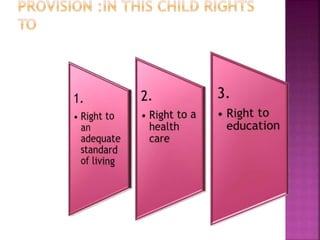
 Classification of children’s rights according
UNCRC:
United Nations educational guides for
children classify the rights outlined in
Convention on the rights of child as ‘3P’
provision, Protection and Participation.
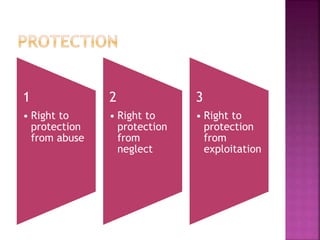
1
• Right to
protection
from abuse
2
• Right to
protection
from
neglect
3
• Right to
protection
from
exploitation
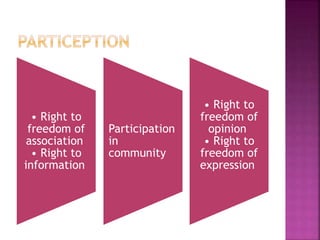
• Right to
freedom of
association
• Right to
information
Participation
in
community
• Right to
freedom of
opinion
• Right to
freedom of
expression
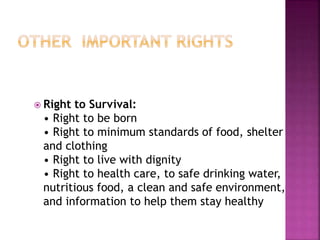
 Right to Survival:
• Right to be born
• Right to minimum standards of food, shelter
and clothing
• Right to live with dignity
• Right to health care, to safe drinking water,
nutritious food, a clean and safe environment,
and information to help them stay healthy
 Right to Survival:
• Right to be born
• Right to minimum standards of food,
shelter and clothing
• Right to live with dignity
• Right to health care, to safe drinking
water, nutritious food, a clean and safe
environment, and information to help them
stay healthy
 Article 24 :- Prohibition of employment of
child in factories. No child below the age of
fourteen yrs shall be employed to work in
factory or mine or engaged in any hazardous
employment.
 Article 39:-The state shall in particular direct
its policy towards securing that the health
and strength of workers men/women and
tender age children are not abused. By this
article children and youth are protected
against exploitation and against moral and
material abandoment.
 Article 45:- Provision of free and compulsory
education for children. The state shall
endeavor to provide within a period of ten
years from the commencement of the
constitution for free and compulsory
education for all children until they
complete the age of fourteen years.
 Child welfare is a continuum of services designed
to ensure that children are safe and that families
have the necessary support to care for their
children successfully.
 Some of the Schemes of child welfare:
 a) Mid- Day Meal Scheme:15 August 1995
 b) Integrated Child Development Services
(ICDS):1975
 c) Sabla Scheme 1 april 2011
 d) Pulse Polio Immunization Programme Dec.1995
 e) Kasturba Gandhi Balika Vidyalaya :Aug 2004
 Observation homes/ Remand homes:-
child taken under charge of under the act and
who are not released on bail are admitted
these homes for further investigation ,
observation and treatment .
In these homes facilities of recreation
,games/outdoor activities are provided and
probation officer studies the child cases,makes
inquary, and observe behaviour of child.
 Under the children's amendment act 1978
delinquent children needing institutional
care are sent to specials schools and
neglected children needy for institutional
care sent to childrens home for provide care
,education , training and treatment to the
needy children.
 It bans child for working below 14 years.
 It aims to identify processes and industries
which are hazardous which scheduled in
Employment of children act 1938.
 Banning child labor in these industries and
regulating the condition of work of non
hazardous industries.
 Came into force 1 Nov. 2007 replaced child
marriage restraint act. 1929
 Child in this act boy below 21 and girl below
18.
 It focus on punishment of person who are
involved child marriage.
 Act also null marriage by any party petition
in court if victim is minor.
 It covers Child age 16 for boys girls for 18
years.
 It provides care , maintenance , welfare
,training, education and rehabilitation of
delinquent child .
 It covers neglected child , the destitute , the
socially handicapped , uncontrollable ,
victimized and delinquent children.
 It covers child till age 18 but some situation
child crime like a adult than allow court to
charge as adult (16-18)
 It provide for comprehensive scheme for care,
protection treatment, development and
rehabilitation of delinquent juveniles.
 It provide uniform legal framework all over
country.
 It establish norms and standard for
administration of juvenile justice in term of
investigation ,care, treatment and
rehabilitation.
 It have specialized approach toward prevention
and treatment juvenile delinquency in keeping
with the developmental needs of children.
 The Government has adopted a new National Policy for Children, 2013
on 26th April, 2013.
 The Policy recognizes every person below the age of eighteen years as
a child and covers all children within the territory and jurisdiction of
the country.
 It recognizes that a multispectral and multidimensional approach is
necessary to secure the rights of children.
 The Policy has identified four key priority areas:
 survival, health and nutrition;
 education and development;
 Protection
 participation, for focused attention.
 As children’s needs are multi-sectoral, interconnected and require
collective action, the Policy calls for purposeful convergence and
coordination across different sectors and levels of governance.

Childrens right and child welfare

  • 1.
    RIGHTS OF CHILDREN PRESENTEDBY : K.R.LOYAL M.Sc.(N) PREVIOUS GCON JAIPUR
  • 2.
    The constitution ofIndia guarantees equality before the law to all citizens and pledge special protection for children. Every child has rights to lead a decent life. In India 40% of total population are children and status of child is yet not good yet in India.
  • 3.
    Child- according toUNCRC. A CHILD is any human being below the age of 18 years. In India according central children act 1960 a “child “ as boy who not attained the age 16 and a girl who not attained age 18 year is a child. Child rights:- are specialized human rights that apply to all human beings below the age of 18 year.
  • 4.
    Milestone in childcare in world in concern child rights: 1946: UN establishes United Nations international children emergency fund. 1959: The 14th General assembly of the United Nations approved the declaration of the rights of child.
  • 5.
     The Conventionon the Rights of the Child enters into force on 2 September 1990 – representing the most rapid entry-into-force of any human rights treaty. The World Summit for Children is held in New York in September. The Summit adopts the World Declaration on Survival, Protection, Development of Children and a plan of action -- together setting forth a vision of a ‘first call’ for children. The Summit represents the high point to date of a four-decade effort by UNICEF to place children’s needs at the top of the world’s agenda.
  • 6.
     1992: Indiaaccepted the obligations of UN Convention on the child rights of child (UNCRC) 2005: formation of national commission for protection of child rights. 2005: A national plan of action for children. 2009: Right to education.
  • 7.
     Classification ofchildren’s rights according UNCRC: United Nations educational guides for children classify the rights outlined in Convention on the rights of child as ‘3P’ provision, Protection and Participation.
  • 9.
    1 • Right to protection fromabuse 2 • Right to protection from neglect 3 • Right to protection from exploitation
  • 10.
    • Right to freedomof association • Right to information Participation in community • Right to freedom of opinion • Right to freedom of expression
  • 11.
     Right toSurvival: • Right to be born • Right to minimum standards of food, shelter and clothing • Right to live with dignity • Right to health care, to safe drinking water, nutritious food, a clean and safe environment, and information to help them stay healthy
  • 12.
     Right toSurvival: • Right to be born • Right to minimum standards of food, shelter and clothing • Right to live with dignity • Right to health care, to safe drinking water, nutritious food, a clean and safe environment, and information to help them stay healthy
  • 13.
     Article 24:- Prohibition of employment of child in factories. No child below the age of fourteen yrs shall be employed to work in factory or mine or engaged in any hazardous employment.  Article 39:-The state shall in particular direct its policy towards securing that the health and strength of workers men/women and tender age children are not abused. By this article children and youth are protected against exploitation and against moral and material abandoment.
  • 14.
     Article 45:-Provision of free and compulsory education for children. The state shall endeavor to provide within a period of ten years from the commencement of the constitution for free and compulsory education for all children until they complete the age of fourteen years.
  • 15.
     Child welfareis a continuum of services designed to ensure that children are safe and that families have the necessary support to care for their children successfully.  Some of the Schemes of child welfare:  a) Mid- Day Meal Scheme:15 August 1995  b) Integrated Child Development Services (ICDS):1975  c) Sabla Scheme 1 april 2011  d) Pulse Polio Immunization Programme Dec.1995  e) Kasturba Gandhi Balika Vidyalaya :Aug 2004
  • 16.
     Observation homes/Remand homes:- child taken under charge of under the act and who are not released on bail are admitted these homes for further investigation , observation and treatment . In these homes facilities of recreation ,games/outdoor activities are provided and probation officer studies the child cases,makes inquary, and observe behaviour of child.
  • 17.
     Under thechildren's amendment act 1978 delinquent children needing institutional care are sent to specials schools and neglected children needy for institutional care sent to childrens home for provide care ,education , training and treatment to the needy children.
  • 18.
     It banschild for working below 14 years.  It aims to identify processes and industries which are hazardous which scheduled in Employment of children act 1938.  Banning child labor in these industries and regulating the condition of work of non hazardous industries.
  • 19.
     Came intoforce 1 Nov. 2007 replaced child marriage restraint act. 1929  Child in this act boy below 21 and girl below 18.  It focus on punishment of person who are involved child marriage.  Act also null marriage by any party petition in court if victim is minor.
  • 20.
     It coversChild age 16 for boys girls for 18 years.  It provides care , maintenance , welfare ,training, education and rehabilitation of delinquent child .  It covers neglected child , the destitute , the socially handicapped , uncontrollable , victimized and delinquent children.
  • 21.
     It coverschild till age 18 but some situation child crime like a adult than allow court to charge as adult (16-18)  It provide for comprehensive scheme for care, protection treatment, development and rehabilitation of delinquent juveniles.  It provide uniform legal framework all over country.  It establish norms and standard for administration of juvenile justice in term of investigation ,care, treatment and rehabilitation.  It have specialized approach toward prevention and treatment juvenile delinquency in keeping with the developmental needs of children.
  • 22.
     The Governmenthas adopted a new National Policy for Children, 2013 on 26th April, 2013.  The Policy recognizes every person below the age of eighteen years as a child and covers all children within the territory and jurisdiction of the country.  It recognizes that a multispectral and multidimensional approach is necessary to secure the rights of children.  The Policy has identified four key priority areas:  survival, health and nutrition;  education and development;  Protection  participation, for focused attention.  As children’s needs are multi-sectoral, interconnected and require collective action, the Policy calls for purposeful convergence and coordination across different sectors and levels of governance.

Editor's Notes