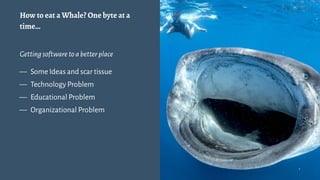
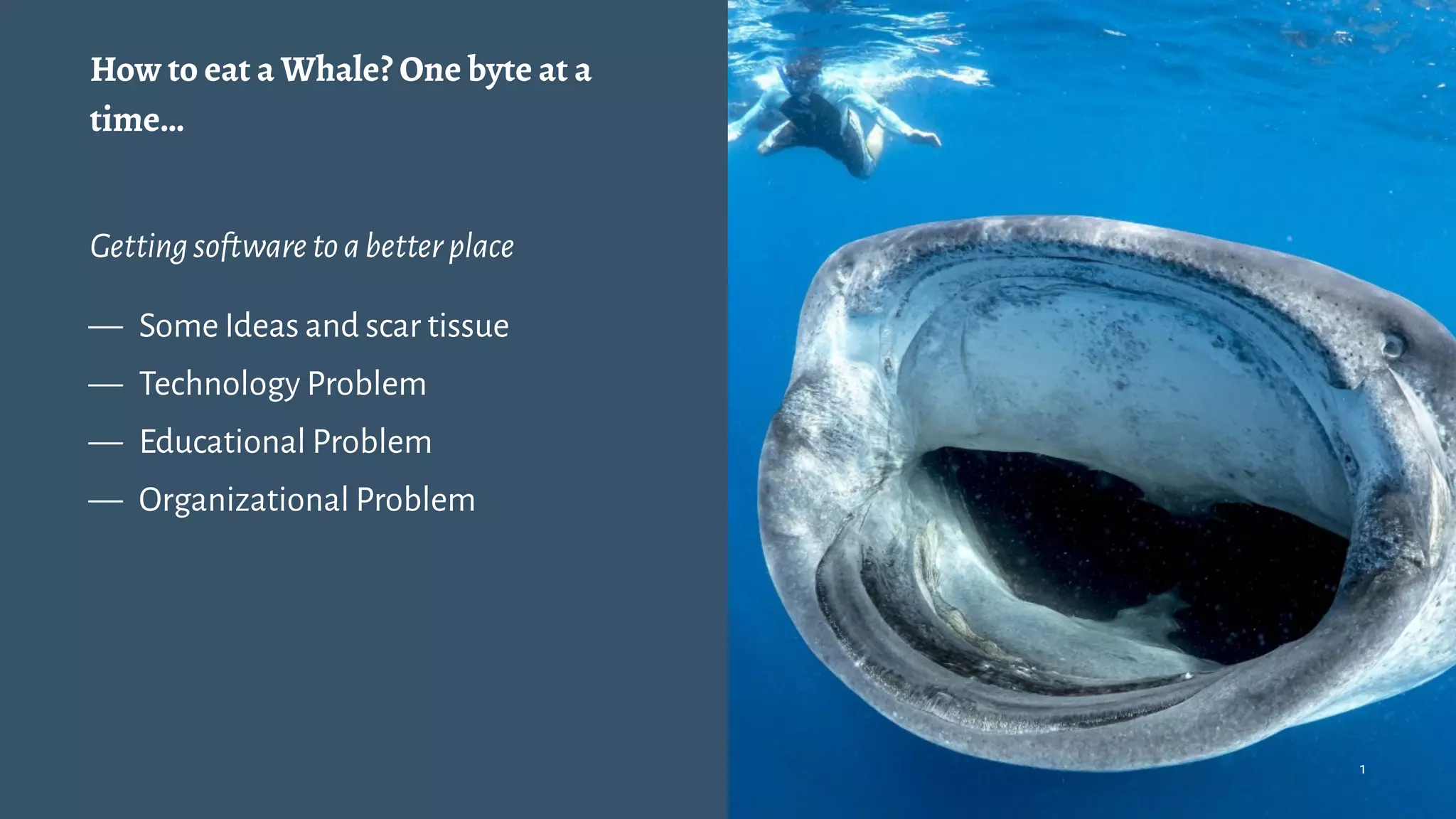
How to eat a Whale? One byte at a
time…
Gettingsoftwaretoabetterplace
— Some Ideas and scar tissue
— Technology Problem
— Educational Problem
— Organizational Problem
1
Overall Situation:
— We have an existing system that works but needs new capabilities
— We want to move to Microservices/Containers,Comprehensive
Monitoring,Service Discovery,and Advanced Orchestration
— Need to get to stateless and immutable services
— We don't have time or are scared shitless of a rewrite
(for good reason)
2
Potentially Fatal Mistakes
— Underestimating what you have
— Trying to deliver too much at once
— Be Agile even if you weren't
originally
— Not thinking about code,state,and
data together
— Transient technology choices
— Run before walking-complexity
— You get better over time,plan for it
3
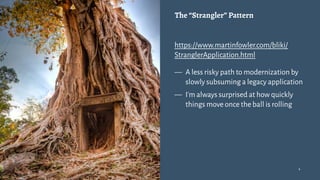
The “Strangler” Pattern
https://www.martinfowler.com/bliki/
StranglerApplication.html
— A less risky path to modernization by
slowly subsuming a legacy application
— I'm always surprised at how quickly
things move once the ball is rolling
4
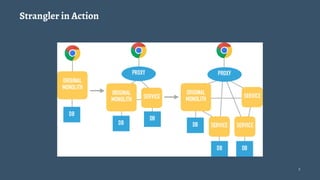
Strangler in Action
5
First Steps:
1. Find a way to run old and new together
— And talk to each other…
2. Write new features in the new
framework
3. Pick stuff to change or replace
4. Put new tools in the context of existing
tools
6
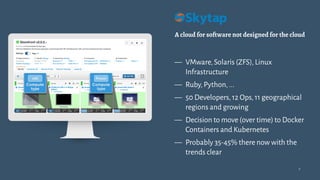
A cloud for software not designed for the cloud
— VMware,Solaris (ZFS),Linux
Infrastructure
— Ruby,Python,...
— 50 Developers,12 Ops,11 geographical
regions and growing
— Decision to move (over time) to Docker
Containers and Kubernetes
— Probably 35-45% there now with the
trends clear
7
Technology Problem: Dealing with
technical change
— Developers don't like tools to change
— Release management process is
usually built into technical tools you're
already using
— Kube-native vs traditional CI/CD
— Fits new deployment paradigm
exactly
— Require re-education
— Hides complexity
8
Skytap CI/CD and Kube
— Started in 2015,at the time there were almost no native kube CI/CD
tools
— We deploy ~ 150 third-party and in-house services on ~ 800 machines
running in 11 georgraphical regions
— We have custom CI/CD tools built on top of Capistrano and Jenkins
— We always did source deployment without artifact generation,we'd
just update source to certain tag
— We went with integrating kubernetes with our existing CI/CD
framework
9
Our experience
— All new services since end of 2015 are
running on kubernetes
— All in-house high churn services
converted to kubernetes by now
— We spent around around 1.5
developer/years to adapt kubernetes in
our existing CI/CD
— We didn't have to change our release
process and it looks the same for both
engineers,QA and Operations
10
Testability of conversion
— Deployment tools and deployments
themselves are usually hardest to test
— If you have shared test or
preproduction environment and your
deployment failed,you can't get"clean"
reproduction on the same
environment
— Skytap built tool that nightly creates
test/preprod environments from
scratch
— We were able to release our
kubernetes conversion changes early
11
Educational problem
— Containers are still new enough that
pushback from core engineers can turn
company against them
— Good education and support for
developers would guarantee smooth
transition
— Retaining CI/CD tools can save bunch
of time regarding re-educating
developers
— New paradigms are still introduced
— Dedicated Slack channel for
12
Skytap experience
— Developers directly responsible for image generation,before they
split os image and dependency management with operations team
— Major areas Skytap Tools team had to teach developers were:
— Dependency management,pinning third-party dependencies to
exact versions during build
— Dockerfile syntax and caching of images for faster builds
— Implementing readiness and liveliness health checks for
kubernetes
— Estimating resource usage and setting correct requests and limits
13
Organizational problem
— Major challenge is creating a team that
can drive kubernetes changes
— Perfect team members would have:
1. Technical ability to understand
kubernetes internals
2. Architectural knowledge
understand existing release
management and deployment
practices and rationale
— Team should be driven enough not to
give up
14
Results
— At this point all the kubernetes enablement is mostly done
— Teams are moving to kubernetes at their own pace
— 2 people on the team consult rest of organization full time
15

How to eat a whale?

  • 1.
    How to eata Whale? One byte at a time… Gettingsoftwaretoabetterplace — Some Ideas and scar tissue — Technology Problem — Educational Problem — Organizational Problem 1
  • 2.
    Overall Situation: — Wehave an existing system that works but needs new capabilities — We want to move to Microservices/Containers,Comprehensive Monitoring,Service Discovery,and Advanced Orchestration — Need to get to stateless and immutable services — We don't have time or are scared shitless of a rewrite (for good reason) 2
  • 3.
    Potentially Fatal Mistakes —Underestimating what you have — Trying to deliver too much at once — Be Agile even if you weren't originally — Not thinking about code,state,and data together — Transient technology choices — Run before walking-complexity — You get better over time,plan for it 3
  • 4.
    The “Strangler” Pattern https://www.martinfowler.com/bliki/ StranglerApplication.html —A less risky path to modernization by slowly subsuming a legacy application — I'm always surprised at how quickly things move once the ball is rolling 4
  • 5.
  • 6.
    First Steps: 1. Finda way to run old and new together — And talk to each other… 2. Write new features in the new framework 3. Pick stuff to change or replace 4. Put new tools in the context of existing tools 6
  • 7.
    A cloud forsoftware not designed for the cloud — VMware,Solaris (ZFS),Linux Infrastructure — Ruby,Python,... — 50 Developers,12 Ops,11 geographical regions and growing — Decision to move (over time) to Docker Containers and Kubernetes — Probably 35-45% there now with the trends clear 7
  • 8.
    Technology Problem: Dealingwith technical change — Developers don't like tools to change — Release management process is usually built into technical tools you're already using — Kube-native vs traditional CI/CD — Fits new deployment paradigm exactly — Require re-education — Hides complexity 8
  • 9.
    Skytap CI/CD andKube — Started in 2015,at the time there were almost no native kube CI/CD tools — We deploy ~ 150 third-party and in-house services on ~ 800 machines running in 11 georgraphical regions — We have custom CI/CD tools built on top of Capistrano and Jenkins — We always did source deployment without artifact generation,we'd just update source to certain tag — We went with integrating kubernetes with our existing CI/CD framework 9
  • 10.
    Our experience — Allnew services since end of 2015 are running on kubernetes — All in-house high churn services converted to kubernetes by now — We spent around around 1.5 developer/years to adapt kubernetes in our existing CI/CD — We didn't have to change our release process and it looks the same for both engineers,QA and Operations 10
  • 11.
    Testability of conversion —Deployment tools and deployments themselves are usually hardest to test — If you have shared test or preproduction environment and your deployment failed,you can't get"clean" reproduction on the same environment — Skytap built tool that nightly creates test/preprod environments from scratch — We were able to release our kubernetes conversion changes early 11
  • 12.
    Educational problem — Containersare still new enough that pushback from core engineers can turn company against them — Good education and support for developers would guarantee smooth transition — Retaining CI/CD tools can save bunch of time regarding re-educating developers — New paradigms are still introduced — Dedicated Slack channel for 12
  • 13.
    Skytap experience — Developersdirectly responsible for image generation,before they split os image and dependency management with operations team — Major areas Skytap Tools team had to teach developers were: — Dependency management,pinning third-party dependencies to exact versions during build — Dockerfile syntax and caching of images for faster builds — Implementing readiness and liveliness health checks for kubernetes — Estimating resource usage and setting correct requests and limits 13
  • 14.
    Organizational problem — Majorchallenge is creating a team that can drive kubernetes changes — Perfect team members would have: 1. Technical ability to understand kubernetes internals 2. Architectural knowledge understand existing release management and deployment practices and rationale — Team should be driven enough not to give up 14
  • 15.
    Results — At thispoint all the kubernetes enablement is mostly done — Teams are moving to kubernetes at their own pace — 2 people on the team consult rest of organization full time 15