CM MatchPoint Agile
Christoph Heinrich, CM First
This sessions shows how to use CM MatchPoint for the
management and automated deployments in agile projects
using frameworks like SCRUM
Christoph Heinrich
• CM First Group
• Based in Salt Lake City, USA
• With CA Plex/CA 2E for 20+ years
Speaker Bio
• CM First Group
• Agile Application Lifecycle Management – DevOps
• SCRUM
• CM MatchPoint for Agile Projects
• CM MatchPoint Roadmap
• Q&A
Agenda
• IT Services and Product Company
• Focus on Application Modernization on IBM environments
• Headquartered in Switzerland, Operations in USA, and France
• 35 employees / over 400 customers
• CA Technologies Partner for CA Plex / CA 2E / CA Repository
– Sales, Services, CA SMART Certified Products
• CM First Products add value to CA Technologies Products
CM First Group
• CA 2E Services
– Education
– Install / Upgrades
– Audit / Best Practices
– ALM – CA 2E
CM/Implementer
– Web Option / Web Services
– Staff Augmentation
– PDS Partner for Europe
CM First Group – our Services
• CA Plex Services
– Education
– Install / Upgrades
– Audit / Best Practices
– Platform Migrations
 RPG/C++ to C#/Java
 IBM i to Windows/Linux
– Web Services, Web/Mobile
Apps
– ALM – CM Matchpoint
– Staff Augmentation
– PDS Partner for Europe
• CM WebClient
– Plug-in HTML5/JavaScript generator for CA Plex, generates directly from CA Plex models
without a rewrite
• CM MatchPoint ALM
– Application Lifecycle Management for CA Plex/CA 2E and IBM I
• CM M3
– Transforms CA 2E models to CA Plex, generate web/mobile versions in Java, and
replatform to Windows/Linux/Cloud
• Worksoft Certify for CA Plex Integration
– Test Plex C++ Apps with complex UI’s using Worksoft Certify. 5250, Java, Web, Mobile
testing also available (no integration necessary)
• CM MetaAnalytics
– Analyze zOS applications (Java, ASM, JCL, COBOL) for component connectivity and
quality metrics. Load results to CA Repository.
CM First Group – our Products
DevOps
Agile - DevOps
DevOps Lifecycle
Source: IBM SoftwareTechnical White Paper
• CA Technologies
– A recent global study, commissioned by CA Technologies,
which canvassed 1 300 senior IT decision-makers worldwide,
revealed respondents had seen a 17% to 23% improvement
with regards to increased earnings, shorter time-to-market,
heightened competitiveness and greater customer
satisfaction due to their DevOps initiatives
• Other studies show similar or higher improvements
DevOps
Agile Adoption
Source. Forrester
Agile Adoption - continued
Agile adoption – continued
Source. Forrester
Agile vs. Waterfall
Agile is….
– Quick — Can handle projects as short as a couple of
weeks
– Iterative — Agile is built around a constant feedback loop
– Continuous — Agile focuses on continuous integration,
test and deployment
– Verifiable — With a definition of done that is transparent
and verifiable, project progress is quickly apparent
Agile vs. Waterfall
But Agile is also…
– Not a silver bullet — Agile exposes problems early, but
does not solve all of them
– Disruptive — Agile requires significant changes to culture,
governance and IT's interactions with the rest of
organization
– Less mature — Over a dozen years old, but new to many
organizations
– Harder to outsource — Does not fit fixed bid contract
model
Let’s look at
SCRUM
an agile framework
www.scrum.org
SCRUM – an agile framework
SCRUM
• Scrum is..
– Lightweight
– Simple to understand
– Extremely difficult to master
• 3 Pillars of Scrum
– Transparency
– Inspection
– Adaption
SCRUM Overview
SCRUM Artifacts
• Product Backlog
– Ordered
– Items at the top are more granular than items at the bottom
– Maintained/re-ordered during the Backlog Grooming effort by Product
Owner
• Sprint Backlog
– Committed items negotiated between team and Product Owner in Sprint
Planning Meeting
– Scope commitment is fixed during Sprint execution
• Increment
– Sum of all Product Backlog items completed during a Sprint and all
previous Sprints which produce a new increment that must be ‘Done’
– Usable condition regardless of Product Owner readiness to release it
SCRUM Roles
• Product Owner
– Responsible for maximizing the value of the Product and the
work of the Dev team.
– Responsible for managing the Product Backlog
• Scrum Master
– Responsible for ensuring Scrum is understood and enacted
– Servant-leader for Scrum team
• Development Team
– Cross-functional team who produce a potentially releasable
increment of ‘Done’ at the end of each sprint
– Only members of this team create the increment
SCRUM Rules
• Definition of ‘Done’
– When a Product Backlog Item or Increment is described
as ‘Done’, everyone needs a common understanding
– Shared understanding is the key as this definition drives
the amount of Product Backlog Items the team can select
during a Sprint
– Increments are usable; Product Owner may choose to
immediately release it
SCRUM Events / 1
• Sprint
– Time boxed at 4 weeks or less in which a ‘Done’, usable, and
potentially releasable increment is created
– Consistent duration and are continuous
• Sprint Planning Meeting
– Time boxed at 8 hours for a 4 week Sprint
– Plans the work to be performed in the Sprint
– Two parts: 1) What will be delivered, 2) How will it be delivered
• Daily Scrum
– Time boxed at 15 minutes/day
– Finished, going to finish, obstacles/impediments today
SCRUM Events / 2
• Sprint Review
– Time boxed at 4 hours for a 4 week Sprint
– Inspect the increment/Adapt the backlog
– Elicit feedback and foster collaboration
• Sprint Retrospective
– Time boxed at 3 hours for a 4 week Sprint
– Team self-inspection and creation of a plan for improving
execution
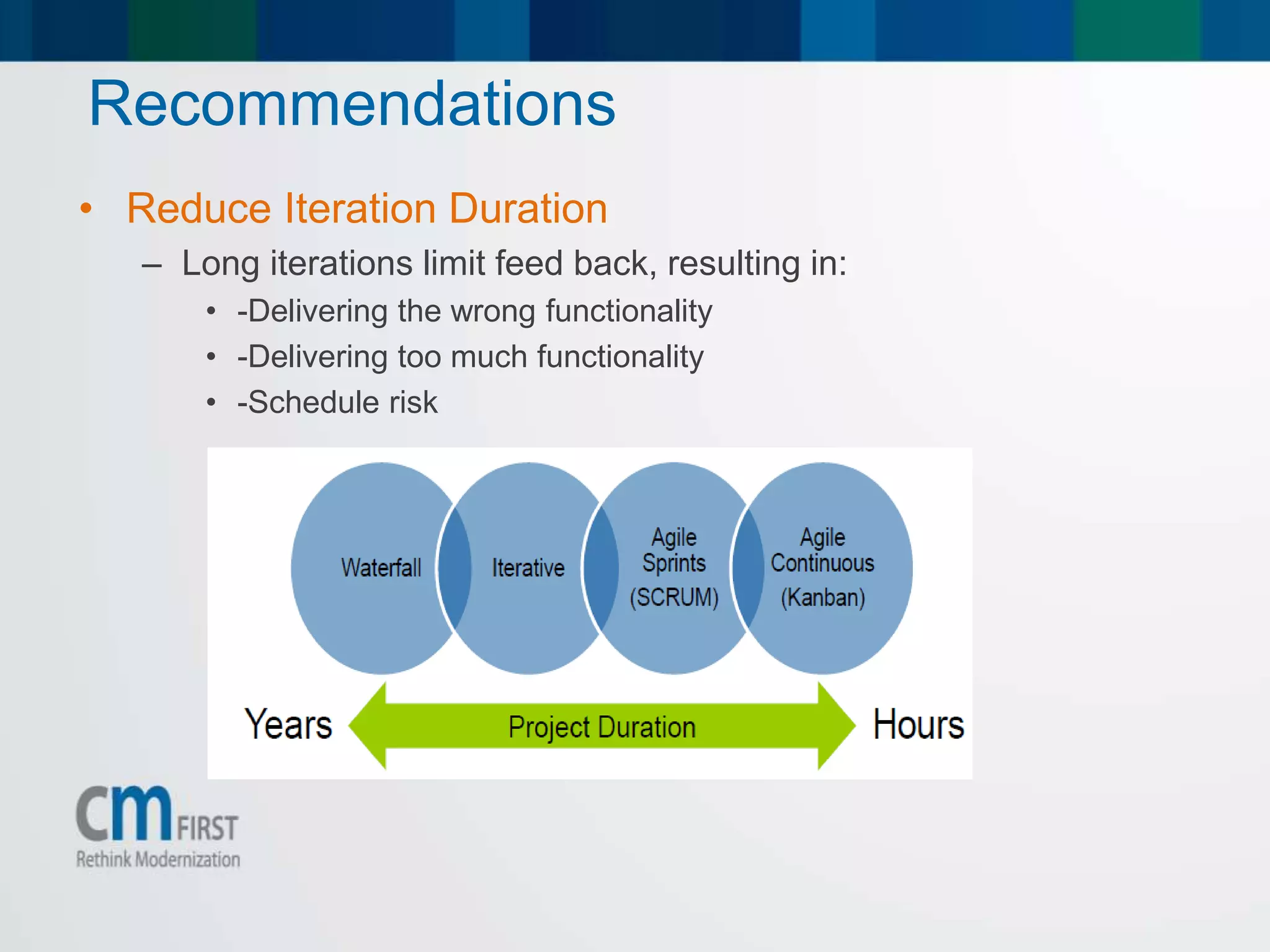
Recommendations
• Reduce Iteration Duration
– Long iterations limit feed back, resulting in:
• -Delivering the wrong functionality
• -Delivering too much functionality
• -Schedule risk
Recommendations - continued
Automate Deployment and Test
CM MatchPoint Overview
• Cover the complete process
Demo
CM MatchPoint Agile
• Manage Agile Projects
– Manage user stories/tickets/use cases -> Backlog
– Plan, prioritize, order, specify, assign resources
– Execute sprints, work on sprint backlog items
– Monitor progress
– Deploy changes
• Transparency
– Reports
Demo
CM MatchPoint ALM Roadmap
• Agile
– Acceptance Criteria
– Test Automation Integration
– Managing Sprints, Sprint Teams
– UI Improvements: Tabs, Drag and Drop of Stories
between sprints and states
• Deployment
– Improved support for Code Libraries / .Net development
– Automatic rollback of deployments
• Management
– Task management and templates
• Platform
– SQL Server Backend
• Moving towards Agile / DevOps
– Short Cycles
– Transparency, Inspection, Adaption
• CM MatchPoint ALM
– Integration of CA Plex model management and model objects
– Setup for Agile/SCRUM
– AUTOMATION is crucial for Agile/DevOPs
Summary

CM MatchPoint Agile Session

  • 1.
    CM MatchPoint Agile ChristophHeinrich, CM First This sessions shows how to use CM MatchPoint for the management and automated deployments in agile projects using frameworks like SCRUM
  • 2.
    Christoph Heinrich • CMFirst Group • Based in Salt Lake City, USA • With CA Plex/CA 2E for 20+ years Speaker Bio
  • 3.
    • CM FirstGroup • Agile Application Lifecycle Management – DevOps • SCRUM • CM MatchPoint for Agile Projects • CM MatchPoint Roadmap • Q&A Agenda
  • 4.
    • IT Servicesand Product Company • Focus on Application Modernization on IBM environments • Headquartered in Switzerland, Operations in USA, and France • 35 employees / over 400 customers • CA Technologies Partner for CA Plex / CA 2E / CA Repository – Sales, Services, CA SMART Certified Products • CM First Products add value to CA Technologies Products CM First Group
  • 5.
    • CA 2EServices – Education – Install / Upgrades – Audit / Best Practices – ALM – CA 2E CM/Implementer – Web Option / Web Services – Staff Augmentation – PDS Partner for Europe CM First Group – our Services • CA Plex Services – Education – Install / Upgrades – Audit / Best Practices – Platform Migrations  RPG/C++ to C#/Java  IBM i to Windows/Linux – Web Services, Web/Mobile Apps – ALM – CM Matchpoint – Staff Augmentation – PDS Partner for Europe
  • 6.
    • CM WebClient –Plug-in HTML5/JavaScript generator for CA Plex, generates directly from CA Plex models without a rewrite • CM MatchPoint ALM – Application Lifecycle Management for CA Plex/CA 2E and IBM I • CM M3 – Transforms CA 2E models to CA Plex, generate web/mobile versions in Java, and replatform to Windows/Linux/Cloud • Worksoft Certify for CA Plex Integration – Test Plex C++ Apps with complex UI’s using Worksoft Certify. 5250, Java, Web, Mobile testing also available (no integration necessary) • CM MetaAnalytics – Analyze zOS applications (Java, ASM, JCL, COBOL) for component connectivity and quality metrics. Load results to CA Repository. CM First Group – our Products
  • 7.
  • 8.
  • 9.
    DevOps Lifecycle Source: IBMSoftwareTechnical White Paper
  • 10.
    • CA Technologies –A recent global study, commissioned by CA Technologies, which canvassed 1 300 senior IT decision-makers worldwide, revealed respondents had seen a 17% to 23% improvement with regards to increased earnings, shorter time-to-market, heightened competitiveness and greater customer satisfaction due to their DevOps initiatives • Other studies show similar or higher improvements DevOps
  • 11.
  • 12.
  • 13.
    Agile adoption –continued Source. Forrester
  • 14.
    Agile vs. Waterfall Agileis…. – Quick — Can handle projects as short as a couple of weeks – Iterative — Agile is built around a constant feedback loop – Continuous — Agile focuses on continuous integration, test and deployment – Verifiable — With a definition of done that is transparent and verifiable, project progress is quickly apparent
  • 15.
    Agile vs. Waterfall ButAgile is also… – Not a silver bullet — Agile exposes problems early, but does not solve all of them – Disruptive — Agile requires significant changes to culture, governance and IT's interactions with the rest of organization – Less mature — Over a dozen years old, but new to many organizations – Harder to outsource — Does not fit fixed bid contract model
  • 16.
    Let’s look at SCRUM anagile framework www.scrum.org
  • 17.
    SCRUM – anagile framework
  • 18.
    SCRUM • Scrum is.. –Lightweight – Simple to understand – Extremely difficult to master • 3 Pillars of Scrum – Transparency – Inspection – Adaption
  • 19.
  • 20.
    SCRUM Artifacts • ProductBacklog – Ordered – Items at the top are more granular than items at the bottom – Maintained/re-ordered during the Backlog Grooming effort by Product Owner • Sprint Backlog – Committed items negotiated between team and Product Owner in Sprint Planning Meeting – Scope commitment is fixed during Sprint execution • Increment – Sum of all Product Backlog items completed during a Sprint and all previous Sprints which produce a new increment that must be ‘Done’ – Usable condition regardless of Product Owner readiness to release it
  • 21.
    SCRUM Roles • ProductOwner – Responsible for maximizing the value of the Product and the work of the Dev team. – Responsible for managing the Product Backlog • Scrum Master – Responsible for ensuring Scrum is understood and enacted – Servant-leader for Scrum team • Development Team – Cross-functional team who produce a potentially releasable increment of ‘Done’ at the end of each sprint – Only members of this team create the increment
  • 22.
    SCRUM Rules • Definitionof ‘Done’ – When a Product Backlog Item or Increment is described as ‘Done’, everyone needs a common understanding – Shared understanding is the key as this definition drives the amount of Product Backlog Items the team can select during a Sprint – Increments are usable; Product Owner may choose to immediately release it
  • 23.
    SCRUM Events /1 • Sprint – Time boxed at 4 weeks or less in which a ‘Done’, usable, and potentially releasable increment is created – Consistent duration and are continuous • Sprint Planning Meeting – Time boxed at 8 hours for a 4 week Sprint – Plans the work to be performed in the Sprint – Two parts: 1) What will be delivered, 2) How will it be delivered • Daily Scrum – Time boxed at 15 minutes/day – Finished, going to finish, obstacles/impediments today
  • 24.
    SCRUM Events /2 • Sprint Review – Time boxed at 4 hours for a 4 week Sprint – Inspect the increment/Adapt the backlog – Elicit feedback and foster collaboration • Sprint Retrospective – Time boxed at 3 hours for a 4 week Sprint – Team self-inspection and creation of a plan for improving execution
  • 25.
    Recommendations • Reduce IterationDuration – Long iterations limit feed back, resulting in: • -Delivering the wrong functionality • -Delivering too much functionality • -Schedule risk
  • 26.
  • 27.
    CM MatchPoint Overview •Cover the complete process Demo
  • 28.
    CM MatchPoint Agile •Manage Agile Projects – Manage user stories/tickets/use cases -> Backlog – Plan, prioritize, order, specify, assign resources – Execute sprints, work on sprint backlog items – Monitor progress – Deploy changes • Transparency – Reports Demo
  • 29.
    CM MatchPoint ALMRoadmap • Agile – Acceptance Criteria – Test Automation Integration – Managing Sprints, Sprint Teams – UI Improvements: Tabs, Drag and Drop of Stories between sprints and states • Deployment – Improved support for Code Libraries / .Net development – Automatic rollback of deployments • Management – Task management and templates • Platform – SQL Server Backend
  • 30.
    • Moving towardsAgile / DevOps – Short Cycles – Transparency, Inspection, Adaption • CM MatchPoint ALM – Integration of CA Plex model management and model objects – Setup for Agile/SCRUM – AUTOMATION is crucial for Agile/DevOPs Summary

Editor's Notes

  • #18 Explain example with Ball Delivery Game: Rule 1: Each team will execute the following recurring 5 minute “Sprint” pattern: • Plan: 1 minute • Execute: 2 minutes • Review: 1 minute • Retrospect: 1 minute • Rule 2: Each “Execute” (time boxed) will require the team to gain as many points as possible. • Rule 3: A point is earned by the originator of the ball delivery getting a ball back in their hands. • Rule 4: One team member is designated as the “starter”. Starter begins to deliver the ball to team members. Each time a ball returns back to the starter, team earns 1 point. • Rule 5: Each person on the team must touch the ball, one person at a time. • Rule 6: Passing the ball requires air time (no hand-off) • Rule 7: Passing the ball to your immediate neighbor (on right or left) is not allowed.
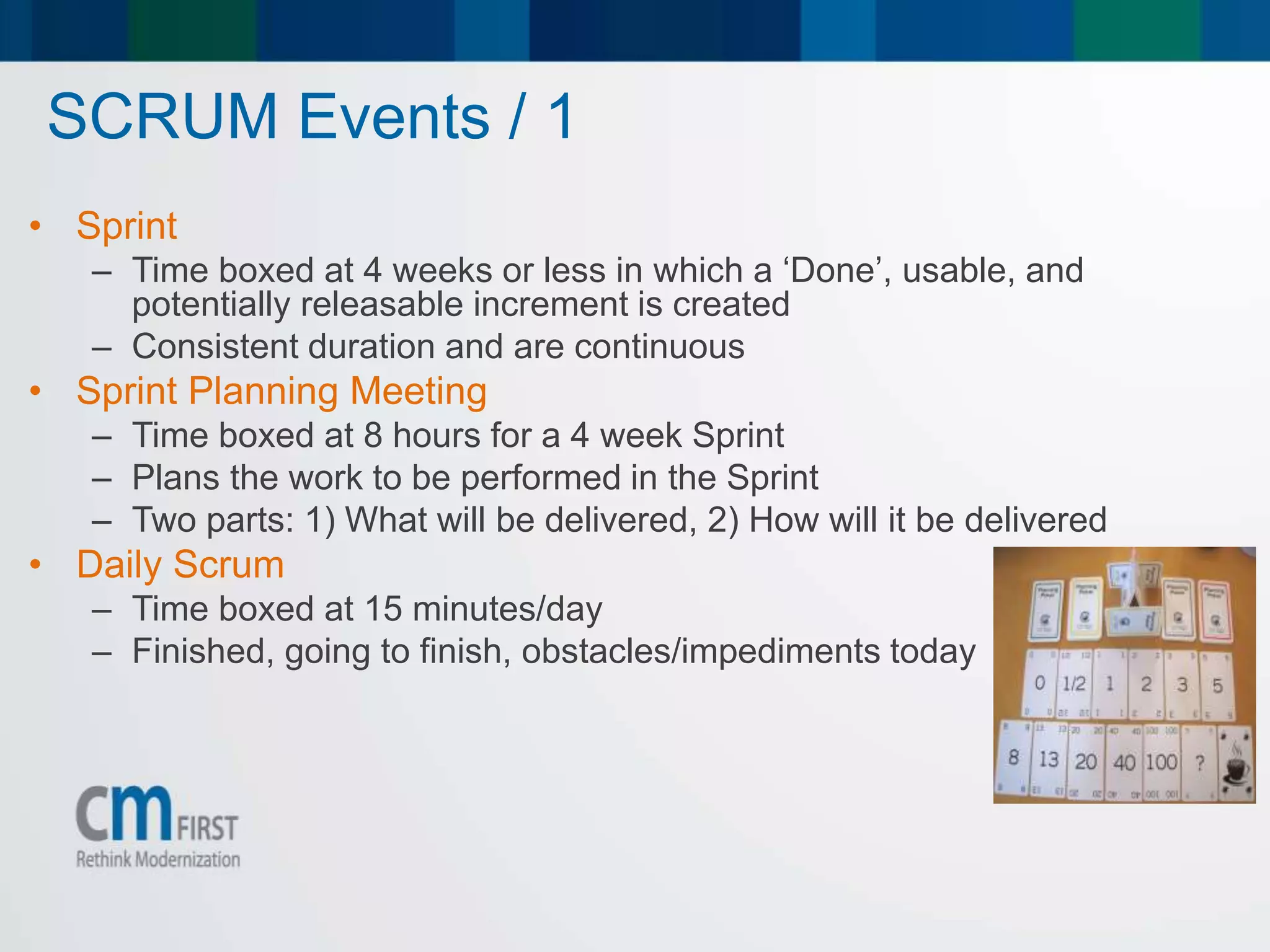
  • #24 Fibonacci numbers for Planning poker: 1,2,3,5,8,13,21,34,55,89 ,144