How to create a SaaS sales
compensation plan.
A guide by Married2Growth.
Creating your first compensation plan
can be daunting.
Here are a few tips to get you
started building your own
sales compensation plan.
1. Determine the
on-target earnings
for your team.
On-target earnings (OTE) (also called
total target comp, TTC) are what
someone will make if they hit quota.
So, your first mission is to determine
your OTE for all sales team members—
your AEs, SDRs, sales engineers and
various support/operations roles.
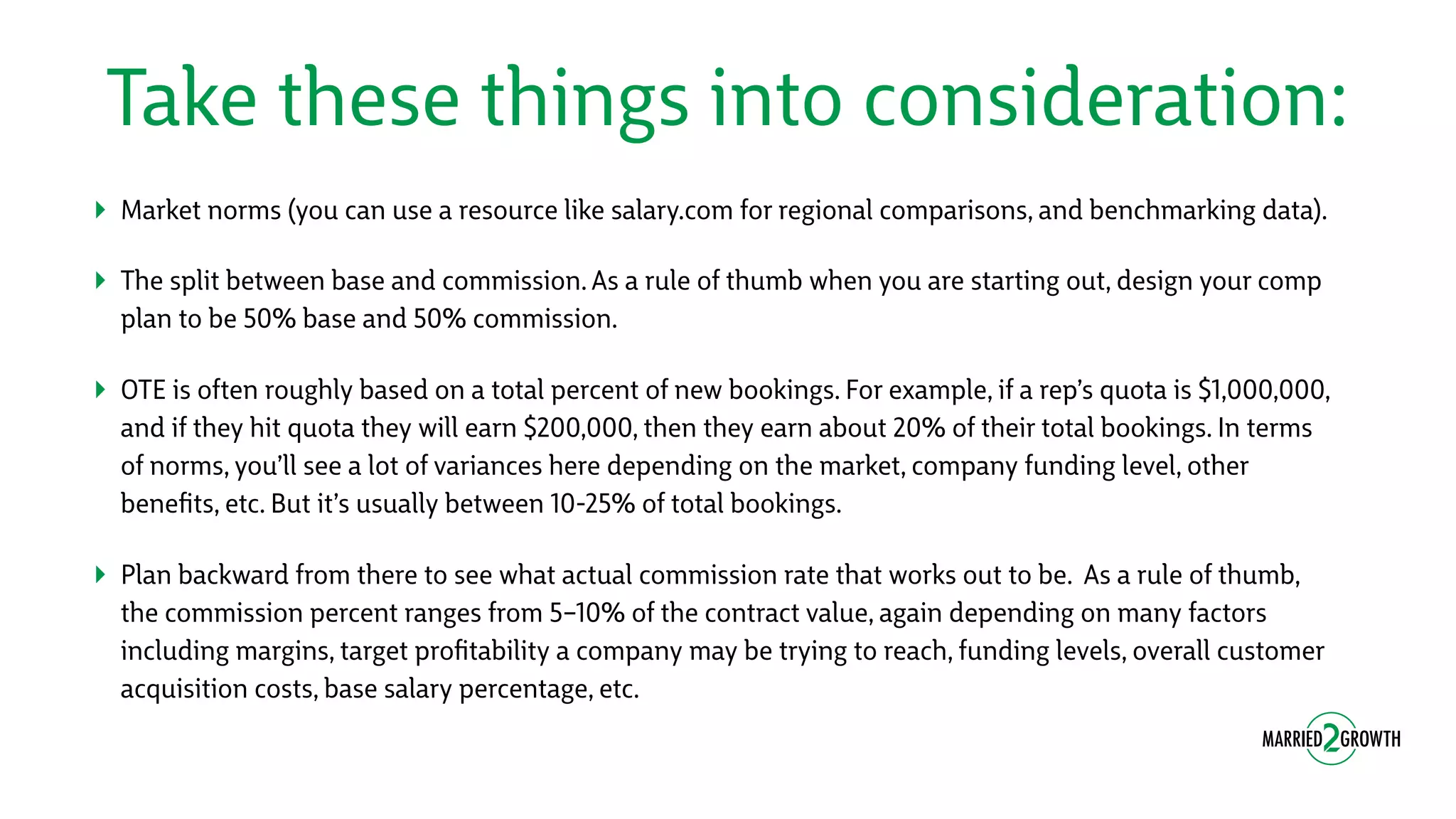
Take these things into consideration:
‣ Market norms (you can use a resource like salary.com for regional comparisons, and benchmarking data).
‣ The split between base and commission. As a rule of thumb when you are starting out, design your comp
plan to be 50% base and 50% commission.
‣ OTE is often roughly based on a total percent of new bookings. For example, if a rep’s quota is $1,000,000,
and if they hit quota they will earn $200,000, then they earn about 20% of their total bookings. In terms
of norms, you’ll see a lot of variances here depending on the market, company funding level, other
benefits, etc. But it’s usually between 10-25% of total bookings.
‣ Plan backward from there to see what actual commission rate that works out to be. As a rule of thumb,
the commission percent ranges from 5–10% of the contract value, again depending on many factors
including margins, target profitability a company may be trying to reach, funding levels, overall customer
acquisition costs, base salary percentage, etc.
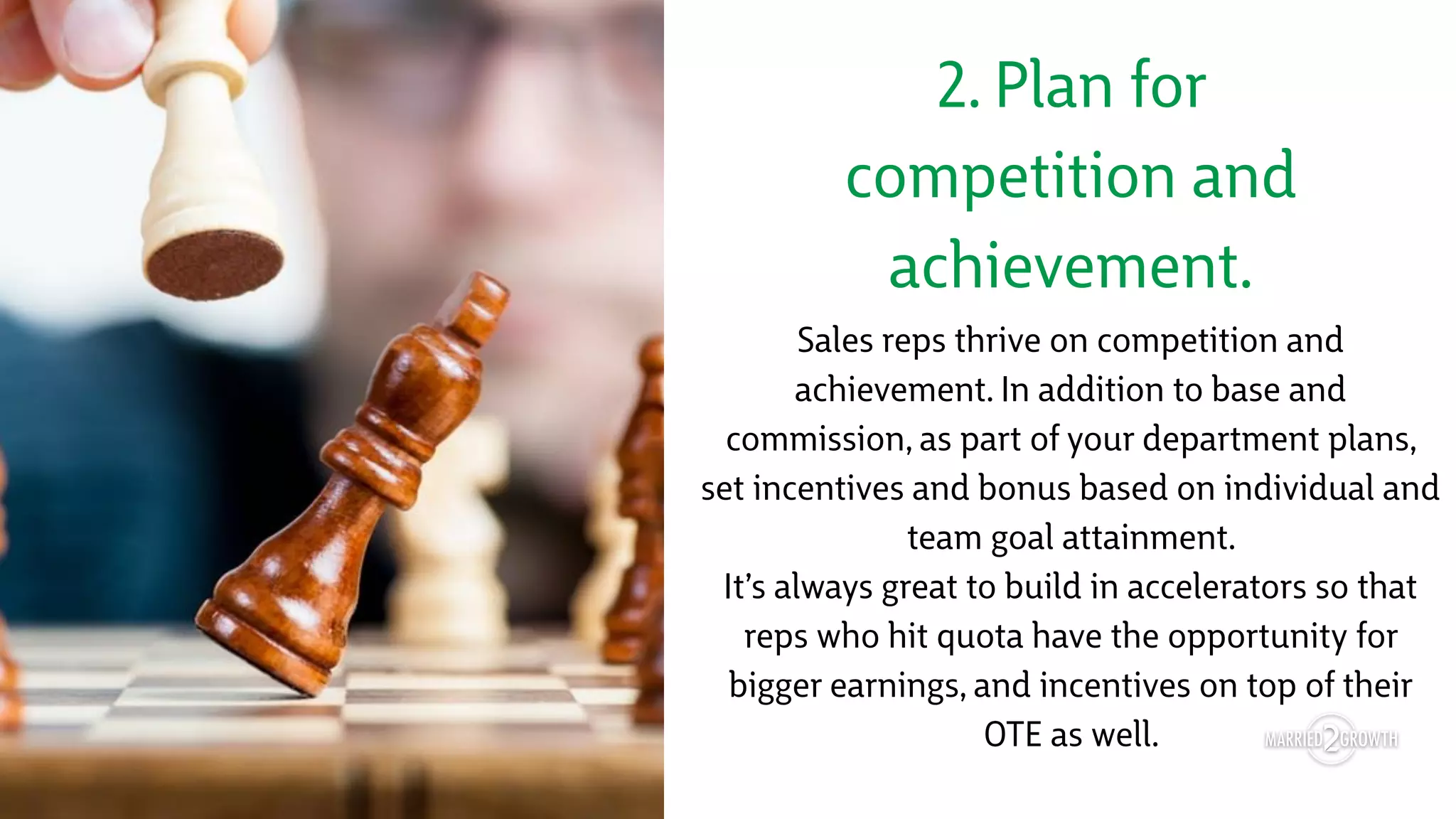
2. Plan for
competition and
achievement.
Sales reps thrive on competition and
achievement. In addition to base and
commission, as part of your department plans,
set incentives and bonus based on individual and
team goal attainment.
It’s always great to build in accelerators so that
reps who hit quota have the opportunity for
bigger earnings, and incentives on top of their
OTE as well.
3. Think through
all the details.
Of course, planning for commission rates, OTE,
and overall costs is your most important mission,
but don’t forget the details as well.
Will all people in a role have the same comp plan,
or will you provide different base/commission
based on experience level or tenure?
Ask yourself the easy questions, the difficult
questions and all questions in between.

Leave no stone unturned when building your
SaaS sales compensation plan.
More on the details:
‣ Plan holistically—it’s not just the AE’s you are compensating with commission. You will
need some level of incentives, bonus or commission for roles like sales operations, sales
engineers, SDRs, etc.

Look at costs across the entire team to ensure you are hitting the right cost of sales targets
you (or your manager) have set.
‣ Be strategic when considering your comp plan because you get what you incentivize.

Want longer or non-cancelable contracts? Make the commission higher on those.

Want to sell more deals with services attached to them? Pay a higher commission on
services.

Want to focus on the sheer number of new customers, not contract value? Bonus those who
close the most customers in a month/quarter/year.

Whatever you incentivize is, without a doubt, is what you will get, so consider carefully.
Remember to keep it simple!
If your comp plan is hard to understand or overly complex it will be a
burden on you and your team.
Keep it as straightforward and simple as you possibly can, and remember
that you always get what you incentivize.
Use these tips to get started on your
SaaS sales compensation plan today!
Want more?
These slides were inspired by “How to Create a SaaS Sales Compensation Plan”
on the Married2Growth blog.
Visit us for more stuff like this!
Thank you!
We hope this was helpful, and we’d love to hear from you!
info@married2growth.com
THE BUSINESS OF SaaS

How to create a SaaS sales compensation plan.

  • 1.
    How to createa SaaS sales compensation plan. A guide by Married2Growth.
  • 2.
    Creating your firstcompensation plan can be daunting.
  • 3.
    Here are afew tips to get you started building your own sales compensation plan.
  • 4.
    1. Determine the on-target earnings foryour team. On-target earnings (OTE) (also called total target comp, TTC) are what someone will make if they hit quota. So, your first mission is to determine your OTE for all sales team members— your AEs, SDRs, sales engineers and various support/operations roles.
  • 5.
    Take these thingsinto consideration: ‣ Market norms (you can use a resource like salary.com for regional comparisons, and benchmarking data). ‣ The split between base and commission. As a rule of thumb when you are starting out, design your comp plan to be 50% base and 50% commission. ‣ OTE is often roughly based on a total percent of new bookings. For example, if a rep’s quota is $1,000,000, and if they hit quota they will earn $200,000, then they earn about 20% of their total bookings. In terms of norms, you’ll see a lot of variances here depending on the market, company funding level, other benefits, etc. But it’s usually between 10-25% of total bookings. ‣ Plan backward from there to see what actual commission rate that works out to be. As a rule of thumb, the commission percent ranges from 5–10% of the contract value, again depending on many factors including margins, target profitability a company may be trying to reach, funding levels, overall customer acquisition costs, base salary percentage, etc.
  • 6.
    2. Plan for competitionand achievement. Sales reps thrive on competition and achievement. In addition to base and commission, as part of your department plans, set incentives and bonus based on individual and team goal attainment. It’s always great to build in accelerators so that reps who hit quota have the opportunity for bigger earnings, and incentives on top of their OTE as well.
  • 7.
    3. Think through allthe details. Of course, planning for commission rates, OTE, and overall costs is your most important mission, but don’t forget the details as well. Will all people in a role have the same comp plan, or will you provide different base/commission based on experience level or tenure? Ask yourself the easy questions, the difficult questions and all questions in between.
 Leave no stone unturned when building your SaaS sales compensation plan.
  • 8.
    More on thedetails: ‣ Plan holistically—it’s not just the AE’s you are compensating with commission. You will need some level of incentives, bonus or commission for roles like sales operations, sales engineers, SDRs, etc.
 Look at costs across the entire team to ensure you are hitting the right cost of sales targets you (or your manager) have set. ‣ Be strategic when considering your comp plan because you get what you incentivize.
 Want longer or non-cancelable contracts? Make the commission higher on those.
 Want to sell more deals with services attached to them? Pay a higher commission on services.
 Want to focus on the sheer number of new customers, not contract value? Bonus those who close the most customers in a month/quarter/year.
 Whatever you incentivize is, without a doubt, is what you will get, so consider carefully.
  • 9.
    Remember to keepit simple! If your comp plan is hard to understand or overly complex it will be a burden on you and your team. Keep it as straightforward and simple as you possibly can, and remember that you always get what you incentivize.
  • 10.
    Use these tipsto get started on your SaaS sales compensation plan today!
  • 11.
    Want more? These slideswere inspired by “How to Create a SaaS Sales Compensation Plan” on the Married2Growth blog. Visit us for more stuff like this!
  • 12.
    Thank you! We hopethis was helpful, and we’d love to hear from you! info@married2growth.com
  • 13.