How to build
        an AOP framework
(and how to lose your sanity in the process)

Roland Zwaga                    Christophe Herreman
@mechhead                       @herrodius
Agenda
- Quick AOP primer
- Typed Proxies
- ABC
- AS3Commons Bytecode
- AS3Commons AOP
About us
Two geeks from Holland and Belgium

Run Stack & Heap, a development and consulting company
based in Belgium

Core members of Spring ActionScript and AS3Commons
Aspect Oriented Programming
AOP Primer: example "Security"
class MyService {

    public function getData():MyData {
       // get data
    }

    public function getSecretData():MyData {
       // get secret data
    }

    public function getMoreSecretData():MyData {
       // get more secret data
    }

}
AOP Primer: example "Security"

Requirement

The methods getSecretData and
getMoreSecretData may only be invoked by authorized
users.
AOP Primer: example "Security"
...
      public function getData():MyData {
         // get data
      }

      public function getSecretData():MyData {
         if (userIsAuthorized) {
             // get secret data
         } else {
             throw new Error("User is not authorized");
         }
      }
...
AOP Primer: example "Security"
...
      public function getMoreSecretData():MyData {
         if (userIsAuthorized) {
             // get more secret data
         } else {
             throw new Error("User is not authorized");
         }
      }
...
AOP Primer: example "Security"
Notice the following:

- code is "cluttered" with extra security code; lost focus
- code duplication
- the above will increase with more methods and services

What if:

- security requirements change?
- service class must be used in other (non-secure) context
AOP Primer: example "Security"
The AOP solution:

Separate the security code from the service code and
merge them.
AOP Primer: example "Security"
public class AuthorizationAdvice implements
       IMethodBeforeAdvice {

    public function beforeMethod( method:Method,
                                  args:Array,
                                  target:* ):void {
       if (method.name == "getSecretData"
              || method.name == "getMoreSecretData") {
           if (!userIsAuthorized) {
              throw new Error("User is not authorized");
           }
       }
    }
}
AOP Primer: example "Security"
var factory:AOPProxyFactory = new AOPProxyFactory();
factory.target = MyService;
factory.addAdvice(new AuthorizationAdvice());

var operation:IOperation = factory.load();
operation.addCompleteListener(factory_completeHandler);

function factory_completeHandler(event:OperationEvent):
void {
   var service:MyService = factory.getProxy();
   service.getData();
   service.getSecretData();
}
AOP Primer: Terminology

Aspect      The general concept of a cross-cutting
Advice      concern.
Pointcut
Joinpoint   In the example: "security"
Advisor
            Logging, Error Handling, Method Run-Time
            Monitoring, Validation, etc. are other useful
            examples.
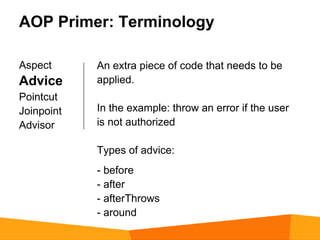
AOP Primer: Terminology

Aspect      An extra piece of code that needs to be
Advice      applied.
Pointcut
Joinpoint   In the example: throw an error if the user
Advisor     is not authorized

            Types of advice:
            - before
            - after
            - afterThrows
            - around
AOP Primer: Terminology

Aspect      A rule about when an Advice should be
Advice      applied.
Pointcut
Joinpoint   In the example: the methods
Advisor     "getSecretData" and "getMoreSecretData"

            Other examples: all public methods of a
            class, all methods starting with "load", all
            methods that take a String parameter, ...
AOP Primer: Terminology

Aspect      A single point in the execution of the code
Advice      where Advice is applied because the rule of a
Pointcut    Pointcut has been satisfied.
Joinpoint
Advisor
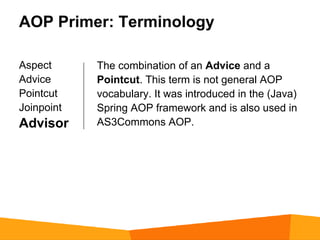
AOP Primer: Terminology

Aspect      The combination of an Advice and a
Advice      Pointcut. This term is not general AOP
Pointcut    vocabulary. It was introduced in the (Java)
Joinpoint   Spring AOP framework and is also used in
Advisor     AS3Commons AOP.
Dynamic Typed Proxies
Runtime generated dynamic proxies

● A subclass of a class or an implementation of an
  interface to which we'd like to add extra functionality
  (aspects in AOP)

● Has a reference to an
  IMethodInvocationInterceptor injected

● The (sub)class does not exist as ActionScript code.
  Instead, it gets generated at runtime

● Not the same as flash.utils.Proxy
We asked Adobe for Typed Proxies


                     ... but it didn't happen.
The original method

public function conferenceEvaluator(name:String):String
{
   if (name == '360|Flex') {
       return 'awesome';
   }
   return 'meh';
}
The proxied method

override public function conferenceEvaluator(name:String):
String {
   return methodInvocationInterceptor.intercept
   (
       this,
       InvocationKind.METHOD,
       new QName("", "conferenceEvaluator"),
       [name],
       super.conferenceEvaluator
   );
}
How the bloody hell do we do this?
●   AS3eval? (eval.hurlant.com)
●   flash.utils.Proxy class?
●   Flemit and Floxy? (asmock.sourceforge.org)
●   Loom-as3!!

Loom-as3 gets discontinued prematurely :(

Oops... Time to get our hands dirty... (and lose our sanity)
The birth of AS3Commons Bytecode!
ABC
ActionScript Byte Code
AS3Commons Bytecode
AS3Commons-Bytecode API
General purpose ABC Bytecode API, not just aimed at
AOP.

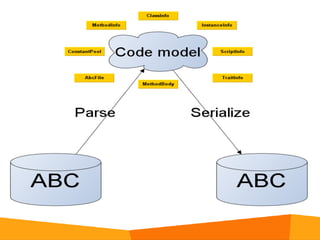
●   ABCDeserializer
●   ABCSerializer
●   ByteCodeType (reflection)
●   AbcBuilder (emit API)
●   ProxyFactory (proxy API)
Let's generate this class
package org {

    public class Conferences()
    {
       super();
    }

    public function myFavoriteConference():String
    {
       return "360|Flex!";
    }

}
Creating the AbcFile manually, loads of fun!
var abcFile:AbcFile = new AbcFile();                                                           var method:MethodInfo = new MethodInfo();
var instanceInfo:InstanceInfo = new InstanceInfo();                                            method.methodName = "org.Conferences/:myFavoriteConference";
instanceInfo.classMultiname = new QualifiedName("Conferences", new LNamespace(NamespaceKind.   method.returnType = new QualifiedName("String", LNamespace.PUBLIC);
PACKAGE_NAMESPACE, "org"));
                                                                                               method.methodBody.localCount = 1;
var constructor:MethodInfo = new MethodInfo();
                                                                                               method.methodBody.initScopeDepth = 1;
constructor.methodName = "org.Conferences/:Conferences";
                                                                                               method.methodBody.maxScopeDepth = 2;
constructor.returnType = new QualifiedName("*", LNamespace.ASTERISK);
                                                                                               method.methodBody.maxStack = 2;
constructor.methodBody = new MethodBody();
                                                                                               method.methodBody.opcodes.push(Opcode.getlocal_0.op());
constructor.methodBody.localCount = 1;
                                                                                               method.methodBody.opcodes.push(Opcode.pushscope.op());
constructor.methodBody.initScopeDepth = 1;
                                                                                               method.methodBody.opcodes.push(Opcode.pushstring.op(["360|Flex!"]));
constructor.methodBody.maxScopeDepth = 2;
                                                                                               method.methodBody.opcodes.push(Opcode.returnvalue.op());
constructor.methodBody.maxStack = 1;
                                                                                               trait = new MethodTrait();
constructor.methodBody.opcodes.push(Opcode.getlocal_0.op());
                                                                                               trait.traitKind = TraitKind.METHOD;
constructor.methodBody.opcodes.push(Opcode.pushscope.op());
                                                                                               method.as3commonsByteCodeAssignedMethodTrait = trait;
constructor.methodBody.opcodes.push(Opcode.getlocal_0.op());
                                                                                               instanceInfo.methodInfo.push(method);
constructor.methodBody.opcodes.push(Opcode.constructsuper.op([0]));
                                                                                               var scriptInfo:ScriptInfo = new ScriptInfo();
constructor.methodBody.opcodes.push(Opcode.returnvoid.op());
                                                                                               var scriptInitializer:MethodInfo = new MethodInfo();
var trait:MethodTrait = new MethodTrait();
                                                                                               scriptInfo.scriptInitializer = scriptInitializer;
trait.traitKind = TraitKind.METHOD;
                                                                                               scriptInitializer.methodName = "";
constructor.as3commonsByteCodeAssignedMethodTrait = trait;
                                                                                               scriptInitializer.returnType = new QualifiedName("*", LNamespace.ASTERISK);
instanceInfo.addTrait(trait);
                                                                                               scriptInitializer.methodBody.opcodes.push(Opcode.getlocal_0.op());
instanceInfo.constructor = constructor;
                                                                                               scriptInitializer.methodBody.opcodes.push(Opcode.pushscope.op());
var staticConstructor:MethodInfo = new MethodInfo();
                                                                                               scriptInitializer.methodBody.opcodes.push(Opcode.getscopeobject.op([0]));
staticConstructor.methodName = "org.Conferences:Conferences:::Conferences$cinit";
                                                                                               var mn:QualifiedName = new QualifiedName("Conferences", new LNamespace(NamespaceKind.PACKAGE_NAMESPACE,
staticConstructor.returnType = new QualifiedName("*", LNamespace.ASTERISK);                    "org"));
staticConstructor.methodBody = new MethodBody();                                               scriptInitializer.methodBody.opcodes.push(Opcode.findpropstrict.op([mn])) //
staticConstructor.methodBody.localCount = 1;                                                   scriptInitializer.methodBody.opcodes.push(Opcode.getproperty.op([mn]));
staticConstructor.methodBody.initScopeDepth = 1;                                               scriptInitializer.methodBody.opcodes.push(Opcode.pushscope.op());
staticConstructor.methodBody.maxScopeDepth = 2;                                                scriptInitializer.methodBody.opcodes.push(Opcode.popscope.op());
staticConstructor.methodBody.maxStack = 1;                                                     scriptInitializer.methodBody.opcodes.push(Opcode.newclass, [classInfo]);
staticConstructor.methodBody.opcodes.push(Opcode.getlocal_0.op());                             scriptInitializer.methodBody.opcodes.push(Opcode.initproperty, [mn]);
staticConstructor.methodBody.opcodes.push(Opcode.pushscope.op());                              scriptInitializer.methodBody.opcodes.push(Opcode.returnvoid);
staticConstructor.methodBody.opcodes.push(Opcode.returnvoid.op());                             abcFile.addClassInfo(classInfo);
var classInfo:ClassInfo = new ClassInfo();                                                     abcFile.addScriptInfo(scriptInfo);
classInfo.staticInitializer = staticConstructor;                                               abcFile.addInstanceInfo(instanceInfo);
Generate a class with the emit API
var abcBuilder:IAbcBuilder = new AbcBuilder();
var classbuilder:IClassBuilder =
   abcBuilder.defineClass("org.Conferences");

var methodBuilder:IMethodBuilder = classbuilder.
defineMethod("myFavoriteConference");

methodBuilder.returnType = "String";
methodBuilder.addOpcode(Opcode.getlocal_0)
              .addOpcode(Opcode.pushscope)
              .addOpcode(Opcode.pushstring,["360|Flex!"])
              .addOpcode(Opcode.returnvalue);
Loading the class into the AVM
abcBuilder.addEventListener(Event.COMPLETE,
loadedHandler);

abcBuilder.buildAndLoad();

function loadedHandler(event:Event):void {
  var clazz:Class =
          ApplicationDomain.currentDomain.getDefinition
       ("org.Conferences") as Class;
  var instance:* = new clazz();
  var result:String = instance.myFavoriteConference();
  // result == '360|Flex!'
}
The feeling after this finally works...
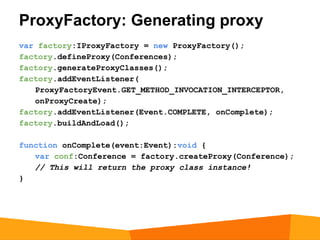
ProxyFactory: Generating proxy
var factory:IProxyFactory = new ProxyFactory();
factory.defineProxy(Conferences);
factory.generateProxyClasses();
factory.addEventListener(
   ProxyFactoryEvent.GET_METHOD_INVOCATION_INTERCEPTOR,
   onProxyCreate);
factory.addEventListener(Event.COMPLETE, onComplete);
factory.buildAndLoad();

function onComplete(event:Event):void {
   var conf:Conference = factory.createProxy(Conference);
   // This will return the proxy class instance!
}
ProxyFactory: Injecting interceptors
function onProxyCreate(event:ProxyFactoryEvent):void {
   var interceptor:IMethodInvocationInterceptor =
       createInterceptor();
   event.methodInvocationInterceptor = interceptor;
}

function createInterceptor():IMethodInvocationInterceptor
{
   var result:IMethodInvocationInterceptor = new
       BasicMethodInvocationInterceptor();
   //register IInterceptors...
}
IInterceptor interface
public interface IInterceptor {

    function intercept(invocation:IMethodInvocation):void;

}
IMethodInvocation interface
public interface IMethodInvocation {

    function   get   kind():InvocationKind;
    function   get   targetInstance():Object;
    function   get   targetMember():QName;
    function   get   targetMethod():Function;
    function   get   arguments():Array;
    function   get   proceed():Boolean;
    function   set   proceed(value:Boolean):void;
    function   get   returnValue():*;
    function   set   returnValue(value:*):void;

}
So, how to build an AOP framework?

●   ABC - I hate myself and I want to die
●   AbcBuilder - I think the emit API sucks
●   Emit API - I think the proxy API sucks
●   Proxy API - I love AS3Commons-Bytecode!

Pick your poison!
AS3Commons AOP
AS3Commons AOP
Advice interfaces (some of them)

- IMethodBeforeAdvice
   beforeMethod(method:Method, args:Array, target:*):void;

- IConstructorAfterAdvice
   afterConstructor(constructor:Constructor, args:Array,
                    target:*):void;

- ISetterAroundAdvice
   beforeSetter(setter:Accessor, target:*, value:*):void;
   afterSetter(setter:Accessor):void;
   afterSetterThrows(setter:Accessor, value:*, target:*,
                       error:Error):void;
AS3Commons AOP
Advisor

Combines Pointcut (when) and Advice (what).

Actually, Advice is always wrapped in an Advisor:

// in AOPProxyFactory...
public function addAdvice(advice:IAdvice, target:*=null):void {
   addAdvisor(new AlwaysMatchingPointcutAdvisor(advice),
       target);
}
AS3Commons AOP
Adding an advisor to the proxy factory (1/2)

var factory:AOPProxyFactory = new AOPProxyFactory();

var pointcut:IPointcut = new
   MethodNameMatchPointcut(["getSecretData","
getMoreSecretData"]);

var advice:IAdvice = new AuthenticationAdvice();

factory.addAdvisor(new PointcutAdvisor(pointcut, advice));
AS3Commons AOP
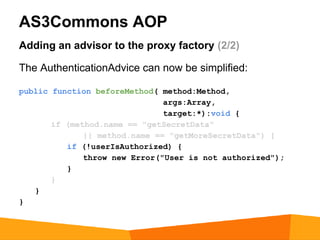
Adding an advisor to the proxy factory (2/2)

The AuthenticationAdvice can now be simplified:

public function beforeMethod( method:Method,
                               args:Array,
                               target:*):void {
       if (method.name == "getSecretData"
              || method.name == "getMoreSecretData") {
          if (!userIsAuthorized) {
              throw new Error("User is not authorized");
          }
       }
   }
}
AS3Commons AOP
Pointcuts

- Name matching
- Regular expression matching
- Binary: combine pointcuts (and, or, ...)
AS3Commons AOP
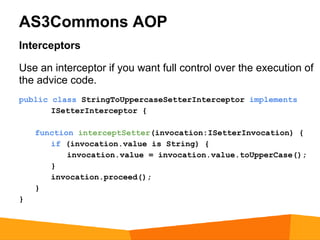
Interceptors

Use an interceptor if you want full control over the execution of
the advice code.
public class StringToUppercaseSetterInterceptor implements
       ISetterInterceptor {

    function interceptSetter(invocation:ISetterInvocation) {
       if (invocation.value is String) {
           invocation.value = invocation.value.toUpperCase();
       }
       invocation.proceed();
    }
}
AS3Commons AOP
AOPProxyFactory

Configure it with advice, advisors and/or interceptors and
get proxies from it.

var factory:AOPProxyFactory = new AOPProxyFactory();
factory.target = MyService;
factory.addAdvice(new AuthorizationAdvice());
... (asynchronous loading of the factory)
var service:MyService = factory.getProxy();


Hides Bytecode's ProxyFactory interceptor details.
AS3Commons AOP
AOPBatchProxyFactory

Proxy factory to create multiple proxies. Used inside the
AOPProxyFactory.

Uses AS3Commons-Bytecode to generate the proxies.

The interceptor we create is an AdvisorInterceptor.
AS3Commons AOP
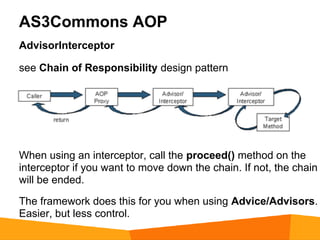
AdvisorInterceptor

see Chain of Responsibility design pattern


When using an interceptor, call the proceed() method on the
interceptor if you want to move down the chain. If not, the chain
will be ended.

The framework does this for you when using Advice/Advisors.
Easier, but less control.
AS3Commons AOP
What's to come and what is possible?

- Pointcut dialect & metadata/annotation driven pointcut
configuration

- Integration with Spring ActionScript or other Dependency
Injection frameworks
More info

www.as3commons.org

ActionScript Virtual Machine 2 Spec: http://www.adobe.
com/content/dam/Adobe/en/devnet/actionscript/articles/avm2
overview.pdf

Twitter

@mechhead, @herrodius, @as3commons, @stackandheap
Questions ?
Thank you !

How to build an AOP framework in ActionScript

  • 1.
    How to build an AOP framework (and how to lose your sanity in the process) Roland Zwaga Christophe Herreman @mechhead @herrodius
  • 2.
    Agenda - Quick AOPprimer - Typed Proxies - ABC - AS3Commons Bytecode - AS3Commons AOP
  • 3.
    About us Two geeksfrom Holland and Belgium Run Stack & Heap, a development and consulting company based in Belgium Core members of Spring ActionScript and AS3Commons
  • 4.
  • 5.
    AOP Primer: example"Security" class MyService { public function getData():MyData { // get data } public function getSecretData():MyData { // get secret data } public function getMoreSecretData():MyData { // get more secret data } }
  • 6.
    AOP Primer: example"Security" Requirement The methods getSecretData and getMoreSecretData may only be invoked by authorized users.
  • 7.
    AOP Primer: example"Security" ... public function getData():MyData { // get data } public function getSecretData():MyData { if (userIsAuthorized) { // get secret data } else { throw new Error("User is not authorized"); } } ...
  • 8.
    AOP Primer: example"Security" ... public function getMoreSecretData():MyData { if (userIsAuthorized) { // get more secret data } else { throw new Error("User is not authorized"); } } ...
  • 9.
    AOP Primer: example"Security" Notice the following: - code is "cluttered" with extra security code; lost focus - code duplication - the above will increase with more methods and services What if: - security requirements change? - service class must be used in other (non-secure) context
  • 10.
    AOP Primer: example"Security" The AOP solution: Separate the security code from the service code and merge them.
  • 11.
    AOP Primer: example"Security" public class AuthorizationAdvice implements IMethodBeforeAdvice { public function beforeMethod( method:Method, args:Array, target:* ):void { if (method.name == "getSecretData" || method.name == "getMoreSecretData") { if (!userIsAuthorized) { throw new Error("User is not authorized"); } } } }
  • 12.
    AOP Primer: example"Security" var factory:AOPProxyFactory = new AOPProxyFactory(); factory.target = MyService; factory.addAdvice(new AuthorizationAdvice()); var operation:IOperation = factory.load(); operation.addCompleteListener(factory_completeHandler); function factory_completeHandler(event:OperationEvent): void { var service:MyService = factory.getProxy(); service.getData(); service.getSecretData(); }
  • 13.
    AOP Primer: Terminology Aspect The general concept of a cross-cutting Advice concern. Pointcut Joinpoint In the example: "security" Advisor Logging, Error Handling, Method Run-Time Monitoring, Validation, etc. are other useful examples.
  • 14.
    AOP Primer: Terminology Aspect An extra piece of code that needs to be Advice applied. Pointcut Joinpoint In the example: throw an error if the user Advisor is not authorized Types of advice: - before - after - afterThrows - around
  • 15.
    AOP Primer: Terminology Aspect A rule about when an Advice should be Advice applied. Pointcut Joinpoint In the example: the methods Advisor "getSecretData" and "getMoreSecretData" Other examples: all public methods of a class, all methods starting with "load", all methods that take a String parameter, ...
  • 16.
    AOP Primer: Terminology Aspect A single point in the execution of the code Advice where Advice is applied because the rule of a Pointcut Pointcut has been satisfied. Joinpoint Advisor
  • 17.
    AOP Primer: Terminology Aspect The combination of an Advice and a Advice Pointcut. This term is not general AOP Pointcut vocabulary. It was introduced in the (Java) Joinpoint Spring AOP framework and is also used in Advisor AS3Commons AOP.
  • 18.
  • 19.
    Runtime generated dynamicproxies ● A subclass of a class or an implementation of an interface to which we'd like to add extra functionality (aspects in AOP) ● Has a reference to an IMethodInvocationInterceptor injected ● The (sub)class does not exist as ActionScript code. Instead, it gets generated at runtime ● Not the same as flash.utils.Proxy
  • 20.
    We asked Adobefor Typed Proxies ... but it didn't happen.
  • 21.
    The original method publicfunction conferenceEvaluator(name:String):String { if (name == '360|Flex') { return 'awesome'; } return 'meh'; }
  • 22.
    The proxied method overridepublic function conferenceEvaluator(name:String): String { return methodInvocationInterceptor.intercept ( this, InvocationKind.METHOD, new QName("", "conferenceEvaluator"), [name], super.conferenceEvaluator ); }
  • 23.
    How the bloodyhell do we do this? ● AS3eval? (eval.hurlant.com) ● flash.utils.Proxy class? ● Flemit and Floxy? (asmock.sourceforge.org) ● Loom-as3!! Loom-as3 gets discontinued prematurely :( Oops... Time to get our hands dirty... (and lose our sanity) The birth of AS3Commons Bytecode!
  • 24.
  • 27.
  • 28.
    AS3Commons-Bytecode API General purposeABC Bytecode API, not just aimed at AOP. ● ABCDeserializer ● ABCSerializer ● ByteCodeType (reflection) ● AbcBuilder (emit API) ● ProxyFactory (proxy API)
  • 29.
    Let's generate thisclass package org { public class Conferences() { super(); } public function myFavoriteConference():String { return "360|Flex!"; } }
  • 30.
    Creating the AbcFilemanually, loads of fun! var abcFile:AbcFile = new AbcFile(); var method:MethodInfo = new MethodInfo(); var instanceInfo:InstanceInfo = new InstanceInfo(); method.methodName = "org.Conferences/:myFavoriteConference"; instanceInfo.classMultiname = new QualifiedName("Conferences", new LNamespace(NamespaceKind. method.returnType = new QualifiedName("String", LNamespace.PUBLIC); PACKAGE_NAMESPACE, "org")); method.methodBody.localCount = 1; var constructor:MethodInfo = new MethodInfo(); method.methodBody.initScopeDepth = 1; constructor.methodName = "org.Conferences/:Conferences"; method.methodBody.maxScopeDepth = 2; constructor.returnType = new QualifiedName("*", LNamespace.ASTERISK); method.methodBody.maxStack = 2; constructor.methodBody = new MethodBody(); method.methodBody.opcodes.push(Opcode.getlocal_0.op()); constructor.methodBody.localCount = 1; method.methodBody.opcodes.push(Opcode.pushscope.op()); constructor.methodBody.initScopeDepth = 1; method.methodBody.opcodes.push(Opcode.pushstring.op(["360|Flex!"])); constructor.methodBody.maxScopeDepth = 2; method.methodBody.opcodes.push(Opcode.returnvalue.op()); constructor.methodBody.maxStack = 1; trait = new MethodTrait(); constructor.methodBody.opcodes.push(Opcode.getlocal_0.op()); trait.traitKind = TraitKind.METHOD; constructor.methodBody.opcodes.push(Opcode.pushscope.op()); method.as3commonsByteCodeAssignedMethodTrait = trait; constructor.methodBody.opcodes.push(Opcode.getlocal_0.op()); instanceInfo.methodInfo.push(method); constructor.methodBody.opcodes.push(Opcode.constructsuper.op([0])); var scriptInfo:ScriptInfo = new ScriptInfo(); constructor.methodBody.opcodes.push(Opcode.returnvoid.op()); var scriptInitializer:MethodInfo = new MethodInfo(); var trait:MethodTrait = new MethodTrait(); scriptInfo.scriptInitializer = scriptInitializer; trait.traitKind = TraitKind.METHOD; scriptInitializer.methodName = ""; constructor.as3commonsByteCodeAssignedMethodTrait = trait; scriptInitializer.returnType = new QualifiedName("*", LNamespace.ASTERISK); instanceInfo.addTrait(trait); scriptInitializer.methodBody.opcodes.push(Opcode.getlocal_0.op()); instanceInfo.constructor = constructor; scriptInitializer.methodBody.opcodes.push(Opcode.pushscope.op()); var staticConstructor:MethodInfo = new MethodInfo(); scriptInitializer.methodBody.opcodes.push(Opcode.getscopeobject.op([0])); staticConstructor.methodName = "org.Conferences:Conferences:::Conferences$cinit"; var mn:QualifiedName = new QualifiedName("Conferences", new LNamespace(NamespaceKind.PACKAGE_NAMESPACE, staticConstructor.returnType = new QualifiedName("*", LNamespace.ASTERISK); "org")); staticConstructor.methodBody = new MethodBody(); scriptInitializer.methodBody.opcodes.push(Opcode.findpropstrict.op([mn])) // staticConstructor.methodBody.localCount = 1; scriptInitializer.methodBody.opcodes.push(Opcode.getproperty.op([mn])); staticConstructor.methodBody.initScopeDepth = 1; scriptInitializer.methodBody.opcodes.push(Opcode.pushscope.op()); staticConstructor.methodBody.maxScopeDepth = 2; scriptInitializer.methodBody.opcodes.push(Opcode.popscope.op()); staticConstructor.methodBody.maxStack = 1; scriptInitializer.methodBody.opcodes.push(Opcode.newclass, [classInfo]); staticConstructor.methodBody.opcodes.push(Opcode.getlocal_0.op()); scriptInitializer.methodBody.opcodes.push(Opcode.initproperty, [mn]); staticConstructor.methodBody.opcodes.push(Opcode.pushscope.op()); scriptInitializer.methodBody.opcodes.push(Opcode.returnvoid); staticConstructor.methodBody.opcodes.push(Opcode.returnvoid.op()); abcFile.addClassInfo(classInfo); var classInfo:ClassInfo = new ClassInfo(); abcFile.addScriptInfo(scriptInfo); classInfo.staticInitializer = staticConstructor; abcFile.addInstanceInfo(instanceInfo);
  • 31.
    Generate a classwith the emit API var abcBuilder:IAbcBuilder = new AbcBuilder(); var classbuilder:IClassBuilder = abcBuilder.defineClass("org.Conferences"); var methodBuilder:IMethodBuilder = classbuilder. defineMethod("myFavoriteConference"); methodBuilder.returnType = "String"; methodBuilder.addOpcode(Opcode.getlocal_0) .addOpcode(Opcode.pushscope) .addOpcode(Opcode.pushstring,["360|Flex!"]) .addOpcode(Opcode.returnvalue);
  • 32.
    Loading the classinto the AVM abcBuilder.addEventListener(Event.COMPLETE, loadedHandler); abcBuilder.buildAndLoad(); function loadedHandler(event:Event):void { var clazz:Class = ApplicationDomain.currentDomain.getDefinition ("org.Conferences") as Class; var instance:* = new clazz(); var result:String = instance.myFavoriteConference(); // result == '360|Flex!' }
  • 33.
    The feeling afterthis finally works...
  • 34.
    ProxyFactory: Generating proxy varfactory:IProxyFactory = new ProxyFactory(); factory.defineProxy(Conferences); factory.generateProxyClasses(); factory.addEventListener( ProxyFactoryEvent.GET_METHOD_INVOCATION_INTERCEPTOR, onProxyCreate); factory.addEventListener(Event.COMPLETE, onComplete); factory.buildAndLoad(); function onComplete(event:Event):void { var conf:Conference = factory.createProxy(Conference); // This will return the proxy class instance! }
  • 35.
    ProxyFactory: Injecting interceptors functiononProxyCreate(event:ProxyFactoryEvent):void { var interceptor:IMethodInvocationInterceptor = createInterceptor(); event.methodInvocationInterceptor = interceptor; } function createInterceptor():IMethodInvocationInterceptor { var result:IMethodInvocationInterceptor = new BasicMethodInvocationInterceptor(); //register IInterceptors... }
  • 36.
    IInterceptor interface public interfaceIInterceptor { function intercept(invocation:IMethodInvocation):void; }
  • 37.
    IMethodInvocation interface public interfaceIMethodInvocation { function get kind():InvocationKind; function get targetInstance():Object; function get targetMember():QName; function get targetMethod():Function; function get arguments():Array; function get proceed():Boolean; function set proceed(value:Boolean):void; function get returnValue():*; function set returnValue(value:*):void; }
  • 38.
    So, how tobuild an AOP framework? ● ABC - I hate myself and I want to die ● AbcBuilder - I think the emit API sucks ● Emit API - I think the proxy API sucks ● Proxy API - I love AS3Commons-Bytecode! Pick your poison!
  • 39.
  • 40.
    AS3Commons AOP Advice interfaces(some of them) - IMethodBeforeAdvice beforeMethod(method:Method, args:Array, target:*):void; - IConstructorAfterAdvice afterConstructor(constructor:Constructor, args:Array, target:*):void; - ISetterAroundAdvice beforeSetter(setter:Accessor, target:*, value:*):void; afterSetter(setter:Accessor):void; afterSetterThrows(setter:Accessor, value:*, target:*, error:Error):void;
  • 41.
    AS3Commons AOP Advisor Combines Pointcut(when) and Advice (what). Actually, Advice is always wrapped in an Advisor: // in AOPProxyFactory... public function addAdvice(advice:IAdvice, target:*=null):void { addAdvisor(new AlwaysMatchingPointcutAdvisor(advice), target); }
  • 42.
    AS3Commons AOP Adding anadvisor to the proxy factory (1/2) var factory:AOPProxyFactory = new AOPProxyFactory(); var pointcut:IPointcut = new MethodNameMatchPointcut(["getSecretData"," getMoreSecretData"]); var advice:IAdvice = new AuthenticationAdvice(); factory.addAdvisor(new PointcutAdvisor(pointcut, advice));
  • 43.
    AS3Commons AOP Adding anadvisor to the proxy factory (2/2) The AuthenticationAdvice can now be simplified: public function beforeMethod( method:Method, args:Array, target:*):void { if (method.name == "getSecretData" || method.name == "getMoreSecretData") { if (!userIsAuthorized) { throw new Error("User is not authorized"); } } } }
  • 44.
    AS3Commons AOP Pointcuts - Namematching - Regular expression matching - Binary: combine pointcuts (and, or, ...)
  • 45.
    AS3Commons AOP Interceptors Use aninterceptor if you want full control over the execution of the advice code. public class StringToUppercaseSetterInterceptor implements ISetterInterceptor { function interceptSetter(invocation:ISetterInvocation) { if (invocation.value is String) { invocation.value = invocation.value.toUpperCase(); } invocation.proceed(); } }
  • 46.
    AS3Commons AOP AOPProxyFactory Configure itwith advice, advisors and/or interceptors and get proxies from it. var factory:AOPProxyFactory = new AOPProxyFactory(); factory.target = MyService; factory.addAdvice(new AuthorizationAdvice()); ... (asynchronous loading of the factory) var service:MyService = factory.getProxy(); Hides Bytecode's ProxyFactory interceptor details.
  • 47.
    AS3Commons AOP AOPBatchProxyFactory Proxy factoryto create multiple proxies. Used inside the AOPProxyFactory. Uses AS3Commons-Bytecode to generate the proxies. The interceptor we create is an AdvisorInterceptor.
  • 48.
    AS3Commons AOP AdvisorInterceptor see Chainof Responsibility design pattern When using an interceptor, call the proceed() method on the interceptor if you want to move down the chain. If not, the chain will be ended. The framework does this for you when using Advice/Advisors. Easier, but less control.
  • 49.
    AS3Commons AOP What's tocome and what is possible? - Pointcut dialect & metadata/annotation driven pointcut configuration - Integration with Spring ActionScript or other Dependency Injection frameworks
  • 50.
    More info www.as3commons.org ActionScript VirtualMachine 2 Spec: http://www.adobe. com/content/dam/Adobe/en/devnet/actionscript/articles/avm2 overview.pdf Twitter @mechhead, @herrodius, @as3commons, @stackandheap
  • 51.
  • 52.