FOURTH
QUARTER!
1
LESSON TITLE: BECOMING MEMBERS OF THE SOCIETY
CULTURAL, SOCIAL, AND POLITICAL INSITUTIONS:
KINSHIP, MARRIAGE,
AND THE HOUSEHOLD
MR. JACOB A. MATIAS, LPT
TEACHER, UCSP
ARELLANO UNIVERSITY – JUAN SUMULONG CAMPUS
2
LESSON OBJECTIVES:
The leaners should be able to.
▸ Trace kinship ties and social network.
▸ Described the organized nature of social
life and rules governing behavior.
3
MOTIVATION
4
1. How do you organize
your personal things?
2.Why do you think
organizing your
things is important?
“ To us, family means
putting your arms around
each other and being there.
-Barbara Bush
5
CONCEPT
NOTES
6
The bond of blood or
marriage which
binds people
together in group.
KINSHIP
7
▸ Kinship System
includes socially
recognized
relationships based
on supposed as well
as actual
genealogical ties.
TYPES OF KINSHIP
AFFINAL
Relationships based
upon marriage or
cohabitation
between collaterals
(people treated as
the same
generation)
CONSANGUINEOUS
Connections between
people that are traced
by blood.
8
KINSHIP
BY BLOOD
9
Kinship is reckoned
in a number of
different ways
around the world,
resulting in a variety
of types of descent
patterns and kin
groups.
THE DESCENT SYSTEMS
10
Anthropologists
frequently use
diagrams to illustrate
kinship relationships to
make them more
understandable.
TRACING THE DESCENT SYSTEM
11
TRACING THE DESCENT SYSTEM
12
UNILINEAL DESCENT
13
This traces descent only through a single
line of ancestors, male or female. Both males and
females are members of a unilineal family, but
descent links are only recognized through relatives
of one gender. The two basic forms of unilineal
descent are referred to as patrilineal and
matrilineal.
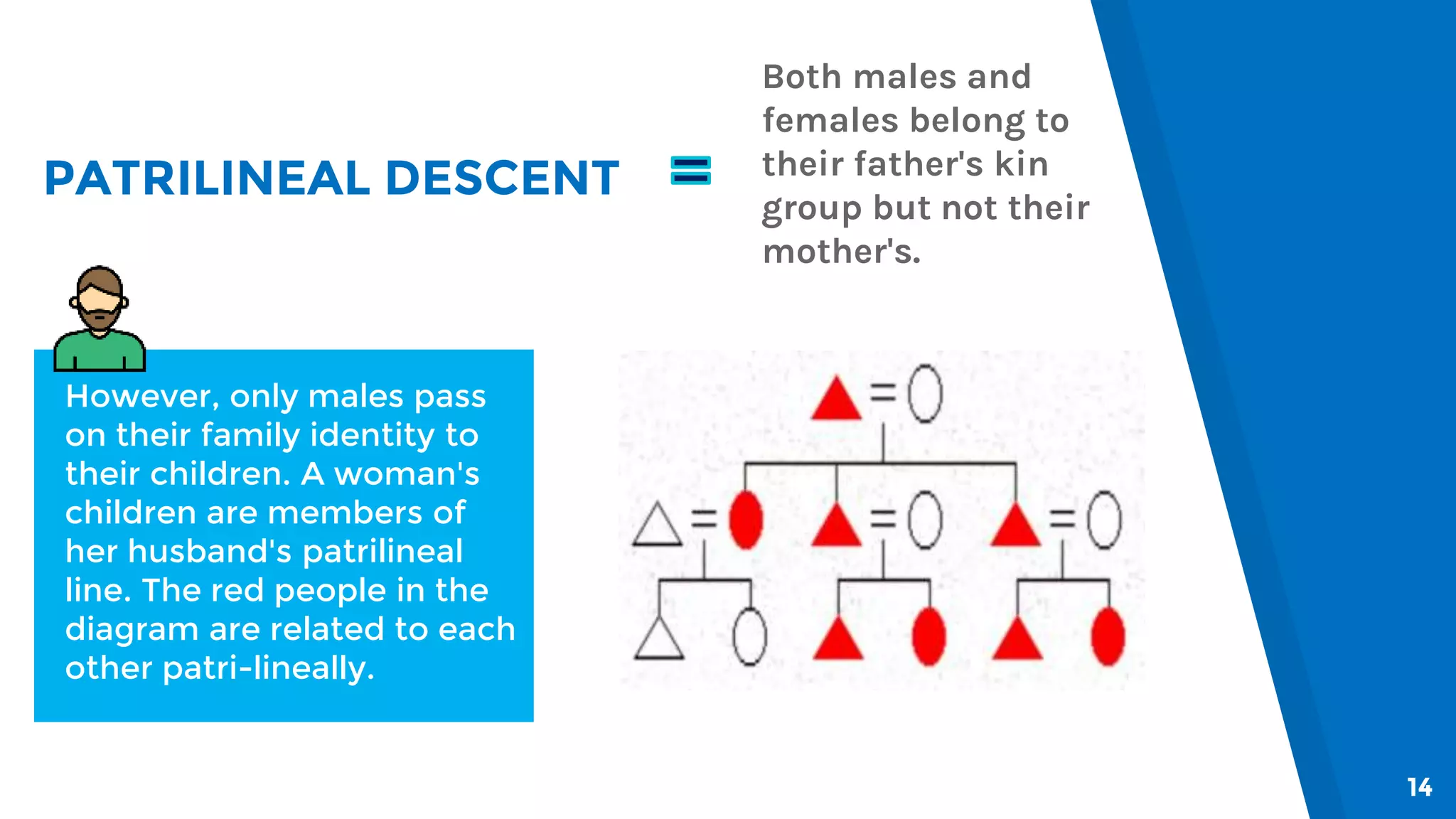
Both males and
females belong to
their father's kin
group but not their
mother's.
PATRILINEAL DESCENT
14
However, only males pass
on their family identity to
their children. A woman's
children are members of
her husband's patrilineal
line. The red people in the
diagram are related to each
other patri-lineally.
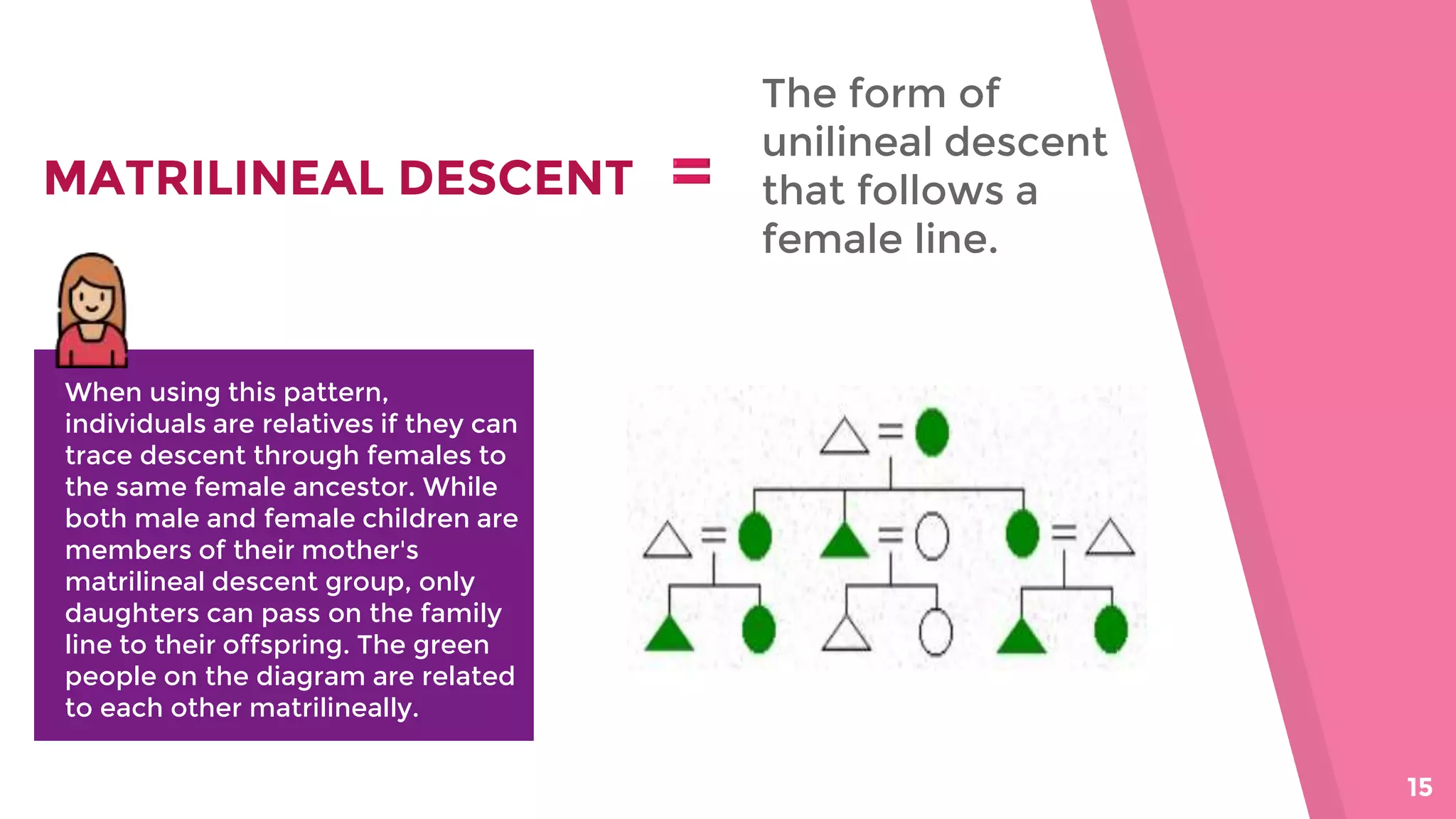
The form of
unilineal descent
that follows a
female line.
MATRILINEAL DESCENT
15
When using this pattern,
individuals are relatives if they can
trace descent through females to
the same female ancestor. While
both male and female children are
members of their mother's
matrilineal descent group, only
daughters can pass on the family
line to their offspring. The green
people on the diagram are related
to each other matrilineally.
BILINEAL DESCENT
16
When both patrilineal and matrilineal
descent principles are combined both
KINSHIP BY
MARRIAGE
17
18
What is a Marriage?
Marriage is an institution
that admits men and
women to family life.
19
Types of Marriage
MONOGAMY
POLYGAMY
MONOGAMY
20
Monogamy is the practice of having
only one spouse at one time. In some
cases, monogamy means having only
one spouse for an entire life span.
• Social monogamy: Two persons that live together, have sex with
one another, and cooperate in acquiring basic resources such as
food, clothes, and money.
• Sexual monogamy: Two persons that remain sexually exclusive with
one another and have no outside sex partners.
• Genetic monogamy: Two partners that only have offspring with one
another.
• Marital monogamy: Marriages of only two people.
• Serial monogamy: A series of relationships. One person has only one
partner at a time, and then moves on to another partner after
severing the relationship with the first.
TYPES OF MONOGAMY
POLYGAMY
21
Practice of “Multiple Marriages”. It is a
marriage pattern in which an individual
is married to more than one person at
a time.
• POLYGYNY is the practice of one man having more than one wife or
sexual partner at a time.
• POLYANDRY involves one woman having multiple husbands, within
Polyandry there are many variations on the marriage style.
TYPES OF POLYGAMY
RESIDENCE PATTERN
22
NEOLOCAL RESIDENCE
Couple finds their own house,
independent from all family
members.
PATRILOCAL RESIDENCE
Married couple lives with the
husband’s father’s family by living
with the husband’s family, it lets all
the men, continue to work together
in the house.
MATRILOCAL RESIDENCE
It’s where the couple moves to live
where the wife grew up; usually
found with matrilineal kinship
system.
AVUNCULOCAL RESIDENCE
is also related in matrilineal
societies however in this case the
couple moves to live with the
husband’s mother’s brother. They
live with the most significant man,
his uncle, because it’s who they will
later inherit everything from.
RITUAL KINSHIP
23
COMPADRAZGO
24
• Ritual kinship in the form of godparenthood
• Parents selected godparents for a child at his or her
baptism, confirmation, and marriage. The godparents were
then tied to the parents as coparents.
25
THE KINSHIP &
THE HOUSEHOLD
NUCLEAR FAMILY
26
• A family consisting of a married man &
woman and their biological children.
• The main issue for children is to help
them under- stand that their two-parent,
heterosexual family is a fine family, and is
one kind among many other kinds of
families.
EXTENDED FAMILY
27
• A family where Grandparents or
Aunts and Uncles play major roles
in the children’s upbringing. This
may or may not include those
relatives living with the children.
These family members may be in
addition to the child’s parents or
instead of the child’s parents.
CONDITIONALLY SEPARATED FAMILY
28
• A family member is separated
from the rest of the family. This
may be due to employment far
away; military service;
incarceration; hospitalization. They
remain significant members of the
family.
TRANSNATIONAL FAMILY
29
• These families live in more than
one country. They may spend part
of each year in their country of
origin returning to the U.S. on a
regular basis. The child may spend
time being cared for by different
family members in each country.
30
POLITICS OF KINSHIP
31
• Kinship politics is commonly found in tribal
societies across the world where kin genealogy
is applied to determine the system of
communal leadership. It is the traditional
pattern of bequeathing political power family
members.
• Kinship politics is built based on the classic
political principle: blood is thicker than water. It
asserts that power should be distributed among
family members.
• For the sake of family security, power should
not be seized from those who have kinship
connections and must be circulated only among
those who are tied by blood.
32

How Society is Organized?

  • 1.
  • 2.
    LESSON TITLE: BECOMINGMEMBERS OF THE SOCIETY CULTURAL, SOCIAL, AND POLITICAL INSITUTIONS: KINSHIP, MARRIAGE, AND THE HOUSEHOLD MR. JACOB A. MATIAS, LPT TEACHER, UCSP ARELLANO UNIVERSITY – JUAN SUMULONG CAMPUS 2
  • 3.
    LESSON OBJECTIVES: The leanersshould be able to. ▸ Trace kinship ties and social network. ▸ Described the organized nature of social life and rules governing behavior. 3
  • 4.
    MOTIVATION 4 1. How doyou organize your personal things? 2.Why do you think organizing your things is important?
  • 5.
    “ To us,family means putting your arms around each other and being there. -Barbara Bush 5
  • 6.
  • 7.
    The bond ofblood or marriage which binds people together in group. KINSHIP 7 ▸ Kinship System includes socially recognized relationships based on supposed as well as actual genealogical ties.
  • 8.
    TYPES OF KINSHIP AFFINAL Relationshipsbased upon marriage or cohabitation between collaterals (people treated as the same generation) CONSANGUINEOUS Connections between people that are traced by blood. 8
  • 9.
  • 10.
    Kinship is reckoned ina number of different ways around the world, resulting in a variety of types of descent patterns and kin groups. THE DESCENT SYSTEMS 10 Anthropologists frequently use diagrams to illustrate kinship relationships to make them more understandable.
  • 11.
  • 12.
  • 13.
    UNILINEAL DESCENT 13 This tracesdescent only through a single line of ancestors, male or female. Both males and females are members of a unilineal family, but descent links are only recognized through relatives of one gender. The two basic forms of unilineal descent are referred to as patrilineal and matrilineal.
  • 14.
    Both males and femalesbelong to their father's kin group but not their mother's. PATRILINEAL DESCENT 14 However, only males pass on their family identity to their children. A woman's children are members of her husband's patrilineal line. The red people in the diagram are related to each other patri-lineally.
  • 15.
    The form of unilinealdescent that follows a female line. MATRILINEAL DESCENT 15 When using this pattern, individuals are relatives if they can trace descent through females to the same female ancestor. While both male and female children are members of their mother's matrilineal descent group, only daughters can pass on the family line to their offspring. The green people on the diagram are related to each other matrilineally.
  • 16.
    BILINEAL DESCENT 16 When bothpatrilineal and matrilineal descent principles are combined both
  • 17.
  • 18.
    18 What is aMarriage? Marriage is an institution that admits men and women to family life.
  • 19.
  • 20.
    MONOGAMY 20 Monogamy is thepractice of having only one spouse at one time. In some cases, monogamy means having only one spouse for an entire life span. • Social monogamy: Two persons that live together, have sex with one another, and cooperate in acquiring basic resources such as food, clothes, and money. • Sexual monogamy: Two persons that remain sexually exclusive with one another and have no outside sex partners. • Genetic monogamy: Two partners that only have offspring with one another. • Marital monogamy: Marriages of only two people. • Serial monogamy: A series of relationships. One person has only one partner at a time, and then moves on to another partner after severing the relationship with the first. TYPES OF MONOGAMY
  • 21.
    POLYGAMY 21 Practice of “MultipleMarriages”. It is a marriage pattern in which an individual is married to more than one person at a time. • POLYGYNY is the practice of one man having more than one wife or sexual partner at a time. • POLYANDRY involves one woman having multiple husbands, within Polyandry there are many variations on the marriage style. TYPES OF POLYGAMY
  • 22.
    RESIDENCE PATTERN 22 NEOLOCAL RESIDENCE Couplefinds their own house, independent from all family members. PATRILOCAL RESIDENCE Married couple lives with the husband’s father’s family by living with the husband’s family, it lets all the men, continue to work together in the house. MATRILOCAL RESIDENCE It’s where the couple moves to live where the wife grew up; usually found with matrilineal kinship system. AVUNCULOCAL RESIDENCE is also related in matrilineal societies however in this case the couple moves to live with the husband’s mother’s brother. They live with the most significant man, his uncle, because it’s who they will later inherit everything from.
  • 23.
  • 24.
    COMPADRAZGO 24 • Ritual kinshipin the form of godparenthood • Parents selected godparents for a child at his or her baptism, confirmation, and marriage. The godparents were then tied to the parents as coparents.
  • 25.
  • 26.
    NUCLEAR FAMILY 26 • Afamily consisting of a married man & woman and their biological children. • The main issue for children is to help them under- stand that their two-parent, heterosexual family is a fine family, and is one kind among many other kinds of families.
  • 27.
    EXTENDED FAMILY 27 • Afamily where Grandparents or Aunts and Uncles play major roles in the children’s upbringing. This may or may not include those relatives living with the children. These family members may be in addition to the child’s parents or instead of the child’s parents.
  • 28.
    CONDITIONALLY SEPARATED FAMILY 28 •A family member is separated from the rest of the family. This may be due to employment far away; military service; incarceration; hospitalization. They remain significant members of the family.
  • 29.
    TRANSNATIONAL FAMILY 29 • Thesefamilies live in more than one country. They may spend part of each year in their country of origin returning to the U.S. on a regular basis. The child may spend time being cared for by different family members in each country.
  • 30.
  • 31.
    31 • Kinship politicsis commonly found in tribal societies across the world where kin genealogy is applied to determine the system of communal leadership. It is the traditional pattern of bequeathing political power family members. • Kinship politics is built based on the classic political principle: blood is thicker than water. It asserts that power should be distributed among family members. • For the sake of family security, power should not be seized from those who have kinship connections and must be circulated only among those who are tied by blood.
  • 32.