How NOT to make your  first movie Confessions of a former virgin filmmaker who learned to get screwed and now enjoys it. SUDHISH KAMATH
Show me the money Dave: But movies cost millions of dollars to make. Robert K. Bowfinger: That's after gross net deduction profit percentage deferment ten percent of the nut. Cash, every movie cost $2,184.
What NOT to say? Ok, you want to make a movie.  Why? What do you want to say? Do people want to know? Art? Entertainment? Poster? Painting? Scrapbook? Expression? Communication? Indigestion?
Art & Entertainment Between wanking around and being a gigolo, what do you rather do? Does doing it for yourself give you more pleasure or making someone else happy give you pleasure? What is honesty?
Indie filmmaking? Dil pe Mat le yaar, Haath me le! Just do it.
Part 1: How NOT to write Write without thinking (Exercise) Is everyone creative? Are there are any new stories left to tell? Make it up as you go.
Stages of development Concept Note Synopsis Scene Breakdown First Draft Rewrites Final Draft
Character/Characteristics Who? What? Where? When? Why?How? Details… Digesis…  Backstories…
Anatomy of a scene Scene or story, it’s all about beginning, middle and end. Set-up, Confrontation, Resolution Every scene should tell a story and many stories should tell a larger story. If any of these stories is not needed to tell the larger story, why should be part of the script? What determines length? What’s a plot point? Character arc, Hero’s journey
Text, Subtext, Context What you want to say? What do you want to NOT say but hint What gives what you are saying more perspective Plot/ subplot/ metaphor How NOT to title your film/tagline
Structure Should story be told from A to Z? What are the other ways to tell a story and when do you use alternative structure? Examples: Pulp Fiction, Groundhog Day, Run Lola Run, Let’s talk… Lost
Tools to help you write Celtx/ Sophocles/ Final Draft MS Word Notebook/ Tissue paper/ Toilet paper/ Bus ticket - Index Cards
When is your script ready? Are you convinced completely, entirely after the honeymoon period? Have you read it and not got bored even after the 50th time? What about your friends?  How many rewrites are necessary?
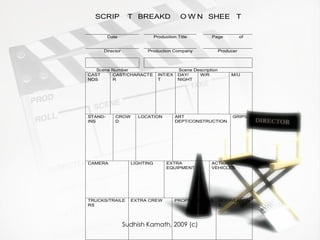
Part 2: How NOT to prepare Who do you cast? How do you cast? How do you know what is needed to shoot? How much it is going to cost? Script Breakdowns - Production Manager/ First Assistant Director - Two hands of a filmmaker
 
Picking the team The road trip  The recce Will there be sex on the sets?
Budgeting People Places Properties Costumes Converting Breakdown Sheets into Money or Resources
What Dicky Fox told  Jerry McGuire “ The key to the job is personal relationships.”
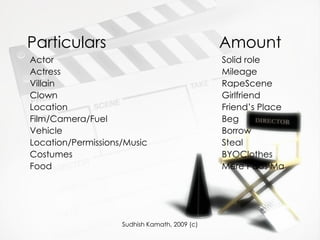
Particulars  Amount Actor Solid role Actress Mileage Villain RapeScene Clown Girlfriend Location Friend’s Place Film/Camera/Fuel Beg Vehicle Borrow Location/Permissions/Music Steal Costumes BYOClothes Food Mere Paas Ma
Scheduling Tools Excel Sheet Sticky notes & a Chart / Index Cards How NOT to schedule  D/N, Location availability, actor availability How much can you shoot?
Contracts You know WHO, WHAT, WHEN, HOW… now get them to commit.  A signature can save your soul… Or ass.  Internet or Rick Schmidt’s book
Rehearsals Test shoots Dress rehearsals Stand-ins Substitutes Improvisation/Rewrites Final changes/lock script/production
Creating your own set-up Build lights with tubelights Wheelchair as trolley Rope and suspension Build your own steadycam BUT remember, prepare to travel light!
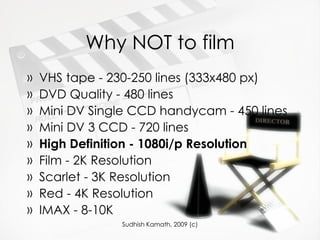
Why NOT to film VHS tape - 230-250 lines (333x480 px) DVD Quality - 480 lines Mini DV Single CCD handycam - 450 lines Mini DV 3 CCD - 720 lines High Definition - 1080i/p Resolution Film - 2K Resolution Scarlet - 3K Resolution Red - 4K Resolution IMAX - 8-10K
Part 3: How NOT to shoot Lights, Camera, Action AD duties: Logging takes, Coordinating with dept heads for present and next scene, Crowd control The madness of trying to capture live sound
Dealing with your team Good cop, bad cop - ADs Finding method in the madness Working with the chaos ALWAYS keep a cool head Morale of the team Brownie points - always end the day with a carrot no matter how much stick you’ve given
Actors Who’s your Daddy? Equation is everything Fragile egos It’s all about the mood.  Don’t let them go till you get what you want Difference between team work and anarchy On camera rehearsals, out-takes, alternative scenes, cutaways, mood shots, montages
Food for thought Eat/Feed three to four times a day Red Bulls/ Water/ Glucose First aid kit Fruits on set Importance of tea-breaks
Plan B Murphy’s law What do you do if you lose your lead? Films are not made at the set, they are made at the editing table. You can tell the same story using different characters, tools (voiceover, animation sequence, comicbook)  or sometimes even using text.
Making of the film/ Production Stills Keep a photographer on stand by Continuity and Publicity Shoot as much video as possible - making of the film, stock footage
Part 4: How NOT to cut a film Letting go The art of patience The editor-director conflict The director-writer conflict Film is a product of what is shot, not what is written Making sense out of rushes - how to salvage what’s not available
Part 5: How NOT to complete a film Remember a film remains incomplete if you miss out any of these processes: Adding Foley sound, ADR (even if you have done live sound) Background score Sound mixing - 5.1 Dolby or DTS mix Titling/ credits/ acknowledgements/disclaimers
Background Score Copyright free music Garage Band Rock/Pop bands albums 20 second rule - but you cannot sell this music
Censorship Registration of title - Earlier the better Publicity Clearance - all posters and publicity need to be cleared by the producers council or the local governing body Shooting Script Censorship fees Screening and food
Part 6: How NOT to distribute your film Do it yourself? Word of mouth? Media? Festivals? Theatrical Release? Alternative Channels? Satellite and Video rights?
Rate your own film Get everyone who watches it to rate it as honestly as possible Take into account all reviews - your own, internal, external, neutral, biased and arrive at an average. Be open to criticism from people who matter Below 4: Move on, don’t even try to promote it 4-6: Give it free, distribute on channels where the audience does not have to pay 6-8: Never give up, keep pushing the film shamelessly
Being an indie filmmaker Be active on IMDB Make sure your films and you have a website with your work/portfolio Compile all reviews and keep a record Keep working on scripts, it’s all just a matter of time before you start again
No true fiasco ever began as a quest for mere adequacy.  A motto of the British Special Air Force is: “Those who risk, win.”  A single green vine shoot is able to grow through cement.  The Pacific Northwestern Salmon beats itself bloody on its quest to travel hundreds of miles upstream against the current, with a single purpose, sex of course, but also… life. - Drew Baylor (Elizabethtown)
“ I know what I have to do now. I have to keep breathing. Tomorrow, the sun will rise, who knows what the tide would bring?” - Chuck Noland (Castaway)
The End

How NOT To Make A Film

  • 1.
    How NOT tomake your first movie Confessions of a former virgin filmmaker who learned to get screwed and now enjoys it. SUDHISH KAMATH
  • 2.
    Show me themoney Dave: But movies cost millions of dollars to make. Robert K. Bowfinger: That's after gross net deduction profit percentage deferment ten percent of the nut. Cash, every movie cost $2,184.
  • 3.
    What NOT tosay? Ok, you want to make a movie. Why? What do you want to say? Do people want to know? Art? Entertainment? Poster? Painting? Scrapbook? Expression? Communication? Indigestion?
  • 4.
    Art & EntertainmentBetween wanking around and being a gigolo, what do you rather do? Does doing it for yourself give you more pleasure or making someone else happy give you pleasure? What is honesty?
  • 5.
    Indie filmmaking? Dilpe Mat le yaar, Haath me le! Just do it.
  • 6.
    Part 1: HowNOT to write Write without thinking (Exercise) Is everyone creative? Are there are any new stories left to tell? Make it up as you go.
  • 7.
    Stages of developmentConcept Note Synopsis Scene Breakdown First Draft Rewrites Final Draft
  • 8.
    Character/Characteristics Who? What?Where? When? Why?How? Details… Digesis… Backstories…
  • 9.
    Anatomy of ascene Scene or story, it’s all about beginning, middle and end. Set-up, Confrontation, Resolution Every scene should tell a story and many stories should tell a larger story. If any of these stories is not needed to tell the larger story, why should be part of the script? What determines length? What’s a plot point? Character arc, Hero’s journey
  • 10.
    Text, Subtext, ContextWhat you want to say? What do you want to NOT say but hint What gives what you are saying more perspective Plot/ subplot/ metaphor How NOT to title your film/tagline
  • 11.
    Structure Should storybe told from A to Z? What are the other ways to tell a story and when do you use alternative structure? Examples: Pulp Fiction, Groundhog Day, Run Lola Run, Let’s talk… Lost
  • 12.
    Tools to helpyou write Celtx/ Sophocles/ Final Draft MS Word Notebook/ Tissue paper/ Toilet paper/ Bus ticket - Index Cards
  • 13.
    When is yourscript ready? Are you convinced completely, entirely after the honeymoon period? Have you read it and not got bored even after the 50th time? What about your friends? How many rewrites are necessary?
  • 14.
    Part 2: HowNOT to prepare Who do you cast? How do you cast? How do you know what is needed to shoot? How much it is going to cost? Script Breakdowns - Production Manager/ First Assistant Director - Two hands of a filmmaker
  • 15.
  • 16.
    Picking the teamThe road trip The recce Will there be sex on the sets?
  • 17.
    Budgeting People PlacesProperties Costumes Converting Breakdown Sheets into Money or Resources
  • 18.
    What Dicky Foxtold Jerry McGuire “ The key to the job is personal relationships.”
  • 19.
    Particulars AmountActor Solid role Actress Mileage Villain RapeScene Clown Girlfriend Location Friend’s Place Film/Camera/Fuel Beg Vehicle Borrow Location/Permissions/Music Steal Costumes BYOClothes Food Mere Paas Ma
  • 20.
    Scheduling Tools ExcelSheet Sticky notes & a Chart / Index Cards How NOT to schedule D/N, Location availability, actor availability How much can you shoot?
  • 21.
    Contracts You knowWHO, WHAT, WHEN, HOW… now get them to commit. A signature can save your soul… Or ass. Internet or Rick Schmidt’s book
  • 22.
    Rehearsals Test shootsDress rehearsals Stand-ins Substitutes Improvisation/Rewrites Final changes/lock script/production
  • 23.
    Creating your ownset-up Build lights with tubelights Wheelchair as trolley Rope and suspension Build your own steadycam BUT remember, prepare to travel light!
  • 24.
    Why NOT tofilm VHS tape - 230-250 lines (333x480 px) DVD Quality - 480 lines Mini DV Single CCD handycam - 450 lines Mini DV 3 CCD - 720 lines High Definition - 1080i/p Resolution Film - 2K Resolution Scarlet - 3K Resolution Red - 4K Resolution IMAX - 8-10K
  • 25.
    Part 3: HowNOT to shoot Lights, Camera, Action AD duties: Logging takes, Coordinating with dept heads for present and next scene, Crowd control The madness of trying to capture live sound
  • 26.
    Dealing with yourteam Good cop, bad cop - ADs Finding method in the madness Working with the chaos ALWAYS keep a cool head Morale of the team Brownie points - always end the day with a carrot no matter how much stick you’ve given
  • 27.
    Actors Who’s yourDaddy? Equation is everything Fragile egos It’s all about the mood. Don’t let them go till you get what you want Difference between team work and anarchy On camera rehearsals, out-takes, alternative scenes, cutaways, mood shots, montages
  • 28.
    Food for thoughtEat/Feed three to four times a day Red Bulls/ Water/ Glucose First aid kit Fruits on set Importance of tea-breaks
  • 29.
    Plan B Murphy’slaw What do you do if you lose your lead? Films are not made at the set, they are made at the editing table. You can tell the same story using different characters, tools (voiceover, animation sequence, comicbook) or sometimes even using text.
  • 30.
    Making of thefilm/ Production Stills Keep a photographer on stand by Continuity and Publicity Shoot as much video as possible - making of the film, stock footage
  • 31.
    Part 4: HowNOT to cut a film Letting go The art of patience The editor-director conflict The director-writer conflict Film is a product of what is shot, not what is written Making sense out of rushes - how to salvage what’s not available
  • 32.
    Part 5: HowNOT to complete a film Remember a film remains incomplete if you miss out any of these processes: Adding Foley sound, ADR (even if you have done live sound) Background score Sound mixing - 5.1 Dolby or DTS mix Titling/ credits/ acknowledgements/disclaimers
  • 33.
    Background Score Copyrightfree music Garage Band Rock/Pop bands albums 20 second rule - but you cannot sell this music
  • 34.
    Censorship Registration oftitle - Earlier the better Publicity Clearance - all posters and publicity need to be cleared by the producers council or the local governing body Shooting Script Censorship fees Screening and food
  • 35.
    Part 6: HowNOT to distribute your film Do it yourself? Word of mouth? Media? Festivals? Theatrical Release? Alternative Channels? Satellite and Video rights?
  • 36.
    Rate your ownfilm Get everyone who watches it to rate it as honestly as possible Take into account all reviews - your own, internal, external, neutral, biased and arrive at an average. Be open to criticism from people who matter Below 4: Move on, don’t even try to promote it 4-6: Give it free, distribute on channels where the audience does not have to pay 6-8: Never give up, keep pushing the film shamelessly
  • 37.
    Being an indiefilmmaker Be active on IMDB Make sure your films and you have a website with your work/portfolio Compile all reviews and keep a record Keep working on scripts, it’s all just a matter of time before you start again
  • 38.
    No true fiascoever began as a quest for mere adequacy. A motto of the British Special Air Force is: “Those who risk, win.” A single green vine shoot is able to grow through cement. The Pacific Northwestern Salmon beats itself bloody on its quest to travel hundreds of miles upstream against the current, with a single purpose, sex of course, but also… life. - Drew Baylor (Elizabethtown)
  • 39.
    “ I knowwhat I have to do now. I have to keep breathing. Tomorrow, the sun will rise, who knows what the tide would bring?” - Chuck Noland (Castaway)
  • 40.