How AI changes
SME finance
(Commented version)
Windows < Android web access
March 2018Artificial Intelligence (AI) is
already impacting all of our lives.
Prominent examples for current
uses are virtual assistants, such as:
Alexa, Siri and Google Assistant.
Spotify playlists based on musical
taste is another example.
To understand how AI is going to
impact (SME) finance, we need to first
understand one of the biggest
paradigm changes in computer science
within the last decades. I will illustrate
this change with two examples of AI
playing games against human players.
1997
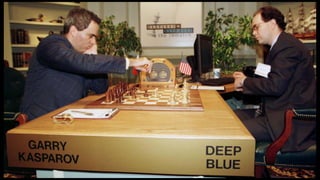
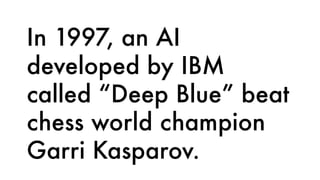
In 1997, an AI
developed by IBM
called “Deep Blue” beat
chess world champion
Garri Kasparov.
The way Deep Blue
was able to win
was through sheer
processing power.
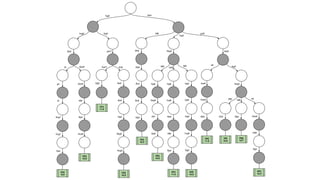
Deep Blue was able to calculate 200
million moves per second using decision
trees. While this is an impressive feat, the
AI did not really “learn” like a human
would. The approach IBM used calculates
probabilites of the best possible move,
going through many possible iterations on
the board - winning through “brute force”.
The IBM team was allowed to change
certain parameters of the AI inbetween
matches, acting as a guiding force. This
bears a similarity on how we handle
big data in financial risk assessment
today - parameters based on human
experience.
2016
2016 had another challenge in store
for artificial intelligence: the Chinese
2500 year old game “GO”. This
game can not be solved by the brute
force approach, because there are
more possible moves than atoms in
the known universe.
2500 years old
10
172
moves
The team behind AlphaGo (London-
based Deep Mind, acquired by
Google) had to use a different strategy
to “solve the game”. After all it had to
beat the best GO player in the world
at that time: 18 times world champion
Lee Sedol from South Korea.
In the end Alpha Go won 4-1 against Lee Sedol
under tournament conditions. He remarked that
the AI made unusual moves that no experienced
human player would have ever made, beause
they are considered “bad” under the given
circumstances. It turned out that the AI showed
its creative genius with exactly these kind of
moves. Sedol admitted that the AlphaGo taught
him new things about the game, which made him
a better player as a result (paraphrased).
The AlphaGo team used a technique called
Deep Learning (a Machine Learning method)
to accomplish this result. This neural network
approach is much closer to the workings of a
true self-learning system, e.g. the human
brain. Neural networks take a description of
the Go board as an input and processes it
through a number of different network layers
containing millions of neuron-like connections. 
To beat the strongest players an AI “brain”
needs to be trained. AlphaGo was trained
using recorded moves of human players.
After this initial phase, the AI mimicked
these strategies and played thousands of
games against itself. Based on this training,
AlphaGo is able to recommend the best
plays in a given situation.
The crucial paradigm change
here is using Deep Learning,
to let software write and
improve itself based on
experience (training), instead
of humans writing code.
Risk Module
(2019)
In the world of today there are many
applications of AI in the financial sector.
One of them is the assessment of risk in
factoring. efcom offers the standard
factoring solution on the European market.
One of its modules is a parameter-driven
risk monitoring tool, which is able to tell
whether an invoice is fraudulent or not.
The risk module uses paramters to filter
through thousands of invoices,
identifying fraudulent patterns. (e.g.
Benford analysis, posting date of the
invoice and comparing the habits of a
client within different timeframes, etc).
This product is used by some of the
biggest banks on the market.
The question we asked
ourselves at efcom is:
what if we can find
innovative risk strategies
with AI in factoring?
Risk parameters of current
solutions are all based on human
experience of past frauds.
Comparable to the IBM chess
team who acted as a human
adjustment to the AI by changing
its parameters after each game.
A Machine Learning approach could help
us to find new patterns - to teach us new
things about the “game” of financial risk.
This could lead to immense growth, because
we could scale and automate risk control to
a much higher degree. efcom is currently
conducting a feasibility study, to explore
possible AI enhancements for its risk
module.
Please direct
all inquries to:
Daniel.huszar@efcom.de

How AI changes SME finance

  • 1.
    How AI changes SMEfinance (Commented version)
  • 2.
    Windows < Androidweb access March 2018Artificial Intelligence (AI) is already impacting all of our lives. Prominent examples for current uses are virtual assistants, such as: Alexa, Siri and Google Assistant. Spotify playlists based on musical taste is another example.
  • 3.
    To understand howAI is going to impact (SME) finance, we need to first understand one of the biggest paradigm changes in computer science within the last decades. I will illustrate this change with two examples of AI playing games against human players.
  • 4.
  • 6.
    In 1997, anAI developed by IBM called “Deep Blue” beat chess world champion Garri Kasparov.
  • 8.
    The way DeepBlue was able to win was through sheer processing power.
  • 10.
    Deep Blue wasable to calculate 200 million moves per second using decision trees. While this is an impressive feat, the AI did not really “learn” like a human would. The approach IBM used calculates probabilites of the best possible move, going through many possible iterations on the board - winning through “brute force”.
  • 12.
    The IBM teamwas allowed to change certain parameters of the AI inbetween matches, acting as a guiding force. This bears a similarity on how we handle big data in financial risk assessment today - parameters based on human experience.
  • 13.
  • 15.
    2016 had anotherchallenge in store for artificial intelligence: the Chinese 2500 year old game “GO”. This game can not be solved by the brute force approach, because there are more possible moves than atoms in the known universe.
  • 16.
  • 18.
    The team behindAlphaGo (London- based Deep Mind, acquired by Google) had to use a different strategy to “solve the game”. After all it had to beat the best GO player in the world at that time: 18 times world champion Lee Sedol from South Korea.
  • 21.
    In the endAlpha Go won 4-1 against Lee Sedol under tournament conditions. He remarked that the AI made unusual moves that no experienced human player would have ever made, beause they are considered “bad” under the given circumstances. It turned out that the AI showed its creative genius with exactly these kind of moves. Sedol admitted that the AlphaGo taught him new things about the game, which made him a better player as a result (paraphrased).
  • 23.
    The AlphaGo teamused a technique called Deep Learning (a Machine Learning method) to accomplish this result. This neural network approach is much closer to the workings of a true self-learning system, e.g. the human brain. Neural networks take a description of the Go board as an input and processes it through a number of different network layers containing millions of neuron-like connections. 
  • 24.
    To beat thestrongest players an AI “brain” needs to be trained. AlphaGo was trained using recorded moves of human players. After this initial phase, the AI mimicked these strategies and played thousands of games against itself. Based on this training, AlphaGo is able to recommend the best plays in a given situation.
  • 25.
    The crucial paradigmchange here is using Deep Learning, to let software write and improve itself based on experience (training), instead of humans writing code.
  • 26.
  • 28.
    In the worldof today there are many applications of AI in the financial sector. One of them is the assessment of risk in factoring. efcom offers the standard factoring solution on the European market. One of its modules is a parameter-driven risk monitoring tool, which is able to tell whether an invoice is fraudulent or not.
  • 29.
    The risk moduleuses paramters to filter through thousands of invoices, identifying fraudulent patterns. (e.g. Benford analysis, posting date of the invoice and comparing the habits of a client within different timeframes, etc). This product is used by some of the biggest banks on the market.
  • 31.
    The question weasked ourselves at efcom is: what if we can find innovative risk strategies with AI in factoring?
  • 32.
    Risk parameters ofcurrent solutions are all based on human experience of past frauds. Comparable to the IBM chess team who acted as a human adjustment to the AI by changing its parameters after each game.
  • 33.
    A Machine Learningapproach could help us to find new patterns - to teach us new things about the “game” of financial risk. This could lead to immense growth, because we could scale and automate risk control to a much higher degree. efcom is currently conducting a feasibility study, to explore possible AI enhancements for its risk module.
  • 34.
    Please direct all inquriesto: Daniel.huszar@efcom.de