How accurate is CFD simulation?
In solving fluid flow problems we need aware that the underlying physics is complex and
the results generated by a CFD code are at best as good as the physics (and chemistry 0
embedded in it and at worst as good as its operator. The user of the code must have skills in a
number of areas. Prior to setting up and running a CFD simulation, there is a stage of
identification and formulation of the flow pattern in terms of physical and chemical phenomena
that need to be considered.
Flow inside a CFD solution domain is driven by the boundary conditions. In a sense the
process of solving a field problem (e.g. a fluid flow) is nothing more then the extrapolation of a
set of data defined and a boundary contour or surface into the domain interior. It is, therefore, of
paramount importance that we supply physically realistic, well-posed boundary conditions,
otherwise sever difficulties are encountered in obtaining solution. The single most cause of rapid
divergence of CFD simulation is the inappropriate selection of boundary conditions.
A good understanding of the numerical solution algorithm is also crucial. Three
mathematical concepts are useful in determining the success or otherwise of such algorithm:
convergence, consistency and stability. Convergence is the property of a numerical method to
produce a solution with approaches the exact solution as the grid spacing; control volume size or
element size is reduced to zero. Consistent numerical schemes produce systems of algebraic
equations, which can be demonstrated to be equivalent to the original governing equation, as the
grid spacing tends to zero. Stability is associated with damping of errors as the numerical
methods proceeds. If a technique is not stable even round off errors in the initial data can cause
wild oscillations or divergence. Round off errors would swamp the solution long before a grid
spacing of zero is actually reached. Engineers need CFD codes that produce physically realistic
results with good accuracy in simulations with finite (sometimes quiet coarse) grids. The
bounded ness property is akin to stability and requires that in a linear problem without source the
solution be bounded by the maximum and minimum boundary values of the flow variables.
Bounded ness can be achieved by placing restrictions on the magnitude and signs of the
coefficient of the algebraic equations. Although flow problems are non-linear it is important to
study the bounded ness of a finite volume scheme for closely related.
Finally all the flow processes contain effects due to convection and diffusion. In diffusion
phenomena such as heat conduction and a change of temperature in more or less equal measure
in all directions around it. Convective phenomena involve influencing exclusively in the flow
direction so that a point only experiences effects due to changes at upstream locations. Finite
volume schemes with the transportiveness property must account for the directionality of
influencing in terms of the relative strength of diffusion to convection. Conservativeness,
bounded ness and transportiveness are designed into all finite volume codes and have widely
shown to lead to successful CFD simulations. Good CFD often involves a delicate balancing act
between solution accuracy and stability.
Specification of the domain geometry and grid design is the main tasks at the input stage.
The two aspects that characterize good results are convergence of the iterative process and grid
independence. Progress towards a converged solution can be greatly assisted by careful selection
of the settings of various relaxation factors and acceleration devices and they are problem
dependent.
At the end of a simulation the must take a judgment whether the results are “good
enough”. It is impossible to assess the validity of the models of physics and chemistry embedded
in a program as complex as a CFD code or the accuracy of its final results by any means other
than comparison with experimental test work. Anyone wishing to use CFD in a serious way must
realize that it is no substitute for experimental, but a very powerful additional problem-solving
tool. Validation of a CFD code requires highly detailed information concerning the boundary
conditions of a problem and generates a large volume of results. To validate these in a
meaningful way it is necessary to produce experimental data of similar scope. This may involve
programs such as velocity measurement with hot -wire or laser anemometer. Sometimes the
facilities to perform experimental work may not (yet) exist in which case the CFD users must
rely on
1. Previous experience
2. Comparisons with analytical solutions of similar but simpler flow
3. Comparisons with high quality data from closely related problems reported in the
literature.
Excellent sources of the last type of information can be found in transactions of ASME
(in particular the Journal of Fluid Engineering, Journal of Engineering for Gas Turbines and
Power and Journal of Heat Transfer), AIAA Journal, Journal of Fluid Mechanics and
Proceedings of the Imeche.
It is clear that there are guidelines for good operating practice, which can assist the user
of a CFD code; the main ingredients for success in CFD are experience and a through
understanding of the physics of fluid and the fundamentals of the numerical algorithms.
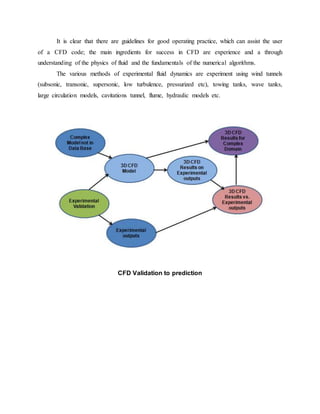
The various methods of experimental fluid dynamics are experiment using wind tunnels
(subsonic, transonic, supersonic, low turbulence, pressurized etc), towing tanks, wave tanks,
large circulation models, cavitations tunnel, flume, hydraulic models etc.
CFD Validation to prediction

How accurate is cfd simulation

  • 1.
    How accurate isCFD simulation? In solving fluid flow problems we need aware that the underlying physics is complex and the results generated by a CFD code are at best as good as the physics (and chemistry 0 embedded in it and at worst as good as its operator. The user of the code must have skills in a number of areas. Prior to setting up and running a CFD simulation, there is a stage of identification and formulation of the flow pattern in terms of physical and chemical phenomena that need to be considered. Flow inside a CFD solution domain is driven by the boundary conditions. In a sense the process of solving a field problem (e.g. a fluid flow) is nothing more then the extrapolation of a set of data defined and a boundary contour or surface into the domain interior. It is, therefore, of paramount importance that we supply physically realistic, well-posed boundary conditions, otherwise sever difficulties are encountered in obtaining solution. The single most cause of rapid divergence of CFD simulation is the inappropriate selection of boundary conditions. A good understanding of the numerical solution algorithm is also crucial. Three mathematical concepts are useful in determining the success or otherwise of such algorithm: convergence, consistency and stability. Convergence is the property of a numerical method to produce a solution with approaches the exact solution as the grid spacing; control volume size or element size is reduced to zero. Consistent numerical schemes produce systems of algebraic equations, which can be demonstrated to be equivalent to the original governing equation, as the grid spacing tends to zero. Stability is associated with damping of errors as the numerical methods proceeds. If a technique is not stable even round off errors in the initial data can cause wild oscillations or divergence. Round off errors would swamp the solution long before a grid spacing of zero is actually reached. Engineers need CFD codes that produce physically realistic results with good accuracy in simulations with finite (sometimes quiet coarse) grids. The bounded ness property is akin to stability and requires that in a linear problem without source the solution be bounded by the maximum and minimum boundary values of the flow variables. Bounded ness can be achieved by placing restrictions on the magnitude and signs of the coefficient of the algebraic equations. Although flow problems are non-linear it is important to study the bounded ness of a finite volume scheme for closely related. Finally all the flow processes contain effects due to convection and diffusion. In diffusion phenomena such as heat conduction and a change of temperature in more or less equal measure
  • 2.
    in all directionsaround it. Convective phenomena involve influencing exclusively in the flow direction so that a point only experiences effects due to changes at upstream locations. Finite volume schemes with the transportiveness property must account for the directionality of influencing in terms of the relative strength of diffusion to convection. Conservativeness, bounded ness and transportiveness are designed into all finite volume codes and have widely shown to lead to successful CFD simulations. Good CFD often involves a delicate balancing act between solution accuracy and stability. Specification of the domain geometry and grid design is the main tasks at the input stage. The two aspects that characterize good results are convergence of the iterative process and grid independence. Progress towards a converged solution can be greatly assisted by careful selection of the settings of various relaxation factors and acceleration devices and they are problem dependent. At the end of a simulation the must take a judgment whether the results are “good enough”. It is impossible to assess the validity of the models of physics and chemistry embedded in a program as complex as a CFD code or the accuracy of its final results by any means other than comparison with experimental test work. Anyone wishing to use CFD in a serious way must realize that it is no substitute for experimental, but a very powerful additional problem-solving tool. Validation of a CFD code requires highly detailed information concerning the boundary conditions of a problem and generates a large volume of results. To validate these in a meaningful way it is necessary to produce experimental data of similar scope. This may involve programs such as velocity measurement with hot -wire or laser anemometer. Sometimes the facilities to perform experimental work may not (yet) exist in which case the CFD users must rely on 1. Previous experience 2. Comparisons with analytical solutions of similar but simpler flow 3. Comparisons with high quality data from closely related problems reported in the literature. Excellent sources of the last type of information can be found in transactions of ASME (in particular the Journal of Fluid Engineering, Journal of Engineering for Gas Turbines and Power and Journal of Heat Transfer), AIAA Journal, Journal of Fluid Mechanics and Proceedings of the Imeche.
  • 3.
    It is clearthat there are guidelines for good operating practice, which can assist the user of a CFD code; the main ingredients for success in CFD are experience and a through understanding of the physics of fluid and the fundamentals of the numerical algorithms. The various methods of experimental fluid dynamics are experiment using wind tunnels (subsonic, transonic, supersonic, low turbulence, pressurized etc), towing tanks, wave tanks, large circulation models, cavitations tunnel, flume, hydraulic models etc. CFD Validation to prediction