CRC Energy Efficiency
Scheme
Content
• Introduction
• Climate Change
• Regulatory Background
• Local Government
Commitment
• CRC Energy Efficiency
Scheme
• What we are doing?
• What you can do?
• Contacts
Introduction
• Purpose of presentation
To provide Business Managers a tool to raise awareness and provide
practical advise on reducing energy/water costs and usage
• Why are we doing this
EU and Government driven legislation, children are our future and the
need for a sustainable future
• What is needed to do this
A whole school approach, internal and external support, sharing of
information and commitment
• How are we going to do this
ECCU, communication, practical solutions, policy/strategy templates
and share best practice
Climate Change
Every time we burn fossil fuels such as gas, coal or oil, carbon dioxide
is released into the atmosphere.
Climate change is the long-term change in the climate.
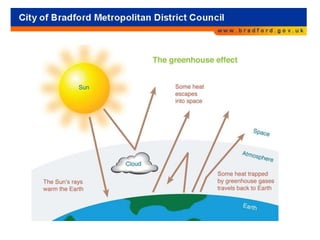
The greenhouse effect is the term used to describe the warming of the
earth.
If the concentration of greenhouse gases is too high too much heat is
trapped in the atmosphere and the planet warms up, causing climate
change.
The main greenhouse gas is carbon dioxide (CO2).
One of the main causes of increased CO2 has been the burning fossil
fuels and cutting down trees
Climate Change
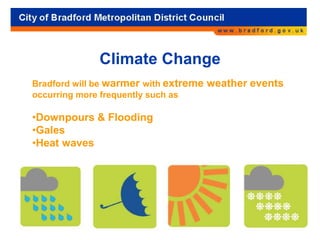
Bradford will be warmer with extreme weather events
occurring more frequently such as
•Downpours & Flooding
•Gales
•Heat waves
Regulatory Background
In the Government’s Energy White Paper of May 2007. It was
highlighted the UK’s need for an incentive to reduce CO2
emissions.
Therefore, the CRC Energy Efficiency Scheme was introduced
by the Government in 2008. As well as reducing carbon emissions, the scheme
was introduced to help organisations save money by reducing their energy
bills.
The CRC Energy Efficiency Scheme recently known as the
Carbon Reduction Scheme is the mandatory carbon emissions
trading scheme to cover all organisations using more than
6,000MWh per year of electricity.
The aim is to reduce carbon emissions from these organisations
by at least 4 million tonnes of carbon dioxide per year, by 2020.
34% reduction of
carbon emissions
by 2020.
CBMDC
portfolio of
Buildings use
147,666 MWh of
fuel per year.
Local Government Commitment
To support Government’s CRC Energy Efficiency Scheme
the Council’s has created strategic delivery priorities,
which enforce that local government are encouraged to
raise awareness and support carbon emission reduction
strategies.
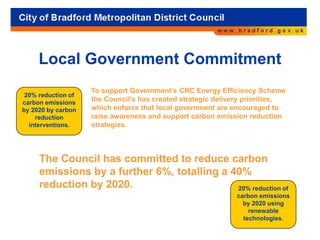
The Council has committed to reduce carbon
emissions by a further 6%, totalling a 40%
reduction by 2020. 20% reduction of
carbon emissions
by 2020 using
renewable
technologies.
20% reduction of
carbon emissions
by 2020 by carbon
reduction
interventions.
CRC Energy Efficiency Scheme
April 2012
Formally request consumption data from suppliers, in the form of a CRC
Statement. Gather total number of kwh’s of electricity generated by renewable
technologies i.e. solar pv
May - June 2012
Collate, analyse, prepare and produce the CRC Report, in line with
Government legislation
July 2012
Submit the CRC Report and purchase CRC Allowances currently equating to
£12 per tonne of carbon for the whole of the Council and Schools portfolio of
buildings for energy consumed between April 2011 – March 2012
August 2012
Council will be invoicing the full charge for Academies and “Full Budget
Schools” in September 2012 and journal the full charge at the same time for
“Part Budget Schools” to their respective SAP cost centre codes.
What does is all mean ?
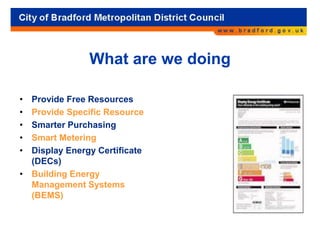
What are we doing
• Provide Free Resources
• Provide Specific Resource
• Smarter Purchasing
• Smart Metering
• Display Energy Certificate
(DECs)
• Building Energy
Management Systems
(BEMS)
What can you do
• Utilise the YPO Contract
• Take Regular Energy and
Fuel Meter readings
• Take Renewable
Technology Meter
Readings at the Start and
End of Each Financial
Period (1st April – 31st
March)
• Communicate Changes
• Raise Awareness
Contacts
ECCU@bradford.gov.uk

CRC Explained.ppt

  • 1.
  • 2.
    Content • Introduction • ClimateChange • Regulatory Background • Local Government Commitment • CRC Energy Efficiency Scheme • What we are doing? • What you can do? • Contacts
  • 3.
    Introduction • Purpose ofpresentation To provide Business Managers a tool to raise awareness and provide practical advise on reducing energy/water costs and usage • Why are we doing this EU and Government driven legislation, children are our future and the need for a sustainable future • What is needed to do this A whole school approach, internal and external support, sharing of information and commitment • How are we going to do this ECCU, communication, practical solutions, policy/strategy templates and share best practice
  • 4.
    Climate Change Every timewe burn fossil fuels such as gas, coal or oil, carbon dioxide is released into the atmosphere. Climate change is the long-term change in the climate. The greenhouse effect is the term used to describe the warming of the earth. If the concentration of greenhouse gases is too high too much heat is trapped in the atmosphere and the planet warms up, causing climate change. The main greenhouse gas is carbon dioxide (CO2). One of the main causes of increased CO2 has been the burning fossil fuels and cutting down trees
  • 6.
    Climate Change Bradford willbe warmer with extreme weather events occurring more frequently such as •Downpours & Flooding •Gales •Heat waves
  • 7.
    Regulatory Background In theGovernment’s Energy White Paper of May 2007. It was highlighted the UK’s need for an incentive to reduce CO2 emissions. Therefore, the CRC Energy Efficiency Scheme was introduced by the Government in 2008. As well as reducing carbon emissions, the scheme was introduced to help organisations save money by reducing their energy bills. The CRC Energy Efficiency Scheme recently known as the Carbon Reduction Scheme is the mandatory carbon emissions trading scheme to cover all organisations using more than 6,000MWh per year of electricity. The aim is to reduce carbon emissions from these organisations by at least 4 million tonnes of carbon dioxide per year, by 2020. 34% reduction of carbon emissions by 2020. CBMDC portfolio of Buildings use 147,666 MWh of fuel per year.
  • 8.
    Local Government Commitment Tosupport Government’s CRC Energy Efficiency Scheme the Council’s has created strategic delivery priorities, which enforce that local government are encouraged to raise awareness and support carbon emission reduction strategies. The Council has committed to reduce carbon emissions by a further 6%, totalling a 40% reduction by 2020. 20% reduction of carbon emissions by 2020 using renewable technologies. 20% reduction of carbon emissions by 2020 by carbon reduction interventions.
  • 9.
    CRC Energy EfficiencyScheme April 2012 Formally request consumption data from suppliers, in the form of a CRC Statement. Gather total number of kwh’s of electricity generated by renewable technologies i.e. solar pv May - June 2012 Collate, analyse, prepare and produce the CRC Report, in line with Government legislation July 2012 Submit the CRC Report and purchase CRC Allowances currently equating to £12 per tonne of carbon for the whole of the Council and Schools portfolio of buildings for energy consumed between April 2011 – March 2012 August 2012 Council will be invoicing the full charge for Academies and “Full Budget Schools” in September 2012 and journal the full charge at the same time for “Part Budget Schools” to their respective SAP cost centre codes. What does is all mean ?
  • 10.
    What are wedoing • Provide Free Resources • Provide Specific Resource • Smarter Purchasing • Smart Metering • Display Energy Certificate (DECs) • Building Energy Management Systems (BEMS)
  • 11.
    What can youdo • Utilise the YPO Contract • Take Regular Energy and Fuel Meter readings • Take Renewable Technology Meter Readings at the Start and End of Each Financial Period (1st April – 31st March) • Communicate Changes • Raise Awareness
  • 12.