1
SARS-CoV2 and
Water/Wastewat
er
June, 2020Zia Bukhari,
PhD
22
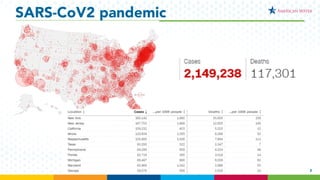
SARS-CoV2 pandemic
33
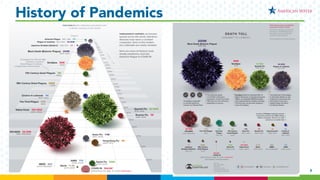
History of Pandemics
4
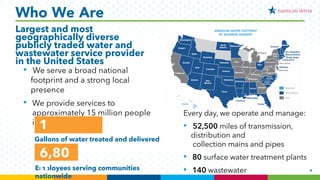
Who We Are
Largest and most
geographically diverse
publicly traded water and
wastewater service provider
in the United States
• We serve a broad national
footprint and a strong local
presence
• We provide services to
approximately 15 million people
in 46 states
1
BILLIONGallons of water treated and delivered
every day
Employees serving communities
nationwide
6,80
0
25+
Every day, we operate and manage:
• 52,500 miles of transmission,
distribution and
collection mains and pipes
• 80 surface water treatment plants
• 140 wastewater
5
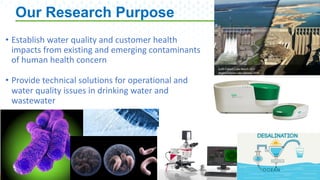
Our Research Purpose
5
• Establish water quality and customer health
impacts from existing and emerging contaminants
of human health concern
• Provide technical solutions for operational and
water quality issues in drinking water and
wastewater
6
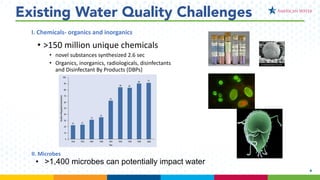
Existing Water Quality Challenges
6
• >150 million unique chemicals
• novel substances synthesized 2.6 sec
• Organics, inorganics, radiologicals, disinfectants
and Disinfectant By Products (DBPs)
• >1,400 microbes can potentially impact water
II. Microbes
I. Chemicals- organics and inorganics
7
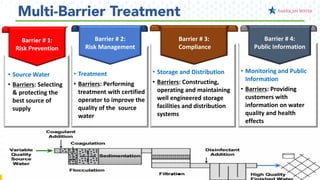
Multi-Barrier Treatment
7
• Treatment
• Barriers: Performing
treatment with certified
operator to improve the
quality of the source
water
• Storage and Distribution
• Barriers: Constructing,
operating and maintaining
well engineered storage
facilities and distribution
systems
Barrier # 3:
Compliance
• Monitoring and Public
Information
• Barriers: Providing
customers with
information on water
quality and health
effects
Barrier # 4:
Public Information
• Source Water
• Barriers: Selecting
& protecting the
best source of
supply
Barrier # 2:
Risk Management
Barrier # 1:
Risk Prevention
8
Emerging Challenges
8
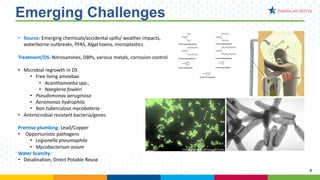
• Source: Emerging chemicals/accidental spills/ weather impacts,
waterborne outbreaks, PFAS, Algal toxins, microplastics
Treatment/DS: Nitrosamines, DBPs, various metals, corrosion control
• Microbial regrowth in DS
• Free living amoebae
• Acanthamoeba spp.,
• Naegleria fowleri
• Pseudomonas aeruginosa
• Aeromonas hydrophila
• Non tuberculous mycobateria
• Antimicrobial resistant bacteria/genes
Premise plumbing: Lead/Copper
• Opportunistic pathogens
• Legionella pneumophila
• Mycobacterium avium
Water Scarcity:
• Desalination, Direct Potable Reuse
9
Coronavirus
• 100’s of coronaviruses: mostly in animals (e.g. pigs,
camels, bats and cats). In humans mostly responsible
for mild to moderate upper-respiratory tract illnesses,
like the common cold.
• Last 20 years 3 new coronaviruses emerged from
animal reservoirs causing serious and widespread
illness and death.
• SARS-CoV: emerged in November 2002 and caused
severe acute respiratory syndrome (SARS).
Disappeared by 2004.
• MERS: Transmitted from camels & identified in
September 2012. Continues to cause sporadic and
localized outbreaks.
• SARS-CoV-2: Began in China Dec 2019, caused COVID-
19 and declared a global pandemic by the World
Health Organization on March 11, 2020.
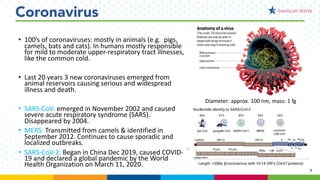
Diameter: approx. 100 nm, mass: 1 fg
10
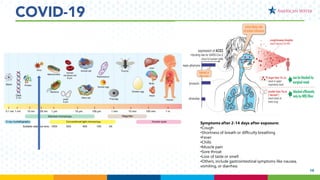
COVID-19
11
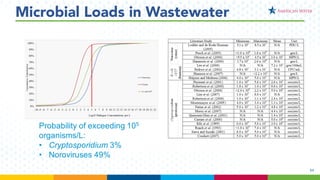
Microbial Loads in Wastewater
12
Environmental Significance
• SARS-CoV2 levels in wastewater similar to other enteric viruses
• 32 billions gallons daily and approx. 2 billion reused
• Most microbes have a tendency attach to particles.
• Surrogates for enveloped viruses (e.g. murine hepatitis virus (MHV) and Pseudomonas phage
ϕ6) confirm higher partitioning to solids than non-enveloped viruses.
• Partitioning to solid phase helps removal through settling or separation (e.g. coagulation,
filtration, etc.)
Other factors contributing to reduction in virus loads in water and wastewater include:
• Dilution effects in wastewater or large water bodies
• Natural die-off or death due to environmental stress, time or through treatment
• Rapid inactivation through chemical or physical disinfection
13
Virus survival
• SARS-CoV-2 is enveloped and less stable than non-enveloped human enteric viruses (e.g.
adenoviruses, norovirus, rotavirus and hepatitis A) usually encountered in drinking or wastewater
Human coronaviruses survival
• Like SARS-CoV1 survival for 2 hours to 9 days on surfaces.
• Influencing factors: type of surface, temperature, relative humidity and the strain of the virus
Common disinfectants (i.e. 70% ethanol or 0.1% sodium hypochlorite) kill within 1 min
• 4 weeks in reagent grade water at 25°C.
• 2 days in dechlorinated tap water at 20°C.
• > 4 log removal of influenza virus in drinking-water with 0.3 mg/L chlorine for 5 min
• 3 log of coronaviruses in primary sewage effluent at 23°C after 2 days
No evidence so far that SARS-CoV2 transmitted through wastewater with or
without treatment
14
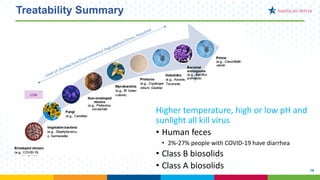
Treatability Summary
Higher temperature, high or low pH and
sunlight all kill virus
• Human feces
• 2%-27% people with COVID-19 have diarrhea
• Class B biosolids
• Class A biosolids
15
Best Practices for Wastewater
Workers
Important to adhere to appropriate PPE requirements:
• Protective outerwear
• Heavy-duty gloves
• Boots
• Goggles or a face shield, and a mask
• Hand hygiene
• Avoid touching their eyes, nose or mouth
• Social distancing
Risk is low…but not Absent
16
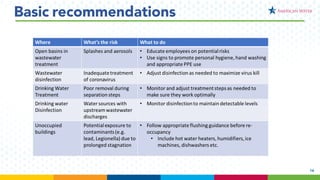
Basic recommendations
Thank you
Zia Bukhari, PhD.
American Water
1 Water Street
Camden, NJ 08102
Tel: 856 672 1758
Email : zia.Bukhari@amwater.com

SARS - CoV2 and Water/Wastewater

  • 1.
  • 2.
  • 3.
  • 4.
    4 Who We Are Largestand most geographically diverse publicly traded water and wastewater service provider in the United States • We serve a broad national footprint and a strong local presence • We provide services to approximately 15 million people in 46 states 1 BILLIONGallons of water treated and delivered every day Employees serving communities nationwide 6,80 0 25+ Every day, we operate and manage: • 52,500 miles of transmission, distribution and collection mains and pipes • 80 surface water treatment plants • 140 wastewater
  • 5.
    5 Our Research Purpose 5 •Establish water quality and customer health impacts from existing and emerging contaminants of human health concern • Provide technical solutions for operational and water quality issues in drinking water and wastewater
  • 6.
    6 Existing Water QualityChallenges 6 • >150 million unique chemicals • novel substances synthesized 2.6 sec • Organics, inorganics, radiologicals, disinfectants and Disinfectant By Products (DBPs) • >1,400 microbes can potentially impact water II. Microbes I. Chemicals- organics and inorganics
  • 7.
    7 Multi-Barrier Treatment 7 • Treatment •Barriers: Performing treatment with certified operator to improve the quality of the source water • Storage and Distribution • Barriers: Constructing, operating and maintaining well engineered storage facilities and distribution systems Barrier # 3: Compliance • Monitoring and Public Information • Barriers: Providing customers with information on water quality and health effects Barrier # 4: Public Information • Source Water • Barriers: Selecting & protecting the best source of supply Barrier # 2: Risk Management Barrier # 1: Risk Prevention
  • 8.
    8 Emerging Challenges 8 • Source:Emerging chemicals/accidental spills/ weather impacts, waterborne outbreaks, PFAS, Algal toxins, microplastics Treatment/DS: Nitrosamines, DBPs, various metals, corrosion control • Microbial regrowth in DS • Free living amoebae • Acanthamoeba spp., • Naegleria fowleri • Pseudomonas aeruginosa • Aeromonas hydrophila • Non tuberculous mycobateria • Antimicrobial resistant bacteria/genes Premise plumbing: Lead/Copper • Opportunistic pathogens • Legionella pneumophila • Mycobacterium avium Water Scarcity: • Desalination, Direct Potable Reuse
  • 9.
    9 Coronavirus • 100’s ofcoronaviruses: mostly in animals (e.g. pigs, camels, bats and cats). In humans mostly responsible for mild to moderate upper-respiratory tract illnesses, like the common cold. • Last 20 years 3 new coronaviruses emerged from animal reservoirs causing serious and widespread illness and death. • SARS-CoV: emerged in November 2002 and caused severe acute respiratory syndrome (SARS). Disappeared by 2004. • MERS: Transmitted from camels & identified in September 2012. Continues to cause sporadic and localized outbreaks. • SARS-CoV-2: Began in China Dec 2019, caused COVID- 19 and declared a global pandemic by the World Health Organization on March 11, 2020. Diameter: approx. 100 nm, mass: 1 fg
  • 10.
  • 11.
  • 12.
    12 Environmental Significance • SARS-CoV2levels in wastewater similar to other enteric viruses • 32 billions gallons daily and approx. 2 billion reused • Most microbes have a tendency attach to particles. • Surrogates for enveloped viruses (e.g. murine hepatitis virus (MHV) and Pseudomonas phage ϕ6) confirm higher partitioning to solids than non-enveloped viruses. • Partitioning to solid phase helps removal through settling or separation (e.g. coagulation, filtration, etc.) Other factors contributing to reduction in virus loads in water and wastewater include: • Dilution effects in wastewater or large water bodies • Natural die-off or death due to environmental stress, time or through treatment • Rapid inactivation through chemical or physical disinfection
  • 13.
    13 Virus survival • SARS-CoV-2is enveloped and less stable than non-enveloped human enteric viruses (e.g. adenoviruses, norovirus, rotavirus and hepatitis A) usually encountered in drinking or wastewater Human coronaviruses survival • Like SARS-CoV1 survival for 2 hours to 9 days on surfaces. • Influencing factors: type of surface, temperature, relative humidity and the strain of the virus Common disinfectants (i.e. 70% ethanol or 0.1% sodium hypochlorite) kill within 1 min • 4 weeks in reagent grade water at 25°C. • 2 days in dechlorinated tap water at 20°C. • > 4 log removal of influenza virus in drinking-water with 0.3 mg/L chlorine for 5 min • 3 log of coronaviruses in primary sewage effluent at 23°C after 2 days No evidence so far that SARS-CoV2 transmitted through wastewater with or without treatment
  • 14.
    14 Treatability Summary Higher temperature,high or low pH and sunlight all kill virus • Human feces • 2%-27% people with COVID-19 have diarrhea • Class B biosolids • Class A biosolids
  • 15.
    15 Best Practices forWastewater Workers Important to adhere to appropriate PPE requirements: • Protective outerwear • Heavy-duty gloves • Boots • Goggles or a face shield, and a mask • Hand hygiene • Avoid touching their eyes, nose or mouth • Social distancing Risk is low…but not Absent
  • 16.
  • 17.
    Thank you Zia Bukhari,PhD. American Water 1 Water Street Camden, NJ 08102 Tel: 856 672 1758 Email : zia.Bukhari@amwater.com