The Ultimate Guide to!
BUYING A
HOME
How to Find Your Dream!
Home at Your Dream Price!
The costs of homeownership 

Owning a home is a big responsibility that comes with great rewards. Budgeting is important, so plan for sudden
expenses that may arise in addition to your regular monthly expenses. Don’t forget to include all costs in your
monthly budget including: 

•  Property taxes and special assessments
•  Home/hazard insurance
•  Property maintenance
•  Association and membership fees (for condominiums, townhomes and some developments)


Some of the fees mentioned above are part of your monthly mortgage payment while others are not – be sure to ask
about how these fees are to be paid. 

!
!
Credit and credit histories !
!
It’s no secret. Your credit history is an important factor that affects your ability to obtain a mortgage for the purchase
of your home. Lenders want to see how you borrowed and repaid money in the past. This is reflected in your FICO
score. FICO scores range from 300 to 850, and lenders believe that borrowers with higher scores are more likely to
repay their loan.
!
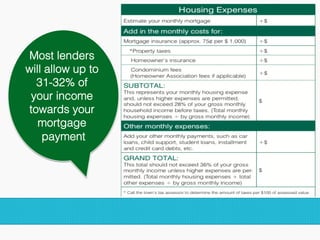
Most lenders
will allow up to
31-32% of
your income
towards your
mortgage
payment!
Many buyers get frustrated when their Realtor asks if they have been pre-approved. They think, “all I want to do is look at houses, we can worry about the
pre-approval later.” I understand your frustration, but let me help explain why the pre-approval process is so important….

1. A Pre-approval Letter shows that you can buy a house
Unless you plan on buying a house for cash, you will need some sort of financing. If you cannot obtain the financing, you will be unable to buy a house, for
now. There is not much more that is frustrating and depressing (to buyers and Realtors alike) than to look at houses for several days only to find out that
you cannot obtain financing to buy one. Therefore, I ask for a pre-approval so we can both have reassurance that you can buy a house.

2. A Pre-approval Letter helps define your search
It lets you know what you can spend, so it saves time and energy from searching for houses that you cannot afford. Think of the emotional drain of finding
the house of your dreams and then the bank says that you cannot afford it. I would rather you not look at those houses that you cannot afford. If you can
only afford a $100,000 house, we need to make sure you are only looking in that price range. If you look at too many houses outside of your price range,
you will not enjoy the houses in your price range as much. A Ford Focus never looks as good after you drive a Lamborghini.

3. You’ll have more leverage in negotiations with the seller
Having a strong pre-approval letter really makes your offer look good to the seller of the house. They are more willing to negotiate with someone who is
pre-approved than someone who isn’t. Plus, if there are multiple offers on a house, yours will be ranked higher due to the fact that you are already pre-
approved. It is less risky for the seller than looking at an offer from someone who isn’t.

4. A Pre-approval letter is better than being pre-qualified
Many banks will give you an informal estimate of what you can afford, and this is known as pre-qualification. It is not a statement of fact, but rather an
opinion. Make sure you get an official Pre-Approval letter. This is a statement of fact, and will hold a lot more weight than a pre-qualification letter. It takes
more work to get pre-approved, but it will save you a lot of time in the long run.
Why Getting Pre-Approved is Important to Starting a
House Search
•  Accepted Offer to Purchase Real Estate and a Purchase
and Sale Agreement, both signed by all parties. Copies of
canceled checks (front and back) used for the down-
payment listed on the Purchase and Sale Agreement will be
required prior to closing.
•  Names and addresses of all employers for the previous two
years.
•  Annual Gross Salary (overtime and bonuses listed
separately), copies of W-2 forms from previous two years,
and most recent pay stubs (at least one month).
•  If self-employed, copies of your federal income tax returns
with all schedules for the previous two years. If employed
by your own corporation or partnership, copies of its returns
for the previous two years, and

a year-to-date profit and loss statement prepared by your
accountant (sole proprietorships included).
•  If relying on Social Security, disability or pension income,
bring a copy of the three most recent stubs or three bank
statements if directly deposited, as well as the Award
Certificate from the issuing agent.
•  Copy of front and back of Resident Alien Registration Card,
if applicable.
!
•  Names and addresses of banks, credit unions, and
depositors in which you have deposit accounts. List account
numbers and balances in each account. Include copies of the
last three monthly statements for each account.
•  List of all stocks, bonds, certificates of deposit and other
securities, showing current market value. Include copies of
last three monthly and/or quarterly statements, account
numbers, etc.
•  Complete list of all outstanding installment debt, including
auto loans, student loans, and personal loans. Supply creditor
name, address, account number, current balance and
monthly payment.
•  Complete list of all outstanding credit card debt including
account numbers, balances and minimum payments.
•  Verification of monthly rental payment. Copies of canceled
checks (front and back) from previous 12 months.
•  If receiving or obligated to pay alimony, child support and/or
separate maintenance, provide a copy of your divorce decree
and/ or court order. Include canceled checks from previous 12
months to verify the receipt or payment of these funds.
!
What do I need to bring with me during the application process?

To expedite the processing of a mortgage application,
borrowers should provide the following:
!
Down Payments 

You will need to make an up-front investment in your new home in order to get a mortgage. The amount of the down
payment, or the initial payment made when buying a home, will also impact your ability to get a mortgage as well as
the interest rate and terms of the mortgage loan. Buyers who contribute their own funds to the purchase of a home
are considered a better overall credit risk. There are a number of low down payment mortgages available, and
even a few with no down payment. However, their availability is based a lot on your credit score and for some
mortgage products the location you are looking to purchase in.


If you’re making a down payment that is less than 20% of the home price, mortgage insurance will be required.
!
!
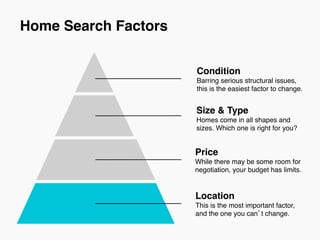
Home Search Factors!
Condition
Barring serious structural issues,
this is the easiest factor to change.!
Size & Type
Homes come in all shapes and
sizes. Which one is right for you?!
Price
While there may be some room for
negotiation, your budget has limits.!
Location
This is the most important factor,
and the one you can’t change.!
Now that you know what you can afford, it’s time to start looking at houses. You’re probably asking yourself, where should I look, what can
I expect to find? While no property will have everything you want, the home you purchase should meet as many of your needs and wants
as possible. You might start out looking for a mini-mansion but end up finding that a mid-size ranch home is just right for you and your
budget. 

Where to begin 

You’ve probably been making a mental wish list of expectations for your new home. Maybe you can’t live without a walk-in closet, a living room with high
ceilings or a functioning fireplace. Let’s get all those details listed on paper and make sure that the priorities reflect you and your family. Consider the
neighborhood, the home’s exterior, interior layout, number of bedrooms and bathrooms as well as location and lifestyle, commuting distance and community,
and reputation of the schools.
Take your list with you when you look at prospective homes and size up each house according to the items on your list. Can you envision entertaining family
and friends during holidays in the dining room? Is there enough closet space to store your ever-growing shoe collection? The more the home matches up to
items on your list, the happier you’ll be when you’re living in it. 

What are my options? 

First, you need to decide what type of home you want. Be mindful of your plans for the next five years. Do you plan on starting a family or would you be
interested in renting out a space in your home? There are a number of housing types to choose from to suit your individual needs, including: 

Single-Family

Single-family homes are the most common target property for prospective homeowners. There are two options: a newly-constructed house or an older home in
an already established neighbor- hood. Both new construction and older homes offer advantages to first-time buyers. Older homes may be roomier, more
affordable, and situated in a convenient or central location. A new home likely has a more efficient heating system, better insulation, and lower maintenance
costs, since everything is brand new. 

Condominium

A condominium is a single unit in a multi-unit property. Benefits of condo ownership include low maintenance and many of the freedoms of apartment living.
Remember, though, that along with your private space, you will also share common areas with the owners of other condominiums in your property. As a condo
owner, you may be asked or may wish to serve on the association board. This involves overseeing the collection of fees, upkeep of the grounds, maintaining
cash reserves, and managing both emergency and scheduled repairs.
!
Multifamily

Purchasing a 2- to 4-unit property provides you with both an investment property and a personal residence. Along with the possible tax and income
advantages of multifamily homes come the added responsibilities of a landlord, such as tenant search and selection, leases, security deposit procedures,
evictions and emergency repairs.
Fixer-Upper

During your search for a home, you are sure to find many houses that can be described

as fixer-uppers – generally older homes in need of updates and repair. These homes are often in older, more established neighborhoods, but have suffered
from neglect over a long period of time. If you decide that a fixer-upper is for you, be prepared for the numerous costs involved in rehabilitation work. Once
work begins, you may uncover additional issues. Rehabilitation costs can rise quickly and significantly, as can the time needed to get the house in good
working order. If you decide on a fixer-upper, have a contractor or home inspector detail the extent of rehabilitation work, and estimate the costs. Do this
before you make your offer on the home. The amount it will cost to repair the property will impact the price you pay for the house.
!
Location, location, location

You’ve heard it before. Your home’s location is arguably the most important feature to consider. Are you comfortable living on or near a main street? Would
you like to have a dog park within walking distance? Here are some things to consider when choosing a location:

• How far are you willing to commute to work?
• How accessible is the home to highways or public transportation?
• How close are shopping, churches, day care facilities and recreation areas?
• What is the quality of the public schools?

Prioritize the attributes that are most important to you. Ask yourself, would you trade a larger yard for highway access, public transportation for shopping and
restaurants, a shorter commute for better public schools? With your list in hand, you’ll be better equipped to find the town and the home that best suits your
desired lifestyle.
After carefully searching, you finally found the right home and you’re
ready to make an offer.

An offer is a legally binding commitment stating that you will buy the
home for a specific price provided that certain terms and conditions are
met. Once the seller accepts your offer, it must be signed both by you
and the seller.
Considerations for the offer

You may want to think about the following as you prepare your offer:

• What is the age and condition of the home?
• Are any repairs needed? What will they cost? Are the sellers
willing to share any of the expense?
• How long has the property been on the market?
• How active is the market (i.e., buyer’s or seller’s market)?
• Are the sellers anxious to sell?
• Is the property in a particularly desirable location or school
system?
• Does the home meet many, most, or all of the items on your wish
list?

Preparing the offer

Pay close attention to all the details. Be sure that the offer clearly outlines all the terms and conditions of the sale, including:

• Your name and the seller’s name
• The property’s address
• Any special provisions regarding fixtures, appliances, etc.
• The purchase price being offered (including the deposit put down to bind the offer and the deposit to be paid upon the execution of the Purchase
and Sale Agreement)
• Any additional riders and deadline dates
• Any contingencies to which the offer is subject (e.g., pest inspection, securing financing)
Timing and deadlines

Now it’s time to get out your calendar. Take time to think about how long it will take you to negoti- ate the offer with the seller, get an inspection, and get
approved for a mortgage. Consider meeting those deadlines when you set a closing date. Your deal could fall through if deadlines aren’t met.

Negotiating the offer

After you make your offer, the seller may accept, reject or counter it with a different price. If the seller counter-offers, you can then accept, reject, or
counter that. While the negotiation goes on, the house will stay on the market.
!
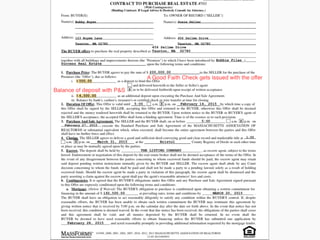
Purchase and Sale Agreement 

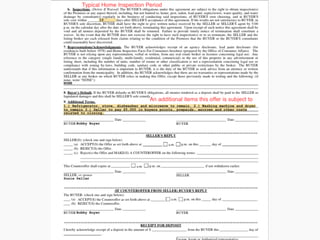
It’s not over yet! After negotiations are settled and your offer is accepted, a Purchase and Sale Agreement is written up by the broker. This document
spells out the agreement in specific detail. Because it’s a legally binding contract, have your attorney review it before you sign it. 


Provisions and contingencies 

Your first line of defense before you go into contract on your first home is to include provisions and contingencies in your offer. This ensures that you
and your money are protected in the event that the loan is not approved and the deal is called off. It is very important that the Purchase and Sale
Agreement include a mortgage contingency clause, which states that your buying the home is dependent on your ability to get a mortgage. Such a
clause allows you to keep your deposit if your mortgage isn’t approved.


Other contingencies to be added to the Purchase and Sale Agreement should be based on the home’s condition, pest, radon, and lead paint
inspections. The closing date and occupancy date should also be indicated. 

The home inspection 

You wouldn’t buy a car without taking it for a test drive, the same goes for a home. Having a professional assess and inspect the home will help you
know if you are getting what you’re paying for.


Once you schedule an inspection, a home inspector will look carefully at the condition of the home, letting you know about any potential problems or
necessary repairs. An inspection usually costs a few hundred dollars and is paid for by the buyer.
!
Getting your future home approved by an inspector is a vital step in the buying process. You’ll be responsible for finding a licensed inspector and
paying him, but learning the findings will make you feel more comfortable buying the home.
Do I need a home inspection?
A home inspection is like getting a physical from a doctor – it will teach you about the home’s potential problems so that you can make an informed
decision about whether you want to continue with the purchase. The inspector will examine the structure and systems of the home (such as the
heating, plumbing, and electrical). He or she will let you know if there are existing or potential problems and may recommend ways to address them.
If you’re planning on selling your home, consider a home inspection as well. It will give you an opportunity to make repairs and ensure that a buyer’s
inspector finds your property in good condition for a sale.
What is involved in a home inspection?
•  An inspector will do a visual check of the home’s:
•  Heating system
•  Central air conditioning system (temperature permitting)
•  Plumbing
•  Electrical systems
•  Roof, attic, and visible insulation
•  Walls
•  Ceilings
•  Floors
•  Windows and doors
•  Foundation, basement, and the visible structures of the home
•  Environmental concerns (removal of oil tank, etc.)
The inspector should give you a written report immediately after the inspection. If the inspector finds many problems and gives the home failing
grades, you may withdraw from the agreement provided that was in the contingency clause in your offer.
You can also have the home inspected for termites, radon, lead paint, and asbestos, which is not covered in a basic inspection.
!
Your home inspector will inspect
the fundamental and essential
home systems, including
plumbing. !
!
Are there any additional fees?
When you do the formal application (not the pre-approval you completed previously), you MAY be charged a
non-refundable application fee to cover the costs of the home appraisal, credit report and the lender’s
underwriting costs. The application process may take anywhere from one to three weeks depending on the
availability of your underwriting documents. Your lender is required by law to provide you with a good faith
estimate of the closing costs you will pay. Once the lender has issued a loan commitment, a closing time can be
set.
The loan terms 

Because each lender will have different terms to its mortgage, you can compare some key points to understand
which deal is the best for you. Compare:
•  Interest rate
•  Whether the rate is fixed or adjustable
•  Whether the rate can be locked in when you apply for the mortgage. For how long and at what cost?
•  Other fees charged by the lender.
•  Do all lenders charge these fees?
•  Closing costs
!
Prior to closing on your new home, you and your lender need to complete a few final tasks. 

Title search
Before the lender gives you a mortgage, a title search must be done to verify that the seller truly owns the property and that there are no liens (claims) on
the property. If there are any claims, the seller is required to pay them prior to the closing. 

Title insurance
The lender will require title insurance to protect its investment in case a question about the validity of the title arises after closing. Additional title insurance
to protect your investment is also available. Generally, the buyer pays for title insurance. 

Homeowner’s insurance
You will need to obtain homeowner’s insurance prior to closing. A paid receipt and declaration of issuance must be presented at closing. 

Survey
Most transactions will require providing the lender with a certified property sketch. The sketch is a technical drawing of the property and its structures. Your
lender will order this survey and it gets paid as part of your closing costs. It is NOT an instrument survey, it is more of a sketch.
Flood search
The lender will order a flood search on the property you are buying. The flood search determines whether the property is located in a designated flood zone.
Federal flood insurance is available to those residing in flood zones and may be a condition of the mortgage commitment. 

Septic certification - Title 5 (if applicable)
If the property you are purchasing contains a septic tank, a passing Title 5 Certification Report is required and will be completed by the seller.
Well testing
Your lender may require that drinking water wells be tested for contaminants. If the property’s served by a well, you should have this testing done during
your home inspection period.
Termite inspection
For certain loans a termite inspection must be completed prior to the closing. The buyer generally pays for the property to be inspected for termite damage
and infestation by a termite inspection firm. A certificate of inspection should be delivered to your lender before the closing, if needed, and the testing
completed during your home inspection period.
!
Excited about finally moving into your new home? There’s just one more step left – the closing. Ownership is transferred to you from the seller and money
is exchanged. It’s stressful but your real estate agent and attorney will be there to guide you through the process.
How do I prepare?
You should walk through the home within 24 hours of the closing to make sure it looks as you expected and is in move-in condition. This final inspection
gives you the opportunity to see that the seller has moved out and completed all repairs agreed to in the sales contract. Make sure all appliances and
systems are working and that any items the seller agreed to leave behind are in the house. If you discover something after the closing, you have no way
out, so be sure to walk slowly and look carefully.
What do I bring to the closing?
The mortgage lender’s attorney will let you know exactly what documents you should bring. Typically, you need a form of photo or state-issued ID, a
cashier’s check to cover the closing costs (the attorney will let you know the correct amount), and a homeowner’s insurance policy.
What happens during closing?
The closing usually takes place at the attorney or mortgage lender’s office. You will be asked to sign a lot of documents, so make sure you read each one
closely.
Closing costs
There are some costs that will need to be paid at the closing. Your attorney will go over your HUD-1 Statement with you, which itemizes all the costs.
Some standard costs include:
•  Downpayment
•  Attorney fees
•  Title search (a check of the title records to ensure that the seller is the legal owner of the property and that there are no liens or other claims
outstanding)
•  Title insurance (to protect the lender and/or the buyer against loss arising from disputes over ownership of a property)
•  Municipal lien search (to determine that there are no outstanding legal claims against the property that must be paid when the property is sold)
•  Appraisal
•  Credit report and a certified plot plan
•  A full-year insurance binder
•  Recording fees and transfer charges
•  Prepaid interest due on the mortgage for the month in which you are closing the loan
!
Payments 

The closing attorney will provide the buyer (you) and the seller with a list of all the costs that must be paid at this time.
You make these payments and sign for your mortgage. By signing the mortgage, you agree that if you do not make
payments, the lender is entitled to sell your property and apply the proceeds to your unpaid debt. You will also sign a
mortgage note agreeing to pay back the loan.
Title
The owner will give you title to the house in the form of a deed. The title and mortgage will be recorded at the Registry of
Deeds.
Congratulations! 

The closing process is now complete and you have just purchased your first home. You are now officially homeowners!
I hope that my step-by-step guide proved to be a helpful resource along the way.
!
FOR MORE INFORMATION
My job is to make the process of buying a new home
as easy and enjoyable as possible, and I have
dedicated my career and livelihood to this goal. As
your agent, I will be your tireless advocate, ensuring
that you secure the right home at the right price.
Please contact me for a free consultation. I look
forward to meeting you.!
I can be reached at:

508.521.9480 Direct / SMS

bobbie@MARealty1.com Email

www.BerkleyMass.com Web
www.Facebook.com/bobbiefiles.Realtor
!
!

First time homebuyers guide

  • 1.
    The Ultimate Guideto! BUYING A HOME How to Find Your Dream! Home at Your Dream Price!
  • 3.
    The costs ofhomeownership 
 Owning a home is a big responsibility that comes with great rewards. Budgeting is important, so plan for sudden expenses that may arise in addition to your regular monthly expenses. Don’t forget to include all costs in your monthly budget including: 
 •  Property taxes and special assessments •  Home/hazard insurance •  Property maintenance •  Association and membership fees (for condominiums, townhomes and some developments) 
 Some of the fees mentioned above are part of your monthly mortgage payment while others are not – be sure to ask about how these fees are to be paid. 
 ! ! Credit and credit histories ! ! It’s no secret. Your credit history is an important factor that affects your ability to obtain a mortgage for the purchase of your home. Lenders want to see how you borrowed and repaid money in the past. This is reflected in your FICO score. FICO scores range from 300 to 850, and lenders believe that borrowers with higher scores are more likely to repay their loan. !
  • 4.
    Most lenders will allowup to 31-32% of your income towards your mortgage payment!
  • 5.
    Many buyers getfrustrated when their Realtor asks if they have been pre-approved. They think, “all I want to do is look at houses, we can worry about the pre-approval later.” I understand your frustration, but let me help explain why the pre-approval process is so important….
 1. A Pre-approval Letter shows that you can buy a house Unless you plan on buying a house for cash, you will need some sort of financing. If you cannot obtain the financing, you will be unable to buy a house, for now. There is not much more that is frustrating and depressing (to buyers and Realtors alike) than to look at houses for several days only to find out that you cannot obtain financing to buy one. Therefore, I ask for a pre-approval so we can both have reassurance that you can buy a house.
 2. A Pre-approval Letter helps define your search It lets you know what you can spend, so it saves time and energy from searching for houses that you cannot afford. Think of the emotional drain of finding the house of your dreams and then the bank says that you cannot afford it. I would rather you not look at those houses that you cannot afford. If you can only afford a $100,000 house, we need to make sure you are only looking in that price range. If you look at too many houses outside of your price range, you will not enjoy the houses in your price range as much. A Ford Focus never looks as good after you drive a Lamborghini.
 3. You’ll have more leverage in negotiations with the seller Having a strong pre-approval letter really makes your offer look good to the seller of the house. They are more willing to negotiate with someone who is pre-approved than someone who isn’t. Plus, if there are multiple offers on a house, yours will be ranked higher due to the fact that you are already pre- approved. It is less risky for the seller than looking at an offer from someone who isn’t.
 4. A Pre-approval letter is better than being pre-qualified Many banks will give you an informal estimate of what you can afford, and this is known as pre-qualification. It is not a statement of fact, but rather an opinion. Make sure you get an official Pre-Approval letter. This is a statement of fact, and will hold a lot more weight than a pre-qualification letter. It takes more work to get pre-approved, but it will save you a lot of time in the long run. Why Getting Pre-Approved is Important to Starting a House Search
  • 6.
    •  Accepted Offerto Purchase Real Estate and a Purchase and Sale Agreement, both signed by all parties. Copies of canceled checks (front and back) used for the down- payment listed on the Purchase and Sale Agreement will be required prior to closing. •  Names and addresses of all employers for the previous two years. •  Annual Gross Salary (overtime and bonuses listed separately), copies of W-2 forms from previous two years, and most recent pay stubs (at least one month). •  If self-employed, copies of your federal income tax returns with all schedules for the previous two years. If employed by your own corporation or partnership, copies of its returns for the previous two years, and
 a year-to-date profit and loss statement prepared by your accountant (sole proprietorships included). •  If relying on Social Security, disability or pension income, bring a copy of the three most recent stubs or three bank statements if directly deposited, as well as the Award Certificate from the issuing agent. •  Copy of front and back of Resident Alien Registration Card, if applicable. ! •  Names and addresses of banks, credit unions, and depositors in which you have deposit accounts. List account numbers and balances in each account. Include copies of the last three monthly statements for each account. •  List of all stocks, bonds, certificates of deposit and other securities, showing current market value. Include copies of last three monthly and/or quarterly statements, account numbers, etc. •  Complete list of all outstanding installment debt, including auto loans, student loans, and personal loans. Supply creditor name, address, account number, current balance and monthly payment. •  Complete list of all outstanding credit card debt including account numbers, balances and minimum payments. •  Verification of monthly rental payment. Copies of canceled checks (front and back) from previous 12 months. •  If receiving or obligated to pay alimony, child support and/or separate maintenance, provide a copy of your divorce decree and/ or court order. Include canceled checks from previous 12 months to verify the receipt or payment of these funds. ! What do I need to bring with me during the application process?
 To expedite the processing of a mortgage application, borrowers should provide the following: !
  • 7.
    Down Payments 
 Youwill need to make an up-front investment in your new home in order to get a mortgage. The amount of the down payment, or the initial payment made when buying a home, will also impact your ability to get a mortgage as well as the interest rate and terms of the mortgage loan. Buyers who contribute their own funds to the purchase of a home are considered a better overall credit risk. There are a number of low down payment mortgages available, and even a few with no down payment. However, their availability is based a lot on your credit score and for some mortgage products the location you are looking to purchase in. 
 If you’re making a down payment that is less than 20% of the home price, mortgage insurance will be required. ! !
  • 8.
    Home Search Factors! Condition Barringserious structural issues, this is the easiest factor to change.! Size & Type Homes come in all shapes and sizes. Which one is right for you?! Price While there may be some room for negotiation, your budget has limits.! Location This is the most important factor, and the one you can’t change.!
  • 9.
    Now that youknow what you can afford, it’s time to start looking at houses. You’re probably asking yourself, where should I look, what can I expect to find? While no property will have everything you want, the home you purchase should meet as many of your needs and wants as possible. You might start out looking for a mini-mansion but end up finding that a mid-size ranch home is just right for you and your budget. 
 Where to begin 
 You’ve probably been making a mental wish list of expectations for your new home. Maybe you can’t live without a walk-in closet, a living room with high ceilings or a functioning fireplace. Let’s get all those details listed on paper and make sure that the priorities reflect you and your family. Consider the neighborhood, the home’s exterior, interior layout, number of bedrooms and bathrooms as well as location and lifestyle, commuting distance and community, and reputation of the schools. Take your list with you when you look at prospective homes and size up each house according to the items on your list. Can you envision entertaining family and friends during holidays in the dining room? Is there enough closet space to store your ever-growing shoe collection? The more the home matches up to items on your list, the happier you’ll be when you’re living in it. 
 What are my options? 
 First, you need to decide what type of home you want. Be mindful of your plans for the next five years. Do you plan on starting a family or would you be interested in renting out a space in your home? There are a number of housing types to choose from to suit your individual needs, including: 
 Single-Family
 Single-family homes are the most common target property for prospective homeowners. There are two options: a newly-constructed house or an older home in an already established neighbor- hood. Both new construction and older homes offer advantages to first-time buyers. Older homes may be roomier, more affordable, and situated in a convenient or central location. A new home likely has a more efficient heating system, better insulation, and lower maintenance costs, since everything is brand new. 
 Condominium
 A condominium is a single unit in a multi-unit property. Benefits of condo ownership include low maintenance and many of the freedoms of apartment living. Remember, though, that along with your private space, you will also share common areas with the owners of other condominiums in your property. As a condo owner, you may be asked or may wish to serve on the association board. This involves overseeing the collection of fees, upkeep of the grounds, maintaining cash reserves, and managing both emergency and scheduled repairs. !
  • 10.
    Multifamily
 Purchasing a 2-to 4-unit property provides you with both an investment property and a personal residence. Along with the possible tax and income advantages of multifamily homes come the added responsibilities of a landlord, such as tenant search and selection, leases, security deposit procedures, evictions and emergency repairs. Fixer-Upper
 During your search for a home, you are sure to find many houses that can be described
 as fixer-uppers – generally older homes in need of updates and repair. These homes are often in older, more established neighborhoods, but have suffered from neglect over a long period of time. If you decide that a fixer-upper is for you, be prepared for the numerous costs involved in rehabilitation work. Once work begins, you may uncover additional issues. Rehabilitation costs can rise quickly and significantly, as can the time needed to get the house in good working order. If you decide on a fixer-upper, have a contractor or home inspector detail the extent of rehabilitation work, and estimate the costs. Do this before you make your offer on the home. The amount it will cost to repair the property will impact the price you pay for the house. ! Location, location, location
 You’ve heard it before. Your home’s location is arguably the most important feature to consider. Are you comfortable living on or near a main street? Would you like to have a dog park within walking distance? Here are some things to consider when choosing a location:
 • How far are you willing to commute to work? • How accessible is the home to highways or public transportation? • How close are shopping, churches, day care facilities and recreation areas? • What is the quality of the public schools?
 Prioritize the attributes that are most important to you. Ask yourself, would you trade a larger yard for highway access, public transportation for shopping and restaurants, a shorter commute for better public schools? With your list in hand, you’ll be better equipped to find the town and the home that best suits your desired lifestyle.
  • 11.
    After carefully searching,you finally found the right home and you’re ready to make an offer.
 An offer is a legally binding commitment stating that you will buy the home for a specific price provided that certain terms and conditions are met. Once the seller accepts your offer, it must be signed both by you and the seller. Considerations for the offer
 You may want to think about the following as you prepare your offer:
 • What is the age and condition of the home? • Are any repairs needed? What will they cost? Are the sellers willing to share any of the expense? • How long has the property been on the market? • How active is the market (i.e., buyer’s or seller’s market)? • Are the sellers anxious to sell? • Is the property in a particularly desirable location or school system? • Does the home meet many, most, or all of the items on your wish list?

  • 12.
    Preparing the offer
 Payclose attention to all the details. Be sure that the offer clearly outlines all the terms and conditions of the sale, including:
 • Your name and the seller’s name • The property’s address • Any special provisions regarding fixtures, appliances, etc. • The purchase price being offered (including the deposit put down to bind the offer and the deposit to be paid upon the execution of the Purchase and Sale Agreement) • Any additional riders and deadline dates • Any contingencies to which the offer is subject (e.g., pest inspection, securing financing) Timing and deadlines
 Now it’s time to get out your calendar. Take time to think about how long it will take you to negoti- ate the offer with the seller, get an inspection, and get approved for a mortgage. Consider meeting those deadlines when you set a closing date. Your deal could fall through if deadlines aren’t met.
 Negotiating the offer
 After you make your offer, the seller may accept, reject or counter it with a different price. If the seller counter-offers, you can then accept, reject, or counter that. While the negotiation goes on, the house will stay on the market. !
  • 15.
    Purchase and SaleAgreement 
 It’s not over yet! After negotiations are settled and your offer is accepted, a Purchase and Sale Agreement is written up by the broker. This document spells out the agreement in specific detail. Because it’s a legally binding contract, have your attorney review it before you sign it. 
 
 Provisions and contingencies 
 Your first line of defense before you go into contract on your first home is to include provisions and contingencies in your offer. This ensures that you and your money are protected in the event that the loan is not approved and the deal is called off. It is very important that the Purchase and Sale Agreement include a mortgage contingency clause, which states that your buying the home is dependent on your ability to get a mortgage. Such a clause allows you to keep your deposit if your mortgage isn’t approved. 
 Other contingencies to be added to the Purchase and Sale Agreement should be based on the home’s condition, pest, radon, and lead paint inspections. The closing date and occupancy date should also be indicated. 
 The home inspection 
 You wouldn’t buy a car without taking it for a test drive, the same goes for a home. Having a professional assess and inspect the home will help you know if you are getting what you’re paying for. 
 Once you schedule an inspection, a home inspector will look carefully at the condition of the home, letting you know about any potential problems or necessary repairs. An inspection usually costs a few hundred dollars and is paid for by the buyer. !
  • 16.
    Getting your futurehome approved by an inspector is a vital step in the buying process. You’ll be responsible for finding a licensed inspector and paying him, but learning the findings will make you feel more comfortable buying the home. Do I need a home inspection? A home inspection is like getting a physical from a doctor – it will teach you about the home’s potential problems so that you can make an informed decision about whether you want to continue with the purchase. The inspector will examine the structure and systems of the home (such as the heating, plumbing, and electrical). He or she will let you know if there are existing or potential problems and may recommend ways to address them. If you’re planning on selling your home, consider a home inspection as well. It will give you an opportunity to make repairs and ensure that a buyer’s inspector finds your property in good condition for a sale. What is involved in a home inspection? •  An inspector will do a visual check of the home’s: •  Heating system •  Central air conditioning system (temperature permitting) •  Plumbing •  Electrical systems •  Roof, attic, and visible insulation •  Walls •  Ceilings •  Floors •  Windows and doors •  Foundation, basement, and the visible structures of the home •  Environmental concerns (removal of oil tank, etc.) The inspector should give you a written report immediately after the inspection. If the inspector finds many problems and gives the home failing grades, you may withdraw from the agreement provided that was in the contingency clause in your offer. You can also have the home inspected for termites, radon, lead paint, and asbestos, which is not covered in a basic inspection. ! Your home inspector will inspect the fundamental and essential home systems, including plumbing. ! !
  • 17.
    Are there anyadditional fees? When you do the formal application (not the pre-approval you completed previously), you MAY be charged a non-refundable application fee to cover the costs of the home appraisal, credit report and the lender’s underwriting costs. The application process may take anywhere from one to three weeks depending on the availability of your underwriting documents. Your lender is required by law to provide you with a good faith estimate of the closing costs you will pay. Once the lender has issued a loan commitment, a closing time can be set. The loan terms 
 Because each lender will have different terms to its mortgage, you can compare some key points to understand which deal is the best for you. Compare: •  Interest rate •  Whether the rate is fixed or adjustable •  Whether the rate can be locked in when you apply for the mortgage. For how long and at what cost? •  Other fees charged by the lender. •  Do all lenders charge these fees? •  Closing costs !
  • 18.
    Prior to closingon your new home, you and your lender need to complete a few final tasks. 
 Title search Before the lender gives you a mortgage, a title search must be done to verify that the seller truly owns the property and that there are no liens (claims) on the property. If there are any claims, the seller is required to pay them prior to the closing. 
 Title insurance The lender will require title insurance to protect its investment in case a question about the validity of the title arises after closing. Additional title insurance to protect your investment is also available. Generally, the buyer pays for title insurance. 
 Homeowner’s insurance You will need to obtain homeowner’s insurance prior to closing. A paid receipt and declaration of issuance must be presented at closing. 
 Survey Most transactions will require providing the lender with a certified property sketch. The sketch is a technical drawing of the property and its structures. Your lender will order this survey and it gets paid as part of your closing costs. It is NOT an instrument survey, it is more of a sketch. Flood search The lender will order a flood search on the property you are buying. The flood search determines whether the property is located in a designated flood zone. Federal flood insurance is available to those residing in flood zones and may be a condition of the mortgage commitment. 
 Septic certification - Title 5 (if applicable) If the property you are purchasing contains a septic tank, a passing Title 5 Certification Report is required and will be completed by the seller. Well testing Your lender may require that drinking water wells be tested for contaminants. If the property’s served by a well, you should have this testing done during your home inspection period. Termite inspection For certain loans a termite inspection must be completed prior to the closing. The buyer generally pays for the property to be inspected for termite damage and infestation by a termite inspection firm. A certificate of inspection should be delivered to your lender before the closing, if needed, and the testing completed during your home inspection period. !
  • 19.
    Excited about finallymoving into your new home? There’s just one more step left – the closing. Ownership is transferred to you from the seller and money is exchanged. It’s stressful but your real estate agent and attorney will be there to guide you through the process. How do I prepare? You should walk through the home within 24 hours of the closing to make sure it looks as you expected and is in move-in condition. This final inspection gives you the opportunity to see that the seller has moved out and completed all repairs agreed to in the sales contract. Make sure all appliances and systems are working and that any items the seller agreed to leave behind are in the house. If you discover something after the closing, you have no way out, so be sure to walk slowly and look carefully. What do I bring to the closing? The mortgage lender’s attorney will let you know exactly what documents you should bring. Typically, you need a form of photo or state-issued ID, a cashier’s check to cover the closing costs (the attorney will let you know the correct amount), and a homeowner’s insurance policy. What happens during closing? The closing usually takes place at the attorney or mortgage lender’s office. You will be asked to sign a lot of documents, so make sure you read each one closely. Closing costs There are some costs that will need to be paid at the closing. Your attorney will go over your HUD-1 Statement with you, which itemizes all the costs. Some standard costs include: •  Downpayment •  Attorney fees •  Title search (a check of the title records to ensure that the seller is the legal owner of the property and that there are no liens or other claims outstanding) •  Title insurance (to protect the lender and/or the buyer against loss arising from disputes over ownership of a property) •  Municipal lien search (to determine that there are no outstanding legal claims against the property that must be paid when the property is sold) •  Appraisal •  Credit report and a certified plot plan •  A full-year insurance binder •  Recording fees and transfer charges •  Prepaid interest due on the mortgage for the month in which you are closing the loan !
  • 20.
    Payments 
 The closingattorney will provide the buyer (you) and the seller with a list of all the costs that must be paid at this time. You make these payments and sign for your mortgage. By signing the mortgage, you agree that if you do not make payments, the lender is entitled to sell your property and apply the proceeds to your unpaid debt. You will also sign a mortgage note agreeing to pay back the loan. Title The owner will give you title to the house in the form of a deed. The title and mortgage will be recorded at the Registry of Deeds. Congratulations! 
 The closing process is now complete and you have just purchased your first home. You are now officially homeowners! I hope that my step-by-step guide proved to be a helpful resource along the way. !
  • 21.
    FOR MORE INFORMATION Myjob is to make the process of buying a new home as easy and enjoyable as possible, and I have dedicated my career and livelihood to this goal. As your agent, I will be your tireless advocate, ensuring that you secure the right home at the right price. Please contact me for a free consultation. I look forward to meeting you.! I can be reached at:
 508.521.9480 Direct / SMS
 bobbie@MARealty1.com Email
 www.BerkleyMass.com Web www.Facebook.com/bobbiefiles.Realtor ! !