September 2014
Management Contract Trends -
A Review
2 Management Contract Trends - A Review	
This report identifies the main commercial
trends and conditions contained within a
selection of Hotel Management Contracts
(HMC’s) across India. Our comments
are based on a review of 42 management
contracts for properties across various
segments, located in the primary and
secondary cities of India. The review
highlights key trends pertaining to fee
structures and important clauses in Hotel
Management Contracts and aims to reflect
current trends in the industry.
Management Contract Trends - A Review 3
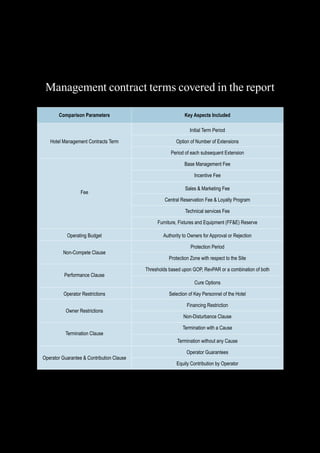
Management contract terms covered in the report
Comparison Parameters Key Aspects Included
Hotel Management Contracts Term
Initial Term Period
Option of Number of Extensions
Period of each subsequent Extension
Fee
Base Management Fee
Incentive Fee
Sales & Marketing Fee
Central Reservation Fee & Loyalty Program
Technical services Fee
Furniture, Fixtures and Equipment (FF&E) Reserve
Operating Budget Authority to Owners for Approval or Rejection
Non-Compete Clause
Protection Period
Protection Zone with respect to the Site
Performance Clause
Thresholds based upon GOP, RevPAR or a combination of both
Cure Options
Operator Restrictions Selection of Key Personnel of the Hotel
Owner Restrictions
Financing Restriction
Non-Disturbance Clause
Termination Clause
Termination with a Cause
Termination without any Cause
Operator Guarantee & Contribution Clause
Operator Guarantees
Equity Contribution by Operator
4 Management Contract Trends - A Review	
Research Sample Details
Our sample set was fairly evenly spread across all segments, with a
majority of contracts pertaining to properties located in primary cities.
Segment
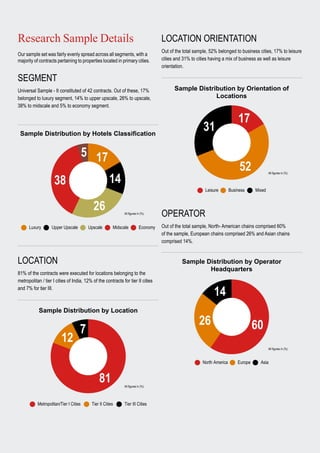
Universal Sample - It constituted of 42 contracts. Out of these, 17%
belonged to luxury segment, 14% to upper upscale, 26% to upscale,
38% to midscale and 5% to economy segment.
Location
81% of the contracts were executed for locations belonging to the
metropolitan / tier I cities of India, 12% of the contracts for tier II cities
and 7% for tier III.
Location Orientation
Out of the total sample, 52% belonged to business cities, 17% to leisure
cities and 31% to cities having a mix of business as well as leisure
orientation.
Operator
Out of the total sample, North- American chains comprised 60%
of the sample, European chains comprised 26% and Asian chains
comprised 14%.
Sample Distribution by Hotels Classification
Sample Distribution by Orientation of
Locations
Sample Distribution by Operator
Headquarters
Sample Distribution by Location
All figures in (%)
All figures in (%)
All figures in (%)
All figures in (%)
Metropolitan/Tier I Cities Tier II Cities Tier III Cities
81
12
7
Leisure Business Mixed
17
52
31
North America Europe Asia
6026
14
Midscale EconomyLuxury UpscaleUpper Upscale
17
14
26
38
5
Management Contract Trends - A Review 5
Management Contracts -
Key Aspects
Term
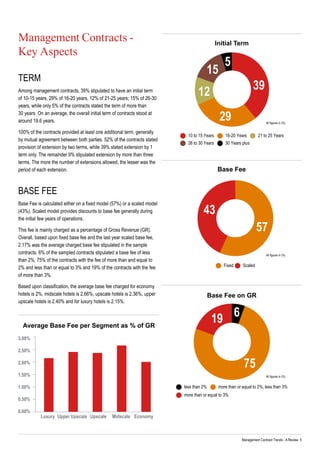
Among management contracts, 39% stipulated to have an initial term
of 10-15 years, 29% of 16-20 years, 12% of 21-25 years; 15% of 26-30
years, while only 5% of the contracts stated the term of more than
30 years. On an average, the overall initial term of contracts stood at
around 19.6 years.
100% of the contracts provided at least one additional term, generally
by mutual agreement between both parties. 52% of the contracts stated
provision of extension by two terms, while 39% stated extension by 1
term only. The remainder 9% stipulated extension by more than three
terms. The more the number of extensions allowed, the lesser was the
period of each extension.
Initial Term
Base Fee
Base Fee is calculated either on a fixed model (57%) or a scaled model
(43%). Scaled model provides discounts to base fee generally during
the initial few years of operations.
This fee is mainly charged as a percentage of Gross Revenue (GR).
Overall, based upon fixed base fee and the last year scaled base fee,
2.17% was the average charged base fee stipulated in the sample
contracts. 6% of the sampled contracts stipulated a base fee of less
than 2%, 75% of the contracts with the fee of more than and equal to
2% and less than or equal to 3% and 19% of the contracts with the fee
of more than 3%.
Based upon classification, the average base fee charged for economy
hotels is 2%, midscale hotels is 2.66%, upscale hotels is 2.36%, upper
upscale hotels is 2.40% and for luxury hotels is 2.15%.
All figures in (%)
Base Fee
All figures in (%)
Fixed Scaled
57
43
Base Fee on GR
All figures in (%)
Average Base Fee per Segment as % of GR
10 to 15 Years 16-20 Years 21 to 25 Years
26 to 30 Years 30 Years plus
39
29
12
15
5
less than 2% more than or equal to 2%, less than 3%
more than or equal to 3%
6
75
19
6 Management Contract Trends - A Review	
Incentive Fee as % of GOP
Incentive Fee
Incentive fee is stated in agreements over and above the Base Fee.
The majority of agreements had an incentive fee calculated on Gross
Operating Profit (GOP). There were few linked to the available cash
flows too instead of a flat fee. Fee is generally scaled from 4% to
10% of GOP. In few of the cases, incentive was nil for GOP being
less than 30% of the Gross Operating Revenue (GOR). 19% of the
contracts stipulated a flat fee ranging from 6.5% to 8% irrespective of
the GOP as a percentage of the GOR.
81% of the sampled contracts had a variable incentive fee linked to
profitability.
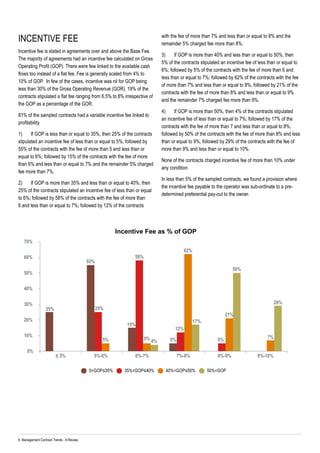
1) If GOP is less than or equal to 35%, then 25% of the contracts
stipulated an incentive fee of less than or equal to 5%; followed by
55% of the contracts with the fee of more than 5 and less than or
equal to 6%; followed by 15% of the contracts with the fee of more
than 6% and less than or equal to 7% and the remainder 5% charged
fee more than 7%.
2) If GOP is more than 35% and less than or equal to 40%, then
25% of the contracts stipulated an incentive fee of less than or equal
to 6%; followed by 58% of the contracts with the fee of more than
6 and less than or equal to 7%; followed by 12% of the contracts
with the fee of more than 7% and less than or equal to 8% and the
remainder 5% charged fee more than 8%.
3) If GOP is more than 40% and less than or equal to 50%, then
5% of the contracts stipulated an incentive fee of less than or equal to
6%; followed by 5% of the contracts with the fee of more than 6 and
less than or equal to 7%; followed by 62% of the contracts with the fee
of more than 7% and less than or equal to 8%, followed by 21% of the
contracts with the fee of more than 8% and less than or equal to 9%
and the remainder 7% charged fee more than 9%.
4) If GOP is more than 50%, then 4% of the contracts stipulated
an incentive fee of less than or equal to 7%; followed by 17% of the
contracts with the fee of more than 7 and less than or equal to 8%;
followed by 50% of the contracts with the fee of more than 8% and less
than or equal to 9%, followed by 29% of the contracts with the fee of
more than 9% and less than or equal to 10%.
None of the contracts charged incentive fee of more than 10% under
any condition.
In less than 5% of the sampled contracts, we found a provision where
the incentive fee payable to the operator was sub-ordinate to a pre-
determined preferential pay-out to the owner.
50%<GOP
25%
55%
15%
5%
25%
58%
12%
5%5% 5%
62%
21%
7%
4%
17%
50%
29%
0%
10%
20%
30%
40%
50%
60%
70%
5%-6% 6%-7% 7%-8% 8%-9% 9%-10%
Management Contract Trends - A Review 7
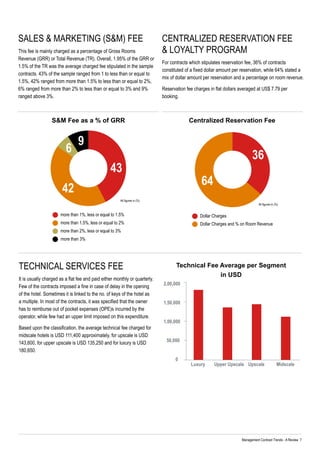
Sales & Marketing (S&M) Fee
This fee is mainly charged as a percentage of Gross Rooms
Revenue (GRR) or Total Revenue (TR). Overall, 1.95% of the GRR or
1.5% of the TR was the average charged fee stipulated in the sample
contracts. 43% of the sample ranged from 1 to less than or equal to
1.5%, 42% ranged from more than 1.5% to less than or equal to 2%,
6% ranged from more than 2% to less than or equal to 3% and 9%
ranged above 3%.
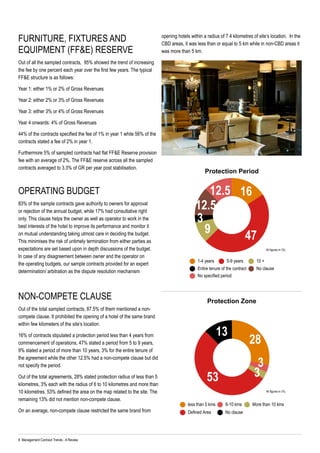
CENTRALIZED Reservation Fee
& Loyalty Program
For contracts which stipulates reservation fee, 36% of contracts
constituted of a fixed dollar amount per reservation, while 64% stated a
mix of dollar amount per reservation and a percentage on room revenue.
Reservation fee charges in flat dollars averaged at US$ 7.79 per
booking.
Technical Services Fee
It is usually charged as a flat fee and paid either monthly or quarterly.
Few of the contracts imposed a fine in case of delay in the opening
of the hotel. Sometimes it is linked to the no. of keys of the hotel as
a multiple. In most of the contracts, it was specified that the owner
has to reimburse out of pocket expenses (OPE)s incurred by the
operator, while few had an upper limit imposed on this expenditure.
Based upon the classification, the average technical fee charged for
midscale hotels is USD 111,400 approximately, for upscale is USD
143,600, for upper upscale is USD 135,250 and for luxury is USD
180,650.
Centralized Reservation Fee
All figures in (%)
S&M Fee as a % of GRR
more than 1%, less or equal to 1.5%
more than 1.5%, less or equal to 2%
more than 2%, less or equal to 3%
more than 3%
43
42
6
9
All figures in (%)
Dollar Charges
Dollar Charges and % on Room Revenue
Technical Fee Average per Segment
in USD
36
64
8 Management Contract Trends - A Review	
Furniture, Fixtures and
Equipment (FF&E) Reserve
Out of all the sampled contracts, 95% showed the trend of increasing
the fee by one percent each year over the first few years. The typical
FF&E structure is as follows:
Year 1: either 1% or 2% of Gross Revenues
Year 2: either 2% or 3% of Gross Revenues
Year 3: either 3% or 4% of Gross Revenues
Year 4 onwards: 4% of Gross Revenues
44% of the contracts specified the fee of 1% in year 1 while 56% of the
contracts stated a fee of 2% in year 1.
Furthermore 5% of sampled contracts had flat FF&E Reserve provision
fee with an average of 2%. The FF&E reserve across all the sampled
contracts averaged to 3.3% of GR per year post stabilisation.
Operating Budget
83% of the sample contracts gave authority to owners for approval
or rejection of the annual budget, while 17% had consultative right
only. This clause helps the owner as well as operator to work in the
best interests of the hotel to improve its performance and monitor it
on mutual understanding taking utmost care in deciding the budget.
This minimises the risk of untimely termination from either parties as
expectations are set based upon in depth discussions of the budget.
In case of any disagreement between owner and the operator on
the operating budgets, our sample contracts provided for an expert
determination/ arbitration as the dispute resolution mechanism
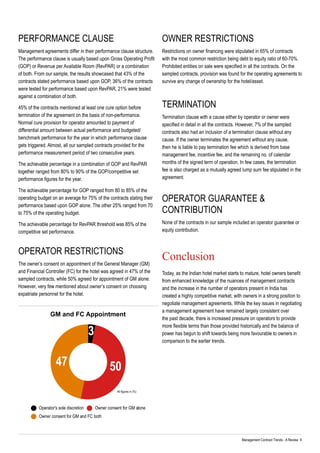
Non-compete clause
Out of the total sampled contracts, 87.5% of them mentioned a non-
compete clause. It prohibited the opening of a hotel of the same brand
within few kilometers of the site’s location.
16% of contracts stipulated a protection period less than 4 years from
commencement of operations, 47% stated a period from 5 to 9 years,
9% stated a period of more than 10 years, 3% for the entire tenure of
the agreement while the other 12.5% had a non-compete clause but did
not specify the period.
Out of the total agreements, 28% stated protection radius of less than 5
kilometres, 3% each with the radius of 6 to 10 kilometres and more than
10 kilometres, 53% defined the area on the map related to the site. The
remaining 13% did not mention non-compete clause.
On an average, non-compete clause restricted the same brand from
Protection Period
Protection Zone
All figures in (%)
All figures in (%)
opening hotels within a radius of 7.4 kilometres of site’s location. In the
CBD areas, it was less than or equal to 5 km while in non-CBD areas it
was more than 5 km.
1-4 years 5-9 years 10 +
Entire tenure of the contract
No specified period
No clause
16
47
9
3
12.5
12.5
Defined Area No clause
less than 5 kms More than 10 kms6-10 kms
28
3
353
13
Management Contract Trends - A Review 9
Performance clause
Management agreements differ in their performance clause structure.
The performance clause is usually based upon Gross Operating Profit
(GOP) or Revenue per Available Room (RevPAR) or a combination
of both. From our sample, the results showcased that 43% of the
contracts stated performance based upon GOP, 36% of the contracts
were tested for performance based upon RevPAR, 21% were tested
against a combination of both.
45% of the contracts mentioned at least one cure option before
termination of the agreement on the basis of non-performance.
Normal cure provision for operator amounted to payment of
differential amount between actual performance and budgeted/
benchmark performance for the year in which performance clause
gets triggered. Almost, all our sampled contracts provided for the
performance measurement period of two consecutive years.
The achievable percentage in a combination of GOP and RevPAR
together ranged from 80% to 90% of the GOP/competitive set
performance figures for the year.
The achievable percentage for GOP ranged from 80 to 85% of the
operating budget on an average for 75% of the contracts stating their
performance based upon GOP alone. The other 25% ranged from 70
to 75% of the operating budget.
The achievable percentage for RevPAR threshold was 85% of the
competitive set performance.
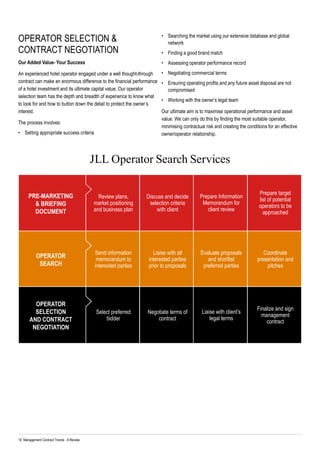
Operator Restrictions
The owner’s consent on appointment of the General Manager (GM)
and Financial Controller (FC) for the hotel was agreed in 47% of the
sampled contracts, while 50% agreed for appointment of GM alone.
However, very few mentioned about owner’s consent on choosing
expatriate personnel for the hotel.
OWNER RESTRICTIONS
Restrictions on owner financing were stipulated in 65% of contracts
with the most common restriction being debt to equity ratio of 60-70%.
Prohibited entities on sale were specified in all the contracts. On the
sampled contracts, provision was found for the operating agreements to
survive any change of ownership for the hotel/asset.
Termination
Termination clause with a cause either by operator or owner were
specified in detail in all the contracts. However, 7% of the sampled
contracts also had an inclusion of a termination clause without any
cause. If the owner terminates the agreement without any cause,
then he is liable to pay termination fee which is derived from base
management fee, incentive fee, and the remaining no. of calendar
months of the signed term of operation. In few cases, the termination
fee is also charged as a mutually agreed lump sum fee stipulated in the
agreement.
Operator Guarantee &
Contribution
None of the contracts in our sample included an operator guarantee or
equity contribution.
Conclusion
Today, as the Indian hotel market starts to mature, hotel owners benefit
from enhanced knowledge of the nuances of management contracts
and the increase in the number of operators present in India has
created a highly competitive market, with owners in a strong position to
negotiate management agreements. While the key issues in negotiating
a management agreement have remained largely consistent over
the past decade, there is increased pressure on operators to provide
more flexible terms than those provided historically and the balance of
power has begun to shift towards being more favourable to owners in
comparison to the earlier trends.
Operator's sole discretion
Owner consent for GM and FC both
Owner consent for GM alone
3
5047
GM and FC Appointment
All figures in (%)
10 Management Contract Trends - A Review	
JLL Operator Search Services
Review plans,
market positioning
and business plan
Send information
memorandum to
interested parties
Select preferred
bidder
Discuss and decide
selection criteria
with client
Liaise with all
interested parties
prior to proposals
Negotiate terms of
contract
Prepare Information
Memorandum for
client review
Evaluate proposals
and shortlist
preferred parties
Liaise with client’s
legal terms
Prepare target
list of potential
operators to be
approached
Coordinate
presentation and
pitches
Finalize and sign
management
contract
Pre-marketing
& Briefing
Document
Operator
search
Operator
Selection
and Contract
Negotiation
OPERATOR SELECTION &
CONTRACT NEGOTIATION
Our Added Value- Your Success
An experienced hotel operator engaged under a well thought-through
contract can make an enormous difference to the financial performance
of a hotel investment and its ultimate capital value. Our operator
selection team has the depth and breadth of experience to know what
to look for and how to button down the detail to protect the owner’s
interest.
The process involves:
•	 Setting appropriate success criteria
•	 Searching the market using our extensive database and global
network
•	 Finding a good brand match
•	 Assessing operator performance record
•	 Negotiating commercial terms
•	 Ensuring operating profits and any future asset disposal are not
compromised
•	 Working with the owner’s legal team
Our ultimate aim is to maximise operational performance and asset
value. We can only do this by finding the most suitable operator,
minimising contractual risk and creating the conditions for an effective
owner/operator relationship.
Management Contract Trends - A Review 11
Authors
Mandeep S Lamba
Managing Director, India
Hotels and Hospitality Group
tel +124 460 5151
mandeep.lamba@ap.jll.com
Shirat Mathur
Senior Analyst
Hotels and Hospitality Group
tel +124 460 5775
shirat.mathur@ap.jll.com
Harshendra Goyal
Senior Vice President
Hotels and Hospitality Group
tel +124 460 5168
harshendra.goyal@ap.jll.com
Christopher Thepot
Hotels and Hospitality Group
tel +124 460 5092
christopher.thepot@ap.jll.com
Roopa George
Senior Associate
Hotels and Hospitality Group
tel +124 460 5089
roopa.george@ap.jll.com
About JLL Hotels & Hospitality Group
JLL’s Hotels & Hospitality Group serves as the hospitality industry’s global leader in real estate services for
luxury, upscale, select service and budget hotels; timeshare and fractional ownership properties; convention
centers; mixed-use developments and other hospitality properties. The firm’s 300 dedicated hotel and
hospitality experts partner with investors and owner/operators around the globe to support and shape
investment strategies that deliver maximum value throughout the entire lifecycle of an asset.
In the last five years, the team completed more transactions than any other hotels and hospitality real estate
advisor in the world totaling nearly US $36 billion, while also completing approximately 4,000 advisory,
valuation and asset management assignments.
The group’s hotels and hospitality specialists provide independent and expert advice to clients, backed by
industry-leading research.
Atlanta
tel: +1 404 995 2100
Auckland
tel: +64 9 366 1666
Bangkok
tel: +66 2 624 6400
Barcelona
tel: +34 93 318 53 53
Beijing
tel: +86 10 5922 1300
Brisbane
tel: +61 7 3231 1311
Buenos Aires
tel: +54 11 4893 2600
Chengdu
tel: +86 28 6680 5000
Chicago
tel: +1 312 782 5800
Dallas
tel: +1 214 438 6100
Denver
tel: +1 303 260 6500
Dubai
tel: +971 4 426 6999
Dublin
tel: +353 1 673 1600
Düsseldorf
tel: +49 211 13006 0
Exeter
tel: +44 1392 423696
Frankfurt
tel: +49 69 2003 0
Glasgow
tel: +44 141 248 6040
Istanbul
tel: +90 212 350 0800
Jakarta
tel: +62 21 2922 3888
Leeds
tel: +44 113 244 6440
London
tel: +44 20 7493 4933
Los Angeles
tel: +1 213 239 6000
Lyon
tel: +33 4 78 89 26 26
Madrid
tel: +34 91 789 11 00
Manchester
tel: +44 161 828 6440
Marseille
tel: +33 4 95 09 1313
Melbourne
tel: +61 3 9672 6666
Mexico City
tel: +52 55 5980 8003
Miami
tel: +1 305 529 6345
Milan
tel: +39 2 85 86 861
Moscow
tel: +7 495 737 8000
Munich
tel: +49 89 2900 88 0
New Delhi
tel: +91 124 460 5000
Jones Lang LaSalle Property Consultants (India) Pvt Ltd © 2014. All rights reserved. All information contained herein is from sources deemed reliable; however, no representation or
warranty is made to the accuracy thereof.
About JLL
JLL (NYSE: JLL) is a professional services and investment management firm offering specialized real estate services to clients seeking increased value by
owning, occupying and investing in real estate. With annual fee revenue of $4 billion, JLL has more than 200 corporate offices and operates in 75 countries
worldwide. On behalf of its clients, the firm provides management and real estate outsourcing services for a property portfolio of 3 billion square feet and
completed $99 billion in sales, acquisitions and finance transactions in 2013. Its investment management business, LaSalle Investment Management, has $48.0
billion of real estate assets under management.
JLL has over 50 years of experience in Asia Pacific, with over 27,500 employees operating in 80 offices in 15 countries across the region. The firm was named
‘Best Property Consultancy’ in seven Asia Pacific countries at the International Property Awards Asia Pacific 2014, and won nine Asia Pacific awards in the
Euromoney Real Estate Awards 2013. www.jll.com/asiapacific
About JLL India
JLL is India’s premier and largest professional services firm specializing in real estate. With an extensive geographic footprint across 11 cities (Ahmedabad, Delhi,
Mumbai, Bangalore, Pune, Chennai, Hyderabad, Kolkata, Kochi, Chandigarh and Coimbatore) and a staff strength of over 6800, the firm provides investors,
developers, local corporates and multinational companies with a comprehensive range of services including research, analytics, consultancy, transactions, project
and development services, integrated facility management, property and asset management, sustainability, industrial, capital markets, residential, hotels, health
care, senior living, education and retail advisory. The firm was named the Best Property Consultancy in India at the International Property Awards Asia Pacific
2014-15. For further information, please visit www.joneslanglasalle.co.in
New York
tel: +1 212 812 5700
Paris
tel: +33 1 40 55 15 15
Perth
tel: +61 8 9322 5111
Rome
tel: +39 06 4200671
San Francisco
tel: +1 415 395 4900
São Paulo
tel: +55 11 3043 6900
Shanghai
tel: +86 21 6393 3333
Singapore
tel: +65 6220 3888
Sydney
tel: +61 2 9220 8500
Tokyo
tel: +81 3 5501 9200
Washington D.C.
tel: +1 202 719 5000
JLL’s Hotels & Hospitality Group offices

Hotel management contracts trends hotels

  • 1.
  • 2.
    2 Management ContractTrends - A Review This report identifies the main commercial trends and conditions contained within a selection of Hotel Management Contracts (HMC’s) across India. Our comments are based on a review of 42 management contracts for properties across various segments, located in the primary and secondary cities of India. The review highlights key trends pertaining to fee structures and important clauses in Hotel Management Contracts and aims to reflect current trends in the industry.
  • 3.
    Management Contract Trends- A Review 3 Management contract terms covered in the report Comparison Parameters Key Aspects Included Hotel Management Contracts Term Initial Term Period Option of Number of Extensions Period of each subsequent Extension Fee Base Management Fee Incentive Fee Sales & Marketing Fee Central Reservation Fee & Loyalty Program Technical services Fee Furniture, Fixtures and Equipment (FF&E) Reserve Operating Budget Authority to Owners for Approval or Rejection Non-Compete Clause Protection Period Protection Zone with respect to the Site Performance Clause Thresholds based upon GOP, RevPAR or a combination of both Cure Options Operator Restrictions Selection of Key Personnel of the Hotel Owner Restrictions Financing Restriction Non-Disturbance Clause Termination Clause Termination with a Cause Termination without any Cause Operator Guarantee & Contribution Clause Operator Guarantees Equity Contribution by Operator
  • 4.
    4 Management ContractTrends - A Review Research Sample Details Our sample set was fairly evenly spread across all segments, with a majority of contracts pertaining to properties located in primary cities. Segment Universal Sample - It constituted of 42 contracts. Out of these, 17% belonged to luxury segment, 14% to upper upscale, 26% to upscale, 38% to midscale and 5% to economy segment. Location 81% of the contracts were executed for locations belonging to the metropolitan / tier I cities of India, 12% of the contracts for tier II cities and 7% for tier III. Location Orientation Out of the total sample, 52% belonged to business cities, 17% to leisure cities and 31% to cities having a mix of business as well as leisure orientation. Operator Out of the total sample, North- American chains comprised 60% of the sample, European chains comprised 26% and Asian chains comprised 14%. Sample Distribution by Hotels Classification Sample Distribution by Orientation of Locations Sample Distribution by Operator Headquarters Sample Distribution by Location All figures in (%) All figures in (%) All figures in (%) All figures in (%) Metropolitan/Tier I Cities Tier II Cities Tier III Cities 81 12 7 Leisure Business Mixed 17 52 31 North America Europe Asia 6026 14 Midscale EconomyLuxury UpscaleUpper Upscale 17 14 26 38 5
  • 5.
    Management Contract Trends- A Review 5 Management Contracts - Key Aspects Term Among management contracts, 39% stipulated to have an initial term of 10-15 years, 29% of 16-20 years, 12% of 21-25 years; 15% of 26-30 years, while only 5% of the contracts stated the term of more than 30 years. On an average, the overall initial term of contracts stood at around 19.6 years. 100% of the contracts provided at least one additional term, generally by mutual agreement between both parties. 52% of the contracts stated provision of extension by two terms, while 39% stated extension by 1 term only. The remainder 9% stipulated extension by more than three terms. The more the number of extensions allowed, the lesser was the period of each extension. Initial Term Base Fee Base Fee is calculated either on a fixed model (57%) or a scaled model (43%). Scaled model provides discounts to base fee generally during the initial few years of operations. This fee is mainly charged as a percentage of Gross Revenue (GR). Overall, based upon fixed base fee and the last year scaled base fee, 2.17% was the average charged base fee stipulated in the sample contracts. 6% of the sampled contracts stipulated a base fee of less than 2%, 75% of the contracts with the fee of more than and equal to 2% and less than or equal to 3% and 19% of the contracts with the fee of more than 3%. Based upon classification, the average base fee charged for economy hotels is 2%, midscale hotels is 2.66%, upscale hotels is 2.36%, upper upscale hotels is 2.40% and for luxury hotels is 2.15%. All figures in (%) Base Fee All figures in (%) Fixed Scaled 57 43 Base Fee on GR All figures in (%) Average Base Fee per Segment as % of GR 10 to 15 Years 16-20 Years 21 to 25 Years 26 to 30 Years 30 Years plus 39 29 12 15 5 less than 2% more than or equal to 2%, less than 3% more than or equal to 3% 6 75 19
  • 6.
    6 Management ContractTrends - A Review Incentive Fee as % of GOP Incentive Fee Incentive fee is stated in agreements over and above the Base Fee. The majority of agreements had an incentive fee calculated on Gross Operating Profit (GOP). There were few linked to the available cash flows too instead of a flat fee. Fee is generally scaled from 4% to 10% of GOP. In few of the cases, incentive was nil for GOP being less than 30% of the Gross Operating Revenue (GOR). 19% of the contracts stipulated a flat fee ranging from 6.5% to 8% irrespective of the GOP as a percentage of the GOR. 81% of the sampled contracts had a variable incentive fee linked to profitability. 1) If GOP is less than or equal to 35%, then 25% of the contracts stipulated an incentive fee of less than or equal to 5%; followed by 55% of the contracts with the fee of more than 5 and less than or equal to 6%; followed by 15% of the contracts with the fee of more than 6% and less than or equal to 7% and the remainder 5% charged fee more than 7%. 2) If GOP is more than 35% and less than or equal to 40%, then 25% of the contracts stipulated an incentive fee of less than or equal to 6%; followed by 58% of the contracts with the fee of more than 6 and less than or equal to 7%; followed by 12% of the contracts with the fee of more than 7% and less than or equal to 8% and the remainder 5% charged fee more than 8%. 3) If GOP is more than 40% and less than or equal to 50%, then 5% of the contracts stipulated an incentive fee of less than or equal to 6%; followed by 5% of the contracts with the fee of more than 6 and less than or equal to 7%; followed by 62% of the contracts with the fee of more than 7% and less than or equal to 8%, followed by 21% of the contracts with the fee of more than 8% and less than or equal to 9% and the remainder 7% charged fee more than 9%. 4) If GOP is more than 50%, then 4% of the contracts stipulated an incentive fee of less than or equal to 7%; followed by 17% of the contracts with the fee of more than 7 and less than or equal to 8%; followed by 50% of the contracts with the fee of more than 8% and less than or equal to 9%, followed by 29% of the contracts with the fee of more than 9% and less than or equal to 10%. None of the contracts charged incentive fee of more than 10% under any condition. In less than 5% of the sampled contracts, we found a provision where the incentive fee payable to the operator was sub-ordinate to a pre- determined preferential pay-out to the owner. 50%<GOP 25% 55% 15% 5% 25% 58% 12% 5%5% 5% 62% 21% 7% 4% 17% 50% 29% 0% 10% 20% 30% 40% 50% 60% 70% 5%-6% 6%-7% 7%-8% 8%-9% 9%-10%
  • 7.
    Management Contract Trends- A Review 7 Sales & Marketing (S&M) Fee This fee is mainly charged as a percentage of Gross Rooms Revenue (GRR) or Total Revenue (TR). Overall, 1.95% of the GRR or 1.5% of the TR was the average charged fee stipulated in the sample contracts. 43% of the sample ranged from 1 to less than or equal to 1.5%, 42% ranged from more than 1.5% to less than or equal to 2%, 6% ranged from more than 2% to less than or equal to 3% and 9% ranged above 3%. CENTRALIZED Reservation Fee & Loyalty Program For contracts which stipulates reservation fee, 36% of contracts constituted of a fixed dollar amount per reservation, while 64% stated a mix of dollar amount per reservation and a percentage on room revenue. Reservation fee charges in flat dollars averaged at US$ 7.79 per booking. Technical Services Fee It is usually charged as a flat fee and paid either monthly or quarterly. Few of the contracts imposed a fine in case of delay in the opening of the hotel. Sometimes it is linked to the no. of keys of the hotel as a multiple. In most of the contracts, it was specified that the owner has to reimburse out of pocket expenses (OPE)s incurred by the operator, while few had an upper limit imposed on this expenditure. Based upon the classification, the average technical fee charged for midscale hotels is USD 111,400 approximately, for upscale is USD 143,600, for upper upscale is USD 135,250 and for luxury is USD 180,650. Centralized Reservation Fee All figures in (%) S&M Fee as a % of GRR more than 1%, less or equal to 1.5% more than 1.5%, less or equal to 2% more than 2%, less or equal to 3% more than 3% 43 42 6 9 All figures in (%) Dollar Charges Dollar Charges and % on Room Revenue Technical Fee Average per Segment in USD 36 64
  • 8.
    8 Management ContractTrends - A Review Furniture, Fixtures and Equipment (FF&E) Reserve Out of all the sampled contracts, 95% showed the trend of increasing the fee by one percent each year over the first few years. The typical FF&E structure is as follows: Year 1: either 1% or 2% of Gross Revenues Year 2: either 2% or 3% of Gross Revenues Year 3: either 3% or 4% of Gross Revenues Year 4 onwards: 4% of Gross Revenues 44% of the contracts specified the fee of 1% in year 1 while 56% of the contracts stated a fee of 2% in year 1. Furthermore 5% of sampled contracts had flat FF&E Reserve provision fee with an average of 2%. The FF&E reserve across all the sampled contracts averaged to 3.3% of GR per year post stabilisation. Operating Budget 83% of the sample contracts gave authority to owners for approval or rejection of the annual budget, while 17% had consultative right only. This clause helps the owner as well as operator to work in the best interests of the hotel to improve its performance and monitor it on mutual understanding taking utmost care in deciding the budget. This minimises the risk of untimely termination from either parties as expectations are set based upon in depth discussions of the budget. In case of any disagreement between owner and the operator on the operating budgets, our sample contracts provided for an expert determination/ arbitration as the dispute resolution mechanism Non-compete clause Out of the total sampled contracts, 87.5% of them mentioned a non- compete clause. It prohibited the opening of a hotel of the same brand within few kilometers of the site’s location. 16% of contracts stipulated a protection period less than 4 years from commencement of operations, 47% stated a period from 5 to 9 years, 9% stated a period of more than 10 years, 3% for the entire tenure of the agreement while the other 12.5% had a non-compete clause but did not specify the period. Out of the total agreements, 28% stated protection radius of less than 5 kilometres, 3% each with the radius of 6 to 10 kilometres and more than 10 kilometres, 53% defined the area on the map related to the site. The remaining 13% did not mention non-compete clause. On an average, non-compete clause restricted the same brand from Protection Period Protection Zone All figures in (%) All figures in (%) opening hotels within a radius of 7.4 kilometres of site’s location. In the CBD areas, it was less than or equal to 5 km while in non-CBD areas it was more than 5 km. 1-4 years 5-9 years 10 + Entire tenure of the contract No specified period No clause 16 47 9 3 12.5 12.5 Defined Area No clause less than 5 kms More than 10 kms6-10 kms 28 3 353 13
  • 9.
    Management Contract Trends- A Review 9 Performance clause Management agreements differ in their performance clause structure. The performance clause is usually based upon Gross Operating Profit (GOP) or Revenue per Available Room (RevPAR) or a combination of both. From our sample, the results showcased that 43% of the contracts stated performance based upon GOP, 36% of the contracts were tested for performance based upon RevPAR, 21% were tested against a combination of both. 45% of the contracts mentioned at least one cure option before termination of the agreement on the basis of non-performance. Normal cure provision for operator amounted to payment of differential amount between actual performance and budgeted/ benchmark performance for the year in which performance clause gets triggered. Almost, all our sampled contracts provided for the performance measurement period of two consecutive years. The achievable percentage in a combination of GOP and RevPAR together ranged from 80% to 90% of the GOP/competitive set performance figures for the year. The achievable percentage for GOP ranged from 80 to 85% of the operating budget on an average for 75% of the contracts stating their performance based upon GOP alone. The other 25% ranged from 70 to 75% of the operating budget. The achievable percentage for RevPAR threshold was 85% of the competitive set performance. Operator Restrictions The owner’s consent on appointment of the General Manager (GM) and Financial Controller (FC) for the hotel was agreed in 47% of the sampled contracts, while 50% agreed for appointment of GM alone. However, very few mentioned about owner’s consent on choosing expatriate personnel for the hotel. OWNER RESTRICTIONS Restrictions on owner financing were stipulated in 65% of contracts with the most common restriction being debt to equity ratio of 60-70%. Prohibited entities on sale were specified in all the contracts. On the sampled contracts, provision was found for the operating agreements to survive any change of ownership for the hotel/asset. Termination Termination clause with a cause either by operator or owner were specified in detail in all the contracts. However, 7% of the sampled contracts also had an inclusion of a termination clause without any cause. If the owner terminates the agreement without any cause, then he is liable to pay termination fee which is derived from base management fee, incentive fee, and the remaining no. of calendar months of the signed term of operation. In few cases, the termination fee is also charged as a mutually agreed lump sum fee stipulated in the agreement. Operator Guarantee & Contribution None of the contracts in our sample included an operator guarantee or equity contribution. Conclusion Today, as the Indian hotel market starts to mature, hotel owners benefit from enhanced knowledge of the nuances of management contracts and the increase in the number of operators present in India has created a highly competitive market, with owners in a strong position to negotiate management agreements. While the key issues in negotiating a management agreement have remained largely consistent over the past decade, there is increased pressure on operators to provide more flexible terms than those provided historically and the balance of power has begun to shift towards being more favourable to owners in comparison to the earlier trends. Operator's sole discretion Owner consent for GM and FC both Owner consent for GM alone 3 5047 GM and FC Appointment All figures in (%)
  • 10.
    10 Management ContractTrends - A Review JLL Operator Search Services Review plans, market positioning and business plan Send information memorandum to interested parties Select preferred bidder Discuss and decide selection criteria with client Liaise with all interested parties prior to proposals Negotiate terms of contract Prepare Information Memorandum for client review Evaluate proposals and shortlist preferred parties Liaise with client’s legal terms Prepare target list of potential operators to be approached Coordinate presentation and pitches Finalize and sign management contract Pre-marketing & Briefing Document Operator search Operator Selection and Contract Negotiation OPERATOR SELECTION & CONTRACT NEGOTIATION Our Added Value- Your Success An experienced hotel operator engaged under a well thought-through contract can make an enormous difference to the financial performance of a hotel investment and its ultimate capital value. Our operator selection team has the depth and breadth of experience to know what to look for and how to button down the detail to protect the owner’s interest. The process involves: • Setting appropriate success criteria • Searching the market using our extensive database and global network • Finding a good brand match • Assessing operator performance record • Negotiating commercial terms • Ensuring operating profits and any future asset disposal are not compromised • Working with the owner’s legal team Our ultimate aim is to maximise operational performance and asset value. We can only do this by finding the most suitable operator, minimising contractual risk and creating the conditions for an effective owner/operator relationship.
  • 11.
    Management Contract Trends- A Review 11 Authors Mandeep S Lamba Managing Director, India Hotels and Hospitality Group tel +124 460 5151 mandeep.lamba@ap.jll.com Shirat Mathur Senior Analyst Hotels and Hospitality Group tel +124 460 5775 shirat.mathur@ap.jll.com Harshendra Goyal Senior Vice President Hotels and Hospitality Group tel +124 460 5168 harshendra.goyal@ap.jll.com Christopher Thepot Hotels and Hospitality Group tel +124 460 5092 christopher.thepot@ap.jll.com Roopa George Senior Associate Hotels and Hospitality Group tel +124 460 5089 roopa.george@ap.jll.com About JLL Hotels & Hospitality Group JLL’s Hotels & Hospitality Group serves as the hospitality industry’s global leader in real estate services for luxury, upscale, select service and budget hotels; timeshare and fractional ownership properties; convention centers; mixed-use developments and other hospitality properties. The firm’s 300 dedicated hotel and hospitality experts partner with investors and owner/operators around the globe to support and shape investment strategies that deliver maximum value throughout the entire lifecycle of an asset. In the last five years, the team completed more transactions than any other hotels and hospitality real estate advisor in the world totaling nearly US $36 billion, while also completing approximately 4,000 advisory, valuation and asset management assignments. The group’s hotels and hospitality specialists provide independent and expert advice to clients, backed by industry-leading research.
  • 12.
    Atlanta tel: +1 404995 2100 Auckland tel: +64 9 366 1666 Bangkok tel: +66 2 624 6400 Barcelona tel: +34 93 318 53 53 Beijing tel: +86 10 5922 1300 Brisbane tel: +61 7 3231 1311 Buenos Aires tel: +54 11 4893 2600 Chengdu tel: +86 28 6680 5000 Chicago tel: +1 312 782 5800 Dallas tel: +1 214 438 6100 Denver tel: +1 303 260 6500 Dubai tel: +971 4 426 6999 Dublin tel: +353 1 673 1600 Düsseldorf tel: +49 211 13006 0 Exeter tel: +44 1392 423696 Frankfurt tel: +49 69 2003 0 Glasgow tel: +44 141 248 6040 Istanbul tel: +90 212 350 0800 Jakarta tel: +62 21 2922 3888 Leeds tel: +44 113 244 6440 London tel: +44 20 7493 4933 Los Angeles tel: +1 213 239 6000 Lyon tel: +33 4 78 89 26 26 Madrid tel: +34 91 789 11 00 Manchester tel: +44 161 828 6440 Marseille tel: +33 4 95 09 1313 Melbourne tel: +61 3 9672 6666 Mexico City tel: +52 55 5980 8003 Miami tel: +1 305 529 6345 Milan tel: +39 2 85 86 861 Moscow tel: +7 495 737 8000 Munich tel: +49 89 2900 88 0 New Delhi tel: +91 124 460 5000 Jones Lang LaSalle Property Consultants (India) Pvt Ltd © 2014. All rights reserved. All information contained herein is from sources deemed reliable; however, no representation or warranty is made to the accuracy thereof. About JLL JLL (NYSE: JLL) is a professional services and investment management firm offering specialized real estate services to clients seeking increased value by owning, occupying and investing in real estate. With annual fee revenue of $4 billion, JLL has more than 200 corporate offices and operates in 75 countries worldwide. On behalf of its clients, the firm provides management and real estate outsourcing services for a property portfolio of 3 billion square feet and completed $99 billion in sales, acquisitions and finance transactions in 2013. Its investment management business, LaSalle Investment Management, has $48.0 billion of real estate assets under management. JLL has over 50 years of experience in Asia Pacific, with over 27,500 employees operating in 80 offices in 15 countries across the region. The firm was named ‘Best Property Consultancy’ in seven Asia Pacific countries at the International Property Awards Asia Pacific 2014, and won nine Asia Pacific awards in the Euromoney Real Estate Awards 2013. www.jll.com/asiapacific About JLL India JLL is India’s premier and largest professional services firm specializing in real estate. With an extensive geographic footprint across 11 cities (Ahmedabad, Delhi, Mumbai, Bangalore, Pune, Chennai, Hyderabad, Kolkata, Kochi, Chandigarh and Coimbatore) and a staff strength of over 6800, the firm provides investors, developers, local corporates and multinational companies with a comprehensive range of services including research, analytics, consultancy, transactions, project and development services, integrated facility management, property and asset management, sustainability, industrial, capital markets, residential, hotels, health care, senior living, education and retail advisory. The firm was named the Best Property Consultancy in India at the International Property Awards Asia Pacific 2014-15. For further information, please visit www.joneslanglasalle.co.in New York tel: +1 212 812 5700 Paris tel: +33 1 40 55 15 15 Perth tel: +61 8 9322 5111 Rome tel: +39 06 4200671 San Francisco tel: +1 415 395 4900 São Paulo tel: +55 11 3043 6900 Shanghai tel: +86 21 6393 3333 Singapore tel: +65 6220 3888 Sydney tel: +61 2 9220 8500 Tokyo tel: +81 3 5501 9200 Washington D.C. tel: +1 202 719 5000 JLL’s Hotels & Hospitality Group offices