Hospital capacity management

                      Rene Alvarez
                      March, 2012


Rene Alvarez, 2012                           1
Agenda
1. Why must we manage capacity?
2. Some models currently used:

     a) The “Pure Average Model” model
     b) The IHI model


3. A more comprehensive model
4. Conclusions

Rene Alvarez, 2012
                                         2
1. Why must we manage capacity?


               Are there only financial reasons?


Rene Alvarez, 2012                                 3
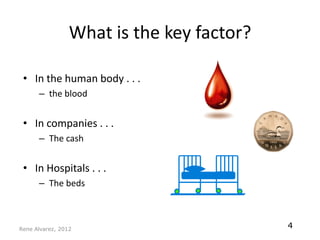
What is the key factor?

 • In the human body . . .
      – the blood


 • In companies . . .
      – The cash


 • In Hospitals . . .
      – The beds


Rene Alvarez, 2012
                                           4
Capacity management
• The main objective of “capacity management”
  is to efficiently use the main physical resource
  of a hospital (beds) in order to provide
  excellent care to actual and future patients
• In this context, the concept of “patient flow”
  becomes key


Rene Alvarez, 2012
                                                5
Challenges
•   Complex environment
•   Uncertainty in demand
•   Uncertainty in length of stay (LOS)
•   Variability


Rene Alvarez, 2012
                                          6
2. Some models currently used

                     a) The “Pure Average Model” model
                              b) The IHI model


Rene Alvarez, 2012                                       7
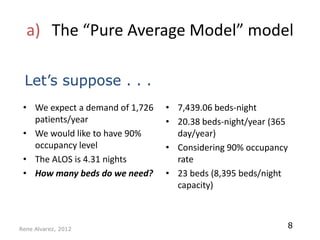
a) The “Pure Average Model” model

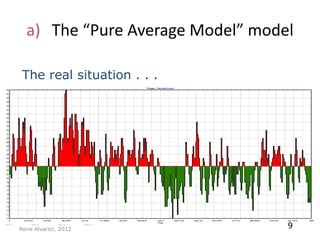
 Let’s suppose . . .
 • We expect a demand of 1,726   • 7,439.06 beds-night
   patients/year                 • 20.38 beds-night/year (365
 • We would like to have 90%       day/year)
   occupancy level               • Considering 90% occupancy
 • The ALOS is 4.31 nights         rate
 • How many beds do we need?     • 23 beds (8,395 beds/night
                                   capacity)


Rene Alvarez, 2012
                                                            8
a) The “Pure Average Model” model

The real situation . . .


Rene Alvarez, 2012
                                  9
a) The “Pure Average Model” model


 • Averages are dangerous . . .


Rene Alvarez, 2012
                                  10
a) The “Pure Average Model” model
• “Plan and manage capacity based on simply
  deterministic spreadsheets calculations . . .
  does not provide the right information and
  results in underestimating the bed
  requirements”


                       Harper PR, Shahani AK (2002) Modelling for the Planning and
                     management of bed capacities in Hospitals. Journal of Operations
                                                     Research Society. 53 pg. 11-18


Rene Alvarez, 2012
                                                                               11
b) The IHI Model: Planning for the next morning
• Step 1:
     – Predict next day discharges from 8:00 to 14:00
• Step 2:
     – Predict next day demand (ED, elective, transfers, etc.) from 8:00
       to 14:00
• Step 3:
     – Develop a plan to match the capacity with the demand
• Step 4:
     – Evaluate the plan and predictions


Rene Alvarez, 2012
                                                                    12
b) The IHI Model: Planning for the next morning


 •    Excellent idea
 •    Generates results
 •    Requires a cultural change
 •    Improves patient flow
 •    Improves communication


Rene Alvarez, 2012
                                                  13
b) The IHI Model: Yes, but . . .

 • Extremely short term
 • Requires lots of
   meetings/energy (time
   consumer)
 • Not all key players are involved
 • Based on “believes” not in
   “data” (inaccurate predictions)
 • Does not allow timely reaction
 • Does not set goals
 • Lack of “planning”, lots of
   “reacting”


Rene Alvarez, 2012
                                          14
3. A more comprehensive model

           Is it possible to have a more sophisticated, flexible
            and accurate capacity planning model that takes
                into account the complex environment of a
                                  hospital?


Rene Alvarez, 2012
                                                                   15
Simulation model description

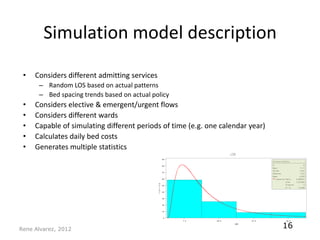
 •   Considers different admitting services
      – Random LOS based on actual patterns
      – Bed spacing trends based on actual policy
 •   Considers elective & emergent/urgent flows
 •   Considers different wards
 •   Capable of simulating different periods of time (e.g. one calendar year)
 •   Calculates daily bed costs
 •   Generates multiple statistics
                                                  90


                                                  80


                                                  70


                                                  60


                                              P
                                              e   50
                                              r
                                              c
                                              e
                                              n   40
                                              t


                                                  30


                                                  20


                                                  10


                                                  0


                                                                                   16
                                                       7. 5   22. 5        37. 5   52. 5

                                                                      GR
                                                                      E


Rene Alvarez, 2012
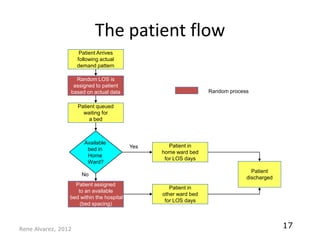
The patient flow
                      Patient Arrives
                     following actual
                     demand pattern

                   Random LOS is
                  assigned to patient
                 based on actual data                             Random process

                     Patient queued
                       waiting for
                          a bed


                        Available
                                           Yes      Patient in
                         bed in
                                                 home ward bed
                         Home
                                                  for LOS days
                         Ward?
                                                                                 Patient
                       No
                                                                               discharged
                   Patient assigned
                                                    Patient in
                    to an available
                                                 other ward bed
                 bed within the hospital
                                                  for LOS days
                     (bed spacing)


Rene Alvarez, 2012
                                                                                            17
The simulation model can improve
            planning activities
1. Long term: Right-size the number of staffed beds
   and improve allocation amongst services

2. Medium-short term: Plan the occupancy level by
   predicting demand and LOS


Rene Alvarez, 2012
                                                  18
Predictions . . .


     Is it possible to predict
     the demand in a complex
     environment like
     healthcare?


Rene Alvarez, 2012
                                         19
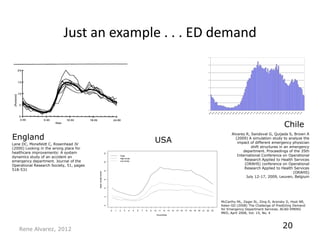
Just an example . . . ED demand


                                                                                         Chile
England
                                                          Alvarez R, Sandoval G, Quijada S, Brown A

Lane DC, Monefeldt C, Rosenhead JV
                                          USA               (2009) A simulation study to analyze the
                                                             impact of different emergency physician
(2000) Looking in the wrong place for                                 shift structures in an emergency
healthcare improvements: A system                                department. Proceedings of the 35th
dynamics study of an accident an                             International Conference on Operational
emergency department. Journal of the                              Research Applied to Health Services
Operational Research Society, 51, pages                           (ORAHS) conference on Operational
518-531                                                           Research Applied to Health Services
                                                                                              (ORAHS)
                                                                   July 12-17, 2009, Leuven, Belgium


                                                    McCarthy ML, Zeger SL, Ding R, Aronsky D, Hoot NR,
                                                    Kelen GD (2008) The Challenge of Predicting Demand
                                                    for Emergency Department Services. ACAD EMERG
                                                    MED, April 2008, Vol. 15, No. 4


   Rene Alvarez, 2012
                                                                                        20
Capacity planning in the medium term

               Demand forecasts            LOS forecasts


                           Simulation model


                       Occupancy level predictions
                       for different periods of time


                           Mitigating strategies


Rene Alvarez, 2012
                                                           21
Interesting . . . but . . .


     Does this kind of model
     exist beyond the
     literature?


Rene Alvarez, 2012
                                                   22
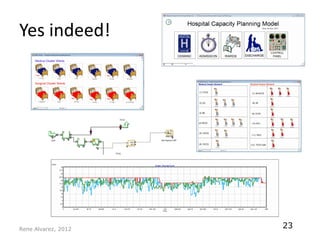
Yes indeed!


Rene Alvarez, 2012
                     23
4. Conclusions

                        So What?


Rene Alvarez, 2012                    24
Yes . . .

 • It is possible to build a sophisticated,
   accurate and flexible model to deal with
   capacity planning
 • It requires the right knowledge and skills
 • Hospitals should focus their energies in
   those high leverage/yield
   projects/initiatives such as this one


Rene Alvarez, 2012
                                                25
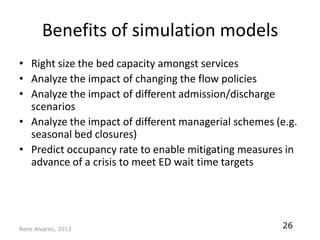
Benefits of simulation models
• Right size the bed capacity amongst services
• Analyze the impact of changing the flow policies
• Analyze the impact of different admission/discharge
  scenarios
• Analyze the impact of different managerial schemes (e.g.
  seasonal bed closures)
• Predict occupancy rate to enable mitigating measures in
  advance of a crisis to meet ED wait time targets


Rene Alvarez, 2012
                                                      26
Requirements
• The simulation model should be adapted (configured) to
  the reality of each hospital
• Data should be collected, analyzed and prepared to
  populate the model’s databases
• A calibration/validation process should be conducted
  prior to use of the model
• Additions to the simulation model should be done to
  answer more sophisticated questions/predictions
• It requires specific knowledge/skills


Rene Alvarez, 2012
                                                     27
A final reflection on improvement . . .


Rene Alvarez, 2012
                                                       28
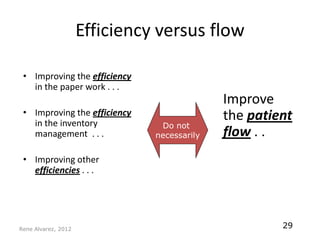
Efficiency versus flow

 • Improving the efficiency
   in the paper work . . .
                                             Improve
 • Improving the efficiency                  the patient
   in the inventory             Do not
   management . . .            necessarily   flow . .
 • Improving other
   efficiencies . . .


Rene Alvarez, 2012
                                                      29
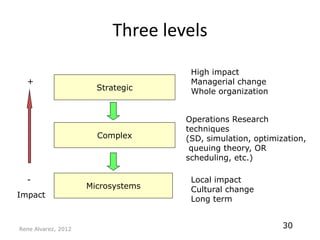
Three levels
                                     High impact
  +                                  Managerial change
                       Strategic     Whole organization


                                    Operations Research
                                    techniques
                       Complex      (SD, simulation, optimization,
                                     queuing theory, OR
                                    scheduling, etc.)

  -                                  Local impact
                     Microsystems    Cultural change
Impact
                                     Long term


Rene Alvarez, 2012
                                                            30
Hospital capacity management

                      Rene Alvarez
                      March, 2012


Rene Alvarez, 2012                           31

Hospital capacity management

  • 1.
    Hospital capacity management Rene Alvarez March, 2012 Rene Alvarez, 2012 1
  • 2.
    Agenda 1. Why mustwe manage capacity? 2. Some models currently used: a) The “Pure Average Model” model b) The IHI model 3. A more comprehensive model 4. Conclusions Rene Alvarez, 2012 2
  • 3.
    1. Why mustwe manage capacity? Are there only financial reasons? Rene Alvarez, 2012 3
  • 4.
    What is thekey factor? • In the human body . . . – the blood • In companies . . . – The cash • In Hospitals . . . – The beds Rene Alvarez, 2012 4
  • 5.
    Capacity management • Themain objective of “capacity management” is to efficiently use the main physical resource of a hospital (beds) in order to provide excellent care to actual and future patients • In this context, the concept of “patient flow” becomes key Rene Alvarez, 2012 5
  • 6.
    Challenges • Complex environment • Uncertainty in demand • Uncertainty in length of stay (LOS) • Variability Rene Alvarez, 2012 6
  • 7.
    2. Some modelscurrently used a) The “Pure Average Model” model b) The IHI model Rene Alvarez, 2012 7
  • 8.
    a) The “PureAverage Model” model Let’s suppose . . . • We expect a demand of 1,726 • 7,439.06 beds-night patients/year • 20.38 beds-night/year (365 • We would like to have 90% day/year) occupancy level • Considering 90% occupancy • The ALOS is 4.31 nights rate • How many beds do we need? • 23 beds (8,395 beds/night capacity) Rene Alvarez, 2012 8
  • 9.
    a) The “PureAverage Model” model The real situation . . . Rene Alvarez, 2012 9
  • 10.
    a) The “PureAverage Model” model • Averages are dangerous . . . Rene Alvarez, 2012 10
  • 11.
    a) The “PureAverage Model” model • “Plan and manage capacity based on simply deterministic spreadsheets calculations . . . does not provide the right information and results in underestimating the bed requirements” Harper PR, Shahani AK (2002) Modelling for the Planning and management of bed capacities in Hospitals. Journal of Operations Research Society. 53 pg. 11-18 Rene Alvarez, 2012 11
  • 12.
    b) The IHIModel: Planning for the next morning • Step 1: – Predict next day discharges from 8:00 to 14:00 • Step 2: – Predict next day demand (ED, elective, transfers, etc.) from 8:00 to 14:00 • Step 3: – Develop a plan to match the capacity with the demand • Step 4: – Evaluate the plan and predictions Rene Alvarez, 2012 12
  • 13.
    b) The IHIModel: Planning for the next morning • Excellent idea • Generates results • Requires a cultural change • Improves patient flow • Improves communication Rene Alvarez, 2012 13
  • 14.
    b) The IHIModel: Yes, but . . . • Extremely short term • Requires lots of meetings/energy (time consumer) • Not all key players are involved • Based on “believes” not in “data” (inaccurate predictions) • Does not allow timely reaction • Does not set goals • Lack of “planning”, lots of “reacting” Rene Alvarez, 2012 14
  • 15.
    3. A morecomprehensive model Is it possible to have a more sophisticated, flexible and accurate capacity planning model that takes into account the complex environment of a hospital? Rene Alvarez, 2012 15
  • 16.
    Simulation model description • Considers different admitting services – Random LOS based on actual patterns – Bed spacing trends based on actual policy • Considers elective & emergent/urgent flows • Considers different wards • Capable of simulating different periods of time (e.g. one calendar year) • Calculates daily bed costs • Generates multiple statistics 90 80 70 60 P e 50 r c e n 40 t 30 20 10 0 16 7. 5 22. 5 37. 5 52. 5 GR E Rene Alvarez, 2012
  • 17.
    The patient flow Patient Arrives following actual demand pattern Random LOS is assigned to patient based on actual data Random process Patient queued waiting for a bed Available Yes Patient in bed in home ward bed Home for LOS days Ward? Patient No discharged Patient assigned Patient in to an available other ward bed bed within the hospital for LOS days (bed spacing) Rene Alvarez, 2012 17
  • 18.
    The simulation modelcan improve planning activities 1. Long term: Right-size the number of staffed beds and improve allocation amongst services 2. Medium-short term: Plan the occupancy level by predicting demand and LOS Rene Alvarez, 2012 18
  • 19.
    Predictions . .. Is it possible to predict the demand in a complex environment like healthcare? Rene Alvarez, 2012 19
  • 20.
    Just an example. . . ED demand Chile England Alvarez R, Sandoval G, Quijada S, Brown A Lane DC, Monefeldt C, Rosenhead JV USA (2009) A simulation study to analyze the impact of different emergency physician (2000) Looking in the wrong place for shift structures in an emergency healthcare improvements: A system department. Proceedings of the 35th dynamics study of an accident an International Conference on Operational emergency department. Journal of the Research Applied to Health Services Operational Research Society, 51, pages (ORAHS) conference on Operational 518-531 Research Applied to Health Services (ORAHS) July 12-17, 2009, Leuven, Belgium McCarthy ML, Zeger SL, Ding R, Aronsky D, Hoot NR, Kelen GD (2008) The Challenge of Predicting Demand for Emergency Department Services. ACAD EMERG MED, April 2008, Vol. 15, No. 4 Rene Alvarez, 2012 20
  • 21.
    Capacity planning inthe medium term Demand forecasts LOS forecasts Simulation model Occupancy level predictions for different periods of time Mitigating strategies Rene Alvarez, 2012 21
  • 22.
    Interesting . .. but . . . Does this kind of model exist beyond the literature? Rene Alvarez, 2012 22
  • 23.
  • 24.
    4. Conclusions So What? Rene Alvarez, 2012 24
  • 25.
    Yes . .. • It is possible to build a sophisticated, accurate and flexible model to deal with capacity planning • It requires the right knowledge and skills • Hospitals should focus their energies in those high leverage/yield projects/initiatives such as this one Rene Alvarez, 2012 25
  • 26.
    Benefits of simulationmodels • Right size the bed capacity amongst services • Analyze the impact of changing the flow policies • Analyze the impact of different admission/discharge scenarios • Analyze the impact of different managerial schemes (e.g. seasonal bed closures) • Predict occupancy rate to enable mitigating measures in advance of a crisis to meet ED wait time targets Rene Alvarez, 2012 26
  • 27.
    Requirements • The simulationmodel should be adapted (configured) to the reality of each hospital • Data should be collected, analyzed and prepared to populate the model’s databases • A calibration/validation process should be conducted prior to use of the model • Additions to the simulation model should be done to answer more sophisticated questions/predictions • It requires specific knowledge/skills Rene Alvarez, 2012 27
  • 28.
    A final reflectionon improvement . . . Rene Alvarez, 2012 28
  • 29.
    Efficiency versus flow • Improving the efficiency in the paper work . . . Improve • Improving the efficiency the patient in the inventory Do not management . . . necessarily flow . . • Improving other efficiencies . . . Rene Alvarez, 2012 29
  • 30.
    Three levels High impact + Managerial change Strategic Whole organization Operations Research techniques Complex (SD, simulation, optimization, queuing theory, OR scheduling, etc.) - Local impact Microsystems Cultural change Impact Long term Rene Alvarez, 2012 30
  • 31.
    Hospital capacity management Rene Alvarez March, 2012 Rene Alvarez, 2012 31