Change Management and Process
Improvement


                     Rene Alvarez

Rene Alvarez, 2010
Issues

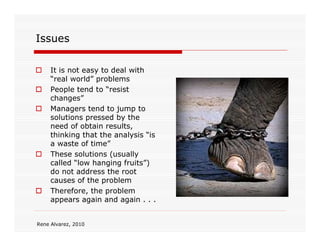
     It is not easy to deal with
     “real world” problems
     People tend to “resist
     changes”
     Managers tend to jump to
     solutions pressed by the
     need of obtain results,
     thinking that the analysis “is
     a waste of time”
     These solutions (usually
     called “low hanging fruits”)
     do not address the root
     causes of the problem
     Therefore, the problem
     appears again and again . . .


Rene Alvarez, 2010
So . . . we need a methodology


     Intuitively, most people
     know how to solve
     problems, but are unable
     to, because they have no
     method of focusing their
     intuition.

     Without a means to focus,
     people will do the opposite
     of what they really believe
     and will play a lot of games
     with numbers and words.


                 Eli Goldratt. It’s not luck.


Rene Alvarez, 2010
How do we use to deal with problems?


     Causes and effects are not ‘close in time
     and space’
     Where to apply changes to get significant
     improvements is usually non obvious to
     most participants in the system
     Our non systemic ways of thinking are so
     damaging specifically because they
     consistently lead us to focus on low-
     leverage changes: we focus on
     symptoms where the stress is greatest.
     We frequently repair the symptoms not the
     problem                                     Senge, P. M., (1990) The fifth discipline: the art
                                                 and practice of the learning organization.
     Such efforts only make matters better in
     the short run, at best, and worse in the
     long run


Rene Alvarez, 2010
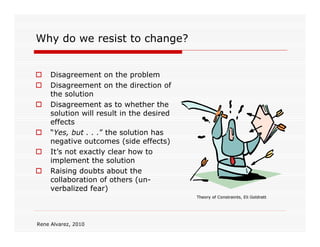
Why do we resist to change?


     Disagreement on the problem
     Disagreement on the direction of
     the solution
     Disagreement as to whether the
     solution will result in the desired
     effects
     “Yes, but . . .” the solution has
     negative outcomes (side effects)
     It’s not exactly clear how to
     implement the solution
     Raising doubts about the
     collaboration of others (un-
     verbalized fear)
                                           Theory of Constraints, Eli Goldratt
                                           Theory of Constraints, Eli Goldratt


Rene Alvarez, 2010
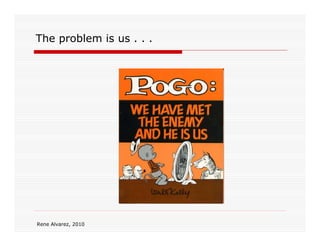
The problem is us . . .


Rene Alvarez, 2010
The solution: To use a methodology


     Whether it is in medicine or
     engineering, continuous
     improvement processes
     should be conducted
     following a logical
     methodology that allows
     the team to achieve its
     goals, without spending
     time in futile discussions


Rene Alvarez, 2010
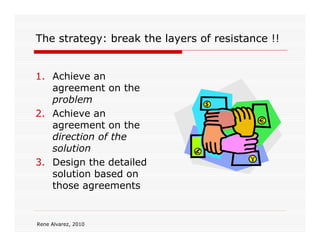
The strategy: break the layers of resistance !!


1. Achieve an
   agreement on the
   problem
2. Achieve an
   agreement on the
   direction of the
   solution
3. Design the detailed
   solution based on
   those agreements


Rene Alvarez, 2010
To solve the problem . . .


     We need to define the
     problem
     We need to achieve “an
     agreement on the problem”
     We need to eliminate the
     root causes of the problem


'Okay, Houston, we've had a problem here.‘
 'Okay, Houston, we've had a problem here.‘
John Swigert, Jr. US’s Apollo 13 Moon flight
 John Swigert, Jr. US’s Apollo 13 Moon flight


Rene Alvarez, 2010
What are the root causes of the problem?


     We need to find
     them using a
     “logic
     methodology”


Rene Alvarez, 2010
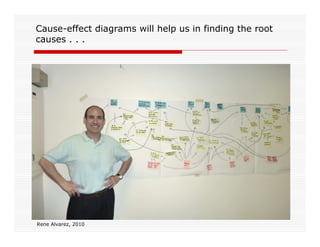
Cause-effect diagrams will help us in finding the root
causes . . .


Rene Alvarez, 2010
The Good news !!

     After a collective
     process of building
     the cause-effect
     diagram, we have
     broken the first layer
     of resistance to the
     change . . .
     We have an
     agreement on the
     problem !


Rene Alvarez, 2010
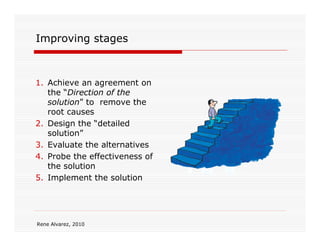
Improving stages


1. Achieve an agreement on
   the “Direction of the
   solution” to remove the
   root causes
2. Design the “detailed
   solution”
3. Evaluate the alternatives
4. Probe the effectiveness of
   the solution
5. Implement the solution


Rene Alvarez, 2010
Solution


     Once the team has
     identified the root
     causes of a problem,
     it is necessary to
     eliminate them
     through developing
     a “solution”


Rene Alvarez, 2010
The direction of the solution


     The direction of the solution is
     the “Strategic guideline for the
     detailed solution”
     Teams must concentrate on
     the desired future state
     Teams must avoid going into
     details in this phase (“Yes, but
     . . . ” will be welcome in later
     steps, not now)


Rene Alvarez, 2010
Types of changes


     New written procedures
     Additional training for the
     staff
     New equipments and
     technology
     Changes in the
     responsibilities
     Staff empowerment


Rene Alvarez, 2010
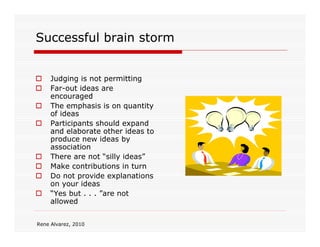
Successful brain storm


     Judging is not permitting
     Far-out ideas are
     encouraged
     The emphasis is on quantity
     of ideas
     Participants should expand
     and elaborate other ideas to
     produce new ideas by
     association
     There are not “silly ideas”
     Make contributions in turn
     Do not provide explanations
     on your ideas
     “Yes but . . . ”are not
     allowed


Rene Alvarez, 2010
Agreement


     We have broken the
     second layer of
     resistance to the
     change !

     Now we have an
     agreement on the
     direction of the
     solution !


Rene Alvarez, 2010
Now . . .


     Having an
     agreement on the
     direction of the
     solution, we can
     design a detailed
     solution for the
     problem


Rene Alvarez, 2010
Change design


    The goal is to obtain a
    new “well designed
    process”
    The new process must
    reduce waste and add
    value from the
    customer’s perspective
    We need to understand
    the current process first
    through a process map
    exercise


Rene Alvarez, 2010
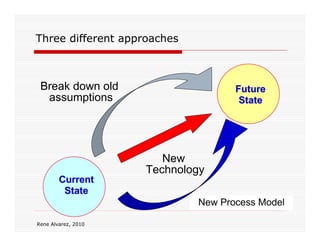
Three different approaches


 Break down old                     Future
  assumptions                        State


                        New
                     Technology
        Current
         State
                             New Process Model

Rene Alvarez, 2010
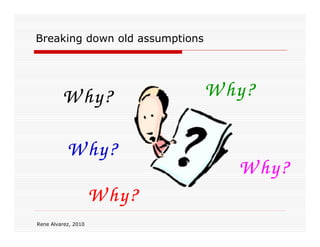
Breaking down old assumptions


         W hy?                  W hy?

           W hy?
                                   W hy?
                     W hy?
Rene Alvarez, 2010
What to analyze?

     What are the customer’s needs?
     Who does the work?
     Where the work is done?
     When the work is done?
     What resources are needed?
     Why do we do this work?
     What are the constraints for the
     work?
     How do we control the process?
     What are the “contact points” with
     the customer?


Rene Alvarez, 2010
New process models


1.    Re-localize the work
2.    Minimize the hand-offs
3.    Reconfigure and reorder steps
4.    Create new mixed teams
5.    Integrate tasks
6.    Eliminate intermediates
7.    Reduce the amount of decisions
8.    Relocate the decision points
9.    Share information to allow staff to see “beyond the walls”
10.   Improve process cycle efficiency by eliminating stages that do not add value
      from the customer’s point of view
11.   Make visible those invisible parts of the process (“Staple to and follow the
      customer in his/her journey” to see the whole process through his/her eyes)
12.   Focus on those aspects of the process that cause the 80% of the undesirable
      effect
13.   Standardization
14.   Minimize variation


  Rene Alvarez, 2010
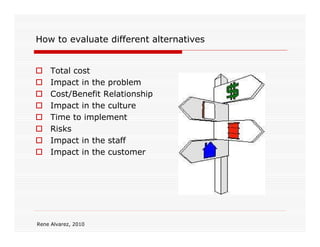
How to evaluate different alternatives


     Total cost
     Impact in the problem
     Cost/Benefit Relationship
     Impact in the culture
     Time to implement
     Risks
     Impact in the staff
     Impact in the customer


Rene Alvarez, 2010
Effectiveness of the solution


           Pilot tests

           Dry runs

           Simulation


Rene Alvarez, 2010
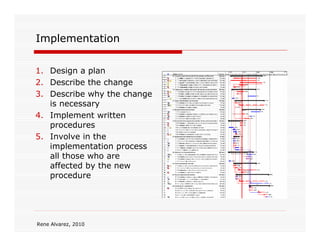
Implementation

1. Design a plan
2. Describe the change
3. Describe why the change
   is necessary
4. Implement written
   procedures
5. Involve in the
   implementation process
   all those who are
   affected by the new
   procedure


Rene Alvarez, 2010
The beginning . . .


          Rene Alvarez


Rene Alvarez, 2010

Process improvement and change management

  • 1.
    Change Management andProcess Improvement Rene Alvarez Rene Alvarez, 2010
  • 2.
    Issues It is not easy to deal with “real world” problems People tend to “resist changes” Managers tend to jump to solutions pressed by the need of obtain results, thinking that the analysis “is a waste of time” These solutions (usually called “low hanging fruits”) do not address the root causes of the problem Therefore, the problem appears again and again . . . Rene Alvarez, 2010
  • 3.
    So . .. we need a methodology Intuitively, most people know how to solve problems, but are unable to, because they have no method of focusing their intuition. Without a means to focus, people will do the opposite of what they really believe and will play a lot of games with numbers and words. Eli Goldratt. It’s not luck. Rene Alvarez, 2010
  • 4.
    How do weuse to deal with problems? Causes and effects are not ‘close in time and space’ Where to apply changes to get significant improvements is usually non obvious to most participants in the system Our non systemic ways of thinking are so damaging specifically because they consistently lead us to focus on low- leverage changes: we focus on symptoms where the stress is greatest. We frequently repair the symptoms not the problem Senge, P. M., (1990) The fifth discipline: the art and practice of the learning organization. Such efforts only make matters better in the short run, at best, and worse in the long run Rene Alvarez, 2010
  • 5.
    Why do weresist to change? Disagreement on the problem Disagreement on the direction of the solution Disagreement as to whether the solution will result in the desired effects “Yes, but . . .” the solution has negative outcomes (side effects) It’s not exactly clear how to implement the solution Raising doubts about the collaboration of others (un- verbalized fear) Theory of Constraints, Eli Goldratt Theory of Constraints, Eli Goldratt Rene Alvarez, 2010
  • 6.
    The problem isus . . . Rene Alvarez, 2010
  • 7.
    The solution: Touse a methodology Whether it is in medicine or engineering, continuous improvement processes should be conducted following a logical methodology that allows the team to achieve its goals, without spending time in futile discussions Rene Alvarez, 2010
  • 8.
    The strategy: breakthe layers of resistance !! 1. Achieve an agreement on the problem 2. Achieve an agreement on the direction of the solution 3. Design the detailed solution based on those agreements Rene Alvarez, 2010
  • 9.
    To solve theproblem . . . We need to define the problem We need to achieve “an agreement on the problem” We need to eliminate the root causes of the problem 'Okay, Houston, we've had a problem here.‘ 'Okay, Houston, we've had a problem here.‘ John Swigert, Jr. US’s Apollo 13 Moon flight John Swigert, Jr. US’s Apollo 13 Moon flight Rene Alvarez, 2010
  • 10.
    What are theroot causes of the problem? We need to find them using a “logic methodology” Rene Alvarez, 2010
  • 11.
    Cause-effect diagrams willhelp us in finding the root causes . . . Rene Alvarez, 2010
  • 12.
    The Good news!! After a collective process of building the cause-effect diagram, we have broken the first layer of resistance to the change . . . We have an agreement on the problem ! Rene Alvarez, 2010
  • 13.
    Improving stages 1. Achievean agreement on the “Direction of the solution” to remove the root causes 2. Design the “detailed solution” 3. Evaluate the alternatives 4. Probe the effectiveness of the solution 5. Implement the solution Rene Alvarez, 2010
  • 14.
    Solution Once the team has identified the root causes of a problem, it is necessary to eliminate them through developing a “solution” Rene Alvarez, 2010
  • 15.
    The direction ofthe solution The direction of the solution is the “Strategic guideline for the detailed solution” Teams must concentrate on the desired future state Teams must avoid going into details in this phase (“Yes, but . . . ” will be welcome in later steps, not now) Rene Alvarez, 2010
  • 16.
    Types of changes New written procedures Additional training for the staff New equipments and technology Changes in the responsibilities Staff empowerment Rene Alvarez, 2010
  • 17.
    Successful brain storm Judging is not permitting Far-out ideas are encouraged The emphasis is on quantity of ideas Participants should expand and elaborate other ideas to produce new ideas by association There are not “silly ideas” Make contributions in turn Do not provide explanations on your ideas “Yes but . . . ”are not allowed Rene Alvarez, 2010
  • 18.
    Agreement We have broken the second layer of resistance to the change ! Now we have an agreement on the direction of the solution ! Rene Alvarez, 2010
  • 19.
    Now . .. Having an agreement on the direction of the solution, we can design a detailed solution for the problem Rene Alvarez, 2010
  • 20.
    Change design The goal is to obtain a new “well designed process” The new process must reduce waste and add value from the customer’s perspective We need to understand the current process first through a process map exercise Rene Alvarez, 2010
  • 21.
    Three different approaches Break down old Future assumptions State New Technology Current State New Process Model Rene Alvarez, 2010
  • 22.
    Breaking down oldassumptions W hy? W hy? W hy? W hy? W hy? Rene Alvarez, 2010
  • 23.
    What to analyze? What are the customer’s needs? Who does the work? Where the work is done? When the work is done? What resources are needed? Why do we do this work? What are the constraints for the work? How do we control the process? What are the “contact points” with the customer? Rene Alvarez, 2010
  • 24.
    New process models 1. Re-localize the work 2. Minimize the hand-offs 3. Reconfigure and reorder steps 4. Create new mixed teams 5. Integrate tasks 6. Eliminate intermediates 7. Reduce the amount of decisions 8. Relocate the decision points 9. Share information to allow staff to see “beyond the walls” 10. Improve process cycle efficiency by eliminating stages that do not add value from the customer’s point of view 11. Make visible those invisible parts of the process (“Staple to and follow the customer in his/her journey” to see the whole process through his/her eyes) 12. Focus on those aspects of the process that cause the 80% of the undesirable effect 13. Standardization 14. Minimize variation Rene Alvarez, 2010
  • 25.
    How to evaluatedifferent alternatives Total cost Impact in the problem Cost/Benefit Relationship Impact in the culture Time to implement Risks Impact in the staff Impact in the customer Rene Alvarez, 2010
  • 26.
    Effectiveness of thesolution Pilot tests Dry runs Simulation Rene Alvarez, 2010
  • 27.
    Implementation 1. Design aplan 2. Describe the change 3. Describe why the change is necessary 4. Implement written procedures 5. Involve in the implementation process all those who are affected by the new procedure Rene Alvarez, 2010
  • 28.
    The beginning .. . Rene Alvarez Rene Alvarez, 2010