Future Internet: Technologies, Applications & Perspectives
SABER FERJANI
http://www.publicpolicy.telefonica.com/blogs/wp-content/uploads/2013/04/Future-Internet.jpg
Outline
1. State of the art
2. Technologies
3. Applications
4. Challenges
5. Conclusions
2/60
I. State of the art
1. Internet Evolution
2. Web Evolution
3. Future Internet Constituents
4. Future Internet Landscape
3/60
250K 100M 500M1000
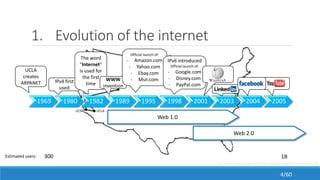
1. Evolution of the internet
1969 1980 1982 1989 1995 1998 2001 2003 2004 2005
300
Web 2.0
UCLA
creates
ARPANET IPv4 first
used
The word
“Internet”
is used for
the first
time
WWW
invention
Official launch of:
- Amazon.com
- Yahoo.com
- Ebay.com
- Msn.com
IPv6 introduced
Official launch of:
- Google.com
- Disney.com
- PayPal.com
1BEstimated users:
Web 1.0
http://www.usfca.edu/fac-staff/morriss/478/spring03/internet/history.htm
4/60
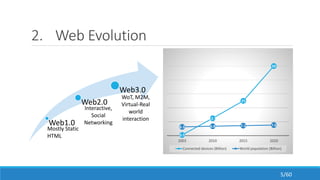
Web1.0
Web2.0
Web3.0
2. Web Evolution
Mostly Static
HTML
Interactive,
Social
Networking
WoT, M2M,
Virtual-Real
world
interaction
0.5
12.5
25
50
6.3 6.8 7.2 7.6
2003 2010 2015 2020
Connected devices (Billion) World population (Billion)
5/60
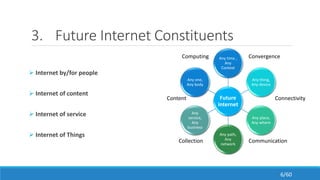
3. Future Internet Constituents
 Internet by/for people
 Internet of content
 Internet of service
 Internet of Things
Future
internet
Any time ,
Any
Context
Any thing,
Any device
Any place,
Any where
Any path,
Any
network
Any
service,
Any
business
Any one,
Any body
Content Connectivity
Computing Convergence
CommunicationCollection
6/60
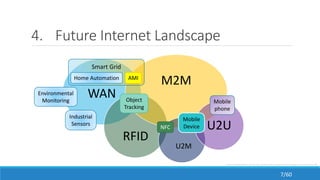
4. Future Internet Landscape
WAN
RFID
M2M
U2M
U2U
Mobile
phone
Object
Tracking
Smart Grid
Home Automation
Environmental
Monitoring
Industrial
Sensors
AMI
http://stakeholders.ofcom.org.uk/binaries/research/technology-research/wsn3.pdf
NFC
Mobile
Device
7/60
II. Technologies
1. Internet protocols
2. Constrained device protocols
3. Service composition
4. Semantic web
5. Wireless ad hoc networks
8/60
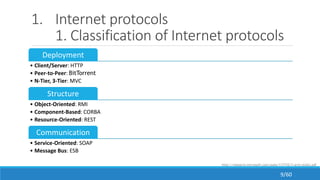
1. Internet protocols
1. Classification of Internet protocols
Deployment
• Client/Server: HTTP
• Peer-to-Peer: BitTorrent
• N-Tier, 3-Tier: MVC
Structure
• Object-Oriented: RMI
• Component-Based: CORBA
• Resource-Oriented: REST
Communication
• Service-Oriented: SOAP
• Message Bus: ESB
http://research.microsoft.com/pubs/117710/3-arch-styles.pdf
9/60
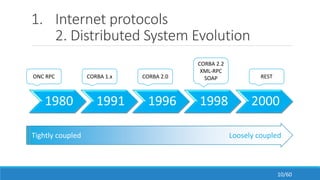
1. Internet protocols
2. Distributed System Evolution
1980 1991 1996 1998 2000
ONC RPC CORBA 1.x CORBA 2.0 REST
CORBA 2.2
XML-RPC
SOAP
Tightly coupled Loosely coupled
10/60
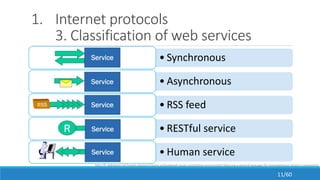
1. Internet protocols
3. Classification of web services
• Synchronous
• Asynchronous
• RSS feed
• RESTful service
• Human service
http://fr.slideshare.net/cesare.pautasso/jopera-eclipsebased-visual-composition-environment-featuring-a-general-language-for-heterogeneous-service-ccomposition
11/60
1. Internet protocols
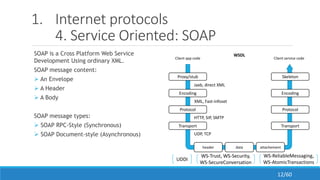
4. Service Oriented: SOAP
SOAP is a Cross Platform Web Service
Development Using ordinary XML.
SOAP message content:
 An Envelope
 A Header
 A Body
SOAP message types:
 SOAP RPC-Style (Synchronous)
 SOAP Document-style (Asynchronous)
Client app code Client service code
Proxy/stub
Encoding
Protocol
Transport
Skeleton
Encoding
Protocol
Transport
attachementdataheader
Jaxb, direct XML
XML, Fast-infoset
HTTP, SIP, SMTP
UDP, TCP
WSDL
UDDI
WS-Trust, WS-Security,
WS-SecureConversation
WS-ReliableMessaging,
WS-AtomicTransactions
12/60
1. Internet protocols
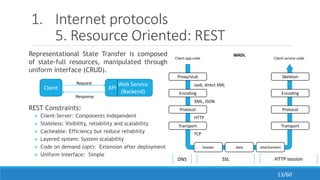
5. Resource Oriented: REST
Representational State Transfer is composed
of state-full resources, manipulated through
uniform interface (CRUD).
REST Constraints:
 Client-Server: Components Independent
 Stateless: Visibility, reliability and scalability
 Cacheable: Efficiency but reduce reliability
 Layered system: System scalability
 Code on demand (opt): Extension after deployment
 Uniform Interface: Simple
Client
Web Service
(Backend)
Request
Response
API
Client app code Client service code
Proxy/stub
Encoding
Protocol
Transport
Skeleton
Encoding
Protocol
Transport
attachementdataheader
WADL
Jaxb, direct XML
XML, JSON
HTTP
TCP
DNS SSL HTTP session
13/60
1. Internet protocols
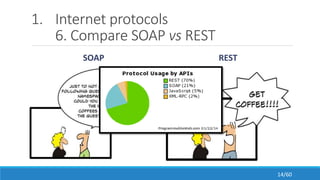
6. Compare SOAP vs REST
SOAP REST
• Exposes resources that represent data
• Uses VERBS (Methods: GET/POST/PUT/DELETE)
• Supports multiple data formats: XML, JSON…
• Only stateless communication
• GET-base URIs are cacheable
• Exposes operations that represent logic
• Uses only the verb POST
• Encodes everything in XML
• Supports stateless and state-full operations
• Not cached by any existing technology
14/60
2. Constrained device protocols
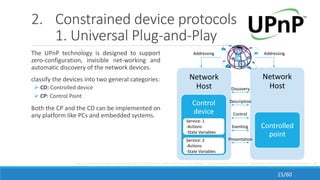
1. Universal Plug-and-Play
The UPnP technology is designed to support
zero-configuration, invisible net-working and
automatic discovery of the network devices.
classify the devices into two general categories:
 CD: Controlled device
 CP: Control Point
Both the CP and the CD can be implemented on
any platform like PCs and embedded systems.
Network
Host
Network
Host
Control
device
Controlled
point
Service: 1
-Actions
-State Variables
Service: 2
-Actions
-State Variables
http://download.springer.com/static/pdf/632/chp%253A10.1007%252F978-3-642-38082-2_26.pdf?auth66=1390154381_6a2d54b42f14fb298210f1a8dfcbe5ab&ext=.pdf
Discovery
Description
Control
Eventing
Presentation
AddressingAddressing
15/60
2. Constrained device protocols
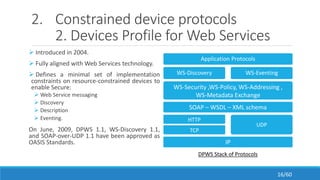
2. Devices Profile for Web Services
 Introduced in 2004.
 Fully aligned with Web Services technology.
 Defines a minimal set of implementation
constraints on resource-constrained devices to
enable Secure:
 Web Service messaging
 Discovery
 Description
 Eventing.
On June, 2009, DPWS 1.1, WS-Discovery 1.1,
and SOAP-over-UDP 1.1 have been approved as
OASIS Standards.
DPWS Stack of Protocols
16/60
Application Protocols
WS-Security ,WS-Policy, WS-Addressing ,
WS-Metadata Exchange
SOAP – WSDL – XML schema
HTTP
UDP
TCP
IP
WS-EventingWS-Discovery
2. Constrained device protocols
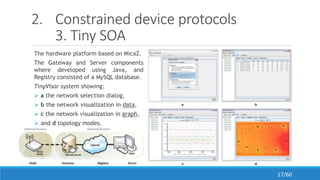
3. Tiny SOA
The hardware platform based on MicaZ.
The Gateway and Server components
where developed using Java, and
Registry consisted of a MySQL database.
TinyVisor system showing:
 a the network selection dialog,
 b the network visualization in data,
 c the network visualization in graph,
 and d topology modes.
17/60
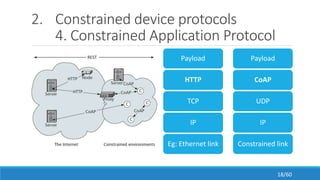
2. Constrained device protocols
4. Constrained Application Protocol
Eg: Ethernet link
IP
TCP
HTTP
Payload
Constrained link
IP
UDP
CoAP
Payload
18/60
3. Service Composition
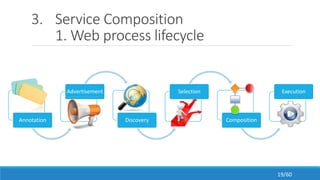
1. Web process lifecycle
Annotation
Advertisement
Discovery
Selection
Composition
Execution
19/60
3. Service Composition
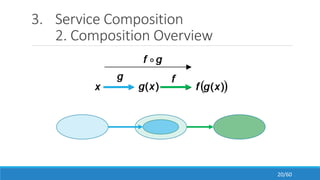
2. Composition Overview
20/60
3. Service Composition
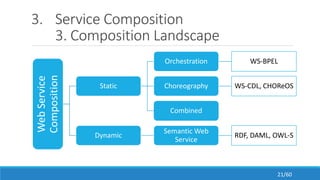
3. Composition LandscapeWebService
Composition
Static
Orchestration WS-BPEL
Choreography WS-CDL, CHOReOS
Combined
Dynamic
Semantic Web
Service
RDF, DAML, OWL-S
21/60
3. Service Composition
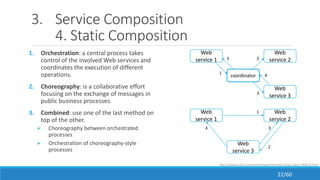
4. Static Composition
1. Orchestration: a central process takes
control of the involved Web services and
coordinates the execution of different
operations.
2. Choreography: is a collaborative effort
focusing on the exchange of messages in
public business processes.
3. Combined: use one of the last method on
top of the other.
 Choreography between orchestrated
processes
 Orchestration of choreography-style
processes
coordinator
Web
service 1
Web
service 2
1
2
Web
service 33
4
5
Web
service 1
Web
service 3
Web
service 2
1
2
34
http://www.oracle.com/technetwork/articles/matjaz-bpel1-090575.html
22/60
3. Service Composition
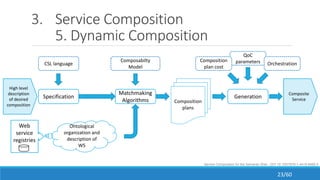
5. Dynamic Composition
Specification
Matchmaking
Algorithms
Generation
CSL language
Composabilty
Model
Composition
plans
Web
service
registries
Ontological
organization and
description of
WS
High level
description
of desired
composition
Composite
Service
QoC
parametersComposition
plan cost
Orchestration
Service Composition for the Semantic Web - DOI 10.1007/978-1-4419-8465-4
23/60
3. Service Composition
6. Composition Representation
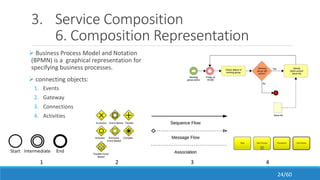
 Business Process Model and Notation
(BPMN) is a graphical representation for
specifying business processes.
 connecting objects:
1. Events
2. Gateway
3. Connections
4. Activities
1 2 3 4
24/60
3. Service Composition
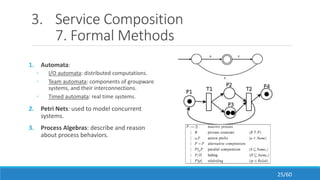
7. Formal Methods
1. Automata:
◦ I/O automata: distributed computations.
◦ Team automata: components of groupware
systems, and their interconnections.
◦ Timed automata: real time systems.
2. Petri Nets: used to model concurrent
systems.
3. Process Algebras: describe and reason
about process behaviors.
25/60
3. Service Composition
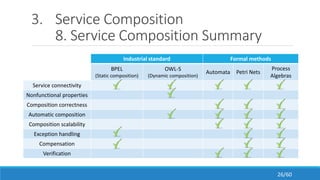
8. Service Composition Summary
Industrial standard Formal methods
BPEL
(Static composition)
OWL-S
(Dynamic composition)
Automata Petri Nets
Process
Algebras
Service connectivity
Nonfunctional properties
Composition correctness
Automatic composition
Composition scalability
Exception handling
Compensation
Verification
26/60
3. Service Composition
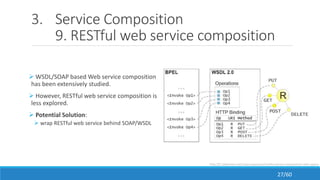
9. RESTful web service composition
 WSDL/SOAP based Web service composition
has been extensively studied.
 However, RESTful web service composition is
less explored.
 Potential Solution:
 wrap RESTful web service behind SOAP/WSDL
http://fr.slideshare.net/cesare.pautasso/restful-service-composition-with-jopera
27/60
4. Semantic Web
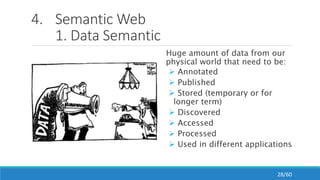
1. Data Semantic
Huge amount of data from our
physical world that need to be:
 Annotated
 Published
 Stored (temporary or for
longer term)
 Discovered
 Accessed
 Processed
 Used in different applications
28/60
4. Semantic Web
1. Data Semantic
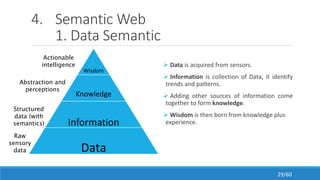
Wisdom
Knowledge
Information
Data
Raw
sensory
data
Structured
data (with
semantics)
Abstraction and
perceptions
Actionable
intelligence  Data is acquired from sensors.
 Information is collection of Data, it identify
trends and patterns.
 Adding other sources of information come
together to form knowledge.
 Wisdom is then born from knowledge plus
experience.
29/60
4. Semantic Web
2. Functional Semantic
 Appropriate Service Discovery.
 Semantic signature depend on functional
requirements.
 Intended function of each service is
represented as annotations using ontologies.
30/60
4. Semantic Web
3. Execution Semantic
Execution semantic encompasses:
 Message sequence, Execution flow
 Conversion pattern
 Preconditions, Post-conditions
 Invocation effects
 Activities coordination
31/60
4. Semantic Web
4. Quality of Service Semantic
 Multiple choices: Select suitable service
 Evaluation of alternative strategies
 Web processes can be designed according to
QoS metrics
32/60
5. Wireless ad hoc networks
1. State of the Art
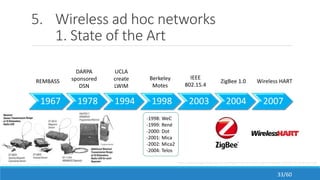
1967 1978 1994 1998 2003 2004 2007
Wireless HARTZigBee 1.0
IEEE
802.15.4
Berkeley
Motes
UCLA
create
LWIM
REMBASS
DARPA
sponsored
DSN
https://www.cooperating-objects.eu/fileadmin/dissemination/joint-seminars/20100719-camp-wsn.pdf
http://www.fas.org/man/dod-101/sys/land/rembass.htm
-1998: WeC
-1999: René
-2000: Dot
-2001: Mica
-2002: Mica2
-2004: Telos
33/60
5. Wireless ad hoc networks
2. Components
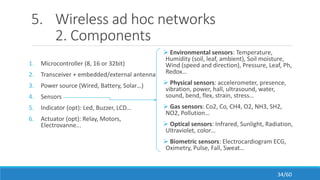
1. Microcontroller (8, 16 or 32bit)
2. Transceiver + embedded/external antenna
3. Power source (Wired, Battery, Solar…)
4. Sensors
5. Indicator (opt): Led, Buzzer, LCD…
6. Actuator (opt): Relay, Motors,
Electrovanne...
 Environmental sensors: Temperature,
Humidity (soil, leaf, ambient), Soil moisture,
Wind (speed and direction), Pressure, Leaf, Ph,
Redox…
 Physical sensors: accelerometer, presence,
vibration, power, hall, ultrasound, water,
sound, bend, flex, strain, stress…
 Gas sensors: Co2, Co, CH4, O2, NH3, SH2,
NO2, Pollution…
 Optical sensors: Infrared, Sunlight, Radiation,
Ultraviolet, color…
 Biometric sensors: Electrocardiogram ECG,
Oximetry, Pulse, Fall, Sweat…
34/60
5. Wireless ad hoc networks
3. Hardware platforms
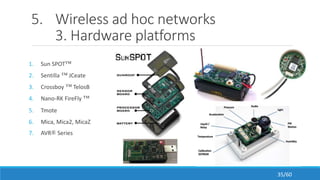
1. Sun SPOT™
2. Sentilla ™ JCeate
3. Crossboy ™ TelosB
4. Nano-RK FireFly ™
5. Tmote
6. Mica, Mica2, MicaZ
7. AVR® Series
35/60
5. Wireless ad hoc networks
4. Operating Systems
1. Tiny OS: based on event driven execution
2. Lite OS: Unix-like OS for WSN
3. Contiki: OS for low power wireless IoT devices
4. Squawk VM: JAVA Micro Edition VM developed for Sun SPOT
5. Mantis: multi-threaded operating system written in C for WSN
6. SOS: developed in C and follows event-driven programming model
7. SenOS: finite state machine based OS
36/60
5. Wireless ad hoc networks
5. Connectivity
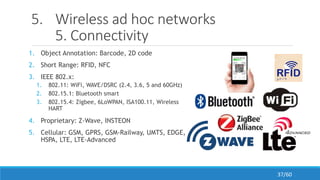
1. Object Annotation: Barcode, 2D code
2. Short Range: RFID, NFC
3. IEEE 802.x:
1. 802.11: WiFi, WAVE/DSRC (2.4, 3.6, 5 and 60GHz)
2. 802.15.1: Bluetooth smart
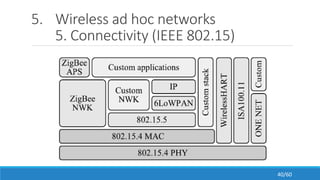
3. 802.15.4: Zigbee, 6LoWPAN, ISA100.11, Wireless
HART
4. Proprietary: Z-Wave, INSTEON
5. Cellular: GSM, GPRS, GSM-Railway, UMTS, EDGE,
HSPA, LTE, LTE-Advanced
37/60
5. Wireless ad hoc networks
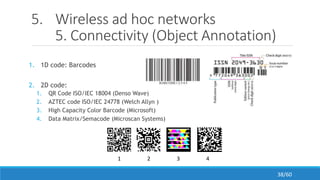
5. Connectivity (Object Annotation)
1. 1D code: Barcodes
2. 2D code:
1. QR Code ISO/IEC 18004 (Denso Wave)
2. AZTEC code ISO/IEC 24778 (Welch Allyn )
3. High Capacity Color Barcode (Microsoft)
4. Data Matrix/Semacode (Microscan Systems)
1 2 3 4
38/60
5. Wireless ad hoc networks
5. Connectivity (Short Range)
1. RFID (Radio Frequency Identification)
1. Tag identifier: 64-96 bit (provided by EPC-Global)
2. Frequency: 135Khz, 13.56Mhz, 433Mhz, 865-868(EU) MHz/902-928MHz(US), 2.45-5.8Ghz
3. Energy source:
• Active: plugged to power source
• Passive: use electromagnetic field to power the chip
2. NFC (Near field communication) builds upon RFID, Bidirectional communication:
1. Commerce: contactless payment systems
2. Bluetooth and Wi-Fi connections: bootstrap more capable wireless connections
3. Social networking: exchange contacts
4. Identity and access tokens: electronic identity documents and keycards
5. Smartphone automation and NFC tags: automate tasks
39/60
5. Wireless ad hoc networks
5. Connectivity (IEEE 802.15)
40/60
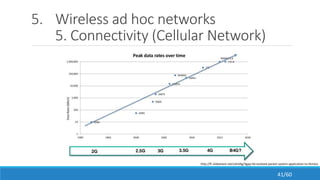
5. Wireless ad hoc networks
5. Connectivity (Cellular Network)
http://fr.slideshare.net/zahidtg/3gpp-lte-evolved-packet-system-application-to-femtos
41/60
III. Applications
1. Intelligent Transport Systems
2. Industrial
3. Healthcare
4. Agriculture
5. Logistic
6. Smart Home
7. Smart Grid
42/60
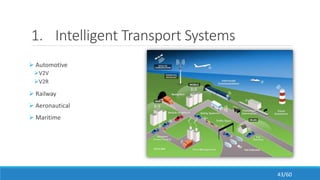
1. Intelligent Transport Systems
 Automotive
V2V
V2R
 Railway
 Aeronautical
 Maritime
43/60
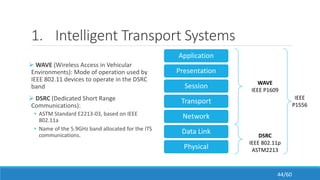
1. Intelligent Transport Systems
 WAVE (Wireless Access in Vehicular
Environments): Mode of operation used by
IEEE 802.11 devices to operate in the DSRC
band
 DSRC (Dedicated Short Range
Communications):
• ASTM Standard E2213-03, based on IEEE
802.11a
• Name of the 5.9GHz band allocated for the ITS
communications.
Physical
Data Link
Network
Transport
Session
Presentation
Application
WAVE
IEEE P1609
DSRC
IEEE 802.11p
ASTM2213
IEEE
P1556
44/60
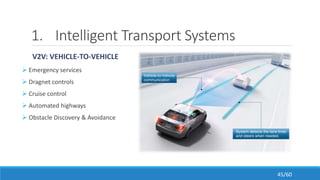
1. Intelligent Transport Systems
V2V: VEHICLE-TO-VEHICLE
 Emergency services
 Dragnet controls
 Cruise control
 Automated highways
 Obstacle Discovery & Avoidance
45/60
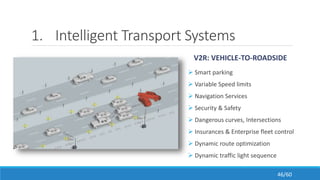
1. Intelligent Transport Systems
V2R: VEHICLE-TO-ROADSIDE
 Smart parking
 Variable Speed limits
 Navigation Services
 Security & Safety
 Dangerous curves, Intersections
 Insurances & Enterprise fleet control
 Dynamic route optimization
 Dynamic traffic light sequence
46/60
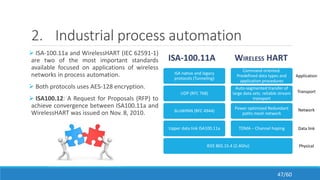
2. Industrial process automation
 ISA-100.11a and WirelessHART (IEC 62591-1)
are two of the most important standards
available focused on applications of wireless
networks in process automation.
 Both protocols uses AES-128 encryption.
 ISA100.12: A Request for Proposals (RFP) to
achieve convergence between ISA100.11a and
WirelessHART was issued on Nov. 8, 2010.
ISA-100.11A WIRELESS HART
IEEE 802.15.4 (2.4Ghz)
Upper data link ISA100.11a
6LoWPAN (RFC 4944)
UDP (RFC 768)
ISA native and legacy
protocols (Tunneling)
TDMA – Channel hoping
Power optimized Redundant
paths mesh network
Auto-segmented transfer of
large data sets. reliable stream
transport
Command oriented.
Predefined data types and
application procedures
Physical
Data link
Network
Transport
Application
47/60
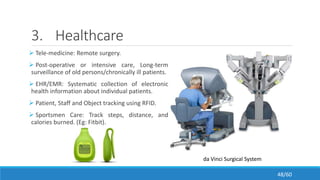
3. Healthcare
 Tele-medicine: Remote surgery.
 Post-operative or intensive care, Long-term
surveillance of old persons/chronically ill patients.
 EHR/EMR: Systematic collection of electronic
health information about individual patients.
 Patient, Staff and Object tracking using RFID.
 Sportsmen Care: Track steps, distance, and
calories burned. (Eg: Fitbit).
da Vinci Surgical System
48/60
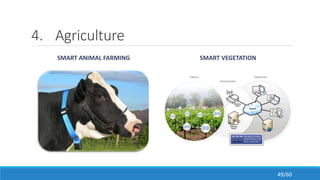
4. Agriculture
SMART ANIMAL FARMING SMART VEGETATION
49/60
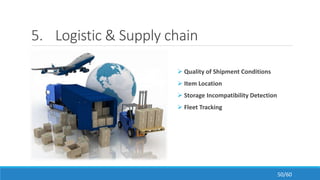
5. Logistic & Supply chain
 Quality of Shipment Conditions
 Item Location
 Storage Incompatibility Detection
 Fleet Tracking
50/60
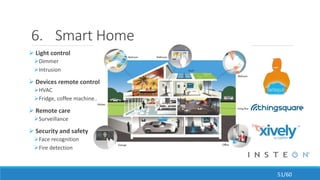
6. Smart Home
 Light control
Dimmer
Intrusion
 Devices remote control
HVAC
Fridge, coffee machine..
 Remote care
Surveillance
 Security and safety
Face recognition
Fire detection
51/60
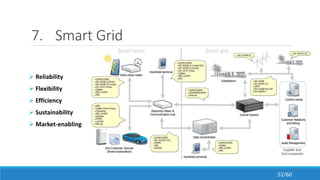
7. Smart Grid
 Reliability
 Flexibility
 Efficiency
 Sustainability
 Market-enabling
52/60
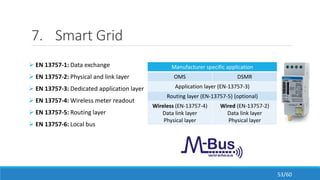
7. Smart Grid
 EN 13757-1: Data exchange
 EN 13757-2: Physical and link layer
 EN 13757-3: Dedicated application layer
 EN 13757-4: Wireless meter readout
 EN 13757-5: Routing layer
 EN 13757-6: Local bus
Manufacturer specific application
OMS DSMR
Application layer (EN-13757-3)
Routing layer (EN-13757-5) (optional)
Wireless (EN-13757-4)
Data link layer
Physical layer
Wired (EN-13757-2)
Data link layer
Physical layer
53/60
IV. Challenges
1. Standardization, Heterogeneity & Interoperability
2. Security, Privacy & Trust
54/60
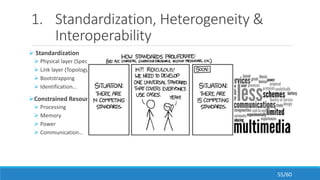
1. Standardization, Heterogeneity &
Interoperability
55/60
 Standardization
 Physical layer (Spectrum management)
 Link layer (Topology)
 Bootstrapping
 Identification…
Constrained Resources
 Processing
 Memory
 Power
 Communication…
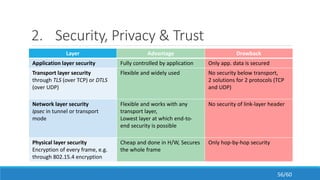
2. Security, Privacy & Trust
Layer Advantage Drawback
Application layer security Fully controlled by application Only app. data is secured
Transport layer security
through TLS (over TCP) or DTLS
(over UDP)
Flexible and widely used No security below transport,
2 solutions for 2 protocols (TCP
and UDP)
Network layer security
Ipsec in tunnel or transport
mode
Flexible and works with any
transport layer,
Lowest layer at which end-to-
end security is possible
No security of link-layer header
Physical layer security
Encryption of every frame, e.g.
through 802.15.4 encryption
Cheap and done in H/W, Secures
the whole frame
Only hop-by-hop security
56/60
V. Conclusions
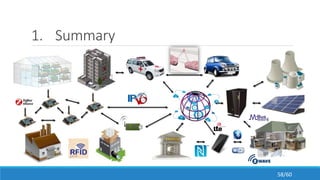
1. Summary
2. Perspectives
57/60
1. Summary
58/60
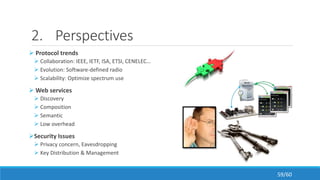
2. Perspectives
 Protocol trends
 Collaboration: IEEE, IETF, ISA, ETSI, CENELEC…
 Evolution: Software-defined radio
 Scalability: Optimize spectrum use
 Web services
 Discovery
 Composition
 Semantic
 Low overhead
Security Issues
 Privacy concern, Eavesdropping
 Key Distribution & Management
59/60
Thanks for your attention!
60/60

Future Internet

  • 1.
    Future Internet: Technologies,Applications & Perspectives SABER FERJANI http://www.publicpolicy.telefonica.com/blogs/wp-content/uploads/2013/04/Future-Internet.jpg
  • 2.
    Outline 1. State ofthe art 2. Technologies 3. Applications 4. Challenges 5. Conclusions 2/60
  • 3.
    I. State ofthe art 1. Internet Evolution 2. Web Evolution 3. Future Internet Constituents 4. Future Internet Landscape 3/60
  • 4.
    250K 100M 500M1000 1.Evolution of the internet 1969 1980 1982 1989 1995 1998 2001 2003 2004 2005 300 Web 2.0 UCLA creates ARPANET IPv4 first used The word “Internet” is used for the first time WWW invention Official launch of: - Amazon.com - Yahoo.com - Ebay.com - Msn.com IPv6 introduced Official launch of: - Google.com - Disney.com - PayPal.com 1BEstimated users: Web 1.0 http://www.usfca.edu/fac-staff/morriss/478/spring03/internet/history.htm 4/60
  • 5.
    Web1.0 Web2.0 Web3.0 2. Web Evolution MostlyStatic HTML Interactive, Social Networking WoT, M2M, Virtual-Real world interaction 0.5 12.5 25 50 6.3 6.8 7.2 7.6 2003 2010 2015 2020 Connected devices (Billion) World population (Billion) 5/60
  • 6.
    3. Future InternetConstituents  Internet by/for people  Internet of content  Internet of service  Internet of Things Future internet Any time , Any Context Any thing, Any device Any place, Any where Any path, Any network Any service, Any business Any one, Any body Content Connectivity Computing Convergence CommunicationCollection 6/60
  • 7.
    4. Future InternetLandscape WAN RFID M2M U2M U2U Mobile phone Object Tracking Smart Grid Home Automation Environmental Monitoring Industrial Sensors AMI http://stakeholders.ofcom.org.uk/binaries/research/technology-research/wsn3.pdf NFC Mobile Device 7/60
  • 8.
    II. Technologies 1. Internetprotocols 2. Constrained device protocols 3. Service composition 4. Semantic web 5. Wireless ad hoc networks 8/60
  • 9.
    1. Internet protocols 1.Classification of Internet protocols Deployment • Client/Server: HTTP • Peer-to-Peer: BitTorrent • N-Tier, 3-Tier: MVC Structure • Object-Oriented: RMI • Component-Based: CORBA • Resource-Oriented: REST Communication • Service-Oriented: SOAP • Message Bus: ESB http://research.microsoft.com/pubs/117710/3-arch-styles.pdf 9/60
  • 10.
    1. Internet protocols 2.Distributed System Evolution 1980 1991 1996 1998 2000 ONC RPC CORBA 1.x CORBA 2.0 REST CORBA 2.2 XML-RPC SOAP Tightly coupled Loosely coupled 10/60
  • 11.
    1. Internet protocols 3.Classification of web services • Synchronous • Asynchronous • RSS feed • RESTful service • Human service http://fr.slideshare.net/cesare.pautasso/jopera-eclipsebased-visual-composition-environment-featuring-a-general-language-for-heterogeneous-service-ccomposition 11/60
  • 12.
    1. Internet protocols 4.Service Oriented: SOAP SOAP is a Cross Platform Web Service Development Using ordinary XML. SOAP message content:  An Envelope  A Header  A Body SOAP message types:  SOAP RPC-Style (Synchronous)  SOAP Document-style (Asynchronous) Client app code Client service code Proxy/stub Encoding Protocol Transport Skeleton Encoding Protocol Transport attachementdataheader Jaxb, direct XML XML, Fast-infoset HTTP, SIP, SMTP UDP, TCP WSDL UDDI WS-Trust, WS-Security, WS-SecureConversation WS-ReliableMessaging, WS-AtomicTransactions 12/60
  • 13.
    1. Internet protocols 5.Resource Oriented: REST Representational State Transfer is composed of state-full resources, manipulated through uniform interface (CRUD). REST Constraints:  Client-Server: Components Independent  Stateless: Visibility, reliability and scalability  Cacheable: Efficiency but reduce reliability  Layered system: System scalability  Code on demand (opt): Extension after deployment  Uniform Interface: Simple Client Web Service (Backend) Request Response API Client app code Client service code Proxy/stub Encoding Protocol Transport Skeleton Encoding Protocol Transport attachementdataheader WADL Jaxb, direct XML XML, JSON HTTP TCP DNS SSL HTTP session 13/60
  • 14.
    1. Internet protocols 6.Compare SOAP vs REST SOAP REST • Exposes resources that represent data • Uses VERBS (Methods: GET/POST/PUT/DELETE) • Supports multiple data formats: XML, JSON… • Only stateless communication • GET-base URIs are cacheable • Exposes operations that represent logic • Uses only the verb POST • Encodes everything in XML • Supports stateless and state-full operations • Not cached by any existing technology 14/60
  • 15.
    2. Constrained deviceprotocols 1. Universal Plug-and-Play The UPnP technology is designed to support zero-configuration, invisible net-working and automatic discovery of the network devices. classify the devices into two general categories:  CD: Controlled device  CP: Control Point Both the CP and the CD can be implemented on any platform like PCs and embedded systems. Network Host Network Host Control device Controlled point Service: 1 -Actions -State Variables Service: 2 -Actions -State Variables http://download.springer.com/static/pdf/632/chp%253A10.1007%252F978-3-642-38082-2_26.pdf?auth66=1390154381_6a2d54b42f14fb298210f1a8dfcbe5ab&ext=.pdf Discovery Description Control Eventing Presentation AddressingAddressing 15/60
  • 16.
    2. Constrained deviceprotocols 2. Devices Profile for Web Services  Introduced in 2004.  Fully aligned with Web Services technology.  Defines a minimal set of implementation constraints on resource-constrained devices to enable Secure:  Web Service messaging  Discovery  Description  Eventing. On June, 2009, DPWS 1.1, WS-Discovery 1.1, and SOAP-over-UDP 1.1 have been approved as OASIS Standards. DPWS Stack of Protocols 16/60 Application Protocols WS-Security ,WS-Policy, WS-Addressing , WS-Metadata Exchange SOAP – WSDL – XML schema HTTP UDP TCP IP WS-EventingWS-Discovery
  • 17.
    2. Constrained deviceprotocols 3. Tiny SOA The hardware platform based on MicaZ. The Gateway and Server components where developed using Java, and Registry consisted of a MySQL database. TinyVisor system showing:  a the network selection dialog,  b the network visualization in data,  c the network visualization in graph,  and d topology modes. 17/60
  • 18.
    2. Constrained deviceprotocols 4. Constrained Application Protocol Eg: Ethernet link IP TCP HTTP Payload Constrained link IP UDP CoAP Payload 18/60
  • 19.
    3. Service Composition 1.Web process lifecycle Annotation Advertisement Discovery Selection Composition Execution 19/60
  • 20.
    3. Service Composition 2.Composition Overview 20/60
  • 21.
    3. Service Composition 3.Composition LandscapeWebService Composition Static Orchestration WS-BPEL Choreography WS-CDL, CHOReOS Combined Dynamic Semantic Web Service RDF, DAML, OWL-S 21/60
  • 22.
    3. Service Composition 4.Static Composition 1. Orchestration: a central process takes control of the involved Web services and coordinates the execution of different operations. 2. Choreography: is a collaborative effort focusing on the exchange of messages in public business processes. 3. Combined: use one of the last method on top of the other.  Choreography between orchestrated processes  Orchestration of choreography-style processes coordinator Web service 1 Web service 2 1 2 Web service 33 4 5 Web service 1 Web service 3 Web service 2 1 2 34 http://www.oracle.com/technetwork/articles/matjaz-bpel1-090575.html 22/60
  • 23.
    3. Service Composition 5.Dynamic Composition Specification Matchmaking Algorithms Generation CSL language Composabilty Model Composition plans Web service registries Ontological organization and description of WS High level description of desired composition Composite Service QoC parametersComposition plan cost Orchestration Service Composition for the Semantic Web - DOI 10.1007/978-1-4419-8465-4 23/60
  • 24.
    3. Service Composition 6.Composition Representation  Business Process Model and Notation (BPMN) is a graphical representation for specifying business processes.  connecting objects: 1. Events 2. Gateway 3. Connections 4. Activities 1 2 3 4 24/60
  • 25.
    3. Service Composition 7.Formal Methods 1. Automata: ◦ I/O automata: distributed computations. ◦ Team automata: components of groupware systems, and their interconnections. ◦ Timed automata: real time systems. 2. Petri Nets: used to model concurrent systems. 3. Process Algebras: describe and reason about process behaviors. 25/60
  • 26.
    3. Service Composition 8.Service Composition Summary Industrial standard Formal methods BPEL (Static composition) OWL-S (Dynamic composition) Automata Petri Nets Process Algebras Service connectivity Nonfunctional properties Composition correctness Automatic composition Composition scalability Exception handling Compensation Verification 26/60
  • 27.
    3. Service Composition 9.RESTful web service composition  WSDL/SOAP based Web service composition has been extensively studied.  However, RESTful web service composition is less explored.  Potential Solution:  wrap RESTful web service behind SOAP/WSDL http://fr.slideshare.net/cesare.pautasso/restful-service-composition-with-jopera 27/60
  • 28.
    4. Semantic Web 1.Data Semantic Huge amount of data from our physical world that need to be:  Annotated  Published  Stored (temporary or for longer term)  Discovered  Accessed  Processed  Used in different applications 28/60
  • 29.
    4. Semantic Web 1.Data Semantic Wisdom Knowledge Information Data Raw sensory data Structured data (with semantics) Abstraction and perceptions Actionable intelligence  Data is acquired from sensors.  Information is collection of Data, it identify trends and patterns.  Adding other sources of information come together to form knowledge.  Wisdom is then born from knowledge plus experience. 29/60
  • 30.
    4. Semantic Web 2.Functional Semantic  Appropriate Service Discovery.  Semantic signature depend on functional requirements.  Intended function of each service is represented as annotations using ontologies. 30/60
  • 31.
    4. Semantic Web 3.Execution Semantic Execution semantic encompasses:  Message sequence, Execution flow  Conversion pattern  Preconditions, Post-conditions  Invocation effects  Activities coordination 31/60
  • 32.
    4. Semantic Web 4.Quality of Service Semantic  Multiple choices: Select suitable service  Evaluation of alternative strategies  Web processes can be designed according to QoS metrics 32/60
  • 33.
    5. Wireless adhoc networks 1. State of the Art 1967 1978 1994 1998 2003 2004 2007 Wireless HARTZigBee 1.0 IEEE 802.15.4 Berkeley Motes UCLA create LWIM REMBASS DARPA sponsored DSN https://www.cooperating-objects.eu/fileadmin/dissemination/joint-seminars/20100719-camp-wsn.pdf http://www.fas.org/man/dod-101/sys/land/rembass.htm -1998: WeC -1999: René -2000: Dot -2001: Mica -2002: Mica2 -2004: Telos 33/60
  • 34.
    5. Wireless adhoc networks 2. Components 1. Microcontroller (8, 16 or 32bit) 2. Transceiver + embedded/external antenna 3. Power source (Wired, Battery, Solar…) 4. Sensors 5. Indicator (opt): Led, Buzzer, LCD… 6. Actuator (opt): Relay, Motors, Electrovanne...  Environmental sensors: Temperature, Humidity (soil, leaf, ambient), Soil moisture, Wind (speed and direction), Pressure, Leaf, Ph, Redox…  Physical sensors: accelerometer, presence, vibration, power, hall, ultrasound, water, sound, bend, flex, strain, stress…  Gas sensors: Co2, Co, CH4, O2, NH3, SH2, NO2, Pollution…  Optical sensors: Infrared, Sunlight, Radiation, Ultraviolet, color…  Biometric sensors: Electrocardiogram ECG, Oximetry, Pulse, Fall, Sweat… 34/60
  • 35.
    5. Wireless adhoc networks 3. Hardware platforms 1. Sun SPOT™ 2. Sentilla ™ JCeate 3. Crossboy ™ TelosB 4. Nano-RK FireFly ™ 5. Tmote 6. Mica, Mica2, MicaZ 7. AVR® Series 35/60
  • 36.
    5. Wireless adhoc networks 4. Operating Systems 1. Tiny OS: based on event driven execution 2. Lite OS: Unix-like OS for WSN 3. Contiki: OS for low power wireless IoT devices 4. Squawk VM: JAVA Micro Edition VM developed for Sun SPOT 5. Mantis: multi-threaded operating system written in C for WSN 6. SOS: developed in C and follows event-driven programming model 7. SenOS: finite state machine based OS 36/60
  • 37.
    5. Wireless adhoc networks 5. Connectivity 1. Object Annotation: Barcode, 2D code 2. Short Range: RFID, NFC 3. IEEE 802.x: 1. 802.11: WiFi, WAVE/DSRC (2.4, 3.6, 5 and 60GHz) 2. 802.15.1: Bluetooth smart 3. 802.15.4: Zigbee, 6LoWPAN, ISA100.11, Wireless HART 4. Proprietary: Z-Wave, INSTEON 5. Cellular: GSM, GPRS, GSM-Railway, UMTS, EDGE, HSPA, LTE, LTE-Advanced 37/60
  • 38.
    5. Wireless adhoc networks 5. Connectivity (Object Annotation) 1. 1D code: Barcodes 2. 2D code: 1. QR Code ISO/IEC 18004 (Denso Wave) 2. AZTEC code ISO/IEC 24778 (Welch Allyn ) 3. High Capacity Color Barcode (Microsoft) 4. Data Matrix/Semacode (Microscan Systems) 1 2 3 4 38/60
  • 39.
    5. Wireless adhoc networks 5. Connectivity (Short Range) 1. RFID (Radio Frequency Identification) 1. Tag identifier: 64-96 bit (provided by EPC-Global) 2. Frequency: 135Khz, 13.56Mhz, 433Mhz, 865-868(EU) MHz/902-928MHz(US), 2.45-5.8Ghz 3. Energy source: • Active: plugged to power source • Passive: use electromagnetic field to power the chip 2. NFC (Near field communication) builds upon RFID, Bidirectional communication: 1. Commerce: contactless payment systems 2. Bluetooth and Wi-Fi connections: bootstrap more capable wireless connections 3. Social networking: exchange contacts 4. Identity and access tokens: electronic identity documents and keycards 5. Smartphone automation and NFC tags: automate tasks 39/60
  • 40.
    5. Wireless adhoc networks 5. Connectivity (IEEE 802.15) 40/60
  • 41.
    5. Wireless adhoc networks 5. Connectivity (Cellular Network) http://fr.slideshare.net/zahidtg/3gpp-lte-evolved-packet-system-application-to-femtos 41/60
  • 42.
    III. Applications 1. IntelligentTransport Systems 2. Industrial 3. Healthcare 4. Agriculture 5. Logistic 6. Smart Home 7. Smart Grid 42/60
  • 43.
    1. Intelligent TransportSystems  Automotive V2V V2R  Railway  Aeronautical  Maritime 43/60
  • 44.
    1. Intelligent TransportSystems  WAVE (Wireless Access in Vehicular Environments): Mode of operation used by IEEE 802.11 devices to operate in the DSRC band  DSRC (Dedicated Short Range Communications): • ASTM Standard E2213-03, based on IEEE 802.11a • Name of the 5.9GHz band allocated for the ITS communications. Physical Data Link Network Transport Session Presentation Application WAVE IEEE P1609 DSRC IEEE 802.11p ASTM2213 IEEE P1556 44/60
  • 45.
    1. Intelligent TransportSystems V2V: VEHICLE-TO-VEHICLE  Emergency services  Dragnet controls  Cruise control  Automated highways  Obstacle Discovery & Avoidance 45/60
  • 46.
    1. Intelligent TransportSystems V2R: VEHICLE-TO-ROADSIDE  Smart parking  Variable Speed limits  Navigation Services  Security & Safety  Dangerous curves, Intersections  Insurances & Enterprise fleet control  Dynamic route optimization  Dynamic traffic light sequence 46/60
  • 47.
    2. Industrial processautomation  ISA-100.11a and WirelessHART (IEC 62591-1) are two of the most important standards available focused on applications of wireless networks in process automation.  Both protocols uses AES-128 encryption.  ISA100.12: A Request for Proposals (RFP) to achieve convergence between ISA100.11a and WirelessHART was issued on Nov. 8, 2010. ISA-100.11A WIRELESS HART IEEE 802.15.4 (2.4Ghz) Upper data link ISA100.11a 6LoWPAN (RFC 4944) UDP (RFC 768) ISA native and legacy protocols (Tunneling) TDMA – Channel hoping Power optimized Redundant paths mesh network Auto-segmented transfer of large data sets. reliable stream transport Command oriented. Predefined data types and application procedures Physical Data link Network Transport Application 47/60
  • 48.
    3. Healthcare  Tele-medicine:Remote surgery.  Post-operative or intensive care, Long-term surveillance of old persons/chronically ill patients.  EHR/EMR: Systematic collection of electronic health information about individual patients.  Patient, Staff and Object tracking using RFID.  Sportsmen Care: Track steps, distance, and calories burned. (Eg: Fitbit). da Vinci Surgical System 48/60
  • 49.
    4. Agriculture SMART ANIMALFARMING SMART VEGETATION 49/60
  • 50.
    5. Logistic &Supply chain  Quality of Shipment Conditions  Item Location  Storage Incompatibility Detection  Fleet Tracking 50/60
  • 51.
    6. Smart Home Light control Dimmer Intrusion  Devices remote control HVAC Fridge, coffee machine..  Remote care Surveillance  Security and safety Face recognition Fire detection 51/60
  • 52.
    7. Smart Grid Reliability  Flexibility  Efficiency  Sustainability  Market-enabling 52/60
  • 53.
    7. Smart Grid EN 13757-1: Data exchange  EN 13757-2: Physical and link layer  EN 13757-3: Dedicated application layer  EN 13757-4: Wireless meter readout  EN 13757-5: Routing layer  EN 13757-6: Local bus Manufacturer specific application OMS DSMR Application layer (EN-13757-3) Routing layer (EN-13757-5) (optional) Wireless (EN-13757-4) Data link layer Physical layer Wired (EN-13757-2) Data link layer Physical layer 53/60
  • 54.
    IV. Challenges 1. Standardization,Heterogeneity & Interoperability 2. Security, Privacy & Trust 54/60
  • 55.
    1. Standardization, Heterogeneity& Interoperability 55/60  Standardization  Physical layer (Spectrum management)  Link layer (Topology)  Bootstrapping  Identification… Constrained Resources  Processing  Memory  Power  Communication…
  • 56.
    2. Security, Privacy& Trust Layer Advantage Drawback Application layer security Fully controlled by application Only app. data is secured Transport layer security through TLS (over TCP) or DTLS (over UDP) Flexible and widely used No security below transport, 2 solutions for 2 protocols (TCP and UDP) Network layer security Ipsec in tunnel or transport mode Flexible and works with any transport layer, Lowest layer at which end-to- end security is possible No security of link-layer header Physical layer security Encryption of every frame, e.g. through 802.15.4 encryption Cheap and done in H/W, Secures the whole frame Only hop-by-hop security 56/60
  • 57.
    V. Conclusions 1. Summary 2.Perspectives 57/60
  • 58.
  • 59.
    2. Perspectives  Protocoltrends  Collaboration: IEEE, IETF, ISA, ETSI, CENELEC…  Evolution: Software-defined radio  Scalability: Optimize spectrum use  Web services  Discovery  Composition  Semantic  Low overhead Security Issues  Privacy concern, Eavesdropping  Key Distribution & Management 59/60
  • 60.
    Thanks for yourattention! 60/60

Editor's Notes

  • #2 Mes dames et messieurs bonjour, j’ai le plaisir d’être parmi vous pour présenter l’avancement de mes travaux de recherches, sur l’état de l’art, et l’évolution de l’internet
  • #5 Stanford Research Institute UTAH University of California, Santa Barbara University of Utah
  • #6 Web 1: Mostly static, One way comunication Web 2: Webservice, Social Networking, Two way comunication Web 3: Web og things, M2M, Cisco Vision: IoT is simply the point in time when more “things or objects” were connected to the Internet than people. Future Internet requirements: Scalable internet Interoperable internet Mobile internet Aware and adaptive internet Safe internet
  • #7 - Break the digital divide, by interconnecting growing populations of new users over time (??) - Content is any type and volume of media. Content may be prerecorded, cached or live, static or dynamic, monolithic or modular. - An umbrella term to describe several interacting phenomena that will shape the future of how services are provided and operated on the Internet. - A global network infrastructure, linking physical and virtual objects through the exploitation of data capture and communication capabilities.
  • #10 The architecture of a software system is almost never limited to a single architectural style, but is often a combination of architectural styles that make up the complete system. ______________ http://research.microsoft.com/pubs/117710/3-arch-styles.pdf
  • #11 Open Networking Comunication RPC: highly coupled to Unix/C language CORBA1: Object model, IDL, DII, Interface Repository CORBA2: Interoperability CORBA2.2 SOAP is the first “divergence” from the RPC pedigree, defined wire protocols, not language/OS/frameworks REST is the second (and larger) “divergence” from the RPC pedigree: focuses on data (i.e., document) exchange, does not define wire protocols, leverages existing HTTP, MIME, DNS,
  • #12 The key principles of the Service Oriented Architecture architectural style are: Services are autonomous Services are distributable Services are loosely coupled Services share schema and contract (not class) Compatibility is based on policy Service Oriented Architecture is considered when developing applications that compose a variety of services into a single user interface, or when creating Software plus Services (S+S), Software as a Service (SaaS), or cloud-based applications.
  • #13 1998 for Microsoft, outgrowth of XML-RPC, originally an acronym for Simple Object Access Protocol currently maintained by W3C An Envelope that identifies XML document as a SOAP message A Header element that contains header information A Body element that contains call and response information ____ Universal Description Discovery and Integration
  • #14 Most common implementation of REST is HTTP Roy Fielding 2000 _____ Client-Server Improve the portability of the user interface across multiple platforms Improve scalability by simplifying the server components. supporting the Internet-scale Stateless (to server) Request from client to server must contain all of the information necessary to understand the request, Session state is therefore kept entirely on the client. Induces the properties of visibility, reliability, and scalability. Visibility is improved because a monitoring system does not have to look beyond a single request datum in order to determine the full nature of the request. Reliability is improved because it eases the task of recovering from partial failures. Scalability is improved because not having to store state between requests allows the server component to quickly free resources, and further simplifies implementation because the server doesn't have to manage resource usage across requests. Cacheable A response to a request be implicitly or explicitly labeled as cacheable or non-cacheable. The advantage of adding cache constraints is that they have the potential to partially or completely eliminate some interactions, improving efficiency, scalability, and user-perceived performance by reducing the average latency of a series of interactions. The trade-off, however, is that a cache can decrease reliability if stale data within the cache differs significantly from the data that would have been obtained had the request been sent directly to the server. Code on Demand REST allows client functionality to be extended by downloading and executing code in the form of applets or scripts. This simplifies clients by reducing the number of features required to be pre-implemented. Allowing features to be downloaded after deployment improves system extensibility. However, it also reduces visibility, and thus is only an optional constraint within REST. Layered The layered system style allows an architecture to be composed of hierarchical layers by constraining component behavior such that each component cannot "see" beyond the immediate layer with which they are interacting. Layers can be used to encapsulate legacy services and to protect new services from legacy clients, simplifying components by moving infrequently used functionality to a shared intermediary. Intermediaries can also be used to improve system scalability by enabling load balancing of services across multiple networks and processors. ______________________________ description : NO (except WADL) presentation : NO (except JAX-WS, . . . ) encoding : JSON, XML protocol : HTTP transport : TCP security : SSL sessions : HTTP session state directory : DNS activation/ping : NO DGC : NO code mobility : NO coupling : loose
  • #16  Controlled device: performs the role of a server, and respond to CP.
  • #17 • WS-Discovery is used to dynamically discover network devices using plug-and-play, ad hoc protocol. It uses a multicast protocol for searching and locating of network devices. • WS-Eventing allows a web service (event consumer) to subscribe to another web service (event source) in order to receive event notification messages. • WS-Security provides a set of rules to ensure a secure SOAP message exchange through message integrity, message confidentiality, and single message authentication. • WS-Policy determines the policies of web services. WS-Policy assertions express the capabilities and constraints of a particular Web service. • WS-Addressing uses SOAP, where all addressing information of a message will be put into the envelope of the SOAP message header, which can be extracted by one of the transport layer protocols. • WS-Metadata Exchange allows to dynamically obtaining web service metadata (WSDL, XML and policy).
  • #18 2009 Uses a gateway to allows high-level access to the data and operations of a wireless sensor network via Web service interfaces. MicaZ motes with MTS310CA sensing boards, and MIB510 programming boards.
  • #19 HTTP and TCP are considered too heavy for devices such as sensors. UDP is preferred for light queries and HTTP can be simplified to make the parsing of data messages easier and also to reduce its overhead. 2010 IETF started a new working group on Constrained RESTful Environments (CoRE). It has two goals: - The CoAP (constraint application protocol) protocol is a way of structuring the exchange of information based on the representational state transfer (REST) paradigm but optimized for M2M applications. - The group will also define a set of security bootstrapping methods for use in constrained environments in order to associate devices and set up keying material for secure operation.
  • #22  DARPA Agent Markup Language
  • #24 Composition Specification Language: extends UML activity diagrams with an ontological description of the composition request.
  • #29 Aggregated
  • #30 Sagesse This principle of sharing information and building on discoveries can best be understood by examining how humans process data. From bottom to top, the pyramid layers include data, information, knowledge, and wisdom. Data is the raw material that is processed into information. Individual data by itself is not very useful, but volumes of it can identify trends and patterns. This and other sources of information come together to form knowledge. In the simplest sense, knowledge is information of which someone is aware. Wisdom is then born from knowledge plus experience. While knowledge changes over time, wisdom is timeless, and it all begins with the acquisition of data.
  • #32 Some of these details may not be meant for sharing and some may be
  • #34  REMBASS Remotely Monitored Battlefield Sensor system: The sensors are normally in an idle mode with very low power dissipation. When a target comes into detection range, the sensors note a change in the ambient energy level (seismic/acoustic, thermal, and/or magnetic), and are activated. The sensors identify the target (as a person or a tracked or wheeled vehicle), format this information into short digital messages, and transmit the messages to a monitoring device DARPA (Defense Advanced Research Projects Agency) sponsored workshop Distributed Sensor Nets LWIM Low power Wireless Integrated Micro-sensors – UCLA WMN Wireless Mesh Network WSN: Wireless Sensor Network MANET: Mobile Ad Hoc Network VANET: Vehicular Ad-Hoc Networks _____ Motes: http://uweb.deis.unical.it/leim/wp-content/uploads/2012/07/Devito_WSN_2012_1.pdf
  • #37 MultimodAl system for NeTworks of In-situ wireless Sensors ______ http://dos.iitm.ac.in/publications/LabPapers/adiWirelessOS.pdf
  • #38 BLE (wibree) V4.1: ​03 December 2013
  • #39 UPC is the barcode mainly used for scanning of trade items at the point of sale __________ Denso Wave (toyota) Welch Allyn (now Honeywell Scanning and Mobility)
  • #40 EPC (electronic product code)
  • #41 physical layer and media access control for low-rate wireless personal area networks. 868.0-868.6 MHz: Europe, allows one communication channel (2003), extended to three (2006) 902-928 MHz: North America, up to ten channels (2003), extended to thirty (2006) 2400-2483.5 MHz: worldwide use, up to sixteen channels (2003, 2006) ONE-NET est une spécification open source used for home automation, security & monitoring, device control, and sensor networks.
  • #42 nec andreasmaeder cellular evolution befemto 2012
  • #44 Automotive, Railway, Aeronautical and maritime systems véhicule hypothéqué Navigation & Driver Services Dynamic Traffic Information Route Calculation Real-time Alerts Security & Safety Stolen vehicle tracking eCall Services Roadside Assistance Insurances Monitor leased & mortgaged vehicles Pay as you drive solutions Road Charge DSRC Module GPS Tolling capabilities
  • #46  Dedicated vehicles send warning messages to other road users On board equipment receives these messages Driver is made aware of such events and can react accordingly
  • #48 WirelessHART (Highway Addressable Remote Transducer) et ISA100.11a sont destinés aux applications de l'industrie, où des processus de mesures et de contrôle ont des exigences strictes en matière de délais de communication de bout en bout (temps réel), la fiabilité et la sécurité. http://www.isa.org/InTechTemplate.cfm?Section=Focus_Areas1&template=/ContentManagement/ContentDisplay.cfm&ContentID=91334
  • #49 Remote surgery combines elements of robotics cutting edge communication technology. Electronic health record The administration of incorrect drugs, incorrect dosage, or blood of the wrong type, potentially could cause harm or death to the patient: using an automated process reduce risk of error.
  • #50  Detect the risk of frost, possible plant diseases and find watering requirements, using wireless sensor network. Manage crop cultivation to know the exact condition in which plants are growing from the comfort of your own home. Control conditions in nurseries and closely monitor high performance of delicate crops. Determine the optimum conditions for each crop, by comparing the figures obtained during the best harvests. Also: SMART ANIMAL FARMING (similar approach, different sensors)
  • #51 Monitoring of vibrations, strokes, container openings or cold chain maintenance for insurance purposes. Search of individual items in big surfaces like warehouses or harbours. Warning emission on containers storing inflammable goods closed to others containing explosive material. Control of routes followed for delicate goods like medical drugs, jewels or dangerous merchandises.
  • #52  Thingsquare (own product) Xively: support LPC mbed (NXP) Used protocols: Z-wave ZigBee 6LoWPAN INSTEON Wavenis ___ https://www.ipoll.com/blog/2013/07/power-up-your-survey-rewards-to-live-like-a-jetson-in-smart-home/
  • #53 SCADA is Industrial Control Systems: First generation: "Monolithic" Second generation: "Distributed“ Third generation: "Networked“ Fourth generation: "Internet of Things" The smart grid represents the full suite of current and proposed responses to the challenges of electricity supply. 20/20/20 European Target: - A 20% reduction in EU greenhouse gas emissions from 1990 levels; - Raising the share of EU energy consumption produced from renewable resources to 20%; - A 20% improvement in the EU's energy efficiency. Reliability: fault detection, self-healing Flexibility in network topology: bidirectional energy flows Efficiency: Load adjustment Sustainability: permits greater penetration of highly variable renewable energy sources such as solar power and wind power Market-enabling: Only the critical loads will need to pay the peak energy prices
  • #54  Dutch Smart Meter Requirements (DSMR), and Open Metering System (OMS) are specifications that extend the EN-13757-3 application layer with: Installation algorithms AES-128 encryption Clock synchronization Collision avoidance
  • #60 International Society for Automation
  • #61 Ref: http://msdn.microsoft.com/en-us/library/ee658117.aspx http://java.dzone.com/articles/different-soap-encoding-styles http://seanmehan.globat.com/blog/2011/06/17/soap-vs-rest/