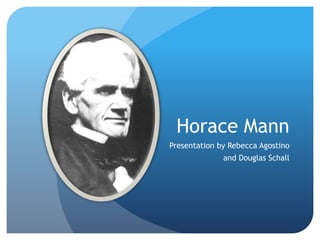
Horace Mann
Presentation by Rebecca Agostino
              and Douglas Schall
Our Survey
Throughout this presentation, you will be prompted to
answer questions through an online survey. Please only
complete the question in the powerpoint directions (no
peaking ahead!) The results will be shared on the
discussion board at the end of the week. All responses
will be recorded anonymously


The green button symbol (around this
text box) will remind you to refer
back to the survey
What is the purpose of
 education? Who should benefit
 from our public education
 system?
Who should finance public
 education? Should this financial
 burden be shared equally?
Is education a natural right?
Background on Horace Mann
(Baines, 2006, 269)


 Worked first as a lawyer, and then as a senator

 Tireless advocate for not only public education, but also
  good public education

 Promoted institutions to train teachers and establish
  libraries

 Also was a strong proponent of physical education

 Mann considered education the "antidote" to many
  issues that plagued society, including "poverty, crime,
  poor health, ignorance…" (Mann, 1891, 269)
What is the Purpose of Public
     Education?         Before you start- what do
                                           you think? You should
                                           complete “Purpose of
Cornell West believes that the role of     Education” Parts I and II
education is to prepare one for their      on the survey
eminent death.
    Don‟t believe me? Watch this clip.


                                   AND: The Massachusetts 1647 Charter on
                                   Education asserted that, “‟every town
                                   with 100 families‟ was required to „set
                                   up a grammar school‟ whose master
                                   should be „able to instruct youth so far
                                   as they are fitted for university.‟‟‟
 Respond to this quote through     (Valentine, 1891, p.108)
 the next question on the
 survey!
So What did Mann think?
Mann argues that free and universal education is,
“indispensable to the continuance of republican
government.” (Mann, 1891, p.113)
  “Mann envisioned a “common school” that would unite all
  citizens—of varied religions, ethnic backgrounds,
  socioeconomic levels, and professions—into one community,
  educated in the values of a basically white Protestant
  society.” (Berkman, 2009, p.253)
2 sides of the argument
     Without public
      education…                               But…
 Mann asserted that, society,      Think about it! What are
  as a whole, would be harmed        some downsides to public
  if all did not participate in
                                     education? (We know you
  educating the younger
  generations: “They who             are in an education
  refuse to train up children in     program! Don‟t worry- your
  a way they should go are           responses are anonymous…)
  training up incendiaries and
  madmen to destroy property
  and life, and to invade and
  pollute the sanctuaries of         Enter your thoughts into the
  society.” (Valentine, 1891,        survey
  p.129)
Who Should Finance Public
Education?
Mann asserted that it was the government’s responsibility to foot the bill
for the country‟s educational system because government has a moral
obligation to protect the rights of the minority (i.e. the youth), by ensuring
their access to the shared intellectual property from past generations
(Valentine, 1891, p.126)

This is the manifestation of Mann‟s greatest fears (of young people being
denied an education).


                                          WHAT DO YOU THINK?
                                          Survey time! Complete the
                                          question following the title
                                          page “Financing Public
                                          Education”
Mann’s serious about this!! Really serious. He feels that it’s
societies MORAL DUTY to provide all citizens with an education.

“…any community, whether nation or state, that ventures to
organize a government, or administer a government already
organized, without making provisions for the free education of all
its children, dares the certain vengeances of Heaven, and in the
squalid forms of poverty and destitution, in the scourges of
violence and misrule, in the heart destroying corruptions of
licentiousness and debauchery and in political profligacy and
legalized perfidy, in all the blended and mutually aggravated
crimes of civilization and barbarism, will be sure to feel the
terrible retribution of its delinquency. (Mann, 1891, p.130)


              Do you agree? To what extent??
“Every Child”
   "In 1642, the General Court of the colony, by a public
    act, enjoined upon the municipal authorities the duty of
    seeing that every child within their respective
    jurisdictions should be educated." (106)

Thanks to civil rights activists, parents,
                                                 Survey time! Complete
students, teachers, and administrators, ALL
                                                 the next question in
children today must receive a Fair and
                                                 the survey.
Appropriate Education (FAPE), regardless of
disability. However, some people think that we
should modify our rules and/or expectations
around students with special needs. What do
you think?
What’s the legal rationale for Government to
extract money from its citizens in order to pay for
the enterprise of public education?

Mann believed that the legal basis for the common school
movement rested in what is called Natural Law, which
“compels the state to provide [for] schools that prepare
individuals to perform all the duties essential for
citizenship.” (Grande, 2006, p.69)
Natural law asserts two things
             First                            Second
 There is such a thing as           The existence of this
  human nature                        nature means that there
                                      are certain basic goods that
                                      we should all pursue in our
                                      actions

Want to learn more?


Or even more? (please excuse the
advertisement that precedes the video)
Opposing Viewpoints                          (Berkman,2009, 252)


            Mann                      On the other hand…
 According to Mann, all              This might imply that
  students should be a part of         school choice threatens the
  a “common school”                    public school values, by
  community                            allowing parents to “opt
                                       out” of the public
                                       education


Whose side are you on? Go to the survey to
identify where on the spectrum you fall
More opposing viewpoints
(Baines, 2006, 270)


              Mann                  On the other hand…
 Viewed education as               Many poor families wanted
  compulsory                         their children to work, as
                                     they needed income merely
                                     to sustain their households

                                    The beginning of this video
                                     describes many opponents
                                     of Mann, and current
                                     education reformers, quite
                                     well
Whose side are you on? Go to the
survey to identify where on the
spectrum you fall
Citations
Baines, Lawrence (2005, Fall- 2006, Summer). A school for
        the common good: does Horace Mann still matter.
        Educational Horizons, 84(2), 268-274

Berkman, James S. (2009, Fall). Mann‟s democratic vision
      of school choice. Schools: Studies in Education,
      6(2), 251-256

Brick, Blanch (2005). Changing concepts of equal education
        opportunity: A comparison of the views of Thomas
        Jefferson, Horace Mann, and John Dewey. American
        Educational History Journal, 32(2), 166-174
Citations


Grande, Albert (2006, November). Education as a natural
      right. St. John’s Journal of Legal Commentary,
      21(1), 63-72

Valentine (1891). Foundations in education: life and
       works of Horace Mann, vol. IV. Boston: Lee and
       Shepard, 105-140

Horace mann 2012_2

  • 1.
    Horace Mann Presentation byRebecca Agostino and Douglas Schall
  • 2.
    Our Survey Throughout thispresentation, you will be prompted to answer questions through an online survey. Please only complete the question in the powerpoint directions (no peaking ahead!) The results will be shared on the discussion board at the end of the week. All responses will be recorded anonymously The green button symbol (around this text box) will remind you to refer back to the survey
  • 3.
    What is thepurpose of education? Who should benefit from our public education system? Who should finance public education? Should this financial burden be shared equally? Is education a natural right?
  • 4.
    Background on HoraceMann (Baines, 2006, 269)  Worked first as a lawyer, and then as a senator  Tireless advocate for not only public education, but also good public education  Promoted institutions to train teachers and establish libraries  Also was a strong proponent of physical education  Mann considered education the "antidote" to many issues that plagued society, including "poverty, crime, poor health, ignorance…" (Mann, 1891, 269)
  • 5.
    What is thePurpose of Public Education? Before you start- what do you think? You should complete “Purpose of Cornell West believes that the role of Education” Parts I and II education is to prepare one for their on the survey eminent death. Don‟t believe me? Watch this clip. AND: The Massachusetts 1647 Charter on Education asserted that, “‟every town with 100 families‟ was required to „set up a grammar school‟ whose master should be „able to instruct youth so far as they are fitted for university.‟‟‟ Respond to this quote through (Valentine, 1891, p.108) the next question on the survey!
  • 6.
    So What didMann think? Mann argues that free and universal education is, “indispensable to the continuance of republican government.” (Mann, 1891, p.113) “Mann envisioned a “common school” that would unite all citizens—of varied religions, ethnic backgrounds, socioeconomic levels, and professions—into one community, educated in the values of a basically white Protestant society.” (Berkman, 2009, p.253)
  • 7.
    2 sides ofthe argument Without public education… But…  Mann asserted that, society,  Think about it! What are as a whole, would be harmed some downsides to public if all did not participate in education? (We know you educating the younger generations: “They who are in an education refuse to train up children in program! Don‟t worry- your a way they should go are responses are anonymous…) training up incendiaries and madmen to destroy property and life, and to invade and pollute the sanctuaries of Enter your thoughts into the society.” (Valentine, 1891, survey p.129)
  • 8.
    Who Should FinancePublic Education? Mann asserted that it was the government’s responsibility to foot the bill for the country‟s educational system because government has a moral obligation to protect the rights of the minority (i.e. the youth), by ensuring their access to the shared intellectual property from past generations (Valentine, 1891, p.126) This is the manifestation of Mann‟s greatest fears (of young people being denied an education). WHAT DO YOU THINK? Survey time! Complete the question following the title page “Financing Public Education”
  • 9.
    Mann’s serious aboutthis!! Really serious. He feels that it’s societies MORAL DUTY to provide all citizens with an education. “…any community, whether nation or state, that ventures to organize a government, or administer a government already organized, without making provisions for the free education of all its children, dares the certain vengeances of Heaven, and in the squalid forms of poverty and destitution, in the scourges of violence and misrule, in the heart destroying corruptions of licentiousness and debauchery and in political profligacy and legalized perfidy, in all the blended and mutually aggravated crimes of civilization and barbarism, will be sure to feel the terrible retribution of its delinquency. (Mann, 1891, p.130) Do you agree? To what extent??
  • 10.
    “Every Child”  "In 1642, the General Court of the colony, by a public act, enjoined upon the municipal authorities the duty of seeing that every child within their respective jurisdictions should be educated." (106) Thanks to civil rights activists, parents, Survey time! Complete students, teachers, and administrators, ALL the next question in children today must receive a Fair and the survey. Appropriate Education (FAPE), regardless of disability. However, some people think that we should modify our rules and/or expectations around students with special needs. What do you think?
  • 11.
    What’s the legalrationale for Government to extract money from its citizens in order to pay for the enterprise of public education? Mann believed that the legal basis for the common school movement rested in what is called Natural Law, which “compels the state to provide [for] schools that prepare individuals to perform all the duties essential for citizenship.” (Grande, 2006, p.69)
  • 12.
    Natural law assertstwo things First Second  There is such a thing as  The existence of this human nature nature means that there are certain basic goods that we should all pursue in our actions Want to learn more? Or even more? (please excuse the advertisement that precedes the video)
  • 13.
    Opposing Viewpoints (Berkman,2009, 252) Mann On the other hand…  According to Mann, all  This might imply that students should be a part of school choice threatens the a “common school” public school values, by community allowing parents to “opt out” of the public education Whose side are you on? Go to the survey to identify where on the spectrum you fall
  • 14.
    More opposing viewpoints (Baines,2006, 270) Mann On the other hand…  Viewed education as  Many poor families wanted compulsory their children to work, as they needed income merely to sustain their households  The beginning of this video describes many opponents of Mann, and current education reformers, quite well Whose side are you on? Go to the survey to identify where on the spectrum you fall
  • 15.
    Citations Baines, Lawrence (2005,Fall- 2006, Summer). A school for the common good: does Horace Mann still matter. Educational Horizons, 84(2), 268-274 Berkman, James S. (2009, Fall). Mann‟s democratic vision of school choice. Schools: Studies in Education, 6(2), 251-256 Brick, Blanch (2005). Changing concepts of equal education opportunity: A comparison of the views of Thomas Jefferson, Horace Mann, and John Dewey. American Educational History Journal, 32(2), 166-174
  • 16.
    Citations Grande, Albert (2006,November). Education as a natural right. St. John’s Journal of Legal Commentary, 21(1), 63-72 Valentine (1891). Foundations in education: life and works of Horace Mann, vol. IV. Boston: Lee and Shepard, 105-140