Haley Young
Dr. Jennifer Buckley
Aurora University
15 April 2014
 Background biological info.
 Recent studies
 My study
 Quantitative and qualitative data
 Possible improvements and variables
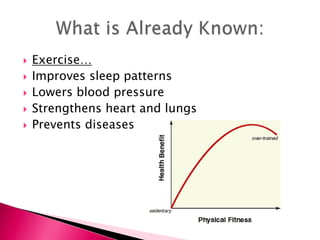
 Exercise…
 Improves sleep patterns
 Lowers blood pressure
 Strengthens heart and lungs
 Prevents diseases
 demonstrates that exercise improves
cognitive functioning!
 Aerobic exercise is most beneficial.
 Our ancestors had to move in search of food
and for survival.
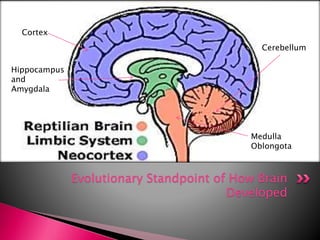
 Evolutionary standpoint: This is how the brain
became more advanced.
Evolutionary Standpoint of How Brain
Developed
Cortex
Medulla
Oblongota
Cerebellum
Hippocampus
and
Amygdala
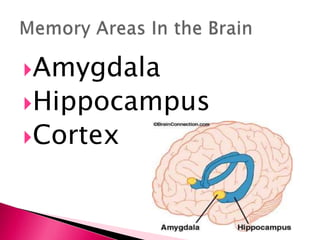
Amygdala
Hippocampus
Cortex
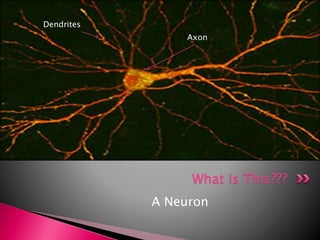
Dendrite
What is This???
A Neuron
Dendrites
Axon
 Hormones and Neurotransmitters:
 ***Brain-Derived Neurotrophic Factor (BDNF)
 Insulin-Like Growth Factor (IGF-1)
 Vascular Endothelial Growth Factor (VEGF)
 Serotonin
 Dopamine
 Gammaaminobutyric Acid (GABA)
 ***Glutamate
 Various hormones and neurotransmitters:
 Increase dendritic expansion
 Increase axons in cortical region of brain
 Increased blood flow allows for growth of new
neurons and capillaries= increased brain
volume= improved cognition
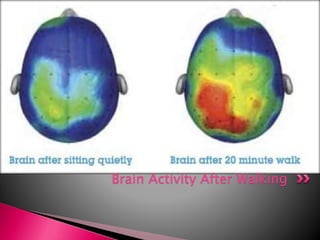
Brain Activity After Walking
 Study #1:
59 people (age 60-79) randomly assigned to
aerobic or anaerobic exercise groups
Duration: 1 hour, 3 times a week
Results: Aerobic group had increased brain
volume in cortical regions and frontal lobe
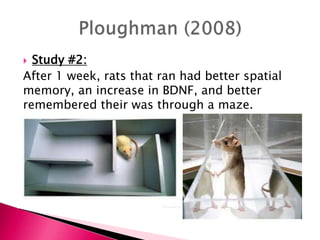
 Study #2:
After 1 week, rats that ran had better spatial
memory, an increase in BDNF, and better
remembered their was through a maze.
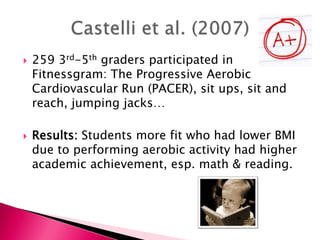
 259 3rd-5th graders participated in
Fitnessgram: The Progressive Aerobic
Cardiovascular Run (PACER), sit ups, sit and
reach, jumping jacks…
 Results: Students more fit who had lower BMI
due to performing aerobic activity had higher
academic achievement, esp. math & reading.
 Those who perform acute aerobic exercise
before they take their final exam will
demonstrate greater growth from their mid-
term to final exam.
 Independent variables: exercisers and non-
exercisers
 Dependent variable: grades/growth
 4 exercisers and 4 non-exercisers*
 Demographics sheet
 Exercise for 45 mins. 60-80% of target HR
 Have 30 mins. to take final
 Compare midterm and final %
Grading Scale
A+ 96-100
A 93-95
A- 90-92
B+ 86-89
B 83-85
B- 80-82
C+ 76-79
C 73-75
C- 70-72
D+ 66-69
D 63-65
D- 60-62
F <59
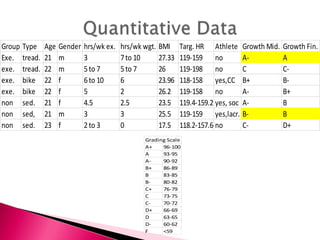
Group Type Age Gender hrs/wk ex. hrs/wk wgt. BMI Targ. HR Athlete Growth Mid. Growth Fin.
Exe. tread. 21 m 3 7to 10 27.33 119-159 no A- A
exe. tread. 22 m 5to 7 5to 7 26 119-198 no C C-
exe. bike 22 f 6to 10 6 23.96 118-158 yes,CC B+ B-
exe. bike 22 f 5 2 26.2 119-158 no A- B+
non sed. 21 f 4.5 2.5 23.5 119.4-159.2 yes, soc A- B
non sed, 21 m 3 3 25.5 119-159 yes,lacr. B- B
non sed. 23 f 2to 3 0 17.5 118.2-157.6 no C- D+
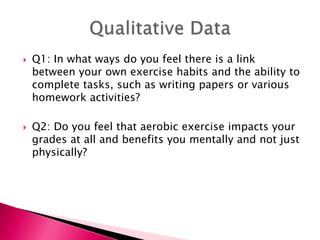
 Q1: In what ways do you feel there is a link
between your own exercise habits and the ability to
complete tasks, such as writing papers or various
homework activities?
 Q2: Do you feel that aerobic exercise impacts your
grades at all and benefits you mentally and not just
physically?
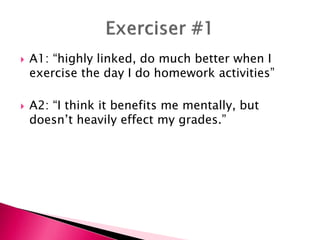
 A1: “highly linked, do much better when I
exercise the day I do homework activities”
 A2: “I think it benefits me mentally, but
doesn’t heavily effect my grades.”
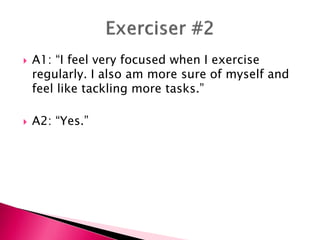
 A1: “I feel very focused when I exercise
regularly. I also am more sure of myself and
feel like tackling more tasks.”
 A2: “Yes.”
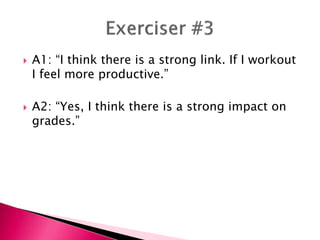
 A1: “I think there is a strong link. If I workout
I feel more productive.”
 A2: “Yes, I think there is a strong impact on
grades.”
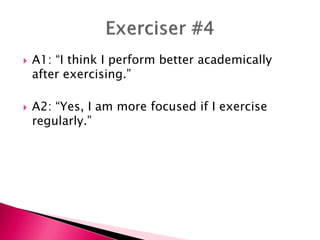
 A1: “I think I perform better academically
after exercising.”
 A2: “Yes, I am more focused if I exercise
regularly.”
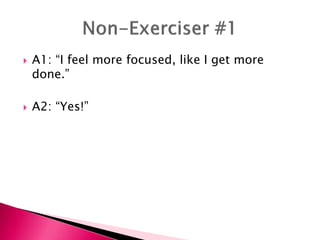
 A1: “I feel more focused, like I get more
done.”
 A2: “Yes!”
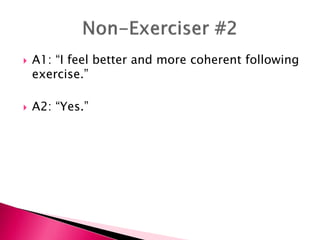
 A1: “I feel better and more coherent following
exercise.”
 A2: “Yes.”
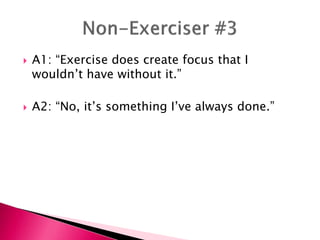
 A1: “Exercise does create focus that I
wouldn’t have without it.”
 A2: “No, it’s something I’ve always done.”
 1 student from each group demonstrated
growth:
 Exerciser #1: A- to A
 Non-Exerciser #2: B- to B
 Everyone felt that there was a link between
their exercising habits and ability to perform
academically.
 Everyone besides one exerciser felt that
exercise benefits them mentally.
 Sample size
 Amount of time may have had effect
 Gender specific
 Choose one type of workout equipment
 Workout history
 GPA- what kind of student are they?
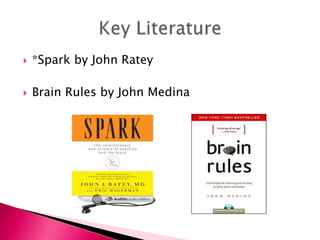
 *Spark by John Ratey
 Brain Rules by John Medina
• Castelli, D.M., Hillman, C.H., Buck, S.M., Erwin, H.E. (2007). Physical fitness and academic achievement in third-and fifth-grade students.
Jouirnal of Sport and Exercise Psychology. 29,239-252.
• Chodzko-Zaijko, W., Kramer, A., Poon, L.W. 2009. Enhancing Cognitive Functioning and Brain Plasticity. Volume 3. Champaign:
Human Kinetics.
• Cressy, J. (2011). The roles of physical activity and health in enhancing student engagement: implications for leadership in post-
secondary education. College Quarterly, 14(4).
• Fox, C. K., Barr-Anderson, D., Neumark-Sztainer, D., & Wall, M. (2010). Physical activity and sports team participation: associations
with academic outcomes in middle school and high school students. Journal Of School Health, 80(1), 31-37.
• Gligoroska, J.P. and Manchevska, S. (2012). The effect of physical activity on cognition- physiological mechanisms. Mat Soc Med. 24(3):
198-202.
• Hillman, C., Castelli, D.M., Buck, S.M. Aerobic fitness and neurocognitive function in healthy preadolescent children. (2005).
Official Journal of The American College of Sports Medicine.
• Katch, V.L., McArdle, W.D., Katch F.I. (2001). Essentials of Exercise Physiology. Fourth Edition. Baltimore: Lippincott Williams
& Wilkins.
• Knaepen, K., Goekint, M., Heyman, E.M., Meeusen, R. (2010). Neuroplasticity- Exercise-induced response of peripheral brain-derived
neurotrophic factor. Sports Med. 40(9), 765-801.
• Lo Bue-Estes, C., Willer, B., Burton, H., Leddy, J.J., Wilding, E.G., Horvath, P.J. (2008). Short- term exercise to exhaustion and
its effects on cognitive function in young women. Perceptual and Motor Skills. 107(3), 933-945.
• *Medina, J. (2008). Brain Rules. Seattle: Pear Press.
• Ploughman, M. (2008). Exercise is brain food: The effects of physical activity on cognitive function.Developmental
Neurorehabilitation. 11(3), 236-240.
• *Ratey, J.J. (2008). Spark. New York: Little, Brown and Company.
• Tomporowski, P. D., Davis, C. L., Miller, P. H., & Naglieri, J. A. (2008). Exercise and children’s intelligence, cognition, and academic
achievement. Educational Psychology Review, 20(2), 111-131.
Questions???

Honors Program-Senior Presentation-Exercise and Cognition

  • 1.
    Haley Young Dr. JenniferBuckley Aurora University 15 April 2014
  • 2.
     Background biologicalinfo.  Recent studies  My study  Quantitative and qualitative data  Possible improvements and variables
  • 3.
     Exercise…  Improvessleep patterns  Lowers blood pressure  Strengthens heart and lungs  Prevents diseases
  • 4.
     demonstrates thatexercise improves cognitive functioning!  Aerobic exercise is most beneficial.  Our ancestors had to move in search of food and for survival.  Evolutionary standpoint: This is how the brain became more advanced.
  • 5.
    Evolutionary Standpoint ofHow Brain Developed Cortex Medulla Oblongota Cerebellum Hippocampus and Amygdala
  • 6.
  • 7.
    Dendrite What is This??? ANeuron Dendrites Axon
  • 8.
     Hormones andNeurotransmitters:  ***Brain-Derived Neurotrophic Factor (BDNF)  Insulin-Like Growth Factor (IGF-1)  Vascular Endothelial Growth Factor (VEGF)  Serotonin  Dopamine  Gammaaminobutyric Acid (GABA)  ***Glutamate
  • 9.
     Various hormonesand neurotransmitters:  Increase dendritic expansion  Increase axons in cortical region of brain  Increased blood flow allows for growth of new neurons and capillaries= increased brain volume= improved cognition
  • 10.
  • 11.
     Study #1: 59people (age 60-79) randomly assigned to aerobic or anaerobic exercise groups Duration: 1 hour, 3 times a week Results: Aerobic group had increased brain volume in cortical regions and frontal lobe
  • 12.
     Study #2: After1 week, rats that ran had better spatial memory, an increase in BDNF, and better remembered their was through a maze.
  • 13.
     259 3rd-5thgraders participated in Fitnessgram: The Progressive Aerobic Cardiovascular Run (PACER), sit ups, sit and reach, jumping jacks…  Results: Students more fit who had lower BMI due to performing aerobic activity had higher academic achievement, esp. math & reading.
  • 14.
     Those whoperform acute aerobic exercise before they take their final exam will demonstrate greater growth from their mid- term to final exam.  Independent variables: exercisers and non- exercisers  Dependent variable: grades/growth
  • 15.
     4 exercisersand 4 non-exercisers*  Demographics sheet  Exercise for 45 mins. 60-80% of target HR  Have 30 mins. to take final  Compare midterm and final %
  • 16.
    Grading Scale A+ 96-100 A93-95 A- 90-92 B+ 86-89 B 83-85 B- 80-82 C+ 76-79 C 73-75 C- 70-72 D+ 66-69 D 63-65 D- 60-62 F <59 Group Type Age Gender hrs/wk ex. hrs/wk wgt. BMI Targ. HR Athlete Growth Mid. Growth Fin. Exe. tread. 21 m 3 7to 10 27.33 119-159 no A- A exe. tread. 22 m 5to 7 5to 7 26 119-198 no C C- exe. bike 22 f 6to 10 6 23.96 118-158 yes,CC B+ B- exe. bike 22 f 5 2 26.2 119-158 no A- B+ non sed. 21 f 4.5 2.5 23.5 119.4-159.2 yes, soc A- B non sed, 21 m 3 3 25.5 119-159 yes,lacr. B- B non sed. 23 f 2to 3 0 17.5 118.2-157.6 no C- D+
  • 17.
     Q1: Inwhat ways do you feel there is a link between your own exercise habits and the ability to complete tasks, such as writing papers or various homework activities?  Q2: Do you feel that aerobic exercise impacts your grades at all and benefits you mentally and not just physically?
  • 18.
     A1: “highlylinked, do much better when I exercise the day I do homework activities”  A2: “I think it benefits me mentally, but doesn’t heavily effect my grades.”
  • 19.
     A1: “Ifeel very focused when I exercise regularly. I also am more sure of myself and feel like tackling more tasks.”  A2: “Yes.”
  • 20.
     A1: “Ithink there is a strong link. If I workout I feel more productive.”  A2: “Yes, I think there is a strong impact on grades.”
  • 21.
     A1: “Ithink I perform better academically after exercising.”  A2: “Yes, I am more focused if I exercise regularly.”
  • 22.
     A1: “Ifeel more focused, like I get more done.”  A2: “Yes!”
  • 23.
     A1: “Ifeel better and more coherent following exercise.”  A2: “Yes.”
  • 24.
     A1: “Exercisedoes create focus that I wouldn’t have without it.”  A2: “No, it’s something I’ve always done.”
  • 25.
     1 studentfrom each group demonstrated growth:  Exerciser #1: A- to A  Non-Exerciser #2: B- to B  Everyone felt that there was a link between their exercising habits and ability to perform academically.  Everyone besides one exerciser felt that exercise benefits them mentally.
  • 26.
     Sample size Amount of time may have had effect  Gender specific  Choose one type of workout equipment  Workout history  GPA- what kind of student are they?
  • 27.
     *Spark byJohn Ratey  Brain Rules by John Medina
  • 28.
    • Castelli, D.M.,Hillman, C.H., Buck, S.M., Erwin, H.E. (2007). Physical fitness and academic achievement in third-and fifth-grade students. Jouirnal of Sport and Exercise Psychology. 29,239-252. • Chodzko-Zaijko, W., Kramer, A., Poon, L.W. 2009. Enhancing Cognitive Functioning and Brain Plasticity. Volume 3. Champaign: Human Kinetics. • Cressy, J. (2011). The roles of physical activity and health in enhancing student engagement: implications for leadership in post- secondary education. College Quarterly, 14(4). • Fox, C. K., Barr-Anderson, D., Neumark-Sztainer, D., & Wall, M. (2010). Physical activity and sports team participation: associations with academic outcomes in middle school and high school students. Journal Of School Health, 80(1), 31-37. • Gligoroska, J.P. and Manchevska, S. (2012). The effect of physical activity on cognition- physiological mechanisms. Mat Soc Med. 24(3): 198-202. • Hillman, C., Castelli, D.M., Buck, S.M. Aerobic fitness and neurocognitive function in healthy preadolescent children. (2005). Official Journal of The American College of Sports Medicine. • Katch, V.L., McArdle, W.D., Katch F.I. (2001). Essentials of Exercise Physiology. Fourth Edition. Baltimore: Lippincott Williams & Wilkins. • Knaepen, K., Goekint, M., Heyman, E.M., Meeusen, R. (2010). Neuroplasticity- Exercise-induced response of peripheral brain-derived neurotrophic factor. Sports Med. 40(9), 765-801. • Lo Bue-Estes, C., Willer, B., Burton, H., Leddy, J.J., Wilding, E.G., Horvath, P.J. (2008). Short- term exercise to exhaustion and its effects on cognitive function in young women. Perceptual and Motor Skills. 107(3), 933-945. • *Medina, J. (2008). Brain Rules. Seattle: Pear Press. • Ploughman, M. (2008). Exercise is brain food: The effects of physical activity on cognitive function.Developmental Neurorehabilitation. 11(3), 236-240. • *Ratey, J.J. (2008). Spark. New York: Little, Brown and Company. • Tomporowski, P. D., Davis, C. L., Miller, P. H., & Naglieri, J. A. (2008). Exercise and children’s intelligence, cognition, and academic achievement. Educational Psychology Review, 20(2), 111-131.
  • 29.

Editor's Notes

  • #4 Many people know this, but many are unaware of the impact exercise has on cognitive function
  • #5 People were not sedentary like many people are today, they had to move in search of food and in order to avoid predators- to survive
  • #6 Taking a look at this diagram, orange=brain stem(breathing & HR), Green=amygdala and hippocampus (learning and memory), Blue=cortex (high level thinking)
  • #8 Does anyone know what this is?=neuron… nerve cell responsible for sending chemical and electrical messages to one another and relaying it to brain. Many dendrites take in info, ONLY 1 axon sends out message (otherwise chaos)
  • #9 These are various hormones and neurotransmitters- released in greater amounts during and after exercise, growth and dendritic expansion, glutamate excitatory, GABA inhibitory
  • #11 Red is where most activity takes place
  • #13 Rats were observed and completed a maze. Then split in 2 groups: one group got a wheel to run on. After 1 wk, they improved in maze.
  • #14 There is more research done on longitudinal studies. I chose to examine acute, immediate effects of exercise.
  • #16 After approval from Institutional Review Board, students from Dr. Buckley’s fitness and health promotion class signed the consent form agreeing to participate in my study.
  • #19 Exerciser #1 felt that exercise and the ability to perform academically are highly linked.