Nicole Bracciale and Dr. Michele
                          Skelton
Department of Integrative Health
                           Science
http://exerciseismedicine.org/


“Calling on all health care providers to assess and
  review every patient’s physical activity program at
  every visit.”
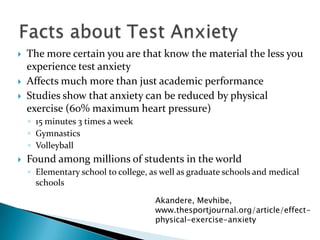
   The more certain you are that know the material the less you
    experience test anxiety
   Affects much more than just academic performance
   Studies show that anxiety can be reduced by physical
    exercise (60% maximum heart pressure)
    ◦ 15 minutes 3 times a week
    ◦ Gymnastics
    ◦ Volleyball
   Found among millions of students in the world
    ◦ Elementary school to college, as well as graduate schools and medical
      schools
                                     Akandere, Mevhibe,
                                     www.thesportjournal.org/article/effect-
                                     physical-exercise-anxiety
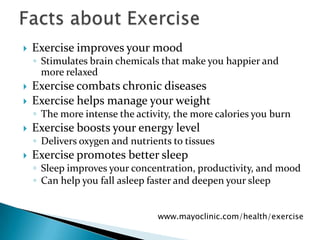
   Exercise improves your mood
    ◦ Stimulates brain chemicals that make you happier and
      more relaxed
   Exercise combats chronic diseases
   Exercise helps manage your weight
    ◦ The more intense the activity, the more calories you burn
   Exercise boosts your energy level
    ◦ Delivers oxygen and nutrients to tissues
   Exercise promotes better sleep
    ◦ Sleep improves your concentration, productivity, and mood
    ◦ Can help you fall asleep faster and deepen your sleep


                                www.mayoclinic.com/health/exercise
To see the exercise effects on GPA, BMI, and on the
scores of the STAI with students who believe to have
                  test taking anxiety
   Survey for the State Trait Anxiety Inventory was
    adapted from Akandere et al (1) and was made
    available via surveymonkey.com by way of a group
    on facebook.com
   Survey was 45 questions
    ◦   Demographic questions (7 questions)
    ◦   State Trait Anxiety Inventory (20 questions)
    ◦   Test anxiety and academic performance (10 questions)
    ◦   Exercise habits (8 questions)
   267 usable responses
    ◦ College –aged (20.6 ± 3.25)
    ◦ Year in school
    ◦ What school attending
   Classification of subjects
    ◦   Belief of test taking anxiety
    ◦   Non-belief of test taking anxiety
    ◦   Belief that exercise helps test taking anxiety
    ◦   Belief that exercise does not help test taking anxiety
   119 students believe that they have test taking
    anxiety, while 147 students believe that they do not
    have test taking anxiety
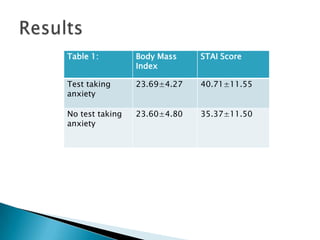
   The 119 that believe they have test taking anxiety
    scored significantly higher on the STAI than those
    that do not believe they have test taking anxiety
   There is no significant difference in BMI between
    students who believe they take have test taking
    anxiety and the students that believe they do not
Table 1:         Body Mass    STAI Score
                 Index

Test taking      23.69±4.27   40.71±11.55
anxiety

No test taking   23.60±4.80   35.37±11.50
anxiety
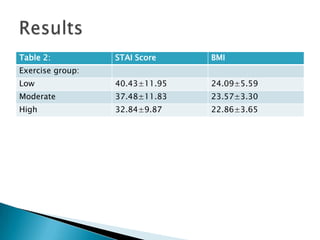
   There is a significant difference between the “low”
    exercise group and the “high” exercise group, but
    not the “low” and “moderate,” in terms of scoring on
    the STAI and BMI
Table 2:          STAI Score    BMI
Exercise group:
Low               40.43±11.95   24.09±5.59
Moderate          37.48±11.83   23.57±3.30
High              32.84±9.87    22.86±3.65
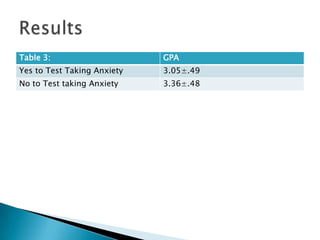
   The G.P.A. in participants who believed to have test
    taking anxiety was lower than the participants’
    G.P.As who believe they do not have test taking
    anxiety
Table 3:                     GPA
Yes to Test Taking Anxiety   3.05±.49
No to Test taking Anxiety    3.36±.48
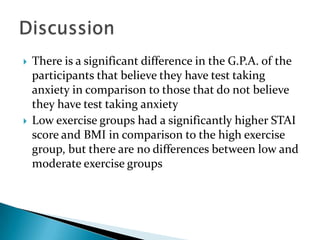
   There is a significant difference in the G.P.A. of the
    participants that believe they have test taking
    anxiety in comparison to those that do not believe
    they have test taking anxiety
   Low exercise groups had a significantly higher STAI
    score and BMI in comparison to the high exercise
    group, but there are no differences between low and
    moderate exercise groups
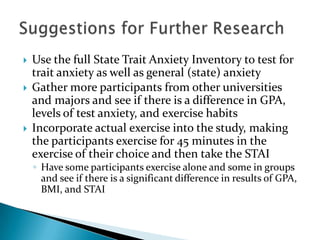
   Use the full State Trait Anxiety Inventory to test for
    trait anxiety as well as general (state) anxiety
   Gather more participants from other universities
    and majors and see if there is a difference in GPA,
    levels of test anxiety, and exercise habits
   Incorporate actual exercise into the study, making
    the participants exercise for 45 minutes in the
    exercise of their choice and then take the STAI
    ◦ Have some participants exercise alone and some in groups
      and see if there is a significant difference in results of GPA,
      BMI, and STAI
   Marcus Tullius Cicero: “It is exercise alone that
    supports the spirits, and keeps the mind in vigor”

   John Adams, 2nd president of the United States:
    “Exercise invigorates, and enlivens all the faculties
    of body and of mind…it spreads a gladness and
    satisfaction over our minds and qualifies us for
    every sort of business, and every sort of pleasure”
   I would like to thank Dr. Michele Skelton for all of
    her help and support in this project, the IHSC
    department, my friends who helped greatly with the
    distribution of this survey, and Dr. Ivan Fleishman
    for his help with accessing and scoring the results of
    the STAI.
   Akandere, Mevhibe, and Ali Tekin. "The Effect of Physical Exercise on Anxiety." The Sport Journal 5.2 (2002). The Olympic
    Edition | The Sport Journal. Web. 19 Sept. 2010. <http://www.thesportjournal.org/article/effect-physical-exercise-
    anxiety>.
   Chomitz, Virgina R., Meghan M. Slining, and Robert J. McGowan. "Is There a Relationship Between Physical." Journal of
    School Health 79.1 (2009): 30-37. American School Health Association. 4 Feb. 2008. Web. 16 Sept. 2010.
    <http://extension.oregonstate.edu/physicalactivity/sites/default/files/Fit_kids_are_smart_kids.pdf>.
   Congos, Dennis H. "Overcoming Test Anxiety." Student Academic Resource Center. University of Central Florida. Web. 16
    Sept. 2010. <http://www.medstudent.ucla.edu/current/careeradvising/documents/Overcoming_Test_Anxiety.pdf>.
   "Effect of Relaxation or Exercise on Undergraduates' Test Anxiety." Pub Med. Web. 04 Dec. 2010.
    <http://www.ncbi.nlm.nih.gov/pubmed/2674884>.
   "Exercise and Physical Fitness: MedlinePlus." National Library of Medicine - National Institutes of Health. Web. 04 Dec. 2010.
    <http://www.nlm.nih.gov/medlineplus/exerciseandphysicalfitness.html>.
   Jalili, Mousa. "The Effects of Two Methods of Training on Depression and Anxiety of University Male and Female Students."
    World Applied Sciences Journal 9.5 (2010): 526-30. IDOSI Publications. Web. 16 Sept. 2010.
    <http://www.idosi.org/wasj/wasj9(5)/11.pdf>.
   Johnson, Trevor. "Testophobia Treatment - A Fear Of Taking Tests – Tips And Advice | Panic Anxiety Treatment." Panic
    Anxiety Treatment - How to Cure Panic Anxiety Attacks. 28 Feb. 2010. Web. 04 Dec. 2010. <http://www.panic-
    anxiety.net/a-fear-of-taking-tests-tips-and-advice.html>.
   Kramer, Arthur F., Kirk I. Erickson, and Stanley J. Colcombe. "Exercise, Cognition and the Aging Brain -- Kramer Et Al.,
    10.1152/japplphysiol.00500.2006." Journal of Applied Physiology. 2006. Web. 04 Dec. 2010.
    <http://jap.physiology.org/cgi/reprint/00500.2006v1>.
   "Overcoming Test Anxiety, Stress Solutions, Raise Test Scores - HeartMath." HeartMath - a Change of Heart Changes
    Everything - Stress Relief & Stress Management Products. Web. 19 Sept. 2010. <http://www.heartmath.com/personal-
    growth/solutions-overcoming-test-anxiety.html>.
   Reteguiz, Jo-Ann. "Relationship Between Anxiety and Standardized Patient Test Performance in the Medicine Clerkship." J
    Gen Intern Med 21.5 (2006): 415-18. Web. 16 Sept. 2010. <http://www.ncbi.nlm.nih.gov/pmc/articles/PMC1484796/>.
   Schwartz, Gary E., Richard J. Davidson, and Daniel J. Goleman. "Patterning of Cognitive and Somatic Processes in the Self-
    Regulation of Anxiety: Effects of Meditation versus Exercise."Psychosomatic Medicine. Web. 04 Dec. 2010.
    <http://www.ncbi.nlm.nih.gov/pubmed/356080>.
   Taylor, C. Barr, James F. Sallis, and Richard Needle. "The Relation of Physical Activity and Exercise to Mental Health." Public
    Health Reports 100.2: 195-202. Web. 2 Dec. 2010. <http://www.ncbi.nlm.nih.gov/pmc/articles/PMC1424736/>.
   "The Human Brain - Exercise." Resources for Science Learning. Web. 04 Dec. 2010.
    <http://www.fi.edu/learn/brain/exercise.html#physicalexercise>.
Physical Exercise And Test Taking Anxiety

Physical Exercise And Test Taking Anxiety

  • 1.
    Nicole Bracciale andDr. Michele Skelton Department of Integrative Health Science
  • 2.
    http://exerciseismedicine.org/ “Calling on allhealth care providers to assess and review every patient’s physical activity program at every visit.”
  • 3.
    The more certain you are that know the material the less you experience test anxiety  Affects much more than just academic performance  Studies show that anxiety can be reduced by physical exercise (60% maximum heart pressure) ◦ 15 minutes 3 times a week ◦ Gymnastics ◦ Volleyball  Found among millions of students in the world ◦ Elementary school to college, as well as graduate schools and medical schools Akandere, Mevhibe, www.thesportjournal.org/article/effect- physical-exercise-anxiety
  • 4.
    Exercise improves your mood ◦ Stimulates brain chemicals that make you happier and more relaxed  Exercise combats chronic diseases  Exercise helps manage your weight ◦ The more intense the activity, the more calories you burn  Exercise boosts your energy level ◦ Delivers oxygen and nutrients to tissues  Exercise promotes better sleep ◦ Sleep improves your concentration, productivity, and mood ◦ Can help you fall asleep faster and deepen your sleep www.mayoclinic.com/health/exercise
  • 5.
    To see theexercise effects on GPA, BMI, and on the scores of the STAI with students who believe to have test taking anxiety
  • 6.
    Survey for the State Trait Anxiety Inventory was adapted from Akandere et al (1) and was made available via surveymonkey.com by way of a group on facebook.com  Survey was 45 questions ◦ Demographic questions (7 questions) ◦ State Trait Anxiety Inventory (20 questions) ◦ Test anxiety and academic performance (10 questions) ◦ Exercise habits (8 questions)
  • 7.
    267 usable responses ◦ College –aged (20.6 ± 3.25) ◦ Year in school ◦ What school attending  Classification of subjects ◦ Belief of test taking anxiety ◦ Non-belief of test taking anxiety ◦ Belief that exercise helps test taking anxiety ◦ Belief that exercise does not help test taking anxiety
  • 8.
    119 students believe that they have test taking anxiety, while 147 students believe that they do not have test taking anxiety  The 119 that believe they have test taking anxiety scored significantly higher on the STAI than those that do not believe they have test taking anxiety  There is no significant difference in BMI between students who believe they take have test taking anxiety and the students that believe they do not
  • 9.
    Table 1: Body Mass STAI Score Index Test taking 23.69±4.27 40.71±11.55 anxiety No test taking 23.60±4.80 35.37±11.50 anxiety
  • 10.
    There is a significant difference between the “low” exercise group and the “high” exercise group, but not the “low” and “moderate,” in terms of scoring on the STAI and BMI
  • 11.
    Table 2: STAI Score BMI Exercise group: Low 40.43±11.95 24.09±5.59 Moderate 37.48±11.83 23.57±3.30 High 32.84±9.87 22.86±3.65
  • 12.
    The G.P.A. in participants who believed to have test taking anxiety was lower than the participants’ G.P.As who believe they do not have test taking anxiety
  • 13.
    Table 3: GPA Yes to Test Taking Anxiety 3.05±.49 No to Test taking Anxiety 3.36±.48
  • 14.
    There is a significant difference in the G.P.A. of the participants that believe they have test taking anxiety in comparison to those that do not believe they have test taking anxiety  Low exercise groups had a significantly higher STAI score and BMI in comparison to the high exercise group, but there are no differences between low and moderate exercise groups
  • 15.
    Use the full State Trait Anxiety Inventory to test for trait anxiety as well as general (state) anxiety  Gather more participants from other universities and majors and see if there is a difference in GPA, levels of test anxiety, and exercise habits  Incorporate actual exercise into the study, making the participants exercise for 45 minutes in the exercise of their choice and then take the STAI ◦ Have some participants exercise alone and some in groups and see if there is a significant difference in results of GPA, BMI, and STAI
  • 16.
    Marcus Tullius Cicero: “It is exercise alone that supports the spirits, and keeps the mind in vigor”  John Adams, 2nd president of the United States: “Exercise invigorates, and enlivens all the faculties of body and of mind…it spreads a gladness and satisfaction over our minds and qualifies us for every sort of business, and every sort of pleasure”
  • 17.
    I would like to thank Dr. Michele Skelton for all of her help and support in this project, the IHSC department, my friends who helped greatly with the distribution of this survey, and Dr. Ivan Fleishman for his help with accessing and scoring the results of the STAI.
  • 18.
    Akandere, Mevhibe, and Ali Tekin. "The Effect of Physical Exercise on Anxiety." The Sport Journal 5.2 (2002). The Olympic Edition | The Sport Journal. Web. 19 Sept. 2010. <http://www.thesportjournal.org/article/effect-physical-exercise- anxiety>.  Chomitz, Virgina R., Meghan M. Slining, and Robert J. McGowan. "Is There a Relationship Between Physical." Journal of School Health 79.1 (2009): 30-37. American School Health Association. 4 Feb. 2008. Web. 16 Sept. 2010. <http://extension.oregonstate.edu/physicalactivity/sites/default/files/Fit_kids_are_smart_kids.pdf>.  Congos, Dennis H. "Overcoming Test Anxiety." Student Academic Resource Center. University of Central Florida. Web. 16 Sept. 2010. <http://www.medstudent.ucla.edu/current/careeradvising/documents/Overcoming_Test_Anxiety.pdf>.  "Effect of Relaxation or Exercise on Undergraduates' Test Anxiety." Pub Med. Web. 04 Dec. 2010. <http://www.ncbi.nlm.nih.gov/pubmed/2674884>.  "Exercise and Physical Fitness: MedlinePlus." National Library of Medicine - National Institutes of Health. Web. 04 Dec. 2010. <http://www.nlm.nih.gov/medlineplus/exerciseandphysicalfitness.html>.  Jalili, Mousa. "The Effects of Two Methods of Training on Depression and Anxiety of University Male and Female Students." World Applied Sciences Journal 9.5 (2010): 526-30. IDOSI Publications. Web. 16 Sept. 2010. <http://www.idosi.org/wasj/wasj9(5)/11.pdf>.  Johnson, Trevor. "Testophobia Treatment - A Fear Of Taking Tests – Tips And Advice | Panic Anxiety Treatment." Panic Anxiety Treatment - How to Cure Panic Anxiety Attacks. 28 Feb. 2010. Web. 04 Dec. 2010. <http://www.panic- anxiety.net/a-fear-of-taking-tests-tips-and-advice.html>.  Kramer, Arthur F., Kirk I. Erickson, and Stanley J. Colcombe. "Exercise, Cognition and the Aging Brain -- Kramer Et Al., 10.1152/japplphysiol.00500.2006." Journal of Applied Physiology. 2006. Web. 04 Dec. 2010. <http://jap.physiology.org/cgi/reprint/00500.2006v1>.  "Overcoming Test Anxiety, Stress Solutions, Raise Test Scores - HeartMath." HeartMath - a Change of Heart Changes Everything - Stress Relief & Stress Management Products. Web. 19 Sept. 2010. <http://www.heartmath.com/personal- growth/solutions-overcoming-test-anxiety.html>.  Reteguiz, Jo-Ann. "Relationship Between Anxiety and Standardized Patient Test Performance in the Medicine Clerkship." J Gen Intern Med 21.5 (2006): 415-18. Web. 16 Sept. 2010. <http://www.ncbi.nlm.nih.gov/pmc/articles/PMC1484796/>.  Schwartz, Gary E., Richard J. Davidson, and Daniel J. Goleman. "Patterning of Cognitive and Somatic Processes in the Self- Regulation of Anxiety: Effects of Meditation versus Exercise."Psychosomatic Medicine. Web. 04 Dec. 2010. <http://www.ncbi.nlm.nih.gov/pubmed/356080>.  Taylor, C. Barr, James F. Sallis, and Richard Needle. "The Relation of Physical Activity and Exercise to Mental Health." Public Health Reports 100.2: 195-202. Web. 2 Dec. 2010. <http://www.ncbi.nlm.nih.gov/pmc/articles/PMC1424736/>.  "The Human Brain - Exercise." Resources for Science Learning. Web. 04 Dec. 2010. <http://www.fi.edu/learn/brain/exercise.html#physicalexercise>.

Editor's Notes

  • #3 1. Campaign to raise awareness that exercise is beneficial to the human body. 2. A global initiative3. Focused on health care providers, health and fitness professionals, the public, media, policy makers, and the network
  • #4 1. Affects self esteem,overall health,immune system, causing a higher risk of illnesses and disease2. Studies reveal each year that the number of people with test taking anxiety increases 3.
  • #7 1. Demographic questions: age, gender, year in school, height, weight, year in college, university currently enrolled in, and major of study 2. STAI: 20 questions asked about how they feel at that very moment. Rank from 1-4, 1 being not at all and 4 being very much so. Questions such as: I feel calm, I feel upset, I feel nervous, I am relaxed, I feel confused, I feel steady.3. Test anxiety and academic performance: do they believe they have test taking anxiety? What symptoms do they experience on a regular basis in regards to academic performance and test taking? Procrastination, easily distracted? Do you overlook questions? Do you expect to always do poorly on a test? How many classes do you miss a semester? What symptoms do you experience while taking a test? What is your overall GPA?4. Exercise habits: how many days a week do you exercise and for how long? What forms do you participate in? what intensity level? Would you rather exercise alone or with a friend/group? Do you participate in Intramurals or NCAA? Do you believe that your exercise habits help decrease TTA?
  • #8 Freshmen (16.1%) Sophomores (25.1%) Juniors (24.7%) and Seniors (34.1%)Belief of test taking anxiety: 44.6% yes, 55.4% no Belief of exercise and TTA: 33.7% yes, 21.7% no, 34.5 % sometimes, and 10.1% don’t exercise at all
  • #10 Here is a chart with clarification on how subjects were classified and the totals for the classification. The classification is necessary for determining which group of individuals have a relationship between test taking anxiety and exercise habits, in relation to their body mass index and STAI score.
  • #12 The mean and standard deviation of the STAI scores and the BMI are here. There is a significant difference in the low and high group in both STAI and BMI, but not as much between low and moderate groups.