




Influenza


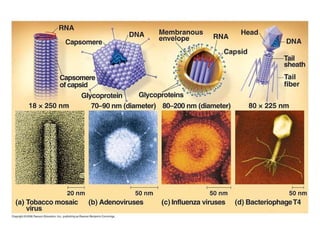
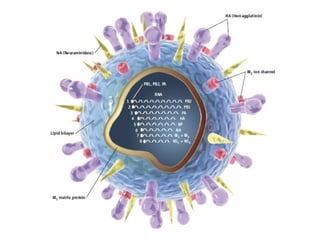
What is a ‘type’ or strain? Refers to genes and mechanisms/structures Type A Type B H N
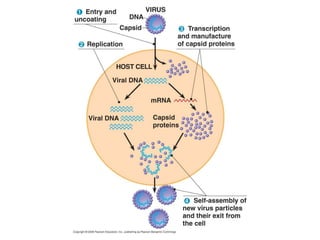
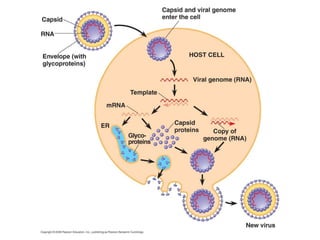
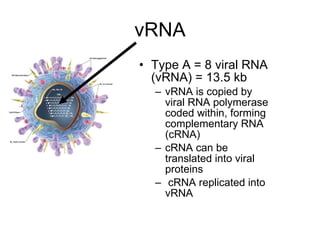
vRNA Type A = 8 viral RNA (vRNA) = 13.5 kb vRNA is copied by viral RNA polymerase coded within, forming complementary RNA (cRNA) cRNA can be translated into viral proteins cRNA replicated into vRNA
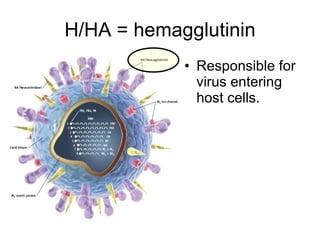
H/HA = hemagglutinin Responsible for virus entering host cells.
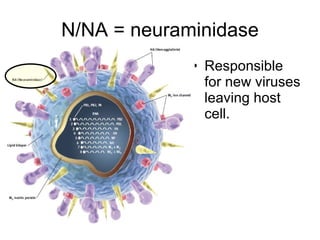
N/NA = neuraminidase Responsible for new viruses leaving host cell.
Neuraminidase inhibitor Cause budding virus to aggregate at cell surface; active against A & B
Influenza Evolution
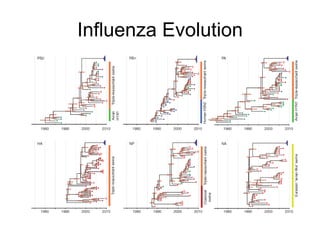
Influenza Evolution Very high rate of mutation; 1 in 1000 bases may change per single case of influenza. Infection involves multiple replication cycles. Accumulated mutations =  genetic drift . Antigenic shift : DNA mutations change viral proteins that are target of immune systems.
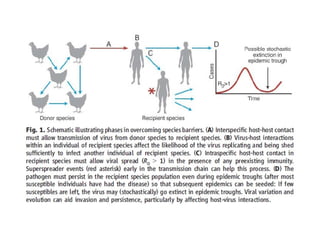
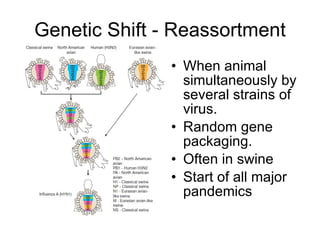
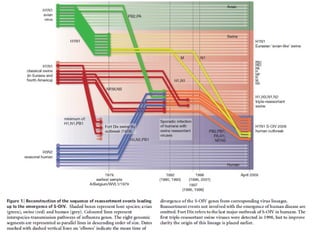
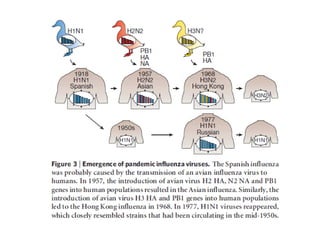
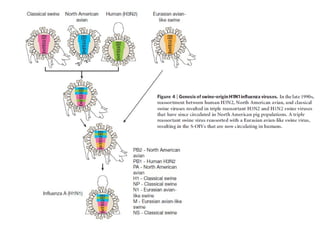
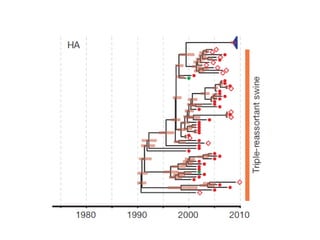
Genetic Shift - Reassortment When animal simultaneously by several strains of virus. Random gene packaging. Often in swine Start of all major pandemics


Influenza Genome Used by public health officials like bar code to monitor spread and evolution of influenza. Virus emerges in one country and spreads to another can be identified by similarity of gene sequence. Virus that spreads from one species to another will retain similar genomic sequence. New virus genome which emerges through reassortment will NOT match previously isolated strains (parts might match, but not whole).
 
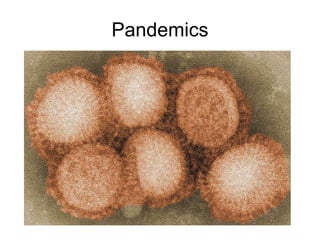
Pandemics
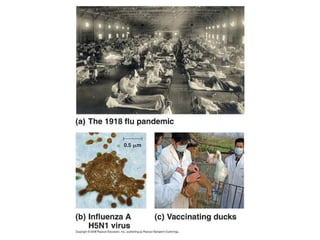
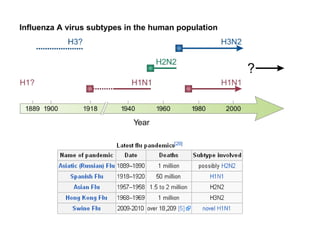
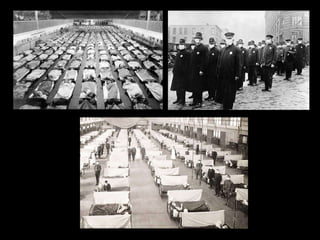
Spanish Flu (1918–1920) Category 5  H1N1 "the greatest medical holocaust in history"  As many as 25 million may have been killed in the first 25 weeks;  in contrast,  HIV/AIDS  has killed 25 million in its first 25 years
 
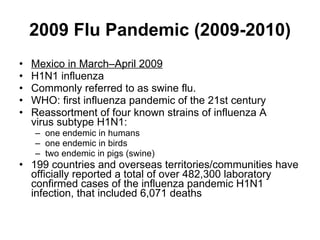
2009 Flu Pandemic (2009-2010) Mexico in March–April 2009   H1N1 influenza  Commonly referred to as swine flu. WHO: first influenza pandemic of the 21st century  Reassortment of four known strains of influenza A virus subtype H1N1:  one endemic in humans one endemic in birds two endemic in pigs (swine)  199 countries and overseas territories/communities have officially reported a total of over 482,300 laboratory confirmed cases of the influenza pandemic H1N1 infection, that included 6,071 deaths
 
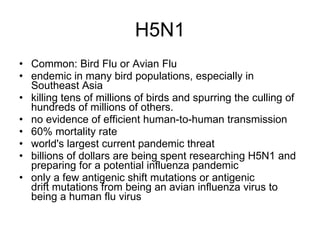
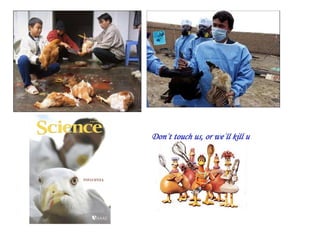
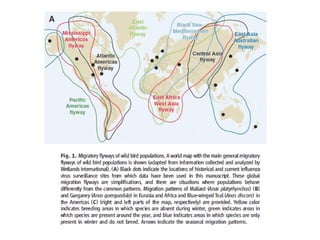
H5N1 Common: Bird Flu or Avian Flu endemic in many bird populations, especially in Southeast Asia  killing tens of millions of birds and spurring the culling of hundreds of millions of others. no evidence of efficient human-to-human transmission  60% mortality rate world's largest current pandemic threat  billions of dollars are being spent researching H5N1 and preparing for a potential influenza pandemic  only a few antigenic shift mutations or antigenic drift mutations from being an avian influenza virus to being a human flu virus


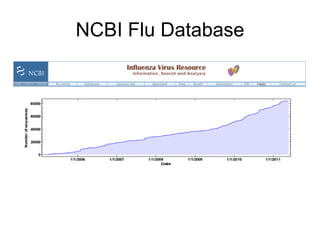
NCBI Flu Database
Your Hypothesis State a hypothesis that can  be tested by visualizing the genetic between different strains of virus. Example : Due to geographical proximity of China and Hong Kong, the H5N1viral strains circulated in the period of 2000-2005 in birds should be similar in both places.

Honors ~ Influenza 1011

  • 1.
  • 2.
  • 3.
  • 4.
  • 5.
  • 6.
  • 7.
  • 8.
  • 9.
  • 10.
  • 11.
  • 12.
    What is a‘type’ or strain? Refers to genes and mechanisms/structures Type A Type B H N
  • 13.
    vRNA Type A= 8 viral RNA (vRNA) = 13.5 kb vRNA is copied by viral RNA polymerase coded within, forming complementary RNA (cRNA) cRNA can be translated into viral proteins cRNA replicated into vRNA
  • 14.
    H/HA = hemagglutininResponsible for virus entering host cells.
  • 15.
    N/NA = neuraminidaseResponsible for new viruses leaving host cell.
  • 16.
    Neuraminidase inhibitor Causebudding virus to aggregate at cell surface; active against A & B
  • 17.
  • 18.
    Influenza Evolution Veryhigh rate of mutation; 1 in 1000 bases may change per single case of influenza. Infection involves multiple replication cycles. Accumulated mutations = genetic drift . Antigenic shift : DNA mutations change viral proteins that are target of immune systems.
  • 19.
    Genetic Shift -Reassortment When animal simultaneously by several strains of virus. Random gene packaging. Often in swine Start of all major pandemics
  • 20.
  • 21.
  • 22.
  • 23.
    Influenza Genome Usedby public health officials like bar code to monitor spread and evolution of influenza. Virus emerges in one country and spreads to another can be identified by similarity of gene sequence. Virus that spreads from one species to another will retain similar genomic sequence. New virus genome which emerges through reassortment will NOT match previously isolated strains (parts might match, but not whole).
  • 24.
  • 25.
  • 26.
    Spanish Flu (1918–1920)Category 5 H1N1 "the greatest medical holocaust in history" As many as 25 million may have been killed in the first 25 weeks; in contrast,  HIV/AIDS  has killed 25 million in its first 25 years
  • 27.
  • 28.
    2009 Flu Pandemic(2009-2010) Mexico in March–April 2009 H1N1 influenza Commonly referred to as swine flu. WHO: first influenza pandemic of the 21st century Reassortment of four known strains of influenza A virus subtype H1N1: one endemic in humans one endemic in birds two endemic in pigs (swine) 199 countries and overseas territories/communities have officially reported a total of over 482,300 laboratory confirmed cases of the influenza pandemic H1N1 infection, that included 6,071 deaths
  • 29.
  • 30.
    H5N1 Common: BirdFlu or Avian Flu endemic in many bird populations, especially in Southeast Asia killing tens of millions of birds and spurring the culling of hundreds of millions of others. no evidence of efficient human-to-human transmission 60% mortality rate world's largest current pandemic threat billions of dollars are being spent researching H5N1 and preparing for a potential influenza pandemic only a few antigenic shift mutations or antigenic drift mutations from being an avian influenza virus to being a human flu virus
  • 31.
  • 32.
  • 33.
  • 34.
  • 35.
    Your Hypothesis Statea hypothesis that can be tested by visualizing the genetic between different strains of virus. Example : Due to geographical proximity of China and Hong Kong, the H5N1viral strains circulated in the period of 2000-2005 in birds should be similar in both places.