LANDBANKING PROGRAM FOR AFFORDABLE HOUSING
Through the Landbanking Program for Affordable Housing (Landbank), the City of Eugene acquires land
suitable for the future development of housing that is affordable to low-income persons. All development
begins with a site, yet acquiring appropriate property is a difficult hurdle in the development process.
Through the Landbank, the City has not only created a steady stream of appropriate sites, but also has
actively sought to purchase sites for affordable housing that are dispersed throughout the community. The
Landbank is a cornerstone of Eugene’s overall affordable housing program.
Since the purchase of the Landbank’s first site in 1979, nearly 90 acres have been acquired for affordable
                                                              U        U


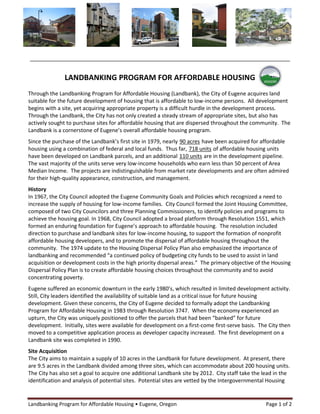
housing using a combination of federal and local funds. Thus far, 718 units of affordable housing units
                                                                  U            U


have been developed on Landbank parcels, and an additional 110 units are in the development pipeline.
                                                              U            U


The vast majority of the units serve very low-income households who earn less than 50 percent of Area
Median Income. The projects are indistinguishable from market rate developments and are often admired
for their high-quality appearance, construction, and management.
History
In 1967, the City Council adopted the Eugene Community Goals and Policies which recognized a need to
increase the supply of housing for low-income families. City Council formed the Joint Housing Committee,
composed of two City Councilors and three Planning Commissioners, to identify policies and programs to
achieve the housing goal. In 1968, City Council adopted a broad platform through Resolution 1551, which
formed an enduring foundation for Eugene’s approach to affordable housing. The resolution included
direction to purchase and landbank sites for low-income housing, to support the formation of nonprofit
affordable housing developers, and to promote the dispersal of affordable housing throughout the
community. The 1974 update to the Housing Dispersal Policy Plan also emphasized the importance of
landbanking and recommended “a continued policy of budgeting city funds to be used to assist in land
acquisition or development costs in the high priority dispersal areas.” The primary objective of the Housing
Dispersal Policy Plan is to create affordable housing choices throughout the community and to avoid
concentrating poverty.
Eugene suffered an economic downturn in the early 1980’s, which resulted in limited development activity.
Still, City leaders identified the availability of suitable land as a critical issue for future housing
development. Given these concerns, the City of Eugene decided to formally adopt the Landbanking
Program for Affordable Housing in 1983 through Resolution 3747. When the economy experienced an
upturn, the City was uniquely positioned to offer the parcels that had been “banked” for future
development. Initially, sites were available for development on a first-come first-serve basis. The City then
moved to a competitive application process as developer capacity increased. The first development on a
Landbank site was completed in 1990.
Site Acquisition
The City aims to maintain a supply of 10 acres in the Landbank for future development. At present, there
are 9.5 acres in the Landbank divided among three sites, which can accommodate about 200 housing units.
The City has also set a goal to acquire one additional Landbank site by 2012. City staff take the lead in the
identification and analysis of potential sites. Potential sites are vetted by the Intergovernmental Housing


Landbanking Program for Affordable Housing • Eugene, Oregon                                        Page 1 of 2
Policy Board (HPB), which is composed of elected officials and citizens. City Council makes the final
decision to purchase Landbank sites based on the recommendation of the HPB.
The City carefully evaluates all parcels to ensure that they are suitable for housing affordable to low-income
persons. Site assessment factors include: 1) location related to public transportation, jobs, services, parks,
schools, and other amenities; 2) dispersal of affordable housing; 3) site environmental conditions; 4) cost;
5) allowed density; 6) existing on-site structures and improvements; and 7) existing utility and street
infrastructure. Typical sites accommodate multifamily housing developments with 40 to 100 units. Access
to public transportation is a critical selection factor for landbank sites. The City of Eugene is served by an
extensive bus system provided by Lane Transit District (LTD), a nationally recognized transit agency. Over
40,000 Lane County residents use the bus system each day. Proactively siting affordable housing close to
public transportation has allowed residents of affordable housing to also reduce transportation costs.
Over time, the City has utilized a number of strategies to acquire Landbank sites. Parcels have been
purchased from private individuals and corporations as well as institutional owners such as the University
of Oregon and the Eugene School District. Several parcels were already owned by the City and transferred
to the Landbank at no cost. The City has utilized a variety of sources to purchase Landbank sites including
local general funds, Community Development Block Grant, and Federal Revenue Sharing. Records show
that almost $5 million has been expended since 1979 to purchase Landbank sites. This equates to a land
cost of less than $5,000 per housing unit.
Site Development
The City offers Landbank sites, one at a time, for development through an open Request for Proposals
(RFP). Other development subsidies are made available through the same RFP. Development proposals are
evaluated by City staff and the HPB based on project feasibility, target population, project design and
services, and a cost and benefit analysis. Ultimately, the City Council selects the development proposal
deemed to be most appropriate for the site based on the recommendation of the HPB. With land and
commitment of local subsidies in hand, developers have successfully leveraged highly competitive state and
federal resources.
Impact
To date, 718 affordable housing units have been developed on Landbank sites. These include 15
multifamily developments with a total of 693 units and 5 single-family homeownership developments with
a total of 25 units. Two additional multifamily developments are in the construction phase with 110
planned rental units.
The Landbank has also supported the formation of a strong local network of affordable housing developers
by offering a steady stream of development opportunities. Eugene is currently served by multiple
experienced affordable housing developers who work on a citywide basis. Each entity has developed
numerous affordable housing developments subsidized in part by the Landbank and other City resources.
Developments on Landbank sites have received numerous national and state awards for excellence in
design and services and the Landbanking Program was recently recognized by Harvard University’s
Innovations in American Government program. A recent survey of affordable housing residents
demonstrates overall satisfaction and many positive benefits. The statement of one resident sums up the
many benefits offered through the affordable housing that is developed on Landbank site:

       “For the first time my children and I live in a place that is safe and clean. I can let my
       kids go outside without constantly worrying. I can afford the rent and for the first time I
       can try to save some money. I just want to thank you for the difference this has made in
       our lives. It’s huge.”


Landbanking Program for Affordable Housing • Eugene, Oregon                                      Page 2 of 2

SSC2011_Stephanie Jennings PPT

  • 1.
    LANDBANKING PROGRAM FORAFFORDABLE HOUSING Through the Landbanking Program for Affordable Housing (Landbank), the City of Eugene acquires land suitable for the future development of housing that is affordable to low-income persons. All development begins with a site, yet acquiring appropriate property is a difficult hurdle in the development process. Through the Landbank, the City has not only created a steady stream of appropriate sites, but also has actively sought to purchase sites for affordable housing that are dispersed throughout the community. The Landbank is a cornerstone of Eugene’s overall affordable housing program. Since the purchase of the Landbank’s first site in 1979, nearly 90 acres have been acquired for affordable U U housing using a combination of federal and local funds. Thus far, 718 units of affordable housing units U U have been developed on Landbank parcels, and an additional 110 units are in the development pipeline. U U The vast majority of the units serve very low-income households who earn less than 50 percent of Area Median Income. The projects are indistinguishable from market rate developments and are often admired for their high-quality appearance, construction, and management. History In 1967, the City Council adopted the Eugene Community Goals and Policies which recognized a need to increase the supply of housing for low-income families. City Council formed the Joint Housing Committee, composed of two City Councilors and three Planning Commissioners, to identify policies and programs to achieve the housing goal. In 1968, City Council adopted a broad platform through Resolution 1551, which formed an enduring foundation for Eugene’s approach to affordable housing. The resolution included direction to purchase and landbank sites for low-income housing, to support the formation of nonprofit affordable housing developers, and to promote the dispersal of affordable housing throughout the community. The 1974 update to the Housing Dispersal Policy Plan also emphasized the importance of landbanking and recommended “a continued policy of budgeting city funds to be used to assist in land acquisition or development costs in the high priority dispersal areas.” The primary objective of the Housing Dispersal Policy Plan is to create affordable housing choices throughout the community and to avoid concentrating poverty. Eugene suffered an economic downturn in the early 1980’s, which resulted in limited development activity. Still, City leaders identified the availability of suitable land as a critical issue for future housing development. Given these concerns, the City of Eugene decided to formally adopt the Landbanking Program for Affordable Housing in 1983 through Resolution 3747. When the economy experienced an upturn, the City was uniquely positioned to offer the parcels that had been “banked” for future development. Initially, sites were available for development on a first-come first-serve basis. The City then moved to a competitive application process as developer capacity increased. The first development on a Landbank site was completed in 1990. Site Acquisition The City aims to maintain a supply of 10 acres in the Landbank for future development. At present, there are 9.5 acres in the Landbank divided among three sites, which can accommodate about 200 housing units. The City has also set a goal to acquire one additional Landbank site by 2012. City staff take the lead in the identification and analysis of potential sites. Potential sites are vetted by the Intergovernmental Housing Landbanking Program for Affordable Housing • Eugene, Oregon Page 1 of 2
  • 2.
    Policy Board (HPB),which is composed of elected officials and citizens. City Council makes the final decision to purchase Landbank sites based on the recommendation of the HPB. The City carefully evaluates all parcels to ensure that they are suitable for housing affordable to low-income persons. Site assessment factors include: 1) location related to public transportation, jobs, services, parks, schools, and other amenities; 2) dispersal of affordable housing; 3) site environmental conditions; 4) cost; 5) allowed density; 6) existing on-site structures and improvements; and 7) existing utility and street infrastructure. Typical sites accommodate multifamily housing developments with 40 to 100 units. Access to public transportation is a critical selection factor for landbank sites. The City of Eugene is served by an extensive bus system provided by Lane Transit District (LTD), a nationally recognized transit agency. Over 40,000 Lane County residents use the bus system each day. Proactively siting affordable housing close to public transportation has allowed residents of affordable housing to also reduce transportation costs. Over time, the City has utilized a number of strategies to acquire Landbank sites. Parcels have been purchased from private individuals and corporations as well as institutional owners such as the University of Oregon and the Eugene School District. Several parcels were already owned by the City and transferred to the Landbank at no cost. The City has utilized a variety of sources to purchase Landbank sites including local general funds, Community Development Block Grant, and Federal Revenue Sharing. Records show that almost $5 million has been expended since 1979 to purchase Landbank sites. This equates to a land cost of less than $5,000 per housing unit. Site Development The City offers Landbank sites, one at a time, for development through an open Request for Proposals (RFP). Other development subsidies are made available through the same RFP. Development proposals are evaluated by City staff and the HPB based on project feasibility, target population, project design and services, and a cost and benefit analysis. Ultimately, the City Council selects the development proposal deemed to be most appropriate for the site based on the recommendation of the HPB. With land and commitment of local subsidies in hand, developers have successfully leveraged highly competitive state and federal resources. Impact To date, 718 affordable housing units have been developed on Landbank sites. These include 15 multifamily developments with a total of 693 units and 5 single-family homeownership developments with a total of 25 units. Two additional multifamily developments are in the construction phase with 110 planned rental units. The Landbank has also supported the formation of a strong local network of affordable housing developers by offering a steady stream of development opportunities. Eugene is currently served by multiple experienced affordable housing developers who work on a citywide basis. Each entity has developed numerous affordable housing developments subsidized in part by the Landbank and other City resources. Developments on Landbank sites have received numerous national and state awards for excellence in design and services and the Landbanking Program was recently recognized by Harvard University’s Innovations in American Government program. A recent survey of affordable housing residents demonstrates overall satisfaction and many positive benefits. The statement of one resident sums up the many benefits offered through the affordable housing that is developed on Landbank site: “For the first time my children and I live in a place that is safe and clean. I can let my kids go outside without constantly worrying. I can afford the rent and for the first time I can try to save some money. I just want to thank you for the difference this has made in our lives. It’s huge.” Landbanking Program for Affordable Housing • Eugene, Oregon Page 2 of 2