Thug: a low-interaction honeyclient
Angelo Dell'Aera
Speaker

Chief Executive Officer @ Honeynet Project

Information Security Independent Researcher @ Antifork
Research (10+ years)
Agenda

Introduction

Honeyclient technologies

Thug

Conclusions
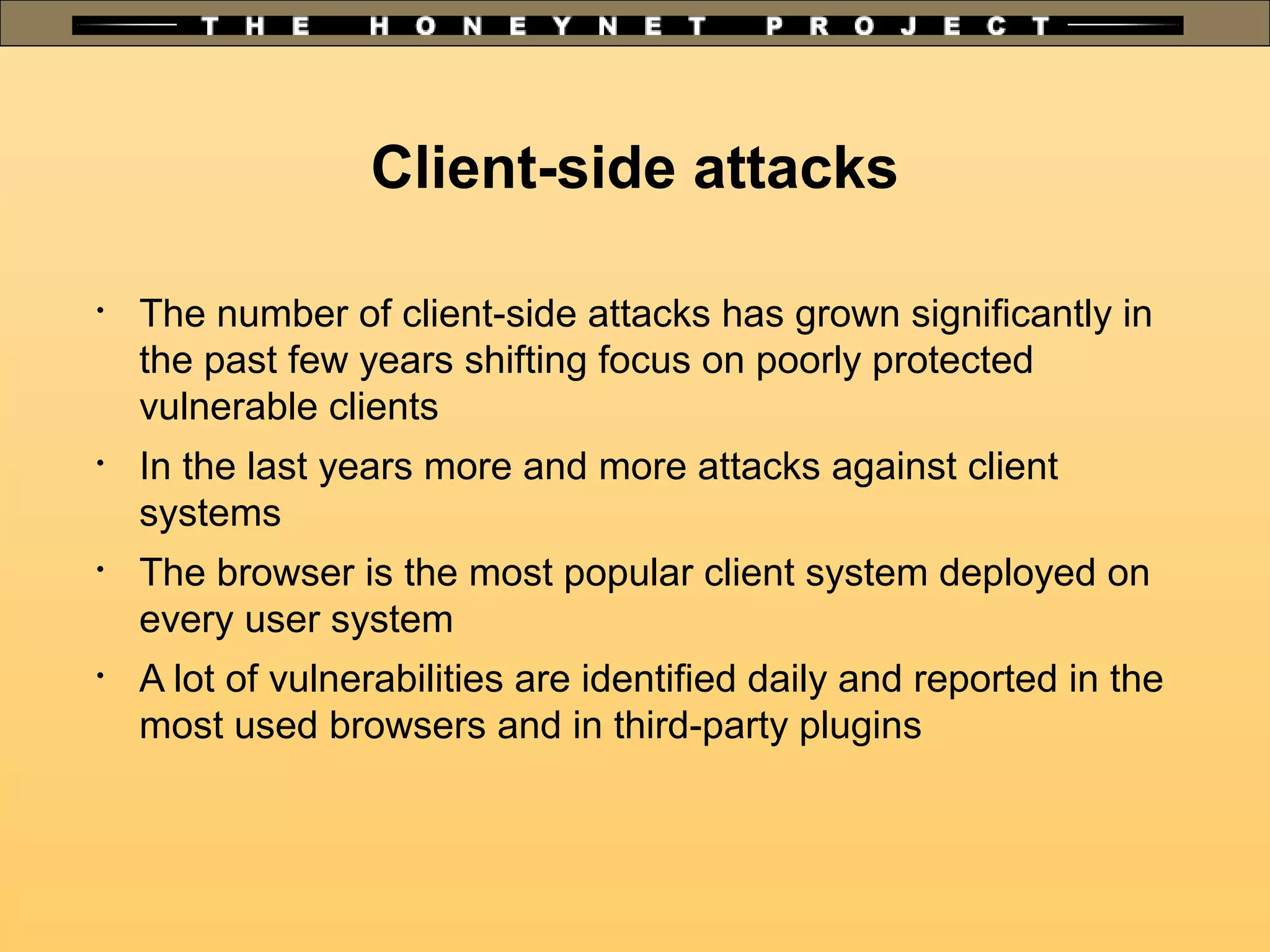
Client-side attacks

The number of client-side attacks has grown significantly in
the past few years shifting focus on poorly protected
vulnerable clients

In the last years more and more attacks against client
systems

The browser is the most popular client system deployed on
every user system

A lot of vulnerabilities are identified daily and reported in the
most used browsers and in third-party plugins
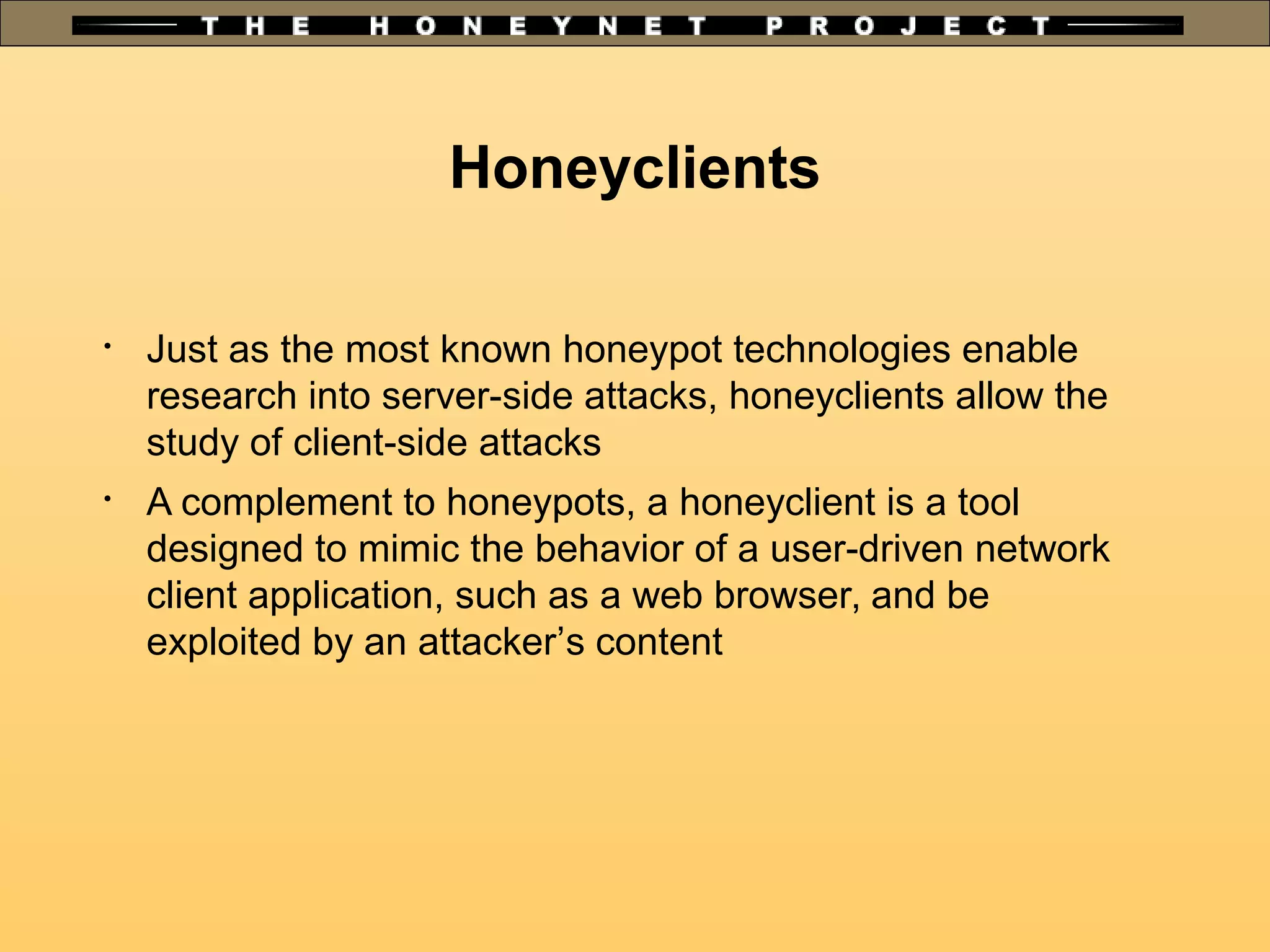
Honeyclients

Just as the most known honeypot technologies enable
research into server-side attacks, honeyclients allow the
study of client-side attacks

A complement to honeypots, a honeyclient is a tool
designed to mimic the behavior of a user-driven network
client application, such as a web browser, and be
exploited by an attacker’s content
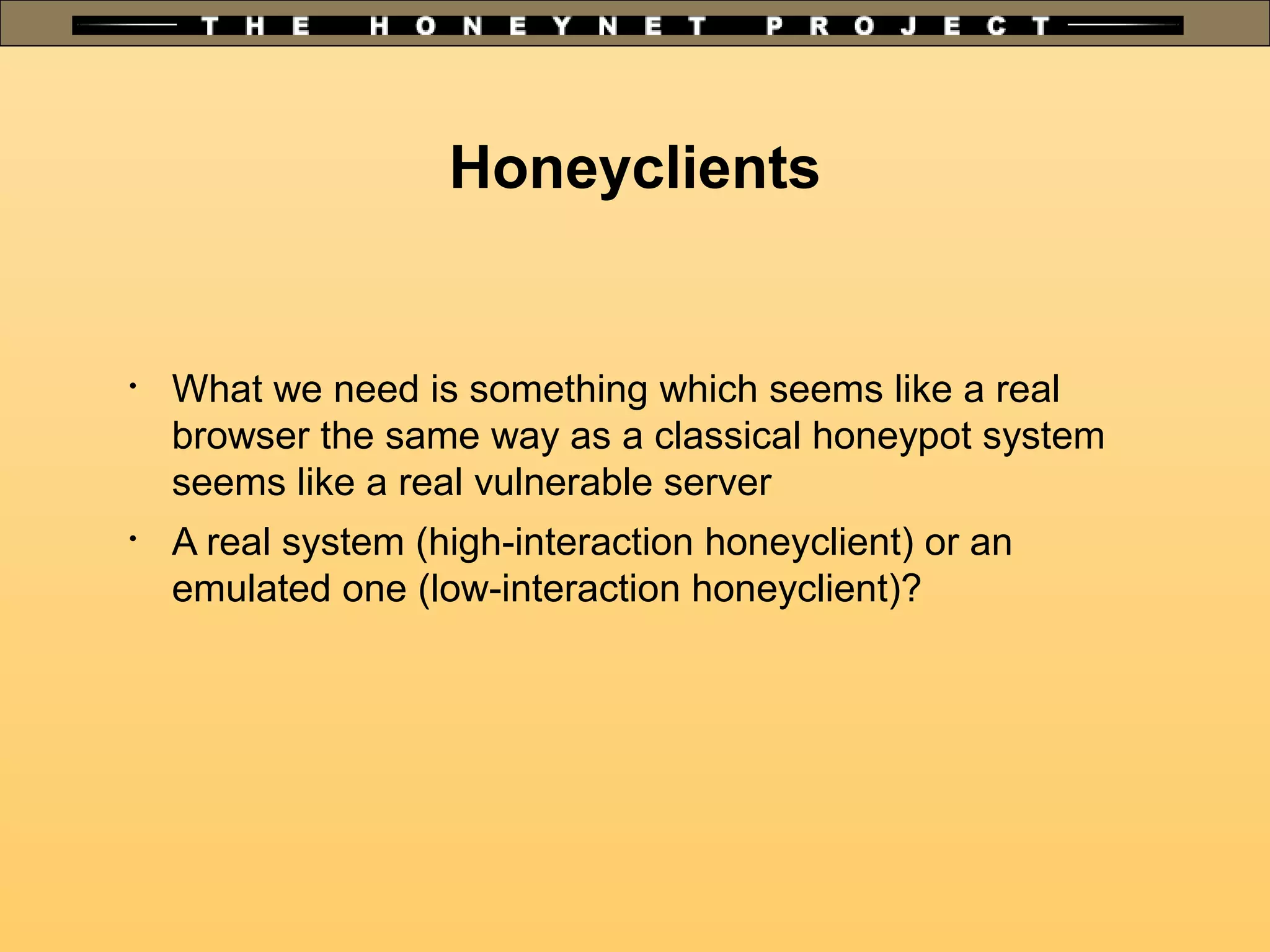
Honeyclients

What we need is something which seems like a real
browser the same way as a classical honeypot system
seems like a real vulnerable server

A real system (high-interaction honeyclient) or an
emulated one (low-interaction honeyclient)?
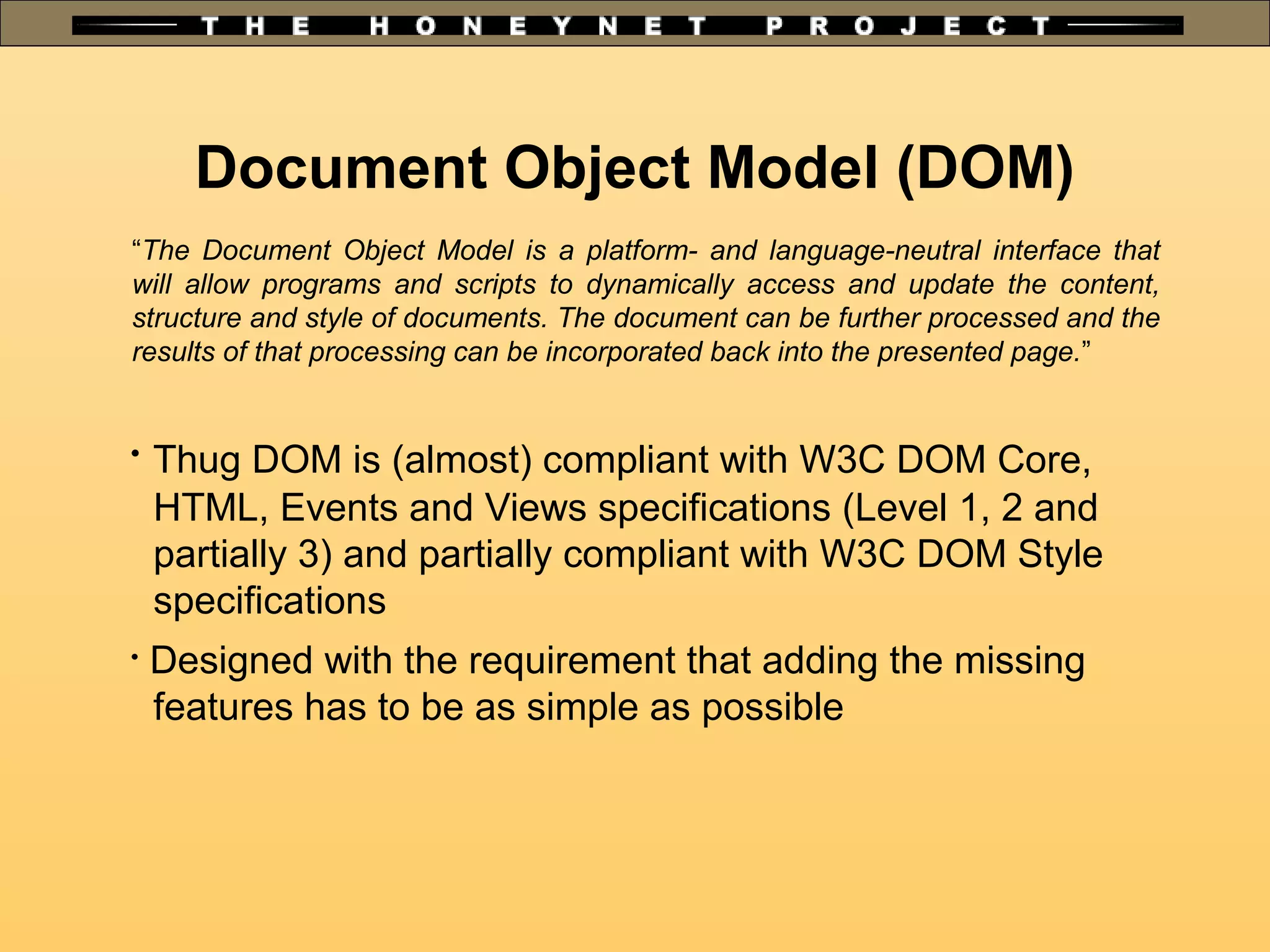
Document Object Model (DOM)
“The Document Object Model is a platform- and language-neutral interface that
will allow programs and scripts to dynamically access and update the content,
structure and style of documents. The document can be further processed and the
results of that processing can be incorporated back into the presented page.”

Thug DOM is (almost) compliant with W3C DOM Core,
HTML, Events and Views specifications (Level 1, 2 and
partially 3) and partially compliant with W3C DOM Style
specifications

Designed with the requirement that adding the missing
features has to be as simple as possible
Document Object Model (DOM)
Browser Personalities

Drive-by download attacks target specific versions of the
browser so a properly designed low-interaction honeyclient
should be able to emulate different browser personalities

Supporting different browser personalities is almost a
matter of implementing different (and sometimes totally
incompatible) DOM behaviors and interfaces
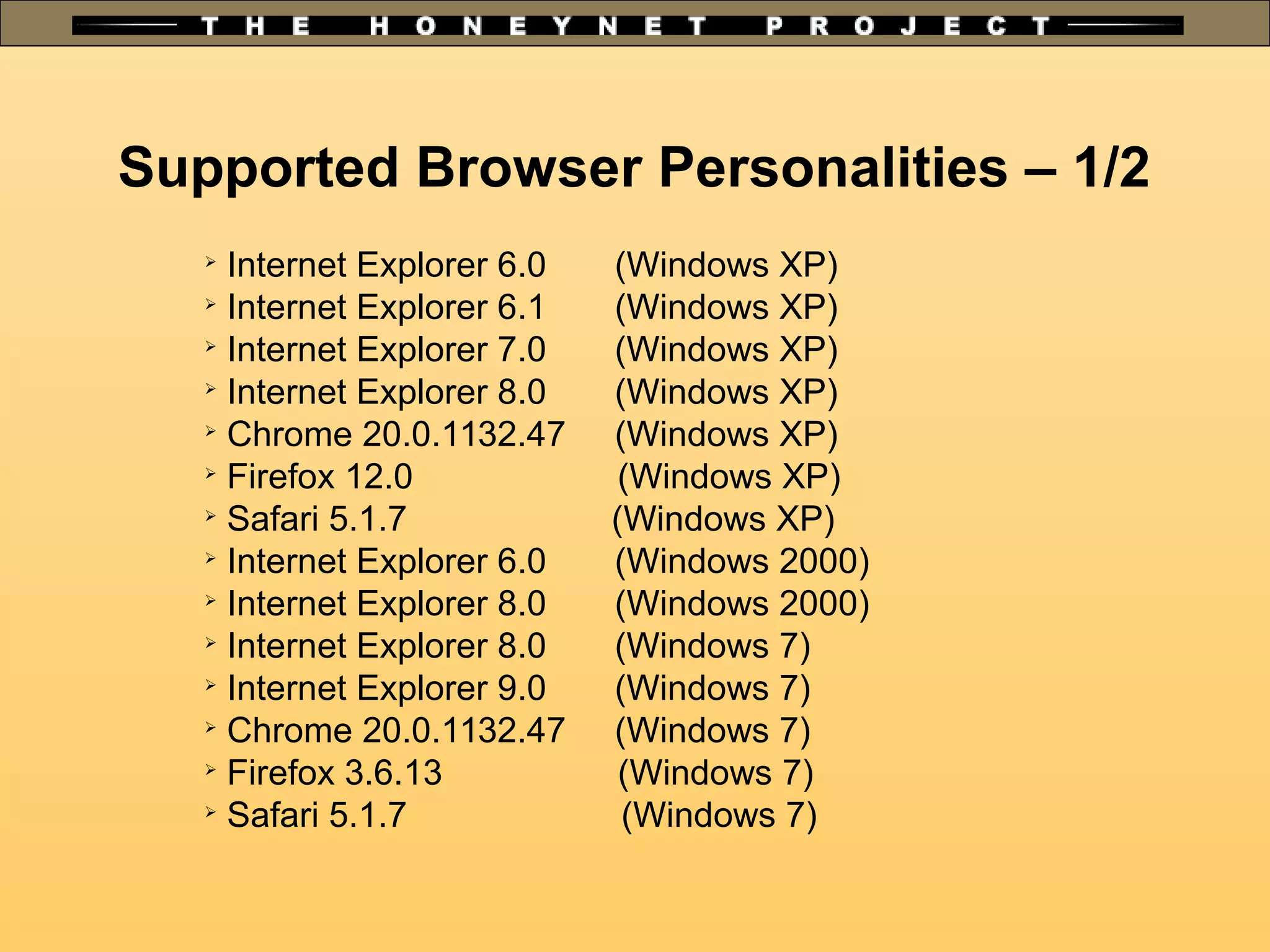
Supported Browser Personalities – 1/2
➢
Internet Explorer 6.0 (Windows XP)
➢
Internet Explorer 6.1 (Windows XP)
➢
Internet Explorer 7.0 (Windows XP)
➢
Internet Explorer 8.0 (Windows XP)
➢
Chrome 20.0.1132.47 (Windows XP)
➢
Firefox 12.0 (Windows XP)
➢
Safari 5.1.7 (Windows XP)
➢
Internet Explorer 6.0 (Windows 2000)
➢
Internet Explorer 8.0 (Windows 2000)
➢
Internet Explorer 8.0 (Windows 7)
➢
Internet Explorer 9.0 (Windows 7)
➢
Chrome 20.0.1132.47 (Windows 7)
➢
Firefox 3.6.13 (Windows 7)
➢
Safari 5.1.7 (Windows 7)
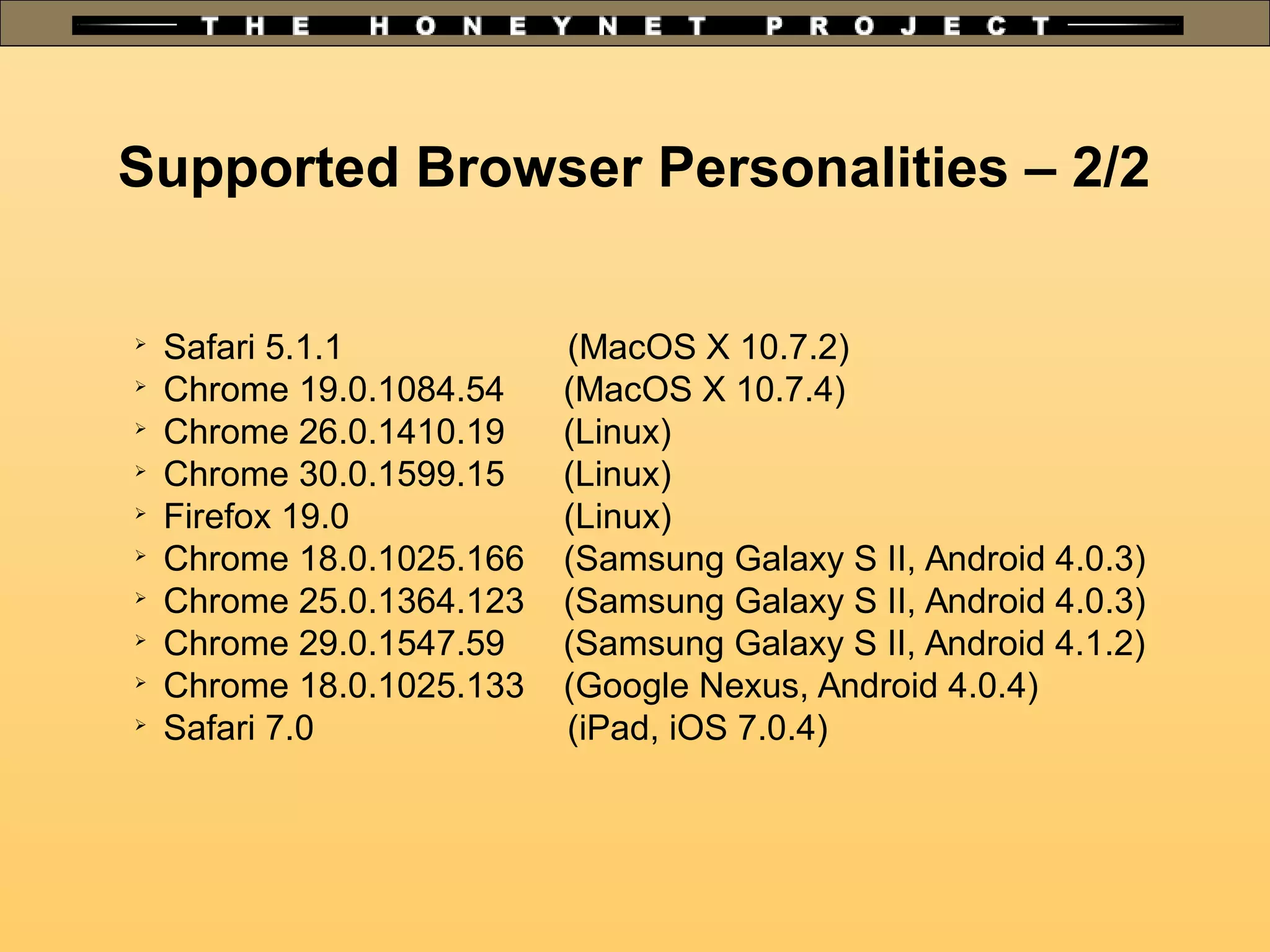
Supported Browser Personalities – 2/2
➢
Safari 5.1.1 (MacOS X 10.7.2)
➢
Chrome 19.0.1084.54 (MacOS X 10.7.4)
➢
Chrome 26.0.1410.19 (Linux)
➢
Chrome 30.0.1599.15 (Linux)
➢
Firefox 19.0 (Linux)
➢
Chrome 18.0.1025.166 (Samsung Galaxy S II, Android 4.0.3)
➢
Chrome 25.0.1364.123 (Samsung Galaxy S II, Android 4.0.3)
➢
Chrome 29.0.1547.59 (Samsung Galaxy S II, Android 4.1.2)
➢
Chrome 18.0.1025.133 (Google Nexus, Android 4.0.4)
➢
Safari 7.0 (iPad, iOS 7.0.4)
Document Object Model (DOM)
Event Handling
•
W3C DOM Events specification constitute the most
difficult one to emulate because of the (sometimes huge)
differences in how different browsers handle events
•
Thug emulates the different behaviors of the supported
browsers emulating load and mousemove events by
default and allowing to emulate all the other ones if
needed
Document Object Model (DOM)
Hooks
•
Thug defines some DOM hooks which are useful for
analyzing well-known exploits
•
The next example shows how Thug implements an hook
for analyzing a Java exploit with security prompt/warning
bypass (CVE-2013-2423)
Document Object Model (DOM)
Hooks
def _handle_jnlp(self, data, headers):
try:
soup = BeautifulSoup.BeautifulSoup(data)
except:
return
if soup.find("jnlp") is None:
return
log.ThugLogging.add_behavior_warn(description = '[JNLP Detected]', method = 'Dynamic Analysis')
for param in soup.find_all('param'):
log.ThugLogging.add_behavior_warn(description = '[JNLP] %s' % (param, ),
method = 'Dynamic Analysis')
self._check_jnlp_param(param)
jar = soup.find("jar")
if jar is None:
return
try:
url = jar.attrs['href']
headers['User-Agent'] = self.javaWebStartUserAgent
response, content = self.window._navigator.fetch(url, headers = headers, redirect_type = "JNLP")
except:
pass
Javascript

Google V8 Javascript engine wrapped through PyV8

“V8 implements ECMAScript as specified in ECMA-262, 5th edition,
and runs on Windows, Mac OS X , and Linux systems that use IA-32,
x64, or ARM processors. The V8 API provides functions for compiling
and executing scripts, accessing C++ methods and data structures,
handling errors, and enabling security checks”
•
Abstract Syntax Tree generation and inspection (static
analysis)
•
Context inspection (dynamic analysis)
•
Other potentially interesting features (GDB JIT interface,
live objects inspection, code disassembler, etc.) exported
through a clean and well designed API
Analysis

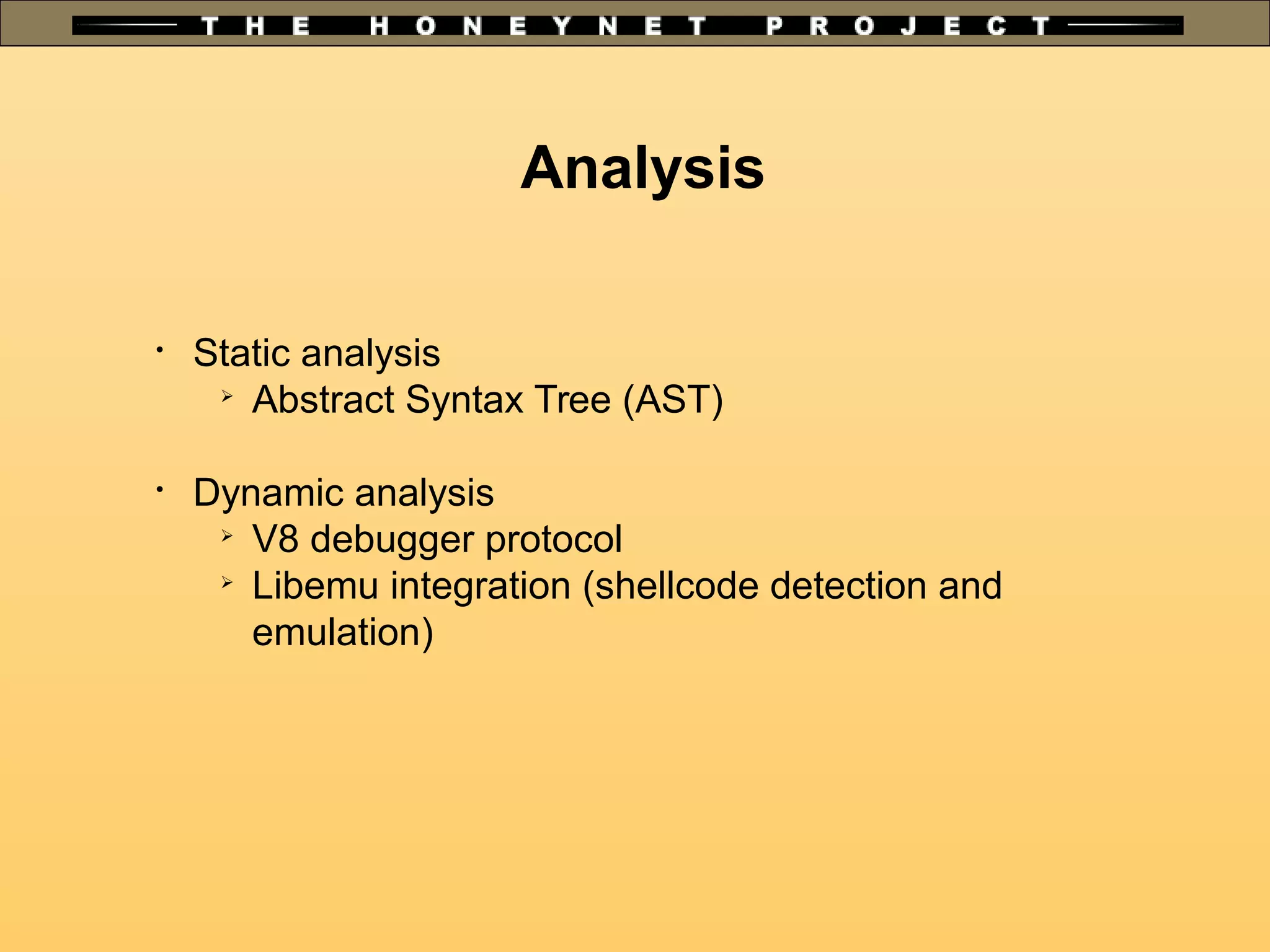
Static analysis
➢
Abstract Syntax Tree (AST)

Dynamic analysis

V8 debugger protocol

Libemu integration (shellcode detection and
emulation)
Abstract Syntax Tree (AST)
•
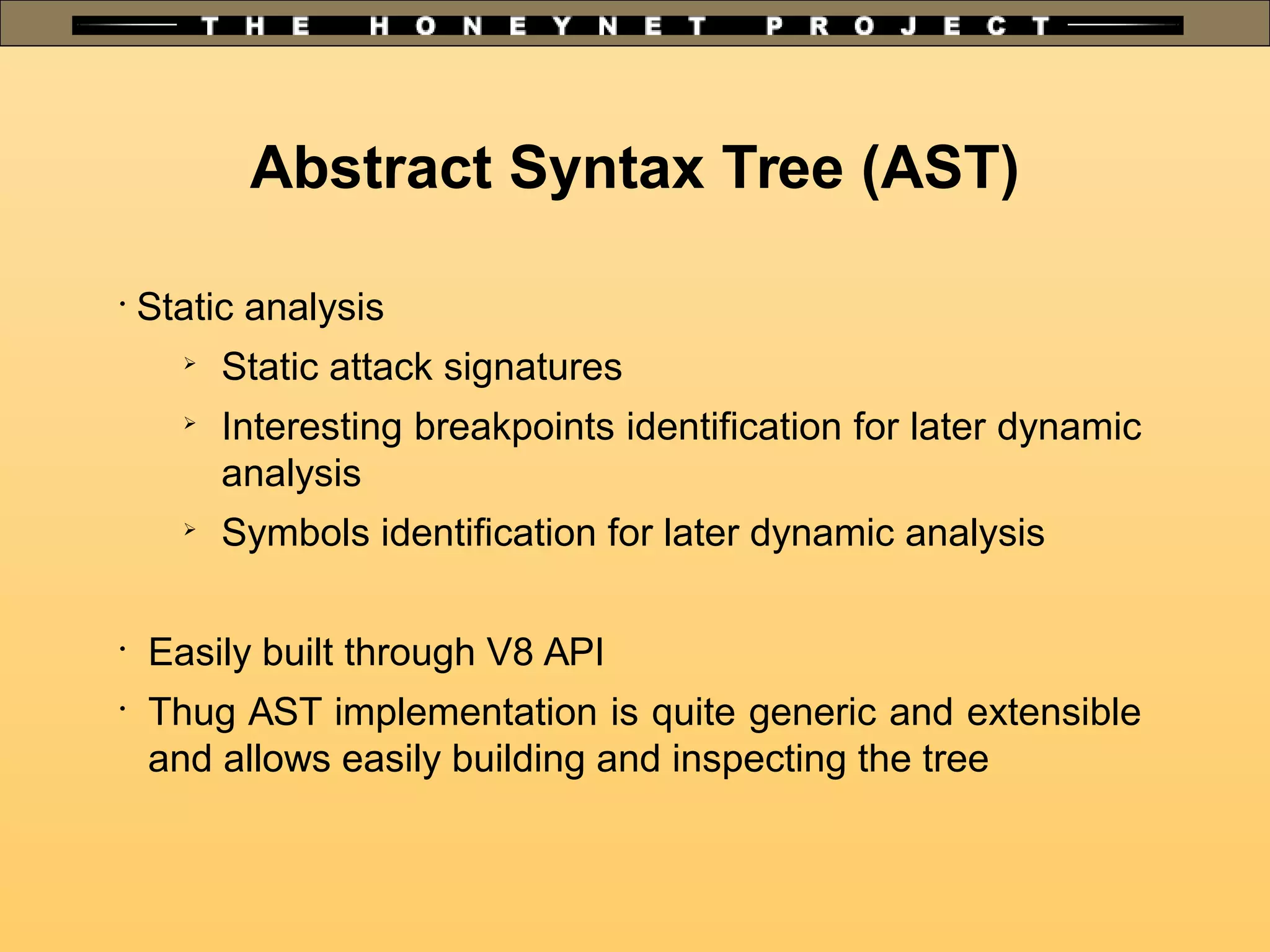
Static analysis
➢
Static attack signatures
➢
Interesting breakpoints identification for later dynamic
analysis
➢
Symbols identification for later dynamic analysis
•
Easily built through V8 API
•
Thug AST implementation is quite generic and extensible
and allows easily building and inspecting the tree
Vulnerability Modules

Python-based vulnerability modules

ActiveX controls

Core browser functionalities

Browser plugins
ActiveX
•
Thug implements an ActiveX layer of its own for emulating
ActiveX controls (just for Internet Explorer personalities)
•
It makes use of (Python) vulnerability modules in order to
emulate such ActiveX controls or just some of their
methods and attributes
•
The layer was designed in order to allow adding new
ActiveX controls in a fast and easy way
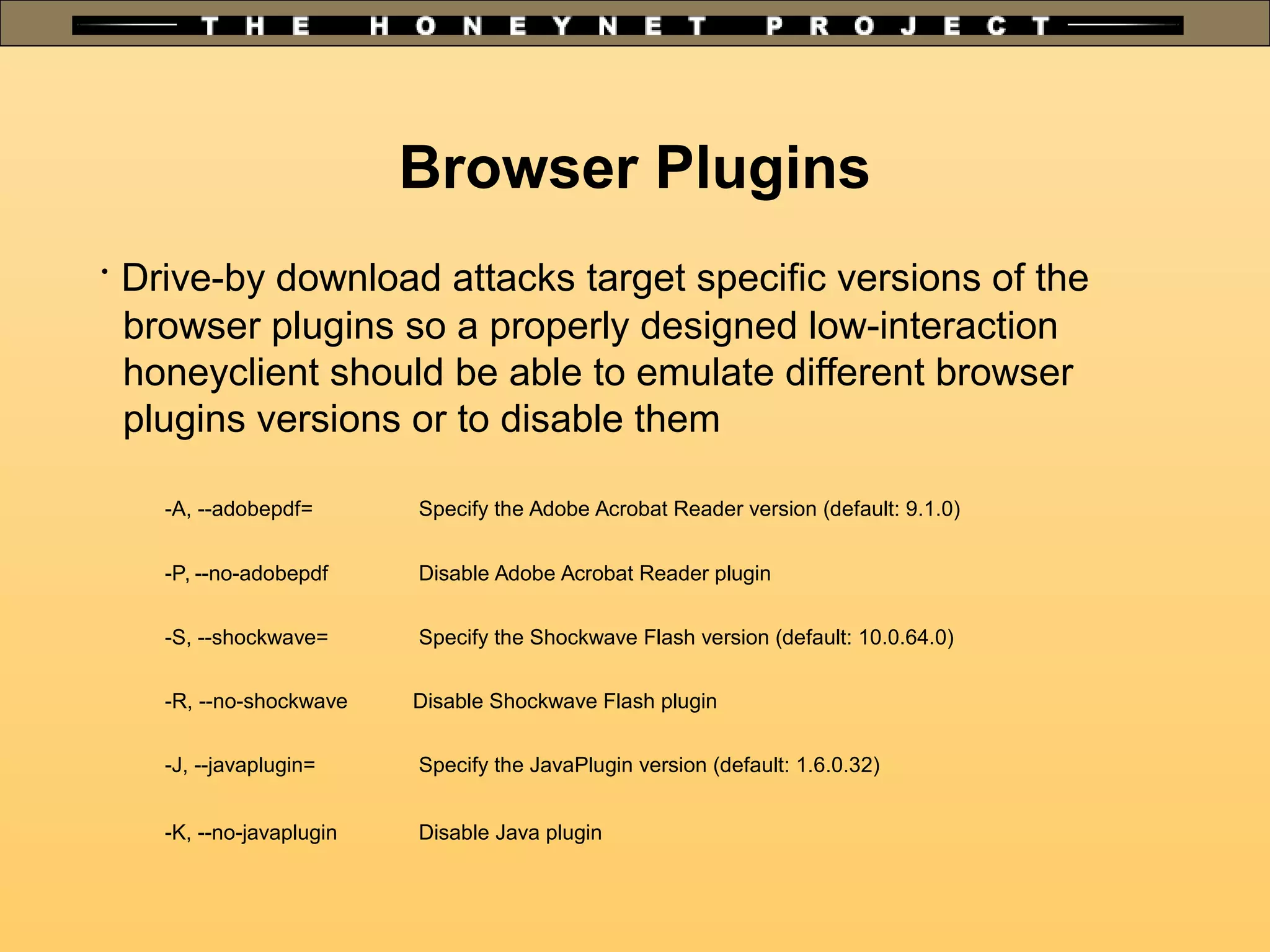
Browser Plugins
•
Drive-by download attacks target specific versions of the
browser plugins so a properly designed low-interaction
honeyclient should be able to emulate different browser
plugins versions or to disable them
-A, --adobepdf= Specify the Adobe Acrobat Reader version (default: 9.1.0)
-P, --no-adobepdf Disable Adobe Acrobat Reader plugin
-S, --shockwave= Specify the Shockwave Flash version (default: 10.0.64.0)
-R, --no-shockwave Disable Shockwave Flash plugin
-J, --javaplugin= Specify the JavaPlugin version (default: 1.6.0.32)
-K, --no-javaplugin Disable Java plugin
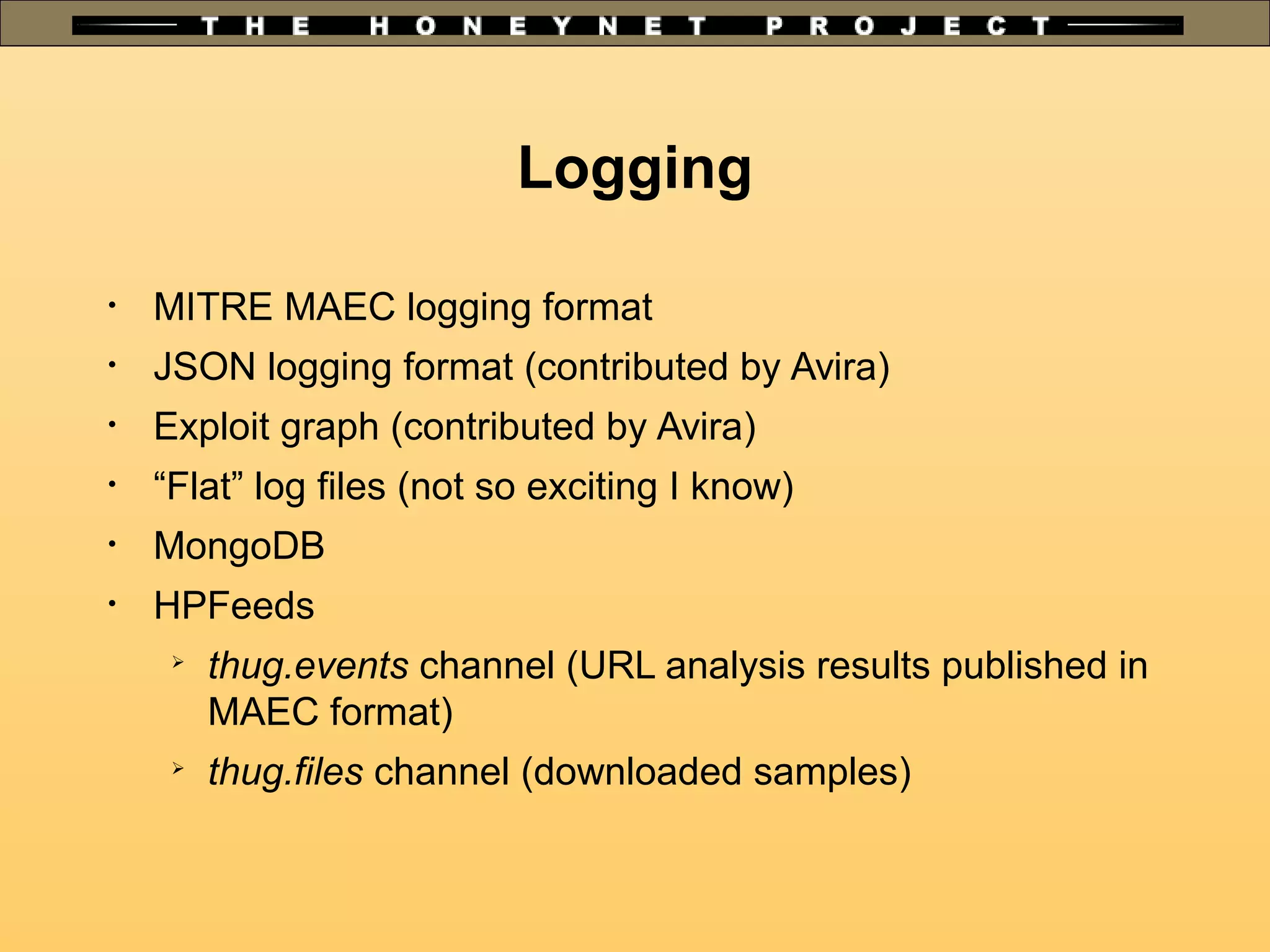
Logging
•
MITRE MAEC logging format
•
JSON logging format (contributed by Avira)
•
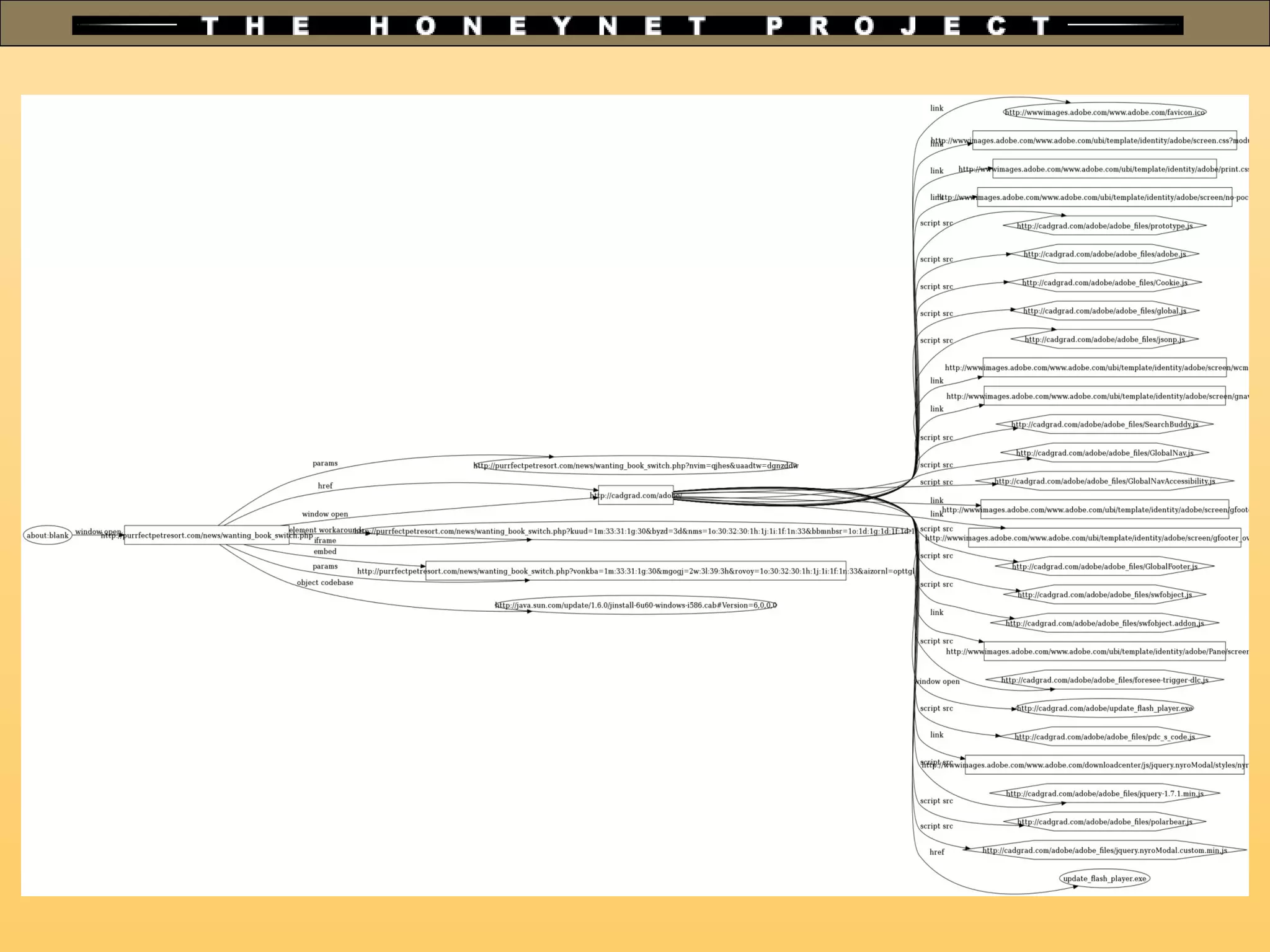
Exploit graph (contributed by Avira)
•
“Flat” log files (not so exciting I know)
•
MongoDB
•
HPFeeds

thug.events channel (URL analysis results published in
MAEC format)

thug.files channel (downloaded samples)
Logging
Blackhole 2.0 Exploit Kit
{
“timestamp”: “2013-04-13 13:43:54.307237”,
“cve”: “None”,
"description": [window open redirection] about:blank->
hxxp://purrfectpetresort.com/news/wanting_book_switch.php“,
"method": "Dynamic Analysis"
}
Logging
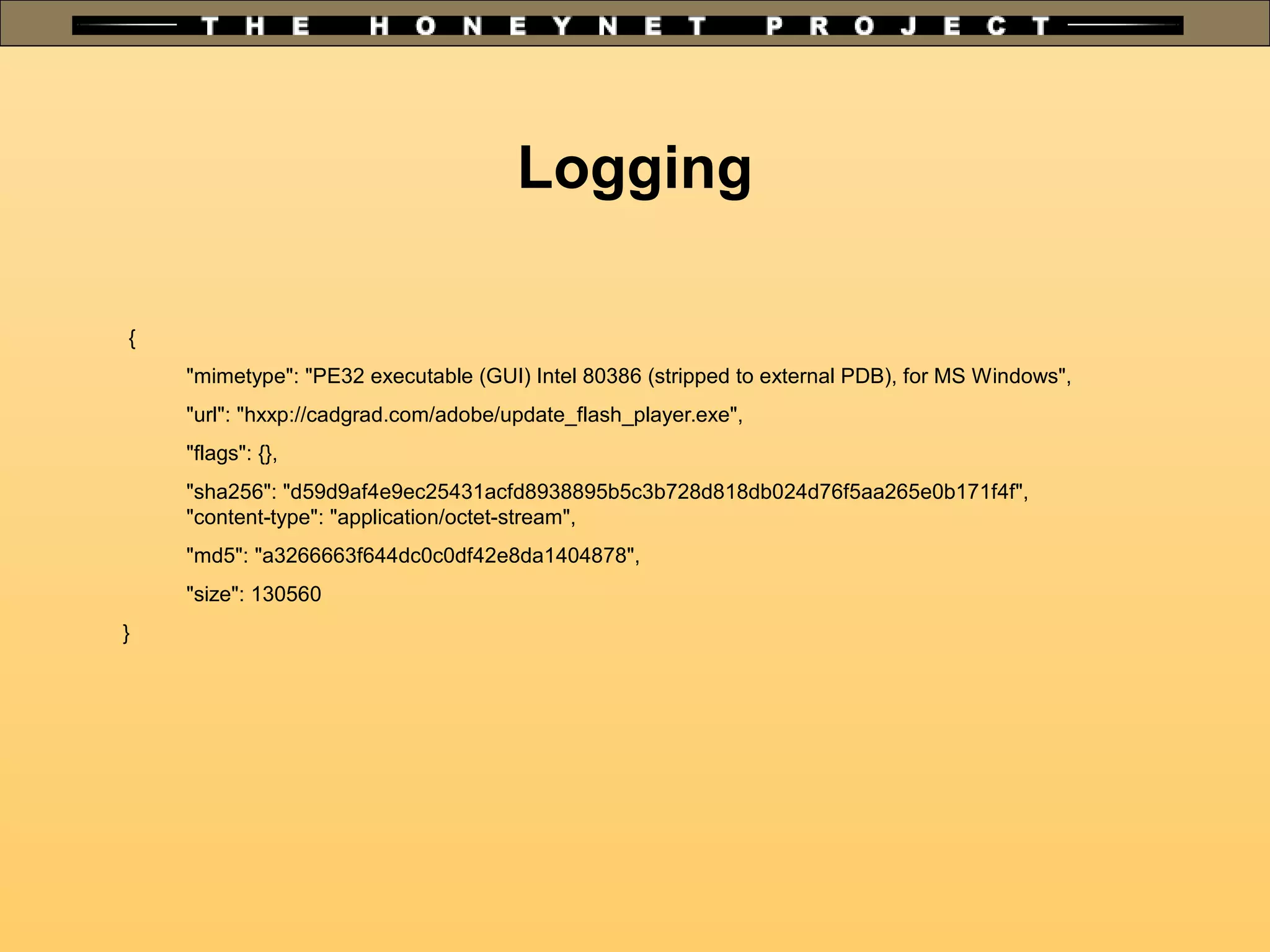
{
"mimetype": "PE32 executable (GUI) Intel 80386 (stripped to external PDB), for MS Windows",
"url": "hxxp://cadgrad.com/adobe/update_flash_player.exe",
"flags": {},
"sha256": "d59d9af4e9ec25431acfd8938895b5c3b728d818db024d76f5aa265e0b171f4f",
"content-type": "application/octet-stream",
"md5": "a3266663f644dc0c0df42e8da1404878",
"size": 130560
}
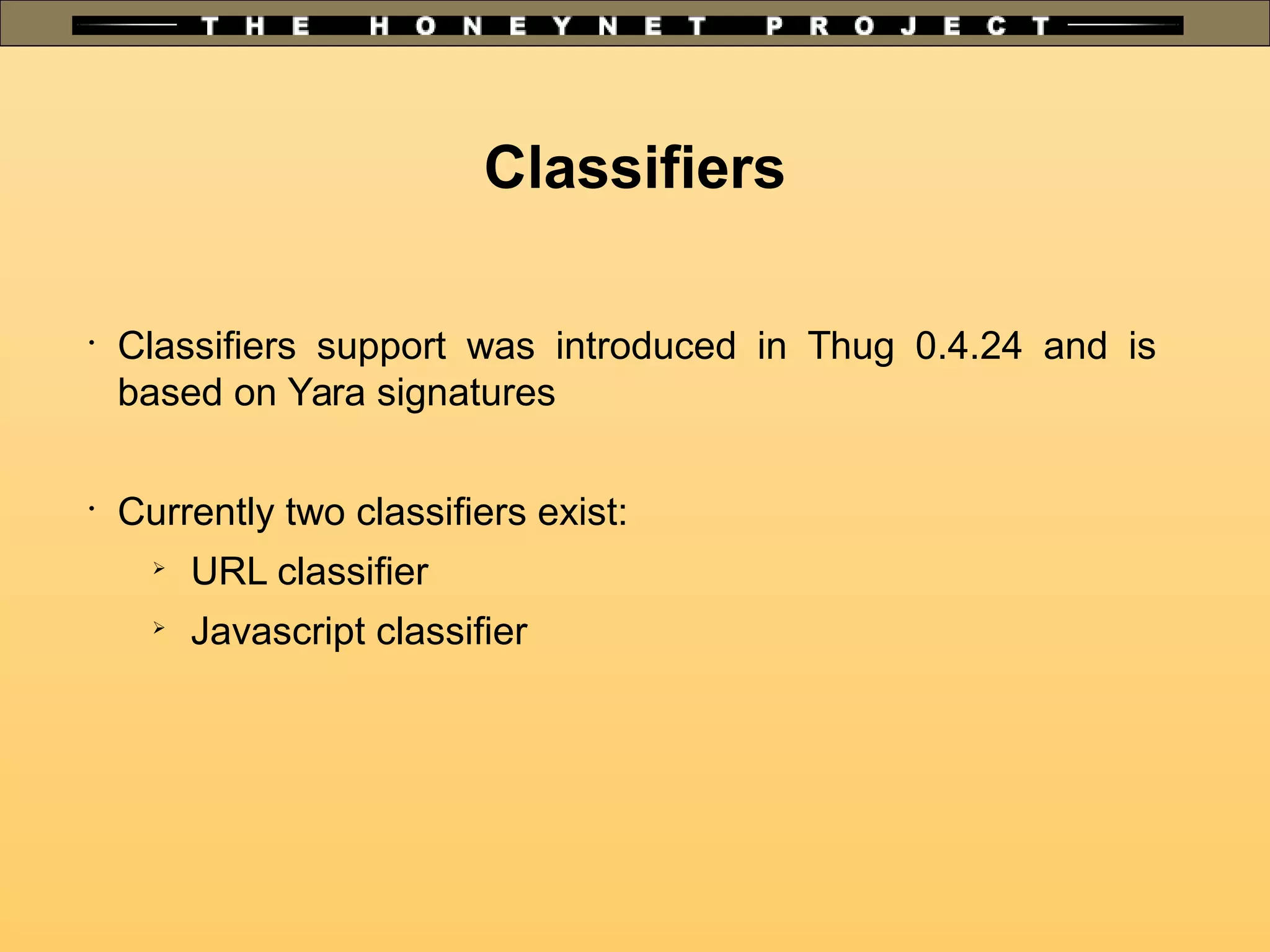
•
Classifiers support was introduced in Thug 0.4.24 and is
based on Yara signatures
•
Currently two classifiers exist:
➢
URL classifier
➢
Javascript classifier
Classifiers
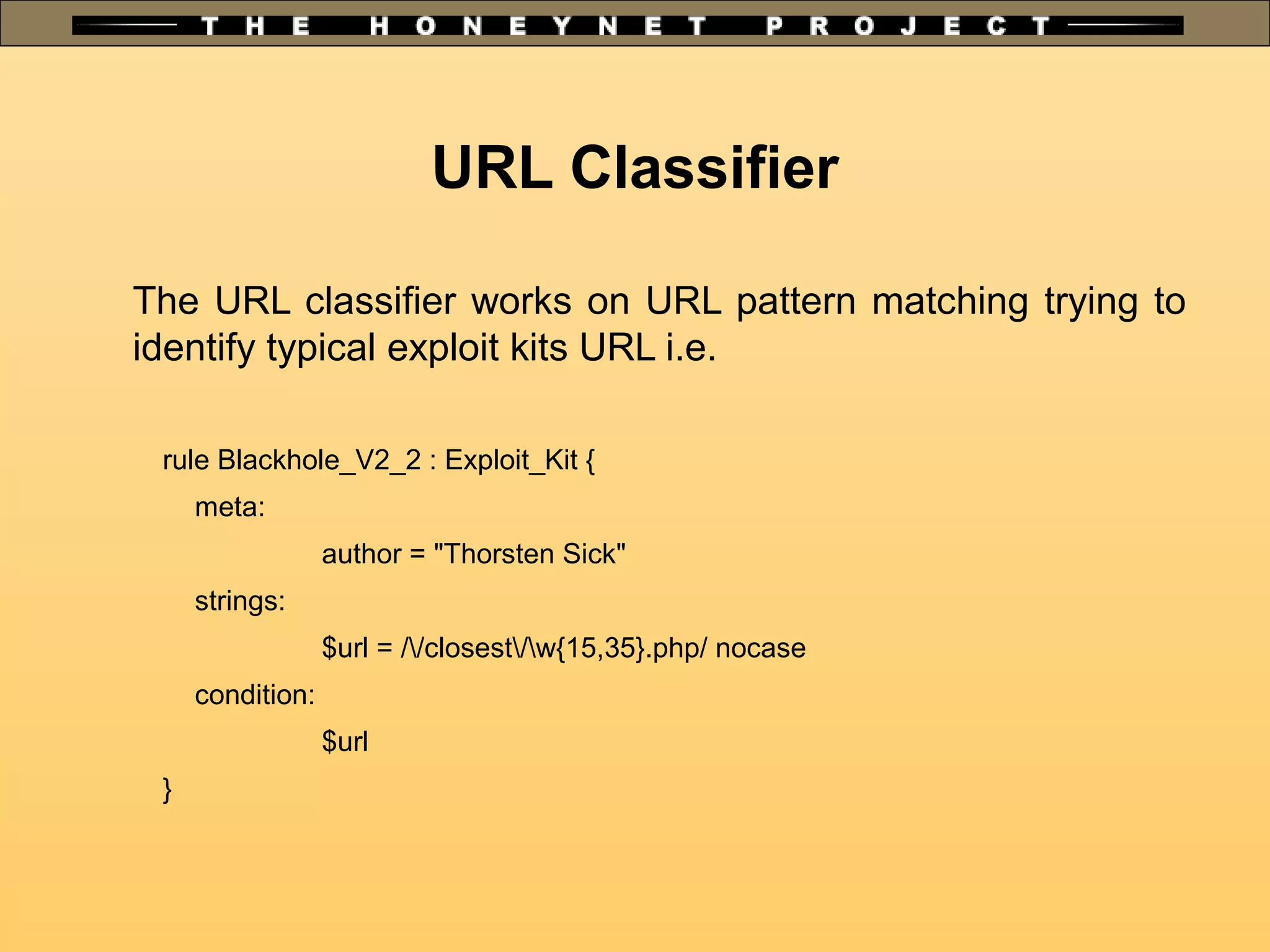
The URL classifier works on URL pattern matching trying to
identify typical exploit kits URL i.e.
rule Blackhole_V2_2 : Exploit_Kit {
meta:
author = "Thorsten Sick"
strings:
$url = //closest/w{15,35}.php/ nocase
condition:
$url
}
URL Classifier
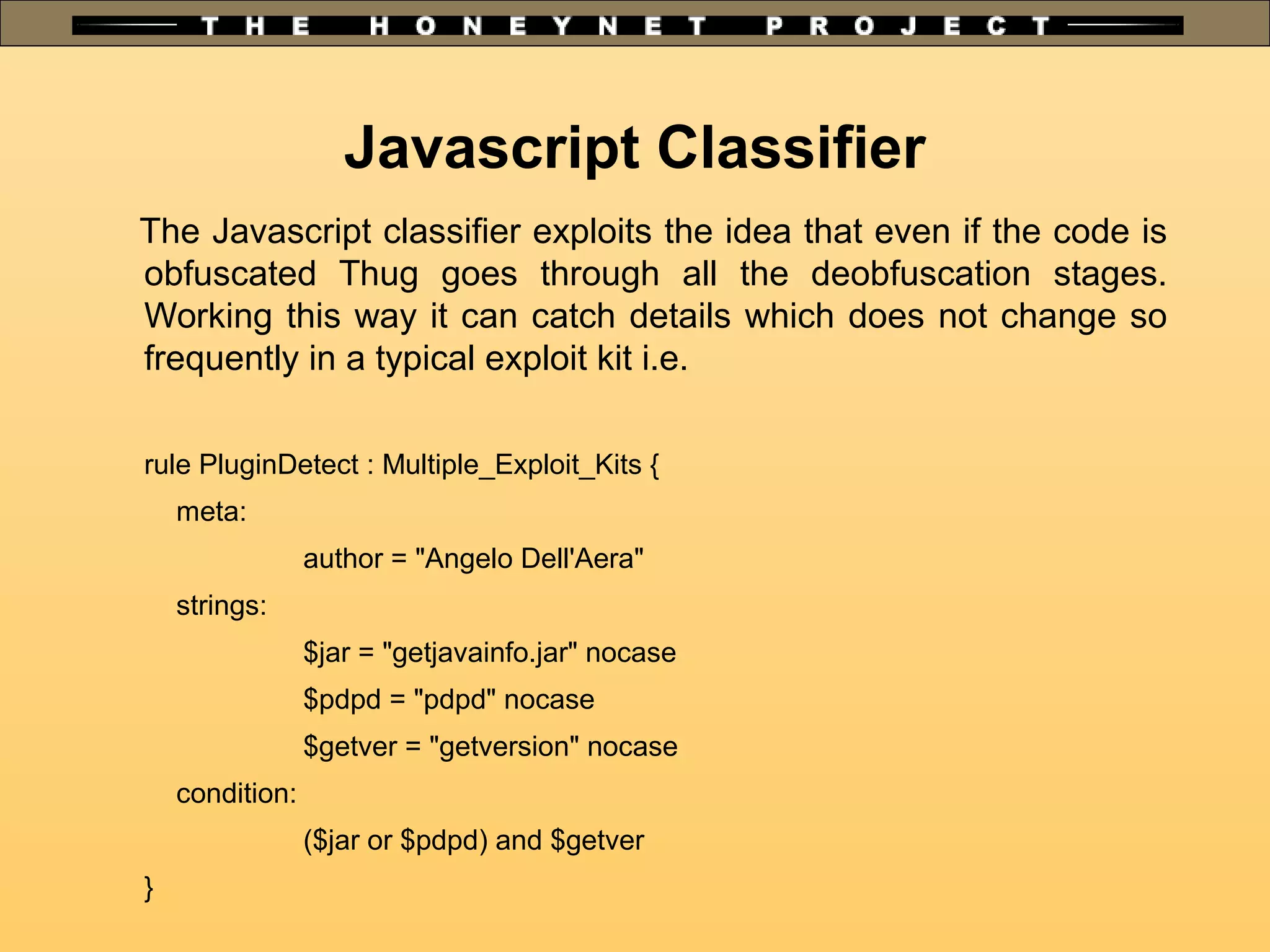
The Javascript classifier exploits the idea that even if the code is
obfuscated Thug goes through all the deobfuscation stages.
Working this way it can catch details which does not change so
frequently in a typical exploit kit i.e.
rule PluginDetect : Multiple_Exploit_Kits {
meta:
author = "Angelo Dell'Aera"
strings:
$jar = "getjavainfo.jar" nocase
$pdpd = "pdpd" nocase
$getver = "getversion" nocase
condition:
($jar or $pdpd) and $getver
}
Javascript Classifier
Thug source code is publicly available at
https://github.com/buffer/thug
Contributions, comments and feedback welcome!
Source code
Thanks for the attention!
Questions?
Angelo Dell'Aera
<angelo.dellaera@honeynet.org>

Honeynet Project Workshop 2014 - Thug: a low-interaction honeyclient

  • 1.
    Thug: a low-interactionhoneyclient Angelo Dell'Aera
  • 2.
    Speaker  Chief Executive Officer@ Honeynet Project  Information Security Independent Researcher @ Antifork Research (10+ years)
  • 3.
  • 4.
    Client-side attacks  The numberof client-side attacks has grown significantly in the past few years shifting focus on poorly protected vulnerable clients  In the last years more and more attacks against client systems  The browser is the most popular client system deployed on every user system  A lot of vulnerabilities are identified daily and reported in the most used browsers and in third-party plugins
  • 5.
    Honeyclients  Just as themost known honeypot technologies enable research into server-side attacks, honeyclients allow the study of client-side attacks  A complement to honeypots, a honeyclient is a tool designed to mimic the behavior of a user-driven network client application, such as a web browser, and be exploited by an attacker’s content
  • 6.
    Honeyclients  What we needis something which seems like a real browser the same way as a classical honeypot system seems like a real vulnerable server  A real system (high-interaction honeyclient) or an emulated one (low-interaction honeyclient)?
  • 7.
    Document Object Model(DOM) “The Document Object Model is a platform- and language-neutral interface that will allow programs and scripts to dynamically access and update the content, structure and style of documents. The document can be further processed and the results of that processing can be incorporated back into the presented page.”  Thug DOM is (almost) compliant with W3C DOM Core, HTML, Events and Views specifications (Level 1, 2 and partially 3) and partially compliant with W3C DOM Style specifications  Designed with the requirement that adding the missing features has to be as simple as possible
  • 8.
    Document Object Model(DOM) Browser Personalities  Drive-by download attacks target specific versions of the browser so a properly designed low-interaction honeyclient should be able to emulate different browser personalities  Supporting different browser personalities is almost a matter of implementing different (and sometimes totally incompatible) DOM behaviors and interfaces
  • 9.
    Supported Browser Personalities– 1/2 ➢ Internet Explorer 6.0 (Windows XP) ➢ Internet Explorer 6.1 (Windows XP) ➢ Internet Explorer 7.0 (Windows XP) ➢ Internet Explorer 8.0 (Windows XP) ➢ Chrome 20.0.1132.47 (Windows XP) ➢ Firefox 12.0 (Windows XP) ➢ Safari 5.1.7 (Windows XP) ➢ Internet Explorer 6.0 (Windows 2000) ➢ Internet Explorer 8.0 (Windows 2000) ➢ Internet Explorer 8.0 (Windows 7) ➢ Internet Explorer 9.0 (Windows 7) ➢ Chrome 20.0.1132.47 (Windows 7) ➢ Firefox 3.6.13 (Windows 7) ➢ Safari 5.1.7 (Windows 7)
  • 10.
    Supported Browser Personalities– 2/2 ➢ Safari 5.1.1 (MacOS X 10.7.2) ➢ Chrome 19.0.1084.54 (MacOS X 10.7.4) ➢ Chrome 26.0.1410.19 (Linux) ➢ Chrome 30.0.1599.15 (Linux) ➢ Firefox 19.0 (Linux) ➢ Chrome 18.0.1025.166 (Samsung Galaxy S II, Android 4.0.3) ➢ Chrome 25.0.1364.123 (Samsung Galaxy S II, Android 4.0.3) ➢ Chrome 29.0.1547.59 (Samsung Galaxy S II, Android 4.1.2) ➢ Chrome 18.0.1025.133 (Google Nexus, Android 4.0.4) ➢ Safari 7.0 (iPad, iOS 7.0.4)
  • 11.
    Document Object Model(DOM) Event Handling • W3C DOM Events specification constitute the most difficult one to emulate because of the (sometimes huge) differences in how different browsers handle events • Thug emulates the different behaviors of the supported browsers emulating load and mousemove events by default and allowing to emulate all the other ones if needed
  • 12.
    Document Object Model(DOM) Hooks • Thug defines some DOM hooks which are useful for analyzing well-known exploits • The next example shows how Thug implements an hook for analyzing a Java exploit with security prompt/warning bypass (CVE-2013-2423)
  • 13.
    Document Object Model(DOM) Hooks def _handle_jnlp(self, data, headers): try: soup = BeautifulSoup.BeautifulSoup(data) except: return if soup.find("jnlp") is None: return log.ThugLogging.add_behavior_warn(description = '[JNLP Detected]', method = 'Dynamic Analysis') for param in soup.find_all('param'): log.ThugLogging.add_behavior_warn(description = '[JNLP] %s' % (param, ), method = 'Dynamic Analysis') self._check_jnlp_param(param) jar = soup.find("jar") if jar is None: return try: url = jar.attrs['href'] headers['User-Agent'] = self.javaWebStartUserAgent response, content = self.window._navigator.fetch(url, headers = headers, redirect_type = "JNLP") except: pass
  • 14.
    Javascript  Google V8 Javascriptengine wrapped through PyV8  “V8 implements ECMAScript as specified in ECMA-262, 5th edition, and runs on Windows, Mac OS X , and Linux systems that use IA-32, x64, or ARM processors. The V8 API provides functions for compiling and executing scripts, accessing C++ methods and data structures, handling errors, and enabling security checks” • Abstract Syntax Tree generation and inspection (static analysis) • Context inspection (dynamic analysis) • Other potentially interesting features (GDB JIT interface, live objects inspection, code disassembler, etc.) exported through a clean and well designed API
  • 15.
    Analysis  Static analysis ➢ Abstract SyntaxTree (AST)  Dynamic analysis  V8 debugger protocol  Libemu integration (shellcode detection and emulation)
  • 16.
    Abstract Syntax Tree(AST) • Static analysis ➢ Static attack signatures ➢ Interesting breakpoints identification for later dynamic analysis ➢ Symbols identification for later dynamic analysis • Easily built through V8 API • Thug AST implementation is quite generic and extensible and allows easily building and inspecting the tree
  • 17.
    Vulnerability Modules  Python-based vulnerabilitymodules  ActiveX controls  Core browser functionalities  Browser plugins
  • 18.
    ActiveX • Thug implements anActiveX layer of its own for emulating ActiveX controls (just for Internet Explorer personalities) • It makes use of (Python) vulnerability modules in order to emulate such ActiveX controls or just some of their methods and attributes • The layer was designed in order to allow adding new ActiveX controls in a fast and easy way
  • 19.
    Browser Plugins • Drive-by downloadattacks target specific versions of the browser plugins so a properly designed low-interaction honeyclient should be able to emulate different browser plugins versions or to disable them -A, --adobepdf= Specify the Adobe Acrobat Reader version (default: 9.1.0) -P, --no-adobepdf Disable Adobe Acrobat Reader plugin -S, --shockwave= Specify the Shockwave Flash version (default: 10.0.64.0) -R, --no-shockwave Disable Shockwave Flash plugin -J, --javaplugin= Specify the JavaPlugin version (default: 1.6.0.32) -K, --no-javaplugin Disable Java plugin
  • 20.
    Logging • MITRE MAEC loggingformat • JSON logging format (contributed by Avira) • Exploit graph (contributed by Avira) • “Flat” log files (not so exciting I know) • MongoDB • HPFeeds  thug.events channel (URL analysis results published in MAEC format)  thug.files channel (downloaded samples)
  • 21.
    Logging Blackhole 2.0 ExploitKit { “timestamp”: “2013-04-13 13:43:54.307237”, “cve”: “None”, "description": [window open redirection] about:blank-> hxxp://purrfectpetresort.com/news/wanting_book_switch.php“, "method": "Dynamic Analysis" }
  • 23.
    Logging { "mimetype": "PE32 executable(GUI) Intel 80386 (stripped to external PDB), for MS Windows", "url": "hxxp://cadgrad.com/adobe/update_flash_player.exe", "flags": {}, "sha256": "d59d9af4e9ec25431acfd8938895b5c3b728d818db024d76f5aa265e0b171f4f", "content-type": "application/octet-stream", "md5": "a3266663f644dc0c0df42e8da1404878", "size": 130560 }
  • 24.
    • Classifiers support wasintroduced in Thug 0.4.24 and is based on Yara signatures • Currently two classifiers exist: ➢ URL classifier ➢ Javascript classifier Classifiers
  • 25.
    The URL classifierworks on URL pattern matching trying to identify typical exploit kits URL i.e. rule Blackhole_V2_2 : Exploit_Kit { meta: author = "Thorsten Sick" strings: $url = //closest/w{15,35}.php/ nocase condition: $url } URL Classifier
  • 26.
    The Javascript classifierexploits the idea that even if the code is obfuscated Thug goes through all the deobfuscation stages. Working this way it can catch details which does not change so frequently in a typical exploit kit i.e. rule PluginDetect : Multiple_Exploit_Kits { meta: author = "Angelo Dell'Aera" strings: $jar = "getjavainfo.jar" nocase $pdpd = "pdpd" nocase $getver = "getversion" nocase condition: ($jar or $pdpd) and $getver } Javascript Classifier
  • 27.
    Thug source codeis publicly available at https://github.com/buffer/thug Contributions, comments and feedback welcome! Source code
  • 28.
    Thanks for theattention! Questions? Angelo Dell'Aera <angelo.dellaera@honeynet.org>