S
     A
    F
   UV
G RVO
  1
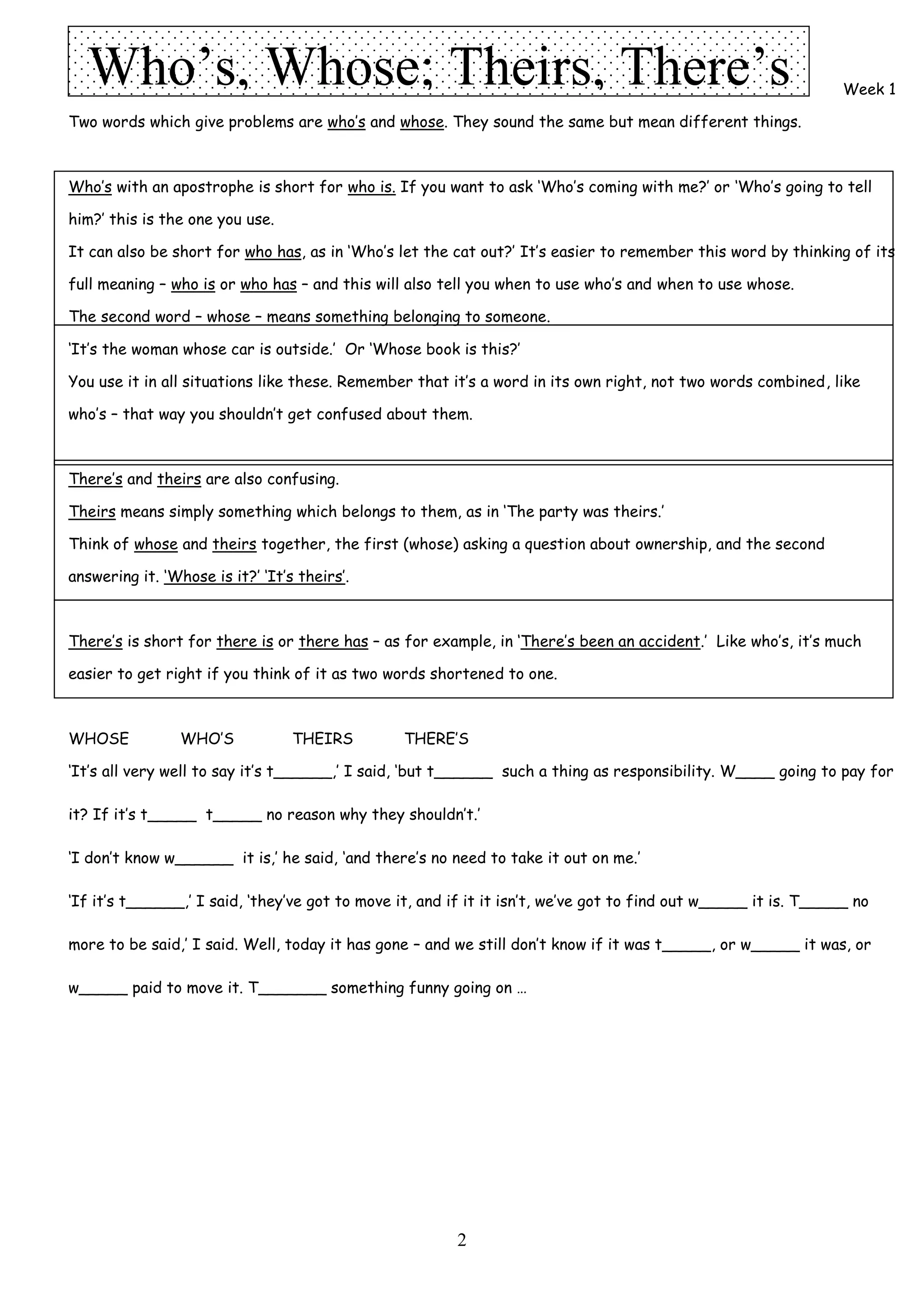
Who’s, Whose; Theirs, There’s                                                                                  Week 1

Two words which give problems are who’s and whose. They sound the same but mean different things.


Who’s with an apostrophe is short for who is. If you want to ask ‘Who’s coming with me?’ or ‘Who’s going to tell

him?’ this is the one you use.

It can also be short for who has, as in ‘Who’s let the cat out?’ It’s easier to remember this word by thinking of its

full meaning – who is or who has – and this will also tell you when to use who’s and when to use whose.

The second word – whose – means something belonging to someone.

‘It’s the woman whose car is outside.’ Or ‘Whose book is this?’

You use it in all situations like these. Remember that it’s a word in its own right, not two words combined, like

who’s – that way you shouldn’t get confused about them.


There’s and theirs are also confusing.

Theirs means simply something which belongs to them, as in ‘The party was theirs.’

Think of whose and theirs together, the first (whose) asking a question about ownership, and the second

answering it. ‘Whose is it?’ ‘It’s theirs’.


There’s is short for there is or there has – as for example, in ‘There’s been an accident.’ Like who’s, it’s much

easier to get right if you think of it as two words shortened to one.


WHOSE            WHO’S            THEIRS         THERE’S

‘It’s all very well to say it’s t______,’ I said, ‘but t______ such a thing as responsibility. W____ going to pay for

it? If it’s t_____ t_____ no reason why they shouldn’t.’

‘I don’t know w______ it is,’ he said, ‘and there’s no need to take it out on me.’

‘If it’s t______,’ I said, ‘they’ve got to move it, and if it it isn’t, we’ve got to find out w_____ it is. T_____ no

more to be said,’ I said. Well, today it has gone – and we still don’t know if it was t_____, or w_____ it was, or

w_____ paid to move it. T_______ something funny going on …


                                                        2
Week 2
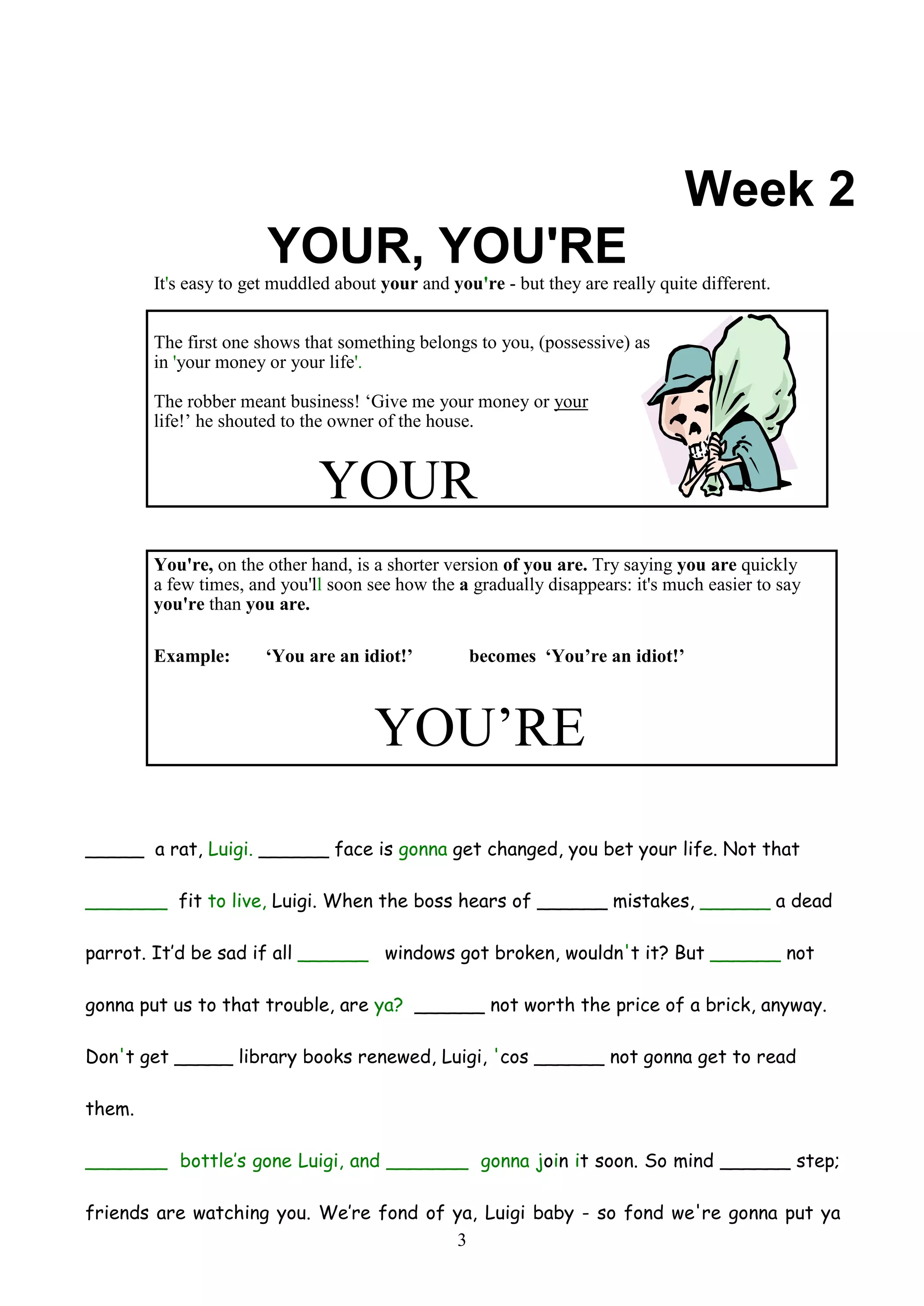
                       YOUR, YOU'RE
        It's easy to get muddled about your and you're - but they are really quite different.


        The first one shows that something belongs to you, (possessive) as
        in 'your money or your life'.

        The robber meant business! ‘Give me your money or your
        life!’ he shouted to the owner of the house.


                              YOUR
        You're, on the other hand, is a shorter version of you are. Try saying you are quickly
        a few times, and you'll soon see how the a gradually disappears: it's much easier to say
        you're than you are.

        Example:       ‘You are an idiot!’         becomes ‘You’re an idiot!’


                                      YOU’RE
_____ a rat, Luigi. ______ face is gonna get changed, you bet your life. Not that

_______ fit to live, Luigi. When the boss hears of ______ mistakes, ______ a dead

parrot. It’d be sad if all ______ windows got broken, wouldn't it? But ______ not

gonna put us to that trouble, are ya? ______ not worth the price of a brick, anyway.

Don't get _____ library books renewed, Luigi, 'cos ______ not gonna get to read

them.

_______ bottle’s gone Luigi, and _______ gonna join it soon. So mind ______ step;

friends are watching you. We’re fond of ya, Luigi baby - so fond we're gonna put ya
                                        3
out of ______ misery, soon as we get the chance. _____ miserable life's as good as

over. Say _____ prayers, Luigi: _____ gonna need to, 'cos ______ a dead man, Luigi.


                                        4
Week 3
                             Connectives
Write out a sentence or two containing each of these connectives.
DICTIONARY DEFINITIONS
And – together with


Although – even though



Consequently – as a result


However – but, even so



Therefore – for that reason



Nonetheless/Nevertheless – in spite of that


Accordingly – because of this


But – except that, or unless


Furthermore – in addition, moreover


On the other hand – looking at it from another point of view…


                                       5
Week 4
                               Homophones
Words that sound the same but that are spelt differently are called
homophones. The name comes from the Ancient Greek words:


                               homos (same)
                               phone (sound)

If the wrong homophone is used a passage might be quite difficult to read, like
the one below. However, if you do manage to read it aloud (allowed!), other
people will be able to understand it perfectly.
       For example:
I maid my weigh down the rode. Suddenly eye sore a wight
                          hoarse.
           ”Ware are ewe off two?” aye asked
      “Too sea the see and watch the son go down.”
               “Isle come with yew,” I said.
  Sew, I court him and wee road together, wile the wind
                     blue in hour hare.


There are 25 homophones in that short passage. Can you find them and say how
the words should have been spelt?
1.                                          20.
2.                                          21.
3.                                          22.
4.                                          23.
5.                                          24.
6.                                          25.
7.
8.
9.
10.
11.
12.
13.
14.
15.
16.
17.
18.
19.


                                       6
Pupils to spend 10 mins on
these spellings, memorising
them or working with a partner.
Teacher to test them after the
time. OR Word Games (word                                      Week 5
searches – hangman)


             1. “It’s a good thing I happened to be passing,” the
                window cleaner said.

             2. “What height do you think you are?” the giraffe
                seemed to be asking.

             3. “Ghosts are imaginary!”

             4. “This is an interesting pack of cards,” she cried,
                turning them over in her hands.

             5. “What a lovely mosaic,” he said. “Must be Roman.”

             6. Many people believe that marriage is a good idea.

             7. Portsmouth scored to make it 4-3. Meanwhile, at
                Old Trafford, Alan Smith put United ahead against
                Rochdale.

             8. “I know there were two people involved in this
                dastardly crime. Moreover, I know exactly who you
                are!”

             9. – Knock! Knock!
                – Who’s there?
                – Isabel!
                – Isabel who?
                – Is a bell really necessary on a bike?

             10. The police tried to bring a peaceful end to the
                 protests.


                                          7
Pupils to spend 10 mins on
these spellings, memorising
them or working with a partner.
Teacher to test them after the                         Week 6
time. OR Word Games (word
searches – hangman)


        1. We tried to find accommodation when we got
           to Paris.

        2. He told us that he was actually our lost uncle.

        3. Alcohol should not be consumed in public
           places.

        4. Although there were fifty firemen, it took
           twenty minutes to get Tiddles out of the tree.

        5. The analysis of the fossil proved that it was
           one hundred million years old.

        6. The argument between the men lasted for five
           hours.

        7. At the end of the school year there will be an
           assessment.

        8. Earth’s atmosphere is full of oxygen.

        9. Only the dripping water was audible.

        10. The audience watched in wonder.

        11. Autumn begins in October.


                                  8
Homework Booklet 2 Y7

  • 1.
    S A F UV G RVO 1
  • 2.
    Who’s, Whose; Theirs,There’s Week 1 Two words which give problems are who’s and whose. They sound the same but mean different things. Who’s with an apostrophe is short for who is. If you want to ask ‘Who’s coming with me?’ or ‘Who’s going to tell him?’ this is the one you use. It can also be short for who has, as in ‘Who’s let the cat out?’ It’s easier to remember this word by thinking of its full meaning – who is or who has – and this will also tell you when to use who’s and when to use whose. The second word – whose – means something belonging to someone. ‘It’s the woman whose car is outside.’ Or ‘Whose book is this?’ You use it in all situations like these. Remember that it’s a word in its own right, not two words combined, like who’s – that way you shouldn’t get confused about them. There’s and theirs are also confusing. Theirs means simply something which belongs to them, as in ‘The party was theirs.’ Think of whose and theirs together, the first (whose) asking a question about ownership, and the second answering it. ‘Whose is it?’ ‘It’s theirs’. There’s is short for there is or there has – as for example, in ‘There’s been an accident.’ Like who’s, it’s much easier to get right if you think of it as two words shortened to one. WHOSE WHO’S THEIRS THERE’S ‘It’s all very well to say it’s t______,’ I said, ‘but t______ such a thing as responsibility. W____ going to pay for it? If it’s t_____ t_____ no reason why they shouldn’t.’ ‘I don’t know w______ it is,’ he said, ‘and there’s no need to take it out on me.’ ‘If it’s t______,’ I said, ‘they’ve got to move it, and if it it isn’t, we’ve got to find out w_____ it is. T_____ no more to be said,’ I said. Well, today it has gone – and we still don’t know if it was t_____, or w_____ it was, or w_____ paid to move it. T_______ something funny going on … 2
  • 3.
    Week 2 YOUR, YOU'RE It's easy to get muddled about your and you're - but they are really quite different. The first one shows that something belongs to you, (possessive) as in 'your money or your life'. The robber meant business! ‘Give me your money or your life!’ he shouted to the owner of the house. YOUR You're, on the other hand, is a shorter version of you are. Try saying you are quickly a few times, and you'll soon see how the a gradually disappears: it's much easier to say you're than you are. Example: ‘You are an idiot!’ becomes ‘You’re an idiot!’ YOU’RE _____ a rat, Luigi. ______ face is gonna get changed, you bet your life. Not that _______ fit to live, Luigi. When the boss hears of ______ mistakes, ______ a dead parrot. It’d be sad if all ______ windows got broken, wouldn't it? But ______ not gonna put us to that trouble, are ya? ______ not worth the price of a brick, anyway. Don't get _____ library books renewed, Luigi, 'cos ______ not gonna get to read them. _______ bottle’s gone Luigi, and _______ gonna join it soon. So mind ______ step; friends are watching you. We’re fond of ya, Luigi baby - so fond we're gonna put ya 3
  • 4.
    out of ______misery, soon as we get the chance. _____ miserable life's as good as over. Say _____ prayers, Luigi: _____ gonna need to, 'cos ______ a dead man, Luigi. 4
  • 5.
    Week 3 Connectives Write out a sentence or two containing each of these connectives. DICTIONARY DEFINITIONS And – together with Although – even though  Consequently – as a result However – but, even so  Therefore – for that reason  Nonetheless/Nevertheless – in spite of that Accordingly – because of this But – except that, or unless Furthermore – in addition, moreover On the other hand – looking at it from another point of view… 5
  • 6.
    Week 4 Homophones Words that sound the same but that are spelt differently are called homophones. The name comes from the Ancient Greek words: homos (same) phone (sound) If the wrong homophone is used a passage might be quite difficult to read, like the one below. However, if you do manage to read it aloud (allowed!), other people will be able to understand it perfectly. For example: I maid my weigh down the rode. Suddenly eye sore a wight hoarse. ”Ware are ewe off two?” aye asked “Too sea the see and watch the son go down.” “Isle come with yew,” I said. Sew, I court him and wee road together, wile the wind blue in hour hare. There are 25 homophones in that short passage. Can you find them and say how the words should have been spelt? 1. 20. 2. 21. 3. 22. 4. 23. 5. 24. 6. 25. 7. 8. 9. 10. 11. 12. 13. 14. 15. 16. 17. 18. 19. 6
  • 7.
    Pupils to spend10 mins on these spellings, memorising them or working with a partner. Teacher to test them after the time. OR Word Games (word Week 5 searches – hangman) 1. “It’s a good thing I happened to be passing,” the window cleaner said. 2. “What height do you think you are?” the giraffe seemed to be asking. 3. “Ghosts are imaginary!” 4. “This is an interesting pack of cards,” she cried, turning them over in her hands. 5. “What a lovely mosaic,” he said. “Must be Roman.” 6. Many people believe that marriage is a good idea. 7. Portsmouth scored to make it 4-3. Meanwhile, at Old Trafford, Alan Smith put United ahead against Rochdale. 8. “I know there were two people involved in this dastardly crime. Moreover, I know exactly who you are!” 9. – Knock! Knock! – Who’s there? – Isabel! – Isabel who? – Is a bell really necessary on a bike? 10. The police tried to bring a peaceful end to the protests. 7
  • 8.
    Pupils to spend10 mins on these spellings, memorising them or working with a partner. Teacher to test them after the Week 6 time. OR Word Games (word searches – hangman) 1. We tried to find accommodation when we got to Paris. 2. He told us that he was actually our lost uncle. 3. Alcohol should not be consumed in public places. 4. Although there were fifty firemen, it took twenty minutes to get Tiddles out of the tree. 5. The analysis of the fossil proved that it was one hundred million years old. 6. The argument between the men lasted for five hours. 7. At the end of the school year there will be an assessment. 8. Earth’s atmosphere is full of oxygen. 9. Only the dripping water was audible. 10. The audience watched in wonder. 11. Autumn begins in October. 8