Homer's Odyssey
Prologue, verses 1-10
What we’re up to:
Together, we will explore
- the gods' will
- the hero's choices
- the poet's verses.
Based on Robert Fagles' translation.
Odyssey Overview
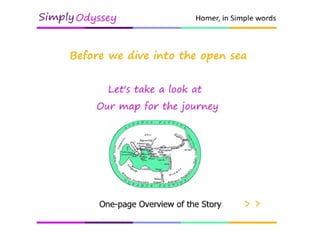
Before we dive into Poseidon’s open sea,
let's take a look at our map for the journey.
The Odyssey at a glance:
One-page overview of the story.
Odyssey, Basic Structure:
• Prologue + Intro
• Divine assembly
• Adventures of Telemachus (books 1-4),
• Adventures of Odysseus (books 5-12),
• Revenge at Ithaca (books 13-24).
About Odyssey’s Prologue
The literary term is preamble,
i.e., an initial (pre) walk-around (ambul-are),
a little like a movie trailer.
Homer hands us some basic clues, like
WHO - WHAT - WHY, and raises anticipation
for the rest of the story.
So, how does Homer keep us interested?
Fiction: Basic Elements
He acquaints is with the Main Hero.
He fixes his Topic. He states his Theme.
He populates his Universe.
He sets his Characters in Motion.
In short,
he hands us a number of important info
he hooks us with Emotion,
he promises a breath-takiing followup.
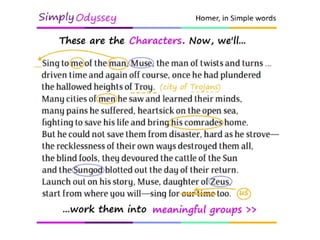
Prologue, Characters
Translation by Robert Fagles
In the original Greek text,
Homer accomplishes all this
with only 10 verses.
How on earth does he do it?!?
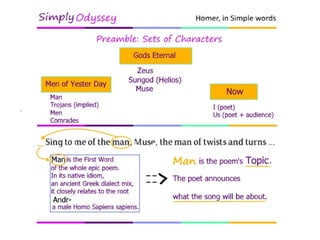
Odyssey, Prologue, Characters
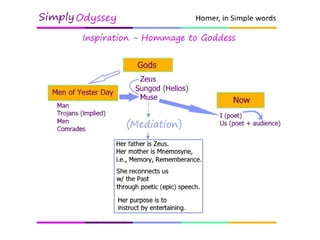
Sets of Characters:
Gods Eternal
(Zeus, Sungod / Helios, Muse)
Men of Yester Day
(Man, Trojans-implied, men, comrades)
Now
(I=poet, us=poet+audience)
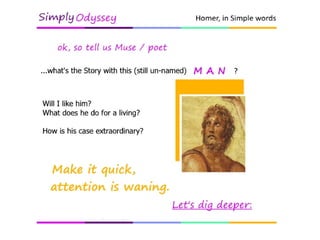
An Un-named Man
Man is the first word of the whole epic poem.
In its native idiom, an ancient Greek dialect
mix, it closely relates to the root Andr-, a
male Homo Sapiens sapiens.
Man is the poem's Topic.
The poet announces what the song will be
about.
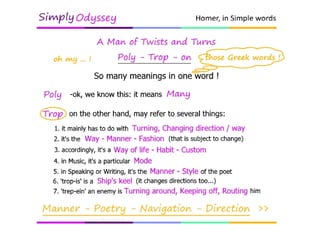
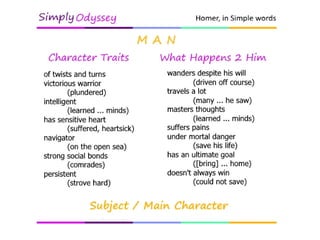
A Man of Twists & Turns
“Poly-Trop-on” --includes many meanings.
"Poly-" means "Many".
"Trop-" may refer to several things:
it mainly has to do with
Manner - Poetry - Navigation - Direction -
Change
Who is the Man?
We see
What Happens to the Man
Character Traits
Sing to me, Muse
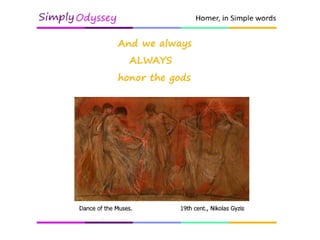
In the Odyssey we always,
ALWAYS remember to honor the gods.
Painting: Dance of the Muses, by Nikolas
Gyzis, 19th cent.
Muse: Goddess of Inspiration
The Muse mediates.
Her father is Zeus.
Her mother is Mnemosyne, i.e., Memory,
Rememberance.
She reconnects is with the Past through
poetic (epic) speech.
Her purpose is to instruct by entertaining.
Prologue, Characters
We learn
about the Main Character (Man)
some other Characters (men + gods)
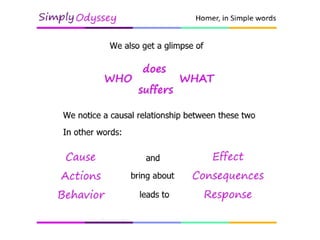
Who does What - Who suffers What
There’s a causal relationship between these
two:
--> Cause & Effect
is a central Theme of this epic story.
What to Do Next
Following our overview of
Characters,
we're ready to take our next step into
Theme.
Check out more handy resources at
SimplyOdyssey.com
Homer's Odyssey in simple words & images.

Homer's Odyssey, Prologue: a simple guide

  • 1.
  • 2.
    What we’re upto: Together, we will explore - the gods' will - the hero's choices - the poet's verses. Based on Robert Fagles' translation.
  • 3.
    Odyssey Overview Before wedive into Poseidon’s open sea, let's take a look at our map for the journey. The Odyssey at a glance: One-page overview of the story.
  • 4.
    Odyssey, Basic Structure: •Prologue + Intro • Divine assembly • Adventures of Telemachus (books 1-4), • Adventures of Odysseus (books 5-12), • Revenge at Ithaca (books 13-24).
  • 5.
    About Odyssey’s Prologue Theliterary term is preamble, i.e., an initial (pre) walk-around (ambul-are), a little like a movie trailer. Homer hands us some basic clues, like WHO - WHAT - WHY, and raises anticipation for the rest of the story. So, how does Homer keep us interested?
  • 6.
    Fiction: Basic Elements Heacquaints is with the Main Hero. He fixes his Topic. He states his Theme. He populates his Universe. He sets his Characters in Motion. In short, he hands us a number of important info he hooks us with Emotion, he promises a breath-takiing followup.
  • 7.
    Prologue, Characters Translation byRobert Fagles In the original Greek text, Homer accomplishes all this with only 10 verses. How on earth does he do it?!?
  • 8.
    Odyssey, Prologue, Characters Setsof Characters: Gods Eternal (Zeus, Sungod / Helios, Muse) Men of Yester Day (Man, Trojans-implied, men, comrades) Now (I=poet, us=poet+audience)
  • 9.
    An Un-named Man Manis the first word of the whole epic poem. In its native idiom, an ancient Greek dialect mix, it closely relates to the root Andr-, a male Homo Sapiens sapiens. Man is the poem's Topic. The poet announces what the song will be about.
  • 10.
    A Man ofTwists & Turns “Poly-Trop-on” --includes many meanings. "Poly-" means "Many". "Trop-" may refer to several things: it mainly has to do with Manner - Poetry - Navigation - Direction - Change
  • 11.
    Who is theMan? We see What Happens to the Man Character Traits
  • 12.
    Sing to me,Muse In the Odyssey we always, ALWAYS remember to honor the gods. Painting: Dance of the Muses, by Nikolas Gyzis, 19th cent.
  • 13.
    Muse: Goddess ofInspiration The Muse mediates. Her father is Zeus. Her mother is Mnemosyne, i.e., Memory, Rememberance. She reconnects is with the Past through poetic (epic) speech. Her purpose is to instruct by entertaining.
  • 14.
    Prologue, Characters We learn aboutthe Main Character (Man) some other Characters (men + gods) Who does What - Who suffers What There’s a causal relationship between these two: --> Cause & Effect is a central Theme of this epic story.
  • 15.
    What to DoNext Following our overview of Characters, we're ready to take our next step into Theme. Check out more handy resources at SimplyOdyssey.com Homer's Odyssey in simple words & images.