HOMEOSTATIC MECHANISM
Presented to:- Mrs. Prabhjot Saini
Associate professor
DMCH
Presented by:- Simranpreet kaur
M.Sc. (N) 1st year
Roll no.- 25
 Define homeostatsis
 Enlist the three components of
maintaining homeostatsis
Definition
 Homeostatic mechanism can be defined as “the
property of a system, either open or closed, that
regulates its internal environment and ends to
maintain a stable, constant condition. Multiple
dynamic equilibrium adjustment and regulation
mechanisms make homeostasis possible.”
( Claude Bernad and Walter Cannon)
Positive feedback:-
 Positive feedback mechanisms are
designed to accelerate or enhance the
output created by a stimulus that has
already been activated.
 It perpetuates the chain of events set
in motion by the original disturbance
instead of compensating for it. As the
system become more unbalanced,
disorder and disintegration occurs.
Cont….
For example:
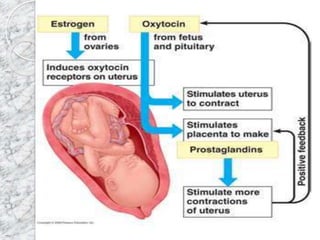
 1. events in the body is platelet
accumulation which in causes blood
clotting in response to break or tear in
the lining of blood vessels.
 2. Uretrus contraction during delivery
Negative feedback:-
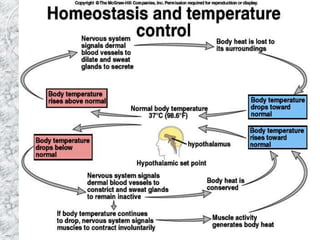
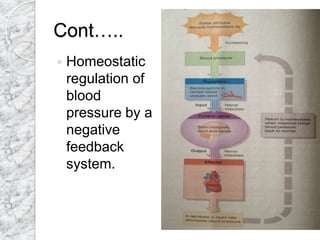
 It consist of reducing the output or
activity of any organ or system back to
its normal range of functioning.
 With negative feedback, any change
in the organism’s external
environment will be met with an
effector response that will seek to
counteract that change e.g. a
decrease in temperature will be met
with a response by the organism to
generate more heat.
Cont…..
 Homeostatic
regulation of
blood
pressure by a
negative
feedback
system.
Cont……
 Another example is when body is
deprived of food. Exercise can change
this effect by increasing the metabolic
demand.
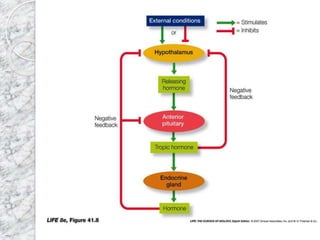
 Other example while maintaining
hormone balance by hypothalamus
and pituitary gland in body.
Homeostatic imbalance:-
 Many diseases are result of
disturbances of
homeostatsis, a common
condition known as
homeostatic imbalance.
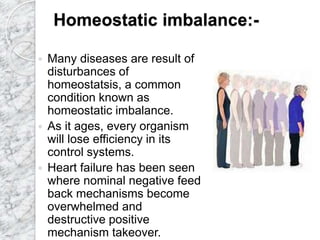
 As it ages, every organism
will lose efficiency in its
control systems.
 Heart failure has been seen
where nominal negative feed
back mechanisms become
overwhelmed and
destructive positive
mechanism takeover.
BIOLOGICAL
&
PSYCHOSOCIAL FACTORS IN
CAUSATION OF DISEASE
Health:-
 Health is a state of complete physical
mental and social well being and not
merely the absence of diseases or
infirmity
Definition
 Illness is defined as state in which a
person is physical, emotional,
intellectual, social, developmental or
spiritual functioning is diminished or
impaired with previous experience.
 Disease:- A pathological condition of a
part, organ, or system of an organism
resulting from various causes, such as
infection, genetic defect, or
environmental stress, and characterized
by an identifiable group of signs or
symptoms.
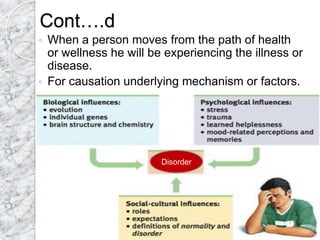
Cont….d
 When a person moves from the path of health
or wellness he will be experiencing the illness or
disease.
 For causation underlying mechanism or factors.
Disorder
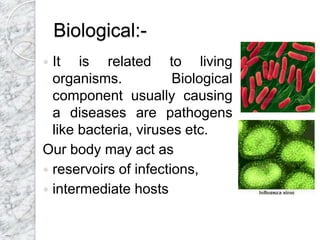
Biological:-
 It is related to living
organisms. Biological
component usually causing
a diseases are pathogens
like bacteria, viruses etc.
Our body may act as
 reservoirs of infections,
 intermediate hosts
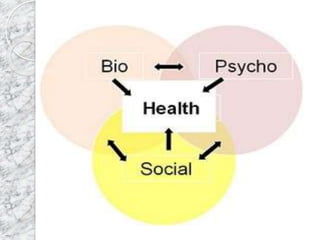
Biopsychosocial model
 In 1977, American Psychiatrist George
Engel introduced the major theory in
medicine, the BPS Model. The model
accounted for biological, psychological,
and sociological interconnected
spectrums, each as systems of the body.
 This model is based on the system
perspective.
 BPS model rejected biomedical model as
dogma
Cont…..
 Biological component of the model refers to the
fact that pathogens like germs and toxins
precipitate illness.
 Psychological/behavioural component looks for
potential psychological causes for a health
problem such lack of self-control, emotional
turmoil, and negative thinking.
 The social part of the BPS model explains how
different social factors such as socioeconomic
status, culture, poverty, technology, and religion
can influence health.
The model presumes that it is important to handle
these three factors together when managing
health problems.
Psychological factors:-
 Physiological factors has both positive
and negative impact on health of
individual.
 Psychological factors can influence
physical health either indirectly, by
changing behaviors that affect your
health, such as eating, sleeping and
socializing, or directly, by producing
changes in your hormones and/or
heart rate.
Cont….
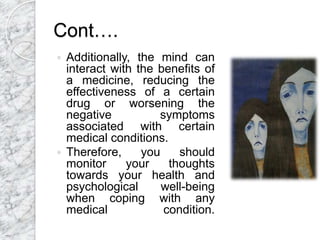
 Additionally, the mind can
interact with the benefits of
a medicine, reducing the
effectiveness of a certain
drug or worsening the
negative symptoms
associated with certain
medical conditions.
 Therefore, you should
monitor your thoughts
towards your health and
psychological well-being
when coping with any
medical condition.
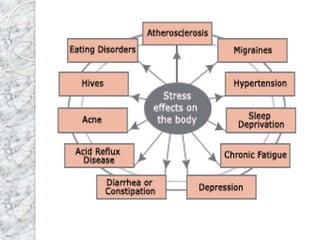
Stress
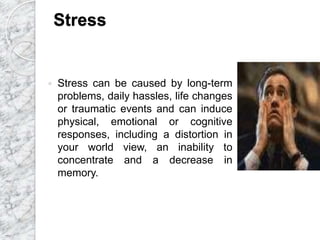
 Stress can be caused by long-term
problems, daily hassles, life changes
or traumatic events and can induce
physical, emotional or cognitive
responses, including a distortion in
your world view, an inability to
concentrate and a decrease in
memory.
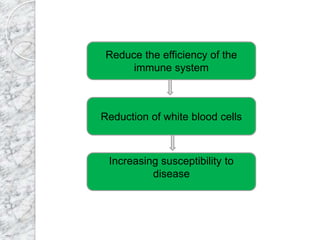
Reduce the efficiency of the
immune system
Reduction of white blood cells
Increasing susceptibility to
disease
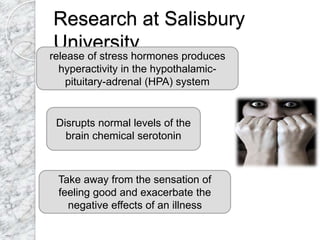
Research at Salisbury
University
release of stress hormones produces
hyperactivity in the hypothalamic-
pituitary-adrenal (HPA) system
Disrupts normal levels of the
brain chemical serotonin
Take away from the sensation of
feeling good and exacerbate the
negative effects of an illness
Depression
 As a common risk factor for heart
disease. In fact, depression can wear
down the heart and speed up the disease
process.
 In addition, poor lifestyle habits related to
depression, such as social isolation, a
lack of exercise and excessive alcohol or
other drug abuse, can harm your health
system.
 Therefore, avoid depression by staying
active or seeing a doctor as it can make
the recovery from certain medical
conditions increasingly difficult or even
impossible.
Insomnia
 According to experts, anxiety,
depression and stress play
interacting roles in the causes of
insomnia, which can severely
impair the body's healing
processes.
 In fact, a 2007 research study
reported by Harvard University
examined the relationship between
sleep and cellular immune function
and found that people who fail to
achieve adequate sleep--about six
to eight hours--significantly altered
their immune system similar to
people who suffer from certain
disease patterns, such as
rheumatoid arthritis and HIV
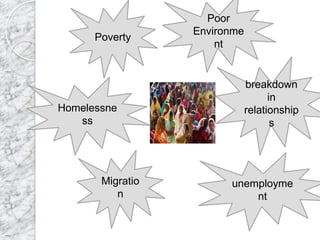
Social factors
Homelessne
ss
Poverty
unemployme
nt
Poor
Environme
nt
breakdown
in
relationship
s
Migratio
n
Cont….
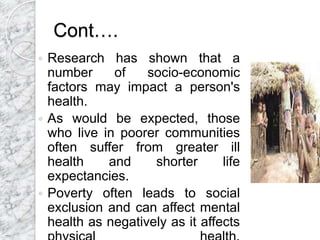
 Research has shown that a
number of socio-economic
factors may impact a person's
health.
 As would be expected, those
who live in poorer communities
often suffer from greater ill
health and shorter life
expectancies.
 Poverty often leads to social
exclusion and can affect mental
health as negatively as it affects
Application of BPS Model
 E.g. Social isolation and joblessness -----
--> depression/self-
incrimination/sedentary lifestyle ------>
hypercholestrolemia/myocardial
infarction/diabetes
 BPS model implies that treatment of
cancer/diabetes/mental disorders should
address biological, psychological and
social components of the problem.
 mental health care.
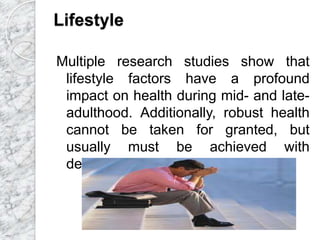
Lifestyle
Multiple research studies show that
lifestyle factors have a profound
impact on health during mid- and late-
adulthood. Additionally, robust health
cannot be taken for granted, but
usually must be achieved with
deliberate actions.
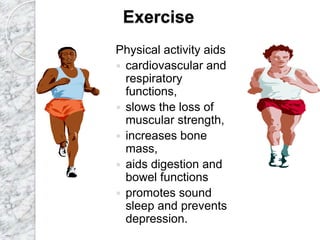
Exercise
Physical activity aids
 cardiovascular and
respiratory
functions,
 slows the loss of
muscular strength,
 increases bone
mass,
 aids digestion and
bowel functions
 promotes sound
sleep and prevents
depression.
Nutrition.
 Healthy diet, use of
supplements, and drinking
plenty of water.
 The experts advocate a low fat
diet with a minimum of 5
servings of fruits and
vegetables, and 2 to 4 servings
of low-fat dairy products each
day.
 A multivitamin is recommended
to fill in gaps from the diet,
 6 to 8 glasses of water or clear
fluids to promote optimal organ
function.
Not smoking and Avoidance
of excessive alcohol.
 Cessation of smoking
reduces the risk of heart
disease, stroke, some
cancers, bronchitis, and
emphysema.
 Limiting alcohol to one glass
of wine per day reduces the
risk of liver disease and
certain cancers. However, the
older you get, the more
cautious you should be, even
about drinking small
amounts.
Stress reduction.
 Reduction of stress and anxiety helps
to strengthen the immune system and
decreases susceptibility to disease.
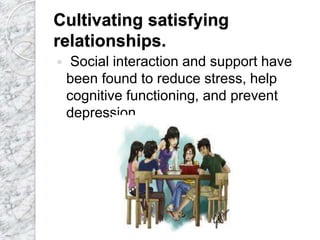
Cultivating satisfying
relationships.
 Social interaction and support have
been found to reduce stress, help
cognitive functioning, and prevent
depression
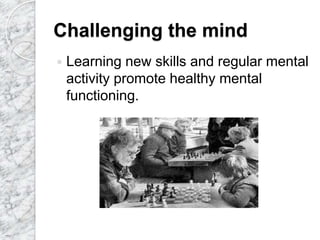
Challenging the mind
 Learning new skills and regular mental
activity promote healthy mental
functioning.
Avoid the effect of aging
 The Center for Disease Control (CDC)
also states that healthy lifestyles are
more influential than genetics to avoid
the deterioration associated with aging
(CDC, 2002).
 The CDC recommends that people be
“physically active, eat a healthy diet, do
not use tobacco, and practice other
healthy behaviors” to reduce the risk of
chronic diseases. They emphasize that
“physical activity is the key to healthy
aging.”
THANK U
bibliography
 Khan S. Yaseen & Basheer P. Shabeer
“comprehensive textbook of Advanced Nursing
Practices” published by EMMESS publications,
page no. – 189 to 193
 Gulani k.k.” community health
nursing”published by Kumar publications.
 Park K. “ preventive & social medicine”
published by Bhanot publications.
 www.wikipedia.com

HOMEOSTATIC_MECHANISM.pptx

  • 1.
    HOMEOSTATIC MECHANISM Presented to:-Mrs. Prabhjot Saini Associate professor DMCH Presented by:- Simranpreet kaur M.Sc. (N) 1st year Roll no.- 25
  • 2.
     Define homeostatsis Enlist the three components of maintaining homeostatsis
  • 3.
    Definition  Homeostatic mechanismcan be defined as “the property of a system, either open or closed, that regulates its internal environment and ends to maintain a stable, constant condition. Multiple dynamic equilibrium adjustment and regulation mechanisms make homeostasis possible.” ( Claude Bernad and Walter Cannon)
  • 4.
    Positive feedback:-  Positivefeedback mechanisms are designed to accelerate or enhance the output created by a stimulus that has already been activated.  It perpetuates the chain of events set in motion by the original disturbance instead of compensating for it. As the system become more unbalanced, disorder and disintegration occurs.
  • 5.
    Cont…. For example:  1.events in the body is platelet accumulation which in causes blood clotting in response to break or tear in the lining of blood vessels.  2. Uretrus contraction during delivery
  • 7.
    Negative feedback:-  Itconsist of reducing the output or activity of any organ or system back to its normal range of functioning.  With negative feedback, any change in the organism’s external environment will be met with an effector response that will seek to counteract that change e.g. a decrease in temperature will be met with a response by the organism to generate more heat.
  • 9.
  • 10.
    Cont……  Another exampleis when body is deprived of food. Exercise can change this effect by increasing the metabolic demand.  Other example while maintaining hormone balance by hypothalamus and pituitary gland in body.
  • 12.
    Homeostatic imbalance:-  Manydiseases are result of disturbances of homeostatsis, a common condition known as homeostatic imbalance.  As it ages, every organism will lose efficiency in its control systems.  Heart failure has been seen where nominal negative feed back mechanisms become overwhelmed and destructive positive mechanism takeover.
  • 13.
  • 14.
    Health:-  Health isa state of complete physical mental and social well being and not merely the absence of diseases or infirmity
  • 15.
    Definition  Illness isdefined as state in which a person is physical, emotional, intellectual, social, developmental or spiritual functioning is diminished or impaired with previous experience.  Disease:- A pathological condition of a part, organ, or system of an organism resulting from various causes, such as infection, genetic defect, or environmental stress, and characterized by an identifiable group of signs or symptoms.
  • 16.
    Cont….d  When aperson moves from the path of health or wellness he will be experiencing the illness or disease.  For causation underlying mechanism or factors. Disorder
  • 17.
    Biological:-  It isrelated to living organisms. Biological component usually causing a diseases are pathogens like bacteria, viruses etc. Our body may act as  reservoirs of infections,  intermediate hosts
  • 18.
    Biopsychosocial model  In1977, American Psychiatrist George Engel introduced the major theory in medicine, the BPS Model. The model accounted for biological, psychological, and sociological interconnected spectrums, each as systems of the body.  This model is based on the system perspective.  BPS model rejected biomedical model as dogma
  • 20.
    Cont…..  Biological componentof the model refers to the fact that pathogens like germs and toxins precipitate illness.  Psychological/behavioural component looks for potential psychological causes for a health problem such lack of self-control, emotional turmoil, and negative thinking.  The social part of the BPS model explains how different social factors such as socioeconomic status, culture, poverty, technology, and religion can influence health. The model presumes that it is important to handle these three factors together when managing health problems.
  • 21.
    Psychological factors:-  Physiologicalfactors has both positive and negative impact on health of individual.  Psychological factors can influence physical health either indirectly, by changing behaviors that affect your health, such as eating, sleeping and socializing, or directly, by producing changes in your hormones and/or heart rate.
  • 22.
    Cont….  Additionally, themind can interact with the benefits of a medicine, reducing the effectiveness of a certain drug or worsening the negative symptoms associated with certain medical conditions.  Therefore, you should monitor your thoughts towards your health and psychological well-being when coping with any medical condition.
  • 23.
    Stress  Stress canbe caused by long-term problems, daily hassles, life changes or traumatic events and can induce physical, emotional or cognitive responses, including a distortion in your world view, an inability to concentrate and a decrease in memory.
  • 24.
    Reduce the efficiencyof the immune system Reduction of white blood cells Increasing susceptibility to disease
  • 25.
    Research at Salisbury University releaseof stress hormones produces hyperactivity in the hypothalamic- pituitary-adrenal (HPA) system Disrupts normal levels of the brain chemical serotonin Take away from the sensation of feeling good and exacerbate the negative effects of an illness
  • 27.
    Depression  As acommon risk factor for heart disease. In fact, depression can wear down the heart and speed up the disease process.  In addition, poor lifestyle habits related to depression, such as social isolation, a lack of exercise and excessive alcohol or other drug abuse, can harm your health system.  Therefore, avoid depression by staying active or seeing a doctor as it can make the recovery from certain medical conditions increasingly difficult or even impossible.
  • 28.
    Insomnia  According toexperts, anxiety, depression and stress play interacting roles in the causes of insomnia, which can severely impair the body's healing processes.  In fact, a 2007 research study reported by Harvard University examined the relationship between sleep and cellular immune function and found that people who fail to achieve adequate sleep--about six to eight hours--significantly altered their immune system similar to people who suffer from certain disease patterns, such as rheumatoid arthritis and HIV
  • 29.
  • 30.
  • 31.
    Cont….  Research hasshown that a number of socio-economic factors may impact a person's health.  As would be expected, those who live in poorer communities often suffer from greater ill health and shorter life expectancies.  Poverty often leads to social exclusion and can affect mental health as negatively as it affects
  • 32.
    Application of BPSModel  E.g. Social isolation and joblessness ----- --> depression/self- incrimination/sedentary lifestyle ------> hypercholestrolemia/myocardial infarction/diabetes  BPS model implies that treatment of cancer/diabetes/mental disorders should address biological, psychological and social components of the problem.  mental health care.
  • 33.
    Lifestyle Multiple research studiesshow that lifestyle factors have a profound impact on health during mid- and late- adulthood. Additionally, robust health cannot be taken for granted, but usually must be achieved with deliberate actions.
  • 34.
    Exercise Physical activity aids cardiovascular and respiratory functions,  slows the loss of muscular strength,  increases bone mass,  aids digestion and bowel functions  promotes sound sleep and prevents depression.
  • 35.
    Nutrition.  Healthy diet,use of supplements, and drinking plenty of water.  The experts advocate a low fat diet with a minimum of 5 servings of fruits and vegetables, and 2 to 4 servings of low-fat dairy products each day.  A multivitamin is recommended to fill in gaps from the diet,  6 to 8 glasses of water or clear fluids to promote optimal organ function.
  • 36.
    Not smoking andAvoidance of excessive alcohol.  Cessation of smoking reduces the risk of heart disease, stroke, some cancers, bronchitis, and emphysema.  Limiting alcohol to one glass of wine per day reduces the risk of liver disease and certain cancers. However, the older you get, the more cautious you should be, even about drinking small amounts.
  • 37.
    Stress reduction.  Reductionof stress and anxiety helps to strengthen the immune system and decreases susceptibility to disease.
  • 38.
    Cultivating satisfying relationships.  Socialinteraction and support have been found to reduce stress, help cognitive functioning, and prevent depression
  • 39.
    Challenging the mind Learning new skills and regular mental activity promote healthy mental functioning.
  • 40.
    Avoid the effectof aging  The Center for Disease Control (CDC) also states that healthy lifestyles are more influential than genetics to avoid the deterioration associated with aging (CDC, 2002).  The CDC recommends that people be “physically active, eat a healthy diet, do not use tobacco, and practice other healthy behaviors” to reduce the risk of chronic diseases. They emphasize that “physical activity is the key to healthy aging.”
  • 41.
  • 42.
    bibliography  Khan S.Yaseen & Basheer P. Shabeer “comprehensive textbook of Advanced Nursing Practices” published by EMMESS publications, page no. – 189 to 193  Gulani k.k.” community health nursing”published by Kumar publications.  Park K. “ preventive & social medicine” published by Bhanot publications.  www.wikipedia.com