

How Effective is theVeterans
Homelessness Prevention
Demonstration Program
(VHPD)?
Daniel Scott
MAS 625
April 24th 2013
Needs Assessment
Purpose of Evaluation
• Determine the effectiveness if the current
programs and strategies thatVHPD utilize are
working towards endingVeteran Homelessness.
• Determining the effectiveness ofVHPD is a key
factor in the quality of life our NationsVeterans
will live.
• Identifying the numerous programs created and
funded by theVeterans HealthAdministration
section of the Department ofVeteran Affairs.
• Identifying the most effective way to end
Veterans Homelessness will improve the quality
of life for our NationsVeterans.
• Ultimately ensuring the success of theVeterans
Homelessness Prevention Demonstration
Program.
• Determine any shortcomings inVHPD to that
indicate the need for enhancement to the
program.
Structure and Context
Structure
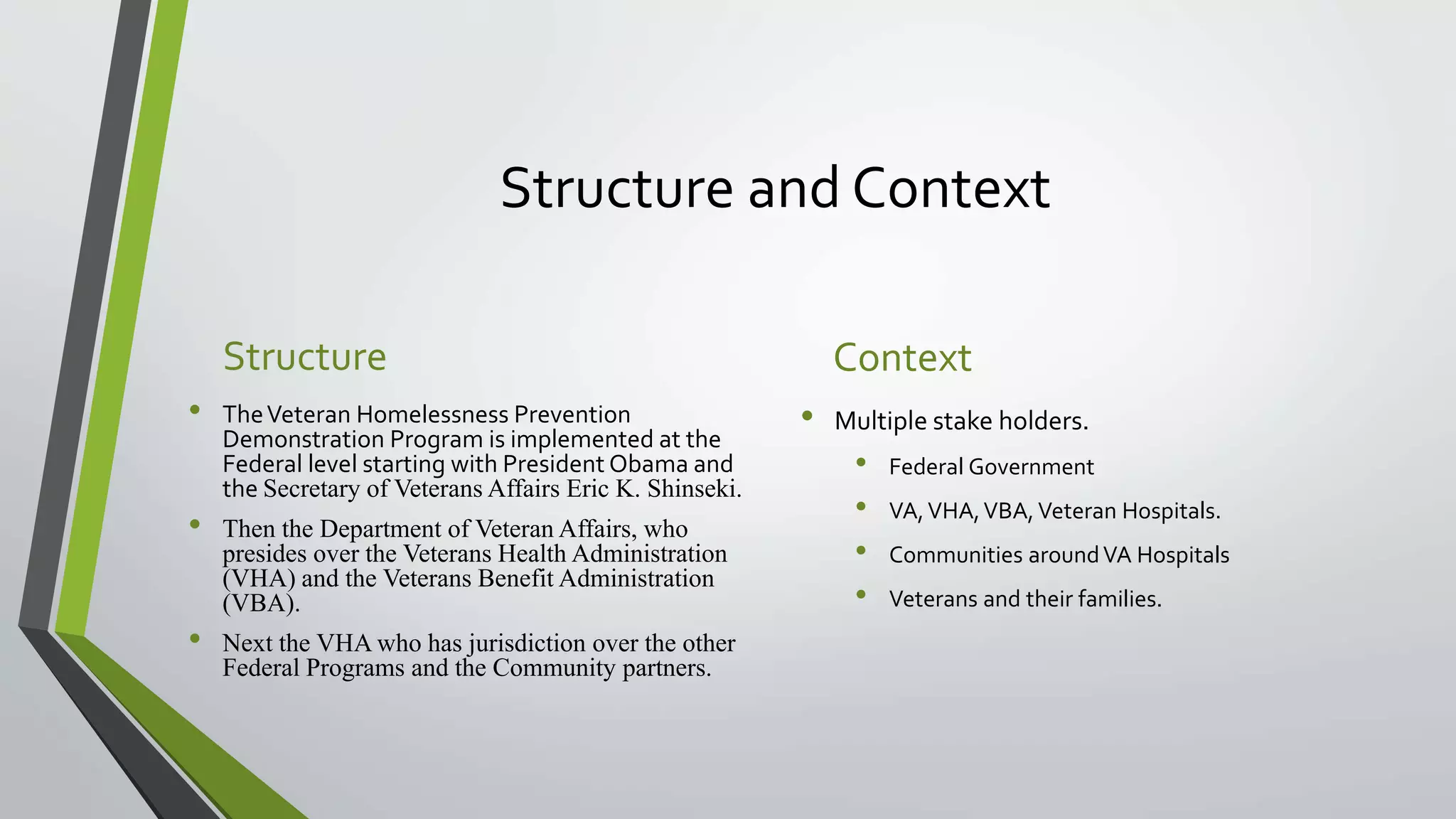
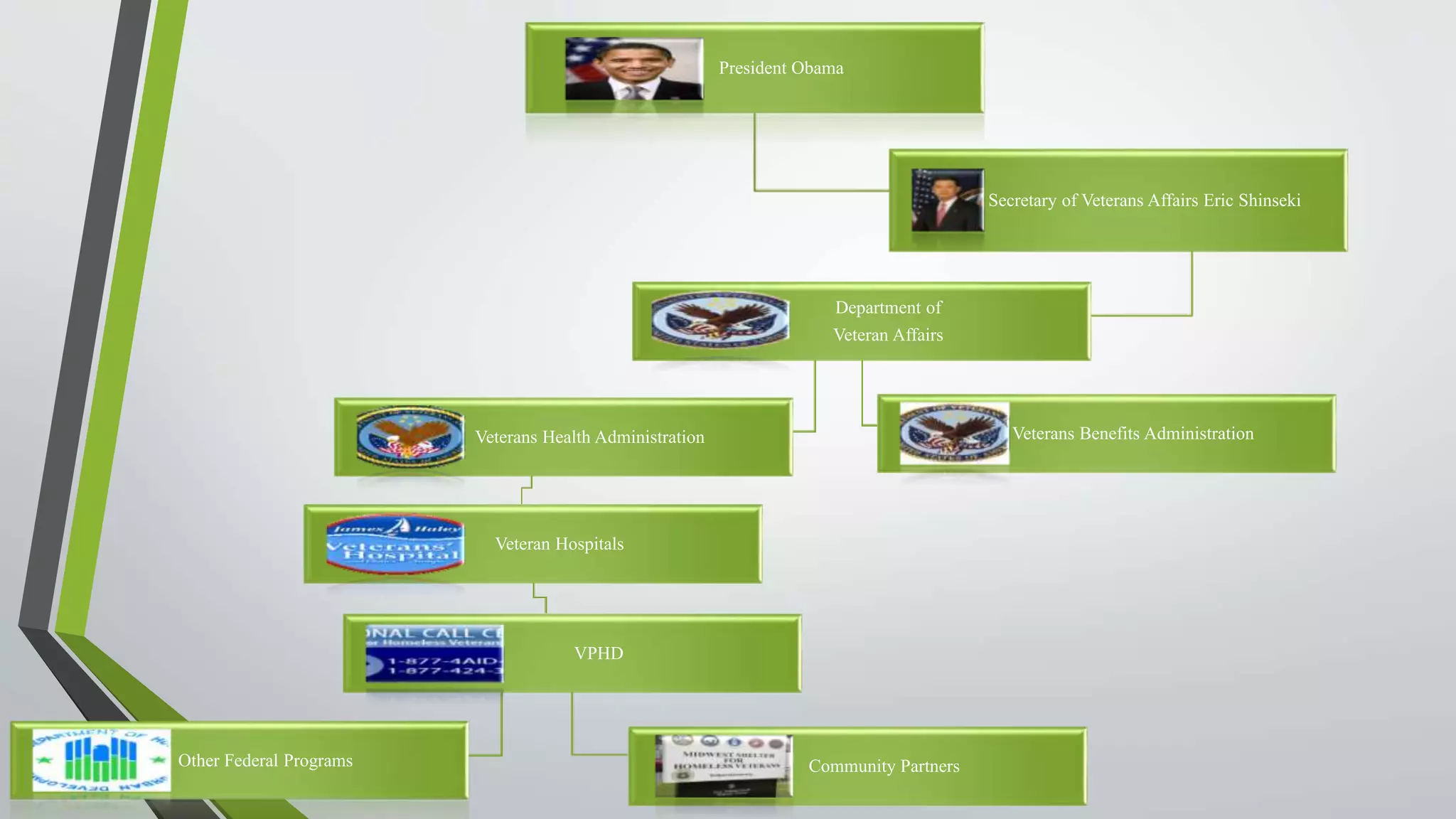
• TheVeteran Homelessness Prevention
Demonstration Program is implemented at the
Federal level starting with President Obama and
the Secretary of Veterans Affairs Eric K. Shinseki.
• Then the Department of Veteran Affairs, who
presides over the Veterans Health Administration
(VHA) and the Veterans Benefit Administration
(VBA).
• Next the VHA who has jurisdiction over the other
Federal Programs and the Community partners.
Context
• Multiple stake holders.
• Federal Government
• VA,VHA,VBA,Veteran Hospitals.
• Communities aroundVA Hospitals
• Veterans and their families.
President Obama
Secretary of Veterans Affairs Eric Shinseki
Department of
Veteran Affairs
Veterans Health Administration
Veteran Hospitals
VPHD
Community PartnersOther Federal Programs
Veterans Benefits Administration
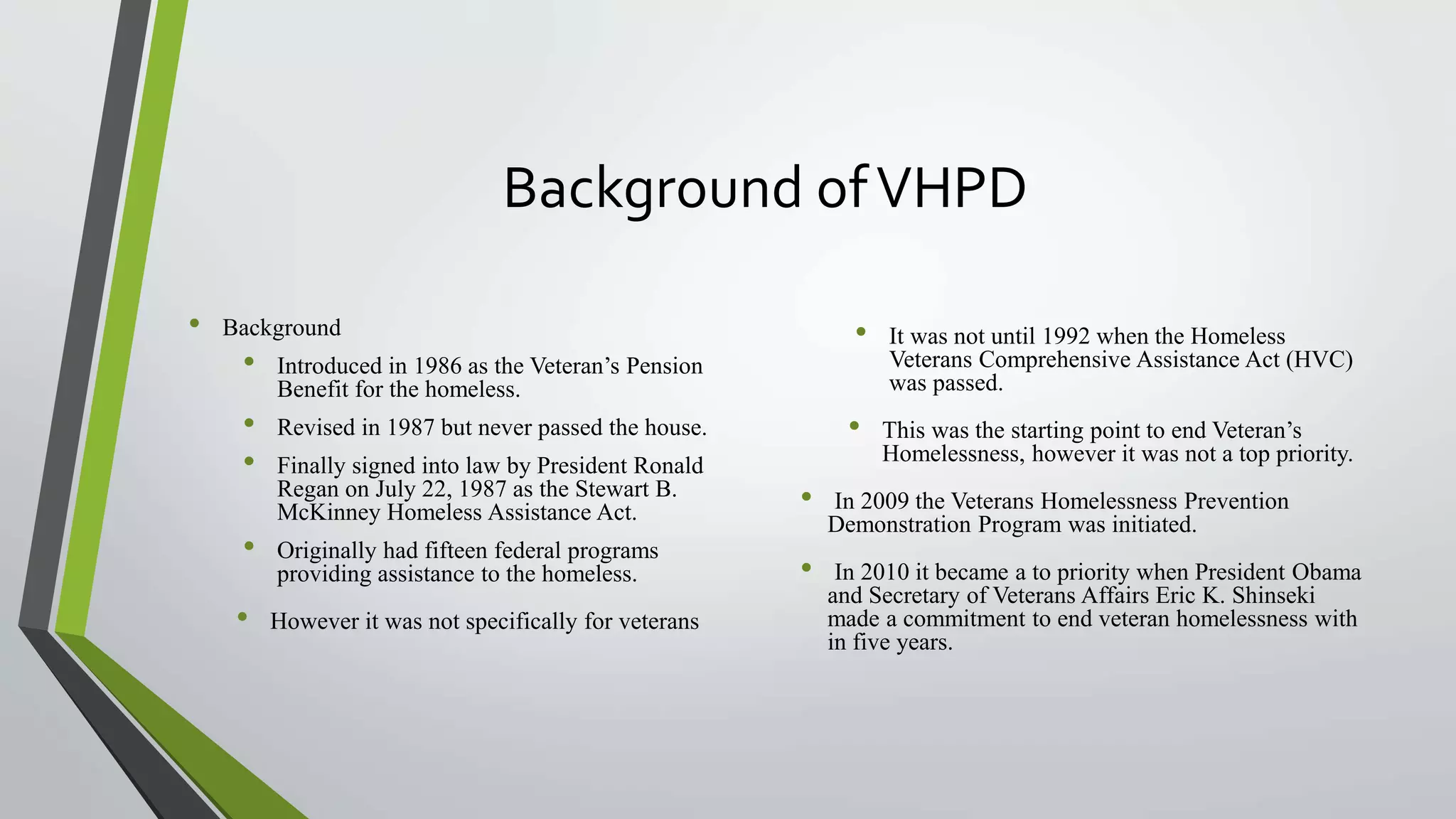
Background ofVHPD
• Background
• Introduced in 1986 as the Veteran’s Pension
Benefit for the homeless.
• Revised in 1987 but never passed the house.
• Finally signed into law by President Ronald
Regan on July 22, 1987 as the Stewart B.
McKinney Homeless Assistance Act.
• Originally had fifteen federal programs
providing assistance to the homeless.
• However it was not specifically for veterans
• It was not until 1992 when the Homeless
Veterans Comprehensive Assistance Act (HVC)
was passed.
• This was the starting point to end Veteran’s
Homelessness, however it was not a top priority.
• In 2009 the Veterans Homelessness Prevention
Demonstration Program was initiated.
• In 2010 it became a to priority when President Obama
and Secretary of Veterans Affairs Eric K. Shinseki
made a commitment to end veteran homelessness with
in five years.
Goals ofVHPD
• Finish the job of ending chronic homelessness in five years.
• Prevent and end homelessness amongVeterans in five years.
• Prevent and end homelessness for families, youth, and children in ten
years.
• Set a path to ending all types of homelessness.
• Lastly get everyone involved it is not just the Federal Governments job the
best ideas are often found outside Washington.
Goals of Evaluation
• Identify the most effective way to achieveVHPD’s ultimate goal.
• Ensure the success of endingVeterans Homelessness by utilizing the
information gathered to make recommendations to improve the program.
• Determine the effectiveness ofVPHD to ensure it will improve the quality of
life our NationsVeterans.
Evaluation Plan & Implementation
• The Logic Model
• Stakeholders
• Evaluation questions
• Methods to answer questions
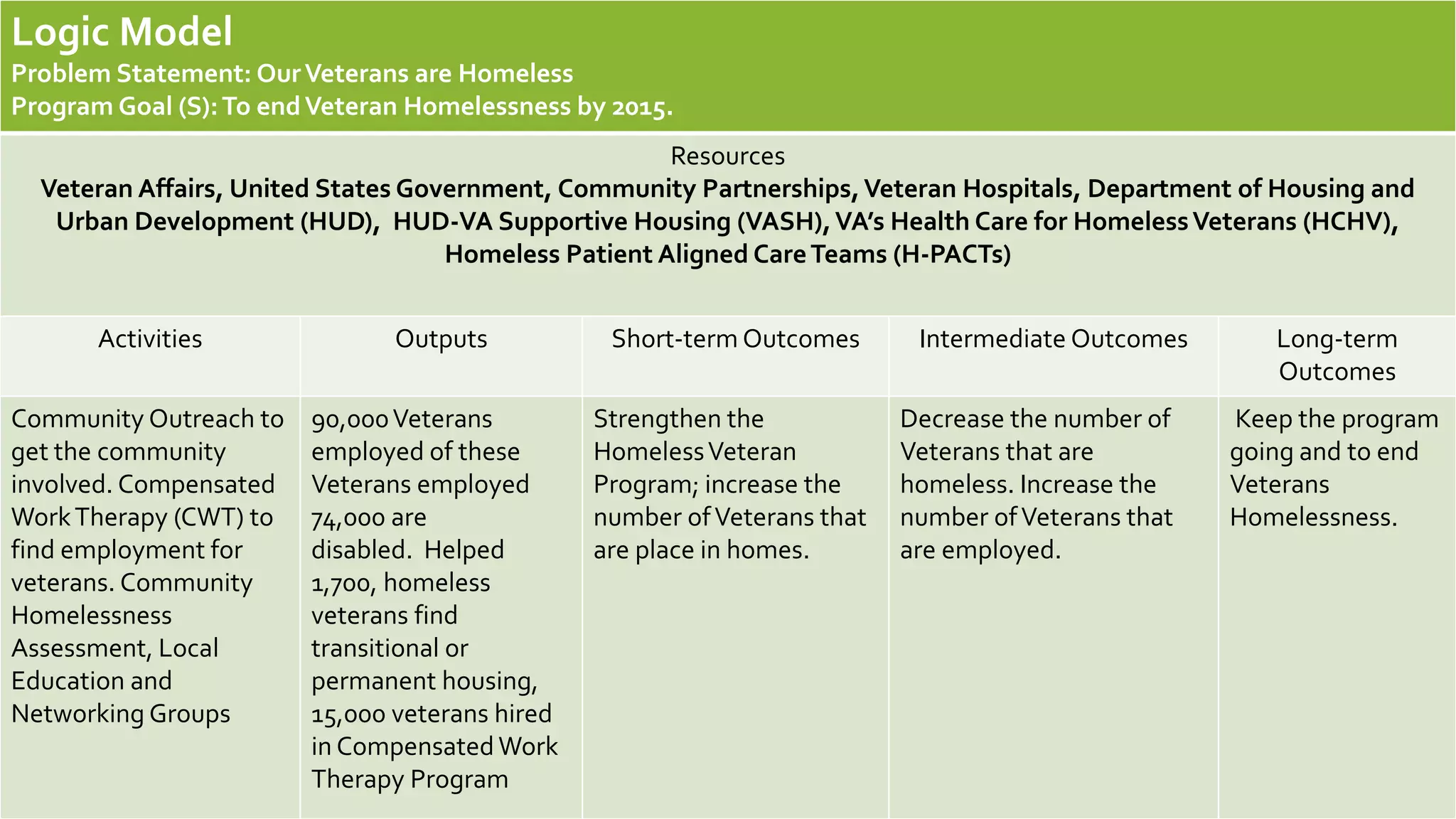
Logic Model
Problem Statement: OurVeterans are Homeless
Program Goal (S):To endVeteran Homelessness by 2015.
Resources
Veteran Affairs, United States Government, Community Partnerships,Veteran Hospitals, Department of Housing and
Urban Development (HUD), HUD-VA Supportive Housing (VASH),VA’s Health Care for HomelessVeterans (HCHV),
Homeless Patient Aligned CareTeams (H-PACTs)
Activities Outputs Short-term Outcomes Intermediate Outcomes Long-term
Outcomes
Community Outreach to
get the community
involved. Compensated
WorkTherapy (CWT) to
find employment for
veterans. Community
Homelessness
Assessment, Local
Education and
Networking Groups
90,000Veterans
employed of these
Veterans employed
74,000 are
disabled. Helped
1,700, homeless
veterans find
transitional or
permanent housing,
15,000 veterans hired
in Compensated Work
Therapy Program
Strengthen the
HomelessVeteran
Program; increase the
number ofVeterans that
are place in homes.
Decrease the number of
Veterans that are
homeless. Increase the
number ofVeterans that
are employed.
Keep the program
going and to end
Veterans
Homelessness.
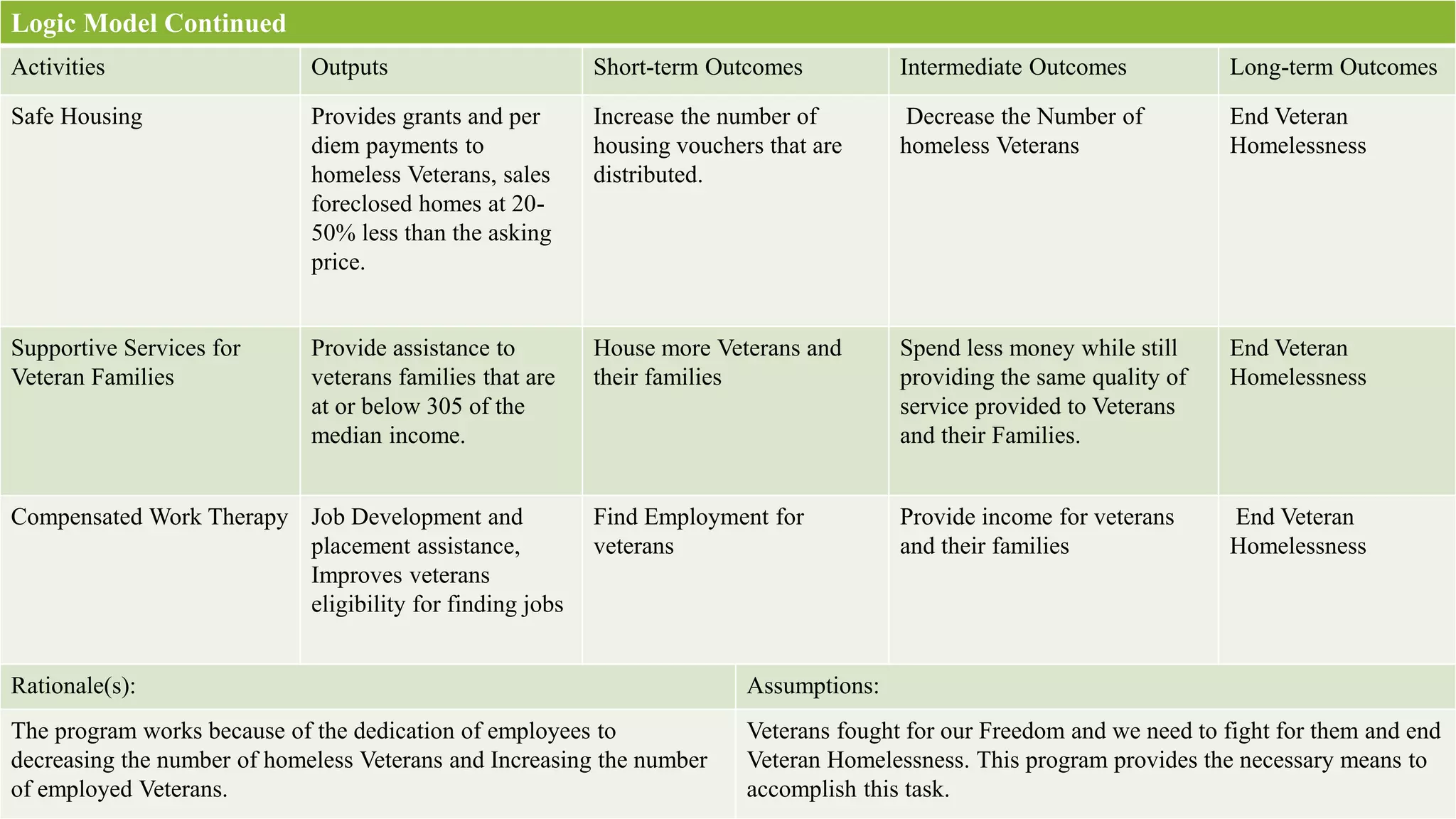
Logic Model Continued
Activities Outputs Short-term Outcomes Intermediate Outcomes Long-term Outcomes
Safe Housing Provides grants and per
diem payments to
homeless Veterans, sales
foreclosed homes at 20-
50% less than the asking
price.
Increase the number of
housing vouchers that are
distributed.
Decrease the Number of
homeless Veterans
End Veteran
Homelessness
Supportive Services for
Veteran Families
Provide assistance to
veterans families that are
at or below 305 of the
median income.
House more Veterans and
their families
Spend less money while still
providing the same quality of
service provided to Veterans
and their Families.
End Veteran
Homelessness
Compensated Work Therapy Job Development and
placement assistance,
Improves veterans
eligibility for finding jobs
Find Employment for
veterans
Provide income for veterans
and their families
End Veteran
Homelessness
Rationale(s): Assumptions:
The program works because of the dedication of employees to
decreasing the number of homeless Veterans and Increasing the number
of employed Veterans.
Veterans fought for our Freedom and we need to fight for them and end
Veteran Homelessness. This program provides the necessary means to
accomplish this task.
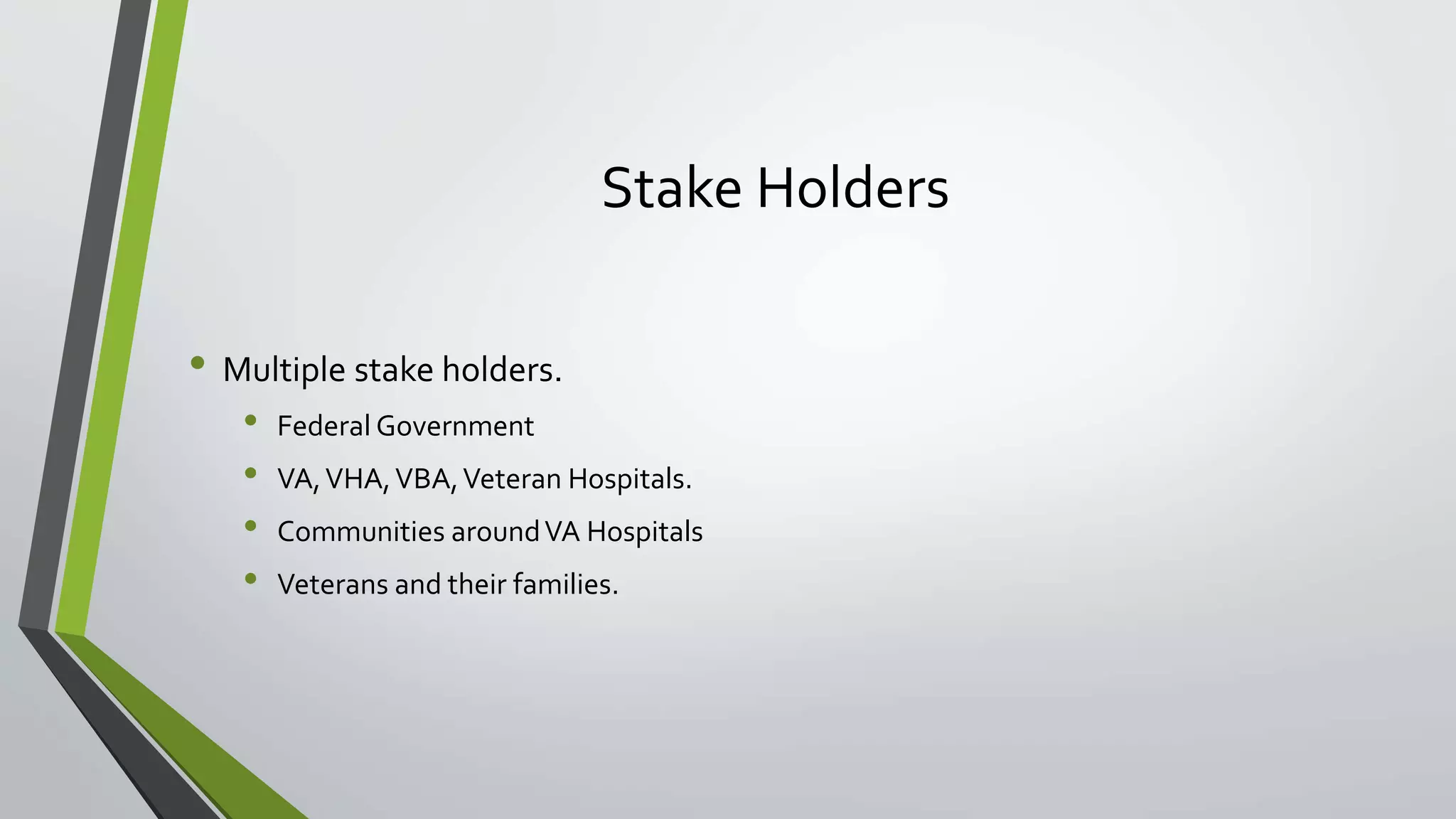
Stake Holders
• Multiple stake holders.
• Federal Government
• VA,VHA,VBA,Veteran Hospitals.
• Communities aroundVA Hospitals
• Veterans and their families.
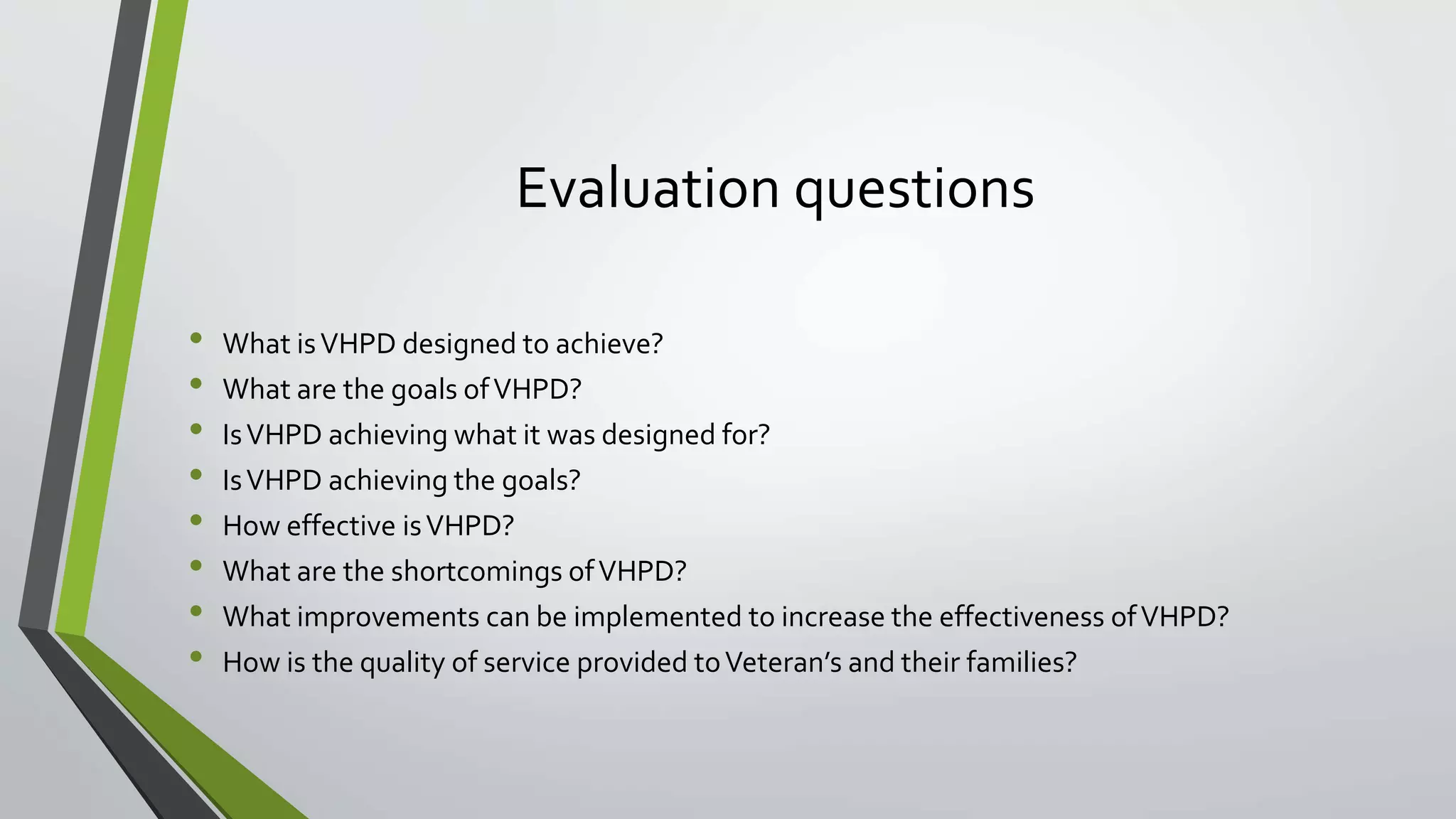
Evaluation questions
• What isVHPD designed to achieve?
• What are the goals ofVHPD?
• IsVHPD achieving what it was designed for?
• IsVHPD achieving the goals?
• How effective isVHPD?
• What are the shortcomings ofVHPD?
• What improvements can be implemented to increase the effectiveness ofVHPD?
• How is the quality of service provided toVeteran’s and their families?
Methods
• A literature will be conducted that includes;
• Reports to Congress and Articles on the Department ofVeteranAffairsWebsite.
• Behavioral Objectives Approach;That focuses on the degree to which the
VHPD is achieving the objectives.
• A Change/Longitudinal Design Evaluations; will be used to determine the
impact theVHPD has on homeless veterans versus the general population
and determine the effects ofVHPD over time.
Data Collection & Reporting Results
• How will data be collected.
• How results will be reported.
• Measures used to assess the evaluation’s effectiveness.
Data Collection
• Data will be collected through literature reviews of;
• 2010 Annual Homeless Assessment Report (AHAR) to Congress
• 2012 Housing Inventory Count and Point-in-Time Count of Homeless
Persons Data Collection Guidance
• Opening Doors Federal Strategic Plan to Prevent and End Homelessness
2010
Reporting the Results
• Results will be reported through writing a paper and class presentation to a
graduate level class on the evaluation.
Measurements for Assessing
the Effectiveness
• A Paired SampleT-Test
• Independent SampleT-Test
Conclusion
• According to the dataVHPD program appears to be effective.
• The number of homeless decreased from 2009 to 2010 in all areas.
• Enhancements to the program could include increasing awareness and substance abuse class.
• According to the statics in the paired sample t-test the there is a 95% confidence interval.
• TheVHPD program is effective because it is fulfilling the objectives and goal that it was
designed to complete.
• With the rateVHPD is decreasing the number of homeless veterans it is on track to end
homeliness for veterans.
Questions?

Homeless Presentation

  • 1.
    How Effective istheVeterans Homelessness Prevention Demonstration Program (VHPD)? Daniel Scott MAS 625 April 24th 2013
  • 2.
    Needs Assessment Purpose ofEvaluation • Determine the effectiveness if the current programs and strategies thatVHPD utilize are working towards endingVeteran Homelessness. • Determining the effectiveness ofVHPD is a key factor in the quality of life our NationsVeterans will live. • Identifying the numerous programs created and funded by theVeterans HealthAdministration section of the Department ofVeteran Affairs. • Identifying the most effective way to end Veterans Homelessness will improve the quality of life for our NationsVeterans. • Ultimately ensuring the success of theVeterans Homelessness Prevention Demonstration Program. • Determine any shortcomings inVHPD to that indicate the need for enhancement to the program.
  • 3.
    Structure and Context Structure •TheVeteran Homelessness Prevention Demonstration Program is implemented at the Federal level starting with President Obama and the Secretary of Veterans Affairs Eric K. Shinseki. • Then the Department of Veteran Affairs, who presides over the Veterans Health Administration (VHA) and the Veterans Benefit Administration (VBA). • Next the VHA who has jurisdiction over the other Federal Programs and the Community partners. Context • Multiple stake holders. • Federal Government • VA,VHA,VBA,Veteran Hospitals. • Communities aroundVA Hospitals • Veterans and their families.
  • 4.
    President Obama Secretary ofVeterans Affairs Eric Shinseki Department of Veteran Affairs Veterans Health Administration Veteran Hospitals VPHD Community PartnersOther Federal Programs Veterans Benefits Administration
  • 5.
    Background ofVHPD • Background •Introduced in 1986 as the Veteran’s Pension Benefit for the homeless. • Revised in 1987 but never passed the house. • Finally signed into law by President Ronald Regan on July 22, 1987 as the Stewart B. McKinney Homeless Assistance Act. • Originally had fifteen federal programs providing assistance to the homeless. • However it was not specifically for veterans • It was not until 1992 when the Homeless Veterans Comprehensive Assistance Act (HVC) was passed. • This was the starting point to end Veteran’s Homelessness, however it was not a top priority. • In 2009 the Veterans Homelessness Prevention Demonstration Program was initiated. • In 2010 it became a to priority when President Obama and Secretary of Veterans Affairs Eric K. Shinseki made a commitment to end veteran homelessness with in five years.
  • 6.
    Goals ofVHPD • Finishthe job of ending chronic homelessness in five years. • Prevent and end homelessness amongVeterans in five years. • Prevent and end homelessness for families, youth, and children in ten years. • Set a path to ending all types of homelessness. • Lastly get everyone involved it is not just the Federal Governments job the best ideas are often found outside Washington.
  • 7.
    Goals of Evaluation •Identify the most effective way to achieveVHPD’s ultimate goal. • Ensure the success of endingVeterans Homelessness by utilizing the information gathered to make recommendations to improve the program. • Determine the effectiveness ofVPHD to ensure it will improve the quality of life our NationsVeterans.
  • 8.
    Evaluation Plan &Implementation • The Logic Model • Stakeholders • Evaluation questions • Methods to answer questions
  • 9.
    Logic Model Problem Statement:OurVeterans are Homeless Program Goal (S):To endVeteran Homelessness by 2015. Resources Veteran Affairs, United States Government, Community Partnerships,Veteran Hospitals, Department of Housing and Urban Development (HUD), HUD-VA Supportive Housing (VASH),VA’s Health Care for HomelessVeterans (HCHV), Homeless Patient Aligned CareTeams (H-PACTs) Activities Outputs Short-term Outcomes Intermediate Outcomes Long-term Outcomes Community Outreach to get the community involved. Compensated WorkTherapy (CWT) to find employment for veterans. Community Homelessness Assessment, Local Education and Networking Groups 90,000Veterans employed of these Veterans employed 74,000 are disabled. Helped 1,700, homeless veterans find transitional or permanent housing, 15,000 veterans hired in Compensated Work Therapy Program Strengthen the HomelessVeteran Program; increase the number ofVeterans that are place in homes. Decrease the number of Veterans that are homeless. Increase the number ofVeterans that are employed. Keep the program going and to end Veterans Homelessness.
  • 10.
    Logic Model Continued ActivitiesOutputs Short-term Outcomes Intermediate Outcomes Long-term Outcomes Safe Housing Provides grants and per diem payments to homeless Veterans, sales foreclosed homes at 20- 50% less than the asking price. Increase the number of housing vouchers that are distributed. Decrease the Number of homeless Veterans End Veteran Homelessness Supportive Services for Veteran Families Provide assistance to veterans families that are at or below 305 of the median income. House more Veterans and their families Spend less money while still providing the same quality of service provided to Veterans and their Families. End Veteran Homelessness Compensated Work Therapy Job Development and placement assistance, Improves veterans eligibility for finding jobs Find Employment for veterans Provide income for veterans and their families End Veteran Homelessness Rationale(s): Assumptions: The program works because of the dedication of employees to decreasing the number of homeless Veterans and Increasing the number of employed Veterans. Veterans fought for our Freedom and we need to fight for them and end Veteran Homelessness. This program provides the necessary means to accomplish this task.
  • 11.
    Stake Holders • Multiplestake holders. • Federal Government • VA,VHA,VBA,Veteran Hospitals. • Communities aroundVA Hospitals • Veterans and their families.
  • 12.
    Evaluation questions • WhatisVHPD designed to achieve? • What are the goals ofVHPD? • IsVHPD achieving what it was designed for? • IsVHPD achieving the goals? • How effective isVHPD? • What are the shortcomings ofVHPD? • What improvements can be implemented to increase the effectiveness ofVHPD? • How is the quality of service provided toVeteran’s and their families?
  • 13.
    Methods • A literaturewill be conducted that includes; • Reports to Congress and Articles on the Department ofVeteranAffairsWebsite. • Behavioral Objectives Approach;That focuses on the degree to which the VHPD is achieving the objectives. • A Change/Longitudinal Design Evaluations; will be used to determine the impact theVHPD has on homeless veterans versus the general population and determine the effects ofVHPD over time.
  • 14.
    Data Collection &Reporting Results • How will data be collected. • How results will be reported. • Measures used to assess the evaluation’s effectiveness.
  • 15.
    Data Collection • Datawill be collected through literature reviews of; • 2010 Annual Homeless Assessment Report (AHAR) to Congress • 2012 Housing Inventory Count and Point-in-Time Count of Homeless Persons Data Collection Guidance • Opening Doors Federal Strategic Plan to Prevent and End Homelessness 2010
  • 16.
    Reporting the Results •Results will be reported through writing a paper and class presentation to a graduate level class on the evaluation.
  • 17.
    Measurements for Assessing theEffectiveness • A Paired SampleT-Test • Independent SampleT-Test
  • 18.
    Conclusion • According tothe dataVHPD program appears to be effective. • The number of homeless decreased from 2009 to 2010 in all areas. • Enhancements to the program could include increasing awareness and substance abuse class. • According to the statics in the paired sample t-test the there is a 95% confidence interval. • TheVHPD program is effective because it is fulfilling the objectives and goal that it was designed to complete. • With the rateVHPD is decreasing the number of homeless veterans it is on track to end homeliness for veterans.
  • 19.