Understanding the Sacrament of Confirmation
Sometimes words are not
enough.
A deeper sign or symbol
is needed.
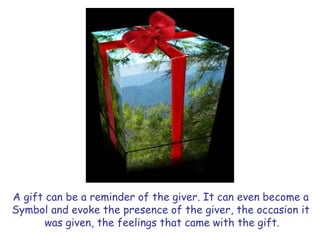
A gift can be a reminder of the giver. It can even become a
Symbol and evoke the presence of the giver, the occasion it
was given, the feelings that came with the gift.
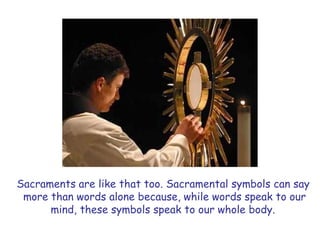
Sacraments are like that too. Sacramental symbols can say
more than words alone because, while words speak to our
mind, these symbols speak to our whole body.
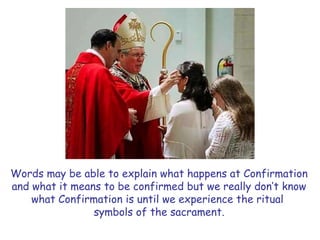
Words may be able to explain what happens at Confirmation
and what it means to be confirmed but we really don’t know
what Confirmation is until we experience the ritual
symbols of the sacrament.
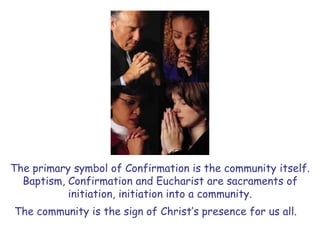
The primary symbol of Confirmation is the community itself.
Baptism, Confirmation and Eucharist are sacraments of
initiation, initiation into a community.
The community is the sign of Christ’s presence for us all.
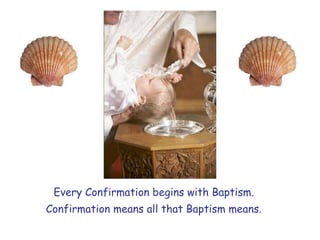
Every Confirmation begins with Baptism.
Confirmation means all that Baptism means.
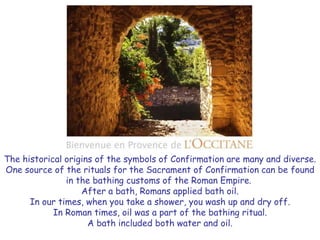
The historical origins of the symbols of Confirmation are many and diverse.
One source of the rituals for the Sacrament of Confirmation can be found
in the bathing customs of the Roman Empire.
After a bath, Romans applied bath oil.
In our times, when you take a shower, you wash up and dry off.
In Roman times, oil was a part of the bathing ritual.
A bath included both water and oil.
The water ritual (Baptism) came to mean the washing away of sin,
and the oil ritual (Confirmation) was interpreted to mean
the sweet fragrance of God’s presence: sanctifying grace.
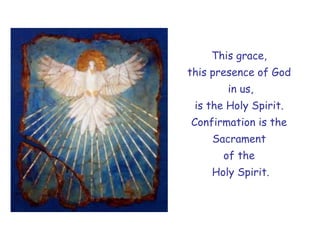
This grace,
this presence of God
in us,
is the Holy Spirit.
Confirmation is the
Sacrament
of the
Holy Spirit.
What are your memories of anointing?
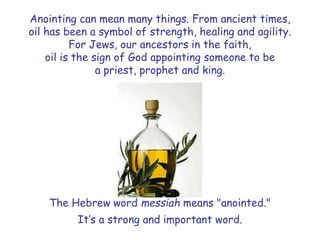
Anointing can mean many things. From ancient times,
oil has been a symbol of strength, healing and agility.
For Jews, our ancestors in the faith,
oil is the sign of God appointing someone to be
a priest, prophet and king.
The Hebrew word messiah means "anointed."
It’s a strong and important word.
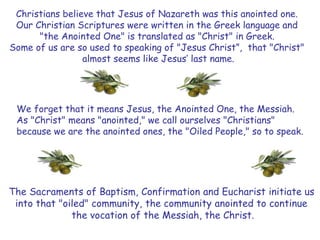
Christians believe that Jesus of Nazareth was this anointed one.
Our Christian Scriptures were written in the Greek language and
"the Anointed One" is translated as "Christ" in Greek.
Some of us are so used to speaking of "Jesus Christ”, that "Christ"
almost seems like Jesus’ last name.
We forget that it means Jesus, the Anointed One, the Messiah.
As "Christ" means "anointed," we call ourselves "Christians"
because we are the anointed ones, the "Oiled People," so to speak.
The Sacraments of Baptism, Confirmation and Eucharist initiate us
into that "oiled" community, the community anointed to continue
the vocation of the Messiah, the Christ.
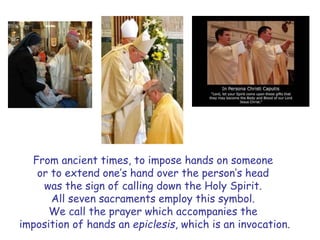
From ancient times, to impose hands on someone
or to extend one’s hand over the person’s head
was the sign of calling down the Holy Spirit.
All seven sacraments employ this symbol.
We call the prayer which accompanies the
imposition of hands an epiclesis, which is an invocation.
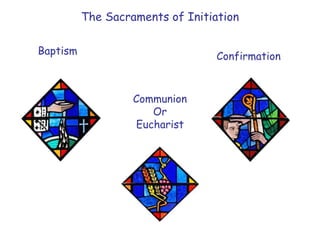
The Sacraments of Initiation
Baptism
Confirmation
Communion
Or
Eucharist
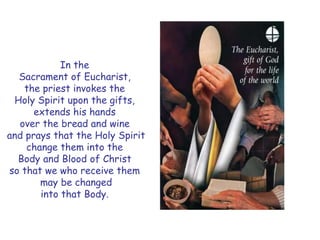
In the
Sacrament of Eucharist,
the priest invokes the
Holy Spirit upon the gifts,
extends his hands
over the bread and wine
and prays that the Holy Spirit
change them into the
Body and Blood of Christ
so that we who receive them
may be changed
into that Body.
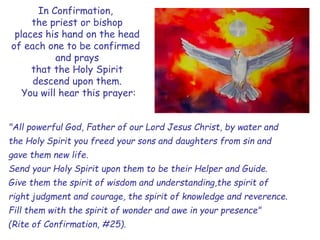
In Confirmation,
the priest or bishop
places his hand on the head
of each one to be confirmed
and prays
that the Holy Spirit
descend upon them.
You will hear this prayer:
"All powerful God, Father of our Lord Jesus Christ, by water and
the Holy Spirit you freed your sons and daughters from sin and
gave them new life.
Send your Holy Spirit upon them to be their Helper and Guide.
Give them the spirit of wisdom and understanding,the spirit of
right judgment and courage, the spirit of knowledge and reverence.
Fill them with the spirit of wonder and awe in your presence"
(Rite of Confirmation, #25).
The Seven Sacraments
This prayer asks for the graces which we have come to call
the seven gifts of the Holy Spirit.
The number seven is itself a symbol of completeness,
of boldness, of abundance.
When we say that there are seven sacraments,
we mean more than their number is one plus six.
Seven sacraments implies the abundance
of God’s love for us and
the all-sufficient nature of grace.
The words used in the rite are another symbol of Confirmation.
The words of the ceremony,
the readings from Scripture,
the homily,
the invitation of the presider,
the prayer for the sevenfold Spirit:
All of these can help us learn the meaning of the sacrament.
When you are anointed,
the presider first says your name and then says,
"Be sealed with the gift of the Holy Spirit."
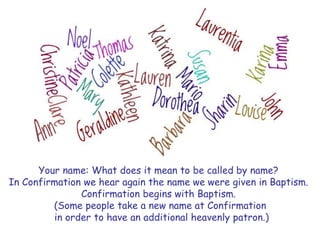
Your name: What does it mean to be called by name?
In Confirmation we hear again the name we were given in Baptism.
Confirmation begins with Baptism.
(Some people take a new name at Confirmation
in order to have an additional heavenly patron.)
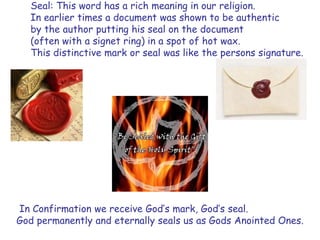
In Confirmation we receive God’s mark, God’s seal.
God permanently and eternally seals us as Gods Anointed Ones.
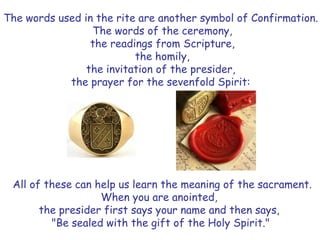
Seal: This word has a rich meaning in our religion.
In earlier times a document was shown to be authentic
by the author putting his seal on the document
(often with a signet ring) in a spot of hot wax.
This distinctive mark or seal was like the persons signature.
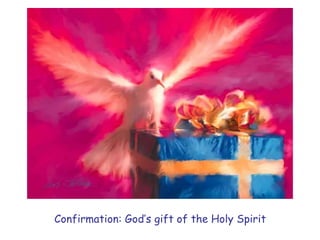
Confirmation: God’s gift of the Holy Spirit
St. Paul uses this analogy with the human body
to describe our relation with Christ.
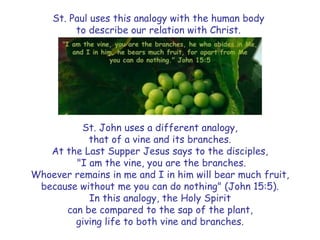
St. John uses a different analogy,
that of a vine and its branches.
At the Last Supper Jesus says to the disciples,
"I am the vine, you are the branches.
Whoever remains in me and I in him will bear much fruit,
because without me you can do nothing" (John 15:5).
In this analogy, the Holy Spirit
can be compared to the sap of the plant,
giving life to both vine and branches.
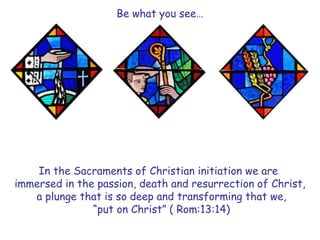
Be what you see…
In the Sacraments of Christian initiation we are
immersed in the passion, death and resurrection of Christ,
a plunge that is so deep and transforming that we,
“put on Christ” ( Rom:13:14)
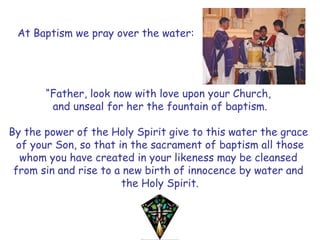
At Baptism we pray over the water:
“Father, look now with love upon your Church,
and unseal for her the fountain of baptism.
By the power of the Holy Spirit give to this water the grace
of your Son, so that in the sacrament of baptism all those
whom you have created in your likeness may be cleansed
from sin and rise to a new birth of innocence by water and
the Holy Spirit.
At Confirmation, we learn what this new life in the Spirit
implies:
“All-powerful God, Father of our Lord Jesus Christ,
by water and the Holy Spirit you freed your sons and
Daughters from sin and gave them new life.
Send your Holy Spirit upon them to be their helper and guide.
Give them the spirit of wisdom
and understanding,
the spirit
of right judgement
and courage,
the spirit of knowledge
and reverence.
Fill them with the spirit of wonder and awe in your presence.
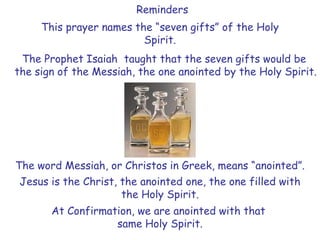
The Prophet Isaiah taught that the seven gifts would be
the sign of the Messiah, the one anointed by the Holy Spirit.
The word Messiah, or Christos in Greek, means “anointed”.
Jesus is the Christ, the anointed one, the one filled with
the Holy Spirit.
At Confirmation, we are anointed with that
same Holy Spirit.
This prayer names the “seven gifts” of the Holy
Spirit.
Reminders
At the actual anointing during Confirmation we hear the words
“Be sealed with the gift of the Holy Spirit.”
We are sealed by the gift which is the Holy Spirit.
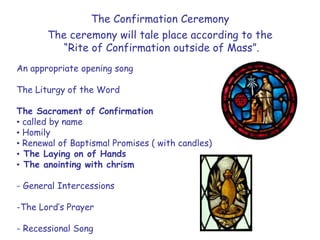
The Confirmation Ceremony
The ceremony will tale place according to the
“Rite of Confirmation outside of Mass”.
An appropriate opening song
The Liturgy of the Word
The Sacrament of Confirmation
• called by name
• Homily
• Renewal of Baptismal Promises ( with candles)
• The Laying on of Hands
• The anointing with chrism
- General Intercessions
-The Lord’s Prayer
- Recessional Song
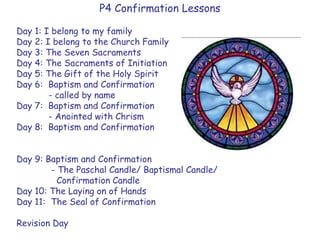
P4 Confirmation Lessons
Day 1: I belong to my family
Day 2: I belong to the Church Family
Day 3: The Seven Sacraments
Day 4: The Sacraments of Initiation
Day 5: The Gift of the Holy Spirit
Day 6: Baptism and Confirmation
- called by name
Day 7: Baptism and Confirmation
- Anointed with Chrism
Day 8: Baptism and Confirmation
Day 9: Baptism and Confirmation
- The Paschal Candle/ Baptismal Candle/
Confirmation Candle
Day 10: The Laying on of Hands
Day 11: The Seal of Confirmation
Revision Day
P4 Confirmation Lessons (Topics)
Our Families
The Church Family
The Seven Sacraments
The Sacraments of Initiation
The Gift of the Holy Spirit:
Pentecost, Baptism and Confirmation
Connections between Baptism and Confirmation:
Called by Name: Anointed with Chrism; Baptismal Promises;
Paschal Candle; Baptismal Candle; Confirmation Candle
Laying on of Hands
Sealed with the Gift of the Holy Spirit

confirmation_cpd_p4 (1).ppt

  • 1.
  • 2.
    Sometimes words arenot enough. A deeper sign or symbol is needed.
  • 3.
    A gift canbe a reminder of the giver. It can even become a Symbol and evoke the presence of the giver, the occasion it was given, the feelings that came with the gift.
  • 4.
    Sacraments are likethat too. Sacramental symbols can say more than words alone because, while words speak to our mind, these symbols speak to our whole body.
  • 5.
    Words may beable to explain what happens at Confirmation and what it means to be confirmed but we really don’t know what Confirmation is until we experience the ritual symbols of the sacrament.
  • 6.
    The primary symbolof Confirmation is the community itself. Baptism, Confirmation and Eucharist are sacraments of initiation, initiation into a community. The community is the sign of Christ’s presence for us all.
  • 7.
    Every Confirmation beginswith Baptism. Confirmation means all that Baptism means.
  • 8.
    The historical originsof the symbols of Confirmation are many and diverse. One source of the rituals for the Sacrament of Confirmation can be found in the bathing customs of the Roman Empire. After a bath, Romans applied bath oil. In our times, when you take a shower, you wash up and dry off. In Roman times, oil was a part of the bathing ritual. A bath included both water and oil.
  • 9.
    The water ritual(Baptism) came to mean the washing away of sin, and the oil ritual (Confirmation) was interpreted to mean the sweet fragrance of God’s presence: sanctifying grace.
  • 10.
    This grace, this presenceof God in us, is the Holy Spirit. Confirmation is the Sacrament of the Holy Spirit.
  • 11.
    What are yourmemories of anointing?
  • 12.
    Anointing can meanmany things. From ancient times, oil has been a symbol of strength, healing and agility. For Jews, our ancestors in the faith, oil is the sign of God appointing someone to be a priest, prophet and king. The Hebrew word messiah means "anointed." It’s a strong and important word.
  • 13.
    Christians believe thatJesus of Nazareth was this anointed one. Our Christian Scriptures were written in the Greek language and "the Anointed One" is translated as "Christ" in Greek. Some of us are so used to speaking of "Jesus Christ”, that "Christ" almost seems like Jesus’ last name. We forget that it means Jesus, the Anointed One, the Messiah. As "Christ" means "anointed," we call ourselves "Christians" because we are the anointed ones, the "Oiled People," so to speak. The Sacraments of Baptism, Confirmation and Eucharist initiate us into that "oiled" community, the community anointed to continue the vocation of the Messiah, the Christ.
  • 14.
    From ancient times,to impose hands on someone or to extend one’s hand over the person’s head was the sign of calling down the Holy Spirit. All seven sacraments employ this symbol. We call the prayer which accompanies the imposition of hands an epiclesis, which is an invocation.
  • 15.
    The Sacraments ofInitiation Baptism Confirmation Communion Or Eucharist
  • 16.
    In the Sacrament ofEucharist, the priest invokes the Holy Spirit upon the gifts, extends his hands over the bread and wine and prays that the Holy Spirit change them into the Body and Blood of Christ so that we who receive them may be changed into that Body.
  • 17.
    In Confirmation, the priestor bishop places his hand on the head of each one to be confirmed and prays that the Holy Spirit descend upon them. You will hear this prayer: "All powerful God, Father of our Lord Jesus Christ, by water and the Holy Spirit you freed your sons and daughters from sin and gave them new life. Send your Holy Spirit upon them to be their Helper and Guide. Give them the spirit of wisdom and understanding,the spirit of right judgment and courage, the spirit of knowledge and reverence. Fill them with the spirit of wonder and awe in your presence" (Rite of Confirmation, #25).
  • 18.
    The Seven Sacraments Thisprayer asks for the graces which we have come to call the seven gifts of the Holy Spirit. The number seven is itself a symbol of completeness, of boldness, of abundance. When we say that there are seven sacraments, we mean more than their number is one plus six. Seven sacraments implies the abundance of God’s love for us and the all-sufficient nature of grace.
  • 19.
    The words usedin the rite are another symbol of Confirmation. The words of the ceremony, the readings from Scripture, the homily, the invitation of the presider, the prayer for the sevenfold Spirit: All of these can help us learn the meaning of the sacrament. When you are anointed, the presider first says your name and then says, "Be sealed with the gift of the Holy Spirit."
  • 20.
    Your name: Whatdoes it mean to be called by name? In Confirmation we hear again the name we were given in Baptism. Confirmation begins with Baptism. (Some people take a new name at Confirmation in order to have an additional heavenly patron.)
  • 21.
    In Confirmation wereceive God’s mark, God’s seal. God permanently and eternally seals us as Gods Anointed Ones. Seal: This word has a rich meaning in our religion. In earlier times a document was shown to be authentic by the author putting his seal on the document (often with a signet ring) in a spot of hot wax. This distinctive mark or seal was like the persons signature.
  • 22.
    Confirmation: God’s giftof the Holy Spirit
  • 24.
    St. Paul usesthis analogy with the human body to describe our relation with Christ. St. John uses a different analogy, that of a vine and its branches. At the Last Supper Jesus says to the disciples, "I am the vine, you are the branches. Whoever remains in me and I in him will bear much fruit, because without me you can do nothing" (John 15:5). In this analogy, the Holy Spirit can be compared to the sap of the plant, giving life to both vine and branches.
  • 25.
    Be what yousee… In the Sacraments of Christian initiation we are immersed in the passion, death and resurrection of Christ, a plunge that is so deep and transforming that we, “put on Christ” ( Rom:13:14)
  • 26.
    At Baptism wepray over the water: “Father, look now with love upon your Church, and unseal for her the fountain of baptism. By the power of the Holy Spirit give to this water the grace of your Son, so that in the sacrament of baptism all those whom you have created in your likeness may be cleansed from sin and rise to a new birth of innocence by water and the Holy Spirit.
  • 27.
    At Confirmation, welearn what this new life in the Spirit implies: “All-powerful God, Father of our Lord Jesus Christ, by water and the Holy Spirit you freed your sons and Daughters from sin and gave them new life. Send your Holy Spirit upon them to be their helper and guide. Give them the spirit of wisdom and understanding, the spirit of right judgement and courage, the spirit of knowledge and reverence. Fill them with the spirit of wonder and awe in your presence.
  • 28.
    The Prophet Isaiahtaught that the seven gifts would be the sign of the Messiah, the one anointed by the Holy Spirit. The word Messiah, or Christos in Greek, means “anointed”. Jesus is the Christ, the anointed one, the one filled with the Holy Spirit. At Confirmation, we are anointed with that same Holy Spirit. This prayer names the “seven gifts” of the Holy Spirit. Reminders
  • 29.
    At the actualanointing during Confirmation we hear the words “Be sealed with the gift of the Holy Spirit.” We are sealed by the gift which is the Holy Spirit.
  • 30.
    The Confirmation Ceremony Theceremony will tale place according to the “Rite of Confirmation outside of Mass”. An appropriate opening song The Liturgy of the Word The Sacrament of Confirmation • called by name • Homily • Renewal of Baptismal Promises ( with candles) • The Laying on of Hands • The anointing with chrism - General Intercessions -The Lord’s Prayer - Recessional Song
  • 31.
    P4 Confirmation Lessons Day1: I belong to my family Day 2: I belong to the Church Family Day 3: The Seven Sacraments Day 4: The Sacraments of Initiation Day 5: The Gift of the Holy Spirit Day 6: Baptism and Confirmation - called by name Day 7: Baptism and Confirmation - Anointed with Chrism Day 8: Baptism and Confirmation Day 9: Baptism and Confirmation - The Paschal Candle/ Baptismal Candle/ Confirmation Candle Day 10: The Laying on of Hands Day 11: The Seal of Confirmation Revision Day
  • 32.
    P4 Confirmation Lessons(Topics) Our Families The Church Family The Seven Sacraments The Sacraments of Initiation The Gift of the Holy Spirit: Pentecost, Baptism and Confirmation Connections between Baptism and Confirmation: Called by Name: Anointed with Chrism; Baptismal Promises; Paschal Candle; Baptismal Candle; Confirmation Candle Laying on of Hands Sealed with the Gift of the Holy Spirit