Holt Social Studies
World History
Interactive Reader and Study Guide
Copyright © by Holt, Rinehart and Winston
All rights reserved. No part of this publication may be reproduced or transmitted in any form
or by any means, electronic or mechanical, including photocopy, recording, or any informa-
tion storage and retrieval system, without permission in writing from the publisher.
Teachers using HOLT SOCIAL STUDIES: WORLD HISTORY may photocopy complete pages
in sufficient quantities for classroom use only and not for resale.
HOLT and the “Owl Design” are trademarks licensed to Holt, Rinehart and Winston,
registered in the United States of America and/or other jurisdictions.
Printed in the United States of America
ISBN 0-03-042314-7
2 3 4 5 6 7 082 08 07 06 05
5671_MSH_IntActReaderSG_FM.indd ii5671_MSH_IntActReaderSG_FM.indd ii 6/29/05 6:33:51 PM6/29/05 6:33:51 PM
Copyright © by Holt, Rinehart and Winston. All rights reserved.
iii Interactive Reader and Study Guide
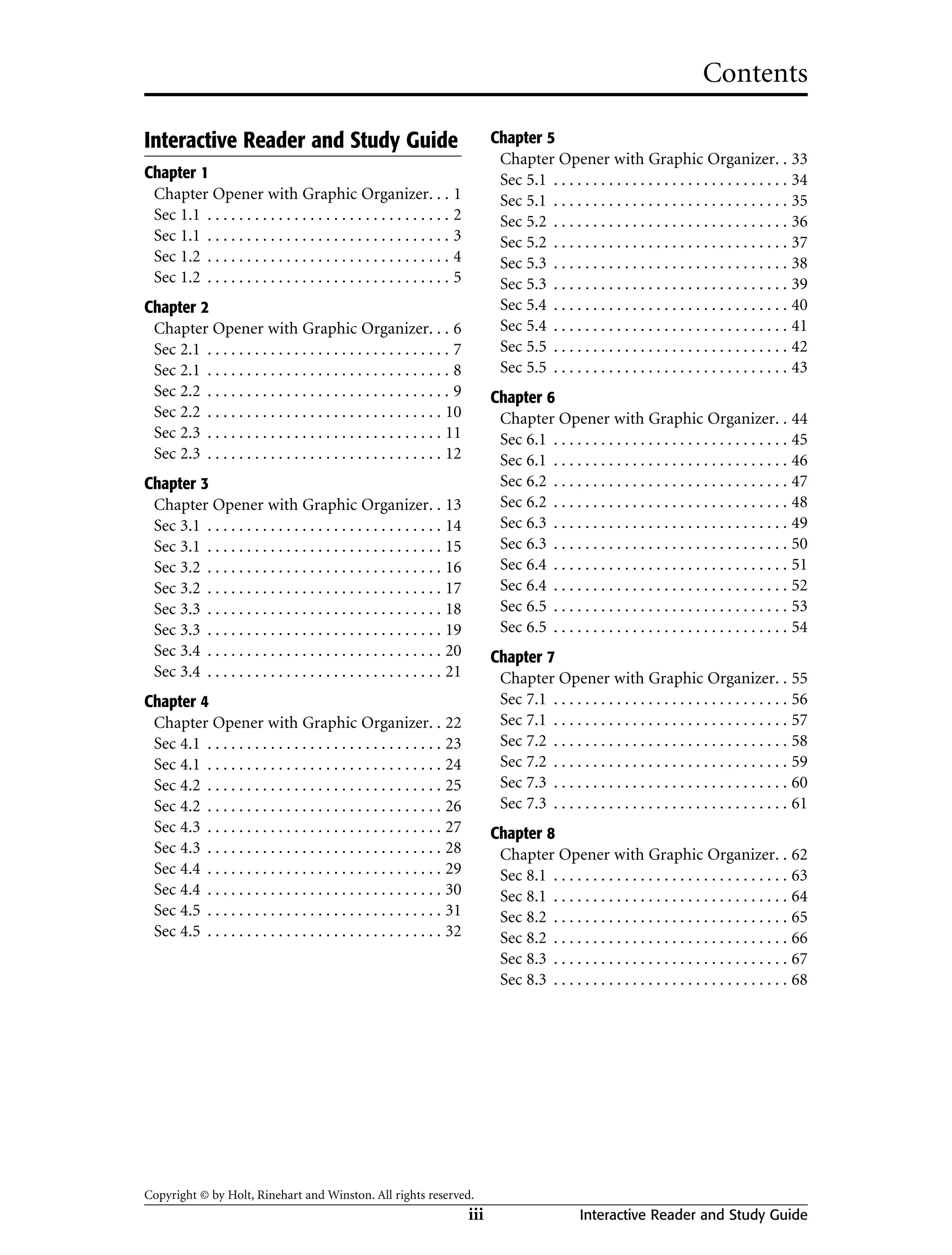
Contents
Interactive Reader and Study Guide
Chapter 1
Chapter Opener with Graphic Organizer. . . 1
Sec 1.1 . . . . . . . . . . . . . . . . . . . . . . . . . . . . . . . 2
Sec 1.1 . . . . . . . . . . . . . . . . . . . . . . . . . . . . . . . 3
Sec 1.2 . . . . . . . . . . . . . . . . . . . . . . . . . . . . . . . 4
Sec 1.2 . . . . . . . . . . . . . . . . . . . . . . . . . . . . . . . 5
Chapter 2
Chapter Opener with Graphic Organizer. . . 6
Sec 2.1 . . . . . . . . . . . . . . . . . . . . . . . . . . . . . . . 7
Sec 2.1 . . . . . . . . . . . . . . . . . . . . . . . . . . . . . . . 8
Sec 2.2 . . . . . . . . . . . . . . . . . . . . . . . . . . . . . . . 9
Sec 2.2 . . . . . . . . . . . . . . . . . . . . . . . . . . . . . . 10
Sec 2.3 . . . . . . . . . . . . . . . . . . . . . . . . . . . . . . 11
Sec 2.3 . . . . . . . . . . . . . . . . . . . . . . . . . . . . . . 12
Chapter 3
Chapter Opener with Graphic Organizer. . 13
Sec 3.1 . . . . . . . . . . . . . . . . . . . . . . . . . . . . . . 14
Sec 3.1 . . . . . . . . . . . . . . . . . . . . . . . . . . . . . . 15
Sec 3.2 . . . . . . . . . . . . . . . . . . . . . . . . . . . . . . 16
Sec 3.2 . . . . . . . . . . . . . . . . . . . . . . . . . . . . . . 17
Sec 3.3 . . . . . . . . . . . . . . . . . . . . . . . . . . . . . . 18
Sec 3.3 . . . . . . . . . . . . . . . . . . . . . . . . . . . . . . 19
Sec 3.4 . . . . . . . . . . . . . . . . . . . . . . . . . . . . . . 20
Sec 3.4 . . . . . . . . . . . . . . . . . . . . . . . . . . . . . . 21
Chapter 4
Chapter Opener with Graphic Organizer. . 22
Sec 4.1 . . . . . . . . . . . . . . . . . . . . . . . . . . . . . . 23
Sec 4.1 . . . . . . . . . . . . . . . . . . . . . . . . . . . . . . 24
Sec 4.2 . . . . . . . . . . . . . . . . . . . . . . . . . . . . . . 25
Sec 4.2 . . . . . . . . . . . . . . . . . . . . . . . . . . . . . . 26
Sec 4.3 . . . . . . . . . . . . . . . . . . . . . . . . . . . . . . 27
Sec 4.3 . . . . . . . . . . . . . . . . . . . . . . . . . . . . . . 28
Sec 4.4 . . . . . . . . . . . . . . . . . . . . . . . . . . . . . . 29
Sec 4.4 . . . . . . . . . . . . . . . . . . . . . . . . . . . . . . 30
Sec 4.5 . . . . . . . . . . . . . . . . . . . . . . . . . . . . . . 31
Sec 4.5 . . . . . . . . . . . . . . . . . . . . . . . . . . . . . . 32
Chapter 5
Chapter Opener with Graphic Organizer. . 33
Sec 5.1 . . . . . . . . . . . . . . . . . . . . . . . . . . . . . . 34
Sec 5.1 . . . . . . . . . . . . . . . . . . . . . . . . . . . . . . 35
Sec 5.2 . . . . . . . . . . . . . . . . . . . . . . . . . . . . . . 36
Sec 5.2 . . . . . . . . . . . . . . . . . . . . . . . . . . . . . . 37
Sec 5.3 . . . . . . . . . . . . . . . . . . . . . . . . . . . . . . 38
Sec 5.3 . . . . . . . . . . . . . . . . . . . . . . . . . . . . . . 39
Sec 5.4 . . . . . . . . . . . . . . . . . . . . . . . . . . . . . . 40
Sec 5.4 . . . . . . . . . . . . . . . . . . . . . . . . . . . . . . 41
Sec 5.5 . . . . . . . . . . . . . . . . . . . . . . . . . . . . . . 42
Sec 5.5 . . . . . . . . . . . . . . . . . . . . . . . . . . . . . . 43
Chapter 6
Chapter Opener with Graphic Organizer. . 44
Sec 6.1 . . . . . . . . . . . . . . . . . . . . . . . . . . . . . . 45
Sec 6.1 . . . . . . . . . . . . . . . . . . . . . . . . . . . . . . 46
Sec 6.2 . . . . . . . . . . . . . . . . . . . . . . . . . . . . . . 47
Sec 6.2 . . . . . . . . . . . . . . . . . . . . . . . . . . . . . . 48
Sec 6.3 . . . . . . . . . . . . . . . . . . . . . . . . . . . . . . 49
Sec 6.3 . . . . . . . . . . . . . . . . . . . . . . . . . . . . . . 50
Sec 6.4 . . . . . . . . . . . . . . . . . . . . . . . . . . . . . . 51
Sec 6.4 . . . . . . . . . . . . . . . . . . . . . . . . . . . . . . 52
Sec 6.5 . . . . . . . . . . . . . . . . . . . . . . . . . . . . . . 53
Sec 6.5 . . . . . . . . . . . . . . . . . . . . . . . . . . . . . . 54
Chapter 7
Chapter Opener with Graphic Organizer. . 55
Sec 7.1 . . . . . . . . . . . . . . . . . . . . . . . . . . . . . . 56
Sec 7.1 . . . . . . . . . . . . . . . . . . . . . . . . . . . . . . 57
Sec 7.2 . . . . . . . . . . . . . . . . . . . . . . . . . . . . . . 58
Sec 7.2 . . . . . . . . . . . . . . . . . . . . . . . . . . . . . . 59
Sec 7.3 . . . . . . . . . . . . . . . . . . . . . . . . . . . . . . 60
Sec 7.3 . . . . . . . . . . . . . . . . . . . . . . . . . . . . . . 61
Chapter 8
Chapter Opener with Graphic Organizer. . 62
Sec 8.1 . . . . . . . . . . . . . . . . . . . . . . . . . . . . . . 63
Sec 8.1 . . . . . . . . . . . . . . . . . . . . . . . . . . . . . . 64
Sec 8.2 . . . . . . . . . . . . . . . . . . . . . . . . . . . . . . 65
Sec 8.2 . . . . . . . . . . . . . . . . . . . . . . . . . . . . . . 66
Sec 8.3 . . . . . . . . . . . . . . . . . . . . . . . . . . . . . . 67
Sec 8.3 . . . . . . . . . . . . . . . . . . . . . . . . . . . . . . 68
Copyright © by Holt, Rinehart and Winston. All rights reserved.
iv Interactive Reader and Study Guide
Contents
Chapter 9
Chapter Opener with Graphic Organizer. . 69
Sec 9.1 . . . . . . . . . . . . . . . . . . . . . . . . . . . . . . 70
Sec 9.1 . . . . . . . . . . . . . . . . . . . . . . . . . . . . . . 71
Sec 9.2 . . . . . . . . . . . . . . . . . . . . . . . . . . . . . . 72
Sec 9.2 . . . . . . . . . . . . . . . . . . . . . . . . . . . . . . 73
Sec 9.3 . . . . . . . . . . . . . . . . . . . . . . . . . . . . . . 74
Sec 9.3 . . . . . . . . . . . . . . . . . . . . . . . . . . . . . . 75
Sec 9.4 . . . . . . . . . . . . . . . . . . . . . . . . . . . . . . 76
Sec 9.4 . . . . . . . . . . . . . . . . . . . . . . . . . . . . . . 77
Chapter 10
Chapter Opener with Graphic Organizer. . 78
Sec 10.1 . . . . . . . . . . . . . . . . . . . . . . . . . . . . . 79
Sec 10.1 . . . . . . . . . . . . . . . . . . . . . . . . . . . . . 80
Sec 10.2 . . . . . . . . . . . . . . . . . . . . . . . . . . . . . 81
Sec 10.2 . . . . . . . . . . . . . . . . . . . . . . . . . . . . . 82
Sec 10.3 . . . . . . . . . . . . . . . . . . . . . . . . . . . . . 83
Sec 10.3 . . . . . . . . . . . . . . . . . . . . . . . . . . . . . 84
Chapter 11
Chapter Opener with Graphic Organizer. . 85
Sec 11.1 . . . . . . . . . . . . . . . . . . . . . . . . . . . . . 86
Sec 11.1 . . . . . . . . . . . . . . . . . . . . . . . . . . . . . 87
Sec 11.2 . . . . . . . . . . . . . . . . . . . . . . . . . . . . . 88
Sec 11.2 . . . . . . . . . . . . . . . . . . . . . . . . . . . . . 89
Sec 11.3 . . . . . . . . . . . . . . . . . . . . . . . . . . . . . 90
Sec 11.3 . . . . . . . . . . . . . . . . . . . . . . . . . . . . . 91
Chapter 12
Chapter Opener with Graphic Organizer. . 92
Sec 12.1 . . . . . . . . . . . . . . . . . . . . . . . . . . . . . 93
Sec 12.1 . . . . . . . . . . . . . . . . . . . . . . . . . . . . . 94
Sec 12.2 . . . . . . . . . . . . . . . . . . . . . . . . . . . . . 95
Sec 12.2 . . . . . . . . . . . . . . . . . . . . . . . . . . . . . 96
Sec 12.3 . . . . . . . . . . . . . . . . . . . . . . . . . . . . . 97
Sec 12.3 . . . . . . . . . . . . . . . . . . . . . . . . . . . . . 98
Sec 12.4 . . . . . . . . . . . . . . . . . . . . . . . . . . . . . 99
Sec 12.4 . . . . . . . . . . . . . . . . . . . . . . . . . . . . 100
Chapter 13
Chapter Opener with Graphic Organizer. 101
Sec 13.1 . . . . . . . . . . . . . . . . . . . . . . . . . . . . 102
Sec 13.1 . . . . . . . . . . . . . . . . . . . . . . . . . . . . 103
Sec 13.2 . . . . . . . . . . . . . . . . . . . . . . . . . . . . 104
Sec 13.2 . . . . . . . . . . . . . . . . . . . . . . . . . . . . 105
Sec 13.3 . . . . . . . . . . . . . . . . . . . . . . . . . . . . 106
Sec 13.3 . . . . . . . . . . . . . . . . . . . . . . . . . . . . 107
Sec 13.4 . . . . . . . . . . . . . . . . . . . . . . . . . . . . 108
Sec 13.4 . . . . . . . . . . . . . . . . . . . . . . . . . . . . 109
Chapter 14
Chapter Opener with Graphic Organizer. 110
Sec 14.1 . . . . . . . . . . . . . . . . . . . . . . . . . . . . 111
Sec 14.1 . . . . . . . . . . . . . . . . . . . . . . . . . . . . 112
Sec 14.2 . . . . . . . . . . . . . . . . . . . . . . . . . . . . 113
Sec 14.2 . . . . . . . . . . . . . . . . . . . . . . . . . . . . 114
Sec 14.3 . . . . . . . . . . . . . . . . . . . . . . . . . . . . 115
Sec 14.3 . . . . . . . . . . . . . . . . . . . . . . . . . . . . 116
Sec 14.4 . . . . . . . . . . . . . . . . . . . . . . . . . . . . 117
Sec 14.4 . . . . . . . . . . . . . . . . . . . . . . . . . . . . 118
Chapter 15
Chapter Opener with Graphic Organizer. 119
Sec 15.1 . . . . . . . . . . . . . . . . . . . . . . . . . . . . 120
Sec 15.1 . . . . . . . . . . . . . . . . . . . . . . . . . . . . 121
Sec 15.2 . . . . . . . . . . . . . . . . . . . . . . . . . . . . 122
Sec 15.2 . . . . . . . . . . . . . . . . . . . . . . . . . . . . 123
Sec 15.3 . . . . . . . . . . . . . . . . . . . . . . . . . . . . 124
Sec 15.3 . . . . . . . . . . . . . . . . . . . . . . . . . . . . 125
Chapter 16
Chapter Opener with Graphic Organizer. 126
Sec 16.1 . . . . . . . . . . . . . . . . . . . . . . . . . . . . 127
Sec 16.1 . . . . . . . . . . . . . . . . . . . . . . . . . . . . 128
Sec 16.2 . . . . . . . . . . . . . . . . . . . . . . . . . . . . 129
Sec 16.2 . . . . . . . . . . . . . . . . . . . . . . . . . . . . 130
Sec 16.3 . . . . . . . . . . . . . . . . . . . . . . . . . . . . 131
Sec 16.3 . . . . . . . . . . . . . . . . . . . . . . . . . . . . 132
Chapter 17
Chapter Opener with Graphic Organizer. 133
Sec 17.1 . . . . . . . . . . . . . . . . . . . . . . . . . . . . 134
Sec 17.1 . . . . . . . . . . . . . . . . . . . . . . . . . . . . 135
Sec 17.2 . . . . . . . . . . . . . . . . . . . . . . . . . . . . 136
Sec 17.2 . . . . . . . . . . . . . . . . . . . . . . . . . . . . 137
Sec 17.3 . . . . . . . . . . . . . . . . . . . . . . . . . . . . 138
Sec 17.3 . . . . . . . . . . . . . . . . . . . . . . . . . . . . 139
Sec 17.4 . . . . . . . . . . . . . . . . . . . . . . . . . . . . 140
Sec 17.4 . . . . . . . . . . . . . . . . . . . . . . . . . . . . 141
Chapter 18
Chapter Opener with Graphic Organizer. 142
Sec 18.1 . . . . . . . . . . . . . . . . . . . . . . . . . . . . 143
Sec 18.1 . . . . . . . . . . . . . . . . . . . . . . . . . . . . 144
Sec 18.2 . . . . . . . . . . . . . . . . . . . . . . . . . . . . 145
Sec 18.2 . . . . . . . . . . . . . . . . . . . . . . . . . . . . 146
Sec 18.3 . . . . . . . . . . . . . . . . . . . . . . . . . . . . 147
Sec 18.3 . . . . . . . . . . . . . . . . . . . . . . . . . . . . 148
Sec 18.4 . . . . . . . . . . . . . . . . . . . . . . . . . . . . 149
Sec 18.4 . . . . . . . . . . . . . . . . . . . . . . . . . . . . 150
Sec 18.5 . . . . . . . . . . . . . . . . . . . . . . . . . . . . 151
Sec 18.5 . . . . . . . . . . . . . . . . . . . . . . . . . . . . 152
Copyright © by Holt, Rinehart and Winston. All rights reserved.
v Interactive Reader and Study Guide
Contents
Chapter 19
Chapter Opener with Graphic Organizer. 153
Sec 19.1 . . . . . . . . . . . . . . . . . . . . . . . . . . . . 154
Sec 19.1 . . . . . . . . . . . . . . . . . . . . . . . . . . . . 155
Sec 19.2 . . . . . . . . . . . . . . . . . . . . . . . . . . . . 156
Sec 19.2 . . . . . . . . . . . . . . . . . . . . . . . . . . . . 157
Sec 19.3 . . . . . . . . . . . . . . . . . . . . . . . . . . . . 158
Sec 19.3 . . . . . . . . . . . . . . . . . . . . . . . . . . . . 159
Chapter 20
Chapter Opener with Graphic Organizer. 160
Sec 20.1 . . . . . . . . . . . . . . . . . . . . . . . . . . . . 161
Sec 20.1 . . . . . . . . . . . . . . . . . . . . . . . . . . . . 162
Sec 20.2 . . . . . . . . . . . . . . . . . . . . . . . . . . . . 163
Sec 20.2 . . . . . . . . . . . . . . . . . . . . . . . . . . . . 164
Sec 20.3 . . . . . . . . . . . . . . . . . . . . . . . . . . . . 165
Sec 20.3 . . . . . . . . . . . . . . . . . . . . . . . . . . . . 166
Chapter 21
Chapter Opener with Graphic Organizer. 167
Sec 21.1 . . . . . . . . . . . . . . . . . . . . . . . . . . . . 168
Sec 21.1 . . . . . . . . . . . . . . . . . . . . . . . . . . . . 169
Sec 21.2 . . . . . . . . . . . . . . . . . . . . . . . . . . . . 170
Sec 21.2 . . . . . . . . . . . . . . . . . . . . . . . . . . . . 171
Sec 21.3 . . . . . . . . . . . . . . . . . . . . . . . . . . . . 172
Sec 21.3 . . . . . . . . . . . . . . . . . . . . . . . . . . . . 173
Chapter 22
Chapter Opener with Graphic Organizer. 174
Sec 22.1 . . . . . . . . . . . . . . . . . . . . . . . . . . . . 175
Sec 22.1 . . . . . . . . . . . . . . . . . . . . . . . . . . . . 176
Sec 22.2 . . . . . . . . . . . . . . . . . . . . . . . . . . . . 177
Sec 22.2 . . . . . . . . . . . . . . . . . . . . . . . . . . . . 178
Sec 22.3 . . . . . . . . . . . . . . . . . . . . . . . . . . . . 179
Sec 22.3 . . . . . . . . . . . . . . . . . . . . . . . . . . . . 180
Chapter 23
Chapter Opener with Graphic Organizer. 181
Sec 23.1 . . . . . . . . . . . . . . . . . . . . . . . . . . . . 182
Sec 23.1 . . . . . . . . . . . . . . . . . . . . . . . . . . . . 183
Sec 23.2 . . . . . . . . . . . . . . . . . . . . . . . . . . . . 184
Sec 23.2 . . . . . . . . . . . . . . . . . . . . . . . . . . . . 185
Sec 23.3 . . . . . . . . . . . . . . . . . . . . . . . . . . . . 186
Sec 23.3 . . . . . . . . . . . . . . . . . . . . . . . . . . . . 187
Copyright © by Holt, Rinehart and Winston. All rights reserved.
vi Interactive Reader and Study Guide
The Interactive Reader and Study Guide was developed to help you get the most from your world
history course. Using this book will help you master the content of the course while developing
your reading and vocabulary skills. Reviewing the next few pages before getting started will make
you aware of the many useful features of this book.
Chapter Summary pages help you connect with the big picture. Studying them will keep you
focused on the information you will need to be successful on your exams.
Name Class Date
CHAPTER SUMMARY
COMPREHENSION AND CRITICAL THINKING
Use the answers to the following questions to fill in the graphic
organizer above.
1. Explain How is modern society similar to Ancient Greece? How is it different?
2. Identify Cause and Effect When and why did the Greeks form city-states?
3. Evaluate How did democracy first develop in Athens?
4. Draw a Conclusion How did mythology influence the daily lives of Greeks?
Ancient Greece
Copyright © by Holt, Rinehart and Winston. All rights reserved.
62 Interactive Reader and Study Guide
Ancient Greece
mythology
literature
a union of
states
United States
Comparing Important
Elements of Culture
5394_IntActReaderSG_Ch08.indd 62 3/25/05 1:38:22 PM
Name Class Date
CHAPTER SUMMARY
Aryan invasion of Indus
and Ganges
led to
development of the
caste system
unification of India
into empires
led to stability and prosperity
development of religion led to
changes in roles of early
Indian kings
stability of early
Indian empires
led to
advances in arts
and sciences
Ancient India
5394_IntActReaderSG_Ch05.indd 33 3/25/05 1:18:43 PM
How to Use This Book
Graphic organizers help you to
summarize each chapter.
• Some have blanks you will need
to fill.
• Others have been completed
for you.
Either way, they are a valuable
study tool to help you prepare for
important tests.
Answering each question will help
you to understand the graphic
organizer and ensure that you fully
comprehend the content from the
chapter.
5671_MSH_IntActReaderSG_FM.indd vi5671_MSH_IntActReaderSG_FM.indd vi 6/29/05 6:34:14 PM6/29/05 6:34:14 PM
Copyright © by Holt, Rinehart and Winston. All rights reserved.
vii Interactive Reader and Study Guide
Section Summary pages allow you to interact easily with the content and Key Terms from
each section.
Copyright © by Holt, Rinehart and Winston. All rights reserved.
40 Interactive Reader and Study Guide
Name Class Date
Ancient India
Section 4
Key Terms and People
Candragupta Maurya Indian military leader who first unified India and founded the
Mauryan Empire
Asoka Candragupta’s grandson and last ruler of the Mauryan Empire
Candra Gupta II ruler who brought great prosperity and stability to India
Academic Vocabulary
establish to set up or create
Section Summary
MAURYAN EMPIRE UNIFIES INDIA
Under Aryan rule, India was divided into several
states with no central leader. Then, during the
300s BC, the conquests of Alexander the Great
brought much of India into his empire. An Indian
military leader named Candragupta Maurya
followed Alexander’s example and seized control
of the entire northern part of India. The Mauryan
Empire lasted for 150 years.
Candragupta’s complex government included
a huge army and a network of spies. He taxed the
population heavily for the protection he offered.
Eventually, Candragupta became a Jainist monk and
gave up his throne to his son. His family continued
to expand the Indian empire.
Candragupta’s grandson, Asoka, was the
strongest ruler of the Mauryan dynasty. The empire
thrived under his rule. But at last, tired of killing
and war, Asoka converted to Buddhism. He sent
Buddhist missionaries to other countries and
MAIN IDEAS
1. The Mauryan Empire unified most of India.
2. Gupta rulers promoted Hinduism within their empires.
What is the relationship between
Candragupta’s government and the
heavy taxes?
Who inspired Indian leader
Candragupta Maurya to unify India
for the first time?
5394_IntActReaderSG_Ch05.indd 40 3/25/05 1:22:51 PM
Main Ideas statements from your
textbook focus your attention as you
read the summaries.
Clearly labeled page headers make
navigating the book extraordinarily
simple.
The Key Terms and Academic
Vocabulary from the textbook are
provided with their definitions,
making studying them easier.
Headings under each section sum-
mary relate to each heading in the
textbook, making it easy for you to
find the material you need.
Simple summaries explain each
Main Idea in a way that is easy to
understand.
5671_MSH_IntActReaderSG_FM.indd vii5671_MSH_IntActReaderSG_FM.indd vii 6/29/05 6:34:36 PM6/29/05 6:34:36 PM
Copyright © by Holt, Rinehart and Winston. All rights reserved.
viii Interactive Reader and Study Guide
Notes throughout the margins help you to interact with the content and understand the
information you are reading.
Challenge Activities following each section will bring the material to life and further develop
your analysis skills.
Copyright © by Holt, Rinehart and Winston. All rights reserved.
41 Interactive Reader and Study Guide
Name Class Date
Section 4, continued
devoted the rest of his rule to improving the lives of
his people. The rest of the family, however, did not
follow Asoka’s example. When Asoka died, his
sons struggled for power and foreign invaders
threatened the country. The Mauryan Empire fell in
184 BC India remained divided for about 500 years.
The spread of Buddhism steadily increased, while
Hinduism declined.
GUPTA RULERS PROMOTE HINDUISM
A new dynasty was established in India. During
the 300s AD, the Gupta Dynasty once again rose
to unite and build the prosperity of India. Not only
did the Guptas control India’s military, they were
devout Hindus and encouraged the revival
of Hindu traditions and writings. The Guptas,
however, also supported Jainism and Buddhism.
Indian civilization reached a high point under
Candra Gupta II (not related to Candragupta
Maurya). He poured money and resources into
strengthening the country’s borders, as well as
promoting the arts, literature, and religion.
The Guptas believed the caste system supported
stability. This was not good for women, whose role
under the empire was very restricted. Women were
expected to marry, in weddings arranged by their
parents, and raise children. A woman had to obey
her husband and had few rights.
The Gupta Dynasty lasted until fierce attacks by
the Huns from Central Asia during the 400s drained
the empire of its resources. India broke up once
again into a patchwork of small states.
CHALLENGE ACTIVITY
Critical Thinking: Drawing Inferences Asoka was strongly influenced by
Buddhism. Candra Gupta II followed Hinduism. Write an essay
explaining which king you think was a better leader. How did their
religion affect their rule? Keep in mind the situation of Indian society
under both kings’ reign.
Which dynasty ruled over a
“golden age” of Indian civilization?
Asoka is sometimes regarded as
proof that national security can
coexist with peace. Do you think
a leader like Asoka could be
effective in the world today? Why
or why not?
Name two flaws, from a
democratic point of view, in Indian
civilization under the Guptas.
5394_IntActReaderSG_Ch05.indd 41 3/25/05 1:23:25 PM
Be sure to read all notes and answer
all of the questions in the margins.
They have been written specifically
to help you keep track of important
information. Your answers to these
questions will help you to study for
your tests.
The Key Terms and Academic
Vocabulary from your textbook have
been boldfaced, allowing you to find
and study them quickly.
Challenge Activities ask you to think
critically about the material from the
section. Completing each of these
exercises will increase your under-
standing of the material and develop
your analysis skills.
5671_MSH_IntActReaderSG_FM.indd viii5671_MSH_IntActReaderSG_FM.indd viii 6/29/05 6:35:00 PM6/29/05 6:35:00 PM
5671_MSH_IntActReaderSG_FM.indd ix5671_MSH_IntActReaderSG_FM.indd ix 6/29/05 6:35:22 PM6/29/05 6:35:22 PM
Copyright © by Holt, Rinehart and Winston. All rights reserved.
2 Interactive Reader and Study Guide
Name Class Date
Uncovering the Past
Section 1
Key Terms and People
history the study of the past
culture the knowledge, beliefs, customs, and values of a group of people
archaeology the study of the past based on what people left behind
fossil a part or imprint of something that was once alive
artifacts objects created by and used by humans
primary source an account of an event created by someone who took part in or
witnessed the event
secondary source information gathered by someone who did not take part in or
witness an event
Academic Vocabulary
values ideas that people hold dear and try to live by
Section Summary
THE STUDY OF THE PAST
History is the study of the past. Historians are
people who study history. Historians want to know
how people lived and why they did the things
they did. They try to learn about the problems
people faced and how they found solutions. They
are interested in how people lived their daily lives.
They study the past to understand people’s culture.
Culture is the knowledge, beliefs, customs, and
values of a group of people.
The study of the past based on what people left
behind is called archaeology (ahr-kee-AH-luh-jee).
MAIN IDEAS
1. History is the study of the past.
2. We can improve our understanding of people’s actions and beliefs through
the study of history.
3. Historians use clues from various sources to learn about the past.
What do we call people who study
how people lived in the past?
Copyright © by Holt, Rinehart and Winston. All rights reserved.
3 Interactive Reader and Study Guide
Name Class Date
Section 1, continued
Archaeologists explore places where people once
lived, worked, or fought. They examine the things
that people left in these places to learn what they
can tell about the past.
UNDERSTANDING THROUGH HISTORY
Understanding the past helps you understand the
world today. History can even teach you about
yourself. What if you did not know about your own
past? You would not know what makes you proud
about yourself. You would not know what mistakes
you should not repeat.
History is just as important for groups. What
would happen if countries had no record of their
past? People would not remember their nation’s
great triumphs or tragedies. History shapes our
identity and teaches us the values that we share.
History also teaches about cultures that are
unlike your own. Learning other people’s stories can
help you respect and understand different opinions.
You also learn to understand how today’s events are
shaped by events of the past. History encourages
you to ask important questions.
USING CLUES
We learn about history from a variety of sources.
Fossils, such as bones or footprints preserved in
rock, give us clues to life very long ago. Artifacts,
such as tools, coins, or pottery, also give us
information. Writing has taught us a great deal.
Writing can be a primary source (by someone who
took part in or witnessed an event) or a secondary
source (information gathered by someone who did
not take part in or witness an event).
CHALLENGE ACTIVITY
Critical Thinking: Drawing Inferences Imagine a tribe or group of
people that might have lived a long time ago. Write a short essay about
their culture.
How can studying history teach
you about yourself?
Circle the sentence that explains
why history helps you relate more
easily to people of different
backgrounds.
What sources give us clues to life
very long ago?
Copyright © by Holt, Rinehart and Winston. All rights reserved.
4 Interactive Reader and Study Guide
Name Class Date
Uncovering the Past
Section 2
Key Terms and People
geography the study of the earth’s physical and cultural features
environment all the living and nonliving things that affect life in an area
landforms the natural features of the land’s surface
climate the pattern of weather conditions in a certain area over a long period of time
region an area with one or more features that make it different from surrounding
areas
resources materials found in the earth that people need and value
Academic Vocabulary
features characteristics
Section Summary
STUDYING PLACES AND PEOPLE
To understand what happened in the past, you
need to know where events took place and who was
involved. That is why historians study the earth’s
physical and cultural features, such as mountains,
rivers, people, cities, and countries. This study is
called geography.
Geography has two main areas of study.
Physical geography is the study of the earth’s land
and features. Human geography is the study of
people and the places where they live. Physical
geographers study the environment, which includes
all the living and nonliving things that affect life in
an area. The most important features for physical
geographers are landforms, the natural features of
MAIN IDEAS
1. Geography is the study of places and people.
2. Studying location is important to both physical and human geography.
3. Geography and history are closely
connected.
What subject helps historians to
understand where events took
place?
What are the two main areas of
study in geography?
Copyright © by Holt, Rinehart and Winston. All rights reserved.
5 Interactive Reader and Study Guide
Name Class Date
Section 2, continued
the land’s surface. Physical geographers also study
climate, the weather conditions in a certain area
over a long period of time. Specialists in human
geography study many interesting questions about
how people and the environment affect each other.
STUDYING LOCATION
No two places are exactly alike. That is why
geographers try to understand how different
locations can affect human populations, or groups
of people. Geographers use maps to study and
compare locations. A map is a drawing of an area.
Some maps show physical features, such as
mountains, forests, and rivers. Other maps show
cities and the boundaries of states or countries.
Studying location is often helped by learning about
regions, or areas with one or more features that
make them different from surrounding areas.
GEOGRAPHY AND HISTORY
Geography gives us important clues about the
people and places that came before us. Like
detectives, we can piece together a great deal of
information about past cultures by knowing where
people lived and what the area was like.
Early people settled in places that were rich in
resources. Resources are materials that are found
in the earth that people need and value. Resources
include water, animals, land for farming, stone for
tools, and metals. Features and resources influence
the development of cultures and the growth of
civilizations. The relationship between geography
and people is not one sided. People influence their
environments in both positive and negative ways.
CHALLENGE ACTIVITY
Critical Thinking: Drawing Inferences Draw a map of an imaginary
country or region. Include features such as mountains, rivers, and cities.
What is climate?
What is the main tool that
geographers use to study and
compare locations?
Underline the sentence that
explains how geography gives us
clues about the past.
Name Class Date
CHAPTER SUMMARY
Need for food led to development of tools
Changes in climate patterns led to migrations
Need to communicate led to development of language
Farming communities led to growth of towns
COMPREHENSION AND CRITICAL THINKING
Use information from the graphic organizer to answer the following
questions.
1. Explain What were the earliest stone tools used for?
2. Identify Cause and Effect Why did so many people migrate during the ice ages?
3. Evaluate Why did hunter-gatherer societies develop language?
4. Draw a Conclusion How did farming contribute to the growth of towns?
The Stone Ages and Early Cultures
Copyright © by Holt, Rinehart and Winston. All rights reserved.
6 Interactive Reader and Study Guide
Copyright © by Holt, Rinehart and Winston. All rights reserved.
7 Interactive Reader and Study Guide
Name Class Date
The Stone Ages and Early Cultures
Section 1
Key Terms and People
prehistory the time before there was writing
hominid an early ancestor of humans
ancestor a relative who lived in the past
tool any handheld object that has been modified to help a person accomplish a task
Paleolithic Era the first part of the Stone Age
hunter-gatherers people who hunt animals and gather wild plants, seeds, fruits, and
nuts to survive
society a community of people who share a common culture
Academic Vocabulary
distribute to divide among a group of people
Section Summary
SCIENTISTS STUDY REMAINS
Although humans have lived on the earth for more
than a million years, writing was not invented until
about 5,000 years ago. Historians call the time
before there was writing prehistory. To study
prehistory, historians rely on the work of
archaeologists and anthropologists.
Archaeologists have found old bones that appear
to belong to hominids, early ancestors of humans.
Discoveries of ancient bones give us information
about early humans and their ancestors, but not all
scientists agree on the meaning of these discoveries.
MAIN IDEAS
1. Scientists study the remains of early humans to learn about prehistory.
2. Hominids and early humans first appeared in East Africa millions of years ago.
3. Stone Age tools grew more complex as time passed.
4. Hunter-gatherer societies developed language, art, and religion.
What do historians call the time
before there was writing?
Do you think that hominids are
the same as humans, or did they
come before humans?
Copyright © by Holt, Rinehart and Winston. All rights reserved.
8 Interactive Reader and Study Guide
Name Class Date
Section 1, continued
HOMINIDS AND EARLY HUMANS
As time passed hominids became more like modern
humans. Many scientists think that the first modern
humans appeared in Africa about 200,000 years ago.
Scientists call these early humans homo sapiens, or
“wise man.” Every person alive today belongs to
this group.
STONE AGE TOOLS
During the Paleolithic (pay-lee-uh-LI-thik) Era,
which lasted until about 10,000 years ago, people
used sharpened stones as tools. Stone tools were
probably used to cut, chop, and scrape roots,
bones, or meat. Later, people learned how to attach
wooden handles to sharp stones to make hand axes
and spears.
HUNTER-GATHERER SOCIETIES
Anthropologists believe that early humans lived
in small groups of hunter-gatherers. In these
societies, men hunted and women collected plants
to eat and took care of children. These societies
developed cultures with language, religion, and art.
Language developed as a means of communicating
and of resolving issues like how to distribute food.
CHALLENGE ACTIVITY
Critical Thinking: Drawing Inferences Many years from now, an
archaeologist discovers your house with nothing in it but old furniture,
appliances, tools, and bits of clothing. Write a short essay describing
some conclusions the archaeologist might draw from these artifacts.
What cultural element did Stone
Age societies develop as a means
of communicating and resolving
issues?
Can you think of an advantage to
attaching a wooden handle to a
stone tool? Draw a picture if it will
help you visualize the tool.
What do scientists call modern
humans?
Copyright © by Holt, Rinehart and Winston. All rights reserved.
9 Interactive Reader and Study Guide
Name Class Date
The Stone Ages and Early Cultures
Section 2
Key Terms and People
ice ages long periods of freezing weather
migrate move to a new place
land bridge a strip of land connecting two continents
Mesolithic Era the middle part of the Stone Age, from about 10,000 years ago to
about 5,000 years ago
Section Summary
PEOPLE MOVE OUT OF AFRICA
About 1.6 million years ago, many places around
the world began to experience ice ages, or long
periods of freezing weather. In response to these
changes, many hominids and early humans
migrated from Africa to Asia and eventually spread
to India, China, Southeast Asia, and Europe. The ice
ages ended about 10,000 years ago.
During the ice ages, huge sheets of ice covered
much of the earth’s land. These ice sheets were
formed from ocean water, leaving ocean levels
lower than they are now. Many areas that are now
under water were dry land then. Scientists think
that in some places the ocean level dropped and
exposed land bridges between continents. These
land bridges allowed Stone Age people to migrate
around the world. Early humans probably came to
North America across a land bridge from northern
Asia, and spread throughout North America and to
South America. By 9000 BC, humans lived on all
continents except Antarctica.
Use the library or an online
resource to find a map showing
the approximate dates and routes
of early human migrations.
MAIN IDEAS
1. People moved out of Africa as the earth’s climates changed.
2. People adapted to new environments by making clothing and new types of
tools.
From which continent did the first
early humans probably come to
North America?
Copyright © by Holt, Rinehart and Winston. All rights reserved.
10 Interactive Reader and Study Guide
Name Class Date
Section 2, continued
PEOPLE ADAPT TO NEW ENVIRONMENTS
Early people had to learn to adapt to new
environments. The places to which they migrated
were often much colder than the places they left,
and often had strange plants and animals.
To keep warm, they learned to sew animal skins
together to make clothing. At first they took shelter
in caves. When they moved to areas with no caves,
they built their own shelters. At first these shelters
were pits in the ground with roofs of branches and
leaves. Later, people learned to build more
permanent structures with wood, stone, clay, or
other materials, even bones from large animals
such as mammoths. They covered frames with
animal hides to form solid roofs and walls.
People also began to make new types of tools.
These tools were smaller and more complex than
tools from the Paleolithic Era. They defined the
Mesolithic (me-zuh-LI-thik) Era, which began
more than 10,000 years ago and lasted to about
5,000 years ago in some places. These new tools
included hooks and spears for fishing, and bows
and arrows for hunting.
People in the Mesolithic Era also developed new
technologies to improve their lives. For example,
they learned how to make pots from clay, how to
hollow out logs to make canoes, and how to use
dogs for protection and to help them hunt.
CHALLENGE ACTIVITY
Critical Thinking: Drawing Inferences Draw a building plan with
written instructions for a Mesolithic dwelling.
What materials did early humans
use to cover frame structures with
roofs and walls?
How did early humans make
canoes?
Copyright © by Holt, Rinehart and Winston. All rights reserved.
11 Interactive Reader and Study Guide
Name Class Date
The Stone Ages and Early Cultures
Section 3
Key Terms and People
Neolithic Era the last Stone Age, lasting from about 10,000 years ago to about 5,000
years ago in Egypt and Southwest Asia and later elsewhere
domestication the process of changing plants or animals to make them more useful
to humans
agriculture the development of farming from the domestication of plants
megaliths huge stones used as monuments or sites for religious gatherings
Academic Vocabulary
development creation and growth
Section Summary
THE FIRST FARMERS
A warming trend brought an end to the ice ages,
and new plants began to grow in some areas. As
early as 10,000 years ago, in Egypt and Southwest
Asia, people came to depend on wild barley and
wheat for food. People soon learned that they could
plant seeds to grow their own crops. This shift
from food gathering to food producing defined the
Neolithic (nee-uh-LI-thik) Era.
This domestication of plants led to the
development of agriculture, or farming. The first
farmers also learned to domesticate animals. Instead
of following wild herds, they could now keep sheep
and goats for milk, food, and wool. People could
also use large animals like cattle to carry loads or to
pull large tools used in farming. Domestication
Use the library or an online
resource to find a map showing
where specific plants and animals
were first domesticated.
MAIN IDEAS
1. The first farmers learned to grow plants and raise animals in the Stone Age.
2. Farming changed societies and the way people lived.
What brought an end to the
ice ages?
Copyright © by Holt, Rinehart and Winston. All rights reserved.
12 Interactive Reader and Study Guide
Name Class Date
Section 3, continued
greatly improved people’s chances of surviving.
With survival more certain, people could focus on
activities other than finding food.
During this time, people also learned to polish
stones to make specialized tools like saws and drills.
People also learned how to make fire. Before
learning that skill, peopel could use only fire that
had been started by natural causes, such as lightning.
FARMING CHANGES SOCIETIES
People began to make clothing from plant fibers
and wool as well as from animal skins. As these
early farmers learned to control their own food
production and to make better shelters and
clothing, populations grew. In some areas farming
communities developed into towns.
Some groups gathered to perform religious
ceremonies around huge stone monuments called
megaliths. These people probably believed in gods
and goddesses associated with the four elements—
air, water, fire, and earth—or with animals. Some
scholars believe that prehistoric people also prayed
to their ancestors. Some societies today still hold
these beliefs.
CHALLENGE ACTIVITY
Critical Thinking: Drawing Inferences Use the Internet or a library to
research theories about how the megaliths at Stonehenge in England
were built. Then write your own theory.
What great discovery did Neolithic
people make about fire?
What two materials were first
used by Neolithic people to make
clothing?
What are the four elements?
Name Class Date
CHAPTER SUMMARY
COMPREHENSION AND CRITICAL THINKING
Use information from the graphic organizer to answer the following
questions.
1. Identify Which two of the eight aspects of civilization in the graphic organizer
above can be classed as economic structures?
2. Interpret Of the following five words (ARTS, SILT, WRITING, TRADE, OIL),
which three belong in the graphic organizer above? Write the three correct words
in the empty circles.
3. Sequence Of the eleven words or phrases around the word CIVILIZATION,
which comes first in time order? Which do you think comes last?
Mesopotamia and the Fertile Crescent
Copyright © by Holt, Rinehart and Winston. All rights reserved.
13 Interactive Reader and Study Guide
CIVILIZATION
FARMING CITIES RELIGION
SOCIAL
HIERARCHY
INVENTION
MATH AND
SCIENCE
ARCHITECTURELAW
Copyright © by Holt, Rinehart and Winston. All rights reserved.
14 Interactive Reader and Study Guide
Name Class Date
Mesopotamia and the Fertile Crescent
Section 1
Key Terms and People
Fertile Crescent a large arc of rich farmland extending from the Persian Gulf to the
Mediterranean Sea
silt a mix of rich soil and small rocks
irrigation a way of supplying water to an area of land
canals human-made waterways
surplus more of something than is needed
division of labor an arrangement in which people specialize in specific tasks
Section Summary
RIVERS SUPPORT THE GROWTH OF CIVILIZATION
Early people settled where crops would grow.
Crops usually grew well near rivers, where water
was available and regular floods made the soil rich.
Mesopotamia, part of the region known as the
Fertile Crescent in Southwest Asia, lay between the
Tigris and Euphrates rivers. Every year, floods on
the rivers brought silt. The fertile silt made the land
ideal for farming.
Hunter-gatherer groups first settled in
Mesopotamia more than 12,000 years ago. Over time
these people learned how to work together to control
floods. They planted crops and grew their own food.
Farm settlements formed in Mesopotamia as
early as 7000 BC. Farmers grew wheat, barley, and
other grains. Livestock, birds, and fish were also
sources of food. Plentiful food led to population
growth and villages formed. Eventually, these early
villages developed into the world’s first civilization.
“Mesopotamia” means “between
the rivers” in Greek. To which two
rivers does the name of the region
refer?
MAIN IDEAS
1. The rivers of Southwest Asia supported the growth of civilization.
2. New farming techniques led to the growth of cities.
Name two grains grown by
Mesopotamian farmers.
Copyright © by Holt, Rinehart and Winston. All rights reserved.
15 Interactive Reader and Study Guide
Name Class Date
Section 1, continued
FARMING AND CITIES
Early farmers faced the challenge of learning how to
control the flow of river water to their fields in both
rainy and dry seasons. Flooding destroyed crops,
killed livestock, and washed away homes. When
water levels were too low, crops dried up.
To solve their problems, Mesopotamians used
irrigation. They dug out large storage basins to
hold water supplies. Then they dug canals that
connected these basins to a network of ditches.
These ditches brought water to the fields and
watered grazing areas for cattle and sheep.
Because irrigation made farmers more productive,
they produced a surplus. Some people became free
to do other jobs. For the first time, people became
craftspersons, religious leaders, and
government workers. A division of labor developed.
Mesopotamian settlements grew in size and
complexity. Most people continued to work in
farming jobs. However, cities became important
places. People traded goods in cities. Cities became
the political, religious, cultural, and economic
centers of Mesopotamian civilization.
CHALLENGE ACTIVITY
Critical Thinking: Drawing Inferences Write a proposal for an irrigation
system that will divert flood waters and benefit riverbank farmers.
Which places in Mesopotamia
became the centers of civilization?
Underline the sentence that lists
some of the problems caused by
flooding.
From where did the water collected
in the storage basins come?
Copyright © by Holt, Rinehart and Winston. All rights reserved.
16 Interactive Reader and Study Guide
Name Class Date
Mesopotamia and the Fertile Crescent
Section 2
Key Terms and People
rural having to do with the countryside
urban having to do with the city
city-state a political unit consisting of a city and the surrounding countryside
empire land with different territories and people under a single rule
polytheism the worship of many gods
priests people who performed religious ceremonies
social hierarchy a division of society by rank or class
Academic Vocabulary
role a part or function
Section Summary
AN ADVANCED SOCIETY
In southern Mesopotamia about 3000 BC, people
known as the Sumerians (soo-MER-ee-unz) created
a complex, advanced society. Most people in Sumer
(SOO-muhr) lived in rural areas, but they were
governed from urban areas that controlled the
surrounding countryside. The size of the
countryside controlled by each of these city-states
depended on its military strength. Stronger city-
states controlled larger areas. Individual city-states
gained and lost power over time.
Around 2300 BC Sargon was the leader of the
Akkadians (uh-KAY-dee-uhns), a people who lived to
the north of Sumer. Sargon built a large army
Why do you think governments
are usually located in cities?
MAIN IDEAS
1. The Sumerians created the world’s first complex, advanced society.
2. Religion played a major role in Sumerian society.
3. Sumerian society was divided into classes.
Copyright © by Holt, Rinehart and Winston. All rights reserved.
17 Interactive Reader and Study Guide
Name Class Date
Section 2, continued
and defeated all the city-states of Sumer as well
as all of northern Mesopotamia. With these
conquests, Sargon established the world’s first
empire. It stretched from the Persian Gulf to the
Mediterranean Sea. The Akkadian empire lasted
about 150 years.
RELIGION SHAPES SOCIETY
Religion played an important role in nearly
every aspect of Sumerian public and private life.
Sumerians practiced polytheism, the worship of
many gods. They believed that their gods had
enormous powers. Gods could bring a good harvest
or a disastrous flood. The gods could bring illness
or they could bring good health and wealth. The
Sumerians believed that success in every area of life
depended on pleasing the gods. Each city-state
considered one god to be its special protector.
People relied on priests to help them gain the gods’
favor. Priests interpreted the wishes of the gods and
made offerings to them.
A social hierarchy developed in Sumerian
city-states. Kings were at the top. Below them
were priests and nobles. The middle ranks included
skilled craftspeople and merchants. Farmers and
laborers made up the large working class. Slaves
were at the bottom of the social order. Although
the role of most women was limited to the home
and raising children, some upper-class women were
educated and even became priestesses.
CHALLENGE ACTIVITY
Critical Thinking: Drawing Inferences You are the king of a Sumerian
city-state. Write a letter to your priests asking them to make offerings
to the gods in order to protect your farms from a possible flood.
In Sumerian religious practice,
what did priests do to try to please
the gods?
Use a world atlas to determine
how many miles across the
Akkadian empire extended.
Do you think religion plays an
important role in public life today?
Why or why not?
Which two groups formed the
Sumerian upper classes?
Copyright © by Holt, Rinehart and Winston. All rights reserved.
18 Interactive Reader and Study Guide
Name Class Date
Mesopotamia and the Fertile Crescent
Section 3
Key Terms and People
cuneiform the Sumerian system of writing, which used symbols to represent basic
parts of words
pictographs picture symbols that represented objects such as trees or animals
scribe writer
epics long poems that tell the story of a hero
architecture the science of building
ziggurat a pyramid-shaped temple tower
Section Summary
THE INVENTION OF WRITING
The Sumerians made one of the greatest cultural
advances in history. They developed cuneiform
(kyoo-NEE-uh-fohrm), the world’s first system of
writing. But Sumerians did not have pencils, pens,
or paper. Instead, they used sharp reeds to make
wedge-shaped symbols on clay tablets.
Sumerians first used cuneiform to keep records
for business, government, and temples. As the use
of cuneiform grew, simple pictographs evolved into
more complex symbols that represented basic parts
of words. Writing was taught in schools. Becoming
a writer, or scribe, was a way to move up in social
class. Scribes began to combine symbols to express
complex ideas. In time, scribes wrote works on law,
grammar, and mathematics. Sumerians also wrote
stories, proverbs, songs, poems to celebrate military
victories, and long poems called epics.
Write the name of the world’s first
system of writing.
MAIN IDEAS
1. The Sumerians invented the world’s first writing system.
2. Advances and inventions changed Sumerian lives.
3. Many types of art developed in Sumer.
What are pictographs?
Copyright © by Holt, Rinehart and Winston. All rights reserved.
19 Interactive Reader and Study Guide
Name Class Date
Section 3, continued
ADVANCES AND INVENTIONS
The Sumerians were the first to build wheeled
vehicles like carts and wagons. They invented the
potter’s wheel, a device that spins wet clay as a
craftsperson shapes it into bowls. They invented the
ox-drawn plow and greatly improved farm
production. They built sewers under city streets.
They learned to use bronze to make strong tools and
weapons. They named thousands of animals, plants,
and minerals, and used them to produce healing
drugs. The clock and the calendar we use today are
based on Sumerian methods of measuring time.
THE ARTS OF SUMER
Sumerian remains reveal great skill in architecture.
A pyramid-shaped ziggurat dominated each city.
Most people lived in one-story houses with rooms
arranged around a small courtyard.
Sumerian art is renowned for sculpture and
jewelry. Sculptors created statues of gods for the
temples, and made small objects of ivory or rare
woods. Jewelers worked with imported gold, silver,
and fine stones. Earrings and other items found
in the region show that Sumerian jewelers knew
advanced methods for putting gold pieces together.
The Sumerians also developed a special art form
called the cylinder seal. The cylinder seal was a
small stone cylinder that was engraved with designs
and could be rolled over wet clay to decorate
containers or to “sign” documents.
Music played an important role in Sumerian
society. Musicians played stringed instruments,
reed pipes, drums, and tambourines both for
entertainment and for special occasions.
CHALLENGE ACTIVITY
Critical Thinking: Drawing Inferences Consider the invention of
writing and of the wheel. As you go through a normal day keep a list of
the things you do that rely on one or the other of these two inventions.
Name four types of musical
instruments played by Sumerians.
Which Sumerian invention greatly
improved farm production?
Underline the sentence that
describes the kind of houses in
which most Sumerians lived.
Copyright © by Holt, Rinehart and Winston. All rights reserved.
20 Interactive Reader and Study Guide
Name Class Date
Mesopotamia and the Fertile Crescent
Section 4
Key Terms and People
monarch a ruler of a kingdom or empire
Hammurabi’s Code the earliest known written collection of laws, comprising 282 laws
that dealt with almost every part of life
chariot a wheeled, horse-drawn battle car
Nebuchadnezzar the Chaldean king who rebuilt Babylon
alphabet a set of letters than can be combined to form written words
Section Summary
THE BABYLONIANS CONQUER MESOPOTAMIA
By 1800 BC, a powerful city-state had arisen in
Babylon, an old Sumerian city on the Euphrates.
Babylon’s greatest monarch (MAH-nark),
Hammurabi, conquered all of Mespotamia.
During his 42-year reign, Hammurabi oversaw
many building and irrigation projects, improved
the tax collection system, and brought prosperity
through increased trade. He is most famous, however,
for Hammurabi’s Code, the earliest known written
collection of laws. It contained laws on everything
from trade, loans, and theft to injury, marriage, and
murder. Some of its ideas are still found in laws today.
The code was important not only for how thorough it
was, but also because it was written down for all to see.
INVASIONS OF MESOPOTAMIA
Several other civilizations developed in and around
the Fertile Crescent. As their armies battled each
On what river was the city of
Babylon located?
MAIN IDEAS
1. The Babylonians conquered Mesopotamia and created a code of law.
2. Later invasions of Mesopotamia changed the region’s culture.
3. The Phoenicians built a trading society in the eastern Mediterranean region.
Why do you think it is important
for laws to be written down?
Copyright © by Holt, Rinehart and Winston. All rights reserved.
21 Interactive Reader and Study Guide
Name Class Date
Section 4, continued
other for Mesopotamia’s fertile land, control of the
region passed from one empire to another. The
Hittites of Asia Minor captured Babylon in 1595 BC
with strong iron weapons and the skillful use of the
chariot on the battlefield. After the Hittite king was
killed, the Kassites captured Babylon and ruled for
almost 400 years.
The Assyrians were the next group to conquer all
of Mesopotamia. They ruled from Nineveh, a city
in the north. The Assyrians collected taxes, enforced
laws, and raised troops through local leaders. The
Assyrians also built roads to link distant parts of the
empire. In 612 BC the Chaldeans, a group from the
Syrian Desert, conquered the Assyrians.
Nebuchadnezzar (neb-uh-kuhd-NEZ-uhr), the
most famous Chaldean king, rebuilt Babylon into
a beautiful city. According to legend, his grand
palace featured the famous Hanging Gardens. The
Chaldeans revived Sumerian culture and made
notable advances in astronomy and mathematics.
THE PHOENICIANS
Phoenicia, at the western end of the Fertile Crescent
along the Mediterranean Sea, created a wealthy
trading society. Fleets of fast Phoenician trading
ships sailed throughout the Mediterrranean and
even into the Atlantic Ocean, building trade
networks and founding new cities. The Phoenicians’
most lasting achievement, however, was the
alphabet, a major development that has had a huge
impact on the ancient world and on our own.
CHALLENGE ACTIVITY
Critical Thinking: Drawing Inferences Make a timeline with approximate
dates showing the various empires and invasions that characterized the
history of Mesopotamia up to the time of the Chaldeans.
On what body of water were most
Phoenician colonies located?
Name four groups that
conquered all of Mesopotamia
after the Babylonians.
Which older Mesopotamian
civilization did the Chaldeans
admire and study?
Name Class Date
CHAPTER SUMMARY
Egypt Kush
Women worked in the home Women worked in _________
Led by pharaohs (male) Led by __________
Worshipped _________, with
a human head and man’s body
Worshipped lion-headed god
__________
Developed pictograph writing
style called _________
Developed pictograph writing
style called Meroitic
Built ________ pyramids to
bury dead kings
Built ________ pyramids to
bury dead kings
COMPREHENSION AND CRITICAL THINKING
Use the answers to the following questions to fill in the graphic
organizer above.
1. Explain What were three similarities between the Kush and Egyptian cultures?
2. Identify Cause and Effect How was the position of women in Kush society
different than that of Egyptian women?
3. Evaluate Why do you think houses in Egypt were different than houses in Kush?
4. Draw a Conclusion How were the two cultures similar? How were the two
cultures distinctly different?
Ancient Egypt and Kush
Copyright © by Holt, Rinehart and Winston. All rights reserved.
22 Interactive Reader and Study Guide
Copyright © by Holt, Rinehart and Winston. All rights reserved.
23 Interactive Reader and Study Guide
Name Class Date
Ancient Egypt and Kush
Section 1
Key Terms and People
cataract steep river rapids, almost impossible to sail by boat
delta a triangle-shaped area of land made of soil deposited by a river
Menes an Egyptian leader who united both upper and lower Egypt into one kingdom
pharaoh ruler of unified Egypt, literally means “great house”
dynasty a series of rulers from the same family
Section Summary
THE GIFT OF THE NILE
The existence of Egypt was based solely around the
Nile, the world’s longest river. The Nile carries water
from central Africa through a vast stretch of desert
land. The Nile also carries fine black silt as it flows.
When the river floods, it deposits this soil along its
banks. The land surrounding the Nile Valley was
arid desert, so the area along the river was the
lifeline for everyone who lived in the region. The
river was so important to people that Egypt was
called the “gift of the Nile.”
Ancient Egypt developed along a 750-mile stretch
of the Nile, and was originally organized into two
kingdoms—Upper Egypt and Lower Egypt. Upper
Egypt was located upriver in relation to the Nile’s
flow. Lower Egypt was the northern region and was
located downriver.
Cataracts, or steep rapids, marked the southern
border of Upper Egypt. Lower Egypt was centered
in the river delta, a triangle-shaped area of land
What gifts did the Nile give to the
land along its banks?
MAIN IDEAS
1. Egypt was called the “gift of the Nile” because the Nile River gave life to the
desert.
2. Civilization developed along the Nile in this region after people began
farming.
3. Strong kings unified all of Egypt.
How could a cataract serve as a
natural protective barrier?
Copyright © by Holt, Rinehart and Winston. All rights reserved.
24 Interactive Reader and Study Guide
Name Class Date
Section 1, continued
made of soil deposited by the river. In midsummer
the Nile would flood Upper Egypt. In the fall the
river would flood Lower Egypt.
CIVILIZATION DEVELOPS ALONG THE NILE
With dry desert all around, it is no wonder that
ancient settlers were attracted to this abundant and
protected area of fertile farmland. Hunter-gatherers
first moved to the area around 12,000 years ago and
found plenty of meat and fish to hunt and eat.
By 4500 BC farmers were living in villages and
growing wheat and barley. They were also raising
cattle and sheep.
Around 3200 BC the Egyptian villages became
organized into two kingdoms. The capital of Lower
Egypt was located in the northwest Nile Delta at a
town called Pe. The capital city of Upper Egypt was
called Nekhen. It was located on the west bank of
the Nile.
KINGS UNIFY EGYPT
Around 3100 BC Menes (MEE-neez), the king of
Upper Egypt, invaded Lower Egypt. He married a
princess there in order to unite the two kingdoms
under his rule. Menes was the first pharaoh, which
literally means ruler of a “great house.” He also
started the first Egyptian dynasty, or series of rulers
from the same family. He built a new capital city,
Memphis, which became a popular cultural center.
His dynasty ruled for nearly 200 years.
CHALLENGE ACTIVITY
Critical Thinking: Drawing Inferences Villages developed when people
stopped being hunter-gatherers and start growing their food. Some
people in villages became powerful leaders who united several villages
and their people into larger territories under one organization. Imagine
that you are a village leader in ancient Egypt and that you are interested
in uniting several villages. Write a speech explaining why you want to
unite the villages and why people should agree with you.
Why would hunter-gatherers be
attracted to the banks of a river
that floods every year?
Why do you think Egyptian
farming villages banded together
and became kingdoms?
Copyright © by Holt, Rinehart and Winston. All rights reserved.
25 Interactive Reader and Study Guide
Name Class Date
Ancient Egypt and Kush
Section 2
Key Terms and People
Old Kingdom the third Egyptian dynasty, which lasted nearly 500 years
Khufu the most famous pharaoh of the Old Kingdom
nobles people from rich and powerful families
afterlife life after death, a widely held ancient Egyptian belief
mummies the Egyptian method of preserving dead bodies by wrapping them in cloth
elite people of wealth and power
pyramids huge stone tombs with four triangle-shaped walls that meet at a top point
engineering the application of scientific knowledge for practical purposes
Academic Vocabulary
acquire to get
method a way of doing something
Section Summary
EARLY EGYPTIAN SOCIETY
Around 2700 BC the third dynasty, or Old
Kingdom, came to power in Egypt. During the next
500 years, the Egyptians developed a political
system based on the belief that the pharaoh was
both a king and a god. The most famous pharaoh
of the Old Kingdom was Khufu, in whose honor
the largest of the pyramids was built.
Although the pharaoh owned everything, he was
also held personally responsible if anything went
wrong. He was expected to make trade profitable.
It was up to him to prevent war. To manage these
duties, he appointed government officials, mostly
Would you say that there was any
distinction between religion and
politics in Egypt’s Old Kingdom?
Why or why not?
MAIN IDEAS
1. In early Egyptian society, pharaohs ruled as gods and were at the top of the
social structure.
2. Religion shaped Egyptian life.
3. The pyramids of Egypt were built as tombs for the pharaohs.
Copyright © by Holt, Rinehart and Winston. All rights reserved.
26 Interactive Reader and Study Guide
Name Class Date
Section 2, continued
from his family. Social classes developed, with
the pharaoh at the top and nobles from rich and
powerful families making up the upper class. The
middle class included some government officials,
the scribes, and rich craftspeople. Most people,
including farmers, belonged to the lower class. The
pharaoh often used people from the lower class as a
source of labor.
During the time of the Old Kingdom, trade
between Egypt and other areas developed. Traders
sailed the Mediterranean Sea, south on the Nile
River, and on the Red Sea to acquire gold, copper,
ivory, slaves, wood, incense, and myrrh.
RELIGION AND EGYPTIAN LIFE
The Old Kingdom formalized a religious structure
that everyone was expected to follow. Over time
certain cities built temples and were associated
with particular gods.
Much of Egyptian religion focused on the
afterlife. Each person’s ka (KAH), or life force,
existed after death but remained linked to the
body. To keep the ka from suffering, the Egyptians
developed a method called embalming to preserve
bodies. The bodies were preserved as mummies,
specially treated bodies wrapped in cloth. Only
royalty and other members of the elite could afford
to have mummies made.
THE PYRAMIDS
Pyramids, spectacular stone monuments, were
built to house dead rulers. Many pyramids are still
standing today, amazing reminders of Egyptian
engineering.
CHALLENGE ACTIVITY
Critical Thinking: Drawing Inferences Is the way the ancient Egyptians
viewed the pharaoh different or the same as the way we view the U.S.
president? Write a one-page essay considering whether a god-king
pharaoh ruling today would be loved or hated by his people.
Why do you think the Egyptians
believed that royal burial sites
were so important?
Of the upper, middle, and lower
classes, which was the largest in
ancient Egypt?
What is the ka?
Copyright © by Holt, Rinehart and Winston. All rights reserved.
27 Interactive Reader and Study Guide
Name Class Date
Ancient Egypt and Kush
Section 3
Key Terms and People
Middle Kingdom period of stability and order in ancient Egypt between about 2050
and 1750 BC
New Kingdom the height of Egypt’s power and glory, between 1550 and 1050 BC
trade routes paths followed by traders
Queen Hatshepsut New Kingdom ruler renowned for expanding Egyptian trade
Ramses the Great important New Kingdom pharaoh who defended Egypt from
invaders and strengthened defenses
Academic Vocabulary
contracts binding legal agreements
Section Summary
THE MIDDLE KINGDOM
The Old Kingdom ended with the pharaohs in debt.
Ambitious nobles serving in government positions
managed to take power from the pharaohs and
rule Egypt for nearly 160 years. Finally, a powerful
pharaoh regained control of Egypt around 2050
BC and started a peaceful period of rule. This era
was called the Middle Kingdom and lasted until
Southwest Asian invaders conquered Lower Egypt
around 1750 BC.
THE NEW KINGDOM
When an Egyptian named Ahmose (AHM-ohs) drove
away the invaders and declared himself king of
Egypt in 1550 BC, he ushered in Egypt’s eighteenth
dynasty and the start of the New Kingdom.
From where did the raiders who
ended the Middle Kingdom come?
MAIN IDEAS
1. The Middle Kingdom was a period of stable government between periods of
disorder.
2. In the New Kingdom, Egyptian trade and military power reached their peak,
but Egypt’s greatness did not last.
3. Work and daily life were different among Egypt’s social classes.
Copyright © by Holt, Rinehart and Winston. All rights reserved.
28 Interactive Reader and Study Guide
Name Class Date
Section 3, continued
Responding to invasions, Egypt took control of the
invasion routes and became the leading military
power in the region. Egypt’s empire extended from
the Euphrates River in the northeast to Nubia in the
south. These conquests made Egypt rich through
gifts and vastly expanded trade routes. One of
Egypt’s rulers in particular, Queen Hatshepshut,
was active in establishing new paths for traders.
Despite the strong leadership of Ramses the
Great, a tide of invasions from Southwest Asia and
from the west eventually reduced Egypt to violence
and disorder.
WORK AND DAILY LIFE
During the Middle and New Kingdoms, Egypt’s
population continued to grow and became more
complex. Professional and skilled workers like
scribes, artisans, artists, and architects were
honored. These roles in society were usually passed
on in families, with young boys learning a trade
from their father.
For farmers and peasants, who made up the vast
majority of the population, life never changed.
In addition to hard work on the land, they were
required to pay taxes and were subject to special
labor duty at any time. Only slaves were beneath
them in social status.
Most Egyptian families lived in their own homes.
Boys were expected to marry young and start their
own families. Women worked in the home, but
many also had jobs outside the home. Egyptian
women had the legal rights to own property, make
contracts, and divorce their husbands.
CHALLENGE ACTIVITY
Critical Thinking: Drawing Inferences In a structured society, such as
the Middle Kingdom in ancient Egypt, what are the advantages and
disadvantages of young people learning a trade from their fathers? Write
a brief essay explaining your answer.
Which direction would you go
from Egypt to reach Nubia?
Which professional workers
probably designed the pyramids?
For farmers, did daily life in Egypt
change much with the rise and fall
of dynasties and kingdoms?
Copyright © by Holt, Rinehart and Winston. All rights reserved.
29 Interactive Reader and Study Guide
Name Class Date
Ancient Egypt and Kush
Section 4
Key Terms and People
hieroglyphics Egyptian writing system, one of the world’s first, which used symbols
papyrus long-lasting, paper-like substance made from reeds
Rosetta Stone a stone slab discovered in 1799 that was inscribed with hieroglyphics
and their Greek meanings
sphinxes huge ancient Egyptian statues of imaginary creatures with the heads of
people and bodies of lions
obelisk a tall, four-sided pillar that is pointed on top
King Tutankhamen a pharaoh whose tomb was untouched by raiders, leaving much
information about Egyptian art and burial practices
Section Summary
EGYPTIAN WRITING
Egyptians invented one of the world’s first writ-
ing systems, using a series of images, symbols, and
pictures called hieroglyphics (hy-ruh-GLIH-fiks).
Each symbol represented one or more sounds in the
Egyptian language.
At first hieroglyphics were carved in stone. Later
they were written with brushes and ink on papyrus
(puh-PY-ruhs). Because papyrus didn’t decay, many
ancient Egyptian texts still survive, including
government records, historical records, science
texts, medical manuals, and literary works such as
The Book of the Dead. The discovery of the Rosetta
Stone in 1799 provided the key to reading Egyptian
writing. The Rosetta Stone contained the same text
inscribed in both hieroglyphics and Greek.
EGYPT’S GREAT TEMPLES
Egyptian architects are known not only for the
pyramids but also for their magnificent temples.
What language helped scholars
to understand the meaning of
hieroglyphics on the Rosetta
Stone?
MAIN IDEAS
1. The Egyptians developed a writing system using hieroglyphics.
2. The Egyptians created magnificent temples, tombs, and works of art.
Copyright © by Holt, Rinehart and Winston. All rights reserved.
30 Interactive Reader and Study Guide
Name Class Date
Section 4, continued
The temples were lavishly designed with numerous
statues and beautifully painted walls and pillars.
Sphinxes and obelisks were usually found near the
entrances to the temples.
EGYPTIAN ART
Ancient Egyptians were masterful artists and many
of their greatest works are found in either the tem-
ples or the tombs of the pharaohs. Most Egyptians,
however, never saw these paintings because only
kings, priests, or other important people could
enter these places.
Egyptian paintings depict a variety of subjects,
from crowning kings to illustrating religious rituals
and showing scenes from daily life. The paintings
also have a particular style, with people drawn as
if they were twisting as they walked, and in differ-
ent sizes depending upon their stature in society.
In contrast, animals appear more realistically. The
Egyptians were also skilled stone and metal workers,
creating beautiful statues and jewelry.
Much of what we know about Egyptian art and
burial practices comes from the tomb of King
Tutankhamen, one of the few Egyptian tombs that
was left untouched by raiders looking for valuables.
The tomb was discovered in 1922.
CHALLENGE ACTIVITY
Critical Thinking: Analyzing Using the library or an online resource,
find a key to translate Egyptian hieroglyphics into English. Write a
message using hieroglyphics. Trade your message with another student
to see if you can read each other’s messages. Be sure to provide a copy
of your message and the translation to your teacher. Do you prefer to
write in hieroglyphics or English? Write a paragraph explaining your
preference.
Why is King Tutankhamen’s tomb
so important for the study of
Egyptian history?
Besides architects, what two
groups of skilled artists worked to
decorate Egyptian temples?
Who got to see ancient Egyptian
sculpture and painting?
Copyright © by Holt, Rinehart and Winston. All rights reserved.
31 Interactive Reader and Study Guide
Name Class Date
Ancient Egypt and Kush
Section 5
MAIN IDEAS
1. The geography of early Nubia helped civilization develop there.
2. Kush and Egypt traded but they also fought.
3. Later Kush became a trading power with a unique culture.
4. Both internal and external conflicts lead to the decline of Kush.
Key Terms and People
Piankhi Kushite king who conquered all of Egypt
trade network a system of people in different lands who trade goods back and forth
merchants traders
exports items sent for sale in other countries or regions
imports goods brought in from other countries or regions
Queen Shanakhdakheto the first woman to rule Kush
King Ezana Aksumite king who destroyed Meroë and took over the kingdom of Kush
Academic Vocabulary
authority power or influence
Section Summary
THE GEOGRAPHY OF EARLY NUBIA
The kingdom of Kush developed in Nubia, south of
Egypt. Just as in Egypt, yearly Nile floods provided
fertile soil and farming thrived. The area was also
rich in gold, copper, and stone. Kerma (KAR-muh),
the capital city on the Nile, was protected by a
cataract, or stretch of shallow rapids. As time passed
Kushite society became more complex.
KUSH AND EGYPT
Kush and Egypt were trading partners. The Kushites
sent slaves to Egypt. They also sent gold, copper,
ebony, and ivory. At times Kush and Egypt were at
war. Around 1500 BC, Thutmose I invaded Kush
and left the palace at Kerma in ruins. Kush became
What valuable resources were
important to Kush’s prosperity?
Copyright © by Holt, Rinehart and Winston. All rights reserved.
32 Interactive Reader and Study Guide
Name Class Date
Section 5, continued
free from Egypt in about 1050 BC. By around
850 BC Kush was a power again. During the 700s,
under the king Kashta, the Kushites began to invade
Egypt. Kashta’s son, Piankhi (PYANG-kee),
conquered all of Egypt by the time he died in 716
BC. Piankhi’s brother, Shabaka (SHAB-uh-kuh),
became pharaoh of the twenty-fifth, or Kushite,
dynasty. Egyptian culture thrived. But by 670 BC,
Assyrians invaded Egypt. Their iron weapons were
better than the bronze weapons of Kush. Over time,
the Assyrians pushed the Kushites back to Nubia.
LATER KUSH
After Kush lost control of Egypt, it developed trade
to make itself rich again. Meroë (MER-oh-wee)
became the center of a trade network. Africa’s first
iron industry developed here because iron ore and
wood for fuel were available. The Kushites sent
goods to Egypt. From there, Egyptian and Greek
merchants shipped goods to the Mediterranean
and beyond. Kush’s exports included gold, pottery,
iron tools, ivory, leopard skins, and slaves. Imports
included luxury items from Egypt, Asia, and the
Mediterranean.
The Kushites worshipped their own gods and
developed their own writing. Women were active
in society, and some rose to positions of authority.
Queen Shanakhdakheto (shah-nahk-dah-KEE-toh)
was the first of many women who ruled Kush.
THE DECLINE OF KUSH
By the AD 300s, another trading center, Aksum
(AHK-soom), located in what is now Eritrea, began
competing with Kush. Soon trade routes bypassed
Meroë, weakening Kush. The Aksum leader King
Ezana (AY-zah-nah) invaded, and Kush fell.
CHALLENGE ACTIVITY
Critical Thinking: Solving Problems Pretend you are a Kushite leader in
850 BC. Write a short essay explaining your plan to defeat Egypt.
For about how many years was
Kush under Egyptian control?
What industry helped make Kush a
rich and successful kingdom again?
How was the position of women
in Kushite society different than
that of women in most other
ancient civilizations?
Circle the name and kingdom
of the ruler who eventually
defeated Kush.
Name Class Date
CHAPTER SUMMARY
Aryan invasion of Indus
and Ganges
led to
development of the
caste system
unification of India
into empires
led to stability and prosperity
development of religion led to
changes in roles of early
Indian kings
stability of early
Indian empires
led to
advances in arts
and sciences
COMPREHENSION AND CRITICAL THINKING
Use information from the graphic organizer to answer the following
questions.
1. Recall Which group introduced and developed the caste system in India?
2. Identify Cause and Effect Why does the unification of civilizations usually lead
to prosperity and stability?
3. Evaluate Why do you think religion played such an important role in the way
rulers were regarded in early civilizations?
4. Draw a Conclusion What characteristic of a civilization usually provides a sound
basis for advances in arts and sciences?
Ancient India
Copyright © by Holt, Rinehart and Winston. All rights reserved.
33 Interactive Reader and Study Guide
Copyright © by Holt, Rinehart and Winston. All rights reserved.
34 Interactive Reader and Study Guide
Name Class Date
Ancient India
Section 1
Key Terms and People
subcontinent a large landmass smaller than a continent
monsoon seasonal wind patterns that cause wet and dry seasons
Sanskrit ancient India’s most influential language
Section Summary
GEOGRAPHY OF INDIA
India is home to one of the world’s earliest
civilizations. India is so huge it’s called a
subcontinent, which is a large landmass that is
smaller than a continent. A subcontinent is usually
separated from a continent by physical features,
such as mountains. The world’s highest mountains,
the Himalayas, are in India. India also has a vast
desert, many fertile plains, and rugged plateaus. The
Indus River, which flows from the Himalayas and is
located mainly in present-day Pakistan, is the cradle
of ancient Indian civilization. As in Egypt and Kush,
the flooding river created fertile plains where people
first settled. India’s hot and humid climate is heavily
influenced by monsoons, wind patterns that cause
wet and dry seasons.
HARAPPAN CIVILIZATION
India’s first civilization was the Harappan
civilization, which developed along the Indus River
Circle the name of the world’s
highest mountains.
MAIN IDEAS
1. The geography of India includes high mountains, great rivers and heavy
seasonal rain.
2. Harappan civilization developed along the Indus River.
3. The Aryan invasion of India changed the region’s civilization.
What two natural cycles affected
agricultural development in the
Indus valley?
Copyright © by Holt, Rinehart and Winston. All rights reserved.
35 Interactive Reader and Study Guide
Name Class Date
Section 1, continued
valley. Named after the ancient city of Harappa,
archaeologists believe Harappans thrived between
2300 and 1700 BC. In fact, most information about
Harappans comes from the ruins of Harappa and
another major city, Mohenjo Daro. Each city was
well planned and built in the shadow of a fortress
that could easily oversee the city streets.
The cities were very advanced. Most houses
had indoor plumbing. The Harappans developed
beautiful artisan crafts and a system of weights and
measures. They also developed India’s first writing
system, but scholars have not been able to read it.
Because of this, we know little for sure about the
Harappan government, though it is thought that
there were kings, who might have been thought of
as gods. It’s also unclear why the Harappan
civilization crumbled.
ARYAN INVASION
Originally nomads from Central Asia, the Aryans
had taken over the Indus and Ganges River valleys
by 1200 BC. Unlike the Harappans, they had no
central government and they did not build planned
cities. Aryans lived in small communities run by a
local leader, or raja. Aryan groups fought each other
as often as they fought outsiders.
The Aryans spoke Sanskrit and developed a rich
tradition of poems and hymns that survived from
generation to generation by word of mouth. People
later figured out how to write in Sanskrit. The huge
lasting influence of these early written works made
Sanskrit the most important language of ancient
India. Much of what we know about the early
Aryans comes to us through Sanskrit records.
CHALLENGE ACTIVITY
Critical Thinking: Drawing Inferences Write a short essay explaining
what you think might have happened to the Harappan civilization.
Why do you think we know so
little about the Harappans?
Why was it an advantage for
the streets of Mohenjo Daro
and Harappa to be viewed from
a fortress?
The early Aryans had a rich and
expressive language, but they did
not write. How did they preserve
their poems and their history
without writing?
Copyright © by Holt, Rinehart and Winston. All rights reserved.
36 Interactive Reader and Study Guide
Name Class Date
Ancient India
Section 2
Key Terms and People
caste system a division of Indian society into groups based on a person’s birth,
wealth, or occupation
Hinduism the most widespread religion in India today
reincarnation the belief that the soul, once a person dies, is reborn in another person
karma the effects that good or bad actions have on a person’s soul
Jainism a nonviolent religion based on the teachings of Mahavira
nonviolence the avoidance of violent actions
Section Summary
INDIAN SOCIETY DIVIDES
Aryan society was divided into social classes. There
were four main groups, called varnas. The Brahmins
(BRAH-muhns) were priests and were the highest
ranking varna. The Kshatriyas (KSHA-tree-uhs)
were rulers or warriors. The Vaisyas (VYSH-yuhs)
were commoners, including farmers, craftspeople,
and traders. The Sudras (SOO-drahs) were laborers
and servants.
This caste system became more complex,
dividing Indian society into groups based on rank,
wealth or occupation. Castes were family based. If
you were born into a caste, you would probably stay
in it for your whole life. Life for the lower castes
was difficult, but those who had no caste, called
untouchables, were ostracized.
Rank the main groups of the
Aryan social classes in order of
importance, with one (1) being
highest and four (4) being the
lowest:
Brahmins
Sudras
Kshatriyas
Vaisyas
MAIN IDEAS
1. Indian society divided into distinct social classes under the Aryans.
2. The Aryans practiced a religion known as Brahmanism.
3. Hinduism developed out of Brahmanism and influences from other cultures.
4. The Jains reacted to Hinduism by breaking away to form their own religion.
In ancient India, why was it
important to belong to some
caste?
Copyright © by Holt, Rinehart and Winston. All rights reserved.
37 Interactive Reader and Study Guide
Name Class Date
Section 2, continued
BRAHMANISM
The religion practiced by the Brahmins became
known as Brahmanism. Brahmanism was perhaps
the most important part of ancient Indian life, as
shown by the high status of the priest caste. The
religion was based on the four Vedas, writings that
contained ancient sacred hymns and poems. Over
time, Aryan Brahmins and scholars wrote their
thoughts about the Vedas. These thoughts were
compiled into Vedic texts. The texts described
rituals, explained how to perform sacrifices, and
offered reflections from religious scholars.
HINDUISM DEVELOPS
Hinduism is India’s largest religion today. It
developed from Brahmanism and other influences.
Hindus believe that there are many gods, but all
gods are part of a universal spirit called Brahmin.
Hindus believe everyone has a soul, or atman, and
the soul longs to join with Brahmin. This happens
when the soul recognizes that the world we live in is
an illusion. Hindus believe this understanding takes
several lifetimes, so reincarnation, or rebirth, is
necessary. How you are reborn depends upon your
karma, or your actions in life. In the caste system,
those who have good karma are born to higher
castes. Those with bad karma are born into lower
castes or maybe even an animal.
The religion of Jainism developed in reaction to
Hinduism. Jainism is based upon the principle of
nonviolence, or ahimsa.
CHALLENGE ACTIVITY
Critical Thinking: Drawing Inferences Do ahimsa, reincarnation, or
karma have any relevance in our society? Pick one or more of these
terms and write a one-page essay on how such terms could, or could
not, be used in your world.
What is the Hindu name for
the soul?
The Vedas existed before Sanskrit
was written down. At first, how
had they been preserved?
Think about why you believe that
the real world actually exists. Do
you think you can prove that it
does? Answer yes or no.
Copyright © by Holt, Rinehart and Winston. All rights reserved.
38 Interactive Reader and Study Guide
Name Class Date
Ancient India
Section 3
Key Terms and People
fasting going without food
meditation focusing the mind on spiritual ideas
the Buddha the “Enlightened One”
Buddhism religion based on the teachings of the Buddha
nirvana a state of perfect peace
missionaries people who spread and teach religious beliefs
Section Summary
SIDDARTHA’S SEARCH FOR WISDOM
Not everyone in India accepted Hinduism. In the
late 500s BC, a major new religion began to develop
from questions posed by a young prince named
Siddhartha Gautama (si-DAHR-tuh GAU-tuh-
muh). Siddhartha was born to a wealthy family and
led a life of comfort, but he wondered at the pain
and suffering he saw all around him. By the age
of 30, Siddharta left his home and family to travel
India. He talked to many priests and wise men, but
he was not satisfied with their answers.
Siddhartha did not give up. He wandered for
years through the forests trying to free himself from
daily concerns by fasting and meditating. After
six years, Siddhartha sat down under a tree and
meditated for seven weeks. He came up with an
answer to what causes human suffering. Suffering is
caused by wanting what one does not have, wanting
MAIN IDEAS
1. Siddhartha Gautama searched for wisdom in many ways.
2. The teachings of Buddhism deal with finding peace.
3. Buddhism spread far from where it began in India.
Why did Prince Siddhartha leave
a comfortable home and loving
family?
Can you think of a form of human
suffering not covered by one of
Siddhartha’s three categories? If
so, state briefly what it is.
Copyright © by Holt, Rinehart and Winston. All rights reserved.
39 Interactive Reader and Study Guide
Name Class Date
Section 3, continued
to keep what one likes and already has, and not
wanting what one dislikes but has. He began to
travel and teach his ideas, and was soon called the
Buddha, or “Enlightened One.” From his teachings
sprang the religion Buddhism.
TEACHINGS OF BUDDHISM
Buddhism is intent on relieving human suffering. It
is based upon the Four Noble Truths. These truths
are: Suffering and unhappiness are part of life;
suffering stems from our desire for pleasure and
material goods; people can overcome their desires
and reach nirvana, a state of perfect peace, which
ends the cycle of reincarnation; and people can
follow an eightfold path to nirvana, overcoming
desire and ignorance.
These teachings were similar to some Hindu
concepts, but went against some traditional Hindu
ideas. Buddhism questioned the need for animal
sacrifice. It also challenged the authority of the
Brahmins. The Buddah said that each individual
could reach salvation on his or her own. Buddhism
also opposed the caste system.
BUDDHISM SPREADS
Buddhism spread quickly throughout India.
With the help of Indian king Asoka, Buddhist
missionaries were sent to other countries to teach
their religious beliefs. Buddhism quickly took hold
in neighboring countries like Nepal, Sri Lanka, and
China. Buddhism soon became very influential in
Japan and Korea. In modern times, Buddhism has
become a major global religion.
CHALLENGE ACTIVITY
Critical Thinking: Drawing Inferences Could you leave your family,
home, and everything you know to preach what you believe to be a
spiritual truth? You are preparing to follow the Buddha. Write a
goodbye letter to your family explaining why you have chosen this
life of sacrifice.
What is the name of the central
teachings of Buddhism?
Buddhist texts often refer to “the
compassionate Buddha.” Why is
this term appropriate?
Name one way in which Buddhist
doctrine is similar to democracy.
Copyright © by Holt, Rinehart and Winston. All rights reserved.
40 Interactive Reader and Study Guide
Name Class Date
Ancient India
Section 4
Key Terms and People
Candragupta Maurya Indian military leader who first unified India and founded the
Mauryan Empire
Asoka Candragupta’s grandson and last ruler of the Mauryan Empire
Candra Gupta II ruler who brought great prosperity and stability to India
Academic Vocabulary
establish to set up or create
Section Summary
MAURYAN EMPIRE UNIFIES INDIA
Under Aryan rule, India was divided into several
states with no central leader. Then, during the
300s BC, the conquests of Alexander the Great
brought much of India into his empire. An Indian
military leader named Candragupta Maurya
followed Alexander’s example and seized control
of the entire northern part of India. The Mauryan
Empire lasted for 150 years.
Candragupta’s complex government included
a huge army and a network of spies. He taxed the
population heavily for the protection he offered.
Eventually, Candragupta became a Jainist monk and
gave up his throne to his son. His family continued
to expand the Indian empire.
Candragupta’s grandson, Asoka, was the
strongest ruler of the Mauryan dynasty. The empire
thrived under his rule. But at last, tired of killing
and war, Asoka converted to Buddhism. He sent
Buddhist missionaries to other countries and
MAIN IDEAS
1. The Mauryan Empire unified most of India.
2. Gupta rulers promoted Hinduism within their empires.
What is the relationship between
Candragupta’s government and the
heavy taxes?
Who inspired Indian leader
Candragupta Maurya to unify India
for the first time?
Copyright © by Holt, Rinehart and Winston. All rights reserved.
41 Interactive Reader and Study Guide
Name Class Date
Section 4, continued
devoted the rest of his rule to improving the lives of
his people. The rest of the family, however, did not
follow Asoka’s example. When Asoka died, his
sons struggled for power and foreign invaders
threatened the country. The Mauryan Empire fell in
184 BC India remained divided for about 500 years.
The spread of Buddhism steadily increased, while
Hinduism declined.
GUPTA RULERS PROMOTE HINDUISM
A new dynasty was established in India. During
the 300s AD, the Gupta Dynasty once again rose
to unite and build the prosperity of India. Not only
did the Guptas control India’s military, they were
devout Hindus and encouraged the revival
of Hindu traditions and writings. The Guptas,
however, also supported Jainism and Buddhism.
Indian civilization reached a high point under
Candra Gupta II (not related to Candragupta
Maurya). He poured money and resources into
strengthening the country’s borders, as well as
promoting the arts, literature, and religion.
The Guptas believed the caste system supported
stability. This was not good for women, whose role
under the empire was very restricted. Women were
expected to marry, in weddings arranged by their
parents, and raise children. A woman had to obey
her husband and had few rights.
The Gupta Dynasty lasted until fierce attacks by
the Huns from Central Asia during the 400s drained
the empire of its resources. India broke up once
again into a patchwork of small states.
CHALLENGE ACTIVITY
Critical Thinking: Drawing Inferences Asoka was strongly influenced by
Buddhism. Candra Gupta II followed Hinduism. Write an essay
explaining which king you think was a better leader. How did their
religion affect their rule? Keep in mind the situation of Indian society
under both kings’ reign.
Which dynasty ruled over a
“golden age” of Indian civilization?
Asoka is sometimes regarded as
proof that national security can
coexist with peace. Do you think
a leader like Asoka could be
effective in the world today? Why
or why not?
Name two flaws, from a
democratic point of view, in Indian
civilization under the Guptas.
Copyright © by Holt, Rinehart and Winston. All rights reserved.
42 Interactive Reader and Study Guide
Name Class Date
Ancient India
Section 5
Key Terms and People
metallurgy the science of working with metals
alloy a mixture of two or more metals
Hindu-Arabic numerals the numbering system invented by Indian mathematicians
and brought to Europe by Arabs; the numbers we use today
inoculation a method of injecting a person with a small dose of a virus to help him or
her build up defenses to a disease
astronomy the study of stars and planets
Academic Vocabulary
process a series of steps by which a task is completed
Section Summary
RELIGIOUS ART
Both the Mauryan and Guptan empires unified
India and created a stable environment where
artists, writers, scholars, and scientists could thrive.
Their works are still admired today. Much of the
Indian art from this period was religious, inspired
by both Hindu and Buddhist teachings. Many
beautiful temples were built during this time and
decorated with elaborate wood and stone carvings.
SANSKRIT LITERATURE
Great works of literature were written in Sanskrit,
the ancient Aryan language, during the Gupta
MAIN IDEAS
1. Indian artists created great works of religious art.
2. Sanskrit literature flourished during the Gupta period.
3. The Indians made scientific advances in metalworking, medicine and other
sciences.
Sanskrit literature had a long
tradition before it was written
down. How were these early
works first preserved?
What was the main inspiration
for art and literature during the
Mauryan and Guptan empires?
Copyright © by Holt, Rinehart and Winston. All rights reserved.
43 Interactive Reader and Study Guide
Name Class Date
Section 5, continued
Dynasty. The best-known works are the
Mahabharata (muh-HAH-BAH-ruh-tuh) and the
Ramayana (rah-MAH-yuh-nuh). The Mahabharata,
a long story about the struggle between good and
evil, is considered a classic Hindu text. The most
famous passage is called the Bhagavad Gita (BUG-
uh-vuhd-GEE-tah). The Ramayana is the story of
the Prince Rama, a human incarnation of one of
the three major Hindu gods, Vishnu, who fights
demons and marries the beautiful princess Sita.
SCIENTIFIC ADVANCES
Scientific and scholarly work also blossomed during
the early Indian empires. Most prominent was the
development of metallurgy, the science of working
with metals. Indian technicians and engineers made
strong tools and weapons. They also invented
processes for creating alloys. Alloys, such as steel or
bronze, may be stronger or more useful than pure
metals like iron or copper.
The numbers we use today, called Hindu-
Arabic numerals, were first developed by Indian
mathematicians. They also created the concept of
zero, upon which all modern math is based.
Other sciences also benefited from this period
of Indian history. In medicine, Indians developed
the technique of inoculation, which is injecting a
person with a small dose of a virus to help him or
her build up defenses to a disease. Doctors could
even perform certain surgeries. India’s fascination
with astronomy, the study of stars and planets, led
to the discovery of seven of the planets in our solar
system.
CHALLENGE ACTIVITY
Critical Thinking: Drawing Inferences Our modern society borrows
significantly from the scientific and mathematical achievements of the
early Indian empires. Write a short play, story, or essay describing how
our modern world might look without these inventions.
What major modern industry
involves the production of a
widely used alloy?
Indians at this period did not have
telescopes. How do you think they
discovered planets?
What mathematical concept
expresses the idea of “none?”
Name Class Date
CHAPTER SUMMARY
COMPREHENSION AND CRITICAL THINKING
Use information from the graphic organizer to answer the following
questions.
1. Identify Which of the first five dynasties lasted the longest?
2. Draw Inferences Which dynasty improved on a rudimentary system of
communication that had probably existed for 2000 years?
3. Evaluate Which dynasty kept some beneficial aspects of the former regime and
ended its harsher aspects?
Ancient China
Copyright © by Holt, Rinehart and Winston. All rights reserved.
44 Interactive Reader and Study Guide
XIA 2200 BC:
According
to legend,
the first
waterways
were built
SHANG 1500 BC:
Writing system
begins
ZHOU 1100 BC:
Social hierarchy,
family structure,
central authority
QIN 220 BC:
Military
regime, strong
central
government,
harsh policies,
roads, canals,
Great Wall
HAN 200 BC:
Poetry, central
government
preserved,
paper,
acupuncture,
trade
THE FIRST FIVE DYNASTIES
Copyright © by Holt, Rinehart and Winston. All rights reserved.
45 Interactive Reader and Study Guide
Name Class Date
Ancient China
Section 1
Key Terms and People
jade a hard gemstone
oracle a prediction
Section Summary
CHINA’S PHYSICAL GEOGRAPHY
China is a large country with many different
geographical features. China is about the same size
as the United States. Some geographical features
separated groups of people within China, while
other features separated China from the rest of
the world. These features include the Gobi Desert,
which spreads over much of China’s north, and
rugged mountains on the western frontier.
Low-lying plains in the east form one of the
world’s largest farming regions. Weather patterns
vary widely across China. Two great rivers flow
from west to east, the Huang He, or Yellow River,
and the Chang Jiang, or Yangzi River.
CIVILIZATION BEGINS
Like other ancient peoples, people in China first
settled along rivers. By 7000 BC farmers grew rice
in the Chang Jiang Valley. Along the Huang He, they
grew millet and wheat. Early Chinese also fished
and hunted with bows and arrows. They raised
In which part of China is the Gobi
Desert?
MAIN IDEAS
1. China’s physical geography made farming possible but travel and
communication difficult.
2. Civilization began in China along the Huang He and Chang Jiang rivers.
3. China’s first dynasties helped Chinese society develop and made many other
achievements.
Where did the Chinese first grow
rice?
Copyright © by Holt, Rinehart and Winston. All rights reserved.
46 Interactive Reader and Study Guide
Name Class Date
Section 1, continued
pigs and sheep. Separate cultures developed along
the two rivers. As populations grew, villages spread.
A social order developed. The graves of the rich
often contained objects made from jade.
CHINA’S FIRST DYNASTIES
Societies along the Huang He grew larger and more
complex. Around 2200 BC, a legendary emperor
called Yu the Great is said to have founded the Xia
(SHAH) dynasty. It is believed that the first flood con-
trol channels were built during the Xia dynasty.
The first dynasty for which we have clear
evidence is the Shang. It was firmly established by
the 1500s BC. The Shang king and his family were
at the top of the social order. Nobles and warrior
leaders also had high rank. Artisans lived in groups
depending on what they did for a living. Farmers
worked hard but had little wealth. Taxes claimed
much of what they earned. Slaves provided an
important source of labor.
The Shang made many advances, including
China’s first writing system. The Chinese symbols
that are used today are based on those of the Shang
period. Priests carved questions about the future
on cattle bones and turtle shells, which were then
heated, causing them to crack. The priests believed
they could “read” these cracks to predict the future.
For this reason the bones were called oracle bones.
Artisans made beautiful bronze containers for
cooking and religious ceremonies. They also made
ornaments, knives, and axes from jade. The army
developed war chariots and bronze body armor.
Shang astrologers developed a calendar based on
the cycles of the moon.
CHALLENGE ACTIVITY
Critical Thinking: Drawing Inferences Using the library or online
resource, study ancient Chinese writing. Use some of these symbols to
illustrate something you have learned about China.
Which dynasty provided the basis
for China’s writing system?
About how many years ago were
the first flood control channels
built in China?
Copyright © by Holt, Rinehart and Winston. All rights reserved.
47 Interactive Reader and Study Guide
Name Class Date
Ancient China
Section 2
Key Terms and People
lords people of high rank
peasants farmers with small farms
Confucius most influential teacher in Chinese history
ethics moral values
Confucianism the ideas of Confucius
Daoism an early Chinese belief that stressed living in harmony with the universe
Laozi the most famous Daoist teacher
Legalism an early Chinese belief that people were bad by nature and needed to be
controlled
Academic Vocabulary
structure the way something is set up or organized
Section Summary
THE ZHOU DYNASTY
The Zhou (JOH) came from the west and overthrew
the Shang dynasty during the 1100s BC. Their
armies defeated people in every direction. They
expanded their rule south to the Chang Jiang river.
The Zhou established a new political order. The
king granted land to lords in return for loyalty and
military assistance. Lords divided their land among
lesser nobles. Peasants received a small plot of land
and had to farm additional land for a noble. The
social order brought by the Zhou lasted a long time,
but the loyalty of the lords gradually lessened. They
MAIN IDEAS
1. The Zhou dynasty expanded China but then declined.
2. Confucius offered ideas to bring order to Chinese society.
3. Daoism and Legalism also gained followers.
How did the Zhou establish their
rule throughout China?
Copyright © by Holt, Rinehart and Winston. All rights reserved.
48 Interactive Reader and Study Guide
Name Class Date
Section 2, continued
began to fight each other. Family structure, which
had been the foundation of Chinese life for centuries,
was severely weakened. By the 400s BC, China had
entered an era called the Warring States period.
CONFUCIUS AND SOCIETY
Toward the end of the Zhou period, a teacher
named Confucius traveled through China. He
taught that order in society stems from ethics,
or moral values, and not laws. He wanted China
to return to the ideas and practices from a time
when people knew their proper roles in society.
Confucianism has been a guiding force in human
behavior and religious understanding in China and
elsewhere through the centuries.
DAOISM AND LEGALISM
Around the same time as Confucius, other
influential beliefs arose in China. Daoism (DOW-
ih-zum) stressed living in harmony with the Dao,
the guiding force of all reality. Daoists believed that
people should be like water and simply let things
flow in a natural way. They regarded humans as just
a part of nature, not superior to any other thing.
Laozi was the most famous Daoist teacher.
Legalism is different than both Daoism and
Confucianism. Legalists believed that society needed
strict laws to keep people in line. They believed in
unity, efficiency, and punishment for bad conduct.
They wanted the empire to continue to expand, so
they urged the state to be always prepared for war.
Legalists were the first to put their ideas into
practice throughout China.
CHALLENGE ACTIVITY
Critical Thinking: Drawing Inferences Write a short play with two
characters, a Daoist and a Legalist. Make sure each character clearly
expresses his or her views on behavior, society, and government.
Do you think that Legalism is
strong force in American society
today? Why or why not?
Do you think that Confucius’s ideas
about virtue and kindness are
strongly held in American society
today? Why or why not?
Underline the sentence that
describes the way Daoists regard
human life.
Copyright © by Holt, Rinehart and Winston. All rights reserved.
49 Interactive Reader and Study Guide
Name Class Date
Ancient China
Section 3
Key Terms and People
Shi Huangdi literally “first emperor,” the title the Qin king Ying Zheng gave himself
Great Wall a barrier built by the Qin that linked earlier walls across China’s northern
frontier
Section Summary
THE QIN EMPEROR’S STRONG GOVERNMENT
The Warring States period marked a time in China
when several states battled each other for power.
One state, the Qin (CHIN), built a strong army that
defeated the armies of the other states. In 221
BC the Qin king Ying Zheng was able to unify
China. He gave himself the title Shi Huangdi (SHEE
hwahng-dee), which means “first emperor.”
Shi Huangdi was a follower of Legalist beliefs. He
created a strong government with strict laws and
severe punishments. He ordered the burning of all
books that did not agree with Legalism.
Shi Huangdi took land away from the lords. He
divided China into 36 miltary districts. He made
commoners work on goverment building projects.
A UNIFIED CHINA
Qin rule brought other major changes to China.
Under Shi Huangdi, new policies and achievements
united the Chinese people. The emperor set up a
uniform system of law. Rules and punishments were
to be the same in all parts of the empire. He also
MAIN IDEAS
1. The first Qin emperor created a strong but strict government.
2. A unified China was created through Qin policies and achievements.
Do you think Shi Huangdi
respected human or family values?
Explain your answer.
List three ways Shi Huangdi
unified China.
Copyright © by Holt, Rinehart and Winston. All rights reserved.
50 Interactive Reader and Study Guide
Name Class Date
Section 3, continued
standardized the written language. People
everywhere were required to write using the same
set of symbols. People from different regions could
now communicate with each other in writing. This
gave them a sense of shared culture and a common
identity.
Shi Huangdi also set up a new monetary system.
Standardized gold and copper coins became the
currency for all of China. Weights and measures
were also standardized. With all these changes and
the unified writing system, trade became much
easier. A new network of highways connected the
capital to every part of the empire. Workers built
canals to connect the country’s rivers. Parts of the
Qin irrigation system are still used today.
The completion of the Great Wall was a major
Qin achievement. The Qin connected earlier pieces
of the wall to form a long, unbroken structure that
protected China from fierce northern nomads.
Building the wall required years of labor from
hundreds of thousands of soldiers and workers.
Many of them died building the wall.
Although he unified China, many Chinese people
hated Shi Huangdi’s harsh ways. When he died in
210 BC, rebel forces formed across the country and
tried to take over the government. After a period of
disorder, the Qin palace was attacked and burned to
the ground. Qin authority had disappeared. China
fell into civil war.
CHALLENGE ACTIVITY
Critical Thinking: Drawing Inferences If a brutal dictator came to
power in the United States, would you join a revolutionary group
planning to overthrow the government? Be sure to consider the ideas of
Confucianism and Daoism in your answer.
Give three reasons why trade
flourished under the Qin.
What was the purpose of the
Great Wall?
Copyright © by Holt, Rinehart and Winston. All rights reserved.
51 Interactive Reader and Study Guide
Name Class Date
Ancient China
Section 4
Key Terms and People
sundial a device that uses the position of shadows cast by the sun to tell time
seismograph a device that measures the strength of an earthquake
acupuncture the practice of inserting small needles through the skin at specific points
to cure disease or relieve pain
Academic Vocabulary
innovation a new idea, method, or device
Section Summary
HAN DYNASTY GOVERNMENT
Liu Bang (lee-oo bang), a peasant, led the army that
won control of China after the collapse of the Qin
dynasty. He earned the people’s loyalty and trust. He
lowered taxes for farmers and made punishments
less severe. He set up a government that built on the
foundation begun by the Qin. Liu Bang’s successor,
Wudi (WOO-dee), made Confucianism the official
government policy of China. To get a government
job, a person had to pass a test based on Confucian
teachings. However, wealthy and influential families
still controlled the government.
FAMILY LIFE
A firm social order took hold during Han rule. In
the Confucian view, peasants made up the second-
highest class. Merchants occupied the lowest class
because they merely bought and sold what others
Which feature of the Qin dynasty
did the Han preserve?
MAIN IDEAS
1. Han dynasty government was based on the ideas of Confucius.
2. Family life strengthened Han China.
3. The Han made many achievements in art, literature, and learning.
Why does Confucian thinking
devalue merchants?
Copyright © by Holt, Rinehart and Winston. All rights reserved.
52 Interactive Reader and Study Guide
Name Class Date
Section 4, continued
had made. However, this social division did not
indicate wealth or power. Peasants were still poor
and merchants were still rich.
During Wudi’s reign, the family once again
became the center of Chinese society. Children
were taught from birth to respect their elders.
Within the family, the father had absolute power.
Han officials believed that if the family was strong
and people obeyed the father, then people would
obey the emperor, too. Chinese parents valued boys
more highly than girls. Some women, however, still
gained power. They could influence their sons’
families. An older widow could even become the
head of the family.
HAN ACHIEVEMENTS
The Han dynasty was a time of great
accomplishments. Art and literature thrived, and
inventors developed many useful devices. Han
artists painted portraits and realistic scenes that
showed everyday life. Poets developed new styles
of verse. Historian Sima Qian wrote a complete
history of China until the Han dynasty.
The Han Chinese invented paper. They made
it by grinding plant fibers into a paste and then
letting it dry in sheets. They made “books” by
pasting sheets together into a long sheet that was
rolled into a scroll.
Other Han innovations included the sundial
and the seismograph. They developed the disinctive
Chinese medical practice of acupuncture (AK-yoo-
punk-cher). These and other Han inventions and
advances are still used today.
CHALLENGE ACTIVITY
Critical Thinking: Drawing Inferences Could the Han dynasty have
flourished so well if the Qin had not set up a strong government
structure? Write a brief essay presenting your point of view on this
question.
Name the greatest and most
far-reaching Han invention.
Circle the sentence that explains
which women could become heads
of families.
Who had absolute power in the
family under the Han?
Copyright © by Holt, Rinehart and Winston. All rights reserved.
53 Interactive Reader and Study Guide
Name Class Date
Key Terms and People
silk a soft, light, highly valued fabric made from the cocoons of silkworms
Silk Road a network of routes between China and the Mediterranean Sea
diffusion the spread of ideas from one culture to another
Academic Vocabulary
procedure the way a task is accomplished
Section Summary
FARMING AND MANUFACTURING
During the Han dynasty, many farming advances
led to bigger harvests. Manufacturing methods
improved. Master ironworkers developed the iron
plow and the wheelbarrow, two devices that made
farming vastly more efficient.
The centuries-old process of producing silk
increased. Weavers used foot-powered looms to
weave silk threads into beautiful fabric. Garments
made from silk were very expensive. The Chinese
were determined to keep their procedure for
making silk a secret. Revealing this secret was
punishable by death.
TRADE ROUTES
When Han armies conquered lands deep in Central
Asia, they learned that people even farther west
MAIN IDEAS
1. Farming and manufacturing grew during the Han dynasty.
2. Trade routes linked China with the Middle East and Rome.
3. Buddhism came to China from India and gained many followers.
Ancient China
Section 5
Name two devices that made
farming more efficient.
Why do you think it was
important to keep the silk
production process a secret?
Copyright © by Holt, Rinehart and Winston. All rights reserved.
54 Interactive Reader and Study Guide
Name Class Date
Section 5, continued
wanted silk. Han leaders saw that they could make
a profit by bringing silk to Central Asia and trading
the cloth for strong, sturdy Central Asian horses.
The Central Asian people would take the silk to the
west and trade it for products they wanted.
Traders used a series of overland routes known
as the Silk Road to take Chinese goods to distant
buyers. Although traveling the Silk Road was
difficult and risky, it was worth it. Silk was so
popular in Rome, for example, that China grew
wealthy just from trading with the Romans. Traders
returned to China with gold, silver, precious stones,
and horses.
BUDDHISM COMES TO CHINA
Over time, the Han government became less stable.
Life became violent and uncertain. In this climate,
Buddhist missionaries from India began to attract
attention.
Buddhism seemed to provide more hope than
the traditional Chinese beliefs did. At first, Indian
Buddhists had trouble explaining their religion to
the Chinese. Then they used the ideas of Daoism
to help describe Buddhist beliefs. Before long,
Buddhism caught on in China with both the rich
and poor.
Buddhism’s introduction to China is an example
of diffusion, the spread of ideas from one culture
to another. Chinese culture adopted Buddhism and
changed in response to the new faith.
CHALLENGE ACTIVITY
Critical Thinking: Drawing Inferences Do you think it was difficult to
keep the origin of silk and its production process a secret? Write a brief
story about a woman who is dying to tell and her fear of the dire
consequences.
Aside from Rome, where did
many of the items traded for silk
come from?
What did Buddhism provide that
other beliefs lacked?
Underline the sentence that
describes how the Indian
Buddhists made their religion
understandable to the Chinese.
Name Class Date
CHAPTER SUMMARY
COMPREHENSION AND CRITICAL THINKING
Use information from the graphic organizer to answer the following
questions.
1. Explain Who was the first Jew in the Bible? What did God ask of him?
2. Identify Cause and Effect Why did so many Jews leave Jerusalem in the first
century AD?
3. Evaluate How did the Diaspora affect Judaism?
4. Draw a Conclusion Which trip was the hardest one for Jews to make? Explain
your answer.
The Hebrews and Judaism
Copyright © by Holt, Rinehart and Winston. All rights reserved.
55 Interactive Reader and Study Guide
1. God tells Abraham
to leave Mesopotamia
and move to Canaan
(c. 2000 BC)
2. Jews move
to Egypt due
to famine in
Canaan
3. The Exodus—
Moses leads
the Jews out of
slavery in Egypt
(c. 1200 BC)
4. King David
conquers
Canaan,
establishes
capital in
Jerusalem
(c. 1000 BC)
5. Jerusalem falls
to the Chaldeans
(c. 586 BC) Many
Jews taken as
slaves to Babylon
6. Persia conquers
the Chaldeans
(c. 530 BC) Some
Jews spread
throughout the
Persian Empire,
others return to
Jerusalem and
build the Second
Temple
7. Jerusalem
conquered
by Rome
(63 BC)
8. Jews revolt against
Roman rule. Roman
destroys the Second
Temple (AD 70). Many
Jews taken as slaves
to Rome, others
scattered to parts of
the Roman Empire
and Egypt
9. Second revolt
fails, Rome forces
all remaining Jews
to leave Jerusalem
(c. AD 130)
10. Jews
migrate to the
Mediterranean
region and
beyond. Jews
who settle in
Spain and
Portugal
become the
Sephardim
Copyright © by Holt, Rinehart and Winston. All rights reserved.
56 Interactive Reader and Study Guide
Name Class Date
The Hebrews and Judaism
Section 1
Key Terms and People
Judaism the religion of the Hebrews
Abraham the biblical father of the Hebrew people
Moses Hebrew prophet who led the Jews from slavery in Egypt
Exodus the journey the Hebrews made from Egypt to Canaan, led by Moses
Ten Commandments moral code of laws that God handed down to Moses
David former outlaw who became king after the death of Saul, Israel’s first king
Solomon David’s son; became king of the Israelites
Diaspora the scattering of the Jews outside of Canaan
Section Summary
ABRAHAM AND MOSES LEAD THE HEBREWS
A people called the Hebrews (HEE-brooz) appeared
in Southwest Asia sometime between 2000 and 1500
BC. Their writings describe the laws of their reli-
gion, Judaism (JOO-dee-i-zuhm). The Hebrew Bible,
or Torah, traces the Hebrews back to a man named
Abraham. The Bible says that God told Abraham
to leave his home. God promised to lead him to a
new land and to make his children into a mighty
nation. Abraham moved to Canaan (KAY-nuhn). The
Hebrews lived there for many years.
Some Hebrews later moved to Egypt. In time
Egypt’s ruler, the pharaoh, made them slaves. In the
1200s BC, God then told a man named Moses to
demand the Hebrews’ freedom. The pharaoh agreed
only after a series of plagues struck Egypt.
MAIN IDEAS
1. Abraham and Moses led the Hebrews to Canaan and to a new religion.
2. Strong kings united the Israelites to fight off invaders.
3. Invaders conquered and ruled the Hebrews after their kingdom broke apart.
4. Some women in Hebrew society made great contributions to their history.
Underline the promise that God
made to Abraham. Where did
Abraham move?
Circle the name of the people who
appeared in Southwest Asia
sometime between 2000 and
1500 BC.
Copyright © by Holt, Rinehart and Winston. All rights reserved.
57 Interactive Reader and Study Guide
Name Class Date
Section 1, continued
Moses led the Hebrews out of Egypt in a
journey called the Exodus. The Bible says that
during this journey, God gave Moses two stone
tablets with laws written on them, known as the Ten
Commandments. The Hebrews were to worship
only God and to value human life, self-control, and
justice. The Hebrews reached Canaan after 40 years.
They became the Israelites.
KINGS UNITE THE ISRAELITES
A man named Saul fought the Philistines (FI-li-
steenz) and became the first king of Israel. After
Saul died a former outlaw named David became
king. David was well-loved. He defeated the
Philistines and other Jewish enemies. He captured
the city of Jerusalem. It became Israel’s new capital.
David’s son Solomon (SAHL-uh-muhn) became king
next around 965 BC. Solomon was a strong king.
He built a great temple in Jerusalem.
INVADERS CONQUER AND RULE
Soon after Solomon’s death in 930 BC, Israel split
into two kingdoms, Israel and Judah (JOO-duh).
The people of Judah were known as Jews. Over the
centuries the Jewish people were often conquered
and enslaved. The scattering of the Jews outside of
Canaan is known as the Diaspora. Jerusalem was
conquered by the Greeks during the 330s BC. Judah
regained independence for a time, but was conquered
again in 63 BC, this time by the Romans.
WOMEN IN HEBREW SOCIETY
Men dominated Hebrew society, but some Hebrew
women made great contributions to the culture.
CHALLENGE ACTIVITY
Critical Thinking: Drawing Inferences Write a set of ten commandments
that reflects the responsibilities and rights of students and faculty for
your school.
Why was Moses an important
Hebrew leader?
What three basic values
are emphasized in the Ten
Commandments?
Circle the names of the first three
kings of Israel. Which king built a
temple to God?
Copyright © by Holt, Rinehart and Winston. All rights reserved.
58 Interactive Reader and Study Guide
Name Class Date
The Hebrews and Judaism
Section 2
Key Terms and People
monotheism belief in only one god
Torah the sacred text of Judaism
synagogue Jewish house of worship
prophets people said to receive messages from God to be taught to others
Talmud commentaries, stories, and folklore recorded to explain Jewish laws
Dead Sea Scrolls writings by Jews who lived about 2,000 years ago
Section Summary
JEWISH BELIEFS ANCHOR THEIR SOCIETY
Jewish society is founded upon religion. Judaism’s
main beliefs are beliefs in God, education, justice,
and obedience.
Judaism is the oldest known religion to practice
monotheism, the belief in only one god. The Jews
call this god Yahweh (YAH-way). They believe that
they are Yahweh’s chosen people. The Jews say their
history was guided through God’s relationship with
Abraham, Moses, and other leaders. Moral and
religious laws, believed to be handed down from
God, have guided Jewish society through their
history and continue to do so today.
Besides the Ten Commandments, Jews believe
that Moses recorded a whole set of laws governing
Jewish behavior. These laws are called Mosaic law.
These laws set down rules for everything including
what to eat, when to work, and how to pray. Today
Underline the four core values of
Judaism.
MAIN IDEAS
1. Beliefs in God, education, justice, and obedience anchor Jewish society.
2. Jewish beliefs are recorded in the Torah, the Hebrew Bible, and the
Commentaries.
3. The Dead Sea Scrolls reveal many ancient Jewish beliefs.
4. The ideas of Judaism have helped shape later cultures.
What is monotheism?
Copyright © by Holt, Rinehart and Winston. All rights reserved.
59 Interactive Reader and Study Guide
Name Class Date
Section 2, continued
Orthodox Jews continue to follow all of the Mosaic
laws. Reform Jews choose not to follow many of the
ancient rules. Conservative Jews fall in between.
TEXTS LIST JEWISH BELIEFS
The laws and principles of Judaism are written
down in sacred texts. The most important text is the
Torah. The five books of the Torah record most of
the laws and the history of Judaism until the death
of Moses. Every synagogue, or place of Jewish
worship, has at least one Torah.
The Torah is one of the three parts of the Hebrew
Bible, or Tanakh (tah-NAKH). The second part con-
tains messages from prophets, people who are said
to receive messages directly from God. The third
part is a collection of poems, songs, stories, lessons,
and histories.
The Talmud is a collection of commentaries,
folktales, and stories written by scholars. These are
intended to help people understand and analyze the
laws described in the Hebrew Bible.
SCROLLS REVEAL PAST BELIEFS
Another set of ancient texts, the Dead Sea Scrolls,
was discovered in 1947. These scrolls, written by
Jewish scholars about 2,000 years ago, contain
commentaries and stories, and offer more
information about ancient Jewish life.
JUDAISM AND LATER CULTURES
Jewish ideas have helped shape two other major
world religions, Christianity and Islam. The Ten
Commandments are reflected in our laws and in
modern society’s rules of behavior.
CHALLENGE ACTIVITY
Critical Thinking: Drawing Inferences Pretend you are a writer
contributing to a modern-day Talmud of American life. Write a short
story illustrating how one of the Ten Commandments is still followed
today.
What is in the Talmud?
Circle the name of the most
important sacred Jewish text.
Copyright © by Holt, Rinehart and Winston. All rights reserved.
60 Interactive Reader and Study Guide
Name Class Date
The Hebrews and Judaism
Section 3
Key Terms and People
Zealots Jews who rebelled against their Roman rulers
rabbis teachers who guide Jews in their religious lives
Passover a time for Jews to remember the Exodus
High Holy Days the two most sacred Jewish holidays, Rosh Hashanah and Yom Kippur
Section Summary
REVOLT, DEFEAT, AND MIGRATION
The teachings of Judaism helped unite the ancient
Jews. But many Jews were unhappy with the Roman
rule of Jerusalem. Tensions increased. Some Jews
refused to obey Roman officials. In AD 66, a group
called the Zealots (ze-LUHTS) led a rebellion against
Rome. After four years of fierce fighting, the
rebellion failed. The Jews’ main temple was
destroyed in AD 70. The Romans put down another
Jewish rebellion 60 years later. After this uprising,
Jews were banned from living in Jerusalem. So they
migrated to other parts of the world.
TWO CULTURAL TRADITIONS
Because Jews could not worship at a central temple
anymore, their traditions changed. Everywhere Jews
went, they built local temples. They also appointed
rabbis, religious leaders responsible for teaching
Judaism. Even with a similar culture and
Underline the definition of a rabbi
in your summary.
MAIN IDEAS
1. Revolt, defeat, and migration led to great changes in Jewish culture.
2. Because Jews settled in different parts of the world, two different cultural
traditions formed.
3. Jewish traditions and holy days celebrate their traditions and religion.
Underline when the Zealots
revolted against Roman rule. Why
did they revolt?
Copyright © by Holt, Rinehart and Winston. All rights reserved.
61 Interactive Reader and Study Guide
Name Class Date
Section 3, continue
background, Jewish traditions grew differently
depending on where they moved. Two major Jewish
cultures developed that still exist today.
The Ashkenazim (ahsh-kuh-NAH-zuhm) are
descended from Jews who moved to France,
Germany, and Eastern Europe. These Jews
maintained separate customs from the region’s
residents. They even developed their own language,
called Yiddish.
The Sephardim (suh-FAHR-duhm) moved to
Spain and Portugal. Unlike the Ashkenazim, these
Jews mixed with their non-Jewish neighbors. This
melding of language and culture produced a Jewish
golden age in Spain and Portugal. Many Jews
contributed to artistic achievement and scientific
discovery.
TRADITIONS AND HOLY DAYS
No matter where Jews live, common traditions and
holy days help them maintain and celebrate their
long history. Many of these holidays honor the Jews’
freedom. Passover, for example, celebrates the Jews’
flight from slavery in Egypt during the Exodus.
Hanukkah commemorates the successful rededication
of the Temple of Jerusalem during the successful
revolt against the Greeks in 160 BC.
The most important holidays are the High Holy
Days. These holy days are Rosh Hashanah (rahsh-
uh-SHAH-nuh), which celebrates the Jewish New
Year, and Yom Kippur (yohm-ki-POOHR), when Jews
ask God to forgive their sins.
CHALLENGE ACTIVITY
Critical Thinking: Drawing Inferences Pretend that you are a Jew being
forced to leave Jerusalem during Roman rule. Where would you go—
Spain or Portugal, or Eastern Europe? Write a letter to your relatives
explaining why you chose a particular place. Be sure to refer to the
differences between the Ashkenazim and Sephardim.
What is the proper name for the
Jewish New Year?
What was the main difference
between the Ashkenazim and the
Sephardim?
Name Class Date
CHAPTER SUMMARY
COMPREHENSION AND CRITICAL THINKING
Use the answers to the following questions to fill in the graphic
organizer above.
1. Explain How is modern society similar to Ancient Greece? How is it different?
2. Identify Cause and Effect When and why did the Greeks form city-states?
3. Evaluate How did democracy first develop in Athens?
4. Draw a Conclusion How did mythology influence the daily lives of Greeks?
Ancient Greece
Copyright © by Holt, Rinehart and Winston. All rights reserved.
62 Interactive Reader and Study Guide
Ancient Greece
mythology
literature
a union of
states
United States
Comparing Important
Elements of Culture
Copyright © by Holt, Rinehart and Winston. All rights reserved.
63 Interactive Reader and Study Guide
Name Class Date
Ancient Greece
Section 1
Key Terms and People
polis Greek word for city-state
classical filled with great achievements
acropolis a fortress atop a tall hill in the center of the city-states
Section Summary
GEOGRAPHY SHAPES GREEK CIVILIZATION
The Greeks lived on rocky, mountainous lands,
located on a peninsula surrounded by the
Mediterranean, Ionian, and Aegean Seas. The
peninsula has an irregular shape. Many islands float
off the mainland. This area was the home of one of
the world’s greatest civilizations.
The few small valleys and plains of Greece
provided farmland and that is where people settled.
These communities were separated by steep
mountains, so there was little contact between
groups. The villages created separate governments.
Because they were surrounded by water the
Greeks became skilled shipbuilders and sailors. The
Greeks were exposed to other cultures when they
sailed to other lands.
TRADING CULTURES DEVELOP
Of the many cultures that settled and grew in early
Greece, the earliest and most influential were the
Minoans and the Mycenaens. By 2000 BC these
two cultures had built advanced societies on the
Underline the names of the
three seas that ringed the Greek
peninsula.
MAIN IDEAS
1. Geography helped shape early Greek civilizations.
2. Trading cultures developed in the Minoan and Mycenaean civilizations.
3. The Greeks created city-states for protection and security.
Why did separate governments
develop in ancient Greece?
Copyright © by Holt, Rinehart and Winston. All rights reserved.
64 Interactive Reader and Study Guide
Name Class Date
Section 1, continued
island of Crete. The Minoans were known as the
best shipbuilders of their time. They used ships
mainly for trading purposes. A volcano that erupted
in the 1600s BC may have led to the end of the
Minoan civilization.
The Mycenaeans spoke the language that
became Greek. While the Minoans were sailing, the
Mycenaeans were building fortresses on the Greek
mainland. The Mycenaeans eventually took over
the trade routes once sailed by the Minoans. The
Mycenaeans set up a powerful trading network on
the Mediterranean and Black seas. But Mycenaean
culture also fell prey to earthquakes and invaders.
Greece entered a dark period.
GREEKS CREATE CITY-STATES
After 300 years of war and disorder communities
began to band together for stability and protection.
They created the polis, or city-state. This marked
the beginning of the Greek classical age, a time
filled with great achievements.
A city-state often was built around a fortress
perched atop a high hill called an acropolis. Walls
surrounded many of these cities. Much of daily life
centered around the agora, or marketplace, where
politics and shopping shared the stage. As stability
returned some of the Greek city-states formed
colonies in foreign lands. Early colonies included
modern-day Istanbul in Turkey, Marseilles in
France, and Naples in Italy. This created further
independence for these city-states, and some city-
states became great trading centers.
CHALLENGE ACTIVITY
Critical Thinking: Drawing Inferences You are a leader of an ancient
Greek polis, or city-state, dealing with all the same problems and
circumstances the real city-states of the time faced. Write your own set
of laws that would improve both security and quality of life for the
citizens who live there.
While the Minoans built
,
the Mycenaeans built
.
What features of the polis made it
a safe, protected place to live and
conduct business?
Copyright © by Holt, Rinehart and Winston. All rights reserved.
65 Interactive Reader and Study Guide
Name Class Date
Ancient Greece
Section 2
Key Terms and People
democracy type of government in which people rule themselves
oligarchy government in which only a few people have power
aristocrats rich landowners
citizens people with the right to participate in government
tyrant leader who rules by the use of force
Pericles Athenian leader who ruled at the height of Athenian democracy
Section Summary
ARISTOCRATS AND TYRANTS RULE
Democracy was born in Ancient Greece in the city
of Athens. Democracy is a form of a government
in which people rule themselves. However, Athens
was ruled first by kings, and then by an oligarchy of
aristocrats, or rich landowners.
In the 600s BC a group of rebels tried to
overthrow the aristocrats. The rebellion failed and
Draco gained power in Athens. Draco was a strict
leader and was very unpopular. His successor,
Solon, ruled that all free men were citizens who had
a right to participate in government. But it was too
late; people were tired of the aristocracy.
Peisistratus overthrew the oligarchy and became
a leader of Athens by force. Peisistratus was the first
tyrant. Though that word has a negative meaning
today, some Greek tyrants were good leaders.
Peisistratus led well and Athens flourished under
his care. But after he died rebellious aristocrats
regained control of Athens.
MAIN IDEAS
1. Aristocrats and tyrants ruled early Athens.
2. Athens created the world’s first democracy.
3. Ancient democracy was different than modern democracy.
Was democracy the only form of
government in the ancient Greek
city-states?
Look up the word “draconian” in
a dictionary. Write the definition
here:
Copyright © by Holt, Rinehart and Winston. All rights reserved.
66 Interactive Reader and Study Guide
Name Class Date
Section 2, continued
ATHENS CREATES DEMOCRACY
A leader named Cleisthenes introduced democracy
to Athens in 500 BC. Though he was an aristocrat
himself, he did not support the aristocracy. He
overthrew the aristocratic leaders using popular
support. Under his rule all citizens had the right to
participate in the assembly that created laws. The
assemblies were held outdoors and anyone could
give a speech before votes were taken. This could be
messy. Either too many people would come to an
assembly or not enough. Eventually the Athenians
began to select city officials to make decisions.
Citizens were eventually allowed to decide court
cases by serving on juries.
Citizens gradually gained more power. Athenian
democracy reached its height with Pericles, who led
the government from 460 to 429 BC. Still, democracy
all but ended when Athens was conquered by
Macedonia in the 330s BC. The Macedonian king
did not like anyone other than himself making laws.
Though the city council kept operating in a limited
way, a new Greek king in 320 BC abolished even
that right.
ANCIENT DEMOCRACY DIFFERS FROM MODERN DEMOCRACY
Although citizenship was very limited, Athens had
a direct democracy, in which every citizen could
participate and the majority ruled.
The United States operates as a representative
government, in which citizens elect people to
represent them.
CHALLENGE ACTIVITY
Critical Thinking: Drawing Inferences Have students in the class discuss
and vote on an issue—real or fictional—first as a direct democracy and
then as a representative democracy. Have them discuss the merits of
both democracies, or write a paper describing which system they prefer
and why.
What do you think is the major
disadvantage of allowing every
citizen to participate in
lawmaking?
Name an example of direct
democracy practiced in the United
States today.
Copyright © by Holt, Rinehart and Winston. All rights reserved.
67 Interactive Reader and Study Guide
Name Class Date
Ancient Greece
Section 3
Key Terms and People
mythology body of stories about gods or heroes that tries to explain how the
world works
Homer author of two great epic poems, the Iliad and the Odyssey
Sappho most famous lyrical poet of ancient Greece
Aesop author of the world’s most famous set of fables
fables short stories that offer lessons on living
Section Summary
MYTHS EXPLAIN THE WORLD
Instead of science the ancient Greeks used
mythology—stories about gods or heroes—to try
to explain how the world works. The Greeks
believed that the gods caused natural events,
from the rising of the moon to thunderstorms.
Everything was attributed to the gods, from
disasters to daily events.
The Greeks believed that Demeter, the goddess
of agriculture, caused the seasons. Hades, the god
of the underworld, kidnapped Demeter’s daughter.
Demeter struck a bargain to get her daughter back
for half of the year, during the spring and summer.
In the winter, she missed her daughter, and because
of her grief the plants did not grow.
Some myths told not of gods, but of heroes. Each
city had its own hero, real or fictional, who would
slay terrible monsters. The most famous Greek hero
was Hercules. The Greeks loved to tell these stories.
MAIN IDEAS
1. The Greeks created myths to explain the world.
2. Ancient Greek literature provides some of the world’s greatest poems and
stories.
3. Greek literature lives in and influences our world even today.
We often use the word “myth” as
a synonym for “lie” or “untruth.”
Do you believe this is correct?
Explain your answer.
Is the story of Demeter
worthless because it conflicts with
the scientific explanation of
seasonal change? Why or why not?
Copyright © by Holt, Rinehart and Winston. All rights reserved.
68 Interactive Reader and Study Guide
Name Class Date
Section 3, continued
ANCIENT GREEK LITERATURE
Because of their love of stories, Greek writers
produced great works of literature and some of the
world’s most famous stories. Among the earliest and
most influential are the epic poems the lliad and
the Odyssey, by the poet Homer. It is thought that
Homer lived some time during the 800s-700s BC.
Scholars are not sure if Homer actually existed, but
the poems were central to Greek lore and education.
The Iliad told the story of the Myceaneans’ war with
the Trojans. The Odyssey told of the Greek hero
Odysseus’ long journey home after the war.
Other forms of literature were also popular. Lyric
poetry, recited by the poet while playing the lyre,
was especially prized. The most famous lyric poet
was a woman, Sappho. Fables, or short stories that
offer the readers lessons on life, were also popular.
The most famous fable writer was Aesop, who was
said to live sometime before 400 BC. Aesop’s fables
are still commonly told today.
GREEK LITERATURE LIVES
Greek literature, language, and art have had a great
influence on modern culture. The English language
is peppered with Greek expressions: a long journey,
for example, is called an “odyssey” after Odysseus.
Many places are named after Greek gods. Greek
myths and stories have inspired painters, writers,
and filmmakers for centuries.
CHALLENGE ACTIVITY
Critical Thinking: Drawing Inferences The later Greeks believed
that their greatest literary works from earlier times were written by
individual authors. Historical evidence suggests that these early works
actually represented stories that evolved and changed with successive
generations of poets. Write a paragraph describing why scholars might
doubt the existence of writers like Homer and Aesop.
The Greek word for people is
“demos.” What political system
is known in English by a word
derived from “demos?”
If Homer did not exist, how
do you think the Iliad and the
Odyssey were composed?
Are there popular poets today
who, like the ancient Greek lyric
poets, perform their work while
accompanying themselves with a
stringed musical instrument? Can
you name one?
Name Class Date
CHAPTER SUMMARY
COMPREHENSION AND CRITICAL THINKING
Use information from the graphic organizer to answer the following
questions.
1. Recall Which ruler can be regarded as the founder of Hellenistic culture?
2. Draw Inferences Why did the very different cultures of Athens and Sparta form
an alliance?
3. Evaluate Why do you think Athens surrendered so quickly to Alexander?
4. Identify Which new major power put an end to Hellenistic culture?
The Greek World
Copyright © by Holt, Rinehart and Winston. All rights reserved.
69 Interactive Reader and Study Guide
Persia invades Greece
Athens-Sparta alliance victorious
Peloponnesian War between Athens and Sparta
Athenian culture flourishes
Alexander the Great captures Athens
Alexander’s empire grows
Hellenistic culture flourishes
Rome engulfs Greece, Syria, and Egypt
Copyright © by Holt, Rinehart and Winston. All rights reserved.
70 Interactive Reader and Study Guide
Name Class Date
The Greek World
Section 1
Key Terms and People
cavalry a unit of soldiers mounted on horses
Cyrus the Great founder of the Persian Empire
Darius I Persian emperor who organized and expanded the empire
Persian Wars a series of wars between Persia and Greece beginning in 490 BC
Xerxes I Persian emperor who led the second invasion of Greece in 480 BC
Section Summary
PERSIA BECOMES AN EMPIRE
Early in their history, the Persians often fought
other peoples of Southwest Asia. In 550 BC the
Persian king Cyrus II won independence from a
group called the Medes. He went on to conquer
almost all of Southwest Asia. His well-organized
army included many war chariots and a powerful
cavalry. Cyrus let the people he conquered keep
their own customs. As a result, few people rebelled
and the empire remained strong. By the time he
died around 529 BC, Cyrus ruled the largest empire
the world had ever seen. He became known in
history as Cyrus the Great.
THE PERSIAN EMPIRE GROWS STRONGER
Darius I seized power when the death of Cyrus’s
son left Persia without a clear leader. Darius
organized the empire by dividing it into
20 provinces. Then he chose governors called
satraps (SAY-traps) to rule the provinces for him.
MAIN IDEAS
1. Persia became an empire under Cyrus the Great.
2. The Persian Empire grew stronger under Darius I.
3. The Persians fought Greece twice in the Persian Wars.
What was the name of the people
who lived in the region called
Media?
Why do you think king Cyrus
became known as “the Great”?
Copyright © by Holt, Rinehart and Winston. All rights reserved.
71 Interactive Reader and Study Guide
Name Class Date
Section 1, continued
Darius expanded the Persian Empire eastward to
the Indus Valley and westward into Southeastern
Europe. He called himself king of kings to remind
other rulers of his power.
Darius’s many improvements to Persian society
included roads. Messengers used these roads to
travel quickly throughout Persia. Darius also built a
new capital called Persepolis.
During his reign a popular new religion called
Zoroastrianism (zawr-uh-WAS-tree-uh-nih-zuhm)
arose in Persia. This religion taught that the forces
of good and evil were fighting for control of the
universe.
THE PERSIANS FIGHT GREECE
In 499 BC several Greek cities in what is now
Turkey rebelled against Persian rule. They were
joined by a few city-states from mainland Greece.
The Persians put down the revolt, but nine years
later Darius invaded Greece and began the Persian
Wars. The Greeks won the first battle, at Marathon,
because they had better weapons and armor.
Ten years later, Persian Emperor Xerxes I
(ZUHRK-seez) sent another army into Greece.
The city-states of Athens and Sparta joined forces
to defend Greece. Despite a brave stand by the
Spartans at Thermopylae (thuhr-MAH-puh-lee), the
Persians succeeded in attacking and burning
Athens. However in the subsequent battles of
Salamis (SAH-luh-muhs) and Plataea (pluh-TEE-uh),
the Greeks prevailed and brought an end to
the wars. They had defeated a powerful foe and
defended their homeland.
CHALLENGE ACTIVITY
Critical Thinking: Drawing Inferences Draw a simple map of a
location where three armed soldiers could prevent an entire army of
foot-soldiers from moving forward.
Do you think the Zoroastrian
teaching is still relevant today?
Why or why not?
Circle the sentence that explains
why the Greeks defeated the
Persians at the Battle of Marathon.
Who won the Persian Wars?
Copyright © by Holt, Rinehart and Winston. All rights reserved.
72 Interactive Reader and Study Guide
Name Class Date
The Greek World
Section 2
Key Terms and People
alliance an agreement to work together
Peloponnesian War a war between the two great Greek city-states of Athens and
Sparta in the 400s BC
Section Summary
SPARTA BUILDS A MILITARY SOCIETY
Spartan life was dominated by the army. Courage
and strength were the highest values. Unhealthy
babies were taken outside the city and left to die.
Boys who survived were trained from an early age
to be soldiers. Boys ran, jumped, swam, and threw
javelins to increase their strength. Men between the
ages of 20 and 30 lived in army barracks and only
occasionally visited their families. Spartan men
stayed in the army until they turned 60.
Because Spartan men were often away at war,
Spartan women had more rights than other Greek
women. Women owned much of the land in Sparta
and ran their households. Women also learned how
to run, jump, wrestle, and throw javelins, and even
competed with men in sporting events.
Slaves grew the city’s crops and did many other
jobs. Although slaves outnumbered Spartan citizens,
fear of the army kept them from rebelling.
Sparta was officially ruled by two kings who
jointly led the army. But elected officials ran
MAIN IDEAS
1. The Spartans built a military society to provide security and protection.
2. The Athenians admired the mind and the arts in addition to physical abilities.
3. Sparta and Athens fought over who should have power and influence in
Greece.
Look up the word “Spartan” in
a dictionary. Does it mean more
than simply “having to do with
Sparta?” Write that meaning here.
If a baby could be taken by the
government and left to die, what
does this tell you about the real
state of women’s rights in Sparta?
Copyright © by Holt, Rinehart and Winston. All rights reserved.
73 Interactive Reader and Study Guide
Name Class Date
Section 2, continued
Sparta’s day-to-day activities and handled dealings
between Sparta and other city-states.
ATHENIANS ADMIRE THE MIND
Sparta’s main rival in Greece was Athens. Although
Athens had a powerful military and valued physical
training, the Athenians also prized education, clear
thinking, and the arts. They believed that studying
the arts made people better citizens.
In addition to physical training, many Athenian
students learned to read, write, and count as well
as sing and play musical instruments. Boys from
rich families often had private tutors who taught
them philosophy, geometry, astronomy, and other
subjects, as well as public speaking. Boys from poor
families, however, did not receive much education
and girls got almost none. Despite Athens’
reputation for freedom and democracy, Athenian
women had almost no rights at all.
SPARTA AND ATHENS FIGHT
After the Persian Wars, many Greek city-states
joined an alliance to help defend each other and
protect trade. With its navy protecting the islands,
Athens was the most powerful member of the
league. Soon Athenians began to treat other city-
states as their subjects. In 431 BC Sparta and other
cities formed a league of their own and declared
war on Athens. In the long Peloponnesian War that
followed the Athenians won at first, but were forced
to surrender in 404 BC. For about 30 years after
this the Spartans controlled nearly all of Greece,
but resentment from other city-states led to a long
period of war that weakened all of Greece and left it
open to attack from outside.
CHALLENGE ACTIVITY
Critical Thinking: Drawing Inferences Write a poem or a song
expressing how it feels when someone you love goes to fight in a war.
Why do you think public speaking
was considered an important part
of the education of rich boys?
Underline the sentence that
explains why the Athenians valued
the arts.
Circle the noun that describes the
popular feeling that undermined
the power of Sparta.
Copyright © by Holt, Rinehart and Winston. All rights reserved.
74 Interactive Reader and Study Guide
Name Class Date
The Greek World
Section 3
Key Terms and People
Philip II powerful king of Macedonia
phalanx a group of warriors who stood close together in a square
Alexander the Great king of Macedonia who built the largest empire the world had
ever seen
Hellenistic name for the blended culture that developed in Alexander’s empire
Section Summary
MACEDONIA CONQUERS GREECE
About 360 BC Philip II of Macedonia invaded
Athens and won easily. The rest of Greece
surrendered. Philip’s victory resulted from his
military strategy and weaponry. For instance, he
extended the Greek idea of the phalanx by giving
each soldier a spear 16 feet long. Philip planned to
conquer Persia, but he was murdered in 336 BC and
his throne passed to his 20-year-old son Alexander.
ALEXANDER BUILDS AN EMPIRE
When Philip died, the people in the Greek city of
Thebes rebelled. Alexander attacked Thebes and
enslaved the Theban people. He used Thebes as an
example of what would happen if any other Greek
cities rebelled against him. Alexander went on to
defeat the Persians time after time and to conquer
Egypt. He became ruler of what had been the
About what age was Alexander
when his army attacked Thebes
and enslaved the Thebans?
MAIN IDEAS
1. Macedonia conquered Greece in the 300s BC.
2. Alexander the Great built an empire that united much of Europe, Asia, and
Egypt.
3. The Hellenistic kingdoms formed from Alexander’s empire blended Greek and
other cultures.
Why do you think Philip’s
improvement on the phalanx gave
his armies an advantage in battle?
Copyright © by Holt, Rinehart and Winston. All rights reserved.
75 Interactive Reader and Study Guide
Name Class Date
Section 3, continued
Persian empire. Before his death at 33 years of age,
Alexander the Great (as he came to be called) had
built an empire stretching from the Adriatic Sea
west to India and to the Upper Nile in the south.
Alexander admired Greek culture and worked
to spread Greek influence by founding cities in
the lands he conquered. He encouraged Greek
settlers to move to these new cities and as a result,
Greek became a common language throughout
Alexander’s empire. Even as he supported the
spread of Greek culture, however, Alexander
encouraged common people to keep their own
customs and traditions. The new, blended culture
that developed is called Hellenistic. It was not
purely Greek, but it was heavily influenced by
Greek ideas.
HELLENISTIC KINGDOMS
Alexander died unexpectedly without an obvious
heir. With no clear direction, his generals fought for
power. Eventually, three distinct Hellenistic kingdoms
emerged: Macedonia (which included Greece), Syria,
and Egypt. Although Hellenistic culture flourished
in all three kingdoms—in particular, Alexandria in
Egypt became a great center of culture and
learning—all three kingdoms fell to the growing
power of Rome between 60 and 30 BC.
CHALLENGE ACTIVITY
Critical Thinking: Drawing Inferences Write a short essay that
characterizes the United States as a blended culture.
What new empire was growing in
power during the 100s BC?
Why is Hellenistic culture called a
“blended” culture?
Underline the sentence that
explains why Greek became a
common language throughout
Alexander’s empire.
Copyright © by Holt, Rinehart and Winston. All rights reserved.
76 Interactive Reader and Study Guide
Name Class Date
The Greek World
Section 4
Key Terms and People
Socrates the first of the great Greek thinkers and teachers
Plato teacher and thinker, student of Socrates, and founder of the Academy
Aristotle philosopher who taught that people should live lives of moderation based
on reason
reason clear and ordered thinking
Euclid great and influential mathematician
Hippocrates great Greek doctor who taught how to treat disease by understanding
what caused illness
Section Summary
THE ARTS
The ancient Greeks were master artists. Their
paintings and statues have been admired for
hundreds of years. Greek sculptors studied the
human body, especially how it looks when it is
moving. They used what they learned when they
made their statues. Greek artists painted detailed
scenes on vases, pots, and other vessels. The remains
of Greek architecture show how much care the
Greeks took in designing their buildings so they
would reflect the beauty of their cities.
Greek writers created new literary forms, including
drama and history. Dramatists wrote tragedies,
which described hardships faced by Greek heroes,
and comedies, which made fun of people and ideas.
MAIN IDEAS
1. The Greeks made great contributions to the arts.
2. The teachings of Socrates, Plato, and Aristotle are the basis of modern
philosophy.
3. In science, the Greeks made key discoveries in math, medicine, and
engineering.
Which three art forms are
mentioned in this paragraph?
Copyright © by Holt, Rinehart and Winston. All rights reserved.
77 Interactive Reader and Study Guide
Name Class Date
Section 4, continued
Historians were interested in the lessons that history
could teach. They tried to figure out what caused
wars so the Greeks could learn from their mistakes
and avoid similar wars in the future.
PHILOSOPHY
The ancient Greeks worshipped gods and goddesses
whose actions explained many of the mysteries of
the world. But around 500 BC a few people began
to think about other explanations. We call these
people philosophers. Philosophers believe in the
power of the human mind to think, explain, and
understand life.
Socrates (SAHK-ruh-teez) believed that people
must never stop looking for knowledge. He taught
by asking questions. When people answered, he
challenged their answers with more questions. His
student Plato (PLAYT-oh) created a school called
the Academy to which students, philosophers,
and scientists could come to discuss ideas. Plato’s
student Aristotle (ar-uh-STAH-tuhl) taught that
people should live lives of moderation, or balance.
He believed that moderation was based on reason.
Aristotle also made great advances in the field of
logic, the process of making inferences.
SCIENCE
Many of the rules we still use today to measure
and calculate were first developed by Greek
mathematicians like Euclid (YOO-kluhd). Greek
doctors like Hippocrates (hip-AHK-ruh-teez)
wanted to cure diseases and keep people healthy.
Greek inventors also made many discoveries that are
still in use, from practical devices like water screws
(which bring water up from a lower level to a higher
one) to playful mechanical toys.
CHALLENGE ACTIVITY
Critical Thinking: Drawing Inferences Write a story, poem, or play that
makes fun of some political figure.
Would Socrates say that we stop
learning when we leave school?
What would he say?
Look in a dictionary for the
etymology (word origin) of the
word “philosophy.”
Do you think doctors today have
the same fundamental beliefs
about medicine as Hippocrates
did? Why or why not?
Name Class Date
CHAPTER SUMMARY
COMPREHENSION AND CRITICAL THINKING
Use information from the graphic organizer to answer the following
questions.
1. Explain What class of people originally held all of the political power in Rome?
2. Identify Cause and Effect Why did the patricians change the government and
allow plebeians to run for political office?
3. Evaluate Who did not have the right to vote or participate in politics? Why?
4. Draw a Conclusion Was Rome a fair place for most people who lived there, or
were other ancient civilizations better? Why or why not?
The Roman Republic
Copyright © by Holt, Rinehart and Winston. All rights reserved.
78 Interactive Reader and Study Guide
Patrician Plebeian The poor Slave
wealthy
gained some
political power
could not join
the army
had no legal
rights
original Roman
Senate member
could eventually
serve in a
political position
could not vote
considered
property of the
wealthy
had most of the
political power
could serve in
the army
had very few
rights
could serve in any
political position
could not marry
a patrician
could vote later got the vote
Copyright © by Holt, Rinehart and Winston. All rights reserved.
79 Interactive Reader and Study Guide
Name Class Date
The Roman Republic
Section 1
Key Terms and People
Aeneas mythical hero who fled the fallen city of Troy for Italy in a journey
chronicled in Virgil’s Aeneid
Romulus and Remus mythical twin brothers who are said to have founded Rome
republic government led by rulers elected by the citizens
dictator ruler with almost absolute power, elected during time of war
Cincinnatus famous dictator who chose not to retain his power
plebeians Rome’s common people, including artisans, craftsmen, and traders
patricians wealthy, noble people of Rome
Section Summary
THE GEOGRAPHY OF ITALY
Rome grew from a small town on the Tiber River
to become a great power. Rome conquered Greece,
Mesopotamia, Egypt, and Persia. Rome’s central
location and good climate were factors in its
success. Because most of Italy is surrounded by
water, Romans could easily travel by sea. The
mountains in the north made it difficult to travel
over land. The warm dry weather resulted in high
crop yields, so the Romans had plenty of food.
ROME’S LEGENDARY ORIGINS
Rome’s beginnings are a mystery. A few ancient
ruins show that people lived there as early as 800 BC.
Later, the Romans wanted a glorious past, so they
created stories or legends about their history.
MAIN IDEAS
1. The geography of Italy made land travel difficult but helped the Romans
prosper.
2. Ancient historians were very interested in Rome’s legendary history.
3. Once a monarchy, the Romans created a republic.
Why do you think Italy’s
geography helped the rise
of Rome?
Why did the Romans make up
stories and legends about their
history?
Copyright © by Holt, Rinehart and Winston. All rights reserved.
80 Interactive Reader and Study Guide
Name Class Date
Section 1, continued
The early Romans believed their history began
with the mythical hero Aeneas (i-NEE-uhs). Aeneas
fled Troy when the Greeks destroyed the city during
the Trojan War. He formed an alliance with a group
called the Latins and traveled to Italy. This story is
told in the Aeneid (i-NEE-id), an epic poem written
by a poet named Virgil (VUHR-juhl) around 20 BC.
According to legend, Rome was built by twin
brothers Romulus (RAHM-yuh-luhs) and Remus
(REE-muhs). Romulus killed Remus and became the
first king of Rome. Scholars believe Rome started
sometime between 800 and 700 BC. Early Rome was
ruled by kings until the Romans created a republic
in 509 BC.
THE EARLY REPUBLIC
In the republic the Romans created, citizens
elected leaders to govern them. They voted once a
year to prevent any one person from gaining too
much power. But early Rome had its troubles. For
one thing, Rome was usually at war with nearby
countries.
To lead the country during war, the Romans
elected dictators, rulers with almost absolute
power. A dictator’s power could not last more
than six months. The most famous dictator was
Cincinnatus (sin-suh-NAT-uhs), a farmer elected to
defeat a major enemy. He resigned as dictator right
after the war and went back to his farm.
Within Rome the plebeians, or common people,
worked for change. Only the city’s patricians, the
wealthy citizens, could be elected to rule Rome.
When the plebeians elected a council, the patricians
changed the government.
CHALLENGE ACTIVITY
Critical Thinking: Drawing Inferences You are a Roman plebeian. Write
a campaign speech saying why people should elect you to office—even
though your position has no official power. Create a historically
accurate persona.
Which of the two brothers named
the city of Rome after himself?
Why is Aeneas sometimes referred
to as “the Father of Rome?”
Why do you think Rome’s
patricians were so concerned
when the plebeians elected their
own council?
Copyright © by Holt, Rinehart and Winston. All rights reserved.
81 Interactive Reader and Study Guide
Name Class Date
The Roman Republic
Section 2
Key Terms and People
magistrates officials elected to fulfill specific duties for the city
consuls most powerful elected officials in the Roman Republic
Roman Senate a powerful group of wealthy citizens who advised elected officials
veto to prohibit an official action
Latin language spoken by the ancient Romans
checks and balances methods of balancing power
forum Rome’s public meeting place
Section Summary
ROMAN GOVERNMENT
During the 400s BC, the plebeians were unhappy
that they did not have any say with the government.
The city’s leaders knew that they had to compromise
or the plebeians might rise up and overthrow the
government. So the patricians created positions
in the government for the plebeians. A tripartite
(try-PAHR-tyt) government, a government with three
parts, was established to keep any one group from
getting too much power.
The first part of the government was made up
elected officials called magistrates (MA-juh-strayts).
The most powerful magistrates were called consuls
(KAHN-suhlz). Two consuls were elected each year
to run the city and lead the army. The consuls got
advice from the Roman Senate. The Senate was a
council of wealthy, powerful citizens who held seats
for life. Magistrates who finished their one-year terms
MAIN IDEAS
1. Roman government was made up of three parts that worked together to run
the city.
2. Written laws helped keep order in Rome.
3. The Roman Forum was the heart of Roman society.
Why do you think it is important
to keep too much power from
concentrating among one group of
people?
What is the difference between a
consul and a magistrate?
Copyright © by Holt, Rinehart and Winston. All rights reserved.
82 Interactive Reader and Study Guide
Name Class Date
Section 2, continued
earned a seat on the Senate, so the Senate gained
more power as time passed.
The third branch of government had two parts.
The first branch was made up of assemblies. The
assemblies elected the magistrates who ran the
city of Rome. The second branch was a group
of officials called tribunes. The tribunes had the
power to veto (VEE-toh), or prohibit, actions by
the government. Veto means “to forbid” in Latin,
the ancient Roman language.
Checks and balances existed to even out power.
Some officials had the power to block actions by
other officials. Action could be stalled if people
could not work together. But when an agreement
was reached, Rome worked strongly and efficiently.
WRITTEN LAWS KEEP ORDER
At first Rome’s laws were not written down. People
thought that it was not fair to be charged by laws
they did not know existed. In 450 BC Rome’s first
legal code was written on twelve bronze tablets
and displayed in the forum, Rome’s public meeting
place. Although the Romans continued to make
laws, the Law of the Twelve Tables remained as the
basis of Roman law.
THE ROMAN FORUM
The forum was the heart of Rome. All the important
government buildings and religious temples were
there. It was also the main meeting place for Roman
citizens. It was used for public speeches, and for
shopping and entertainment.
CHALLENGE ACTIVITY
Critical Thinking: Drawing Inferences Do some research and locate the
text of the Roman law code of 450 BC. Which laws do you think were
fair and which laws do you think were unfair? Remove and change any
unfair laws, explaining how and why you made the changes. Discuss
whether those laws, including the amended ones, should or should not
apply to the modern world.
What was the official name of
Rome’s first set of written laws?
Underline the definition of the
Latin word “veto.”
Do you think our modern idea
of “downtown” is related to the
idea of the Roman Forum? Why or
why not?
Copyright © by Holt, Rinehart and Winston. All rights reserved.
83 Interactive Reader and Study Guide
Name Class Date
The Roman Republic
Section 3
Key Terms and People
legions groups of up to 6,000 soldiers
Punic Wars a series of wars between Rome and Carthage
Hannibal brilliant Carthaginian general who attacked the city of Rome
Gaius Marius general who tried to solve unemployment by inviting poor people to
join the army, creating a force more loyal to him than to Rome
Lucius Cornelius Sulla rival of Marius who raised his own army to defeat Marius and
take control of Rome
Spartacus slave and former gladiator who led an uprising of slaves
Section Summary
GROWTH OF TERRITORY AND TRADE
Rome expanded due to threats from other cities.
When the Gauls took over Rome in 410 BC, Roman
officials paid them to leave. Because of this Rome
was constantly fighting off invaders. Rome’s army
was very organized, so defense of the city was usually
successful. Soldiers were divided into legions, or
groups of up to 6,000 men. Each legion was divided
into centuries, or groups of 100 soldiers. The army
had the flexibility to fight together, or break up into
smaller groups.
Most Romans were originally farmers. Many of
them moved to the city and ran their farms from afar
with help from slaves. As the population of the city
grew, so did the need for more food. An extensive
trading network was established. Rome coined copper
and silver money, which was used widely in the region.
MAIN IDEAS
1. The late republic period saw the growth of territory and trade.
2. Through wars, Rome grew beyond Italy.
3. Several crises struck the republic in its later years.
What necessity led to the
expansion of trade in ancient
Rome?
What is the military advantage of
an army with both small units and
large units?
Copyright © by Holt, Rinehart and Winston. All rights reserved.
84 Interactive Reader and Study Guide
Name Class Date
Section 3, continued
ROME GROWS BEYOND ITALY
Rome’s growth made both allies and enemies in
the Mediterranean. The Roman army fought many
wars, including the Punic (PYOO-nik) Wars with
Carthage. Carthage was the capital of a Phoenician
civilization that flourished in North Africa between
264 and 156 BC. Although an attack on Rome led
by the brilliant general Hannibal nearly succeeded,
Rome eventually conquered Carthage. The Romans
then took over Gaul, Greece, and parts of Asia. The
Romans were deeply influenced by the Greeks and
adopted much of the Greek culture.
CRISES STRIKE THE REPUBLIC
As Rome’s territory grew, so did its problems.
Tensions between the rich and poor grew. Some
leaders tried to keep the poor citizens happy, but
their plans were not popular with the wealthy.
Politicians who tried to make a change and went
against Rome’s powerful leaders were killed.
Army general Gaius Marius (GY-uhs MER-ee-uhs)
encouraged the poor and the unemployed to join
the army. Before, only people who owned property
had been allowed in the army. As a result, the army
became more loyal to Marius than to the Roman
government.
Another man, Lucius Cornelius Sulla (LOO-
shuhs kawr-NEEL-yuhs SUHL-uh), raised his own
army. He fought and killed Marius and became
dictator. Soon afterward, Spartacus (SPAHR-tuh-
kuhs), a slave and former gladiator, led an uprising
of thousands of slaves against the republic. Spartacus
was eventually defeated and killed, but these conflicts
had weakened Rome.
CHALLENGE ACTIVITY
Critical Thinking: Drawing Inferences Spartacus was eventually caught
and killed, yet his rebellion had an impact on Roman history. Write an
essay evaluating how one person can affect the course of history, using
Spartacus as an example.
What body of water lay between
Rome and Carthage?
Why do you think the poor and
unemployed respected Gaius
Marius?
Why do you think Spartacus
attracted such a large following?
Name Class Date
CHAPTER SUMMARY
History of the Roman Empire
Western Empire Eastern Empire
Capital Constantinople
Description of Religion
Eastern Orthodox
Church
Date of fall 476
Conquered by
Goths and other
barbarians
COMPREHENSION AND CRITICAL THINKING
Use the answers to the following questions to fill in the graphic
organizer above.
1. Describe Give one example of Roman architecture, one example of Roman art,
and one example of Roman literature.
2. Explain Who was the Messiah? Why did Jews think he was important?
3. Evaluate Why do you think some Roman emperors persecuted Christians?
4. Draw a Conclusion Why do you think Rome eventually adopted Christianity,
which was once illegal in the Roman Empire, as Rome’s official religion?
5. Identify Cause and Effect When did the eastern empire fall? Why did the eastern
empire last longer than the western empire?
Rome and Christianity
Copyright © by Holt, Rinehart and Winston. All rights reserved.
85 Interactive Reader and Study Guide
Copyright © by Holt, Rinehart and Winston. All rights reserved.
86 Interactive Reader and Study Guide
Name Class Date
The Roman Empire and Christianity
Section 1
Key Terms and People
Cicero orator who said Romans should give control of government back to the Senate
orator a public speaker
Julius Caesar the greatest general in Roman history
Augustus Caesar’s adopted son, defeated Antony and Cleopatra
provinces the areas outside of Italy that the Romans controlled
currency money
Pax Romana the Roman Peace, a peaceful period in Rome’s history
aqueduct a raised channel used to carry water from mountains into cities
Ovid a poet who wrote about Roman mythology
Romance languages the languages that developed from Latin
civil law a legal system based on a written code of laws
Academic Vocabulary
agreement a decision reached by two or more people or groups
Section Summary
DISORDER AND THE END OF THE REPUBLIC
Cicero, a famous orator, asked Romans to return
power to the Senate and bring order back to Rome.
But Rome’s government stayed the same.
After conquering Gaul and defeating Pompey,
Julius Caesar named himself Roman dictator. But
on March 15 in 44 BC, a group of Senators stabbed
him to death. Marc Antony and Octavian, later
renamed Augustus, took charge of Roman politics.
They defeated Caesar’s killers, who then killed
MAIN IDEAS
1. Disorder in the Roman Republic created an opportunity for Julius Caesar to
gain power.
2. The Republic ended when Augustus became Rome’s first empire.
3. The Roman Empire grew to control the entire Mediterranean world.
4. The Romans accomplished great things in science, engineering, architecture,
art, literature, and law.
What actions did Cicero ask
Romans to take?
Copyright © by Holt, Rinehart and Winston. All rights reserved.
87 Interactive Reader and Study Guide
Name Class Date
Section 1, continued
themselves. Octavian returned to Italy while Antony
headed east to fight Rome’s enemies.
In Egypt Antony fell in love with Cleopatra
and was named king of Egypt. Antony divorced
Octavian’s sister. In 31 BC Octavian defeated
Antony’s fleet. Antony escaped and returned to
Cleopatra. They killed themselves to avoid capture.
Octavian ruled Rome. He claimed that he was
giving his power to the Senate. But he took the
name Augustus and became the Roman emperor.
ROME’S GROWING EMPIRE
By the 100s, the Romans ruled Gaul and much of
central Europe. Their empire stretched from Asia
Minor to Britain. Traders traveled the provinces
to trade artisans’ goods for metals, cloth, and food.
Roman coins were used all over as currency. The
Pax Romana was a time of peace and prosperity.
ROME’S ACCOMPLISHMENTS
Romans took a practical approach to engineering
and science. They improved on Greek medicine.
They made lasting structures with cement and
arches. Roman aqueducts still stand today. Romans
used vaults to create open spaces in buildings.
The Romans prized beauty. Greek designs
influenced their art and architecture. Romans
decorated walls with frescoes and floors with
mosaics. Many sculptors copied Greek sculptures.
Ovid wrote lovely poems, and Virgil wrote a
great epic, the Aeneid, about the founding of Rome.
Roman poets wrote in Latin. Latin later led to the
development of the Romance languages.
Civil law was inspired by Roman law, which was
enforced throughout the Roman Empire. Most
European nations today are ruled by civil law.
CHALLENGE ACTIVITY
Critical Thinking: Summarizing Summarize the events leading from
Caesar’s conquest of Gaul to Octavian’s becoming Roman emperor.
Circle the two sentences that best
explains why Octavian sent a fleet
to attack Antony.
Why do you think some Roman
structures still stand?
How were the Romans influenced
by the Greeks?
Copyright © by Holt, Rinehart and Winston. All rights reserved.
88 Interactive Reader and Study Guide
Name Class Date
Rome and Christianity
Section 2
Key Terms and People
Christianity religion based on the teachings of Jesus of Nazareth
Jesus of Nazareth founder of Christianity
Messiah leader Jews believed would return and restore the greatness of Israel
Bible the holy book of Christianity
crucifixion a type of execution that involved being nailed to a cross
Resurrection Christian belief that Jesus rose from the dead three days after his death
disciples followers
Apostles the 12 disciples whom Jesus chose to receive special teaching
Paul of Tarsus disciple whose letters defined Christianity as separate from Judaism
martyrs people who die for their religious beliefs
persecution punishing people for their beliefs
Constantine Roman emperor who became a Christian
Section Summary
RELIGIOUS TOLERANCE AND CONFLICT
Rome conquered Judea, the homeland of most Jews,
in 63 BC. Roman leaders banned a religion only if
there were political problems. Some Romans felt
the Jewish belief in one god insulted their gods. But
Judaism was not banned at first. The Jews wanted
to be free, so they rebelled. In the end, Rome sacked
the capital Jerusalem and forced the Jews to scatter.
A NEW RELIGION
At the start of the first century AD, a new religion
appeared. Christianity had roots in Judaism, but it
MAIN IDEAS
1. Romans generally practiced religious tolerance, but they came into conflict
with the Jews.
2. A new religion, Christianity, grew out of Judaism.
3. Jesus of Nazareth, who preached about salvation, love for God, and kindness
was seen as the Messiah by many.
4. Christianity grew in popularity and eventually became the sole religion
allowed in the Roman Empire.
Why do you think the Romans
usually chose to tolerate the
religions of conquered peoples?
Copyright © by Holt, Rinehart and Winston. All rights reserved.
89 Interactive Reader and Study Guide
Name Class Date
Section 2, continued
was based on the teachings of Jesus of Nazareth.
At this time there were several Jewish groups. The
largest group followed Moses’s laws very strictly
to ensure that a savior would appear. This savior
was called the Messiah (muh-SY-uh), which means
“God’s chosen one.” When Judea had fallen, many
Jews felt the Messiah would come soon.
Jesus of Nazareth was born at the end of the first
century BC. Much of what we know about Jesus is
from the Bible, the holy book of Christianity. Jesus
was born in Bethlehem (BETH-li-hem) to a woman
named Mary. Christians believe that God was Jesus’s
father. When Jesus was about 30, he began to travel
and teach. Roman leaders thought his teachings
challenged their authority. Jesus was arrested and
executed by crucifixion. Christians believe Jesus
rose from the dead. This is called the Resurrection.
Many of Jesus’s disciples claimed to see him again.
Jesus taught that people should love God and
each other. Jesus also taught about salvation. Jesus
chose 12 of his disciples, the Apostles, to spread his
teachings. However another man, Paul of Tarses,
was most important in spreading Christianity. Paul
traveled and wrote letters explaining Christianity.
He helped Christianity break away from Judaism.
THE GROWTH OF CHRISTIANITY
As Christianity became more popular, Roman
leaders began to worry. Christians began preaching
to Jews and non-Jews. Some local leaders arrested
and killed Christians. These martyrs died for their
religious beliefs. Some Roman emperors outlawed
Christianity and persecuted Christians.
In the early 300s, emperor Constantine became a
Christian and removed the bans on Christians. Later
Christianity became the official religion of Rome.
CHALLENGE ACTIVITY
Critical Thinking: Drawing Inferences How did Emperor Hadrian deal
with religious rebels? Would you do the same? Explain why or why not.
Why do you think the Messiah
was so important for the Jews
who were living in Judea under
Roman rule?
Do you think modern leaders who
say they are Christians act with
Jesus’s teachings in mind? Why or
why not? Provide examples to
support your opinion.
Why do you think the early
Christians were slow to offer their
message to non-Jews?
Copyright © by Holt, Rinehart and Winston. All rights reserved.
90 Interactive Reader and Study Guide
Name Class Date
Rome and Christianity
Section 3
Key Terms and People
Diocletian emperor who divided the Roman Empire into two parts
Attila fearsome Hun leader who attacked Rome’s eastern empire
corruption decay in people’s values
Justinian last ruler of the Roman Empire
Theodora Justinian’s wife, a wise woman who advised her husband during his reign
Byzantine Empire civilization that developed in the eastern Roman Empire
Academic Vocabulary
efficient productive and not wasteful
Section Summary
PROBLEMS IN THE EMPIRE
At its height the Roman Empire ruled all of the land
around the Mediterranean Sea. But by the late 100s,
emperors had to give up some land.
Rome had to defend itself constantly from attacks
from the north and the east. Problems came from
within the empire, too. Disease killed many people.
Taxes were high. Food was scarce because many
farmers went to war. To increase food production,
Germanic farmers were invited to work on Roman
lands, but they were not loyal to Rome.
The emperor Diocletian took power in the late
200s. He ruled the east himself and chose a co-
emperor to rule the west. The emperor Constantine
reunited the empire for a short time. He moved the
capital from Rome to Constantinople in the east.
MAIN IDEAS
1. Many problems threatened the Roman Empire, leading one emperor to divide
it in half.
2. Rome declined because of barbarian invasion and political and economic
problems.
3. In the eastern empire, people created a new society and religious traditions
that were very different from those in the west.
Name three problems facing the
Roman Empire around 200.
Do you think Diocletian’s decision
to divide the Roman Empire made
sense? Why or why not?
Copyright © by Holt, Rinehart and Winston. All rights reserved.
91 Interactive Reader and Study Guide
Name Class Date
Section 3, continued
THE DECLINE OF ROME
Once the capital moved to the east, barbarians
attacked Roman territory in the north. During the
late 300s, an Asian group called the Huns began
attacking the Goths. The Goths were forced into
Roman territory. In the end, the Goths broke
through into Italy and destroyed Rome.
The Vandals, Angles, Saxons, Jutes, and Franks
all invaded Roman territory in the west. The Huns
under Attila raided in the east. In 476 a barbarian
leader overthrew the Roman emperor and became
king. This ended the western empire.
The vast size of the Roman empire also
contributed to its fall. The government was not
efficient, and it suffered from corruption. Rome
was no longer the great center it had once been.
A NEW EASTERN EMPIRE
As Rome fell, the eastern empire prospered.
Justinian ruled the east in the 500s. He wanted to
reunite the Roman Empire. His armies recaptured
Italy. He was respected for making laws more fair.
But he made enemies who tried to overthrow him.
Justinian got advice from his wife Theodora and
was able to keep his throne. Despite Justinian’s
success, the empire declined for 700 years. In
1453 Constantinople was defeated by the
Ottoman Turks.
People in the eastern empire began to follow
non-Roman influences. The Byzantine Empire
developed in the east. This empire practiced
Christianity differently than Romans. In the 1000s,
the church split in two. In the east the Eastern
Orthodox Church formed. Thus religion further
divided eastern and western Europe.
CHALLENGE ACTIVITY
Critical Thinking: Drawing Inferences Was there anything the rulers
could have done to stop the disintegration of the Roman empire, or was
it inevitable? Write a one-page essay explaining your answer.
Who was Justinian’s most trusted
advisor?
A famous phrase says “power
corrupts and absolute power
corrupts absolutely.” Do you think
this is true? Why or why not?
Some historians believe that the
well-known historical division
between the “eastern” and
“western” worlds begins in
Byzantine culture. Do you think
this so? Why or why not?
Name Class Date
CHAPTER SUMMARY
Examples of Islamic Impact
Western Empire
Arabia First caliph unified Arabia for first time
Social Change
Role of Women
Byzantine Empire Overcame by Ottoman Turks
Science, Medicine, and
Mathematics
Arts and Architecture The Thousand and One Nights, Taj Mahal
COMPREHENSION AND CRITICAL THINKING
Use the answers to the following questions to fill in the graphic
organizer above.
1. Explain Who was the first caliph? What did he accomplish?
2. Identify Cause and Effect How did the teachings of Muhammad affect early
Arabian society?
3. Evaluate Name three great achievements of Islamic empires.
4. Draw a Conclusion Were the Islamic empires a good place to live if you were a
woman or a non-Muslim? Explain.
The Islamic World
Copyright © by Holt, Rinehart and Winston. All rights reserved.
92 Interactive Reader and Study Guide
Copyright © by Holt, Rinehart and Winston. All rights reserved.
93 Interactive Reader and Study Guide
Name Class Date
The Islamic World
Section 1
Key Terms and People
oasis a wet, fertile area in the desert
caravan a group of traders that travels together
Muhammad an Arabian prophet whose teachings became the basis for a new religion
Islam religion based on messages Muhammad received from God
Muslim a person who follows Islam
Qur’an the holy book of Islam
pilgrimage journey to a sacred place
mosque a building for Muslim prayer
Academic Vocabulary
influence change, or have an effect on
Section Summary
LIFE IN A DESERT LAND
Arabia, in the southwest corner of Asia, is the
crossroads for Africa, Europe, and Asia. Arabia
is a mostly hot and dry desert of scorching
temperatures and little water. Water is scarce and
exists mainly in oases. An oasis is a wet, fertile area
in the desert. Oases are key stops along Arabia’s
trade routes.
People developed two ways to live in the desert.
Nomads moved from place to place. Nomads lived
in tents and raised goats, sheep, and camels. They
traveled with their herds to find food and water
for their animals. They traveled in tribes, or groups
of people. Tribe membership provided protection
from danger and reduced competition for grazing
lands.
MAIN IDEAS
1. Arabia is a mostly a desert land where two ways of life, nomadic and
sedentary, developed
2. A new religion called Islam, founded by the prophet Muhammad, spread
throughout Arabia in the 600s.
Arabia was the trading crossroads
for what three continents?
Why would a nomad prefer to
travel in a tribe?
Copyright © by Holt, Rinehart and Winston. All rights reserved.
94 Interactive Reader and Study Guide
Name Class Date
Section 1, continued
Others led a settled life. Towns sprang up in
oases along the trade routes. Merchants and
craftspeople traded with groups of traders who
traveled together in caravans. Most towns had a
market or bazaar. Both nomads and caravans used
these centers of trade.
A NEW RELIGION
A man named Muhammad brought a new religion
to Arabia. Much of what we know about him comes
from religious writings. Muhammad was born in
the city of Mecca around 570. As a child, he traveled
with his uncle’s caravans. As an adult, Muhammad
managed a caravan business.
Muhammad was upset that rich people did not
help the poor. He often went to a cave to meditate
on this problem. According to Islamic belief, when
Muhammad was 40, an angel spoke to him. These
messages form the basis of a religion called Islam.
They were written in the Qur´an (kuh-RAN), the holy
book of Islam. A follower of Islam is called a Muslim.
Muhammad taught that there was only one God,
Allah. The belief in one god was a new idea for
many Arabs. Before this time, Arabs prayed to many
gods at shrines. The most important shrine was in
Mecca. Many people traveled to Mecca every year
on a pilgrimage. Muhammad also taught that the
rich should give money to the poor. But rich
merchants in Mecca rejected this idea.
Slowly, Muhammad’s message began to influence
people. The rulers in Mecca felt threatened by him.
Muhammed left and went to Medina. His house
there became the first mosque, or building for
Muslim prayer. After years of conflict, the people of
Mecca finally gave in and accepted Islam.
CHALLENGE ACTIVITY
Critical Thinking: Drawing Inferences If you lived in Arabia, would you
choose a nomadic or sedentary life? Write a one-page description of
what your life would be like.
Where did Muhammad first hear
from an angel of God?
Circle the name of Islam’s prophet
and founder.
Why do you think the rich
merchants disliked being told they
should give money to the poor?
Copyright © by Holt, Rinehart and Winston. All rights reserved.
95 Interactive Reader and Study Guide
Name Class Date
The Islamic World
Section 2
Key Terms and People
jihad literally means “to make an effort” or “to struggle”
Sunnah a collection of actions or sayings by Muhammad
Five Pillars of Islam the five acts of worship required of all Muslims
Section Summary
THE QUR’AN
After Muhammad died, his followers wrote down
all of the messages he received from Allah. This
collection of teachings became known as the
Qur´an. Muslims believe that the Qur´an is the
exact word of God as it was told to Muhammad.
Like the Jewish and Christian bibles, the Qur´an
says there is one God (Allah). Islam teaches that
there is a definite beginning and end to the world.
On that final day, Muslims believe, God will judge
all people. Those who have obeyed God’s orders
will be granted life in paradise. Those who have not
obeyed God will be punished.
Muslims believe that God wishes them to follow
many rules in order to be judged a good person.
These rules affect the everyday life of Muslims.
In the early days of Islam, these rules led to great
changes in Arabian society. For example, owning
slaves was forbidden.
Jihad (ji-HAHD) is an important Islamic concept.
Literally, jihad means “to make an effort” or “to
struggle.” It refers to the internal struggle of a
Muslim trying to follow Islamic beliefs. It can also
mean the struggle to defend the Muslim community
Circle the name of Islam’s most
important holy book.
MAIN IDEAS
1. The Qur’an guides Muslims’ lives.
2. The Sunnah tells Muslims of important duties expected of them.
3. Islamic law is based on the Qur’an and the Sunnah.
How do you think “jihad” came to
mean “holy war?”
Copyright © by Holt, Rinehart and Winston. All rights reserved.
96 Interactive Reader and Study Guide
Name Class Date
Section 2, continued
or convert people to Islam. The word has also been
translated as “holy war.”
THE SUNNAH
Another important holy book in Islam is the
Sunnah (SOOH-nuh), a collection of Muhammad’s
words and actions. The Sunnah spells out the main
duties for Muslims. These are known as the Five
Pillars of Islam. The first pillar is a statement of
faith. The second pillar says a Muslim must pray
five times daily. The third pillar is a yearly donation
to charity. The fourth pillar is fasting during the
holy month of Ramadan (RAH-muh-dahn). The fifth
pillar is the hajj (HAJ), a pilgrimage to Mecca. The
hajj must be made at least once in a lifetime.
The Sunnah also preaches moral duties that must
be met in daily life, in business, and in government.
For example, it is considered immoral to owe
someone money or to disobey a leader.
ISLAMIC LAW
The Qur´an and the Sunnah form the basis of
Islamic law, or Shariah (shuh-REE-uh). Shariah lists
rewards or punishments for obeying or disobeying
laws. Shariah punishments can be severe. Shariah
makes no distinction between religious and secular
life. Most Islamic countries today blend Islamic law
with a legal system much like that in the United
States.
CHALLENGE ACTIVITY
Critical Thinking: Drawing Inferences Write a brief essay evaluating the
differences and similarities between the two earlier religions of Judaism
and Christianity with Islam. Focus not only on beliefs but also on
practices and what social conditions might have influenced these
practices in all the religions.
What is the third pillar of Islam?
Do Muslims believe that the
Sunnah is the direct word of God?
Is Shariah the only law used in
Islamic countries?
Copyright © by Holt, Rinehart and Winston. All rights reserved.
97 Interactive Reader and Study Guide
Name Class Date
The Islamic World
Section 3
Key Terms and People
Abu Bakr one of Islam’s first converts, appointed caliph after Muhammad’s death
caliph title of the highest Islamic leader
tolerance acceptance
Janissaries slave boys converted to Islam and trained as soldiers
Mehmed II Ottoman ruler who defeated the Byzantine Empire
Suleyman I Ottoman ruler who led the empire to its heights
Shia Muslims who believed only members of Muhammad’s family should be caliphs
Sunni Muslims who believed caliphs did not have to be related to Muhammad
Academic Vocabulary
development the process of growing or improving
Section Summary
MUSLIMS ARMIES CONQUER MANY LANDS
After Muhammad’s death Abu Bakr (uh-boo
bak-uhr) was the leader of Islam. He was the first
caliph (kay-luhf). This title was used for the highest
Islamic leader. Abu Bakr unified Arabia. The Arab
army conquered the Persian and Byzantine empires.
Later caliphs conquered lands in Central Asia,
northern India, and North Africa. They controlled
eastern Mediterranean trade routes. After many
years of fighting, the Berbers of North Africa
converted to Islam. A combined Arab and Berber
army conquered Spain and ruled for 700 years.
TRADE HELPS ISLAM SPREAD
Arab merchants took Islamic beliefs and practices
with them to new lands. Coastal trading cities
MAIN IDEAS
1. Muslim armies conquered many lands into which Islam slowly spread.
2. Trade helped Islam spread into new areas.
3. Three Muslim empires controlled much of Europe, Asia, and Africa from the
1400s to the 1800s.
What present-day countries
mark the eastern and western
boundaries of the Islamic empire?
Why do think trade flourishes in
coastal cities?
Copyright © by Holt, Rinehart and Winston. All rights reserved.
98 Interactive Reader and Study Guide
Name Class Date
Section 3, continued
developed into large Muslim communities.
Muslims generally practiced tolerance, or
acceptance. They did not ban all other religions in
their lands. More people began speaking Arabic and
practicing Islam. The Arabs also took on non-
Muslim customs. Cultural blending changed Islam
into a religion of many cultures. The development
of Muslim cities like Baghdad and Córdoba
reflected this blending of cultures.
THREE MUSLIM EMPIRES
In the 1200s, Muslim Turks known as Ottomans
attacked the Byzantine Empire. They trained
Janissaries, boys from conquered towns who were
enslaved and converted to Islam. The Janissaries
fought fiercely. In 1453 the Ottomans led by
Mehmed II took Constantinople. This ended the
Byzantine Empire. The Ottoman Empire peaked
under Suleyman I
(soo-lay-MAHN). By 1566 the Ottomans took control
of the eastern Mediterranean and parts of Europe.
Meanwhile, the Safavids (sah-FAH-vuhds) gained
power in the east. Before long, the Safavids came
into conflict with the Ottomans and other Muslims.
The conflict stemmed from an old disagreement
about who should be caliph. In the mid-600s, Islam
had split into two groups—the Sunni and the Shia.
The Ottomans were Sunni, and the Safavids were
Shia. The Safavid Empire conquered Persia in 1501.
East of the Safavid Empire, in India, lay the
Mughal (MOO-guhl) Empire. The Mughals united
many diverse peoples and were known for their
architecture—particularly the Taj Mahal. Under the
leader Akbar, the Mughal Empire was known for
its religious tolerance. But more restrictive policies
after his death led to the end of the empire.
CHALLENGE ACTIVITY
Critical Thinking: Drawing Inferences Draw a timeline marking the
major Muslim conquests and a map to show the size of Islamic territory.
Think of what you know about
the Middle East today. Does the
conflict between the Sunnis and
the Shias continue?
Underline the phrase that tells
where the Ottomans found fierce
soldiers to fight in their armies.
What date signifies the absolute
final end of the Roman Empire?
Copyright © by Holt, Rinehart and Winston. All rights reserved.
99 Interactive Reader and Study Guide
Name Class Date
The Islamic World
Section 4
MAIN IDEAS
Key Terms and People
Ibn Battutah Muslim explorer and geographer
Sufism a movement of Islam, based on the belief that one must have a personal
relationship with God
Omar Khayyám famous Sufi poet who wrote The Rubáiyát
patrons sponsors
minaret a narrow tower on a mosque from which Muslims are called to pray
calligraphy decorative writing
Section Summary
SCIENCE AND PHILOSOPHY
Islamic scholars made great advances in many fields.
These included astronomy, geography, math, and
science. At Baghdad and Córdoba, Greek and other
writings were translated into Arabic. A common
language helped scholars share research.
Muslim scientists built observatories to study
the stars. They also improved the astrolabe. The
Greeks had invented this tool to chart the position
of the stars. The astrolabe would later be used in sea
exploration.
It was a Muslim mathematician who invented
algebra. Muslims found better ways to calculate
distance and make precise maps. They also used the
stars to navigate. Muslim merchants and explorers
traveled wide and far. One great explorer was Ibn
Battutah. He traveled to Africa, India, China, and
Spain.
MAIN IDEAS
1. Muslim scholars made lasting contributions to the fields of science and
philosophy.
2. In literature and the arts, Muslim achievements included beautiful poetry,
memorable short stories, and splendid architecture.
Which two cities came to be
recognized as the cultural capitals
of Islam during the Middle Ages?
Why do you think the
astrolabe would be useful in
sea exploration?
Copyright © by Holt, Rinehart and Winston. All rights reserved.
100 Interactive Reader and Study Guide
Name Class Date
Section 4, continued
Muslims were also known in medicine. They
added greatly to Greek and Indian medicine.
Muslims also started the first school of pharmacy.
A doctor in Baghdad found out how to detect and
treat the disease smallpox. Another doctor, known
in the West as Avicenna (av-uh-SEN-uh), wrote a
medical encyclopedia. It was used widely in Europe
for centuries.
A new philosophy developed. It was called
Sufism (SOO-fi-zuhm). People who practice
Sufism are Sufis (SOO-feez). Sufis seek a personal
relationship with God. Sufism has brought many
followers to Islam.
LITERATURE AND THE ARTS
Poetry and short stories were popular among
Muslims. The collection of stories called The
Thousand and One Nights is still one of the best-
loved books in the world. Sufi poets were popular,
including the famous Omar Khayyám (OH-mahr
ky-AHM).
There were many achievements in architecture.
Rulers liked to be patrons. Patrons helped fund the
design and construction of beautiful mosques. The
main part of a mosque is a huge hall where thou-
sands of people gather to pray. Often mosques have
a large dome and a minaret.
Islam does not allow artists to show animals or
humans in religious art. Muslims believe only Allah
can create humans and animals or their images. In
part for this reason, Muslim artists turned to
calligraphy, This decorative writing became an
art form.
CHALLENGE ACTIVITY
Critical Thinking: Drawing Inferences Islamic culture has created many
advances in science, medicine, and art that we still use today. Pick the
advance that you think is the most important to our modern society,
and write a one-page paper explaining your position.
What two advances in medicine
were made by Muslim doctors:
Underline the sentence that helps
to explain why Muslim artists
developed calligraphy as a fine art
What is the name of Islam’s great
collection of stories?
Name Class Date
CHAPTER SUMMARY
West African Timeline
c. 3000 BC Climate changes as the desert expands; people settle in
c. 500 BC West Africans learn how to make tools out of iron
c. 300 AD Small bands of defend themselves against
c. 800 AD Ghana controls
c. 1200 AD Ghana’s decline caused by ,
, and
c. 1300 AD In Mali, Mansa Musa establishes Timbuktu as a great center of
Islamic culture
c. 1400s AD empire declines;
empire grows powerful under Sunni Ali
c. 1600 AD destroy Timbiktu and Gao; era of West
African empires ends
COMPREHENSION AND CRITICAL THINKING
Use the answers to the following questions to fill in the graphic
organizer above.
1. Explain When and why did West Africans first begin to settle in villages?
2. Evaluate Why did West African society change dramatically in 300 AD?
3. Identify Cause and Effect How did Ghana become the first West African empire?
What were the causes of Ghana’s decline?
4. Make Inferences In the 1400s, why did one empire gain power as another declined?
5. Identify Cause and Effect What led to the fall of the Songhai empire?
Early African Civilizations
Copyright © by Holt, Rinehart and Winston. All rights reserved.
101 Interactive Reader and Study Guide
Copyright © by Holt, Rinehart and Winston. All rights reserved.
102 Interactive Reader and Study Guide
Name Class Date
Early African Civilizations
Section 1
Key Terms and People
rifts long, deep valleys formed by movements of the earth’s crust
sub-Saharan Africa Africa south of the Sahara Desert
Sahel a strip of land in West Africa that divides the desert from wetter areas
savannah open grassland with scattered trees
rain forests dense, wet forests near the equator
extended family parents, children, and near relatives who all live in one household
animism the belief that bodies of water, animals, trees and other natural objects have
spirits
Section Summary
LANDFORMS, CLIMATE, AND RESOURCES
Africa is the second-largest continent in the world.
The Sahara Desert stretches across North Africa.
There are also mighty mountain chains. In eastern
Africa, mountains extend along rifts. These are
long, deep valleys formed by movements of the
earth’s crust. There are large rivers that cross the
plains of sub-Saharan Africa.
Great civilizations grew up along the Niger River.
The Niger River’s middle section has several
low-lying lakes and marshes. Many animals and
plants flourish in this area.
Four different regions make up the area around
the Niger. The regions, running from east to west,
range from very dry and sandy to very wet and
green. The northern band is the southern part of
the Sahara desert, so it is hot and dry here. Next
is the Sahel, a strip of land that divides the desert
from the wetter areas. Then there is the savannah,
MAIN IDEAS
1. Landforms, climate, and resources affected the history of West Africa.
2. The way of life of early peoples in West Africa was shaped by family ties,
religion, iron technology, and trade.
What caused the great rift valleys
of eastern Africa?
What are the four regions around
the Niger River?
Copyright © by Holt, Rinehart and Winston. All rights reserved.
103 Interactive Reader and Study Guide
Name Class Date
Section 1, continued
which has open grasslands. The fourth region is
rain forest a dense, wet area with lots of trees and
plants. The rain forests lie near the equator.
West Africa’s farm land is a major resource. Its
different climates help grow many different types
of crops. These crops include dates from the desert
and medicinal kola nuts from the forest. Minerals
such as gold and salt are also an important resource.
EARLY PEOPLE’S WAY OF LIFE
A typical West African family was an extended
family. In an extended family, parents, children,
and near relatives all live in one household. In some
areas, men or women born within two to three
years of each other formed age-sets.
Loyalty to family and age-sets helped support
village life. The men hunted and farmed. The
women took care of the children, farmed, gathered
firewood, carried water, and ground grain.
Religion was also central to West African life.
Most villagers believed that the spirits of their
ancestors stayed close by to their village. They set
up statues in honor of their dead ancestors. Another
common belief was animism, the belief that
animals, trees, bodies of water, and other natural
objects have spirits.
Over time new discoveries changed West African
culture. Around 500 BC, West Africans learned how
to make tools out of iron. With iron tools, people
could cut down trees and make more land useable
for farming. With more resources, the people had
surpluses that they could trade. They traded gold,
salt, cloth, and human slaves. Traders crossed the
Sahara to North Africa and the Islamic world.
CHALLENGE ACTIVITY
Critical Thinking: Drawing Inferences Early West African culture might
seem very different from our modern world. Are there any similarities
between the ways the early West Africans lived and the way you live?
Write a one-page essay explaining your answer.
What two areas along the Niger
are good for grazing cattle?
Can you name another group who
value the extended family?
Explain very briefly how the
family is central even to West
African religion.
Copyright © by Holt, Rinehart and Winston. All rights reserved.
104 Interactive Reader and Study Guide
Name Class Date
Early African Civilizations
Section 2
Key Terms and People
silent barter a process in which people exchange goods without ever contacting each
other directly
Tunka Manin Ghana’s king who ruled the empire at the height of its power
Academic Vocabulary
process a series of steps by which a task is accomplished
Section Summary
GHANA CONTROLS TRADE
Ghana (GAH-nuh) was the first West African empire
to profit from Saharan trade by controlling trade
routes. Ghana lay between the Niger and Senegal
rivers in sub-Saharan Africa, northwest of the
nation now called Ghana.
Historians think the first people in Ghana were
farmers. Starting around 300, these farmers were
threatened by nomadic herders. The herders wanted
the water and pastures. For protection, small groups
began to band together. These groups grew stronger
with the introduction of farming tools and weapons
made of iron.
Ghana’s territory lay between the desert and the
forests. These were areas rich with salt and gold.
The gold and salt trade sometimes followed a
process called silent barter. In this process people
exchange goods without contacting each other
directly. This ensured peaceful business and kept the
location of the gold mines secret.
MAIN IDEAS
1. Ghana controlled trade and became wealthy.
2. Through its control of trade, Ghana built an empire.
3. Ghana’s decline was caused by attacking invaders, overgrazing, and the loss
of trade.
What economic factor was Ghana
the first in West Africa to exploit?
Which was more valuable, salt or
gold? Why?
Copyright © by Holt, Rinehart and Winston. All rights reserved.
105 Interactive Reader and Study Guide
Name Class Date
Section 2, continued
As populations grew and trade increased, the
rulers of Ghana grew stronger. Their armies used
iron weapons. They took control of the trade routes
that had been run by North African merchants.
GHANA BUILDS AN EMPIRE
By 800, Ghana was firmly in control of West Africa’s
trade routes. As a result, trade became safer and
Ghana’s influence increased. Traders were charged
a tax to enter or leave Ghana. The kings made it
illegal for anyone other than themselves to own
gold. They also taxed the people of Ghana.
The kings increased the size of Ghana by
conquering other tribes. However, Ghana’s kings
allowed former rulers to keep much of their own
power. These kings acted as governors of their
territories. The empire of Ghana reached its peak
under Tunka Manin (TOOHN-kah MAH-nin).
GHANA’S DECLINE
By the early 1200s, Ghana had collapsed. Three
major factors contributed to its decline. A group of
Muslim Berbers called the Almoravids invaded and
weakened the empire. These Berbers were herders.
Their animals overgrazed and ruined the farmland.
Many farmers left. At the same time, internal
rebellions led to Ghana’s loss of control over
trade routes.
CHALLENGE ACTIVITY
Critical Thinking: Drawing Inferences Recreate the silent barter system
in the classroom. Divide students into groups of gold and salt traders.
Each group of “traders” should write a one-page paper detailing the
advantages and disadvantages of silent barter.
When the kings made it illegal
for anyone else to own gold, what
happened to the value of gold?
Explain.
List two reasons for the decline of
Ghana’s empire.
Copyright © by Holt, Rinehart and Winston. All rights reserved.
106 Interactive Reader and Study Guide
Name Class Date
Early African Civilizations
Section 3
Key Terms and People
Sundiata ruler that led the Mali Empire’s rise to power
Mansa Musa Muslim king who ruled the Mali Empire at the height of its power and
spread Islam through a large part of Africa
Sunni Ali first leader of Songhai, the last of the great West African empires
Askia the Great Muslim ruler who led Songhai to the height of its power
Section Summary
MALI
Like Ghana, Mali (MAH-lee) lays along the upper
Niger River. Mali’s location on the Niger River
allowed its people to control trade on the river.
Mali’s rise to power began under a ruler named
Sundiata (soohn-JAHT-ah).
A cruel ruler conquered Mali when Sundiata was
a boy. When Sundiata grew older, he raised an army
and won Mali’s independence. Sundiata conquered
nearby kingdoms, including Ghana, and took over
the salt and gold trades. He also took over religious
and political authority held by local leaders.
Mali’s greatest and most famous ruler was a
Muslim named Mansa Musa (MAHN-sah moo-SAH).
Under his leadership, Mali reached its peak. Musa
ruled Mali for about 25 years and captured many
important trading cities. He also made the Islamic
world aware of Mali on his pilgrimage to Mecca.
Mansa Musa stressed the importance of learning
Arabic in order to read the Qur´an. He spread Islam
through West Africa by building mosques in cities.
MAIN IDEAS
1. The empire of Mali reached its height under the ruler Mansa Musa, but the
empire fell to invaders in the 1400s.
2. The Songhai built a new Islamic empire in West Africa, conquering many of
the lands that were once part of Mali.
3. Great Zimbabwe was a powerful state that developed in southern Africa.
What river flowed through both
Ghana and Mali?
Name three important things
Mansa Musa did as leader of Mali.
Copyright © by Holt, Rinehart and Winston. All rights reserved.
107 Interactive Reader and Study Guide
Name Class Date
Section 3, continued
After Mansa Musa died, invaders destroyed the
schools and mosques of Timbuktu. Rebel groups
seized the city. By 1500 nearly all of the lands the
empire had once ruled were lost.
SONGHAI
As Mali declined, a people called the Songhai
(SAHNG-hy) grew in strength. In the 1300s, the
Songhai lands lay within the empire of Mali. As
Mali weakened, the Songhai broke free. Songhai
leader Sunni Ali (SOOH-nee ah-LEE) strengthened
and enlarged the Songhai empire.
After Sunni Ali died, his son Sunni Baru became
ruler. He was not Muslim. But most of the people of
the empire’s towns were Muslim. They feared that if
Sunni Baru did not support Islam they would lose
trade and power, so they rebelled. After overthrowing
Sunni Baru, the leader of that rebellion became
known as Askia the Great.
Muslim culture and education thrived during
Askia’s reign. Timbuktu’s universities, schools,
libraries, and mosques attracted thousands.
Morocco invaded Songhai and destroyed Gao
and Timbuktu. Songhai never recovered and trade
declined. Other trade centers north and south of the
old empire became more important. The period of
great West African empires came to an end.
GREAT ZIMBABWE
In southern Africa, a great kingdom arose in the
late 1000s called Great Zimbabwe. Farming, gold
mining, and trading made the rulers wealthy and
powerful. But in the 1400s, the gold trade declined,
and by 1500, Great Zimbabwe was no longer a
political and trading center.
CHALLENGE ACTIVITY
Critical Thinking: Drawing Inferences You are reporter who does not
know much about Africa. One day, the ruler of Mali or Songhai comes
through your city. Write an article about this person.
Why was Sunni Baru overthrown?
Do research on the Internet or in
a library and find the population
of Timbuktu today. Write that
figure here:
Copyright © by Holt, Rinehart and Winston. All rights reserved.
108 Interactive Reader and Study Guide
Name Class Date
Early African Civilizations
Section 4
Key Terms and People
oral history a spoken record of past events
griots West African storytellers responsible for reciting oral history
proverbs short sayings of wisdom or truth
kente handwoven, brightly colored cloth made in West Africa
Section Summary
PRESERVING HISTORY
Although cities like Timbuktu and Djenné were
known for their universities and libraries, writing
was not common in West Africa. None of the major
early civilizations of West Africa developed a writ-
ten language. Arabic was the only written language
used. Instead of writing their history, West Africans
passed along information about their civilization
through oral history in their native languages.
The task of remembering and telling West Africa’s
history was entrusted to storytellers called griots
(GREE-ohz). Griots tried to make their stories
entertaining. They also told proverbs, or short
sayings of wisdom or truth. The griots had to
memorize hundreds of names and dates. Some
griots confused names and events in their heads, so
some stories might became distorted. Still, much
knowledge could be gained by listening to a griot.
The histories of empires were often told as epic
poems, long poems about kingdoms and heroes.
Many of these poems were collected in the Dausi
(DAW-zee) and the Sundiata. The Dausi tells the
history of Ghana, but it also includes myths and
MAIN IDEAS
1. West Africans have preserved their history through storytelling and the written
accounts of visitors.
2. Through art, music, and dance, West Africans have expressed their creativity
and kept alive their cultural traditions.
Did Arabic replace the native
languages of the West Africans?
How do you know your answer is
correct?
Why might the history of the
griots not be perfectly accurate?
Copyright © by Holt, Rinehart and Winston. All rights reserved.
109 Interactive Reader and Study Guide
Name Class Date
Section 4, continued
legends. The Sundiata tells the story of Mali’s first
ruler. A conqueror killed his family, but the boy
was spared because he was sick. He grew up to be a
great warrior and overthrew the conqueror.
Though the West Africans left no written
histories, visitors from other parts of the world did
write about the region. Much of what we know
about early West Africa comes from the writings
of travelers and scholars from Muslim lands such
as Spain and Arabia. Ibn Battutah was the most
famous visitor to write about West Africa.
ART, MUSIC, AND DANCE
Besides storytelling, West African cultures
considered other art forms, including sculpture,
mask-making, cloth-making, music, and dance just
as important. West African artists made sculptures
of people from wood, brass, clay, ivory, stone, and
other materials. Some of these images have inspired
modern artists like Matisse and Picasso.
West Africans are also known for distinctive
mask-making and textiles. Particularly prized is
the brightly colored kente (ken-TAY), a hand-woven
cloth that was worn by kings and queens on special
occasions.
In many West African societies, music and dance
were as important as the visual arts. Singing,
dancing, and drumming were great entertainment,
but they also helped people celebrate their history
and were central to many religious celebrations.
CHALLENGE ACTIVITY
Critical Thinking: Drawing Inferences Much of what we know about
West Africa comes from oral traditions or accounts by visitors to the
land. Write one page evaluating the accuracy of these resources. Which
sources are primary, which are secondary? Consider how much a visitor
who was not raised in a culture can really understand about that
culture.
List three ways in which music
had a place in West African
culture.
Circle the names of the modern
artists inspired by the images
crafted by West African sculptors.
Name Class Date
CHAPTER SUMMARY
COMPREHENSION AND CRITICAL THINKING
Use information from the graphic organizer to answer the following
questions.
1. Identify From which direction did invaders of China almost always come?
2. Draw inference Confucianism emphasized order in society. Which category of
achievement do you think was most influenced by Confucianism?
3. Evaluate Why do you think agricultural achievements such as irrigation and
faster-growing crops lead to increased trade?
4. Recall What major world religion exerted a powerful influence on Chinese
culture?
China
Copyright © by Holt, Rinehart and Winston. All rights reserved.
110 Interactive Reader and Study Guide
ACHIEVEMENT
ARTS AND
INVENTIONSAGRICULTURE
TRADECIVIL SERVICE
CONQUEST
FROM THE
NORTH
CONFUCIANISM
BUDDHISM
Copyright © by Holt, Rinehart and Winston. All rights reserved.
111 Interactive Reader and Study Guide
Name Class Date
China
Section 1
Key Terms and People
Empress Wu Tang ruler whose methods were sometimes vicious, but whose reign was
stable and prosperous
Section Summary
THE PERIOD OF DISUNION
After the Han dynasty collapsed in 220, China was
split into several competing kingdoms, each ruled
by military leaders. This time is called the Period of
Disunion. The era lasted for more than 350 years,
from 220 to 589. During this period, nomadic tribes
settled in northern China, and many northern
Chinese moved south. These movements resulted in
blended cultures in both north and south China.
THE SUI, TANG, AND SONG
After this time of political confusion and cultural
change, China was reunified. Under the Sui, Tang,
and Song dynasties, China remained unified for
most of the next 700 years.
The Sui (SWAY) dynasty was established by a
northern leader called Yang Chien (YANG jee-en).
In 589 he led his army to conquer lands to the west
and south and reunified China. The Tang dynasty
replaced the Sui in 618. The Tang ruled China for
nearly 300 years. During this period, Chinese power
and influence reached all of east and Southeast Asia,
as well as much of Central Asia.
Who was the first Sui ruler?
MAIN IDEAS
1. The Period of Disunion was a time of war and disorder that followed the end
of the Han dynasty.
2. China was reunified under the Sui, Tang, and Song dynasties.
3. The Age of Buddhism saw major religious changes in China.
What were the two general
elements in the blended culture of
northern China during the Period
of Disunion?
How many years did the Sui
dynasty last?
Copyright © by Holt, Rinehart and Winston. All rights reserved.
112 Interactive Reader and Study Guide
Name Class Date
Section 1, continued
Historians view the Tang dynasty as a golden age
of Chinese civilization. Among its leaders, three are
especially notable. Taizong (TY-tzoong) conquered
most of Central Asia, reformed the military, and
created law codes. In the reign of Xuanzong
(SHOO-AN-tzoong), culture flourished and many of
China’s finest poets wrote. Empress Wu, the only
woman to rule China, ruled with an iron first, but
she but kept China stable and prosperous.
After the Tang dynasty fell, China entered a
period of 53 years known as Five Dynasties and Ten
Kingdoms. Then, in 960, China was again reunified
under the Song dynasty, and another great period
of accomplishment began that lasted for about
300 years, until 1279.
THE AGE OF BUDDHISM
During the troubled Period of Disunion, many
Chinese people turned to Buddhism. They took
comfort in the Buddhist teaching that people can
escape suffering and achieve a state of peace. During
the Sui and Tang dynasties, Buddhism became well
established throughout China and Buddhist temples
arose across the land.
Buddhism influenced many aspects of Chinese
culture, including art, literature, and architecture.
Chinese Buddhist missionaries brought the religion
to Japan, Korea, and other Asian lands. Despite
a Tang emperor’s campaign against the religion,
Buddhism remained a vital part of Chinese culture.
CHALLENGE ACTIVITY
Critical Thinking: Sequence Research the origin and development of
Buddhism before it became popular in China.
Why do you think Buddhism
comforted people during the
Period of Disunion?
Name three important Tang rulers.
Copyright © by Holt, Rinehart and Winston. All rights reserved.
113 Interactive Reader and Study Guide
Name Class Date
China
Section 2
Key Terms and People
porcelain a thin, beautiful pottery invented by the Chinese
gunpowder a mixture of powders used in guns and explosives
compass an instrument that uses the earth’s magnetic field to indicate direction
woodblock printing a form of printing in which an entire page is carved into a block
of wood that is covered with ink and then pressed against paper to make a copy of
the page
Section Summary
ADVANCES IN AGRICULTURE
Under the Song dynasty, Chinese agriculture reached
new heights. Farmers created elaborate irrigation
systems based on new techniques and devices. The
amount of land under cultivation increased. Farmers
developed a new type of fast-ripening rice that
enabled them to grow two or even three crops in
the time it used to take to grow just one. They also
learned to grow cotton efficently and processed the
fiber to make clothes and other goods.
Merchants traded food crops, so food was
abundant not just in the countryside but in
the cities, too. Population grew to more than
100 million people, making China the most
populous country in the world.
CITIES AND TRADE
Chinese cities grew and flourished as the trade
centers of the Tang and Song dynasties. Chang’an
(chahng-AHN), with a population of more than a
MAIN IDEAS
1. Advances in agriculture led to increased trade and population growth.
2. Cities and trade grew during the Tang and Song dynasties
3. The Tang and Song dynasties produced fine arts and inventions.
What was the advantage of
fast-ripening rice?
Do you think agricultural
abundance and the growth of
cities are connected? Why?
Copyright © by Holt, Rinehart and Winston. All rights reserved.
114 Interactive Reader and Study Guide
Name Class Date
Section 2 continued
million people, was by far the largest city in the
world at the time. Traders used the Grand Canal, a
series of waterways that linked major cities, to ship
goods and agricultural products throughout China.
Foreign trade used both land routes and sea
routes. China’s Pacific ports were open to foreign
traders. A bustling trade was carried on with India,
Africa, and Southwest Asia. Chinese exports
included tea, rice, spices, and jade. Especially prized
by foreigners, however, were silk and porcelain. The
methods of making these Chinese inventions were
kept secret for centuries.
ARTS AND INVENTIONS
The Tang dynasty produced some of China’s greatest
artists and writers, including Li Po and Du Fu—
the most famous of all Chinese poets—and the
Buddhist painter Wu Daozi (DOW-tzee). The Song
dynasty produced Li Qingzhao (ching-ZHOW),
perhaps China’s greatest female poet. Artists of
both dynasties created exquisite objects in clay,
particularly porcelain items with a pale green glaze
called celadon (SEL-uh-duhn).
The Tang and Song dynasties produced some of
the most remarkable—and important—inventions
in human history, including gunpowder and the
compass.
The world’s oldest-known printed book, using
woodblock printing, was printed in China in 868.
Later, during the Song dynasty, the Chinese invented
movable type for printing. The Song dynasty also
introduced the concept of paper money.
CHALLENGE ACTIVITY
Critical Thinking: Drawing Inferences Create a document showing an
exchange of goods between a Song dynasty Chinese trader and a foreign
merchant.
What printing technology
ultimately superseded woodblock
printing?
Why do you think the Chinese did
not want foreigners to know how
to make silk and porcelain?
Use the Internet or a library to
find a poem by Li Po.
Copyright © by Holt, Rinehart and Winston. All rights reserved.
115 Interactive Reader and Study Guide
Name Class Date
China
Section 3
Key Terms and People
bureaucracy body of unelected government officials
civil service service as a government official
scholar-official an educated member of the government
Academic Vocabulary
function work or perform
incentive something that leads people to follow a certain course of action
Section Summary
CONFUCIANISM
Confucianism is the name given to the ideas of
the Chinese philosopher Confucius. Confucius’s
teachings focused on ethics, or proper behavior,
of individuals and governments. He argued that
society would function best if everyone followed
two principles, ren and li. Ren means concern for
others, and li means following appropriate customs
and behavior. Order in society is maintained when
people know their place and behave appropriately.
For a thousand years after his death, Confucius’s
ideas went in and out of favor several times. Early
in the Song dynasty, however, a new version of
Confucianism, known as neo-Confucianism, was
adopted as official government policy. In addition
to teaching proper behavior, neo-Confucian
scholars and officials discussed spiritual questions
like what made human beings do bad things even
if their basic nature was good.
MAIN IDEAS
1. Confucianism underwent changes and influenced Chinese government.
2. Scholar-officials ran China’s government during the Song dynasty.
Before the Song dynasty, what
religious belief probably had a
negative effect on the popularity
of Confucianism in China?
Conduct some research to find the
title usually given in English to a
book containing Confucius’s ideas.
Write that title here.
Copyright © by Holt, Rinehart and Winston. All rights reserved.
116 Interactive Reader and Study Guide
Name Class Date
Section 3, continued
SCHOLAR-OFFICIALS
The Song dynasty took another major step that
would affect the Chinese imperial state for centuries
to come. The Song established a system by which
people went to work for the government. These
workers formed a large bureaucracy by passing a
series of written civil service examinations.
The tests covered both the traditional teachings
of Confucius and spiritual questions. Because the
tests were extremely difficult, students spent years
preparing for them. Often only very few students
passed the exam. Candidates had a strong incentive
for studying hard. Passing the tests meant life as
a scholar-official, whose benefits included
considerable respect, a good salary, and reduced
penalties for breaking the law.
The civil service examination system helped
ensure that talented, intelligent people became
scholar-officials. This system was a major factor in
the stability of the Song government.
CHALLENGE ACTIVITY
Critical Thinking: Drawing Inferences Write a short essay on the
relation between the Song dynasty development of civil service and
the Confucian ideals of ren and li.
Name a well-known government
today that has a large bureaucracy.
Draw a picture of what you think
a Song scholar-official might
look like.
Copyright © by Holt, Rinehart and Winston. All rights reserved.
117 Interactive Reader and Study Guide
Name Class Date
China
Section 4
Key Terms and People
Genghis Khan powerful leader who united the Mongols
Kublai Khan Genghis Khan’s grandson, who completed the conquest of China
Zheng He famous seafaring voyager of the Ming dynasty
isolationism a policy of removing a country from contact with other countries
Academic Vocabulary
consequences effects of a particular event or events
Section Summary
THE MONGOL EMPIRE
For centuries, the Mongols had lived as nomadic
tribes in the vast plains north of China. Then in
1206, a powerful leader known as Genghis Khan
(jeng-giz KAHN) united them. He led huge armies
on bloody expeditions of conquest throughout
much of Asia and Eastern Europe.
Genghis Khan first led his armies into northern
China in 1211. They fought their way south, wrecking
whole towns and ruining farmland. By the time of
Genghis Khan’s death in 1227, all of northern China
was under Mongol control.
Genghis Khan’s grandson, Kublai Khan (KOO-
bluh KAHN), completed the conquest of China
and declared himself emperor of China in 1279. He
named his new dynasty the Yuan dynasty. Kublai
MAIN IDEAS
1. The Mongol Empire included China, and the Mongols ruled China as the Yuan
dynasty.
2. The Ming dynasty was a time of stability and prosperity.
3. China under the Ming saw great changes in its government and relations with
other countries.
What country today represents the
homeland of the Mongols?
How many years did it take for
the Mongol armies to conquer all
of China?
Copyright © by Holt, Rinehart and Winston. All rights reserved.
118 Interactive Reader and Study Guide
Name Class Date
Section 4, continued
Khan’s empire, which stretched all the way to
eastern Europe, covered more land than any other
empire in world history.
Kublai Khan’s regime preserved much of the
structure of the Song dynasty, including the civil
service and trade routes. The Italian merchant
Marco Polo, who traveled in China between 1271
and 1295, wrote of a highly civilized country and
sparked Europeans’ interest in China.
Two failed campaigns against Japan and
expensive public works projects gradually weakened
the Yuan dynasty. Many Chinese groups rebelled.
Finally, in 1368, Chu Yuan-Chang (JOO yoo-ahn-
JAHNG) took control and founded the Ming
dynasty.
THE MING DYNASTY
The Ming dynasty lasted nearly 300 years, from
1368 to 1644. Ming China proved to be one of the
most stable and prosperous times in Chinese
history. Great Ming achievements include the
fabulous ships and goodwill voyages of Zheng He
(juhng HUH), the famous Forbidden City at the
center of Beijing, and the Great Wall of China.
CHINA UNDER THE MING
Around 1400 China’s emperor and scholar-officials
began to react against the popular influence of
foreign goods, beliefs, and customs, and the
increasing wealth and power of merchants. China
entered a period of isolationism. Ironically, the
consequences of this policy included a weakness
that allowed opportunistic Westerners to seize
considerable power in some parts of China as
China’s imperial glory faded.
CHALLENGE ACTIVITY
Critical Thinking: Drawing Inferences Draw a street map of an
imaginary city. Include a “forbidden city” within it that is restricted to
a certain group of your choosing.
Which two aspects of Song
civilization would you say Kublai
Khan appreciated the most?
Name another major country
whose history includes a period of
isolationism.
What do you think was the
original reason for building the
Great Wall?
Name Class Date
CHAPTER SUMMARY
Cause Effect
The first Japanese rulers
Prince Shotoku’s reign
The emperor’s move to
Heian court
Daimyos hiring shoguns and
samurai for protection
COMPREHENSION AND CRITICAL THINKING
Use the answers to the following questions to fill in the graphic
organizer above.
1. Explain Who were the first rulers of Japan and how did they get to be rulers?
2. Identify Cause and Effect How did Prince Shotoku’s interest in all things Chinese
impact Japanese culture?
3. Evaluate Why were the Japanese willing to submit to shogun and samurai rule?
4. Draw a Conclusion Why do you think the shogun kept the emperor in place as a
figurehead, even though the emperor was a ruler with no power?
Japan
Copyright © by Holt, Rinehart and Winston. All rights reserved.
119 Interactive Reader and Study Guide
Copyright © by Holt, Rinehart and Winston. All rights reserved.
120 Interactive Reader and Study Guide
Name Class Date
Japan
Section 1
Key Terms and People
clans extended families
Shinto the traditional religion of Japan, based on the belief that everything in nature
has a spirit
Prince Shotoku popular Japanese ruler who brought many Chinese ideas to Japan
regent someone who rules for someone who is unable rule alone
Section Summary
GEOGRAPHY SHAPES LIFE IN JAPAN
The islands of Japan are the tops of undersea
mountains and volcanoes. Because it is difficult to
live and farm on mountain slopes, most Japanese
people have always lived in the few flat areas along
the coastal plains.
The nearness of the sea means that seafood has
been a key part of the Japanese diet for thousands
of years. Isolation has contributed to a distinctive
Japanese culture, although the Japanese have been
influenced by nearby Korea and China.
EARLY JAPANESE SOCIETY
Early Japan was home to two different cultures,
neither of which had much—if any—contact
with the rest of Asia. The Ainu (EYE-noo), with a
look and language distinct from the rest of Asia,
were driven by conflict to the northern island of
Hokkaido. Over time, the Ainu culture almost
disappeared.
MAIN IDEAS
1. Geography shaped life in Japan.
2. Early Japanese society was organized in clans, which came to be ruled by an
emperor.
3. Japan learned about language, society, and government from China and
Korea.
Why is most of Japan’s land hilly,
and not flat?
What geographic feature is
probably the main reason why
Japan’s early culture was so
distinct from that of other parts
of Asia?
Copyright © by Holt, Rinehart and Winston. All rights reserved.
121 Interactive Reader and Study Guide
Name Class Date
Section 1, continued
The people living to the south of the Ainu
eventually became the Japanese. They lived mostly
in small farm villages. Clans, or extended families,
ruled these villages. They practiced religious
rituals that became Shinto, the traditional religion
of Japan. According to this tradition, everything in
nature has a spirit, or kami (KAH-mee).
Some clans became so powerful that they took
over much of Japan. The Yamato rulers were the
first clan to call themselves emperors of Japan.
JAPAN LEARNS FROM CHINA AND KOREA
By the mid-500s, Japanese rulers yearned to learn
new things. They sent emissaries to Korea and
China to learn about those cultures. Chinese
culture was very influential in Japan. With no
written language of their own, the Japanese used
Chinese characters to spell out Japanese sounds and
words. Chinese was actually Japan’s official language
from about 500 to about 1100.
Prince Shotoku (shoh-toh-koo), who served
as regent for his aunt the empress, was a major
proponent of Chinese culture. Shotoku had advisors
introduce the Chinese philosophy of Confucianism
to Japan. He also encouraged the spread of
Buddhism. Shotoku’s attempt to bring a more
absolute, Chinese-style of rule to Japan did not fare
as well. Clan leaders opposed it. They were afraid to
give up their power. Prince Shotoku died without
achieving his goals. Later rulers put many of his
ideas in practice, though.
CHALLENGE ACTIVITY
Critical Thinking: Drawing Inferences Why do you think the Japanese
were so interested in learning from the Chinese and the Koreans? Write
a one-page essay describing specific examples of what China and other
cultures offered that Japan did not have at the time.
What was the unit of political life
in early Japan?
Underline the sentence that
explains why the clan leaders did
not want a Chinese-style rule.
For about how many centuries
was Chinese the official language
of Japan?
Copyright © by Holt, Rinehart and Winston. All rights reserved.
122 Interactive Reader and Study Guide
Name Class Date
Japan
Section 2
Key Terms and People
court group of nobles who serve as advisors to a ruler
Lady Murasaki Shikibu Japanese writer credited with writing the world’s first novel
Zen form of Buddhism involving quiet, thoughtful meditation
Section Summary
JAPANESE NOBLES CREATE GREAT ART
In 794 the emperor and empress of Japan moved
to Heian (HAY-ahn), a city now called Kyoto. The
nobles who followed created an imperial court.
These nobles had little to do with the common
people of Heian. They lived apart from poorer
citizens and seldom left the city. They loved beauty
and made the court at Heian the center of a golden
age of art and learning between 794 and 1185.
These nobles dressed in beautiful silk robes and
carried decorative fans. They were also lovers of the
written and spoken word, and spent many hours
writing in journals. Several women of the Heian
court wrote in the Japanese language, although
Chinese was the official language. As a result,
women wrote most of the major works of early
Japanese literature.
Probably the greatest of these early writers was
Lady Murasaki Shikibu (moohr-ah-sahk-ee shee-
kee-boo). Around 1000, she wrote The Tale of Genji,
often considered the world’s first full-length novel.
It is the story of a prince named Genji and his quest
for love. During his search he meets women from
many different social classes.
Circle the name of the author of
what is considered the world’s
first novel.
MAIN IDEAS
1. Japanese nobles created great art in their court at Heian.
2. Buddhism changed in Japan during the Heian period.
Why do you think the nobles of
Heian devoted so much time to the
promotion of the arts?
Copyright © by Holt, Rinehart and Winston. All rights reserved.
123 Interactive Reader and Study Guide
Name Class Date
Section 2, continued
Visual arts were also popular, particularly
painting, calligraphy, and architecture. The
paintings were made in bright, bold colors. Most
Heian architecture was based on that of the Chinese
capital. Other architectural styles were simple
and airy. Wood houses with tiled roofs featured
large open spaces surrounded by elegant gardens.
Performing arts also flourished at the Heian court,
particularly a form of drama called Noh, which
combined music, dance and speaking parts. Noh
plays often presented the feats of great Japanese
heroes.
BUDDHISM CHANGES
Common Japanese people had no time for the long,
elaborate rituals practiced by the court. Both groups
were deeply religious, however. The Japanese
introduced important changes to the Buddhism,
which had been brought from China. Some new
forms of Buddhism blended elements of Shinto
Other forms were unique to Japan. One very
popular form, called Pure Land Buddhism, did
not require any special rituals. Instead, Pure Land
Buddhists chanted the Buddha’s name over and
over again.
In the 1100s a new form of Buddhism called
Zen developed. Zen Buddhists believed that
neither faith nor good behavior led to wisdom.
Instead, people should practice self-discipline and
meditation, or quiet thinking. These ideas appealed
to many Japanese, especially warriors. As these
warriors gained more influence in Japan, so did
Zen Buddhism.
CHALLENGE ACTIVITY
Critical Thinking: Drawing Inferences If you were a noble in the Heian
court who did not have to work, what would you do all day? Write a
journal entry in the style and manner of a Japanese noble, describing a
typical day.
Underline the phrase that defines
the central practices of Zen
Buddhism.
What did Pure Land Buddhism
require of its followers?
What class of people do you think
provided food and services for the
Heian court?
Copyright © by Holt, Rinehart and Winston. All rights reserved.
124 Interactive Reader and Study Guide
Name Class Date
Japan
Section 3
Key Terms and People
daimyo large landowner
samurai trained professional warriors
figurehead a person who appears to rule though real power rests with someone else
shogun a general who ruled Japan in the emperor’s name
Bushido the strict samurai code of rules
Section Summary
SAMURAI AND SHOGUNS TAKE OVER JAPAN
While the Heian court flourished, order was
breaking down in Japanese society. By the late
1100s, powerful nobles were openly at war. Rebels
fought against imperial officials. Japan’s rulers did
not notice the problems growing in their country.
Japan’s large landowners, or daimyo (DY-mee-oh),
decided they could not rely on the emperor to
protect them. They hired samurai (SA-muh-ry),
trained professional warriors, to defend their
property. Several noble clans decided to seize power
themselves.
Two of these clans fought each other fiercely for
30 years. Finally, the head of the Minamoto clan
declared himself Japan’s new ruler. The Minamoto
leader kept the emperor on as a figurehead. The
Minamoto leader took the title shogun. He ruled in
Underline the phrase that explains
why the daimyo went out and
hired their own protection in the
late 1100s.
MAIN IDEAS
1. Samurai and shoguns took over Japan as emperors lost influence.
2. Samurai warriors lived honorably.
3. Order broke down when the power of the shoguns was challenged by invad-
ers and rebellions.
4. Strong leaders took over and reunified Japan.
To what clan did Japan’s first
shogun belong?
Copyright © by Holt, Rinehart and Winston. All rights reserved.
125 Interactive Reader and Study Guide
Name Class Date
Section 3, continued
the emperor’s name. When he died, he passed his
title and power on to one of his children. For about
the next 700 years, Japan was ruled by shoguns.
SAMURAI LIVE HONORABLY
The samurai enjoyed many privileges, but also
had to follow a strict code of rules called Bushido
(booh-shi-doh). Loyalty and honor were central to
this code. Both men and women of samurai families
learned to fight.
ORDER BREAKS DOWN
The shoguns, with the help of the samurai, kept
order in Japan for nearly a century. Slowly that
order broke down. Two foreign invasions by the
Mongols were stopped, but the authority of the
shoguns weakened. Increasingly, nobles began to
resent the shoguns’ power over them. The daimyo
and the emperor worked together to limit the power
of the shogun.
STRONG LEADERS TAKE OVER
Eventually, new leaders rose to power. Each fought
to unify all of Japan under his control. The first to
restore the power of the shogun was Oda Nobunaga
(ohd-ah noh-booh-nah-gah), who ruled half of
Japan by 1582. Other shoguns who followed
stabilized Japanese rule. The shogun Tokugawa
Ieyasu (toh-koohg-ah-wuh ee-e-yahs-ooh) sent
emissaries out to the world. Others, however, feared
the intrusion of foreigners. In 1630, the reigning
shogun closed off Japan completely. This extended
the samurai period until the 1800s.
CHALLENGE ACTIVITY
Critical Thinking: Drawing Inferences You are an ordinary Japanese
citizen living in the Middle Ages. To whom do you pledge the highest
allegiance—the gods, the emperor, the shogun, or the samurai who
work for them? Explain your reasoning in a one-page essay.
Which shogun opened Japan up
the world?
Why do you think the emperor
might resent the power of the
shoguns?
Circle how many years the
shoguns would rule Japan.
Name Class Date
CHAPTER SUMMARY
Comparing the Maya, Aztec, and Inca
Maya Aztec Inca
Taxes
Tributes of cotton,
gold, or food
Labor
Upper Classes
King, priests,
warriors, merchants
King, nobles,
priests, warriors
Lower Classes Farmers
Farmers and
laborers; slaves
Language Writing No writing
Sacrifices
Blood, human
sacrifice
Llamas, cloth,
or food
Structures
Temples, palace,
causeways
Massive stones
in buildings,
network of roads
Condition of
Empire when
Spanish Arrived
Civilization in decline Empire at peak
COMPREHENSION AND CRITICAL THINKING
Use the answers to the following questions to fill in the graphic
organizer above.
1. Contrast In what form were taxes collected in each civilization?
2. Compare and Contrast Name at least two differences and two similarities among
the Maya, Aztec, and Inca civilizations.
3. Draw a Conclusion Although they were greatly outnumbered, Spanish
conquistadors conquered all three empires. Explain how this was possible.
The Early Americas
Copyright © by Holt, Rinehart and Winston. All rights reserved.
126 Interactive Reader and Study Guide
5671_IntActReaderSG_Ch16.indd 1265671_IntActReaderSG_Ch16.indd 126 6/29/05 6:35:58 PM6/29/05 6:35:58 PM
Copyright © by Holt, Rinehart and Winston. All rights reserved.
127 Interactive Reader and Study Guide
Name Class Date
The Early Americas
Section 1
Key Terms and People
maize corn
observatories buildings designed to study astronomy and view the stars
Academic Vocabulary
aspect a part of something
rebel to fight against authority
Section Summary
GEOGRAPHY AND THE EARLY MAYA
Mesoamerica extends from the middle Mexico to
Central America. The Maya (MY-uh) civilization
developed here around 1000 BC. Thick forests
covered the area, so the Maya had cleared the area to
farm. They grew maize, or corn, and beans, squash,
and avocados. The forest was also a source of many
resources, including animals for food and wood for
building materials. The Maya lived in villages. By
AD 200, the Maya were building large cities.
THE CLASSIC AGE
Maya civilization was at its peak between AD 250
and 900, a period called the Classic Age. There were
more than more than 40 Maya city-states. They
traded crops, wood, jade, and obsidian.
The Maya built large stone pyramids, temples,
and palaces. Some buildings honored local kings. A
temple built in the city of Palenque (pah-LENG-kay)
MAIN IDEAS
1. Geography affected the life of the early Maya in Mesoamerica.
2. During the Classic Age, the Maya built great cities linked by trade.
3. Maya culture was influenced by social structure, religion, and achievements in
science and the arts.
4. The decline of Maya civilization began in the 900s, for reasons that are still
unclear.
List three valued Maya exports.
Underline the description of the
land included in the area called
Mesoamerica.
5671_IntActReaderSG_Ch16.indd 1275671_IntActReaderSG_Ch16.indd 127 6/29/05 6:36:14 PM6/29/05 6:36:14 PM
Copyright © by Holt, Rinehart and Winston. All rights reserved.
128 Interactive Reader and Study Guide
Name Class Date
Section 1, continued
honored the king Pacal (puh-KAHL). The Maya built
canals to bring water to the cities. They also shaped
hillsides into flat terraces for crops.
MAYA CULTURE
The Maya had a complex social structure. Kings
held the highest position. Priests, warriors, and
merchants made up the upper class. Most Maya
belonged to lower class farming families. Maya
farmers had to “pay” the rulers with some of their
crops and with goods such as cloth and salt. They
also had to help build temples and other buildings.
The Maya worshipped many gods. Each god
represented a different aspect of life. The Maya
tried to keep the gods happy by giving them blood.
Maya achievements in art, architecture, math,
science, and writing were remarkable. They built
observatories for priests to study the stars. They
learned that the year had about 365 days. The Maya
developed a complex number system and a writing
system. They also made jade and gold jewelry.
DECLINE OF MAYA CIVILIZATION
Maya civilization began to collapse in the 900s.
They stopped building large buildings and left the
cities for the countryside. Historians are not sure
why this happened, but there are several theories.
Some historians believe that Maya farmers kept
planting the same crop over and over, which
weakened the soil. This may have caused more
competition and war between the cities. The people
may have decided to rebel against their kings’
demands. There probably were many factors that
led to the decline of the Maya civilization.
CHALLENGE ACTIVITY
Critical Thinking: Drawing Inferences One source of information about
the Maya comes from kings like Pacal, who dedicated a temple to his
achievements. Draw a building that honors our culture. Include details
that would help future historians reconstruct 21st century life.
What did the Maya think their
gods wanted in order to be
appeased?
List two factors that may have
contributed to the decline of the
Maya civilization.
How do historians know about the
rule of the Maya king Pacal?
Copyright © by Holt, Rinehart and Winston. All rights reserved.
129 Interactive Reader and Study Guide
Name Class Date
The Early Americas
Section 2
Key Terms and People
causeways raised paths across water or wet ground
Hernán Cortés Spanish conquistador leader who conquered the Aztec Empire
conquistadors Spanish soldiers and explorers
Moctezuma II Aztec ruler who mistook Cortés for a god, leading to the Aztec’s
downfall
Academic Vocabulary
motive reason for doing something
Section Summary
THE AZTECS BUILD AN EMPIRE
The first Aztecs were poor farmers from northern
Mexico who migrated south. Other tribes had
taken the good farmland, so the Aztecs settled on a
swampy island in Lake Texcoco (tays-KOH-koh). In
1325, they began building their capital here.
War was key to the Aztecs’ rise to power. The
Aztec warriors conquered many towns and made
the conquered people pay tributes of cotton, gold, or
food. The Aztecs also controlled the trade network.
The Aztecs’ power and wealth was most visible in
the capital, Tenochtitlán (tay-NAWCH-teet-LAHN). The
Aztecs built three causeways to connect the island
to the shore and floating gardens on the lake. At its
peak, Tenochtitlán had about 200,000 people. The
city had temples, a palace, and a busy market.
LIFE IN THE EMPIRE
Aztec society had clearly defined social classes.
The king was the most important person.
MAIN IDEAS
1. The Aztecs built a rich and powerful empire in central Mexico.
2. Life in the empire was shaped by social structure, religion, and warfare.
3. Hernán Cortés conquered the Aztec Empire in 1521.
Where were the humble origins of
the mighty Aztecs?
What were the two key ways that
the Aztecs became rich, even if
they did not have their own
farmland?
5671_IntActReaderSG_Ch16.indd 1295671_IntActReaderSG_Ch16.indd 129 6/29/05 6:36:33 PM6/29/05 6:36:33 PM
Copyright © by Holt, Rinehart and Winston. All rights reserved.
130 Interactive Reader and Study Guide
Name Class Date
Section 2, continued
He was in charge of law, trade, tribute, and warfare.
The nobles, including tax collectors and judges,
helped the king with his duties. Below the king and
nobles were priests and warriors. Priests had great
influence over Aztecs. Warriors were respected for
conquering new lands. Below priests and warriors
were merchants and artisans, and then farmers and
laborers. Slaves were lowest in society.
The Aztecs believed that gods ruled all parts of life
and sacrifice was necessary to keep the gods happy.
In rituals priests cut themselves to give blood to the
gods and sacrificed nearly 10,000 humans a year.
The Aztecs studied astronomy. Their calendar
was much like the Maya calendar. The Aztecs had a
rich artistic tradition and their own writing system.
They also had a strong oral tradition.
CORTÉS CONQUERS THE AZTECS
In 1519 Spanish explorer Hernán Cortés (er-NAHN
kawr-TAYS) led soldiers called conquistadors into
Mexico. Their motives were to seek gold, claim
land, and spread their religion. The Aztec ruler,
Moctezuma II (MAWK-tay-SOO-mah), thought Cortés
was a god. Moctezuma sent Cortés many gifts,
including gold. Wanting more gold, Cortés took
Moctezuma prisoner. Enraged, the Aztecs attacked
the Spanish. They drove the Spanish out of the city,
but Moctezuma was killed.
To defeat the Aztecs, the Spanish allied with
tribes who resented the Aztec rulers. Together they
used guns and rode horses. The Spanish also carried
diseases like smallpox that killed many Aztecs. In
1521 the Spanish conquered Tenochtitlán. This
brought the Aztec empire to an end.
CHALLENGE ACTIVITY
Critical Thinking: Drawing Inferences What do you think about
Hernán Cortés and his actions toward the Aztecs? Write a one-page
paper defending your opinion. Give examples to support your opinion.
Why were Aztec religious
ceremonies so bloody?
Underline the sentence that
describes the responsibilities of
the king.
What factors contributed to the
Spanish’s defeat of the Aztecs?
Copyright © by Holt, Rinehart and Winston. All rights reserved.
131 Interactive Reader and Study Guide
Name Class Date
The Early Americas
Section 3
Key Terms and People
Pachacuti ruler who expanded the Inca Empire in the mid-1400s
Quechua the language of the Incas
masonry stonework
Atahualpa the last Inca ruler
Francisco Pizarro Spanish conquistador leader who conquered the Incas
Academic Vocabulary
distribute to divide among a group of people
Section Summary
THE INCAS CREATE AN EMPIRE
While the Aztecs rose in Mesoamerica, the Incas were
building an empire in South America. The Incas
began as a small tribe high in the Andes. They built
their capital, Cuzco, in modern-day Peru. In the
mid-1400s, the ruler Pachacuti (pah-chah-KOO-tee)
led the Incas to expand their territory. By the early
1500s, the Inca Empire stretched from northern
Ecuador to central Chile.
To rule this empire of 12 million people, the
Incas formed a strong central government. The
Incas replaced local leaders of conquered areas with
new people loyal to the Inca government. The Incas
established an official language, Quechua (KE-chuh-
wuh). The Incas paid taxes in the form of labor.
This labor tax system was called the mita (MEE-tah).
There were no merchants or markets.
MAIN IDEAS
1. The Incas created an empire with a strong central government in South
America.
2. Life in the Inca Empire was influenced by social structure and religion; the
Incas made great cultural achievements.
3. Francisco Pizarro conquered the Incas and took control of the region in 1537.
On what continent did the Incas
build their empire?
Where did the Inca tribe
originate?
5671_IntActReaderSG_Ch16.indd 1315671_IntActReaderSG_Ch16.indd 131 6/29/05 6:37:13 PM6/29/05 6:37:13 PM
Copyright © by Holt, Rinehart and Winston. All rights reserved.
132 Interactive Reader and Study Guide
Name Class Date
Section 3, continued
Instead, government officials would distribute
goods collected through the mita.
LIFE IN THE INCA EMPIRE
Inca society had two main social classes. The king,
priests, and government officials were the upper
class. The upper class lived in Cuzco and did not
pay the labor tax. The lower class included farmers,
artisans, and servants. Most Incas were farmers.
They could not own more goods than they needed.
The Inca religion was based on the belief that
Inca rulers were related to the sun god and never
really died. Inca ceremonies often included sacrifice
of llamas, cloth, or food. They also believed certain
natural landforms had magical powers.
Incas are known for their masonry, or stonework.
They built massive buildings and a network of
roads. Inca artisans made beautiful pottery, jewelry,
and textiles. The Incas had no written language.
Instead, they kept records with cords and passed
down stories and songs orally.
PIZARRO CONQUERS THE INCAS
There was a civil war between an Inca ruler’s two
sons, Atahualpa (ah-tah-WAHL-pah) and Huáscar
(WAHS-kahr). Atahualpa won, but the war had
weakened the Inca army. On his way to be crowned
king, Atahualpa heard that conquistadors led by
Francisco Pizarro were in Peru. When Atahualpa
came to meet with them, the Spanish captured him.
They attacked and killed thousands of Inca soldiers.
The Incas brought gold and silver to offer for
Atahualpa’s return. But instead the Spanish killed
him. The Spanish defeated the Incas and ruled their
lands for the next 300 years.
CHALLENGE ACTIVITY
Critical Thinking: Drawing Inferences The Incas used labor as a form
of currency. What are the advantages and disadvantages of this type of
economic system? Write a brief essay explaining your answer.
How did Incas get food, clothing
and other goods?
Incas believed their rulers were
related to whom?
The Incas excelled in the use of
what building material?
Name Class Date
CHAPTER SUMMARY
The need for lords to protect
their land
led to
led to
knights maintaining an
honorable code of behavior
Feudalism led to
people’s lives bound
together by honor and duty
Self-sufficient manors led to
COMPREHENSION AND CRITICAL THINKING
Use the answers to the following questions to fill in the graphic
organizer above.
1. Explain How did the lord of a manor protect his land?
2. Identify Cause and Effect What kept a knight from abusing his power?
3. Evaluate How did an economic system of land and service, rather than money,
impact people’s lives?
4. Draw a Conclusion How was manor life different than town and city life?
The Early Middle Ages
Copyright © by Holt, Rinehart and Winston. All rights reserved.
133 Interactive Reader and Study Guide
5671_IntActReaderSG_Ch17.indd 1335671_IntActReaderSG_Ch17.indd 133 6/30/05 9:32:27 AM6/30/05 9:32:27 AM
Copyright © by Holt, Rinehart and Winston. All rights reserved.
134 Interactive Reader and Study Guide
Name Class Date
The Early Middle Ages
Section 1
Key Terms and People
Eurasia the large landmass that includes Europe and Asia
topography the shape and elevation of the land in a region
Section Summary
THE PHYSICAL FEATURES OF EUROPE
Europe is a small continent, but it is very diverse.
Many different landforms, water features, and
climates can be found there. Although we call
Europe a continent, it is part of Eurasia, a large
landmass that includes both Europe and Asia.
Europe’s topography, the shape and elevation of
the land, varies widely from place to place. Southern
Europe is very mountainous, with some of the
world’s highest mountains in the Alps. As you travel
north, the land gets flat. Northern Europe was once
covered in thick forests.
Most of Europe’s rivers are in the north. Farther
north, the land gets rugged and hilly again, though
not as high as the mountains in the south. Many
peninsulas jut out from Europe, creating a long and
jagged coastline. The climate is hotter and drier in
the south, and gets progressively colder as you
move north.
GEOGRAPHY SHAPES LIFE
Not surprisingly, with this variety of topography
and climate, life in early Europe was different
depending upon where you lived. In southern
Europe, most people lived on coastal plains or in
river valleys where the land was flat enough to farm.
MAIN IDEAS
1. The physical features of Europe vary
widely from region to region.
2. Geography has shaped life in Europe, including where and how people live.
Why is Europe considered to be
part of Eurasia?
What is the highest mountain
range in Europe?
5671_IntActReaderSG_Ch17.indd 1345671_IntActReaderSG_Ch17.indd 134 6/30/05 9:32:48 AM6/30/05 9:32:48 AM
Copyright © by Holt, Rinehart and Winston. All rights reserved.
135 Interactive Reader and Study Guide
Name Class Date
Section 1, continued
People grew crops like grapes and olives that could
grow on mountainsides and also survive the region’s
dry summers. High in the mountains, where the
land was too steep or rocky to farm, people raised
sheep and goats.
Because southern Europe has a long coastline
with numerous peninsulas, many people turned to
the sea for food and transportation. Societies that
lived in southern Europe often became great traders
and seafarers.
Most people in northern Europe lived much
farther from the sea than people in southern Europe
did. They still had access to the sea, however,
through northern Europe’s many rivers. Because
rivers were an easy means of transportation, many
towns grew up along them. These rivers also
sometimes provided protection for cities.
In the fields around cities, farmers took
advantage of northern Europe’s rich soils to grow
all sorts of crops. These fields were excellent
farmlands, but the flat land also created an easy
route for invaders to follow. No mountains blocked
people’s access to northern Europe. As a result, the
region was frequently invaded.
CHALLENGE ACTIVITY
Critical Thinking: Drawing Inferences Where would you have
preferred to live in Europe during the Middle Ages, if you had your
choice? Write a short letter to a family member explaining what daily
life is like in the area you choose and why you like it there.
List two reasons why grapes and
olives are ideal crops for southern
Europe.
List two reasons why Northern
Europe was frequently invaded.
Copyright © by Holt, Rinehart and Winston. All rights reserved.
136 Interactive Reader and Study Guide
Name Class Date
The Early Middle Ages
Section 2
Key Terms and People
Middle Ages the period lasting from about 500 to about 1500
medieval another name for the Middle Ages
Saint Patrick Christian missionary credited with converting Ireland to Christianity
monks religious men who lived apart from society in isolated communities
monasteries communities of monks
Saint Benedict monk responsible for creating the Benedictine rule, a code prescribing
a monk’s behavior
Charlemagne warrior and king who led the Franks in building a huge empire
Section Summary
CHRISTIANITY SPREADS TO NORTHERN
EUROPE
Europe was a dangerous place during Rome’s long
collapse. Without the Roman government, Europe
had no central authority to keep order. Various
groups from the north and east moved into former
Roman lands, creating their own states and making
their own kings. These kings often fought among
themselves. As a result, by the early 500s Europe was
divided into many small kingdoms. This marked the
beginning of the Middle Ages, or medieval period.
At the beginning of the Middle Ages, most of the
kingdoms of northern Europe were not Christian.
Christianity was common only in places that had
been part of the Roman Empire, such as Italy and
MAIN IDEAS
1. Christianity spread to northern Europe through the work of missionaries and
monks.
2. The Franks, led by Charlemagne, created a huge Christian empire and brought
together scholars from around Europe.
3. Invaders threatened much of Europe in the 700s and 800s.
Why is the period between about
500 and about 1500 called the
Middle Ages?
List three reasons why Europe was
so dangerous around the year 500.
5671_IntActReaderSG_Ch17.indd 1365671_IntActReaderSG_Ch17.indd 136 6/30/05 9:33:16 AM6/30/05 9:33:16 AM
Copyright © by Holt, Rinehart and Winston. All rights reserved.
137 Interactive Reader and Study Guide
Name Class Date
Section 2, continued
Spain. As time passed, Christianity slowly spread
farther north, largely through the efforts of two
groups of Christians—monks and missionaries.
The pope sent missionaries to northern Europe,
hoping that Christianity would make Europe a safer
place. Missionaries converted much of Germany,
France, and Britain. One of the earliest missionaries,
Saint Patrick, was an English Christian who took it
upon himself to convert Ireland. Unlike missionaries
monks lived apart from society in isolated
communities, praying, working, and meditating.
Communities of monks, or monasteries, were built
all over Europe in the Middle Ages. Most monks
followed a strict set of rules created in the early 500s
by Saint Benedict.
THE FRANKS BUILD AN EMPIRE
In the 500s a powerful group called the Franks
conquered Gaul, the region we now call France.
Under a ruler named Clovis, the Franks became
Christian and created one of the strongest
kingdoms in Europe. The Franks reached their
greatest power during the 700s under Charlemagne
(SHAHR-luh-mayn). At its height Charlemagne’s
empire reached from France into modern Germany,
Austria, Italy, and northern Spain. Religious
scholarship flourished in Charlemagne’s time.
INVADERS THREATEN EUROPE
While Charlemagne was building his empire,
Europe was being attacked on all sides by invaders.
The most fearsome were the swift and vicious
attacks of the Vikings from Scandinavia.
CHALLENGE ACTIVITY
Critical Thinking: Drawing Inferences The life of a monk in the Middle
Ages was strict and without luxuries. Why would someone want to
become a monk? Write a letter from the point of view of someone who
wishes to join a monastery, explaining your decision to live the life of a
monk.
Did the pope send Saint Patrick to
Ireland?
Who established Christianity
among the Franks?
Why do you think the Vikings are
still so vividly remembered in our
culture today?
Copyright © by Holt, Rinehart and Winston. All rights reserved.
138 Interactive Reader and Study Guide
Name Class Date
The Early Middle Ages
Section 3
Key Terms and People
knights warriors who fought on horseback
vassal a knight who agrees to protect and serve a lord in exchange for land
feudalism the system that governs the relationship between lords and vassals
William the Conqueror French noble who conquered England and spread feudalism
manor large estate owned by a knight or lord
serfs workers who were tied to the land on which they lived
Eleanor of Aquitaine powerful French noblewoman who became queen of France
and England
Section Summary
FEUDALISM GOVERNS KNIGHTS AND NOBLES
After Charlemagne’s time, raids on Europe from
the north and east intensified. The Frankish kings
were unable to defend their empire. Nobles had to
defend their own lands. Many nobles began to rule
their lands as independent territories. These nobles
needed soldiers. They gave knights, warriors who
fought on horseback, land in exchange for military
service. A noble who gave land to a knight was
called a lord, while the knight was called a vassal.
The system that governed the promises between
lords and vassals is called feudalism.
Lords and vassals had responsibilities to each
other. A lord had to send help if an enemy attacked
a vassal. A lord had to be fair or vassals could break
MAIN IDEAS
1. Feudalism governed how knights and nobles dealt with each other.
2. Feudalism spread through much of Europe.
3. The manor system dominated Europe’s economy.
4. Towns and trade grew and helped end the feudal system.
Why did many nobles become
rulers of their own lands?
5671_IntActReaderSG_Ch17.indd 1385671_IntActReaderSG_Ch17.indd 138 6/30/05 9:33:36 AM6/30/05 9:33:36 AM
Copyright © by Holt, Rinehart and Winston. All rights reserved.
139 Interactive Reader and Study Guide
Name Class Date
Section 3, continued
all ties with him. Vassals had to fight at a lord’s
command. They also had to house and feed a lord if
he visited and sometimes pay him money.
FEUDALISM SPREADS
Frankish knights introduced feudalism into northern
Italy, Spain, and Germany. From Germany, knights
carried feudalism into eastern Europe. Feudalism
reached Britain when William the Conqueror
invaded and made himself king of England.
THE MANOR SYSTEM
An estate owned by a knight or lord was called a
manor. As fighters, knights had no time to work in
the fields. Most peasants owned no land but needed
to grow food to live. So knights allowed peasants
to live and farm land on their estates. In return
the peasants, or serfs, had to give the knights food
or other payment. Skilled craftsman also lived and
worked on the manor, which provided everything
people needed.
Women in the Middle Ages had fewer rights than
men, but they still played important roles in society.
Some women, like Eleanor of Aquitaine, even
became politically powerful.
TOWNS AND TRADE GROW
Most people lived in manors during the Middle
Ages, but as Europe’s population grew so did the
size and number of towns and cities. The invention
of the plough and increased trade eventually led to
the decline of feudalism as people had more
opportunities to make a living.
CHALLENGE ACTIVITY
Critical Thinking: Drawing Inferences During the Middle Ages the
ability for a person to better their lot depended upon where they started
out in life. Research the options for advancement for the following
people: the lord of the manor, lady of the manor, a vassal, a peasant,
and a serf. 5
What group supported the
work of skilled craftsmen under
feudalism?
List two responsibilities of a vassal
toward a lord.
Why do you think people left the
manors for the towns and cities?
Who brought feudalism to eastern
Europe?
Copyright © by Holt, Rinehart and Winston. All rights reserved.
140 Interactive Reader and Study Guide
Name Class Date
The Early Middle Ages
Section 4
Key Terms and People
chivalry code of honorable behavior for European knights
haiku short poems, with only three lines and 17 syllables, that usually describe
nature themes
Section Summary
FEUDAL SOCIETIES SHARE COMMON
ELEMENTS
Feudalism was not unique to Europe. You may have
noticed a connection between the lords and vassals
of Europe and, half a world away, the samurai and
the daimyo of Japan. But how similar were the two
societies?
Both knights and samurai were paid in land,
rather than in money, and had peasants work the
land for them. Both collected part of the crop yield
in return for allowing the peasants to farm on their
property. Both kinds of warriors promised to serve
and fight for their nobles. In exchange for the land,
both lords and daimyo expected their warriors to
behave with honor and loyalty. The Japanese code
of behavior for a samurai was called Bushido. A
similar code of honorable behavior for European
knights was called chivalry.
EUROPE AND JAPAN DIFFER
Still, there were many differences between the two
cultures. Perhaps the main difference was expressed
through religion. Although religion was important
to both groups, the religious concepts were
different. The Europeans were mostly Christians,
Underline the names of the two
codes of honor that ruled behavior
for the knights and samurai.
MAIN IDEAS
1. Feudal societies shared common elements in Europe and Japan.
2. Europe and Japan differed in their cultural elements such as religion and art.
How were knights, or vassals, and
samurai paid for their military
service?
5671_IntActReaderSG_Ch17.indd 1405671_IntActReaderSG_Ch17.indd 140 6/30/05 9:34:00 AM6/30/05 9:34:00 AM
Copyright © by Holt, Rinehart and Winston. All rights reserved.
141 Interactive Reader and Study Guide
Name Class Date
Section 4, continued
while the Japanese had blended the naturalistic
Shinto religion, where everything has a spirit, with
Buddhism and Confucianism. Religion strongly
influences the way people look at life and ultimately
how they act.
The differences in religion appear in the art of
the two cultures. In Europe most art of the Middle
Ages showed Christian religious themes. Painting
and sculpture represented scenes from the Bible
or male and female saints. Poems and stories often
taught people how to live or tried to inspire them
with the lives of great Christians.
The art of Japan, on the other hand, expressed
mostly natural scenes. Paintings of nature were
common, and people designed and built beautiful
gardens. The simple wooden architecture of a house
was designed to blend into nature, rather than stand
out. Japanese literature also celebrated nature. For
example, Japanese poets in the 1600s created haiku,
short poems of three lines and 17 syllables that
often describe scenes of nature.
Still, it is remarkable that similar systems of
feudalism developed at the same time in two
completely different cultures, located so far from
each other. While feudalism has faded, it still
impacts the life and culture of these two different
regions today.
CHALLENGE ACTIVITY
Critical Thinking: Drawing Inferences How do you think religion
influences your modern outlook and the people around you? Think
hard about this concept. Even if you do not hold religious beliefs
yourself, religion is a system of thought that influences how you view
life and how you act. Write a brief essay discussing how your thoughts
and attitudes on religion reflect the way you view the world.
Write a haiku.
What is the main subject of most
European medieval art?
Name Class Date
CHAPTER SUMMARY
The rise of Christianity led to
an increase in the political
power of the church.
The Black Death led to
the demise of the
manor system.
The Magna Carta led to
a new set of rights founding
modern democracy.
Challenges to church
authority
led to
persecution of Jews and
other non-Christians.
COMPREHENSION AND CRITICAL THINKING
Use information from the graphic organizer and from the following
pages to answer the following questions.
1. Explain Name one reason why the church became more politically powerful in
the Later Middle Ages?
2. Identify Cause and Effect How did the Black Death cause the end of the manor
system?
3. Evaluate Who wrote the Magna Carta? Why is it important to history?
4. Draw a Conclusion Why do you think the rise of Christianity led to increased
intolerance of Jews and other non-Christians?
The Later Middle Ages
Copyright © by Holt, Rinehart and Winston. All rights reserved.
142 Interactive Reader and Study Guide
Copyright © by Holt, Rinehart and Winston. All rights reserved.
143 Interactive Reader and Study Guide
Name Class Date
The Later Middle Ages
Section 1
Key Terms and People
excommunicate casting an offender out of the church
Pope Gregory VII pope who excommunicated Emperor Henry IV
Emperor Henry IV Holy Roman ruler who challenged Pope Gregory VII
Section Summary
POPES AND KINGS RULE EUROPE
In the early Middle Ages, great nobles and their
knights held most of the political power. As time
passed this power began to shift to two types of
leaders, popes and kings. The pope had great
spiritual power. The kings had political power.
Together, the pope and the kings controlled most
of European society.
The pope was the head of the Christian Church.
Since nearly everyone in the Middle Ages belonged
to this church, the pope had great power. Christians
believed that the pope was God’s representative
on earth. Because the pope was seen as God’s
representative, it was his duty to decide what the
church would teach. From time to time, a pope
would write a letter called a bull to explain a
religious teaching or outline a church policy.
It was also the pope’s duty to decide when
someone was acting against the church. For the
most serious offenses, the pope could choose to
excommunicate, or cast out, an offender from the
church. This much power often put the pope in
direct conflict with the kings.
MAIN IDEAS
1. Popes and kings ruled Europe as spiritual and political leaders.
2. Popes fought for power, leading to a permanent split within the church.
3. Kings and popes clashed over some issues.
Name two of the pope’s
responsibilities as leader of the
Christian church.
Why do you think people
feared the pope’s ability to
excommunicate them?
Copyright © by Holt, Rinehart and Winston. All rights reserved.
144 Interactive Reader and Study Guide
Name Class Date
Section 1, continued
In 1000 Europe was divided into many states
that were ruled by kings. Many of the kings did not
have much power. But the kings of England, France,
and the Holy Roman Empire held a lot of power.
In France and England, the throne was inherited
through family. The Holy Roman Empire got its
name because the empire existed with the pope’s
approval. In the Holy Roman Empire, the nobles
elected the emperor. The pope settled any disagree-
ments among the nobles.
POPES FIGHT FOR POWER
The popes of Western Europe tried to assert their
authority over the bishops of Eastern Europe. The
bishops of Eastern Europe did not want to answer
to the pope. Pope Leo IX excommunicated the
bishop of Constantinople when the bishop would
not recognize the pope’s authority. This caused a
permanent split in the church between the Eastern
Orthodox Church and the Roman Catholic Church.
KINGS AND POPES CLASH
Popes also argued with kings, particularly over
the king’s right to select bishops. A dispute arose
when Pope Gregory VII did not like a bishop
chosen by Holy Roman Emperor Henry IV. Henry
tried to remove the pope from office. The pope
excommunicated Henry. Henry had to beg for the
pope’s forgiveness to remain in power. After their
deaths, a compromise was ultimately struck. From
then on, the pope would select religious officials,
but religious officals must obey the emperor.
CHALLENGE ACTIVITY
Critical Thinking: Drawing Inferences Would you have rather been a
pope or a king during the Middle Ages? Write a one-page paper
defending your answer.
During the lifetimes of Gregory
and Henry, who would you say
won their battle of wills?
What event caused a permanent
split in the church?
Underline how emperors were
selected in France and England.
Now, circle how an emperor
was selected in the Holy Roman
Empire.
Copyright © by Holt, Rinehart and Winston. All rights reserved.
145 Interactive Reader and Study Guide
Name Class Date
The Later Middle Ages
Section 2
Key Terms and People
Crusades a long series of wars fought between Christians and Muslims over control
of Palestine
Holy Land the European name for Palestine, the region where Jesus had lived
Pope Urban II head of the Roman Catholic Church who started the Crusades
King Richard I English king who led the third, ill-fated Crusade to seize Palestine
Saladin Turkish leader of the Muslim forces that prevented England from taking
Palestine
Section Summary
CRUSADERS INVADE THE HOLY LAND
The Crusades were a long series of wars between
Christians and Muslims in Southwest Asia. The
Europeans fought the Muslims to retake Palestine.
Christians call the region the Holy Land because it
was where Jesus had lived, preached, and died.
For many years Palestine had been ruled by
Muslims. In general, the Muslims did not bother
Christians who visited the region. In the late 1000s,
however, a new group of Turkish Muslims captured
the city of Jerusalem. Pilgrims returning to Europe
said that these Turks had attacked them.
Before long the Turks began to raid the
Byzantine Empire. The Byzantine emperor asked
Pope Urban II of the Roman Catholic Church
for help. Although the Byzantines were Eastern
Orthodox Christians and not Roman Catholic, the
pope agreed to help.
Circle the name of the person who
made the call to arms that led to
the Crusades.
MAIN IDEAS
1. The pope called on Crusaders to invade the Holy Land.
2. Despite some initial success, the later Crusades failed.
3. The Crusades changed Europe forever.
Why did Christians call Palestine
the “Holy Land?”
Copyright © by Holt, Rinehart and Winston. All rights reserved.
146 Interactive Reader and Study Guide
Name Class Date
Section 2, continued
Pope Urban called on Christians to retake the
Holy Land from the Muslim Turks. Crusaders from
all over Europe flocked to France to prepare to
fight. Many peasants set out on the First Crusade.
The Crusaders used the holy war as an excuse to
kill many Jews along the way to Palestine. Some
Christians at the time blamed the Jews for the death
of Jesus. The peasant Crusaders were defeated by
the professional Turk army. However, the nobles
and knights were able to capture Palestine and set
up four kingdoms there.
LATER CRUSADES FAIL
Within 50 years the Muslims had started taking
land back from the Christians. The Europeans
launched more Crusades, but these invasions ended
in defeat and heavy losses for the Christians. The
Third Crusade started as a group effort between
the German, French, and English kings. But only
King Richard I of England stayed on to fight. His
opponent was the brilliant Turkish leader Saladin.
Eventually, King Richard left Palestine, which was
still under Muslim control. By 1291 Muslims had
taken back Palestine. The Crusades were over.
CRUSADES CHANGE EUROPE
The Crusades increased trade between Europe and
Asia. In some cases, the Crusades increased the
power of the kings. But the main impact of the wars
was divisive. The Crusades hurt the trust European
Jews had developed with Christians. The Crusades
also caused a major split between the Muslim and
Christian worlds. Those tensions are still felt today.
CHALLENGE ACTIVITY
Critical Thinking: Drawing Inferences Were the Crusades justified?
Using what you now know about the impact the Crusades continue
to have on our society today, write a brief position paper stating your
opinion. Be sure to list facts and examples to support your point of
view.
What do you think was the main
impact the Crusades had on the
world?
Do you think the reason given for
killing Jews was a mask for racial
discrimination? Why or why not?
Circle the name of the European
and Turkish leaders fighting in the
Third Crusade.
Copyright © by Holt, Rinehart and Winston. All rights reserved.
147 Interactive Reader and Study Guide
Name Class Date
The Later Middle Ages
Section 3
Key Terms and People
clergy church officials
religious order group of people who dedicate their lives to religion and follow
common rules
Francis of Assisi founder of the Franciscan order
friars members of religious orders who lived and worked among the general public
Thomas Aquinas philosopher who showed how religious faith and reason could
co-exist
natural law Thomas Aquinas’s concept that God created a law that governed how the
world operated
Section Summary
THE CHURCH SHAPES SOCIETY AND POLITICS
The clergy were very influential in medieval
European culture and politics. For many people in
the European Middle Ages, life revolved around the
local church. Religious ceremonies like baptisms
and weddings were key events in people’s lives.
Some people made pilgrimages, or journeys to
religious locations.
The church owned a lot of land in Europe
because many people left their property to the
church when they died. In this way the church
became a major feudal lord. Church officials often
became political advisors to local rulers.
MAIN IDEAS
1. The Christian Church shaped society and politics in medieval Europe.
2. Orders of monks and friars did not like the church’s political nature.
3. Church leaders helped build the first universities in Europe.
4. The church influenced the arts in medieval Europe.
List two key events in a person’s
life during the Middle Ages in
which the local church was closely
involved
Copyright © by Holt, Rinehart and Winston. All rights reserved.
148 Interactive Reader and Study Guide
Name Class Date
Section 3, continued
MONKS AND FRIARS
Some people thought that the church was
becoming too involved with politics. The monks of
Cluny, France, established a new religious order.
They dedicated their lives to religion with com-
mon rules. Other new orders followed. Women cre-
ated their own religious communities in convents.
Most monks lived apart from society, but two new
religious orders developed for those who wanted
to live and teach among people. These were the
Dominicans, started by Dominic de Guzmán, and
the Franciscans, started by Francis of Assisi. The
members of these orders were called friars.
UNIVERSITIES ARE BUILT
Europe’s first universities were built by the church.
Religion, law, medicine, and philosophy were
taught. Scholars wanted to establish a connection
between religious faith and intellectual reason. The
Dominican friar Thomas Aquinas wrote a reasoned
argument for the existence of God. He also developed
a philosophical system called natural law to show
how God had ordered the world.
THE CHURCH AND THE ARTS
The great Gothic cathedrals of late medieval Europe
are among the most beautiful of all architectural
achievements. Their spires and high ceilings and
colorful stained glass windows are all designed to
bring people closer to God. Everything inside the
church, from the walls to the clergy’s robes to the
books used, were also works of art.
CHALLENGE ACTIVITY
Critical Thinking: Drawing Inferences Which medieval religious people
do you agree with the most—those who became involved in politics, the
monks who left society, or the friars who believed in working among
the people? Write a one-page paper defending your views.
How were the Dominicans and
Franciscans different than the
orders who lived in monasteries?
Underline the sentence that
explains why the monks of Cluny
established a new religious order.
Do you think it is necessary to
be able to prove the existence of
God? Why or why not?
Why do you think so much
medieval European art was made
for the church?
Copyright © by Holt, Rinehart and Winston. All rights reserved.
149 Interactive Reader and Study Guide
Name Class Date
The Later Middle Ages
Section 4
Key Terms and People
Magna Carta document written by English nobles and signed by King John listing
rights the king could not ignore
Parliament lawmaking body that governs England
Hundred Years’ War long-standing conflict between England and France during the
1300s and 1400s
Joan of Arc teenage peasant girl who rallied the French troops and turned the tide of
the Hundred Years’ War
Black Death deadly plague that killed millions of Europeans between 1347 and 1351
Section Summary
MAGNA CARTA CAUSES CHANGE IN ENGLAND
In 1215 a group of English nobles decided to force
the king to respect their rights. They made King
John approve a document listing rights the king
could not ignore. This document was called the
Magna Carta, or “Great Charter.” Among these
rights was that no one could be kept in jail without
reason, and even the king must obey the law.
This charter became a key principle of English
government and an important step in the
development of democracy.
The Magna Carta led to more changes. Faced
with war and financial troubles, the kings turned
to a council of nobles for advice and money. Before
long, the council developed into Parliament, the
lawmaking body that still governs England today.
MAIN IDEAS
1. Magna Carta caused changes in England’s government and legal system.
2. The Hundred Years’ War led to political changes in England and France.
3. The Black Death, which swept through Europe in the Middle Ages, led to
social changes.
Who made up the original British
Parliament?
Why do you think the agreement
between King John and the nobles
was called the “great charter?”
Copyright © by Holt, Rinehart and Winston. All rights reserved.
150 Interactive Reader and Study Guide
Name Class Date
Section 4, continued
THE HUNDRED YEARS’ WAR
In Europe, kings were not giving up their power
easily, but other events forced political change.
A major event was the Hundred Years’ War, a long
conflict between England and France. The war
started when the English king tried to take control
of France’s throne. England invaded France and
won many key battles until a teenage peasant girl,
Joan of Arc, rallied the French troops. The English
caught and killed Joan, but the French eventually
won the war. In England, the war helped increase
the power of Parliament because the king needed
Parliament’s approval to raise money to pay for the
war. In France, the king’s power grew after the war.
THE BLACK DEATH
During the Hundred Years’ War an even greater
crisis arose. This crisis was the Black Death, a
deadly plague that swept through Europe between
1347 and 1351. The plague originally came from
central and eastern Asia. Traders unknowingly
brought rats carrying the disease to Mediterranean
ports. From there it quickly swept throughout much
of Europe. Fleas that fed on infected rats passed on
the plague to people.
Some historians think the Black Death killed a
third of Europe’s population—perhaps 25 million
people. This caused sweeping changes all over
Europe. The old manor system, already weakened
by the growth of cities, collapsed. Plague survivors
found their skills in demand and charged more for
their labor. Instead of working for the rich, peasants
now had other job opportunities.
CHALLENGE ACTIVITY
Critical Thinking: Drawing Inferences Many events during the later
Middle Ages impacted the way we live today. Take one event discussed
in this chapter and write a one-page paper explaining how our lives
might be different if this event had not occurred.
Underline the estimated number
of victims of the Black Death.
Why was Joan of Arc’s feat truly
remarkable? (List one of many
possible reasons.)
How did the Black Death
ultimately benefit the survivors
who lived on the manors?
Copyright © by Holt, Rinehart and Winston. All rights reserved.
151 Interactive Reader and Study Guide
Name Class Date
The Later Middle Ages
Section 5
Key Terms and People
heresy religious ideas that oppose accepted church teachings
Reconquista Christian efforts to retake Spain from the Muslim Moors
King Ferdinand Aragon prince who married Isabella of Castile to rule a united Spain
Queen Isabella Castilian princess who ruled Spain with her husband, Ferdinand of
Aragon
Spanish Inquisition organization of priests charged with seeking out and punishing
non-Christians
Section Summary
THE CHURCH REACTS TO CHALLENGERS
By around 1100, some Christians in Europe felt
that the clergy were more concerned with money
and land than with God. Others did not agree with
the church’s ideas. They began to preach their own
ideas about religion.
Religious ideas that oppose church teachings are
called heresy. Church officials sent priests and friars
throughout Europe to find people who might be
heretics. Most of these priests and friars tried to be
fair, but some were not. Some tortured people until
they confessed, even if they were innocent. Most
people found guilty in these trials were fined or put
in prison. Some, however, were put to death.
In the early 1200s, Pope Innocent III called for
a crusade against heretics in southern France.
MAIN IDEAS
1. The church reacted to challengers by punishing people who opposed its
teachings.
2. Christians fought Moors in Spain and Portugal in an effort to drive all Muslims
out of Europe.
3. Jews faced discrimination across Europe in the Middle Ages.
Why do you think the church
in late medieval Europe was so
threatened by heresy?
Do you think it was wise of the
church authorities to leave the
trials of heretics in the hands of
individual priests and friars? Why
or why not?
Copyright © by Holt, Rinehart and Winston. All rights reserved.
152 Interactive Reader and Study Guide
Name Class Date
Section 5, continued
He encouraged the king and his knights to rid their
country of heretics. The result was a bloody struggle
that lasted about 20 years, destroying towns and
cities and costing thousands of lives.
CHRISTIANS FIGHT THE MOORS
In Spain, the reign of the Muslim Moors collapsed
in the 1000s. Christian kingdoms in Spain started a
war to drive out the Muslims. They called their war
Reconquista (reh-kahn-KEES-tuh), or reconquest.
The kingdom of Castile was the first to free itself
of Muslim rule. Portugal and Aragon soon
followed. Castile and Aragon became united by the
marriage of two royals, King Ferdinand of Aragon
and Queen Isabella of Castile. Their union created
the modern country of Spain. Portugal remained
independent. In addition to banning Islam, Spain
required all Jews to convert to Christianity or leave.
Ferdinand and Isabella created the Spanish
Inquisition, an organization of priests that looked
for and punished non-Christians. The inquisition
executed about 2,000 people in Spain and almost
1,400 more in Portugal.
JEWS FACE DISCRIMINATION
Spain’s treatment of Jews spurred a more wide-scale
attack on Jews. It had become common among many
Christians to blame all Jews for the persecution and
death of Jesus. Some people even blamed the Jews
for the Black Death. In many kingdoms, Jews were
driven out by angry mobs, and sometimes by the
kings themselves. They had to flee from their homes
or die.
CHALLENGE ACTIVITY
Critical Thinking: Drawing Inferences It is easy to see now that
this period in history gave rise to intolerance and injustice for non-
Christians. What could have led people to support such extreme and
measures? Write a paper explaining how you think the church might
have justified its methods.
What was the Reconquista?
How many people in both
Portugal and Spain died at the
hands of the Spanish Inquisition?
Name two things that some
medieval Europeans blamed on
the Jews.
Name Class Date
CHAPTER SUMMARY
Increased trade with Asia led to
Wealth and love of art
and education
led to the Renaissance.
The printing press and
universities
led to
Martin Luther’s protest led to the Protestant Reformation.
Protestant Reformation led to
The Council of Trent led to the Catholic Reformation.
Formation of new orders
such as the Jesuits
led to
COMPREHENSION AND CRITICAL THINKING
Use information from the graphic organizer to answer the following
questions.
1. Explain Why did Italian cities lead the way as centers of learning?
2. Identify Cause and Effect How did the printing press help the Renaissance?
3. Make Inferences Why did the Lutherans form their own church?
4. Draw a Conclusion What impacts of the Catholic Reformation can we still see in
the world today?
The Renaissance and Reformation
Copyright © by Holt, Rinehart and Winston. All rights reserved.
153 Interactive Reader and Study Guide
Copyright © by Holt, Rinehart and Winston. All rights reserved.
154 Interactive Reader and Study Guide
Name Class Date
The Renaissance and Reformation
Section 1
Key Terms and People
Marco Polo European explorer who traveled through Asia in the 1200s
Renaissance period following the Middle Ages, characterized by renewed interest in
Greek and Roman culture and an emphasis on secular rather than religious matters
humanism emphasis on human value and achievement
Dante Alighieri Italian poet who wrote The Divine Comedy
Niccolo Machiavelli political philosopher who wrote The Prince
Michelangelo master artist who painted the ceiling of the Vatican’s Sistine Chapel
Leonardo da Vinci master inventor, engineer, and artist who painted the Mona Lisa
Academic Vocabulary
classical referring to the cultures of ancient Greece or Rome
Section Summary
TRADE WITH ASIA
Despite the Black Death’s terrible death toll, the
disease did not harm farmland, buildings, ships,
machines, or gold. Survivors used these things to
raise more food or make new products. Europe’s
economy began to grow. Some new products from
the east appeared in markets. Traders brought these
new goods across the Silk Road, a caravan route
from Europe to China that had fallen into disuse. In
the 1200s, the Mongols re-opened the Silk Road.
A traveler named Marco Polo spent 20 years in
Asia. He wrote a book that rekindled an interest
in the Far East. The book inspired traders to seek
Asian goods.
By the 1300s Florence, Genoa, Milan, and Venice
had become major trading centers in Italy.
MAIN IDEAS
1. Increased trade with Asia brought wealth to Italian cities, leading to the
Renaissance.
2. Italian writers and artists contributed great works during the Renaissance.
Name one good result that came
from the otherwise terrible Black
Death.
Why do you think the land route
to China was called the Silk Road?
Copyright © by Holt, Rinehart and Winston. All rights reserved.
155 Interactive Reader and Study Guide
Name Class Date
Section 1, continued
These cities also were manufacturing centers. They
made many specialized products. Venice and Genoa
were port cities. Huge ships brought goods from
Asia into their harbors.
Florence developed a banking system used all
over Europe. The richest bankers were the Medici
family. In Italian cities, rich families controlled the
government. By 1434 Cosimo de Medici (KOH-zee-
moh day MED-I-chee) ruled Florence. He wanted
to make Florence a center of art, literature, and
culture. This love of art and education was key
to the Renaissance, which means “rebirth.” The
Renaissance followed the Middle Ages.
ITALIAN WRITERS AND ARTISTS
In the Middle Ages, most thinkers in Europe devoted
themselves to religious study. In the Renaissance,
people began to study poetry, history, and art. These
subjects are part of the humanities. This emphasis
on human achievement was called humanism. This
led to a renewed interest in the classical writings of
the Greeks and Romans.
Dante Alighieri (DAHN-tay ahl-eeg-YEH-ree) was
an early Italian Renaissance writer. He wrote in
Italian, the language of the common people, rather
than in Latin. A later writer, Niccolo Machiavelli
(neek-koh-LOH mahk-yah-VEL-lee), advised leaders
on how they should rule in his book, The Prince.
A Renaissance person is one who does every-
thing well. Two men best embodied this ideal.
Michelangelo (mee-kay-LAHN-jay-loh) had many
talents. He designed buildings, wrote poetry, made
sculptures, and was a master painter. Leonardo da
Vinci was another master in the arts. But he also
was an architect, inventor, engineer, and mapmaker.
CHALLENGE ACTIVITY
Critical Thinking: Drawing Inferences Why do you think beauty and
education were so important to the Medici family of Florence? Write a
short paper explaining your answer.
Who usually controlled the Italian
cities during this time period?
How was education in the
Renaissance different than
education during the Middle Ages?
In what language did Dante
Alighieri write?
Copyright © by Holt, Rinehart and Winston. All rights reserved.
156 Interactive Reader and Study Guide
Name Class Date
The Renaissance and Reformation
Section 2
Key Terms and People
Petrarch Renaissance poet and scholar who helped change education
Johann Gutenberg German inventor of a printing press with movable type
Christian humanism combination of humanism and Christianity
Desiderius Erasmus priest and Christian humanist who critiqued corrupt clergy
Albrecht Dürer German painter who is also known for his block printing
Miguel de Cervantes Spanish writer of Don Quixote, a novel that mocked medieval
habits and customs
William Shakespeare English dramatist and poet inspired by the Renaissance
Academic Vocabulary
affect to change of influence
Section Summary
ADVANCES IN SCIENCE AND EDUCATION
Renaissance scientists used math to make advances
in fields such as engineering and architecture. They
also discovered that the earth moves around the
sun. There also were dramatic changes in education.
Students began to study the humanities. History
became very important. An early Renaissance
scholar, Petrarch (PE-trahrk), was a champion of
studying history. His ideas would affect education
for many years.
THE SPREAD OF NEW IDEAS
Travelers and artists helped spread Renaissance
ideas throughout Europe. The development of
printing was a major revolution. For the first time,
thousands of people could read books.
MAIN IDEAS
1. During the Renaissance, advances in science and education were made.
2. New ideas from the Renaissance spread across Europe through the
development of paper, printing, and new universities.
How was education in the
Renaissance different than
education during the Middle Ages?
Copyright © by Holt, Rinehart and Winston. All rights reserved.
157 Interactive Reader and Study Guide
Name Class Date
Section 2, continued
Papermaking came from China to the Middle
East and from there to Europe. European
factories were making paper by the 1300s. Then
in the mid-1400s, a German named Johann
Gutenberg (GOOT-uhn-berk) developed a printing
press that used movable type. Using this method an
entire page could be printed at once.
Scholars from around the world came to Italy
to study. Humanist universities opened all over
Europe. Women were not allowed to study in
universities, but often they were educated at home.
THE NORTHERN RENAISSANCE
Scholars of northern Europe changed some
Renaissance concepts. They often applied
humanism to religious topics. They believed that
human beings were valuable for their own sake, and
the church should treat people better. They called
for church reform. This combination of humanism
with religion is called Christian humanism. A
Dutch priest, Desiderius Erasmus (des-i-DEER-ee-
uhs i-RAZ-mus), criticized corrupt clergy.
Northern artists also embraced realism. However,
their people did not look like Greek Gods but were
realistic, with physical flaws. German artist Albrecht
Dürer (AWL-brekt DYUR-uhr) showed objects in great
detail. He is known for his prints.
LITERATURE BEYOND ITALY
Like Dante, writers in other countries wrote in their
native languages. In Spain, Miguel de Cervantes
(mee-GEL day ser-VAHN-tays) wrote Don Quixote
(kee-HOH-tay). In this book Cervantes poked fun
at the romantic tales of the Middle Ages. The
Renaissance also inspired the great English
playwright and poet William Shakespeare.
CHALLENGE ACTIVITY
Critical Thinking: Drawing Inferences How did the northern Europeans
build upon Renaissance ideas? Write a paragraph using specific examples.
The Bible was the first book
printed using Gutenberg’s movable
type. Why do you think that is?
Why do you think Cervantes
made fun of the ideas of the
Middle Ages?
Circle the name of a famous
northern Renaissance painter who
drew in a realistic style.
Copyright © by Holt, Rinehart and Winston. All rights reserved.
158 Interactive Reader and Study Guide
Name Class Date
The Renaissance and Reformation
Section 3
Key Terms and People
Reformation reform movement against the Roman Catholic Church
Martin Luther priest who criticized the church abuses and started the Reformation
Protestants those who protested against the Catholic Church
John Calvin reformer who taught that common people should have a say in church
policy
Catholic Reformation the effort to reform the Catholic Church from within
Jesuits religious order founded to serve the pope and spread Catholic teachings
federalism sharing of power between national and local governments
Academic Vocabulary
agreement a decision reached by two or more people or groups
Section Summary
REFORMERS CALL FOR CHANGE
By the late Renaissance people began complaining
about the Catholic Church. Many people thought
the church was too rich. Some thought the priests
were not religious. Many objected to the church’s
sale of indulgences. This led to the Reformation.
In 1517 a priest named Martin Luther called for
reform. He nailed a list of 95 complaints to a church
door in Germany. Luther was excommunicated and
ordered to leave the empire. His ideas led to a split in
the church. Those who protested against the Catholic
Church were known as Protestants. Another reformer
was John Calvin. His teachings included predestina-
tion—the idea that God knew who would be saved.
MAIN IDEAS
1. Martin Luther and other reformers called for change in the Catholic Church,
but eventually broke away from the church.
2. The Catholic Reformation developed in the 1500s in response to the spread
of Protestantism.
3. The political impact of the Reformation included wars between Protestants
and Catholics and a new interest in self-government.
Define “Protestant.”
“Reformation” is a noun. Upon
what verb is it built?
Copyright © by Holt, Rinehart and Winston. All rights reserved.
159 Interactive Reader and Study Guide
Name Class Date
Section 3, continued
THE CATHOLIC REFORMATION
The effort to reform the Catholic Church from
within is called the Catholic Reformation. Catholic
leaders worked to strengthen the church.
Catholic leaders met at the Council of Trent to
discuss church reforms. The council made new
rules for clergy. They rejected Protestant ideas. To
win back support, Catholic reformers created new
religious orders in southern Europe in the 1500s.
One such order was the Jesuits. Rather than change
the church, many Catholics decided to dedicate
their lives to helping it grow. Missionaries spread
Catholism around the world.
THE POLITICAL IMPACT
The Reformation left Europe divided. Most of
northern Europe became Protestant. Most of
southern Europe stayed Catholic. The Holy Roman
Empire became a patchwork of small kingdoms.
Some were Catholic and some were Protestant.
Many conflicts arose because of this division.
In France, most people remained Catholic. The
king outlawed the Protestants, called Huguenots
(HYOO-guh-nahts). After decades of war between
the Catholics and Huguenots, religious freedom
was granted to most of France. The Holy Roman
Empire fared no better. After the Thirty Years’ War,
Europe’s rulers reached an agreement. It allowed
rulers to decide the religion of their countries.
The Reformation led to social and political
change. Most people had little to say in governing
the Catholic Church. But in Protestant churches,
each congregation made its own rules. National
rulers began to share power with local governments.
This system was called federalism. As a result, more
people began to question authority.
CHALLENGE ACTIVITY
Critical Thinking: Drawing Inferences What is the most important
change from the Reformation that still impacts society today? Explain.
How did religious reform led to
political reform?
Which part of Europe became
predominantly Protestant in the
span of merely 100 years?
Underline the name for efforts to
reform the Catholic Church from
within.
Name Class Date
CHAPTER SUMMARY
Cause Effect
Henry the Navigator builds school for
sailors
Portugal becomes an early leader in
exploration
Columbus discovers America Questioning of old authorities
Vasco da Gama sails around Africa New trade routes open to India
Copernican theory of a sun-centered
solar system
Conflict of science and religion
Conquistadors defeat Incas and Aztecs Spain rules much of the Americas
Mercantilism; triangle trade among
Europe, Africa, and the Americas
Development of mining and
plantations; exploitation of Africans and
Native Americans
English and Dutch develop trade routes
and banks
Shift of economic power in Europe
Success of science and reason Democratic ideas gain favor; changing
governments; conflict with the church
Demand for manufactured goods Birth of capitalism
COMPREHENSION AND CRITICAL THINKING
Use information from the graphic organizer to answer the following
questions.
1. Identify Cause and Effect Explain why the Catholic Church might have been
threatened by the advances in both science and exploration.
2. Draw a Conclusion What changes in society and politics were contributed to by
the Scientific Revolution?
3. Make Inferences Why do you think Europeans prohibited trade among different
American colonies founded by different countries?
4. Contrast How are capitalism and mercantilism alike? How do they differ?
Science and Exploration
Copyright © by Holt, Rinehart and Winston. All rights reserved.
160 Interactive Reader and Study Guide
Copyright © by Holt, Rinehart and Winston. All rights reserved.
161 Interactive Reader and Study Guide
Name Class Date
Science and Exploration
Section 1
Key Terms and People
Scientific Revolution series of events that led to the birth of modern science
theories explanations developed by scientists to explain observable facts
Ptolemy Greek astronomer whose work was based on observation and logic
Nicolaus Copernicus Polish astronomer who theorized that the planets orbit the sun
Johannes Kepler German astronomer who proved that planets’ orbits are elliptical
Galileo Galilei Italian scientist and astronomer who tested his theories in experiments
Sir Isaac Newton English scientist who discovered laws of motion and of gravity
scientific method step-by-step procedure for performing experiments or research
Academic Vocabulary
logical reasoned, well thought out
principles basic beliefs, rules, or laws
Section Summary
THE BIRTH OF MODERN SCIENCE
The series of events that led to the birth of modern
science is called the Scientific Revolution. It took
place in Europe from roughly 1540 to 1700. Before
this time, learned people relied on authorities—the
ancient Greeks or the Catholic Church—for
information about the world. Afterward they relied
on observation and logical thinking.
Science is a specific way of gaining knowledge.
Scientists identify facts by observation. Then they
develop theories to explain facts. Theories must
be tested. Science had its roots in ancient Greece.
Aristotle and Ptolemy studied astronomy, logic, and
Underline the two sentences
that explain the basic method of
science.
MAIN IDEAS
1. The Scientific Revolution marked the birth of modern science.
2. The discoveries and inventions of the Scientific Revolution helped scientists
study the natural world.
3. The Scientific Revolution had broad effects on society, changing ideas about
the physical world, human behavior, and religion.
What was so revolutionary about
the Scientific Revolution?
Copyright © by Holt, Rinehart and Winston. All rights reserved.
162 Interactive Reader and Study Guide
Name Class Date
Section 1, continued
geography. These thinkers were rationalists, people
who looked at the world in a rational way.
DISCOVERIES AND INVENTIONS
In 1492 Columbus found a new continent. Greek
thinkers never knew it existed. Scholars began to
question authorities for the first time.
Ptolemy thought that the planets moved around
the earth. Polish astronomer Nicolaus Copernicus
disagreed with him. Copernicus thought the planets
orbited the sun. Johannes Kepler proved that the
planets orbit the sun in oval-shaped orbits. Galileo
Galilei was the first person to study the sky with a
telescope. Sir Isaac Newton was one of the greatest
scientists. He developed theories of light, gravity,
and motion. His theories have been proven so many
times that they have become laws.
Scientists were helped by the microscope, the
thermometer, and the barometer. They used these
new inventions to observe the world more precisely.
EFFECTS ON SOCIETY
Francis Bacon and René Descartes encouraged the use
of orderly experiments and clear reasoning.
Their ideas led to the scientific method. The
scientific method is a step-by-step procedure for doing
scientific research. It involves observation and experi-
mentation—the main principles of modern science.
Science had a great impact on society and
politics. People recognized that logic could solve
many human problems. Political problems could be
solved by changing government. Democratic ideas
gained favor. The advances of science also brought
conflict. Church leaders tried to force scientists to
reject findings that opposed the church’s teachings.
CHALLENGE ACTIVITY
Critical Thinking: Drawing Inferences Write a one-page paper
describing a world without rationalist ideas. How would people think,
feel, and react? How would they understand the world around them?
Why do you think Columbus’s
discovery of the New World cast
doubt on the writings of ancient
authorities?
How did inventions help
scientists?
Why did applying the scientific
model to human behavior lead to
the idea that people are equal?
Copyright © by Holt, Rinehart and Winston. All rights reserved.
163 Interactive Reader and Study Guide
Name Class Date
Science and Exploration
Section 2
Key Terms and People
Henry the Navigator Portuguese prince who started a sailing school and funded many
expeditions
Vasco da Gama first explorer to sail safely around Africa to India
Christopher Columbus Italian explorer who accidentally discovered the Americas
while searching for a shorter route to Asia
Ferdinand Magellan Portuguese navigator who first circumnavigated the globe
circumnavigate to go all the way around
Sir Francis Drake famous English pirate who robbed Spanish ships in the Americas
Spanish Armada huge fleet of Spanish ships defeated and wrecked while preparing to
attack England in 1588
Section Summary
DESIRE AND OPPORTUNITY TO EXPLORE
Europeans began a new age of exploration in the
1400s. Advances in navigational tools, cartography,
and shipbuilding spurred their interest in travel.
Explorers set off in search of new trade routes to
Asia. They wanted to find rare spices, to spread
Christianity, and to discover new lands and people.
PORTUGUESE AND SPANISH EXPLORATIONS
Henry the Navigator helped make Portugal a great
success on the seas. Henry built an observatory and
a navigation school for sailors. He funded many
sailing voyages. With Henry’s help, a sailor named
Vasco da Gama became the first person to sail safely
around Africa to India.
Christopher Columbus was Italian, but he offered
his services to Spain. He thought he could reach Asia
MAIN IDEAS
1. Europeans had a desire and opportunity to explore in the 1400s and 1500s.
2. Portuguese and Spanish explorations led to discoveries of new trade routes,
lands, and people.
3. English and French explorers claimed land in North America.
List four motivations that drove
European explorers during the
1400s and 1500s.
Henry the Navigator never left
Portugal. Why was he so
influential in early Portuguese
explorations?
Copyright © by Holt, Rinehart and Winston. All rights reserved.
164 Interactive Reader and Study Guide
Name Class Date
Section 2, continued
by heading west across the Atlantic. His voyage
led to the accidental discovery of the Americas.
Ferdinand Magellan, a Portuguese navigator
sailing for Spain, set out to circumnavigate the
globe. Magellan was killed before the end of the
trip, but his crew did become the first to go all the
way around the globe.
After Columbus, the Spanish conquistadors
sailed to the Americas in the early 1500s. With
better weapons, they conquered the Incas and
Aztecs. Spain soon ruled much of the Americas.
ENGLISH AND FRENCH IN AMERICA
As Portugal and Spain secured southern trade
routes, France and England went north. Early
journeys by explorers from both countries again
confused North America with Asia, but they secured
claims to the land. The famous pirate Sir Francis
Drake, in the service of England, raided Spanish
ships for their treasures. Spain retaliated by
sending a fleet of ships, the Spanish Armada, to
attack England in 1588. The English navy defeated
the Armada with the help of a great storm at sea.
Spanish sea power never recovered.
A NEW EUROPEAN WORLD VIEW
The voyages of the 1400s and 1500s led to new and
more accurate maps. These maps for the first time
showed the entire world. Europeans saw a new
world full of opportunity. They saw the potential
for great wealth from colonies and trade. This
ushered in a new period of European influence in
the world.
CHALLENGE ACTIVITY
Critical Thinking: Drawing Inferences European explorers had to spend
as much time raising money as they did sailing. Pretend that you are an
explorer living in Spain, Portugal, France, or England during the 1400s.
You need to convince a rich patron to pay for a sailing expedition. Write
an argument in which you lay out the reasons and purpose for your trip.
Why did Columbus think he was
sailing to Asia?
How did English pirate Francis
Drake contribute to Spain’s loss of
control over the sea?
Copyright © by Holt, Rinehart and Winston. All rights reserved.
165 Interactive Reader and Study Guide
Name Class Date
Science and Exploration
Section 3
Key Terms and People
plantations large farms
mercantilism trading system in which the government controls all economic activity
capitalism system in which individuals and private businesses run most industries
market economy system in which individuals decide what goods and services to buy
Section Summary
EXCHANGING PLANTS, ANIMALS, AND IDEAS
The New World (the Americas) exchanged plants,
animals, and ideas with the Old World (Europe).
This trade is called the Columbian Exchange.
Europeans brought crops such as oranges, onions,
lettuce, bananas, and sugarcane to the Americas.
They also brought cows, goats, sheep, horses, pigs,
and chickens. Europeans took home tomatoes,
potatoes, beans, squash, and chocolate.
Europeans introduced animals that made life and
work easier. They brought horses for transportation,
and the oxen and plough for farming. They also
brought technologies such as guns, steel, and the
wheel. New industries sprang up from these
innovations, such as plantations and mining.
Sugarcane plantations and mines made a lot
of money for Spain and Portugal. But these
plantations were built on the backs of American
Indians, who were forced into slave labor. Many
Native Americans died as a result of harsh
treatment and new diseases. Europeans then
began to use Africans as slaves.
Underline the names of the main
crops that criss-crossed oceans in
the Columbian Exchange.
MAIN IDEAS
1. Plants, animals, and ideas were exchanged among Europe, Asia, Africa, and
the Americas.
2. In the 1600s and 1700s, new trading patterns developed and economic
power shifted in Europe.
3. Market economies changed business in Europe.
What was new about the animals
Europeans introduced in the
Americas?
Copyright © by Holt, Rinehart and Winston. All rights reserved.
166 Interactive Reader and Study Guide
Name Class Date
Section 3, continued
TRADE AND ECONOMIC POWER
Europeans saw the colonies as a way to get rich.
This view of the colonies was part of an economic
system called mercantilism. In this system, a
government controls all economic activity in a
country and its colonies. Mercantilism makes the
government stronger and richer. To stay rich, each
country tries to export more goods than it imports.
Mercantilism was the main economic policy in
Europe between 1500 and 1800.
A trade network called triangular trade began
among Europe, Africa, and the Americas. Raw
materials, manufactured goods, and slaves were
traded. The Atlantic slave trade was a major part of
the trade. Africans were crammed in ships without
enough food or water and sold in the colonies.
Early on, Portugal and Spain benefited most
from the mercantilism. But the English and Dutch
developed new trade routes and established banks
to shift power in their favor. The Dutch formed a
company to trade directly with Asia. This helped
them control many trading posts there. Economic
power in Europe shifted.
MARKET ECONOMIES
Increased wealth in Europe led to an increased
demand for manufactured goods. People who came
up with ways to increase the supply to meet the
demand for goods created the basis of capitalism,
a new economic system in which individuals and
private business controlled most industries. This
stimulates competition among manufacturers, and a
market economy, in which individuals decide what
goods and services they want to buy.
CHALLENGE ACTIVITY
Critical Thinking: Drawing Inferences The roots of modern American
cultures were built on the backs of African and American Indian slaves,
who were treated as lesser people because of the color of their skin. In
what ways does this racism still permeate the United States today?
How does a balance of trade
benefit a country?
Why do you think the trade
among Europe, Africa and the
Americas was called triangular
trade?
What stimulates competition in a
capitalist economic system?
Name Class Date
CHAPTER SUMMARY
Event Key People Key Ideas
Enlightenment Locke,
,
Rousseau
American Revolution Jefferson,
French Revolution King Louis XVI
COMPREHENSION AND CRITICAL THINKING
Use the answers to the following questions to fill in the graphic
organizer above.
1. Explain Which country was the first to abolish the divine right of kings?
2. Identify Cause and Effect Why were the American colonists unhappy with
British rule?
3. Evaluate Why do you think the French took longer to form a democracy than
England or America?
4. Draw a Conclusion What key ideas from the Enlightenment became founding
principles in the English, American, and French declarations of human rights?
Enlightenment and Revolution
Copyright © by Holt, Rinehart and Winston. All rights reserved.
167 Interactive Reader and Study Guide
Copyright © by Holt, Rinehart and Winston. All rights reserved.
168 Interactive Reader and Study Guide
Name Class Date
Enlightenment and Revolution
Section 1
Key Terms and People
Enlightenment period in which people valued the use of reason as a guide to
improving society
secular non-religious
Voltaire French writer who mocked government and religion
salon social gathering in which people discuss ideas
Mary Wollstonecraft British writer who championed women’s rights
Section Summary
THE AGE OF REASON
The Scientific Revolution and the European
exploration of the Americas caused a growing
number of European scholars to challenge
long-held beliefs about science, religion, and
government. They believed the newly developed
power of human reason could be used to increase
knowledge, freedom, and happiness in the world.
This use of reason to define politics and society
defined a period called the Enlightenment.
THE ENLIGHTENMENT’S ROOTS
Enlightenment thinkers were influenced by the
ideas of the ancient Greeks and Romans, the
Christian Reformation, the Renaissance, and the
Scientific Revolution. Greek philosophers like
Aristotle believed there was a natural order to the
world. This had been further expanded into the
Underline the sentence that
indicates how Aristotle inspired
Enlightenment thinkers.
MAIN IDEAS
1. The Enlightenment was also called the Age of Reason.
2. The Enlightenment’s roots can be traced back to earlier ideas.
3. New ideas came mainly from French and British thinkers.
What do you think was
“enlightened” about the
Enlightenment?
Copyright © by Holt, Rinehart and Winston. All rights reserved.
169 Interactive Reader and Study Guide
Name Class Date
Section 1, continued
natural law envisioned by the Romans. Thomas
Aquinas’s demonstration that faith could be
paired with reason caused people to challenge
the church’s authority. Renaissance thinkers had
shifted emphasis from God to individual human
achievement.
Reformers like Martin Luther and scientists like
Galileo had challenged the church’s understanding
of events. They found that church teaching was not
always in line with reality or logic. All this led to a
more secular, or non-religious, view of how society
could be ordered.
NEW IDEAS
French philosophers like Voltaire (vohl-TAYR)
were openly outspoken in their disregard for the
authority of the church and existing governments.
He mocked both government and religion freely in
his writings. He got in trouble for this, of course,
and so spoke passionately against censorship.
Another Frenchman, Denis Diderot (dee-DROH),
edited the first book to collect these ideas, a
multivolume work called the Encyclopedia. It was
banned by the king of France and the pope. People
began to sponsor salons, social gatherings to
discuss ideas.
Though women were still not considered equal
to men, many women sponsored salons. British
writer Mary Wollstonecraft argued in favor of
women’s rights.
CHALLENGE ACTIVITY
Critical Thinking: Drawing Inferences If you were to hold a salon today,
what would the topics of discussion include? Have students in the
classroom define important topics (e.g. war, racism, politics, poverty,
teen pregnancy, etc.) and discuss ideas on how to resolve these issues.
Remind your students that all ideas are equally valid, but students must
defend their opinions with reasons, and be prepared for possible
disagreement.
What institution had its authority
undermined by the Enlightenment?
Why did the Enlightenment cause
a more secular movement?
In what country did the subject of
women’s rights first surface as a
serious idea?
Copyright © by Holt, Rinehart and Winston. All rights reserved.
170 Interactive Reader and Study Guide
Name Class Date
Enlightenment and Revolution
Section 2
Key Terms and People
John Locke English philosopher who said government is a contract between ruler and
the people
natural rights Locke’s idea that every person has the right to life, liberty, and property
Charles-Louis Montesquieu French philosopher who said government should be
divided into separate branches, each branch limiting the power of the other branch
Jean-Jacques Rousseau French writer who proposed the idea of popular sovereignty
popular sovereignty government that expresses the will of the people
Benjamin Franklin American philosopher, scientiest, and statesman who argued
before the British Parliment for the repeal of extra taxes on colonists
Thomas Jefferson American statesman who proposed the idea of colonial
independence
Academic Vocabulary
contract a binding legal agreement
Section Summary
ENLIGHTENMENT INFLUENCE ON MONARCHIES
In the 1600s most European monarchs thought
they ruled by right imparted directly from God. The
Enlightenment challenged this belief. It inspired
some rulers to try to improve life for common
people. These rulers were called enlightened
despots. Although the enlightened despots made
some improvements in their countires, many
Enlightenment thinkers, began to consider the
need for democracy.
MAIN IDEAS
1. The Enlightenment influenced some monarchies.
2. Enlightenment thinkers helped the growth of democratic ideas.
3. In America, the Enlightenment inspired a struggle for independence.
Look up the word “despot” in a
dictionary and write the definition
here:
Copyright © by Holt, Rinehart and Winston. All rights reserved.
171 Interactive Reader and Study Guide
Name Class Date
Section 2, continued
DEMOCRATIC IDEAS
Three Enlightenment thinkers set the stage for
modern democracy. English philosopher John
Locke argued against a ruler’s divine right,
proposing instead that government should be based
on a contract between the ruler and the people. He
also said the government should have one goal: the
peace, safety, and public good of the people. Locke
said people had natural rights to life, liberty, and
property.
French thinker Charles-Louis Montesquieu
(mohn-te-SKYOO) expanded on these ideas, saying
that government should be divided into separate
branches, each one limiting the power of the other.
Another Frenchman, Jean-Jacques Rousseau (roo-
SOH), proposed the idea of popular sovereignty,
that governments express the will of the people.
THE ENLIGHTENMENT IN AMERICA
British colonists living in America were deeply
moved by these ideas. When the British government
began to chip away at what the colonists saw as
their rights, they began to protest. They began by
arguing against the extra taxes Britain imposed on
colonists for certain products. American printer and
scientist Benjamin Franklin traveled to London
and argued successfully in Parliament for the
repeal of these taxes. Franklin argued that the
British government had no right to tax the colonists
because the colonists had no representative in
Parliment. Meanwhile, Thomas Jefferson, a
scholar, scientist, and farmer, proposed the idea
of independence for the colonies.
CHALLENGE ACTIVITY
Critical Thinking: Drawing Inferences Write up your own legal contract
with your teacher about how to preserve the peace, safety, and public
good in your classroom. Be very specific and thoughtful about the rules
you choose. Remember, both sides need to follow rules.
Who were the two American
colonists who took conscious
action based on the ideas of Locke,
Montesquieu, and Rousseau?
What did John Locke believe was
the only goal of a government?
Underline Rousseau and
Montesquieu’s ideas about
government.
Copyright © by Holt, Rinehart and Winston. All rights reserved.
172 Interactive Reader and Study Guide
Name Class Date
Enlightenment and Revolution
Section 3
Key Terms and People
English Bill of Rights document that listed rights agreed on between British rulers, the
Parliament, and the people in 1689
Declaration of Independence document declaring the colonie’s independence form
British rule in 1776
regime government in power
Declaration of the Rights of Man and of the Citizen document granting freedom of
speech, the press, and religion for the French
Academic Vocabulary
ideals ideas or goals that people try to live up to
Section Summary
REVOLUTION AND REFORM IN ENGLAND
In England, the uneasy relationship been Parliament
and the monarchy exploded into a civil war in 1642.
A series of rulers took power before Parliament
invited William of Orange to invade and overthrow
the king in 1688. William took power, but only
after agreeing to sign an English Bill of Rights for
Parliament and the English people in 1689. William
became king, but shared power with Parliment.
DEMOCRACY IN AMERICA
The English Bill of Rights did not apply to the
American colonies. The colonies developed their
own governing bodies, but were still subject to
burdensome taxes and trade restrictions. Though
Underline the phrase that
indicates the main American
grievances against English rule.
MAIN IDEAS
1. Revolution and reform changed the government of England.
2. Enlightenment ideas led to democracy in America.
3. The French Revolution caused major changes in France’s government.
When was the English Bill of
Rights signed?
Copyright © by Holt, Rinehart and Winston. All rights reserved.
173 Interactive Reader and Study Guide
Name Class Date
Section 3, continued
not all Americans wanted independence, everyone
wanted more equitable treatment. When their
protests were put down by British troops, the
colonists organized militias to protect themselves.
In 1776 Thomas Jefferson drafted the Declaration
of Independence, announcing the colonies’
independence from British rule.
The Declaration clearly expresses Enlightenment
ideals. Britain eventually gave up the fight and
recognized the independence of the colonies. A new
government plan for the United States, in keeping
with Montesquieu’s idea about separate branches,
was developed by James Madison and others.
THE FRENCH REVOLUTION
The American Revolution inspired the French to
rebel against their own regime. Most commoners in
France had no say in government at all, paying high
taxes with virtually no rights. A National Assembly
was formed to demand rights from King Louis XVI,
but he refused to listen.
The French Revolution began in 1789. The king
eventually agreed to rules similar to the English
Bill of Rights and the American Declaration of
Independence, called the Declaration of the Rights
of Man and the Citizen. Still, Louis was eventually
tried and executed. It took the French several years
to develop a stable new government because the
rage of the commoners, called the Reign of Terror,
was hard to control. Eventually, France also installed
a democratic system of government.
CHALLENGE ACTIVITY
Critical Thinking: Drawing Inferences You are a revolutionary
agitator, either in England, the British colonies in America, or in
France. How would you inspire your neighbors and friends to join you
in the fight? Develop a character and write a persuasive speech that is
historically appropriate to the period. Depending on the country you
choose, remember to mention the other country’s revolutions whose
ideas inspired your own.
How did Louis XVI die?
What general area of European
thought underlay the push for
independence in America??
Why were the commoners of
France so outraged at the king?
Circle the name of the person who
drafted a new form of government
for the United States of America.
Name Class Date
CHAPTER SUMMARY
COMPREHENSION AND CRITICAL THINKING
Use information from the graphic organizer to answer the following
questions.
1. Explain How did the need for raw materials and the growth of the middle class
contribute to a new wave of imperialism?
2. Make Inferences The United States sent Commodore Matthew Perry to Japan
to negotiate a trade treaty. Japan wanted to avoid foreign domination. How did
Japan avoid becoming a colony?
3. Make Inferences The steam engine made it cheaper to distribute imported
goods. How did the steam engine contribute to imperialism?
4. Make a Prediction How do you think the growth of national pride inside
colonies would affect imperialism?
Revolutions and Nations
Copyright © by Holt, Rinehart and Winston. All rights reserved.
174 Interactive Reader and Study Guide
NATIONALISM
growth of nation states
pride in national identity
military buildup
INDUSTRIALISM
need for raw materials for production
need for markets for goods
growing middle class
IMPERIALISM
control of other regions
control of markets
spread of own culture
Copyright © by Holt, Rinehart and Winston. All rights reserved.
175 Interactive Reader and Study Guide
Name Class Date
Revolutions and Nations
Section 1
Key Terms and People
Napoleon Bonaparte French general who became emperor
coup d’état forceful overthrow of a government
Klemens von Metternich Austrian prince who led the Congress of Vienna
conservatism movement to preserve the old social order and governments
liberalism movement for individual rights and liberties
Simon Bolívar a leader of South American independence movements
Academic Vocabulary
opposition the act of opposing or resisting
conflict an open clash between two opposing groups
Section Summary
THE NAPOLEONIC ERA
Napoleon Bonaparte became a hero in France
after the French Revolution. In 1799 he took
power in a coup d’état, the forceful overthrow of
the government. While he was emperor, France
controlled much of Europe. He improved the
education and banking systems. Napoleon issued a
set of laws that brought new freedoms to the French
people. But he did not allow opposition to his rule.
Napoleon’s rule ended after the British defeated
his navy and Russia defeated his armies. European
nations worked together to remove him from
power. They forced him to leave France. After he
returned with a new army, Napoleon was defeated
by English forces at the Battle of Waterloo.
MAIN IDEAS
1. During the Napoleonic Era, Napoleon conquered vast territories in Europe and
spread reforms across the continent.
2. At the Congress of Vienna, European leaders tried to restore the old
monarchies and ensure peace.
3. Inspired by revolutionary ideals in Europe, Latin American colonies began to
win their independence.
Why do you think the new set
of laws was known as the
Napoleonic Code?
Copyright © by Holt, Rinehart and Winston. All rights reserved.
176 Interactive Reader and Study Guide
Name Class Date
Section 1, continued
THE CONGRESS OF VIENNA
At the Congress of Vienna, European leaders met
to write a peace settlement. Prince Klemens von
Metternich of Austria led the meetings. France
was forced to give back territories conquered by
Napoleon. The shapes of the countries near France
were changed to balance power in Europe. These
changes were to ensure that no one power could
threaten the rest of Europe.
These leaders opposed the ideals of the French
Revolution. They preferred conservatism and the
way things had been. They wanted the old system
and old rulers to continue. Liberalism, which was
built on individual rights, gained strength in the
next few decades. Conservatives remained in
control, but things had begun to change.
LATIN AMERICAN INDEPENDENCE
The ideals of the French Revolution crossed the
Atlantic Ocean. They spread through the Caribbean
and South America. Many colonies fought for
their independence. In the French colony of Haiti,
Toussaint L’Ouverture led a slave rebellion. The
result was Haiti’s independence. Simon Bolívar led
the fight for independence across South America.
By 1831 a dozen Latin American nations had won
their freedom.
Bolívar tried to build peace on the continent. But
the new nations fought over borders. There was
also conflict between conservatives and liberals.
Conservatives wanted the rich to control the new
governments. Liberals wanted the people to vote for
leaders. These conflicts caused many governments
to be unstable. There were many changes of leaders
as the governments rose and fell.
CHALLENGE ACTIVITY
Critical Thinking: Make Inferences Changes in government often occur
as a result of conflict, such as the French Revolution. Why don’t these
changes always result from peaceful agreement between sides?
Why do you think most of the
European leaders were
conservatives?
What was the goal of the Congress
of Vienna?
What caused the new
governments in Latin America
to be unstable?
Copyright © by Holt, Rinehart and Winston. All rights reserved.
177 Interactive Reader and Study Guide
Name Class Date
Revolutions and Nations
Section 2
Key Terms and People
factory system a production system in which machines rapidly produce goods
laissez-faire an attitude that government should stay out of business matters
socialism a system in which businesses are owned by workers or the government
Karl Marx German philosopher who called for workers to unite against the capitalist
system
Section Summary
NEW MACHINES AND METHODS
In the 1700s and 1800s, there were many new
inventions and scientific discoveries. These advances
changed the way people lived and worked. Factories
grew. There were great strides in the way people
communicated and in the ease of travel. This period
was called the Industrial Revolution.
Machines did much of the work that had been
done at home. They made manufacturing faster.
The invention of the steam engine provided power
for the machines and for trains and ships. The
factory system used machines to rapidly produce
large quantities of goods. Ships and trains delivered
the goods to faraway markets faster than ever before.
Factories grew in the United States and Western
Europe in the 1800s. The factory system was funded
by capitalists. These were bankers and merchants
who invested capital, or money. Because they
provided the money, they did not want the
government to control business. They wanted a
laissez-faire (leh-say-FAR) attitude. In this approach,
the government leaves business alone.
MAIN IDEAS
1. During the Industrial Revolution, new machines and methods dramatically
changed the way that goods were produced.
2. Industrialization and the factory system brought a new way of life to Europe
and America.
How did development of the
steam engine help business?
Why do you think that capitalists
were able to convince the
governments to stay out of
business matters?
Copyright © by Holt, Rinehart and Winston. All rights reserved.
178 Interactive Reader and Study Guide
Name Class Date
Section 2, continued
At the same time, scientific research increased.
Scientists found ways to prevent and cure diseases.
Chemists and physicists made discoveries about
the structure of atoms, the particles that make up
everything. Many other fields of science, such as
geology and psychology, advanced as well.
A NEW WAY OF LIFE
The Industrial Revolution changed the way that
millions of people lived. Factories made goods
faster. The people who had made products in the
country no longer had a way to support themselves.
They moved to the cities and took jobs in the new
factories. Thus, cities quickly grew.
Factory workers worked long hours in dangerous
and tiring jobs for low wages. Even children worked
in the factories. In addition to the hard work,
people in the cities had to endure crowding, crime,
and pollution.
Some people wanted to replace the capitalist
system. They hoped workers would be treated better
in a socialist system. Socialism is a system in which
the government or the workers own the businesses.
German philosopher Karl Marx called for workers
to unite and bring down capitalism.
The changes of the 1800s helped some people
more than others. A middle class of people with
good incomes grew. The middle class included
factory managers, clerks, merchants, engineers,
doctors, and other well-educated people. The upper
and middle classes had time for the arts. There were
two major trends in the arts. Romanticism stressed
beauty, nature, emotions, and simpler times.
Realism tried to show everyday life as it really was.
CHALLENGE ACTIVITY
Critical Thinking: Make Judgments Do you think that a socialist system
would cure all of the problems caused by the Industrial Revolution?
Write a one-page paper defending your opinion.
Underline the sentences that
describe ways in which the
Industrial Revolution made
workers’ lives harder.
How did advances in science help
the factory system grow?
What is the main difference
between socialism and capitalism?
Copyright © by Holt, Rinehart and Winston. All rights reserved.
179 Interactive Reader and Study Guide
Name Class Date
Revolutions and Nations
Section 3
Key Terms and People
nationalism devotion and loyalty to one’s own country
nation-states self-governing countries of people with a common culture
Giuseppe Garibaldi Sicilian leader who helped unite Italy into a single country
Otto von Bismarck Prussian leader who developed a plan to unify Germany
imperialism control of a region or country by another country
Matthew Perry U.S. naval leader who negotiated a treaty with Japan
Academic Vocabulary
competition a contest between two rivals
Section Summary
NATIONALISM
In the 1800s the way goods were made changed. In
addition, other important changes occurred. Now
many people in the world were ruled by people
from a different culture. As they grew tired of this
situation, nationalism developed. Nationalism is
a devotion and loyalty to one’s own country. People
wanted to rule themselves. They began to unite
with others who shared their cultures, beliefs, and
customs. They supported the idea of nation-states.
These states are self-governing countries of people
with a common culture and background.
In the early 1800s Italy was divided into many
states. Each had a different ruler. As nationalism
grew, many people in Italy wanted to unite into one
country. Efforts to unite the country failed at first.
Then Giuseppe Garibaldi and Camillo di Cavour
MAIN IDEAS
1. Nationalism sparked independence movements in Europe and the unification
of Italy and Germany.
2. Colonial empires grew in the late 1800s as industrialism led to a new wave of
imperialism.
What caused people to start
thinking about nationalism and
building their own nations?
Why do you think it takes one
or more strong leaders to get
individual states to join into one
nation-state?
Copyright © by Holt, Rinehart and Winston. All rights reserved.
180 Interactive Reader and Study Guide
Name Class Date
Section 3, continued
each gained control of several Italian states. They
joined their lands together into one kingdom.
Germany was also made of many small states in
the 1800s. German nationalists grew stronger when
Italy became united. Otto von Bismarck was the
prime minister of the largest state, Prussia. He came
up with a plan to unite Germany. He gained control
of the northern states through war. When he waged
war on France, the southern German states sided
with Prussia. In 1871 the German Empire was
declared. King Wilhem became emperor.
COLONIAL EMPIRES
As the European nation-states united, they wanted
to grow in strength. One way to do this was to
get colonies around the world. These new nations
joined other European countries in competition for
colonies. By controlling other regions of the world,
they obtained raw materials for industry and
markets for their goods.
Imperialism is the control of one region or
country by another country. The countries of
Europe took over areas of Africa and Asia. They
formed empires. Many imperialists felt that they
were doing good for the people in the colonies, who
they saw as less advanced.
The United States did not want Europe to build
new colonies in the Americas. At the same time, the
United States expanded west. It also gained control
of the Phillipines, Puerto Rico, Hawaii, and part of
Panama. The United States wanted to open up trade
with Japan. They sent Commodore Matthew Perry
to obtain a treaty with the Japanese. Japan was deter-
mined to avoid foreign domination so the country
industrialized its economy and built its own empire.
CHALLENGE ACTIVITY
Critical Thinking: Evaluate France, Britain, and Spain were able to
build an empire long before Italy and Germany. Why didn’t Italian and
German imperialism begin before the 1800s?
Underline the sentences that
describe ways that nations can
benefit from having an empire.
How did Otto von Bismarck get
smaller states to join with Prussia,
without attacking them?
Why do you think the United
States wanted to prevent European
nations from establishing new
colonies in the Americas?
Name Class Date
CHAPTER SUMMARY
Major Conflicts of the 20th
Century
World War I World War II Cold War
When 1914–1918 1938–1945 1945–1991
Major Powers
Involved
Germany,
Austria-Hungary,
France, Great
Britain, Russia,
United States
Germany, Italy,
Japan, Great
Britain, France,
United States,
Soviet Union
United States,
Soviet Union
Underlying
Causes
nationalism,
imperialism,
military buildup
world economic
collapse,
resentment of
WWI treaty, rise
of dictators
struggle for
superpower
influence,
ideological
differences
Major Changes
Afterward
map of Europe
redrawn, Russian
Revolution
imperialism
declined,
communist vs.
non-communist
nations, rise of
UN, superpowers
defined
decline of
communism,
breakup of Soviet
Union
COMPREHENSION AND CRITICAL THINKING
Use the information in the graphic organizer above to answer the
following questions.
1. Identify Cause and Effect Which countries became superpowers as a result of
World War II?
2. Draw a Conclusion During what part of the 20th
century was imperialism most
widespread? In what ways did it contribute to the first global war?
3. Evaluate Why is the Cold War called a war, even though it did not have military
combat like the world wars?
Global Challenges
Copyright © by Holt, Rinehart and Winston. All rights reserved.
181 Interactive Reader and Study Guide
Copyright © by Holt, Rinehart and Winston. All rights reserved.
182 Interactive Reader and Study Guide
Name Class Date
Global Challenges
Section 1
Key Terms and People
communism a system in which the government controls all business and the economy
Vladimir Lenin Bolshevik leader who built support among workers and soldiers
Academic Vocabulary
defend to keep secure from danger
Section Summary
THE ONSET OF WAR
Nationalism and imperialism caused strong
rivalries among the nations of Europe. Some
countries were working to expand their power.
Others were still ruled by other countries. As
European nations began to build large armies,
they started to fear one another. Nations formed
alliances and promised to defend their allies if they
were attacked.
In 1914 a Serbian nationalist killed the heir to the
throne of Austria-Hungary. Austria-Hungary then
declared war on Serbia. The alliances caused Europe
to split into two warring sides. The Central Powers
were led by Austria-Hungary and Germany. The
Allies were led by Great Britain, France, and Russia.
Countries worldwide joined the fight.
THE ALLIES’ VICTORY
When Germany attacked France and Belgium,
French and British troops stopped them near Paris.
MAIN IDEAS
1. The onset of World War I can be traced to nationalism, imperialism, and the
buildup of military forces in Europe.
2. The Allies’ victory over the Central Powers came soon after the United States
entered the war.
3. The Treaty of Versailles changed the map of Europe and created resentment.
4. The Russian Revolution resulted in the world’s first communist state.
Why do you think so many
European countries built large
armies in the early 1900s?
Why did so many countries fight
in World War I, even though the
original conflict involved only two
of them?
Copyright © by Holt, Rinehart and Winston. All rights reserved.
183 Interactive Reader and Study Guide
Name Class Date
Section 1, continued
Neither side gained an advantage for three years.
Millions of people were killed by powerful new
weapons. When Germany started using submarines
to attack supply ships, the United States warned
against attacking unarmed ships. Germany ignored
the warning, and the United States joined the Allies.
American troops gave the Allies an advantage. The
Central Powers were defeated in 1918.
THE TREATY OF VERSAILLES
The Allies met after the war at Versailles (ver-SI),
near Paris, to discuss peace terms. U.S. President
Woodrow Wilson suggested a plan to prevent more
wars. The plan included a League of Nations, in
which countries would work to solve problems
peacefully. The Allies drew a new map of Europe.
They created new nations and allowed nationalities
to rule themselves. Germany had to reduce its
army, give up its colonies, and pay for war damages.
Because many people did not like the terms of the
treaty, it set the stage for more conflict.
THE RUSSIAN REVOLUTION
World War I led to a revolution in Russia. Problems
had been growing for decades. People turned
against the government because of poverty,
food shortages, and loss of lives in the war. The
Bolsheviks, who supported communism, gained
power. Communism is a system in which the
government owns all business and controls the
economy. Vladimir Lenin, the Bolshevik leader,
gained support from workers and soldiers. He
overthrew the government and built the world’s
first communist state, the Soviet Union.
CHALLENGE ACTIVITY
Critical Thinking: Make Inferences One result of the Treaty of Versailles
was the creation of new nations out of parts of Russia, Germany, and
Austria-Hungary. How could this have decreased European stability?
Write a one-page paper explaining your answer.
What was the purpose of the
League of Nations?
Underline the sentences that
explain why the United States
became involved in a war in
Europe.
Why would people think that
problems could be solved by
changing to a different
government?
Copyright © by Holt, Rinehart and Winston. All rights reserved.
184 Interactive Reader and Study Guide
Name Class Date
Global Challenges
Section 2
Key Terms and People
fascism a political philosophy based on nationalism and strong government
Allies Great Britain and France, and later the United States
Axis Powers Germany, Italy, and Japan
Holocaust an effort by the Nazis to exterminate the Jewish people
genocide the deliberate destruction of a people
Cold War a period of intense rivalry between superpowers without direct fighting
Section Summary
ANOTHER GLOBAL CONFLICT
After World War I many countries had deep
economic and political problems. But then these
problems grew worse. The Great Depression caused
a severe economic slump around the globe.
In the crisis, people looked to strong leaders. In
Japan the military took over. The dictator Joseph
Stalin rose to power in the Soviet Union. Benito
Mussolini came to power in Italy and Adolf Hitler
became ruler of Germany. They found support with
fascism (fa-shiz-um). Fascism is a political approach
based on nationalism and a strong government.
Hitler was bitter about the effects of the Treaty
of Versailles. He worked to rebuild German power.
When Germany attacked Poland, the Allies—Great
Britain and France—declared war on Germany.
Germany formed an alliance with Italy and Japan.
This group was known as the Axis Powers. After
France fell to the German army in 1940, the
British used their air force to resist the Germans.
Meanwhile Germany attacked the Soviet Union.
MAIN IDEAS
1. Another global conflict, World War II, pitted the Allies against the Axis Powers
from 1939 to 1945.
2. The results of World War II included a staggering loss of life and a new power
struggle between the United States and the Soviet Union.
How did the economic problems
after World War I help cause
World War II?
What action caused the Allies to
declare war on Germany?
Copyright © by Holt, Rinehart and Winston. All rights reserved.
185 Interactive Reader and Study Guide
Name Class Date
Section 2, continued
Japan attacked the United States at Pearl Harbor
in 1941, and the U.S. joined the Allies. Battles were
fought around the world using the most powerful
weapons ever seen. In 1944 American and British
troops landed in France and pushed toward
Germany while Soviet troops attacked Germany
from the east. Germany surrendered in May 1945.
In order to bring the war in the Pacific to an end,
the United States dropped two atomic bombs on
Japan. Japan surrendered days later.
RESULTS OF THE WAR
World War II was the deadliest conflict in history.
More than 22 million soldiers were killed. Another
34 million were injured. More than 30 million
civilians were also killed.
Many of the civilian casualties were victims of the
Holocaust (HO-luh-kost). This was an effort by the
Nazis to exterminate the Jewish people. This act of
genocide (JE-nuh-side), the deliberate destruction
of a people, killed 6 million Jews. Millions of other
people were also killed by the Nazis. Thousands of
civilians were also killed in Japan when the atomic
bombs were dropped.
The war changed the power balance in the world.
The United States and the Soviet Union became the
two strongest nations. These two countries no
longer trusted one another. There was a long period,
called the Cold War, during which they had a tense
rivalry but no direct fighting.
During the Cold War, the United States used
economic aid to support its allies in western
Europe. At the same time, the Soviet Union helped
set up communist governments in Eastern Europe.
CHALLENGE ACTIVITY
Critical Thinking: Making Predictions How might World War II have
been different if Japan had not decided to bomb the U.S. forces at Pearl
Harbor? Write a short paper to explain your answer.
Underline the sentences that
explain why the Holocaust is
considered an act of genocide.
Germany was vulnerable at the
end of World War II because it
was fighting a two-front war. What
does this mean?
Why was the tension between the
United States and the Soviet Union
called a Cold War if there was no
direct fighting?
Copyright © by Holt, Rinehart and Winston. All rights reserved.
186 Interactive Reader and Study Guide
Name Class Date
Global Challenges
Section 3
Key Terms and People
Mohandas Gandhi leader of the independence movement in India
ideologies systems of belief
Korean War North Korea and China against South Korea and United Nations troops,
including those from the United States
Vietnam War North Vietnam against South Vietnam and the United States
Ronald Reagan U.S. president at the end of the Cold War
Mikhail Gorbachev Soviet leader at the end of the Cold War
terrorism use of violence to create fear and push for political change
Academic Vocabulary
neutral not engaged on either side
Section Summary
THE END OF COLONIALISM
After World War II the nations of Europe were
weak. They could no longer hold their empires.
In India Mohandas Gandhi led protests against
British rule. India was Britain’s most important
colony. In the end, Britain split the colony into
two parts, India and Pakistan, and granted each
independence.
Nationalism grew in the decades after World
War II. European countries lost colonies in Asia,
the Middle East, and Africa. Some changes were
peaceful and others were violent. As new nations
formed, some made alliances with the United States
or the Soviet Union. Others remained neutral.
MAIN IDEAS
1. Colonialism came to an end after World War II, as countries in Asia, the
Middle East, and Africa gained independence.
2. The Cold War ended with democracy on the rise and communism in retreat.
3. Worldwide terrorism has become a great threat to peace.
4. Global interdependence creates new opportunities and challenges for all of
us today.
Why did the European nations
have trouble keeping their
colonies after World War II?
Copyright © by Holt, Rinehart and Winston. All rights reserved.
187 Interactive Reader and Study Guide
Name Class Date
Section 3, continued
THE COLD WAR
The Cold War began as an arms race between the
United States and the Soviet Union, and lasted for
more than 40 years. Both sides knew that using
nuclear weapons could destroy much of the world.
The Cold War became a battle between ideologies,
or systems of beliefs.
Much of the world was involved in the Cold War.
Many countries were allied with the United States
or the Soviet Union. Germany was divided into
two parts. In Asia the Cold War was violent. The
Korean War ended with no winner. The Vietnam
War, between the North Vietnam and South
Vietnam, ended with communism prevailing.
In the 1980s President Ronald Reagan expanded
the U.S. military forces. The Soviet Union, led by
Mikhail Gorbachev, had economic problems trying
to keep up. The reform in Eastern Europe led to the
fall of European communism. Soon after, the Soviet
Union broke up into 15 countries.
WORLDWIDE TERRORISM
Many modern conflicts involve terrorism, the use of
violence to create fear and push for political change.
Terrorism has been a major tactic in Northern Ireland,
Spain, South America, Africa, Asia, and the Middle
East. Terrorist acts include shootings, bombings,
kidnappings, and hijackings. Since the end of the Cold
War, terrorism is the top threat to peace in the world.
GLOBAL INTERDEPENDENCE
People all over the world are closer together now
than at any time in history. Rapid changes in
technology have led to a global economy. But there
are both challenges and opportunities as countries
try to work together.
CHALLENGE ACTIVITY
Critical Thinking: Evaluate How has the increase in terrorism affected
your life? Consider, among other things, effects on travel and security.
What were the two superpowers
whose relationships defined how
the Cold War developed?
How does terrorism differ from
conventional warfare as a way to
create political change?
Underline the sentences that
describe some effects of the Cold
War on Asia.

Holt Social Studies Workbook

  • 1.
    Holt Social Studies WorldHistory Interactive Reader and Study Guide
  • 2.
    Copyright © byHolt, Rinehart and Winston All rights reserved. No part of this publication may be reproduced or transmitted in any form or by any means, electronic or mechanical, including photocopy, recording, or any informa- tion storage and retrieval system, without permission in writing from the publisher. Teachers using HOLT SOCIAL STUDIES: WORLD HISTORY may photocopy complete pages in sufficient quantities for classroom use only and not for resale. HOLT and the “Owl Design” are trademarks licensed to Holt, Rinehart and Winston, registered in the United States of America and/or other jurisdictions. Printed in the United States of America ISBN 0-03-042314-7 2 3 4 5 6 7 082 08 07 06 05 5671_MSH_IntActReaderSG_FM.indd ii5671_MSH_IntActReaderSG_FM.indd ii 6/29/05 6:33:51 PM6/29/05 6:33:51 PM
  • 3.
    Copyright © byHolt, Rinehart and Winston. All rights reserved. iii Interactive Reader and Study Guide Contents Interactive Reader and Study Guide Chapter 1 Chapter Opener with Graphic Organizer. . . 1 Sec 1.1 . . . . . . . . . . . . . . . . . . . . . . . . . . . . . . . 2 Sec 1.1 . . . . . . . . . . . . . . . . . . . . . . . . . . . . . . . 3 Sec 1.2 . . . . . . . . . . . . . . . . . . . . . . . . . . . . . . . 4 Sec 1.2 . . . . . . . . . . . . . . . . . . . . . . . . . . . . . . . 5 Chapter 2 Chapter Opener with Graphic Organizer. . . 6 Sec 2.1 . . . . . . . . . . . . . . . . . . . . . . . . . . . . . . . 7 Sec 2.1 . . . . . . . . . . . . . . . . . . . . . . . . . . . . . . . 8 Sec 2.2 . . . . . . . . . . . . . . . . . . . . . . . . . . . . . . . 9 Sec 2.2 . . . . . . . . . . . . . . . . . . . . . . . . . . . . . . 10 Sec 2.3 . . . . . . . . . . . . . . . . . . . . . . . . . . . . . . 11 Sec 2.3 . . . . . . . . . . . . . . . . . . . . . . . . . . . . . . 12 Chapter 3 Chapter Opener with Graphic Organizer. . 13 Sec 3.1 . . . . . . . . . . . . . . . . . . . . . . . . . . . . . . 14 Sec 3.1 . . . . . . . . . . . . . . . . . . . . . . . . . . . . . . 15 Sec 3.2 . . . . . . . . . . . . . . . . . . . . . . . . . . . . . . 16 Sec 3.2 . . . . . . . . . . . . . . . . . . . . . . . . . . . . . . 17 Sec 3.3 . . . . . . . . . . . . . . . . . . . . . . . . . . . . . . 18 Sec 3.3 . . . . . . . . . . . . . . . . . . . . . . . . . . . . . . 19 Sec 3.4 . . . . . . . . . . . . . . . . . . . . . . . . . . . . . . 20 Sec 3.4 . . . . . . . . . . . . . . . . . . . . . . . . . . . . . . 21 Chapter 4 Chapter Opener with Graphic Organizer. . 22 Sec 4.1 . . . . . . . . . . . . . . . . . . . . . . . . . . . . . . 23 Sec 4.1 . . . . . . . . . . . . . . . . . . . . . . . . . . . . . . 24 Sec 4.2 . . . . . . . . . . . . . . . . . . . . . . . . . . . . . . 25 Sec 4.2 . . . . . . . . . . . . . . . . . . . . . . . . . . . . . . 26 Sec 4.3 . . . . . . . . . . . . . . . . . . . . . . . . . . . . . . 27 Sec 4.3 . . . . . . . . . . . . . . . . . . . . . . . . . . . . . . 28 Sec 4.4 . . . . . . . . . . . . . . . . . . . . . . . . . . . . . . 29 Sec 4.4 . . . . . . . . . . . . . . . . . . . . . . . . . . . . . . 30 Sec 4.5 . . . . . . . . . . . . . . . . . . . . . . . . . . . . . . 31 Sec 4.5 . . . . . . . . . . . . . . . . . . . . . . . . . . . . . . 32 Chapter 5 Chapter Opener with Graphic Organizer. . 33 Sec 5.1 . . . . . . . . . . . . . . . . . . . . . . . . . . . . . . 34 Sec 5.1 . . . . . . . . . . . . . . . . . . . . . . . . . . . . . . 35 Sec 5.2 . . . . . . . . . . . . . . . . . . . . . . . . . . . . . . 36 Sec 5.2 . . . . . . . . . . . . . . . . . . . . . . . . . . . . . . 37 Sec 5.3 . . . . . . . . . . . . . . . . . . . . . . . . . . . . . . 38 Sec 5.3 . . . . . . . . . . . . . . . . . . . . . . . . . . . . . . 39 Sec 5.4 . . . . . . . . . . . . . . . . . . . . . . . . . . . . . . 40 Sec 5.4 . . . . . . . . . . . . . . . . . . . . . . . . . . . . . . 41 Sec 5.5 . . . . . . . . . . . . . . . . . . . . . . . . . . . . . . 42 Sec 5.5 . . . . . . . . . . . . . . . . . . . . . . . . . . . . . . 43 Chapter 6 Chapter Opener with Graphic Organizer. . 44 Sec 6.1 . . . . . . . . . . . . . . . . . . . . . . . . . . . . . . 45 Sec 6.1 . . . . . . . . . . . . . . . . . . . . . . . . . . . . . . 46 Sec 6.2 . . . . . . . . . . . . . . . . . . . . . . . . . . . . . . 47 Sec 6.2 . . . . . . . . . . . . . . . . . . . . . . . . . . . . . . 48 Sec 6.3 . . . . . . . . . . . . . . . . . . . . . . . . . . . . . . 49 Sec 6.3 . . . . . . . . . . . . . . . . . . . . . . . . . . . . . . 50 Sec 6.4 . . . . . . . . . . . . . . . . . . . . . . . . . . . . . . 51 Sec 6.4 . . . . . . . . . . . . . . . . . . . . . . . . . . . . . . 52 Sec 6.5 . . . . . . . . . . . . . . . . . . . . . . . . . . . . . . 53 Sec 6.5 . . . . . . . . . . . . . . . . . . . . . . . . . . . . . . 54 Chapter 7 Chapter Opener with Graphic Organizer. . 55 Sec 7.1 . . . . . . . . . . . . . . . . . . . . . . . . . . . . . . 56 Sec 7.1 . . . . . . . . . . . . . . . . . . . . . . . . . . . . . . 57 Sec 7.2 . . . . . . . . . . . . . . . . . . . . . . . . . . . . . . 58 Sec 7.2 . . . . . . . . . . . . . . . . . . . . . . . . . . . . . . 59 Sec 7.3 . . . . . . . . . . . . . . . . . . . . . . . . . . . . . . 60 Sec 7.3 . . . . . . . . . . . . . . . . . . . . . . . . . . . . . . 61 Chapter 8 Chapter Opener with Graphic Organizer. . 62 Sec 8.1 . . . . . . . . . . . . . . . . . . . . . . . . . . . . . . 63 Sec 8.1 . . . . . . . . . . . . . . . . . . . . . . . . . . . . . . 64 Sec 8.2 . . . . . . . . . . . . . . . . . . . . . . . . . . . . . . 65 Sec 8.2 . . . . . . . . . . . . . . . . . . . . . . . . . . . . . . 66 Sec 8.3 . . . . . . . . . . . . . . . . . . . . . . . . . . . . . . 67 Sec 8.3 . . . . . . . . . . . . . . . . . . . . . . . . . . . . . . 68
  • 4.
    Copyright © byHolt, Rinehart and Winston. All rights reserved. iv Interactive Reader and Study Guide Contents Chapter 9 Chapter Opener with Graphic Organizer. . 69 Sec 9.1 . . . . . . . . . . . . . . . . . . . . . . . . . . . . . . 70 Sec 9.1 . . . . . . . . . . . . . . . . . . . . . . . . . . . . . . 71 Sec 9.2 . . . . . . . . . . . . . . . . . . . . . . . . . . . . . . 72 Sec 9.2 . . . . . . . . . . . . . . . . . . . . . . . . . . . . . . 73 Sec 9.3 . . . . . . . . . . . . . . . . . . . . . . . . . . . . . . 74 Sec 9.3 . . . . . . . . . . . . . . . . . . . . . . . . . . . . . . 75 Sec 9.4 . . . . . . . . . . . . . . . . . . . . . . . . . . . . . . 76 Sec 9.4 . . . . . . . . . . . . . . . . . . . . . . . . . . . . . . 77 Chapter 10 Chapter Opener with Graphic Organizer. . 78 Sec 10.1 . . . . . . . . . . . . . . . . . . . . . . . . . . . . . 79 Sec 10.1 . . . . . . . . . . . . . . . . . . . . . . . . . . . . . 80 Sec 10.2 . . . . . . . . . . . . . . . . . . . . . . . . . . . . . 81 Sec 10.2 . . . . . . . . . . . . . . . . . . . . . . . . . . . . . 82 Sec 10.3 . . . . . . . . . . . . . . . . . . . . . . . . . . . . . 83 Sec 10.3 . . . . . . . . . . . . . . . . . . . . . . . . . . . . . 84 Chapter 11 Chapter Opener with Graphic Organizer. . 85 Sec 11.1 . . . . . . . . . . . . . . . . . . . . . . . . . . . . . 86 Sec 11.1 . . . . . . . . . . . . . . . . . . . . . . . . . . . . . 87 Sec 11.2 . . . . . . . . . . . . . . . . . . . . . . . . . . . . . 88 Sec 11.2 . . . . . . . . . . . . . . . . . . . . . . . . . . . . . 89 Sec 11.3 . . . . . . . . . . . . . . . . . . . . . . . . . . . . . 90 Sec 11.3 . . . . . . . . . . . . . . . . . . . . . . . . . . . . . 91 Chapter 12 Chapter Opener with Graphic Organizer. . 92 Sec 12.1 . . . . . . . . . . . . . . . . . . . . . . . . . . . . . 93 Sec 12.1 . . . . . . . . . . . . . . . . . . . . . . . . . . . . . 94 Sec 12.2 . . . . . . . . . . . . . . . . . . . . . . . . . . . . . 95 Sec 12.2 . . . . . . . . . . . . . . . . . . . . . . . . . . . . . 96 Sec 12.3 . . . . . . . . . . . . . . . . . . . . . . . . . . . . . 97 Sec 12.3 . . . . . . . . . . . . . . . . . . . . . . . . . . . . . 98 Sec 12.4 . . . . . . . . . . . . . . . . . . . . . . . . . . . . . 99 Sec 12.4 . . . . . . . . . . . . . . . . . . . . . . . . . . . . 100 Chapter 13 Chapter Opener with Graphic Organizer. 101 Sec 13.1 . . . . . . . . . . . . . . . . . . . . . . . . . . . . 102 Sec 13.1 . . . . . . . . . . . . . . . . . . . . . . . . . . . . 103 Sec 13.2 . . . . . . . . . . . . . . . . . . . . . . . . . . . . 104 Sec 13.2 . . . . . . . . . . . . . . . . . . . . . . . . . . . . 105 Sec 13.3 . . . . . . . . . . . . . . . . . . . . . . . . . . . . 106 Sec 13.3 . . . . . . . . . . . . . . . . . . . . . . . . . . . . 107 Sec 13.4 . . . . . . . . . . . . . . . . . . . . . . . . . . . . 108 Sec 13.4 . . . . . . . . . . . . . . . . . . . . . . . . . . . . 109 Chapter 14 Chapter Opener with Graphic Organizer. 110 Sec 14.1 . . . . . . . . . . . . . . . . . . . . . . . . . . . . 111 Sec 14.1 . . . . . . . . . . . . . . . . . . . . . . . . . . . . 112 Sec 14.2 . . . . . . . . . . . . . . . . . . . . . . . . . . . . 113 Sec 14.2 . . . . . . . . . . . . . . . . . . . . . . . . . . . . 114 Sec 14.3 . . . . . . . . . . . . . . . . . . . . . . . . . . . . 115 Sec 14.3 . . . . . . . . . . . . . . . . . . . . . . . . . . . . 116 Sec 14.4 . . . . . . . . . . . . . . . . . . . . . . . . . . . . 117 Sec 14.4 . . . . . . . . . . . . . . . . . . . . . . . . . . . . 118 Chapter 15 Chapter Opener with Graphic Organizer. 119 Sec 15.1 . . . . . . . . . . . . . . . . . . . . . . . . . . . . 120 Sec 15.1 . . . . . . . . . . . . . . . . . . . . . . . . . . . . 121 Sec 15.2 . . . . . . . . . . . . . . . . . . . . . . . . . . . . 122 Sec 15.2 . . . . . . . . . . . . . . . . . . . . . . . . . . . . 123 Sec 15.3 . . . . . . . . . . . . . . . . . . . . . . . . . . . . 124 Sec 15.3 . . . . . . . . . . . . . . . . . . . . . . . . . . . . 125 Chapter 16 Chapter Opener with Graphic Organizer. 126 Sec 16.1 . . . . . . . . . . . . . . . . . . . . . . . . . . . . 127 Sec 16.1 . . . . . . . . . . . . . . . . . . . . . . . . . . . . 128 Sec 16.2 . . . . . . . . . . . . . . . . . . . . . . . . . . . . 129 Sec 16.2 . . . . . . . . . . . . . . . . . . . . . . . . . . . . 130 Sec 16.3 . . . . . . . . . . . . . . . . . . . . . . . . . . . . 131 Sec 16.3 . . . . . . . . . . . . . . . . . . . . . . . . . . . . 132 Chapter 17 Chapter Opener with Graphic Organizer. 133 Sec 17.1 . . . . . . . . . . . . . . . . . . . . . . . . . . . . 134 Sec 17.1 . . . . . . . . . . . . . . . . . . . . . . . . . . . . 135 Sec 17.2 . . . . . . . . . . . . . . . . . . . . . . . . . . . . 136 Sec 17.2 . . . . . . . . . . . . . . . . . . . . . . . . . . . . 137 Sec 17.3 . . . . . . . . . . . . . . . . . . . . . . . . . . . . 138 Sec 17.3 . . . . . . . . . . . . . . . . . . . . . . . . . . . . 139 Sec 17.4 . . . . . . . . . . . . . . . . . . . . . . . . . . . . 140 Sec 17.4 . . . . . . . . . . . . . . . . . . . . . . . . . . . . 141 Chapter 18 Chapter Opener with Graphic Organizer. 142 Sec 18.1 . . . . . . . . . . . . . . . . . . . . . . . . . . . . 143 Sec 18.1 . . . . . . . . . . . . . . . . . . . . . . . . . . . . 144 Sec 18.2 . . . . . . . . . . . . . . . . . . . . . . . . . . . . 145 Sec 18.2 . . . . . . . . . . . . . . . . . . . . . . . . . . . . 146 Sec 18.3 . . . . . . . . . . . . . . . . . . . . . . . . . . . . 147 Sec 18.3 . . . . . . . . . . . . . . . . . . . . . . . . . . . . 148 Sec 18.4 . . . . . . . . . . . . . . . . . . . . . . . . . . . . 149 Sec 18.4 . . . . . . . . . . . . . . . . . . . . . . . . . . . . 150 Sec 18.5 . . . . . . . . . . . . . . . . . . . . . . . . . . . . 151 Sec 18.5 . . . . . . . . . . . . . . . . . . . . . . . . . . . . 152
  • 5.
    Copyright © byHolt, Rinehart and Winston. All rights reserved. v Interactive Reader and Study Guide Contents Chapter 19 Chapter Opener with Graphic Organizer. 153 Sec 19.1 . . . . . . . . . . . . . . . . . . . . . . . . . . . . 154 Sec 19.1 . . . . . . . . . . . . . . . . . . . . . . . . . . . . 155 Sec 19.2 . . . . . . . . . . . . . . . . . . . . . . . . . . . . 156 Sec 19.2 . . . . . . . . . . . . . . . . . . . . . . . . . . . . 157 Sec 19.3 . . . . . . . . . . . . . . . . . . . . . . . . . . . . 158 Sec 19.3 . . . . . . . . . . . . . . . . . . . . . . . . . . . . 159 Chapter 20 Chapter Opener with Graphic Organizer. 160 Sec 20.1 . . . . . . . . . . . . . . . . . . . . . . . . . . . . 161 Sec 20.1 . . . . . . . . . . . . . . . . . . . . . . . . . . . . 162 Sec 20.2 . . . . . . . . . . . . . . . . . . . . . . . . . . . . 163 Sec 20.2 . . . . . . . . . . . . . . . . . . . . . . . . . . . . 164 Sec 20.3 . . . . . . . . . . . . . . . . . . . . . . . . . . . . 165 Sec 20.3 . . . . . . . . . . . . . . . . . . . . . . . . . . . . 166 Chapter 21 Chapter Opener with Graphic Organizer. 167 Sec 21.1 . . . . . . . . . . . . . . . . . . . . . . . . . . . . 168 Sec 21.1 . . . . . . . . . . . . . . . . . . . . . . . . . . . . 169 Sec 21.2 . . . . . . . . . . . . . . . . . . . . . . . . . . . . 170 Sec 21.2 . . . . . . . . . . . . . . . . . . . . . . . . . . . . 171 Sec 21.3 . . . . . . . . . . . . . . . . . . . . . . . . . . . . 172 Sec 21.3 . . . . . . . . . . . . . . . . . . . . . . . . . . . . 173 Chapter 22 Chapter Opener with Graphic Organizer. 174 Sec 22.1 . . . . . . . . . . . . . . . . . . . . . . . . . . . . 175 Sec 22.1 . . . . . . . . . . . . . . . . . . . . . . . . . . . . 176 Sec 22.2 . . . . . . . . . . . . . . . . . . . . . . . . . . . . 177 Sec 22.2 . . . . . . . . . . . . . . . . . . . . . . . . . . . . 178 Sec 22.3 . . . . . . . . . . . . . . . . . . . . . . . . . . . . 179 Sec 22.3 . . . . . . . . . . . . . . . . . . . . . . . . . . . . 180 Chapter 23 Chapter Opener with Graphic Organizer. 181 Sec 23.1 . . . . . . . . . . . . . . . . . . . . . . . . . . . . 182 Sec 23.1 . . . . . . . . . . . . . . . . . . . . . . . . . . . . 183 Sec 23.2 . . . . . . . . . . . . . . . . . . . . . . . . . . . . 184 Sec 23.2 . . . . . . . . . . . . . . . . . . . . . . . . . . . . 185 Sec 23.3 . . . . . . . . . . . . . . . . . . . . . . . . . . . . 186 Sec 23.3 . . . . . . . . . . . . . . . . . . . . . . . . . . . . 187
  • 6.
    Copyright © byHolt, Rinehart and Winston. All rights reserved. vi Interactive Reader and Study Guide The Interactive Reader and Study Guide was developed to help you get the most from your world history course. Using this book will help you master the content of the course while developing your reading and vocabulary skills. Reviewing the next few pages before getting started will make you aware of the many useful features of this book. Chapter Summary pages help you connect with the big picture. Studying them will keep you focused on the information you will need to be successful on your exams. Name Class Date CHAPTER SUMMARY COMPREHENSION AND CRITICAL THINKING Use the answers to the following questions to fill in the graphic organizer above. 1. Explain How is modern society similar to Ancient Greece? How is it different? 2. Identify Cause and Effect When and why did the Greeks form city-states? 3. Evaluate How did democracy first develop in Athens? 4. Draw a Conclusion How did mythology influence the daily lives of Greeks? Ancient Greece Copyright © by Holt, Rinehart and Winston. All rights reserved. 62 Interactive Reader and Study Guide Ancient Greece mythology literature a union of states United States Comparing Important Elements of Culture 5394_IntActReaderSG_Ch08.indd 62 3/25/05 1:38:22 PM Name Class Date CHAPTER SUMMARY Aryan invasion of Indus and Ganges led to development of the caste system unification of India into empires led to stability and prosperity development of religion led to changes in roles of early Indian kings stability of early Indian empires led to advances in arts and sciences Ancient India 5394_IntActReaderSG_Ch05.indd 33 3/25/05 1:18:43 PM How to Use This Book Graphic organizers help you to summarize each chapter. • Some have blanks you will need to fill. • Others have been completed for you. Either way, they are a valuable study tool to help you prepare for important tests. Answering each question will help you to understand the graphic organizer and ensure that you fully comprehend the content from the chapter. 5671_MSH_IntActReaderSG_FM.indd vi5671_MSH_IntActReaderSG_FM.indd vi 6/29/05 6:34:14 PM6/29/05 6:34:14 PM
  • 7.
    Copyright © byHolt, Rinehart and Winston. All rights reserved. vii Interactive Reader and Study Guide Section Summary pages allow you to interact easily with the content and Key Terms from each section. Copyright © by Holt, Rinehart and Winston. All rights reserved. 40 Interactive Reader and Study Guide Name Class Date Ancient India Section 4 Key Terms and People Candragupta Maurya Indian military leader who first unified India and founded the Mauryan Empire Asoka Candragupta’s grandson and last ruler of the Mauryan Empire Candra Gupta II ruler who brought great prosperity and stability to India Academic Vocabulary establish to set up or create Section Summary MAURYAN EMPIRE UNIFIES INDIA Under Aryan rule, India was divided into several states with no central leader. Then, during the 300s BC, the conquests of Alexander the Great brought much of India into his empire. An Indian military leader named Candragupta Maurya followed Alexander’s example and seized control of the entire northern part of India. The Mauryan Empire lasted for 150 years. Candragupta’s complex government included a huge army and a network of spies. He taxed the population heavily for the protection he offered. Eventually, Candragupta became a Jainist monk and gave up his throne to his son. His family continued to expand the Indian empire. Candragupta’s grandson, Asoka, was the strongest ruler of the Mauryan dynasty. The empire thrived under his rule. But at last, tired of killing and war, Asoka converted to Buddhism. He sent Buddhist missionaries to other countries and MAIN IDEAS 1. The Mauryan Empire unified most of India. 2. Gupta rulers promoted Hinduism within their empires. What is the relationship between Candragupta’s government and the heavy taxes? Who inspired Indian leader Candragupta Maurya to unify India for the first time? 5394_IntActReaderSG_Ch05.indd 40 3/25/05 1:22:51 PM Main Ideas statements from your textbook focus your attention as you read the summaries. Clearly labeled page headers make navigating the book extraordinarily simple. The Key Terms and Academic Vocabulary from the textbook are provided with their definitions, making studying them easier. Headings under each section sum- mary relate to each heading in the textbook, making it easy for you to find the material you need. Simple summaries explain each Main Idea in a way that is easy to understand. 5671_MSH_IntActReaderSG_FM.indd vii5671_MSH_IntActReaderSG_FM.indd vii 6/29/05 6:34:36 PM6/29/05 6:34:36 PM
  • 8.
    Copyright © byHolt, Rinehart and Winston. All rights reserved. viii Interactive Reader and Study Guide Notes throughout the margins help you to interact with the content and understand the information you are reading. Challenge Activities following each section will bring the material to life and further develop your analysis skills. Copyright © by Holt, Rinehart and Winston. All rights reserved. 41 Interactive Reader and Study Guide Name Class Date Section 4, continued devoted the rest of his rule to improving the lives of his people. The rest of the family, however, did not follow Asoka’s example. When Asoka died, his sons struggled for power and foreign invaders threatened the country. The Mauryan Empire fell in 184 BC India remained divided for about 500 years. The spread of Buddhism steadily increased, while Hinduism declined. GUPTA RULERS PROMOTE HINDUISM A new dynasty was established in India. During the 300s AD, the Gupta Dynasty once again rose to unite and build the prosperity of India. Not only did the Guptas control India’s military, they were devout Hindus and encouraged the revival of Hindu traditions and writings. The Guptas, however, also supported Jainism and Buddhism. Indian civilization reached a high point under Candra Gupta II (not related to Candragupta Maurya). He poured money and resources into strengthening the country’s borders, as well as promoting the arts, literature, and religion. The Guptas believed the caste system supported stability. This was not good for women, whose role under the empire was very restricted. Women were expected to marry, in weddings arranged by their parents, and raise children. A woman had to obey her husband and had few rights. The Gupta Dynasty lasted until fierce attacks by the Huns from Central Asia during the 400s drained the empire of its resources. India broke up once again into a patchwork of small states. CHALLENGE ACTIVITY Critical Thinking: Drawing Inferences Asoka was strongly influenced by Buddhism. Candra Gupta II followed Hinduism. Write an essay explaining which king you think was a better leader. How did their religion affect their rule? Keep in mind the situation of Indian society under both kings’ reign. Which dynasty ruled over a “golden age” of Indian civilization? Asoka is sometimes regarded as proof that national security can coexist with peace. Do you think a leader like Asoka could be effective in the world today? Why or why not? Name two flaws, from a democratic point of view, in Indian civilization under the Guptas. 5394_IntActReaderSG_Ch05.indd 41 3/25/05 1:23:25 PM Be sure to read all notes and answer all of the questions in the margins. They have been written specifically to help you keep track of important information. Your answers to these questions will help you to study for your tests. The Key Terms and Academic Vocabulary from your textbook have been boldfaced, allowing you to find and study them quickly. Challenge Activities ask you to think critically about the material from the section. Completing each of these exercises will increase your under- standing of the material and develop your analysis skills. 5671_MSH_IntActReaderSG_FM.indd viii5671_MSH_IntActReaderSG_FM.indd viii 6/29/05 6:35:00 PM6/29/05 6:35:00 PM
  • 9.
  • 10.
    Copyright © byHolt, Rinehart and Winston. All rights reserved. 2 Interactive Reader and Study Guide Name Class Date Uncovering the Past Section 1 Key Terms and People history the study of the past culture the knowledge, beliefs, customs, and values of a group of people archaeology the study of the past based on what people left behind fossil a part or imprint of something that was once alive artifacts objects created by and used by humans primary source an account of an event created by someone who took part in or witnessed the event secondary source information gathered by someone who did not take part in or witness an event Academic Vocabulary values ideas that people hold dear and try to live by Section Summary THE STUDY OF THE PAST History is the study of the past. Historians are people who study history. Historians want to know how people lived and why they did the things they did. They try to learn about the problems people faced and how they found solutions. They are interested in how people lived their daily lives. They study the past to understand people’s culture. Culture is the knowledge, beliefs, customs, and values of a group of people. The study of the past based on what people left behind is called archaeology (ahr-kee-AH-luh-jee). MAIN IDEAS 1. History is the study of the past. 2. We can improve our understanding of people’s actions and beliefs through the study of history. 3. Historians use clues from various sources to learn about the past. What do we call people who study how people lived in the past?
  • 11.
    Copyright © byHolt, Rinehart and Winston. All rights reserved. 3 Interactive Reader and Study Guide Name Class Date Section 1, continued Archaeologists explore places where people once lived, worked, or fought. They examine the things that people left in these places to learn what they can tell about the past. UNDERSTANDING THROUGH HISTORY Understanding the past helps you understand the world today. History can even teach you about yourself. What if you did not know about your own past? You would not know what makes you proud about yourself. You would not know what mistakes you should not repeat. History is just as important for groups. What would happen if countries had no record of their past? People would not remember their nation’s great triumphs or tragedies. History shapes our identity and teaches us the values that we share. History also teaches about cultures that are unlike your own. Learning other people’s stories can help you respect and understand different opinions. You also learn to understand how today’s events are shaped by events of the past. History encourages you to ask important questions. USING CLUES We learn about history from a variety of sources. Fossils, such as bones or footprints preserved in rock, give us clues to life very long ago. Artifacts, such as tools, coins, or pottery, also give us information. Writing has taught us a great deal. Writing can be a primary source (by someone who took part in or witnessed an event) or a secondary source (information gathered by someone who did not take part in or witness an event). CHALLENGE ACTIVITY Critical Thinking: Drawing Inferences Imagine a tribe or group of people that might have lived a long time ago. Write a short essay about their culture. How can studying history teach you about yourself? Circle the sentence that explains why history helps you relate more easily to people of different backgrounds. What sources give us clues to life very long ago?
  • 12.
    Copyright © byHolt, Rinehart and Winston. All rights reserved. 4 Interactive Reader and Study Guide Name Class Date Uncovering the Past Section 2 Key Terms and People geography the study of the earth’s physical and cultural features environment all the living and nonliving things that affect life in an area landforms the natural features of the land’s surface climate the pattern of weather conditions in a certain area over a long period of time region an area with one or more features that make it different from surrounding areas resources materials found in the earth that people need and value Academic Vocabulary features characteristics Section Summary STUDYING PLACES AND PEOPLE To understand what happened in the past, you need to know where events took place and who was involved. That is why historians study the earth’s physical and cultural features, such as mountains, rivers, people, cities, and countries. This study is called geography. Geography has two main areas of study. Physical geography is the study of the earth’s land and features. Human geography is the study of people and the places where they live. Physical geographers study the environment, which includes all the living and nonliving things that affect life in an area. The most important features for physical geographers are landforms, the natural features of MAIN IDEAS 1. Geography is the study of places and people. 2. Studying location is important to both physical and human geography. 3. Geography and history are closely connected. What subject helps historians to understand where events took place? What are the two main areas of study in geography?
  • 13.
    Copyright © byHolt, Rinehart and Winston. All rights reserved. 5 Interactive Reader and Study Guide Name Class Date Section 2, continued the land’s surface. Physical geographers also study climate, the weather conditions in a certain area over a long period of time. Specialists in human geography study many interesting questions about how people and the environment affect each other. STUDYING LOCATION No two places are exactly alike. That is why geographers try to understand how different locations can affect human populations, or groups of people. Geographers use maps to study and compare locations. A map is a drawing of an area. Some maps show physical features, such as mountains, forests, and rivers. Other maps show cities and the boundaries of states or countries. Studying location is often helped by learning about regions, or areas with one or more features that make them different from surrounding areas. GEOGRAPHY AND HISTORY Geography gives us important clues about the people and places that came before us. Like detectives, we can piece together a great deal of information about past cultures by knowing where people lived and what the area was like. Early people settled in places that were rich in resources. Resources are materials that are found in the earth that people need and value. Resources include water, animals, land for farming, stone for tools, and metals. Features and resources influence the development of cultures and the growth of civilizations. The relationship between geography and people is not one sided. People influence their environments in both positive and negative ways. CHALLENGE ACTIVITY Critical Thinking: Drawing Inferences Draw a map of an imaginary country or region. Include features such as mountains, rivers, and cities. What is climate? What is the main tool that geographers use to study and compare locations? Underline the sentence that explains how geography gives us clues about the past.
  • 14.
    Name Class Date CHAPTERSUMMARY Need for food led to development of tools Changes in climate patterns led to migrations Need to communicate led to development of language Farming communities led to growth of towns COMPREHENSION AND CRITICAL THINKING Use information from the graphic organizer to answer the following questions. 1. Explain What were the earliest stone tools used for? 2. Identify Cause and Effect Why did so many people migrate during the ice ages? 3. Evaluate Why did hunter-gatherer societies develop language? 4. Draw a Conclusion How did farming contribute to the growth of towns? The Stone Ages and Early Cultures Copyright © by Holt, Rinehart and Winston. All rights reserved. 6 Interactive Reader and Study Guide
  • 15.
    Copyright © byHolt, Rinehart and Winston. All rights reserved. 7 Interactive Reader and Study Guide Name Class Date The Stone Ages and Early Cultures Section 1 Key Terms and People prehistory the time before there was writing hominid an early ancestor of humans ancestor a relative who lived in the past tool any handheld object that has been modified to help a person accomplish a task Paleolithic Era the first part of the Stone Age hunter-gatherers people who hunt animals and gather wild plants, seeds, fruits, and nuts to survive society a community of people who share a common culture Academic Vocabulary distribute to divide among a group of people Section Summary SCIENTISTS STUDY REMAINS Although humans have lived on the earth for more than a million years, writing was not invented until about 5,000 years ago. Historians call the time before there was writing prehistory. To study prehistory, historians rely on the work of archaeologists and anthropologists. Archaeologists have found old bones that appear to belong to hominids, early ancestors of humans. Discoveries of ancient bones give us information about early humans and their ancestors, but not all scientists agree on the meaning of these discoveries. MAIN IDEAS 1. Scientists study the remains of early humans to learn about prehistory. 2. Hominids and early humans first appeared in East Africa millions of years ago. 3. Stone Age tools grew more complex as time passed. 4. Hunter-gatherer societies developed language, art, and religion. What do historians call the time before there was writing? Do you think that hominids are the same as humans, or did they come before humans?
  • 16.
    Copyright © byHolt, Rinehart and Winston. All rights reserved. 8 Interactive Reader and Study Guide Name Class Date Section 1, continued HOMINIDS AND EARLY HUMANS As time passed hominids became more like modern humans. Many scientists think that the first modern humans appeared in Africa about 200,000 years ago. Scientists call these early humans homo sapiens, or “wise man.” Every person alive today belongs to this group. STONE AGE TOOLS During the Paleolithic (pay-lee-uh-LI-thik) Era, which lasted until about 10,000 years ago, people used sharpened stones as tools. Stone tools were probably used to cut, chop, and scrape roots, bones, or meat. Later, people learned how to attach wooden handles to sharp stones to make hand axes and spears. HUNTER-GATHERER SOCIETIES Anthropologists believe that early humans lived in small groups of hunter-gatherers. In these societies, men hunted and women collected plants to eat and took care of children. These societies developed cultures with language, religion, and art. Language developed as a means of communicating and of resolving issues like how to distribute food. CHALLENGE ACTIVITY Critical Thinking: Drawing Inferences Many years from now, an archaeologist discovers your house with nothing in it but old furniture, appliances, tools, and bits of clothing. Write a short essay describing some conclusions the archaeologist might draw from these artifacts. What cultural element did Stone Age societies develop as a means of communicating and resolving issues? Can you think of an advantage to attaching a wooden handle to a stone tool? Draw a picture if it will help you visualize the tool. What do scientists call modern humans?
  • 17.
    Copyright © byHolt, Rinehart and Winston. All rights reserved. 9 Interactive Reader and Study Guide Name Class Date The Stone Ages and Early Cultures Section 2 Key Terms and People ice ages long periods of freezing weather migrate move to a new place land bridge a strip of land connecting two continents Mesolithic Era the middle part of the Stone Age, from about 10,000 years ago to about 5,000 years ago Section Summary PEOPLE MOVE OUT OF AFRICA About 1.6 million years ago, many places around the world began to experience ice ages, or long periods of freezing weather. In response to these changes, many hominids and early humans migrated from Africa to Asia and eventually spread to India, China, Southeast Asia, and Europe. The ice ages ended about 10,000 years ago. During the ice ages, huge sheets of ice covered much of the earth’s land. These ice sheets were formed from ocean water, leaving ocean levels lower than they are now. Many areas that are now under water were dry land then. Scientists think that in some places the ocean level dropped and exposed land bridges between continents. These land bridges allowed Stone Age people to migrate around the world. Early humans probably came to North America across a land bridge from northern Asia, and spread throughout North America and to South America. By 9000 BC, humans lived on all continents except Antarctica. Use the library or an online resource to find a map showing the approximate dates and routes of early human migrations. MAIN IDEAS 1. People moved out of Africa as the earth’s climates changed. 2. People adapted to new environments by making clothing and new types of tools. From which continent did the first early humans probably come to North America?
  • 18.
    Copyright © byHolt, Rinehart and Winston. All rights reserved. 10 Interactive Reader and Study Guide Name Class Date Section 2, continued PEOPLE ADAPT TO NEW ENVIRONMENTS Early people had to learn to adapt to new environments. The places to which they migrated were often much colder than the places they left, and often had strange plants and animals. To keep warm, they learned to sew animal skins together to make clothing. At first they took shelter in caves. When they moved to areas with no caves, they built their own shelters. At first these shelters were pits in the ground with roofs of branches and leaves. Later, people learned to build more permanent structures with wood, stone, clay, or other materials, even bones from large animals such as mammoths. They covered frames with animal hides to form solid roofs and walls. People also began to make new types of tools. These tools were smaller and more complex than tools from the Paleolithic Era. They defined the Mesolithic (me-zuh-LI-thik) Era, which began more than 10,000 years ago and lasted to about 5,000 years ago in some places. These new tools included hooks and spears for fishing, and bows and arrows for hunting. People in the Mesolithic Era also developed new technologies to improve their lives. For example, they learned how to make pots from clay, how to hollow out logs to make canoes, and how to use dogs for protection and to help them hunt. CHALLENGE ACTIVITY Critical Thinking: Drawing Inferences Draw a building plan with written instructions for a Mesolithic dwelling. What materials did early humans use to cover frame structures with roofs and walls? How did early humans make canoes?
  • 19.
    Copyright © byHolt, Rinehart and Winston. All rights reserved. 11 Interactive Reader and Study Guide Name Class Date The Stone Ages and Early Cultures Section 3 Key Terms and People Neolithic Era the last Stone Age, lasting from about 10,000 years ago to about 5,000 years ago in Egypt and Southwest Asia and later elsewhere domestication the process of changing plants or animals to make them more useful to humans agriculture the development of farming from the domestication of plants megaliths huge stones used as monuments or sites for religious gatherings Academic Vocabulary development creation and growth Section Summary THE FIRST FARMERS A warming trend brought an end to the ice ages, and new plants began to grow in some areas. As early as 10,000 years ago, in Egypt and Southwest Asia, people came to depend on wild barley and wheat for food. People soon learned that they could plant seeds to grow their own crops. This shift from food gathering to food producing defined the Neolithic (nee-uh-LI-thik) Era. This domestication of plants led to the development of agriculture, or farming. The first farmers also learned to domesticate animals. Instead of following wild herds, they could now keep sheep and goats for milk, food, and wool. People could also use large animals like cattle to carry loads or to pull large tools used in farming. Domestication Use the library or an online resource to find a map showing where specific plants and animals were first domesticated. MAIN IDEAS 1. The first farmers learned to grow plants and raise animals in the Stone Age. 2. Farming changed societies and the way people lived. What brought an end to the ice ages?
  • 20.
    Copyright © byHolt, Rinehart and Winston. All rights reserved. 12 Interactive Reader and Study Guide Name Class Date Section 3, continued greatly improved people’s chances of surviving. With survival more certain, people could focus on activities other than finding food. During this time, people also learned to polish stones to make specialized tools like saws and drills. People also learned how to make fire. Before learning that skill, peopel could use only fire that had been started by natural causes, such as lightning. FARMING CHANGES SOCIETIES People began to make clothing from plant fibers and wool as well as from animal skins. As these early farmers learned to control their own food production and to make better shelters and clothing, populations grew. In some areas farming communities developed into towns. Some groups gathered to perform religious ceremonies around huge stone monuments called megaliths. These people probably believed in gods and goddesses associated with the four elements— air, water, fire, and earth—or with animals. Some scholars believe that prehistoric people also prayed to their ancestors. Some societies today still hold these beliefs. CHALLENGE ACTIVITY Critical Thinking: Drawing Inferences Use the Internet or a library to research theories about how the megaliths at Stonehenge in England were built. Then write your own theory. What great discovery did Neolithic people make about fire? What two materials were first used by Neolithic people to make clothing? What are the four elements?
  • 21.
    Name Class Date CHAPTERSUMMARY COMPREHENSION AND CRITICAL THINKING Use information from the graphic organizer to answer the following questions. 1. Identify Which two of the eight aspects of civilization in the graphic organizer above can be classed as economic structures? 2. Interpret Of the following five words (ARTS, SILT, WRITING, TRADE, OIL), which three belong in the graphic organizer above? Write the three correct words in the empty circles. 3. Sequence Of the eleven words or phrases around the word CIVILIZATION, which comes first in time order? Which do you think comes last? Mesopotamia and the Fertile Crescent Copyright © by Holt, Rinehart and Winston. All rights reserved. 13 Interactive Reader and Study Guide CIVILIZATION FARMING CITIES RELIGION SOCIAL HIERARCHY INVENTION MATH AND SCIENCE ARCHITECTURELAW
  • 22.
    Copyright © byHolt, Rinehart and Winston. All rights reserved. 14 Interactive Reader and Study Guide Name Class Date Mesopotamia and the Fertile Crescent Section 1 Key Terms and People Fertile Crescent a large arc of rich farmland extending from the Persian Gulf to the Mediterranean Sea silt a mix of rich soil and small rocks irrigation a way of supplying water to an area of land canals human-made waterways surplus more of something than is needed division of labor an arrangement in which people specialize in specific tasks Section Summary RIVERS SUPPORT THE GROWTH OF CIVILIZATION Early people settled where crops would grow. Crops usually grew well near rivers, where water was available and regular floods made the soil rich. Mesopotamia, part of the region known as the Fertile Crescent in Southwest Asia, lay between the Tigris and Euphrates rivers. Every year, floods on the rivers brought silt. The fertile silt made the land ideal for farming. Hunter-gatherer groups first settled in Mesopotamia more than 12,000 years ago. Over time these people learned how to work together to control floods. They planted crops and grew their own food. Farm settlements formed in Mesopotamia as early as 7000 BC. Farmers grew wheat, barley, and other grains. Livestock, birds, and fish were also sources of food. Plentiful food led to population growth and villages formed. Eventually, these early villages developed into the world’s first civilization. “Mesopotamia” means “between the rivers” in Greek. To which two rivers does the name of the region refer? MAIN IDEAS 1. The rivers of Southwest Asia supported the growth of civilization. 2. New farming techniques led to the growth of cities. Name two grains grown by Mesopotamian farmers.
  • 23.
    Copyright © byHolt, Rinehart and Winston. All rights reserved. 15 Interactive Reader and Study Guide Name Class Date Section 1, continued FARMING AND CITIES Early farmers faced the challenge of learning how to control the flow of river water to their fields in both rainy and dry seasons. Flooding destroyed crops, killed livestock, and washed away homes. When water levels were too low, crops dried up. To solve their problems, Mesopotamians used irrigation. They dug out large storage basins to hold water supplies. Then they dug canals that connected these basins to a network of ditches. These ditches brought water to the fields and watered grazing areas for cattle and sheep. Because irrigation made farmers more productive, they produced a surplus. Some people became free to do other jobs. For the first time, people became craftspersons, religious leaders, and government workers. A division of labor developed. Mesopotamian settlements grew in size and complexity. Most people continued to work in farming jobs. However, cities became important places. People traded goods in cities. Cities became the political, religious, cultural, and economic centers of Mesopotamian civilization. CHALLENGE ACTIVITY Critical Thinking: Drawing Inferences Write a proposal for an irrigation system that will divert flood waters and benefit riverbank farmers. Which places in Mesopotamia became the centers of civilization? Underline the sentence that lists some of the problems caused by flooding. From where did the water collected in the storage basins come?
  • 24.
    Copyright © byHolt, Rinehart and Winston. All rights reserved. 16 Interactive Reader and Study Guide Name Class Date Mesopotamia and the Fertile Crescent Section 2 Key Terms and People rural having to do with the countryside urban having to do with the city city-state a political unit consisting of a city and the surrounding countryside empire land with different territories and people under a single rule polytheism the worship of many gods priests people who performed religious ceremonies social hierarchy a division of society by rank or class Academic Vocabulary role a part or function Section Summary AN ADVANCED SOCIETY In southern Mesopotamia about 3000 BC, people known as the Sumerians (soo-MER-ee-unz) created a complex, advanced society. Most people in Sumer (SOO-muhr) lived in rural areas, but they were governed from urban areas that controlled the surrounding countryside. The size of the countryside controlled by each of these city-states depended on its military strength. Stronger city- states controlled larger areas. Individual city-states gained and lost power over time. Around 2300 BC Sargon was the leader of the Akkadians (uh-KAY-dee-uhns), a people who lived to the north of Sumer. Sargon built a large army Why do you think governments are usually located in cities? MAIN IDEAS 1. The Sumerians created the world’s first complex, advanced society. 2. Religion played a major role in Sumerian society. 3. Sumerian society was divided into classes.
  • 25.
    Copyright © byHolt, Rinehart and Winston. All rights reserved. 17 Interactive Reader and Study Guide Name Class Date Section 2, continued and defeated all the city-states of Sumer as well as all of northern Mesopotamia. With these conquests, Sargon established the world’s first empire. It stretched from the Persian Gulf to the Mediterranean Sea. The Akkadian empire lasted about 150 years. RELIGION SHAPES SOCIETY Religion played an important role in nearly every aspect of Sumerian public and private life. Sumerians practiced polytheism, the worship of many gods. They believed that their gods had enormous powers. Gods could bring a good harvest or a disastrous flood. The gods could bring illness or they could bring good health and wealth. The Sumerians believed that success in every area of life depended on pleasing the gods. Each city-state considered one god to be its special protector. People relied on priests to help them gain the gods’ favor. Priests interpreted the wishes of the gods and made offerings to them. A social hierarchy developed in Sumerian city-states. Kings were at the top. Below them were priests and nobles. The middle ranks included skilled craftspeople and merchants. Farmers and laborers made up the large working class. Slaves were at the bottom of the social order. Although the role of most women was limited to the home and raising children, some upper-class women were educated and even became priestesses. CHALLENGE ACTIVITY Critical Thinking: Drawing Inferences You are the king of a Sumerian city-state. Write a letter to your priests asking them to make offerings to the gods in order to protect your farms from a possible flood. In Sumerian religious practice, what did priests do to try to please the gods? Use a world atlas to determine how many miles across the Akkadian empire extended. Do you think religion plays an important role in public life today? Why or why not? Which two groups formed the Sumerian upper classes?
  • 26.
    Copyright © byHolt, Rinehart and Winston. All rights reserved. 18 Interactive Reader and Study Guide Name Class Date Mesopotamia and the Fertile Crescent Section 3 Key Terms and People cuneiform the Sumerian system of writing, which used symbols to represent basic parts of words pictographs picture symbols that represented objects such as trees or animals scribe writer epics long poems that tell the story of a hero architecture the science of building ziggurat a pyramid-shaped temple tower Section Summary THE INVENTION OF WRITING The Sumerians made one of the greatest cultural advances in history. They developed cuneiform (kyoo-NEE-uh-fohrm), the world’s first system of writing. But Sumerians did not have pencils, pens, or paper. Instead, they used sharp reeds to make wedge-shaped symbols on clay tablets. Sumerians first used cuneiform to keep records for business, government, and temples. As the use of cuneiform grew, simple pictographs evolved into more complex symbols that represented basic parts of words. Writing was taught in schools. Becoming a writer, or scribe, was a way to move up in social class. Scribes began to combine symbols to express complex ideas. In time, scribes wrote works on law, grammar, and mathematics. Sumerians also wrote stories, proverbs, songs, poems to celebrate military victories, and long poems called epics. Write the name of the world’s first system of writing. MAIN IDEAS 1. The Sumerians invented the world’s first writing system. 2. Advances and inventions changed Sumerian lives. 3. Many types of art developed in Sumer. What are pictographs?
  • 27.
    Copyright © byHolt, Rinehart and Winston. All rights reserved. 19 Interactive Reader and Study Guide Name Class Date Section 3, continued ADVANCES AND INVENTIONS The Sumerians were the first to build wheeled vehicles like carts and wagons. They invented the potter’s wheel, a device that spins wet clay as a craftsperson shapes it into bowls. They invented the ox-drawn plow and greatly improved farm production. They built sewers under city streets. They learned to use bronze to make strong tools and weapons. They named thousands of animals, plants, and minerals, and used them to produce healing drugs. The clock and the calendar we use today are based on Sumerian methods of measuring time. THE ARTS OF SUMER Sumerian remains reveal great skill in architecture. A pyramid-shaped ziggurat dominated each city. Most people lived in one-story houses with rooms arranged around a small courtyard. Sumerian art is renowned for sculpture and jewelry. Sculptors created statues of gods for the temples, and made small objects of ivory or rare woods. Jewelers worked with imported gold, silver, and fine stones. Earrings and other items found in the region show that Sumerian jewelers knew advanced methods for putting gold pieces together. The Sumerians also developed a special art form called the cylinder seal. The cylinder seal was a small stone cylinder that was engraved with designs and could be rolled over wet clay to decorate containers or to “sign” documents. Music played an important role in Sumerian society. Musicians played stringed instruments, reed pipes, drums, and tambourines both for entertainment and for special occasions. CHALLENGE ACTIVITY Critical Thinking: Drawing Inferences Consider the invention of writing and of the wheel. As you go through a normal day keep a list of the things you do that rely on one or the other of these two inventions. Name four types of musical instruments played by Sumerians. Which Sumerian invention greatly improved farm production? Underline the sentence that describes the kind of houses in which most Sumerians lived.
  • 28.
    Copyright © byHolt, Rinehart and Winston. All rights reserved. 20 Interactive Reader and Study Guide Name Class Date Mesopotamia and the Fertile Crescent Section 4 Key Terms and People monarch a ruler of a kingdom or empire Hammurabi’s Code the earliest known written collection of laws, comprising 282 laws that dealt with almost every part of life chariot a wheeled, horse-drawn battle car Nebuchadnezzar the Chaldean king who rebuilt Babylon alphabet a set of letters than can be combined to form written words Section Summary THE BABYLONIANS CONQUER MESOPOTAMIA By 1800 BC, a powerful city-state had arisen in Babylon, an old Sumerian city on the Euphrates. Babylon’s greatest monarch (MAH-nark), Hammurabi, conquered all of Mespotamia. During his 42-year reign, Hammurabi oversaw many building and irrigation projects, improved the tax collection system, and brought prosperity through increased trade. He is most famous, however, for Hammurabi’s Code, the earliest known written collection of laws. It contained laws on everything from trade, loans, and theft to injury, marriage, and murder. Some of its ideas are still found in laws today. The code was important not only for how thorough it was, but also because it was written down for all to see. INVASIONS OF MESOPOTAMIA Several other civilizations developed in and around the Fertile Crescent. As their armies battled each On what river was the city of Babylon located? MAIN IDEAS 1. The Babylonians conquered Mesopotamia and created a code of law. 2. Later invasions of Mesopotamia changed the region’s culture. 3. The Phoenicians built a trading society in the eastern Mediterranean region. Why do you think it is important for laws to be written down?
  • 29.
    Copyright © byHolt, Rinehart and Winston. All rights reserved. 21 Interactive Reader and Study Guide Name Class Date Section 4, continued other for Mesopotamia’s fertile land, control of the region passed from one empire to another. The Hittites of Asia Minor captured Babylon in 1595 BC with strong iron weapons and the skillful use of the chariot on the battlefield. After the Hittite king was killed, the Kassites captured Babylon and ruled for almost 400 years. The Assyrians were the next group to conquer all of Mesopotamia. They ruled from Nineveh, a city in the north. The Assyrians collected taxes, enforced laws, and raised troops through local leaders. The Assyrians also built roads to link distant parts of the empire. In 612 BC the Chaldeans, a group from the Syrian Desert, conquered the Assyrians. Nebuchadnezzar (neb-uh-kuhd-NEZ-uhr), the most famous Chaldean king, rebuilt Babylon into a beautiful city. According to legend, his grand palace featured the famous Hanging Gardens. The Chaldeans revived Sumerian culture and made notable advances in astronomy and mathematics. THE PHOENICIANS Phoenicia, at the western end of the Fertile Crescent along the Mediterranean Sea, created a wealthy trading society. Fleets of fast Phoenician trading ships sailed throughout the Mediterrranean and even into the Atlantic Ocean, building trade networks and founding new cities. The Phoenicians’ most lasting achievement, however, was the alphabet, a major development that has had a huge impact on the ancient world and on our own. CHALLENGE ACTIVITY Critical Thinking: Drawing Inferences Make a timeline with approximate dates showing the various empires and invasions that characterized the history of Mesopotamia up to the time of the Chaldeans. On what body of water were most Phoenician colonies located? Name four groups that conquered all of Mesopotamia after the Babylonians. Which older Mesopotamian civilization did the Chaldeans admire and study?
  • 30.
    Name Class Date CHAPTERSUMMARY Egypt Kush Women worked in the home Women worked in _________ Led by pharaohs (male) Led by __________ Worshipped _________, with a human head and man’s body Worshipped lion-headed god __________ Developed pictograph writing style called _________ Developed pictograph writing style called Meroitic Built ________ pyramids to bury dead kings Built ________ pyramids to bury dead kings COMPREHENSION AND CRITICAL THINKING Use the answers to the following questions to fill in the graphic organizer above. 1. Explain What were three similarities between the Kush and Egyptian cultures? 2. Identify Cause and Effect How was the position of women in Kush society different than that of Egyptian women? 3. Evaluate Why do you think houses in Egypt were different than houses in Kush? 4. Draw a Conclusion How were the two cultures similar? How were the two cultures distinctly different? Ancient Egypt and Kush Copyright © by Holt, Rinehart and Winston. All rights reserved. 22 Interactive Reader and Study Guide
  • 31.
    Copyright © byHolt, Rinehart and Winston. All rights reserved. 23 Interactive Reader and Study Guide Name Class Date Ancient Egypt and Kush Section 1 Key Terms and People cataract steep river rapids, almost impossible to sail by boat delta a triangle-shaped area of land made of soil deposited by a river Menes an Egyptian leader who united both upper and lower Egypt into one kingdom pharaoh ruler of unified Egypt, literally means “great house” dynasty a series of rulers from the same family Section Summary THE GIFT OF THE NILE The existence of Egypt was based solely around the Nile, the world’s longest river. The Nile carries water from central Africa through a vast stretch of desert land. The Nile also carries fine black silt as it flows. When the river floods, it deposits this soil along its banks. The land surrounding the Nile Valley was arid desert, so the area along the river was the lifeline for everyone who lived in the region. The river was so important to people that Egypt was called the “gift of the Nile.” Ancient Egypt developed along a 750-mile stretch of the Nile, and was originally organized into two kingdoms—Upper Egypt and Lower Egypt. Upper Egypt was located upriver in relation to the Nile’s flow. Lower Egypt was the northern region and was located downriver. Cataracts, or steep rapids, marked the southern border of Upper Egypt. Lower Egypt was centered in the river delta, a triangle-shaped area of land What gifts did the Nile give to the land along its banks? MAIN IDEAS 1. Egypt was called the “gift of the Nile” because the Nile River gave life to the desert. 2. Civilization developed along the Nile in this region after people began farming. 3. Strong kings unified all of Egypt. How could a cataract serve as a natural protective barrier?
  • 32.
    Copyright © byHolt, Rinehart and Winston. All rights reserved. 24 Interactive Reader and Study Guide Name Class Date Section 1, continued made of soil deposited by the river. In midsummer the Nile would flood Upper Egypt. In the fall the river would flood Lower Egypt. CIVILIZATION DEVELOPS ALONG THE NILE With dry desert all around, it is no wonder that ancient settlers were attracted to this abundant and protected area of fertile farmland. Hunter-gatherers first moved to the area around 12,000 years ago and found plenty of meat and fish to hunt and eat. By 4500 BC farmers were living in villages and growing wheat and barley. They were also raising cattle and sheep. Around 3200 BC the Egyptian villages became organized into two kingdoms. The capital of Lower Egypt was located in the northwest Nile Delta at a town called Pe. The capital city of Upper Egypt was called Nekhen. It was located on the west bank of the Nile. KINGS UNIFY EGYPT Around 3100 BC Menes (MEE-neez), the king of Upper Egypt, invaded Lower Egypt. He married a princess there in order to unite the two kingdoms under his rule. Menes was the first pharaoh, which literally means ruler of a “great house.” He also started the first Egyptian dynasty, or series of rulers from the same family. He built a new capital city, Memphis, which became a popular cultural center. His dynasty ruled for nearly 200 years. CHALLENGE ACTIVITY Critical Thinking: Drawing Inferences Villages developed when people stopped being hunter-gatherers and start growing their food. Some people in villages became powerful leaders who united several villages and their people into larger territories under one organization. Imagine that you are a village leader in ancient Egypt and that you are interested in uniting several villages. Write a speech explaining why you want to unite the villages and why people should agree with you. Why would hunter-gatherers be attracted to the banks of a river that floods every year? Why do you think Egyptian farming villages banded together and became kingdoms?
  • 33.
    Copyright © byHolt, Rinehart and Winston. All rights reserved. 25 Interactive Reader and Study Guide Name Class Date Ancient Egypt and Kush Section 2 Key Terms and People Old Kingdom the third Egyptian dynasty, which lasted nearly 500 years Khufu the most famous pharaoh of the Old Kingdom nobles people from rich and powerful families afterlife life after death, a widely held ancient Egyptian belief mummies the Egyptian method of preserving dead bodies by wrapping them in cloth elite people of wealth and power pyramids huge stone tombs with four triangle-shaped walls that meet at a top point engineering the application of scientific knowledge for practical purposes Academic Vocabulary acquire to get method a way of doing something Section Summary EARLY EGYPTIAN SOCIETY Around 2700 BC the third dynasty, or Old Kingdom, came to power in Egypt. During the next 500 years, the Egyptians developed a political system based on the belief that the pharaoh was both a king and a god. The most famous pharaoh of the Old Kingdom was Khufu, in whose honor the largest of the pyramids was built. Although the pharaoh owned everything, he was also held personally responsible if anything went wrong. He was expected to make trade profitable. It was up to him to prevent war. To manage these duties, he appointed government officials, mostly Would you say that there was any distinction between religion and politics in Egypt’s Old Kingdom? Why or why not? MAIN IDEAS 1. In early Egyptian society, pharaohs ruled as gods and were at the top of the social structure. 2. Religion shaped Egyptian life. 3. The pyramids of Egypt were built as tombs for the pharaohs.
  • 34.
    Copyright © byHolt, Rinehart and Winston. All rights reserved. 26 Interactive Reader and Study Guide Name Class Date Section 2, continued from his family. Social classes developed, with the pharaoh at the top and nobles from rich and powerful families making up the upper class. The middle class included some government officials, the scribes, and rich craftspeople. Most people, including farmers, belonged to the lower class. The pharaoh often used people from the lower class as a source of labor. During the time of the Old Kingdom, trade between Egypt and other areas developed. Traders sailed the Mediterranean Sea, south on the Nile River, and on the Red Sea to acquire gold, copper, ivory, slaves, wood, incense, and myrrh. RELIGION AND EGYPTIAN LIFE The Old Kingdom formalized a religious structure that everyone was expected to follow. Over time certain cities built temples and were associated with particular gods. Much of Egyptian religion focused on the afterlife. Each person’s ka (KAH), or life force, existed after death but remained linked to the body. To keep the ka from suffering, the Egyptians developed a method called embalming to preserve bodies. The bodies were preserved as mummies, specially treated bodies wrapped in cloth. Only royalty and other members of the elite could afford to have mummies made. THE PYRAMIDS Pyramids, spectacular stone monuments, were built to house dead rulers. Many pyramids are still standing today, amazing reminders of Egyptian engineering. CHALLENGE ACTIVITY Critical Thinking: Drawing Inferences Is the way the ancient Egyptians viewed the pharaoh different or the same as the way we view the U.S. president? Write a one-page essay considering whether a god-king pharaoh ruling today would be loved or hated by his people. Why do you think the Egyptians believed that royal burial sites were so important? Of the upper, middle, and lower classes, which was the largest in ancient Egypt? What is the ka?
  • 35.
    Copyright © byHolt, Rinehart and Winston. All rights reserved. 27 Interactive Reader and Study Guide Name Class Date Ancient Egypt and Kush Section 3 Key Terms and People Middle Kingdom period of stability and order in ancient Egypt between about 2050 and 1750 BC New Kingdom the height of Egypt’s power and glory, between 1550 and 1050 BC trade routes paths followed by traders Queen Hatshepsut New Kingdom ruler renowned for expanding Egyptian trade Ramses the Great important New Kingdom pharaoh who defended Egypt from invaders and strengthened defenses Academic Vocabulary contracts binding legal agreements Section Summary THE MIDDLE KINGDOM The Old Kingdom ended with the pharaohs in debt. Ambitious nobles serving in government positions managed to take power from the pharaohs and rule Egypt for nearly 160 years. Finally, a powerful pharaoh regained control of Egypt around 2050 BC and started a peaceful period of rule. This era was called the Middle Kingdom and lasted until Southwest Asian invaders conquered Lower Egypt around 1750 BC. THE NEW KINGDOM When an Egyptian named Ahmose (AHM-ohs) drove away the invaders and declared himself king of Egypt in 1550 BC, he ushered in Egypt’s eighteenth dynasty and the start of the New Kingdom. From where did the raiders who ended the Middle Kingdom come? MAIN IDEAS 1. The Middle Kingdom was a period of stable government between periods of disorder. 2. In the New Kingdom, Egyptian trade and military power reached their peak, but Egypt’s greatness did not last. 3. Work and daily life were different among Egypt’s social classes.
  • 36.
    Copyright © byHolt, Rinehart and Winston. All rights reserved. 28 Interactive Reader and Study Guide Name Class Date Section 3, continued Responding to invasions, Egypt took control of the invasion routes and became the leading military power in the region. Egypt’s empire extended from the Euphrates River in the northeast to Nubia in the south. These conquests made Egypt rich through gifts and vastly expanded trade routes. One of Egypt’s rulers in particular, Queen Hatshepshut, was active in establishing new paths for traders. Despite the strong leadership of Ramses the Great, a tide of invasions from Southwest Asia and from the west eventually reduced Egypt to violence and disorder. WORK AND DAILY LIFE During the Middle and New Kingdoms, Egypt’s population continued to grow and became more complex. Professional and skilled workers like scribes, artisans, artists, and architects were honored. These roles in society were usually passed on in families, with young boys learning a trade from their father. For farmers and peasants, who made up the vast majority of the population, life never changed. In addition to hard work on the land, they were required to pay taxes and were subject to special labor duty at any time. Only slaves were beneath them in social status. Most Egyptian families lived in their own homes. Boys were expected to marry young and start their own families. Women worked in the home, but many also had jobs outside the home. Egyptian women had the legal rights to own property, make contracts, and divorce their husbands. CHALLENGE ACTIVITY Critical Thinking: Drawing Inferences In a structured society, such as the Middle Kingdom in ancient Egypt, what are the advantages and disadvantages of young people learning a trade from their fathers? Write a brief essay explaining your answer. Which direction would you go from Egypt to reach Nubia? Which professional workers probably designed the pyramids? For farmers, did daily life in Egypt change much with the rise and fall of dynasties and kingdoms?
  • 37.
    Copyright © byHolt, Rinehart and Winston. All rights reserved. 29 Interactive Reader and Study Guide Name Class Date Ancient Egypt and Kush Section 4 Key Terms and People hieroglyphics Egyptian writing system, one of the world’s first, which used symbols papyrus long-lasting, paper-like substance made from reeds Rosetta Stone a stone slab discovered in 1799 that was inscribed with hieroglyphics and their Greek meanings sphinxes huge ancient Egyptian statues of imaginary creatures with the heads of people and bodies of lions obelisk a tall, four-sided pillar that is pointed on top King Tutankhamen a pharaoh whose tomb was untouched by raiders, leaving much information about Egyptian art and burial practices Section Summary EGYPTIAN WRITING Egyptians invented one of the world’s first writ- ing systems, using a series of images, symbols, and pictures called hieroglyphics (hy-ruh-GLIH-fiks). Each symbol represented one or more sounds in the Egyptian language. At first hieroglyphics were carved in stone. Later they were written with brushes and ink on papyrus (puh-PY-ruhs). Because papyrus didn’t decay, many ancient Egyptian texts still survive, including government records, historical records, science texts, medical manuals, and literary works such as The Book of the Dead. The discovery of the Rosetta Stone in 1799 provided the key to reading Egyptian writing. The Rosetta Stone contained the same text inscribed in both hieroglyphics and Greek. EGYPT’S GREAT TEMPLES Egyptian architects are known not only for the pyramids but also for their magnificent temples. What language helped scholars to understand the meaning of hieroglyphics on the Rosetta Stone? MAIN IDEAS 1. The Egyptians developed a writing system using hieroglyphics. 2. The Egyptians created magnificent temples, tombs, and works of art.
  • 38.
    Copyright © byHolt, Rinehart and Winston. All rights reserved. 30 Interactive Reader and Study Guide Name Class Date Section 4, continued The temples were lavishly designed with numerous statues and beautifully painted walls and pillars. Sphinxes and obelisks were usually found near the entrances to the temples. EGYPTIAN ART Ancient Egyptians were masterful artists and many of their greatest works are found in either the tem- ples or the tombs of the pharaohs. Most Egyptians, however, never saw these paintings because only kings, priests, or other important people could enter these places. Egyptian paintings depict a variety of subjects, from crowning kings to illustrating religious rituals and showing scenes from daily life. The paintings also have a particular style, with people drawn as if they were twisting as they walked, and in differ- ent sizes depending upon their stature in society. In contrast, animals appear more realistically. The Egyptians were also skilled stone and metal workers, creating beautiful statues and jewelry. Much of what we know about Egyptian art and burial practices comes from the tomb of King Tutankhamen, one of the few Egyptian tombs that was left untouched by raiders looking for valuables. The tomb was discovered in 1922. CHALLENGE ACTIVITY Critical Thinking: Analyzing Using the library or an online resource, find a key to translate Egyptian hieroglyphics into English. Write a message using hieroglyphics. Trade your message with another student to see if you can read each other’s messages. Be sure to provide a copy of your message and the translation to your teacher. Do you prefer to write in hieroglyphics or English? Write a paragraph explaining your preference. Why is King Tutankhamen’s tomb so important for the study of Egyptian history? Besides architects, what two groups of skilled artists worked to decorate Egyptian temples? Who got to see ancient Egyptian sculpture and painting?
  • 39.
    Copyright © byHolt, Rinehart and Winston. All rights reserved. 31 Interactive Reader and Study Guide Name Class Date Ancient Egypt and Kush Section 5 MAIN IDEAS 1. The geography of early Nubia helped civilization develop there. 2. Kush and Egypt traded but they also fought. 3. Later Kush became a trading power with a unique culture. 4. Both internal and external conflicts lead to the decline of Kush. Key Terms and People Piankhi Kushite king who conquered all of Egypt trade network a system of people in different lands who trade goods back and forth merchants traders exports items sent for sale in other countries or regions imports goods brought in from other countries or regions Queen Shanakhdakheto the first woman to rule Kush King Ezana Aksumite king who destroyed Meroë and took over the kingdom of Kush Academic Vocabulary authority power or influence Section Summary THE GEOGRAPHY OF EARLY NUBIA The kingdom of Kush developed in Nubia, south of Egypt. Just as in Egypt, yearly Nile floods provided fertile soil and farming thrived. The area was also rich in gold, copper, and stone. Kerma (KAR-muh), the capital city on the Nile, was protected by a cataract, or stretch of shallow rapids. As time passed Kushite society became more complex. KUSH AND EGYPT Kush and Egypt were trading partners. The Kushites sent slaves to Egypt. They also sent gold, copper, ebony, and ivory. At times Kush and Egypt were at war. Around 1500 BC, Thutmose I invaded Kush and left the palace at Kerma in ruins. Kush became What valuable resources were important to Kush’s prosperity?
  • 40.
    Copyright © byHolt, Rinehart and Winston. All rights reserved. 32 Interactive Reader and Study Guide Name Class Date Section 5, continued free from Egypt in about 1050 BC. By around 850 BC Kush was a power again. During the 700s, under the king Kashta, the Kushites began to invade Egypt. Kashta’s son, Piankhi (PYANG-kee), conquered all of Egypt by the time he died in 716 BC. Piankhi’s brother, Shabaka (SHAB-uh-kuh), became pharaoh of the twenty-fifth, or Kushite, dynasty. Egyptian culture thrived. But by 670 BC, Assyrians invaded Egypt. Their iron weapons were better than the bronze weapons of Kush. Over time, the Assyrians pushed the Kushites back to Nubia. LATER KUSH After Kush lost control of Egypt, it developed trade to make itself rich again. Meroë (MER-oh-wee) became the center of a trade network. Africa’s first iron industry developed here because iron ore and wood for fuel were available. The Kushites sent goods to Egypt. From there, Egyptian and Greek merchants shipped goods to the Mediterranean and beyond. Kush’s exports included gold, pottery, iron tools, ivory, leopard skins, and slaves. Imports included luxury items from Egypt, Asia, and the Mediterranean. The Kushites worshipped their own gods and developed their own writing. Women were active in society, and some rose to positions of authority. Queen Shanakhdakheto (shah-nahk-dah-KEE-toh) was the first of many women who ruled Kush. THE DECLINE OF KUSH By the AD 300s, another trading center, Aksum (AHK-soom), located in what is now Eritrea, began competing with Kush. Soon trade routes bypassed Meroë, weakening Kush. The Aksum leader King Ezana (AY-zah-nah) invaded, and Kush fell. CHALLENGE ACTIVITY Critical Thinking: Solving Problems Pretend you are a Kushite leader in 850 BC. Write a short essay explaining your plan to defeat Egypt. For about how many years was Kush under Egyptian control? What industry helped make Kush a rich and successful kingdom again? How was the position of women in Kushite society different than that of women in most other ancient civilizations? Circle the name and kingdom of the ruler who eventually defeated Kush.
  • 41.
    Name Class Date CHAPTERSUMMARY Aryan invasion of Indus and Ganges led to development of the caste system unification of India into empires led to stability and prosperity development of religion led to changes in roles of early Indian kings stability of early Indian empires led to advances in arts and sciences COMPREHENSION AND CRITICAL THINKING Use information from the graphic organizer to answer the following questions. 1. Recall Which group introduced and developed the caste system in India? 2. Identify Cause and Effect Why does the unification of civilizations usually lead to prosperity and stability? 3. Evaluate Why do you think religion played such an important role in the way rulers were regarded in early civilizations? 4. Draw a Conclusion What characteristic of a civilization usually provides a sound basis for advances in arts and sciences? Ancient India Copyright © by Holt, Rinehart and Winston. All rights reserved. 33 Interactive Reader and Study Guide
  • 42.
    Copyright © byHolt, Rinehart and Winston. All rights reserved. 34 Interactive Reader and Study Guide Name Class Date Ancient India Section 1 Key Terms and People subcontinent a large landmass smaller than a continent monsoon seasonal wind patterns that cause wet and dry seasons Sanskrit ancient India’s most influential language Section Summary GEOGRAPHY OF INDIA India is home to one of the world’s earliest civilizations. India is so huge it’s called a subcontinent, which is a large landmass that is smaller than a continent. A subcontinent is usually separated from a continent by physical features, such as mountains. The world’s highest mountains, the Himalayas, are in India. India also has a vast desert, many fertile plains, and rugged plateaus. The Indus River, which flows from the Himalayas and is located mainly in present-day Pakistan, is the cradle of ancient Indian civilization. As in Egypt and Kush, the flooding river created fertile plains where people first settled. India’s hot and humid climate is heavily influenced by monsoons, wind patterns that cause wet and dry seasons. HARAPPAN CIVILIZATION India’s first civilization was the Harappan civilization, which developed along the Indus River Circle the name of the world’s highest mountains. MAIN IDEAS 1. The geography of India includes high mountains, great rivers and heavy seasonal rain. 2. Harappan civilization developed along the Indus River. 3. The Aryan invasion of India changed the region’s civilization. What two natural cycles affected agricultural development in the Indus valley?
  • 43.
    Copyright © byHolt, Rinehart and Winston. All rights reserved. 35 Interactive Reader and Study Guide Name Class Date Section 1, continued valley. Named after the ancient city of Harappa, archaeologists believe Harappans thrived between 2300 and 1700 BC. In fact, most information about Harappans comes from the ruins of Harappa and another major city, Mohenjo Daro. Each city was well planned and built in the shadow of a fortress that could easily oversee the city streets. The cities were very advanced. Most houses had indoor plumbing. The Harappans developed beautiful artisan crafts and a system of weights and measures. They also developed India’s first writing system, but scholars have not been able to read it. Because of this, we know little for sure about the Harappan government, though it is thought that there were kings, who might have been thought of as gods. It’s also unclear why the Harappan civilization crumbled. ARYAN INVASION Originally nomads from Central Asia, the Aryans had taken over the Indus and Ganges River valleys by 1200 BC. Unlike the Harappans, they had no central government and they did not build planned cities. Aryans lived in small communities run by a local leader, or raja. Aryan groups fought each other as often as they fought outsiders. The Aryans spoke Sanskrit and developed a rich tradition of poems and hymns that survived from generation to generation by word of mouth. People later figured out how to write in Sanskrit. The huge lasting influence of these early written works made Sanskrit the most important language of ancient India. Much of what we know about the early Aryans comes to us through Sanskrit records. CHALLENGE ACTIVITY Critical Thinking: Drawing Inferences Write a short essay explaining what you think might have happened to the Harappan civilization. Why do you think we know so little about the Harappans? Why was it an advantage for the streets of Mohenjo Daro and Harappa to be viewed from a fortress? The early Aryans had a rich and expressive language, but they did not write. How did they preserve their poems and their history without writing?
  • 44.
    Copyright © byHolt, Rinehart and Winston. All rights reserved. 36 Interactive Reader and Study Guide Name Class Date Ancient India Section 2 Key Terms and People caste system a division of Indian society into groups based on a person’s birth, wealth, or occupation Hinduism the most widespread religion in India today reincarnation the belief that the soul, once a person dies, is reborn in another person karma the effects that good or bad actions have on a person’s soul Jainism a nonviolent religion based on the teachings of Mahavira nonviolence the avoidance of violent actions Section Summary INDIAN SOCIETY DIVIDES Aryan society was divided into social classes. There were four main groups, called varnas. The Brahmins (BRAH-muhns) were priests and were the highest ranking varna. The Kshatriyas (KSHA-tree-uhs) were rulers or warriors. The Vaisyas (VYSH-yuhs) were commoners, including farmers, craftspeople, and traders. The Sudras (SOO-drahs) were laborers and servants. This caste system became more complex, dividing Indian society into groups based on rank, wealth or occupation. Castes were family based. If you were born into a caste, you would probably stay in it for your whole life. Life for the lower castes was difficult, but those who had no caste, called untouchables, were ostracized. Rank the main groups of the Aryan social classes in order of importance, with one (1) being highest and four (4) being the lowest: Brahmins Sudras Kshatriyas Vaisyas MAIN IDEAS 1. Indian society divided into distinct social classes under the Aryans. 2. The Aryans practiced a religion known as Brahmanism. 3. Hinduism developed out of Brahmanism and influences from other cultures. 4. The Jains reacted to Hinduism by breaking away to form their own religion. In ancient India, why was it important to belong to some caste?
  • 45.
    Copyright © byHolt, Rinehart and Winston. All rights reserved. 37 Interactive Reader and Study Guide Name Class Date Section 2, continued BRAHMANISM The religion practiced by the Brahmins became known as Brahmanism. Brahmanism was perhaps the most important part of ancient Indian life, as shown by the high status of the priest caste. The religion was based on the four Vedas, writings that contained ancient sacred hymns and poems. Over time, Aryan Brahmins and scholars wrote their thoughts about the Vedas. These thoughts were compiled into Vedic texts. The texts described rituals, explained how to perform sacrifices, and offered reflections from religious scholars. HINDUISM DEVELOPS Hinduism is India’s largest religion today. It developed from Brahmanism and other influences. Hindus believe that there are many gods, but all gods are part of a universal spirit called Brahmin. Hindus believe everyone has a soul, or atman, and the soul longs to join with Brahmin. This happens when the soul recognizes that the world we live in is an illusion. Hindus believe this understanding takes several lifetimes, so reincarnation, or rebirth, is necessary. How you are reborn depends upon your karma, or your actions in life. In the caste system, those who have good karma are born to higher castes. Those with bad karma are born into lower castes or maybe even an animal. The religion of Jainism developed in reaction to Hinduism. Jainism is based upon the principle of nonviolence, or ahimsa. CHALLENGE ACTIVITY Critical Thinking: Drawing Inferences Do ahimsa, reincarnation, or karma have any relevance in our society? Pick one or more of these terms and write a one-page essay on how such terms could, or could not, be used in your world. What is the Hindu name for the soul? The Vedas existed before Sanskrit was written down. At first, how had they been preserved? Think about why you believe that the real world actually exists. Do you think you can prove that it does? Answer yes or no.
  • 46.
    Copyright © byHolt, Rinehart and Winston. All rights reserved. 38 Interactive Reader and Study Guide Name Class Date Ancient India Section 3 Key Terms and People fasting going without food meditation focusing the mind on spiritual ideas the Buddha the “Enlightened One” Buddhism religion based on the teachings of the Buddha nirvana a state of perfect peace missionaries people who spread and teach religious beliefs Section Summary SIDDARTHA’S SEARCH FOR WISDOM Not everyone in India accepted Hinduism. In the late 500s BC, a major new religion began to develop from questions posed by a young prince named Siddhartha Gautama (si-DAHR-tuh GAU-tuh- muh). Siddhartha was born to a wealthy family and led a life of comfort, but he wondered at the pain and suffering he saw all around him. By the age of 30, Siddharta left his home and family to travel India. He talked to many priests and wise men, but he was not satisfied with their answers. Siddhartha did not give up. He wandered for years through the forests trying to free himself from daily concerns by fasting and meditating. After six years, Siddhartha sat down under a tree and meditated for seven weeks. He came up with an answer to what causes human suffering. Suffering is caused by wanting what one does not have, wanting MAIN IDEAS 1. Siddhartha Gautama searched for wisdom in many ways. 2. The teachings of Buddhism deal with finding peace. 3. Buddhism spread far from where it began in India. Why did Prince Siddhartha leave a comfortable home and loving family? Can you think of a form of human suffering not covered by one of Siddhartha’s three categories? If so, state briefly what it is.
  • 47.
    Copyright © byHolt, Rinehart and Winston. All rights reserved. 39 Interactive Reader and Study Guide Name Class Date Section 3, continued to keep what one likes and already has, and not wanting what one dislikes but has. He began to travel and teach his ideas, and was soon called the Buddha, or “Enlightened One.” From his teachings sprang the religion Buddhism. TEACHINGS OF BUDDHISM Buddhism is intent on relieving human suffering. It is based upon the Four Noble Truths. These truths are: Suffering and unhappiness are part of life; suffering stems from our desire for pleasure and material goods; people can overcome their desires and reach nirvana, a state of perfect peace, which ends the cycle of reincarnation; and people can follow an eightfold path to nirvana, overcoming desire and ignorance. These teachings were similar to some Hindu concepts, but went against some traditional Hindu ideas. Buddhism questioned the need for animal sacrifice. It also challenged the authority of the Brahmins. The Buddah said that each individual could reach salvation on his or her own. Buddhism also opposed the caste system. BUDDHISM SPREADS Buddhism spread quickly throughout India. With the help of Indian king Asoka, Buddhist missionaries were sent to other countries to teach their religious beliefs. Buddhism quickly took hold in neighboring countries like Nepal, Sri Lanka, and China. Buddhism soon became very influential in Japan and Korea. In modern times, Buddhism has become a major global religion. CHALLENGE ACTIVITY Critical Thinking: Drawing Inferences Could you leave your family, home, and everything you know to preach what you believe to be a spiritual truth? You are preparing to follow the Buddha. Write a goodbye letter to your family explaining why you have chosen this life of sacrifice. What is the name of the central teachings of Buddhism? Buddhist texts often refer to “the compassionate Buddha.” Why is this term appropriate? Name one way in which Buddhist doctrine is similar to democracy.
  • 48.
    Copyright © byHolt, Rinehart and Winston. All rights reserved. 40 Interactive Reader and Study Guide Name Class Date Ancient India Section 4 Key Terms and People Candragupta Maurya Indian military leader who first unified India and founded the Mauryan Empire Asoka Candragupta’s grandson and last ruler of the Mauryan Empire Candra Gupta II ruler who brought great prosperity and stability to India Academic Vocabulary establish to set up or create Section Summary MAURYAN EMPIRE UNIFIES INDIA Under Aryan rule, India was divided into several states with no central leader. Then, during the 300s BC, the conquests of Alexander the Great brought much of India into his empire. An Indian military leader named Candragupta Maurya followed Alexander’s example and seized control of the entire northern part of India. The Mauryan Empire lasted for 150 years. Candragupta’s complex government included a huge army and a network of spies. He taxed the population heavily for the protection he offered. Eventually, Candragupta became a Jainist monk and gave up his throne to his son. His family continued to expand the Indian empire. Candragupta’s grandson, Asoka, was the strongest ruler of the Mauryan dynasty. The empire thrived under his rule. But at last, tired of killing and war, Asoka converted to Buddhism. He sent Buddhist missionaries to other countries and MAIN IDEAS 1. The Mauryan Empire unified most of India. 2. Gupta rulers promoted Hinduism within their empires. What is the relationship between Candragupta’s government and the heavy taxes? Who inspired Indian leader Candragupta Maurya to unify India for the first time?
  • 49.
    Copyright © byHolt, Rinehart and Winston. All rights reserved. 41 Interactive Reader and Study Guide Name Class Date Section 4, continued devoted the rest of his rule to improving the lives of his people. The rest of the family, however, did not follow Asoka’s example. When Asoka died, his sons struggled for power and foreign invaders threatened the country. The Mauryan Empire fell in 184 BC India remained divided for about 500 years. The spread of Buddhism steadily increased, while Hinduism declined. GUPTA RULERS PROMOTE HINDUISM A new dynasty was established in India. During the 300s AD, the Gupta Dynasty once again rose to unite and build the prosperity of India. Not only did the Guptas control India’s military, they were devout Hindus and encouraged the revival of Hindu traditions and writings. The Guptas, however, also supported Jainism and Buddhism. Indian civilization reached a high point under Candra Gupta II (not related to Candragupta Maurya). He poured money and resources into strengthening the country’s borders, as well as promoting the arts, literature, and religion. The Guptas believed the caste system supported stability. This was not good for women, whose role under the empire was very restricted. Women were expected to marry, in weddings arranged by their parents, and raise children. A woman had to obey her husband and had few rights. The Gupta Dynasty lasted until fierce attacks by the Huns from Central Asia during the 400s drained the empire of its resources. India broke up once again into a patchwork of small states. CHALLENGE ACTIVITY Critical Thinking: Drawing Inferences Asoka was strongly influenced by Buddhism. Candra Gupta II followed Hinduism. Write an essay explaining which king you think was a better leader. How did their religion affect their rule? Keep in mind the situation of Indian society under both kings’ reign. Which dynasty ruled over a “golden age” of Indian civilization? Asoka is sometimes regarded as proof that national security can coexist with peace. Do you think a leader like Asoka could be effective in the world today? Why or why not? Name two flaws, from a democratic point of view, in Indian civilization under the Guptas.
  • 50.
    Copyright © byHolt, Rinehart and Winston. All rights reserved. 42 Interactive Reader and Study Guide Name Class Date Ancient India Section 5 Key Terms and People metallurgy the science of working with metals alloy a mixture of two or more metals Hindu-Arabic numerals the numbering system invented by Indian mathematicians and brought to Europe by Arabs; the numbers we use today inoculation a method of injecting a person with a small dose of a virus to help him or her build up defenses to a disease astronomy the study of stars and planets Academic Vocabulary process a series of steps by which a task is completed Section Summary RELIGIOUS ART Both the Mauryan and Guptan empires unified India and created a stable environment where artists, writers, scholars, and scientists could thrive. Their works are still admired today. Much of the Indian art from this period was religious, inspired by both Hindu and Buddhist teachings. Many beautiful temples were built during this time and decorated with elaborate wood and stone carvings. SANSKRIT LITERATURE Great works of literature were written in Sanskrit, the ancient Aryan language, during the Gupta MAIN IDEAS 1. Indian artists created great works of religious art. 2. Sanskrit literature flourished during the Gupta period. 3. The Indians made scientific advances in metalworking, medicine and other sciences. Sanskrit literature had a long tradition before it was written down. How were these early works first preserved? What was the main inspiration for art and literature during the Mauryan and Guptan empires?
  • 51.
    Copyright © byHolt, Rinehart and Winston. All rights reserved. 43 Interactive Reader and Study Guide Name Class Date Section 5, continued Dynasty. The best-known works are the Mahabharata (muh-HAH-BAH-ruh-tuh) and the Ramayana (rah-MAH-yuh-nuh). The Mahabharata, a long story about the struggle between good and evil, is considered a classic Hindu text. The most famous passage is called the Bhagavad Gita (BUG- uh-vuhd-GEE-tah). The Ramayana is the story of the Prince Rama, a human incarnation of one of the three major Hindu gods, Vishnu, who fights demons and marries the beautiful princess Sita. SCIENTIFIC ADVANCES Scientific and scholarly work also blossomed during the early Indian empires. Most prominent was the development of metallurgy, the science of working with metals. Indian technicians and engineers made strong tools and weapons. They also invented processes for creating alloys. Alloys, such as steel or bronze, may be stronger or more useful than pure metals like iron or copper. The numbers we use today, called Hindu- Arabic numerals, were first developed by Indian mathematicians. They also created the concept of zero, upon which all modern math is based. Other sciences also benefited from this period of Indian history. In medicine, Indians developed the technique of inoculation, which is injecting a person with a small dose of a virus to help him or her build up defenses to a disease. Doctors could even perform certain surgeries. India’s fascination with astronomy, the study of stars and planets, led to the discovery of seven of the planets in our solar system. CHALLENGE ACTIVITY Critical Thinking: Drawing Inferences Our modern society borrows significantly from the scientific and mathematical achievements of the early Indian empires. Write a short play, story, or essay describing how our modern world might look without these inventions. What major modern industry involves the production of a widely used alloy? Indians at this period did not have telescopes. How do you think they discovered planets? What mathematical concept expresses the idea of “none?”
  • 52.
    Name Class Date CHAPTERSUMMARY COMPREHENSION AND CRITICAL THINKING Use information from the graphic organizer to answer the following questions. 1. Identify Which of the first five dynasties lasted the longest? 2. Draw Inferences Which dynasty improved on a rudimentary system of communication that had probably existed for 2000 years? 3. Evaluate Which dynasty kept some beneficial aspects of the former regime and ended its harsher aspects? Ancient China Copyright © by Holt, Rinehart and Winston. All rights reserved. 44 Interactive Reader and Study Guide XIA 2200 BC: According to legend, the first waterways were built SHANG 1500 BC: Writing system begins ZHOU 1100 BC: Social hierarchy, family structure, central authority QIN 220 BC: Military regime, strong central government, harsh policies, roads, canals, Great Wall HAN 200 BC: Poetry, central government preserved, paper, acupuncture, trade THE FIRST FIVE DYNASTIES
  • 53.
    Copyright © byHolt, Rinehart and Winston. All rights reserved. 45 Interactive Reader and Study Guide Name Class Date Ancient China Section 1 Key Terms and People jade a hard gemstone oracle a prediction Section Summary CHINA’S PHYSICAL GEOGRAPHY China is a large country with many different geographical features. China is about the same size as the United States. Some geographical features separated groups of people within China, while other features separated China from the rest of the world. These features include the Gobi Desert, which spreads over much of China’s north, and rugged mountains on the western frontier. Low-lying plains in the east form one of the world’s largest farming regions. Weather patterns vary widely across China. Two great rivers flow from west to east, the Huang He, or Yellow River, and the Chang Jiang, or Yangzi River. CIVILIZATION BEGINS Like other ancient peoples, people in China first settled along rivers. By 7000 BC farmers grew rice in the Chang Jiang Valley. Along the Huang He, they grew millet and wheat. Early Chinese also fished and hunted with bows and arrows. They raised In which part of China is the Gobi Desert? MAIN IDEAS 1. China’s physical geography made farming possible but travel and communication difficult. 2. Civilization began in China along the Huang He and Chang Jiang rivers. 3. China’s first dynasties helped Chinese society develop and made many other achievements. Where did the Chinese first grow rice?
  • 54.
    Copyright © byHolt, Rinehart and Winston. All rights reserved. 46 Interactive Reader and Study Guide Name Class Date Section 1, continued pigs and sheep. Separate cultures developed along the two rivers. As populations grew, villages spread. A social order developed. The graves of the rich often contained objects made from jade. CHINA’S FIRST DYNASTIES Societies along the Huang He grew larger and more complex. Around 2200 BC, a legendary emperor called Yu the Great is said to have founded the Xia (SHAH) dynasty. It is believed that the first flood con- trol channels were built during the Xia dynasty. The first dynasty for which we have clear evidence is the Shang. It was firmly established by the 1500s BC. The Shang king and his family were at the top of the social order. Nobles and warrior leaders also had high rank. Artisans lived in groups depending on what they did for a living. Farmers worked hard but had little wealth. Taxes claimed much of what they earned. Slaves provided an important source of labor. The Shang made many advances, including China’s first writing system. The Chinese symbols that are used today are based on those of the Shang period. Priests carved questions about the future on cattle bones and turtle shells, which were then heated, causing them to crack. The priests believed they could “read” these cracks to predict the future. For this reason the bones were called oracle bones. Artisans made beautiful bronze containers for cooking and religious ceremonies. They also made ornaments, knives, and axes from jade. The army developed war chariots and bronze body armor. Shang astrologers developed a calendar based on the cycles of the moon. CHALLENGE ACTIVITY Critical Thinking: Drawing Inferences Using the library or online resource, study ancient Chinese writing. Use some of these symbols to illustrate something you have learned about China. Which dynasty provided the basis for China’s writing system? About how many years ago were the first flood control channels built in China?
  • 55.
    Copyright © byHolt, Rinehart and Winston. All rights reserved. 47 Interactive Reader and Study Guide Name Class Date Ancient China Section 2 Key Terms and People lords people of high rank peasants farmers with small farms Confucius most influential teacher in Chinese history ethics moral values Confucianism the ideas of Confucius Daoism an early Chinese belief that stressed living in harmony with the universe Laozi the most famous Daoist teacher Legalism an early Chinese belief that people were bad by nature and needed to be controlled Academic Vocabulary structure the way something is set up or organized Section Summary THE ZHOU DYNASTY The Zhou (JOH) came from the west and overthrew the Shang dynasty during the 1100s BC. Their armies defeated people in every direction. They expanded their rule south to the Chang Jiang river. The Zhou established a new political order. The king granted land to lords in return for loyalty and military assistance. Lords divided their land among lesser nobles. Peasants received a small plot of land and had to farm additional land for a noble. The social order brought by the Zhou lasted a long time, but the loyalty of the lords gradually lessened. They MAIN IDEAS 1. The Zhou dynasty expanded China but then declined. 2. Confucius offered ideas to bring order to Chinese society. 3. Daoism and Legalism also gained followers. How did the Zhou establish their rule throughout China?
  • 56.
    Copyright © byHolt, Rinehart and Winston. All rights reserved. 48 Interactive Reader and Study Guide Name Class Date Section 2, continued began to fight each other. Family structure, which had been the foundation of Chinese life for centuries, was severely weakened. By the 400s BC, China had entered an era called the Warring States period. CONFUCIUS AND SOCIETY Toward the end of the Zhou period, a teacher named Confucius traveled through China. He taught that order in society stems from ethics, or moral values, and not laws. He wanted China to return to the ideas and practices from a time when people knew their proper roles in society. Confucianism has been a guiding force in human behavior and religious understanding in China and elsewhere through the centuries. DAOISM AND LEGALISM Around the same time as Confucius, other influential beliefs arose in China. Daoism (DOW- ih-zum) stressed living in harmony with the Dao, the guiding force of all reality. Daoists believed that people should be like water and simply let things flow in a natural way. They regarded humans as just a part of nature, not superior to any other thing. Laozi was the most famous Daoist teacher. Legalism is different than both Daoism and Confucianism. Legalists believed that society needed strict laws to keep people in line. They believed in unity, efficiency, and punishment for bad conduct. They wanted the empire to continue to expand, so they urged the state to be always prepared for war. Legalists were the first to put their ideas into practice throughout China. CHALLENGE ACTIVITY Critical Thinking: Drawing Inferences Write a short play with two characters, a Daoist and a Legalist. Make sure each character clearly expresses his or her views on behavior, society, and government. Do you think that Legalism is strong force in American society today? Why or why not? Do you think that Confucius’s ideas about virtue and kindness are strongly held in American society today? Why or why not? Underline the sentence that describes the way Daoists regard human life.
  • 57.
    Copyright © byHolt, Rinehart and Winston. All rights reserved. 49 Interactive Reader and Study Guide Name Class Date Ancient China Section 3 Key Terms and People Shi Huangdi literally “first emperor,” the title the Qin king Ying Zheng gave himself Great Wall a barrier built by the Qin that linked earlier walls across China’s northern frontier Section Summary THE QIN EMPEROR’S STRONG GOVERNMENT The Warring States period marked a time in China when several states battled each other for power. One state, the Qin (CHIN), built a strong army that defeated the armies of the other states. In 221 BC the Qin king Ying Zheng was able to unify China. He gave himself the title Shi Huangdi (SHEE hwahng-dee), which means “first emperor.” Shi Huangdi was a follower of Legalist beliefs. He created a strong government with strict laws and severe punishments. He ordered the burning of all books that did not agree with Legalism. Shi Huangdi took land away from the lords. He divided China into 36 miltary districts. He made commoners work on goverment building projects. A UNIFIED CHINA Qin rule brought other major changes to China. Under Shi Huangdi, new policies and achievements united the Chinese people. The emperor set up a uniform system of law. Rules and punishments were to be the same in all parts of the empire. He also MAIN IDEAS 1. The first Qin emperor created a strong but strict government. 2. A unified China was created through Qin policies and achievements. Do you think Shi Huangdi respected human or family values? Explain your answer. List three ways Shi Huangdi unified China.
  • 58.
    Copyright © byHolt, Rinehart and Winston. All rights reserved. 50 Interactive Reader and Study Guide Name Class Date Section 3, continued standardized the written language. People everywhere were required to write using the same set of symbols. People from different regions could now communicate with each other in writing. This gave them a sense of shared culture and a common identity. Shi Huangdi also set up a new monetary system. Standardized gold and copper coins became the currency for all of China. Weights and measures were also standardized. With all these changes and the unified writing system, trade became much easier. A new network of highways connected the capital to every part of the empire. Workers built canals to connect the country’s rivers. Parts of the Qin irrigation system are still used today. The completion of the Great Wall was a major Qin achievement. The Qin connected earlier pieces of the wall to form a long, unbroken structure that protected China from fierce northern nomads. Building the wall required years of labor from hundreds of thousands of soldiers and workers. Many of them died building the wall. Although he unified China, many Chinese people hated Shi Huangdi’s harsh ways. When he died in 210 BC, rebel forces formed across the country and tried to take over the government. After a period of disorder, the Qin palace was attacked and burned to the ground. Qin authority had disappeared. China fell into civil war. CHALLENGE ACTIVITY Critical Thinking: Drawing Inferences If a brutal dictator came to power in the United States, would you join a revolutionary group planning to overthrow the government? Be sure to consider the ideas of Confucianism and Daoism in your answer. Give three reasons why trade flourished under the Qin. What was the purpose of the Great Wall?
  • 59.
    Copyright © byHolt, Rinehart and Winston. All rights reserved. 51 Interactive Reader and Study Guide Name Class Date Ancient China Section 4 Key Terms and People sundial a device that uses the position of shadows cast by the sun to tell time seismograph a device that measures the strength of an earthquake acupuncture the practice of inserting small needles through the skin at specific points to cure disease or relieve pain Academic Vocabulary innovation a new idea, method, or device Section Summary HAN DYNASTY GOVERNMENT Liu Bang (lee-oo bang), a peasant, led the army that won control of China after the collapse of the Qin dynasty. He earned the people’s loyalty and trust. He lowered taxes for farmers and made punishments less severe. He set up a government that built on the foundation begun by the Qin. Liu Bang’s successor, Wudi (WOO-dee), made Confucianism the official government policy of China. To get a government job, a person had to pass a test based on Confucian teachings. However, wealthy and influential families still controlled the government. FAMILY LIFE A firm social order took hold during Han rule. In the Confucian view, peasants made up the second- highest class. Merchants occupied the lowest class because they merely bought and sold what others Which feature of the Qin dynasty did the Han preserve? MAIN IDEAS 1. Han dynasty government was based on the ideas of Confucius. 2. Family life strengthened Han China. 3. The Han made many achievements in art, literature, and learning. Why does Confucian thinking devalue merchants?
  • 60.
    Copyright © byHolt, Rinehart and Winston. All rights reserved. 52 Interactive Reader and Study Guide Name Class Date Section 4, continued had made. However, this social division did not indicate wealth or power. Peasants were still poor and merchants were still rich. During Wudi’s reign, the family once again became the center of Chinese society. Children were taught from birth to respect their elders. Within the family, the father had absolute power. Han officials believed that if the family was strong and people obeyed the father, then people would obey the emperor, too. Chinese parents valued boys more highly than girls. Some women, however, still gained power. They could influence their sons’ families. An older widow could even become the head of the family. HAN ACHIEVEMENTS The Han dynasty was a time of great accomplishments. Art and literature thrived, and inventors developed many useful devices. Han artists painted portraits and realistic scenes that showed everyday life. Poets developed new styles of verse. Historian Sima Qian wrote a complete history of China until the Han dynasty. The Han Chinese invented paper. They made it by grinding plant fibers into a paste and then letting it dry in sheets. They made “books” by pasting sheets together into a long sheet that was rolled into a scroll. Other Han innovations included the sundial and the seismograph. They developed the disinctive Chinese medical practice of acupuncture (AK-yoo- punk-cher). These and other Han inventions and advances are still used today. CHALLENGE ACTIVITY Critical Thinking: Drawing Inferences Could the Han dynasty have flourished so well if the Qin had not set up a strong government structure? Write a brief essay presenting your point of view on this question. Name the greatest and most far-reaching Han invention. Circle the sentence that explains which women could become heads of families. Who had absolute power in the family under the Han?
  • 61.
    Copyright © byHolt, Rinehart and Winston. All rights reserved. 53 Interactive Reader and Study Guide Name Class Date Key Terms and People silk a soft, light, highly valued fabric made from the cocoons of silkworms Silk Road a network of routes between China and the Mediterranean Sea diffusion the spread of ideas from one culture to another Academic Vocabulary procedure the way a task is accomplished Section Summary FARMING AND MANUFACTURING During the Han dynasty, many farming advances led to bigger harvests. Manufacturing methods improved. Master ironworkers developed the iron plow and the wheelbarrow, two devices that made farming vastly more efficient. The centuries-old process of producing silk increased. Weavers used foot-powered looms to weave silk threads into beautiful fabric. Garments made from silk were very expensive. The Chinese were determined to keep their procedure for making silk a secret. Revealing this secret was punishable by death. TRADE ROUTES When Han armies conquered lands deep in Central Asia, they learned that people even farther west MAIN IDEAS 1. Farming and manufacturing grew during the Han dynasty. 2. Trade routes linked China with the Middle East and Rome. 3. Buddhism came to China from India and gained many followers. Ancient China Section 5 Name two devices that made farming more efficient. Why do you think it was important to keep the silk production process a secret?
  • 62.
    Copyright © byHolt, Rinehart and Winston. All rights reserved. 54 Interactive Reader and Study Guide Name Class Date Section 5, continued wanted silk. Han leaders saw that they could make a profit by bringing silk to Central Asia and trading the cloth for strong, sturdy Central Asian horses. The Central Asian people would take the silk to the west and trade it for products they wanted. Traders used a series of overland routes known as the Silk Road to take Chinese goods to distant buyers. Although traveling the Silk Road was difficult and risky, it was worth it. Silk was so popular in Rome, for example, that China grew wealthy just from trading with the Romans. Traders returned to China with gold, silver, precious stones, and horses. BUDDHISM COMES TO CHINA Over time, the Han government became less stable. Life became violent and uncertain. In this climate, Buddhist missionaries from India began to attract attention. Buddhism seemed to provide more hope than the traditional Chinese beliefs did. At first, Indian Buddhists had trouble explaining their religion to the Chinese. Then they used the ideas of Daoism to help describe Buddhist beliefs. Before long, Buddhism caught on in China with both the rich and poor. Buddhism’s introduction to China is an example of diffusion, the spread of ideas from one culture to another. Chinese culture adopted Buddhism and changed in response to the new faith. CHALLENGE ACTIVITY Critical Thinking: Drawing Inferences Do you think it was difficult to keep the origin of silk and its production process a secret? Write a brief story about a woman who is dying to tell and her fear of the dire consequences. Aside from Rome, where did many of the items traded for silk come from? What did Buddhism provide that other beliefs lacked? Underline the sentence that describes how the Indian Buddhists made their religion understandable to the Chinese.
  • 63.
    Name Class Date CHAPTERSUMMARY COMPREHENSION AND CRITICAL THINKING Use information from the graphic organizer to answer the following questions. 1. Explain Who was the first Jew in the Bible? What did God ask of him? 2. Identify Cause and Effect Why did so many Jews leave Jerusalem in the first century AD? 3. Evaluate How did the Diaspora affect Judaism? 4. Draw a Conclusion Which trip was the hardest one for Jews to make? Explain your answer. The Hebrews and Judaism Copyright © by Holt, Rinehart and Winston. All rights reserved. 55 Interactive Reader and Study Guide 1. God tells Abraham to leave Mesopotamia and move to Canaan (c. 2000 BC) 2. Jews move to Egypt due to famine in Canaan 3. The Exodus— Moses leads the Jews out of slavery in Egypt (c. 1200 BC) 4. King David conquers Canaan, establishes capital in Jerusalem (c. 1000 BC) 5. Jerusalem falls to the Chaldeans (c. 586 BC) Many Jews taken as slaves to Babylon 6. Persia conquers the Chaldeans (c. 530 BC) Some Jews spread throughout the Persian Empire, others return to Jerusalem and build the Second Temple 7. Jerusalem conquered by Rome (63 BC) 8. Jews revolt against Roman rule. Roman destroys the Second Temple (AD 70). Many Jews taken as slaves to Rome, others scattered to parts of the Roman Empire and Egypt 9. Second revolt fails, Rome forces all remaining Jews to leave Jerusalem (c. AD 130) 10. Jews migrate to the Mediterranean region and beyond. Jews who settle in Spain and Portugal become the Sephardim
  • 64.
    Copyright © byHolt, Rinehart and Winston. All rights reserved. 56 Interactive Reader and Study Guide Name Class Date The Hebrews and Judaism Section 1 Key Terms and People Judaism the religion of the Hebrews Abraham the biblical father of the Hebrew people Moses Hebrew prophet who led the Jews from slavery in Egypt Exodus the journey the Hebrews made from Egypt to Canaan, led by Moses Ten Commandments moral code of laws that God handed down to Moses David former outlaw who became king after the death of Saul, Israel’s first king Solomon David’s son; became king of the Israelites Diaspora the scattering of the Jews outside of Canaan Section Summary ABRAHAM AND MOSES LEAD THE HEBREWS A people called the Hebrews (HEE-brooz) appeared in Southwest Asia sometime between 2000 and 1500 BC. Their writings describe the laws of their reli- gion, Judaism (JOO-dee-i-zuhm). The Hebrew Bible, or Torah, traces the Hebrews back to a man named Abraham. The Bible says that God told Abraham to leave his home. God promised to lead him to a new land and to make his children into a mighty nation. Abraham moved to Canaan (KAY-nuhn). The Hebrews lived there for many years. Some Hebrews later moved to Egypt. In time Egypt’s ruler, the pharaoh, made them slaves. In the 1200s BC, God then told a man named Moses to demand the Hebrews’ freedom. The pharaoh agreed only after a series of plagues struck Egypt. MAIN IDEAS 1. Abraham and Moses led the Hebrews to Canaan and to a new religion. 2. Strong kings united the Israelites to fight off invaders. 3. Invaders conquered and ruled the Hebrews after their kingdom broke apart. 4. Some women in Hebrew society made great contributions to their history. Underline the promise that God made to Abraham. Where did Abraham move? Circle the name of the people who appeared in Southwest Asia sometime between 2000 and 1500 BC.
  • 65.
    Copyright © byHolt, Rinehart and Winston. All rights reserved. 57 Interactive Reader and Study Guide Name Class Date Section 1, continued Moses led the Hebrews out of Egypt in a journey called the Exodus. The Bible says that during this journey, God gave Moses two stone tablets with laws written on them, known as the Ten Commandments. The Hebrews were to worship only God and to value human life, self-control, and justice. The Hebrews reached Canaan after 40 years. They became the Israelites. KINGS UNITE THE ISRAELITES A man named Saul fought the Philistines (FI-li- steenz) and became the first king of Israel. After Saul died a former outlaw named David became king. David was well-loved. He defeated the Philistines and other Jewish enemies. He captured the city of Jerusalem. It became Israel’s new capital. David’s son Solomon (SAHL-uh-muhn) became king next around 965 BC. Solomon was a strong king. He built a great temple in Jerusalem. INVADERS CONQUER AND RULE Soon after Solomon’s death in 930 BC, Israel split into two kingdoms, Israel and Judah (JOO-duh). The people of Judah were known as Jews. Over the centuries the Jewish people were often conquered and enslaved. The scattering of the Jews outside of Canaan is known as the Diaspora. Jerusalem was conquered by the Greeks during the 330s BC. Judah regained independence for a time, but was conquered again in 63 BC, this time by the Romans. WOMEN IN HEBREW SOCIETY Men dominated Hebrew society, but some Hebrew women made great contributions to the culture. CHALLENGE ACTIVITY Critical Thinking: Drawing Inferences Write a set of ten commandments that reflects the responsibilities and rights of students and faculty for your school. Why was Moses an important Hebrew leader? What three basic values are emphasized in the Ten Commandments? Circle the names of the first three kings of Israel. Which king built a temple to God?
  • 66.
    Copyright © byHolt, Rinehart and Winston. All rights reserved. 58 Interactive Reader and Study Guide Name Class Date The Hebrews and Judaism Section 2 Key Terms and People monotheism belief in only one god Torah the sacred text of Judaism synagogue Jewish house of worship prophets people said to receive messages from God to be taught to others Talmud commentaries, stories, and folklore recorded to explain Jewish laws Dead Sea Scrolls writings by Jews who lived about 2,000 years ago Section Summary JEWISH BELIEFS ANCHOR THEIR SOCIETY Jewish society is founded upon religion. Judaism’s main beliefs are beliefs in God, education, justice, and obedience. Judaism is the oldest known religion to practice monotheism, the belief in only one god. The Jews call this god Yahweh (YAH-way). They believe that they are Yahweh’s chosen people. The Jews say their history was guided through God’s relationship with Abraham, Moses, and other leaders. Moral and religious laws, believed to be handed down from God, have guided Jewish society through their history and continue to do so today. Besides the Ten Commandments, Jews believe that Moses recorded a whole set of laws governing Jewish behavior. These laws are called Mosaic law. These laws set down rules for everything including what to eat, when to work, and how to pray. Today Underline the four core values of Judaism. MAIN IDEAS 1. Beliefs in God, education, justice, and obedience anchor Jewish society. 2. Jewish beliefs are recorded in the Torah, the Hebrew Bible, and the Commentaries. 3. The Dead Sea Scrolls reveal many ancient Jewish beliefs. 4. The ideas of Judaism have helped shape later cultures. What is monotheism?
  • 67.
    Copyright © byHolt, Rinehart and Winston. All rights reserved. 59 Interactive Reader and Study Guide Name Class Date Section 2, continued Orthodox Jews continue to follow all of the Mosaic laws. Reform Jews choose not to follow many of the ancient rules. Conservative Jews fall in between. TEXTS LIST JEWISH BELIEFS The laws and principles of Judaism are written down in sacred texts. The most important text is the Torah. The five books of the Torah record most of the laws and the history of Judaism until the death of Moses. Every synagogue, or place of Jewish worship, has at least one Torah. The Torah is one of the three parts of the Hebrew Bible, or Tanakh (tah-NAKH). The second part con- tains messages from prophets, people who are said to receive messages directly from God. The third part is a collection of poems, songs, stories, lessons, and histories. The Talmud is a collection of commentaries, folktales, and stories written by scholars. These are intended to help people understand and analyze the laws described in the Hebrew Bible. SCROLLS REVEAL PAST BELIEFS Another set of ancient texts, the Dead Sea Scrolls, was discovered in 1947. These scrolls, written by Jewish scholars about 2,000 years ago, contain commentaries and stories, and offer more information about ancient Jewish life. JUDAISM AND LATER CULTURES Jewish ideas have helped shape two other major world religions, Christianity and Islam. The Ten Commandments are reflected in our laws and in modern society’s rules of behavior. CHALLENGE ACTIVITY Critical Thinking: Drawing Inferences Pretend you are a writer contributing to a modern-day Talmud of American life. Write a short story illustrating how one of the Ten Commandments is still followed today. What is in the Talmud? Circle the name of the most important sacred Jewish text.
  • 68.
    Copyright © byHolt, Rinehart and Winston. All rights reserved. 60 Interactive Reader and Study Guide Name Class Date The Hebrews and Judaism Section 3 Key Terms and People Zealots Jews who rebelled against their Roman rulers rabbis teachers who guide Jews in their religious lives Passover a time for Jews to remember the Exodus High Holy Days the two most sacred Jewish holidays, Rosh Hashanah and Yom Kippur Section Summary REVOLT, DEFEAT, AND MIGRATION The teachings of Judaism helped unite the ancient Jews. But many Jews were unhappy with the Roman rule of Jerusalem. Tensions increased. Some Jews refused to obey Roman officials. In AD 66, a group called the Zealots (ze-LUHTS) led a rebellion against Rome. After four years of fierce fighting, the rebellion failed. The Jews’ main temple was destroyed in AD 70. The Romans put down another Jewish rebellion 60 years later. After this uprising, Jews were banned from living in Jerusalem. So they migrated to other parts of the world. TWO CULTURAL TRADITIONS Because Jews could not worship at a central temple anymore, their traditions changed. Everywhere Jews went, they built local temples. They also appointed rabbis, religious leaders responsible for teaching Judaism. Even with a similar culture and Underline the definition of a rabbi in your summary. MAIN IDEAS 1. Revolt, defeat, and migration led to great changes in Jewish culture. 2. Because Jews settled in different parts of the world, two different cultural traditions formed. 3. Jewish traditions and holy days celebrate their traditions and religion. Underline when the Zealots revolted against Roman rule. Why did they revolt?
  • 69.
    Copyright © byHolt, Rinehart and Winston. All rights reserved. 61 Interactive Reader and Study Guide Name Class Date Section 3, continue background, Jewish traditions grew differently depending on where they moved. Two major Jewish cultures developed that still exist today. The Ashkenazim (ahsh-kuh-NAH-zuhm) are descended from Jews who moved to France, Germany, and Eastern Europe. These Jews maintained separate customs from the region’s residents. They even developed their own language, called Yiddish. The Sephardim (suh-FAHR-duhm) moved to Spain and Portugal. Unlike the Ashkenazim, these Jews mixed with their non-Jewish neighbors. This melding of language and culture produced a Jewish golden age in Spain and Portugal. Many Jews contributed to artistic achievement and scientific discovery. TRADITIONS AND HOLY DAYS No matter where Jews live, common traditions and holy days help them maintain and celebrate their long history. Many of these holidays honor the Jews’ freedom. Passover, for example, celebrates the Jews’ flight from slavery in Egypt during the Exodus. Hanukkah commemorates the successful rededication of the Temple of Jerusalem during the successful revolt against the Greeks in 160 BC. The most important holidays are the High Holy Days. These holy days are Rosh Hashanah (rahsh- uh-SHAH-nuh), which celebrates the Jewish New Year, and Yom Kippur (yohm-ki-POOHR), when Jews ask God to forgive their sins. CHALLENGE ACTIVITY Critical Thinking: Drawing Inferences Pretend that you are a Jew being forced to leave Jerusalem during Roman rule. Where would you go— Spain or Portugal, or Eastern Europe? Write a letter to your relatives explaining why you chose a particular place. Be sure to refer to the differences between the Ashkenazim and Sephardim. What is the proper name for the Jewish New Year? What was the main difference between the Ashkenazim and the Sephardim?
  • 70.
    Name Class Date CHAPTERSUMMARY COMPREHENSION AND CRITICAL THINKING Use the answers to the following questions to fill in the graphic organizer above. 1. Explain How is modern society similar to Ancient Greece? How is it different? 2. Identify Cause and Effect When and why did the Greeks form city-states? 3. Evaluate How did democracy first develop in Athens? 4. Draw a Conclusion How did mythology influence the daily lives of Greeks? Ancient Greece Copyright © by Holt, Rinehart and Winston. All rights reserved. 62 Interactive Reader and Study Guide Ancient Greece mythology literature a union of states United States Comparing Important Elements of Culture
  • 71.
    Copyright © byHolt, Rinehart and Winston. All rights reserved. 63 Interactive Reader and Study Guide Name Class Date Ancient Greece Section 1 Key Terms and People polis Greek word for city-state classical filled with great achievements acropolis a fortress atop a tall hill in the center of the city-states Section Summary GEOGRAPHY SHAPES GREEK CIVILIZATION The Greeks lived on rocky, mountainous lands, located on a peninsula surrounded by the Mediterranean, Ionian, and Aegean Seas. The peninsula has an irregular shape. Many islands float off the mainland. This area was the home of one of the world’s greatest civilizations. The few small valleys and plains of Greece provided farmland and that is where people settled. These communities were separated by steep mountains, so there was little contact between groups. The villages created separate governments. Because they were surrounded by water the Greeks became skilled shipbuilders and sailors. The Greeks were exposed to other cultures when they sailed to other lands. TRADING CULTURES DEVELOP Of the many cultures that settled and grew in early Greece, the earliest and most influential were the Minoans and the Mycenaens. By 2000 BC these two cultures had built advanced societies on the Underline the names of the three seas that ringed the Greek peninsula. MAIN IDEAS 1. Geography helped shape early Greek civilizations. 2. Trading cultures developed in the Minoan and Mycenaean civilizations. 3. The Greeks created city-states for protection and security. Why did separate governments develop in ancient Greece?
  • 72.
    Copyright © byHolt, Rinehart and Winston. All rights reserved. 64 Interactive Reader and Study Guide Name Class Date Section 1, continued island of Crete. The Minoans were known as the best shipbuilders of their time. They used ships mainly for trading purposes. A volcano that erupted in the 1600s BC may have led to the end of the Minoan civilization. The Mycenaeans spoke the language that became Greek. While the Minoans were sailing, the Mycenaeans were building fortresses on the Greek mainland. The Mycenaeans eventually took over the trade routes once sailed by the Minoans. The Mycenaeans set up a powerful trading network on the Mediterranean and Black seas. But Mycenaean culture also fell prey to earthquakes and invaders. Greece entered a dark period. GREEKS CREATE CITY-STATES After 300 years of war and disorder communities began to band together for stability and protection. They created the polis, or city-state. This marked the beginning of the Greek classical age, a time filled with great achievements. A city-state often was built around a fortress perched atop a high hill called an acropolis. Walls surrounded many of these cities. Much of daily life centered around the agora, or marketplace, where politics and shopping shared the stage. As stability returned some of the Greek city-states formed colonies in foreign lands. Early colonies included modern-day Istanbul in Turkey, Marseilles in France, and Naples in Italy. This created further independence for these city-states, and some city- states became great trading centers. CHALLENGE ACTIVITY Critical Thinking: Drawing Inferences You are a leader of an ancient Greek polis, or city-state, dealing with all the same problems and circumstances the real city-states of the time faced. Write your own set of laws that would improve both security and quality of life for the citizens who live there. While the Minoans built , the Mycenaeans built . What features of the polis made it a safe, protected place to live and conduct business?
  • 73.
    Copyright © byHolt, Rinehart and Winston. All rights reserved. 65 Interactive Reader and Study Guide Name Class Date Ancient Greece Section 2 Key Terms and People democracy type of government in which people rule themselves oligarchy government in which only a few people have power aristocrats rich landowners citizens people with the right to participate in government tyrant leader who rules by the use of force Pericles Athenian leader who ruled at the height of Athenian democracy Section Summary ARISTOCRATS AND TYRANTS RULE Democracy was born in Ancient Greece in the city of Athens. Democracy is a form of a government in which people rule themselves. However, Athens was ruled first by kings, and then by an oligarchy of aristocrats, or rich landowners. In the 600s BC a group of rebels tried to overthrow the aristocrats. The rebellion failed and Draco gained power in Athens. Draco was a strict leader and was very unpopular. His successor, Solon, ruled that all free men were citizens who had a right to participate in government. But it was too late; people were tired of the aristocracy. Peisistratus overthrew the oligarchy and became a leader of Athens by force. Peisistratus was the first tyrant. Though that word has a negative meaning today, some Greek tyrants were good leaders. Peisistratus led well and Athens flourished under his care. But after he died rebellious aristocrats regained control of Athens. MAIN IDEAS 1. Aristocrats and tyrants ruled early Athens. 2. Athens created the world’s first democracy. 3. Ancient democracy was different than modern democracy. Was democracy the only form of government in the ancient Greek city-states? Look up the word “draconian” in a dictionary. Write the definition here:
  • 74.
    Copyright © byHolt, Rinehart and Winston. All rights reserved. 66 Interactive Reader and Study Guide Name Class Date Section 2, continued ATHENS CREATES DEMOCRACY A leader named Cleisthenes introduced democracy to Athens in 500 BC. Though he was an aristocrat himself, he did not support the aristocracy. He overthrew the aristocratic leaders using popular support. Under his rule all citizens had the right to participate in the assembly that created laws. The assemblies were held outdoors and anyone could give a speech before votes were taken. This could be messy. Either too many people would come to an assembly or not enough. Eventually the Athenians began to select city officials to make decisions. Citizens were eventually allowed to decide court cases by serving on juries. Citizens gradually gained more power. Athenian democracy reached its height with Pericles, who led the government from 460 to 429 BC. Still, democracy all but ended when Athens was conquered by Macedonia in the 330s BC. The Macedonian king did not like anyone other than himself making laws. Though the city council kept operating in a limited way, a new Greek king in 320 BC abolished even that right. ANCIENT DEMOCRACY DIFFERS FROM MODERN DEMOCRACY Although citizenship was very limited, Athens had a direct democracy, in which every citizen could participate and the majority ruled. The United States operates as a representative government, in which citizens elect people to represent them. CHALLENGE ACTIVITY Critical Thinking: Drawing Inferences Have students in the class discuss and vote on an issue—real or fictional—first as a direct democracy and then as a representative democracy. Have them discuss the merits of both democracies, or write a paper describing which system they prefer and why. What do you think is the major disadvantage of allowing every citizen to participate in lawmaking? Name an example of direct democracy practiced in the United States today.
  • 75.
    Copyright © byHolt, Rinehart and Winston. All rights reserved. 67 Interactive Reader and Study Guide Name Class Date Ancient Greece Section 3 Key Terms and People mythology body of stories about gods or heroes that tries to explain how the world works Homer author of two great epic poems, the Iliad and the Odyssey Sappho most famous lyrical poet of ancient Greece Aesop author of the world’s most famous set of fables fables short stories that offer lessons on living Section Summary MYTHS EXPLAIN THE WORLD Instead of science the ancient Greeks used mythology—stories about gods or heroes—to try to explain how the world works. The Greeks believed that the gods caused natural events, from the rising of the moon to thunderstorms. Everything was attributed to the gods, from disasters to daily events. The Greeks believed that Demeter, the goddess of agriculture, caused the seasons. Hades, the god of the underworld, kidnapped Demeter’s daughter. Demeter struck a bargain to get her daughter back for half of the year, during the spring and summer. In the winter, she missed her daughter, and because of her grief the plants did not grow. Some myths told not of gods, but of heroes. Each city had its own hero, real or fictional, who would slay terrible monsters. The most famous Greek hero was Hercules. The Greeks loved to tell these stories. MAIN IDEAS 1. The Greeks created myths to explain the world. 2. Ancient Greek literature provides some of the world’s greatest poems and stories. 3. Greek literature lives in and influences our world even today. We often use the word “myth” as a synonym for “lie” or “untruth.” Do you believe this is correct? Explain your answer. Is the story of Demeter worthless because it conflicts with the scientific explanation of seasonal change? Why or why not?
  • 76.
    Copyright © byHolt, Rinehart and Winston. All rights reserved. 68 Interactive Reader and Study Guide Name Class Date Section 3, continued ANCIENT GREEK LITERATURE Because of their love of stories, Greek writers produced great works of literature and some of the world’s most famous stories. Among the earliest and most influential are the epic poems the lliad and the Odyssey, by the poet Homer. It is thought that Homer lived some time during the 800s-700s BC. Scholars are not sure if Homer actually existed, but the poems were central to Greek lore and education. The Iliad told the story of the Myceaneans’ war with the Trojans. The Odyssey told of the Greek hero Odysseus’ long journey home after the war. Other forms of literature were also popular. Lyric poetry, recited by the poet while playing the lyre, was especially prized. The most famous lyric poet was a woman, Sappho. Fables, or short stories that offer the readers lessons on life, were also popular. The most famous fable writer was Aesop, who was said to live sometime before 400 BC. Aesop’s fables are still commonly told today. GREEK LITERATURE LIVES Greek literature, language, and art have had a great influence on modern culture. The English language is peppered with Greek expressions: a long journey, for example, is called an “odyssey” after Odysseus. Many places are named after Greek gods. Greek myths and stories have inspired painters, writers, and filmmakers for centuries. CHALLENGE ACTIVITY Critical Thinking: Drawing Inferences The later Greeks believed that their greatest literary works from earlier times were written by individual authors. Historical evidence suggests that these early works actually represented stories that evolved and changed with successive generations of poets. Write a paragraph describing why scholars might doubt the existence of writers like Homer and Aesop. The Greek word for people is “demos.” What political system is known in English by a word derived from “demos?” If Homer did not exist, how do you think the Iliad and the Odyssey were composed? Are there popular poets today who, like the ancient Greek lyric poets, perform their work while accompanying themselves with a stringed musical instrument? Can you name one?
  • 77.
    Name Class Date CHAPTERSUMMARY COMPREHENSION AND CRITICAL THINKING Use information from the graphic organizer to answer the following questions. 1. Recall Which ruler can be regarded as the founder of Hellenistic culture? 2. Draw Inferences Why did the very different cultures of Athens and Sparta form an alliance? 3. Evaluate Why do you think Athens surrendered so quickly to Alexander? 4. Identify Which new major power put an end to Hellenistic culture? The Greek World Copyright © by Holt, Rinehart and Winston. All rights reserved. 69 Interactive Reader and Study Guide Persia invades Greece Athens-Sparta alliance victorious Peloponnesian War between Athens and Sparta Athenian culture flourishes Alexander the Great captures Athens Alexander’s empire grows Hellenistic culture flourishes Rome engulfs Greece, Syria, and Egypt
  • 78.
    Copyright © byHolt, Rinehart and Winston. All rights reserved. 70 Interactive Reader and Study Guide Name Class Date The Greek World Section 1 Key Terms and People cavalry a unit of soldiers mounted on horses Cyrus the Great founder of the Persian Empire Darius I Persian emperor who organized and expanded the empire Persian Wars a series of wars between Persia and Greece beginning in 490 BC Xerxes I Persian emperor who led the second invasion of Greece in 480 BC Section Summary PERSIA BECOMES AN EMPIRE Early in their history, the Persians often fought other peoples of Southwest Asia. In 550 BC the Persian king Cyrus II won independence from a group called the Medes. He went on to conquer almost all of Southwest Asia. His well-organized army included many war chariots and a powerful cavalry. Cyrus let the people he conquered keep their own customs. As a result, few people rebelled and the empire remained strong. By the time he died around 529 BC, Cyrus ruled the largest empire the world had ever seen. He became known in history as Cyrus the Great. THE PERSIAN EMPIRE GROWS STRONGER Darius I seized power when the death of Cyrus’s son left Persia without a clear leader. Darius organized the empire by dividing it into 20 provinces. Then he chose governors called satraps (SAY-traps) to rule the provinces for him. MAIN IDEAS 1. Persia became an empire under Cyrus the Great. 2. The Persian Empire grew stronger under Darius I. 3. The Persians fought Greece twice in the Persian Wars. What was the name of the people who lived in the region called Media? Why do you think king Cyrus became known as “the Great”?
  • 79.
    Copyright © byHolt, Rinehart and Winston. All rights reserved. 71 Interactive Reader and Study Guide Name Class Date Section 1, continued Darius expanded the Persian Empire eastward to the Indus Valley and westward into Southeastern Europe. He called himself king of kings to remind other rulers of his power. Darius’s many improvements to Persian society included roads. Messengers used these roads to travel quickly throughout Persia. Darius also built a new capital called Persepolis. During his reign a popular new religion called Zoroastrianism (zawr-uh-WAS-tree-uh-nih-zuhm) arose in Persia. This religion taught that the forces of good and evil were fighting for control of the universe. THE PERSIANS FIGHT GREECE In 499 BC several Greek cities in what is now Turkey rebelled against Persian rule. They were joined by a few city-states from mainland Greece. The Persians put down the revolt, but nine years later Darius invaded Greece and began the Persian Wars. The Greeks won the first battle, at Marathon, because they had better weapons and armor. Ten years later, Persian Emperor Xerxes I (ZUHRK-seez) sent another army into Greece. The city-states of Athens and Sparta joined forces to defend Greece. Despite a brave stand by the Spartans at Thermopylae (thuhr-MAH-puh-lee), the Persians succeeded in attacking and burning Athens. However in the subsequent battles of Salamis (SAH-luh-muhs) and Plataea (pluh-TEE-uh), the Greeks prevailed and brought an end to the wars. They had defeated a powerful foe and defended their homeland. CHALLENGE ACTIVITY Critical Thinking: Drawing Inferences Draw a simple map of a location where three armed soldiers could prevent an entire army of foot-soldiers from moving forward. Do you think the Zoroastrian teaching is still relevant today? Why or why not? Circle the sentence that explains why the Greeks defeated the Persians at the Battle of Marathon. Who won the Persian Wars?
  • 80.
    Copyright © byHolt, Rinehart and Winston. All rights reserved. 72 Interactive Reader and Study Guide Name Class Date The Greek World Section 2 Key Terms and People alliance an agreement to work together Peloponnesian War a war between the two great Greek city-states of Athens and Sparta in the 400s BC Section Summary SPARTA BUILDS A MILITARY SOCIETY Spartan life was dominated by the army. Courage and strength were the highest values. Unhealthy babies were taken outside the city and left to die. Boys who survived were trained from an early age to be soldiers. Boys ran, jumped, swam, and threw javelins to increase their strength. Men between the ages of 20 and 30 lived in army barracks and only occasionally visited their families. Spartan men stayed in the army until they turned 60. Because Spartan men were often away at war, Spartan women had more rights than other Greek women. Women owned much of the land in Sparta and ran their households. Women also learned how to run, jump, wrestle, and throw javelins, and even competed with men in sporting events. Slaves grew the city’s crops and did many other jobs. Although slaves outnumbered Spartan citizens, fear of the army kept them from rebelling. Sparta was officially ruled by two kings who jointly led the army. But elected officials ran MAIN IDEAS 1. The Spartans built a military society to provide security and protection. 2. The Athenians admired the mind and the arts in addition to physical abilities. 3. Sparta and Athens fought over who should have power and influence in Greece. Look up the word “Spartan” in a dictionary. Does it mean more than simply “having to do with Sparta?” Write that meaning here. If a baby could be taken by the government and left to die, what does this tell you about the real state of women’s rights in Sparta?
  • 81.
    Copyright © byHolt, Rinehart and Winston. All rights reserved. 73 Interactive Reader and Study Guide Name Class Date Section 2, continued Sparta’s day-to-day activities and handled dealings between Sparta and other city-states. ATHENIANS ADMIRE THE MIND Sparta’s main rival in Greece was Athens. Although Athens had a powerful military and valued physical training, the Athenians also prized education, clear thinking, and the arts. They believed that studying the arts made people better citizens. In addition to physical training, many Athenian students learned to read, write, and count as well as sing and play musical instruments. Boys from rich families often had private tutors who taught them philosophy, geometry, astronomy, and other subjects, as well as public speaking. Boys from poor families, however, did not receive much education and girls got almost none. Despite Athens’ reputation for freedom and democracy, Athenian women had almost no rights at all. SPARTA AND ATHENS FIGHT After the Persian Wars, many Greek city-states joined an alliance to help defend each other and protect trade. With its navy protecting the islands, Athens was the most powerful member of the league. Soon Athenians began to treat other city- states as their subjects. In 431 BC Sparta and other cities formed a league of their own and declared war on Athens. In the long Peloponnesian War that followed the Athenians won at first, but were forced to surrender in 404 BC. For about 30 years after this the Spartans controlled nearly all of Greece, but resentment from other city-states led to a long period of war that weakened all of Greece and left it open to attack from outside. CHALLENGE ACTIVITY Critical Thinking: Drawing Inferences Write a poem or a song expressing how it feels when someone you love goes to fight in a war. Why do you think public speaking was considered an important part of the education of rich boys? Underline the sentence that explains why the Athenians valued the arts. Circle the noun that describes the popular feeling that undermined the power of Sparta.
  • 82.
    Copyright © byHolt, Rinehart and Winston. All rights reserved. 74 Interactive Reader and Study Guide Name Class Date The Greek World Section 3 Key Terms and People Philip II powerful king of Macedonia phalanx a group of warriors who stood close together in a square Alexander the Great king of Macedonia who built the largest empire the world had ever seen Hellenistic name for the blended culture that developed in Alexander’s empire Section Summary MACEDONIA CONQUERS GREECE About 360 BC Philip II of Macedonia invaded Athens and won easily. The rest of Greece surrendered. Philip’s victory resulted from his military strategy and weaponry. For instance, he extended the Greek idea of the phalanx by giving each soldier a spear 16 feet long. Philip planned to conquer Persia, but he was murdered in 336 BC and his throne passed to his 20-year-old son Alexander. ALEXANDER BUILDS AN EMPIRE When Philip died, the people in the Greek city of Thebes rebelled. Alexander attacked Thebes and enslaved the Theban people. He used Thebes as an example of what would happen if any other Greek cities rebelled against him. Alexander went on to defeat the Persians time after time and to conquer Egypt. He became ruler of what had been the About what age was Alexander when his army attacked Thebes and enslaved the Thebans? MAIN IDEAS 1. Macedonia conquered Greece in the 300s BC. 2. Alexander the Great built an empire that united much of Europe, Asia, and Egypt. 3. The Hellenistic kingdoms formed from Alexander’s empire blended Greek and other cultures. Why do you think Philip’s improvement on the phalanx gave his armies an advantage in battle?
  • 83.
    Copyright © byHolt, Rinehart and Winston. All rights reserved. 75 Interactive Reader and Study Guide Name Class Date Section 3, continued Persian empire. Before his death at 33 years of age, Alexander the Great (as he came to be called) had built an empire stretching from the Adriatic Sea west to India and to the Upper Nile in the south. Alexander admired Greek culture and worked to spread Greek influence by founding cities in the lands he conquered. He encouraged Greek settlers to move to these new cities and as a result, Greek became a common language throughout Alexander’s empire. Even as he supported the spread of Greek culture, however, Alexander encouraged common people to keep their own customs and traditions. The new, blended culture that developed is called Hellenistic. It was not purely Greek, but it was heavily influenced by Greek ideas. HELLENISTIC KINGDOMS Alexander died unexpectedly without an obvious heir. With no clear direction, his generals fought for power. Eventually, three distinct Hellenistic kingdoms emerged: Macedonia (which included Greece), Syria, and Egypt. Although Hellenistic culture flourished in all three kingdoms—in particular, Alexandria in Egypt became a great center of culture and learning—all three kingdoms fell to the growing power of Rome between 60 and 30 BC. CHALLENGE ACTIVITY Critical Thinking: Drawing Inferences Write a short essay that characterizes the United States as a blended culture. What new empire was growing in power during the 100s BC? Why is Hellenistic culture called a “blended” culture? Underline the sentence that explains why Greek became a common language throughout Alexander’s empire.
  • 84.
    Copyright © byHolt, Rinehart and Winston. All rights reserved. 76 Interactive Reader and Study Guide Name Class Date The Greek World Section 4 Key Terms and People Socrates the first of the great Greek thinkers and teachers Plato teacher and thinker, student of Socrates, and founder of the Academy Aristotle philosopher who taught that people should live lives of moderation based on reason reason clear and ordered thinking Euclid great and influential mathematician Hippocrates great Greek doctor who taught how to treat disease by understanding what caused illness Section Summary THE ARTS The ancient Greeks were master artists. Their paintings and statues have been admired for hundreds of years. Greek sculptors studied the human body, especially how it looks when it is moving. They used what they learned when they made their statues. Greek artists painted detailed scenes on vases, pots, and other vessels. The remains of Greek architecture show how much care the Greeks took in designing their buildings so they would reflect the beauty of their cities. Greek writers created new literary forms, including drama and history. Dramatists wrote tragedies, which described hardships faced by Greek heroes, and comedies, which made fun of people and ideas. MAIN IDEAS 1. The Greeks made great contributions to the arts. 2. The teachings of Socrates, Plato, and Aristotle are the basis of modern philosophy. 3. In science, the Greeks made key discoveries in math, medicine, and engineering. Which three art forms are mentioned in this paragraph?
  • 85.
    Copyright © byHolt, Rinehart and Winston. All rights reserved. 77 Interactive Reader and Study Guide Name Class Date Section 4, continued Historians were interested in the lessons that history could teach. They tried to figure out what caused wars so the Greeks could learn from their mistakes and avoid similar wars in the future. PHILOSOPHY The ancient Greeks worshipped gods and goddesses whose actions explained many of the mysteries of the world. But around 500 BC a few people began to think about other explanations. We call these people philosophers. Philosophers believe in the power of the human mind to think, explain, and understand life. Socrates (SAHK-ruh-teez) believed that people must never stop looking for knowledge. He taught by asking questions. When people answered, he challenged their answers with more questions. His student Plato (PLAYT-oh) created a school called the Academy to which students, philosophers, and scientists could come to discuss ideas. Plato’s student Aristotle (ar-uh-STAH-tuhl) taught that people should live lives of moderation, or balance. He believed that moderation was based on reason. Aristotle also made great advances in the field of logic, the process of making inferences. SCIENCE Many of the rules we still use today to measure and calculate were first developed by Greek mathematicians like Euclid (YOO-kluhd). Greek doctors like Hippocrates (hip-AHK-ruh-teez) wanted to cure diseases and keep people healthy. Greek inventors also made many discoveries that are still in use, from practical devices like water screws (which bring water up from a lower level to a higher one) to playful mechanical toys. CHALLENGE ACTIVITY Critical Thinking: Drawing Inferences Write a story, poem, or play that makes fun of some political figure. Would Socrates say that we stop learning when we leave school? What would he say? Look in a dictionary for the etymology (word origin) of the word “philosophy.” Do you think doctors today have the same fundamental beliefs about medicine as Hippocrates did? Why or why not?
  • 86.
    Name Class Date CHAPTERSUMMARY COMPREHENSION AND CRITICAL THINKING Use information from the graphic organizer to answer the following questions. 1. Explain What class of people originally held all of the political power in Rome? 2. Identify Cause and Effect Why did the patricians change the government and allow plebeians to run for political office? 3. Evaluate Who did not have the right to vote or participate in politics? Why? 4. Draw a Conclusion Was Rome a fair place for most people who lived there, or were other ancient civilizations better? Why or why not? The Roman Republic Copyright © by Holt, Rinehart and Winston. All rights reserved. 78 Interactive Reader and Study Guide Patrician Plebeian The poor Slave wealthy gained some political power could not join the army had no legal rights original Roman Senate member could eventually serve in a political position could not vote considered property of the wealthy had most of the political power could serve in the army had very few rights could serve in any political position could not marry a patrician could vote later got the vote
  • 87.
    Copyright © byHolt, Rinehart and Winston. All rights reserved. 79 Interactive Reader and Study Guide Name Class Date The Roman Republic Section 1 Key Terms and People Aeneas mythical hero who fled the fallen city of Troy for Italy in a journey chronicled in Virgil’s Aeneid Romulus and Remus mythical twin brothers who are said to have founded Rome republic government led by rulers elected by the citizens dictator ruler with almost absolute power, elected during time of war Cincinnatus famous dictator who chose not to retain his power plebeians Rome’s common people, including artisans, craftsmen, and traders patricians wealthy, noble people of Rome Section Summary THE GEOGRAPHY OF ITALY Rome grew from a small town on the Tiber River to become a great power. Rome conquered Greece, Mesopotamia, Egypt, and Persia. Rome’s central location and good climate were factors in its success. Because most of Italy is surrounded by water, Romans could easily travel by sea. The mountains in the north made it difficult to travel over land. The warm dry weather resulted in high crop yields, so the Romans had plenty of food. ROME’S LEGENDARY ORIGINS Rome’s beginnings are a mystery. A few ancient ruins show that people lived there as early as 800 BC. Later, the Romans wanted a glorious past, so they created stories or legends about their history. MAIN IDEAS 1. The geography of Italy made land travel difficult but helped the Romans prosper. 2. Ancient historians were very interested in Rome’s legendary history. 3. Once a monarchy, the Romans created a republic. Why do you think Italy’s geography helped the rise of Rome? Why did the Romans make up stories and legends about their history?
  • 88.
    Copyright © byHolt, Rinehart and Winston. All rights reserved. 80 Interactive Reader and Study Guide Name Class Date Section 1, continued The early Romans believed their history began with the mythical hero Aeneas (i-NEE-uhs). Aeneas fled Troy when the Greeks destroyed the city during the Trojan War. He formed an alliance with a group called the Latins and traveled to Italy. This story is told in the Aeneid (i-NEE-id), an epic poem written by a poet named Virgil (VUHR-juhl) around 20 BC. According to legend, Rome was built by twin brothers Romulus (RAHM-yuh-luhs) and Remus (REE-muhs). Romulus killed Remus and became the first king of Rome. Scholars believe Rome started sometime between 800 and 700 BC. Early Rome was ruled by kings until the Romans created a republic in 509 BC. THE EARLY REPUBLIC In the republic the Romans created, citizens elected leaders to govern them. They voted once a year to prevent any one person from gaining too much power. But early Rome had its troubles. For one thing, Rome was usually at war with nearby countries. To lead the country during war, the Romans elected dictators, rulers with almost absolute power. A dictator’s power could not last more than six months. The most famous dictator was Cincinnatus (sin-suh-NAT-uhs), a farmer elected to defeat a major enemy. He resigned as dictator right after the war and went back to his farm. Within Rome the plebeians, or common people, worked for change. Only the city’s patricians, the wealthy citizens, could be elected to rule Rome. When the plebeians elected a council, the patricians changed the government. CHALLENGE ACTIVITY Critical Thinking: Drawing Inferences You are a Roman plebeian. Write a campaign speech saying why people should elect you to office—even though your position has no official power. Create a historically accurate persona. Which of the two brothers named the city of Rome after himself? Why is Aeneas sometimes referred to as “the Father of Rome?” Why do you think Rome’s patricians were so concerned when the plebeians elected their own council?
  • 89.
    Copyright © byHolt, Rinehart and Winston. All rights reserved. 81 Interactive Reader and Study Guide Name Class Date The Roman Republic Section 2 Key Terms and People magistrates officials elected to fulfill specific duties for the city consuls most powerful elected officials in the Roman Republic Roman Senate a powerful group of wealthy citizens who advised elected officials veto to prohibit an official action Latin language spoken by the ancient Romans checks and balances methods of balancing power forum Rome’s public meeting place Section Summary ROMAN GOVERNMENT During the 400s BC, the plebeians were unhappy that they did not have any say with the government. The city’s leaders knew that they had to compromise or the plebeians might rise up and overthrow the government. So the patricians created positions in the government for the plebeians. A tripartite (try-PAHR-tyt) government, a government with three parts, was established to keep any one group from getting too much power. The first part of the government was made up elected officials called magistrates (MA-juh-strayts). The most powerful magistrates were called consuls (KAHN-suhlz). Two consuls were elected each year to run the city and lead the army. The consuls got advice from the Roman Senate. The Senate was a council of wealthy, powerful citizens who held seats for life. Magistrates who finished their one-year terms MAIN IDEAS 1. Roman government was made up of three parts that worked together to run the city. 2. Written laws helped keep order in Rome. 3. The Roman Forum was the heart of Roman society. Why do you think it is important to keep too much power from concentrating among one group of people? What is the difference between a consul and a magistrate?
  • 90.
    Copyright © byHolt, Rinehart and Winston. All rights reserved. 82 Interactive Reader and Study Guide Name Class Date Section 2, continued earned a seat on the Senate, so the Senate gained more power as time passed. The third branch of government had two parts. The first branch was made up of assemblies. The assemblies elected the magistrates who ran the city of Rome. The second branch was a group of officials called tribunes. The tribunes had the power to veto (VEE-toh), or prohibit, actions by the government. Veto means “to forbid” in Latin, the ancient Roman language. Checks and balances existed to even out power. Some officials had the power to block actions by other officials. Action could be stalled if people could not work together. But when an agreement was reached, Rome worked strongly and efficiently. WRITTEN LAWS KEEP ORDER At first Rome’s laws were not written down. People thought that it was not fair to be charged by laws they did not know existed. In 450 BC Rome’s first legal code was written on twelve bronze tablets and displayed in the forum, Rome’s public meeting place. Although the Romans continued to make laws, the Law of the Twelve Tables remained as the basis of Roman law. THE ROMAN FORUM The forum was the heart of Rome. All the important government buildings and religious temples were there. It was also the main meeting place for Roman citizens. It was used for public speeches, and for shopping and entertainment. CHALLENGE ACTIVITY Critical Thinking: Drawing Inferences Do some research and locate the text of the Roman law code of 450 BC. Which laws do you think were fair and which laws do you think were unfair? Remove and change any unfair laws, explaining how and why you made the changes. Discuss whether those laws, including the amended ones, should or should not apply to the modern world. What was the official name of Rome’s first set of written laws? Underline the definition of the Latin word “veto.” Do you think our modern idea of “downtown” is related to the idea of the Roman Forum? Why or why not?
  • 91.
    Copyright © byHolt, Rinehart and Winston. All rights reserved. 83 Interactive Reader and Study Guide Name Class Date The Roman Republic Section 3 Key Terms and People legions groups of up to 6,000 soldiers Punic Wars a series of wars between Rome and Carthage Hannibal brilliant Carthaginian general who attacked the city of Rome Gaius Marius general who tried to solve unemployment by inviting poor people to join the army, creating a force more loyal to him than to Rome Lucius Cornelius Sulla rival of Marius who raised his own army to defeat Marius and take control of Rome Spartacus slave and former gladiator who led an uprising of slaves Section Summary GROWTH OF TERRITORY AND TRADE Rome expanded due to threats from other cities. When the Gauls took over Rome in 410 BC, Roman officials paid them to leave. Because of this Rome was constantly fighting off invaders. Rome’s army was very organized, so defense of the city was usually successful. Soldiers were divided into legions, or groups of up to 6,000 men. Each legion was divided into centuries, or groups of 100 soldiers. The army had the flexibility to fight together, or break up into smaller groups. Most Romans were originally farmers. Many of them moved to the city and ran their farms from afar with help from slaves. As the population of the city grew, so did the need for more food. An extensive trading network was established. Rome coined copper and silver money, which was used widely in the region. MAIN IDEAS 1. The late republic period saw the growth of territory and trade. 2. Through wars, Rome grew beyond Italy. 3. Several crises struck the republic in its later years. What necessity led to the expansion of trade in ancient Rome? What is the military advantage of an army with both small units and large units?
  • 92.
    Copyright © byHolt, Rinehart and Winston. All rights reserved. 84 Interactive Reader and Study Guide Name Class Date Section 3, continued ROME GROWS BEYOND ITALY Rome’s growth made both allies and enemies in the Mediterranean. The Roman army fought many wars, including the Punic (PYOO-nik) Wars with Carthage. Carthage was the capital of a Phoenician civilization that flourished in North Africa between 264 and 156 BC. Although an attack on Rome led by the brilliant general Hannibal nearly succeeded, Rome eventually conquered Carthage. The Romans then took over Gaul, Greece, and parts of Asia. The Romans were deeply influenced by the Greeks and adopted much of the Greek culture. CRISES STRIKE THE REPUBLIC As Rome’s territory grew, so did its problems. Tensions between the rich and poor grew. Some leaders tried to keep the poor citizens happy, but their plans were not popular with the wealthy. Politicians who tried to make a change and went against Rome’s powerful leaders were killed. Army general Gaius Marius (GY-uhs MER-ee-uhs) encouraged the poor and the unemployed to join the army. Before, only people who owned property had been allowed in the army. As a result, the army became more loyal to Marius than to the Roman government. Another man, Lucius Cornelius Sulla (LOO- shuhs kawr-NEEL-yuhs SUHL-uh), raised his own army. He fought and killed Marius and became dictator. Soon afterward, Spartacus (SPAHR-tuh- kuhs), a slave and former gladiator, led an uprising of thousands of slaves against the republic. Spartacus was eventually defeated and killed, but these conflicts had weakened Rome. CHALLENGE ACTIVITY Critical Thinking: Drawing Inferences Spartacus was eventually caught and killed, yet his rebellion had an impact on Roman history. Write an essay evaluating how one person can affect the course of history, using Spartacus as an example. What body of water lay between Rome and Carthage? Why do you think the poor and unemployed respected Gaius Marius? Why do you think Spartacus attracted such a large following?
  • 93.
    Name Class Date CHAPTERSUMMARY History of the Roman Empire Western Empire Eastern Empire Capital Constantinople Description of Religion Eastern Orthodox Church Date of fall 476 Conquered by Goths and other barbarians COMPREHENSION AND CRITICAL THINKING Use the answers to the following questions to fill in the graphic organizer above. 1. Describe Give one example of Roman architecture, one example of Roman art, and one example of Roman literature. 2. Explain Who was the Messiah? Why did Jews think he was important? 3. Evaluate Why do you think some Roman emperors persecuted Christians? 4. Draw a Conclusion Why do you think Rome eventually adopted Christianity, which was once illegal in the Roman Empire, as Rome’s official religion? 5. Identify Cause and Effect When did the eastern empire fall? Why did the eastern empire last longer than the western empire? Rome and Christianity Copyright © by Holt, Rinehart and Winston. All rights reserved. 85 Interactive Reader and Study Guide
  • 94.
    Copyright © byHolt, Rinehart and Winston. All rights reserved. 86 Interactive Reader and Study Guide Name Class Date The Roman Empire and Christianity Section 1 Key Terms and People Cicero orator who said Romans should give control of government back to the Senate orator a public speaker Julius Caesar the greatest general in Roman history Augustus Caesar’s adopted son, defeated Antony and Cleopatra provinces the areas outside of Italy that the Romans controlled currency money Pax Romana the Roman Peace, a peaceful period in Rome’s history aqueduct a raised channel used to carry water from mountains into cities Ovid a poet who wrote about Roman mythology Romance languages the languages that developed from Latin civil law a legal system based on a written code of laws Academic Vocabulary agreement a decision reached by two or more people or groups Section Summary DISORDER AND THE END OF THE REPUBLIC Cicero, a famous orator, asked Romans to return power to the Senate and bring order back to Rome. But Rome’s government stayed the same. After conquering Gaul and defeating Pompey, Julius Caesar named himself Roman dictator. But on March 15 in 44 BC, a group of Senators stabbed him to death. Marc Antony and Octavian, later renamed Augustus, took charge of Roman politics. They defeated Caesar’s killers, who then killed MAIN IDEAS 1. Disorder in the Roman Republic created an opportunity for Julius Caesar to gain power. 2. The Republic ended when Augustus became Rome’s first empire. 3. The Roman Empire grew to control the entire Mediterranean world. 4. The Romans accomplished great things in science, engineering, architecture, art, literature, and law. What actions did Cicero ask Romans to take?
  • 95.
    Copyright © byHolt, Rinehart and Winston. All rights reserved. 87 Interactive Reader and Study Guide Name Class Date Section 1, continued themselves. Octavian returned to Italy while Antony headed east to fight Rome’s enemies. In Egypt Antony fell in love with Cleopatra and was named king of Egypt. Antony divorced Octavian’s sister. In 31 BC Octavian defeated Antony’s fleet. Antony escaped and returned to Cleopatra. They killed themselves to avoid capture. Octavian ruled Rome. He claimed that he was giving his power to the Senate. But he took the name Augustus and became the Roman emperor. ROME’S GROWING EMPIRE By the 100s, the Romans ruled Gaul and much of central Europe. Their empire stretched from Asia Minor to Britain. Traders traveled the provinces to trade artisans’ goods for metals, cloth, and food. Roman coins were used all over as currency. The Pax Romana was a time of peace and prosperity. ROME’S ACCOMPLISHMENTS Romans took a practical approach to engineering and science. They improved on Greek medicine. They made lasting structures with cement and arches. Roman aqueducts still stand today. Romans used vaults to create open spaces in buildings. The Romans prized beauty. Greek designs influenced their art and architecture. Romans decorated walls with frescoes and floors with mosaics. Many sculptors copied Greek sculptures. Ovid wrote lovely poems, and Virgil wrote a great epic, the Aeneid, about the founding of Rome. Roman poets wrote in Latin. Latin later led to the development of the Romance languages. Civil law was inspired by Roman law, which was enforced throughout the Roman Empire. Most European nations today are ruled by civil law. CHALLENGE ACTIVITY Critical Thinking: Summarizing Summarize the events leading from Caesar’s conquest of Gaul to Octavian’s becoming Roman emperor. Circle the two sentences that best explains why Octavian sent a fleet to attack Antony. Why do you think some Roman structures still stand? How were the Romans influenced by the Greeks?
  • 96.
    Copyright © byHolt, Rinehart and Winston. All rights reserved. 88 Interactive Reader and Study Guide Name Class Date Rome and Christianity Section 2 Key Terms and People Christianity religion based on the teachings of Jesus of Nazareth Jesus of Nazareth founder of Christianity Messiah leader Jews believed would return and restore the greatness of Israel Bible the holy book of Christianity crucifixion a type of execution that involved being nailed to a cross Resurrection Christian belief that Jesus rose from the dead three days after his death disciples followers Apostles the 12 disciples whom Jesus chose to receive special teaching Paul of Tarsus disciple whose letters defined Christianity as separate from Judaism martyrs people who die for their religious beliefs persecution punishing people for their beliefs Constantine Roman emperor who became a Christian Section Summary RELIGIOUS TOLERANCE AND CONFLICT Rome conquered Judea, the homeland of most Jews, in 63 BC. Roman leaders banned a religion only if there were political problems. Some Romans felt the Jewish belief in one god insulted their gods. But Judaism was not banned at first. The Jews wanted to be free, so they rebelled. In the end, Rome sacked the capital Jerusalem and forced the Jews to scatter. A NEW RELIGION At the start of the first century AD, a new religion appeared. Christianity had roots in Judaism, but it MAIN IDEAS 1. Romans generally practiced religious tolerance, but they came into conflict with the Jews. 2. A new religion, Christianity, grew out of Judaism. 3. Jesus of Nazareth, who preached about salvation, love for God, and kindness was seen as the Messiah by many. 4. Christianity grew in popularity and eventually became the sole religion allowed in the Roman Empire. Why do you think the Romans usually chose to tolerate the religions of conquered peoples?
  • 97.
    Copyright © byHolt, Rinehart and Winston. All rights reserved. 89 Interactive Reader and Study Guide Name Class Date Section 2, continued was based on the teachings of Jesus of Nazareth. At this time there were several Jewish groups. The largest group followed Moses’s laws very strictly to ensure that a savior would appear. This savior was called the Messiah (muh-SY-uh), which means “God’s chosen one.” When Judea had fallen, many Jews felt the Messiah would come soon. Jesus of Nazareth was born at the end of the first century BC. Much of what we know about Jesus is from the Bible, the holy book of Christianity. Jesus was born in Bethlehem (BETH-li-hem) to a woman named Mary. Christians believe that God was Jesus’s father. When Jesus was about 30, he began to travel and teach. Roman leaders thought his teachings challenged their authority. Jesus was arrested and executed by crucifixion. Christians believe Jesus rose from the dead. This is called the Resurrection. Many of Jesus’s disciples claimed to see him again. Jesus taught that people should love God and each other. Jesus also taught about salvation. Jesus chose 12 of his disciples, the Apostles, to spread his teachings. However another man, Paul of Tarses, was most important in spreading Christianity. Paul traveled and wrote letters explaining Christianity. He helped Christianity break away from Judaism. THE GROWTH OF CHRISTIANITY As Christianity became more popular, Roman leaders began to worry. Christians began preaching to Jews and non-Jews. Some local leaders arrested and killed Christians. These martyrs died for their religious beliefs. Some Roman emperors outlawed Christianity and persecuted Christians. In the early 300s, emperor Constantine became a Christian and removed the bans on Christians. Later Christianity became the official religion of Rome. CHALLENGE ACTIVITY Critical Thinking: Drawing Inferences How did Emperor Hadrian deal with religious rebels? Would you do the same? Explain why or why not. Why do you think the Messiah was so important for the Jews who were living in Judea under Roman rule? Do you think modern leaders who say they are Christians act with Jesus’s teachings in mind? Why or why not? Provide examples to support your opinion. Why do you think the early Christians were slow to offer their message to non-Jews?
  • 98.
    Copyright © byHolt, Rinehart and Winston. All rights reserved. 90 Interactive Reader and Study Guide Name Class Date Rome and Christianity Section 3 Key Terms and People Diocletian emperor who divided the Roman Empire into two parts Attila fearsome Hun leader who attacked Rome’s eastern empire corruption decay in people’s values Justinian last ruler of the Roman Empire Theodora Justinian’s wife, a wise woman who advised her husband during his reign Byzantine Empire civilization that developed in the eastern Roman Empire Academic Vocabulary efficient productive and not wasteful Section Summary PROBLEMS IN THE EMPIRE At its height the Roman Empire ruled all of the land around the Mediterranean Sea. But by the late 100s, emperors had to give up some land. Rome had to defend itself constantly from attacks from the north and the east. Problems came from within the empire, too. Disease killed many people. Taxes were high. Food was scarce because many farmers went to war. To increase food production, Germanic farmers were invited to work on Roman lands, but they were not loyal to Rome. The emperor Diocletian took power in the late 200s. He ruled the east himself and chose a co- emperor to rule the west. The emperor Constantine reunited the empire for a short time. He moved the capital from Rome to Constantinople in the east. MAIN IDEAS 1. Many problems threatened the Roman Empire, leading one emperor to divide it in half. 2. Rome declined because of barbarian invasion and political and economic problems. 3. In the eastern empire, people created a new society and religious traditions that were very different from those in the west. Name three problems facing the Roman Empire around 200. Do you think Diocletian’s decision to divide the Roman Empire made sense? Why or why not?
  • 99.
    Copyright © byHolt, Rinehart and Winston. All rights reserved. 91 Interactive Reader and Study Guide Name Class Date Section 3, continued THE DECLINE OF ROME Once the capital moved to the east, barbarians attacked Roman territory in the north. During the late 300s, an Asian group called the Huns began attacking the Goths. The Goths were forced into Roman territory. In the end, the Goths broke through into Italy and destroyed Rome. The Vandals, Angles, Saxons, Jutes, and Franks all invaded Roman territory in the west. The Huns under Attila raided in the east. In 476 a barbarian leader overthrew the Roman emperor and became king. This ended the western empire. The vast size of the Roman empire also contributed to its fall. The government was not efficient, and it suffered from corruption. Rome was no longer the great center it had once been. A NEW EASTERN EMPIRE As Rome fell, the eastern empire prospered. Justinian ruled the east in the 500s. He wanted to reunite the Roman Empire. His armies recaptured Italy. He was respected for making laws more fair. But he made enemies who tried to overthrow him. Justinian got advice from his wife Theodora and was able to keep his throne. Despite Justinian’s success, the empire declined for 700 years. In 1453 Constantinople was defeated by the Ottoman Turks. People in the eastern empire began to follow non-Roman influences. The Byzantine Empire developed in the east. This empire practiced Christianity differently than Romans. In the 1000s, the church split in two. In the east the Eastern Orthodox Church formed. Thus religion further divided eastern and western Europe. CHALLENGE ACTIVITY Critical Thinking: Drawing Inferences Was there anything the rulers could have done to stop the disintegration of the Roman empire, or was it inevitable? Write a one-page essay explaining your answer. Who was Justinian’s most trusted advisor? A famous phrase says “power corrupts and absolute power corrupts absolutely.” Do you think this is true? Why or why not? Some historians believe that the well-known historical division between the “eastern” and “western” worlds begins in Byzantine culture. Do you think this so? Why or why not?
  • 100.
    Name Class Date CHAPTERSUMMARY Examples of Islamic Impact Western Empire Arabia First caliph unified Arabia for first time Social Change Role of Women Byzantine Empire Overcame by Ottoman Turks Science, Medicine, and Mathematics Arts and Architecture The Thousand and One Nights, Taj Mahal COMPREHENSION AND CRITICAL THINKING Use the answers to the following questions to fill in the graphic organizer above. 1. Explain Who was the first caliph? What did he accomplish? 2. Identify Cause and Effect How did the teachings of Muhammad affect early Arabian society? 3. Evaluate Name three great achievements of Islamic empires. 4. Draw a Conclusion Were the Islamic empires a good place to live if you were a woman or a non-Muslim? Explain. The Islamic World Copyright © by Holt, Rinehart and Winston. All rights reserved. 92 Interactive Reader and Study Guide
  • 101.
    Copyright © byHolt, Rinehart and Winston. All rights reserved. 93 Interactive Reader and Study Guide Name Class Date The Islamic World Section 1 Key Terms and People oasis a wet, fertile area in the desert caravan a group of traders that travels together Muhammad an Arabian prophet whose teachings became the basis for a new religion Islam religion based on messages Muhammad received from God Muslim a person who follows Islam Qur’an the holy book of Islam pilgrimage journey to a sacred place mosque a building for Muslim prayer Academic Vocabulary influence change, or have an effect on Section Summary LIFE IN A DESERT LAND Arabia, in the southwest corner of Asia, is the crossroads for Africa, Europe, and Asia. Arabia is a mostly hot and dry desert of scorching temperatures and little water. Water is scarce and exists mainly in oases. An oasis is a wet, fertile area in the desert. Oases are key stops along Arabia’s trade routes. People developed two ways to live in the desert. Nomads moved from place to place. Nomads lived in tents and raised goats, sheep, and camels. They traveled with their herds to find food and water for their animals. They traveled in tribes, or groups of people. Tribe membership provided protection from danger and reduced competition for grazing lands. MAIN IDEAS 1. Arabia is a mostly a desert land where two ways of life, nomadic and sedentary, developed 2. A new religion called Islam, founded by the prophet Muhammad, spread throughout Arabia in the 600s. Arabia was the trading crossroads for what three continents? Why would a nomad prefer to travel in a tribe?
  • 102.
    Copyright © byHolt, Rinehart and Winston. All rights reserved. 94 Interactive Reader and Study Guide Name Class Date Section 1, continued Others led a settled life. Towns sprang up in oases along the trade routes. Merchants and craftspeople traded with groups of traders who traveled together in caravans. Most towns had a market or bazaar. Both nomads and caravans used these centers of trade. A NEW RELIGION A man named Muhammad brought a new religion to Arabia. Much of what we know about him comes from religious writings. Muhammad was born in the city of Mecca around 570. As a child, he traveled with his uncle’s caravans. As an adult, Muhammad managed a caravan business. Muhammad was upset that rich people did not help the poor. He often went to a cave to meditate on this problem. According to Islamic belief, when Muhammad was 40, an angel spoke to him. These messages form the basis of a religion called Islam. They were written in the Qur´an (kuh-RAN), the holy book of Islam. A follower of Islam is called a Muslim. Muhammad taught that there was only one God, Allah. The belief in one god was a new idea for many Arabs. Before this time, Arabs prayed to many gods at shrines. The most important shrine was in Mecca. Many people traveled to Mecca every year on a pilgrimage. Muhammad also taught that the rich should give money to the poor. But rich merchants in Mecca rejected this idea. Slowly, Muhammad’s message began to influence people. The rulers in Mecca felt threatened by him. Muhammed left and went to Medina. His house there became the first mosque, or building for Muslim prayer. After years of conflict, the people of Mecca finally gave in and accepted Islam. CHALLENGE ACTIVITY Critical Thinking: Drawing Inferences If you lived in Arabia, would you choose a nomadic or sedentary life? Write a one-page description of what your life would be like. Where did Muhammad first hear from an angel of God? Circle the name of Islam’s prophet and founder. Why do you think the rich merchants disliked being told they should give money to the poor?
  • 103.
    Copyright © byHolt, Rinehart and Winston. All rights reserved. 95 Interactive Reader and Study Guide Name Class Date The Islamic World Section 2 Key Terms and People jihad literally means “to make an effort” or “to struggle” Sunnah a collection of actions or sayings by Muhammad Five Pillars of Islam the five acts of worship required of all Muslims Section Summary THE QUR’AN After Muhammad died, his followers wrote down all of the messages he received from Allah. This collection of teachings became known as the Qur´an. Muslims believe that the Qur´an is the exact word of God as it was told to Muhammad. Like the Jewish and Christian bibles, the Qur´an says there is one God (Allah). Islam teaches that there is a definite beginning and end to the world. On that final day, Muslims believe, God will judge all people. Those who have obeyed God’s orders will be granted life in paradise. Those who have not obeyed God will be punished. Muslims believe that God wishes them to follow many rules in order to be judged a good person. These rules affect the everyday life of Muslims. In the early days of Islam, these rules led to great changes in Arabian society. For example, owning slaves was forbidden. Jihad (ji-HAHD) is an important Islamic concept. Literally, jihad means “to make an effort” or “to struggle.” It refers to the internal struggle of a Muslim trying to follow Islamic beliefs. It can also mean the struggle to defend the Muslim community Circle the name of Islam’s most important holy book. MAIN IDEAS 1. The Qur’an guides Muslims’ lives. 2. The Sunnah tells Muslims of important duties expected of them. 3. Islamic law is based on the Qur’an and the Sunnah. How do you think “jihad” came to mean “holy war?”
  • 104.
    Copyright © byHolt, Rinehart and Winston. All rights reserved. 96 Interactive Reader and Study Guide Name Class Date Section 2, continued or convert people to Islam. The word has also been translated as “holy war.” THE SUNNAH Another important holy book in Islam is the Sunnah (SOOH-nuh), a collection of Muhammad’s words and actions. The Sunnah spells out the main duties for Muslims. These are known as the Five Pillars of Islam. The first pillar is a statement of faith. The second pillar says a Muslim must pray five times daily. The third pillar is a yearly donation to charity. The fourth pillar is fasting during the holy month of Ramadan (RAH-muh-dahn). The fifth pillar is the hajj (HAJ), a pilgrimage to Mecca. The hajj must be made at least once in a lifetime. The Sunnah also preaches moral duties that must be met in daily life, in business, and in government. For example, it is considered immoral to owe someone money or to disobey a leader. ISLAMIC LAW The Qur´an and the Sunnah form the basis of Islamic law, or Shariah (shuh-REE-uh). Shariah lists rewards or punishments for obeying or disobeying laws. Shariah punishments can be severe. Shariah makes no distinction between religious and secular life. Most Islamic countries today blend Islamic law with a legal system much like that in the United States. CHALLENGE ACTIVITY Critical Thinking: Drawing Inferences Write a brief essay evaluating the differences and similarities between the two earlier religions of Judaism and Christianity with Islam. Focus not only on beliefs but also on practices and what social conditions might have influenced these practices in all the religions. What is the third pillar of Islam? Do Muslims believe that the Sunnah is the direct word of God? Is Shariah the only law used in Islamic countries?
  • 105.
    Copyright © byHolt, Rinehart and Winston. All rights reserved. 97 Interactive Reader and Study Guide Name Class Date The Islamic World Section 3 Key Terms and People Abu Bakr one of Islam’s first converts, appointed caliph after Muhammad’s death caliph title of the highest Islamic leader tolerance acceptance Janissaries slave boys converted to Islam and trained as soldiers Mehmed II Ottoman ruler who defeated the Byzantine Empire Suleyman I Ottoman ruler who led the empire to its heights Shia Muslims who believed only members of Muhammad’s family should be caliphs Sunni Muslims who believed caliphs did not have to be related to Muhammad Academic Vocabulary development the process of growing or improving Section Summary MUSLIMS ARMIES CONQUER MANY LANDS After Muhammad’s death Abu Bakr (uh-boo bak-uhr) was the leader of Islam. He was the first caliph (kay-luhf). This title was used for the highest Islamic leader. Abu Bakr unified Arabia. The Arab army conquered the Persian and Byzantine empires. Later caliphs conquered lands in Central Asia, northern India, and North Africa. They controlled eastern Mediterranean trade routes. After many years of fighting, the Berbers of North Africa converted to Islam. A combined Arab and Berber army conquered Spain and ruled for 700 years. TRADE HELPS ISLAM SPREAD Arab merchants took Islamic beliefs and practices with them to new lands. Coastal trading cities MAIN IDEAS 1. Muslim armies conquered many lands into which Islam slowly spread. 2. Trade helped Islam spread into new areas. 3. Three Muslim empires controlled much of Europe, Asia, and Africa from the 1400s to the 1800s. What present-day countries mark the eastern and western boundaries of the Islamic empire? Why do think trade flourishes in coastal cities?
  • 106.
    Copyright © byHolt, Rinehart and Winston. All rights reserved. 98 Interactive Reader and Study Guide Name Class Date Section 3, continued developed into large Muslim communities. Muslims generally practiced tolerance, or acceptance. They did not ban all other religions in their lands. More people began speaking Arabic and practicing Islam. The Arabs also took on non- Muslim customs. Cultural blending changed Islam into a religion of many cultures. The development of Muslim cities like Baghdad and Córdoba reflected this blending of cultures. THREE MUSLIM EMPIRES In the 1200s, Muslim Turks known as Ottomans attacked the Byzantine Empire. They trained Janissaries, boys from conquered towns who were enslaved and converted to Islam. The Janissaries fought fiercely. In 1453 the Ottomans led by Mehmed II took Constantinople. This ended the Byzantine Empire. The Ottoman Empire peaked under Suleyman I (soo-lay-MAHN). By 1566 the Ottomans took control of the eastern Mediterranean and parts of Europe. Meanwhile, the Safavids (sah-FAH-vuhds) gained power in the east. Before long, the Safavids came into conflict with the Ottomans and other Muslims. The conflict stemmed from an old disagreement about who should be caliph. In the mid-600s, Islam had split into two groups—the Sunni and the Shia. The Ottomans were Sunni, and the Safavids were Shia. The Safavid Empire conquered Persia in 1501. East of the Safavid Empire, in India, lay the Mughal (MOO-guhl) Empire. The Mughals united many diverse peoples and were known for their architecture—particularly the Taj Mahal. Under the leader Akbar, the Mughal Empire was known for its religious tolerance. But more restrictive policies after his death led to the end of the empire. CHALLENGE ACTIVITY Critical Thinking: Drawing Inferences Draw a timeline marking the major Muslim conquests and a map to show the size of Islamic territory. Think of what you know about the Middle East today. Does the conflict between the Sunnis and the Shias continue? Underline the phrase that tells where the Ottomans found fierce soldiers to fight in their armies. What date signifies the absolute final end of the Roman Empire?
  • 107.
    Copyright © byHolt, Rinehart and Winston. All rights reserved. 99 Interactive Reader and Study Guide Name Class Date The Islamic World Section 4 MAIN IDEAS Key Terms and People Ibn Battutah Muslim explorer and geographer Sufism a movement of Islam, based on the belief that one must have a personal relationship with God Omar Khayyám famous Sufi poet who wrote The Rubáiyát patrons sponsors minaret a narrow tower on a mosque from which Muslims are called to pray calligraphy decorative writing Section Summary SCIENCE AND PHILOSOPHY Islamic scholars made great advances in many fields. These included astronomy, geography, math, and science. At Baghdad and Córdoba, Greek and other writings were translated into Arabic. A common language helped scholars share research. Muslim scientists built observatories to study the stars. They also improved the astrolabe. The Greeks had invented this tool to chart the position of the stars. The astrolabe would later be used in sea exploration. It was a Muslim mathematician who invented algebra. Muslims found better ways to calculate distance and make precise maps. They also used the stars to navigate. Muslim merchants and explorers traveled wide and far. One great explorer was Ibn Battutah. He traveled to Africa, India, China, and Spain. MAIN IDEAS 1. Muslim scholars made lasting contributions to the fields of science and philosophy. 2. In literature and the arts, Muslim achievements included beautiful poetry, memorable short stories, and splendid architecture. Which two cities came to be recognized as the cultural capitals of Islam during the Middle Ages? Why do you think the astrolabe would be useful in sea exploration?
  • 108.
    Copyright © byHolt, Rinehart and Winston. All rights reserved. 100 Interactive Reader and Study Guide Name Class Date Section 4, continued Muslims were also known in medicine. They added greatly to Greek and Indian medicine. Muslims also started the first school of pharmacy. A doctor in Baghdad found out how to detect and treat the disease smallpox. Another doctor, known in the West as Avicenna (av-uh-SEN-uh), wrote a medical encyclopedia. It was used widely in Europe for centuries. A new philosophy developed. It was called Sufism (SOO-fi-zuhm). People who practice Sufism are Sufis (SOO-feez). Sufis seek a personal relationship with God. Sufism has brought many followers to Islam. LITERATURE AND THE ARTS Poetry and short stories were popular among Muslims. The collection of stories called The Thousand and One Nights is still one of the best- loved books in the world. Sufi poets were popular, including the famous Omar Khayyám (OH-mahr ky-AHM). There were many achievements in architecture. Rulers liked to be patrons. Patrons helped fund the design and construction of beautiful mosques. The main part of a mosque is a huge hall where thou- sands of people gather to pray. Often mosques have a large dome and a minaret. Islam does not allow artists to show animals or humans in religious art. Muslims believe only Allah can create humans and animals or their images. In part for this reason, Muslim artists turned to calligraphy, This decorative writing became an art form. CHALLENGE ACTIVITY Critical Thinking: Drawing Inferences Islamic culture has created many advances in science, medicine, and art that we still use today. Pick the advance that you think is the most important to our modern society, and write a one-page paper explaining your position. What two advances in medicine were made by Muslim doctors: Underline the sentence that helps to explain why Muslim artists developed calligraphy as a fine art What is the name of Islam’s great collection of stories?
  • 109.
    Name Class Date CHAPTERSUMMARY West African Timeline c. 3000 BC Climate changes as the desert expands; people settle in c. 500 BC West Africans learn how to make tools out of iron c. 300 AD Small bands of defend themselves against c. 800 AD Ghana controls c. 1200 AD Ghana’s decline caused by , , and c. 1300 AD In Mali, Mansa Musa establishes Timbuktu as a great center of Islamic culture c. 1400s AD empire declines; empire grows powerful under Sunni Ali c. 1600 AD destroy Timbiktu and Gao; era of West African empires ends COMPREHENSION AND CRITICAL THINKING Use the answers to the following questions to fill in the graphic organizer above. 1. Explain When and why did West Africans first begin to settle in villages? 2. Evaluate Why did West African society change dramatically in 300 AD? 3. Identify Cause and Effect How did Ghana become the first West African empire? What were the causes of Ghana’s decline? 4. Make Inferences In the 1400s, why did one empire gain power as another declined? 5. Identify Cause and Effect What led to the fall of the Songhai empire? Early African Civilizations Copyright © by Holt, Rinehart and Winston. All rights reserved. 101 Interactive Reader and Study Guide
  • 110.
    Copyright © byHolt, Rinehart and Winston. All rights reserved. 102 Interactive Reader and Study Guide Name Class Date Early African Civilizations Section 1 Key Terms and People rifts long, deep valleys formed by movements of the earth’s crust sub-Saharan Africa Africa south of the Sahara Desert Sahel a strip of land in West Africa that divides the desert from wetter areas savannah open grassland with scattered trees rain forests dense, wet forests near the equator extended family parents, children, and near relatives who all live in one household animism the belief that bodies of water, animals, trees and other natural objects have spirits Section Summary LANDFORMS, CLIMATE, AND RESOURCES Africa is the second-largest continent in the world. The Sahara Desert stretches across North Africa. There are also mighty mountain chains. In eastern Africa, mountains extend along rifts. These are long, deep valleys formed by movements of the earth’s crust. There are large rivers that cross the plains of sub-Saharan Africa. Great civilizations grew up along the Niger River. The Niger River’s middle section has several low-lying lakes and marshes. Many animals and plants flourish in this area. Four different regions make up the area around the Niger. The regions, running from east to west, range from very dry and sandy to very wet and green. The northern band is the southern part of the Sahara desert, so it is hot and dry here. Next is the Sahel, a strip of land that divides the desert from the wetter areas. Then there is the savannah, MAIN IDEAS 1. Landforms, climate, and resources affected the history of West Africa. 2. The way of life of early peoples in West Africa was shaped by family ties, religion, iron technology, and trade. What caused the great rift valleys of eastern Africa? What are the four regions around the Niger River?
  • 111.
    Copyright © byHolt, Rinehart and Winston. All rights reserved. 103 Interactive Reader and Study Guide Name Class Date Section 1, continued which has open grasslands. The fourth region is rain forest a dense, wet area with lots of trees and plants. The rain forests lie near the equator. West Africa’s farm land is a major resource. Its different climates help grow many different types of crops. These crops include dates from the desert and medicinal kola nuts from the forest. Minerals such as gold and salt are also an important resource. EARLY PEOPLE’S WAY OF LIFE A typical West African family was an extended family. In an extended family, parents, children, and near relatives all live in one household. In some areas, men or women born within two to three years of each other formed age-sets. Loyalty to family and age-sets helped support village life. The men hunted and farmed. The women took care of the children, farmed, gathered firewood, carried water, and ground grain. Religion was also central to West African life. Most villagers believed that the spirits of their ancestors stayed close by to their village. They set up statues in honor of their dead ancestors. Another common belief was animism, the belief that animals, trees, bodies of water, and other natural objects have spirits. Over time new discoveries changed West African culture. Around 500 BC, West Africans learned how to make tools out of iron. With iron tools, people could cut down trees and make more land useable for farming. With more resources, the people had surpluses that they could trade. They traded gold, salt, cloth, and human slaves. Traders crossed the Sahara to North Africa and the Islamic world. CHALLENGE ACTIVITY Critical Thinking: Drawing Inferences Early West African culture might seem very different from our modern world. Are there any similarities between the ways the early West Africans lived and the way you live? Write a one-page essay explaining your answer. What two areas along the Niger are good for grazing cattle? Can you name another group who value the extended family? Explain very briefly how the family is central even to West African religion.
  • 112.
    Copyright © byHolt, Rinehart and Winston. All rights reserved. 104 Interactive Reader and Study Guide Name Class Date Early African Civilizations Section 2 Key Terms and People silent barter a process in which people exchange goods without ever contacting each other directly Tunka Manin Ghana’s king who ruled the empire at the height of its power Academic Vocabulary process a series of steps by which a task is accomplished Section Summary GHANA CONTROLS TRADE Ghana (GAH-nuh) was the first West African empire to profit from Saharan trade by controlling trade routes. Ghana lay between the Niger and Senegal rivers in sub-Saharan Africa, northwest of the nation now called Ghana. Historians think the first people in Ghana were farmers. Starting around 300, these farmers were threatened by nomadic herders. The herders wanted the water and pastures. For protection, small groups began to band together. These groups grew stronger with the introduction of farming tools and weapons made of iron. Ghana’s territory lay between the desert and the forests. These were areas rich with salt and gold. The gold and salt trade sometimes followed a process called silent barter. In this process people exchange goods without contacting each other directly. This ensured peaceful business and kept the location of the gold mines secret. MAIN IDEAS 1. Ghana controlled trade and became wealthy. 2. Through its control of trade, Ghana built an empire. 3. Ghana’s decline was caused by attacking invaders, overgrazing, and the loss of trade. What economic factor was Ghana the first in West Africa to exploit? Which was more valuable, salt or gold? Why?
  • 113.
    Copyright © byHolt, Rinehart and Winston. All rights reserved. 105 Interactive Reader and Study Guide Name Class Date Section 2, continued As populations grew and trade increased, the rulers of Ghana grew stronger. Their armies used iron weapons. They took control of the trade routes that had been run by North African merchants. GHANA BUILDS AN EMPIRE By 800, Ghana was firmly in control of West Africa’s trade routes. As a result, trade became safer and Ghana’s influence increased. Traders were charged a tax to enter or leave Ghana. The kings made it illegal for anyone other than themselves to own gold. They also taxed the people of Ghana. The kings increased the size of Ghana by conquering other tribes. However, Ghana’s kings allowed former rulers to keep much of their own power. These kings acted as governors of their territories. The empire of Ghana reached its peak under Tunka Manin (TOOHN-kah MAH-nin). GHANA’S DECLINE By the early 1200s, Ghana had collapsed. Three major factors contributed to its decline. A group of Muslim Berbers called the Almoravids invaded and weakened the empire. These Berbers were herders. Their animals overgrazed and ruined the farmland. Many farmers left. At the same time, internal rebellions led to Ghana’s loss of control over trade routes. CHALLENGE ACTIVITY Critical Thinking: Drawing Inferences Recreate the silent barter system in the classroom. Divide students into groups of gold and salt traders. Each group of “traders” should write a one-page paper detailing the advantages and disadvantages of silent barter. When the kings made it illegal for anyone else to own gold, what happened to the value of gold? Explain. List two reasons for the decline of Ghana’s empire.
  • 114.
    Copyright © byHolt, Rinehart and Winston. All rights reserved. 106 Interactive Reader and Study Guide Name Class Date Early African Civilizations Section 3 Key Terms and People Sundiata ruler that led the Mali Empire’s rise to power Mansa Musa Muslim king who ruled the Mali Empire at the height of its power and spread Islam through a large part of Africa Sunni Ali first leader of Songhai, the last of the great West African empires Askia the Great Muslim ruler who led Songhai to the height of its power Section Summary MALI Like Ghana, Mali (MAH-lee) lays along the upper Niger River. Mali’s location on the Niger River allowed its people to control trade on the river. Mali’s rise to power began under a ruler named Sundiata (soohn-JAHT-ah). A cruel ruler conquered Mali when Sundiata was a boy. When Sundiata grew older, he raised an army and won Mali’s independence. Sundiata conquered nearby kingdoms, including Ghana, and took over the salt and gold trades. He also took over religious and political authority held by local leaders. Mali’s greatest and most famous ruler was a Muslim named Mansa Musa (MAHN-sah moo-SAH). Under his leadership, Mali reached its peak. Musa ruled Mali for about 25 years and captured many important trading cities. He also made the Islamic world aware of Mali on his pilgrimage to Mecca. Mansa Musa stressed the importance of learning Arabic in order to read the Qur´an. He spread Islam through West Africa by building mosques in cities. MAIN IDEAS 1. The empire of Mali reached its height under the ruler Mansa Musa, but the empire fell to invaders in the 1400s. 2. The Songhai built a new Islamic empire in West Africa, conquering many of the lands that were once part of Mali. 3. Great Zimbabwe was a powerful state that developed in southern Africa. What river flowed through both Ghana and Mali? Name three important things Mansa Musa did as leader of Mali.
  • 115.
    Copyright © byHolt, Rinehart and Winston. All rights reserved. 107 Interactive Reader and Study Guide Name Class Date Section 3, continued After Mansa Musa died, invaders destroyed the schools and mosques of Timbuktu. Rebel groups seized the city. By 1500 nearly all of the lands the empire had once ruled were lost. SONGHAI As Mali declined, a people called the Songhai (SAHNG-hy) grew in strength. In the 1300s, the Songhai lands lay within the empire of Mali. As Mali weakened, the Songhai broke free. Songhai leader Sunni Ali (SOOH-nee ah-LEE) strengthened and enlarged the Songhai empire. After Sunni Ali died, his son Sunni Baru became ruler. He was not Muslim. But most of the people of the empire’s towns were Muslim. They feared that if Sunni Baru did not support Islam they would lose trade and power, so they rebelled. After overthrowing Sunni Baru, the leader of that rebellion became known as Askia the Great. Muslim culture and education thrived during Askia’s reign. Timbuktu’s universities, schools, libraries, and mosques attracted thousands. Morocco invaded Songhai and destroyed Gao and Timbuktu. Songhai never recovered and trade declined. Other trade centers north and south of the old empire became more important. The period of great West African empires came to an end. GREAT ZIMBABWE In southern Africa, a great kingdom arose in the late 1000s called Great Zimbabwe. Farming, gold mining, and trading made the rulers wealthy and powerful. But in the 1400s, the gold trade declined, and by 1500, Great Zimbabwe was no longer a political and trading center. CHALLENGE ACTIVITY Critical Thinking: Drawing Inferences You are reporter who does not know much about Africa. One day, the ruler of Mali or Songhai comes through your city. Write an article about this person. Why was Sunni Baru overthrown? Do research on the Internet or in a library and find the population of Timbuktu today. Write that figure here:
  • 116.
    Copyright © byHolt, Rinehart and Winston. All rights reserved. 108 Interactive Reader and Study Guide Name Class Date Early African Civilizations Section 4 Key Terms and People oral history a spoken record of past events griots West African storytellers responsible for reciting oral history proverbs short sayings of wisdom or truth kente handwoven, brightly colored cloth made in West Africa Section Summary PRESERVING HISTORY Although cities like Timbuktu and Djenné were known for their universities and libraries, writing was not common in West Africa. None of the major early civilizations of West Africa developed a writ- ten language. Arabic was the only written language used. Instead of writing their history, West Africans passed along information about their civilization through oral history in their native languages. The task of remembering and telling West Africa’s history was entrusted to storytellers called griots (GREE-ohz). Griots tried to make their stories entertaining. They also told proverbs, or short sayings of wisdom or truth. The griots had to memorize hundreds of names and dates. Some griots confused names and events in their heads, so some stories might became distorted. Still, much knowledge could be gained by listening to a griot. The histories of empires were often told as epic poems, long poems about kingdoms and heroes. Many of these poems were collected in the Dausi (DAW-zee) and the Sundiata. The Dausi tells the history of Ghana, but it also includes myths and MAIN IDEAS 1. West Africans have preserved their history through storytelling and the written accounts of visitors. 2. Through art, music, and dance, West Africans have expressed their creativity and kept alive their cultural traditions. Did Arabic replace the native languages of the West Africans? How do you know your answer is correct? Why might the history of the griots not be perfectly accurate?
  • 117.
    Copyright © byHolt, Rinehart and Winston. All rights reserved. 109 Interactive Reader and Study Guide Name Class Date Section 4, continued legends. The Sundiata tells the story of Mali’s first ruler. A conqueror killed his family, but the boy was spared because he was sick. He grew up to be a great warrior and overthrew the conqueror. Though the West Africans left no written histories, visitors from other parts of the world did write about the region. Much of what we know about early West Africa comes from the writings of travelers and scholars from Muslim lands such as Spain and Arabia. Ibn Battutah was the most famous visitor to write about West Africa. ART, MUSIC, AND DANCE Besides storytelling, West African cultures considered other art forms, including sculpture, mask-making, cloth-making, music, and dance just as important. West African artists made sculptures of people from wood, brass, clay, ivory, stone, and other materials. Some of these images have inspired modern artists like Matisse and Picasso. West Africans are also known for distinctive mask-making and textiles. Particularly prized is the brightly colored kente (ken-TAY), a hand-woven cloth that was worn by kings and queens on special occasions. In many West African societies, music and dance were as important as the visual arts. Singing, dancing, and drumming were great entertainment, but they also helped people celebrate their history and were central to many religious celebrations. CHALLENGE ACTIVITY Critical Thinking: Drawing Inferences Much of what we know about West Africa comes from oral traditions or accounts by visitors to the land. Write one page evaluating the accuracy of these resources. Which sources are primary, which are secondary? Consider how much a visitor who was not raised in a culture can really understand about that culture. List three ways in which music had a place in West African culture. Circle the names of the modern artists inspired by the images crafted by West African sculptors.
  • 118.
    Name Class Date CHAPTERSUMMARY COMPREHENSION AND CRITICAL THINKING Use information from the graphic organizer to answer the following questions. 1. Identify From which direction did invaders of China almost always come? 2. Draw inference Confucianism emphasized order in society. Which category of achievement do you think was most influenced by Confucianism? 3. Evaluate Why do you think agricultural achievements such as irrigation and faster-growing crops lead to increased trade? 4. Recall What major world religion exerted a powerful influence on Chinese culture? China Copyright © by Holt, Rinehart and Winston. All rights reserved. 110 Interactive Reader and Study Guide ACHIEVEMENT ARTS AND INVENTIONSAGRICULTURE TRADECIVIL SERVICE CONQUEST FROM THE NORTH CONFUCIANISM BUDDHISM
  • 119.
    Copyright © byHolt, Rinehart and Winston. All rights reserved. 111 Interactive Reader and Study Guide Name Class Date China Section 1 Key Terms and People Empress Wu Tang ruler whose methods were sometimes vicious, but whose reign was stable and prosperous Section Summary THE PERIOD OF DISUNION After the Han dynasty collapsed in 220, China was split into several competing kingdoms, each ruled by military leaders. This time is called the Period of Disunion. The era lasted for more than 350 years, from 220 to 589. During this period, nomadic tribes settled in northern China, and many northern Chinese moved south. These movements resulted in blended cultures in both north and south China. THE SUI, TANG, AND SONG After this time of political confusion and cultural change, China was reunified. Under the Sui, Tang, and Song dynasties, China remained unified for most of the next 700 years. The Sui (SWAY) dynasty was established by a northern leader called Yang Chien (YANG jee-en). In 589 he led his army to conquer lands to the west and south and reunified China. The Tang dynasty replaced the Sui in 618. The Tang ruled China for nearly 300 years. During this period, Chinese power and influence reached all of east and Southeast Asia, as well as much of Central Asia. Who was the first Sui ruler? MAIN IDEAS 1. The Period of Disunion was a time of war and disorder that followed the end of the Han dynasty. 2. China was reunified under the Sui, Tang, and Song dynasties. 3. The Age of Buddhism saw major religious changes in China. What were the two general elements in the blended culture of northern China during the Period of Disunion? How many years did the Sui dynasty last?
  • 120.
    Copyright © byHolt, Rinehart and Winston. All rights reserved. 112 Interactive Reader and Study Guide Name Class Date Section 1, continued Historians view the Tang dynasty as a golden age of Chinese civilization. Among its leaders, three are especially notable. Taizong (TY-tzoong) conquered most of Central Asia, reformed the military, and created law codes. In the reign of Xuanzong (SHOO-AN-tzoong), culture flourished and many of China’s finest poets wrote. Empress Wu, the only woman to rule China, ruled with an iron first, but she but kept China stable and prosperous. After the Tang dynasty fell, China entered a period of 53 years known as Five Dynasties and Ten Kingdoms. Then, in 960, China was again reunified under the Song dynasty, and another great period of accomplishment began that lasted for about 300 years, until 1279. THE AGE OF BUDDHISM During the troubled Period of Disunion, many Chinese people turned to Buddhism. They took comfort in the Buddhist teaching that people can escape suffering and achieve a state of peace. During the Sui and Tang dynasties, Buddhism became well established throughout China and Buddhist temples arose across the land. Buddhism influenced many aspects of Chinese culture, including art, literature, and architecture. Chinese Buddhist missionaries brought the religion to Japan, Korea, and other Asian lands. Despite a Tang emperor’s campaign against the religion, Buddhism remained a vital part of Chinese culture. CHALLENGE ACTIVITY Critical Thinking: Sequence Research the origin and development of Buddhism before it became popular in China. Why do you think Buddhism comforted people during the Period of Disunion? Name three important Tang rulers.
  • 121.
    Copyright © byHolt, Rinehart and Winston. All rights reserved. 113 Interactive Reader and Study Guide Name Class Date China Section 2 Key Terms and People porcelain a thin, beautiful pottery invented by the Chinese gunpowder a mixture of powders used in guns and explosives compass an instrument that uses the earth’s magnetic field to indicate direction woodblock printing a form of printing in which an entire page is carved into a block of wood that is covered with ink and then pressed against paper to make a copy of the page Section Summary ADVANCES IN AGRICULTURE Under the Song dynasty, Chinese agriculture reached new heights. Farmers created elaborate irrigation systems based on new techniques and devices. The amount of land under cultivation increased. Farmers developed a new type of fast-ripening rice that enabled them to grow two or even three crops in the time it used to take to grow just one. They also learned to grow cotton efficently and processed the fiber to make clothes and other goods. Merchants traded food crops, so food was abundant not just in the countryside but in the cities, too. Population grew to more than 100 million people, making China the most populous country in the world. CITIES AND TRADE Chinese cities grew and flourished as the trade centers of the Tang and Song dynasties. Chang’an (chahng-AHN), with a population of more than a MAIN IDEAS 1. Advances in agriculture led to increased trade and population growth. 2. Cities and trade grew during the Tang and Song dynasties 3. The Tang and Song dynasties produced fine arts and inventions. What was the advantage of fast-ripening rice? Do you think agricultural abundance and the growth of cities are connected? Why?
  • 122.
    Copyright © byHolt, Rinehart and Winston. All rights reserved. 114 Interactive Reader and Study Guide Name Class Date Section 2 continued million people, was by far the largest city in the world at the time. Traders used the Grand Canal, a series of waterways that linked major cities, to ship goods and agricultural products throughout China. Foreign trade used both land routes and sea routes. China’s Pacific ports were open to foreign traders. A bustling trade was carried on with India, Africa, and Southwest Asia. Chinese exports included tea, rice, spices, and jade. Especially prized by foreigners, however, were silk and porcelain. The methods of making these Chinese inventions were kept secret for centuries. ARTS AND INVENTIONS The Tang dynasty produced some of China’s greatest artists and writers, including Li Po and Du Fu— the most famous of all Chinese poets—and the Buddhist painter Wu Daozi (DOW-tzee). The Song dynasty produced Li Qingzhao (ching-ZHOW), perhaps China’s greatest female poet. Artists of both dynasties created exquisite objects in clay, particularly porcelain items with a pale green glaze called celadon (SEL-uh-duhn). The Tang and Song dynasties produced some of the most remarkable—and important—inventions in human history, including gunpowder and the compass. The world’s oldest-known printed book, using woodblock printing, was printed in China in 868. Later, during the Song dynasty, the Chinese invented movable type for printing. The Song dynasty also introduced the concept of paper money. CHALLENGE ACTIVITY Critical Thinking: Drawing Inferences Create a document showing an exchange of goods between a Song dynasty Chinese trader and a foreign merchant. What printing technology ultimately superseded woodblock printing? Why do you think the Chinese did not want foreigners to know how to make silk and porcelain? Use the Internet or a library to find a poem by Li Po.
  • 123.
    Copyright © byHolt, Rinehart and Winston. All rights reserved. 115 Interactive Reader and Study Guide Name Class Date China Section 3 Key Terms and People bureaucracy body of unelected government officials civil service service as a government official scholar-official an educated member of the government Academic Vocabulary function work or perform incentive something that leads people to follow a certain course of action Section Summary CONFUCIANISM Confucianism is the name given to the ideas of the Chinese philosopher Confucius. Confucius’s teachings focused on ethics, or proper behavior, of individuals and governments. He argued that society would function best if everyone followed two principles, ren and li. Ren means concern for others, and li means following appropriate customs and behavior. Order in society is maintained when people know their place and behave appropriately. For a thousand years after his death, Confucius’s ideas went in and out of favor several times. Early in the Song dynasty, however, a new version of Confucianism, known as neo-Confucianism, was adopted as official government policy. In addition to teaching proper behavior, neo-Confucian scholars and officials discussed spiritual questions like what made human beings do bad things even if their basic nature was good. MAIN IDEAS 1. Confucianism underwent changes and influenced Chinese government. 2. Scholar-officials ran China’s government during the Song dynasty. Before the Song dynasty, what religious belief probably had a negative effect on the popularity of Confucianism in China? Conduct some research to find the title usually given in English to a book containing Confucius’s ideas. Write that title here.
  • 124.
    Copyright © byHolt, Rinehart and Winston. All rights reserved. 116 Interactive Reader and Study Guide Name Class Date Section 3, continued SCHOLAR-OFFICIALS The Song dynasty took another major step that would affect the Chinese imperial state for centuries to come. The Song established a system by which people went to work for the government. These workers formed a large bureaucracy by passing a series of written civil service examinations. The tests covered both the traditional teachings of Confucius and spiritual questions. Because the tests were extremely difficult, students spent years preparing for them. Often only very few students passed the exam. Candidates had a strong incentive for studying hard. Passing the tests meant life as a scholar-official, whose benefits included considerable respect, a good salary, and reduced penalties for breaking the law. The civil service examination system helped ensure that talented, intelligent people became scholar-officials. This system was a major factor in the stability of the Song government. CHALLENGE ACTIVITY Critical Thinking: Drawing Inferences Write a short essay on the relation between the Song dynasty development of civil service and the Confucian ideals of ren and li. Name a well-known government today that has a large bureaucracy. Draw a picture of what you think a Song scholar-official might look like.
  • 125.
    Copyright © byHolt, Rinehart and Winston. All rights reserved. 117 Interactive Reader and Study Guide Name Class Date China Section 4 Key Terms and People Genghis Khan powerful leader who united the Mongols Kublai Khan Genghis Khan’s grandson, who completed the conquest of China Zheng He famous seafaring voyager of the Ming dynasty isolationism a policy of removing a country from contact with other countries Academic Vocabulary consequences effects of a particular event or events Section Summary THE MONGOL EMPIRE For centuries, the Mongols had lived as nomadic tribes in the vast plains north of China. Then in 1206, a powerful leader known as Genghis Khan (jeng-giz KAHN) united them. He led huge armies on bloody expeditions of conquest throughout much of Asia and Eastern Europe. Genghis Khan first led his armies into northern China in 1211. They fought their way south, wrecking whole towns and ruining farmland. By the time of Genghis Khan’s death in 1227, all of northern China was under Mongol control. Genghis Khan’s grandson, Kublai Khan (KOO- bluh KAHN), completed the conquest of China and declared himself emperor of China in 1279. He named his new dynasty the Yuan dynasty. Kublai MAIN IDEAS 1. The Mongol Empire included China, and the Mongols ruled China as the Yuan dynasty. 2. The Ming dynasty was a time of stability and prosperity. 3. China under the Ming saw great changes in its government and relations with other countries. What country today represents the homeland of the Mongols? How many years did it take for the Mongol armies to conquer all of China?
  • 126.
    Copyright © byHolt, Rinehart and Winston. All rights reserved. 118 Interactive Reader and Study Guide Name Class Date Section 4, continued Khan’s empire, which stretched all the way to eastern Europe, covered more land than any other empire in world history. Kublai Khan’s regime preserved much of the structure of the Song dynasty, including the civil service and trade routes. The Italian merchant Marco Polo, who traveled in China between 1271 and 1295, wrote of a highly civilized country and sparked Europeans’ interest in China. Two failed campaigns against Japan and expensive public works projects gradually weakened the Yuan dynasty. Many Chinese groups rebelled. Finally, in 1368, Chu Yuan-Chang (JOO yoo-ahn- JAHNG) took control and founded the Ming dynasty. THE MING DYNASTY The Ming dynasty lasted nearly 300 years, from 1368 to 1644. Ming China proved to be one of the most stable and prosperous times in Chinese history. Great Ming achievements include the fabulous ships and goodwill voyages of Zheng He (juhng HUH), the famous Forbidden City at the center of Beijing, and the Great Wall of China. CHINA UNDER THE MING Around 1400 China’s emperor and scholar-officials began to react against the popular influence of foreign goods, beliefs, and customs, and the increasing wealth and power of merchants. China entered a period of isolationism. Ironically, the consequences of this policy included a weakness that allowed opportunistic Westerners to seize considerable power in some parts of China as China’s imperial glory faded. CHALLENGE ACTIVITY Critical Thinking: Drawing Inferences Draw a street map of an imaginary city. Include a “forbidden city” within it that is restricted to a certain group of your choosing. Which two aspects of Song civilization would you say Kublai Khan appreciated the most? Name another major country whose history includes a period of isolationism. What do you think was the original reason for building the Great Wall?
  • 127.
    Name Class Date CHAPTERSUMMARY Cause Effect The first Japanese rulers Prince Shotoku’s reign The emperor’s move to Heian court Daimyos hiring shoguns and samurai for protection COMPREHENSION AND CRITICAL THINKING Use the answers to the following questions to fill in the graphic organizer above. 1. Explain Who were the first rulers of Japan and how did they get to be rulers? 2. Identify Cause and Effect How did Prince Shotoku’s interest in all things Chinese impact Japanese culture? 3. Evaluate Why were the Japanese willing to submit to shogun and samurai rule? 4. Draw a Conclusion Why do you think the shogun kept the emperor in place as a figurehead, even though the emperor was a ruler with no power? Japan Copyright © by Holt, Rinehart and Winston. All rights reserved. 119 Interactive Reader and Study Guide
  • 128.
    Copyright © byHolt, Rinehart and Winston. All rights reserved. 120 Interactive Reader and Study Guide Name Class Date Japan Section 1 Key Terms and People clans extended families Shinto the traditional religion of Japan, based on the belief that everything in nature has a spirit Prince Shotoku popular Japanese ruler who brought many Chinese ideas to Japan regent someone who rules for someone who is unable rule alone Section Summary GEOGRAPHY SHAPES LIFE IN JAPAN The islands of Japan are the tops of undersea mountains and volcanoes. Because it is difficult to live and farm on mountain slopes, most Japanese people have always lived in the few flat areas along the coastal plains. The nearness of the sea means that seafood has been a key part of the Japanese diet for thousands of years. Isolation has contributed to a distinctive Japanese culture, although the Japanese have been influenced by nearby Korea and China. EARLY JAPANESE SOCIETY Early Japan was home to two different cultures, neither of which had much—if any—contact with the rest of Asia. The Ainu (EYE-noo), with a look and language distinct from the rest of Asia, were driven by conflict to the northern island of Hokkaido. Over time, the Ainu culture almost disappeared. MAIN IDEAS 1. Geography shaped life in Japan. 2. Early Japanese society was organized in clans, which came to be ruled by an emperor. 3. Japan learned about language, society, and government from China and Korea. Why is most of Japan’s land hilly, and not flat? What geographic feature is probably the main reason why Japan’s early culture was so distinct from that of other parts of Asia?
  • 129.
    Copyright © byHolt, Rinehart and Winston. All rights reserved. 121 Interactive Reader and Study Guide Name Class Date Section 1, continued The people living to the south of the Ainu eventually became the Japanese. They lived mostly in small farm villages. Clans, or extended families, ruled these villages. They practiced religious rituals that became Shinto, the traditional religion of Japan. According to this tradition, everything in nature has a spirit, or kami (KAH-mee). Some clans became so powerful that they took over much of Japan. The Yamato rulers were the first clan to call themselves emperors of Japan. JAPAN LEARNS FROM CHINA AND KOREA By the mid-500s, Japanese rulers yearned to learn new things. They sent emissaries to Korea and China to learn about those cultures. Chinese culture was very influential in Japan. With no written language of their own, the Japanese used Chinese characters to spell out Japanese sounds and words. Chinese was actually Japan’s official language from about 500 to about 1100. Prince Shotoku (shoh-toh-koo), who served as regent for his aunt the empress, was a major proponent of Chinese culture. Shotoku had advisors introduce the Chinese philosophy of Confucianism to Japan. He also encouraged the spread of Buddhism. Shotoku’s attempt to bring a more absolute, Chinese-style of rule to Japan did not fare as well. Clan leaders opposed it. They were afraid to give up their power. Prince Shotoku died without achieving his goals. Later rulers put many of his ideas in practice, though. CHALLENGE ACTIVITY Critical Thinking: Drawing Inferences Why do you think the Japanese were so interested in learning from the Chinese and the Koreans? Write a one-page essay describing specific examples of what China and other cultures offered that Japan did not have at the time. What was the unit of political life in early Japan? Underline the sentence that explains why the clan leaders did not want a Chinese-style rule. For about how many centuries was Chinese the official language of Japan?
  • 130.
    Copyright © byHolt, Rinehart and Winston. All rights reserved. 122 Interactive Reader and Study Guide Name Class Date Japan Section 2 Key Terms and People court group of nobles who serve as advisors to a ruler Lady Murasaki Shikibu Japanese writer credited with writing the world’s first novel Zen form of Buddhism involving quiet, thoughtful meditation Section Summary JAPANESE NOBLES CREATE GREAT ART In 794 the emperor and empress of Japan moved to Heian (HAY-ahn), a city now called Kyoto. The nobles who followed created an imperial court. These nobles had little to do with the common people of Heian. They lived apart from poorer citizens and seldom left the city. They loved beauty and made the court at Heian the center of a golden age of art and learning between 794 and 1185. These nobles dressed in beautiful silk robes and carried decorative fans. They were also lovers of the written and spoken word, and spent many hours writing in journals. Several women of the Heian court wrote in the Japanese language, although Chinese was the official language. As a result, women wrote most of the major works of early Japanese literature. Probably the greatest of these early writers was Lady Murasaki Shikibu (moohr-ah-sahk-ee shee- kee-boo). Around 1000, she wrote The Tale of Genji, often considered the world’s first full-length novel. It is the story of a prince named Genji and his quest for love. During his search he meets women from many different social classes. Circle the name of the author of what is considered the world’s first novel. MAIN IDEAS 1. Japanese nobles created great art in their court at Heian. 2. Buddhism changed in Japan during the Heian period. Why do you think the nobles of Heian devoted so much time to the promotion of the arts?
  • 131.
    Copyright © byHolt, Rinehart and Winston. All rights reserved. 123 Interactive Reader and Study Guide Name Class Date Section 2, continued Visual arts were also popular, particularly painting, calligraphy, and architecture. The paintings were made in bright, bold colors. Most Heian architecture was based on that of the Chinese capital. Other architectural styles were simple and airy. Wood houses with tiled roofs featured large open spaces surrounded by elegant gardens. Performing arts also flourished at the Heian court, particularly a form of drama called Noh, which combined music, dance and speaking parts. Noh plays often presented the feats of great Japanese heroes. BUDDHISM CHANGES Common Japanese people had no time for the long, elaborate rituals practiced by the court. Both groups were deeply religious, however. The Japanese introduced important changes to the Buddhism, which had been brought from China. Some new forms of Buddhism blended elements of Shinto Other forms were unique to Japan. One very popular form, called Pure Land Buddhism, did not require any special rituals. Instead, Pure Land Buddhists chanted the Buddha’s name over and over again. In the 1100s a new form of Buddhism called Zen developed. Zen Buddhists believed that neither faith nor good behavior led to wisdom. Instead, people should practice self-discipline and meditation, or quiet thinking. These ideas appealed to many Japanese, especially warriors. As these warriors gained more influence in Japan, so did Zen Buddhism. CHALLENGE ACTIVITY Critical Thinking: Drawing Inferences If you were a noble in the Heian court who did not have to work, what would you do all day? Write a journal entry in the style and manner of a Japanese noble, describing a typical day. Underline the phrase that defines the central practices of Zen Buddhism. What did Pure Land Buddhism require of its followers? What class of people do you think provided food and services for the Heian court?
  • 132.
    Copyright © byHolt, Rinehart and Winston. All rights reserved. 124 Interactive Reader and Study Guide Name Class Date Japan Section 3 Key Terms and People daimyo large landowner samurai trained professional warriors figurehead a person who appears to rule though real power rests with someone else shogun a general who ruled Japan in the emperor’s name Bushido the strict samurai code of rules Section Summary SAMURAI AND SHOGUNS TAKE OVER JAPAN While the Heian court flourished, order was breaking down in Japanese society. By the late 1100s, powerful nobles were openly at war. Rebels fought against imperial officials. Japan’s rulers did not notice the problems growing in their country. Japan’s large landowners, or daimyo (DY-mee-oh), decided they could not rely on the emperor to protect them. They hired samurai (SA-muh-ry), trained professional warriors, to defend their property. Several noble clans decided to seize power themselves. Two of these clans fought each other fiercely for 30 years. Finally, the head of the Minamoto clan declared himself Japan’s new ruler. The Minamoto leader kept the emperor on as a figurehead. The Minamoto leader took the title shogun. He ruled in Underline the phrase that explains why the daimyo went out and hired their own protection in the late 1100s. MAIN IDEAS 1. Samurai and shoguns took over Japan as emperors lost influence. 2. Samurai warriors lived honorably. 3. Order broke down when the power of the shoguns was challenged by invad- ers and rebellions. 4. Strong leaders took over and reunified Japan. To what clan did Japan’s first shogun belong?
  • 133.
    Copyright © byHolt, Rinehart and Winston. All rights reserved. 125 Interactive Reader and Study Guide Name Class Date Section 3, continued the emperor’s name. When he died, he passed his title and power on to one of his children. For about the next 700 years, Japan was ruled by shoguns. SAMURAI LIVE HONORABLY The samurai enjoyed many privileges, but also had to follow a strict code of rules called Bushido (booh-shi-doh). Loyalty and honor were central to this code. Both men and women of samurai families learned to fight. ORDER BREAKS DOWN The shoguns, with the help of the samurai, kept order in Japan for nearly a century. Slowly that order broke down. Two foreign invasions by the Mongols were stopped, but the authority of the shoguns weakened. Increasingly, nobles began to resent the shoguns’ power over them. The daimyo and the emperor worked together to limit the power of the shogun. STRONG LEADERS TAKE OVER Eventually, new leaders rose to power. Each fought to unify all of Japan under his control. The first to restore the power of the shogun was Oda Nobunaga (ohd-ah noh-booh-nah-gah), who ruled half of Japan by 1582. Other shoguns who followed stabilized Japanese rule. The shogun Tokugawa Ieyasu (toh-koohg-ah-wuh ee-e-yahs-ooh) sent emissaries out to the world. Others, however, feared the intrusion of foreigners. In 1630, the reigning shogun closed off Japan completely. This extended the samurai period until the 1800s. CHALLENGE ACTIVITY Critical Thinking: Drawing Inferences You are an ordinary Japanese citizen living in the Middle Ages. To whom do you pledge the highest allegiance—the gods, the emperor, the shogun, or the samurai who work for them? Explain your reasoning in a one-page essay. Which shogun opened Japan up the world? Why do you think the emperor might resent the power of the shoguns? Circle how many years the shoguns would rule Japan.
  • 134.
    Name Class Date CHAPTERSUMMARY Comparing the Maya, Aztec, and Inca Maya Aztec Inca Taxes Tributes of cotton, gold, or food Labor Upper Classes King, priests, warriors, merchants King, nobles, priests, warriors Lower Classes Farmers Farmers and laborers; slaves Language Writing No writing Sacrifices Blood, human sacrifice Llamas, cloth, or food Structures Temples, palace, causeways Massive stones in buildings, network of roads Condition of Empire when Spanish Arrived Civilization in decline Empire at peak COMPREHENSION AND CRITICAL THINKING Use the answers to the following questions to fill in the graphic organizer above. 1. Contrast In what form were taxes collected in each civilization? 2. Compare and Contrast Name at least two differences and two similarities among the Maya, Aztec, and Inca civilizations. 3. Draw a Conclusion Although they were greatly outnumbered, Spanish conquistadors conquered all three empires. Explain how this was possible. The Early Americas Copyright © by Holt, Rinehart and Winston. All rights reserved. 126 Interactive Reader and Study Guide 5671_IntActReaderSG_Ch16.indd 1265671_IntActReaderSG_Ch16.indd 126 6/29/05 6:35:58 PM6/29/05 6:35:58 PM
  • 135.
    Copyright © byHolt, Rinehart and Winston. All rights reserved. 127 Interactive Reader and Study Guide Name Class Date The Early Americas Section 1 Key Terms and People maize corn observatories buildings designed to study astronomy and view the stars Academic Vocabulary aspect a part of something rebel to fight against authority Section Summary GEOGRAPHY AND THE EARLY MAYA Mesoamerica extends from the middle Mexico to Central America. The Maya (MY-uh) civilization developed here around 1000 BC. Thick forests covered the area, so the Maya had cleared the area to farm. They grew maize, or corn, and beans, squash, and avocados. The forest was also a source of many resources, including animals for food and wood for building materials. The Maya lived in villages. By AD 200, the Maya were building large cities. THE CLASSIC AGE Maya civilization was at its peak between AD 250 and 900, a period called the Classic Age. There were more than more than 40 Maya city-states. They traded crops, wood, jade, and obsidian. The Maya built large stone pyramids, temples, and palaces. Some buildings honored local kings. A temple built in the city of Palenque (pah-LENG-kay) MAIN IDEAS 1. Geography affected the life of the early Maya in Mesoamerica. 2. During the Classic Age, the Maya built great cities linked by trade. 3. Maya culture was influenced by social structure, religion, and achievements in science and the arts. 4. The decline of Maya civilization began in the 900s, for reasons that are still unclear. List three valued Maya exports. Underline the description of the land included in the area called Mesoamerica. 5671_IntActReaderSG_Ch16.indd 1275671_IntActReaderSG_Ch16.indd 127 6/29/05 6:36:14 PM6/29/05 6:36:14 PM
  • 136.
    Copyright © byHolt, Rinehart and Winston. All rights reserved. 128 Interactive Reader and Study Guide Name Class Date Section 1, continued honored the king Pacal (puh-KAHL). The Maya built canals to bring water to the cities. They also shaped hillsides into flat terraces for crops. MAYA CULTURE The Maya had a complex social structure. Kings held the highest position. Priests, warriors, and merchants made up the upper class. Most Maya belonged to lower class farming families. Maya farmers had to “pay” the rulers with some of their crops and with goods such as cloth and salt. They also had to help build temples and other buildings. The Maya worshipped many gods. Each god represented a different aspect of life. The Maya tried to keep the gods happy by giving them blood. Maya achievements in art, architecture, math, science, and writing were remarkable. They built observatories for priests to study the stars. They learned that the year had about 365 days. The Maya developed a complex number system and a writing system. They also made jade and gold jewelry. DECLINE OF MAYA CIVILIZATION Maya civilization began to collapse in the 900s. They stopped building large buildings and left the cities for the countryside. Historians are not sure why this happened, but there are several theories. Some historians believe that Maya farmers kept planting the same crop over and over, which weakened the soil. This may have caused more competition and war between the cities. The people may have decided to rebel against their kings’ demands. There probably were many factors that led to the decline of the Maya civilization. CHALLENGE ACTIVITY Critical Thinking: Drawing Inferences One source of information about the Maya comes from kings like Pacal, who dedicated a temple to his achievements. Draw a building that honors our culture. Include details that would help future historians reconstruct 21st century life. What did the Maya think their gods wanted in order to be appeased? List two factors that may have contributed to the decline of the Maya civilization. How do historians know about the rule of the Maya king Pacal?
  • 137.
    Copyright © byHolt, Rinehart and Winston. All rights reserved. 129 Interactive Reader and Study Guide Name Class Date The Early Americas Section 2 Key Terms and People causeways raised paths across water or wet ground Hernán Cortés Spanish conquistador leader who conquered the Aztec Empire conquistadors Spanish soldiers and explorers Moctezuma II Aztec ruler who mistook Cortés for a god, leading to the Aztec’s downfall Academic Vocabulary motive reason for doing something Section Summary THE AZTECS BUILD AN EMPIRE The first Aztecs were poor farmers from northern Mexico who migrated south. Other tribes had taken the good farmland, so the Aztecs settled on a swampy island in Lake Texcoco (tays-KOH-koh). In 1325, they began building their capital here. War was key to the Aztecs’ rise to power. The Aztec warriors conquered many towns and made the conquered people pay tributes of cotton, gold, or food. The Aztecs also controlled the trade network. The Aztecs’ power and wealth was most visible in the capital, Tenochtitlán (tay-NAWCH-teet-LAHN). The Aztecs built three causeways to connect the island to the shore and floating gardens on the lake. At its peak, Tenochtitlán had about 200,000 people. The city had temples, a palace, and a busy market. LIFE IN THE EMPIRE Aztec society had clearly defined social classes. The king was the most important person. MAIN IDEAS 1. The Aztecs built a rich and powerful empire in central Mexico. 2. Life in the empire was shaped by social structure, religion, and warfare. 3. Hernán Cortés conquered the Aztec Empire in 1521. Where were the humble origins of the mighty Aztecs? What were the two key ways that the Aztecs became rich, even if they did not have their own farmland? 5671_IntActReaderSG_Ch16.indd 1295671_IntActReaderSG_Ch16.indd 129 6/29/05 6:36:33 PM6/29/05 6:36:33 PM
  • 138.
    Copyright © byHolt, Rinehart and Winston. All rights reserved. 130 Interactive Reader and Study Guide Name Class Date Section 2, continued He was in charge of law, trade, tribute, and warfare. The nobles, including tax collectors and judges, helped the king with his duties. Below the king and nobles were priests and warriors. Priests had great influence over Aztecs. Warriors were respected for conquering new lands. Below priests and warriors were merchants and artisans, and then farmers and laborers. Slaves were lowest in society. The Aztecs believed that gods ruled all parts of life and sacrifice was necessary to keep the gods happy. In rituals priests cut themselves to give blood to the gods and sacrificed nearly 10,000 humans a year. The Aztecs studied astronomy. Their calendar was much like the Maya calendar. The Aztecs had a rich artistic tradition and their own writing system. They also had a strong oral tradition. CORTÉS CONQUERS THE AZTECS In 1519 Spanish explorer Hernán Cortés (er-NAHN kawr-TAYS) led soldiers called conquistadors into Mexico. Their motives were to seek gold, claim land, and spread their religion. The Aztec ruler, Moctezuma II (MAWK-tay-SOO-mah), thought Cortés was a god. Moctezuma sent Cortés many gifts, including gold. Wanting more gold, Cortés took Moctezuma prisoner. Enraged, the Aztecs attacked the Spanish. They drove the Spanish out of the city, but Moctezuma was killed. To defeat the Aztecs, the Spanish allied with tribes who resented the Aztec rulers. Together they used guns and rode horses. The Spanish also carried diseases like smallpox that killed many Aztecs. In 1521 the Spanish conquered Tenochtitlán. This brought the Aztec empire to an end. CHALLENGE ACTIVITY Critical Thinking: Drawing Inferences What do you think about Hernán Cortés and his actions toward the Aztecs? Write a one-page paper defending your opinion. Give examples to support your opinion. Why were Aztec religious ceremonies so bloody? Underline the sentence that describes the responsibilities of the king. What factors contributed to the Spanish’s defeat of the Aztecs?
  • 139.
    Copyright © byHolt, Rinehart and Winston. All rights reserved. 131 Interactive Reader and Study Guide Name Class Date The Early Americas Section 3 Key Terms and People Pachacuti ruler who expanded the Inca Empire in the mid-1400s Quechua the language of the Incas masonry stonework Atahualpa the last Inca ruler Francisco Pizarro Spanish conquistador leader who conquered the Incas Academic Vocabulary distribute to divide among a group of people Section Summary THE INCAS CREATE AN EMPIRE While the Aztecs rose in Mesoamerica, the Incas were building an empire in South America. The Incas began as a small tribe high in the Andes. They built their capital, Cuzco, in modern-day Peru. In the mid-1400s, the ruler Pachacuti (pah-chah-KOO-tee) led the Incas to expand their territory. By the early 1500s, the Inca Empire stretched from northern Ecuador to central Chile. To rule this empire of 12 million people, the Incas formed a strong central government. The Incas replaced local leaders of conquered areas with new people loyal to the Inca government. The Incas established an official language, Quechua (KE-chuh- wuh). The Incas paid taxes in the form of labor. This labor tax system was called the mita (MEE-tah). There were no merchants or markets. MAIN IDEAS 1. The Incas created an empire with a strong central government in South America. 2. Life in the Inca Empire was influenced by social structure and religion; the Incas made great cultural achievements. 3. Francisco Pizarro conquered the Incas and took control of the region in 1537. On what continent did the Incas build their empire? Where did the Inca tribe originate? 5671_IntActReaderSG_Ch16.indd 1315671_IntActReaderSG_Ch16.indd 131 6/29/05 6:37:13 PM6/29/05 6:37:13 PM
  • 140.
    Copyright © byHolt, Rinehart and Winston. All rights reserved. 132 Interactive Reader and Study Guide Name Class Date Section 3, continued Instead, government officials would distribute goods collected through the mita. LIFE IN THE INCA EMPIRE Inca society had two main social classes. The king, priests, and government officials were the upper class. The upper class lived in Cuzco and did not pay the labor tax. The lower class included farmers, artisans, and servants. Most Incas were farmers. They could not own more goods than they needed. The Inca religion was based on the belief that Inca rulers were related to the sun god and never really died. Inca ceremonies often included sacrifice of llamas, cloth, or food. They also believed certain natural landforms had magical powers. Incas are known for their masonry, or stonework. They built massive buildings and a network of roads. Inca artisans made beautiful pottery, jewelry, and textiles. The Incas had no written language. Instead, they kept records with cords and passed down stories and songs orally. PIZARRO CONQUERS THE INCAS There was a civil war between an Inca ruler’s two sons, Atahualpa (ah-tah-WAHL-pah) and Huáscar (WAHS-kahr). Atahualpa won, but the war had weakened the Inca army. On his way to be crowned king, Atahualpa heard that conquistadors led by Francisco Pizarro were in Peru. When Atahualpa came to meet with them, the Spanish captured him. They attacked and killed thousands of Inca soldiers. The Incas brought gold and silver to offer for Atahualpa’s return. But instead the Spanish killed him. The Spanish defeated the Incas and ruled their lands for the next 300 years. CHALLENGE ACTIVITY Critical Thinking: Drawing Inferences The Incas used labor as a form of currency. What are the advantages and disadvantages of this type of economic system? Write a brief essay explaining your answer. How did Incas get food, clothing and other goods? Incas believed their rulers were related to whom? The Incas excelled in the use of what building material?
  • 141.
    Name Class Date CHAPTERSUMMARY The need for lords to protect their land led to led to knights maintaining an honorable code of behavior Feudalism led to people’s lives bound together by honor and duty Self-sufficient manors led to COMPREHENSION AND CRITICAL THINKING Use the answers to the following questions to fill in the graphic organizer above. 1. Explain How did the lord of a manor protect his land? 2. Identify Cause and Effect What kept a knight from abusing his power? 3. Evaluate How did an economic system of land and service, rather than money, impact people’s lives? 4. Draw a Conclusion How was manor life different than town and city life? The Early Middle Ages Copyright © by Holt, Rinehart and Winston. All rights reserved. 133 Interactive Reader and Study Guide 5671_IntActReaderSG_Ch17.indd 1335671_IntActReaderSG_Ch17.indd 133 6/30/05 9:32:27 AM6/30/05 9:32:27 AM
  • 142.
    Copyright © byHolt, Rinehart and Winston. All rights reserved. 134 Interactive Reader and Study Guide Name Class Date The Early Middle Ages Section 1 Key Terms and People Eurasia the large landmass that includes Europe and Asia topography the shape and elevation of the land in a region Section Summary THE PHYSICAL FEATURES OF EUROPE Europe is a small continent, but it is very diverse. Many different landforms, water features, and climates can be found there. Although we call Europe a continent, it is part of Eurasia, a large landmass that includes both Europe and Asia. Europe’s topography, the shape and elevation of the land, varies widely from place to place. Southern Europe is very mountainous, with some of the world’s highest mountains in the Alps. As you travel north, the land gets flat. Northern Europe was once covered in thick forests. Most of Europe’s rivers are in the north. Farther north, the land gets rugged and hilly again, though not as high as the mountains in the south. Many peninsulas jut out from Europe, creating a long and jagged coastline. The climate is hotter and drier in the south, and gets progressively colder as you move north. GEOGRAPHY SHAPES LIFE Not surprisingly, with this variety of topography and climate, life in early Europe was different depending upon where you lived. In southern Europe, most people lived on coastal plains or in river valleys where the land was flat enough to farm. MAIN IDEAS 1. The physical features of Europe vary widely from region to region. 2. Geography has shaped life in Europe, including where and how people live. Why is Europe considered to be part of Eurasia? What is the highest mountain range in Europe? 5671_IntActReaderSG_Ch17.indd 1345671_IntActReaderSG_Ch17.indd 134 6/30/05 9:32:48 AM6/30/05 9:32:48 AM
  • 143.
    Copyright © byHolt, Rinehart and Winston. All rights reserved. 135 Interactive Reader and Study Guide Name Class Date Section 1, continued People grew crops like grapes and olives that could grow on mountainsides and also survive the region’s dry summers. High in the mountains, where the land was too steep or rocky to farm, people raised sheep and goats. Because southern Europe has a long coastline with numerous peninsulas, many people turned to the sea for food and transportation. Societies that lived in southern Europe often became great traders and seafarers. Most people in northern Europe lived much farther from the sea than people in southern Europe did. They still had access to the sea, however, through northern Europe’s many rivers. Because rivers were an easy means of transportation, many towns grew up along them. These rivers also sometimes provided protection for cities. In the fields around cities, farmers took advantage of northern Europe’s rich soils to grow all sorts of crops. These fields were excellent farmlands, but the flat land also created an easy route for invaders to follow. No mountains blocked people’s access to northern Europe. As a result, the region was frequently invaded. CHALLENGE ACTIVITY Critical Thinking: Drawing Inferences Where would you have preferred to live in Europe during the Middle Ages, if you had your choice? Write a short letter to a family member explaining what daily life is like in the area you choose and why you like it there. List two reasons why grapes and olives are ideal crops for southern Europe. List two reasons why Northern Europe was frequently invaded.
  • 144.
    Copyright © byHolt, Rinehart and Winston. All rights reserved. 136 Interactive Reader and Study Guide Name Class Date The Early Middle Ages Section 2 Key Terms and People Middle Ages the period lasting from about 500 to about 1500 medieval another name for the Middle Ages Saint Patrick Christian missionary credited with converting Ireland to Christianity monks religious men who lived apart from society in isolated communities monasteries communities of monks Saint Benedict monk responsible for creating the Benedictine rule, a code prescribing a monk’s behavior Charlemagne warrior and king who led the Franks in building a huge empire Section Summary CHRISTIANITY SPREADS TO NORTHERN EUROPE Europe was a dangerous place during Rome’s long collapse. Without the Roman government, Europe had no central authority to keep order. Various groups from the north and east moved into former Roman lands, creating their own states and making their own kings. These kings often fought among themselves. As a result, by the early 500s Europe was divided into many small kingdoms. This marked the beginning of the Middle Ages, or medieval period. At the beginning of the Middle Ages, most of the kingdoms of northern Europe were not Christian. Christianity was common only in places that had been part of the Roman Empire, such as Italy and MAIN IDEAS 1. Christianity spread to northern Europe through the work of missionaries and monks. 2. The Franks, led by Charlemagne, created a huge Christian empire and brought together scholars from around Europe. 3. Invaders threatened much of Europe in the 700s and 800s. Why is the period between about 500 and about 1500 called the Middle Ages? List three reasons why Europe was so dangerous around the year 500. 5671_IntActReaderSG_Ch17.indd 1365671_IntActReaderSG_Ch17.indd 136 6/30/05 9:33:16 AM6/30/05 9:33:16 AM
  • 145.
    Copyright © byHolt, Rinehart and Winston. All rights reserved. 137 Interactive Reader and Study Guide Name Class Date Section 2, continued Spain. As time passed, Christianity slowly spread farther north, largely through the efforts of two groups of Christians—monks and missionaries. The pope sent missionaries to northern Europe, hoping that Christianity would make Europe a safer place. Missionaries converted much of Germany, France, and Britain. One of the earliest missionaries, Saint Patrick, was an English Christian who took it upon himself to convert Ireland. Unlike missionaries monks lived apart from society in isolated communities, praying, working, and meditating. Communities of monks, or monasteries, were built all over Europe in the Middle Ages. Most monks followed a strict set of rules created in the early 500s by Saint Benedict. THE FRANKS BUILD AN EMPIRE In the 500s a powerful group called the Franks conquered Gaul, the region we now call France. Under a ruler named Clovis, the Franks became Christian and created one of the strongest kingdoms in Europe. The Franks reached their greatest power during the 700s under Charlemagne (SHAHR-luh-mayn). At its height Charlemagne’s empire reached from France into modern Germany, Austria, Italy, and northern Spain. Religious scholarship flourished in Charlemagne’s time. INVADERS THREATEN EUROPE While Charlemagne was building his empire, Europe was being attacked on all sides by invaders. The most fearsome were the swift and vicious attacks of the Vikings from Scandinavia. CHALLENGE ACTIVITY Critical Thinking: Drawing Inferences The life of a monk in the Middle Ages was strict and without luxuries. Why would someone want to become a monk? Write a letter from the point of view of someone who wishes to join a monastery, explaining your decision to live the life of a monk. Did the pope send Saint Patrick to Ireland? Who established Christianity among the Franks? Why do you think the Vikings are still so vividly remembered in our culture today?
  • 146.
    Copyright © byHolt, Rinehart and Winston. All rights reserved. 138 Interactive Reader and Study Guide Name Class Date The Early Middle Ages Section 3 Key Terms and People knights warriors who fought on horseback vassal a knight who agrees to protect and serve a lord in exchange for land feudalism the system that governs the relationship between lords and vassals William the Conqueror French noble who conquered England and spread feudalism manor large estate owned by a knight or lord serfs workers who were tied to the land on which they lived Eleanor of Aquitaine powerful French noblewoman who became queen of France and England Section Summary FEUDALISM GOVERNS KNIGHTS AND NOBLES After Charlemagne’s time, raids on Europe from the north and east intensified. The Frankish kings were unable to defend their empire. Nobles had to defend their own lands. Many nobles began to rule their lands as independent territories. These nobles needed soldiers. They gave knights, warriors who fought on horseback, land in exchange for military service. A noble who gave land to a knight was called a lord, while the knight was called a vassal. The system that governed the promises between lords and vassals is called feudalism. Lords and vassals had responsibilities to each other. A lord had to send help if an enemy attacked a vassal. A lord had to be fair or vassals could break MAIN IDEAS 1. Feudalism governed how knights and nobles dealt with each other. 2. Feudalism spread through much of Europe. 3. The manor system dominated Europe’s economy. 4. Towns and trade grew and helped end the feudal system. Why did many nobles become rulers of their own lands? 5671_IntActReaderSG_Ch17.indd 1385671_IntActReaderSG_Ch17.indd 138 6/30/05 9:33:36 AM6/30/05 9:33:36 AM
  • 147.
    Copyright © byHolt, Rinehart and Winston. All rights reserved. 139 Interactive Reader and Study Guide Name Class Date Section 3, continued all ties with him. Vassals had to fight at a lord’s command. They also had to house and feed a lord if he visited and sometimes pay him money. FEUDALISM SPREADS Frankish knights introduced feudalism into northern Italy, Spain, and Germany. From Germany, knights carried feudalism into eastern Europe. Feudalism reached Britain when William the Conqueror invaded and made himself king of England. THE MANOR SYSTEM An estate owned by a knight or lord was called a manor. As fighters, knights had no time to work in the fields. Most peasants owned no land but needed to grow food to live. So knights allowed peasants to live and farm land on their estates. In return the peasants, or serfs, had to give the knights food or other payment. Skilled craftsman also lived and worked on the manor, which provided everything people needed. Women in the Middle Ages had fewer rights than men, but they still played important roles in society. Some women, like Eleanor of Aquitaine, even became politically powerful. TOWNS AND TRADE GROW Most people lived in manors during the Middle Ages, but as Europe’s population grew so did the size and number of towns and cities. The invention of the plough and increased trade eventually led to the decline of feudalism as people had more opportunities to make a living. CHALLENGE ACTIVITY Critical Thinking: Drawing Inferences During the Middle Ages the ability for a person to better their lot depended upon where they started out in life. Research the options for advancement for the following people: the lord of the manor, lady of the manor, a vassal, a peasant, and a serf. 5 What group supported the work of skilled craftsmen under feudalism? List two responsibilities of a vassal toward a lord. Why do you think people left the manors for the towns and cities? Who brought feudalism to eastern Europe?
  • 148.
    Copyright © byHolt, Rinehart and Winston. All rights reserved. 140 Interactive Reader and Study Guide Name Class Date The Early Middle Ages Section 4 Key Terms and People chivalry code of honorable behavior for European knights haiku short poems, with only three lines and 17 syllables, that usually describe nature themes Section Summary FEUDAL SOCIETIES SHARE COMMON ELEMENTS Feudalism was not unique to Europe. You may have noticed a connection between the lords and vassals of Europe and, half a world away, the samurai and the daimyo of Japan. But how similar were the two societies? Both knights and samurai were paid in land, rather than in money, and had peasants work the land for them. Both collected part of the crop yield in return for allowing the peasants to farm on their property. Both kinds of warriors promised to serve and fight for their nobles. In exchange for the land, both lords and daimyo expected their warriors to behave with honor and loyalty. The Japanese code of behavior for a samurai was called Bushido. A similar code of honorable behavior for European knights was called chivalry. EUROPE AND JAPAN DIFFER Still, there were many differences between the two cultures. Perhaps the main difference was expressed through religion. Although religion was important to both groups, the religious concepts were different. The Europeans were mostly Christians, Underline the names of the two codes of honor that ruled behavior for the knights and samurai. MAIN IDEAS 1. Feudal societies shared common elements in Europe and Japan. 2. Europe and Japan differed in their cultural elements such as religion and art. How were knights, or vassals, and samurai paid for their military service? 5671_IntActReaderSG_Ch17.indd 1405671_IntActReaderSG_Ch17.indd 140 6/30/05 9:34:00 AM6/30/05 9:34:00 AM
  • 149.
    Copyright © byHolt, Rinehart and Winston. All rights reserved. 141 Interactive Reader and Study Guide Name Class Date Section 4, continued while the Japanese had blended the naturalistic Shinto religion, where everything has a spirit, with Buddhism and Confucianism. Religion strongly influences the way people look at life and ultimately how they act. The differences in religion appear in the art of the two cultures. In Europe most art of the Middle Ages showed Christian religious themes. Painting and sculpture represented scenes from the Bible or male and female saints. Poems and stories often taught people how to live or tried to inspire them with the lives of great Christians. The art of Japan, on the other hand, expressed mostly natural scenes. Paintings of nature were common, and people designed and built beautiful gardens. The simple wooden architecture of a house was designed to blend into nature, rather than stand out. Japanese literature also celebrated nature. For example, Japanese poets in the 1600s created haiku, short poems of three lines and 17 syllables that often describe scenes of nature. Still, it is remarkable that similar systems of feudalism developed at the same time in two completely different cultures, located so far from each other. While feudalism has faded, it still impacts the life and culture of these two different regions today. CHALLENGE ACTIVITY Critical Thinking: Drawing Inferences How do you think religion influences your modern outlook and the people around you? Think hard about this concept. Even if you do not hold religious beliefs yourself, religion is a system of thought that influences how you view life and how you act. Write a brief essay discussing how your thoughts and attitudes on religion reflect the way you view the world. Write a haiku. What is the main subject of most European medieval art?
  • 150.
    Name Class Date CHAPTERSUMMARY The rise of Christianity led to an increase in the political power of the church. The Black Death led to the demise of the manor system. The Magna Carta led to a new set of rights founding modern democracy. Challenges to church authority led to persecution of Jews and other non-Christians. COMPREHENSION AND CRITICAL THINKING Use information from the graphic organizer and from the following pages to answer the following questions. 1. Explain Name one reason why the church became more politically powerful in the Later Middle Ages? 2. Identify Cause and Effect How did the Black Death cause the end of the manor system? 3. Evaluate Who wrote the Magna Carta? Why is it important to history? 4. Draw a Conclusion Why do you think the rise of Christianity led to increased intolerance of Jews and other non-Christians? The Later Middle Ages Copyright © by Holt, Rinehart and Winston. All rights reserved. 142 Interactive Reader and Study Guide
  • 151.
    Copyright © byHolt, Rinehart and Winston. All rights reserved. 143 Interactive Reader and Study Guide Name Class Date The Later Middle Ages Section 1 Key Terms and People excommunicate casting an offender out of the church Pope Gregory VII pope who excommunicated Emperor Henry IV Emperor Henry IV Holy Roman ruler who challenged Pope Gregory VII Section Summary POPES AND KINGS RULE EUROPE In the early Middle Ages, great nobles and their knights held most of the political power. As time passed this power began to shift to two types of leaders, popes and kings. The pope had great spiritual power. The kings had political power. Together, the pope and the kings controlled most of European society. The pope was the head of the Christian Church. Since nearly everyone in the Middle Ages belonged to this church, the pope had great power. Christians believed that the pope was God’s representative on earth. Because the pope was seen as God’s representative, it was his duty to decide what the church would teach. From time to time, a pope would write a letter called a bull to explain a religious teaching or outline a church policy. It was also the pope’s duty to decide when someone was acting against the church. For the most serious offenses, the pope could choose to excommunicate, or cast out, an offender from the church. This much power often put the pope in direct conflict with the kings. MAIN IDEAS 1. Popes and kings ruled Europe as spiritual and political leaders. 2. Popes fought for power, leading to a permanent split within the church. 3. Kings and popes clashed over some issues. Name two of the pope’s responsibilities as leader of the Christian church. Why do you think people feared the pope’s ability to excommunicate them?
  • 152.
    Copyright © byHolt, Rinehart and Winston. All rights reserved. 144 Interactive Reader and Study Guide Name Class Date Section 1, continued In 1000 Europe was divided into many states that were ruled by kings. Many of the kings did not have much power. But the kings of England, France, and the Holy Roman Empire held a lot of power. In France and England, the throne was inherited through family. The Holy Roman Empire got its name because the empire existed with the pope’s approval. In the Holy Roman Empire, the nobles elected the emperor. The pope settled any disagree- ments among the nobles. POPES FIGHT FOR POWER The popes of Western Europe tried to assert their authority over the bishops of Eastern Europe. The bishops of Eastern Europe did not want to answer to the pope. Pope Leo IX excommunicated the bishop of Constantinople when the bishop would not recognize the pope’s authority. This caused a permanent split in the church between the Eastern Orthodox Church and the Roman Catholic Church. KINGS AND POPES CLASH Popes also argued with kings, particularly over the king’s right to select bishops. A dispute arose when Pope Gregory VII did not like a bishop chosen by Holy Roman Emperor Henry IV. Henry tried to remove the pope from office. The pope excommunicated Henry. Henry had to beg for the pope’s forgiveness to remain in power. After their deaths, a compromise was ultimately struck. From then on, the pope would select religious officials, but religious officals must obey the emperor. CHALLENGE ACTIVITY Critical Thinking: Drawing Inferences Would you have rather been a pope or a king during the Middle Ages? Write a one-page paper defending your answer. During the lifetimes of Gregory and Henry, who would you say won their battle of wills? What event caused a permanent split in the church? Underline how emperors were selected in France and England. Now, circle how an emperor was selected in the Holy Roman Empire.
  • 153.
    Copyright © byHolt, Rinehart and Winston. All rights reserved. 145 Interactive Reader and Study Guide Name Class Date The Later Middle Ages Section 2 Key Terms and People Crusades a long series of wars fought between Christians and Muslims over control of Palestine Holy Land the European name for Palestine, the region where Jesus had lived Pope Urban II head of the Roman Catholic Church who started the Crusades King Richard I English king who led the third, ill-fated Crusade to seize Palestine Saladin Turkish leader of the Muslim forces that prevented England from taking Palestine Section Summary CRUSADERS INVADE THE HOLY LAND The Crusades were a long series of wars between Christians and Muslims in Southwest Asia. The Europeans fought the Muslims to retake Palestine. Christians call the region the Holy Land because it was where Jesus had lived, preached, and died. For many years Palestine had been ruled by Muslims. In general, the Muslims did not bother Christians who visited the region. In the late 1000s, however, a new group of Turkish Muslims captured the city of Jerusalem. Pilgrims returning to Europe said that these Turks had attacked them. Before long the Turks began to raid the Byzantine Empire. The Byzantine emperor asked Pope Urban II of the Roman Catholic Church for help. Although the Byzantines were Eastern Orthodox Christians and not Roman Catholic, the pope agreed to help. Circle the name of the person who made the call to arms that led to the Crusades. MAIN IDEAS 1. The pope called on Crusaders to invade the Holy Land. 2. Despite some initial success, the later Crusades failed. 3. The Crusades changed Europe forever. Why did Christians call Palestine the “Holy Land?”
  • 154.
    Copyright © byHolt, Rinehart and Winston. All rights reserved. 146 Interactive Reader and Study Guide Name Class Date Section 2, continued Pope Urban called on Christians to retake the Holy Land from the Muslim Turks. Crusaders from all over Europe flocked to France to prepare to fight. Many peasants set out on the First Crusade. The Crusaders used the holy war as an excuse to kill many Jews along the way to Palestine. Some Christians at the time blamed the Jews for the death of Jesus. The peasant Crusaders were defeated by the professional Turk army. However, the nobles and knights were able to capture Palestine and set up four kingdoms there. LATER CRUSADES FAIL Within 50 years the Muslims had started taking land back from the Christians. The Europeans launched more Crusades, but these invasions ended in defeat and heavy losses for the Christians. The Third Crusade started as a group effort between the German, French, and English kings. But only King Richard I of England stayed on to fight. His opponent was the brilliant Turkish leader Saladin. Eventually, King Richard left Palestine, which was still under Muslim control. By 1291 Muslims had taken back Palestine. The Crusades were over. CRUSADES CHANGE EUROPE The Crusades increased trade between Europe and Asia. In some cases, the Crusades increased the power of the kings. But the main impact of the wars was divisive. The Crusades hurt the trust European Jews had developed with Christians. The Crusades also caused a major split between the Muslim and Christian worlds. Those tensions are still felt today. CHALLENGE ACTIVITY Critical Thinking: Drawing Inferences Were the Crusades justified? Using what you now know about the impact the Crusades continue to have on our society today, write a brief position paper stating your opinion. Be sure to list facts and examples to support your point of view. What do you think was the main impact the Crusades had on the world? Do you think the reason given for killing Jews was a mask for racial discrimination? Why or why not? Circle the name of the European and Turkish leaders fighting in the Third Crusade.
  • 155.
    Copyright © byHolt, Rinehart and Winston. All rights reserved. 147 Interactive Reader and Study Guide Name Class Date The Later Middle Ages Section 3 Key Terms and People clergy church officials religious order group of people who dedicate their lives to religion and follow common rules Francis of Assisi founder of the Franciscan order friars members of religious orders who lived and worked among the general public Thomas Aquinas philosopher who showed how religious faith and reason could co-exist natural law Thomas Aquinas’s concept that God created a law that governed how the world operated Section Summary THE CHURCH SHAPES SOCIETY AND POLITICS The clergy were very influential in medieval European culture and politics. For many people in the European Middle Ages, life revolved around the local church. Religious ceremonies like baptisms and weddings were key events in people’s lives. Some people made pilgrimages, or journeys to religious locations. The church owned a lot of land in Europe because many people left their property to the church when they died. In this way the church became a major feudal lord. Church officials often became political advisors to local rulers. MAIN IDEAS 1. The Christian Church shaped society and politics in medieval Europe. 2. Orders of monks and friars did not like the church’s political nature. 3. Church leaders helped build the first universities in Europe. 4. The church influenced the arts in medieval Europe. List two key events in a person’s life during the Middle Ages in which the local church was closely involved
  • 156.
    Copyright © byHolt, Rinehart and Winston. All rights reserved. 148 Interactive Reader and Study Guide Name Class Date Section 3, continued MONKS AND FRIARS Some people thought that the church was becoming too involved with politics. The monks of Cluny, France, established a new religious order. They dedicated their lives to religion with com- mon rules. Other new orders followed. Women cre- ated their own religious communities in convents. Most monks lived apart from society, but two new religious orders developed for those who wanted to live and teach among people. These were the Dominicans, started by Dominic de Guzmán, and the Franciscans, started by Francis of Assisi. The members of these orders were called friars. UNIVERSITIES ARE BUILT Europe’s first universities were built by the church. Religion, law, medicine, and philosophy were taught. Scholars wanted to establish a connection between religious faith and intellectual reason. The Dominican friar Thomas Aquinas wrote a reasoned argument for the existence of God. He also developed a philosophical system called natural law to show how God had ordered the world. THE CHURCH AND THE ARTS The great Gothic cathedrals of late medieval Europe are among the most beautiful of all architectural achievements. Their spires and high ceilings and colorful stained glass windows are all designed to bring people closer to God. Everything inside the church, from the walls to the clergy’s robes to the books used, were also works of art. CHALLENGE ACTIVITY Critical Thinking: Drawing Inferences Which medieval religious people do you agree with the most—those who became involved in politics, the monks who left society, or the friars who believed in working among the people? Write a one-page paper defending your views. How were the Dominicans and Franciscans different than the orders who lived in monasteries? Underline the sentence that explains why the monks of Cluny established a new religious order. Do you think it is necessary to be able to prove the existence of God? Why or why not? Why do you think so much medieval European art was made for the church?
  • 157.
    Copyright © byHolt, Rinehart and Winston. All rights reserved. 149 Interactive Reader and Study Guide Name Class Date The Later Middle Ages Section 4 Key Terms and People Magna Carta document written by English nobles and signed by King John listing rights the king could not ignore Parliament lawmaking body that governs England Hundred Years’ War long-standing conflict between England and France during the 1300s and 1400s Joan of Arc teenage peasant girl who rallied the French troops and turned the tide of the Hundred Years’ War Black Death deadly plague that killed millions of Europeans between 1347 and 1351 Section Summary MAGNA CARTA CAUSES CHANGE IN ENGLAND In 1215 a group of English nobles decided to force the king to respect their rights. They made King John approve a document listing rights the king could not ignore. This document was called the Magna Carta, or “Great Charter.” Among these rights was that no one could be kept in jail without reason, and even the king must obey the law. This charter became a key principle of English government and an important step in the development of democracy. The Magna Carta led to more changes. Faced with war and financial troubles, the kings turned to a council of nobles for advice and money. Before long, the council developed into Parliament, the lawmaking body that still governs England today. MAIN IDEAS 1. Magna Carta caused changes in England’s government and legal system. 2. The Hundred Years’ War led to political changes in England and France. 3. The Black Death, which swept through Europe in the Middle Ages, led to social changes. Who made up the original British Parliament? Why do you think the agreement between King John and the nobles was called the “great charter?”
  • 158.
    Copyright © byHolt, Rinehart and Winston. All rights reserved. 150 Interactive Reader and Study Guide Name Class Date Section 4, continued THE HUNDRED YEARS’ WAR In Europe, kings were not giving up their power easily, but other events forced political change. A major event was the Hundred Years’ War, a long conflict between England and France. The war started when the English king tried to take control of France’s throne. England invaded France and won many key battles until a teenage peasant girl, Joan of Arc, rallied the French troops. The English caught and killed Joan, but the French eventually won the war. In England, the war helped increase the power of Parliament because the king needed Parliament’s approval to raise money to pay for the war. In France, the king’s power grew after the war. THE BLACK DEATH During the Hundred Years’ War an even greater crisis arose. This crisis was the Black Death, a deadly plague that swept through Europe between 1347 and 1351. The plague originally came from central and eastern Asia. Traders unknowingly brought rats carrying the disease to Mediterranean ports. From there it quickly swept throughout much of Europe. Fleas that fed on infected rats passed on the plague to people. Some historians think the Black Death killed a third of Europe’s population—perhaps 25 million people. This caused sweeping changes all over Europe. The old manor system, already weakened by the growth of cities, collapsed. Plague survivors found their skills in demand and charged more for their labor. Instead of working for the rich, peasants now had other job opportunities. CHALLENGE ACTIVITY Critical Thinking: Drawing Inferences Many events during the later Middle Ages impacted the way we live today. Take one event discussed in this chapter and write a one-page paper explaining how our lives might be different if this event had not occurred. Underline the estimated number of victims of the Black Death. Why was Joan of Arc’s feat truly remarkable? (List one of many possible reasons.) How did the Black Death ultimately benefit the survivors who lived on the manors?
  • 159.
    Copyright © byHolt, Rinehart and Winston. All rights reserved. 151 Interactive Reader and Study Guide Name Class Date The Later Middle Ages Section 5 Key Terms and People heresy religious ideas that oppose accepted church teachings Reconquista Christian efforts to retake Spain from the Muslim Moors King Ferdinand Aragon prince who married Isabella of Castile to rule a united Spain Queen Isabella Castilian princess who ruled Spain with her husband, Ferdinand of Aragon Spanish Inquisition organization of priests charged with seeking out and punishing non-Christians Section Summary THE CHURCH REACTS TO CHALLENGERS By around 1100, some Christians in Europe felt that the clergy were more concerned with money and land than with God. Others did not agree with the church’s ideas. They began to preach their own ideas about religion. Religious ideas that oppose church teachings are called heresy. Church officials sent priests and friars throughout Europe to find people who might be heretics. Most of these priests and friars tried to be fair, but some were not. Some tortured people until they confessed, even if they were innocent. Most people found guilty in these trials were fined or put in prison. Some, however, were put to death. In the early 1200s, Pope Innocent III called for a crusade against heretics in southern France. MAIN IDEAS 1. The church reacted to challengers by punishing people who opposed its teachings. 2. Christians fought Moors in Spain and Portugal in an effort to drive all Muslims out of Europe. 3. Jews faced discrimination across Europe in the Middle Ages. Why do you think the church in late medieval Europe was so threatened by heresy? Do you think it was wise of the church authorities to leave the trials of heretics in the hands of individual priests and friars? Why or why not?
  • 160.
    Copyright © byHolt, Rinehart and Winston. All rights reserved. 152 Interactive Reader and Study Guide Name Class Date Section 5, continued He encouraged the king and his knights to rid their country of heretics. The result was a bloody struggle that lasted about 20 years, destroying towns and cities and costing thousands of lives. CHRISTIANS FIGHT THE MOORS In Spain, the reign of the Muslim Moors collapsed in the 1000s. Christian kingdoms in Spain started a war to drive out the Muslims. They called their war Reconquista (reh-kahn-KEES-tuh), or reconquest. The kingdom of Castile was the first to free itself of Muslim rule. Portugal and Aragon soon followed. Castile and Aragon became united by the marriage of two royals, King Ferdinand of Aragon and Queen Isabella of Castile. Their union created the modern country of Spain. Portugal remained independent. In addition to banning Islam, Spain required all Jews to convert to Christianity or leave. Ferdinand and Isabella created the Spanish Inquisition, an organization of priests that looked for and punished non-Christians. The inquisition executed about 2,000 people in Spain and almost 1,400 more in Portugal. JEWS FACE DISCRIMINATION Spain’s treatment of Jews spurred a more wide-scale attack on Jews. It had become common among many Christians to blame all Jews for the persecution and death of Jesus. Some people even blamed the Jews for the Black Death. In many kingdoms, Jews were driven out by angry mobs, and sometimes by the kings themselves. They had to flee from their homes or die. CHALLENGE ACTIVITY Critical Thinking: Drawing Inferences It is easy to see now that this period in history gave rise to intolerance and injustice for non- Christians. What could have led people to support such extreme and measures? Write a paper explaining how you think the church might have justified its methods. What was the Reconquista? How many people in both Portugal and Spain died at the hands of the Spanish Inquisition? Name two things that some medieval Europeans blamed on the Jews.
  • 161.
    Name Class Date CHAPTERSUMMARY Increased trade with Asia led to Wealth and love of art and education led to the Renaissance. The printing press and universities led to Martin Luther’s protest led to the Protestant Reformation. Protestant Reformation led to The Council of Trent led to the Catholic Reformation. Formation of new orders such as the Jesuits led to COMPREHENSION AND CRITICAL THINKING Use information from the graphic organizer to answer the following questions. 1. Explain Why did Italian cities lead the way as centers of learning? 2. Identify Cause and Effect How did the printing press help the Renaissance? 3. Make Inferences Why did the Lutherans form their own church? 4. Draw a Conclusion What impacts of the Catholic Reformation can we still see in the world today? The Renaissance and Reformation Copyright © by Holt, Rinehart and Winston. All rights reserved. 153 Interactive Reader and Study Guide
  • 162.
    Copyright © byHolt, Rinehart and Winston. All rights reserved. 154 Interactive Reader and Study Guide Name Class Date The Renaissance and Reformation Section 1 Key Terms and People Marco Polo European explorer who traveled through Asia in the 1200s Renaissance period following the Middle Ages, characterized by renewed interest in Greek and Roman culture and an emphasis on secular rather than religious matters humanism emphasis on human value and achievement Dante Alighieri Italian poet who wrote The Divine Comedy Niccolo Machiavelli political philosopher who wrote The Prince Michelangelo master artist who painted the ceiling of the Vatican’s Sistine Chapel Leonardo da Vinci master inventor, engineer, and artist who painted the Mona Lisa Academic Vocabulary classical referring to the cultures of ancient Greece or Rome Section Summary TRADE WITH ASIA Despite the Black Death’s terrible death toll, the disease did not harm farmland, buildings, ships, machines, or gold. Survivors used these things to raise more food or make new products. Europe’s economy began to grow. Some new products from the east appeared in markets. Traders brought these new goods across the Silk Road, a caravan route from Europe to China that had fallen into disuse. In the 1200s, the Mongols re-opened the Silk Road. A traveler named Marco Polo spent 20 years in Asia. He wrote a book that rekindled an interest in the Far East. The book inspired traders to seek Asian goods. By the 1300s Florence, Genoa, Milan, and Venice had become major trading centers in Italy. MAIN IDEAS 1. Increased trade with Asia brought wealth to Italian cities, leading to the Renaissance. 2. Italian writers and artists contributed great works during the Renaissance. Name one good result that came from the otherwise terrible Black Death. Why do you think the land route to China was called the Silk Road?
  • 163.
    Copyright © byHolt, Rinehart and Winston. All rights reserved. 155 Interactive Reader and Study Guide Name Class Date Section 1, continued These cities also were manufacturing centers. They made many specialized products. Venice and Genoa were port cities. Huge ships brought goods from Asia into their harbors. Florence developed a banking system used all over Europe. The richest bankers were the Medici family. In Italian cities, rich families controlled the government. By 1434 Cosimo de Medici (KOH-zee- moh day MED-I-chee) ruled Florence. He wanted to make Florence a center of art, literature, and culture. This love of art and education was key to the Renaissance, which means “rebirth.” The Renaissance followed the Middle Ages. ITALIAN WRITERS AND ARTISTS In the Middle Ages, most thinkers in Europe devoted themselves to religious study. In the Renaissance, people began to study poetry, history, and art. These subjects are part of the humanities. This emphasis on human achievement was called humanism. This led to a renewed interest in the classical writings of the Greeks and Romans. Dante Alighieri (DAHN-tay ahl-eeg-YEH-ree) was an early Italian Renaissance writer. He wrote in Italian, the language of the common people, rather than in Latin. A later writer, Niccolo Machiavelli (neek-koh-LOH mahk-yah-VEL-lee), advised leaders on how they should rule in his book, The Prince. A Renaissance person is one who does every- thing well. Two men best embodied this ideal. Michelangelo (mee-kay-LAHN-jay-loh) had many talents. He designed buildings, wrote poetry, made sculptures, and was a master painter. Leonardo da Vinci was another master in the arts. But he also was an architect, inventor, engineer, and mapmaker. CHALLENGE ACTIVITY Critical Thinking: Drawing Inferences Why do you think beauty and education were so important to the Medici family of Florence? Write a short paper explaining your answer. Who usually controlled the Italian cities during this time period? How was education in the Renaissance different than education during the Middle Ages? In what language did Dante Alighieri write?
  • 164.
    Copyright © byHolt, Rinehart and Winston. All rights reserved. 156 Interactive Reader and Study Guide Name Class Date The Renaissance and Reformation Section 2 Key Terms and People Petrarch Renaissance poet and scholar who helped change education Johann Gutenberg German inventor of a printing press with movable type Christian humanism combination of humanism and Christianity Desiderius Erasmus priest and Christian humanist who critiqued corrupt clergy Albrecht Dürer German painter who is also known for his block printing Miguel de Cervantes Spanish writer of Don Quixote, a novel that mocked medieval habits and customs William Shakespeare English dramatist and poet inspired by the Renaissance Academic Vocabulary affect to change of influence Section Summary ADVANCES IN SCIENCE AND EDUCATION Renaissance scientists used math to make advances in fields such as engineering and architecture. They also discovered that the earth moves around the sun. There also were dramatic changes in education. Students began to study the humanities. History became very important. An early Renaissance scholar, Petrarch (PE-trahrk), was a champion of studying history. His ideas would affect education for many years. THE SPREAD OF NEW IDEAS Travelers and artists helped spread Renaissance ideas throughout Europe. The development of printing was a major revolution. For the first time, thousands of people could read books. MAIN IDEAS 1. During the Renaissance, advances in science and education were made. 2. New ideas from the Renaissance spread across Europe through the development of paper, printing, and new universities. How was education in the Renaissance different than education during the Middle Ages?
  • 165.
    Copyright © byHolt, Rinehart and Winston. All rights reserved. 157 Interactive Reader and Study Guide Name Class Date Section 2, continued Papermaking came from China to the Middle East and from there to Europe. European factories were making paper by the 1300s. Then in the mid-1400s, a German named Johann Gutenberg (GOOT-uhn-berk) developed a printing press that used movable type. Using this method an entire page could be printed at once. Scholars from around the world came to Italy to study. Humanist universities opened all over Europe. Women were not allowed to study in universities, but often they were educated at home. THE NORTHERN RENAISSANCE Scholars of northern Europe changed some Renaissance concepts. They often applied humanism to religious topics. They believed that human beings were valuable for their own sake, and the church should treat people better. They called for church reform. This combination of humanism with religion is called Christian humanism. A Dutch priest, Desiderius Erasmus (des-i-DEER-ee- uhs i-RAZ-mus), criticized corrupt clergy. Northern artists also embraced realism. However, their people did not look like Greek Gods but were realistic, with physical flaws. German artist Albrecht Dürer (AWL-brekt DYUR-uhr) showed objects in great detail. He is known for his prints. LITERATURE BEYOND ITALY Like Dante, writers in other countries wrote in their native languages. In Spain, Miguel de Cervantes (mee-GEL day ser-VAHN-tays) wrote Don Quixote (kee-HOH-tay). In this book Cervantes poked fun at the romantic tales of the Middle Ages. The Renaissance also inspired the great English playwright and poet William Shakespeare. CHALLENGE ACTIVITY Critical Thinking: Drawing Inferences How did the northern Europeans build upon Renaissance ideas? Write a paragraph using specific examples. The Bible was the first book printed using Gutenberg’s movable type. Why do you think that is? Why do you think Cervantes made fun of the ideas of the Middle Ages? Circle the name of a famous northern Renaissance painter who drew in a realistic style.
  • 166.
    Copyright © byHolt, Rinehart and Winston. All rights reserved. 158 Interactive Reader and Study Guide Name Class Date The Renaissance and Reformation Section 3 Key Terms and People Reformation reform movement against the Roman Catholic Church Martin Luther priest who criticized the church abuses and started the Reformation Protestants those who protested against the Catholic Church John Calvin reformer who taught that common people should have a say in church policy Catholic Reformation the effort to reform the Catholic Church from within Jesuits religious order founded to serve the pope and spread Catholic teachings federalism sharing of power between national and local governments Academic Vocabulary agreement a decision reached by two or more people or groups Section Summary REFORMERS CALL FOR CHANGE By the late Renaissance people began complaining about the Catholic Church. Many people thought the church was too rich. Some thought the priests were not religious. Many objected to the church’s sale of indulgences. This led to the Reformation. In 1517 a priest named Martin Luther called for reform. He nailed a list of 95 complaints to a church door in Germany. Luther was excommunicated and ordered to leave the empire. His ideas led to a split in the church. Those who protested against the Catholic Church were known as Protestants. Another reformer was John Calvin. His teachings included predestina- tion—the idea that God knew who would be saved. MAIN IDEAS 1. Martin Luther and other reformers called for change in the Catholic Church, but eventually broke away from the church. 2. The Catholic Reformation developed in the 1500s in response to the spread of Protestantism. 3. The political impact of the Reformation included wars between Protestants and Catholics and a new interest in self-government. Define “Protestant.” “Reformation” is a noun. Upon what verb is it built?
  • 167.
    Copyright © byHolt, Rinehart and Winston. All rights reserved. 159 Interactive Reader and Study Guide Name Class Date Section 3, continued THE CATHOLIC REFORMATION The effort to reform the Catholic Church from within is called the Catholic Reformation. Catholic leaders worked to strengthen the church. Catholic leaders met at the Council of Trent to discuss church reforms. The council made new rules for clergy. They rejected Protestant ideas. To win back support, Catholic reformers created new religious orders in southern Europe in the 1500s. One such order was the Jesuits. Rather than change the church, many Catholics decided to dedicate their lives to helping it grow. Missionaries spread Catholism around the world. THE POLITICAL IMPACT The Reformation left Europe divided. Most of northern Europe became Protestant. Most of southern Europe stayed Catholic. The Holy Roman Empire became a patchwork of small kingdoms. Some were Catholic and some were Protestant. Many conflicts arose because of this division. In France, most people remained Catholic. The king outlawed the Protestants, called Huguenots (HYOO-guh-nahts). After decades of war between the Catholics and Huguenots, religious freedom was granted to most of France. The Holy Roman Empire fared no better. After the Thirty Years’ War, Europe’s rulers reached an agreement. It allowed rulers to decide the religion of their countries. The Reformation led to social and political change. Most people had little to say in governing the Catholic Church. But in Protestant churches, each congregation made its own rules. National rulers began to share power with local governments. This system was called federalism. As a result, more people began to question authority. CHALLENGE ACTIVITY Critical Thinking: Drawing Inferences What is the most important change from the Reformation that still impacts society today? Explain. How did religious reform led to political reform? Which part of Europe became predominantly Protestant in the span of merely 100 years? Underline the name for efforts to reform the Catholic Church from within.
  • 168.
    Name Class Date CHAPTERSUMMARY Cause Effect Henry the Navigator builds school for sailors Portugal becomes an early leader in exploration Columbus discovers America Questioning of old authorities Vasco da Gama sails around Africa New trade routes open to India Copernican theory of a sun-centered solar system Conflict of science and religion Conquistadors defeat Incas and Aztecs Spain rules much of the Americas Mercantilism; triangle trade among Europe, Africa, and the Americas Development of mining and plantations; exploitation of Africans and Native Americans English and Dutch develop trade routes and banks Shift of economic power in Europe Success of science and reason Democratic ideas gain favor; changing governments; conflict with the church Demand for manufactured goods Birth of capitalism COMPREHENSION AND CRITICAL THINKING Use information from the graphic organizer to answer the following questions. 1. Identify Cause and Effect Explain why the Catholic Church might have been threatened by the advances in both science and exploration. 2. Draw a Conclusion What changes in society and politics were contributed to by the Scientific Revolution? 3. Make Inferences Why do you think Europeans prohibited trade among different American colonies founded by different countries? 4. Contrast How are capitalism and mercantilism alike? How do they differ? Science and Exploration Copyright © by Holt, Rinehart and Winston. All rights reserved. 160 Interactive Reader and Study Guide
  • 169.
    Copyright © byHolt, Rinehart and Winston. All rights reserved. 161 Interactive Reader and Study Guide Name Class Date Science and Exploration Section 1 Key Terms and People Scientific Revolution series of events that led to the birth of modern science theories explanations developed by scientists to explain observable facts Ptolemy Greek astronomer whose work was based on observation and logic Nicolaus Copernicus Polish astronomer who theorized that the planets orbit the sun Johannes Kepler German astronomer who proved that planets’ orbits are elliptical Galileo Galilei Italian scientist and astronomer who tested his theories in experiments Sir Isaac Newton English scientist who discovered laws of motion and of gravity scientific method step-by-step procedure for performing experiments or research Academic Vocabulary logical reasoned, well thought out principles basic beliefs, rules, or laws Section Summary THE BIRTH OF MODERN SCIENCE The series of events that led to the birth of modern science is called the Scientific Revolution. It took place in Europe from roughly 1540 to 1700. Before this time, learned people relied on authorities—the ancient Greeks or the Catholic Church—for information about the world. Afterward they relied on observation and logical thinking. Science is a specific way of gaining knowledge. Scientists identify facts by observation. Then they develop theories to explain facts. Theories must be tested. Science had its roots in ancient Greece. Aristotle and Ptolemy studied astronomy, logic, and Underline the two sentences that explain the basic method of science. MAIN IDEAS 1. The Scientific Revolution marked the birth of modern science. 2. The discoveries and inventions of the Scientific Revolution helped scientists study the natural world. 3. The Scientific Revolution had broad effects on society, changing ideas about the physical world, human behavior, and religion. What was so revolutionary about the Scientific Revolution?
  • 170.
    Copyright © byHolt, Rinehart and Winston. All rights reserved. 162 Interactive Reader and Study Guide Name Class Date Section 1, continued geography. These thinkers were rationalists, people who looked at the world in a rational way. DISCOVERIES AND INVENTIONS In 1492 Columbus found a new continent. Greek thinkers never knew it existed. Scholars began to question authorities for the first time. Ptolemy thought that the planets moved around the earth. Polish astronomer Nicolaus Copernicus disagreed with him. Copernicus thought the planets orbited the sun. Johannes Kepler proved that the planets orbit the sun in oval-shaped orbits. Galileo Galilei was the first person to study the sky with a telescope. Sir Isaac Newton was one of the greatest scientists. He developed theories of light, gravity, and motion. His theories have been proven so many times that they have become laws. Scientists were helped by the microscope, the thermometer, and the barometer. They used these new inventions to observe the world more precisely. EFFECTS ON SOCIETY Francis Bacon and René Descartes encouraged the use of orderly experiments and clear reasoning. Their ideas led to the scientific method. The scientific method is a step-by-step procedure for doing scientific research. It involves observation and experi- mentation—the main principles of modern science. Science had a great impact on society and politics. People recognized that logic could solve many human problems. Political problems could be solved by changing government. Democratic ideas gained favor. The advances of science also brought conflict. Church leaders tried to force scientists to reject findings that opposed the church’s teachings. CHALLENGE ACTIVITY Critical Thinking: Drawing Inferences Write a one-page paper describing a world without rationalist ideas. How would people think, feel, and react? How would they understand the world around them? Why do you think Columbus’s discovery of the New World cast doubt on the writings of ancient authorities? How did inventions help scientists? Why did applying the scientific model to human behavior lead to the idea that people are equal?
  • 171.
    Copyright © byHolt, Rinehart and Winston. All rights reserved. 163 Interactive Reader and Study Guide Name Class Date Science and Exploration Section 2 Key Terms and People Henry the Navigator Portuguese prince who started a sailing school and funded many expeditions Vasco da Gama first explorer to sail safely around Africa to India Christopher Columbus Italian explorer who accidentally discovered the Americas while searching for a shorter route to Asia Ferdinand Magellan Portuguese navigator who first circumnavigated the globe circumnavigate to go all the way around Sir Francis Drake famous English pirate who robbed Spanish ships in the Americas Spanish Armada huge fleet of Spanish ships defeated and wrecked while preparing to attack England in 1588 Section Summary DESIRE AND OPPORTUNITY TO EXPLORE Europeans began a new age of exploration in the 1400s. Advances in navigational tools, cartography, and shipbuilding spurred their interest in travel. Explorers set off in search of new trade routes to Asia. They wanted to find rare spices, to spread Christianity, and to discover new lands and people. PORTUGUESE AND SPANISH EXPLORATIONS Henry the Navigator helped make Portugal a great success on the seas. Henry built an observatory and a navigation school for sailors. He funded many sailing voyages. With Henry’s help, a sailor named Vasco da Gama became the first person to sail safely around Africa to India. Christopher Columbus was Italian, but he offered his services to Spain. He thought he could reach Asia MAIN IDEAS 1. Europeans had a desire and opportunity to explore in the 1400s and 1500s. 2. Portuguese and Spanish explorations led to discoveries of new trade routes, lands, and people. 3. English and French explorers claimed land in North America. List four motivations that drove European explorers during the 1400s and 1500s. Henry the Navigator never left Portugal. Why was he so influential in early Portuguese explorations?
  • 172.
    Copyright © byHolt, Rinehart and Winston. All rights reserved. 164 Interactive Reader and Study Guide Name Class Date Section 2, continued by heading west across the Atlantic. His voyage led to the accidental discovery of the Americas. Ferdinand Magellan, a Portuguese navigator sailing for Spain, set out to circumnavigate the globe. Magellan was killed before the end of the trip, but his crew did become the first to go all the way around the globe. After Columbus, the Spanish conquistadors sailed to the Americas in the early 1500s. With better weapons, they conquered the Incas and Aztecs. Spain soon ruled much of the Americas. ENGLISH AND FRENCH IN AMERICA As Portugal and Spain secured southern trade routes, France and England went north. Early journeys by explorers from both countries again confused North America with Asia, but they secured claims to the land. The famous pirate Sir Francis Drake, in the service of England, raided Spanish ships for their treasures. Spain retaliated by sending a fleet of ships, the Spanish Armada, to attack England in 1588. The English navy defeated the Armada with the help of a great storm at sea. Spanish sea power never recovered. A NEW EUROPEAN WORLD VIEW The voyages of the 1400s and 1500s led to new and more accurate maps. These maps for the first time showed the entire world. Europeans saw a new world full of opportunity. They saw the potential for great wealth from colonies and trade. This ushered in a new period of European influence in the world. CHALLENGE ACTIVITY Critical Thinking: Drawing Inferences European explorers had to spend as much time raising money as they did sailing. Pretend that you are an explorer living in Spain, Portugal, France, or England during the 1400s. You need to convince a rich patron to pay for a sailing expedition. Write an argument in which you lay out the reasons and purpose for your trip. Why did Columbus think he was sailing to Asia? How did English pirate Francis Drake contribute to Spain’s loss of control over the sea?
  • 173.
    Copyright © byHolt, Rinehart and Winston. All rights reserved. 165 Interactive Reader and Study Guide Name Class Date Science and Exploration Section 3 Key Terms and People plantations large farms mercantilism trading system in which the government controls all economic activity capitalism system in which individuals and private businesses run most industries market economy system in which individuals decide what goods and services to buy Section Summary EXCHANGING PLANTS, ANIMALS, AND IDEAS The New World (the Americas) exchanged plants, animals, and ideas with the Old World (Europe). This trade is called the Columbian Exchange. Europeans brought crops such as oranges, onions, lettuce, bananas, and sugarcane to the Americas. They also brought cows, goats, sheep, horses, pigs, and chickens. Europeans took home tomatoes, potatoes, beans, squash, and chocolate. Europeans introduced animals that made life and work easier. They brought horses for transportation, and the oxen and plough for farming. They also brought technologies such as guns, steel, and the wheel. New industries sprang up from these innovations, such as plantations and mining. Sugarcane plantations and mines made a lot of money for Spain and Portugal. But these plantations were built on the backs of American Indians, who were forced into slave labor. Many Native Americans died as a result of harsh treatment and new diseases. Europeans then began to use Africans as slaves. Underline the names of the main crops that criss-crossed oceans in the Columbian Exchange. MAIN IDEAS 1. Plants, animals, and ideas were exchanged among Europe, Asia, Africa, and the Americas. 2. In the 1600s and 1700s, new trading patterns developed and economic power shifted in Europe. 3. Market economies changed business in Europe. What was new about the animals Europeans introduced in the Americas?
  • 174.
    Copyright © byHolt, Rinehart and Winston. All rights reserved. 166 Interactive Reader and Study Guide Name Class Date Section 3, continued TRADE AND ECONOMIC POWER Europeans saw the colonies as a way to get rich. This view of the colonies was part of an economic system called mercantilism. In this system, a government controls all economic activity in a country and its colonies. Mercantilism makes the government stronger and richer. To stay rich, each country tries to export more goods than it imports. Mercantilism was the main economic policy in Europe between 1500 and 1800. A trade network called triangular trade began among Europe, Africa, and the Americas. Raw materials, manufactured goods, and slaves were traded. The Atlantic slave trade was a major part of the trade. Africans were crammed in ships without enough food or water and sold in the colonies. Early on, Portugal and Spain benefited most from the mercantilism. But the English and Dutch developed new trade routes and established banks to shift power in their favor. The Dutch formed a company to trade directly with Asia. This helped them control many trading posts there. Economic power in Europe shifted. MARKET ECONOMIES Increased wealth in Europe led to an increased demand for manufactured goods. People who came up with ways to increase the supply to meet the demand for goods created the basis of capitalism, a new economic system in which individuals and private business controlled most industries. This stimulates competition among manufacturers, and a market economy, in which individuals decide what goods and services they want to buy. CHALLENGE ACTIVITY Critical Thinking: Drawing Inferences The roots of modern American cultures were built on the backs of African and American Indian slaves, who were treated as lesser people because of the color of their skin. In what ways does this racism still permeate the United States today? How does a balance of trade benefit a country? Why do you think the trade among Europe, Africa and the Americas was called triangular trade? What stimulates competition in a capitalist economic system?
  • 175.
    Name Class Date CHAPTERSUMMARY Event Key People Key Ideas Enlightenment Locke, , Rousseau American Revolution Jefferson, French Revolution King Louis XVI COMPREHENSION AND CRITICAL THINKING Use the answers to the following questions to fill in the graphic organizer above. 1. Explain Which country was the first to abolish the divine right of kings? 2. Identify Cause and Effect Why were the American colonists unhappy with British rule? 3. Evaluate Why do you think the French took longer to form a democracy than England or America? 4. Draw a Conclusion What key ideas from the Enlightenment became founding principles in the English, American, and French declarations of human rights? Enlightenment and Revolution Copyright © by Holt, Rinehart and Winston. All rights reserved. 167 Interactive Reader and Study Guide
  • 176.
    Copyright © byHolt, Rinehart and Winston. All rights reserved. 168 Interactive Reader and Study Guide Name Class Date Enlightenment and Revolution Section 1 Key Terms and People Enlightenment period in which people valued the use of reason as a guide to improving society secular non-religious Voltaire French writer who mocked government and religion salon social gathering in which people discuss ideas Mary Wollstonecraft British writer who championed women’s rights Section Summary THE AGE OF REASON The Scientific Revolution and the European exploration of the Americas caused a growing number of European scholars to challenge long-held beliefs about science, religion, and government. They believed the newly developed power of human reason could be used to increase knowledge, freedom, and happiness in the world. This use of reason to define politics and society defined a period called the Enlightenment. THE ENLIGHTENMENT’S ROOTS Enlightenment thinkers were influenced by the ideas of the ancient Greeks and Romans, the Christian Reformation, the Renaissance, and the Scientific Revolution. Greek philosophers like Aristotle believed there was a natural order to the world. This had been further expanded into the Underline the sentence that indicates how Aristotle inspired Enlightenment thinkers. MAIN IDEAS 1. The Enlightenment was also called the Age of Reason. 2. The Enlightenment’s roots can be traced back to earlier ideas. 3. New ideas came mainly from French and British thinkers. What do you think was “enlightened” about the Enlightenment?
  • 177.
    Copyright © byHolt, Rinehart and Winston. All rights reserved. 169 Interactive Reader and Study Guide Name Class Date Section 1, continued natural law envisioned by the Romans. Thomas Aquinas’s demonstration that faith could be paired with reason caused people to challenge the church’s authority. Renaissance thinkers had shifted emphasis from God to individual human achievement. Reformers like Martin Luther and scientists like Galileo had challenged the church’s understanding of events. They found that church teaching was not always in line with reality or logic. All this led to a more secular, or non-religious, view of how society could be ordered. NEW IDEAS French philosophers like Voltaire (vohl-TAYR) were openly outspoken in their disregard for the authority of the church and existing governments. He mocked both government and religion freely in his writings. He got in trouble for this, of course, and so spoke passionately against censorship. Another Frenchman, Denis Diderot (dee-DROH), edited the first book to collect these ideas, a multivolume work called the Encyclopedia. It was banned by the king of France and the pope. People began to sponsor salons, social gatherings to discuss ideas. Though women were still not considered equal to men, many women sponsored salons. British writer Mary Wollstonecraft argued in favor of women’s rights. CHALLENGE ACTIVITY Critical Thinking: Drawing Inferences If you were to hold a salon today, what would the topics of discussion include? Have students in the classroom define important topics (e.g. war, racism, politics, poverty, teen pregnancy, etc.) and discuss ideas on how to resolve these issues. Remind your students that all ideas are equally valid, but students must defend their opinions with reasons, and be prepared for possible disagreement. What institution had its authority undermined by the Enlightenment? Why did the Enlightenment cause a more secular movement? In what country did the subject of women’s rights first surface as a serious idea?
  • 178.
    Copyright © byHolt, Rinehart and Winston. All rights reserved. 170 Interactive Reader and Study Guide Name Class Date Enlightenment and Revolution Section 2 Key Terms and People John Locke English philosopher who said government is a contract between ruler and the people natural rights Locke’s idea that every person has the right to life, liberty, and property Charles-Louis Montesquieu French philosopher who said government should be divided into separate branches, each branch limiting the power of the other branch Jean-Jacques Rousseau French writer who proposed the idea of popular sovereignty popular sovereignty government that expresses the will of the people Benjamin Franklin American philosopher, scientiest, and statesman who argued before the British Parliment for the repeal of extra taxes on colonists Thomas Jefferson American statesman who proposed the idea of colonial independence Academic Vocabulary contract a binding legal agreement Section Summary ENLIGHTENMENT INFLUENCE ON MONARCHIES In the 1600s most European monarchs thought they ruled by right imparted directly from God. The Enlightenment challenged this belief. It inspired some rulers to try to improve life for common people. These rulers were called enlightened despots. Although the enlightened despots made some improvements in their countires, many Enlightenment thinkers, began to consider the need for democracy. MAIN IDEAS 1. The Enlightenment influenced some monarchies. 2. Enlightenment thinkers helped the growth of democratic ideas. 3. In America, the Enlightenment inspired a struggle for independence. Look up the word “despot” in a dictionary and write the definition here:
  • 179.
    Copyright © byHolt, Rinehart and Winston. All rights reserved. 171 Interactive Reader and Study Guide Name Class Date Section 2, continued DEMOCRATIC IDEAS Three Enlightenment thinkers set the stage for modern democracy. English philosopher John Locke argued against a ruler’s divine right, proposing instead that government should be based on a contract between the ruler and the people. He also said the government should have one goal: the peace, safety, and public good of the people. Locke said people had natural rights to life, liberty, and property. French thinker Charles-Louis Montesquieu (mohn-te-SKYOO) expanded on these ideas, saying that government should be divided into separate branches, each one limiting the power of the other. Another Frenchman, Jean-Jacques Rousseau (roo- SOH), proposed the idea of popular sovereignty, that governments express the will of the people. THE ENLIGHTENMENT IN AMERICA British colonists living in America were deeply moved by these ideas. When the British government began to chip away at what the colonists saw as their rights, they began to protest. They began by arguing against the extra taxes Britain imposed on colonists for certain products. American printer and scientist Benjamin Franklin traveled to London and argued successfully in Parliament for the repeal of these taxes. Franklin argued that the British government had no right to tax the colonists because the colonists had no representative in Parliment. Meanwhile, Thomas Jefferson, a scholar, scientist, and farmer, proposed the idea of independence for the colonies. CHALLENGE ACTIVITY Critical Thinking: Drawing Inferences Write up your own legal contract with your teacher about how to preserve the peace, safety, and public good in your classroom. Be very specific and thoughtful about the rules you choose. Remember, both sides need to follow rules. Who were the two American colonists who took conscious action based on the ideas of Locke, Montesquieu, and Rousseau? What did John Locke believe was the only goal of a government? Underline Rousseau and Montesquieu’s ideas about government.
  • 180.
    Copyright © byHolt, Rinehart and Winston. All rights reserved. 172 Interactive Reader and Study Guide Name Class Date Enlightenment and Revolution Section 3 Key Terms and People English Bill of Rights document that listed rights agreed on between British rulers, the Parliament, and the people in 1689 Declaration of Independence document declaring the colonie’s independence form British rule in 1776 regime government in power Declaration of the Rights of Man and of the Citizen document granting freedom of speech, the press, and religion for the French Academic Vocabulary ideals ideas or goals that people try to live up to Section Summary REVOLUTION AND REFORM IN ENGLAND In England, the uneasy relationship been Parliament and the monarchy exploded into a civil war in 1642. A series of rulers took power before Parliament invited William of Orange to invade and overthrow the king in 1688. William took power, but only after agreeing to sign an English Bill of Rights for Parliament and the English people in 1689. William became king, but shared power with Parliment. DEMOCRACY IN AMERICA The English Bill of Rights did not apply to the American colonies. The colonies developed their own governing bodies, but were still subject to burdensome taxes and trade restrictions. Though Underline the phrase that indicates the main American grievances against English rule. MAIN IDEAS 1. Revolution and reform changed the government of England. 2. Enlightenment ideas led to democracy in America. 3. The French Revolution caused major changes in France’s government. When was the English Bill of Rights signed?
  • 181.
    Copyright © byHolt, Rinehart and Winston. All rights reserved. 173 Interactive Reader and Study Guide Name Class Date Section 3, continued not all Americans wanted independence, everyone wanted more equitable treatment. When their protests were put down by British troops, the colonists organized militias to protect themselves. In 1776 Thomas Jefferson drafted the Declaration of Independence, announcing the colonies’ independence from British rule. The Declaration clearly expresses Enlightenment ideals. Britain eventually gave up the fight and recognized the independence of the colonies. A new government plan for the United States, in keeping with Montesquieu’s idea about separate branches, was developed by James Madison and others. THE FRENCH REVOLUTION The American Revolution inspired the French to rebel against their own regime. Most commoners in France had no say in government at all, paying high taxes with virtually no rights. A National Assembly was formed to demand rights from King Louis XVI, but he refused to listen. The French Revolution began in 1789. The king eventually agreed to rules similar to the English Bill of Rights and the American Declaration of Independence, called the Declaration of the Rights of Man and the Citizen. Still, Louis was eventually tried and executed. It took the French several years to develop a stable new government because the rage of the commoners, called the Reign of Terror, was hard to control. Eventually, France also installed a democratic system of government. CHALLENGE ACTIVITY Critical Thinking: Drawing Inferences You are a revolutionary agitator, either in England, the British colonies in America, or in France. How would you inspire your neighbors and friends to join you in the fight? Develop a character and write a persuasive speech that is historically appropriate to the period. Depending on the country you choose, remember to mention the other country’s revolutions whose ideas inspired your own. How did Louis XVI die? What general area of European thought underlay the push for independence in America?? Why were the commoners of France so outraged at the king? Circle the name of the person who drafted a new form of government for the United States of America.
  • 182.
    Name Class Date CHAPTERSUMMARY COMPREHENSION AND CRITICAL THINKING Use information from the graphic organizer to answer the following questions. 1. Explain How did the need for raw materials and the growth of the middle class contribute to a new wave of imperialism? 2. Make Inferences The United States sent Commodore Matthew Perry to Japan to negotiate a trade treaty. Japan wanted to avoid foreign domination. How did Japan avoid becoming a colony? 3. Make Inferences The steam engine made it cheaper to distribute imported goods. How did the steam engine contribute to imperialism? 4. Make a Prediction How do you think the growth of national pride inside colonies would affect imperialism? Revolutions and Nations Copyright © by Holt, Rinehart and Winston. All rights reserved. 174 Interactive Reader and Study Guide NATIONALISM growth of nation states pride in national identity military buildup INDUSTRIALISM need for raw materials for production need for markets for goods growing middle class IMPERIALISM control of other regions control of markets spread of own culture
  • 183.
    Copyright © byHolt, Rinehart and Winston. All rights reserved. 175 Interactive Reader and Study Guide Name Class Date Revolutions and Nations Section 1 Key Terms and People Napoleon Bonaparte French general who became emperor coup d’état forceful overthrow of a government Klemens von Metternich Austrian prince who led the Congress of Vienna conservatism movement to preserve the old social order and governments liberalism movement for individual rights and liberties Simon Bolívar a leader of South American independence movements Academic Vocabulary opposition the act of opposing or resisting conflict an open clash between two opposing groups Section Summary THE NAPOLEONIC ERA Napoleon Bonaparte became a hero in France after the French Revolution. In 1799 he took power in a coup d’état, the forceful overthrow of the government. While he was emperor, France controlled much of Europe. He improved the education and banking systems. Napoleon issued a set of laws that brought new freedoms to the French people. But he did not allow opposition to his rule. Napoleon’s rule ended after the British defeated his navy and Russia defeated his armies. European nations worked together to remove him from power. They forced him to leave France. After he returned with a new army, Napoleon was defeated by English forces at the Battle of Waterloo. MAIN IDEAS 1. During the Napoleonic Era, Napoleon conquered vast territories in Europe and spread reforms across the continent. 2. At the Congress of Vienna, European leaders tried to restore the old monarchies and ensure peace. 3. Inspired by revolutionary ideals in Europe, Latin American colonies began to win their independence. Why do you think the new set of laws was known as the Napoleonic Code?
  • 184.
    Copyright © byHolt, Rinehart and Winston. All rights reserved. 176 Interactive Reader and Study Guide Name Class Date Section 1, continued THE CONGRESS OF VIENNA At the Congress of Vienna, European leaders met to write a peace settlement. Prince Klemens von Metternich of Austria led the meetings. France was forced to give back territories conquered by Napoleon. The shapes of the countries near France were changed to balance power in Europe. These changes were to ensure that no one power could threaten the rest of Europe. These leaders opposed the ideals of the French Revolution. They preferred conservatism and the way things had been. They wanted the old system and old rulers to continue. Liberalism, which was built on individual rights, gained strength in the next few decades. Conservatives remained in control, but things had begun to change. LATIN AMERICAN INDEPENDENCE The ideals of the French Revolution crossed the Atlantic Ocean. They spread through the Caribbean and South America. Many colonies fought for their independence. In the French colony of Haiti, Toussaint L’Ouverture led a slave rebellion. The result was Haiti’s independence. Simon Bolívar led the fight for independence across South America. By 1831 a dozen Latin American nations had won their freedom. Bolívar tried to build peace on the continent. But the new nations fought over borders. There was also conflict between conservatives and liberals. Conservatives wanted the rich to control the new governments. Liberals wanted the people to vote for leaders. These conflicts caused many governments to be unstable. There were many changes of leaders as the governments rose and fell. CHALLENGE ACTIVITY Critical Thinking: Make Inferences Changes in government often occur as a result of conflict, such as the French Revolution. Why don’t these changes always result from peaceful agreement between sides? Why do you think most of the European leaders were conservatives? What was the goal of the Congress of Vienna? What caused the new governments in Latin America to be unstable?
  • 185.
    Copyright © byHolt, Rinehart and Winston. All rights reserved. 177 Interactive Reader and Study Guide Name Class Date Revolutions and Nations Section 2 Key Terms and People factory system a production system in which machines rapidly produce goods laissez-faire an attitude that government should stay out of business matters socialism a system in which businesses are owned by workers or the government Karl Marx German philosopher who called for workers to unite against the capitalist system Section Summary NEW MACHINES AND METHODS In the 1700s and 1800s, there were many new inventions and scientific discoveries. These advances changed the way people lived and worked. Factories grew. There were great strides in the way people communicated and in the ease of travel. This period was called the Industrial Revolution. Machines did much of the work that had been done at home. They made manufacturing faster. The invention of the steam engine provided power for the machines and for trains and ships. The factory system used machines to rapidly produce large quantities of goods. Ships and trains delivered the goods to faraway markets faster than ever before. Factories grew in the United States and Western Europe in the 1800s. The factory system was funded by capitalists. These were bankers and merchants who invested capital, or money. Because they provided the money, they did not want the government to control business. They wanted a laissez-faire (leh-say-FAR) attitude. In this approach, the government leaves business alone. MAIN IDEAS 1. During the Industrial Revolution, new machines and methods dramatically changed the way that goods were produced. 2. Industrialization and the factory system brought a new way of life to Europe and America. How did development of the steam engine help business? Why do you think that capitalists were able to convince the governments to stay out of business matters?
  • 186.
    Copyright © byHolt, Rinehart and Winston. All rights reserved. 178 Interactive Reader and Study Guide Name Class Date Section 2, continued At the same time, scientific research increased. Scientists found ways to prevent and cure diseases. Chemists and physicists made discoveries about the structure of atoms, the particles that make up everything. Many other fields of science, such as geology and psychology, advanced as well. A NEW WAY OF LIFE The Industrial Revolution changed the way that millions of people lived. Factories made goods faster. The people who had made products in the country no longer had a way to support themselves. They moved to the cities and took jobs in the new factories. Thus, cities quickly grew. Factory workers worked long hours in dangerous and tiring jobs for low wages. Even children worked in the factories. In addition to the hard work, people in the cities had to endure crowding, crime, and pollution. Some people wanted to replace the capitalist system. They hoped workers would be treated better in a socialist system. Socialism is a system in which the government or the workers own the businesses. German philosopher Karl Marx called for workers to unite and bring down capitalism. The changes of the 1800s helped some people more than others. A middle class of people with good incomes grew. The middle class included factory managers, clerks, merchants, engineers, doctors, and other well-educated people. The upper and middle classes had time for the arts. There were two major trends in the arts. Romanticism stressed beauty, nature, emotions, and simpler times. Realism tried to show everyday life as it really was. CHALLENGE ACTIVITY Critical Thinking: Make Judgments Do you think that a socialist system would cure all of the problems caused by the Industrial Revolution? Write a one-page paper defending your opinion. Underline the sentences that describe ways in which the Industrial Revolution made workers’ lives harder. How did advances in science help the factory system grow? What is the main difference between socialism and capitalism?
  • 187.
    Copyright © byHolt, Rinehart and Winston. All rights reserved. 179 Interactive Reader and Study Guide Name Class Date Revolutions and Nations Section 3 Key Terms and People nationalism devotion and loyalty to one’s own country nation-states self-governing countries of people with a common culture Giuseppe Garibaldi Sicilian leader who helped unite Italy into a single country Otto von Bismarck Prussian leader who developed a plan to unify Germany imperialism control of a region or country by another country Matthew Perry U.S. naval leader who negotiated a treaty with Japan Academic Vocabulary competition a contest between two rivals Section Summary NATIONALISM In the 1800s the way goods were made changed. In addition, other important changes occurred. Now many people in the world were ruled by people from a different culture. As they grew tired of this situation, nationalism developed. Nationalism is a devotion and loyalty to one’s own country. People wanted to rule themselves. They began to unite with others who shared their cultures, beliefs, and customs. They supported the idea of nation-states. These states are self-governing countries of people with a common culture and background. In the early 1800s Italy was divided into many states. Each had a different ruler. As nationalism grew, many people in Italy wanted to unite into one country. Efforts to unite the country failed at first. Then Giuseppe Garibaldi and Camillo di Cavour MAIN IDEAS 1. Nationalism sparked independence movements in Europe and the unification of Italy and Germany. 2. Colonial empires grew in the late 1800s as industrialism led to a new wave of imperialism. What caused people to start thinking about nationalism and building their own nations? Why do you think it takes one or more strong leaders to get individual states to join into one nation-state?
  • 188.
    Copyright © byHolt, Rinehart and Winston. All rights reserved. 180 Interactive Reader and Study Guide Name Class Date Section 3, continued each gained control of several Italian states. They joined their lands together into one kingdom. Germany was also made of many small states in the 1800s. German nationalists grew stronger when Italy became united. Otto von Bismarck was the prime minister of the largest state, Prussia. He came up with a plan to unite Germany. He gained control of the northern states through war. When he waged war on France, the southern German states sided with Prussia. In 1871 the German Empire was declared. King Wilhem became emperor. COLONIAL EMPIRES As the European nation-states united, they wanted to grow in strength. One way to do this was to get colonies around the world. These new nations joined other European countries in competition for colonies. By controlling other regions of the world, they obtained raw materials for industry and markets for their goods. Imperialism is the control of one region or country by another country. The countries of Europe took over areas of Africa and Asia. They formed empires. Many imperialists felt that they were doing good for the people in the colonies, who they saw as less advanced. The United States did not want Europe to build new colonies in the Americas. At the same time, the United States expanded west. It also gained control of the Phillipines, Puerto Rico, Hawaii, and part of Panama. The United States wanted to open up trade with Japan. They sent Commodore Matthew Perry to obtain a treaty with the Japanese. Japan was deter- mined to avoid foreign domination so the country industrialized its economy and built its own empire. CHALLENGE ACTIVITY Critical Thinking: Evaluate France, Britain, and Spain were able to build an empire long before Italy and Germany. Why didn’t Italian and German imperialism begin before the 1800s? Underline the sentences that describe ways that nations can benefit from having an empire. How did Otto von Bismarck get smaller states to join with Prussia, without attacking them? Why do you think the United States wanted to prevent European nations from establishing new colonies in the Americas?
  • 189.
    Name Class Date CHAPTERSUMMARY Major Conflicts of the 20th Century World War I World War II Cold War When 1914–1918 1938–1945 1945–1991 Major Powers Involved Germany, Austria-Hungary, France, Great Britain, Russia, United States Germany, Italy, Japan, Great Britain, France, United States, Soviet Union United States, Soviet Union Underlying Causes nationalism, imperialism, military buildup world economic collapse, resentment of WWI treaty, rise of dictators struggle for superpower influence, ideological differences Major Changes Afterward map of Europe redrawn, Russian Revolution imperialism declined, communist vs. non-communist nations, rise of UN, superpowers defined decline of communism, breakup of Soviet Union COMPREHENSION AND CRITICAL THINKING Use the information in the graphic organizer above to answer the following questions. 1. Identify Cause and Effect Which countries became superpowers as a result of World War II? 2. Draw a Conclusion During what part of the 20th century was imperialism most widespread? In what ways did it contribute to the first global war? 3. Evaluate Why is the Cold War called a war, even though it did not have military combat like the world wars? Global Challenges Copyright © by Holt, Rinehart and Winston. All rights reserved. 181 Interactive Reader and Study Guide
  • 190.
    Copyright © byHolt, Rinehart and Winston. All rights reserved. 182 Interactive Reader and Study Guide Name Class Date Global Challenges Section 1 Key Terms and People communism a system in which the government controls all business and the economy Vladimir Lenin Bolshevik leader who built support among workers and soldiers Academic Vocabulary defend to keep secure from danger Section Summary THE ONSET OF WAR Nationalism and imperialism caused strong rivalries among the nations of Europe. Some countries were working to expand their power. Others were still ruled by other countries. As European nations began to build large armies, they started to fear one another. Nations formed alliances and promised to defend their allies if they were attacked. In 1914 a Serbian nationalist killed the heir to the throne of Austria-Hungary. Austria-Hungary then declared war on Serbia. The alliances caused Europe to split into two warring sides. The Central Powers were led by Austria-Hungary and Germany. The Allies were led by Great Britain, France, and Russia. Countries worldwide joined the fight. THE ALLIES’ VICTORY When Germany attacked France and Belgium, French and British troops stopped them near Paris. MAIN IDEAS 1. The onset of World War I can be traced to nationalism, imperialism, and the buildup of military forces in Europe. 2. The Allies’ victory over the Central Powers came soon after the United States entered the war. 3. The Treaty of Versailles changed the map of Europe and created resentment. 4. The Russian Revolution resulted in the world’s first communist state. Why do you think so many European countries built large armies in the early 1900s? Why did so many countries fight in World War I, even though the original conflict involved only two of them?
  • 191.
    Copyright © byHolt, Rinehart and Winston. All rights reserved. 183 Interactive Reader and Study Guide Name Class Date Section 1, continued Neither side gained an advantage for three years. Millions of people were killed by powerful new weapons. When Germany started using submarines to attack supply ships, the United States warned against attacking unarmed ships. Germany ignored the warning, and the United States joined the Allies. American troops gave the Allies an advantage. The Central Powers were defeated in 1918. THE TREATY OF VERSAILLES The Allies met after the war at Versailles (ver-SI), near Paris, to discuss peace terms. U.S. President Woodrow Wilson suggested a plan to prevent more wars. The plan included a League of Nations, in which countries would work to solve problems peacefully. The Allies drew a new map of Europe. They created new nations and allowed nationalities to rule themselves. Germany had to reduce its army, give up its colonies, and pay for war damages. Because many people did not like the terms of the treaty, it set the stage for more conflict. THE RUSSIAN REVOLUTION World War I led to a revolution in Russia. Problems had been growing for decades. People turned against the government because of poverty, food shortages, and loss of lives in the war. The Bolsheviks, who supported communism, gained power. Communism is a system in which the government owns all business and controls the economy. Vladimir Lenin, the Bolshevik leader, gained support from workers and soldiers. He overthrew the government and built the world’s first communist state, the Soviet Union. CHALLENGE ACTIVITY Critical Thinking: Make Inferences One result of the Treaty of Versailles was the creation of new nations out of parts of Russia, Germany, and Austria-Hungary. How could this have decreased European stability? Write a one-page paper explaining your answer. What was the purpose of the League of Nations? Underline the sentences that explain why the United States became involved in a war in Europe. Why would people think that problems could be solved by changing to a different government?
  • 192.
    Copyright © byHolt, Rinehart and Winston. All rights reserved. 184 Interactive Reader and Study Guide Name Class Date Global Challenges Section 2 Key Terms and People fascism a political philosophy based on nationalism and strong government Allies Great Britain and France, and later the United States Axis Powers Germany, Italy, and Japan Holocaust an effort by the Nazis to exterminate the Jewish people genocide the deliberate destruction of a people Cold War a period of intense rivalry between superpowers without direct fighting Section Summary ANOTHER GLOBAL CONFLICT After World War I many countries had deep economic and political problems. But then these problems grew worse. The Great Depression caused a severe economic slump around the globe. In the crisis, people looked to strong leaders. In Japan the military took over. The dictator Joseph Stalin rose to power in the Soviet Union. Benito Mussolini came to power in Italy and Adolf Hitler became ruler of Germany. They found support with fascism (fa-shiz-um). Fascism is a political approach based on nationalism and a strong government. Hitler was bitter about the effects of the Treaty of Versailles. He worked to rebuild German power. When Germany attacked Poland, the Allies—Great Britain and France—declared war on Germany. Germany formed an alliance with Italy and Japan. This group was known as the Axis Powers. After France fell to the German army in 1940, the British used their air force to resist the Germans. Meanwhile Germany attacked the Soviet Union. MAIN IDEAS 1. Another global conflict, World War II, pitted the Allies against the Axis Powers from 1939 to 1945. 2. The results of World War II included a staggering loss of life and a new power struggle between the United States and the Soviet Union. How did the economic problems after World War I help cause World War II? What action caused the Allies to declare war on Germany?
  • 193.
    Copyright © byHolt, Rinehart and Winston. All rights reserved. 185 Interactive Reader and Study Guide Name Class Date Section 2, continued Japan attacked the United States at Pearl Harbor in 1941, and the U.S. joined the Allies. Battles were fought around the world using the most powerful weapons ever seen. In 1944 American and British troops landed in France and pushed toward Germany while Soviet troops attacked Germany from the east. Germany surrendered in May 1945. In order to bring the war in the Pacific to an end, the United States dropped two atomic bombs on Japan. Japan surrendered days later. RESULTS OF THE WAR World War II was the deadliest conflict in history. More than 22 million soldiers were killed. Another 34 million were injured. More than 30 million civilians were also killed. Many of the civilian casualties were victims of the Holocaust (HO-luh-kost). This was an effort by the Nazis to exterminate the Jewish people. This act of genocide (JE-nuh-side), the deliberate destruction of a people, killed 6 million Jews. Millions of other people were also killed by the Nazis. Thousands of civilians were also killed in Japan when the atomic bombs were dropped. The war changed the power balance in the world. The United States and the Soviet Union became the two strongest nations. These two countries no longer trusted one another. There was a long period, called the Cold War, during which they had a tense rivalry but no direct fighting. During the Cold War, the United States used economic aid to support its allies in western Europe. At the same time, the Soviet Union helped set up communist governments in Eastern Europe. CHALLENGE ACTIVITY Critical Thinking: Making Predictions How might World War II have been different if Japan had not decided to bomb the U.S. forces at Pearl Harbor? Write a short paper to explain your answer. Underline the sentences that explain why the Holocaust is considered an act of genocide. Germany was vulnerable at the end of World War II because it was fighting a two-front war. What does this mean? Why was the tension between the United States and the Soviet Union called a Cold War if there was no direct fighting?
  • 194.
    Copyright © byHolt, Rinehart and Winston. All rights reserved. 186 Interactive Reader and Study Guide Name Class Date Global Challenges Section 3 Key Terms and People Mohandas Gandhi leader of the independence movement in India ideologies systems of belief Korean War North Korea and China against South Korea and United Nations troops, including those from the United States Vietnam War North Vietnam against South Vietnam and the United States Ronald Reagan U.S. president at the end of the Cold War Mikhail Gorbachev Soviet leader at the end of the Cold War terrorism use of violence to create fear and push for political change Academic Vocabulary neutral not engaged on either side Section Summary THE END OF COLONIALISM After World War II the nations of Europe were weak. They could no longer hold their empires. In India Mohandas Gandhi led protests against British rule. India was Britain’s most important colony. In the end, Britain split the colony into two parts, India and Pakistan, and granted each independence. Nationalism grew in the decades after World War II. European countries lost colonies in Asia, the Middle East, and Africa. Some changes were peaceful and others were violent. As new nations formed, some made alliances with the United States or the Soviet Union. Others remained neutral. MAIN IDEAS 1. Colonialism came to an end after World War II, as countries in Asia, the Middle East, and Africa gained independence. 2. The Cold War ended with democracy on the rise and communism in retreat. 3. Worldwide terrorism has become a great threat to peace. 4. Global interdependence creates new opportunities and challenges for all of us today. Why did the European nations have trouble keeping their colonies after World War II?
  • 195.
    Copyright © byHolt, Rinehart and Winston. All rights reserved. 187 Interactive Reader and Study Guide Name Class Date Section 3, continued THE COLD WAR The Cold War began as an arms race between the United States and the Soviet Union, and lasted for more than 40 years. Both sides knew that using nuclear weapons could destroy much of the world. The Cold War became a battle between ideologies, or systems of beliefs. Much of the world was involved in the Cold War. Many countries were allied with the United States or the Soviet Union. Germany was divided into two parts. In Asia the Cold War was violent. The Korean War ended with no winner. The Vietnam War, between the North Vietnam and South Vietnam, ended with communism prevailing. In the 1980s President Ronald Reagan expanded the U.S. military forces. The Soviet Union, led by Mikhail Gorbachev, had economic problems trying to keep up. The reform in Eastern Europe led to the fall of European communism. Soon after, the Soviet Union broke up into 15 countries. WORLDWIDE TERRORISM Many modern conflicts involve terrorism, the use of violence to create fear and push for political change. Terrorism has been a major tactic in Northern Ireland, Spain, South America, Africa, Asia, and the Middle East. Terrorist acts include shootings, bombings, kidnappings, and hijackings. Since the end of the Cold War, terrorism is the top threat to peace in the world. GLOBAL INTERDEPENDENCE People all over the world are closer together now than at any time in history. Rapid changes in technology have led to a global economy. But there are both challenges and opportunities as countries try to work together. CHALLENGE ACTIVITY Critical Thinking: Evaluate How has the increase in terrorism affected your life? Consider, among other things, effects on travel and security. What were the two superpowers whose relationships defined how the Cold War developed? How does terrorism differ from conventional warfare as a way to create political change? Underline the sentences that describe some effects of the Cold War on Asia.