Holt "Accessibility Essentials: A 2025 NISO Training Series, Session Three: An Accessible Publishing Programme: What, Why, and Who?"
This presentation was provided by Simon Holt of Elsevier, during the third session of the NISO training series "Accessibility Essentials." Session Three: An Introduction to Accessible Publishing, was held April 17, 2025.
Holt "Accessibility Essentials: A 2025 NISO Training Series, Session Three: An Accessible Publishing Programme: What, Why, and Who?"
1.
Simon Holt
Head ofContent Accessibility
Elsevier
An Accessible Publishing
Programme
What, Why and Who?
2.
Simon Holt
Head ofContent Accessibility, Elsevier | Director,
Society for Scholarly Publishing | 15+ Years in Scholarly Publishing,
mainly Commissioning Books / Managing Journals | Trustee, MyVision
Oxfordshire| Disability Inclusion Campaigner |
Visually Impaired Person
What I’m going to talk about
• Content Accessibility ‘Why’ and ‘What’
• The main pillars of content accessibility
• How this interacts with the law
• General approach taken by Elsevier
What I’m not going to talk about
• ‘When’ and ‘How’- specific workflow solutions will be covered by Simon
Mellins
• Neither of us will give you the ‘magic bullet’ to getting accessibility
right (because there isn’t one)
• Neither of us will tell you specifically what you need to do to make this
happen – the principles are the same across organizations, but the
‘how’ will differ depending on your culture and priorities.
3.
Content Accessibility: Who’sIt For?
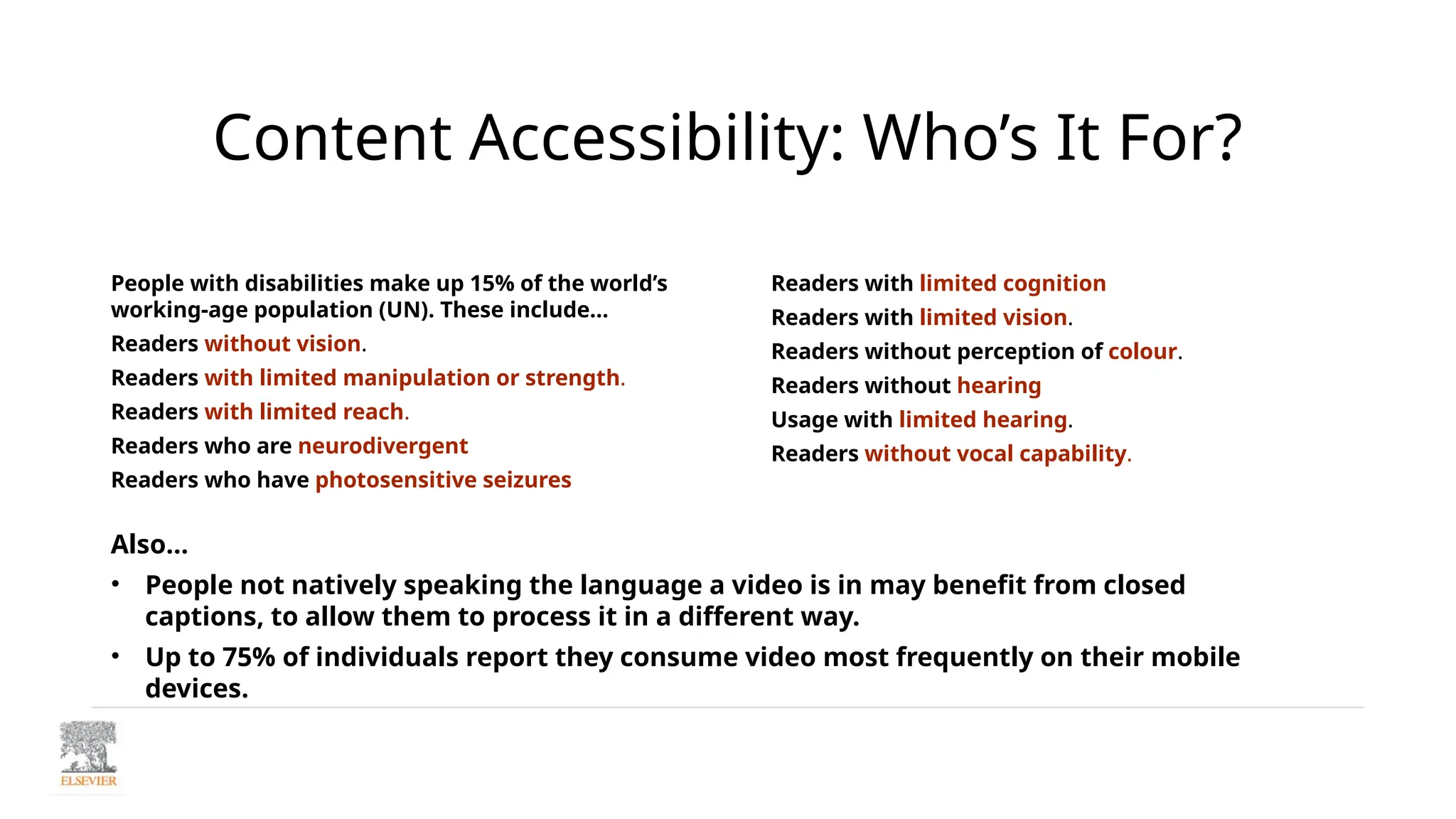
People with disabilities make up 15% of the world’s
working-age population (UN). These include…
Readers without vision.
Readers with limited manipulation or strength.
Readers with limited reach.
Readers who are neurodivergent
Readers who have photosensitive seizures
Readers with limited cognition
Readers with limited vision.
Readers without perception of colour.
Readers without hearing
Usage with limited hearing.
Readers without vocal capability.
Also…
• People not natively speaking the language a video is in may benefit from closed
captions, to allow them to process it in a different way.
• Up to 75% of individuals report they consume video most frequently on their mobile
devices.
4.
What is anAccessible
Publishing Programme?
One in which anyone can access irrespective of disability
• Authoring Content
• Reviewing Content
• Discovering Content
• Choosing Content
• Buing Content
• Downloading Content
• Reading Content
• Interacting with Content (e.g. highlighting, commenting on, summarizing)
5.
Accessibility is Coreto
What We Do
• As publishers, we:
• Curate Content
• Enrich Content
• Disseminate Content
• If any of the individual platforms within the publishing cycle are inaccessible,
the submissions process becomes a dead end.
• There is no part of the system that can’t be improved for disabled people,
and we all have a part to play.
6.
What Problems AreWe
Trying to Solve?
1. Submission and Peer Review:
• If someone is unable to submit to your submission system because it’s
inaccessible, there’s 100% chance they are not getting published.
• If a reviewer can’t access the system because it is inaccessible, your review
process is implicitly biased.
2. Discovery and Reading:
• Inadequate Text Customization Options (e.g. fonts, text size, line spacing)
• Cluttered and Overwhelming User Interfaces
• Inadequate Support for Multimodal Content (e.g. captioning, transcription)
• Lack of Mobile Accessibility
7.
Accessible Publishing is
AboutChoice
• What are your non-standard alternatives / accommodations to include people
with disabilities? Do you have a point of contact?
• How are you including people with disabilities in the design / validation process?
• Enable people to learn in the way that suits them:
• Reading with their eyes
• Listening with their ears
• Touching with their fingers
• Accessible Formats (e.g. HTML, ePub3, PDF / UA
• Accessible File Request Services in accordance with the Marrakesh Treaty
To do this, we need to consider scalability, financial sustainability and
flexibility.
8.
How Does thisInteract
with the new Legislation?
• The laws are mostly about published materials. However, it is also worth
considering other aspects of the publishing lifecycle – e.g. submission
and review – to have a truly accessible publishing programme.
• The laws aim to improve the lives of people with disabilities by making
products and services more accessible:
• Designed to enhance accessibility by establishing common accessibility
rules.
• The laws aim to ensure that digital products and services are accessible
to all individuals, particularly those with disabilities.
• Equal access, regardless of disability by removing barriers to discovery,
purchase and usage.
9.
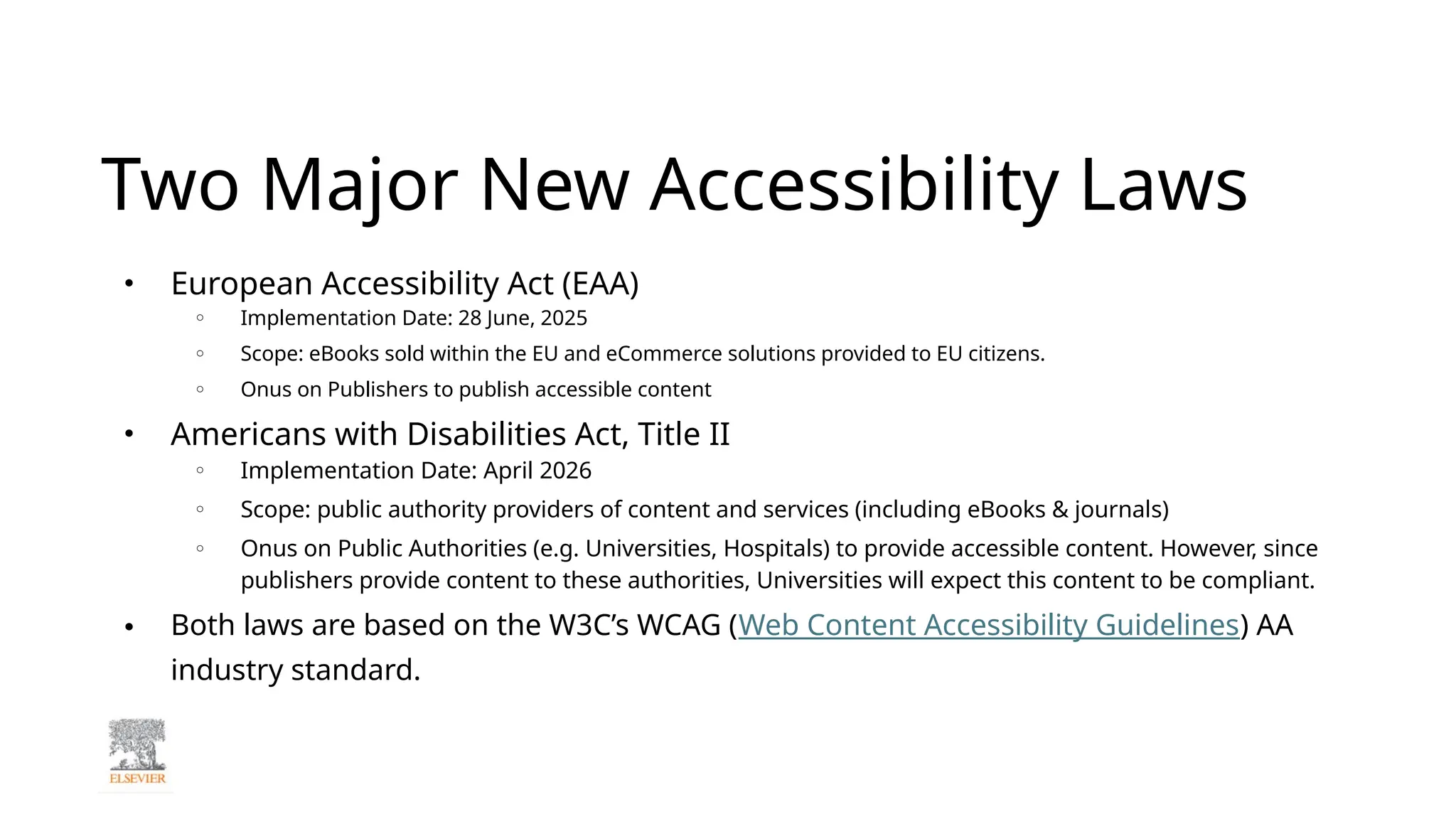
Two Major NewAccessibility Laws
● European Accessibility Act (EAA)
○ Implementation Date: 28 June, 2025
○ Scope: eBooks sold within the EU and eCommerce solutions provided to EU citizens.
○ Onus on Publishers to publish accessible content
● Americans with Disabilities Act, Title II
○ Implementation Date: April 2026
○ Scope: public authority providers of content and services (including eBooks & journals)
○ Onus on Public Authorities (e.g. Universities, Hospitals) to provide accessible content. However, since
publishers provide content to these authorities, Universities will expect this content to be compliant.
● Both laws are based on the W3C’s WCAG (Web Content Accessibility Guidelines) AA
industry standard.
10.
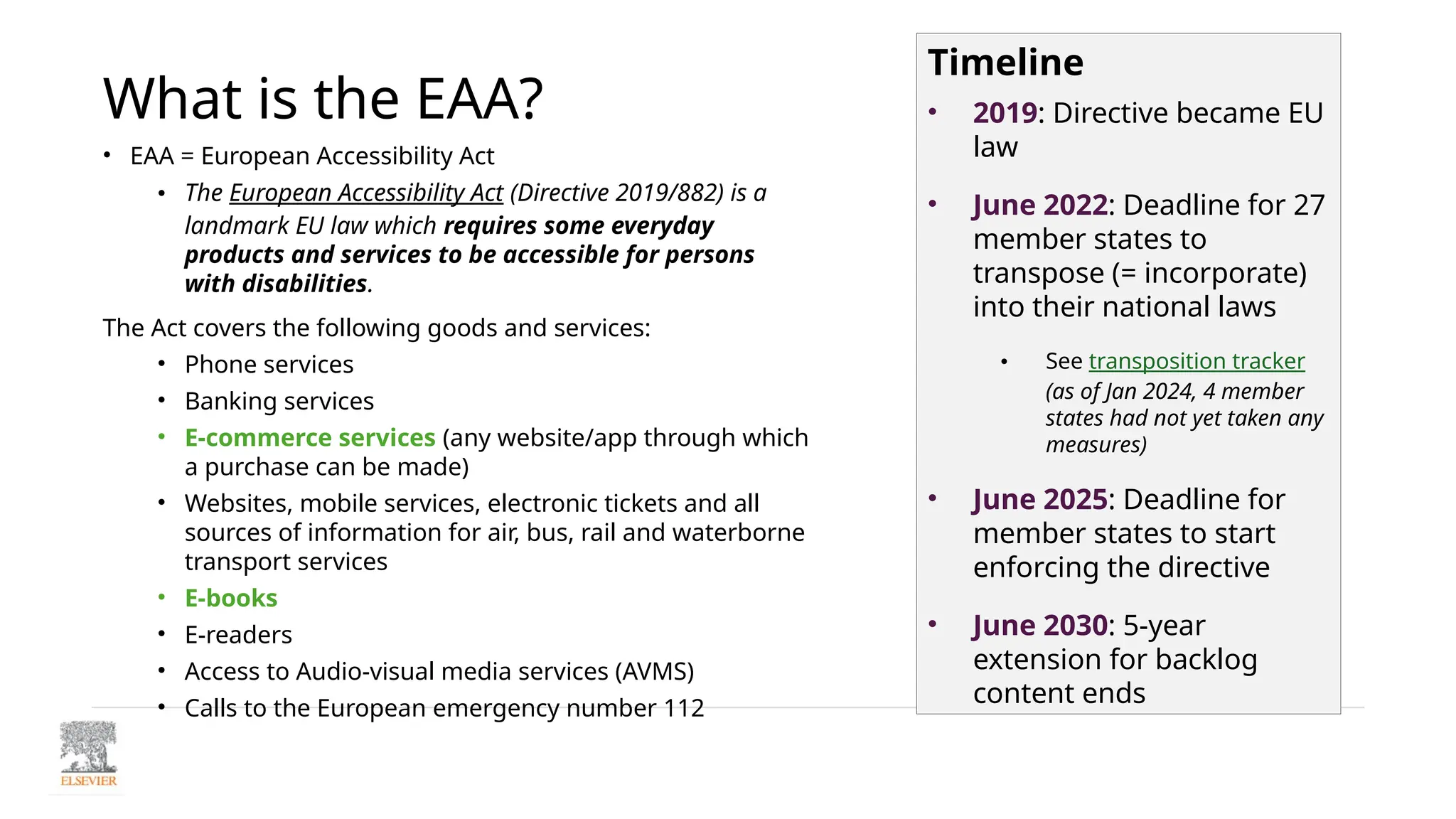
What is theEAA?
• EAA = European Accessibility Act
• The European Accessibility Act (Directive 2019/882) is a
landmark EU law which requires some everyday
products and services to be accessible for persons
with disabilities.
The Act covers the following goods and services:
• Phone services
• Banking services
• E-commerce services (any website/app through which
a purchase can be made)
• Websites, mobile services, electronic tickets and all
sources of information for air, bus, rail and waterborne
transport services
• E-books
• E-readers
• Access to Audio-visual media services (AVMS)
• Calls to the European emergency number 112
Timeline
• 2019: Directive became EU
law
• June 2022: Deadline for 27
member states to
transpose (= incorporate)
into their national laws
• See transposition tracker
(as of Jan 2024, 4 member
states had not yet taken any
measures)
• June 2025: Deadline for
member states to start
enforcing the directive
• June 2030: 5-year
extension for backlog
content ends
11.
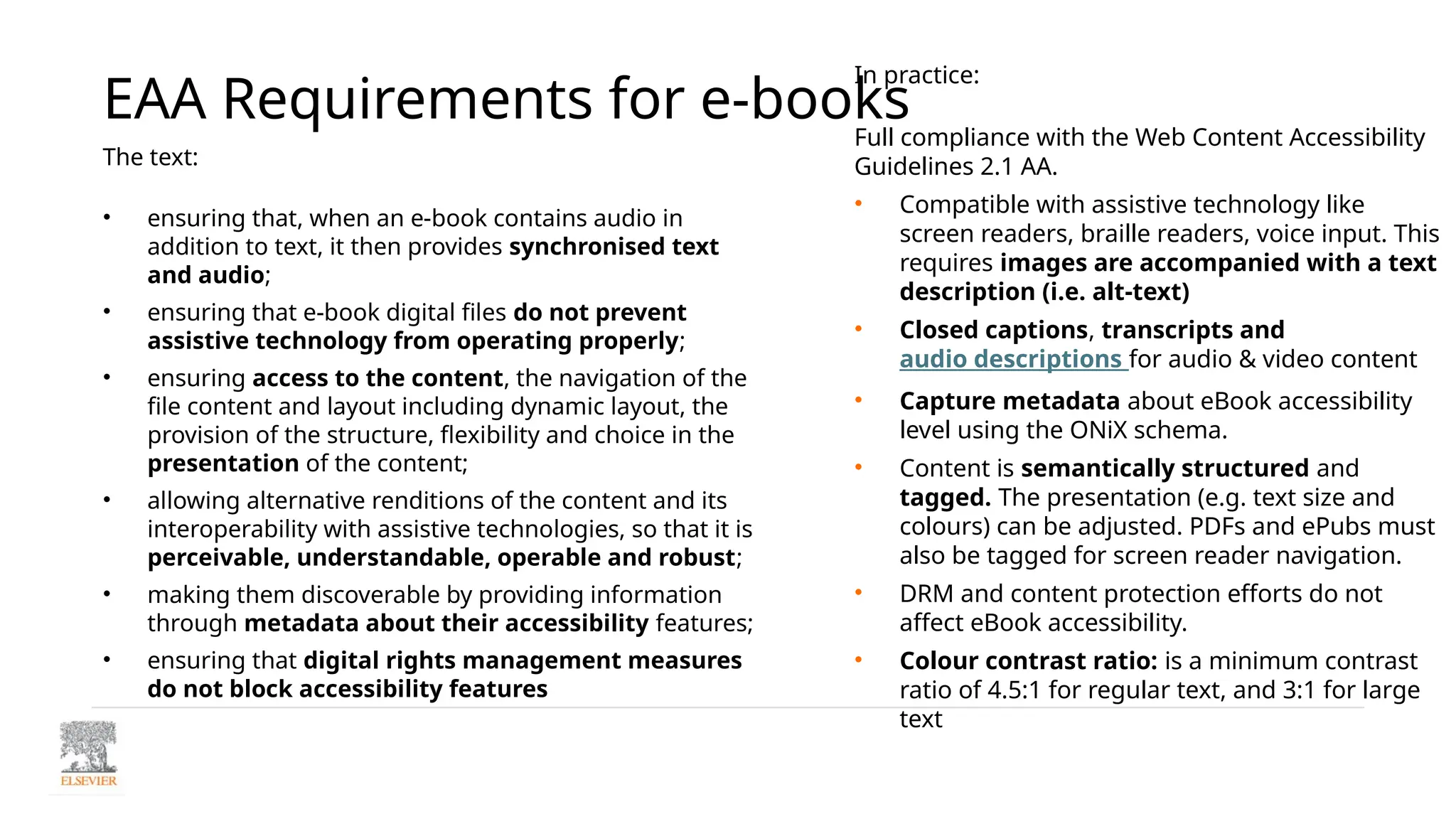
EAA Requirements fore-books
The text:
• ensuring that, when an e-book contains audio in
addition to text, it then provides synchronised text
and audio;
• ensuring that e-book digital files do not prevent
assistive technology from operating properly;
• ensuring access to the content, the navigation of the
file content and layout including dynamic layout, the
provision of the structure, flexibility and choice in the
presentation of the content;
• allowing alternative renditions of the content and its
interoperability with assistive technologies, so that it is
perceivable, understandable, operable and robust;
• making them discoverable by providing information
through metadata about their accessibility features;
• ensuring that digital rights management measures
do not block accessibility features
In practice:
Full compliance with the Web Content Accessibility
Guidelines 2.1 AA.
• Compatible with assistive technology like
screen readers, braille readers, voice input. This
requires images are accompanied with a text
description (i.e. alt-text)
• Closed captions, transcripts and
audio descriptions for audio & video content
• Capture metadata about eBook accessibility
level using the ONiX schema.
• Content is semantically structured and
tagged. The presentation (e.g. text size and
colours) can be adjusted. PDFs and ePubs must
also be tagged for screen reader navigation.
• DRM and content protection efforts do not
affect eBook accessibility.
• Colour contrast ratio: is a minimum contrast
ratio of 4.5:1 for regular text, and 3:1 for large
text
12.
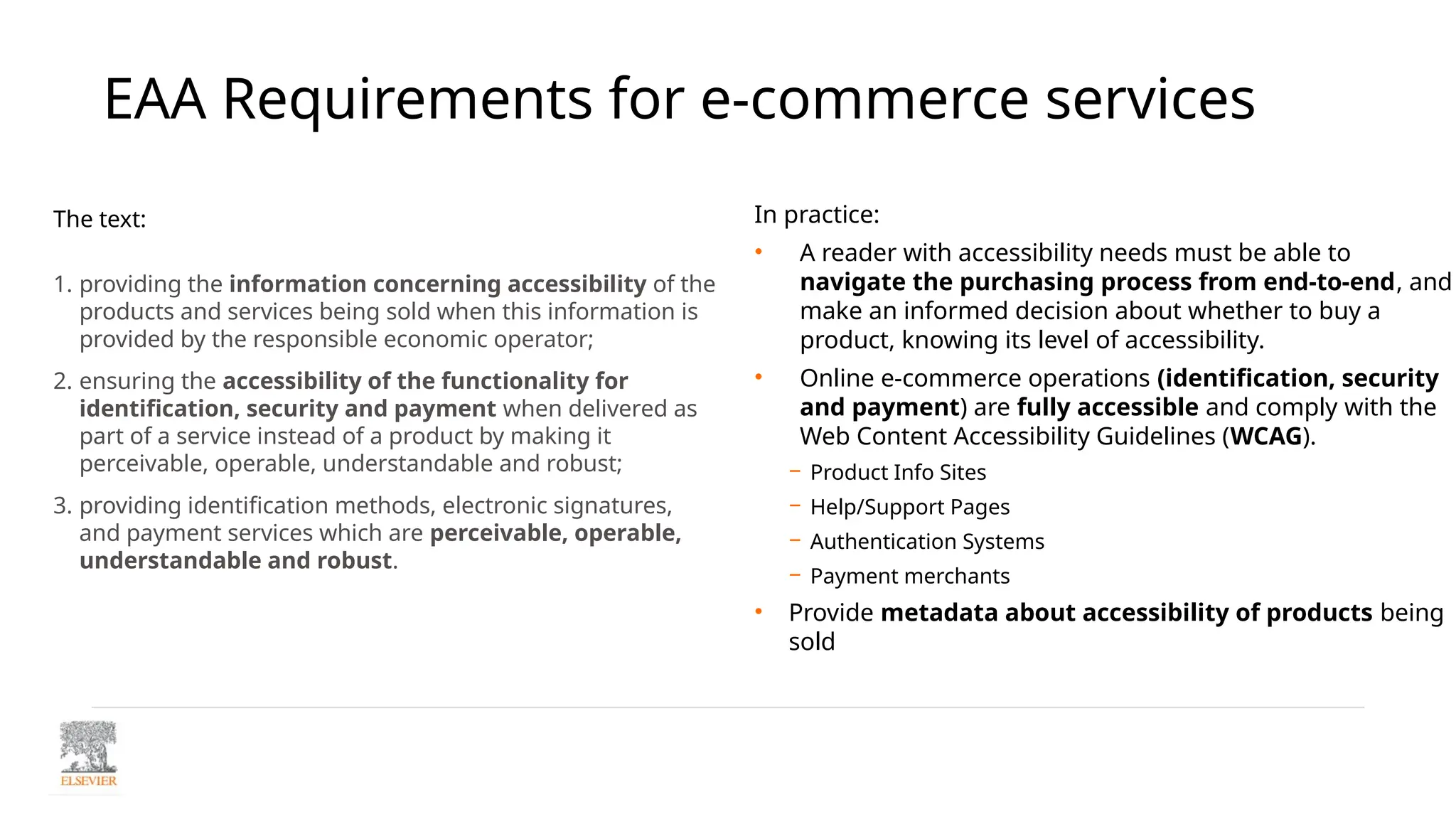
EAA Requirements fore-commerce services
The text:
1. providing the information concerning accessibility of the
products and services being sold when this information is
provided by the responsible economic operator;
2. ensuring the accessibility of the functionality for
identification, security and payment when delivered as
part of a service instead of a product by making it
perceivable, operable, understandable and robust;
3. providing identification methods, electronic signatures,
and payment services which are perceivable, operable,
understandable and robust.
In practice:
• A reader with accessibility needs must be able to
navigate the purchasing process from end-to-end, and
make an informed decision about whether to buy a
product, knowing its level of accessibility.
• Online e-commerce operations (identification, security
and payment) are fully accessible and comply with the
Web Content Accessibility Guidelines (WCAG).
− Product Info Sites
− Help/Support Pages
− Authentication Systems
− Payment merchants
• Provide metadata about accessibility of products being
sold
13.
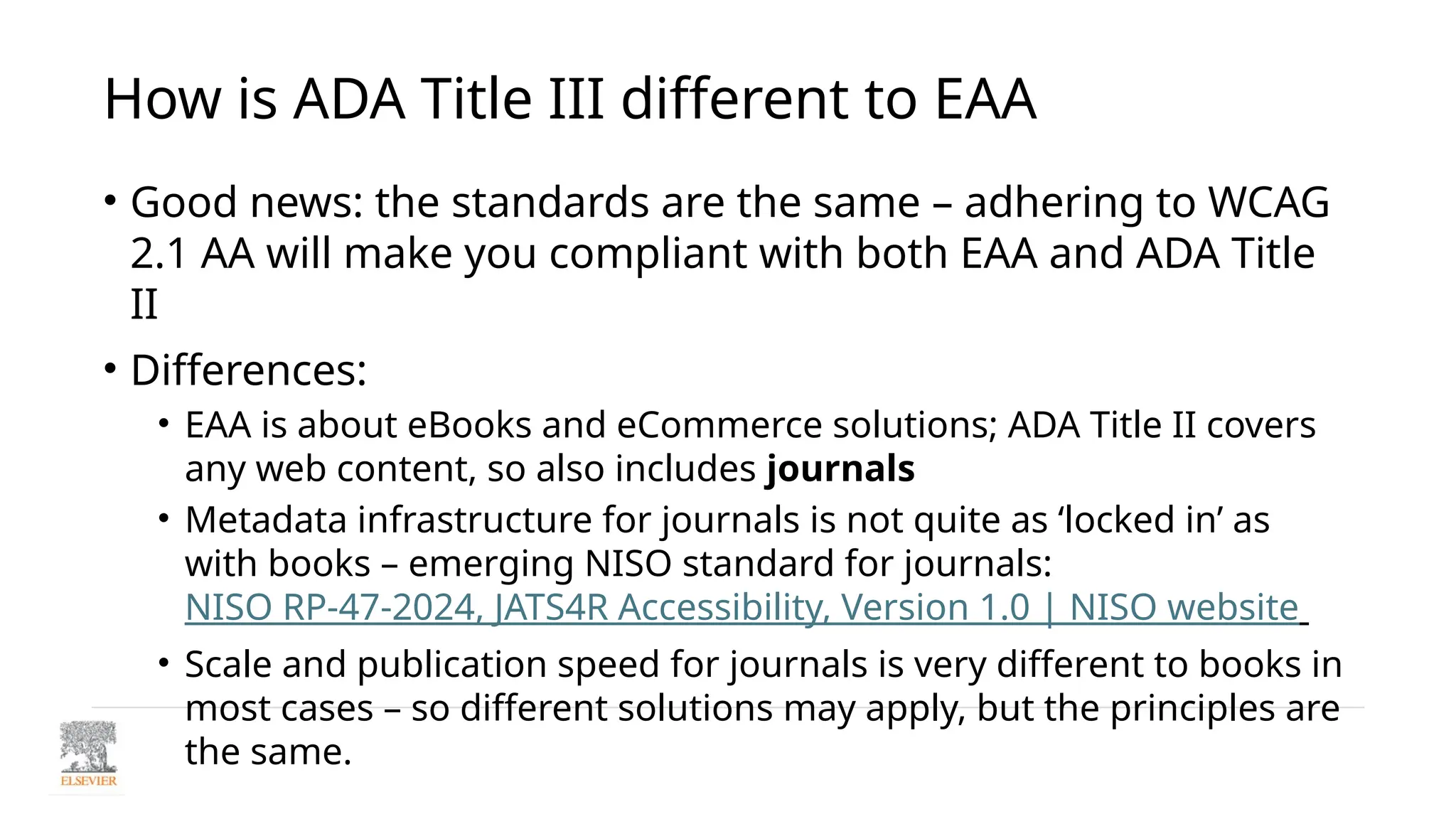
How is ADATitle III different to EAA
• Good news: the standards are the same – adhering to WCAG
2.1 AA will make you compliant with both EAA and ADA Title
II
• Differences:
• EAA is about eBooks and eCommerce solutions; ADA Title II covers
any web content, so also includes journals
• Metadata infrastructure for journals is not quite as ‘locked in’ as
with books – emerging NISO standard for journals:
NISO RP-47-2024, JATS4R Accessibility, Version 1.0 | NISO website
• Scale and publication speed for journals is very different to books in
most cases – so different solutions may apply, but the principles are
the same.
14.
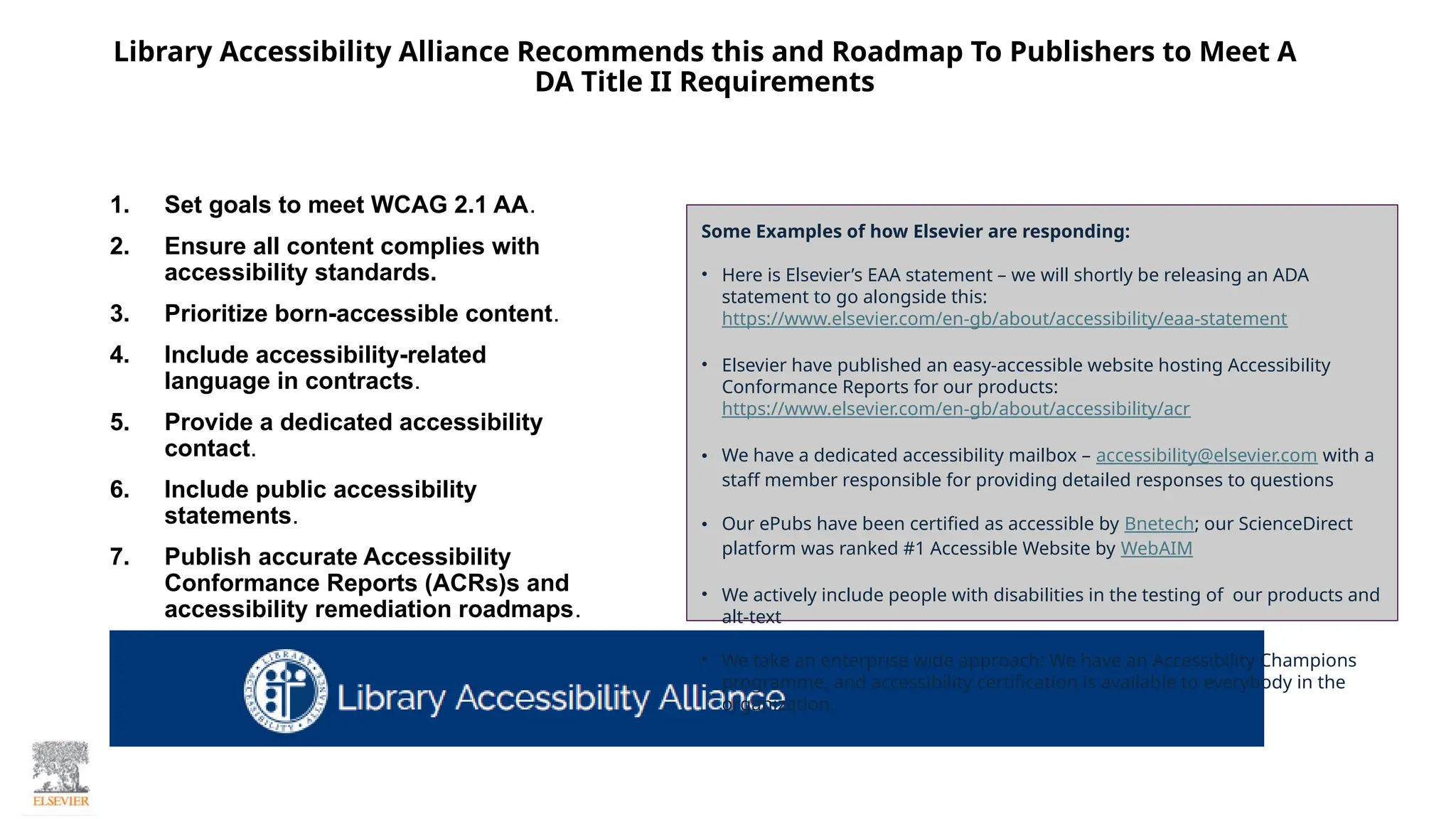
1. Set goalsto meet WCAG 2.1 AA.
2. Ensure all content complies with
accessibility standards.
3. Prioritize born-accessible content.
4. Include accessibility-related
language in contracts.
5. Provide a dedicated accessibility
contact.
6. Include public accessibility
statements.
7. Publish accurate Accessibility
Conformance Reports (ACRs)s and
accessibility remediation roadmaps.
Library Accessibility Alliance Recommends this and Roadmap To Publishers to Meet A
DA Title II Requirements
Some Examples of how Elsevier are responding:
• Here is Elsevier’s EAA statement – we will shortly be releasing an ADA
statement to go alongside this:
https://www.elsevier.com/en-gb/about/accessibility/eaa-statement
• Elsevier have published an easy-accessible website hosting Accessibility
Conformance Reports for our products:
https://www.elsevier.com/en-gb/about/accessibility/acr
• We have a dedicated accessibility mailbox – accessibility@elsevier.com with a
staff member responsible for providing detailed responses to questions
• Our ePubs have been certified as accessible by Bnetech; our ScienceDirect
platform was ranked #1 Accessible Website by WebAIM
• We actively include people with disabilities in the testing of our products and
alt-text
• We take an enterprise wide approach: We have an Accessibility Champions
programme, and accessibility certification is available to everybody in the
organization.
15.
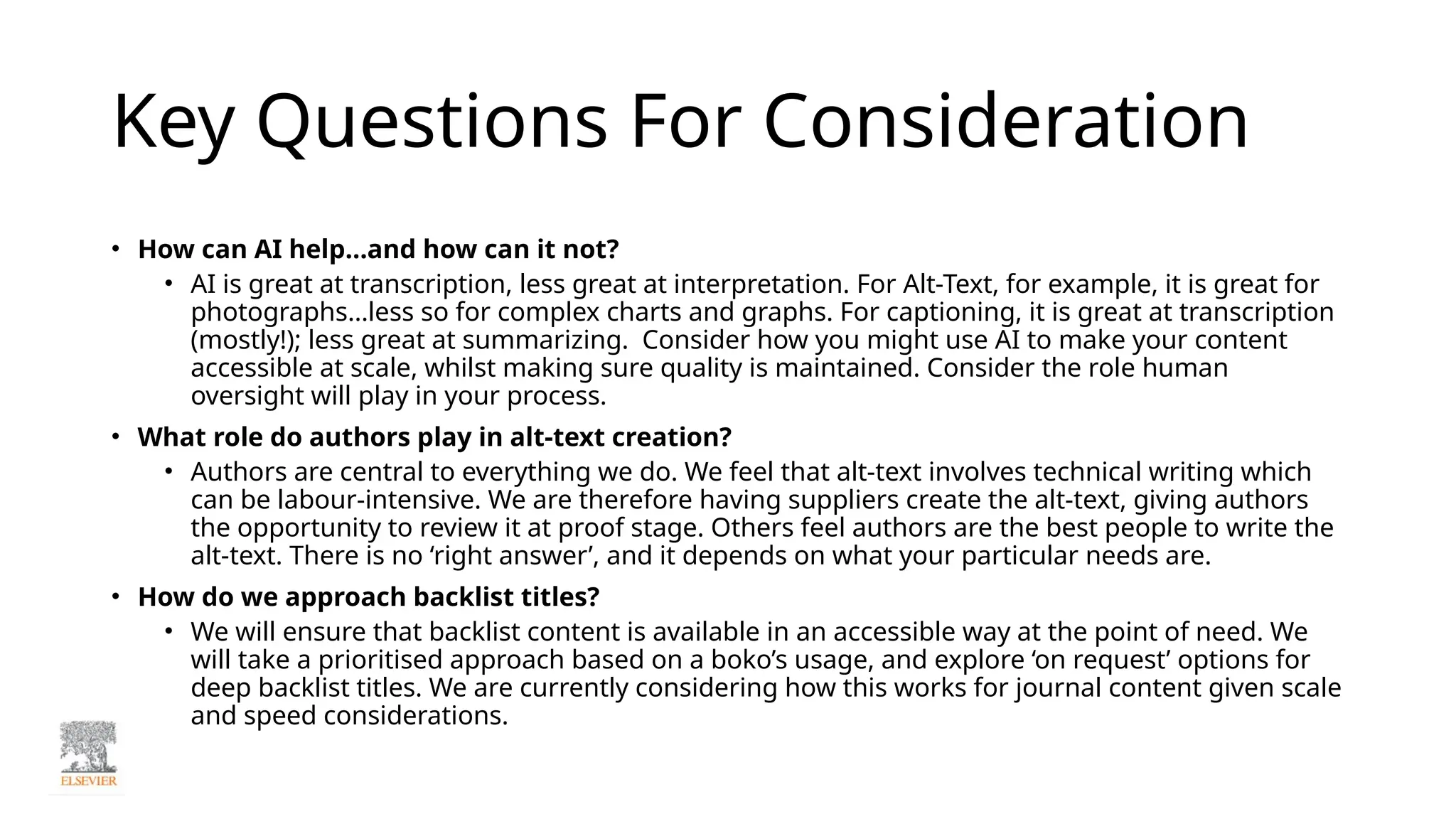
Key Questions ForConsideration
• How can AI help…and how can it not?
• AI is great at transcription, less great at interpretation. For Alt-Text, for example, it is great for
photographs…less so for complex charts and graphs. For captioning, it is great at transcription
(mostly!); less great at summarizing. Consider how you might use AI to make your content
accessible at scale, whilst making sure quality is maintained. Consider the role human
oversight will play in your process.
• What role do authors play in alt-text creation?
• Authors are central to everything we do. We feel that alt-text involves technical writing which
can be labour-intensive. We are therefore having suppliers create the alt-text, giving authors
the opportunity to review it at proof stage. Others feel authors are the best people to write the
alt-text. There is no ‘right answer’, and it depends on what your particular needs are.
• How do we approach backlist titles?
• We will ensure that backlist content is available in an accessible way at the point of need. We
will take a prioritised approach based on a boko’s usage, and explore ‘on request’ options for
deep backlist titles. We are currently considering how this works for journal content given scale
and speed considerations.
Discussion questions
• Whyis accessible publishing important to your role or team?
• What about accessibility benefits your organization?
• How does accessibility fit into mission or vision statements?
#11 The most important one is that our eBooks are compliant with WCAG 2.1 (POUR)
Lucky for us we are ahead of the game in lots of areas: EPUBS GCA
SD very accessible book experience.
Working on CC and image alt text. (Simon Holt)
#12 If we are selling an ePUB book the e store has to provide a way to see the a11y support.
#14 Speaker: JON –> (TED/SIMON)
LAAB – Simon
The ADA will be enforced on Elsevier by customers, not the Government, DOJ
The real ADA risk is commercial, revenue loss
We received this letter last month from the Library A11y Alliance stating:
"As consumers of your product, we request your assistance in meeting our obligations under ADA Title II so we can continue our business relationships with you".
Represents the voice of over 100 colleges and Unis
----------
https://www.researchprofessionalnews.com/rr-news-world-2025-2-elsevier-parent-company-reports-10-rise-in-profit-to-3-2bn/
Relx said its primary research business “continued to be driven by volume growth, with article submissions growing very strongly across the portfolio, particularly in pay-to-publish”.
How about this for an argument:
If Elsevier wants to continue to grow our article submissions part of the business (as mentioned as a big growth engine above) we must be able to attract authors and societies to our accessible publishing platforms like ScienceDirect and woo them with our content enrichments such as alt text for images. Expanding our accessibility program to include OA platforms and content will also help protect us from expected increased scrutiny of ADA watchdogs, Politicians, and Research Organizations who push against paying for publicly funded research. We have to be more accessible than Open Research Europe so that customers realize the value add of publishing with and paying for Elsevier subscriptions.