Holistic and Multidisciplinary Education
Prof. B. V. Appa Rao
Professor of Chemistry(Retd.), NIT Warangal
Formerly Visiting Professor, University of Hyderabad
Formerly Consultant, Accreditations, IIIT Hyderabad
UGC National Resource Person in Malaviya Mission
bva.nitw@gmail.com
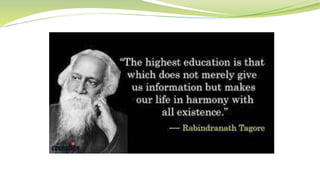
Rabindranath Tagore founded Viswa-Bharathi in the year 1921 in order to
provide holistic Education to the students in Higher Education. In the
year 1951, Viswa-Bharathi became a Central University by the act of
Parliament. Prime Minister is the Chancellor of this University.
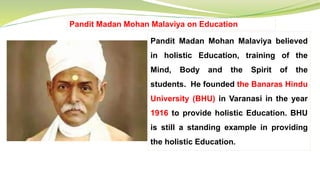
Pandit Madan Mohan Malaviya on Education
Pandit Madan Mohan Malaviya believed
in holistic Education, training of the
Mind, Body and the Spirit of the
students. He founded the Banaras Hindu
University (BHU) in Varanasi in the year
1916 to provide holistic Education. BHU
is still a standing example in providing
the holistic Education.
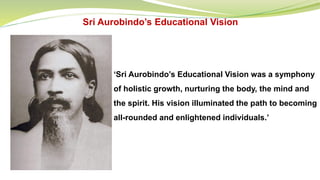
Sri Aurobindo’s Educational Vision
‘Sri Aurobindo’s Educational Vision was a symphony
of holistic growth, nurturing the body, the mind and
the spirit. His vision illuminated the path to becoming
all-rounded and enlightened individuals.’
• Sri Aurobindo International Centre of Education at Pondicherry was
founded on the Educational Philosophy of sri Aurobindo.
•Many integral schools have been established all over India, based on the
Educational Philosophy of sri Aurobindo to provide holistic Education.
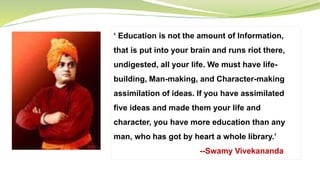
‘ Education is not the amount of Information,
that is put into your brain and runs riot there,
undigested, all your life. We must have life-
building, Man-making, and Character-making
assimilation of ideas. If you have assimilated
five ideas and made them your life and
character, you have more education than any
man, who has got by heart a whole library.’
--Swamy Vivekananda
• Vivekananda Kendra Vidyalaya or VKV is the academic wing
of Vivekananda Kendra (an organization based on Swami Vivekananda’s
preachings of life–reforming principles). VKV operates a chain of schools in
different states of India, under the project Vivekananda Kendra Siksha
Prasar Vibhag. All these schools implement holistic Education.
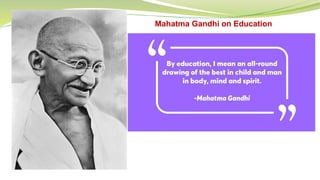
Mahatma Gandhi on Education
•Many Educational Institutions were founded in India, based on the
Gandhian Philosophy of Education. Gandhigram Rural Institute
(in Tamilnadu) is a standing example which has been founded in the year
1956 in order to provide holistic Education. It was declared as deemed to
be University in the year 1976 by UGC under section 3 of UGC Act 1956.
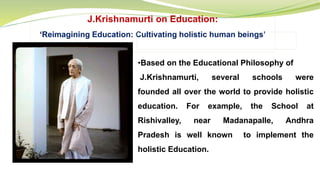
J.Krishnamurti on Education:
‘Reimagining Education: Cultivating holistic human beings’
•Based on the Educational Philosophy of
J.Krishnamurti, several schools were
founded all over the world to provide holistic
education. For example, the School at
Rishivalley, near Madanapalle, Andhra
Pradesh is well known to implement the
holistic Education.
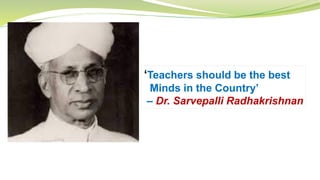
‘Teachers should be the best
Minds in the Country’
– Dr. Sarvepalli Radhakrishnan
‘Education should be imparted with a view to the type of the Society
that we wish to build. We are working for a modern Democracy built
on the values of human dignity and equality. These are only ideals.
We should make them living forces. Our Vision of the Future should
include these great principles’.- Dr. S.Radhakrishnan, a great
Teacher and the first Vice-President of India.
•Training of Mind and Body is understood reasonably well by all the Educators.
However, there are several view points regarding the Spiritual Education.
• In this lecture, Secular Spirituality is considered in Spiritual Education.
• “Secular spirituality is the adherence to a spiritual philosophy without
adherence to a religion. Secular spirituality emphasizes the inner peace of the
individual, rather than a relationship with the divine. Secular spirituality is
made up of the search for meaning outside of a religious institution; it
considers one's relationship with the self, others, and nature.”
(Ref: Elkins, D. N.; Hedstrom, L. J.; Hughes, L. L.; Leaf, J. A. & Saunders, C. (1988).
"Toward a humanistic-phenomenological spirituality". Journal of Humanistic
Psychology. 28 (4): 10. )
•According to the American philosopher Robert C. Solomon, "spirituality
is coextensive with religion and it is not incompatible with or opposed to
science or the scientific outlook. Naturalized spirituality is spirituality
without any need for the 'other‐worldly'. Spirituality is one of the goals,
perhaps the ultimate goal, of philosophy.“
•(Robert C. Solomon (2003). Spirituality for the Skeptic: The Thoughtful
Love of life Oxford Scholarship Online. ISBN 9780195134674)
•The holistic Education thus includes Cognitive domain (related to
mental process, thinking process), Psychomotor domain (related to
physical activites in learning), Physical Education (Training related to
Body, ie; games, sports, Physical Exercises including Yoga) and
Secular Spiritual Education (related to understanding of self and
relationship with nature and others, Human Values, and Meditation).
•When holistic Education is implemented in the Schools, Colleges, and
Universities, the individuals are truely educated, and live in harmony
with all the existence around them.
•Holistic Education only can be said as Education in its true sense.
•Holistic Education includes design of the multidisciplinary curriculum,
innovative and flexible curriculum, and its implementation by providing
the necessary Infrastructural facilities and using the appropriate
pedagogical practices.
Holistic Education was implemented in the Ancient Universities in India:
• For example in Taxhashila (Taxila), and Nalanda.
• Taxhashila (or Taxila) dates back to 5th or 6th century B.C to 5th century A.D
• It was established in Gandhara (now in Pakistan)
• The Vedas and the Eighteen Arts, which included skills such as archery,
hunting, and elephant lore, were taught in addition to its law school, medical
school, and school of military science.
• The Ayurvedic healer, Charaka studied at Taxhashila.
• Arthasastra, by Chanakya (Kautilya) was composed at Takshashila
(Ref: Wikipedia)
• The University of Nalanda, (5th century -12th century AD) in India was one
of the achievements of the ancient period in the field of Education
• It was one of the world’s first residential universities.
• it had over 10,000 students and 2,000 teachers on the campus i.e., with a
faculty-student ratio of 1:5.
• The library was a nine-storeyed building where meticulous copies of texts
were produced and preserved.
.
• Students studied Science, Astronomy, Medicine and Logic as diligently
as they applied themselves to Metaphysics, Philosophy, Samkhya,
Yoga-shastra, the Vedas, the Scriptures of Buddhism, Foreign
Philosophy, transcending ethnic and national boundaries.
• The University attracted pupils and scholars from Korea, Japan, China,
Tibet, Indonesia, Persia, Turkey and other parts of the globe.
• Nalanda represents the concept of the university of the ancient period.
That concept is relevant even today as seen in NEP 2020
•Understanding the meanings of the terms :Multidisciplinary, Interdisciplinary
and Trans-disciplinary Education
•Multidisciplinary Education implies the study of an academic program,
consisting of courses from multiple different disciplines at the same time.
Perspectives from the different disciplines create a broader understanding of
the major discipline (s) of the academic program. The student crosses the
boundaries of the disciplines, but the disciplines keep their own ‘identity'.
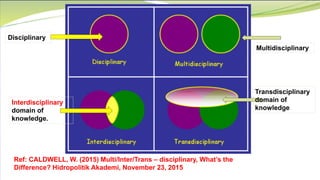
•Disciplinary, Multidisciplinary, Interdisciplinary and Transdisciplinary
domains of Learning are depicted diagrammatically in the next slide.
Interdisciplinary
domain of
knowledge.
Transdisciplinary
domain of
knowledge
Disciplinary
Multidisciplinary
Ref: CALDWELL, W. (2015) Multi/Inter/Trans – disciplinary, What’s the
Difference? Hidropolitik Akademi, November 23, 2015
•For some professionally, vocationally, or technically oriented careers,
curricula delivered in higher education establishments may focus on teaching
material related to a single discipline. By contrast, multidisciplinary,
interdisciplinary, and transdisciplinary teaching (MITT) results in improved
affective and cognitive learning and critical thinking, offering
learners/students the opportunity to obtain a broad general knowledge base.
•According to Oxforddictionaries.com: multidisciplinary is an adjective that
describes, “combining or involving several academic disciplines or professional
specializations in approach to a topic or problem.”
•Interdisciplinary is an adjective that describes, “of or relating to more than one
branch of knowledge.” Transdisciplinary is also an adjective that describes, “relating
to more than one branch of knowledge.” So what exactly is the difference?
Ref: CALDWELL, W. (2015) Multi/Inter/Trans – disciplinary, What’s the Difference?
Hidropolitik Akademi, November 23, 2015
• According to Lakehead University’s “Essential Guide to Writing Research Papers,”
multidisciplinarity contrasts disciplinary perspectives in an additive manner,
meaning two or more disciplines each provide their viewpoint on a problem from
their perspectives. Multidisciplinarity involves little interaction across disciplines.
• Interdisciplinarity combines two or more disciplines to a new level of integration
suggesting component boundaries start to break down. Interdisciplinarity is no
longer a simple addition of parts but the recognition that each discipline can affect
the research output of the other.
•Transdisciplinarity occurs when two or more discipline perspectives transcend
each other to form a new holistic approach. The outcome will be completely
different from what one would expect from the addition of the parts.
Transdisciplinarity results in a type, xenogenesis where the output is created
as a result of disciplines integrating to become something completely new.
•(Xenogenesis meaning: The Offspring is totally different from either of the
Parents.)
•Single Discipline Courses: Certificate Courses belong to a single Discipline
•Examples:
•Certificate in Business Skills
•Certificate in Beekeeping
•Certificate Programme in Yoga
•Certificate in Information Technology
•Certificate in Human Rights
•Certificate in Organic Farming
•Certificate in Visual Arts- Applied Arts
• IGNOU offers the above Certificate Courses.
•Certificate Courses- Some more examples:
• C++
•Java
•Web designing
•Graphics designing
•Data Science
•Data Analytics
•Data Analysis with Python
•R Programming
•Clinical Psychology
•Many Diploma Courses(two year- duration) are also of a single Discipline.
•Examples:
•1. Diploma in Foreign Languages like German, French, Russian etc.
•2. Diploma in Music ( Veena, Violin, Guitar etc.)
•Multidisciplinary Programs: All the Undergraduate academic programs are
Multidisciplinary in nature.
•However, these programs may also consist of Interdisciplinary Courses.
•Examples:
•1. B.Tech program in Metallurgical and materials engineering includes courses
like ‘Corrosion Science’, which is an interdisciplinary Coure between
Metullurgical Engineering and Electrochemistry.
•2. Bachellors Program in Law consists of courses such as Environmental
Law, Sociology of Law, which are interdisciplinary Courses.
• 3. Bachelor of Education includes Educational Technology, an interdisciplinary
course.
Interdisciplinary Programs: A few of the Post-Graduate Programs are
interdisciplinary in nature.
Examples:
1. M.Tech / M.Sc in Bio-informatics
2. M.S or Dual degree Programs(B.Tech and M.S of five year-duration)
in Computational Linguistics, Computational Natural Sciences
(offered at IIIT Hyderabad).
3. M.Sc in Health Psychology
4. M.Tech in Enviromental Biotechnology
* However, most of the P.G programs are intradisciplinary ( many courses and
specializations in the same Discipline). Some Programs may contain
a few interdisciplinary courses.
Transdisciplinary Education: This needs a very high degree of collaboration
between different Departments and Teachers belonging to different
disciplines.
Examples:
1. Projects executed by the Students in the Interdisciplinary academic
Programs.
2. Executing Research Projects sponsored by the Industry.
3. Executing Consultancy Projects.
•Multidisciplinary, Interdisciplinary, and Transdisciplinary Education
Programs are of great relevance in Higher Education.
•Interdisciplinary and Transdisciplinary Education nurtures the Students
to take up complex real world problems and contribute to innovative
solutions.
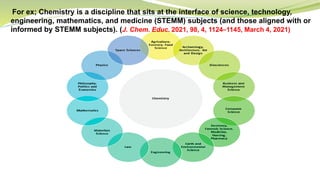
For ex; Chemistry is a discipline that sits at the interface of science, technology,
engineering, mathematics, and medicine (STEMM) subjects (and those aligned with or
informed by STEMM subjects). (J. Chem. Educ. 2021, 98, 4, 1124–1145, March 4, 2021)
UNIVERSAL HUMAN VALUES
"All great people of the world have tried to realise the truth and to live by it
in terms of love and compassion. They have tried to understand
themselves (human being), understand the underlying harmony in nature,
in existence. They have tried to understand the role of the human being in
nature, in existence, to live by it, and to develop an equitable and just
society which ensures the wellbeing of all.”
(Ref: uhv.org.in- Home page)
‘Revised guidelines, Mulya Pravah 2.0 - Inculcation of Human Values and
Professional Ethics in Higher Education Institutions proposes the curriculum and
pedagogy of Higher Education Institutions (HEIs) to develop deep respect towards
Fundamental Duties and Constitutional Values among the students, bonding with
one’s country, and conscious awareness of the roles and responsibilities in a
changing world, including universal human values of truth (satya), righteous
conduct (dharma), peace (shanti), love (prema), non-violence (ahimsa), scientific
temper, citizenship values, and also life-skills. An integral part of a holistic
education includes lessons in seva and/or service and participation in community
service programmes.’ (Extract from the Foreword of Prof. M.Jagadeesh Kumar,
Chairman, UGC in the Document, Mulya Pravah 2.0- Inculcation of Human Values
and Professional Ethics in Higher Education Institutions, )
VALUES AND ETHICS FOR STAKEHOLDERS
• The success of an institution’s mission and vision is driven by the value-based ethical
behaviour of its committed faculty members, officers, staff, and students.
•Therefore, an institute should thrive on imbibing core values and ethical behaviour into
the daily interactions of stakeholder groups.
•These stakeholders of an institution, be they faculty, students, administrators or others,
should be guided by the following core values.
Values and Ethics for Stakeholders
1. Integrity: adhere to conduct duties in a righteous manner and in accordance with the
principles of honesty, trust, transparency, and fairness.
2. Trusteeship: operate in an efficient, ethical, and true manner while ensuring group
participation and a system of checks and balances within an institution.
3. Harmony: balance diversity and differences through a culture of tolerance, discussion,
and forgiveness among stakeholders.
4. Accountability: enable the environment of openness and trust to accommodate
mistakes and encourage individuals to take responsibility for their actions.
5. Inclusiveness: adopt standards, policies and procedures to promote and ensure equal
opportunity, without discrimination against any individual or group, for education,
employment, promotion, and other activities in an institution.
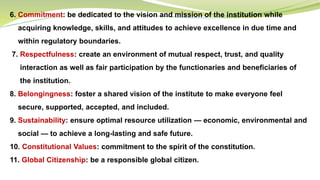
6. Commitment: be dedicated to the vision and mission of the institution while
acquiring knowledge, skills, and attitudes to achieve excellence in due time and
within regulatory boundaries.
7. Respectfulness: create an environment of mutual respect, trust, and quality
interaction as well as fair participation by the functionaries and beneficiaries of
the institution.
8. Belongingness: foster a shared vision of the institute to make everyone feel
secure, supported, accepted, and included.
9. Sustainability: ensure optimal resource utilization — economic, environmental and
social — to achieve a long-lasting and safe future.
10. Constitutional Values: commitment to the spirit of the constitution.
11. Global Citizenship: be a responsible global citizen.
Integrating Human Values in Higher Education
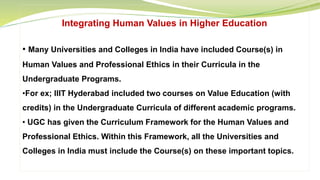
• Many Universities and Colleges in India have included Course(s) in
Human Values and Professional Ethics in their Curricula in the
Undergraduate Programs.
•For ex; IIIT Hyderabad included two courses on Value Education (with
credits) in the Undergraduate Curricula of different academic programs.
• UGC has given the Curriculum Framework for the Human Values and
Professional Ethics. Within this Framework, all the Universities and
Colleges in India must include the Course(s) on these important topics.
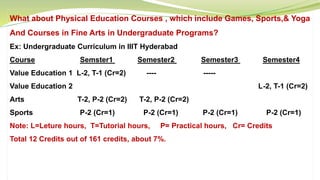
What about Physical Education Courses , which include Games, Sports,& Yoga
And Courses in Fine Arts in Undergraduate Programs?
Ex: Undergraduate Curriculum in IIIT Hyderabad
Course Semster1 Semester2 Semester3 Semester4
Value Education 1 L-2, T-1 (Cr=2) ---- -----
Value Education 2 L-2, T-1 (Cr=2)
Arts T-2, P-2 (Cr=2) T-2, P-2 (Cr=2)
Sports P-2 (Cr=1) P-2 (Cr=1) P-2 (Cr=1) P-2 (Cr=1)
Note: L=Leture hours, T=Tutorial hours, P= Practical hours, Cr= Credits
Total 12 Credits out of 161 credits, about 7%.
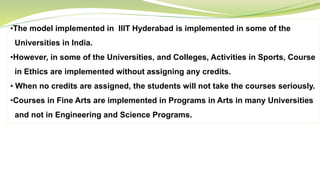
•The model implemented in IIIT Hyderabad is implemented in some of the
Universities in India.
•However, in some of the Universities, and Colleges, Activities in Sports, Course
in Ethics are implemented without assigning any credits.
• When no credits are assigned, the students will not take the courses seriously.
•Courses in Fine Arts are implemented in Programs in Arts in many Universities
and not in Engineering and Science Programs.
NSS and Community Service:
• The above programs are implemented in most of the Universities.
•In some Universities, the activities are implemented more seriously,
involving all the students, at least for one year during their study of 3 or
4 years.
•Example of Community Service in Gandhigram Rural University,
Gandhigram in Tamilnadu, which is one of the models.
Course categories ( U.G.Programmes) as per UGC revised Choice-based credit
system (Multidisciplinary Curriculum)
The Multidisciplinary curriculum must consist of
a) core courses(Major disciplines), Other related Disciplines(Supporting)
b) electives ( discipline specific, Interdisciplinary and/or Transdisciplinary, generic)
c) ability enhancement compulsory courses (including Value Education, Environmental
Studies)
d) skill enhancement courses
e) Value added courses
f) Summer Internship
g) *Research Project( in case of 4 year Honors degree with research, for 12 credits)
* Honours students not undertaking research will do 3 courses for a total of 12 credits in lieu of
a research project / Dissertation.
https://www.ugc.ac.in/pdfnews/7193743_FYUGP.pdf
•In addition to the above, Courses in Physical Education, Yoga, Fine Arts.
• NSS, and Community Service Programs.
•Hobby Clubs.
•Meditation Hall for interested students to do Meditation.
Innovative and Flexible Curriculum:
• A Flexible Curriculum is the Curriculum that can adapt to the changing
needs, interests, and the abilities of the Students and the Learning
Environment.
• It is the Student-Centric Curriculum.
•While core courses and mandatory courses are continued, there is a greater flexibility
in the Elective Courses, which are offered as per the choice of the Students. In other
words, the elective courses offered, may change every year depending on the
interests of the students in that batch.
• New elective courses are introduced in the Curriculum, based on the latest
advances in the major Discipline(s), and their relevance to the needs of the Students.
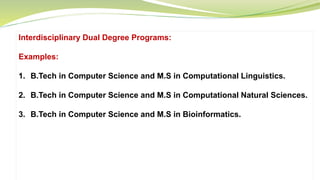
Interdisciplinary Dual Degree Programs:
Examples:
1. B.Tech in Computer Science and M.S in Computational Linguistics.
2. B.Tech in Computer Science and M.S in Computational Natural Sciences.
3. B.Tech in Computer Science and M.S in Bioinformatics.
NEP 2020: Multiple Entry and Exit System in Academic programs in Higher
Education –Benefits for students
•National Educational Policy 2020 brought out a great reform in the form of ‘’ Multiple
Entry and Exit system’ (MEES) for the benefit of the students of Higher Education.
•In accordance with NEP 2020, University Grants Commission (UGC) formulated
guidelines for its implementation in all the colleges and universities in India ( Ref:
UGC Guidelines dated 29th July 2021).
•In this lecture the ‘Multiple Entry and Exit System’ in Higher Education and its
benefits for the students are also presented.
Undergraduate Education:
• UGC suggested a) a 3 year degree program and b) a 4 year degree
program(preferred)
• In order to implement the multiple entry and exit system, UGC asked the
colleges and universities to reserve a few seats in the 2nd year , 3rd year and
4th year of every degree program for the lateral entry of the students
• UGC also called for the maintenance of Academic Bank of Credits (ABC) for
every student in every semester of every academic program.
Usefulness of the Academic Bank of Credits(ABC):
• This is a national level facility, which promotes flexibility in curriculum and the academic
mobility of the students across the colleges and universities with appropriate credit
transfer mechanism.
• The ABC enables the students to exit from one college after the 1st year or 2nd year or 3rd
year and join another institution with the help of credits accumulated in his/her Academic
Bank Account.
• ABC facilitates the students to obtain a certificate or diploma or a degree by studying in
any institution, any time and at any level during the 4 year/ 3 year degree program.
• However, he/she should satisfy the credit requirement ( as per the UGC guidelines) and
score in the entrance test (where applicable) or Cumulative Grade Point Average(CGPA) as
prescribed by the Admission seeking institution for lateral entry.
• Suppose, a student got a job after the 1st or 2nd or 3rd year of a 4 year degree program,
he/she can exit the institution and join the same institution or any other institution in
the next level after a few years, with the credits accumulated in his/her account.
• Suppose a girl student got married during the course of study of a degree, she can
exit after that particular academic year, receive certificate or diploma(as applicable)
and continue her studies after some time in the same institution or any other
institution
• In a similar way, it is beneficial to married girl students, who would like to exit due to
child birth and continue studies later.
• Due to economic reasons or unforeseen calamities in the family, a student may exit
after a particular year of study and continue studies later
• A student can enter or reenter only in the beginning of the odd semester and exit only
after completion of the even semester
• A student after studying 1st year or 2nd year in one institution ,would like to study 3rd year
and 4th year in another institution because of the specialized courses available in that
institution. He / She may do so if he/she gets admission. Thus, the students can choose
their learning path and obtain the degree with the courses of their choice within a
curriculum framework.
• The colleges and universities offering programmes with the multiple entry and exit
system need to register in the ABC to enable credit transfer, and credit acceptance.
• The credits earned, will be valid to a maximum period of 7 years or as specified by the
ABC.
• The procedure for depositing credits , their shelf life, redemption of credits, will be as per
UGC Regulations, 2021(Establishment and Operationalization of ABC scheme in Higher
Education).
Let’s see the multiple entry and exit system for an undergraduate program(Four years)
1st year Entry Requirement: Intermediate or plus 2 qualification and marks in the
entrance test (where applicable), based on merit and the usual reservation of seats
under different categories. Admission criterion into B.A/B.Sc/B.Com or other programs
depends upon the subjects studied in Intermediate or plus 2 and will be mentioned by
the colleges and universities in their prospectus.
Exit after 1st year and requirement for the award of the Certificate: The student must
have acquired 36-40 credits for the award of a Certificate.
•2nd year Entry Requirement: Certificate after completion of the 1st year and also
attainment of the desired score in the entrance exam conducted by the admission
seeking institution
•Exit after 2nd year and requirement for the award of a diploma: The student must
have acquired 72-80 credits during the first two years, with 36-40 credits in each year.
•3rd year Entry Requirement: Diploma after completion of the 2nd year and also
attainment of the desired score in the entrance exam conducted by the admission
seeking institution
•Exit after 3rd year and requirement for the award of a degree: The student must have
acquired 108-120 credits during the first three years, with 36-40 credits in each of the
years.
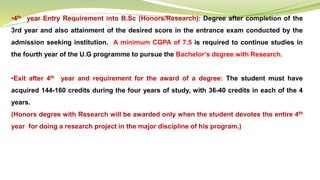
•4th year Entry Requirement into B.Sc (Honors/Research): Degree after completion of the
3rd year and also attainment of the desired score in the entrance exam conducted by the
admission seeking institution. A minimum CGPA of 7.5 is required to continue studies in
the fourth year of the U.G programme to pursue the Bachelor’s degree with Research.
•Exit after 4th year and requirement for the award of a degree: The student must have
acquired 144-160 credits during the four years of study, with 36-40 credits in each of the 4
years.
(Honors degree with Research will be awarded only when the student devotes the entire 4th
year for doing a research project in the major discipline of his program.)
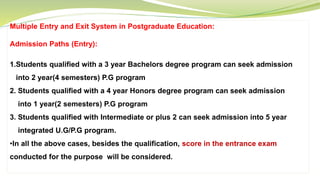
Multiple Entry and Exit System in Postgraduate Education:
Admission Paths (Entry):
1.Students qualified with a 3 year Bachelors degree program can seek admission
into 2 year(4 semesters) P.G program
2. Students qualified with a 4 year Honors degree program can seek admission
into 1 year(2 semesters) P.G program
3. Students qualified with Intermediate or plus 2 can seek admission into 5 year
integrated U.G/P.G program.
•In all the above cases, besides the qualification, score in the entrance exam
conducted for the purpose will be considered.
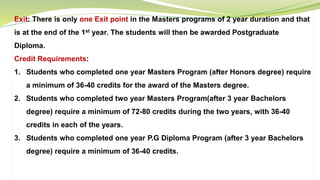
Exit: There is only one Exit point in the Masters programs of 2 year duration and that
is at the end of the 1st year. The students will then be awarded Postgraduate
Diploma.
Credit Requirements:
1. Students who completed one year Masters Program (after Honors degree) require
a minimum of 36-40 credits for the award of the Masters degree.
2. Students who completed two year Masters Program(after 3 year Bachelors
degree) require a minimum of 72-80 credits during the two years, with 36-40
credits in each of the years.
3. Students who completed one year P.G Diploma Program (after 3 year Bachelors
degree) require a minimum of 36-40 credits.
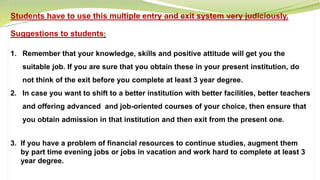
Students have to use this multiple entry and exit system very judiciously.
Suggestions to students:
1. Remember that your knowledge, skills and positive attitude will get you the
suitable job. If you are sure that you obtain these in your present institution, do
not think of the exit before you complete at least 3 year degree.
2. In case you want to shift to a better institution with better facilities, better teachers
and offering advanced and job-oriented courses of your choice, then ensure that
you obtain admission in that institution and then exit from the present one.
3. If you have a problem of financial resources to continue studies, augment them
by part time evening jobs or jobs in vacation and work hard to complete at least 3
year degree.
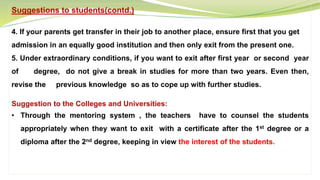
Suggestions to students(contd.)
4. If your parents get transfer in their job to another place, ensure first that you get
admission in an equally good institution and then only exit from the present one.
5. Under extraordinary conditions, if you want to exit after first year or second year
of degree, do not give a break in studies for more than two years. Even then,
revise the previous knowledge so as to cope up with further studies.
Suggestion to the Colleges and Universities:
• Through the mentoring system , the teachers have to counsel the students
appropriately when they want to exit with a certificate after the 1st degree or a
diploma after the 2nd degree, keeping in view the interest of the students.
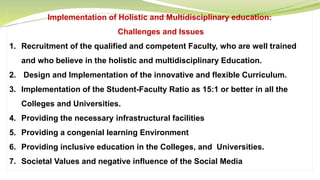
Implementation of Holistic and Multidisciplinary education:
Challenges and Issues
1. Recruitment of the qualified and competent Faculty, who are well trained
and who believe in the holistic and multidisciplinary Education.
2. Design and Implementation of the innovative and flexible Curriculum.
3. Implementation of the Student-Faculty Ratio as 15:1 or better in all the
Colleges and Universities.
4. Providing the necessary infrastructural facilities
5. Providing a congenial learning Environment
6. Providing inclusive education in the Colleges, and Universities.
7. Societal Values and negative influence of the Social Media
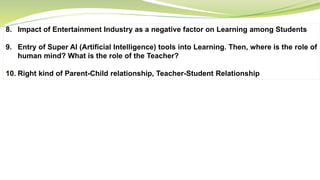
8. Impact of Entertainment Industry as a negative factor on Learning among Students
9. Entry of Super AI (Artificial Intelligence) tools into Learning. Then, where is the role of
human mind? What is the role of the Teacher?
10. Right kind of Parent-Child relationship, Teacher-Student Relationship
62
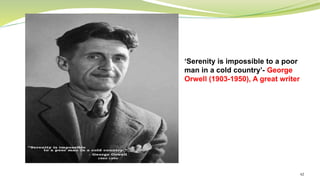
‘Serenity is impossible to a poor
man in a cold country’- George
Orwell (1903-1950), A great writer
63
Charles Dickens' famous opening sentence introducing universal approach
of ‘A tale of two cities’ (1859)
‘It was the best of times, it was the worst of times, it was the age of wisdom, it was
the age of foolishness, it was the epoch of belief, it was the epoch of incredulity, it
was the season of Light, it was the season of Darkness, it was the spring of hope, it
was the winter of despair, we had everything before us, we had nothing before us,
we were all going direct to Heaven, we were all going direct the other way—in short,
the period was so far like the present period, that some of its noisiest authorities
insisted on its being received, for good or for evil, in the superlative degree of
comparison only’ (This was written in the year1859).
Is the above sentence not relevant even today (2023)?
Conclusion
•The Challenges and Issues in the implementation of holistic and multidisciplinary Education
can be overcome with the collective effort from the Governments, Vice-Chancellors and
Principals of the Universities and Colleges and above all the Teachers in Higher Education.
Holistic Education might lead to holistic Individuals, who can live in harmony with all
existence.
• Sri A.P.J.Abdul Kalam, Ex President of India in his Speech in the golden jubilee
meeting of the European Union, quoted the Tamil Philosopher, Kaniyan Poongunranar,
who said ‘ When there is righteousness in the Character, there is Beauty in the Heart.
When there is Beauty in the Heart, there is Harmony in the Home. When there is
Harmony in the Home, there is Order in the Nation. When there is Order in the Nation,
there is Peace in the World’. Video Link https://www.youtube.com/watch?v=smjfGmCn7x0
Question- Answer Session

Holistic and multidisciplinary education

  • 1.
    Holistic and MultidisciplinaryEducation Prof. B. V. Appa Rao Professor of Chemistry(Retd.), NIT Warangal Formerly Visiting Professor, University of Hyderabad Formerly Consultant, Accreditations, IIIT Hyderabad UGC National Resource Person in Malaviya Mission bva.nitw@gmail.com
  • 3.
    Rabindranath Tagore foundedViswa-Bharathi in the year 1921 in order to provide holistic Education to the students in Higher Education. In the year 1951, Viswa-Bharathi became a Central University by the act of Parliament. Prime Minister is the Chancellor of this University.
  • 4.
    Pandit Madan MohanMalaviya on Education Pandit Madan Mohan Malaviya believed in holistic Education, training of the Mind, Body and the Spirit of the students. He founded the Banaras Hindu University (BHU) in Varanasi in the year 1916 to provide holistic Education. BHU is still a standing example in providing the holistic Education.
  • 5.
    Sri Aurobindo’s EducationalVision ‘Sri Aurobindo’s Educational Vision was a symphony of holistic growth, nurturing the body, the mind and the spirit. His vision illuminated the path to becoming all-rounded and enlightened individuals.’
  • 6.
    • Sri AurobindoInternational Centre of Education at Pondicherry was founded on the Educational Philosophy of sri Aurobindo. •Many integral schools have been established all over India, based on the Educational Philosophy of sri Aurobindo to provide holistic Education.
  • 7.
    ‘ Education isnot the amount of Information, that is put into your brain and runs riot there, undigested, all your life. We must have life- building, Man-making, and Character-making assimilation of ideas. If you have assimilated five ideas and made them your life and character, you have more education than any man, who has got by heart a whole library.’ --Swamy Vivekananda
  • 8.
    • Vivekananda KendraVidyalaya or VKV is the academic wing of Vivekananda Kendra (an organization based on Swami Vivekananda’s preachings of life–reforming principles). VKV operates a chain of schools in different states of India, under the project Vivekananda Kendra Siksha Prasar Vibhag. All these schools implement holistic Education.
  • 9.
  • 10.
    •Many Educational Institutionswere founded in India, based on the Gandhian Philosophy of Education. Gandhigram Rural Institute (in Tamilnadu) is a standing example which has been founded in the year 1956 in order to provide holistic Education. It was declared as deemed to be University in the year 1976 by UGC under section 3 of UGC Act 1956.
  • 11.
    J.Krishnamurti on Education: ‘ReimaginingEducation: Cultivating holistic human beings’ •Based on the Educational Philosophy of J.Krishnamurti, several schools were founded all over the world to provide holistic education. For example, the School at Rishivalley, near Madanapalle, Andhra Pradesh is well known to implement the holistic Education.
  • 12.
    ‘Teachers should bethe best Minds in the Country’ – Dr. Sarvepalli Radhakrishnan
  • 13.
    ‘Education should beimparted with a view to the type of the Society that we wish to build. We are working for a modern Democracy built on the values of human dignity and equality. These are only ideals. We should make them living forces. Our Vision of the Future should include these great principles’.- Dr. S.Radhakrishnan, a great Teacher and the first Vice-President of India.
  • 14.
    •Training of Mindand Body is understood reasonably well by all the Educators. However, there are several view points regarding the Spiritual Education. • In this lecture, Secular Spirituality is considered in Spiritual Education. • “Secular spirituality is the adherence to a spiritual philosophy without adherence to a religion. Secular spirituality emphasizes the inner peace of the individual, rather than a relationship with the divine. Secular spirituality is made up of the search for meaning outside of a religious institution; it considers one's relationship with the self, others, and nature.” (Ref: Elkins, D. N.; Hedstrom, L. J.; Hughes, L. L.; Leaf, J. A. & Saunders, C. (1988). "Toward a humanistic-phenomenological spirituality". Journal of Humanistic Psychology. 28 (4): 10. )
  • 15.
    •According to theAmerican philosopher Robert C. Solomon, "spirituality is coextensive with religion and it is not incompatible with or opposed to science or the scientific outlook. Naturalized spirituality is spirituality without any need for the 'other‐worldly'. Spirituality is one of the goals, perhaps the ultimate goal, of philosophy.“ •(Robert C. Solomon (2003). Spirituality for the Skeptic: The Thoughtful Love of life Oxford Scholarship Online. ISBN 9780195134674)
  • 16.
    •The holistic Educationthus includes Cognitive domain (related to mental process, thinking process), Psychomotor domain (related to physical activites in learning), Physical Education (Training related to Body, ie; games, sports, Physical Exercises including Yoga) and Secular Spiritual Education (related to understanding of self and relationship with nature and others, Human Values, and Meditation).
  • 17.
    •When holistic Educationis implemented in the Schools, Colleges, and Universities, the individuals are truely educated, and live in harmony with all the existence around them. •Holistic Education only can be said as Education in its true sense. •Holistic Education includes design of the multidisciplinary curriculum, innovative and flexible curriculum, and its implementation by providing the necessary Infrastructural facilities and using the appropriate pedagogical practices.
  • 18.
    Holistic Education wasimplemented in the Ancient Universities in India: • For example in Taxhashila (Taxila), and Nalanda. • Taxhashila (or Taxila) dates back to 5th or 6th century B.C to 5th century A.D • It was established in Gandhara (now in Pakistan) • The Vedas and the Eighteen Arts, which included skills such as archery, hunting, and elephant lore, were taught in addition to its law school, medical school, and school of military science. • The Ayurvedic healer, Charaka studied at Taxhashila. • Arthasastra, by Chanakya (Kautilya) was composed at Takshashila (Ref: Wikipedia)
  • 19.
    • The Universityof Nalanda, (5th century -12th century AD) in India was one of the achievements of the ancient period in the field of Education • It was one of the world’s first residential universities. • it had over 10,000 students and 2,000 teachers on the campus i.e., with a faculty-student ratio of 1:5. • The library was a nine-storeyed building where meticulous copies of texts were produced and preserved. .
  • 20.
    • Students studiedScience, Astronomy, Medicine and Logic as diligently as they applied themselves to Metaphysics, Philosophy, Samkhya, Yoga-shastra, the Vedas, the Scriptures of Buddhism, Foreign Philosophy, transcending ethnic and national boundaries. • The University attracted pupils and scholars from Korea, Japan, China, Tibet, Indonesia, Persia, Turkey and other parts of the globe. • Nalanda represents the concept of the university of the ancient period. That concept is relevant even today as seen in NEP 2020
  • 21.
    •Understanding the meaningsof the terms :Multidisciplinary, Interdisciplinary and Trans-disciplinary Education •Multidisciplinary Education implies the study of an academic program, consisting of courses from multiple different disciplines at the same time. Perspectives from the different disciplines create a broader understanding of the major discipline (s) of the academic program. The student crosses the boundaries of the disciplines, but the disciplines keep their own ‘identity'. •Disciplinary, Multidisciplinary, Interdisciplinary and Transdisciplinary domains of Learning are depicted diagrammatically in the next slide.
  • 22.
    Interdisciplinary domain of knowledge. Transdisciplinary domain of knowledge Disciplinary Multidisciplinary Ref:CALDWELL, W. (2015) Multi/Inter/Trans – disciplinary, What’s the Difference? Hidropolitik Akademi, November 23, 2015
  • 23.
    •For some professionally,vocationally, or technically oriented careers, curricula delivered in higher education establishments may focus on teaching material related to a single discipline. By contrast, multidisciplinary, interdisciplinary, and transdisciplinary teaching (MITT) results in improved affective and cognitive learning and critical thinking, offering learners/students the opportunity to obtain a broad general knowledge base.
  • 24.
    •According to Oxforddictionaries.com:multidisciplinary is an adjective that describes, “combining or involving several academic disciplines or professional specializations in approach to a topic or problem.” •Interdisciplinary is an adjective that describes, “of or relating to more than one branch of knowledge.” Transdisciplinary is also an adjective that describes, “relating to more than one branch of knowledge.” So what exactly is the difference? Ref: CALDWELL, W. (2015) Multi/Inter/Trans – disciplinary, What’s the Difference? Hidropolitik Akademi, November 23, 2015
  • 25.
    • According toLakehead University’s “Essential Guide to Writing Research Papers,” multidisciplinarity contrasts disciplinary perspectives in an additive manner, meaning two or more disciplines each provide their viewpoint on a problem from their perspectives. Multidisciplinarity involves little interaction across disciplines. • Interdisciplinarity combines two or more disciplines to a new level of integration suggesting component boundaries start to break down. Interdisciplinarity is no longer a simple addition of parts but the recognition that each discipline can affect the research output of the other.
  • 26.
    •Transdisciplinarity occurs whentwo or more discipline perspectives transcend each other to form a new holistic approach. The outcome will be completely different from what one would expect from the addition of the parts. Transdisciplinarity results in a type, xenogenesis where the output is created as a result of disciplines integrating to become something completely new. •(Xenogenesis meaning: The Offspring is totally different from either of the Parents.)
  • 27.
    •Single Discipline Courses:Certificate Courses belong to a single Discipline •Examples: •Certificate in Business Skills •Certificate in Beekeeping •Certificate Programme in Yoga •Certificate in Information Technology •Certificate in Human Rights •Certificate in Organic Farming •Certificate in Visual Arts- Applied Arts • IGNOU offers the above Certificate Courses.
  • 28.
    •Certificate Courses- Somemore examples: • C++ •Java •Web designing •Graphics designing •Data Science •Data Analytics •Data Analysis with Python •R Programming •Clinical Psychology
  • 29.
    •Many Diploma Courses(twoyear- duration) are also of a single Discipline. •Examples: •1. Diploma in Foreign Languages like German, French, Russian etc. •2. Diploma in Music ( Veena, Violin, Guitar etc.)
  • 30.
    •Multidisciplinary Programs: Allthe Undergraduate academic programs are Multidisciplinary in nature. •However, these programs may also consist of Interdisciplinary Courses. •Examples: •1. B.Tech program in Metallurgical and materials engineering includes courses like ‘Corrosion Science’, which is an interdisciplinary Coure between Metullurgical Engineering and Electrochemistry. •2. Bachellors Program in Law consists of courses such as Environmental Law, Sociology of Law, which are interdisciplinary Courses. • 3. Bachelor of Education includes Educational Technology, an interdisciplinary course.
  • 31.
    Interdisciplinary Programs: Afew of the Post-Graduate Programs are interdisciplinary in nature. Examples: 1. M.Tech / M.Sc in Bio-informatics 2. M.S or Dual degree Programs(B.Tech and M.S of five year-duration) in Computational Linguistics, Computational Natural Sciences (offered at IIIT Hyderabad). 3. M.Sc in Health Psychology 4. M.Tech in Enviromental Biotechnology * However, most of the P.G programs are intradisciplinary ( many courses and specializations in the same Discipline). Some Programs may contain a few interdisciplinary courses.
  • 32.
    Transdisciplinary Education: Thisneeds a very high degree of collaboration between different Departments and Teachers belonging to different disciplines. Examples: 1. Projects executed by the Students in the Interdisciplinary academic Programs. 2. Executing Research Projects sponsored by the Industry. 3. Executing Consultancy Projects.
  • 33.
    •Multidisciplinary, Interdisciplinary, andTransdisciplinary Education Programs are of great relevance in Higher Education. •Interdisciplinary and Transdisciplinary Education nurtures the Students to take up complex real world problems and contribute to innovative solutions.
  • 34.
    For ex; Chemistryis a discipline that sits at the interface of science, technology, engineering, mathematics, and medicine (STEMM) subjects (and those aligned with or informed by STEMM subjects). (J. Chem. Educ. 2021, 98, 4, 1124–1145, March 4, 2021)
  • 35.
    UNIVERSAL HUMAN VALUES "Allgreat people of the world have tried to realise the truth and to live by it in terms of love and compassion. They have tried to understand themselves (human being), understand the underlying harmony in nature, in existence. They have tried to understand the role of the human being in nature, in existence, to live by it, and to develop an equitable and just society which ensures the wellbeing of all.” (Ref: uhv.org.in- Home page)
  • 36.
    ‘Revised guidelines, MulyaPravah 2.0 - Inculcation of Human Values and Professional Ethics in Higher Education Institutions proposes the curriculum and pedagogy of Higher Education Institutions (HEIs) to develop deep respect towards Fundamental Duties and Constitutional Values among the students, bonding with one’s country, and conscious awareness of the roles and responsibilities in a changing world, including universal human values of truth (satya), righteous conduct (dharma), peace (shanti), love (prema), non-violence (ahimsa), scientific temper, citizenship values, and also life-skills. An integral part of a holistic education includes lessons in seva and/or service and participation in community service programmes.’ (Extract from the Foreword of Prof. M.Jagadeesh Kumar, Chairman, UGC in the Document, Mulya Pravah 2.0- Inculcation of Human Values and Professional Ethics in Higher Education Institutions, )
  • 37.
    VALUES AND ETHICSFOR STAKEHOLDERS • The success of an institution’s mission and vision is driven by the value-based ethical behaviour of its committed faculty members, officers, staff, and students. •Therefore, an institute should thrive on imbibing core values and ethical behaviour into the daily interactions of stakeholder groups. •These stakeholders of an institution, be they faculty, students, administrators or others, should be guided by the following core values.
  • 38.
    Values and Ethicsfor Stakeholders 1. Integrity: adhere to conduct duties in a righteous manner and in accordance with the principles of honesty, trust, transparency, and fairness. 2. Trusteeship: operate in an efficient, ethical, and true manner while ensuring group participation and a system of checks and balances within an institution. 3. Harmony: balance diversity and differences through a culture of tolerance, discussion, and forgiveness among stakeholders. 4. Accountability: enable the environment of openness and trust to accommodate mistakes and encourage individuals to take responsibility for their actions. 5. Inclusiveness: adopt standards, policies and procedures to promote and ensure equal opportunity, without discrimination against any individual or group, for education, employment, promotion, and other activities in an institution.
  • 39.
    6. Commitment: bededicated to the vision and mission of the institution while acquiring knowledge, skills, and attitudes to achieve excellence in due time and within regulatory boundaries. 7. Respectfulness: create an environment of mutual respect, trust, and quality interaction as well as fair participation by the functionaries and beneficiaries of the institution. 8. Belongingness: foster a shared vision of the institute to make everyone feel secure, supported, accepted, and included. 9. Sustainability: ensure optimal resource utilization — economic, environmental and social — to achieve a long-lasting and safe future. 10. Constitutional Values: commitment to the spirit of the constitution. 11. Global Citizenship: be a responsible global citizen.
  • 40.
    Integrating Human Valuesin Higher Education • Many Universities and Colleges in India have included Course(s) in Human Values and Professional Ethics in their Curricula in the Undergraduate Programs. •For ex; IIIT Hyderabad included two courses on Value Education (with credits) in the Undergraduate Curricula of different academic programs. • UGC has given the Curriculum Framework for the Human Values and Professional Ethics. Within this Framework, all the Universities and Colleges in India must include the Course(s) on these important topics.
  • 41.
    What about PhysicalEducation Courses , which include Games, Sports,& Yoga And Courses in Fine Arts in Undergraduate Programs? Ex: Undergraduate Curriculum in IIIT Hyderabad Course Semster1 Semester2 Semester3 Semester4 Value Education 1 L-2, T-1 (Cr=2) ---- ----- Value Education 2 L-2, T-1 (Cr=2) Arts T-2, P-2 (Cr=2) T-2, P-2 (Cr=2) Sports P-2 (Cr=1) P-2 (Cr=1) P-2 (Cr=1) P-2 (Cr=1) Note: L=Leture hours, T=Tutorial hours, P= Practical hours, Cr= Credits Total 12 Credits out of 161 credits, about 7%.
  • 42.
    •The model implementedin IIIT Hyderabad is implemented in some of the Universities in India. •However, in some of the Universities, and Colleges, Activities in Sports, Course in Ethics are implemented without assigning any credits. • When no credits are assigned, the students will not take the courses seriously. •Courses in Fine Arts are implemented in Programs in Arts in many Universities and not in Engineering and Science Programs.
  • 43.
    NSS and CommunityService: • The above programs are implemented in most of the Universities. •In some Universities, the activities are implemented more seriously, involving all the students, at least for one year during their study of 3 or 4 years. •Example of Community Service in Gandhigram Rural University, Gandhigram in Tamilnadu, which is one of the models.
  • 44.
    Course categories (U.G.Programmes) as per UGC revised Choice-based credit system (Multidisciplinary Curriculum) The Multidisciplinary curriculum must consist of a) core courses(Major disciplines), Other related Disciplines(Supporting) b) electives ( discipline specific, Interdisciplinary and/or Transdisciplinary, generic) c) ability enhancement compulsory courses (including Value Education, Environmental Studies) d) skill enhancement courses e) Value added courses f) Summer Internship g) *Research Project( in case of 4 year Honors degree with research, for 12 credits) * Honours students not undertaking research will do 3 courses for a total of 12 credits in lieu of a research project / Dissertation. https://www.ugc.ac.in/pdfnews/7193743_FYUGP.pdf
  • 45.
    •In addition tothe above, Courses in Physical Education, Yoga, Fine Arts. • NSS, and Community Service Programs. •Hobby Clubs. •Meditation Hall for interested students to do Meditation.
  • 46.
    Innovative and FlexibleCurriculum: • A Flexible Curriculum is the Curriculum that can adapt to the changing needs, interests, and the abilities of the Students and the Learning Environment. • It is the Student-Centric Curriculum. •While core courses and mandatory courses are continued, there is a greater flexibility in the Elective Courses, which are offered as per the choice of the Students. In other words, the elective courses offered, may change every year depending on the interests of the students in that batch. • New elective courses are introduced in the Curriculum, based on the latest advances in the major Discipline(s), and their relevance to the needs of the Students.
  • 47.
    Interdisciplinary Dual DegreePrograms: Examples: 1. B.Tech in Computer Science and M.S in Computational Linguistics. 2. B.Tech in Computer Science and M.S in Computational Natural Sciences. 3. B.Tech in Computer Science and M.S in Bioinformatics.
  • 48.
    NEP 2020: MultipleEntry and Exit System in Academic programs in Higher Education –Benefits for students •National Educational Policy 2020 brought out a great reform in the form of ‘’ Multiple Entry and Exit system’ (MEES) for the benefit of the students of Higher Education. •In accordance with NEP 2020, University Grants Commission (UGC) formulated guidelines for its implementation in all the colleges and universities in India ( Ref: UGC Guidelines dated 29th July 2021). •In this lecture the ‘Multiple Entry and Exit System’ in Higher Education and its benefits for the students are also presented.
  • 49.
    Undergraduate Education: • UGCsuggested a) a 3 year degree program and b) a 4 year degree program(preferred) • In order to implement the multiple entry and exit system, UGC asked the colleges and universities to reserve a few seats in the 2nd year , 3rd year and 4th year of every degree program for the lateral entry of the students • UGC also called for the maintenance of Academic Bank of Credits (ABC) for every student in every semester of every academic program.
  • 50.
    Usefulness of theAcademic Bank of Credits(ABC): • This is a national level facility, which promotes flexibility in curriculum and the academic mobility of the students across the colleges and universities with appropriate credit transfer mechanism. • The ABC enables the students to exit from one college after the 1st year or 2nd year or 3rd year and join another institution with the help of credits accumulated in his/her Academic Bank Account. • ABC facilitates the students to obtain a certificate or diploma or a degree by studying in any institution, any time and at any level during the 4 year/ 3 year degree program. • However, he/she should satisfy the credit requirement ( as per the UGC guidelines) and score in the entrance test (where applicable) or Cumulative Grade Point Average(CGPA) as prescribed by the Admission seeking institution for lateral entry.
  • 51.
    • Suppose, astudent got a job after the 1st or 2nd or 3rd year of a 4 year degree program, he/she can exit the institution and join the same institution or any other institution in the next level after a few years, with the credits accumulated in his/her account. • Suppose a girl student got married during the course of study of a degree, she can exit after that particular academic year, receive certificate or diploma(as applicable) and continue her studies after some time in the same institution or any other institution • In a similar way, it is beneficial to married girl students, who would like to exit due to child birth and continue studies later. • Due to economic reasons or unforeseen calamities in the family, a student may exit after a particular year of study and continue studies later • A student can enter or reenter only in the beginning of the odd semester and exit only after completion of the even semester
  • 52.
    • A studentafter studying 1st year or 2nd year in one institution ,would like to study 3rd year and 4th year in another institution because of the specialized courses available in that institution. He / She may do so if he/she gets admission. Thus, the students can choose their learning path and obtain the degree with the courses of their choice within a curriculum framework. • The colleges and universities offering programmes with the multiple entry and exit system need to register in the ABC to enable credit transfer, and credit acceptance. • The credits earned, will be valid to a maximum period of 7 years or as specified by the ABC. • The procedure for depositing credits , their shelf life, redemption of credits, will be as per UGC Regulations, 2021(Establishment and Operationalization of ABC scheme in Higher Education).
  • 53.
    Let’s see themultiple entry and exit system for an undergraduate program(Four years) 1st year Entry Requirement: Intermediate or plus 2 qualification and marks in the entrance test (where applicable), based on merit and the usual reservation of seats under different categories. Admission criterion into B.A/B.Sc/B.Com or other programs depends upon the subjects studied in Intermediate or plus 2 and will be mentioned by the colleges and universities in their prospectus. Exit after 1st year and requirement for the award of the Certificate: The student must have acquired 36-40 credits for the award of a Certificate.
  • 54.
    •2nd year EntryRequirement: Certificate after completion of the 1st year and also attainment of the desired score in the entrance exam conducted by the admission seeking institution •Exit after 2nd year and requirement for the award of a diploma: The student must have acquired 72-80 credits during the first two years, with 36-40 credits in each year. •3rd year Entry Requirement: Diploma after completion of the 2nd year and also attainment of the desired score in the entrance exam conducted by the admission seeking institution •Exit after 3rd year and requirement for the award of a degree: The student must have acquired 108-120 credits during the first three years, with 36-40 credits in each of the years.
  • 55.
    •4th year EntryRequirement into B.Sc (Honors/Research): Degree after completion of the 3rd year and also attainment of the desired score in the entrance exam conducted by the admission seeking institution. A minimum CGPA of 7.5 is required to continue studies in the fourth year of the U.G programme to pursue the Bachelor’s degree with Research. •Exit after 4th year and requirement for the award of a degree: The student must have acquired 144-160 credits during the four years of study, with 36-40 credits in each of the 4 years. (Honors degree with Research will be awarded only when the student devotes the entire 4th year for doing a research project in the major discipline of his program.)
  • 56.
    Multiple Entry andExit System in Postgraduate Education: Admission Paths (Entry): 1.Students qualified with a 3 year Bachelors degree program can seek admission into 2 year(4 semesters) P.G program 2. Students qualified with a 4 year Honors degree program can seek admission into 1 year(2 semesters) P.G program 3. Students qualified with Intermediate or plus 2 can seek admission into 5 year integrated U.G/P.G program. •In all the above cases, besides the qualification, score in the entrance exam conducted for the purpose will be considered.
  • 57.
    Exit: There isonly one Exit point in the Masters programs of 2 year duration and that is at the end of the 1st year. The students will then be awarded Postgraduate Diploma. Credit Requirements: 1. Students who completed one year Masters Program (after Honors degree) require a minimum of 36-40 credits for the award of the Masters degree. 2. Students who completed two year Masters Program(after 3 year Bachelors degree) require a minimum of 72-80 credits during the two years, with 36-40 credits in each of the years. 3. Students who completed one year P.G Diploma Program (after 3 year Bachelors degree) require a minimum of 36-40 credits.
  • 58.
    Students have touse this multiple entry and exit system very judiciously. Suggestions to students: 1. Remember that your knowledge, skills and positive attitude will get you the suitable job. If you are sure that you obtain these in your present institution, do not think of the exit before you complete at least 3 year degree. 2. In case you want to shift to a better institution with better facilities, better teachers and offering advanced and job-oriented courses of your choice, then ensure that you obtain admission in that institution and then exit from the present one. 3. If you have a problem of financial resources to continue studies, augment them by part time evening jobs or jobs in vacation and work hard to complete at least 3 year degree.
  • 59.
    Suggestions to students(contd.) 4.If your parents get transfer in their job to another place, ensure first that you get admission in an equally good institution and then only exit from the present one. 5. Under extraordinary conditions, if you want to exit after first year or second year of degree, do not give a break in studies for more than two years. Even then, revise the previous knowledge so as to cope up with further studies. Suggestion to the Colleges and Universities: • Through the mentoring system , the teachers have to counsel the students appropriately when they want to exit with a certificate after the 1st degree or a diploma after the 2nd degree, keeping in view the interest of the students.
  • 60.
    Implementation of Holisticand Multidisciplinary education: Challenges and Issues 1. Recruitment of the qualified and competent Faculty, who are well trained and who believe in the holistic and multidisciplinary Education. 2. Design and Implementation of the innovative and flexible Curriculum. 3. Implementation of the Student-Faculty Ratio as 15:1 or better in all the Colleges and Universities. 4. Providing the necessary infrastructural facilities 5. Providing a congenial learning Environment 6. Providing inclusive education in the Colleges, and Universities. 7. Societal Values and negative influence of the Social Media
  • 61.
    8. Impact ofEntertainment Industry as a negative factor on Learning among Students 9. Entry of Super AI (Artificial Intelligence) tools into Learning. Then, where is the role of human mind? What is the role of the Teacher? 10. Right kind of Parent-Child relationship, Teacher-Student Relationship
  • 62.
    62 ‘Serenity is impossibleto a poor man in a cold country’- George Orwell (1903-1950), A great writer
  • 63.
    63 Charles Dickens' famousopening sentence introducing universal approach of ‘A tale of two cities’ (1859) ‘It was the best of times, it was the worst of times, it was the age of wisdom, it was the age of foolishness, it was the epoch of belief, it was the epoch of incredulity, it was the season of Light, it was the season of Darkness, it was the spring of hope, it was the winter of despair, we had everything before us, we had nothing before us, we were all going direct to Heaven, we were all going direct the other way—in short, the period was so far like the present period, that some of its noisiest authorities insisted on its being received, for good or for evil, in the superlative degree of comparison only’ (This was written in the year1859). Is the above sentence not relevant even today (2023)?
  • 64.
    Conclusion •The Challenges andIssues in the implementation of holistic and multidisciplinary Education can be overcome with the collective effort from the Governments, Vice-Chancellors and Principals of the Universities and Colleges and above all the Teachers in Higher Education. Holistic Education might lead to holistic Individuals, who can live in harmony with all existence. • Sri A.P.J.Abdul Kalam, Ex President of India in his Speech in the golden jubilee meeting of the European Union, quoted the Tamil Philosopher, Kaniyan Poongunranar, who said ‘ When there is righteousness in the Character, there is Beauty in the Heart. When there is Beauty in the Heart, there is Harmony in the Home. When there is Harmony in the Home, there is Order in the Nation. When there is Order in the Nation, there is Peace in the World’. Video Link https://www.youtube.com/watch?v=smjfGmCn7x0
  • 65.